Tech Trends Report
13th Annual Edition
Section 1 of 2
The Future Today Institute’s 2020 Tech Trends
Report is presented in two sections on
SlideShare. This is part 1 of 2. If you would like to
download the complete deck, please visit
www.futuretodayinstitute.com/trends.
The Year Ahead
A century ago marked the beginning of a new, exuberant era: the “Roaring Twen-
ties.” New technologies promised better ways of living. A hopeful optimism led
Americans to cast aside traditional moral standards, valuing conspicuous con-
sumption over austerity. Radio shows brought fresh ideas and music into homes
and cars transported Americans from their family farms to new opportunities in
the city. Americans weren’t the only beneficiaries of all this growth. Europeans
enjoyed great economic prosperity in the aftermath of World War I, while South
America became a beneficiary of new oil production. It seemed as though the
good times might last forever.
But the Roaring Twenties also brought Prohibition, a short-sighted regulatory
attempt to shape American society that resulted in the rise of organized crime and
kingpins like Al Capone. Fascism, authoritarian dictators and civil wars erupted in
Eastern Europe and China in the aftermath of collapsed empires. Technological
innovations, like the Panama Canal, moving assembly lines and wide-scale electric
power transmission, had created new wealth but it wasn’t evenly distributed. More
than two-thirds of Americans survived on wages too low to sustain everyday living,
and they didn’t have a safety net. High valuations and the promise of massive
returns lured enthusiastic investors, who bought company shares—lots of them—
using questionable loans. When share prices began their inevitable decline, people
panicked. By October 1929, the stock market crashed, setting in motion a Great
Depression, a rise in xenophobia and far-right extremism, and eventually, another
world war.
It’s difficult not to see unsettling parallels to our present-day world. But we are
positioned to make better choices this time around. A century ago, the tools of
modern strategic foresight hadn’t been invented yet. There was no method of
researching and categorizing trends that might influence the future. Rather than
studying plausible long-term implications, leaders made decisions in the moment.
Or they didn’t actively make decisions at all.
© 2020 FUTURE TODAY INSTITUTE
With the benefit of both hindsight and strategic foresight, we now have
frameworks and methods to identify risk and capitalize on emerging opportunity.
In fact, you’re holding one of those tools in your hand: our 2020 Tech Trends
Report. It’s vitally important to make connections between emerging trends, your
industry and society, especially this year as we reach a tipping point for a number
of technologies and trends that will shape the world of tomorrow.
A sample of them include:
 A.I. systems that can be trained in hours rather than weeks
 Widespread availability of algorithmically-traded funds
 Off-planet human civilization
 Bioengineered animals, plant-based proteins and indoor robot-powered farms
 Autonomous cars, trucks, ships and fighter jets
 Exascale computing
 Quantum computing
 Functional 5G networks
Connections must also be made between technologies and many external
uncertainties that will continue to loom:
 The outcome of the 2020 U.S. election
 A heightened scrutiny of chief executives and boards
 Frequent extreme weather events
 The proliferation of superbugs and new epidemics
 The rise of extreme political movements and ideologies
 Unstable U.S.-China relations
 Unresolved tensions between Russia and the West
 An ongoing clash between old laws and new technologies
We cannot know how future historians will remember the 2020s or what they will
name this decade. We can, however, choose to put forth our best efforts to plan
strategically for an era of technological innovation, measured growth, distributed
prosperity and solutions that will propel humankind forward.
Now, more than ever, your organization should examine the potential near and
long-term impact of tech trends. You must factor the trends in this report into your
strategic thinking for the coming year, and adjust your planning, operations and
business models accordingly. Failing to monitor trends in a meaningful way will put
your competitive advantage, growth and survivability at risk.
Think exponentially. Act incrementally. Always remember that the future isn’t yet
written. You and your team have the power to build your best possible futures today.
Sincerely,
Amy Webb
Founder, The Future Today Institute
Writing from my New York office on January 13, 2020
3
are all developing new services and tools ranging from robotic process automa-
tion to offering GPUs (graphics processing unit) in the cloud. Amazon’s upcom-
ing project, AWS For Everyone­—a low-code/no-code platform built to enable
anyone to create business applications using their company data—will be a huge
differentiator when it launches.
 China has created a new world order.
The growth of China’s economy might be slowing, but it would be a mistake to
assume that the People’s Republic of China has lost its influence. In the past
two decades, China overtook the U.S. as the world’s dominant exporter on every
continent with the exception of North America. Its imports matter, too: This
year China should surpass the U.S. and become the world’s largest movie mar-
ket, with a projected $10 billion in revenue. China has a rapidly-expanding middle
class, an educated and trained workforce and a government that executes on
long-term plans. China will continue to assert prolific dominance in 2020 across
multiple areas: diplomacy throughout Southeast Asia, Africa, Latin and South
America and Europe; the development of critical digital infrastructure; artificial
intelligence; data collection and scoring; bioengineering and space.
 Home and office automation is nearing the mainstream.
An Alexa in every pot and a self-driving car in every garage? Nearly 100 years
ago Herbert Hoover promised Americans they would prosper under his pres-
idency: a chicken in every pot, and a car in every garage. Today, A.I.-powered
digital assistants, home security systems and voice-controlled microwaves are
being manufactured—and priced—for the masses. Robots used to be the stuff
of science fiction, but this year major appliance manufacturers, component
makers, and of course, the big tech companies will make compelling arguments
for why our homes and offices should be outfitted with sensors, cameras and
microphones. Next-generation network infrastructure should speed adoption.
The global market could reach $214 billion by 2025. Which company’s operating
system controls all those devices, and what happens to the data being collected,
will spark public debate.
 Everyone alive today is being scored.
In order for our automated systems to work, they need both our data and a
framework for making decisions. We’re shedding data just by virtue of being
alive. From our social media posts, to our unique biology (posture, bone and
 Welcome to the Synthetic Decade.
From digital twins to engineered DNA to plant-based pork sausages, a deep
push to develop synthetic versions of life is already underway. We will look back
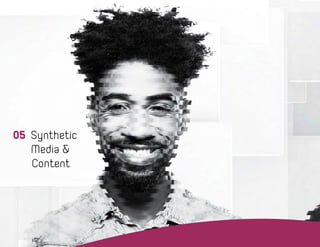
on the 2020s as an era that brought us synthetic media, such as A.I.-generated
characters whose storylines we follow on social media and humanlike virtu-
al assistants who make our appointments and screen our calls. Soon, we will
produce “designer” molecules in a range of host cells on demand and at scale,
which will lead to transformational improvements in vaccine production, tissue
production and medical treatments. Scientists will start to build entire human
chromosomes, and they will design programmable proteins. Foods made from
synthetic techniques rather than artificial ingredients will make their way to the
mainstream, and you’ll have a wide array of choices: humanely engineered foie
gras, flora-derived ice cream and molecular whiskey made in a lab. Every indus-
try will be impacted as our synthetic decade brings new business opportunities
and strategic risks. Companies will need to ask challenging ethical questions
and examine the security risks for synthetic material in order to earn public
acceptance, government approvals and commercial appeal.
 You’ll soon have augmented hearing and sight.
While you shouldn’t expect to see everyone wearing smart glasses by this
time next year, you will certainly start to notice some important developments
throughout 2020, beginning with audio augmented reality (or AAR). Think of it
as augmented reality for audio. Smart earbuds and glasses will digitally overlay
audio (like directions, notifications, and verbal descriptions of what — or who —
you’re looking at) without others hearing and while you continue to hear what’s
going on around you. Not only will AAR help runners stay safe, it offers a sophis-
ticated alternative to traditional hearing aids. Smart glasses won’t look like the
minimalistic Google Glass headband, but rather a stylish pair of frames you’d find
at your local optometrist’s office. Google, Amazon, Apple, Microsoft and Face-
book all have connected systems on their product roadmaps. The connected
glasses and AAR ecosystem offer tremendous new business opportunities—and
could signal disruption to longtime market leaders in frames, prescription lens-
es, hearing aids and headphones.
 A.I.-as-a-Service and Data-as-a-Service will reshape business.
The future of digital transformation is rooted in two key areas: A.I.-as-a-Service
and Data-as-a-Service. Microsoft, IBM, Google, Amazon, Facebook and Apple
© 2020 FUTURE TODAY INSTITUTE
Key Takeaways
capillary structures, vocal pitch and cadence), to our credit card debt, to our
travel habits, thousands of data points are analyzed to score us. Automated sys-
tems use our scores to make decisions for or about us, whether it’s what price
to show us on e-commerce sites or if we might pose a security risk at a football
game. We anticipate that in the coming year, regulators will take a deeper inter-
est in scoring.
 We’ve traded FOMO for abject fear.
In the 2010s Facebook, Instagram, Snapchat, Reddit, Foursquare and Twitter
caused a “fear of missing out.” Those very same networks (save for the now-de-
funct mobile social app Foursquare) are being used for intentional—and some-
times unwitting—scaremongering. On Facebook, Baltimore Mayor Bernard
“Jack” Young helped propagate a wild—and totally false—story on Facebook
about a white van abducting girls for human trafficking and for selling body
parts. Numerous times, President Donald Trump has used Twitter to stoke fear,
telling the public about armed “large [sic] Caravans” that were “invading” Ameri-
ca. On Twitter, he has publicly threatened the leaders of other countries:
“I will totally destroy and obliterate the [sic] Economy of Turkey” – October 7, 2019
“North Korean Leader Kim Jong Un just stated that the “Nuclear Button is on his
desk at all times.” Will someone from his depleted and food starved regime please
inform him that I too have a Nuclear Button, but it is a much bigger & more power-
ful one than his, and my Button works!” – January 2, 2018
“To Iranian President Rouhani: NEVER, EVER THREATEN THE UNITED STATES
AGAIN OR YOU WILL SUFFER CONSEQUENCES THE LIKES OF WHICH FEW
THROUGHOUT HISTORY HAVE EVER SUFFERED BEFORE. WE ARE NO LONGER
A COUNTRY THAT WILL STAND FOR YOUR DEMENTED WORDS OF VIOLENCE &
DEATH. BE CAUTIOUS!” – July 22, 2018
Social media posts like these are often repeated at rallies and protests, which
only serve to amplify our fear. The Anti-Defamation League discovered a 226%
increase in acts of vandalism and hate crimes in the counties hosting Trump
rallies. We’re continually told that we need protection: from unsafe countries,
people and even our neighbors. Fear is good for business. Amazon bought smart
doorbell company Ring for $1 billion, and it now has lucrative partnerships with
more than 400 U.S. police departments to share recognition tech and surveil-
lance video from users’ homes.
 It’s the end of forgetting.
After a decade of posting photos, videos and written messages on social
media, it’s now clear that our recent histories will persist far into the future. It
isn’t possible to truly delete or erase our pasts. A centerpiece of the European
Union’s landmark internet laws, the “right to be forgotten,” emerged as a stan-
dard intended to force search engines to delete links to personal information if
it wasn’t in the public interest. But in 2019, the European Court of Justice ruled
in Google’s favor, making it much harder for people to request that negative, pri-
vate or misleading information about them is removed from internet searches. A
Google search team member put it more bluntly: “We’re not a truth engine.”
 Our new trust economy is being formed.
We will soon see a host of new tools built to engender and ensure—but also ma-
nipulate—our trust. In the wake of deepfake videos and other manipulated con-
tent, a new ecosystem devoted to trust is in the process of being formed. There’s
a lot at stake: After hearing an A.I. fake his CEO’s voice on the phone, a gullible
employee transferred $243,000 to a scammer. In the coming year, sentinel
surveillance systems will algorithmically detect manipulated content—for a fee.
Meanwhile, governments and interest groups around the world will try to shape
the future development of A.I. and blockchain technology, proposing legislation
and “bill of rights”manifestos.
5
© 2020 FUTURE TODAY INSTITUTE
Table of Contents
04	 Key Takeaways
12	 How To Use Our Report
14	 Strategic Questions to Ask
16	 Methodology
24	 Artificial Intelligence
32 	 Enterprise
32 	 Using A.I. to Speed the 		
	 Process of Scientific
	Discovery
32 	 A.I. in the Cloud
33 	 A.I. at the Edge
	 (or A.I. Not in the Cloud)
33 	 Robotic Process Automation
33 	 Digital Twins and Cognitive
	 Twins in the Enterprise
33 	 Robots with Cognitive Skills
33 	 Advanced A.I. Chipsets
34 	 Serverless Computing
34 	 Proprietary, Homegrown
	 A.I. Languages
34 	 Proliferation of
	Franken-Algorithms
35 	 Companies Manipulating A.I. 	
	 Systems for Competitive 		
	Advantage
35 	 Corporate Biometric Spoofing
35 	 Bots
36 	 Business Ecosystem
36 	 Global Rush to Fund A.I.
36 	 Algorithm Marketplaces
37 	 Marketplace Consolidation
37 	 Fragmentation
37 	 Liability Insurance for A.I.
37 	 Ambient Surveillance
38 	 Processes, Systems and
	 Computational Neuroscience
38 	 Creating 3D Models from 		
	 Flat 2D Images
38 	 Neuro-Symbolic A.I.
	 Algorithms and Systems
38 	 Real-Time Machine Learning
39 	 Natural Language
	 Understanding (NLU)
39 	 Machine Reading
	 Comprehension (MRC)
39 	 Natural Language
	 Generation (NLG)
40 	 Real-Time Context in
	 Machine Learning
40 	 General Reinforcement 		
	 Learning Algorithms
40 	 Deep Learning Scales
40 	 Faster and More Powerful 	
	 Open Source Frameworks
40 	 Reinforcement Learning 		
	 and Hierarchical RL
41 	 Continuous Learning
41 	 Multitask Learning
41 	 Generative Adversarial
	 Networks (GANs)
41 	 New Generative Modeling 	
	Techniques
41 	 Probabilistic Programming 	
	Languages
41 	 Machine Image Completion
7
42 	 Hybrid Human-Computer 	
	 Vision Analysis
43 	 Predictive Machine Vision
43 	 Automated Machine
	 Learning (AutoML)
43 	 Customized Machine Learning
43 	 Graph Neural Networks
43 	 Intelligent Optical
	 Character Recognition
44 	 Content and Creativity
44 	 A.I. for the Creative Process
44 	 Generative Algorithms for 	
	 Content Production
44 	 Generating Virtual
	 Environments from
	 Short Videos
44 	 Automated Versioning
44 	 Automatic Voice Cloning 		
	 and Dubbing
45 	 Spotting Machine-Written 	
	Text
45 	 Algorithmic Fact Checking
45 	 Datamining Crowds
45 	 Deep Linking
46 	 Consumer Products
	 and Services
46 	 Ambient Computing Expands
46 	 Ubiquitous Digital Assistants
46 	 A.I. for Drug Development
47 	 A.I. for Interviews
47 	 Consumer-Grade A.I.
	Applications
49 	 Geopolitics, Geoeconomics 	
	 and Warfare
49 	 The New Mil-Tech
	 Industrial Complex
49 	 National A.I. Strategies
51 	 The Race to Establish
	 A.I. Rules
51 	 Algorithmic Warfare
51	 Making A.I. Explain Itself
51 	 Using A.I. in Critical Systems
52 	 China’s A.I. Rules
54 	 Society
54 	 Artificial Emotional
	Intelligence
54 	 Personal Digital Twins
54 	 Problematic Data Sets
55 	 A.I. to Catch Cheaters
55 	 Algorithms Designed to Target 	
	 Vulnerable Populations
55 	 A.I. Still Has a Bias Problem
55 	 A.I. Systems Intentionally
	 Hiding Data
56 	 The Rise of Undocumented
	 A.I. Accidents
56 	 A.I. and Digital Dividends
56 	 Prioritizing Accountability
	 and Trust
58	 Scoring
62 	 Persistent Tracking
	 and Scoring
62	 Scoring Agencies are
	 on the Rise
62 	 Vast Differences in
	 Verification Systems
63 	 Behavioral Biometrics
63 	 Scoring Vulnerable Populations
63 	 Surveillance Scoring-as-a-	
	 Service (SSaaS)
63 	 Bias in Scoring Systems
64 	 Conflicting Norms, Standards 	
	 and Regulations for Scoring
64 	 Intentionally Opaque
	Methodologies
66	 Recognition Technologies
70 	 Faceprints
70 	 Voiceprints
71 	 Automatic Voice Transcription
71 	 Bone Recognition
71 	 Bioacoustic Recognition
71 	 WiFi Recognition
72 	 Proximity Recognition
72	 Two-factor Biometric-based 	
	Authentication
72 	 Gesture Recognition
73 	 Object Recognition in
	 Computational Photography
73 	 Biometric Camouflage
74 	 Personality Recognition
74 	 Accent Recognition
75 	 Emotional Recognition
75 	 Responsive Recognition 		
	Technology
75 	 Affective Computing
75 	 Genetic Recognition
75 	 Universal Genetic Databases
76 	 Persistent Workplace and 	
	 School Surveillance
77 	 Food Recognition Systems
78	 Emerging Digital Interfaces
81	 Mixed Reality
82	 Virtual Reality
82	 Augmented Reality
83	Holograms
83	 360-degree Video
86	 Synthetic Media and Content
91	 Synthetic Media Technologies
91 	 Speech Synthesis
91 	 Modulating Custom Voices
91 	 Deep Behaviors and Predictive 	
	 Machine Vision
92 	 Generative Algorithms for 	
	 Voice, Sound and Video
92 	 MappedSyntheticEnvironments
94	 Synthetic Media and Society
94 	 Synth-pop Makes a Comeback
94 	 Simulating Human Experiences
95 	 Synthetic Voice Fraud
95 	 Synthetic Sex Tapes
95 	 Synthetic Property Rights 	
	 and Legal Protections
95 	 Using Synthetic Media to 	
	 get around Copyright Laws
95 	 Synthetic Media Marketplaces
96 	 Truth Decay in an Era of 		
	 Synthetic Media
183	 Drone Operation Centers
183	Drones-as-a-Service
183	 Personal Home Drone
	Surveillance
183	 Flying Beyond Visual
	 Line of Sight
184	 Real-Time Mapping
184	 Drones for Dangerous
	 and Hard-To-Reach Areas
184	 Clandestine, Disappearing 	
	Drones
184	 Flying Taxis
185	 Autonomous Underwater 	
	Vehicles
185	 Drone Air Lanes
185	 Follow Me Autonomously
185	 Drone Swarms
186	 Transportation Trends
188	 Cognitive Active
	 Safety Features
188	 Electric Vehicles Cause 		
	 Electricity Demand Spikes
188	Transportation-as-a-Service
188	 Forced Updates To Firmware
	 and Software
189	 Analog Fallbacks
189	 Exponential Growth in
	 Autonomous Miles Data
189	 Autonomous Last
	 Mile Logistics
189	 Mixed-Use Sidewalks
	 and Drone Lanes
190	 Supersonic Flights
© 2020 FUTURE TODAY INSTITUTE
Table of Contents
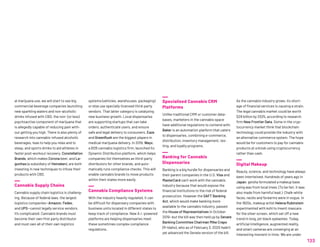
133	 Cannabis Supply Chains
133	 Cannabis Compliance Systems
133	 Specialized Cannabis
	 CRM Platforms
133	 Banking for Cannabis
	Dispensaries
133	 Digital Makeup
134	 Vaping and E-cigarettes
134	Nootropics
134	Neuroenhancers
135	 Digital Addiction
136	Sextech
138	 Journalism
140	 Continued Media Consolidation
141	 The Subscription
	 Economy Matures
142	 Optimizing for New
	 Types of Search
143	 Investigating the Algorithms
144	 Journalism as a Service
145	 One-To-Few Publishing
146	 Popup Newsrooms
	 and Limited-Edition
	 News Products
148	 Demands for Accountability
	 and Trust
149	 The First Amendment
	 in a Digital Age
150	Censorship
152	 The Proliferation
	 of Splinternets
154	 Content Moderation in the 	
	 Name of National Security
156	 Digitally Retouching History
158	 Quantum and Edge
162	 Near-Real-Time Application
	 Environments
162	 A.I. at the Edge
162	 Hyper-Local Data Centers
	 for Edge Computing
162	 Quantum Supremacy
162	 Quantum for the Masses
164	 5G, Robotics and the Industrial 	
	 Internet of Things
166	 5G Triggers a Surge
	 of New Businesses
167	 Capturing IIoT Metadata
168	 Robots as a Service (RaaS)
169	 Collaborative Robots
170	 Autonomous, Programmable
	 Robot Swarms
171	 Robotic Process Automation
172	 Self-Assembling Robots
173	 Robot Compilers
174	 Soft Robotics
175	 Commercial Quadrupedal 	
	Robots
176	 Personal Robots
	 and Robot Butlers
177	 Ethical Manufacturing
178	 Robot Rights
179	 Smart Dust
180	Transportation
182	Drones
183	 Medical Supply Drone Delivery
98	Content
100	 IRL Geography Reshapes the
	 Virtual World
101	 The End of Attention Metrics
102	 Digital Frailty
104	 Trigger Warnings
106	 Abusing the Notification Layer
107	 Cancel Culture and its Backlash
108	 Social Media Platforms
110	 Decentralized Content 		
	Platforms
111	 Platform Ownership
112	 Platform Switching and 		
	 Demographic Shifts Threaten 	
	 Established Social Networks
113	 Platforms Forced to Pick a Side
115	 Censorship in the Digital Age
117	 Detecting Authentic Activity
118	 Sports and Games
120	eSports
122	 Infinite Gameplay
123 	 Sports Tech
124	Toys
126	 Connected Toys
127	 Gamified Health Toys
	 and Games
128 	 Smart Toys and
	 Privacy Concerns
130	Vices
132	 CBD-Infused Products
132	 Scaling Cannabis Infusion 	
	Techniques
190	 Autonomous Ships
192	 Logistics and Supply Chain
194	 Automating the Supply Chain
195	 Sustainability in Supply Chain 	
	 and Logistics
196	 Rebuilding the Cold Chain
197	 Additive Manufacturing
	 and Printing
198	 Energy
200	 Grid Management
201	 Reversing Environmental 	
	 Rules and Regulations
202	 Green Tech
203	 Renewable Energy
204	 Charging Stations
205	 Ultra-High-Voltage Direct 	
	 Current and Macro Grids
206	 Better Batteries
207	 Wireless Charging
	 Everywhere
207	 Energy Trading Platforms
	 for Blockchain
207	 Zero Carbon Natural Gas
207	 Floating Nuclear Energy Plants
207	 Subsea Power Grids
208	 Climate and Geoscience
210	 The Anthropocene Epoch
211	 Unpredictable Sea
	 Level Rise
212	 Extreme Weather Events
214	 Human Migration
	 Patterns Shift
215	Geoengineering
216	 Storing Captured Carbon 	
	 with Algae and Bacteria
216	 Converting Carbon Dioxide 	
	 into Building Materials
216	 Stratospheric Aerosol 		
	 Scattering with Sulfur Dioxide
216	 Injecting Clouds with
	 Sea Salt Particles
216	 Reflecting Sunlight
217	 Sand for Glacier Melt
217	 Fertilizing the Oceans
217	 Enzymes to Eat Ocean Trash
218	 Corporate Environmental 	
	Responsibility
219	 Sustainability as
	 Corporate Identity
219	 Corporates Adopt
	 Net-Zero Energy
219	 Sustainable Shipping
219	 Corporate Meteorologists
219	 Reducing Corporate
	 Reliance on Plastics
222	 AgTech & Global Supply of Food
224	 Aeroponic Growing
225	 Vertical Farming Grows Up
225	 Indoor Plant Factories
225	 Big Data for Better Produce
227	 Precision Agriculture
228	 Deep Learning for
	 Food Recognition
229	 Big Tech Gets into Farming
230	 Artificial Trees
230	 Intelligent Packaging
231	 Insect Agriculture and
	 Bug Proteins
231	 Cellular Agriculture
231	 Off-Planet Terraforming
232	 Synthetic Biology
	 and Genomic Editing
234 	 Synthetic Biology
235	 Single-Nucleotide 		
	 Polymorphism (SNP) Profiling
235	 Super-Fast Molecule Discovery
235	 Designer Cells
236	 Molecular Robotics
236	 Building Full Chromosomes
236	 Creating Synthetic Wombs
236	 Synthetic Age Reversal
237 	 Genomic Editing
238	 Gene Vandalism
239	 Prime Editing
239	 Organoid Development
239	 Super Pigs
239	 Unregulated Pet Cloning
239	 A Shortage of Genome Storage
240	 DNA Storage
240	 Microbe-Engineering
	 as a Service
240	 Microbiome Extinction
240	 Genetic Screening
241	 Biological DVRs
241	 Superbugs, Viruses and Phages
241	 Building a Comprehensive
	 Human Cell Atlas
244	 Biointerfaces and Wearables
246 	 Biointerfaces
247 	 Nanomesh Temporary Tattoos
247 	 Dissolving Bioelectronics
247 	 Programmable, Ingestible,
	 and Implantable Microbots
248 	 Smart Threads
248 	 Skinput
249 	 Wearables
250 	 Cloud-Based Wireless Body 	
	 Area Networks
250 	 Adaptive Wearable
	Technologies
250 	 Commercial Full-Body
	 Exoskeletons
251 	 Wearable Air Conditioners
251 	 Brain-Machine
	 Interfaces (BMIs)
251 	 Smartwatches
252 	 Rings and Bracelets
252 	 Hearables / Earables
252 	 Head Mounted Displays
253 	 Connected Fabrics
253 	 Smart Belts and Shoes
253 	 Smart Gloves
253 	 Touch-Sensitive Materials
254	 The Decade of Connected 	
	 Eyewear
9
© 2020 FUTURE TODAY INSTITUTE
275	 Encrypted Messaging Networks
275	 Vanishing Messages
275	 Digital Eavesdropping Rights
276	 Data Ownership
276	 Digital Self-Incrimination
276	 Differential Privacy
277	 Defining Online Harassment
277	 Safeguarding and Verifying
	 Leaked Data
277	 Promoting Anonymity
278	Trolls
278	 Verification
278	 Data Retention Policies
278	 Compliance Challenges
	 and Unrealistic Budgets
278	 Revenge Porn
279	 Drone Surveillance
279	 Influencing Future
	 Privacy Laws
280	 Security
284	 Zero-Day Exploits
	 on the Rise
284	Zero-Knowledge
	 Proofs Go Commercial
284	 Gaining Access
	 to Backdoors
285	 Remote Kill Switches
285	 Insecure Supply Chains
285	 Data Manipulation Becomes 	
	 the Greater Threat
285	 Consumer Device Targeting
285	 Cyber Risk Insurance
285	 A.I.-Powered Automated
	 Hacking Systems
286	 Hijacking Internet Traffic
286	 DDoS Attacks on the Rise
286	 Third-Party Verified Identities
287	Ransomware-as-a-Service
287	 Decentralized Hacktivists
287	 Targeted Attacks on
	 Voice Interfaces
287	 Weird Glitches
287	 Open Source App
	Vulnerabilities
288	 Global Cybersecurity Pacts
288	 Proliferation of Darknets
288	 Bounty Programs
288	 Magnetic Tape
	 Supply Shortages
289	 Biometric Malware
289	State-Sponsored
	 Security Breaches
289	 Critical Infrastructure Targets
289	 Offensive Government Hacking
294	Geopolitics
296	 Antitrust Probes
	 and Lawsuits
298	 Policy Uncertainty
299	 Regulating Data Ownership
301	 Digital Dividends
	 to Fund Universal Basic
	 Income Plans
302	 U.S. and Global
	 Election Security
303	 Interoperability Initiatives
304	 Corporate Foreign Policy
305	 Multilateral Science
	 and Technology Acts
306	 Overhauling Government 	
	 Tech Infrastructure
308	 China’s Quest for Global 		
	Cybersovereignty
309	 Strategic Guidance:
	 The Case for Establishing 	
	 the U.S. National Office
	 of Strategic Foresight
314	 Smart Cities
316	 Smart City Initiatives
317	 Strengthening Municipal 		
	 Cyber-Security Efforts
320	Blockchain
328	 Digital Citizenship
330	 Self-Sovereign Identity
331	 Web 3.0
333	 Tokenizing Value
334	 Tokens For Smart Royalties 	
	 and Freelancers
335	 Immutable Content
336	 Content Provenance and 		
	 Permanent Archiving
337	 Distributed Computing
	 For a Cause
338	 Financial Technologies
	 and Cryptocurrencies
340	 Tech Companies Acting
	 Like Banks
341	 Financial Inclusion
Table of Contents
256	 Health and Medical 		
	 Technologies
258	 Big Tech Gets
	 Into Healthcare
259	Patient-Generated
	 Health Data
260	 Automated Medical
	Transcription
261	 Hospitals as Tech Innovators
262	 Home Automation
266	 Digital Emissions
266	Interoperability
266	 Retrofitting Old Homes
	 with New Tech
266	 Forced Bundling and 		
	 Planned Obsolescence
266	 Real Estate and Home Building 	
	 Powered by Platforms
266	 Smart Cameras
267	 Smart Camera News Networks
267	 Networked Smart Devices
267	 Interactive Fitness Equipment
267	 The End of Remote Control
267	 Smart Appliance Screens
270	 Privacy
274	 The End of Biological Privacy
275	 Public Entities Selling
	 Private Data
275	 Connected Device
	 Security Loopholes
275	 Tech Workers Fighting
	 for Privacy
342	 The Rise of Quant Funds
343	 Regulating Open Banking
344	 Social Payments
345	 Countries Creating Digital 	
	 Decentralized Currencies
346	 Automated Credit
	 Risk Modeling
346	 Crypto Trading Bots
346	 Crypto-Mining Malware
348	 Space and Off-Planet Trends
353	 Imaging Space
353	 Lots (and Lots) of
	 Satellite Launches
353	 Crowded Skies
353	 Internet from Space
354	Space-Based
	 Quantum Internet
354	 Space Junk
354	 Bigger, Bolder Telescopes
354	 Asteroid Mining for Resources
354	 The New Space Economy
354	 Made in Space
355	 Space Tourism
355	 Galactic Ride Sharing
355	 Seeking a New Life in
	 the Off-World Colonies
355	 Fuel-Free Space
	 Propulsion Systems
356	 Mercury Rain
356	 Galactic Gas Stations
356	 Space Forces
357	 China’s Space Ambitions
357	 Ultra-Long Space Missions
358	 Weak Signals for the 2020s
360	 Events That Will Shape 2020
363	 About the Authors
364	 How to Think More
	 Like a Futurist
365	 About The Future
	 Today Institute
11
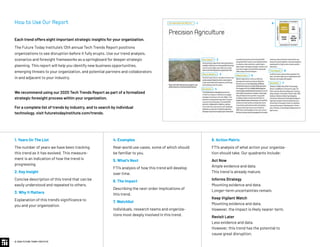
Each trend offers eight important strategic insights for your organization.
The Future Today Institute’s 13th annual Tech Trends Report positions
organizations to see disruption before it fully erupts. Use our trend analysis,
scenarios and foresight frameworks as a springboard for deeper strategic
planning. This report will help you identify new business opportunities,
emerging threats to your organization, and potential partners and collaborators
in and adjacent to your industry.
We recommend using our 2020 Tech Trends Report as part of a formalized
strategic foresight process within your organization.
For a complete list of trends by industry, and to search by individual
technology, visit futuretodayinstitute.com/trends.
© 2020 FUTURE TODAY INSTITUTE
1. Years On The List
The number of years we have been tracking
this trend as it has evolved. This measure-
ment is an indication of how the trend is
progressing.
2. Key Insight
Concise description of this trend that can be
easily understood and repeated to others.
3. Why It Matters
Explanation of this trend’s significance to
you and your organization.
4. Examples
Real-world use cases, some of which should
be familiar to you.
5. What’s Next
FTI’s analysis of how this trend will develop
over time.
6. The Impact
Describing the next-order implications of
this trend.
7. Watchlist
Individuals, research teams and organiza-
tions most deeply involved in this trend.
8. Action Matrix
FTI’s analysis of what action your organiza-
tion should take. Our quadrants include:
Act Now
Ample evidence and data.
This trend is already mature.
Informs Strategy
Mounting evidence and data.
Longer-term uncertainties remain.
Keep Vigilant Watch
Mounting evidence and data.
However, the impact is likely nearer-term.
Revisit Later
Less evidence and data.
However, this trend has the potential to
cause great disruption.
1 8
2
3
4
5
6
7
How to Use Our Report
Scenarios Describe Plausible Outcomes Relevant to Your Organization
In this report, you will find many scenarios imagining future worlds as these trends
evolve and converge. Scenarios offer you fresh perspective on emerging trends
and choices that still have yet to be made. They challenge you to ask “what if,”
and illuminate ways opportunities to prevent, mitigate, leverage or capitalize on
change in the future. The Future Today Institute uses a wide variety of data across
numerous sources to create our scenarios: statistics, patent filings, academic and
archival research, policy briefings, conference papers, structured interviews with
lots of people and even critical design and speculative fiction.
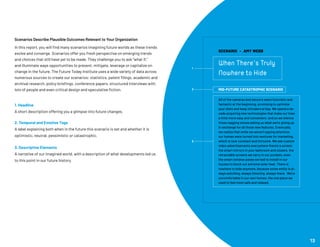
1. Headline
A short description offering you a glimpse into future changes.
2. Temporal and Emotive Tags
A label explaining both when in the future this scenario is set and whether it is
optimistic, neutral, pessimistic or catastrophic.
3. Descriptive Elements
A narrative of our imagined world, with a description of what developments led us
to this point in our future history.
13
SCENARIO • AMY WEBB
When There’s Truly
Nowhere to Hide
MID-FUTURE CATASTROPHIC SCENARIO
All of the cameras and sensors seem futuristic and
fantastic at the beginning, promising to optimize
your diets and keep intruders at bay. We spend a de-
cade acquiring new technologies that make our lives
a little more easy and convenient, and so we silence
those nagging voices asking us what we’re giving up
in exchange for all those new features. Eventually,
we realize that while we weren’t paying attention,
our homes were turned into ventures for marketing,
which is now constant and intrusive. We see custom
video advertisements everywhere there’s a screen:
the smart mirrors in your bathroom and closets, the
retractable screens we carry in our pockets, even
the smart window panes we had to install in our
houses to block out extreme solar heat. There is
nowhere to hide anymore, because some entity is al-
ways watching, always listening, always there. We’re
uncomfortable in our own homes, the one place we
used to feel most safe and relaxed.
1
2
3
What can we learn from their failures
and best practices?
Supporting my team/ business unit
 Does this trend signal emerging
disruption to our organization’s
culture, practices and cherished
beliefs?
 Does this trend indicate future
disruption to the established roles
and responsibilities within our
organization?
 Will our workforce need to change
because of this trend? If so, does our
current operating structure allow
us to make the necessary changes,
whether that means downsizing or
upskilling? If we must attract new
talent, are we positioned to attract
and retain the workers we will need?
Leading our industry into the future
 How does this trend impact our
industry and all of its parts?
 What new uncertainties—about our
industry, organization, customers,
partners—can our organization now
address after reading this report?
 How do we leverage this trend
in a positive way for both our
organizations and the greater good?
To make practical use of this year’s
report, readers should ask and an-
swer some fundamental questions
about what these trends mean to their
organization in the near future. Don’t
discount a trend simply because, at
first glance, it doesn’t seem to connect
directly to you or your field. As you
review the analysis in this report with
your cross-functional team, ask and
answer the following questions when it
comes to:
Guiding our strategic planning process
 How does this trend support or
challenge our current strategic
direction?
 What new emerging threats or
existential risks might result from the
evolution of this trend?
 What are the consequences if our
organization fails to take action on
this trend?
 Considering this research, is our
strategic planning process too
limited in scope or in timing?
Informing our decisions
 How can our organization make
incremental decisions on this trend
today and ongoing, as it evolves?
 How might global events—politics,
climate change, economic shifts—
impact this trend, and as a result, our
organization?
 Can we use this research to build
support and alignment for our
decision-making process?
Making future investments
 What is our current business model,
and how must it change as this trend
evolves?
 Where should we invest our
resources as this trend evolves?
 Are there opportunities to acquire
startups, research teams and those
at the forefront of this trend?
Growing our business
 How is our strategy providing a
competitive edge and helping to
move our organization forward into
the future?
 How will the wants, needs and
expectations of our consumers,
customers and partners change as a
result of this trend?
 How does this trend help us think
about innovation?
Facilitating strong partnerships
 Where does this trend create
potential new partners or
collaborators for us?
 How does this trend introduce new
adversaries we've never seen before?
 How are organizations in adjacent
industries addressing this trend?
© 2020 FUTURE TODAY INSTITUTE
Strategic Questions to Ask
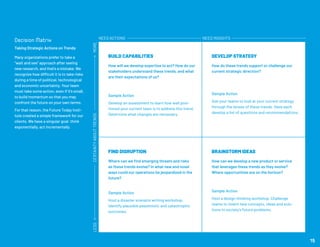
Decision Matrix
Taking Strategic Actions on Trends
Many organizations prefer to take a
“wait and see” approach after seeing
new research, and that’s a mistake. We
recognize how difficult it is to take risks
during a time of political, technological
and economic uncertainty. Your team
must take some action, even if it’s small,
to build momentum so that you may
confront the future on your own terms.
For that reason, the Future Today Insti-
tute created a simple framework for our
clients. We have a singular goal: think
exponentially, act incrementally.
BUILD CAPABILITIES
How will we develop expertise to act? How do our
stakeholders understand these trends, and what
are their expectations of us?
Sample Action
Develop an assessment to learn how well posi-
tioned your current team is to address this trend.
Determine what changes are necessary.
FIND DISRUPTION
Where can we find emerging threats and risks
as these trends evolve? In what new and novel
ways could our operations be jeopardized in the
future?
Sample Action
Host a disaster scenario writing workshop.
Identify plausible pessimistic and catastrophic
outcomes.
DEVELOP STRATEGY
How do these trends support or challenge our
current strategic direction?
Sample Action
Ask your teams to look at your current strategy
through the lenses of these trends. Have each
develop a list of questions and recommendations.
BRAINSTORM IDEAS
How can we develop a new product or service
that leverages these trends as they evolve?
Where opportunities are on the horizon?
Sample Action
Host a design thinking workshop. Challenge
teams to invent new concepts, ideas and solu-
tions to society's future problems.
NEED ACTIONS
LESSCERTAINTYABOUTTRENDSMORE
NEED INSIGHTS
15
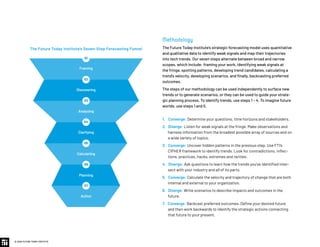
Methodology
The Future Today Institute’s strategic forecasting model uses quantitative
and qualitative data to identify weak signals and map their trajectories
into tech trends. Our seven steps alternate between broad and narrow
scopes, which include: framing your work, identifying weak signals at
the fringe, spotting patterns, developing trend candidates, calculating a
trend’s velocity, developing scenarios, and finally, backcasting preferred
outcomes.
The steps of our methodology can be used independently to surface new
trends or to generate scenarios, or they can be used to guide your strate-
gic planning process. To identify trends, use steps 1 – 4. To imagine future
worlds, use steps 1 and 5.
1. Converge: Determine your questions, time horizons and stakeholders.
2. Diverge: Listen for weak signals at the fringe. Make observations and
harness information from the broadest possible array of sources and on
a wide variety of topics.
3. Converge: Uncover hidden patterns in the previous step. Use FTI’s
CIPHER framework to identify trends. Look for contradictions, inflec-
tions, practices, hacks, extremes and rarities.
4. Diverge: Ask questions to learn how the trends you’ve identified inter-
sect with your industry and all of its parts.
5. Converge: Calculate the velocity and trajectory of change that are both
internal and external to your organization.
6. Diverge: Write scenarios to describe impacts and outcomes in the
future.
7. Converge: Backcast preferred outcomes. Define your desired future
and then work backwards to identify the strategic actions connecting
that future to your present.
© 2020 FUTURE TODAY INSTITUTE
Discovering
Framing
Analyzing
Clarifying
Calculating
Planning
Action
02
01
03
04
05
06
07
The Future Today Institute’s Seven-Step Forecasting Funnel
Trend vs. Trendy: Knowing the Difference
It isn’t always easy to distinguish between trend and trendy, especially now as we transition
to ambient computing, autonomous machines and a wide variety of digital voices. You need
to make sound decisions today, but that’s a difficult ask since much of our technological
ecosystem is still being developed.
The easiest way to cut through hype is to remember that trends are driven by fundamental
shifts in demographics, the economy, technology, politics and social movements. They are
new manifestations representing our fundamental human needs. Trends form steadily over
many years, and they do not necessarily follow a linear path. Trendy phenomena (or fads)
are much more transient. They appear suddenly, capture our attention and distract us with
intense possibilities—only to burn out just as quickly as they arrived. Fads move along a
common cycle: insider discovery, trending on social networks, influencer bragging, media
hysteria and mainstream acceptance, until we are disillusioned because the fads never
meet our broader expectations.
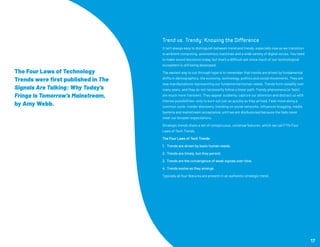
Strategic trends share a set of conspicuous, universal features, which we call FTI’s Four
Laws of Tech Trends.
The Four Laws of Tech Trends
1. Trends are driven by basic human needs.
2. Trends are timely, but they persist.
3. Trends are the convergence of weak signals over time.
4. Trends evolve as they emerge.
Typically all four features are present in an authentic strategic trend.
17
The Four Laws of Technology
Trends were first published in The
Signals Are Talking: Why Today’s
Fringe Is Tomorrow’s Mainstream,
by Amy Webb.
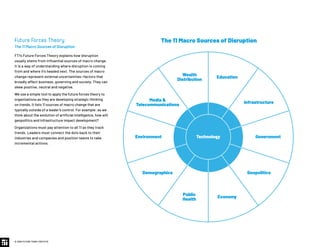
Future Forces Theory:
The 11 Macro Sources of Disruption
FTI’s Future Forces Theory explains how disruption
usually stems from influential sources of macro change.
It is a way of understanding where disruption is coming
from and where it’s headed next. The sources of macro
change represent external uncertainties—factors that
broadly affect business, governing and society. They can
skew positive, neutral and negative.
We use a simple tool to apply the future forces theory to
organizations as they are developing strategic thinking
on trends. It lists 11 sources of macro change that are
typically outside of a leader’s control. For example: as we
think about the evolution of artificial intelligence, how will
geopolitics and infrastructure impact development?
Organizations must pay attention to all 11 as they track
trends. Leaders must connect the dots back to their
industries and companies and position teams to take
incremental actions.
© 2020 FUTURE TODAY INSTITUTE
The 11 Macro Sources of Disruption
Technology
EducationWealth
Distribution
Infrastructure
Government
Media &
Telecommunications
GeopoliticsDemographics
Environment
Economy
Public
Health
The 11 Macro Sources of Disruption Include:
Wealth Distribution
The distribution of income across a population’s house-
holds, the concentration of assets in various communities,
the ability for individuals to move up from their existing
financial circumstances and the gap between the top and
bottom brackets within an economy.
Education
Access and quality of primary, secondary, and post-sec-
ondary education, workforce training, trade apprentice-
ships, certification programs, the ways in which people are
learning and the tools they’re using and what people are
interested in studying.
Infrastructure
Physical, organizational, and digital structures needed
for society to operate (bridges, power grids, roads, wifi
towers, closed-circuit security cameras), the ways in which
the infrastructure of a city, state or country might impact
another’s.
Government
Local, state, national, and international governing bodies,
their planning cycles, their elections and the regulatory
decisions they make.
Geopolitics
The relationships between the leaders, militaries and gov-
ernments of different countries, the risk faced by investors,
companies and elected leaders in response to regulatory,
economic or military actions.
Economy
Shifts in standard macroeconomic and microeconomic
factors.
Public Health
Changes in the health and behavior of a community’s pop-
ulation in response to lifestyles, popular culture, disease,
government regulation, warfare or conflict and religious
beliefs.
Demographics
Observing how birth and death rates, income, population
density, human migration, disease and other dynamics are
shifting communities.
Environment
Changes to the natural world or to specific geographic
areas, including extreme weather events, climate fluctua-
tions, sea level rise, drought, high or low temperatures and
more. (We include agricultural production in this category.)
Media and Telecommunications
All of the ways in which we send and receive information
and learn about the world. This includes social networks,
news organizations, digital platforms, video streaming ser-
vices, gaming and e-sports systems, 5G and the boundless
other ways in which we connect with each other.
Technology
We recognize technology not as an isolated source of
macro change, but rather, as the connective tissue linking
business, government and society. For that reason, we
always look for emerging tech developments, as well as tech
signals within the other sources of change.
19
How To Do Strategic Planning Like A Futurist
For any given uncertainty about the future—whether that’s risk, opportunity or growth—
it’s best to think in the short and long-term simultaneously. To do this, the Future Today
Institute uses a framework that measures certainty and charts actions, rather than simply
marking the passage of time as quarters or years. That’s why our timelines aren’t actually
lines at all—they are cones.
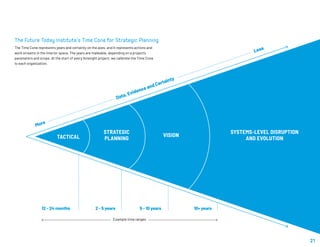
As we think about the future, we build a cone with four distinct categories:
1. Tactics
2. Strategy
3. Vision
4. Systems-Level Evolution
We start by defining the cone’s edge using highly probable events for which there is already
data or evidence. The amount of time varies for every project, organization and industry. In
this example, we’ve used 12-24 months as a place to start. Because we can identify trends
and probable events (both within a company and external to it), the kind of planning that
can be done is tactical in nature, and the corresponding actions could include things like
redesigning products or identifying and targeting a new customer segment.
Tactical decisions must fit into an organization’s strategy. At this point in the cone, we are
a little less certain of outcomes, because we’re looking at the next 24 months to five years.
This area should be most familiar to strategy officers and their teams: We’re describing
traditional strategy and the direction the organization will take. Our actions include defining
priorities, setting resource allocation, making any personnel changes needed and the like.
Lots of teams get stuck cycling between strategy and tactics, and that makes their organi-
zations vulnerable to disruption. If you aren’t simultaneously articulating your vision and a
systems-level evolution, another organization will drag you into their version of the future.
Think exponentially. Act incrementally.
© 2020 FUTURE TODAY INSTITUTE
21
TACTICAL VISION
STRATEGIC
PLANNING
SYSTEMS-LEVEL DISRUPTION
AND EVOLUTION
More
	
	
	 Data, Evidence and Certainty
	
	
	 Less
12 - 24 months 2 - 5 years 5 - 10 years 10+ years
The Future Today Institute's Time Cone for Strategic Planning
The Time Cone represents years and certainty on the axes, and it represents actions and
work streams in the interior space. The years are malleable, depending on a project’s
parameters and scope. At the start of every foresight project, we calibrate the Time Cone
to each organization.
Example time ranges
Disclaimer
The views expressed herein are the authors own and are not representative of the
greater organizations in which they have been employed. The names of compa-
nies, services and products mentioned in this report are not necessarily intended
as endorsements by the Future Today Institute or this report’s authors.
The Future Today Institute’s 2020 Trends Report relies on data, analysis and mod-
eling from a number of sources, which includes: sources within public and private
companies, securities filings, patents, academic research, government agencies,
market research firms, conference presentations and papers, and news media
stories. Additionally, this report draws from the Future Today Institute’s 2020 EMT
Trends Report and from earlier editions of the FTI Trend Report. FTI’s reports are
occasionally updated on the FTI website.
FTI advises hundreds of companies and organizations, some of which are refer-
enced in this report. FTI does not own any equity position in any of the entities
listed in this presentation.
Any trademarks or service marks used in this report are the marks of their respec-
tive owners and who do not endorse the statements in this report. All rights in
marks are reserved by their respective owners. We disclaim any and all warranties,
express or implied, with respect to this report.
© 2020 FUTURE TODAY INSTITUTE
23
Using and Sharing The Material In This Report
We invite you to use, share, and build
upon the material in our 13th annual
Future Today Institute Tech Trends
Report. We are making it freely avail-
able to the public. This work is licensed
under a Creative Commons Attribu-
tion-NonCommercial-ShareAlike 4.0
International License.
You are free to:
Share
Copy and redistribute the material in
any medium or format, including in your
organizations and classrooms.
Adapt
Remix, transform, and build upon the
material for your own research, work,
and teaching.
Under the following terms:
Attribution
You must give appropriate credit to the
Future Today Institute, provide a link
to this Creative Commons license, and
indicate if any changes were made. You
may do so in any reasonable manner,
but not in any way that suggests that
the Future Today Institute endorses you
or your use.
NonCommercial
You may not, under any circumstance,
use the material for commercial pur-
poses.
ShareAlike
If you remix, transform, or build upon
the material, you must distribute your
contributions under the same license
as you see here.
You are prohibited from:
Commercial Sharing
Don’t copy and redistribute this materi-
al in any medium or format for commer-
cial purposes, including any personal/
corporate marketing and client ser-
vices.
Representing This Work As Your Own
Do not represent any part of this mate-
rial as your own without giving credit to
the Future Today Institute.
Additional Restrictions
You may not apply legal terms or tech-
nological measures that legally restrict
others from doing anything this license
permits.
01 Artificial Intelligence
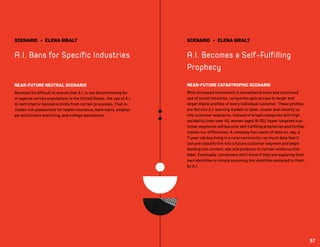
25
32 	 Enterprise
32 	 Using A.I. to Speed the 		
	 Process of Scientific
	Discovery
32 	 A.I. in the Cloud
33 	 A.I. at the Edge
	 (or A.I. Not in the Cloud)
33 	 Robotic Process Automation
33 	 Digital Twins and Cognitive
	 Twins in the Enterprise
33	 Robots with Cognitive Skills
33 	 Advanced A.I. Chipsets
34 	 Serverless Computing
34 	 Proprietary, Homegrown
	 A.I. Languages
34 	 Proliferation of
	Franken-Algorithms
35 	 Companies Manipulating A.I. 	
	 Systems for Competitive 	
	Advantage
35 	 CorporateBiometricSpoofing
35 	Bots
36 	 Business Ecosystem
36 	 Global Rush to Fund A.I.
36 	 Algorithm Marketplaces
37 	 Marketplace Consolidation
37 	Fragmentation
37 	 Liability Insurance for A.I.
37 	 Ambient Surveillance
38 	 Processes, Systems and
	 Computational Neuroscience
38 	 Creating 3D Models from 	
	 Flat 2D Images
38 	 Neuro-Symbolic A.I.
	 Algorithms and Systems
38 	 Real-Time Machine Learning
39 	 Natural Language
	 Understanding (NLU)
39 	 Machine Reading
	 Comprehension (MRC)
39 	 Natural Language
	 Generation (NLG)
40 	 Real-Time Context in
	 Machine Learning
40 	 General Reinforcement 		
	 Learning Algorithms
40 	 Deep Learning Scales
40 	 Faster and More Powerful 	
	 Open Source Frameworks
40 	 Reinforcement Learning 	
	 and Hierarchical RL
41 	 Continuous Learning
41 	 Multitask Learning
41 	 Generative Adversarial
	 Networks (GANs)
41	 New Generative Modeling 	
	Techniques
41 	 Probabilistic Programming 	
	Languages
41 	 Machine Image Completion
42 	 Hybrid Human-Computer 	
	 Vision Analysis
43 	 Predictive Machine Vision
43 	 Automated Machine
	 Learning (AutoML)
43 	 Customized Machine Learning
43 	 Graph Neural Networks
43 	 Intelligent Optical
	 Character Recognition
44 	 Content and Creativity
44 	 A.I. for the Creative Process
44	 Generative Algorithms for 	
	 Content Production
44 	 Generating Virtual
	 Environments from
	 Short Videos
44 	 Automated Versioning
44 	 Automatic Voice Cloning 	
	 and Dubbing
45 	 Spotting Machine-Written 	
	Text
45 	 Algorithmic Fact Checking
45 	 Datamining Crowds
45 	 Deep Linking
46 	 Consumer Products
	 and Services
46 	 Ambient Computing Expands
46 	 Ubiquitous Digital Assistants
46 	 A.I. for Drug Development
47 	 A.I. for Interviews
47 	 Consumer-Grade A.I.
	Applications
49 	 Geopolitics, Geoeconomics 	
	 and Warfare
49 	 The New Mil-Tech
	 Industrial Complex
49 	 National A.I. Strategies
51 	 The Race to Establish
	 A.I. Rules
51 	 Algorithmic Warfare
51 	 Making A.I. Explain Itself
51 	 Using A.I. in Critical Systems
52 	 China’s A.I. Rules
54 	Society
54 	 Artificial Emotional
	Intelligence
54 	 Personal Digital Twins
54 	 Problematic Data Sets
55 	 A.I. to Catch Cheaters
55 	 Algorithms Designed
	 to Target Vulnerable
	Populations
55 	 A.I. Still Has a Bias Problem
55 	 A.I. Systems Intentionally
	 Hiding Data
56 	 The Rise of Undocumented
	 A.I. Accidents
56 	 A.I. and Digital Dividends
56 	 Prioritizing Accountability
	 and Trust
KEY INSIGHT
Artificial intelligence (A.I.) represents the
third era of computing, one that could
usher in a new period of productivity and
prosperity for all. It has potential to act as a
force multiplier for good, helping to address
humanity’s most complex challenges: how
to mitigate climate change, how to increase
the global food supply, how to develop safer
infrastructure, how to manage cyberse-
curity threats and how to diagnose and
eradicate diseases. However, A.I. also
carries risks: gender, race and ethnic bias
continues to negatively influence the crim-
inal justice system; countries differ in their
regulatory approaches; it enables the cre-
ation and spread of fake news and misinfor-
mation; it threatens privacy and security;
and it will inevitably displace swaths of the
workforce. There is no central agreement
on how A.I. should develop during the next
several decades. Many facets of artificial
intelligence have made our list since we
first started publishing this report 13 years
ago. Because A.I. itself isn’t the trend, we
identified different themes within A.I. that
you should be following. You will also find
the technology intersecting with other
trends throughout this report.
WHAT YOU NEED TO KNOW
In its most basic form, artificial intelligence
is a system that makes autonomous deci-
sions. A.I. is a branch of computer science
in which computers are programmed to do
things that normally require human intel-
ligence. This includes learning, reasoning,
problem solving, understanding language
and perceiving a situation or environment.
A.I. is an extremely large, broad field, which
uses its own computer languages and relies
on computer networks modeled on our
human brains.
WHY IT MATTERS
The global A.I. market should grow 20% an-
nually between 2020 and 2024, while global
economic growth generated by A.I. could
reach $16 trillion by the end of this decade.
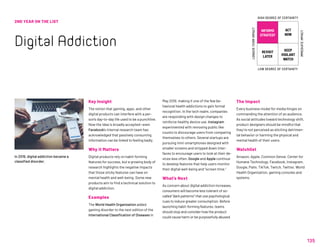
13TH YEAR ON THE LIST
ArtificialIntelligence
© 2020 FUTURE TODAY INSTITUTE
INFORMS
STRATEGY
REVISIT
LATER
ACT
NOW
KEEP
VIGILANT
WATCH
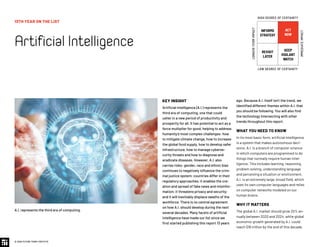
HIGH DEGREE OF CERTAINTY
LOW DEGREE OF CERTAINTY
IMMEDIATEIMPACT
LONGER-TERMIMPACT
A.I. represents the third era of computing.
This is problematic for researchers covering
A.I. developments and for managers who
must make decisions about A.I.
In fact, we have already started to see
real-world examples of functioning AGI. In
2017 researchers at DeepMind, a lab owned
by the same parent company as Google,
announced that A.I. had taught itself how
to play chess, shogi (a Japanese version of
chess) and Go (an abstract strategy board
game)—all without any human intervention.
The system, named AlphaZero, quickly
became the strongest player in history for
each game. The team has been publishing
important discoveries at an impressively
fast pace. Last year, the DeepMind team
taught A.I. agents to play complex games,
such as the capture the flag “game mode”
inside the video game Quake III. They, like
humans, had learned skills specific to the
game as well as when and how to collabo-
rate with other teammates. The A.I. agents
had matched human player ability using
reinforcement learning, in which machines
learn not unlike we do—by trial and error.
 DEEPER DIVE
Weak and Strong A.I.
There are two kinds of A.I.—weak (or “nar-
row”) and strong (or “general”). Narrow A.I.
systems make decisions within very narrow
parameters at the same level as a human or
better, and we use them all day long without
even realizing it. The anti-lock brakes in
your car, the spam filter and autocom-
plete functions in your email and the fraud
detection that authenticates you as you
make a credit card purchase— these are all
examples of artificial narrow intelligence.
Artificial general intelligence (AGI) de-
scribes systems capable of decision-mak-
ing outside of narrow specialties. Dolores in
Westworld, the Samantha operating system
in Her, and the H.A.L. supercomputer from
2001: A Space Odyssey are anthropomor-
phized representations of AGI—but the ac-
tual technology doesn’t necessarily require
humanlike appearances or voices.
There is no single standard that marks the
distinction between weak and strong A.I.
While we haven’t seen an anthropomorphic
A.I. walk out of DeepMind’s lab, we should
consider these projects as part of a long
transition between the narrow A.I of today
and the strong A.I. of tomorrow.
Neural Networks and Deep Neural
Networks
A neural network is the part of a system in
which information is sent and received, and
a program is the set of meticulous instruc-
tions that tell a system precisely what to do
so that it will accomplish a specific task.
How you want the computer to get from
start to finish—essentially, a set of rules—is
the “algorithm.”
A deep neural network is one that has many
hidden layers. There’s no set number of
layers required to make a network “deep.”
Deep neural networks tend to work better
and are more powerful than traditional
neural networks (which can be recurrent or
feedforward).
Machine Learning and Deep Learning
A.I. pioneer Arthur Samuel popularized the
idea of machine learning in 1959, explain-
ing how computers could learn without
being explicitly programmed. This would
mean developing an algorithm that could
someday extract patterns from data sets
and use those patterns to predict and
make real-time decisions automatically. It
took many years for reality to catch up with
Samuel’s idea, but today machine learning
is a primary driver of growth in A.I.
Deep learning is a relatively new branch of
machine learning. Programmers use spe-
cial deep learning algorithms alongside a
corpus of data—typically many terabytes of
text, images, videos, speech and the like.
Often, these systems are trained to learn
on their own, and they can sort through a
variety of unstructured data, whether it’s
making sense of typed text in documents
or audio clips or video. In practical terms,
this means that more and more human
processes will be automated, including the
writing of software, which computers will
soon start to do themselves.
27
Companies Building the Future of A.I.
Nine big tech companies—six American,
and three Chinese—overwhelmingly drive
the future of artificial intelligence. In the
U.S., it’s the G-MAFIA: Google, Microsoft,
Amazon, Facebook, IBM and Apple. In China
it’s the BAT: Baidu, Alibaba and Tencent.
Those nine companies drive the majority
of research, funding, government involve-
ment and consumer-grade applications of
A.I. University researchers and labs rely on
these companies for data, tools and fund-
ing. The Big Nine A.I. companies also wield
huge influence over A.I. mergers and acqui-
sitions, funding A.I. startups and supporting
the next generation of developers.
Artificial Intelligence
and Personal Data
Artificial intelligence requires robust, clean
data sets. For example, manufacturers with
large data sets can build machine learning
models to help them optimize their supply
chain. Logistics companies with route
maps, real-time traffic information and
weather data can use A.I. to make deliveries
more efficient.
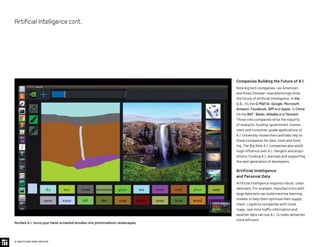
Nvidia’s A.I. turns your hand-scrawled doodles into photorealistic landscapes.
© 2020 FUTURE TODAY INSTITUTE
ArtificialIntelligencecont.
For this reason, we believe that companies
will eventually unify our PIIs into more com-
prehensive “personal data records,” or PDRs
for short. This single unifying ledger would
pull together all of our PIIs, i.e. all of the data
we create as a result of our digital usage
(think internet and mobile phones). But it
would also include other sources of informa-
tion: our school and work histories (diplo-
mas, previous and current employers); our
legal records (marriages, divorces, arrests);
our financial records (home mortgages,
credit scores, loans, taxes); travel informa-
tion (countries visited, visas); dating history
(online apps); health information (electronic
health records, genetic screening results,
exercise habits); and shopping history (on-
line retailers, in-store coupon use).
Who Will Own Your Data in the Future?
Ideally, you would be the owner of your PDR.
It would be fully interoperable between
systems, and the big tech companies would
simply act as custodians. However, given
the lack of enforceable norms, standards
and guardrails, we believe that in the future
your PDRs would be owned and held by one
of the big tech companies.
But a significant amount of our personal
data is also driving the growth of A.I. Called
“personally identifiable information,” or PIIs,
these are discrete units of data we shed
simply by using our computers, phones
and smart speakers. Our personal data is
treated differently around the world. The
California Consumer Privacy Act (CCPA),
which took effect in January of 2020,
limits the ways in which companies can use
personal data, while the European Union’s
General Data Protection Regulation (GDPR)
requires companies to gain consent before
collecting and processing someone’s per-
sonal data.
From Small Bits to Huge Bytes
As smart gadgets become affordable and
recognition systems more common in the
workplace and public spaces, a significant
amount of personal data will be collected
– orders of magnitude more than is today.
By 2025, it is estimated that 463 exabytes
of data will be created every single day –
that’s equivalent to 77 billion Netflix movie
streams. However, more data isn’t necessar-
ily better, especially when data saturation
doesn’t effectively tell a complete story.
During his 2020 presidential run, business-
man Andrew Yang proposed that Congress
pass a new law establishing data as a prop-
erty right for individuals, giving them the
right to protect how it is collected and used,
and a way for them to share in the economic
value generated as a result of their data.
Enabling Future Generations to Inherit
Your Data
Your PDR could be heritable—a compre-
hensive record passed down to and used
by your children. This would enable an A.I.
system to learn from your family’s health
data, which could someday aid in preci-
sion medicine. It could also help track and
untangle a family member’s finances after
their death. Heritable PDRs could also help
families pass down memories of loved ones
to further generations.
Imagine being able to set permissions on all
of the content you consume—news stories,
movies, songs, sporting events, lectures—
and then passing down insights to your
children or other loved ones. The content
we consume shapes our worldviews and ac-
tions, and a window into that content could
help others more deeply understand you, for
better or worse.
THE IMPACT
The long-term impact of A.I. will depend
on choices we make in the present. As ANI
(artificial narrow intelligence) becomes a
ubiquitous presence in business, education,
research and governing, it is imperative that
leaders make informed decisions.
29
Facebook AI lab, Facebook Soumith Chinta-
la, Federal Bureau of Investigation, Federal
Trade Commission, France’s AI for Humanity
strategy, Future of Life Institute, General
Language Understanding Evaluation com-
petition, GenesisAI, Germany’s national AI
framework, GitHub, Google Cloud, Google
Ventures, Google’s Bidirectional Encod-
er Representations from Transformers,
Google Brain, Google Cloud AutoML, Google
Cloud Natural Language API, Google Coral
Project, Google DeepMind team, Google
Duplex team, Graphcore, Harvard University,
HireVue, Huawei, IBM Project Debater, IBM
Research, IBM Watson Text-to-Speech,
Immigration and Customs Enforcement,
In-Q-Tel, Intel, Intel Capital, International
Computer Science Institute, Israel’s national
A.I. plan, Italy’s interdisciplinary A.I. task
force, Joint Enterprise Defense Infrastruc-
ture (JEDI), Kenya’s A.I. taskforce, LaPlaya
Insurance, Lyrebird, Mayo Clinic, McDonald’s
Dynamic Yield, Megvii, MGH and BWH Center
for Clinical Data Science, Michigan State
University, Microsoft Azure Text-to-Speech
API, Microsoft Azure, Microsoft Machine
Reading Comprehension dataset, Micro-
soft’s HoloLens, Massachusetts Institute of
Technology (MIT), MIT and Harvard’s Giant
WATCHLIST FOR SECTION
Algorithmia, Algorithmic Warfare
Cross-Functional Team, Alibaba Cloud, Ali-
baba, Alipay, Allianz, Amazon Polly, Amazon
SageMaker Autopilot, Amazon A9 team,
Amazon AWS Lambda, Amazon DeepCom-
poser, Amazon Rekognition, Apple, Arria
NLG, Automated Insights, Automation Any-
ware, Autoregressive Quantile Networks for
Generative Modeling, AWS, AWS Textract,
Baidu Cloud, Baidu, Baidu Text-to-Speech,
Blue Prism, Bonseyes, Brazil’s eight national
AI laboratories, California Consumer Privacy
Act (CCPA), Carnegie Mellon University, Cen-
tral Intelligence Agency, Cerebras Systems,
Child Exploitation Image Analytics program,
China’s Belt and Road Initiative, China’s
C.E.I.E.C., China’s New Generation Artificial
Intelligence Development Plan, China’s Peo-
ple’s Liberation Army, China’s state broad-
caster CCTV, Citi, CloudSight, Columbia
University, Crosscheq, CycleGAN, Defense
Advanced Research Projects Agency, Deep-
Mind, Descript, Drift, Electronic Frontier
Foundation, Electronic Privacy Informa-
tion Center, European Union’s AI Alliance,
European Union’s General Data Protection
Regulation, Facebook and Carnegie Mellon
University’s Pluribus Networks, Facebook,
Language Model Test Room (GLTR), MIT-IBM
Watson AI Lab, MIT's Computer Science and
Artificial Intelligence Laboratory, Mohamed
bin Zayed University of Artificial Intelligence
in Abu Dhabi, Molly, Multiple Encounter
Dataset, Mythic, Narrative Science, National
Institute of Informatics in Tokyo, National
Science Foundation, New York University
Stern School of Business Professor Arun
Sundararajan, New York University, Nike’s
Celect and Invertex, Nuance AI Marketplace,
Nvidia, Nvidia’s EGX platform, Nvidia’s
GauGAN, ObEN, OpenAI, Oracle, Organisa-
tion for Economic Co-operation and Devel-
opment, Palantir, Pan-Canadian Artificial
Intelligence Strategy, Princeton, PyTorch,
Qualcomm, Quantiacs, Reddit, Resemble
AI, Russia’s Agency for Strategic Initiatives,
Russia’s Federal Security Service, Russia’s
Ministry of Defense, Russia’s National AI
strategy, Salesforce, SambaNova Systems,
Samsung, Samsung AI Center, Samsung
Ventures, SAP, Saudi Arabia’s national AI
strategy, Sensetime, Siemens MindSphere,
Singapore’s AI national strategy, Skolkovo
Institute of Science and Technology, Stan-
ford University, Tamedia, Tencent, Turing
Award, Twitter, U.K. Parliament’s Select
Committee on AI, U.K.’s House of Com-
mons Science and Technology Committee,
U.S. Army Futures Command, U.S. Army
Research Laboratory, U.S. Department of
Energy, U.S. Joint AI Center, U.S. National
Artificial Intelligence Research and Devel-
opment Strategic Plan, U.S. National Insti-
tute of Standards and Technology (NIST),
U.S. National Security Commission on AI,
U.S. National Security Strategy and National
Security Commission on AI, U.S. presiden-
tial candidate Andrew Yang, U.S. Space
Force, Uber, United Arab Emirates’s Minister
of State for Artificial Intelligence Omar
Sultan Al Olama, United Arab Emirates’s
sweeping AI policy initiatives, University of
British Columbia Department of Chemistry,
University of California-Berkeley, University
of Copenhagen, University of Maryland;
University of Montreal, University of Texas
at Arlington’s algorithmic fact-checking
research, Victor Dibia, applied AI researcher
at Cloudera Fast Forward Labs, Wave Com-
puting, Wikipedia, Y Combinator.
© 2020 FUTURE TODAY INSTITUTE
ArtificialIntelligencecont.
3131
 TRENDS
Using A.I. to Speed the Process
of Scientific Discovery
Running experiments with several variables
often requires tiny, methodical tweaks to
measurements, materials and inputs. Grad-
uate students might spend hundreds of te-
dious hours making small adjustments again
and again until a solution is found—a waste
of their cognitive abilities. Increasingly, A.I.
systems are being used in research labs to
speed the process of scientific discovery.
Materials scientists at the University of
British Columbia used a robot overseen by
an A.I. algorithm to rapidly test a new kind
of solar cell and log results. Based on what
each experiment revealed, an algorithm
determined what to change next. A process
that might have taken 9–12 months was
completed in five days. Google’s DeepMind
developed a way of testing and modeling
the complex folding patterns of long chains
of amino acids, solving a problem that has
vexed scientists for many years. DeepMind’s
system, AlphaFold, will allow scientists to
synthesize new drugs to treat diseases and
develop enzymes that might someday break
down pollution.
China’s CCTV featured digital twin hosts on a popular TV show.
A.I. in the Cloud
Corporate leaders within the A.I. ecosystem
have been racing to capture A.I. cloud-
share—and to become the most trusted
provider of A.I. on remote servers. Enter-
prise customers are likely to stick with their
initial vendor, because the more data that a
machine learning system has access to, the
better decisions it will learn to make over
time. For that reason, the race is on. In the
West, the field is led by Amazon, Microsoft
and Google, followed by companies includ-
ing Apple, IBM, Salesforce, SAP and Oracle.
In Asian markets, Alibaba and Baidu dom-
inate the A.I. cloud, although in January of
2020 telecom equipment and smartphone
maker Huawei announced a management
change to focus on what it calls a “full-stake
cloud platform.” It’s a $250 billion industry
and quickly growing. NYU Stern School of
Business professor Arun Sundararajan says
it best: “The prize will be to become the
operating system of the next era of tech.”
ARTIFICIAL INTELLIGENCE
Enterprise
© 2020 FUTURE TODAY INSTITUTE
A.I. at the Edge
(or A.I. Not in the Cloud)
Imagine a self-driving car in a busy neigh-
borhood: A car driving 25 miles per hour is
moving 36.7 feet per second. For a car to
capture an image of a stop sign, process it
in the cloud and then make a decision would
require a consistently fast connection. But
if that image capture and analysis happened
on-site, it would likely not only be faster,
but safer. For that reason, such companies
as Google and Nvidia are building networks
that can make these kinds of local A.I.-driv-
en processing and decision-making on
devices, without any interaction of data in
the cloud or the Internet—a technique that
uses what’s known as “edge computing.”
Processing data directly on devices will be
important in the future for health care, au-
tomotive and manufacturing applications,
because it would potentially be faster, and
therefore safer.
Robotic Process Automation
Robotic Process Automation (RPA) enables
businesses to automate certain tasks and
processes within offices, which allows em-
ployees to spend time on higher-value work.
Google’s Duplex, which is a bot designed to
make routine phone calls to other people,
is an example of an RPA. Amazon uses RPA
to sift through resumes before prioritizing
top candidates for review. In banking, Blue
Prism and Automation Anywhere help staff
with repetitive work functions. RPA will
eventually augment staff and shift their
productivity into higher gear. This will allow
media and entertainment companies to
make better real-time predictive decisions
in a host of different areas, from customer
service to cost savings.
Digital Twins and Cognitive
Twins in the Enterprise
Digital twins are virtual representations
of real-world environments, products or
assets, used for a host of purposes. Man-
ufacturers use digital twins to manage the
performance and effectiveness of machines
and plants, while city planners use them to
simulate the impact of new developments
and roads. The Singapore government
uses them for urban operations. Siemens
MindSphere supports digital twins for a
number of industries. What’s on the horizon:
cognitive twins, which not only simulate
environments but help design solutions.
Robots with Cognitive Skills
As humans and machines work more closely
together, there are opportunities for robots
to learn and adapt new skills based on their
environments. Machine learning, deep re-
inforcement learning, computer vision and
advancements in simulated environments
will soon lead to robots with early-stage
cognitive abilities. Applications include en-
vironmental cleanups, exploring dangerous
terrain and assisting first responders.
Advanced A.I. Chipsets
Today’s neural networks have long required
an enormous amount of computing power,
have taken a very long time to train, and
have relied on data centers and comput-
ers that consume hundreds of kilowatts
of power. That ecosystem is starting to
change. Enter a suite of new processors
found on a SoC—“system on a chip.” Big tech
companies like Huawei, Apple, Microsoft,
Facebook, Alphabet, IBM, Nvidia, Intel and
Qualcomm, as well as startups like Graph-
core, Mythic, Wave Computing, SambaNova
Systems and Cerebras Systems, are all
working on new systems architecture and
SoCs, and some of which come pre-trained.
In short, this means that the chips are more
readily able to work on A.I. projects and
should promise faster and more secure
processing. Projects that might otherwise
take weeks could instead be accomplished
in a matter of hours. Cerebras has built an
A.I. chip with 1.2 trillion transistors, 400,000
processor cores, 18 gigabytes of SRAM and
interconnects (tiny connection nodes) that
can move 100 quadrillion bits per second.
(That’s an astounding amount of compo-
nents and power.) Amazon’s homegrown A.I.
chip, called Inferentia, and Google’s Tensor
Processing Unit (or TPU) were specifically
built for the companies’ cloud services.
Market research company Tractica esti-
mates that the A.I. chip market will quadru-
ple to $6.7 billion in 2022, from $1.66 billion
in 2018. While marketing pre-trained chips
to businesses will speed up commercializa-
tion and, as a result, will further RD, the
challenge is that developers might need to
wrestle with many different frameworks
rather than a handful of standard frame-
works in the near-future, especially if the
various device manufacturers all decide
to start creating unique protocols. We do
anticipate an eventual consolidation, pitting
just a few companies—and their SoCs and
languages—against each other.
33
to build and release their own software
packages now, as well as unique program-
ming languages for A.I. applications. Uber
released its own probabilistic programming
language, Pyro, which it wrote in Python. It’s
a move that signals likely fragmentation in
the future of the A.I. ecosystem, not unlike
our current rivalry of OSX vs Android, and
earlier Mac vs PC camps. Businesses will
find it increasingly cost-prohibitive and
difficult to switch between A.I. frameworks
and languages.
Proliferation of
Franken-Algorithms
Algorithms are simply rules that define
and automate the treatment of data. They
are built using “if this, then that” logic that
a computer can understand and process.
Here’s an easy example: If a website read-
er’s IP address is based in Baltimore, the
rules allow that reader to freely access the
site; if the IP address is based in Belgium,
the rules first show a GDPR screen stating
privacy and cookie policies. While a single
algorithm might be easily described and de-
ployed as expected, systems of algorithms
all working together can sometimes pose
Serverless Computing
Amazon Web Services, Alibaba Cloud,
Microsoft’s Azure, Google Cloud and Baidu
Cloud are rolling out new offerings and
packages for developers, hoping to make it
easier and more affordable for a wide swath
of A.I. startups to launch their ideas into
the marketplace. Amazon’s AWS Lambda
lets teams run code for virtually any type
of application or backend service—without
provisioning or managing servers or hands-
on administration. Microsoft’s Functions
architecture for Azure supports myriad
programming languages, scales on demand
and only charges for active compute time.
This isn’t sitting well with some engineers,
though, who are worried about losing
control.
Proprietary, Homegrown
A.I. Languages
Python is a leading language with lots of
pre-built libraries and frameworks. Julia,
a language developed by MIT, is an open-
source language that focuses on numerical
computing. And of course there’s Lisp,
created by modern A.I. 's foreparent John
McCarthy in 1958. Companies are starting
© 2020 FUTURE TODAY INSTITUTE
Enterprisecont.
Scientists at MIT trained an A.I. psychopath named “Norman” using only the image
captions from a subreddit that's known for disturbing content.
problems. Developers don’t always know in
advance how one algorithm will function
alongside other algorithms. Sometimes,
several teams of developers are all working
independently on different algorithms and
data sets and only see their work once it is
deployed. This has been the cause of recent
stock market glitches and e-commerce
website wonkiness. Indeed, it is a challenge
for big companies like Facebook, which
have billions of algorithms working together
at any given time.
Companies Manipulating A.I.
Systems for Competitive
Advantage
Amazon, Google and Facebook have all
come under fire in the past few years for
manipulating their search systems to
prioritize results that are more profitable
for their companies. For example, Google
has been accused of de-ranking websites
and promoting news stories from preferred
partners. Late in 2019 researchers found
that Amazon had optimized its search
algorithm to boost the visibility of Amazon’s
own brands. Tweaks to search algorithms
have a significant impact on what internet
users see, whether that is news, products
for sale or advertising. The U.S. and E.U. are
currently investigating Amazon’s simultane-
ous roles as a search engine, marketplace
operator and seller of its own products.
Lawmakers are not yet aligned on whether
manipulating algorithms for competitive
advantage meets the criteria for antitrust
activity.
Corporate Biometric Spoofing
Companies might want to think twice before
implementing A.I. systems to monitor and
authenticate staff. New techniques in ma-
chine learning have led to synthetic finger-
prints and other automatically-generating
bioidentifiers capable of fooling monitoring
systems. Researchers at Michigan State
University and New York University built an
algorithm that can generate fake biometric
credentials, signaling the potential for inno-
vation-related vulnerabilities on our horizon.
One such instance might be a malicious
system generating millions of fingerprints in
a brute force attack to remotely open a door
or unlock a laptop.
Bots
The term “bot” has become part of our
mainstream vocabulary, and you can expect
to hear more about them as America com-
pletes its 2020 election cycle. Bots, at the
most basic level, are software applications
designed to automate a specified task. They
can be text or audio-based and can be de-
ployed across various platforms. News bots
can help aggregate and automatically alert
a user about a specified event, whereas
productivity bots are tools companies use
to automate and streamline their day-to-day
operations. Chatbots are now fully main-
stream, and they’re deployed by all kinds
of organizations, especially in customer
service functions. In fact, research from
Survey Monkey and live chat provider
Drift revealed that only 38% of consumers
actually want to talk with a human when
engaging with a brand.
The next big advancement in bots won’t be
technical in nature—it will be regulatory.
During 2018’s campaign cycles, we saw
a resurgence of botnets, which are net-
works of computers designed to send out
misleading content. That, coupled with
concerns that bots are increasingly leading
to widespread deception, led to a new law
in California that requires bots to disclose
that they are not humans in their interac-
tions with people. The law went into effect
on July 1, 2019 and requires the disclosure
to be “clear, conspicuous, and reasonably
designed to inform persons with whom the
bot communicates or interacts that it is a
bot.” The success of this new regulation
could become the basis for other state and
national laws, especially if conversational
bots like Google’s Duplex reach critical mass
within the marketplace.
35
Global Rush to Fund A.I.
There is a well-reported shortage of A.I.
talent, and every sector is hoping to inte-
grate A.I. into their core business functions.
As a result, there is a global race to fund
A.I. research and to acquire startups. In
2019, investors put $136.5 billion into 10,777
deals worldwide. Seed or pre-seed rounds
made up half of those deals, while 21% were
Series A and 12% were Series B. U.S. tech
giants like Apple, Google and Microsoft are
acquiring A.I. companies at a rapid clip,
and non-tech companies are gobbling A.I.
startups too: McDonald’s acquired person-
alization platform Dynamic Yield, while Nike
acquired inventory management company
Celect and guided shopping experience
platform Invertex. The U.S. Department
of Energy is reportedly planning to ask
Congress for $3 - $4 billion over the next
10 years to build next-generation exascale
computers that use A.I. to speed scientific
discoveries. In July of 2019, Japanese con-
glomerate Softbank launched Vision Fund
2, a $108 billion fund designated specifically
for A.I. startups.
Algorithm Marketplaces
In the 2010s, big tech companies, startups
and communities of developers used algo-
rithm marketplaces to share and sell their
work. In 2018, Microsoft paid $7.5 billion to
buy GitHub, a popular development platform
allowing anyone to host and review code,
to collaborate with other developers and to
build all kinds of projects. Amazon’s AWS
hosts its own marketplace, offering models
and algorithms for computer vision, speech
recognition, and text—and its base of sellers
includes Intel, CloudSight and many others.
(Think of AWS Marketplace as an Amazon
for algorithms and models.) There are
marketplaces for generalists, like Gene-
sisAI and Algorithmia, where developers
can upload their work and receive payment
when others pay to access it. Now there
are specialized marketplaces for specific
use cases: Nuance AI Marketplace offers
A.I. developers a single API to connect their
algorithms to radiologists at 6,500 health-
care facilities. Quantiacs allows developers
to build algorithmic trading systems, and
it matches their algorithms up with capital
from institutional investors. Bonseyes is a
European-specific marketplace to buy and
sell A.I. tools.
ARTIFICIAL INTELLIGENCE
BusinessEcosystem
© 2020 FUTURE TODAY INSTITUTE
Github is a popular platform allowing anyone to host and review code.
Marketplace Consolidation
As much as the A.I. ecosystem is booming,
a rush of acquisitions means consolidation,
too. Big companies now pick up startups
long before they have time to mature—the
average age at acquisition is three years
old. Just nine big companies dominate the
A.I. landscape: Google, Amazon, Microsoft,
IBM, Facebook and Apple in the U.S. and
Chinese behemoths Baidu, Alibaba and
Tencent—with significant fortification and
support from the Chinese government. On
the investment side, Qualcomm, Tencent,
Intel Capital, Google Ventures, Nvidia,
Salesforce, Samsung Ventures, Alibaba,
Apple, Baidu, Citi and In-Q-Tel fund much
of the growth. When it comes to the future
of A.I., we should ask whether consolida-
tion makes sense for the greater good,
and whether competition—and therefore
access—will eventually be hindered as we’ve
seen in other fields such as telecommunica-
tions and cable.
Fragmentation
The A.I. ecosystem spans hundreds of
companies. They are building the network
infrastructure, the custom chipsets, the
consumer applications, the backend com-
munications systems, the low-power radios
in our smart home gadgets…we could go on.
Meanwhile, a large number of policy groups,
advocacy organizations and governments
are all developing guidelines, norms and
standards and policy frameworks hoping
to guide the future development of A.I. As
a result, the ecosystem is fragmented in
two ways: infrastructure standards and
governance.
Liability Insurance for A.I.
Who’s to blame when machines behave bad-
ly? Our current legal systems were built to
regulate human behavior, not the actions of
unsupervised machines. As businesses rush
to build and implement A.I. products and
processes, they must plan ahead for emerg-
ing risks. For example, what happens if ma-
chine learning makes a company vulnerable
to attackers injecting fake training data into
a system? What if a healthcare company’s
A.I. misinterprets data and neglects to iden-
tify cancer among certain patients? These
are the kinds of problems that could open a
company up to lawsuits. LaPlaya Insurance
and Allianz are now studying new liability
insurance models that may help to address
these issues.
Ambient Surveillance
What happens behind closed doors may
not be secret for long, and executives
should beware of new ambient surveillance
methods. MIT computer vision scientists
discovered how to use computer vision to
track data from what they call “acciden-
tal cameras.” Windows, mirrors, corners,
houseplants and other common objects
can be used, along with A.I., to track subtle
changes in light, shadow and vibrations.
The result? We all may soon have x-ray
vision capabilities—which may not be great
news for companies working on sensitive
projects. Those working in information
security and risk management should pay
especially close attention to advancements
in computer vision.
37
Creating 3D Models from Flat
2D Images
Last year, Nvidia trained a neural network
to autonomously generate fully-textured 3D
models based on a single photo. Research-
ers trained a neural network using a large
corpus of 3D models, images that had been
transformed into 3D models, and 2D images
showing an object from various angles.
The result: a new system that can render
3D models without any need for human
intervention. Practical applications include
robots that can autonomously generate
realistic models of their environments using
only 2D images.
Neuro-Symbolic A.I. Algorithms
and Systems
The development of A.I. has been on two
conceptual tracks since the 1950s: sym-
bolic (machines use a base of knowledge
and rules that represent concepts) and
non-symbolic (machines use raw data to
create their own patterns and represen-
tations of concepts). Classic A.I. is the
former, because it more closely represents
how we understand human thought—and
Amazon’s Rekognition identifies well-known people to help you “catalogue footage
and photos for marketing, advertising and media industry use cases.”
the original intent was to teach machines
to think like us. Researchers are working
on new ways to combine both learning and
logic using neural networks, which would
understand data through symbols rather
than always relying on human programmers
to sort, tag and catalogue data for them.
Symbolic algorithms will aid the process,
which should eventually lead to robust
systems that don’t always require a human
for training.
Real-Time Machine Learning
One big challenge in A.I. is building ma-
chines that can proactively collect and
interpret data, spot patterns and incorpo-
rate context, and ultimately learn in real
time. New research into real-time machine
learning (RTML) shows that it’s possible to
use a continual flow of transactional data
and adjust models in real-time. This signals
a big change in how data moves, and in
how we retrieve information. The National
Science Foundation launched a $10 million
grant program to catalyze research in this
area, though all of the big tech companies
are working closely to advance RTML too.
ARTIFICIAL INTELLIGENCE
Processes,Systemsand
ComputationalNeuroscience
© 2020 FUTURE TODAY INSTITUTE
Natural Language Understanding
(NLU)
Last year, Amazon released updates to
its Transcribe Medical system, a natural
language understanding (NLU) system
that recognizes speech used by doctors
and medical professionals in real time—no
small achievement. Getting machines to
understand exactly what or who someone
is referring to has been a challenge for
conversational A.I. systems like Siri and
Alexa. At best, the systems are trained to
reference the last pronoun spoken. If a
consumer asks “What time is The Lion King
playing at Cinemark Theater?” and follows
with “parking near there,” the system infers
that “there” means “Cinemark Theater.” In
technical terms, this process is called “slot
carryover,” and it uses syntactic context to
understand what our pronouns mean. The
process works, unless we speak in complex
sentences with many different pronouns.
The fact is that in real conversation, most
of us are messy talkers. We start and stop
sentences without warning, we misuse
words, and sometimes we rely on our tone
to convey something we don’t want to say in
actual words. We tend to speak in unstruc-
tured text. One of the things that makes
reference resolution especially complicated
for a large A.I. system like Alexa is that dif-
ferent Alexa services use different names—
or slots—for the same data. A movie-finding
service, for instance, might tag location
data with the slot name Theater_Location,
while a restaurant-finding service might
use the slot name Landmark_Address. Over
the course of a conversation, Alexa has to
determine which slots used by one service
should inherit data from which slots used by
another.
NLU allows researchers to quantify and
learn from all of that text by extracting
concepts, mapping relationships and
analyzing emotion, and they made some
impressive advancements in the past year.
The General Language Understanding
Evaluation competition (or GLUE) is seen as
a high-water mark in how well an A.I. system
understands human language. China’s Baidu
unseated Google and Microsoft in the most
recent competition and became the first to
develop techniques for understanding not
only English, but Chinese as well.
Machine Reading Comprehension
(MRC)
For A.I. researchers, machine reading com-
prehension (MRC) has been a challenging
goal, but an important one. MRC makes it
possible for systems to read, infer meaning
and immediately deliver answers while sift-
ing through enormous data sets. Last year,
China’s Alibaba outperformed humans when
tested by the Microsoft Machine Reading
Comprehension dataset (or MS MARCO for
short), which assessed its ability to use
natural language to answer real questions
posed by humans. Alibaba’s system deliv-
ered answers to search queries posted by
people to Microsoft’s Bing, like “how many
carbs are in an English muffin?” and “how do
you grow hops?”
One practical application of MRC on the
consumer side: When you perform a search
query, wouldn’t you rather have a system
offer you a precise answer than just a list of
URLs where you can go to hunt down more
specifics—even showing you where, on the
page, that information comes from? If you
are an airline mechanic and you’re trying
to troubleshoot a tricky engine problem
without further delaying a flight, it would
be easier if you had a computer read all of
the technical documentation for you and
suggest likely fixes. Or, better yet, let the
machines figure out what’s wrong on their
own, by making all technical manuals and
documentation available to them for read-
ing and analysis. That’s the promise of MRC,
which represents a necessary step in realiz-
ing artificial general intelligence, and in the
near-term could potentially turn everything
from technical manuals to historical maps
to our medical records into easily search-
able repositories of information.
Natural Language Generation
(NLG)
With the growing popularity of digital assis-
tants, consumers want the ability to have
natural conversations with machines. But
training A.I. systems require a tremendous
amount of data. Natural language gener-
ation (NLG) systems automatically detect,
parse, visualize and then narrate key data.
Google’s Cloud Natural Language API, the
Azure Text-to-Speech API, IBM Watson
Text-to-Speech, Amazon Polly and Baidu’s
Text-to-Speech system are all advancing
the field of NLG. Companies like Arria NLG,
Narrative Science and Automated Insights
39
have products that help non-data science
people make better sense of what’s happen-
ing within their organizations. One possi-
bility for NLG: developing a system that can
use plain language to explain itself, and the
decisions it makes, to others.
Real-Time Context in Machine
Learning
The world is awash with information, mis-
information and superficial thinking. Last
year, IBM unveiled Project Debater, an A.I.
system capable of incorporating context in
real-time learning systems and debating hu-
mans on complex topics. Designed to help
people practice their reasoning, develop
well-informed arguments and reach reliable
conclusions, Project Debater shows how
machine learning systems can use an array
of source material alongside real-time data
to form arguments.
General Reinforcement Learning
Algorithms
Researchers are developing single al-
gorithms that can learn multiple tasks.
DeepMind, the team behind AlphaGo, which
learning, and this subfield of A.I. is finally
taking off in earnest. Programmers use
special deep learning algorithms alongside
a corpus of data—typically many terabytes
of text, images, videos, speech and the
like—and the system is trained to learn on
its own. Though conceptually deep learning
isn’t new, what’s changed recently is the
amount of compute and the volume of data
that’s become available. In practical terms,
this means that more and more human
processes will be automated, including the
writing of software, which computers will
soon start to do themselves. Deep learning
(DL) has been limited by the processing
power of computer networks, however new
chipsets and faster processors will help
DNNs perform at superhuman speeds. (See
trend #7: Advanced AI chipsets.)
Faster and More Powerful Open
Source Frameworks
Research lab OpenAI develops and de-
ploys open source A.I. language systems,
while Google and Facebook’s open source
frameworks are used widely. The open
source PyTorch, created by Soumith
Chintala at Facebook, is among the most
learned how to play Go with the skill level
of a human grandmaster, has developed an
innovative new algorithm: AlphaZero. It is
capable of achieving superhuman perfor-
mance not only in Go, but in other games as
well, including chess and shogi (Japanese
chess). This one algorithm starts with no
knowledge except for the rules of the game
and eventually develops its own strategies
to beat other players. In January of 2020,
DeepMind published new research showing
how reinforcement learning techniques
could be used to improve our understanding
of mental health and motivation.
Deep Learning Scales
In the 1980s, Geoffrey Hinton and a team of
researchers at Carnegie Mellon University
hypothesized a back propagation-based
training method that could someday lead to
an unsupervised A.I. network. It took a few
decades to build and train the massive data
sets, recognition algorithms and powerful
computer systems that could make good
on that idea. Last year, Facebook’s Yann
LeCun, the University of Montreal’s Yoshua
Bengio and Hinton (now at Google) won
the Turing Award for their research in deep
popular machine learning frameworks used
in the world. In 2018, Google open-sourced
its technique for training general purpose
language representation models using the
enormous amount of unannotated text on
the web (known as pre-training). Named Bi-
directional Encoder Representations from
Transformers (or BERT), it is a question
answering system that can be trained in
about 30 minutes. Hardware upgrades and
faster chips should help make open source
frameworks even faster—and popular—in
the years to come.
Reinforcement Learning and
Hierarchical RL
Reinforcement learning (RL) is a powerful
tool for sorting out decision-making prob-
lems, and it’s being used to train A.I. sys-
tems to achieve superhuman capabilities.
Inside of a computer simulation, a system
tries, fails, learns, experiments and then
tries again, in rapid succession, altering its
future attempts each time. It’s because of
RL that AlphaGo, a computer developed by
DeepMind (part of Alphabet), learned how
to beat the greatest Go players in the world.
One problem with RL: agents have difficulty
© 2020 FUTURE TODAY INSTITUTE
Processes,SystemsandComputationalNeurosciencecont.
when they don’t have enough supervision,
or when their objective is to run scenarios
for a very long time horizon. In 2020 and
beyond, researchers will try to solve those
problems using hierarchical reinforcement
learning, which discovers high-level actions
and methodically works through learning
challenges to master new tasks at speeds
we humans can’t imagine. This is important
for non-techies, too: RL will improve the
“intelligence” in our A.I. systems, helping
cars learn to drive in unusual conditions and
helping military drones perform compli-
cated maneuvers that have never been
attempted before in the physical world.
Continuous Learning
At the moment, deep learning techniques
have helped systems learn to solve complex
tasks in a way that more closely matches
what humans can do—but those tasks are
still specific, such as beating a human at a
game. And they require a rigid sequence:
gather data, determine the goal, deploy an
algorithm. This process requires humans
and can be time-consuming, especial-
ly during early phases when supervised
training is required. Continuous learning
(CL) is more about autonomous and incre-
mental skill building and development, and
researchers will continue to push the limits
of what’s possible in this field.
Multitask Learning
In the past year, researchers at Carnegie
Mellon University and Facebook’s AI lab
released a superhuman A.I. for multiplayer
poker called Pluribus, and by the end of
10,000 hands against 12 professional play-
ers, it got very good at bluffing. It marked
a significant milestone in A.I. research.
Winning at games like checkers and chess
entails computational challenges. In poker,
there is an information challenge, since
what’s needed to win is hidden from other
players. Poker also pits multiple players
against each other and achieving victory is
more complex than capturing game pieces.
Pluribus learned to do several things at once
and built its own strategy to win.
Generative Adversarial
Networks (GANs)
Facebook AI research director Yann LeCun
has called generative adversarial networks
(GANs) the most interesting idea of the
decade—and in the past few years, there
have been tremendous advancements in
GANs. Think of a GAN as the Turing test but
without any humans involved. GANs are
unsupervised deep learning systems com-
prised of two competing neural networks
trained on the same data—such as images
of people. For example, the first A.I. creates
photos of a woman that seem realistic,
while the second A.I. compares the gen-
erated photos with photos of real women.
Based on the judgment of the second A.I.,
the first one goes back and makes tweaks to
its process. This happens again and again,
until the first A.I. is automatically gener-
ating all kinds of images of a woman that
look entirely realistic. Last year alone saw a
number of interesting experiments involving
GANs. Researchers from Nvidia, the MGH
and BWH Center for Clinical Data Science
and the Mayo Clinic collaborated on a GAN
that generates synthetic MRIs showing can-
cerous tumors. Researchers at the Skolkovo
Institute of Science and Technology and the
Samsung AI Center made living deepfakes—
the Mona Lisa moved her head and Rasputin
sang “Halo” by Beyonce. (Naturally, it’s this
same GAN technology that’s behind deep-
fakes in general.)
New Generative Modeling
Techniques
Autoregressive Implicit Quantile Networks
(or AIQN for short) sound complicated,
but it’s an innovative idea to help improve
algorithms and make them more stable. The
implication: This could quicken the pace of
advancements in A.I.—and that could mean
faster opportunities and innovations within
the whole ecosystem.
Probabilistic Programming
Languages
Probabilistic programming languages
alleviate some of the strain and tedium of
developing probability models. These newer
languages allow developers to build, reuse
and share their model libraries, while still
accommodating incomplete information.
Machine Image Completion
If a computer system has access to enough
images—millions and millions, say—it can
patch and fill in holes in pictures. This
capability has practical applications for
professional photographers as well as
everyone who wants to take a better selfie.
41
Soon, if the foreground of a mountain is
out of focus, or if your skin has an unsightly
blemish, another version can be swapped in
to generate the perfect picture. But what are
the next-order scenarios and implications?
How will we draw the line between reality
and enhancement? How much image com-
pletion should be allowed without tacking on
a warning label or disclosure? Online daters,
journalists and marketers should be asking
these questions. But so should policymak-
ers. Image completion is also a useful tool
for law enforcement and military intelligence
officers—computers can now assist them
in identifying who or what is in the frame.
Given the bias we’ve already seen across
machine learning algorithms and data sets,
image completion could become part of a
future debate about privacy and our devices.
Hybrid Human-Computer Vision
Analysis
A.I. isn’t yet capable of fully functioning
without human assistance. Hybrid intelli-
gence systems combine humans and A.I.
systems to achieve greater accuracy. New
research from the U.S. Army Research
Laboratory shows a system that uses a
brain-computer interface armed with
© 2020 FUTURE TODAY INSTITUTE
Processes,SystemsandComputationalNeurosciencecont.
Researcher Victor Dibia trained a DCGAN model (deep convolutional generative adversarial network) to generate African Masks.
computer vision technology that allows a
person to rapidly see and sort images within
their line of sight. CloudSight, a Los Ange-
les-based technology company specializing
in image captioning, is working on a hybrid
crowdsourced computer vision system.
Microsoft researchers have proposed hybrid
human-in-the-loop and machine learning
methods (codenamed Pandora) that facili-
tate the process of describing and explain-
ing failures in machine learning systems.
Predictive Machine Vision
In 2019, the DeepMind team developed
a generative adversarial network that
generates videos from images. For exam-
ple: Imagine a photo of a person holding
a basketball. Based on their posture, face
and other data within the picture, the GAN
figures out what likely happened next and
generates a video clip of the action. Earlier,
researchers at MIT's Computer Science and
Artificial Intelligence Laboratory (CSAIL)
trained computers to not only recognize
what’s in a video, but to predict what
humans will do next using YouTube videos
and TV shows such as “The Office” and
“Desperate Housewives.” CSAIL’s system
predicts whether two people are likely to
hug, kiss, shake hands or slap a high five.
This research will someday enable robots to
more easily navigate human environments—
and to interact with us humans by taking
cues from our own body language. It could
also be used in retail environments, while
we’re operating machinery, or while we’re in
classrooms learning.
Automated Machine Learning
(AutoML)
Some organizations want to move away
from traditional machine learning methods,
which are time-consuming and difficult and
require data scientists, specialists in A.I.
fields and engineers. Automated machine
learning, or AutoML, is a new approach: A
process in which raw data and models are
matched together to reveal the most rel-
evant information. Google, Amazon and Mic-
rosoft now offer a host of AutoML products
and services.
Customized Machine Learning
Soon, individual users will upload their own
data to customize existing A.I. models. For
example, tools like Google’s Cloud AutoML
and Amazon SageMaker Autopilot allow
organizations to train custom machine
learning models without highly-trained staff.
Graph Neural Networks
Predicting the way something will smell
is incredibly complex. That’s because
we perceive scents using the millions of
sensory neurons in our brains—and because
scents are multi-faceted. For example, how
would you describe the smell of an orange?
Sweet? Bright? Grassy? Each descriptor is
unique. Classifying smell is tricky because
it requires a multi-label system. Research-
ers at Google are building graph neural
networks—a particular type of deep neural
network that operates on graphs as inputs—
to predict odors at a molecular level.
Intelligent Optical Character
Recognition
An ongoing challenge is getting machines
to recognize the various ways we express
ourselves in writing. Optical character rec-
ognition (OCR) works in fixed, recognizable
formats like highway signs and the text from
a book. But often, OCR isn’t smart enough to
recognize different fonts, unique notations
or spreadsheets with fields specific only to
one company. Researchers are training A.I.
systems to recognize patterns, even if they
show up in unusual places. For example,
AWS’s Textract system now recognizes both
text and context.
43
A.I. for the Creative Process
Generative adversarial networks (GANs)
are capable of far more than generating
deepfake videos. Researchers are partner-
ing with artists and musicians to generate
entirely new forms of creative expression.
From synthesizing African tribal masks to
building fantastical, fictional galaxies, A.I.
is being used to explore new ideas. Last
year, Nvidia launched GauGAN (named after
post-Impressionist painter Paul Gauguin),
a generative adversarial A.I. system that
lets users create lifelike landscape images
that never existed. The National Institute
of Informatics in Tokyo built an A.I. lyricist,
while Amazon released its DeepComposer
system, which composes music “automagi-
cally.” These A.I.s aren’t intended to replace
artists, but rather to enhance their creative
process.
Generative Algorithms for
Content Production
For some time, we’ve been training com-
puters to watch videos and predict corre-
sponding sounds in our physical world. For
example, what sound is generated when a
wooden drumstick taps a couch? A pile of
Automated Versioning
Journalists at Switzerland-based Tamedia
experimented with generative techniques
during their country’s 2018 election. A deci-
sion-tree algorithm Tamedia named “Tobi”
generated automated articles detailing
vote results for each of the municipalities
covered by the private media group’s 30
newspapers, and it produced content si-
multaneously in multiple languages. In total,
Tobi generated 39,996 different versions
of election stories averaging 250 words in
length and published to Tamedia’s online
platforms. Each story carried a special
byline alerting readers that the story had
been written by an algorithm. With more
experiments underway, we expect to see
news and entertainment media companies
developing multiple versions of the same
content to reach wider audiences or to pro-
duce massive amounts of content at scale.
Automatic Voice Cloning
and Dubbing
Anyone who’s ever recorded a podcast is
familiar with editing challenges, such as
guests talking over each other, random
sirens or outdoor noise suddenly blaring
leaves? A glass windowpane? The focus of
this research, underway at MIT's Computer
Science and Artificial Intelligence Labora-
tory (CSAIL), is to help systems understand
how objects interact with each other in the
physical realm. Numerous projects are now
underway to make it easier to automatically
generate voices, videos and even storylines.
Generating Virtual Environments
from Short Videos
Chip designer Nvidia is teaching A.I. to build
realistic 3D environments from short video
clips. The method builds on previous re-
search on generative adversarial networks
(GANs). Nvidia’s system generated graphics
taken from open-source data sets used by
the autonomous driving field. Using short
clips segmented into various categories
(buildings, sky, vehicles, signs, trees, peo-
ple) the GAN was trained to generate new,
different versions of these objects. Future
applications of automatically-generated
virtual environments are vast: think training
environments for logistics (warehouses,
factories, shipping centers), urban planning
simulations, even testing customer flow
scenarios within amusement parks and
shopping centers.
ARTIFICIAL INTELLIGENCE
ContentandCreativity
© 2020 FUTURE TODAY INSTITUTE
Amazon’s DeepComposer system
composes music “automagically.”
in the background, or moments when a
speaker sneezes or coughs. It can interrupt
momentum or stop a conversation cold.
But what if you could edit a spoken conver-
sation the way you edit a word document?
That’s the promise of A.I. Companies like
Lyrebird, Resemble AI and Descript, which
make it possible to clone voices—which
means that soon you might see Keanu
Reeves in a movie and also hear him, in his
own voice, speaking in Italian. There’s a dark
side to this technology, however. Last year,
hackers used voice cloning tools to trick an
employee into thinking he was speaking on
the phone to his CEO—he then transferred
$243,000 to a scammer’s bank account.
Spotting Machine-Written Text
In the past year, researchers showed how
A.I. could be used to compose text so good
that humans couldn’t tell it was machine
written. The team at OpenAI demonstrated
the many reasons why this was problemat-
ic, from mass-generating salacious social
media posts and fake reviews to forging
documents by world leaders. It turns out
that A.I. can also be used to detect when
text was machine generated, even if we
humans can’t spot the fake. That’s because
an essay written by A.I. tends to rely on
statistical patterns in text and doesn’t have
much linguistic variation. Researchers at
the MIT-IBM Watson AI Lab and at Harvard
University developed the Giant Language
Model Test Room (GLTR), which looks for
words that are likely to appear in a par-
ticular order. This is good news for those
concerned about the spread of automated
misinformation campaigns.
Algorithmic Fact Checking
Misleading and outright false information
has polluted the internet and our social
media channels, and everyday consumers
struggle to cope. While we’ve seen tremen-
dous global efforts to fact-check various
governmental officials, algorithms designed
to propagate lies can work faster than
human fact-checkers. Researchers at the
University of Texas at Arlington and Google
have been working on automated tech-
niques using frame semantics. A frame is a
schematic that describes a particular kind
of event, situation, object or relation along
with its participants. Researchers extended
a system called FrameNet to include new
frames built specifically for automated fact
checking.
Datamining Crowds
Well after citizens in the U.K. voted for Brex-
it, they continued to Google “What is the EU”
and “What is Brexit.” In the nearly four years
after the initial vote, this passive data has
continued to tell an interesting story. This is
just one example of what we’re now able to
learn from the crowd by monitoring various
networks. Our smartphone ownership has
reached critical mass, and so has our use of
various networks. Our data not only follows
us around, it’s often available for anyone to
search, collect and analyze. We anticipate
that more news organizations—as well as
marketers, activists and other groups—will
start harnessing this data in creative ways.
That’s because our thinking results in behav-
ior (like searching for “what is the EU?”), and
our behavior results in data—and that data
can be used to learn something about us.
Deep Linking
Deep mobile linking has been around since
the beginning of smartphones, and it makes
it easier to find and share data across all of
the apps in your phone. Deep links are now
being used in ways that obscure information
from consumers. In 2019, Yelp restaurant
listings showed accurate direct contact
information within its mobile app, but when
a customer clicked through they were deep-
linked through to order on the Grubhub app.
Even if customers bypassed the app and
wanted to dial the number, the app instead
routed them through a Grubhub-owned
number, which allowed Grubhub to catego-
rize the interaction as a “marketing call” and
to charge restaurants a hefty commission
fee. There are three kinds of deep links: tra-
ditional, deferred and contextual. Traditional
deep links reroute you from one app or site
to another: If you click on a Baltimore Sun
link someone posts on Twitter, theoretically
it should automatically open in the Baltimore
Sun app, as long as you have it installed. De-
ferred deep links either link straight to con-
tent if the app is installed, or to an app store
for you to download the app first. Contextual
deep links offer much more robust informa-
tion—they take you from site to app, app to
site, site to site or app to app, and they can
also include personalized information. This
is what happened with the Yelp and Grubhub
example, though the process was purposely
hidden from consumers.
45
© 2020 FUTURE TODAY INSTITUTE
Ambient Computing Expands
Also known as “zero-UIs,” our modern
interfaces are becoming more and more
like ambient music—able to do more for us
with fewer direct actions, yet still able to
captivate our attention. Rather than relying
on a single input screen, or even a series of
screens, we’ll instead interact with comput-
ers with less friction. In our modern age of
information, the average adult now makes
more than 20,000 decisions a day—some
big, such as whether or not to invest in
the stock market, and some small, such
as whether to glance at your mobile phone
when you see the screen light up. Ambient
computing systems promise to prioritize
those decisions, delegate them on our be-
half, and even to autonomously answer for
us, depending on the circumstance. Much of
this invisible decision-making will happen
without your direct supervision or input.
What makes ambient design so tantalizing
is that it should require us to make fewer
and fewer decisions in the near-future.
Think of it as a sort of autocomplete for
intention.
Ubiquitous Digital Assistants
Digital assistants (DAs)—like Siri, Alexa, and
their Chinese counterpart Tiān Māo from
Alibaba—use semantic and natural language
processing, along with our data, in order to
anticipate what we want or need to do next,
sometimes before we even know to ask.
Alibaba’s highly advanced DA can not only
interact with real humans, but also deftly
handle interruptions and open-ended an-
swers. Similar to Google’s Duplex, Alibaba’s
DA can make calls on your behalf, but it also
understands intent. So if you’re trying to
schedule an appointment and you mention
you’re usually commuting in the morning,
the system understands that you aren’t
available even though you never explicitly
said that. In 2017, FTI’s model projected that
nearly half of Americans would own and use
a digital assistant by the year 2020, and our
model continues to track in that direction.
Amazon and Google dominate the smart
speaker market, but digital assistants can
be found in many places. There are now
thousands of applications and gadgets that
track and respond to DAs. News organiza-
tions, entertainment companies, marketers,
credit card companies, banks, local govern-
ment agencies (police, highway administra-
tion), political campaigns and many others
can harness DAs to both surface and deliver
critical information.
A.I. for Drug Development
In 2018 and 2019, drug companies ramped
up research to determine if A.I. could be
used at every phase of drug development,
from hypotheses, picking better compounds
and identifying better drug targets to
designing more successful clinical trials and
tracking real-world outcomes. Microsoft
and Novartis announced a collaboration for
A.I.-driven drug discovery, Pfizer intends to
use IBM’s Watson, and Alphabet’s DeepMind
proved last year how a tech company could
beat a roomful of biologists in predicting
the shape of a protein based on its genetic
code. Nearly every major pharmaceutical
company inked deals with A.I. drug dis-
covery startups, too, including Johnson 
Johnson, Novartis, Merck, AstraZeneca
and GlaxoSmithKline. And investors poured
$2.4 billion into hundreds of such startups
between 2013 and 2019, according to data
ARTIFICIAL INTELLIGENCE
ConsumerProductsandServices
Drug companies ramped up research to
determine if A.I. could be used at every
phase of drug development.
47
by PitchBook. Much of the potential in A.I.
stems from deep learning’s ability to sort
through huge volumes of information and
to learn and extrapolate from that informa-
tion. The upshot: A.I. can think faster than
humans—sorting data in months versus
years—and see patterns that we may not.
Still, drug discovery is tricky, because the
algorithms rely on drug targets that must
be published in research journals and have
well-characterized metabolic mechanisms.
Most data about potential compounds, too,
isn’t always readily available, and when it is,
it isn't always complete or reliable. Filling
in the gaps and cleaning up that data takes
time and money. It also requires data shar-
ing—and most drug data is proprietary and
locked up by big drug makers. Despite the
frenzy in the industry about the technol-
ogy’s potential, no A.I.-driven drugs have
been created yet. But the industry may be
inching closer: In September of 2019, Deep
Genomics in Canada successfully used A.I.
to decipher more precisely how one gene
mutation fails to create a protein, one of
hundreds of genes that leads to Wilson’s
disease, a life-threatening genetic disorder
in which the body’s ability to properly dis-
tribute copper is impaired. Deep Genomics
used another set of algorithms to analyze
billions of molecules and ultimately identify
12 drug candidates, which appeared to
work in both cell models and mice. The
company will take one of them, known as
DG12P1, to human clinical trials in 2021.
The process took 18 months, instead of
the traditional 3 to 6 years. If A.I. works for
drug development, it will dramatically alter
the field’s needed skills in the future: drug
developers must not only know biology but
computer science and statistics, too. Then
there’s the Food and Drug Administration
approval process. Using algorithms for drug
development brings up a host of ethical
questions. Will bias invade drug discovery
much like it has other arenas of A.I., thereby
marginalizing certain patients or diseases?
Do algorithms need their own clinical trials?
Could A.I. be used to take shortcuts and
undermine the value of the science being
done inside the laboratory? Advocates say
A.I. will make drug development and clinical
trials more efficient, thereby cutting drug
prices and paving the way for more person-
alized medicine.
A.I. for Interviews
Recognition systems can now be deployed
to watch you being interviewed, to gauge
your enthusiasm, tenacity and poise.
Algorithms analyze hundreds of details,
such as the tone of your voice, your facial
expressions and your mannerisms to try
and predict how you’ll fit in to the culture
of a community. Startups such as HireVue
use A.I. systems to help companies decide
which candidates to hire. But this kind of
recognition technology has practical appli-
cations well beyond job interviews: It can
detect when someone is likely to make a
purchase—or attempt to shoplift—in a store,
whether someone is lying, and whether
someone is receptive to new suggestions
and ideas. Unlike security cameras, which
tend to have a light indicating they’re
recording, algorithms work invisibly, which
means that this is an area that could face
regulatory scrutiny. Consumer advocacy
organization EPIC filed a complaint with the
Federal Trade Commission asking the FTC
to investigate HireVue, alleging its tools
produce results that are “biased, unprov-
able, and not replicable” through algorithmic
models.
Consumer-Grade A.I.
Applications
We’re now seeing a shift from highly tech-
nical A.I. applications that are used by pro-
fessional researchers to more lightweight,
user-friendly apps intended for tech-savvy
consumers. New automated machine
learning platforms make it possible for
non-experts to build and deploy predictive
models. Many hope that in the near future,
we’ll use various A.I. applications as part of
our everyday work, just as we do Microsoft
Office or Google Docs today.
SCENARIO • ELENA GIRALT
Digital Twins Mean Never Having
to Call Customer Service Again
NEAR-FUTURE OPTIMISTIC SCENARIO
Imagine the last time you were on the phone with your health
insurance trying to settle a claim. What about the last time you
tried to dispute a charge with your credit card company? Chances
are at least part of your interaction involved a bot. What if you had
your own bot to negotiate on your behalf for lower premiums and
better rates? This scenario may arrive sooner than you think. Mul-
tiple startups are developing customer-advocacy bots to interact
with corporate bots in a number of industries.
SCENARIO • ELENA GIRALT
Humans Failing the Human Test
NEAR-FUTURE OPTIMISTIC SCENARIO
Have you noticed that CAPTCHA tests have become increasingly
hard to solve? That’s because bots are getting better at cracking
those frustratingly difficult, warped word puzzles. According to
research from Google, computers could solve the hardest distort-
ed text CAPTCHAs with 99% accuracy, while humans could only
solve with a 33% accuracy. This has led to increasingly difficult
CAPTCHA tests that have significant accessibility issues for indi-
viduals who are blind, deaf or have cognitive impairments. In the
future, CAPTCHAs will evolve into more sophisticated tests that
only humans can pass. These tests need to be easy enough for any
human to complete without compromising privacy or personally
identifiable information such as a DNA sample or a fingerprint.
With more and more sophisticated sensors being incorporated
into our digital devices, what if CAPTCHAs evolve to be breatha-
lyzers, body heat sensors or heartbeat monitors on your computer
screen?
49
The New Mil-Tech Industrial
Complex
In the past few years, some of the biggest
A.I. companies in the U.S. started partner-
ing with the military to advance research,
find efficiencies and develop new techno-
logical systems that can be deployed under
a variety of circumstances. The reason: The
public sector cannot advance its technol-
ogy without help from outside companies.
Plus, there is a lot of money to be made.
Both Amazon and Microsoft made head-
lines over a $10 billion, 10-year government
tech contract called the Joint Enterprise
Defense Infrastructure, or JEDI. In addition
to Amazon and Microsoft, several others,
including IBM, Oracle and Google, competed
to transform the military’s cloud computing
systems. Meanwhile, the Central Intelli-
gence Agency awarded Amazon a $600
million cloud services contract, while Mic-
rosoft won a $480 million contract to build
HoloLens headsets for the Army. The con-
tracts prompted employee protests. In 2017,
the Department of Defense established
an Algorithmic Warfare Cross-Functional
Team to work on something called Project
Maven—a computer vision and deep-learn-
ing system that autonomously recognizes
objects from still images and videos. The
team didn’t have the necessary A.I. capa-
bilities, so the DOD contracted with Google
for help training A.I. systems to analyze
drone footage. But the Google employees
assigned to the project didn’t know they’d
actually been working on a military project,
and that resulted in high-profile backlash.
As many as 4,000 Google employees signed
a petition objecting to Project Maven. They
took out a full-page ad in The New York
Times, and ultimately dozens of employees
resigned. Eventually, Google said it wouldn’t
renew its contract with the DOD. Google
eventually launched a set of ethical princi-
ples governing its development and use of
A.I., including a provision that prohibits any
systems from being used for “weapons or
other technologies whose principal purpose
or implementation is to cause or directly
facilitate injury to people.”
National A.I. Strategies
Over the past few years, the danger of
artificial intelligence has been thrown into
sharp relief. From self-driving car accidents
to electioneering through disinformation
campaigns to political repression enhanced
by facial recognition and automated sur-
Google employees protested the company’s A.I. work on a U.S. military project.
THIRTEENTH YEAR ON THE LIST
Geopolitics,GeoeconomicsandWarfare
veillance, it is clear that A.I. is transforming
the security environment for nation-states,
firms and citizens alike. Few guardrails now
exist for a technology that will touch every
facet of humanity, and countries around the
world are racing to develop and publish their
own strategies and guidelines for A.I. The
European Union developed an AI Alliance
and plan of cooperation between member
countries; the United Nations has a number
of ongoing initiatives on A.I.; Brazil is cre-
ating a national strategy and establishing
eight A.I. laboratories; Canada already has a
national A.I. strategy called the Pan-Cana-
dian Artificial Intelligence Strategy; China
passed its “New Generation Artificial Intel-
ligence Development Plan” with aggressive
benchmarks to become the world’s domi-
nant A.I. player within 10 years; Estonia is
developing a legal framework governing the
use of A.I. within the country; France adopt-
ed a national strategy called “AI for Humani-
ty;” Germany adopted a national framework
in 2018; Italy has an interdisciplinary A.I.
task force; Kenya has an A.I. and blockchain
taskforce; Saudi Arabia has both a strategy
and a legal framework giving citizenship to
robots; Singapore launched its national A.I.
strategy in 2019; and perhaps the farthest
ahead, the United Arab Emirates has a
sweeping set of policy initiatives on A.I. and
appointed Omar Sultan Al Olama as its min-
ister of state for artificial intelligence.
In the U.S., numerous initiatives, cells and
centers work independently on the future of
A.I. on behalf of the nation. Those efforts,
however, lack interagency collaboration
and coordinated efforts to streamline
goals, outcomes, RD efforts and funding.
The National Institute of Standards and
Technology (NIST) and various congres-
sional offices attempt to define technical
specifications for A.I., while the Joint AI
Center and the National Security Commis-
sion on AI each focus on national security
and defense. When it comes to A.I. planning,
the National Artificial Intelligence Research
and Development Strategic Plan duplicates
the National Security Strategy and National
Security Commission on AI. Top tech execu-
tives are often asked to serve on multiple
commissions or to engage in similar efforts
across government. Paradoxically, this
creates a gap: with so many groups working
either redundantly or even at odds with
each other, the U.S. will miss strategic
opportunities to coordinate efforts between
the tech, finance and government sectors
© 2020 FUTURE TODAY INSTITUTE
Geopolitics,GeoeconomicsandWarfarecont.
Former Google CEO Eric Schmidt (left) shakes hands with former Secretary of Defense Ash
Carter. Last fall, Schmidt warned that the U.S. must invest more into A.I. or face security
threats from countries like China.
so that significant forward progress can be
made within a reasonable timeframe.
The Race to Establish A.I. Rules
Last year, China moved into position to lead
the first set of global norms and standards
to govern the future of artificial intelligence.
In 2019, China published a report on techni-
cal standards that would allow companies
to collaborate and make their systems
interoperable. The European Union and the
Organisation for Economic Co-operation
and Development similarly published their
own guidelines, and the Trump Administra-
tion signed an executive order to spur the
development of standards in the U.S. While
the result of these efforts could introduce
new ways to safeguard against bias and to
ensure trust, they also attempt to create a
strategic advantage for each stakeholder.
As A.I. continues to develop according to
different rules in China, the E.U. and the
U.S., one of the hallmarks of the field—glob-
al academic collaboration—could drastically
decline.
Algorithmic Warfare
Our future wars will be fought in code, using
data and algorithms as powerful weapons.
The current global order is being shaped by
artificial intelligence, and the same coun-
tries leading the world in A.I. research – the
U.S., China, Israel, France, Russia, the U.K.,
and South Korea – are also developing
weapons systems that include at least some
autonomous functionality. Israel uses auton-
omous drones for border patrol, while China
developed stealth drones capable of auton-
omous airstrikes. Our FTI analysis shows
that the future of warfare encompasses
more than traditional weapons. Using A.I.
techniques, a military can “win” by destabi-
lizing an economy rather than demolishing
countrysides and city centers. From that
perspective, and given China’s unified march
advancing artificial intelligence, China is
dangerously far ahead of the West.
Making A.I. Explain Itself
You’ve undoubtedly heard someone argue
that A.I. is becoming a “black box”—that
even those researchers working in the field
don’t understand how our newest systems
work. That’s not entirely true, however there
is growing concern voiced by computer
scientists, journalists and legal scholars
who argue that A.I. systems shouldn’t be
so secretive. In August 2019, IBM Research
launched AI Explainability 360, an open-
source toolkit of algorithms that support
explainability of machine learning models.
It’s open source so that other researchers
can build on and explain models that are
more transparent. This isn’t a panacea—
there are only a few algorithms in the tool-
kit—but it’s a public attempt to quantify and
measure explainability. Broadly speaking,
there are a few challenges that will need
to be overcome. Requiring transparency in
A.I. could reveal a company’s trade secrets.
Asking the systems to simultaneously
explain their decision-making process
could also degrade the speed and quality of
output. It’s plausible that new regulations
requiring explainability will be enacted
in various countries in the coming years.
Imagine sitting beside a genius mathemati-
cian who gives you correct answers in Italy,
but receiving her answers across the border
in France would mean asking her to stop
and show her work, and so on every time
she was asked to share her answers in a new
country.
Using A.I. in Critical Systems
Machine learning promises efficiencies and
new safeguards in our critical infrastructure
systems. For that reason, government re-
searchers are exploring ways to spearhead
A.I. development for critical systems use:
road and rail transportation systems, power
generation and distribution and predicting
routes for such public safety vehicles as
ambulances and firetrucks. Rather than
shunning A.I. systems, there is new interest
in using the technology to prevent disasters
and improve safety.
51
© 2020 FUTURE TODAY INSTITUTE
 DEEPER DIVE
If you think of China as a country that cop-
ies rather than innovates—think again.
China Rules
China is a global leader in artificial intel-
ligence. Under President Xi Jinping, the
country has made tremendous strides in
many fields, but especially in A.I. Business-
es and government have collaborated on
a sweeping plan to make China the world's
primary A.I. innovation center by 2030, and
it's already making serious progress toward
that goal. That plan is unlikely to be repealed
by a new government; last March, China
abolished Xi's term limits and will effectively
allow him to remain in power for life.
That gives China an incredible advantage
over the West. It also gives three of China's
biggest companies—Baidu, Alibaba, and
Tencent—superpowers. Collectively, they're
known as the BAT, and they're all part of the
country’s well-capitalized, highly organized
A.I. plan. The BAT is important to you even
if you've never used them and don't do any
business in China.
That's because these companies are now
well established in Seattle and around San
Francisco, and they are investing signifi-
cantly in U.S. startups. Alibaba, China’s
version of Amazon, will invest $15 billion
into A.I. research over the next three years,
planting research centers in seven cities
worldwide, including San Mateo, California,
and Bellevue, Washington. Baidu (a Chinese
search-engine company often likened to
Google) established an A.I. research center
in Silicon Valley, and Tencent (the devel-
oper of the mega-popular messaging app
WeChat) began hunting for American talent
when it opened an A.I. lab in Seattle two
years ago. It has since upped its stakes in
companies like Tesla and Snap. The payoff
for the Chinese is not just a typical return
on investment—Chinese firms expect IP as
well. China-based A.I. startups now account
for nearly half of all AI. investments globally.
China’s Rules
In late 2019, China began requiring all citi-
zens to submit to facial recognition in order
to apply for new internet or mobile services,
and telecommunications companies must
deploy A.I. to check the identities of people
registering SIM cards. Chinese social media
platforms require users to sign up with
their “real-name identities.” In Chinese
ARTIFICIAL INTELLIGENCE
China’sA.I.Rules
Sensetime, one of the world’s most valuable A.I. startups, is helping China
build its futuristic panopticon.
53
schools, surveillance cameras outfitted with
computer vision systems are in widespread
use and track whether students are paying
attention, whether they are attempting to
cheat or sleep, and how focused they are
during lectures. These and other national
standards make it easier for the government
to track its citizens. China’s social credit
system, an algorithmic reputation system
developed by the government, will standard-
ize assessments of citizens’ and businesses’
behavior and activity. It’s expected to be
fully operational in the next year.
Numerous complaints have criticized
China’s use of personal data, from allega-
tions of tracking, detaining and abusing the
Uighur Muslim community to myriad other
human rights abuses in factories, where
smart cameras find unproductive workers
and alert human minders to physically strike
them as “encouragement.” In November
2019, a professor filed a lawsuit against
the use of facial recognition technology.
Professor Guo Bing of Zhejiang Sci-Tech
University alleged that when an amusement
park scanned his face without consent,
it violated the country’s consumer rights
protection law. It is the first lawsuit of its
kind in China.
China’s Data Surplus
The country’s massive population—nearing
1.4 billion people—offers researchers and
startups there command of what may be
the most valuable natural resource in the
future—human data—without the privacy
and security restrictions common in much
of the rest of the world. If data is the new
oil, then China is the new OPEC. The kind
of rich data the Chinese are mining can be
used to train A.I. to detect patterns used in
everything from education and manufactur-
ing to retail and military applications. The
Chinese startup Sensetime is pioneering
myriad recognition technologies, such as a
system that provides advertisers real-time
feedback on what people are watching,
technology that can extract customer infor-
mation and carry out statistical analysis in
crowded areas like shopping malls and su-
permarkets, and simultaneous recognition
of everything in a scene, whether it’s people,
pets, automobiles, trees or soda cans.
Risk Profile
We have failed and are continuing to fail to
see China as a militaristic, economic, and
diplomatic pacing threat when it comes to
A.I. China has already used its Belt and Road
Initiative as a platform to build international
partnerships in both physical and digital
infrastructure, and it is making surveillance
technologies available to countries with au-
thoritarian regimes. Ecuador’s surveillance
system, called ECU-911, was built by two
Chinese companies: the state-controlled
C.E.I.E.C. and Huawei. The system promised
to curb high murder rates and drug crime,
but it was too expensive an investment. As a
result, a deal was struck for a Chinese-built
surveillance system financed with Chinese
loans. It was an entrée to a much more
lucrative deal: Ecuador eventually signed
away big portions of its oil reserves to China
to help finance infrastructure projects.
Similar package deals have been brokered
in Venezuela and Bolivia.
China is quietly weaponizing A.I., too.
China’s People Liberation Army is catching
up to the U.S. when it comes to military
applications, using A.I. for such tasks as
spotting hidden images with drones. The
Chinese military is equipping helicopters
and jet fighters with A.I., the government
created a top-secret military lab—a Chinese
version of DARPA in the U.S.—and it’s build-
ing billion-dollar A.I. national laboratories.
China’s military is achieving remarkable
A.I. successes, including a recent test of
“swarm intelligence,” that can automate
dozens of armed drones.
The Bottom Line
有备则无患 is a Chinese proverb that
roughly translates to forewarned is fore-
armed. Now that you know what's coming,
reframe your thinking of China as simply
the world's factory.
—Amy Webb
© 2020 FUTURE TODAY INSTITUTE
Researchers at Loving A.I. and Hanson
Technologies are teaching machines
unconditional love, active listening and
empathy.
Artificial Emotional Intelligence
Research teams at Loving AI and Hanson
Technologies are teaching machines uncon-
ditional love, active listening and empathy.
In the future, machines will convincingly ex-
hibit human emotions like love, happiness,
fear and sadness—begging the question,
what is an authentic emotion? Theory of
mind refers to the ability to imagine the
mental state of others. This has long been
considered a trait unique to humans and
certain primates. A.I. researchers are work-
ing to train machines to build theory of mind
models of their own. This technology could
improve existing A.I. therapy applications
such as WoeBot. By designing machines to
respond with empathy and concern, digital
assistants like Alexa will become more and
more a part of one’s family. This technology
could eventually end up in hospitals, schools
and prisons, providing emotional support
robots to patients, students and inmates.
According to research from health service
organization Cigna, the rate of loneliness
in the U.S. has doubled in the last 50 years.
Two years ago, former U.K. Prime Minister
Theresa May created a new cabinet posi-
tion, the world’s first Minister of Loneliness.
In our increasingly connected world, people
report feeling more isolated. In the future,
governments struggling with a massive
mental health crisis, such as South Korea,
may turn to emotional support robots to
address this issue at scale.
Personal Digital Twins
Last year’s Spring Festival Gala on China’s
state broadcaster (CCTV) featured four well-
known human hosts—Beining Sa, Xun Zhu,
Bo Gao, and Yang Long—alongside their
digital twins. With an estimated billion peo-
ple watching, the A.I. copies mimicked their
human counterparts without pre-scripted
behaviors, speeches or routines. There are
a number of startups building customizable,
trainable platforms that are capable of
learning from you—and then representing
you online via personal digital twins. ObEN
created the twins for CCTV, while Molly,
a Y Combinator-backed startup, answers
questions via text. The near-future could
include digital twins for professionals
across a range of fields, including health
and education.
Problematic Data Sets
In 2018, researchers at MIT revealed
“Norman,” an A.I. trained to perform image
captioning, a deep learning method of gen-
erating a textual description of an image.
They trained Norman using only the image
captions from a subreddit that's known for
content that’s disturbing. When Norman
was ready, they unleashed him against a
similar neural network that had been trained
using standard data. Researchers fed both
systems Rorschach inkblots and asked them
to caption what they saw, and the results
were striking: Where the standard system
saw “a black and white photo of a baseball
glove,” Norman saw “a man murdered by
machine gun in broad daylight.” The point of
the experiment was to prove that A.I. isn’t
inherently biased, but that data input meth-
ods—and the people inputting that data—
can significantly alter an A.I.’s behavior.
In 2019, new pre-trained systems built for
natural language generation were re-
leased—and the conversations they learned
from were scraped from Reddit and Amazon
reviews. This is problematic: Both Reddit
and Amazon commenters skew white and
male, which means that their use of lan-
guage isn’t representative of everyone. But
ARTIFICIAL INTELLIGENCE
Society
55
it illustrates an ongoing challenge within the
developer community. It is already difficult
to get authentic data from real people to
train systems, and with new privacy restric-
tions, developers may choose to rely more
on public—and problematic—data sets.
A.I. to Catch Cheaters
A.I. is also being used to catch cheaters.
ECRI Institute’s Crosscheq uses machine
learning and data analytics to look for hyper-
bole and misleading information during the
hiring process. Drexel University research-
ers built an app that uses biometrics to
predict when dieters are likely to stray from
their prescribed regimen. Researchers at
the University of Copenhagen created a ma-
chine learning system to spot cheating on
essays with, they say, a 90% accuracy rate.
Algorithms Designed to Target
Vulnerable Populations
In countries around the world, A.I. is being
used at border crossings, within poor
neighborhoods, and in school districts
where delinquency is a problem. Most of the
time, the technology is billed as a solution,
but it serves to disenfranchise vulnerable
communities. In 2018, Amazon pitched
Immigration and Customs Enforcement on
an A.I. system capable of identifying and
tracking immigrants and said its Rekogni-
tion face scanning platform could assist
with homeland security investigations. The
Multiple Encounter Dataset is a big data-
base that contains two big sets of photos:
people who have not yet committed a crime,
and an FBI data set of deceased people.
The dataset overindexes on people of color,
which means that if law enforcement use
the data to train algorithms, it’s going to
lead to bias. Image recognition is a particu-
larly vexing challenge, because researchers
need large datasets to perform their work.
Often, images are used without consent.
The Child Exploitation Image Analytics pro-
gram—a data set used by facial recognition
technology developers for testing—has been
running since at least 2016 with images
of “children who range in age from infant
through adolescent” and the majority of
which “feature coercion, abuse, and sexual
activity,” according to the program’s own
developer documentation. These images
are considered particularly challenging for
the software because of the greater vari-
ability of position, context, and more.
A.I. Still Has a Bias Problem
It’s no secret A.I. has a serious and multi-
faceted bias problem. Just one example:
The data sets used for training often come
from places like Reddit, Amazon reviews
and Wikipedia, a site inherently riddled with
bias. The people building models tend to
be homogeneous and aren’t often aware of
their own biases. As computer systems get
better at making decisions, algorithms may
sort each of us into groups that don’t make
any obvious sense to us—but could have
massive repercussions. Every single day,
you are creating unimaginable amounts of
data, both actively (like when uploading and
tagging photos on Facebook) and passively
(driving to work, for example). Those data
are mined and used, often without your
direct knowledge or understanding, by
algorithms. It is used to create advertising,
to help potential employers predict our
behaviors, to determine our mortgage rates
and even to help law enforcement predict
whether or not we’re likely to commit a
crime. Researchers at a number of univer-
sities—including the University of Maryland,
Columbia University, Carnegie Mellon, MIT,
Princeton, University of California-Berke-
ley, International Computer Science Insti-
tute, among others—are studying the side
effects of automatic decision-making. You,
or someone you know, could wind up on the
wrong side of the algorithm and discover
you’re ineligible for a loan, or a particular
medication, or the ability to rent an apart-
ment, for reasons that aren’t transparent
or easy to understand. Increasingly, data is
being harvested and sold to third parties
without your knowledge. These biases can
reinforce themselves over time. As A.I.
applications become more ubiquitous, the
negative effects of bias will have greater
impact. The Apple card gave high credit lim-
its for men versus women, in some cases, by
a factor of 20. Wearables such as Google’s
Fitbit are considerably less accurate for
darker skin-types because of how melanin
absorbs green light. This is problematic
when insurance companies use biased algo-
rithms to track heart rates, blood pressure
and risk rates for conditions like irregular
heartbeats or a potential heart attack.
A.I. Systems Intentionally
Hiding Data
Computers do exactly what they are told
to do. Command a machine to win at a
game, and it will do everything in its power
to achieve that goal. Apparently that now
includes cheating. Researchers at Stanford
and Google discovered that an A.I. created
to turn satellite images into usable maps
was withholding certain data. Research-
ers were using a neural network called
CycleGAN, which learns how to map image
transformations. For example, it could take
an old aerial photograph of a neighbor-
hood, distinguish between streets, alleys,
driveways, buildings and lamp posts, and
generate a map that could be used by a GPS.
Initially, they used an aerial photograph
that hadn’t been seen by the network. The
resulting image looked very close to the
original­­—suspiciously close. But on deeper
inspection, the researchers found that
there were lots of details in both the original
image and the image generated that weren’t
visible in the map made by the A.I. It turns
out that the system learned to hide informa-
tion about the original image inside of the
image it generated.
all published works outlining different
versions of a “digital dividend” – a way for
companies to pay back to society a portion
of the profits derived from A.I.
Prioritizing Accountability
and Trust
We will soon reach a point when we will
no longer be able to tell if a data set has
been tampered with, either intentionally or
accidentally. A.I. systems rely on our trust.
If we no longer trust the outcome, decades
of research and technological advancement
will be for naught. Leaders in every sec-
tor—government, business, the nonprofit
world and so on—must have confidence in
the data and algorithms used. Building trust
and accountability is a matter of showing
the work performed. This is a complicated
process, and, understandably, corporations,
government offices, law enforcement agen-
cies and other organizations want to keep
data private. The scientific community is
focusing on efforts to standardize guide-
lines for research reproducibility and data
sets with open source tools such as Qeresp
and crowd-sourced fact-checking by sites
like Melwy. The ethics of how data is col-
The Rise of Undocumented
A.I. Accidents
There were a number of A.I.-related acci-
dents in 2018 and 2019, but only a few made
the headlines. An Uber self-driving car hit
and killed a pedestrian in Tempe, Arizona—
but there were countless more incidents
that didn’t result in death, and as a result,
aren’t known to the public. At the moment,
researchers are not obligated to report
accidents or incidents involving our data, or
A.I. processes, unless a law is broken. While
big companies must inform consumers if
their personal data—credit card numbers,
home addresses, passwords—have been
stolen, they are not required to publicly doc-
ument instances in which algorithms have
learned to discriminate against someone on
the basis of race or gender, for example.
A.I. and Digital Dividends
Artificial intelligence will inevitably lead to
a shift in the global workforce, causing job
losses across many industries. Researchers
at Oxford’s Institute for Humanity, research-
ers at the Future Today Institute, and U.S.
presidential candidate Andrew Yang have
lected in the first place may also influence
the trustworthiness and validity of scientific
research, particularly in areas such as organ
donations and medical research.
Committing to transparency in method
would create trust without necessarily
divulging any personal data. In addition,
employing ethicists to work directly with
managers and developers and ensuring
developers themselves are diverse—rep-
resenting different races, ethnicities and
genders—will reduce inherent bias in A.I.
systems.
© 2020 FUTURE TODAY INSTITUTE
Societycont.
SCENARIO • ELENA GIRALT
A.I. Bans for Specific Industries
NEAR-FUTURE NEUTRAL SCENARIO
Because it’s difficult to ensure that A.I. is not discriminating for
or against certain populations in the United States, the use of A.I.
is restricted or banned entirely from certain processes. That in-
cludes risk assessment for health insurance, bank loans, employ-
ee recruitment and hiring, and college admissions.
SCENARIO • ELENA GIRALT
A.I. Becomes a Self-Fulfilling
Prophecy
NEAR-FUTURE CATASTROPHIC SCENARIO
With increased investment in surveillance tools and continued
use of social networks, companies gain access to larger and
larger digital profiles of every individual customer. These profiles
are fed into A.I. learning models to label, cluster and classify us
into customer segments. Instead of broad categories with high
variability (men over 40, women aged 18-30), hyper-targeted cus-
tomer segments will become self-fulfilling prophecies and further
ingrain our differences. A company has reams of data on, say, a
7-year-old boy living in a rural community—so much data that it
can pre-classify him into a future customer segment and begin
feeding him content, ads and products to further reinforce this
label. Eventually, consumers don’t know if they are exploring their
own identities or simply assuming the identities assigned to them
by A.I.
57
02 Scoring
62 	 Persistent Tracking
	 and Scoring
62 	 Scoring Agencies are
	 on the Rise
62 	 Vast Differences in
	 Verification Systems
63 	 Behavioral Biometrics
63 	 Scoring Vulnerable
	Populations
63 	 Surveillance
	Scoring-as-a-Service
	(SSaaS)
63 	 Bias in Scoring Systems
64 	 Conflicting Norms,
	 Standards and Regulations
	 for Scoring
64 	 Intentionally Opaque
	Methodologies
59
KEY INSIGHT
In order for our automated systems to work,
they need both our data and a framework
for making decisions. Everyone alive today
is being scored.
WHAT YOU NEED TO KNOW
In the U.S., we have a credit reporting
system that measures our creditworthiness.
Banks, financial institutions and others use
that score to determine the likelihood that
we might default on a loan or mortgage.
Financial credit scoring is tightly regulated
and available to all consumers—we can re-
quest copies of our financial credit scores,
check their accuracy and correct errors.
Now, hundreds of types of data are being
harnessed to assign us scores. However,
unlike the credit reporting system, which is
federally regulated and follows set process-
es, this kind of data isn’t subject to enforce-
able rules. It can be impossible to find out
what our scores are, how they are being
calculated and how to correct them if there
are inaccuracies.
WHY IT MATTERS
Recent advancements in data mining and
artificial intelligence promise new oppor-
tunities for business intelligence and law
enforcement. There are risks, too: China
is selling its government-funded scoring
tools to authoritarian regimes elsewhere in
the world. We anticipate that in the coming
year, regulators will take a deeper interest
in scoring.
 DEEPER DIVE
The Age of Algorithmic Determinism
Our data are being mined, refined and
productized to sort, tag and catalogue
us. Why? To make it easier for systems to
make decisions for, on behalf of and about
us. We’re living in a new age of algorithmic
determinism, where we increasingly rely on
A.I. systems to make choices—even if those
systems score us without being able to
understand our nuanced histories, special
circumstances and the unique characteris-
tics of our humanity.
Quantifying and analyzing our biometric data can reveal patterns in our activities and, as a
result, reveal a lot about who we are, what we’re thinking and what we are likely to do next.
2ND YEAR ON THE LIST
Scoring
© 2020 FUTURE TODAY INSTITUTE
INFORMS
STRATEGY
REVISIT
LATER
ACT
NOW
KEEP
VIGILANT
WATCH
HIGH DEGREE OF CERTAINTY
LOW DEGREE OF CERTAINTY
IMMEDIATEIMPACT
LONGER-TERMIMPACT
trust is glorious and breaking trust is dis-
graceful.” The system will take some time
to become fully operational nationwide, but
already it’s granting and restricting permis-
sions for Chinese citizens algorithmically.
Last year, the system determined that 13
million Chinese citizens are untrustworthy.
Citizens are awarded or deducted points for
a variety of activities, such as paying bills
on time, spreading news contrary to the
government’s viewpoints or spending too
much time playing video games.
In late 2019, a leak of highly classified gov-
ernment documents revealed an opera-
tions manual for detention camps in the far
western region of Xinjiang, where scoring
is used for predictive policing. It is in this
region where China’s Muslim Uighur commu-
nity lives. The International Consortium of
Investigative Journalists published a detailed
report showing the scope and ambition of
Beijing’s scoring system, which awards points
and punishments for inmates in the camps.
China argues its “re-education camps” and
scoring system were built to combat terror-
ists and radical religious extremism.
The Price is Right—For Some
Algorithms can determine how likely we are
to break the law, what kinds of mobile plans
we should qualify for, what sort of news
we should be shown and even how much
we’re willing to pay for a roll of toilet paper.
Researchers at the Consumer Education
Foundation found that when visiting e-com-
merce sites, anonymous shoppers were
offered products at lower prices than the
researchers themselves. For example, when
browsing anonymously at Walmart.com, a
box of ballpoint pens was listed for $4.15,
but when Walmart had access to other data
from the researchers, that price spiked to
$9.69. Customers are being algorithmically
assigned scores based on the predicted
profit they might generate for the company,
and served different prices accordingly.
China is Scoring its Citizens
By now, you are familiar with China’s Social
Credit System, a vast ranking system that
this year will see a national rollout. First an-
nounced in 2014, it promises to make good
on the government’s stance that keeping
China is Scoring Companies, Too
A longstanding goal of China’s Social Credit
System is to create what the Communist
Party of China (CCP) calls a “fair, transpar-
ent and predictable” business environment.
To accomplish that goal starting in 2020,
businesses that operate in China will begin
to earn and lose points as part of China’s
corporate social credit system. The plan in-
cludes centralizing data from domestic and
foreign companies in a government system
that allows the CCP to monitor the activities
of all entities operating in China.
The Sky is Watching
There’s an old Chinese adage that says,
“People are doing things, and the sky is
watching.” But it holds true for the West,
too. Increasingly, everything we do is being
watched and recorded. Algorithms assign
us scores all the time, by governments in
some countries and by the commercial
sector in others.
THE IMPACT
Scoring presents tremendous opportunities
to help businesses understand their cus-
tomers better, which is why in 2020 every
organization must develop a data gover-
nance strategy and ethics policy. For those
who work in risk and compliance, 2020
will be the start of a newly complicated
landscape. Organizations will need to hire
compliance specialists who understand the
complexities of using scoring systems.
For those in the public sector, mas-
sive-scale scoring impacts every facet of
our daily lives, and it will soon influence
geoeconomic relationships around the
world. Chinese tech companies—Huawei,
Hikvision, Dahua and ZTE—are building
and supplying the scoring apparatus for
63 countries around the world. Of those,
36 have signed on to China’s Belt and Road
Initiative. It isn’t just that China is export-
ing technology, it is actively creating an
environment where the CCP can also export
its influence.
61
 TRENDS
Persistent Tracking and Scoring
Retailers hope to gain access to our homes
to deliver purchases—and also to learn more
about what we’re likely to buy next. Now
affordable, Google’s various home automa-
tion systems make it easy for you to shop
online and to take while traveling. Workers
from both Amazon.com and Walmart.com
will deliver packages indoors and even stock
your refrigerator with groceries, and to allay
fears of theft, those workers wear cameras.
The problem? Amazon and Walmart will
store video footage of the delivery, allowing
them to develop computer vision analytics
and other processes to gain insights from
the millions of hours of video collected.
Scoring Agencies Are On the Rise
Hundreds of companies now score cus-
tomers. Some, like Iovation, Kount and
Riskified, focus on niche areas like fraud de-
tection, while such companies as Kustomer
score you more broadly to determine your
purchasing power and your general frame
of mind. Retail Equation’s algorithms tell
WATCHLIST FOR SECTION
AI Now Institute, Airbnb, Alibaba, Amazon,
Amazon Neighbors, Amazon Rekognition
system, Amazon Ring, American Civil Liber-
ties Union, Apple Home Kit, Baidu, Best Buy,
California Consumer Privacy Act (CCPA),
China’s Belt and Road Initiative, China’s
Social Credit System, Clarifai, Communist
Party of China, Consumer Education Foun-
dation, Dahua, Electronic Frontier Founda-
tion, Electronic Privacy Information Center,
European Union, Facebook, Google, Google
Nest, Hikvision, Huawei, IBM Watson, Inter-
national Consortium of Investigative Jour-
nalists, Iovation, Kount, Kustomer, MaxMind,
Megvii’s Face++, Microsoft facial analysis
systems, MIT Media Lab, Retail Equation,
Riskified, Sensetime, Sephora, Tencent,
Uber, University of Colorado-Boulder, U.S.
Federal Communications Commission,
US Federal Trade Commission, Walmart,
Walmart.com, Zeta Global, ZTE.
Best Buy and Sephora whether to accept
or reject a product you’ve purchased from
them online. Zeta Global scores you based
on how much money you’re likely to spend,
while MaxMind scores you based on your
location in the real world. Collectively, these
companies are mining thousands of your
unique data points, including how many
times you open apps on your phone, which
devices you use, where you spend time,
what kinds of food you order for delivery and
insights from messages you’ve sent to Uber
drivers and Airbnb hosts.
Vast Differences in Verification
Systems
Unlike the three major credit agencies
(Equifax, Experian and TransUnion), which
produce scores that typically fall within
roughly the same range, the systems that
generate scores in the datascape each
use different inputs and methodologies to
arrive at their answers. Unlike finance, this
new consumer scoring has no standard-
ization, the algorithms are automated, and
companies cloak methodologies under the
premise of proprietary algorithms.
© 2020 FUTURE TODAY INSTITUTE
Scoringcont.
In China, Megvii’s Face++ system recognizes
and scores your credit-worthiness before
you walk into a bank or retail store.
Behavioral Biometrics
Quantifying and analyzing our biometric
data can reveal patterns in our activities—
and as a result, reveal a lot about who we
are, what we’re thinking, and what we are
likely to do next. This is why companies like
Facebook have come under intense scrutiny
in the past year. Behavioral biometrics tools
can be used to map and measure how you
type—what force you use to press down
on screens, whether you fat finger your
C’s and V’s on your phone and how quickly
you tend to flick your fingers when hunting
through search results. Those tools know
your unique typing pattern on a physical
keyboard, too: whether you’re someone
who constantly spells the word “behavioral”
wrong on the first try, and whether you hold
down or repeatedly tap on the delete button.
You’re not consciously aware that you have
certain identifiable behaviors, but machines
perceive them. We also don’t realize that
they will pose security vulnerabilities—as
well as interesting new opportunities—in
the near future. Imagine never having to
use a password again; your bank would
simply recognize it’s you after typing a few
sentences. The downside is that if your
behavior is observable, at some point it will
become repeatable, too.
Scoring Vulnerable Populations
A.I.-powered recognition tools have
well-documented blind spots. They often
return incorrect results for people of color
and for trans, queer and nonbinary individ-
uals. In November 2019, researchers at the
University of Colorado-Boulder showed how
scoring tools—including Clarifai, Amazon’s
Rekognition system, IBM Watson, Megvii’s
Face++ and Microsoft facial analysis sys-
tems—habitually misidentified non-cisgen-
der people. Another study, this one from the
MIT Media Lab, found that 33% of the time,
Rekognition misidentified women of color
as men. Even so, companies and govern-
ment agencies continue to score vulnerable
communities. Law enforcement, immi-
gration officials, banks, universities and
even religious institutions now use scoring
systems. The Charlottesville Police Depart-
ment was publicly criticized early this year
for placing smart cameras in communities
with public housing and using A.I. systems
to monitor activity.
Surveillance Scoring-as-a-
Service (SSaaS)
Some of our largest tech giants are build-
ing comprehensive systems intended to
optimize our daily lives, and those scoring
systems have appeal beyond their original
use cases. For example, Amazon applied for
a U.S. patent for an unmanned aerial vehicle
that can perform surveillance from the air
and generate images that could be used by
others. Surveillance Scoring-as-a-Service
(SSaas) would be a monetized byproduct of
its drone delivery service, and it would fit
into its broader constellation of surveillance
scoring technologies. In February 2018,
Amazon acquired the video-equipped smart
doorbell company Ring, and three months
later it launched Neighbors, a crime-report-
ing social network that encourages Ring
users to upload videos from their security
cameras and doorbells for others to see.
Now, more than 400 law enforcement agen-
cies in the U.S. use data from Ring.
Bias in Scoring Systems
It is no secret that many of our machine
learning models—and the data they use to
recognize others—are encoded with bias.
That’s because the people who built the
models are themselves subject to uncon-
scious bias, as well as more explicit ho-
mogeneous learning and working environ-
ments. Everyone seems to agree we have
63
China’s social credit score is visible in many
cities. In Rongcheng, photos of “civilized
families” are displayed on public notice-
boards. Photo credit: Simina Mistreanu.
Conflicting Norms, Standards
and Regulations for Scoring
There is no single set of standards nor a
unified code of norms for scoring. That’s
resulted in a piecemeal approach to
regulating scoring and scoring agencies.
Recently, new laws were proposed in Latin
America seeking to strengthen privacy law.
For example, last year Argentine President
Mauricio Macri submitted a bill to drasti-
cally overhaul the country’s data privacy
protection law, which hadn’t been updated
since 2000. It establishes the right to be
forgotten, the right to data portability, and
it would limit the scope of scoring by third
party companies. The E.U.’s GDPR regula-
tions restrict what kinds of personal data
can be collected and under what circum-
stances, but even that is enforced differ-
ently by local authorities. In 2019, New York
State lawmakers introduced a consumer
privacy law that would give consumers more
control over their data. It would require
businesses—including news and entertain-
ment companies—to demonstrate they are
prioritizing customer privacy over profit.
Illinois was one of the first states to enact
legislation preventing facial recognition
a bias problem, but so far the tech industry
still doesn’t have a plan for how to address
and solve for bias in recognition systems
that are now scoring all of us continuously.
The algorithmic bias problem will likely get
worse, especially as more law enforcement
agencies and the justice system adopt
recognition technologies. To reduce bias,
Facebook announced in June of 2019 that
it was building an independent oversight
board—a kind of “supreme court”—to judge
itself. The board of 40 people would make
content review decisions in small panels,
in an effort to curtail false or misleading
information, cyber bullying and meddling
by governments wishing to harm countries
and their citizens. Research scientists Kate
Crawford and Meredith Whittaker founded
the AI Now Institute to study bias in A.I. as
well as the impacts the technology will have
on human rights and labor. In response to a
scathing investigative report by ProPubli-
ca on bias in the technologies used in the
criminal justice system, the New York City
Council and Mayor Bill de Blasio passed
a bill requiring more transparency in A.I.
Microsoft hired creative writers and artists
to train A.I. in language, while IBM is devel-
oping a set of independent bias ratings to
determine whether A.I. systems are fair.
without a consumer’s explicit permission.
Individual cities are passing their own data
privacy laws, too. Oakland, Seattle, Portland
and New York City also approved guidelines
on how personal data can be used. There is
no end in sight to scoring regulations, and
in the years to come, this kind of data gover-
nance will challenge audience insights, risk
and compliance, and distribution for enter-
tainment, news and technology companies.
Intentionally Opaque
Methodologies
New tools intended to enhance our digital
experience instead track us without explic-
itly showing how or why. The latest version
of reCAPTCHA, which determines whether
we are bots or not, isn’t visible. Rather than
asking consumers to click a box saying “I’m
not a robot” or select which pictures show
traffic lights or bananas, this latest version
invisibly tracks how someone navigates
through a website and assigns them a risk
score. Developed by Google, reCAPTCHA
not only establishes that a computer user
is human, it also helps digitize books and
improve machine learning programs. While
it may be far less annoying than clicking
through the old process, this system looks
for other details, such as whether you al-
ready have a Google cookie in your browser
and whether you’re logged into your Google
account. Over time, the system learns the
patterns of real people—but it also means
that Google could gain access to every
single page you’re accessing. The email
program Superhuman similarly uses hidden
tracking tools. Designer and news entre-
preneur Mike Davidson researched how
consumers were being tracked within Su-
perhuman and revealed numerous opaque
surveillance techniques being used—some
to power features like email read receipts.
(To be fair, Superhuman isn’t the only com-
pany embedding tracking pixels in emails.)
This could be problematic for a journalist
working in a country ruled by an authoritar-
ian regime. How to use tracking tools ethi-
cally and how to disclose their true reach to
consumers should be a discussion had by
every entertainment, media and technology
company this year.
© 2020 FUTURE TODAY INSTITUTE
Scoringcont.
SCENARIO • AMY WEBB
When the Bathroom at Your Favorite
Restaurant Won’t Let You In
NEAR-FUTURE CATASTROPHIC SCENARIO
You’re out with colleagues at the city’s hottest new restaurant, which has amaz-
ing Italian food but is in a somewhat dangerous neighborhood. It’s a fantastic
night. On the menu: Sautéed mussels, shrimp and calamari in a fennel tomato
broth over saffron orzo, which you enjoy along with some handmade burrata
and a big hunk of fresh baked bread. The group became friendly during your
company’s LGBTQIA after work happy hour and now shares a bottle of red wine.
You opt instead for a nice, hoppy IPA. As you sit together, talking about your
projects (and, if we’re being totally honest, laughing at that coworker who blath-
ers nonstop and constantly asks everyone else for help), all the water and beer
makes its way through you. You take a last swig of your IPA and excuse yourself
to the bathroom. You notice cameras outfitted on the doors. Must be because
a few weeks ago, there was an “incident.” The doors now auto lock and unlock
after a quick scan by the camera. You grab a hold of the doorknob, but it won’t
budge. You try again, shaking it this time. A server comes near, with a sullen,
embarrassed expression. “I’m really sorry,” she says. “I mean, you look amazing.
Really you do. I don’t think they intended for this to keep happening, because
you’re not the only one. It’s just that your lipstick and earrings are confusing the
camera. We’re still stuck with men’s and women’s bathrooms.”
65
03 Recognition
70 	 Faceprints
70 	 Voiceprints
71 	 Automatic Voice
	Transcription
71 	 Bone Recognition
71 	 Bioacoustic Recognition
71 	 WiFi Recognition
72 	 Proximity Recognition
72	 Two-factor Biometric-
	 based Authentication
72 	 Gesture Recognition
73 	 Object Recognition in
	 Computational Photography
73 	 Biometric Camouflage
74 	 Personality Recognition
74 	 Accent Recognition
75 	 Emotional Recognition
75 	 Responsive Recognition
	Technology
75 	 Affective Computing
75 	 Genetic Recognition
75 	 Universal Genetic
	Databases
76 	 Persistent Workplace
	 and School Surveillance
77 	 Food Recognition Systems
67
KEY INSIGHT
It is officially the end of anonymity. We are
surrounded by cameras, speakers and a
host of other smart devices that monitor us
in real-time, all the time. Recognition sys-
tems use hundreds of different data points
to identify and monitor us and to predict
our likely future actions both online and in
the physical world.
WHAT YOU NEED TO KNOW
Recognition systems, whether they use our
voices, faces or fingerprints, are wildly pop-
ular for good reason. There is tremendous
value in all of this discoverability. Persistent
recognition allows companies to learn more
about consumers and provide them with
a level of personalization that could not
possibly be achieved at scale any other way.
Predictive recognition systems help law en-
forcement agencies keep track of criminals
and prevent their next offense. Respon-
sive recognition technologies understand
context and interact with us accordingly:
They’re starting to empathize with us when
we’re sad, and express enthusiasm when
we’re excited.
WHY IT MATTERS
Our current digital economy is transaction-
al, built on e-commerce, the transfer of
data, and automating business processes.
What new business models will be needed
for our recognition economy?
 DEEPER DIVE
Ethical Concerns
Governments, law enforcement agencies
and others are interested in getting access
to all of this data for a variety of reasons.
The Federal Bureau of Investigation (FBI)
and Immigration and Customs Enforcement
(ICE) have each used images from state
license databases to build a powerful facial
recognition system. While police in the U.S.
have access to biometric data (fingerprints
and DNA) from people who’ve been arrested,
this image recognition system includes res-
idents who have never been charged with
a crime. Whereas someone who has been
China’s Alipay recently added a “beauty filter” to encourage more women to use
face recognition payment systems. Users see an enhanced version of themselves
reflected back on the screen.
4TH YEAR ON THE LIST
Recognition
© 2020 FUTURE TODAY INSTITUTE
INFORMS
STRATEGY
REVISIT
LATER
ACT
NOW
KEEP
VIGILANT
WATCH
HIGH DEGREE OF CERTAINTY
LOW DEGREE OF CERTAINTY
IMMEDIATEIMPACT
LONGER-TERMIMPACT
Data Breaches
Companies and governments are collecting
data on the general public, and the data
security systems of these organizations
have exhibited significant vulnerabilities. In
2019, a line of agencies and firms, includ-
ing U.S. Customs and Border Protection,
Capital One and State Farm, suffered data
breaches. In July 2019, the Federal Trade
Commission fined Facebook $5 billion after
a yearlong investigation into the compa-
ny’s business practices and advertising
model. Commissioner Rohit Chopra wrote
a stunning dissent: “Facebook’s violations
were a direct result of the company’s
behavioral advertising business model.
Facebook flagrantly violated the FTC’s 2012
order by deceiving its users and allowing
pay-for-play data harvesting by develop-
ers. The company’s behavioral advertising
business, which monetizes user behavior
through mass surveillance, contributed to
these violations. Cambridge Analytica’s
tactics of profiling and targeting users were
a small-scale reflection of Facebook’s own
arrested knows their photo and fingerprints
have been taken, U.S. residents are not
informed when their driver license photos
are being entered into a database and used
with machine learning algorithms. Privacy
laws differ in every local jurisdiction in the
U.S., and they lag behind technology signifi-
cantly. The cities of Oakland, San Francisco,
and Somerville, Massachusetts passed laws
banning city departments—including po-
lice—from using facial recognition software.
Meanwhile, airports are beginning to test
face recognition technology. At JetBlue
e-gates, travelers must allow their faces
to be scanned before they board planes.
In Atlanta, Delta’s biometric terminal uses
faces—rather than printed or mobile board-
ing cards—throughout the check-in and
boarding process. While technically U.S.
citizens have the right to opt out, flying can
be a stressful experience, especially when
there are complications like delays. As a re-
sult, travelers have been trading liberties for
conveniences and the opportunity to make
air travel less fraught and more efficient.
practices… The case against Facebook
is about more than just privacy—it is also
about the power to control and manipulate.
Global regulators and policymakers need
to confront the dangers associated with
mass surveillance and the resulting ability
to control and influence us. The behavioral
advertising business incentives of technolo-
gy platforms spur practices that are dividing
our society. The harm from this conduct is
immeasurable, and regulators and policy-
makers must confront it.”
There’s No Going Back
Smart technology is everywhere: in our
cars, homes, offices and pockets—we are
literally surrounded by it. Plus, many of our
daily activities require some form of bio-
metric recognition. The more commonplace
this recognition technology becomes, the
harder it will be to regulate it, despite such
efforts gaining momentum in the U.S. and
Europe. Local city governments can try to
ban Face ID on iPhones, but what about all
of the other personal data being transmit-
ted? With today’s technology, do you really
think a company needs a camera to see who
we are and what we’re doing?
WATCHLIST FOR SECTION
Google’s Project Jacquard, Google’s Project
Soli, Google’s Recorder App, JetBlue, Kon-
takt.io’s Bluetooth Card Beacon, LG, Osram,
Massachusetts General Hospital, MIT’s
Computer Science and Artificial Intelligence
Laboratory (CSAIL), National Taiwan Uni-
versity of Science and Technology, Nvidia,
Road Wise, Samsung, SpotterEDU, State
Farm, Tencent, Twitter, U.S. Air Force, U.S.
Customs and Border Protection, U.S. Fed-
eral Bureau of Investigations, U.S. Federal
Trade Commission, U.S. Immigration and
Customs Enforcement, University of Arizo-
na’s Department of Electrical and Computer
Engineering, University of California-Santa
Barbara, Vanderbilt University, Waitrose.
69
locating a particular target in an instant.”
In practice, this means that a stadium can
be scanned and, within seconds, produce a
high-resolution image of every single face
for recognition algorithms. Researchers in
Japan and China are working on represen-
tation models that require only a portion of
one’s face, even in low light, to accurately
predict their identity—even as they change
their hairstyles, get plastic surgery or grow
a beard. Legal challenges in 2019 resulted in
some U.S. cities barring city departments
from using facial recognition technology
without first going through approved proce-
dures. Individual cities, counties and states
now have different regulations stipulating
who can use faceprints and under what
circumstances.
Voiceprints
Just as each person has a unique set of
characteristics that make up their faces,
our voices also have a wide array of measur-
able characteristics that uniquely identify
who we are. Our voiceprints are what enable
smart Bluetooth speakers like Amazon’s
Alexa to recognize different people within
the same space. New machine learning
techniques, combined with vast datasets
 TRENDS
Faceprints
Our faces each have unique bone, capillary
and muscular construction, in addition
to physical characteristics and pigments
that are specific to each one of us. Even
identical twins aren’t truly carbon copies
of each other—they have thousands of tiny,
potentially even imperceptible differences.
Just like we each have unique fingerprints,
we also have unique faceprints. When a
recognition system scans a human face, it
can be used to identify who the person is,
based on their biometric features. Snap’s
famous selfie filters use faceprints to map
digital overlays and alter them in real time.
China’s Alipay uses faceprints to authen-
ticate people’s identities as they make
purchases. Facebook uses the technology
to automatically tag people in the photos
uploaded. Shanghai-based Fudan Universi-
ty and Changchun Institute of Optics, Fine
Mechanics and Physics (part of the Chinese
Academy of Sciences) in Changchun de-
veloped a 500-megapixel facial recognition
camera that is able to capture “thousands
of faces at a stadium in perfect detail and
generate their facial data for the cloud while
© 2020 FUTURE TODAY INSTITUTE
Recognitioncont.
Google’s Recorder app automatically transcribes audio.
of recorded voices, have now enabled re-
searchers to identify us simply by listening
to the micro-signatures produced when
we speak. Researchers at Carnegie Mellon
University discovered a generative tech-
nique allowing them to build a 3D version of
someone’s face using only their voiceprint.
This system is being deployed by law en-
forcement agencies to identify prank callers
in a practice known as “swatting,” in which
they make false claims to local agencies,
which then unwittingly deploy emergency
crew to false emergencies.
Automatic Voice Transcription
Late in 2019, Google debuted a new app
called Recorder, which uses A.I. to automat-
ically recognize and transcribe voices with
near-perfect accuracy. Available on Google’s
Pixel 4 phones only, it is able to recognize
specific conversations, which means that
crosstalk and background noise won’t affect
the transcription technology. Amazon’s
Transcribe Medical automatically converts
speech used in medical settings into text.
There are lots of practical applications for
automatic voice transcription: recording
meeting minutes, taking lecture notes,
generating transcriptions for podcasts and
shows and serving medical and pharmaco-
logical teams as they work with patients.
Bone Recognition
In 2018, the U.S. Air Force applied for a
patent that explains how wideband radar
can be used to identify people by their bone
structure. A transmitting antenna sends a
signal to a human, and that person’s bio-
metric radar signature is compared against
known signatures in a database. For people
with screws and metal bars in their bodies,
this gives others a new way to identify you
in a crowd: Your metal may be invisible to
everyday people but turn into clear beacons
when scanned. Since 2018, a number of
research papers have been published about
the technology. In addition, scientists at
the University of Arizona’s Department of
Electrical and Computer Engineering have
developed a way of measuring skeletal pos-
ture using mmWave radar and convolutional
neural networks.
Bioacoustic Recognition
Sound is continuously passing through
space, even if we can’t hear it. As sound
waves pass through physical objects, a
unique sound signature is generated.
Researchers at the Electronics Telecom-
munications Research Institute in South
Korea built a system to map the bioacoustic
signatures created as sound waves pass
through humans. The machine uses a trans-
ducer that gently vibrates (and, as a result,
generate sound waves even if they’re not
detectable to human ears). After the sound
waves pass through a person’s skin, bones
and soft tissues, a unique bioacoustic sig-
nature is created. Using these signatures,
they can now discreetly and non-invasively
determine a person’s identity.
WiFi Recognition
We are continuously surrounded by radio
waves, thanks to the millions of WiFi routers
around us. While you can’t see, hear or feel
them, you’re living in a field of 2.4- and
5-gigahertz radio signals. Anytime you
move—take a sip of water, or look out your
window, wash your hair—you are distorting
the waves.
The WiFi transmitter in your home or office
is continually sending and receiving infor-
mation, which it converts into radio waves.
The signals aren’t very strong, only filling up
the space around you (and possibly spill-
ing just outside to the street). It turns out
that, with the right device, it’s possible to
watch us moving through the signals as they
bounce off us and onto other objects. What
this means in practice: WiFi signals can be
harnessed to recognize us and our move-
ments through our walls. Researchers at the
University of California-Santa Barbara used
ambient wifi signals and a smartphone to
look for revealing pattern changes in signal
strength. MIT’s Computer Science and Ar-
tificial Intelligence Laboratory (CSAIL) and
Massachusetts General Hospital developed
a device that uses an advanced A.I. algo-
rithm to analyze the radio signals around
someone when they’re sleeping. The system
then translates all of their body movements
into the stages of sleep: light, deep or REM
(rapid eye movement). Imagine a future
in which your WiFi router collects your
physical movements, then calculates your
health metrics, and automatically adjusts
the devices and appliances in your house to
help you live a better life—if you’re snoring,
for example, your pillow could automatically
inflate or deflate to adjust the angle of your
head and neck. Another CSAIL team built a
WiFi device that could read human emotion
71
scores. For example, Toronto-based GAO
Group developed a system that monitors
location and predicts safety, develops
better workflow optimization and monitors
employee productivity. On college campus-
es, SpotterEDU has deployed its Bluetooth
technology to 40 schools in the U.S.,
including Indiana University and Columbia
University. Proximity recognition technol-
ogy might track a student who is habitually
late for class and doesn’t visit the library
enough—they could be labeled as “high risk”
for dropping out.
Two-Factor Biometric-Based
Authentication
Looking for unique biomarkers beneath the
surface of our skin is a clever way of iden-
tifying us—you can change your hairstyle or
wear colored contacts, but it’s really tricky
to rewire your vein structure. Using biomet-
rics to recognize and authenticate someone
also has an added layer of security in that
it requires that they are living, since these
systems look for both structure and move-
ment. But for those who are concerned that
one bio-identifier isn’t secure enough, sci-
entists at the National Taiwan University of
Science and Technology developed a kind of
using a wireless router. Called EQ-Radio,
it successfully detected emotions without
disturbing the person being monitored. In
2018, they were able to generate images of
a person’s skeleton in motion, showing pos-
ture and movements in real time using WiFi.
Practical applications of the technology
range from motion capture for video gaming
to giving law enforcement and military new
ways to see through walls.
Proximity Recognition
Instead of GPS coordinates, some offic-
es and schools have deployed Bluetooth
beacons and wireless access points to track
people as they move around. The technolo-
gy can collect as many as 6,000 data points
per day per person, which suggests that
location can be pinpointed down to just a
few feet. Kontakt.io’s Bluetooth Card Bea-
con is used as a traditional security access
card, and it also tracks employee movement
throughout an office. Card beacon technol-
ogy can also be used to automatically rec-
ognize when an employee has left their desk
and activate a computer’s screensaver, or
to automatically customize meeting room
temperatures. Tracking systems, combined
with other A.I. systems, can assign people
two-factor authentication method that first
looks at skeleton topologies and then finger
vein patterns.
Gesture Recognition
Gesture recognition technologies are now
capable of interpreting motion to identify us
and make decisions on our behalf. Emerg-
ing gesture recognition systems represent
natural user interfaces (NUIs), and they
will be an important future component
of many different technologies. Imagine
picking up a digital object with your hand,
or controlling a remote robotic arm without
being tethered to a bunch of wires. Gesture
recognition unlocks the interplay between
our physical and digital realms. Google’s
Pixel 4 phone can be controlled without
touching the screen. Instead, the phone
uses motion sense and radar technology
to detect micro-gestures. The technol-
ogy comes out of Project Soli, an early
hand-tracking technology developed by
Google’s Advanced Technology and Projects
group, which also developed the Project
Jacquard connected clothing system found
in Levi’s Commuter Trucker jackets. (In early
2019 Google won approval from the Federal
Communications Commission to run its
© 2020 FUTURE TODAY INSTITUTE
Recognitioncont.
A conceptual diagram of bioacoustics iden-
tity authentication from Electronics and
Telecommunications Research Institute’s
Joo Yong Sim.
SCENARIO • AMY WEBB
When There’s Truly Nowhere
to Hide
MID-FUTURE CATASTROPHIC SCENARIO
All of the cameras and sensors seem futuristic and fantastic at
the beginning, promising to optimize your diets and keep in-
truders at bay. We spend a decade acquiring new technologies
that make our lives a little more easy and convenient, and so we
silence those nagging voices asking us what we’re giving up in ex-
change for all those new features. Eventually, we realize that while
we weren’t paying attention, our homes were turned into ventures
for marketing, which is now constant and intrusive. We see cus-
tom video advertisements everywhere there’s a screen: the smart
mirrors in your bathroom and closets, the retractable screens
we carry in our pockets, even the smart window panes we had to
install in our houses to block out extreme solar heat. There is no-
where to hide anymore, because some entity is always watching,
always listening, always there. We’re uncomfortable in our own
homes, the one place we used to feel most safe and relaxed.
Project Soli hand-tracking technology on
commercial aircraft.) NUIs will soon allow
us to control many devices with our body
movement alone. We’ll also start to see
applications in the workplace that record
our body movement to predict when we’ll be
most productive. It could also help security
systems and teams learn when we might
cause harm to others.
Object Recognition in
Computational Photography
Computational photography is the con-
vergence of computer vision, computer
graphics, the internet and photography.
Rather than relying on optical processes
alone, it uses digital capturing and pro-
cessing techniques to reflect and enhance
the visual effects and phenomena of real
life in photographic form. Everyone with
a smartphone now has access to compu-
tational photography tools. In its iPhones,
Apple uses computational photography
to achieve a shallow depth of field, while
Facebook corrects any 360-degree photos
you upload. Research from Nvidia and the
University of California-Santa Barbara has
revealed a computational zoom technique,
which allows photographers to change the
composition of their photographs in real
time. Photos are taken in a stack, and then
rendered with multiple views. This would
allow photographers to change perspective
and the relative size of objects within a pho-
to after it has been taken. Other use cases
of computational photography include
seamlessly removing or adding objects to
scenes, changing shadows, reflections,
and other atmospheric touches. Mean-
while, MIT’s CSAIL and Google developed a
technique that now automatically retouches
and enhances the photos we take with our
mobile phones.
Biometric Camouflage
New compounds are being developed to
help people fool recognition algorithms and,
somewhat paradoxically, help them be seen
more clearly. U.S.-based Road Wise devel-
oped Safety Skin, a reflective lotion that
makes your skin incredibly reflective. This is
a solution for people who like to run or bike
at night—the compound helps motorists see
them more easily. But the compound, which
includes glass microspheres and plant-
based emollients, also confuses recognition
algorithms, effectively acting as digital
camouflage for those who don’t want to be
73
use new systems that review your online
behavior, emails, and conversations you
have by phone and in person, to assess your
personality in real time. The goal: to predict
your specific needs and desires. Electroni-
cArts is working on a system that assesses
the personality of its multiplayer video
game users to do a better job of matching
players, using their play style, conversa-
tional style and willingness to spend money
as criteria. In the real world, insurance
underwriters are attempting to assess your
personality—via your magazine and website
subscriptions, the photos you post to social
media, and more—in order to determine how
risky an investment you are. Some lenders
have used personality algorithms to predict
your future financial transactions. In the
field of human resources, hiring managers
are using personality recognition systems to
decide whether you’ll be a good cultural fit
for their organization.
Accent Recognition
The problem with voice recognition is that
we tend not to speak using standard, per-
fect language. Depending on where you’re
from in the U.S., the brown, fizzy, caffeinat-
ed beverage you drink from a can might be
seen. Meanwhile, Japanese company Real-f
has developed super-realistic face masks
made of plastic resin around 1 millimeter
thick. It takes two weeks to complete a
mask and at the moment, the company is
only able to produce 100 a year. Masks can
be made to look exactly like you to other
humans while simultaneously confusing
A.I. systems. Artist Jing-Cai Liu invented a
wearable face projector that beams differ-
ent images onto your face, subtly changing
your appearance just enough to confuse the
machines.
Personality Recognition
Numerous academic studies have used
Twitter and Facebook as sandboxes for
computational personality recognition
experiments. What they’re hoping to
understand: Given a set of data, can an A.I.
system predict how you’re likely to react in
just about any situation? This was also a
question posed by the now infamous pre-
dictive analytics firm Cambridge Analytica,
which in 2018 used automated personality
recognition and targeting to help Donald
Trump win the election. Political candi-
dates, law firms, marketers, customer
service reps and others are beginning to
© 2020 FUTURE TODAY INSTITUTE
Recognitioncont.
Roughly6in10Americansbelieveitisnot
possibletogo throughdailylifewithout
havingtheirdatacollected.
Percentage of U.S. adults who say...
Source: Pew Research Center survey conducted June 3-17, 2019
It is possible
It is not possible to go through daily
life without companies collecting
data about them
38%
62%
It is possible
It is not possible to go through
daily life without the government
collecting data about them
No answer01%
36%
63%
called soda, soda pop, pop, or “Coke,” even
if what you’re drinking is a Dr. Pepper. And if
a common word is used, it might not sound
the same. “Caramel” is pronounced “car-ml”
in Colorado and “carra-mel” in Maine. His-
torically, voice recognition systems haven’t
done well with accents or dialects, but that’s
finally starting to change. Tmall Genie, Alib-
aba’s digital assistant, is now being trained
to recognize some of China’s many regional
dialects. Amazon’s Alexa is similarly being
trained to recognize accents and dialects as
well as ethnic origin.
Emotional Recognition
Alexa doesn’t just know who you are—she
now knows how you’re feeling. In 2018,
Amazon filed a patent for a new system that
detects the physical and emotional well-
being of users based on their previous and
current interactions. In 2019, it announced
that its Rekognition suite (used by outside
businesses and organizations) is capable
of seeing fear in our faces, while Alexa can
sense and understand frustration. It’s also
working on a voice-activated wearable that
can help decode how others are feeling.
A real-world use case for the technology:
Paired with smart earbuds, Alexa could ad-
vise the wearer in real time how to interact
more effectively with others.
Responsive Recognition
Technology
Alexa is about to sound a lot more human.
In 2019, Amazon announced some upgrades
to the famed digital assistant, giving her
emotions like excitement and disappoint-
ment. For the time being, Alexa will respond
in a low, disappointed tone when you answer
a question incorrectly, but she’ll perk up
and sound excited if you win a game, for
example. Soon, Alexa’s more humanlike
expression will be responsive. If you sound
sad, she’ll empathize. If you’re stoked about
a great day at work, she’ll match your level of
happiness.
Affective Computing
Affective computing is an interdisciplinary
field spanning computer science, psychol-
ogy, neurobiology and cognitive science.
It encompasses the emotion recognition
research being conducted in A.I. but isn’t
one and the same. Researchers at MIT are
using electrodermal activity collected from
our wearable computers (smart watches,
fitness trackers) with machine learning
algorithms that respond to our emotions,
but biological data from other sources can
be useful, too: our skin, our faces, and our
DNA. Analysts speculate that affective com-
puting could become a $25 billion industry
by 2023.
Genetic Recognition
Late in 2019, popular U.K. grocery store
chain Waitrose partnered with the DNA
discovery platform DnaNudge. Inside stores
was a popup service offering shoppers ge-
netic testing and an app that, based on their
DNA profile, would “nudge” them to make
healthier choices. The genetic recognition
technology from DnaNudge required only
a fast cheek swab. Customers could then
use the DnaNudge app in Waitrose stores to
scan barcodes and assess whether or not
foods matched their genetic profile.
The popularity of consumer DNA testing
may help people learn more about their
ancestry, but it’s also making it easier to
recognize people without their express
permission or knowledge. It is now possible
to find and recognize about 60% of people
in the U.S. who are of European descent,
even if they’ve never sent in a sample to
23andMe, Color, AncestryDNA or any of
the other testing services now available.
That’s because raw biometric data can be
uploaded to open-source databases like
GEDmatch, which allows users to look for
relatives across all of the other DNA plat-
forms, and because of the pervasiveness
of other websites (Facebook, government
databases) that forensic researchers use to
search across many different data points.
23andMe’s enormous bank of human genetic
data is now one of the largest in the world—
and certainly one of the most valuable.
Nearly 10 million people have now paid the
company to sequence their DNA, and 80%
have consented to have their DNA used for
drug research. In 2018, 23andMe received
$300 million to share its data with pharma-
ceutical company GlaxoSmithKline, and last
year 23andMe developed and sold a drug to
Spanish pharmaceutical company Almirall
designed to treat inflammatory diseases
such as psoriasis.
Universal Genetic Databases
The proliferation of consumer DNA testing
services represents significant untapped
75
Persistent Workplace
and School Surveillance
In the U.S. and many other countries,
schools and employers have the legal right
to monitor people, and they don’t always
have to disclose what is being tracked. For
years, China has deployed cameras and
other technology in classrooms to moni-
tor students’ attentiveness. In New York,
the Lockport City School District began
piloting its Aegis facial and object recog-
nition system built by Canadian company
SN Technologies. Meanwhile, Microsoft
mines chat, email, calendar and meeting
data to measure worker productivity within
Microsoft itself. Sales team members were
given personalized dashboards visualizing
how they spend their time, and the system
made recommendations for how to optimize
their workflows. Bunch.ai monitors Slack
channels to help managers understand their
team dynamics and chemistry. Teramind
offers monitoring software that captures
real-time keystrokes, records video of their
activity and will send an alert to managers
if an employee attempts to print a sensitive
document. Humanyze uses Bluetooth-en-
abled badges to track a worker throughout
opportunity in myriad industries and fields,
including insurance, pharmaceuticals and
law enforcement. As a result, there is a
new effort underway to collect and struc-
ture all of this data so that it is more easily
accessed. A team of researchers from
Vanderbilt University say that developing
a universal database with standardized
genetic profiles for every person living in
or visiting a given country would allow law
enforcement to find people who’ve com-
mitted serious crimes. GEDmatch, the
open-source genetic database that helps
compare and match DNA data files from
different testing companies, was used to
help find the Golden State Killer in 2018. It
subsequently sparked renewed interest in
developing universal genetic databases for
government use. Of course, there are lots of
ethical concerns. Under what circumstanc-
es should third parties be able to pull and
use genetic data housed in private databas-
es? What jurisdiction should law enforce-
ment have over our genetic data, even if we
haven’t committed a crime? The govern-
ments of Saudi Arabia, Kuwait, the UK and
China have all been researching whether to
create universal databases populated with
the genetic information of their citizens.
© 2020 FUTURE TODAY INSTITUTE
Recognitioncont.
The DnaNudge wristband shows your genetic predispositions and risk levels (red, yellow,
and green) corresponding to products you scan when shopping at the grocery store.
the day and then correlates that information
with other data points drawn from email in
order to find opportunities for collaboration
within teams.
Food Recognition Systems
Several years ago, Amazon updated its
mobile app to allow people to shop for re-
al-world objects by scanning their barcodes.
Its latest iteration lets users take and
upload a photo. Now you only need to wave
your smartphone near a given object to get
more information on it, or have the option
to directly add it to your shopping cart. For
example, German lighting manufacturer
Osram built a tiny chip that can scan a bar of
chocolate to determine how much cacao it
contains. At the 2020 Consumer Electron-
ics Show, Samsung and LG both unveiled
refrigerators with recognition systems that
can recognize food. The refrigerators will
scan what’s inside, let you know what you’re
out of, and suggest recipes to make the best
use of your available groceries.
SCENARIO • ELENA GIRALT
Humanitarian Surveillance
NEAR-FUTURE CATASTROPHIC SCENARIO
The year is 2023, multiple hurricanes have devastated coastline
communities in the southeastern part of the United States. As
part of emergency response and recovery efforts, FEMA is giving
every affected citizen $500 and a box of foodstuffs and basic
necessities. These resources will be distributed at massive Ama-
zon fulfillment centers because those facilities have the physical
space and technological infrastructure to support the facial-rec-
ognition verification process. Citizens line up, scan their faces
and present government documents to collect their emergency
packages. To get an additional $25 in aid, individuals have the
option to give Amazon full rights to use their faceprints in future
research and analytics projects. For a 10% discount on their next
order, individuals can opt to credit the money directly to their
Amazon account. The average processing time for an individual
to pass the verification process and receive aid is 90 minutes.
Citizens are welcome to opt-out of the Face-AID program. Should
they opt-out, the average time to receive aid is 90 days. This is the
first time FEMA has deployed this technology in the United States,
however these Face-AID systems are standard for USAID opera-
tions around the world in places such as Syria, Haiti, Venezuela
and Iran. This Faceprint database, similar to fingerprint databas-
es, is shared with law enforcement agencies to improve security
systems and counter-terrorism efforts.
77
04 Emerging Digital Interfaces
81	 Mixed Reality
82	 Virtual Reality
82	 Augmented Reality
83	 Holograms
83	 360-degree Video
79
KEY INSIGHT
There are scores of new devices on the
horizon that are designed to alter and
enhance the way we interact both with the
world around us, and with entirely new dig-
ital worlds. These interfaces give us access
to new experiences, extending our sensory
abilities and overlaying our experiences
with layers of illuminating data.
WHAT YOU NEED TO KNOW
From augmented reality workplace training
to holographically enhanced surgeries,
the future of digital interfaces will impact
virtually every aspect of our lives. Most of us
today think of digital interfaces as portals to
alternate or artificial versions of reality. But
over time, these digital realities will begin
to play a more constant and primary role in
our lives. The interfaces we use to access
them will no longer simply be occasionally
helpful tools or temporary forms of diver-
sion—they will arguably become our means
of existence.
WHY IT MATTERS
Every aspect of our perceived reality is
increasingly shaped by devices, platforms,
and content that intervene between our
senses and the “real-life” physical world. The
makers of our digital interfaces will have
immeasurable influence on our psyches and
behaviors.
THE IMPACT
Consumer market analyst IDC determined
that total spending on augmented and
virtual reality spending will continue to
grow, hitting $18.8 billion in 2020, and that
the total market size could balloon to $200
billion by 2024.
WATCHLIST
Amazon, Apple, Base Hologram Produc-
tions, Crypton Future Media, EchoPixel,
Eyellusion, Facebook, Facebook 360,
Garmin, GoPro, Hologram USA, Insta360,
Kodak, Magic Leap, Microsoft HoloLens,
Oculus, OpenSight, Pulse Evolution, Ricoh,
Samsung, Vimeo 360, Xiaomi, YouTube.
Informational overlays are an AR functionality that can unlock efficiencies in warehouses
and on factory floors.
7TH YEAR ON THE LIST
EmergingDigitalInterfaces
© 2020 FUTURE TODAY INSTITUTE
INFORMS
STRATEGY
REVISIT
LATER
ACT
NOW
KEEP
VIGILANT
WATCH
HIGH DEGREE OF CERTAINTY
LOW DEGREE OF CERTAINTY
IMMEDIATEIMPACT
LONGER-TERMIMPACT
Augmented reality can be used to create shared, interactive digital renderings with cre-
ative applications in real estate, architecture, and design.
calibrated to the unique shape and move-
ment of a user’s eye. Eye tracking enables
applications to track where the user is
looking in real time. For example, following
a user’s gaze helps the system understand
intent. Combined with a voice command,
a user can look at a desk and say “put this
here” without having to specifically name
or describe the desk. There are implicit use
cases, too: If someone is reading a screen
with a lot of text, the page can automatically
scroll to keep pace with her eyes. As mixed
reality developers aim to reproduce the
nuances of human vision, including depth-
of-field, this eye-tracking technology could
also prove quite useful in establishing the
user’s point of focus. The Food and Drug
Administration has approved multiple sur-
gical planning apps for Microsoft’s Hololens
mixed reality headset. Florida-based Magic
Leap is expanding its developer program
for the Magic Leap One MR headset, which
will mean new consumer applications and
games in the coming year.
 TRENDS
Mixed Reality
Mixed reality (MR), also referred to as ex-
tended reality (XR), combines the physical
and digital realms and encompasses a num-
ber of technologies—including augmented
reality (AR), virtual reality (VR), 360-degree
video, and holograms. Each of these tech-
nologies requires an interface of some kind:
touch or gesture-based, voice-controlled,
an eye tracking system, or a combination
of various bio-inputs. Nearly every industry
can use these technologies, whether it’s
teaching anatomy to medical students and
training remote employees in technical
skills, to experiencing virtual prototypes
of cars and attending virtual concerts of
artists (Tupac, Elvis) who are long dead.
A prominent device in the mixed reality
space, Microsoft’s Hololens 2 relies on
eyelined-based user interactions. At the
beginning of each use, the headset is
81
Virtual Reality
Virtual Reality (VR) is an immersive comput-
er-simulated environment. VR is typically
experienced through a Head Mounted
Display, which can create the illusion of
being physically present in the scenes being
viewed. VR headsets are available from
brands including Google, Sony, Samsung,
Facebook’s Oculus, and HTC, and they can
also be constructed by slipping a mobile
phone into a special mask.
“Standing” VR is viewed from a relatively
stationary perspective and differs from
“room scale” VR, which allows the viewer to
walk more freely in a physical space, with
their digital environment reflecting their
real-life movements. VR arcades are pop-
ping up across the globe, offering teens who
can’t afford to buy their own headsets the
chance to experience computer-generated
worlds for a couple hours. The VR market-
place is now well established, but not quite
mature enough for widespread adoption.
The drivers of further popularization will
be gradual refinement of the tech, lower
costs for consumer products, and greater
richness and variety of content.
Augmented Reality
Augmented Reality (AR) doesn’t simulate
an entirely new environment, but rather
overlays digital elements onto your natural
field of vision. AR is often experienced with
a Head Mounted Display or smart eyewear,
with devices in the latter category being
introduced this year from many of tech’s
most dominant firms. (See also: The Decade
of Connected Eyewear) Following a $480
million contract with the U.S. military, Mi-
crosoft is developing the Integrated Visual
Augmentation System (IVAS), a custom
device based on the company’s Hololens 2
mixed reality product. This one is for sol-
diers to use in training and in combat.
AR has incredible valuable market poten-
tial, with applications across the military,
healthcare, engineering, and entertainment
industries, to name a few. Be on the lookout
for significant investment in the space, due
to growing demand for its practical applica-
tions. We expect AR's adoption and value to
eclipse VR over the next few years, espe-
cially as smart eyewear grows in popularity
among consumers for everyday use.
© 2020 FUTURE TODAY INSTITUTE
EmergingDigitalInterfacescont.
BASE Hologram launched a 2018 world tour featuring music icons Roy Orbison and Buddy
Holly.
Photo: BASE Hologram
Holograms
Holograms are light field recordings that,
when reproduced, can appear as static or
dynamic three-dimensional visuals. The
term is also more generally applied to any
image that is rendered to appear in 3D. We
see potential applications by companies
in entertainment, medical, advertising
and telecommunications. Looking further
ahead, perfecting hologram technology
represents a critical step in the future of
mixed reality technology, giving depth and
detail to volumetric forms and achieving a
convincing sense of realism.
In the past few years, hologram technology
has been used to create virtual concert
performances, using the likenesses of by-
gone artists. With many of music’s highest
grossing touring acts nearing the end of
their careers and lives, and with encour-
aging sales data from recent tours featur-
ing holograms of stars like Roy Orbison
(produced by Base Hologram) and Frank
Zappa (produced by Eyellusion), holographic
tech looks poised to unlock a new corner of
the events market. Elsewhere in entertain-
ment, rapper Chief Keef used holograms to
perform live in Illinois from a soundstage in
Los Angeles. The German Circus Roncalli
created digital stand-ins to avoid the costly
and controversial use of live animals, and
the Coachella music festival featured the
computer-generated Japanese holographic
act Hatsune Miku.
In the medical field, such 3D mapping could
provide doctors with a 360-degree view of
a patient’s internal organs, vessels, bones,
and tissue and could assist with diagnostics
and surgeries. The technology also paves
the way for “holoporting” when it comes to
both personal and professional telecom-
munications. Facilitated through the use
of a head-mounted display, holoporting
would let people communicate in person via
holographs—your friend’s likeness would be
projected in dynamic physical form in your
physical office space. Think of it like a full-
body 3D video chat where the person you’re
speaking to can appear to interact with
objects in your environment. As it evolves,
this technology will likely revolutionize web-
based social interaction, as well as remote
workplace training and collaboration.
Though scalable in certain event contexts,
affordable consumer hologram hardware
isn't available. The functionality, too, is not
yet advanced and accessible enough to
fuel demand. Expect to hear more about
holograms, however, as engineers improve
resolution, volumetrics, and depth of field,
and as 5G enables the high-bandwidth
instantaneous data transfer speeds needed
for lifelike holographic streaming. To evolve
beyond virtual and augmented reality, it
will be critical to create dynamic 3D forms,
which includes accurate digital reproduc-
tion of faces, bodies, and other complex
structures. Holograms and hologram-relat-
ed technology will play an increasingly sig-
nificant role in our everyday lives, especially
as smart eyewear begins to replace the
smartphone as our primary personal device.
360-degree Video
360-degree video is created with a special
camera rig designed to capture omnidirec-
tional footage. Once the video is rendered,
viewers can rotate their point of view using
a mouse, touchscreen, or motion-control
gesture to explore the recorded scene. The
format offers a more immersive and active
viewing experience than traditional video
for entertainment, documentary, and news,
and it can be viewed through standard me-
diums like laptops and mobile devices. It is a
relatively simple and low-cost alternative to
the total immersion you’d find in advanced
forms of virtual reality. Online platforms
like YouTube, Facebook, and Vimeo, as
well as major television networks including
ABC, Fox, and CNN use 360-degree video in
social media content, entertainment, news,
and sports. User-generated 360-degree
footage has also flourished, due to portable
360-degree cameras from GoPro, Insta360,
Ricoh and Xiaomi. Garmin also recently
introduced a 360-degree dash cam for more
practical applications.
The future of 360-degree video is likely
as a rudimentary version of VR. Because
360-degree content can be created with
relatively inexpensive and user-friendly
hardware, can be shared easily on popu-
lar platforms, and can be consumed on a
variety of standard devices, it will probably
persevere as a significant, if somewhat
niche, format for the foreseeable future.
With camera companies regularly improv-
ing functionality and lowering prices, we
can expect an improvement in the caliber
of 360-degree video in the coming years,
which may coincide with the emergence
of more sophisticated genres of content.
Ultimately, however, the format may be
eclipsed by more advanced forms of VR.
83
© 2020 FUTURE TODAY INSTITUTE
SCENARIOS • MARC PALATUCCI
Virtual Human Touch
Brings Intimacy
MID-FUTURE OPTIMISTIC SCENARIO
As digital interfaces become less indistin-
guishable from the real world—with audiovisual
elements indistinguishable from their real-world
counterparts—developers focus their efforts on
a new sensorial challenge: recreating our sense
of touch. With a combination of haptic tech-
nology and soft robotics, technology convinc-
ingly emulates the mutual sensations of touch
between humans. It provides simple but signif-
icant interactions, whether it’s handshakes or
hugs that are given—and felt—between multiple
remote parties through mixed reality interfaces.
This remote physical interaction serves as a
welcome antidote to the isolating and intangible
aspects of the early internet, and it marks a new
era of more realistic digitally-generated envi-
ronments. Starting with applications in physical
therapy, medical diagnostics, enhanced tele-
commuting and social companionship, the tech-
nology represents a monumental step toward
merging our physical and digital realities.
Redefining Our
Relationships and
Personal Identity
MID-FUTURE NEUTRAL SCENARIO
The distinction between online and offline
relationships blurs as more people adopt online
personas that correspond to their real-life
selves. Eventually, people experiment more
freely with various identities, creating expo-
nentially more connections between a person’s
manifestations, whether it’s physical, digital or
a combination of both. Complex social spheres
take on even more dimensions with advanced
mixed reality and holograms, as well as the rise
of synthetic media. We begin, en masse, to view
the world around us primarily through a digital
medium and see the dawn of a limitless frag-
mentation of identity. A person can now feasi-
bly choose a new persona every morning, use
an algorithm to generate an entirely artificial
character to socialize digitally on their behalf.
They can alter their image while maintaining
their personality and behaviors, or vice versa.
And, presented through near-flawlessly lifelike
digital interfaces, every one of these identities
could be experienced as genuinely real. This
makes us view identity as a far more pliable and
transient construct than in past generations,
and it redefines what an authentic and mean-
ingful relationship means.
We Abandon Our
Physical Bodies
MID-FUTURE CATASTROPHIC SCENARIO
We spend years bracing for the mental health
impact of digital and internet addictions but
failed to fully see the danger they posed to our
physical health. Virtual interfaces and content
grow more and more powerfully habit-forming.
They become the primary medium for daily life,
whether it’s work, communication or entertain-
ment. We spend more time in the 3-D virtual
world, neglecting fitness, diet and sleep. Mixed
reality attempts to recreate some of these
activities on a superficial level—immersive VR
experiences that give you the bodily reactions
of rest or exercise, for example—but it’s a false
substitute. Our bodies get weaker without the
real thing. Cases of severe exhaustion, mal-
nourishment, weakened immune systems, and
premature death climb dramatically. Society
hits a crisis point, because our digitally-induced
disregard for our physical bodies poses an exis-
tential risk for the human species.
85
05 Synthetic
	 Media 
Content
91	 SyntheticMediaTechnologies
91 	 Speech Synthesis
91 	 Modulating Custom Voices
91 	 Deep Behaviors and
	 Predictive Machine Vision
92 	 Marketplace Consolidation
92 	 Generative Algorithms for
	 Voice, Sound and Video
92 	 Mapped Synthetic
	Environments
94	 Synthetic Media
	 and Society
94 	 Synth-pop Makes
	 a Comeback
94 	 Simulating Human
	Experiences
95 	 Synthetic Voice Fraud
95 	 Synthetic Sex Tapes
95 	 Synthetic Property Rights 	
	 and Legal Protections
95 	 Using Synthetic Media to 	
	 get around Copyright Laws
95 	 Synthetic Media
	Marketplaces
96 	 Truth Decay in an Era
	 of Synthetic Media
87
KEY INSIGHT
There are different categories of deep-
fakes, which include malicious, non-ma-
licious and benign. Last year’s malicious
deepfakes included Jon Snow’s public
apology for the ending of Game of Thrones
and Barack Obama calling Donald Trump
a “complete dipshit.” We also watched
Rasputin offering a convincing rendition of
Beyoncé’s Halo. That latter, non-malicious
category is better known as synthetic me-
dia, and you’re about to see a lot of it.
WHAT YOU NEED TO KNOW
Synthetic media is created using artificial
intelligence. Algorithms use an initial set
of data to learn—people, voices, photos,
objects, motions, videos, text and other
types of media. The end result is realis-
tic-looking and sounding artificial digital
content. Voice clones, voice skins, unique
gestures, photos and interactive bots are
all part of the ecosystem. Synthetic media
can be used for practical reasons, such as
generating characters in animated movies
or acting as a stand-in for live action mov-
ies. Synthetic media can automate dubbing
in foreign languages on video chats and
fill in the banks when video call frames are
dropped because of low bandwidth issues.
Imagine an entirely new genre of soap op-
era, where AI systems learn from your digital
behavior, biometrics and personal data and
use details from your personal life for the
storylines of synthetic characters. In an
ultimate expression of a “reality show,” syn-
thetic characters would play to an audience
of exactly one: you.
WHY IT MATTERS
Synthetic media will spark new business
opportunities and risks in 2020.
 DEEPER DIVE
Synthetic Media in Pop Culture
You’ve probably already encountered syn-
thetic media, such as virtual Japanese pop
star Hatsune Miku (she debuted in 2007) or
the British virtual band Gorillaz, a project by
Synthetic media stars Lil Miquela, Blawko and Bermuda in a Christmas post on Instagram.
1ST YEAR ON THE LIST
SyntheticMediaandContent
© 2020 FUTURE TODAY INSTITUTE
INFORMS
STRATEGY
REVISIT
LATER
ACT
NOW
KEEP
VIGILANT
WATCH
HIGH DEGREE OF CERTAINTY
LOW DEGREE OF CERTAINTY
IMMEDIATEIMPACT
LONGER-TERMIMPACT
machine learning to discover patterns. Over
time, the system parses all of those patterns
down to shared features. Then, a decoder is
taught to compose new content using the
shared features. If you’ve ever used the face
swap filter on Snap, the system is identify-
ing the faces, using encoders to find fea-
tures, then reconstructing those features
on the opposite face using decoders. What’s
tricky—and remarkable, considering we use
Snap on our phones—is that the system has
to perform and repeat this process on every
frame without lag.
More recently, synthetic media has been
developed using generative adversarial
images (see also: A.I. section). ThisPer-
sonDoesNotExist.com is a website that will
produce an infinite number of synthetic
people who look perfectly… human. (A
similar site, ThisCatDoesNotExist.com, was
less successful in producing images of syn-
thetic cats.) There are pages dedicated to
algorithmically-generated scenes from the
TV shows “Friends” and “The Office.” These
were accomplished using GANs (or genera-
artist Jamie Hewlett and musician Damon
Albarn that released its first track in 1998.
What’s next is algorithmically-created or
modified media.
Eugenia Kuyda cofounded the synthetic
content company Replika after her best
friend was killed in a car accident. She built
a database of old text messages to preserve
his memory and then trained a chatbot
to mimic his personality and speaking
style. Anyone who wants to build a replica
of themselves for others to interact with
can use Replika. Another synthetic media
example: Google’s Duplex assistant, which
can make calls on a user’s behalf to book
appointments or order products. Its initial
launch provoked questions and concern over
whether it would (or needed to) let call recip-
ients know the system was an A.I. agent.
How it’s Made
Synthetic media requires a considerable
amount of data: photos, videos, audio
recordings. That corpus is run through an
A.I. algorithm called an encoder, which uses
tive adversarial networks, a type of machine
learning in A.I.)
Deepfakes vs Deeply Edited
In May 2019, footage of U.S. Democratic
House Speaker Nancy Pelosi went viral. In
the video, she was slurring her words and,
it appeared to many viewers that she was
either drunk or unwell. Soon, journalists
debunked the footage, and many news
organizations worldwide referred to it as a
“deepfake video.” Many people demanded
that the video be removed from Facebook
and Instagram, where it was being shared
widely. After the platform took no action,
a video of Facebook CEO Mark Zuckerberg
giving a sinister speech was uploaded to
Instagram. In it, Zuckerberg appeared to
say, Imagine this for a second: One man,
with total control of billions of people's
stolen data, all their secrets, their lives,
their futures… whoever controls the data,
controls the future. The Pelosi video
was edited skillfully—but it is not really
an example of synthetic content because
humans manually manipulated the video
using traditional video editing software. The
Zuckerberg video, however, was created
using an algorithm trained on a real-world
videos of him talking. The distinction is im-
portant, because not all synthetic content is
necessarily fake news—and not all fake news
is necessarily synthetic content.
A Business Case for Synthetic Media
Synthetic media isn’t just about goofing
around to make entertaining videos. There
are serious business cases to invest in the
synthetic media ecosystem:
• Cost savings and scheduling
Synthesizing voices could cut down on the
time needed for busy voice actors. If you
have Awkwafina voicing a character in your
animated film, you could capture a sample
of her voice and then program a system to
generate her lines.
• Custom regional accents
Advertisers could generate hundreds (or
even thousands) of synthetic characters
to appeal to narrow demographic bases.
89
Legal and Intellectual Property
Challenges
We’re just entering a new, and very com-
plicated, field of intellectual property law.
For example, if a synthetic version of your
likeness is created but borrows only some
features, who owns the final product?
Can you sue someone for making a digi-
tal caricature with infinite modification
possibilities? Who gets to earn money
from that creation? What about synthetic
characters—who owns the right to program,
control and decommission them?
This leads to thorny questions about our
legal rights to all of the characteristics that
make us who we are. Should a corporation
own pieces of our human identity? What
about a government? What happens if laws
are changed to enable us to monetize our
faces, voices and expressions?
THE IMPACT
There will be new public debates about the
emerging legal and IP landscape as synthet-
ic media gains popularity in 2020. Some
will argue that synthetic media should have
their own digital rights, permissions and
governing structures online—just like we
humans do.
Rather than selecting one human actor to
extol the virtues of a particular toothpaste,
different synthetic characters could speak
directly to Southern California trendset-
ters, stay-at-home-dads living in Chicago,
and aspirational Gen Z-ers who are just
entering college.
• Reaching people in their own languages
In 2019, a campaign produced by A.I. video
synthesis company Synthesia and advertis-
ing agency R/GA London created synthetic
versions of David Beckham for a public
service announcement about malaria.
The short film shows Beckham talking
about how to fight malaria in nine different
languages. (His face moved correctly, but
the voices weren’t matched to his—though
emulating voices is also possible.)
• Archiving ourselves
Advancements in synthetic media will
let us preserve ourselves throughout
our lifetimes. Imagine being able to ask
questions to a 5-year-old version of you
or listen to your mother read to you long
after she’s passed.
WATCHLIST FOR SECTION
Adobe, Alibaba, Alipay, Amazon, Amazon’s
Scout delivery robot, Apple, ASVspoof Chal-
lenge, Baidu, Bermuda, Blawko, D-ID, Face-
book, Google’s Duplex, Gorillaz, Instagram,
Lil Miquela, Lyrebird, MagicLeap, Magi-
cLeap’s Mica, MIT's Computer Science and
Artificial Intelligence Laboratory, Nvidia,
Pindrop, Playhouse, R/GA London, Reddit,
Replika, Russia’s Main Intelligence Director-
ate (GRU), Samsung AI Center, Samsung’s
Technology and Advanced Research Labs
(STAR Labs), Samsung’s Neon, Skolkovo
Institute of Science and Technology, Snap,
SoundCloud, Spotify, Synthesia, Talespin,
Tencent, TikTok, TwentyBN, University of
California-Berkeley, University of Washing-
ton, Vimeo, Voicery, Xinhua, YouTube.
© 2020 FUTURE TODAY INSTITUTE
SyntheticMediaandContentcont.
Synthetic media star Lil Miquela.
Photo: Omar Pineiro
91
 TRENDS
Speech Synthesis
Also known as “synthetic speech” or “text-
to-speech technology,” speech synthesis
mimics real human voices and deploys them
to various interfaces. With enough data and
training, a speech synthesis system can
learn the spectral frequency of anyone’s
voice and produce someone’s digital voice-
print. One company, Synthesia, uses this
technology to dub people through automat-
ed facial re-animation. This will be especial-
ly useful for movies with wide, international
releases. Actors’ facial expressions and
mouths can be reformatted to ensure local
languages are synchronized correctly.
Modulating Custom Voices
Generative algorithms are creating synthet-
ic voices that sound just like the original,
and those voices can be modulated to
the exact pitch and tone desired. Montre-
al-based A.I. startup Lyrebird built a voice
imitation algorithm capable of generating
fake speech that sounds indistinguishable
from the real thing. It uses a database of
voice samples that are either available
in public repositories (YouTube, Vimeo,
SoundCloud) or samples uploaded by the
user. The A.I. learns over time to recognize
not only intonation, but also emotional ca-
dences. This technology can be fun to play
with. You can fake a conversation between
yourself and your favorite celebrity, provid-
ed there are enough publicly-available audio
files of that celebrity to build a dataset.
Soon, the technology will be able to match
and rapidly deploy synthetic voices person-
alized for each individual consumer. Y Com-
binator-backed Voicery creates bespoke
voices for brands. If you loved Daria as a kid,
you might hear Daria Morgendorffer’s voice
(or Jane Lane’s) during a car commercial,
while your spouse might instead hear Phil
and Lil’s mom from Rugrats. We should re-
member that in this era of misinformation,
synthetic voices might also be used to trick
unwitting consumers.
Deep Behaviors and Predictive
Machine Vision
Researchers at MIT's Computer Science and
Artificial Intelligence Laboratory trained
computers to not only recognize what’s in
a video, but to predict what humans will do
next. Trained on YouTube videos and TV
At MIT’s annual EmTech conference, MIT Technology Review editor-in-chief Gideon Lichfield
interviewed a synthetic version Vladimir Putin using real-time adaptive deepfake technology.
SYNTHETIC MEDIA AND CONTENT
SyntheticMediaTechnologies
predict what sound is generated when a
wooden drumstick taps a couch, a pile of
leaves or a glass windowpane. The focus of
this research is to help systems understand
how objects interact with each other in
the physical realm. That work led to more
sophisticated spoofing: In 2017, researchers
at the University of Washington developed
a model that convincingly showed former
President Barack Obama giving a speech—
one that he never actually gave in real life. In
2018, a Belgian political party, Socialistische
Partij Anders, or sp.a for short, published re-
alistic videos of Donald Trump all over social
media in which he offered advice on climate
change: “As you know, I had the balls to
withdraw from the Paris climate agreement,”
he said, looking directly into the camera,
“and so should you.” This trend is likely to
become more problematic as non-malicious
deepfakes are used more widely in enter-
tainment, gaming and news media.
Mapped Synthetic Environments
Companies are now mapping the real world
to generate synthetic digital twins. Amazon
has been studying Snohomish County in
Washington, building realistic simulations
shows such as “The Office” and “Desperate
Housewives,” a computer system can now
predict whether two people are likely to hug,
kiss, shake hands or slap a high five. This
research will someday enable robots to more
easily navigate human environments—and to
interact with humans by taking cues from our
body language. It could also be used in retail
environments, while we’re operating machin-
ery or while we’re in classrooms learning.
Generative Algorithms for Voice,
Sound and Video
Researchers at chipmaker Nvidia deployed
a new generative algorithm in 2018 that
created realistic human faces using a GAN
(generative adversarial network.) In their
system, the algorithm could also tweak var-
ious elements, like age and freckle density.
A team at University of California-Berkeley
created software that can transfer the
movements of one person in a video to
someone in another video automatically. For
some time, we’ve been training computers
to watch videos and predict corresponding
sounds in our physical world. For example,
researchers at MIT’s CSAIL experimented to
learn whether a computer could accurately
© 2020 FUTURE TODAY INSTITUTE
SyntheticMediaTechnologiescont.
A still from a deepfake video in which Bill Hader slowly transforms into
Arnold Schwarzenegger.
Image courtesy of ctrl shift face and YouTube.
SCENARIO • AMY WEBB
The Rolling Stones are Dead—
But They’re Making New Music
MID-FUTURE OPTIMISTIC SCENARIO
The original members of the Rolling Stones die, but thanks to repli-
cating algorithms, they still make new music. That sensation you felt
after hearing the opening 30 seconds of “Paint It Black” for the first
time—the melancholy guitar melody, followed by eight loud bangs
on the drum and a repetitive hook that culminates in Mick Jagger
singing “I see a red door and I want it painted black...”—was a singu-
lar moment of excitement and satisfaction. It didn’t seem possible
you might get to feel that way again with a new Stones song, and yet
their latest track, which was created entirely by an A.I. trained to
emulate their sound, is just as loud, hard and fulfilling.
of the region’s roads, buildings and traffic.
Its maps are reported to be accurate down
to the centimeter, precisely tracking subtle
gradients in pavement and noting unique
markings on sidewalks. Amazon fused maps
and 3D data to build synthetic versions of
the county to test delivery drones. These
kinds of virtual environments will be nec-
essary as the company moves drones from
research labs into the mainstream. In 2019,
Amazon tested its Scout delivery robot in
the real world, having trained it in the syn-
thetic environment.
93
Synth-Pop Makes a Comeback
Synthetic media will give rise to an entirely
new kind of celebrity in the 21st century:
synthetic pop stars. It also affords a host
of opportunities to make and save money.
Already there are a number of synthetic pop
stars with very large fan bases. Lil Miquela
is a sort of Beyonce of synthetic stars, with
1.8 million followers on Instagram as of the
start of this year. She is a model for brands
like Prada and Calvin Klein, a musician with
popular tracks on Spotify and a paid brand
ambassador for enormous, global compa-
nies like Samsung. And she has friends:
Bermuda, a rule-breaking bad girl model/in-
fluencer and Blawko, an L.A.-based guy who
likes fast cars, Absolut vodka and is never
without his trademark face scarf covering
his nose and mouth.
In many ways, these stars are the antidote
to teen stars like Lindsay Lohan and Shia
LeBeouf who, for one reason or another,
stray from their carefully-crafted public im-
ages and cause headaches for their agents,
managers and the brands or projects they
represent. Synthetic stars don’t sleep.
They don’t eat. They never get tired, even if
they’re pushed 24-hours a day. They don’t
drink alcohol or use drugs, would never say
anything off-message, and their mug shots
would never go viral on the internet. (Unless
it was planned, of course. Over the summer,
Bermuda posted her own mugshot on Insta-
gram to “get ahead” of the press.)
While Bermuda and Blawko aren’t program-
mable yet, China’s A.I. news anchors are.
Last year, China's state news agency Xinhua
unveiled A.I. news anchors Xin Xiaomeng,
Qui Hao, and Xin Xiaohao, who appear in
videos and also write stories for the agency.
Simulating Human Experiences
What if you could interact with a simulat-
ed person to learn from them or practice
management techniques? Would you invite
a synth to a dinner party? Samsung’s Tech-
nology and Advanced Research Labs (STAR
Labs) thinks the answer is yes. It developed
Neon, “a computationally created virtual be-
ing that looks and behaves like a real human,
with the ability to show emotions and intelli-
gence.” Neons aren’t intended as a stand-in
for the internet. They were built to hang
out with you. U.S.-based startup Talespin
built synths in virtual reality to teach people
“soft” management skills, including how to
Samsung’s Neons are designed to interact with you.
SYNTHETIC MEDIA AND CONTENT
SyntheticMediaandSociety
© 2020 FUTURE TODAY INSTITUTE
encourage team members or how to fire
someone with empathy and compassion.
Canadian startup TwentyBN built a synthet-
ic sales associate to cheerfully interact with
customers—and convince them to spend
more money.
Synthetic Voice Fraud
Synthesized media has a known problem
area: It can be used by malicious actors to
mislead people, to trick voice authentica-
tion systems and to create forged audio
recordings. Voice fraud cost U.S. businesses
with call centers $14 billion last year alone,
according to a study by call center software
maker Pindrop. Google has been working
on a synthetic speech dataset as part of
the ASVspoof 2019 Challenge, which is
an open source, global initiative designed
to help develop countermeasures to fight
spoofed speech. Researchers hope that the
challenge will lead to more secure synthetic
voice content. Voice synthesis startup Lyre-
bird keeps its ethics statement in view on its
website, and warns that its software “could
potentially have dangerous consequences
such as misleading diplomats, fraud and
more generally any other problem caused by
stealing the identity of someone else.”
Synthetic Sex Tapes
Natalie Portman, Emma Watson, Taylor
Swift and Daisy Ridley—smart, talented
artists—began “appearing” in adult videos in
late 2018. Convincing short clips were made
using deepfake techniques and soon went
viral on Reddit. Not too long after, another
Reddit user published a mobile application
allowing anyone to make their own porn
deepfakes. This poses a particular problem
for public figures, because right now there
isn’t an easy way for the average person to
tell what’s real and what’s fake. Photos and
videos can spread through social networks
and online without much protection for
those victimized. In the absence of digital
tools to spot fakes, we’re left relying on
critical thinking and common sense.
Synthetic Property Rights and
Legal Protections
The video game Call of Duty: Modern
Warfare, was designed with brutal realism.
Players enter lifelike combat situations and
must decide whether to shoot synthetic
civilians. Where do we draw the lines be-
tween disclosure and pure fantasy? Parody
for laughs and deepfakes for harm? What
happens when synthetic content seems so
real that the psychological implications are
intense and profound? What if someone
generates synthetic environments that mir-
ror real-world situations and real people? No
existing laws or regulations govern synthet-
ic content, although some people suggest
adapting current laws, such as those
covering libel, defamation, identity fraud or
impersonating a government official.
Using Synthetic Media to Get
Around Copyright Laws
In many countries it is illegal to plagiarize
someone’s original content. You might
remember the 1989 pop-rap crossover hit
“Ice Ice Baby” by Vanilla Ice. He sampled
David Bowie and Queen’s collaboration
“Under Pressure” (you know the base line
hook: da-da-da—-da-da-da-dum) but didn’t
get permission first. He tried to get around
copyright law saying that he added a beat
between notes (Ice’s version: da-da-da—-
da-da-da-dum, DA—-da-da-da—-da-da-da-
dum) and made it a distinctly different song.
The case settled out of court, but it shined a
light on how U.S. copyright laws were creat-
ed to protect the financial—not creative—in-
terests of artists. What if someone created
a slightly altered copy of you for use in pro-
motional commercials? For example if your
likeness was edited to include facial hair
and a pair of glasses you don’t have in real
life, and then used without your permission.
Would that eliminate the legal requirement
for consent? Israeli startup D-ID thinks so.
It designed software to scrape video from
security cameras to study emotion recog-
nition—without first getting the express
permission from the people in those videos.
Using software like this might not be a
technical violation of the GDPR in Europe or
CCPA in California, but it certainly violates
the spirit of those laws.
Synthetic Media Marketplaces
We already got a taste of what our future
synth media marketplaces will look like. In
2018 a subreddit dedicated to publishing
deepfakes morphed into a makeshift mar-
ketplace. Users were volunteering to create
deepfake videos of celebrities, coworkers,
family members, neighbors and enemies in
exchange for cryptocurrency. In the near-fu-
ture, marketplaces to commission, buy and
sell synthetic media, as well as their attri-
butes, will be visible on the dark social web.
95
Truth Decay in an Era of
Synthetic Media
In 2020, we expect to see synthetic media
technologies commercialized and made
widely available. But without the infrastruc-
ture in place to help consumers distinguish
between synths and humans, the likelihood
of misinformation campaigns will rise.
Synthetic media could be weaponized by
governments, activist groups and indi-
viduals and could be treated the same as
all other internet content, showing up in
search results, on our smart speakers as
audio content, on our connected TVs, in our
inboxes and throughout social media. It is
possible that ahead of the 2020 elections in
the U.S., sacred information channels—pub-
lic, commercial, and cable news, govern-
ment agencies, even family members—
could become compromised.
© 2020 FUTURE TODAY INSTITUTE
SyntheticMediaandSocietycont.
AMY WEBB
Finding Truth in Virtual Worlds
Synthetic content is still built by humans, but at some point, it will
be completely algorithmically generated. This raises some diffi-
cult questions we ought to be addressing today, including:
 Who “owns” synthetic content? Who is responsible for it?
 Would a country’s speech laws govern humans and synthetic
characters in the same way?
 What responsibility would be required to preserve a synthetic
character’s actions? Or could they be easily deleted?
 If the person who created the synthetic character and all their
content dies, or if the company goes out of business, who
inherits that character?
 If an A.I. system starts generating synthetic characters,
and those characters cause harm to others, who is then
responsible?
 What disclosures should be required to let people know content
or characters are synthetic?
 How do we define “truth” in an era of synthesized media?
AMY WEBB
Project Hermione:
Towards Cognitive Synthetic Media
Mathematician and computer scientist Alan Turing once proposed a thesis
and a test: If someday, a computer could answer questions in a manner
indistinguishable from humans, then it must be “thinking.” You’ve likely heard
of the paper by another name: the Turing Test. It’s been a guiding force in the
development of artificial intelligence ever since.
Tests built on either deception (can a computer fool a human into believing
it’s human?) or replication (can a computer act exactly as we would?) do not
acknowledge A.I. for what it has always been: intelligence gained and expressed
in ways that do not resemble our own human experience. Rather than judging
an A.I. based on whether it can or cannot “think” exactly like we do, the Future
Today Institute proposes a new test to measure the meaningful contributions
of an A.I. It would judge the value of cognitive and behavioral tasks that we
could not perform on our own. A system passes the test when it makes general
contributions that are equal to or better than a human’s.
Making a valuable contribution in a group is something that most people
have had to do themselves, whether it’s at work, in a religious setting, at
the neighborhood pub with friends or in a high school history class. Simply
interjecting with a factoid or to answer a question doesn’t add real value to a
conversation. Making a valuable contribution involves many different skills:
 Making educated guesses
This is also called “abductive reasoning,” and it’s how most of us get through
the day. We use the best information available, make and test hypotheses and
come up with an answer even if there’s no clear explanation.
 Correctly extracting meaning from words, pauses and ambient noise
Just because someone says they’re “happy” to take on a new project doesn’t
mean it literally makes them happy. Other cues, like their body language,
might tell us that they’re fairly unhappy with the request but, for whatever
reason, they’re not able to say no.
 Using experience, knowledge and historical context for understanding
When people interact, they bring with them a nuanced worldview, a unique set
of personal experiences and, typically, their own expectations. Sometimes
logic and facts won’t win an argument. Other times, they’re all that matter.
 Reading the room
There’s the explicit interaction—and the tacit one happening beneath the
surface. Subtle cues help us figure out when there’s an elephant demanding
our attention.
Inspired by the Harry Potter character Hermione Granger, who always, and
in every situation, knows just what to say or do, we propose the Hermione
Meaningful Contribution Test. It would be passed when the A.I. can function in
a group of diverse humans representing different cultures, personalities and
power dynamics. For example, when a synthetic media can push back on a small
but growing consensus, tactfully argue for an alternative plan and recruit another
member of the group to support that alternative, it would have made a valuable
contribution. The Hermione Meaningful Contribution Test would be passed.
97
06 Content
100	 IRL Geography
	 Reshapes the
	 Virtual World
101	 The End of
	 Attention Metrics
102	 Digital Frailty
104	 Trigger Warnings
106	 Abusing the
	 Notification Layer
107	 Cancel Culture
	 and its Backlash
99
1ST YEAR ON THE LIST
IRLGeographyReshapes
theVirtualWorld
© 2020 FUTURE TODAY INSTITUTE
INFORMS
STRATEGY
REVISIT
LATER
ACT
NOW
KEEP
VIGILANT
WATCH
HIGH DEGREE OF CERTAINTY
LOW DEGREE OF CERTAINTY
IMMEDIATEIMPACT
LONGER-TERMIMPACT
Key Insight
In the internet’s first two decades, in-
formation crossed borders freely. Now
local, state, and national governments are
creating a complex patchwork of regulation
that assigns internet users (and their data)
different rights in different places.
Why It Matters
Anyone producing content—marketers,
advertising agencies, brands, news organi-
zations and entertainment companies—will
need to adapt to a fragmented landscape of
laws and regulations.
Examples
The California Consumer Privacy Act (CCPA)
went into effect in January 2020, giving Cal-
ifornians the power to stop businesses from
selling their personal information and a GD-
PR-style right to have information deleted.
Even though the first enforcement actions
aren’t expected before April, businesses
that serve Californians—even if they’re not
based in California—were required to be
compliant in January.
Vermont’s data broker regulation law went
into effect on January 1, 2019. Washington
State passed a law strengthening the defini-
tion of personally identifiable information in
the state and shortening the window com-
panies have to notify consumers and the
state attorney general after a data breach.
In New York, legislators passed the Stop
Hacks and Improve Electronic Data Security
Act to increase the types of personal infor-
mation covered by the state’s data breach
reporting law. The New York State Senate
also considered the New York Privacy Act,
a bill that would give companies a fiduciary
responsibility to protect data—and establish
a right for New Yorkers to sue for damages if
their data was compromised.
New laws will give real meaning to the phys-
ical geography of where a user accesses
the internet, and of where the companies
involved are located. The CCPA, for exam-
ple, protects California residents no matter
where they are; the scope of other laws may
be different.
What’s Next
CCPA and the other state laws on the horizon
will impact ad targeting, but watch for major
changes in any business that depends on
knowing its consumers, like subscription
marketing. Expect the debate about regula-
tion of the internet (and its consequences) to
continue. Bills that were defeated by lobby-
ists this past session may be back next year.
The Impact
Without coordinated effort, geographic
differences in rights and expectations will
continue to proliferate. This could change
the economics and operating model for
firms that serve customers across interna-
tional borders (or even across state lines in
the U.S.). Established tech platforms and
multinational organizations will have the
scale to account for that kind of regulatory
complexity, but new entrants may find it
hard to serve—and monetize—audiences in
multiple jurisdictions.
Watchlist
European Union, Federal Communications
Commission, tech platforms, news and en-
tertainment media companies and lawmak-
ers around the world.
Local laws now govern how content can be
published and shared.
1ST YEAR ON THE LIST
TheEndofAttentionMetrics
101
INFORMS
STRATEGY
REVISIT
LATER
ACT
NOW
KEEP
VIGILANT
WATCH
HIGH DEGREE OF CERTAINTY
LOW DEGREE OF CERTAINTY
IMMEDIATEIMPACT
LONGER-TERMIMPACT
Key Insight
The attention economy, which spawned
listicles and tweet roundups, isn’t as easily
measured as previously thought.
Why It Matters
Measuring how consumers allocate their
attention depends on how you count—and
who is counting.
Examples
Researchers estimate that more than half
of web traffic is fake. Fraudulent traffic is
generated by bots that can fake clicks and
by click farms in which a single user can
interact across scores of devices simulta-
neously. Nevertheless, vast portions of the
digital economy are built around quantifying
how users consume media online.
One week after the film “The Irishman” was
made available for streaming, Netflix (who
had purchased the rights to the production)
reported that 26.4 million households had
watched the 3.5 hour-long feature to at
least 70 percent completion. Independent
measurement firm Nielsen calculated that
the film drew half that audience (13.2 million
viewers) in the first five days it was posted.
The vastly different numbers can shape
whether we think the film was a success,
how we perceive Netflix’s future strategy
and more.
Beyond different ways of counting, there’s
also outright fraud online. Schemes to
manipulate metrics follow the money:
MadHive, a digital TV advertising company,
estimates that 20% of video ad requests
are fake, which accounted for nearly $1.4
billion wasted in 2019. That growth comes
as digital advertising budgets are shifting to
video to match the growth in ad-supported
streaming options.
This is a serious problem for both publish-
ers that rely on ad revenue and for adver-
tisers that need to satisfy client metrics.
Facebook reached a tentative $40 million
settlement with advertisers in 2019 over a
miscalculation of video metrics in 2016. A
federal judge in California should approve
the settlement this year, and an unrelated
suit—over allegedly inflated “potential reach”
estimates—will move forward, keeping
the issue top-of-mind for publishers and
advertisers.
What’s Next
Newsrooms have relied on real-time ana-
lytics platforms for years. Chartbeat blinks
and nags every editor’s station. Broadcast-
ers depend on Nielsen ratings. But if so
much internet traffic is fake, why bother
with analytics platforms that measure
everything rather than only what’s verifiably
real? Watch for sharper, more discerning
real-time analytics platforms, as well as
more home-grown engagement metrics
that reflect how people value content.
The Impact
As mainstream browsers increasingly block
third-party tracking cookies by default, it will
be harder to connect individuals to their ac-
tions across the web. Digital marketers and
advertisers must find new ways to quantify
the impact of their work—and to ensure that
their partners trust their metrics.
Watchlist
Amazon Connect, Chartbeat, Financial
Times, Google Analytics, Interactive Adver-
tising Bureau, streaming platforms.
Calculating how many people streamed The
Irishman, and for how long, became a point
of contention between Netflix and indepen-
dent measurement companies.
6TH YEAR ON THE LIST
DigitalFrailty
© 2020 FUTURE TODAY INSTITUTE
INFORMS
STRATEGY
REVISIT
LATER
ACT
NOW
KEEP
VIGILANT
WATCH
HIGH DEGREE OF CERTAINTY
LOW DEGREE OF CERTAINTY
IMMEDIATEIMPACT
LONGER-TERMIMPACT
Key Insight
Digital Frailty is when digital assets are
impermanent or easily compromised by
technical glitches.
Why It Matters
Digital frailty is evolving from a flaw into a
feature: This trend emerged as media was
erased from the web because old sites were
no longer maintained. It's still problematic
when information with archival value is lost,
but more systems are being designed to en-
code impermanence as users adapt ephem-
eral tools like Instagram stories or messag-
es that expire within a set timeframe.
Examples
MySpace announced in March 2019 that it
had accidentally deleted all of the photos,
videos and audio files uploaded to the
platform before 2015, which included an
estimated 50 million songs. The Internet Ar-
chive found a fraction of those, but the inci-
dent remains a cautionary tale for those who
assume their uploads are stored forever.
Differentiating material with archival value
from digital flotsam isn’t always simple.
Twitter announced that it would delete
accounts that had been inactive for an
extended time in November 2019. That deci-
sion was meant to make unused usernames
available to active Tweeters, but it neglect-
ed a major reason that accounts go stale:
death. After backlash from folks who wanted
to preserve their loved ones’ tweets, Twitter
quickly backed off the policy shift, saying it
wouldn’t move forward until it created a way
to memorialize dormant accounts.
Most material disappears unintentionally,
but that’s not always the case: Users post
stories to Snapchat and Instagram with
the expectation that their posts will expire.
Platforms could remove posts that violate
their terms of service, even if that informa-
tion is newsworthy or relevant to a public
debate. Twitter has said it will make ex-
ceptions to its content regulation rules for
certain public figures but other platforms
might act differently.
Politwoops tracks deleted tweets by public officials, including incumbents and candidates
running for office.
103
There’s also risk when organizations turn
to external tools or services to manage
their prominent programming. Storify was
a popular tool for aggregating social media
posts around a major news event. A team of
journalists working for Reported.ly, a now
defunct experiment run by First Look Me-
dia, won a 2015 Online Journalism Award for
reporting on the shooting at Charlie Hebdo
magazine in real-time. All that reporting
lived on Storify but was lost when the plat-
form shut down in 2018.
The Environmental and Data Governance
Initiative estimates that the Trump adminis-
tration removed one-quarter of all referenc-
es to climate change on government web
pages. This was an effort to support the
Trump administration’s ideas and policies.
The Trump administration also removed
LGBTQ content from federal websites,
scrubbed a lot of civil rights information off
of WhiteHouse.gov and scrubbed the HHS.
gov website of healthcare data. While digital
deletions can be politically motivated, they
aren’t always: An archive of administra-
tion-curated news updates (primarily from
conservative outlets) was removed from the
White House website last year as a matter
of housekeeping.
And what about a president’s tweets? The
U.S. National Archives says that posted
tweets are considered presidential records
and requested that the White House save
deleted or altered tweets. The COVFEFE Act
(a backronym for one of President Trump’s
unexplained and presumably mistyped
tweets) sought to reduce confusion by
amending the Presidential Records Act to
include social media posts, but it stalled in
the House. Some independent websites,
including ProPublica’s Politwoops project,
are now archiving President Trump’s deleted
tweets. Other news organizations are
following suit and applying the same stan-
dard to other officials—The Intercept, for
example, reported on and preserved racist
posts by Border Patrol agents to a private
Facebook group.
What’s Next
Sometimes new technology obviates the old
before anyone has had a chance to convert
files or develop archives. The Internet Ar-
chive and others try to create snapshots in
time, but the services can struggle with dy-
namic sites that rely heavily on JavaScript.
While there’s archival value to the files we
post online, users are increasingly choosing
ephemeral formats to share via Instagram
Stories and Snap. How will future societies
learn from the past if they cannot study the
first draft of our present history? Do we
have an obligation to preserve the digital
conversations shaping society? Should we
be working harder to ensure that digital
archives aren’t lost?
As we develop expectations for what should
be archived, we must consider the risks of
creating an indelible record: What should
happen to posts shared by minors to social
networks or student assignments posted
to a school’s digital portal? Do young people
have the right to a blank slate when they
reach adulthood or should they be held
accountable for ideas they try on for size
on the way to maturity? (See also: Cancel
culture)
The Impact
Future historians might look back at the
generations alive today and wish we had
done a better job of preserving daily life as
it was unfolding.
Watchlist
Messaging platforms.
1ST YEAR ON THE LIST
TriggerWarnings
© 2020 FUTURE TODAY INSTITUTE
INFORMS
STRATEGY
REVISIT
LATER
ACT
NOW
KEEP
VIGILANT
WATCH
HIGH DEGREE OF CERTAINTY
LOW DEGREE OF CERTAINTY
IMMEDIATEIMPACT
LONGER-TERMIMPACT
Key Insight
Trigger warnings now appear in email sub-
ject lines, on social media posts and even in
conversation. They’re a way of signaling that
the information about to be conveyed may
upset or aggravate certain readers, viewers,
or listeners.
Why It Matters
Do trigger warnings protect vulnerable
populations or coddle overly sensitive youth
and encumber free speech? The longevity of
the debate and growing empirical evidence
suggest both positions are wrong: trigger
warnings don’t mitigate trauma, but clearly
serve a social function that has led to their
propagation.
Examples
The controversy about trigger warnings has
cooled since Slate declared 2013 “year of
the trigger warning,” but signposting what a
reader might encounter is no less com-
mon: Trigger warnings appear on Twitter
threads and in blogs. Reviewers include
spoiler alerts when revealing pivotal details
about content that their audience may not
yet have consumed. On the new Disney+
streaming service, movies like “Lady and
The Tramp” and “Dumbo” include warnings
that the films may contain “outdated cultural
depictions.”
The first trigger warnings appeared on
feminist message boards during the ‘90s
in posts discussing sexual assault. The
practice of warning readers about what
they might encounter spread to other online
communities, but hit the mainstream when
the warnings started to appear in syllabi
on college campuses: A NPR survey of 800
professors in 2015 found that about half
reported using a trigger warning before
introducing potentially difficult material on
a variety of subjects.
Harvard researchers designed an exper-
iment last year to test whether trigger
warnings can help trauma survivors engage
with potentially distressing literature. The
Prefacing content with the term “trigger warning” (sometimes shortened to “TW”) is a sig-
nal that what’s about to be conveyed could be unsettling or offensive.
105
psychologists randomly split 451 survivors
into one group that received trigger warn-
ings before being exposed to the content,
and one that didn’t. There was no evidence
that trigger warnings reduced anxiety (even
among those with diagnosed PTSD), and in
fact there was “substantial evidence that
trigger warnings countertherapeutically
reinforce survivors' view of their trauma as
central to their identity.” That study adds
to a growing body of literature with similar
conclusions.
What’s Next
Researchers will continue to investigate
how trigger warnings function as a precau-
tionary measure for potential trauma, and
some pundits will continue to decry them as
hypersensitive. But the practice of warning
audiences about what they might encoun-
ter while reading or watching is unlikely
to disappear: The signposts are a way to
build a connection between the creator and
consumer and to forge a community among
individuals who use and expect certain
types of warnings. So far, trigger warnings
have widened existing divisions between
people who value their usage and those who
mock their usage.
The Impact
If we conceptualize the term broadly,
perhaps we could imagine a way to bridge
our fractured media landscape by enabling
individuals to broach controversial subjects
without excluding potentially sensitive
groups from the conversation.
Watchlist
American Association of University Pro-
fessors, Modern Language Association,
National Coalition Against Censorship.
5TH YEAR ON THE LIST
AbusingtheNotificationLayer
© 2020 FUTURE TODAY INSTITUTE
INFORMS
STRATEGY
REVISIT
LATER
ACT
NOW
KEEP
VIGILANT
WATCH
HIGH DEGREE OF CERTAINTY
LOW DEGREE OF CERTAINTY
IMMEDIATEIMPACT
LONGER-TERMIMPACT
Key Insight
Push notifications can be a powerful tool to
deliver time-sensitive information, updates,
reminders and messages directly to our
phones, wearables or connected devices—
and they seize our attention in a way that
passive or in-app notifications can’t.
Why It Matters
Precisely because they are designed to
demand attention, notifications can be used
either to inform or to pester users, poten-
tially reshaping their behavior.
Examples
News organizations have been refining
their push notification strategies for
several years, and consumers are starting
to respond: A growing share of consumers
around the world reported using a push noti-
fication to get a news story in the last week,
according to the 2019 Reuters Institute
Digital News Report.
Publishers commonly see dramatic spikes in
app usage when an alert is sent. Users who
opt in to push notifications use their apps
more frequently, and active users are less
likely to drop a subscription.
It’s not just news apps that use push notifi-
cations: Social networking apps and games
use them to command our attention (see
digital vices). Wearables, including the Apple
Watch and Fitbit, use them to remind us to
stay active. Law enforcement, the national
weather service and local governments use
them to broadcast emergency information
or Amber Alerts. President Donald Trump
ordered a nationwide test of the Nation-
al Wireless Emergency Alert System in
October 2018. That alert, delivered to mobile
devices, generated headlines because users
cannot opt out of presidential alerts, but
the underlying system is a routine tool for
emergency managers. The Federal Commu-
nications Commission said local govern-
ments have sent more than 40,000 alerts
since 2012.
What’s Next
As consumers receive notifications from
more sources, it will get harder to be heard
through the din. iOS already clusters mul-
tiple incoming notifications from a single
source, making it easier for users to then
dismiss them wholesale.
The Impact
Publishers and app makers must get more
sophisticated to ensure their messages
don’t get lost—and must help users under-
stand what types of notifications will be
sent before asking them to opt in, for exam-
ple, so people can make an informed choice.
Watchlist
Tech platforms, mobile OEMS, emergency
management systems, local government
agencies, and federal agencies.
Wireless users in the U.S. cannot opt out of
notifications from the president.
1ST YEAR ON THE LIST
CancelCultureanditsBacklash
107
INFORMS
STRATEGY
REVISIT
LATER
ACT
NOW
KEEP
VIGILANT
WATCH
HIGH DEGREE OF CERTAINTY
LOW DEGREE OF CERTAINTY
IMMEDIATEIMPACT
LONGER-TERMIMPACT
canceled over her views on immigration—
plus many, many other individuals who are
seen to have acted immorally or unjustly.
Although cancel culture is frequently seen
as endemic to the political left, the trans-
gressions that lead to calls for cancellation
take many forms:Conservative activists
cancel their Netflix subscriptions for per-
ceived liberal bias on the streaming service.
Students at Harvard reject the Harvard
Crimson after student journalists ask U.S.
Immigration and Customs Enforcement
(ICE) officials to comment on an immigra-
tion-related event on campus. YouTube
personalities cancel each other for personal
slights, and teenagers use the term collo-
quially to single out social behavior they
think is unacceptable.
Former President Barack Obama was one of
many voices pushing back against the cul-
ture of calling people out online. “The world
is messy; there are ambiguities,” he said
at an Obama Foundation event in October.
“People who do really good stuff have flaws.
People who you are fighting may love their
kids, and share certain things with you.”
Key Insight
Shame isn’t a new political tactic, but social
media has created a supercharged cycle of
outrage, boycott and backlash with its own
name: “cancel culture.”
Why It Matters
The impulse to “cancel” an individual, public-
ly and collectively labeling them as a pariah
in response to perceived bad behavior, rais-
es deep questions about how we hold oth-
ers—especially those with broad platforms—
accountable, but also challenges us to think
about how one might seek forgiveness after
transgressing communal decorum.
Examples
“Cancelling” can come in many forms:
calling out, deplatforming, boycotting. It has
happened to celebrities like comedian Louis
C.K., who was pilloried and lost lucrative
contracts after being exposed for sexual
misconduct, and political figures like conser-
vative columnist Michelle Malkin, who had
a university speaking engagement literally
What’s Next
Every day we create a lasting record of our
lives thanks to the proliferation of connect-
ed devices and the often indelible nature of
online data and content. As people evolve,
those records will memorialize their choic-
es, messages, and frustrations—including
those that are glaringly out of sync with
current society. Not only will it be easier to
find past actions of individuals that trans-
gress contemporary social norms, but there
will inevitably continue to be individuals
who actively breach our trust in the present
day with unacceptable, illegal or repulsive
behavior.
The Impact
As a society, the question is whether cancel
culture will leave any room for redemption.
Will we have a mechanism for those who
transgress to learn from their mistakes?
What can someone do to repent for their
actions? And who gets to decide when that
repentance is complete—the transgressor,
or the person or community who feels they
were violated?
Watchlist
Political movements on all sides of the
spectrum, public figures, social media influ-
encers, technology platforms.
In 2017, a New York Times story revealed
allegations of sexual misconduct by Louis
CK, who later acknowledged they were true.
07 Social Media Platforms
110	 Decentralized
	 Content Platforms
111	 Platform Ownership
112	 Platform Switching
	 and Demographic Shifts 	
	 Threaten Established
	 Social Networks
113	 Platforms Forced
	 to Pick a Side
115	 Censorship in
	 the Digital Age
117	 Detecting Authentic
	Activity
109
© 2020 FUTURE TODAY INSTITUTE
2ND YEAR ON THE LIST
DecentralizedContentPlatforms
Key Insight
Digital influencers will wield far more influ-
ence over consumers than big, recognizable
brands by using decentralized platforms.
How? Blockchains and distributed ledgers
now shift the incentive structures for how
content gets curated and consumed—from
centralized algorithms to vast user bases
who vote for content in return for payments,
reputation, and access.
Why It Matters
This impacts myriad industries, including
online gaming, fashion, retail, tourism, auto
manufacturers and even the 2020 political
campaigns.
Examples
In July 2019, Jack Dorsey announced plans
to “decentralize” Twitter by making it an
open-source protocol—a move that under-
scores a larger trend in decentralizing con-
tent platforms. Platforms like Gab and Mast-
odon give content creators and community
administrators more flexibility, ownership,
and rewards for the content they produce
and curate. In April 2019, one of YouTube’s
most popular content creators, PewDiePie,
struck a deal to exclusively livestream all his
content on DLive, a new decentralized video
platform. These kinds of decentralized
systems allow audiences of any size to coor-
dinate and self-organize, reducing the need
for intermediaries and diminishing the role
of distributors and curators. This could cre-
ate a proving ground for an alternate form
of editorial curation—one that gives more
control to content creators, whether it’s a
social media or posting a public speech.
These kinds of networks also make it harder
to censor or limit access to information,
and creators can be guaranteed that what
they produce doesn’t get altered, filtered, or
blocked by a third party. Gab, a decentral-
ized social media alternative to Twitter, has
grown by providing an alternative to larger
platforms, which have banned such users as
Alex Jones, and which have strict content
moderation policies restricting inappropri-
ate content and cyberbullying.
What’s Next
Centralized content platforms must make
concessions in the form of revenue splits,
content moderation, or managing audi-
ences. By making parts of their platforms
decentralized, companies like Twitter and
Facebook will also be able to shirk the
responsibility of moderating offensive
content.
The Impact
Expect users to demand that platforms
place greater importance on trust and
credibility.
Watchlist
DLive, Facebook, Gab, Mastodon, Mixer,
Reddit, Twitter, YouTube.
YouTube star PewDiePie struck a deal to
exclusively livestream all his content on
DLive, a new decentralized video platform.
INFORMS
STRATEGY
REVISIT
LATER
ACT
NOW
KEEP
VIGILANT
WATCH
HIGH DEGREE OF CERTAINTY
LOW DEGREE OF CERTAINTY
IMMEDIATEIMPACT
LONGER-TERMIMPACT
111
1ST YEAR ON THE LIST
Platform Ownership
to keep watching past the first few seconds
while also evading notice by TikTok’s moder-
ators, who could have removed or curtailed
the reach of the video. The creator claims
she was suspended from the platform for a
month, but TikTok said the video was acci-
dentally removed and the suspension was
due to a video posted to a different account.
The Committee on Foreign Investment in
the United States, a government entity
that reviews transactions involving foreign
companies, launched an investigation into
TikTok and its parent company ByteDance
after it acquired the app Musical.ly for $1
billion. That review will draw additional
scrutiny of TikTok, specifically around how
it treats American user data and whether
the app is being used to further Chinese
political interests.
Earlier in the year, selfies from FaceApp
were all over social media. The Rus-
sian-based app uses neural networks to
make users look older or younger. To use
the photo filters, however, users had to
agree to the privacy policy, which gave
Key Insight
The platforms that shaped the last decade
came out of Silicon Valley; that won’t neces-
sarily be true in the future. Popular apps are
now emerging from countries like China and
Russia, where censorship is commonplace.
As a result, we must grapple with the values
and features that define social networking.
Why it Matters
A leaked version of TikTok’s moderation
policy suggests the platform takes steps to
reduce the reach of political posts, even if
the original video isn’t deleted outright. How
will we respond to platforms with a very
different understanding of free speech than
our own?
Examples
A makeup tutorial went viral on TikTok in
November 2019—not noteworthy on its own,
except that the video was actually a plea
for viewers to inform themselves about
China’s treatment of Uighurs. The video was
designed to entice the creator’s audience
FaceApp permission to upload the imag-
es to its cloud servers—and potentially to
transfer to the data to any location where
the company operates. The company’s
founder said no data was transferred to
Russia, and the firm added an option to let
users delete their data. But the uproar that
preceded those announcements foreshad-
owed a fear that a seemingly silly game
could become a tool for capturing data to be
used as fodder in a geopolitical conflict.
What’s Next
App designers encode their values and
political attitudes into every choice they
make. As a result, we will increasingly grap-
ple with technology that challenges deeply
held assumptions about the world. Should
we download apps that transfer data into
regions with different privacy laws? Should
we post to platforms that actively censor
controversial ideas? When should we act on
suspicion about a tech company’s practic-
es—only when we can prove wrongdoing
completely? Or do we do it preemptively?
The Impact
The growth of TikTok offers an opportunity
to consider the implications of platforms
built without American notions of free
speech at their core.
Watchlist
ByteDance, Committee on Foreign Invest-
ment in the United States, FaceApp, Peo-
ple’s Republic of China, TikTok, social media
tools and apps everywhere.
This viral TikTok video disguised itself as a
makeup tutorial but really implored viewers
to learn about China’s treatment of Uighurs.
TikTok removed the video.
INFORMS
STRATEGY
REVISIT
LATER
ACT
NOW
KEEP
VIGILANT
WATCH
HIGH DEGREE OF CERTAINTY
LOW DEGREE OF CERTAINTY
IMMEDIATEIMPACT
LONGER-TERMIMPACT
© 2020 FUTURE TODAY INSTITUTE
1ST YEAR ON THE LIST
PlatformSwitchingandDemographic
ShiftsThreatenEstablishedSocial
Networks
Key Insight
As Facebook, Twitter, and Instagram grew,
it seemed inevitable that they couldn’t be
replaced, so long as they had enough users
and successfully worked their way into the
fabric of those user’s lives. That assump-
tion is proving false as consumer behavior
evolves and Gen Z displays a willingness to
jump between social networks.
Why it Matters
The most used social networks today—
Facebook and YouTube—started more than
a decade ago. Their relative popularity has
remained consistent over the last several
years, but that could drop as other plat-
forms come into favor: Only 24% of Amer-
ican adults report using Snapchat, com-
pared to 73% of 18-24 year olds, according
to the Pew Research Center.
Examples
While public sharing on Facebook fell in
almost every country in 2018, total engage-
ment stayed steady. Why? Because users
were creating Stories, a feature adapted
from other platforms. To preserve its
dominance, Facebook also formed a team in
July of 2019 to develop experimental apps
that could win over new audiences. The
New Product Experimentation (NPE) team
launched its first apps just months later—
one a chat app for introducing new people,
and another devoted to streaming music
with friends.
What’s Next
Beyond keeping up with the changing pref-
erences of Gen-Z, will today’s most popular
platforms evolve to fit into the world they’ve
shaped? The children of millenials will come
of age with memories and experiences
shaped by starring roles in their parents’
posts, stories, and memes. A strong user
base today won’t be enough to guarantee a
social platform’s future; instead, successful
players will wrestle constantly with privacy,
interpersonal connections and evolving
consumption patterns.
The Impact
If platform switching is more common than
previously thought, it raises the stakes for
incumbents trying to defend their market
position, and opens new opportunities for
startups trying to win market share.
Watchlist
ByteDance, Facebook, Instagram, NPE
team, Twitter, Snap, YouTube.
Seventy-three percent of adults aged 18-24
now use Snapchat.
INFORMS
STRATEGY
REVISIT
LATER
ACT
NOW
KEEP
VIGILANT
WATCH
HIGH DEGREE OF CERTAINTY
LOW DEGREE OF CERTAINTY
IMMEDIATEIMPACT
LONGER-TERMIMPACT
113
1ST YEAR ON THE LIST
Platforms Forced to Pick a Side
preemptive moderation with a policy to ban
misinformation about the 2020 census and
a ban on videos manipulated with A.I. sys-
tems. But the company has generally taken
a more hands-off approach—in particular
when it comes to fact-checking political
ads. Twitter, meanwhile, decided it would
ban political advertising entirely.
Classifying political speech is difficult
because the process inevitably becomes,
well, political—and moderation policies
sometimes have unexpected consequenc-
es. When Tumblr announced in 2018 it would
ban pornography, it disrupted communi-
ties of queer and gender non-conforming
adults who were drawn to the site’s formerly
permissive rules. When Twitter announced
it would ban political advertising, some
labor groups and activists worried it would
be harder to share their messages. An
energy company, for instance, could post a
brand campaign painting a rosy picture of
fossil fuels, while environmental activists
couldn’t post ads for legislation to cut back
on emissions.
Key Insight
As hate speech, fake news, and rampant
harassment escalate, online platforms and
social media sites are increasingly invest-
ing in moderation of their platforms. Each
platform takes a different tack to enforce
its own policies, including blending human
moderators and algorithms to detect hate
or problematic speech, and other features
like muting or blocking users.
Why it Matters
Moderation requires making choices about
what is acceptable—and what isn’t. Plat-
forms must think carefully about what they
optimize for and whose needs they consid-
er, because any decision could be politi-
cized and the platform’s interests may not
align with society’s.
Examples
YouTube rolled out new terms of service
at the end of 2019, adding the phrase,
“YouTube is under no obligation to host or
serve content.” Facebook is wading into
What’s Next
As platforms take a more active stance,
they must balance their principles with
possible backlash from users: When Reddit
quarantined the controversial President
Trump-focused subreddit r/The_Donald,
users started a campaign to move the con-
versations to other platforms that might be
more welcoming to conservatives.
Decisions about all kinds of content, from
user posts to political advertising, will be
highly scrutinized and possibly politicized.
The proliferation of policies to regulate
speech could push meaningful conversa-
tions about what should be allowed in the
public forum; if not, it could further polarize
debate, pushing users deeper into channels
with narrower audiences.
The Impact
As the 2020 election cycle kicks into full
swing, each major social platform has a dif-
ferent posture toward political advertising,
misleading posts and more. Those stances
will be politicized and exploited with far
reaching consequences for our political
climate.
Watchlist
The Coral Project, Facebook, Perspective
API by Google, Reddit, Tumblr, Twitter,
YouTube, political parties and candidates on
both sides.
Facebook, Twitter, YouTube, and Instagram
are investing in moderation of content on
their platforms.
INFORMS
STRATEGY
REVISIT
LATER
ACT
NOW
KEEP
VIGILANT
WATCH
HIGH DEGREE OF CERTAINTY
LOW DEGREE OF CERTAINTY
IMMEDIATEIMPACT
LONGER-TERMIMPACT
SCENARIOS • SAM GUZIK
Forcing Difficult
Conversations
NEAR-FUTURE OPTIMISTIC SCENARIO
Social networks and publishers aren’t excited
to define standards for acceptable behav-
ior, but they recognize that doing so is their
responsibility. Because there are as many
rules as platforms, designers and developers
explain how users should act (not just how
they shouldn’t). The result: meaningful con-
versations about how we engage digitally.
Some people migrate to platforms based on
what posts are allowed, just as newspapers
see subscribers cancel after a controversial
editorial or investigation. But because policies
are revised and enforced transparently, most
people make those decisions without losing
overall trust in the media.
Perfectly Passable
Platforms
NEAR-FUTURE NEUTRAL SCENARIO
Platforms are largely reactive. While A.I.-pow-
ered and human moderators at Facebook,
Twitter, YouTube, and others make countless
decisions every day, they function largely
behind the curtain. While posts are sometimes
removed, more often they are just made less
discoverable. Because moderation largely
happens out of view, platforms make headlines
when they take decisive action, such as ban-
ning prominent users or removing controver-
sial posts. These key players don’t coordinate
explicitly, but they tend to act in lock step,
hoping to fend off criticism. As a result, users
increasingly believe that there’s political bias
baked into social products.
Treating the Symptom,
Not the Problem
NEAR-FUTURE CATASTROPHIC SCENARIO
Stung by public relations crises and aware of
regulations on acceptable speech around the
world, platform companies know they need
to take bigger steps to moderate what they
post. But development is slow: Each time they
introduce a new tool to curb extreme posts,
engagement drops among a small but measur-
able segment of the audience. Engagement is
the lifeblood of a digital platform, and key prod-
uct managers know they can’t exacerbate user
declines while solving the toxic speech prob-
lem. They thread the needle by making it harder
to know whether a post was removed or seen
by other users. Users notice fewer posts that
“cross the line,” but mostly because they’ve
stopped seeing opinions they disagree with.
© 2020 FUTURE TODAY INSTITUTE
115
5TH YEAR ON THE LIST (ORIGINALLY FIRST AMENDMENT IN THE DIGITAL AGE)
Censorship in the Digital Age
Key Insight
As fake news spreads across the globe on
the internet and social platforms, censor-
ship and free speech play instrumental roles
in terms of design, development, and the
legal protections afforded to creators and
users of technology.	
Why It Matters
If Facebook or Twitter decided to block
all politically related posts because they
could not sufficiently weed out “fake” posts,
they would be making a business decision,
but not one that would raise First Amend-
ment issues. So, though we expect to see
platforms tighten the rules on what they
deem permissible, they are fully entitled to
do so. In the United States, the larger First
Amendment issues as they relate to media
involve questions of what (if any) rights are
afforded to A.I. and what liability (if any) can
be imposed on the creators of technology,
algorithms, and code.
Examples
The term “fake news” is relatively new, but
worries about misinformation aren’t. Just
look at the 1938 “War of the Worlds” radio
broadcast—Orson Welles’ fictional story
about an alien invasion that sent real-life
New Yorkers into mass hysteria. The same
kind of hysteria takes place today on various
levels, thanks to the viral nature of fake
news, conspiracy theories, and misinfor-
mation spread on the internet. It’s causing
damage outside the United States, too: Fol-
lowing the February 2019 terrorist attacks
in Kashmir, India, fake stories, photos, and
videos spread at unprecedented levels—ul-
timately fueling calls for military retaliation
against Pakistan and nearly leading the two
countries into war. In Egypt, fake news laws
are being used to silence dissent. For in-
stance, Egyptian activist Amal Fathy posted
a video in which she claimed police officers
had sexually harassed her. Two days later,
her house was raided, and she and her son
were jailed for “spreading false news.”
INFORMS
STRATEGY
REVISIT
LATER
ACT
NOW
KEEP
VIGILANT
WATCH
HIGH DEGREE OF CERTAINTY
LOW DEGREE OF CERTAINTY
IMMEDIATEIMPACT
LONGER-TERMIMPACT
Following the February 2019 terrorist attacks in Kashmir, India, fake stories, photos and
videos spread at unprecedented levels.
© 2020 FUTURE TODAY INSTITUTE
What’s Next
Moving forward, there are numerous
scenarios for how the U.S. government
chooses to protect speech created by A.I.
or automated devices. The most restrictive
scenario would involve deciding that First
Amendment protections do not extend
beyond human produced speech. This
scenario is unlikely due to the fact that
some human programming does go into bot
creation, and would mean that a string of
different technological advances (such as
voice recognition and generation) could be
afforded fewer protections.
A second possibility involves deciding that
the human programmer would be pro-
tected under the First Amendment, while
A.I.-created speech would not be afforded
protections. This attempt to compromise
makes sense at some level but could fall
short when it comes to being able to fully
give credit (or blame) to content created by
a human vs A.I. technology.
Yet another option would be deciding that
all A.I.-produced content is considered free
speech. Supporters of this view contend
that the First Amendment does not limit
speech to that created by humans, hence
any content produced by a voice interface
or bot should be protected. While on one
hand this opens the possibility to all content
being considered speech, if A.I.-created
content is protected as speech, the legal
entities producing such content could be
held liable if appropriate.
We are likely to see some hybrids of these
stances come about as legal questions
arise. Look for media and journalism to be
at the epicenter of numerous technolo-
gy-related legal questions moving forward
everywhere around the world.
The Impact
Americans say fake news is a more pressing
problem than climate change, terrorism,
or racism, according to a 2019 study by
the Pew Research Center. Social media
companies, governments, and citizens
across the globe must balance the need for
free speech with the need for truth. Fake
news threatens democracy globally, causing
confusion, spreading misinformation and
seeding distrust of the news media.
Watchlist
European Union, Federal Communications
Commission, Google, Facebook, Microsoft,
Apple, Amazon, Snap, Instagram, YouTube,
Twitch, broadcasters, newspapers, radio
stations, digital media organizations, Jack
Balkin (Knight Professor of Constitutional
Law and the First Amendment at Yale Law
School), Margot Kaminski (Associate Profes-
sor, University of Colorado Law).
CensorshipintheDigitalAgecont.
Egyptian activist Amal Fathy posted a
video in which she claimed police officers
sexually harassed her. She was soon jailed
for violating the country’s “fake news” laws.
117
3RD YEAR ON THE LIST
Detecting Authentic Activity
Key Insight
Social networks including Facebook and
Twitter have promised to tweak their algo-
rithms to curb the spread of bot-generated
content and engagement—but the bots
are becoming more human and difficult to
detect.
Why It Matters
Some bots may be harmless, helpful, or
funny, but others manipulate people by
spreading misinformation, artificially
inflating the popularity of people, ideas, or
products. There’s also the risk of fraud, sup-
pressing speech, spam, malware, cyberbul-
lying, and trolling. The result: a social media
landscape in which the public increasingly
struggles to distinguish reality from lies.
Examples
Russian-linked Facebook and Twitter bot ac-
counts spread disinformation during the 2016
U.S. presidential election. This is concerning
when two-thirds of Americans get their
news online, according to the Pew Research
Center. In some cases, conspiracy theories
spread by bots inspired real-world violence.
In December 2019, Facebook and Twitter
shut down a system of fake accounts pre-
tending to be real Americans that were pho-
tos of A.I.-generated faces and disseminat-
ing pro-Trump messages. All told, in 2019,
Facebook removed 3.2 billion fake accounts
between April and September—double that
of the same time period in 2018—while Twit-
ter suspended 88,000 accounts. The Uni-
versity of Indiana created a bot tool called
Botometer that checks Twitter activity on
accounts and scores them on the likelihood
they are a bot.
However, researchers at the NATO Stra-
tegic Command Centre of Excellence
in Latvia found it’s simple to buy tens of
thousands of comments, likes, and views on
Facebook, YouTube, Instagram, and Twitter.
Countries across the globe—including India
following the aforementioned terrorist at-
tack—have warned social media companies
that they must reel in fake news, and special
working groups within the United Nations
have explored the topic of regulation, ques-
tioning what responsibilities and standards
social media companies should have when it
comes to international law.
What’s Next
The challenge going forward: Algorithm
changes tend to happen in real-time, with
live audiences. Not all scenarios have been
mapped and tested. This became apparent
when a fake story about a Muslim man,
warning others about a planned terrorist
attack in Slovakia, went viral. Local police
issued a statement correcting the story,
but since it came from the official police
station’s account, tweaks to the News Feed
algorithm prevented Facebook users from
seeing it. As social media companies exper-
iment with better ways to curb the spread
of fake and misleading information, we will
see glitches and potentially even more fake
news stories being spread in the foresee-
able future.
Impact
Labeling of bots will continue to be prob-
lematic. Algorithms, for instance, could cast
a too-wide net, wrongfully flagging inno-
cent content, such as voice-to-text posts
from those with disabilities. If not carefully
handled by tech companies and regulators,
the labeling could also undermine freedom
of expression in democracies.
Watchlist
Facebook, Google, Instagram, Snap, Twitter,
the United Nations, regulators, digital ad-
vertisers, digital marketers.
Fake accounts and bots spread
misinformation and artificially inflate the
popularity of people, ideas, or products.
INFORMS
STRATEGY
REVISIT
LATER
ACT
NOW
KEEP
VIGILANT
WATCH
HIGH DEGREE OF CERTAINTY
LOW DEGREE OF CERTAINTY
IMMEDIATEIMPACT
LONGER-TERMIMPACT
08 Sports  Gaming
120	 eSports
122	 Infinite Gameplay
123 	 Sports Tech
119
2ND YEAR ON THE LIST
Key Insight
eSports is the rapidly growing industry of
competitive digital gaming, specifically
when performed professionally and for a
live streaming, broadcast, or in-person
audience. While organized competitive
gaming has arguably existed for decades,
advancements in gaming technology,
accessibility, streaming capabilities, and
popularity have led to an astronomical rise
in its commercial potential and perceived
legitimacy in recent years.
Why It Matters
In 2019, the top four gaming platforms had
a combined 12.7 billion hours of streaming
content. Players endure 14-hour day mar-
athon gaming sessions seven days a week
in pursuit of huge cash prizes. Millions of
dollars are at stake, and millions of fans
are watching.
Examples
The 2019 League of Legends World Cham-
pionships had more than 100 million unique
viewers. For comparison, the Super Bowl
had 103 million unique viewers that year.
Twitch, the primary streaming portal for
eSports in the Western world, logged a
staggering 800,000 years worth of content
viewed in 2018 alone. (Twitch was acquired
by Amazon in 2014.) One game that entered
the global zeitgeist since its launch in 2017
is Fortnite, with a reported 250 million
registered accounts and monthly active
users in the tens of millions. In 2019, Fornite
pushed boundaries on in-game content with
events such as the DJ Marshmello concert,
with more than 10 million unique views,
and the black hole blackout, where millions
of viewers logged in to watch essentially
a looped video of a black hole while the
game was offline for maintenance for 48
hours. Parent company Epic Games quickly
FunPlus Phoenix, the League of Legends world champions, took home over $2.5 million in
prize money and a massive trophy.
Image credit: Joao Ferreira / ESPAT Media
eSports
© 2020 FUTURE TODAY INSTITUTE
INFORMS
STRATEGY
REVISIT
LATER
ACT
NOW
KEEP
VIGILANT
WATCH
HIGH DEGREE OF CERTAINTY
LOW DEGREE OF CERTAINTY
IMMEDIATEIMPACT
LONGER-TERMIMPACT
capitalized on Fortnite’s success, pledging
a record $100 million in prize money for
the game’s tournament season last year.
Non-gaming content also does well on
eSports platforms. The “Just Chatting”
chatroom channel on Twitch has been the
third most popular channel for the past two
years. Platforms like Facebook, YouTube
and Microsoft’s Mixer now lure top gamers
away from Twitch with exclusivity con-
tracts, but it will take more than that to chip
away at Twitch’s dominance.
What’s Next
Leading up to this year’s 2020 Olympic
Games in Tokyo, Intel will host its Intel
World Open eSports tournament featuring
Street Fighter V and Rocket League with
a total prize pool of $500,000. The 2024
Olympics, held in Paris, will include demon-
stration eSports events.
As audience numbers for eSports continue
to climb, platforms will compete to outbid
each other for media and streaming rights
for events like League of Legends World
Championships and Fortnite concerts. eS-
ports may one day rival television as a form
of mainstream entertainment because of its
interactive and immersive nature. Adver-
tisers are taking notice. Louis Vuitton part-
nered with Riot Games to design custom
avatar skins and player accessories. Nike
sponsors several professional teams. As the
sport matures, so will concerns about fair
play. E-doping is already an issue in profes-
sional eSports leagues, where Adderall and
Ritalin are banned substances and using a
cheat-code can get you banned for life.
The Impact
eSports is primed to continue its growth as
a major cultural phenomenon in the near fu-
ture, with significant impact expected in the
gaming, sports, streaming, entertainment
and tech sectors. eSports is also viewed as
one of the first truly global entertainment
mediums in its reach and influence, which
has investors salivating.
Watchlist
100 Thieves, Activision Blizzard, Alienware,
AppGameKit, Apple, ARCore, Bethesda
Game Studios, Buildbox, Caffeine, Call of
Duty, Call of Duty World League, Capcom,
Catalyst Sports  Media, Cloud9, Complexi-
ty, Corona, Counter Logic Gaming, Crunchy-
roll, Dogo Madness, Douyu.com, Dreamhack,
EA, EA's Origin, Echo Fox, ECS, Epic Games,
ESEA, ESP Gaming, ESPN+, eSports Arena,
eSports One, eSports Stadium, Evolved,
Facebook Gaming, Fifa, Fnatic, Fortnight,
Galibelum, Game Coach, Gamer Sensei,
GamerHours, GameWorks, Godot, Google
Play, Google's Stadia, HTC eSports, Huya,
HyperX, iBuyPower, Immortals, Intel, Intel
Extreme Masters, League of Legends,
League of Legends Championship Series,
Logitech, MagicLeap, Minecraft, Microsoft
Studios, Microsoft's Hololens, Microsoft's
Mixer, MLG, Nintendo, Nvidia, Oculus,
Overwatch, Overwatch League, PandaS-
core, Playvs, PressX, Red Dead Redemp-
tion, Rocket League, RTSmunity, Sega,
Sillz, Smashcast, Smite, Sony, StarLadder,
StarCraft, Street Fighter V, Steam Fluence,
Super League Gaming, TeamLiquid, Ten-
cent, Turtle Beach, Twitch, Ubisoft, Unity,
Upfluence, Vive, Y Media Labs, YouTube.
121
1ST YEAR ON THE LIST
InfiniteGameplay
© 2020 FUTURE TODAY INSTITUTE
INFORMS
STRATEGY
REVISIT
LATER
ACT
NOW
KEEP
VIGILANT
WATCH
HIGH DEGREE OF CERTAINTY
LOW DEGREE OF CERTAINTY
IMMEDIATEIMPACT
LONGER-TERMIMPACT
Key Insight
The most popular video games today have
one thing in common: They never end. Rath-
er than traditional games with a beginning,
middle and end, many of these video games
are more like online worlds, where players
can participate whenever and for however
long they like, with success measured in
achievements instead of a single, finite
objective. Infinite gameplay means you
never have to log off, and you’ll never defeat
the final boss. In these never-ending games,
players can also take part in hybrid re-
al-world experiences like going to a concert
or even buying real estate.
Why It Matters
Infinite gameplay sheds light on the
hardware and software needs we might
encounter as our lives shift more and more
online, and the increasingly immersive and
durational experience of online gaming.
Examples
Never-ending games are nothing new.
Virtual world Second Life was launched all
the way back in 2003, and The Sims and
Minecraft are examples of longstanding
games that allow players to build their own
realities. More recent titles like Fortnight
and League of Legends are universes that
players can log into at any time for a fully
immersive and interactive break from the
real world. Classic games like Super Mario,
Pokemon and Grand Theft Auto are being
redesigned and re-released in this unre-
stricted format to the delight of gamers
everywhere.
What’s Next
How do you “win” a game if it has no end?
Newer game design elements perfect
addiction triggers and dopamine rewards to
shape and alter our psychological state and
behavior. Our lives will be increasingly gam-
ified, as never-ending games merge with
the activities that already form part of our
lives. Connected exercise platforms, such
as Peloton bikes, use built-in game ele-
ments (badges, contests and leaderboards).
Meditation apps like Headspace nudge
and reward us (somewhat paradoxically) to
engage with them. Workplace optimization
tools also encourage us to strive for new
achievements, with progress and rewards
being symbolized in digital form.
The Impact
In the future, never-ending games will blur
the line between the multiple digital spaces
we inhabit, be they personal, professional
or social.
Watchlist
Android, EA, EVE Online, The Elder Scrolls,
Fortnight, Google Play, Google's Stadia,
Grand Theft Auto, HTC, iOS, LittleBigPlanet,
Minecraft, Microsoft, Nintendo, Nintendo
Switch, PlayStation, Red Dead Redemption,
Ring Fit Adventure for Nintendo Switch,
SimCity, Sony, Tencent, Tetris, The Sims,
Twitch, Xbox, Youtube.
Fortnight launched in 2017 and quickly
became one of the world’s most popular
games.
1ST YEAR ON THE LIST
SportsTech
123
INFORMS
STRATEGY
REVISIT
LATER
ACT
NOW
KEEP
VIGILANT
WATCH
HIGH DEGREE OF CERTAINTY
LOW DEGREE OF CERTAINTY
IMMEDIATEIMPACT
LONGER-TERMIMPACT
this has significance beyond concussions in
the NFL. In 2015, the Fédération Internatio-
nale de Football Association (Europe’s gov-
erning body for professional soccer, or FIFA)
approved the use of “wearable technology”
in games. Since then, athletes have started
using increasingly complex performance
tracking systems such as smart gloves and
smart helmets.
Examples
Football equipment manufacturer Riddell
now makes smart helmets outfitted with
tiny sensors that transmit impact data in
real time. Coaches on the sidelines can see
the effects of single and multiple impacts
sustained during a game, and they receive
alerts if the numbers get too high. The Wil-
son X Connected basketball is embedded
with sensors and tracks patterns in shoot-
ing. Adidas makes a smart soccer ball with
integrated sensors that can detect speed,
spin, strike, and trajectory when the ball is
Key Insight
Elite athletes are using more and more
sophisticated tech tools to improve training
and performance. Stadiums now use au-
dience analysis and drones to improve the
live and televised experience. Much of this
sport technology could eventually end up in
the hands of consumers looking to improve
their health and well-being.
Why It Matters
Professional NFL players are retiring early,
citing a history of concussions and the risks
of chronic traumatic encephalopathy, or
CTE. In January of 2020, seven-time Pro
Bowl linebacker Luke Kuechly retired from
the NFL at just 28 years old, and he wasn’t
the first to hang up his helmet before 30.
Rob Gronkowski and Andrew Luck both
retired last year at age 29. As competitive
sports become more intense, data-tracking
tools could help prevent the kinds of injuries
that have led to these early retirements. But
kicked. Meanwhile stadiums employ drones
and video for everything from audience
sentiment analysis to cleaning up garbage
after games.
What’s Next
Italian equipment manufacturer TechnoGym
is developing next-generation machines that
incorporate a user’s biometric data, which
can be tracked before, during and after exer-
cise. Emerging research in reduced-gravity
activity is helping athletes re-acclimate after
injury. AlterG’s anti-gravity treadmill auto-
matically unweights athletes to as little as
20% of body weight in precise 1% increments
for low-impact, pain-free movement.
The Impact
Smart sports equipment could reach a mar-
ket size of $12 billion over the next five years.
The use of advanced technology in both
analytics and performance is likely to alter
the state of many contemporary sports.
Watchlist
Adidas, AHL, AlterG, ASICS, Babolat, Black
Diamond, Bundesliga, Campeonato Brasile-
iro, Chinese Super League, CWHL, ESPN,
FIBA, FIFA, Formula One, J1 League, La Liga,
Ligue 1, Major League Soccer, MLB, National
Pro Fastpitch, NBA, NFL, NHL, Nike, Nippon
Professional Baseball, NWHL, NWSL, Pelo-
ton, Premier League, Puma, Reebok, Rid-
dell, TechnoGym, UEFA Champions League,
Under Armour, Wilson, WNBA.
Riddell’s InSite training helmet collects and
analyzes on-field head impacts.
09 Toys
126	 Connected Toys
127	 Gamified Health Toys
	 and Games
128 	 Smart Toys and
	 Privacy Concerns
125
1ST YEAR ON THE LIST
ConnectedToys
© 2020 FUTURE TODAY INSTITUTE
INFORMS
STRATEGY
REVISIT
LATER
ACT
NOW
KEEP
VIGILANT
WATCH
HIGH DEGREE OF CERTAINTY
LOW DEGREE OF CERTAINTY
IMMEDIATEIMPACT
LONGER-TERMIMPACT
Key Insight
Connected toys collect and use data for in-
teractive experiences. While they’re fun for
kids, lawmakers and academic researchers
have raised questions about privacy.
Why It Matters
Some of the most coveted toys from the
2019 holiday season were connected dolls,
robots and coding kits.
Context
Twenty-five years ago, animatronic Teddy
Ruxpin bears sang, told stories and even
blinked. Priced at $69.99 (roughly $167.00 in
2020 dollars), the dolls had audio cassette
decks built into their backs; specially-for-
matted tapes controlled the servo motors
for Teddy’s eyes and mouth, and also played
audio recordings. For about the same
price today, Cozmo is a small, self-aware,
A.I.-powered robot with a base person-
ality, and the more you play with him, the
more that personality evolves. Made by San
Francisco-based company Anki, the toy ex-
presses anger when he loses a contest, and
his eyes turn into upside-down U’s to show
joy. Facial recognition allows it to remember
faces and call people by their names. Sony’s
Aibo is a lifelike robotic dog that responds
to touch—scratch his neck and his tail will
start wagging. You can teach him tricks, like
fetching a ball and giving a high-five. Aibo
also recognizes his owners using computer
vision technology.
What’s Next
The upcoming generation of connected toys
will use more data and will include even more
personalization. Advancements in computer
vision, voice and sound recognition, and
spatial computing will result in richer, more
interactive experiences. As connected toys
evolve, they will rely less on mobile devices
and will instead connect to the cloud. This
means increased bandwidth needs—and,
very likely, new privacy concerns.
The Impact
As connected toys become more affordable,
kids might prefer to play with devices rather
than simply watch content on them. This
could start to negatively impact the use of
tablets and apps.
Watchlist
Anki, Bandai Namco Holdings, Fisher-Price,
Kano, Lego, Mattel, Meccano, Mibro, Soap-
Box Labs, Sony, Spin Master, Sphero, Toy-
mail, UBTECH, WowWee, Wonder Workshop.
Sony’s connected toy dog Aibo doubles as a
smart home assistant.
1ST YEAR ON THE LIST
GamifiedHealthToysandGames
127
INFORMS
STRATEGY
REVISIT
LATER
ACT
NOW
KEEP
VIGILANT
WATCH
HIGH DEGREE OF CERTAINTY
LOW DEGREE OF CERTAINTY
IMMEDIATEIMPACT
LONGER-TERMIMPACT
Key Insight
Parents, increasingly concerned that their
children aren’t getting enough exercise, are
looking to toys and games that nudge kids
into more active lifestyles. They’re also bor-
rowing from the quantified-self movement
to monitor kids’ health and wellness.
Why It Matters
Approximately one in three children in the
U.S. are now considered to be overweight
or obese, according to the U.S. Centers for
Disease Control and Prevention. That num-
ber has tripled since the 1970s. Researchers
point to a lack of physical activity as a con-
tributing factor. As a result, games and toys
that encourage healthy behaviors are an
attractive market for toy developers, fitness
trackers and game designers.
Context
The Gululu interactive smart water bottle
and health tracker for kids encourages them
to drink more water. The bottle includes
an LED screen with a preloaded game. The
more water kids drink, the further their
character will get in the game. Parents
can monitor their children’s hydration in
real-time using a mobile app. Garmin’s
Vivofit Jr. is a fitness tracker that logs steps
and activity, and its companion app works
alongside an adventure game. Parents set
daily targets and rewards. When an activity
goal has been reached, kids can redeem
their activity for the prizes their parents
have created. (Playdates and sleepovers are
popular.)
What’s Next
Nintendo’s Ring Fit Adventure, which de-
buted in October 2019, highlights a new era
of gamified health toys and games built for
kids. As an add-on for the Nintendo Switch
console, the game takes the player on an
athletic adventure through worlds, villages
and gyms. Cute monsters, dispatched by
arch-nemesis Drageaux, challenge play-
ers to battles: simple yoga poses, squats,
crunches and planks. During the quest,
players jog or run in place. Kids who play
the game spend an average of 30 minutes in
active movement. On the horizon: massively
multiplayer online fitness games, in which
kids can connect with each other and go on
active adventures together.
The Impact
Apps, games and toys to quantify kids’
health are becoming widely available, and
they will have a spill-over effect into other
sectors like consumer electronics, home
automation and network connectivity.
Watchlist
Bandai Namco Holdings, Garmin, Google’s
Stadia, Gululu, Microsoft, Nintendo, Sony,
toy retailers everywhere.
Nintendo’s Ring Fit Adventure teaches kids
how to do basic exercises.
1ST YEAR ON THE LIST
SmartToysandPrivacyConcerns
© 2020 FUTURE TODAY INSTITUTE
INFORMS
STRATEGY
REVISIT
LATER
ACT
NOW
KEEP
VIGILANT
WATCH
HIGH DEGREE OF CERTAINTY
LOW DEGREE OF CERTAINTY
IMMEDIATEIMPACT
LONGER-TERMIMPACT
Key Insight
Connected toys and games require data to
work properly, and privacy experts are con-
cerned about how children’s data are being
collected, used and safeguarded.
Why It Matters
The smart toy industry is growing rapidly.
Some estimate the market could be worth
more than $18 billion by 2023, but privacy
regulation is lagging behind technological
innovation. The biggest market for toys is
China, and the world’s largest toy retailer is
now Amazon.
Context
In 2018, Mozilla discovered that the Dash
robot, which is a popular coding toy used
in schools, was sharing children’s data with
third parties. So was Amazon’s Fire HD Kids’
Edition, although the company has repeat-
edly said that parents have the ability to
view their children’s activity and to delete
their data. In the U.S., the Children's Online
Privacy Protection Act (COPPA) makes it
illegal to collect data from children under
the age of 13 without first obtaining a par-
ent’s consent, and in 2017 the Federal Trade
Commission updated COPPA guidelines
to specifically include toy manufacturers.
For connected toys, the terms of service
are shown during set up, but most people
don’t read the fine print. As a result, they
are agreeing to data sharing, whether they
realize it or not.
What’s Next
The privacy risks posed by connected toys
mirror those adults face whenever using
phones, smart cameras and speakers, and
other connected devices. But our tolerance
for data exposure shifts when children
are involved. In the U.S., we expect to see
heightened privacy concerns ahead of the
2020 holiday season and increased scrutiny
by the FTC.
The Impact
Toy manufacturers could find their products
pulled from shelves if their toys are found
to be in violation of local guidelines and
recommendations.
Watchlist
Amazon, China, Federal Trade Commission,
Mozilla, U.S. Public Interest Research Group.
Parents and privacy advocates are in-
creasingly concerned about the data being
collected as children play with connected
toys and games.
129
10 Vices
132	 CBD-Infused Products
132	 Scaling Cannabis Infusion 	
	Techniques
133	 Cannabis Supply Chains
133	 Cannabis Compliance
	Systems
133	 Specialized Cannabis
	 CRM Platforms
133	 Banking for Cannabis
	Dispensaries
133	 Digital Makeup
134	 Vaping and E-cigarettes
134	 Nootropics
134	 Neuroenhancers
135	 Digital Addiction
136	 SexTech
131
KEY INSIGHT
In our increasingly stressful society, people
are seeking new forms of escape from
reality and mood alteration. This isn’t nec-
essarily bad. In fact, many emerging digital
vices can actually strengthen our mental
performance and agility, help us relax, and
afford us moments of pleasure.
WHAT YOU NEED TO KNOW
From audio stimulants to digital beauty
filters, the unique market for digital and
high-tech vices is growing.
WHY IT MATTERS
According to a global survey of 150,000
by Gallop, Americans are now the most
stressed people in the world. More than half
of adults report experiencing stress during
“a lot of the day,” while 22% say they feel “a
lot” of anger daily. More Americans than ever
are now practicing yoga and meditation, in
addition to seeking out new ways to relax
and unwind.
the federal government’s stance on CBD is
murky. It depends on whether the CBD came
from hemp or marijuana, and every state
follows different local laws. CBD has been
touted for a variety of health benefits and
has been shown in many studies to reduce
seizures, especially in children with epilepsy
syndromes. It’s commonly used in adults for
anxiety and insomnia. Because the Food
and Drug Administration doesn’t regulate
CBD, there aren’t yet studies that determine
the most effective doses. Most of what’s
commercially available in infused products
like drinks and snacks is very low, but the
market is huge. In 2019, sales of CBD-in-
fused products tripled from the year earlier,
and some analysts say that the market could
reach $20 billion by 2024.
Scaling Cannabis Infusion
Techniques
One of the new business verticals within
the cannabis industry is cannabis you can
drink. As restrictions loosen on recreation-
WATCHLIST FOR SECTION
Alibaba, Alipay, Amazon, Baker, Bulletproof,
Centers for Disease Control and Prevention,
Constellation Brands, Doppel, Eaze, Emotiv,
Fedex, Food and Drug Administration,
GreenRush, Heineken, Juul, MakeLoveNot-
Porn, MasterCard, Muse, New Frontier Data,
Sina Technology, SmartCap, State Grid Zhe-
jiang Electric Power, Thync Kit, U.S. House
of Representatives, U.S. Senate Banking
Committee, UPS, Visa, Wayv.
 TRENDS
CBD-Infused Products
You can now get CBD in your post-workout
smoothie, hand lotion, and even your morn-
ing coffee. Cannabidiol, otherwise known
as CBD, is a chemical compound found in
the resinous flower of cannabis. While it’s a
component of marijuana—one of hundreds,
actually—it is far less psychoactive than the
better-known THC, if at all. In other words,
it doesn’t really get you high. In the U.S.,
2ND YEAR ON THE LIST
Vices
© 2020 FUTURE TODAY INSTITUTE
INFORMS
STRATEGY
REVISIT
LATER
ACT
NOW
KEEP
VIGILANT
WATCH
HIGH DEGREE OF CERTAINTY
LOW DEGREE OF CERTAINTY
IMMEDIATEIMPACT
LONGER-TERMIMPACT
General Washington's Secret Stash beer is
infused with cannabinoids.
The Juul vape device is so popular that
“juuling” is now commonly used as a verb
to describe use of the device or other
e-cigarettes.
al marijuana use, we will start to see big
commercial beverage companies launching
new sparkling waters and non-alcoholic
drinks infused with CBD, the non- (or less)
psychoactive component of marijuana that
is allegedly capable of reducing pain with-
out getting you high. There is also plenty of
research into cannabis-infused alcoholic
beverages, teas to help you relax and to
sleep, and sports drinks to aid athletes in
faster post-workout recovery. Constellation
Brands, which makes Corona beer, and La-
gunitas (a subsidiary of Heineken), are both
investing in new techniques to infuse their
products with CBD.
Cannabis Supply Chains
Cannabis supply chain logistics is challeng-
ing. Because of federal laws, the largest
logistics companies—Amazon, Fedex,
and UPS—cannot legally service vendors.
It’s complicated: Cannabis brands must
become their own first party distributor
and must own all of their own logistics
systems (vehicles, warehouses, packaging)
or else use specially-licensed third-party
vendors. That latter category is catalyzing
new business growth. Local dispensaries
are supporting startups that can take
orders, authenticate users, and ensure
safe and legal delivery to consumers. Eaze
and GreenRush are the biggest players in
medical marijuana delivery. In 2019, Wayv,
a B2B cannabis logistics firm, launched its
Dynamic Distribution platform, which helps
companies list themselves as third-party
distributors for other brands, and auto-
matically runs compliance checks. This will
enable cannabis brands to move products
within their states more easily.
Cannabis Compliance Systems
With the industry heavily regulated, it can
be difficult for dispensary companies with
business units located in different states to
keep track of compliance. New A.I.-powered
platforms are helping dispensaries meet
these sometimes complex compliance
regulations.
Specialized Cannabis CRM
Platforms
Unlike traditional CRM or customer data-
bases, marketers in the cannabis space
have additional regulations to contend with.
Baker is an automation platform that caters
to dispensaries, combining e-commerce,
distribution, inventory management, tex-
ting, and loyalty programs.
Banking for Cannabis
Dispensaries
Banking is a big hurdle for dispensaries and
their parent companies in the U.S. Visa and
MasterCard can’t work with the cannabis
industry because that would expose the
financial institutions to the risk of federal
prosecution. However the SAFT Banking
Act, which would make banking more
available to the cannabis industry, passed
the House of Representatives in October
2019—but the bill was then held up by Senate
Banking Committee Chairman Mike Crapo
(R-Idaho), who as of February 3, 2020 hadn’t
yet advanced the Senate version of the bill.
As the cannabis industry grows, its short-
age of financial services is causing a strain.
The legal cannabis market could be worth
$29 billion by 2025, according to research
firm New Frontier Data. Some in the cryp-
tocurrency market think that blockchain
technology could provide the industry with
an alternative commerce system. The hope
would be for customers to pay for cannabis
products at a kiosk using cryptocurrency
rather than cash.
Digital Makeup
Beauty, science, and technology have always
been intertwined. Hundreds of years ago in
Japan, geisha formulated a makeup base
using wax from local trees. (To be fair, it was
also made from harmful lead.) Chalk-white
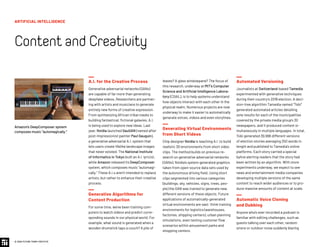
faces, necks and forearms were in vogue. In
the 1920s, makeup artist Helena Rubinstein
experimented with kohl to invent mascara
for the silver screen, which set off a new
trend in long, jet-black eyelashes. Today,
artificial intelligence, augmented reality,
and smart cameras are converging at an
interesting moment in time: We are under
133
continual surveillance and many of us are
striving to look our best. In China, many
people now use facial recognition to pay for
everything from groceries to taxi cabs. It
isn’t privacy that has many Chinese people
concerned, but rather how they look in all
of the next-gen pay-by-face apps. A poll by
Chinese news organization Sina Technology
revealed that 60% of those who use facial
recognition for payments feel self-con-
scious about how they look and would prefer
a system of payment that is more flattering.
In response, payment giants like Alipay—
that’s Alibaba’s e-wallet subsidiary, which
counts more than a billion monthly active
users—are building in beauty filters to their
systems. This could have a reverberating
effect as more digital payment companies
enter the marketplace and competition for
market share heats up. Consumers might be
willing to pay higher transaction fees in ex-
change for looking great (or at least avoiding
looking bad) while they make purchases.
Vaping and E-cigarettes
Last year was terrible for the electronic cig-
arette industry, and worse for the hundreds
of people who became very ill after using
the devices. The Centers for Disease Con-
trol and Prevention confirmed 64 deaths in
the U.S. from vaping-related illnesses. The
majority of people who got sick were using
black market or modified e-liquids or prod-
ucts that contained tetrahydrocannabinol
(THC). A new federal law raised the legal age
to buy tobacco products in the U.S. from 18
to 21, and the Food and Drug Administration
banned most flavored e-cigs. Juul Labs,
which dominates the e-cig market and is
largely blamed for America’s vaping epi-
demic, voluntarily discontinued its flavored
products, with the exception of tobacco and
menthol flavors. Many competing brands
including Puff, blu, Posh, and Stig, now pro-
duce pre-charged, pre-filled vaping devices,
and they’re cheaper than Juul pods.
Nootropics
If you need to manage stress or focus,
you might look to “nootropics,” cognitive
enhancement drugs that promise to help
keep you calm and attentive. These dietary
supplements have been shown to improve
cognitive function—even if they’re not
officially regulated or approved by the FDA.
You may already be taking a few: caffeine,
red reishi mushrooms, ginseng, turmeric,
ginkgo biloba, and Bulletproof coffee are all
popular, while natural supplements like cre-
atine, L-theanine and Bacopa monnieri are
also being marketed to help promote mental
clarity, focus, and information retention.
Synthetic compounds, like Adrafinil and
Noopept, last longer and take effect within
minutes. By some analyst estimates, the
nootropic market could reach $11 billion in
America alone by 2024.
Neuroenhancers
Neuroenhancer devices aim to record brain
waves and send feedback. Some promise
to help you become more productive, while
others are meant to boost your mood.
Australia-based SmartCap uses a tracking
system with voice warnings and vibrations
to keep you alert while on the job. The
Muse headband uses neurofeedback to
help manage stress and improve athletic
performance. The Emotiv Epoc+ and Emotiv
Insight and mobile EEG devices monitor your
brain activity and analyze cognitive perfor-
mance. Doppel, which is worn on the wrist,
uses electric pulses to augment your energy.
The pulsations, which you dial in based on
your needs, are supposed to have an effect
on your brain similar to that of music. The
Thync Kit is a series of electrodes and a
triangular device that you stick on to your
head—as well as a mobile app synced you
to your smartphone. It delivers low-grade
electric pulses to influence either your
sympathetic (fight or flight) or your parasym-
pathetic (rest and digest) nervous system.
Of course, this same technology can be used
for nefarious purposes. In China, the military
and some businesses now use connected
headbands and hats to monitor employee
brain activity. This emotional surveillance
technology is said to optimize productivity—
State Grid Zhejiang Electric Power, based in
Hangzhou, reported its profits spiked $315
million since using neuroenhancer devices
and software to mine, refine, and analyze
employee brain data.
© 2020 FUTURE TODAY INSTITUTE
Vicescont.
Bulletproof makes neuroenhancing
supplements.
135
2ND YEAR ON THE LIST
Digital Addiction
Key Insight
The notion that gaming, apps, and other
digital products can interfere with a per-
son’s day-to-day life used to be a punchline.
Now the idea is broadly accepted—even
Facebook’s internal research team has
acknowledged that passively consuming
information can be linked to feeling badly.
Why it Matters
Digital products rely on habit-forming
features for success, but a growing body of
research highlights the negative impacts
that those sticky features can have on
mental health and well-being. Some new
products aim to find a technical solution to
digital addiction.
Examples
The World Health Organization added
gaming disorder to the next edition of the
International Classification of Diseases in
May 2019, making it one of the few be-
havioral health addictions to gain formal
recognition. In the tech realm, companies
are responding with design changes to
reinforce healthy device use. Instagram
experimented with removing public like
counts to discourage users from comparing
themselves to others. Several startups are
pursuing mini-smartphones designed with
smaller screens and stripped down inter-
faces to encourage users to look at their de-
vices less often. Google and Apple continue
to develop features that help users monitor
their digital well-being and “screen time.”
What’s Next
As concern about digital addiction increases,
consumers will become less tolerant of so-
called “dark patterns” that use psychological
cues to induce greater consumption. Before
launching habit-forming features, teams
should stop and consider how the product
could cause harm or be purposefully abused.
The Impact
Every business model for media hinges on
commanding the attention of an audience.
As social attitudes toward technology shift,
product designers should be mindful that
they’re not perceived as eliciting detrimen-
tal behavior or harming the physical and
mental health of their users.
Watchlist
Amazon, Apple, Common Sense, Center for
Humane Technology, Facebook, Instagram,
Google, Palm, TikTok, Twitch, Twitter, World
Health Organization, gaming consoles and
systems.
In 2019, digital addiction became a
classified disorder.
INFORMS
STRATEGY
REVISIT
LATER
ACT
NOW
KEEP
VIGILANT
WATCH
HIGH DEGREE OF CERTAINTY
LOW DEGREE OF CERTAINTY
IMMEDIATEIMPACT
LONGER-TERMIMPACT
It’s been an interesting few years for the sex tech industry. In 2019, the Consumer Electron-
ics Show awarded its prestigious CES Innovation Prize in the robotics and drone category
to Ose, a prototype of a robotic, hands-free vibrator developed in part by Oregon State
University’s robotics and engineering lab. But when lead designer Lora Haddock DiCarlo
showed up to her booth at CES, she learned that the Ose had suddenly been disqualified for
being “profane,” “obscene,” and “immoral.” There was backlash, boycotting, public outcry, a
media blitz, and, eventually, some measure of redemption. In January 2020, CES devoted an
exhibition area to sex tech, and a dozen companies showed up to display their innovations.
The sex tech industry still has walls to break down—we’re not comfortable as a society
talking about sex and sexuality. But Cindy Gallop, a longtime advertising executive and
famed former U.S. president of the global creative agency Bartle Bogle Hegarty, thinks
it’s a mistake to ignore the market potential of sex tech. In 2009, she shared her idea for
the future of sex on the main TED stage, originally as a public service website called “Porn
World vs Real World.” A positive global response led to the founding of MakeLoveNotPorn,
the first user-generated, human-curated video sharing platform designed to promote
consent, communication, good sexual values and healthy sexual behavior. She also started
the world’s first sex tech venture fund, AllTheSkyHoldings. As Cindy explains, despite our
squeamishness talking about sex, the market is worth an estimated $30 billion. And Stra-
tistics, a market research firm, thinks that number is about to skyrocket—it estimates the
industry could be worth $123 billion by 2026.
So why aren’t we hearing more about sextech? Blame the algorithms. Some people would
be embarrassed to see a sextech ad show up in their Facebook feed or on a website at work,
which is why Google and Facebook, the world’s largest digital advertising platforms, restrict
such advertising. But we are at the beginning of a shift, which some think will bring inclusiv-
ity, awareness, and acceptance. The future of sex tech will help shape adjacent tech trend
areas, including home automation, health technologies, artificial intelligence, recognition,
security, and privacy.
The Future Today Institute invited Cindy to share some of the emerging sex tech trends on
her radar, and to describe how the future of the market and industry will be shaped.
Cindy Gallop: As I regularly point out, the three huge disruption opportunities in tech today
are sex, cannabis and the blockchain - yet ironically, investors are flocking to the other two
categories more than the first. This is a world that has operated through a patriarchal lens
for far too long, which is why sex toys have been phallic shaped. We as women have never
been permitted to bring our lens to bear on human sexuality, and the world is a poorer place
for it. Female sextech founders are changing that. Ti Chang founded Crave, which makes
gorgeous vibrators that can be worn around your neck. They’re jewelry—pendants that
can be charged via USB. They also now make rings. The real innovation is in female-lens
vision, which goes far beyond the staid male-lens belief that sex toys have to be humanoid
or robots. Female-founded sextech doesn't need to depend on the male anatomy to bring
disruptive approaches to pleasure.
Nobody is building or funding the Comscore of sex, yet data is a huge trend. And not just in
the areas of teledicdonics and virtual reality sex. Yes, there are toys and vibrators that can
be remotely controlled by long-distance partners using mobile apps, and artificial intelli-
gence comes into play too. For example, the Lioness tracks data in order to improve orgasm
over time. In that arena, MLNP is an utterly unique data resource, because we capture no
personal data, and we are able to provide aggregated, de-identified insights into the overall
full spectrum of human sexuality.
Sextech is becoming more complicated to use. LELO once sent a special black and gold
TIANI couples massager, and I opened the box, looked at the beautiful object and found
© 2020 FUTURE TODAY INSTITUTE
Sextech Trends
 QA ON SEXTECH
myself asking how I was supposed to use it. There were no instructions in the box beyond a
one-pager that explained how to charge it. So I went to YouTube and found a video desper-
ate to be safe for work featuring a “Stepford Woman” describing how to use the massager,
which was impossible to understand. You can design the most cutting-edge sex toy in the
universe, but if a couple can't bring themselves to talk to each other about their sex life,
they'll never buy and use it.
Which brings me to the most important, if overlooked trend: Socially acceptable sex is an
area of big growth. The money to be made out of socially acceptable sex! Normalizing sex
makes it easier for everyone to openly promote consent, communication, good sexual lives
and good sexual behavior. A million people visited MakeLoveNotPorn.tv last year, which tells
you something about the market potential for socially acceptable sex.
– As told to the Future Today Institute
137
CINDY GALLOP, FOUNDER AND
CEO OF IfWeRanTheWorld AND
MakeLoveNotPorn AND FOUNDER
OF AllTheSkyHoldings
11 Journalism
140	 Continued Media
	Consolidation
141	 The Subscription
	 Economy Matures
142	 Optimizing for New
	 Types of Search
143	 Investigating
	 the Algorithms
144	 Journalism as a Service
145	 One-To-Few Publishing
146	 Popup Newsrooms
	 and Limited-Edition
	 News Products
148	 Demands for
	Accountability
	 and Trust
149	 The First Amendment
	 in a Digital Age
139
5TH YEAR ON THE LIST
ContinuedMediaConsolidation
© 2020 FUTURE TODAY INSTITUTE
INFORMS
STRATEGY
REVISIT
LATER
ACT
NOW
KEEP
VIGILANT
WATCH
HIGH DEGREE OF CERTAINTY
LOW DEGREE OF CERTAINTY
IMMEDIATEIMPACT
LONGER-TERMIMPACT
Key Insight
Consolidation continues as regulations shift
in the U.S. and margins shrink for traditional
media companies. As ownership concen-
trates into a handful of conglomerates,
historic norms about diversity in the press
and on the airwaves are challenged.
Why It Matters
Legacy news publishers will continue to
face intense merger pressure this year.
Examples
Last year saw the completion of mega
deals that were years in the making: CBS
and Viacom spent much of the year flirting
before coming to terms and finalizing their
reunion in December. Disney and Fox com-
pleted their merger in March, a deal so large
it shifted control of Hulu. An appeals court
gave final clearance for ATT’s acquisition
of Warner Media in February, rejecting the
Justice Department’s argument that the
deal was anti-competitive.
Just weeks after Gannett defended itself
from a hostile takeover bid from Digital First
Media, Gannett and Gatehouse Media—the
two biggest newspaper publishers in the
United States—announced plans to merge.
Alden Global Capital, a hedge fund that
owns a chain of newspapers under the name
Media News Group, became the largest
shareholder in Tribune Publishing, an Amer-
ican newspaper publisher, in September.
U.S. telecommunications firm Nexstar
acquired Tribune Local Media in Septem-
ber, creating the largest operator of local
television stations in the country. That deal
required Nexstar to divest from 21 stations
in order to comply with Federal Communi-
cation Commission regulations about media
ownership.
The extent of media concentration means
those FCC regulations have started to pro-
duce counter-intuitive outcomes: In Ohio,
three daily newspapers owned by Cox Media
Group changed their publication schedule
to three days per week after Apollo Global
Management acquired a controlling share.
(FCC rules on cross-ownership only apply to
newspapers that publish four or more times
per week).
What’s Next
FCC Chair Ajit Pai’s push to deregulate has
accelerated the pace—and the corporate
benefits—of consolidation. More recent FCC
votes may have a more immediate impact
on the local news landscape and corporate
profits: At the FCC’s August meeting, the
Republican-appointed majority voted to
limit the ability of municipalities to assess
“franchise fees” that support local access
TV stations and other community ser-
vices. The new rule will likely boost profits
for internet service providers and reduce
the capacity for publicly-funded media to
compete.
The Impact
Media consolidation affects governments,
businesses and citizens everywhere.
Watchlist
Asahi Shimbun Company, ATT, CBS, Cen-
ter for Innovation and Sustainability In Local
Media at the University of North Carolina
at Chapel Hill, Comcast, Cox Media Group,
Digital First Media, Disney, FCC, Gannett,
Grupo Globo, Hearst, Hubert Burda Media,
ITU, local access channels, Meredith Corp,
Microsoft, News Corp, Nexstar, Sinclair
Broadcast Group, Univision, news organiza-
tions everywhere.
In January 2020, Warren Buffet’s Berkshire
Hathaway sold its newspaper holdings for
$140 million to Lee Enterprises.
1ST YEAR ON THE LIST
TheSubscriptionEconomyMatures
141
INFORMS
STRATEGY
REVISIT
LATER
ACT
NOW
KEEP
VIGILANT
WATCH
HIGH DEGREE OF CERTAINTY
LOW DEGREE OF CERTAINTY
IMMEDIATEIMPACT
LONGER-TERMIMPACT
Key Insight
Whether you call it a subscription, a mem-
bership or a donation, we’re living in the age
of audience revenue. For media compa-
nies—news outlets especially—that means
business incentives may soon align what
consumers want.
Why It Matters
The risk is that the propagation of subscrip-
tions will overwhelm audiences’ willingness
(or ability) to pay.
Examples
Everywhere you look, a new subscription
product is launching: Disney+ and Apple TV
joined the crowded streaming subscription
landscape last year. Conde Nast announced
in January 2019 that it was putting all of its
magazine websites—historically ad support-
ed—behind a paywall. Local newspapers are
pushing to launch new subscriptions or to
refine existing offerings. And it’s not just in
media: There are subscription services for
toothbrushes (Quip), “ugly” discount vegeta-
bles (Misfits Market) and probiotics (Seed).
Launching a subscription or membership
program is relatively easy. Keeping your
subscribers is harder: A report from sub-
scription service platform Zuora estimated
an average annualized churn rate of nearly
34% for media business, the highest of any
sector studied. Churn isn’t just a legacy me-
dia problem, though: on-demand streaming
services suffer higher churn rates than
news media, according to estimates cited
by The Information.
July marked the first time that Netflix
reported a loss in domestic subscribers,
and the streaming service has reported flat
numbers in the U.S. since then. The plat-
form is still expected to grow internationally,
but the lesson about saturation is important
for anyone pursuing a subscription model,
especially niche and local publishers. The
Los Angeles Times sought to double its
digital subscriber base to 300,000 in 2019,
according to a memo leaked in July. While
the Times was able to add more than 50,000
new subscribers, its net growth was only
13,000 because of churn.
What’s Next
Look for more services that monitor—and
cancel—unused subscriptions or free trials,
such as True Bill and Free Trial Card. In
California, companies selling subscriptions
must now offer a clear way to cancel them
online, thanks to California Senate Bill No.
313, which went into effect in July 2019.
The Impact
Watch for consumers to become more dis-
criminating in their choice of subscriptions
as more companies compete for a fixed
share of wallet. For publishers, that means
a focus on improving subscriber retention,
not just recruiting lots of new users.
Watchlist
Apple TV, Conde Nast, Disney+, Bean, Do
Not Pay, Free Trial Card, Knewz, Netflix,
Membership Puzzle Project, Scroll, True Bill,
news organizations and media worldwide.
News Corp launched its Knewz aggregation
platform in January 2020.
4TH YEAR ON THE LIST
OptimizingforNewTypesofSearch
© 2020 FUTURE TODAY INSTITUTE
INFORMS
STRATEGY
REVISIT
LATER
ACT
NOW
KEEP
VIGILANT
WATCH
HIGH DEGREE OF CERTAINTY
LOW DEGREE OF CERTAINTY
IMMEDIATEIMPACT
LONGER-TERMIMPACT
Key Insight
As voice interfaces proliferate in people’s
lives, publishers and other organizations face
a new strategic consideration: Is our content
optimized for voice search? And, looking
further into the future, how should we index
our content for future forms of interaction?
Why It Matters
Most people still find the majority of infor-
mation they consume through search.
Examples
A number of companies are racing to index
podcasts, radio shows and music, just as
Google has done so for traditional, text-
based web content. Companies like Trint
help publishers transcribe audio to make
it more searchable by traditional crawlers,
while other startups like Audioburst are
trying to use technology to actually “listen”
to data previously locked into a waveform
and make these units of audio more navi-
gable. Audioburst’s technology ingests and
analyzes audio and uses natural language
processing to understand its contents, con-
textualize it and make it all searchable.
At the same time, the line between
old-fashioned web pages and audio content
is blurring. New markup tools let publishers
help machines (like voice assistant A.I.s)
“read” written content and translate it into
spoken audio. Google recently released a
structured data markup called Speakable
that publishers can use to optimize their
content by marking up sections of news
articles and optimize them to be read aloud
by Google’s smart assistant. (The specifica-
tions are listed on Schema.org.)
The ultimate goal is to deliver a seamless
experience when a user asks their digital
assistant: “Tell me the news.” For now,
a cottage industry of new formats and
distributors is growing to bridge the gap
between what newsrooms produce today
and native programming that fits the syntax
of spoken interaction. The startup Spo-
ken Layer and pilot partnerships between
Google and select news organizations are
taking on this challenge.
What’s Next
Voice Search Optimization (VSO) is the new
Search Engine Optimization (SEO). Compa-
nies will need to consider how their content
is delivered via conversational interfaces.
As VSO catches on, we may see marketers
and publishers attempt to outsmart voice
search algorithms with black hat trickery.
The algorithms will need to adapt accord-
ingly, deterring manipulation of search
optimization without docking legitimate
content sources (a challenge we’ve seen
play out before on the pre-voice web).
Spatial computing is in its infancy today, but
it will raise similarly complex questions for
creators. In the future, consumers might
expect to be served stories that are relevant
to what they are looking at through smart
glasses. Do today’s content management
systems support the kinds of indexing that
anticipate that technology?
The Impact
Searches based on conversation or what a
user is looking at will be highly contextual,
requiring sophisticated algorithms to antic-
ipate the intent of a query and the relevancy
of results.
Watchlist
Amazon, Apple, Audioburst, Facebook,
Google, Listen Notes, Spoken Layer, Trint,
and marketing and news organizations
everywhere.
The more we interact with computers, the
more companies will need to optimize for
new types of searches.
6TH YEAR ON THE LIST
InvestigatingtheAlgorithms
143
INFORMS
STRATEGY
REVISIT
LATER
ACT
NOW
KEEP
VIGILANT
WATCH
HIGH DEGREE OF CERTAINTY
LOW DEGREE OF CERTAINTY
IMMEDIATEIMPACT
LONGER-TERMIMPACT
Key Insight
News organizations must do better at
explaining how algorithms and big data
shape our world. To hold artificial intel-
ligence-powered systems accountable,
reporters will need the technical skills to
unpack how algorithms function and explain
that process to a non-technical audience.
Why It Matters
With the increased use of data and algo-
rithms powering our everyday lives, new
teams are being deployed to investigate
algorithms and the companies using them.
Examples
The Washington Post and The Wall Street
Journal both launched teams of reporters
with computer science skills last year. The
Markup, a startup funded by Craig Newmark
Philanthropies and populated with alumni
from ProPublica and other newsrooms, is
set to start publishing this year. The Markup
aims to explore the societal impacts of big
tech and algorithms and plans to release
tools to help others investigate how data is
being used by third parties.
Last year, the New York Times opinion team
launched the Privacy Project, a series that
explains how firms amass incredibly precise
location data from nearly every smart phone.
(The series culminated in December.) That
analysis would not have been possible with-
out blending multiple disciplines: process-
ing geospatial information, tracing internet
traffic, explaining technical concepts and, of
course, developing a source willing to leak
an incredibly valuable dataset.
What’s Next
News organizations must train their report-
ers to broaden their techniques. As tech-
nology advances, it is harder for laypeople
to understand how systems function—even
as those systems become more deeply
embedded in the fabric of our society.
Understanding where information comes
from, how it spreads and the impact it has—
not to mention explaining the outcomes of
algorithmic decision-making—are central
responsibilities for journalists who wish to
hold powerful systems accountable.
The Impact
Dedicating resources to investigating
algorithms has never been more important
than it is right now, as we all seek to gain a
better understanding of new technological
systems with immense influential power.
Watchlist
Computational Journalism Lab at North-
western University, The New York Times,
The Markup, ProPublica, Tow Center for
Digital Journalism at Columbia University,
The Wall Street Journal, Washington Post
computational journalism team (led by Jere-
my Bowers).
Journalists are starting to investigate the
algorithms and sources of data that com-
panies are using.
6TH YEAR ON THE LIST
JournalismasaService
© 2020 FUTURE TODAY INSTITUTE
INFORMS
STRATEGY
REVISIT
LATER
ACT
NOW
KEEP
VIGILANT
WATCH
HIGH DEGREE OF CERTAINTY
LOW DEGREE OF CERTAINTY
IMMEDIATEIMPACT
LONGER-TERMIMPACT
Key Insight
“Software as a Service” is a licensing and
delivery model, in which users pay for on-de-
mand access. “Journalism as a Service” lets
news organizations sell on-demand access
to the components of their reporting, rather
than just the finished product.
Why It Matters
On the fringes, news organizations are
beginning to provide journalism as a service
in addition to traditional news products,
allowing outside parties to avail themselves
of the organization's functional resources
and assets—for a price.
Examples
ProPublica’s data store launched as an
experiment in 2014. Two years later, the idea
had generated more than $200,000 for the
non-profit newsroom. The store includes
free, open source data products (like Pro-
Publica’s API for accessing information about
Congress) and paid products that have been
organized and processed (like a regularly
updated database of payments by pharma-
ceutical providers to doctors). Transitioning
to “Journalism as a Service” enables news
organizations to fully realize their value to
everyone working in the knowledge econo-
my—universities, legal startups, data science
companies, businesses, hospitals, and even
big tech. News organizations that archive
their content sit on an enormous corpus—
data that can be structured, cleaned and
used by numerous other groups.
What’s Next
News deployed as a service includes dif-
ferent kinds of parcels: news stories; APIs;
databases that can be used by both the
newsroom and paying third parties; calendar
plug-ins for upcoming news events; systems
that can automatically generate reports
using the news org’s archives and databas-
es, and so on. Services work outside of the
social media landscape, relieving news or-
ganizations of revenue sharing and allowing
them to fully monetize their services.
The Impact
Journalism as a Service models are provid-
ing much-needed revenue to cash-strapped
news organizations.
Watchlist
The Coral Project, The Information, MIT
Media Lab, ProPublica, PRX, REDEF Group,
Twilio.
ProPublica offers APIs and other services
to developers who want to build apps.
6TH YEAR ON THE LIST
One-To-FewPublishing
145
INFORMS
STRATEGY
REVISIT
LATER
ACT
NOW
KEEP
VIGILANT
WATCH
HIGH DEGREE OF CERTAINTY
LOW DEGREE OF CERTAINTY
IMMEDIATEIMPACT
LONGER-TERMIMPACT
Key Insight
Newsletters, podcasts and niche networks
can captivate and connect with small, loyal
audiences. Those products thrive on their
authenticity, helping them to fundraise or to
deliver a curated cohort to advertisers.
Why It Matters
Small networks can be uniquely valuable
because of their dedicated fanbase—but
they can also be dangerous: trusted net-
works can spread misinformation that goes
unchecked.
Examples
It’s easier than ever to start a newsletter
or a podcast and get paid for your work. Ser-
vices like Substack and Revue offer tools
to launch a subscription newsletter, while
platforms like Patreon make it easy to col-
lect recurring payments for various forms of
creation. There’s evidence that people are
willing to pay for highly specialized me-
dia, whether it’s paying gamers for Twitch
streams or contributing to a Kickstarter
campaign for a new idea. Venture capital
firm Andreessen Horowitz announced in
July that it would invest in Substack, sug-
gesting we may see accelerated investment
in the space.
Not all niche networks are high-tech: In
June, Wired reported about the role of
conference calls in spreading anti-vax pro-
paganda in ultra-Orthodox Jewish commu-
nities in Brooklyn. In a community that gen-
erally distrusts outside influences and the
internet, the recorded conference calls had
credibility because they were facilitated by
a member of the community. That’s a similar
challenge to the one faced by WhatsApp in
2018, when rumors about child kidnapping
spread quickly in rural India via the mes-
saging service, leading to a series of mob
lynchings. Despite efforts by WhatsApp to
limit the number of times a message can be
forwarded, the proliferation of viral rumors
on the platform persist: WhatsApp was a
major source for disinformation during the
2019 Nigerian general election.
What’s Next
Tight-knit communities will become stron-
ger as Facebook emphasizes private groups
and as micro-influencers gain credibility.
Informal networks like WhatsApp groups
satisfy a basic human need to connect, but
risk further isolating niche communities by
amplifying a group’s beliefs whether or not
they are accurate.
The Impact
Major media companies have an opportu-
nity to develop audiences around specific
columnists or reporters, but it’s uncertain
how that might successfully scale.
Watchlist
Auphonic, Garage Band, Iterable, Kickstart-
er, Libsyn, Mailchimp, Patreon, PRI, PRX,
RadioPublic, Revue, Signal, Skype, Sound-
Cloud, Sounderfm, SpeakPipe, Square,
Stitcher, Substack, Telegram, TinyLetter,
Twilio, WhatsApp.
Judd Legum publishes a popular paid
newsletter on Substack.
6TH YEAR ON THE LIST
PopupNewsroomsandLimited-Edition
NewsProducts
© 2020 FUTURE TODAY INSTITUTE
INFORMS
STRATEGY
REVISIT
LATER
ACT
NOW
KEEP
VIGILANT
WATCH
HIGH DEGREE OF CERTAINTY
LOW DEGREE OF CERTAINTY
IMMEDIATEIMPACT
LONGER-TERMIMPACT
Key Insight
News organizations are using pop-up
newsrooms and limited-edition products
to achieve strategic goals. Collaborative
newsrooms can focus on a single topic or
project, boosting reach and helping uncover
deeper stories.
Why It Matters
Limited-run podcasts, newsletters and
event series identify engaged readers and
help test new ideas.
Examples
During the 2016 and 2018 elections, the
Electionland coalition brought together
more than 1,000 journalists across the Unit-
ed States to cover problems that prevent
eligible voters from casting a ballot. The
project provided a structure for seeking
out stories on social media and ensuring
those stories were covered. More regularly,
groups like the International Consortium of
Investigative Journalists work together to
build scoops across borders.
In March 2019, BuzzFeed distributed a single
day print edition in New York. The move
was a stunt, but it generated a stream of
engagement online. At subscription-driven
publications, limited-run projects can be an
opportunity to deliver additional subscriber
benefits or to develop a new audience. The
New York Times Magazine’s 1619 Project
was a collaboration with the Smithsonian
Institute that included a limited-run pod-
cast, special issue of the magazine, reader
interaction and live events on the history
and legacy of slavery in the United States.
What’s Next
We expect to see a flurry of collaboration
surrounding the 2020 presidential primary
and general election, building on initiatives
like the Electionland coalition.
The Impact
News organizations that launch limited-run
news products will increasingly have spe-
cific subscriber engagement goals; these
tools could also be used to collect first-par-
ty data for targeted ad sales.
Watchlist
News organizations everywhere.
Electionland is a coalition of newsrooms
around the country that are covering mis-
information, cybersecurity, and problems
that prevent eligible voters from casting
their ballots during the 2020 elections.
SCENARIOS • SAM GUZIK
Funding a Vibrant
Media Landscape
NEAR-FUTURE OPTIMISTIC SCENARIO
Local news is on a growth trajectory. Audience
revenue funds much of the news operation,
but it’s only one of multiple revenue streams
for most publishers. The most successful
outlets are thriving because they invested not
only in their newsrooms but also in experi-
mental projects that opened up new lines of
business. Those ventures were fueled by close
collaboration between newsroom and busi-
ness teams; most often, they relied on input
from across the organizational structure, not
just leadership.
Meet the New Business
Model, Same as the Old
Business Model
NEAR-FUTURE PRAGMATIC SCENARIO
Yesterday you were a subscriber to your local
newspaper; today you are a member. Not much
has changed, though: You get regular, person-
al email updates from reporters and editors
(and sometimes you even read them!). There’s
a “Local Deals” section in the newspaper’s
online “Member Center,” but you’ve only visited
the page once. Even though you don’t read a
full article every day (or even every week), you
feel like you get value from the push notifica-
tions sent directly to your phone. Most of your
friends aren’t members—they hear the news
from you or visit the paper’s website once or
twice a year. There are enough people like you,
however, that the paper is stable. The news-
room isn’t as big as it once was, but its leader-
ship has successfully struck a delicate bal-
ance: Asking for more money from members,
but still maintaining an audience large enough
to be valuable to advertisers.
The Audience Can’t
Afford to Pay
NEAR-FUTURE CATASTROPHIC SCENARIO
As subscriptions become the default format
for consuming news, entertainment and daily
essentials, consumers must make hard choic-
es about how to spend their money and time.
Churn increases for all subscription products,
but local news outlets are hit particularly hard
because their potential subscriber base is
geographically limited. The decision to go “all
in” on audience revenue seems like a great
idea on paper, but pushes outlets with few
options to pivot as the competitive landscape
shifts. Publishers fail to anticipate the extent
that non-media subscriptions eat up consum-
ers’ budgets. Newspapers and websites in
large cities and dense suburbs have a critical
mass of folks willing to pay, but constantly
fight to maintain their revenue, because a
substantial portion of their audience is en-
ticed with introductory offers and sales. Rural
areas and small cities increasingly become
news deserts because they lack the population
density to raise enough subscription revenue
to support a newsroom.
147
6TH YEAR ON THE LIST
DemandsforAccountabilityandTrust
© 2020 FUTURE TODAY INSTITUTE
INFORMS
STRATEGY
REVISIT
LATER
ACT
NOW
KEEP
VIGILANT
WATCH
HIGH DEGREE OF CERTAINTY
LOW DEGREE OF CERTAINTY
IMMEDIATEIMPACT
LONGER-TERMIMPACT
Key Insight
The spread of misinformation will contin-
ue until platforms and news organizations
adopt norms and standards for accountabil-
ity and trust.
Why It Matters
Last year, American trust in media declined.
According to a Pew Research Center poll,
roughly 30% of Republicans and Republi-
can-leaning independents said that journal-
ists have “very low” ethical standards.
Examples
A healthy dose of skepticism makes for a
strong electorate. But deepfakes, inten-
tionally misleading stories, and salacious
content posted by political operatives, hack-
ers, and foreign governments have led to
increased calls for new methods to rebuild
our trust in the media.
In August 2019, Twitter finally published
a blog post exposing a series of Chinese
Twitter bots that were intentionally spread-
ing misinformation on the platform. Along
with this transparency about the presence
of these bots, Twitter removed them and
also promised not to accept sponsored
posts from known rogue actors (state or
otherwise).
What’s Next
There is no clear financial incentive for plat-
forms or news organizations to use a stan-
dardized system to prove a piece of content’s
authenticity. Lawmakers have hesitated to
propose legislation that would curb speech,
however it’s an election year and we’re likely
to be flooded with malicious content. As
platforms come under increased scrutiny
this year for issues related to antitrust, we
expect to see demands for transparency
and traceability. Just as supply chains are
inspected to ensure they’re secure, in the fu-
ture we could see new blockchain-powered
supply chains for information.
The Impact
Fake or misleading news itself is a problem.
But it’s also making people less likely to seek
out quality information.
Watchlist
Platforms and news organizations every-
where.
In 2019, doctored videos of Representative
Nancy Pelosi spread virally on Facebook
and Twitter.
5TH YEAR ON THE LIST
TheFirstAmendmentinaDigitalAge
149
INFORMS
STRATEGY
REVISIT
LATER
ACT
NOW
KEEP
VIGILANT
WATCH
HIGH DEGREE OF CERTAINTY
LOW DEGREE OF CERTAINTY
IMMEDIATEIMPACT
LONGER-TERMIMPACT
social media platforms—but other states
only prevent the government from regulat-
ing speech, allowing private entities to do as
they please.
A significant case in July 2019 clarified
Twitter’s status as a public forum—and how
the First Amendment applies on the plat-
form. The Second Circuit Court of Appeals
affirmed a lower court ruling in July that
President Donald Trump could not block
followers on Twitter. The three-judge panel
held that the First Amendment does not
permit a public official…to exclude persons
from an otherwise‐open online dialogue
because they expressed views with which
the official disagrees.”
The ruling is a major step toward defining
the rules of engagement for free speech
on the internet. But there are still deep,
unresolved questions. For example, does
the First Amendment protect bots or other
synthetic media? A California law went
into effect in July requiring that any bot
that tries to influence purchasing or voting
Key Insight
The First Amendment shapes how Silicon
Valley thinks about the design, development
and implications of technology. Its legal
protections are broad in scope but limited
in geography; they only apply in the United
States.
Why It Matters
Publishers and platforms will increasingly
need to consider how different expectations
of free speech inform their operations.
Examples
Constitutional law often lags behind tech-
nology, taking time to adapt and evolve
as historic concepts are applied to new
situations. Although social media has been
a central part of our political conversation,
courts are only now starting to specifically
consider how our rights apply online. State
courts in New Jersey recognize that speech
cannot be abridged by “restrictive and
oppressive conduct by private entities”—like
behavior identify itself. The Electronic
Frontier Foundation and others worried
that an earlier version of the bill would have
gone too far in stifling speech because of
careless definitions of the technology.
While the First Amendment's protections
in the U.S. are generally broad, its scope
is limited in an interconnected world:
Facebook has little legal exposure in the
U.S. because of the intersection of First
Amendment rights and protections from
Section 230 of the Communication Decency
Act, but it could be liable under Germany’s
hate speech laws. Even in the offline world
there is no global understanding of how to
protect “free speech,” and that makes defin-
ing online rights even harder.
What’s Next
Debates about the First Amendment boil
down to what “can” be said. Expect more
decisions that wrestle with clarifying what
is a public forum in the public sphere and
whether A.I.-generated text, video and
images are legally protected speech. And
there will be much murkier debates about
what “should” be published.
The Impact
Paying customers will naturally be more
invested in decisions made by the orga-
nization, and those choices — whether it's
sharing or withholding a fact, opinion or
photo — may only fuel the debate.
Watchlist
American Civil Liberties Union, Electronic
Frontier Foundation, European Union, Fed-
eral Communications Commission, Federal
Trade Commission, Knight First Amend-
ment Institute at Columbia University, U.S.
Supreme Court.
12 Censorship
152	 The Proliferation
	 of Splinternets
154	 Content Moderation
	 in the Name of National 	
	Security
156	 Digitally Retouching
	History
151
4TH YEAR ON THE LIST
TheProliferationofSplinternets
© 2020 FUTURE TODAY INSTITUTE
INFORMS
STRATEGY
REVISIT
LATER
ACT
NOW
KEEP
VIGILANT
WATCH
HIGH DEGREE OF CERTAINTY
LOW DEGREE OF CERTAINTY
IMMEDIATEIMPACT
LONGER-TERMIMPACT
Key Insight
The founding promise of the digital world
was broad connectivity where information
could flow freely. But as some governments
take steps to filter (or completely block) ac-
cess to the internet, and paid subscription
models make access to reliable information
a luxury, we now have a splintered internet
rather than a single world wide web.
Why It Matters
Twenty years ago, the internet emerged as a
global space where information was shared
freely. Now, everyone has a different idea
of how our global information superhighway
ought to be regulated, and by whom.
Examples
Nation-scale internet censorship is most
closely associated with China’s “great
firewall.” The Chinese government aggres-
sively monitors the internet and removes
information that doesn’t meet its political
standards. At times of political unrest, as
during widespread riots in Xinjiang in 2009,
China has completely shut down access to
the internet. China’s leadership believes its
restrictive model contributes to stability—
and is open to exporting that approach to
the rest of the world. “We should respect the
right of individual countries to independent-
ly choose their own path of cyber-develop-
ment,” said Chinese President Xi Jinping at
China’s second World Internet Conference
in 2015.
In 2019, we saw ample signs of nations
learning from the Chinese playbook: There
were nearly 130 documented internet shut-
downs in 29 countries between January and
July 2019, according to the advocacy group
Access Now. Those include a shutdown in
the Democratic Republic of the Congo after
an alleged election hijacking effort, and
India’s internet blackout in Kashmir—the
longest ever in a democracy.
Splinternets—the various versions of a now
fractured internet—aren’t just the product
of blocking free access to the internet;
The future of the internet is fractured.
153
sometimes it's enough to simply increase
the barriers to finding reliable information.
Those can be technical roadblocks—as in
a censorship regime that doesn’t remove
websites, but knows the average user won’t
have the knowledge or time to connect
through a VPN to reach unfiltered informa-
tion—or they can be financial ones.
Even in nations with unrestricted internet
access, the business model for many online
creators is shifting to paid subscriptions.
Creators deserve to be paid for their work,
but we haven’t begun to wrestle with the
implications of a media ecosystem in which
the wealthy can afford to consume the
news and entertainment they wish, and
others cannot. We’re already starting to see
evidence of this classist dynamic in online
gaming: “Children are scorned in games
such as Fortnite if they are seen to wear the
‘default skin’ (the free avatar they receive
at the start of the game),” a report by the
Children’s Commissioner of the U.K. found.
“Children say they feel embarrassed if they
cannot afford new ‘skins,’ because then their
friends see them as poor.”
What’s Next
For governments dealing with social unrest,
the playbook increasingly includes trying to
disrupt the digital tools activists use to or-
ganize. If it becomes clear that leaders can
follow that playbook with impunity, expect
it to be increasingly adopted by democratic
governments.
Mitigating the impacts of political and
financial splinternets will require coming to
a broad, international consensus about how
human rights apply in a digital age: Is there
a fundamental human right to connect free-
ly? Is blocking access to the internet a war
crime? If a video, meme, or report is illegal
in one country but protected in another,
how should ISPs respond?
The Impact
As nations start to implement 5G infrastruc-
ture, questions of network interoperability
will become increasingly relevant. If ten-
sions between the U.S. and China continue,
there’s a risk that components built with
American technology will not be compati-
ble with those built by Chinese firms. That
could embed the fracturing of the web at a
hardware level, making it more difficult to
combat in the future.
Watchlist
Access Now, China’s government, Freedom
House, Software Freedom Law Centre
(India).
4TH YEAR ON THE LIST
ContentModerationinthe
NameofNationalSecurity
© 2020 FUTURE TODAY INSTITUTE
INFORMS
STRATEGY
REVISIT
LATER
ACT
NOW
KEEP
VIGILANT
WATCH
HIGH DEGREE OF CERTAINTY
LOW DEGREE OF CERTAINTY
IMMEDIATEIMPACT
LONGER-TERMIMPACT
Key Insight
It may seem counterintuitive, given that
there is so much talk of regulating big tech,
but government agencies worldwide expect
tech companies to help fight against the
spread of misinformation, propaganda and
terrorism.
Why It Matters
Content moderation and policing efforts
are being met with resistance from free
speech advocates from across the political
spectrum. Content surveillance and moder-
ation will be ever important battlegrounds
around the world for states, companies and
individuals.
Examples
Content moderation is a critical consid-
eration in the design and development of
online platforms, and requires decisions
about the legal protections afforded to
creators and users of technology. Through-
out history, governments have restricted
content and its distribution in the name
of security and morality. After the advent
of the printing press, the Catholic Church
started publishing a list of prohibited books
in 1559. This practice continued until 1966.
With the internet age, content moderation
has become a larger technical challenge not
just for governments and institutions, but
for media and tech companies as well.
Throughout 2018 and 2019, both the U.S. and
European governments held several heated
public hearings with representatives from
Twitter, Google and Facebook in the wake
of controversial elections and increasingly
polarized public discourse. Tech companies
are inconsistent at best when it comes to
enforcing “community standards” of content
moderation and of free or acceptable
speech. Tech companies are struggling to
design algorithms that identify and censor
offensive and dangerous content such as
pornography and misinformation while pro-
tecting the right to personal expression.
Gab, a social network that champions free
speech, launched in 2017 mostly in response
to the suspension of the high-profile ac-
Gab raised more than $1 million in crowdfunding.
155
counts of controversial personalities such
as Milo Yiannopoulos and Alex Jones on
Twitter and Facebook. While Gab doesn’t
have the network effect of mainstream
players, expect to see more services like
it as content moderation policies become
more strictly enforced.
What’s Next
Lawmakers and tech companies alike
struggle with balancing tensions between
censorship, free enterprise, and national
security. The questions—and answers—are
complicated, and they involve all of us.
Google, Twitter and Spotify have all an-
nounced restrictions or complete bans on
political advertisements in 2020. Facebook
is the notable exception here, allowing polit-
ical ads without fact-checking for accuracy.
Moving forward, there are numerous
scenarios for how governments choose to
protect and police content, regardless of
whether it was created by a human or a bot.
One scenario could be that governments
decide freedom of speech protections
don’t extend beyond human-produced
speech. Down the road, certain content
produced via future technological advances
wouldn’t be protected either. But it’s unlikely
this would happen, because humans are
involved in programming bots. Another
potential outcome: human programmers
are protected under the First Amendment,
but A.I.-created speech is not. This makes
sense at some level, but it could fall short
when giving credit or blame to content
created by a human, versus A.I. technology.
Or, ultimately, the government could decide
that A.I.-produced content is considered
free speech, including any content pro-
duced by a voice interface or a bot. In the
end, it could open up the liability to legal
entities responsible for the content.
The Impact
Complex legal questions will arise, and
we’re likely to see various hybrids of these
scenarios in the future. The media and jour-
nalism will be at the center of these legal
questions around the world.
Watchlist
Amazon, Apple, Electronic Frontier Foun-
dation, European Union, Facebook, Federal
Communications Commission, Google,
Instagram, Gab, law enforcement, legal
scholars, media organizations, Microsoft,
Moritz College of Law, technology and priva-
cy advocates, technology company leaders,
Ohio State University, Twitch, YouTube.
1ST YEAR ON THE LIST
DigitallyRetouchingHistory
© 2020 FUTURE TODAY INSTITUTE
INFORMS
STRATEGY
REVISIT
LATER
ACT
NOW
KEEP
VIGILANT
WATCH
HIGH DEGREE OF CERTAINTY
LOW DEGREE OF CERTAINTY
IMMEDIATEIMPACT
LONGER-TERMIMPACT
Key Insight
Digital tools now give government agencies
the ability to edit, distort, or outright censor
content made by citizens.
Why It Matters
Digitally altering archival content—for
example, photos taken of a historic event—
can lead to misunderstanding and public
confusion in the future.
Examples
Throughout history, governments have
manipulated photos—in 2008, when it was
thought that North Korean dictator Kim
Jong-il was critically ill or had died, the
North Korean government released a photo
of Jong-il standing with his People’s Army.
Forensic experts suspected that his image
had been digitally inserted.
What’s Next
Early in 2020, an exhibit at the U.S. National
Archives celebrated the 100th anniversary
of women’s suffrage and included a series
of photographs taken at the first Women’s
March, held a day after President Donald
Trump’s inauguration. One of the photo-
graphs had been altered to blur placards
and signs that disparaged Trump. Signs that
depicted or referenced women’s anatomy
were also digitally edited. In the photo, a
sign that had originally read “Trump  GOP–
Hands Off Women” was digitally altered so
that the word “Trump” could not be seen.
Other signs where Trump’s name could
be read clearly were digitally blurred. The
museum said that it had altered images to
protect student groups touring the exhibit,
but historians balked at the explanation.
It was an unusual move in a democratic
nation—and yet there are currently no reg-
ulations governing the digital alteration of
archival content.
The Impact
With deepfake technologies, automatic
dubbing, and other automated editing tools
more widely available, there is growing
concern that autocratic leaders will start
digitally manipulating content for use in
propaganda and real-time disinformation.
Watchlist
Adobe, Amazon, DataGrid, Facebook,
Google, National Archives, MIT’s CSAIL, Meo,
Microsoft, Modulate, Twitter, governments
worldwide.
The National Archives removed dispar-
aging messages about President Donald
Trump from photos like this one in a 2020
exhibition.
157
13 Quantum
 Edge
162	 Near-Real-Time Application
	Environments
162	 A.I. at the Edge
162	 Hyper-Local Data Centers
	 for Edge Computing
162	 Quantum Supremacy
162	 Quantum for the Masses
159
KEY INSIGHT
We are at the beginning of a new era of
computing, one that will bring powerful
new computers and will eventually enable
more processing at or near the source of
our data.
 DEEPER DIVE
What You Need To Know About
Quantum Computing
In short, quantum computers can solve
problems that are computationally too
difficult for a classical computer, which can
only process information in 1s or 0s. In the
quantum universe, those 1 and 0 bytes can
exist in two states (qubits) at once, allowing
computations to be performed in parallel.
Therefore, if you build two qubits, they are
able to hold four values at the same time:
00, 01, 10, 11. Quantum computers require
special algorithms capable of doing new
things, making them more powerful than
anything built to date. Scientists have
been researching quantum computing forPhotograph of the Sycamore processor. Courtesy of Erik Lucero, research scientist and lead production quantum hardware at Google.
2ND YEAR ON THE LIST
QuantumandEdge
© 2020 FUTURE TODAY INSTITUTE
INFORMS
STRATEGY
REVISIT
LATER
ACT
NOW
KEEP
VIGILANT
WATCH
HIGH DEGREE OF CERTAINTY
LOW DEGREE OF CERTAINTY
IMMEDIATEIMPACT
LONGER-TERMIMPACT
WHY IT MATTERS
Recent advancements have spurred
interest in quantum and edge computing.
In 2019, Google published a paper in the
journal Nature saying that it had reached
a new benchmark for speed on a new kind
of processor. Verizon and Amazon Web
Services announced a new 5G edge cloud
computing partnership in December 2019 to
give developers tools to launch IoT devices
and applications at the edge.
WATCHLIST FOR SECTION
Amazon, Amazon Web Services, Alibaba,
ATT, Baidu, Ben-Gurion University of the
Negev’s Center for Quantum Science 
Technology Bleximo, California Institute of
Technology’s Institute for Quantum Infor-
mation and Matter (IQIM), Chapman Univer-
sity’s Institute for Quantum Studies, Cisco,
Crown Castle, D-Wave Systems, Dartmouth
University’s Quantum and Condensed Matter
Physics Group, Duke University, Georgia
Tech Research Institute’s Quantum Sys-
decades. The challenge, however, has been
proving that a quantum machine is actually
carrying out quantum computations. That’s
because in a quantum system, the very act
of observing information in transit changes
the nature of that data.
What You Need To Know About Edge
Computing
Edge computing performs computations
near or at the source of data. This differs
from the current norm, as today much of
our computing takes place in the cloud, with
distributed data centers handling the pro-
cessing work. The challenge for our existing
cloud-based computing environments is
the potential for delay, which is also known
as latency. In the near-future, more of the
computational work could be done locally—
for example, a car’s computer vision system
would process and recognize images imme-
diately rather than sending that information
to the cloud for verification. Edge comput-
ing requires custom chips and hardware and
will work alongside the cloud rather than
replace its functionality.
tems Group, Google, Harvard University’s
Quantum Initiative, Hebrew University of
Jerusalem’s Quantum Information Science
Center, IBM, Intel, Keio University Quantum
Computing Center, Massachusetts Insti-
tute of Technology’s Engineering Quantum
Systems Group, Michigan State University’s
Laboratory for Hybrid Quantum Systems,
Microsoft, MIT Center for Quantum Engi-
neering (MIT-CQE), MIT Lincoln Laborato-
ry’s Quantum Information and Integrated
Nanosystems, Rigetti Computing, Stanford
University’s Yamamoto Group, University
of California-Berkeley’s Quantum Informa-
tion  Computation Center, University of
British Columbia’s Advanced Materials and
Process Engineering Laboratory, Univer-
sity of California-Los Angeles’s Center for
Quantum Science  Engineering, University
of California-Santa Barbara’s Center for
Spintronics and Quantum Computation,
University of Chicago’s Chicago Quantum
Exchange, University of Maryland’s Center
for Accelerated Real Time Analytics and
UMD’s Joint Center for Quantum Informa-
tion and Computer Science, University of
Science and Technology of China’s Division
of Quantum Physics and Quantum Informa-
tion, University of Washington’s Trapped Ion
Quantum Computing Group, Verizon, Zapata
Computing.
161
platform for edge computing features an ex-
tensive range of GPU (graphics processing
unit)-accelerated software, including Helm
charts (collections of files) for deployment
on Kubernetes, or portable, open-source
systems for managing “containerized” work
and services. It also gives users access to
third-party domain-specific, pre-trained
models and Kubernetes-ready Helm chart-
sthat make it easy to deploy software or
build customized solutions.
Hyper-Local Data Centers for
Edge Computing
All of the new streaming services—Apple
TV+, Peacock, Disney, HBO Max, Quibi—are
entering a crowded field dominated by
Netflix, Amazon, Hulu and YouTube. But
there’s a problem looming: compression
and bandwidth. As a result, we will need
lots of hyper-local data centers that are
located closer to consumers. In December
2019, Amazon Web Services announced
that it would be building “local zones” close
to major cities, with the goal of managing
latency-sensitive workloads.
Quantum Supremacy
In October 2019, Google researchers pub-
lished a paper in the journal Nature as well
as a blog post on the company’s website
explaining that they had achieved “quan-
tum supremacy” for the first time. It was a
significant revelation. Physicists said that
their 53-bit quantum computer, named
Sycamore, calculated something that an
ordinary computer—even a very powerful
one—simply could not have completed.
Sycamore performed a challenging cal-
culation in 200 seconds. On the world’s
current fastest traditional computer, that
same calculation would have taken 10,000
years. Google achieved quantum supremacy
because a computer running on the laws
of quantum physics completed a process
that no conventional computer could have
completed in any reasonable amount of
time. It will be some time before functioning
quantum computers can solve practical
problems, in addition to test problems run
in a lab. But the era of quantum computing
has dawned.
Quantum for the Masses
New kinds of processors are being de-
signed to add-on to existing equipment, to
give classic computers a quantum boost.
The end result isn’t a complete quantum
computing system, but more of a hybrid.
Rigetti Computing is building small quantum
processors that integrate with the cloud.
Pharmaceutical company Merck is experi-
menting with the processors for faster drug
development and production.
 TRENDS
Near-Real-Time Application
Environments
Within the next decade, there could be as
many as 50 billion devices online generating
enormous amounts of data. Edge comput-
ing is closely tied to the Internet of Things
and 5G connectivity. As virtual reality and
extended reality become popular, more
processes will be pushed onto headsets.
For example, Amazon IoT Greengrass, the
company’s platform for extending Amazon
Web Services to edge devices, was created
to more easily deploy applications. In Octo-
ber 2019 at Microsoft’s Government Leaders
Summit, CEO Satya Nadella said that future
application environments would exist at the
edge first, then be transferred to the cloud
for machine learning.
A.I. at the Edge
With the proliferation of smart cameras and
speakers, developers are building edge sys-
tems that can recognize natural language,
people, pets and objects. Nvidia’s EGX
© 2020 FUTURE TODAY INSTITUTE
QuantumandEdgecont.
163
14 5G, Robotics  the Industrial Internet of Things
166	 5G Triggers a Surge
	 of New Businesses
167	 Capturing IIoT Metadata
168	 Robots as a Service (RaaS)
169	 Collaborative Robots
170	 Autonomous,
	Programmable
	 Robot Swarms
171	 Robotic Process
	Automation
172	Self-Assembling Robots
173	 Robot Compilers
174	 Soft Robotics
175	 Commercial
	Quadrupedal
	Robots
176	 Personal Robots
	 and Robot Butlers
177	 Ethical Manufacturing
178	 Robot Rights
179	 Smart Dust
165
3RD YEAR ON THE LIST
5GTriggersaSurgeofNewBusinesses
© 2020 FUTURE TODAY INSTITUTE
INFORMS
STRATEGY
REVISIT
LATER
ACT
NOW
KEEP
VIGILANT
WATCH
HIGH DEGREE OF CERTAINTY
LOW DEGREE OF CERTAINTY
IMMEDIATEIMPACT
LONGER-TERMIMPACT
Key Insight
The latest (or fifth) generation of mobile net-
works, 5G is an upgrade from today’s 4G (or
LTE) networks and will offer higher speeds,
low or even no latency in data transfer, and
the ability for billions of devices to connect
to each other.
Why It Matters
5G will reshape our economies by trans-
forming transportation, education, financial
services, entertainment and healthcare, and
it will catalyze new businesses and applica-
tions we haven’t yet imagined.
Examples
5G advances today’s networks using a more
responsive kind of radio technology that not
only moves data faster, but also requires less
power to do so. 5G will shorten transmission
latency from 30 milliseconds to just a single
millisecond, allowing essentially instanta-
neous connectivity between devices on a
network. This means big opportunities for
telemedicine and robotic-assisted surgery,
autonomous vehicles, and streaming. Unlike
WiFi, a 5G network can be built to prioritize
certain data transmissions over others. For
example, heavy manufacturing companies
and utilities will be able to automate more of
their core processes using advanced robot-
ics systems, which will in turn create a new
market for all of the components, devices
and consulting services for that network.
What’s Next
There’s a geopolitical fight underway, pitting
the U.S. against China and South Korea.
As developed economies shift to the next
generation of wireless technology, some
questions loom about which country’s
technology will power our new networks.
The U.S. will not allow Chinese companies
ZTE and Huawei to supply gear to American
network operators in the states, which is a
problem—Qualcomm, a chipmaker, is the
only U.S. company making components
necessary for a widescale 5G rollout. In 2019,
American security experts urged the U.S.
to build a 5G network with and for our allies
that excludes Chinese equipment entirely.
But in January 2020, the U.K. government
approved a measure to allow Huawei to build
parts of its 5G network. Meanwhile, Chinese
President Xi Jinping has made it clear that
he intends to wean China and its allies off of
Western-made technology.
The Impact
Geopolitical tensions notwithstanding,
the business cases for investing in 5G are
becoming clearer across a number of in-
dustries. It might take longer to find value in
consumer applications.
Watchlist
ATT, China Mobile, China Telecom, China
Unicom, Cisco Systems, Ericsson, Huawei,
KT, LG, LG Uplus, Nokia, Qualcomm, Sam-
sung, SK Telecom, Sprint, T-Mobile, Verizon,
ZTE.
The next generation of wireless infrastruc-
ture will require hundreds of thousands of
small cells and towers.
3RD YEAR ON THE LIST
CapturingIIoTMetadata
167
INFORMS
STRATEGY
REVISIT
LATER
ACT
NOW
KEEP
VIGILANT
WATCH
HIGH DEGREE OF CERTAINTY
LOW DEGREE OF CERTAINTY
IMMEDIATEIMPACT
LONGER-TERMIMPACT
Key Insight
The industrial internet of things (or IIoT)
refers to all of the hardware that’s collect-
ing, sharing and using data within industrial
settings. Some of what’s being collected is
metadata, which describes the data that’s
being generated.
Why It Matters
Metadata is important because it lets us
take a deeper dive into what’s happening,
allowing us to see relationships, keywords,
associations, descriptions and other factors
used in algorithms and indexes.
Examples
In an industrial setting, there is a tremen-
dous amount of data generated by sensors,
switches, and connected devices. Those
data can be mined, refined and analyzed for
cost savings, greater efficiencies and even
new product development. For example,
Palo Alto-based Maana extracts metada-
ta to optimize a company’s processes by
revealing previously unknown relationships.
Austin-based SparkCognition uses metada-
ta for predictive maintenance applications
in energy, gas and utilities.
What’s Next
There is no unified approach for how to
handle metadata in manufacturing and
other IIoT settings—and at the moment, not
all systems and devices are interoperable.
The metadata itself could help solve that
problem, by identifying communication
protocols that would facilitate the exchange
of data throughout a network.
The Impact
Metadata will make it easier for businesses
to organize the data generated from all of
their connected machinery within the IIoT.
Advancements in artificial intelligence will
offer deeper levels of insight into process
automation.
Watchlist
Augury, Axzon, Bayshore Networks, Foghorn
Systems, KMC Controls, Maana, Plataine,
SparkCognition, Tenna, Thetaray, Valarm.
Metadata captured from machines will
advance IIoT systems.
2ND YEAR ON THE LIST
RobotsasaService(RaaS)
© 2020 FUTURE TODAY INSTITUTE
INFORMS
STRATEGY
REVISIT
LATER
ACT
NOW
KEEP
VIGILANT
WATCH
HIGH DEGREE OF CERTAINTY
LOW DEGREE OF CERTAINTY
IMMEDIATEIMPACT
LONGER-TERMIMPACT
Key Insight
Cloud robotics and automation is a field in
which physical robots share data and code
and perform computations remotely via net-
works, rather than within their containers
alone.
Examples
Autonomous vehicles are robots that use a
network to access maps, index data, under-
stand spatial information and more in order
to make decisions. That data is shared on a
network for optimization and later used by
researchers and other vehicles. This is an
example of cloud robotics, which is used
within autonomous driving as well as in
warehouse automation and logistics. Am-
azon’s AWS RoboMaker is a cloud robotics
service created to develop, test and deploy
intelligent robotics applications at scale.
Its partners include Nvidia, Qualcomm,
and UP Squared, and it supports the most
widely-used open-source robotics software
framework, Robot Operating System (ROS).
Google’s Cloud Robotics Core is an open
source platform that provides digital infra-
structure essential to building and running
robotics solutions for business automation.
What’s Next
Using the cloud certainly offers advantag-
es: greater efficiencies and opportunities
for data sharing and insights, as well as
collective learning across robotic networks
and shared platforms. Soon, businesses will
be able to take advantage of cloud-based
robotics for a variety of uses, including stra-
tegic warehouse selection in anticipation
of seasonal retail spikes, security in large
buildings, and factory automation.
The Impact
There will be millions of implementations of
RaaS over the next five years, which could
generate billions of dollars of revenue.
Watchlist
Amazon AWS Robomaker, Anki, Carnegie
Mellon’s Robotics Institute Cobalt Robotics,
Fetch Robotics, Google Cloud Robotics,
Honda RaaS, InVia Robotics, Kuka, Mic-
rosoft, NASA’s Robotics Alliance Project,
Tesla.
Robots as a service will transform business.
4TH YEAR ON THE LIST
CollaborativeRobots
169
INFORMS
STRATEGY
REVISIT
LATER
ACT
NOW
KEEP
VIGILANT
WATCH
HIGH DEGREE OF CERTAINTY
LOW DEGREE OF CERTAINTY
IMMEDIATEIMPACT
LONGER-TERMIMPACT
Key Insight
Collaborative robots—or cobots—work along-
side humans or together with other ma-
chines. Teams of robots can communicate
with each other, on their own, about when
to wait, when to move, when to carry out an
activity, or even to ask what to do next.
Why It Matters
In the past, installing and maintaining col-
laborative robots had been cost-prohibitive
for smaller companies, especially compared
to human workforces—but now that’s start-
ing to change.
Examples
Collaborative robots are finding more wide-
spread use in industrial settings, which can
often prove challenging for humans alone.
Under the European Union’s Horizon2020
project, researchers at the Karlsruhe Insti-
tute of Technology, EPFL, Sapienza Univer-
sità di Roma, and University College London
developed an autonomous humanoid robot
assistant for engineers that interacts with
other robots and can learn from its human
coworkers. Tesla uses robots to assemble
its cars, while Amazon uses robots through-
out its vast warehouses. German compa-
ny KUKA and Japan’s FANUC both offer
collaborative solutions to implement more
automation within factories.
What’s Next
Researchers are developing cobots with
computer vision, faster processors, and A.I.
systems. As 5G comes online and reduces
latency, cobots will process spatial data at
fast enough speeds to adapt to environmen-
tal changes. In the near future, collaborative
robots will play a key role in warehouses and
distribution centers, automating the tasks
previously performed by humans. Some
other use cases: Collaborative robots will
help on construction sites, in factories, and
during military operations. In the further
future, collaborative robots will underpin
fully-automated supply chains, logistics
services and delivery networks.
The Impact
Today, collaborative robots make up just 3%
of the current installed robot base around
the world, but that’s going to change.
According to the International Federation of
Robotics, collaborative robots are the fast-
est growing segment of new robot sales.
Watchlist
ABB Robotics, Aethon Inc., Amazon,
Autonomous Solutions, Boston Dynamics,
Carnegie Mellon University, DARPA, Denso,
Energid Technologies, EPFL, EPSON Robot-
ics, FANUC, Festo, Hitachi, Honda, iRobot,
Johns Hopkins Applied Physics Laboratory,
Karlsruhe Institute of Technology, Kawa-
saki Heavy Industries, KUKA, Lockheed
Martin, Mitsubishi Electric, MIT’s Interactive
Robotics Group, Northrop Grumman, Ocado
Technology, Raytheon, Robotshop, Sapien-
za Università di Roma, Seegrid, SoftBank
Group, SoftBank Robotics Corporation,
SpaceX, Tesla, Toyota, ULC Robotics, Uni-
versity College London, University of Tokyo,
VEX Robotics, Yamaha.
The next generation of robots will work
cooperatively.
2ND YEAR ON THE LIST
Autonomous,Programmable
RobotSwarms
© 2020 FUTURE TODAY INSTITUTE
INFORMS
STRATEGY
REVISIT
LATER
ACT
NOW
KEEP
VIGILANT
WATCH
HIGH DEGREE OF CERTAINTY
LOW DEGREE OF CERTAINTY
IMMEDIATEIMPACT
LONGER-TERMIMPACT
Key Insight
Autonomous robot swarms are coordinated
and distributed to perform complex tasks in
a more efficient way than a single robot or
non-networked group of robots.
Why it matters
Most robots are designed to work inde-
pendently or on a factory line, not as part of
a team, leaving massive untapped oppor-
tunities for the emerging field of swarm
robotics.
Examples
Researchers at Harvard’s Wyss Institute
are experimenting with different form
factors drawn from nature. Last year, they
developed robots that can autonomously
drive interlocking steel sheet piles into
soil. The end result: structures that could
be someday be used as retaining walls or
check dams for erosion control. Another
project, called Kilobots, involves 1,024 tiny
robots working collectively to self-assemble
and perform a programmed task. In 2018,
Walmart filed a patent for robot bees, which
would work collaboratively in teams to
pollinate crops autonomously. If the project
works at scale, it could potentially counter-
balance the effects of the world’s honey bee
population decline.
What’s Next
They’ll fly, crawl, self-assemble, and even
swim. With enough swarm robotics projects
now in the works, researchers are develop-
ing next-generation hive operating systems,
which would communicate between robots
working together on a mission and their
human programmers.
The Impact
The possibilities for this technology are
staggering: autonomous robot teams could
be used to inspect dams and bridges, build
complicated 3D structures, and lay protec-
tive barriers in the case of toxic chemical
spills—freeing up their human counterparts
and keeping them out of harm’s way.
Watchlist
Carnegie Mellon’s Robotics Institute, DAR-
PA, MIT, NASA’s Robotics Alliance Project,
the Academy of Optoelectronics at the
Chinese Academy of Sciences in Beijing,
University of California-Berkeley, University
of Notre Dame, Walmart, Wyss Institute at
Harvard.A thousand Kilobots self-assemble and
work as a team.
2ND YEAR ON THE LIST
RoboticProcessAutomation
171
INFORMS
STRATEGY
REVISIT
LATER
ACT
NOW
KEEP
VIGILANT
WATCH
HIGH DEGREE OF CERTAINTY
LOW DEGREE OF CERTAINTY
IMMEDIATEIMPACT
LONGER-TERMIMPACT
Key Insight
Robotic Process Automation (RPA) enables
businesses to automate certain tasks and
processes within offices, allowing employ-
ees to spend time on higher-value work.
Why It Matters
Despite fears that bots are congesting the
internet and causing mayhem on social
media, they can also automate tasks and
applications to save businesses’ resources
and drive better efficiencies. RPA can be
installed in just about any kind of device
and can work independently or as part of a
company’s cloud environment.
Examples
Amazon uses RPA to sift through resumes
before prioritizing top candidates for
review. Hospitals use RPA such as UiPath,
which automates the process of copying
patient data between files and electronic
patient records. In banking, Blue Prism and
Automation Anywhere help staff process re-
petitive data entry work. The availability of
artificial intelligence tools and frameworks
now let companies digitally automate even
more of their functions.
What’s Next
RPA has the potential to transform the
future of work, which is why so many orga-
nizations are researching how to integrate
it into their workflows and systems. In Jan-
uary 2020, the U.S. government published a
playbook for federal agencies that provides
guidance on how to initiate a new RPA
program. If the government deployed RPA at
scale and was able to eliminate 20 hours of
workload per employee, the capacity would
be worth $3 billion, according to govern-
ment estimates.
The Impact
RPA will eventually augment staff and shift
their productivity into higher gear, especial-
ly as adjacent fields like natural language
processing advance. Companies could then
make better real-time predictive decisions
in a host of different areas, from customer
service to cost savings.
Watchlist
Amazon, Automation Anywhere, Blue Prism,
Google, IBM, Kofax, Kryon, Microsoft, Nice
Robotic Automation, Salesforce, UiPath,
WorkFusion.
RPA will help automate tasks to increase
efficiencies.
3RD YEAR ON THE LIST
Self-AssemblingRobots
© 2020 FUTURE TODAY INSTITUTE
INFORMS
STRATEGY
REVISIT
LATER
ACT
NOW
KEEP
VIGILANT
WATCH
HIGH DEGREE OF CERTAINTY
LOW DEGREE OF CERTAINTY
IMMEDIATEIMPACT
LONGER-TERMIMPACT
Key Insight
A new generation of robots can now self-as-
semble, merge, split and repair themselves.
Why It Matters
These self-assembling robots will create
greater efficiencies in factories and offer
new methods to deliver emergency ser-
vices.
Examples
The Massachusetts Institute of Technology
developed a set of robots called M-Blocks
2.0 that use a barcode system to commu-
nicate. They can identify each other and
move as needed to perform designated
tasks, which at the moment include forming
a straight line and moving down a pathway.
The University of Pennsylvania developed
SMORES-EP robots—tiny, cube-shaped
wheeled robots with sensors and cameras.
Moving independently and docking with
nearby modules, they can form different
structures—and even self-assemble to lift
objects and drop them off.
What’s Next
Self-assembling robots offer a host of
possibilities for medicine, manufacturing,
construction and the military. The MIT
Computer Science and Artificial Intelligence
Laboratory (CSAIL) built a self-assembling
robot called Primer that is controlled by
magnetic fields. It can put on exoskeleton
parts to help it walk, roll, sail or glide better,
depending on the environment. Research-
ers at the Georgia Institute of Technology
and at Peking University (China) discovered
a new technique that mimics automatic ori-
gami—in initial testing, structures could fold
and unfold on their own using inexpensive
liquid polymers and LED projector bulbs.
The Impact
Self-assembling robots will be tremendous
assets in emergency response situations.
Imagine a set of robots forming a temporary
staircase to rescue someone from a burning
building, or a set of bots that can lock to-
gether to form a bridge over flooded roads.
Watchlist
Georgia Institute of Technology, MIT Com-
puter Science and Artificial Intelligence
Laboratory, Peking University, University of
Pennsylvania.
M-Blocks 2.0 self-assemble like
Transformers.
3RD YEAR ON THE LIST
RobotCompilers
173
Key Insight
Today, the process of designing, program-
ming and building robots is time-inten-
sive—and the robot’s capabilities are limited
by its original specifications. In the future,
advanced compilers will enable much faster
conceptualization and fabrication for a host
of different tasks.
Why It Matters
We will soon tell computer systems what
tasks we need completed, and they will au-
tomatically fabricate new robots for the job.
Examples
Researchers from the Laboratory for
Embedded Machines and Ubiquitous Robots
at University of California-Los Angeles, MIT
Computer Science and Artificial Intelli-
gence Laboratory (CSAIL), University of
Pennsylvania and Harvard University have
been working to develop new methods for
rapid robot fabrication. 3D robotic systems
can now be produced using basic software
and programmed using natural language
commands.
What’s Next
Fabricating programmable robots may not
exactly be a simple, DIY weekend project,
but promising research indicates that robot
compilers could soon enable people with
limited technical knowledge to sketch,
design, fabricate and control a robot drawn
straight from their imagination.
The Impact
There are tangible applications for busi-
nesses: Robot compilers would offer
greater efficiencies, big cost savings and
increased production for manufacturers in
every industry.
Watchlist
Alliance Project, Harvard University, MIT
Computer Science and Artificial Intelligence
Laboratory (CSAIL), University of Pennsylva-
nia, Laboratory for Embedded Machines and
Ubiquitous Robots at University of Califor-
nia-Los Angeles, Walmart.
A robot compiler from CSAIL.
INFORMS
STRATEGY
REVISIT
LATER
ACT
NOW
KEEP
VIGILANT
WATCH
HIGH DEGREE OF CERTAINTY
LOW DEGREE OF CERTAINTY
IMMEDIATEIMPACT
LONGER-TERMIMPACT
4TH YEAR ON THE LIST
SoftRobotics
© 2020 FUTURE TODAY INSTITUTE
INFORMS
STRATEGY
REVISIT
LATER
ACT
NOW
KEEP
VIGILANT
WATCH
HIGH DEGREE OF CERTAINTY
LOW DEGREE OF CERTAINTY
IMMEDIATEIMPACT
LONGER-TERMIMPACT
Key Insight
Imagine robots that are pliable and soft
to the touch, more like certain biological
forms, and can operate in unpredictable
environments.
Examples
There are now a variety of soft robots
available. Some look like fat, squishy human
fingers while others resemble gelatinous
cephalopods. Bioengineering researchers
at the University of California-Los Angeles
developed a tissue-based soft robot that
mimics the biomechanics of a stingray. Sci-
entists at the BioRobotics Institute at the
Scuola Superiore Sant’Anna in Pisa, Italy,
created a robot octopus, capable of emulat-
ing the animal’s agile motions. To replicate
the biology of an octopus, they built com-
puter models using exact measurements
and then experimented with a number of
soft actuators to develop artificial muscles.
Researchers at Worcester Polytechnic
Institute have been working on a robotic
snake that could navigate through rubble or
confined spaces.
MIT engineers created soft and compact 3-D
printed structures that can be controlled
using magnets. The hope is that they can
someday help control biomedical devices,
take images within the body, clear arterial
blockages, deliver targeted drugs to specific
body parts, or even extract tissue samples.
What’s Next
Soft robots face a big problem when it
comes to heat control, because they’re
made of flexible synthetic materials rather
than metals, which are better at dissipating
heat. Researchers at Cornell’s School of
Engineering developed a robot capable of
“sweating.” They built a soft robotic muscle
that can autonomously regulate its internal
temperature, just like living organisms do.
The Impact
Someday soon, soft robotics will let us
enter and explore environments previously
unreachable by conventional methods:
deep ocean waters, the terrain of Mars, and
perhaps even the gushing rivers of blood
inside our own bodies.
Watchlist
Defense Advanced Research Projects Agen-
cy (DARPA), Harvard Biodesign Lab, Johns
Hopkins Applied Physics Laboratory, MIT
Media Lab, MIT Computer Science and Arti-
ficial Intelligence Laboratory’s Soft Contact
Modeling Group, MIT Department of Civil and
Environmental Engineering, Scuola Superi-
ore Sant’Anna, Soft Robotics, University of
California-Los Angeles School of Engineer-
ing, Worcester Polytechnic Institute.
A tissue-based soft robot that mimics the
biomechanics of a stingray.
1ST YEAR ON THE LIST
CommercialQuadrupedalRobots
175
Key Insight
Quadrupedal robots have four articulated
legs and can move around difficult terrain,
making them useful tools for inspections
and security applications.
Why It Matters
By emulating the form and mobility of
four-legged animals, these robots can be
deployed in situations that wheeled or
tread-equipped robots cannot navigate,
and that may be too dangerous or physically
inaccessible for human intervention.
Examples
In October 2019, a quadruped from Boston
Dynamics went on sale. The robot, named
Spot, looks like a headless dog and moves
with the agility and athleticism of a border
collie. Spot can map environments, move
around difficult terrain and interact with a
range of different objects.
What’s Next
The ecosystem is still forming, but as de-
velopers build applications across different
industries we expect to see new use cases
emerge, particularly in safety, security,
maintenance, emergency response, mili-
tary, and even consumer contexts.
The Impact
For now, Boston Dynamics is the only com-
pany selling advanced robots like Spot for
commercial, non-military purposes. Still, we
believe this is a trend worth following close-
ly for its potential effect across industries.
Watchlist
Amazon Robotics, Boston Dynamics, Fetch
Robotics, Genesis Robotics, Google, Honda,
Microsoft, NVIDIA, SoftBank, Sony, UBTech,
Universal Robots.
Spot is the first commercially available
advanced quadrupedal robot.
INFORMS
STRATEGY
REVISIT
LATER
ACT
NOW
KEEP
VIGILANT
WATCH
HIGH DEGREE OF CERTAINTY
LOW DEGREE OF CERTAINTY
IMMEDIATEIMPACT
LONGER-TERMIMPACT
4TH YEAR ON THE LIST
PersonalRobotsandRobotButlers
© 2020 FUTURE TODAY INSTITUTE
neck scratches and pats on the head), the
better it gets at interacting. Panasonic and
Japan’s largest homebuilder Daiwa House
created an A.I.-powered robot that can
sort and fold your laundry. Honda and Sony
launched a fleet of personal robots in the
past year, offering both companionship and
some help with the housework. (Whether
there’s a Marie Kondo-bot on the horizon,
we still don’t know.)
What’s Next
Many countries, including Japan, Italy, and
Germany, are facing rapid demographic
shifts. Population numbers in certain age
groups are changing, and within a genera-
tion some of these countries and others will
no longer have the demographic makeup
needed to make their societies function
as they do today. Science and technology
will eventually compensate for the lack of
people: robots will assist with everything
from eldercare, to medical assistance, to
everyday companionship. In Japan, the
Key Insight
Personal robots and robot butlers, capable
of carrying out multiple tasks in domestic
and everyday environments, have entered
the market.
Why It Matters
These assistive robots will soon include
APIs, which will allow developers to make
more applications for them, and should
generate increased demand.
Examples
At the 2020 CES, Samsung introduced
“Ballie,” a small A.I.-powered robo-ball
that functions as a security robot, fitness
assistant, smart speaker and friend. While
there’s no word on when Ballie will be
available to customers, Sony has a robot
dog in the market already. Aibo is a cute
robot puppy that can play fetch—it responds
to reinforcement learning, so the more
its owners offer feedback (in the form of
population is inverting: There aren’t enough
people working to support retirees (one in
four people in the country are now age 65 or
older), and there aren’t enough new babies
being born. It’s no surprise, then, that the
first crop of companion robots is being built
in Japan. Anyone interested in the future
of robotics would be wise to look beyond
Silicon Valley to the universities and RD
labs of Japan, where extensive research on
the next generation of robot companions is
already underway. Out of necessity, robots—
mechanical systems, artificial intelligence,
and automated services—will act as produc-
tive, emotionally-intelligent stand-ins for
younger generations that were simply too
small in numbers.
Impact
For now, personal robots are out of the
price range of average consumers. That will
change as the device ecosystem matures in
the very near future.
Watchlist
AMY Robotics, ARP, Bioinspired Intelligent
Mechatronics Lab, Buddy, Fujitsu, Groove
X, Honda, Johns Hopkins Applied Physics
Laboratory, LG, MIT Media Lab, Mitsubishi
Heavy Industries, Nanyang Technological
University, Panasonic, Ritsumeikan Univer-
sity, Samsung, Sharp, Shinpo Electronics,
SoftBank Robotics, Sony, Tokyo University,
Toyota.
Sony’s newest Aibo plays fetch.
INFORMS
STRATEGY
REVISIT
LATER
ACT
NOW
KEEP
VIGILANT
WATCH
HIGH DEGREE OF CERTAINTY
LOW DEGREE OF CERTAINTY
IMMEDIATEIMPACT
LONGER-TERMIMPACT
4TH YEAR ON THE LIST
EthicalManufacturing
177
Key Insight
Robots could bring an end to forced labor
and lead a new era of ethical manufacturing.
Why It Matters
Millions of people are victims of forced labor
around the world.
Examples
Advancements in robotics will further
reduce the need for human labor. While this
certainly means that people will be out of
certain kinds of work, it could also mean the
end of bonded, forced and child labor—not
to mention outright slavery—which unfortu-
nately has become commonplace in places
like Uzbekistan, China and Bangladesh.
In September 2018, the Associated Press
published a devastating account of foreign
fishing workers, confined and forced to
work on U.S. fishing boats. The AP’s inves-
tigation revealed a disturbing present-day
reality: Fishermen who were forced to use
buckets instead of toilets, suffered sores
from bed bugs and didn’t have enough food
to sustain them.
What’s Next
You might assume that if a t-shirt costs
$5.99, then a robot made it, but that isn't
always the case. Better manufacturing pro-
cesses in fast fashion and other industries
could lead to improved working conditions
for millions of people, but also may put
some of those people out of their jobs.
Sustainability goals set by the United Nation
and other organizations have prioritized
human rights in manufacturing and supply
chain processes and automation.
The Impact
Ethical manufacturing promises more
humane work environments, but could also
potentially lead to disruption in developing
economies. Even with extremely low wages,
a workforce can sustain a local econo-
my—when those wages are lost as workers
are replaced by robots, the flow of money
through the community can go from a trick-
le to a drought.
Watchlist
ABB Robotics, Aethon Inc., Alliance For
American Manufacturing, Alphabet (Goo-
gle), Amazon, Carnegie Mellon University,
MIT’s Interactive Robotics Group, National
Association of Manufacturers, Tesla, ULC
Robotics.
A garment factory in Southeast Asia.
INFORMS
STRATEGY
REVISIT
LATER
ACT
NOW
KEEP
VIGILANT
WATCH
HIGH DEGREE OF CERTAINTY
LOW DEGREE OF CERTAINTY
IMMEDIATEIMPACT
LONGER-TERMIMPACT
3RD YEAR ON THE LIST
RobotRights
© 2020 FUTURE TODAY INSTITUTE
Key Insight
Some believe that we have moral obliga-
tions to our machines, and that, like people,
robots should have rights too.
Why It Matters
We are seeing increased instances of hu-
mans bullying or abusing robots.
Examples
A recent study from the Human Interaction
With Nature and Technological Systems
Lab (HINTS) at the University of Washington
discovered that children didn’t show the
same kind of empathy for robots that they
do with other humans. In the study, 60% of
the child subjects thought that a humanoid
robot named Robovie-II had feelings—yet
more than half of them thought it was fine
to lock him in the closet. Researchers at
ATR Intelligent Robotics and Communi-
cation Laboratories, Osaka University,
Ryukoku University, and Tokai University
in Japan conducted an experiment to mea-
Therationalefor
robot‘rights’is
notaquestionfor
2076,it'salreadya
questionfornow.
– PeterW.Singer,
authorofWiredforWar
sure human empathy toward robots. They
deployed Robovie through a mall in Osaka
without a human minder. If someone walked
into the robot’s path, it would politely ask
the human to move. Adults complied—but
children didn’t. And if unsupervised, the
children were intentionally mean, kicking
the robot, yelling at it and bullying it.
What’s Next
When it comes to our interactions with
robots, what constitutes a moral violation?
What rights should robots have, given that
so many companies are building smart
interfaces and cognitive systems? If we are
teaching machines to think, and to learn
from us humans, then what moral codes are
we programming into our future generations
of robots? Answering these questions will
become increasingly urgent as robots prolif-
erate in many aspects of our everyday lives.
The Impact
Do robots need worker rights, too? Re-
searchers raise this question now, especial-
ly as robots are predicted to take on more
meaningful roles within the workplace and
in society. The European Union is already
discussing whether there ought to be a
special legal status of “electronic persons”
to protect sophisticated robots.
Watchlist
ATR Intelligent Robotics and Communica-
tion Laboratories, Buddy, Honda, LG, MIT
Media Lab, Mitsubishi, Osaka University,
Panasonic, Ritsumeikan University, Ryukoku
University, Sharp, SoftBank Robotics, Sony,
Tokai University, Tokyo University, Toyota,
University of Washington, Wyss Institute
at Harvard.Mechatronics Lab, Buddy,
Fujitsu, Groove X, Honda, Johns Hopkins
Applied Physics Laboratory, LG, MIT Media
Lab, Mitsubishi Heavy Industries, Nanyang
Technological University, Panasonic, Ritsu-
meikan University, Samsung, Sharp, Shinpo
Electronics, SoftBank Robotics, Sony, Tokyo
University, Toyota.
INFORMS
STRATEGY
REVISIT
LATER
ACT
NOW
KEEP
VIGILANT
WATCH
HIGH DEGREE OF CERTAINTY
LOW DEGREE OF CERTAINTY
IMMEDIATEIMPACT
LONGER-TERMIMPACT
3RD YEAR ON THE LIST
SmartDust
179
Key Insight
These computers, no larger than a grain of
dust, are so light they can stay suspended
in midair.
Why It Matters
Smart dust, also known as “microelectrome-
chanical systems” or MEMS, represent a new
kind of atomic-level materials engineering.
Examples
If you watched the “Arkangel” episode of
“Black Mirror” (season four), you’re already
familiar with smart dust. For years, re-
searchers have been hard at work on minia-
turization, as they try to shrink computers
as much as possible, down to the size of
grains of sand or specks of dust. Each
particle-computer consists of circuits and
sensors capable of monitoring the environ-
ment, and even taking photographs. They
can even harvest energy while suspended,
using everything from passive WiFi and our
body heat to power themselves.
It sounds fantastical, but the use of MEMS is
already widespread. They’re the accelerom-
eter sensors for our airbag systems and are
also found in biosensors. Scientists at the
University of California-Berkeley developed
what they call “neural dust,” which com-
prises microscopic computers that work
alongside remote ultrasound to send and
receive data about the brain. Meanwhile,
researchers at the University of Stuttgart
figured out how to print tiny 3D lenses—120
millionths of a meter in diameter, or about
the size of a grain of sand.
What’s Next
In health and medicine, this technology
will dramatically change our approach to
imaging. Rather than relying on our current
endoscopic technology, which is bulky and
invasive, a patient could simply inhale smart
dust. Beyond medicine, trillions of smart
dust particles could be released in the wind
to measure air quality or take photos. But
we must also consider other hazards and
use cases: Would you know if you’d inhaled
rogue smart dust on a windy day? In the fur-
ther-future, could this technology be used
to track us surreptitiously?
The Impact
We should see more interesting develop-
ments in smart dust this year as the practi-
cal application of always-on sensors grows.
Watchlist
Ambiq Micro, Defense Advanced Research
Projects Agency (DARPA), Jeeva Wireless,
Matrix Industries, Northrop Grumman, Psi-
Kick, Purdue University, Stanford University,
University of California-Berkeley, University
of Stuttgart, University of Washington,
University of Southern California Robotics
Research Lab.
Smart dust developed by Hitachi.
INFORMS
STRATEGY
REVISIT
LATER
ACT
NOW
KEEP
VIGILANT
WATCH
HIGH DEGREE OF CERTAINTY
LOW DEGREE OF CERTAINTY
IMMEDIATEIMPACT
LONGER-TERMIMPACT
15 Transportation
186	 Transportation Trends
188	 Cognitive Active
	 Safety Features
188	 Electric Vehicles Cause 		
	 Electricity Demand Spikes
188	 Transportation-as-a-Service
188	 Forced Updates To Firmware
	 and Software
189	 Analog Fallbacks
189	 Exponential Growth in
	 Autonomous Miles Data
189	 Autonomous Last
	 Mile Logistics
189	 Mixed-Use Sidewalks
	 and Drone Lanes
190	 Supersonic Flights
190	 Autonomous Ships
182	 Drones
183	 Medical Supply Drone
	Delivery
183	 Drone Operation Centers
183	 Drones-as-a-Service
183	 Personal Home Drone
	Surveillance
183	 Flying Beyond Visual
	 Line of Sight
184	 Real-Time Mapping
184	 Drones for Dangerous
	 and Hard-To-Reach Areas
184	 Clandestine, Disappearing 	
	Drones
184	 Flying Taxis
185	 Autonomous Underwater 	
	Vehicles
185	 Drone Air Lanes
185	 Follow Me Autonomously
185	 Drone Swarms
181
KEY INSIGHT
A commercial industry has boomed, and
hundreds of thousands of drones are being
used for media, land surveying, building and
infrastructure inspections, and personal
entertainment.
WHAT YOU NEED TO KNOW
Drones were used extensively during the
coronavirus outbreak of 2020: to monitor
residents and encourage them to stay in-
doors, to inspect traffic stops and hospitals,
and to spray cities with disinfectants. A
video clip went viral on a Chinese social
media site, showing a drone breaking up
a mahjong game—residents defied local
ordinances to stay indoors. The government
was reportedly using drones outfitted with
infrared cameras to fly overhead and check
for people who might have fevers.
China offers a glimpse into how drones will
be used more in the near-future. Auton-
omous drones–capable of working inde-
pendently and together as part of a larger
fleet–are finding wider commercial use in
natural disasters, for package deliveries, for
smart city management, within warehouses,
and on automated farms.
WHY IT MATTERS
As drone demand increases around the
world, it’s likely that consolidation will follow.
Flight service providers, hardware startups,
drone and aircraft manufacturers, asset
and flight path management software, and
data processing platforms will see a wave of
mergers and acquisitions in the near future,
which could make it difficult for new start-
ups to compete.
THE IMPACT
Widespread future use of commercial
drones will likely depend on standardizing
regulations. If companies are forced to
comply with patchwork regulations in dif-
ferent locations, it would make compliance
burdensome.
Zipline’s drones, which can carry about 4 pounds and travel at 68 miles per hour, have made
more than 29,551 deliveries.
Credit: Roksenhorn
9TH YEAR ON THE LIST
Drones
© 2020 FUTURE TODAY INSTITUTE
INFORMS
STRATEGY
REVISIT
LATER
ACT
NOW
KEEP
VIGILANT
WATCH
HIGH DEGREE OF CERTAINTY
LOW DEGREE OF CERTAINTY
IMMEDIATEIMPACT
LONGER-TERMIMPACT
 TRENDS
Medical Supply Drone Delivery
Drone platform provider Matternet launched
a new trial program with UPS in 2019 to
deliver medical supplies—documents, blood
samples, and other items—via a secure
drone carrier. After a successful run, the
two companies will provide the service to
medical centers in the U.S. In 2020, Jacobs
Medical Center and the Moores Cancer
Center, which are located about a mile away
from each other in California, will use secure
drone delivery to move samples, documents
and supplies. The flight will take a few
minutes and will be monitored by a team of
remote operators. Previously, UPS had test-
ed a medical supply drone to deliver blood to
remote areas of Rwanda.
Drone Operation Centers
As commercial drones take to our sidewalks
and skies, drone control centers and spe-
cially-trained logistics experts with experi-
ence in geospatial data, predictive analytics
WATCHLIST
Aerodyne Group, Airbus, AirDog, Bell
Helicopter, Boeing, Boeing's Aurora Flight
Sciences, Cora, Corgan, Cyberhawk, DJI,
Dubai Road and Transport Authority, EHang,
Embraer, Federal Aviation Administration,
fiber optic cable providers, Hemav, Hover,
Intel, Joby, Karem Aircraft, Lilium, Lockheed
Martin Corp, Massachusetts Institute of
Technology, municipalities and state legisla-
tures, NASA, NASA Unmanned Aircraft Sys-
tem, oil and gas pipelines, Opener, Operation
Zenith, Pipistrel Aircraft, security providers,
shipping and port operators, Swellpro, Terra
Drone, Toyota, Traffic Management, U.S.
Coast Guard, U.S. Military, U.S. Navy, Volo-
copter, Walkera, Wisk, Yuneec International,
Yuneec, Zipline.
and hardware will help manage fleets. In
addition to optimizing and deploying fleets,
commercial drone operation centers will
work to determine the best delivery routes,
how to minimize costs and the best way to
reach consumers and partners.
Drones-as-a-Service
Ownership of powerful, commercial drones
may be out of reach, financially, for some
companies who need occasional—rather
than ongoing—access to aerial logistics. The
drone industry will likely borrow business
models from other industries—including the
car rental and scooter sharing industry—and
may begin providing drones-as-a-service.
This also reduces the need for special-
ly-trained staff and licensed drone pilots.
Personal Home Drone
Surveillance
Why bother with fixed security cameras
when a flying drone could patrol your home?
A number of new home drone surveillance
startups are now testing new systems for
homeowners. One example: Sunflower
Labs has developed a three-part home
drone surveillance system that includes
flying and ground drones. Think of them as
roving security guards that don’t get tired
or need bathroom breaks. The system relies
on “Sunflowers,” small 1.5-foot bulbs that
resemble ordinary garden lights but are
packed with various sensors. Placed around
a home, the Sunflowers triangulate people
and objects while a Bee—that’s the name of
the drone—flies itself around the property to
monitor activity before returning to its Hive
base station.
Flying Beyond Visual Line of
Sight
Robots harnessing neural networks and ar-
tificial intelligence can make inferences and
decisions when programmed to do so. That’s
because of sense and avoid technology. Last
year, a host of new drones equipped with
anti-collision sensors and transponders ca-
pable of transmitting waypoints were able to
inspect many miles of oil and gas pipelines.
183
Real-Time Mapping
Better cameras, faster processing, and
smarter algorithms will soon help drones
generate live maps while hovering in pre-
viously unknown areas. This will allow for
fast data generation and, as a result, better
insights. For example, some newer software
systems like DroneDeploy can generate
live thermal maps so that farmers and city
managers can visualize temperature range
variability in real-time.
Drones for Dangerous and
Hard-To-Reach Areas
Smaller, rugged, A.I.-powered drones can
access dangerous and hard-to-reach spac-
es. Companies now use drones to survey the
insides of underground mines, ballasts of
tanks and inside of nuclear facilities. Home
and building inspectors now use drones
to inspect rooftops and sides of buildings.
Such use of drones could improve human
safety, cut costs, and shorten downtimes.
Clandestine, Disappearing
Drones
The Department of Advanced Research
Projects Agency (DARPA) funded new
research in drones capable of making
deliveries—and then disappearing into thin
air. The agency’s Vanishing Programmable
Resources (VAPR) program has already
shown that it’s possible to program a small
chip to shatter on command. As part of the
program, SRI International developed the
Stressed Pillar-Engineered CMOS Technol-
ogy Readied for Evanescence (SPECTRE),
which is a silicon-air battery technology that
can self-destruct. It’s also possible to get
rid of certain parts of drones: Scientists at
the University of Houston developed a new
kind of circuit that dissolves when exposed
to water molecules—when programmed or
scheduled. Meanwhile, San Francisco-based
Otherlab built a drone made out of mush-
rooms. Just after deployment, embedded
spores begin to eat away at the drone,
devouring it entirely in less than a week.
Another DARPA program—the Inbound,
Controlled, Air-Releasable, Unrecoverable
Systems (or ICARUS) program—is working on
vanishing drones and other gadgets to assist
the U.S. military when carrying out oper-
ations. But disappearing drones don’t just
serve a military purpose. Amazon is working
on self-destructing features in the event
that one of its delivery drones fails. Rather
than crash into people, homes, or cars, the
drone would instead gently fall apart and
glide down to a safe area.
Flying Taxis
The first flying taxi stations are opening in
2020. Electric vertical take-off and landing
aircraft operators promise to make flying
taxis available and affordable to everyone—
and to alleviate traffic congestion in the
process. Several companies built proof of
concept designs for aircraft that would take
off vertically, fly horizontally and fly short
distances at an affordable price around met-
ropolitan areas, and some are already flying.
In late 2019, the Volocopter 2X made its first
public flight in Singapore. EHang debuted a
flying taxi that is rated to carry 575 lbs for 30
minutes at 80 miles per hour. Berlin-based
Lilium is building a production facility for its
new electric aircraft. Kitty Hawk, a startup
funded by Google’s Larry Page and run by
Sebastian Thrun, who previously launched
Google’s self-driving car unit, entered into
a joint venture with Boeing to launch flying
taxi service Wisk. In February 2020, Wisk
signed a memorandum of understanding
with the government of New Zealand to start
© 2020 FUTURE TODAY INSTITUTE
Drone swarms move together and are used
for light shows, military operations and
reconnaissance missions.
Dronescont.
trials with its self-flying electric aircraft
Cora. A number of other companies are
working on such technology, including Air-
bus, Joby and Toyota. NASA is working with
the Federal Aviation Administration on an
Urban Air Mobility, or UAM, project to create
the groundwork for the safety and security
of this new short-distance aircraft. Uber has
also provided guidelines for vertical takeoff
and landing crafts to be able to travel at up
to 200 miles per hour, at an altitude of 1,000
to 2,000 feet, and have a range of 60 miles.
Uber’s service is envisioned to serve con-
certs, festivals, and green spaces. (Today,
you can book an Uber helicopter to include
car service to and from heliports.)
Autonomous Underwater
Vehicles
Drones aren’t just for air and land—they can
operate underwater, too. Autonomous un-
derwater vehicles can reduce costs for mon-
itoring, building and maintaining underwater
assets. Changing the business dynamics for
marine construction potentially increasing
underwater land usage. Improved mapping
of underwater surfaces will reduce the cost
of laying the transatlantic cables that serve
as the backbone of the internet, enabling
increased competition and connectivity. Mil-
itary autonomous underwater vehicles could
be used for security, intelligence, counter-
measures, network infrastructure, and port
security. These roles could be offensive or
defensive.
Drone Air Lanes
Drone adoption will push the development
of “air lanes” for both manned and unmanned
aircraft where different types of aerial
vehicles are grouped into categories and
traffic lanes. NASA recently completed the
development of a traffic management eco-
system for aerial devices that fly under 400
feet. The Unmanned Aircraft System Traffic
Management (UTM) has been handed off
to the Federal Aviation Administration for
further development and implementation.
Proactively constructing aerial infrastruc-
ture will let regulators relieve congestion,
ensure safety and incorporate learnings
from road and air travel. The development of
regulation will be made at the city and state
level because interoperability at a federal
and global level will be less necessary for
drone travel.
Follow Me Autonomously
“Follow-me” functionality popularized by
consumer drones will drive the development
of sense and avoid technology for autono-
mous vehicles of all sizes. Personal drones
for photography will exponentially increase
testing and accelerate the development of
the technology. Drones that can automat-
ically avoid crashes and avoid obstacles
can increase the safety and versatility of
drones. Autonomous conflict avoidance also
reduces stress on the pilot, making indoor
flight easier and expanding where drones
can be operated. Many consumer drones
available today have “follow-me” crash
avoidance technology used for semi-au-
tonomous flight. A subject is kept in the
frame, and a separate pilot is not needed.
This is ideal for capturing solo activities
where the drone operator is in the field of
view, perhaps doing backflips, cartwheels
or smiling. Obstacle avoidance would be a
logical stepping stone to fully autonomous
drones, but getting there will likely require
more energy efficient processors to do the
necessary calculations onboard the drone.
Connectivity technology like 5G will help
minimize lag time between the movement of
the drone and the calculations performed in
the cloud or via operator device.
Drone Swarms
Drone swarms are groups of drones that fly
and move together. They are used in China
as alternatives to fireworks and in dazzling
light shows at Disney Parks. In the dark,
lights on the drones can look like fireworks
that move and light up in ways that defy
physics. Beyond light shows, drone swarms
are used in military operations and in recon-
naissance missions. Future swarm technol-
ogy could use what Nora Ayanin, a roboticist
at the University of Southern California, calls
“leveraging diversity in the control policy,”
where each drone is programmed slightly
differently, so the one best suited to the task
teaches the rest of the swarm how to act.
185
KEY INSIGHT
An autonomous vehicle is capable of sens-
ing its environment and operating without
human involvement while carrying some
kind of cargo.
WHAT YOU NEED TO KNOW
The Tesla is well-known for its self-driv-
ing capabilities: It can park itself, drive on
highways using auto-pilot, and drive through
parking lots to pick up passengers. In 2020,
several cars with autonomous features will
come to market. Cars aren’t the only autono-
mous vehicles, though. Trucks and ships are
being developed with assistive technologies,
which will require less direct human involve-
ment while operating vehicles.
WHY IT MATTERS
As the autonomous vehicle industry starts
to mature, there are numerous business
opportunities for both startups and estab-
lished companies. However the commercial
sector moved faster than regulators, and in
early 2020 U.S. lawmakers proposed a new
regulatory framework to govern self-driving
vehicles.
 DEEPER DIVE
Levels of Automation
There are different levels of what’s consid-
ered “self-driving.” The Society of Automo-
tive Engineers drafted a generally accepted
definition of autonomous driving that
goes from level zero to level five. The most
advanced publicly available vehicles reached
level two functionality, like Tesla’s Autopilot
or Cadillac’s Super Cruise.
Level Zero
These cars contain features that may
momentarily take control over the vehicle,
but they do not have sustained control of
the car. This includes anti lock brakes and
electronic stability control.
Level 1
This incorporates hands-on or driver assis-
tance,” in which the car works in conjunction
4TH YEAR ON THE LIST
TransportationTrends
© 2020 FUTURE TODAY INSTITUTE
INFORMS
STRATEGY
REVISIT
LATER
ACT
NOW
KEEP
VIGILANT
WATCH
HIGH DEGREE OF CERTAINTY
LOW DEGREE OF CERTAINTY
IMMEDIATEIMPACT
LONGER-TERMIMPACT
Locations of charging stations could shift traffic patterns, benefitting the local economies
of some towns.
Level 4
“Mind-off / high automation” includes
technology that allows the vehicle to need
no input or oversight, but it’s restricted to
specific roads or conditions. An example
would be the Google Firefly Prototype, which
did not have a steering wheel or pedal.
Level 5
“Steering wheel optional/full automation
means the car can operate anywhere and, in
any conditions, that a human could without
needing any human interaction. Waymo
has a fleet of hybrid cars that it’s testing for
Level 5 automation in Phoenix.
How Autonomous Vehicles “Talk” To
Each Other
Autonomous vehicles rely on internal soft-
ware and sensors to perform basic func-
tions. However, in order to achieve Level
5 autonomy—where vehicles drive them-
selves, along with other vehicles across all
of our roads, highways, alleys, bridges, and
driveways—they’ll need to sense and com-
with human control of the vehicle. Examples
would be adaptive cruise control, where
the car controls speed, or the use of “park
assist” where the car controls steering.
Level 2
This is “hands-off / partial automation”
where the car controls acceleration, brak-
ing, and steering, but the human is required
to intervene at any point. A good example is
Tesla’s Autopilot feature, where the car fol-
lows lanes, accelerates to travel speed and
decelerates for traffic and intersections.
Level 3
This would be “eyes-off / conditional auto-
mation,” where the driver is not required to
pay attention to driving for the majority of
the time. But the driver must be prepared to
intervene at certain moments when prompt-
ed by the car. An example would be the Audi
Traffic Jam Pilot, where the car takes full
control of driving in slow-moving traffic on
highways.
municate with each other. This will require
additional work, and some questions still
remain: Should vehicles talk to each other
as part of a big, moving network? Or should
vehicles communicate with infrastructure to
send and receive all the data they need? (Or
would there need to be some combination of
the two?)
Vehicles will need to communicate with one
another and to the road infrastructure to get
real-time information on the road conditions
and collaboration among vehicles. This will
create new data streams to optimize road
usage. Audi, Qualcomm and the Virginia De-
partment of Transportation are testing cars
that will interface with construction zones
and traffic lights.
Multiple cars will travel together in groups
of “platoons” in very short distances of each
other, increasing the efficiency of commu-
nication between the vehicles and the roads
on which they travel. The platoon approach
is a frequent method of increasing the
throughput on existing “dumb” highways—so
vehicles communicate directly with one
another. The platoon would require only one
lead driver, or no driver, depending on the
level of autonomation.
Waze’s user-generated traffic data is an
example of collaborative sourcing of trans-
port information. Cadillac’s Super Cruise
semi-autonomous driving service relies on
similar technology, using vehicles equipped
with expensive LIDAR (Light Detection and
Ranging) that scans the roadway ahead and
provides accurate mapping of the road. Cars
using the Super Cruise function that follow
behind don’t need to have their own LIDAR
equipment.
Network protocols for vehicles and infra-
structure communication must be devel-
oped, and it needs to be unfailingly reliable,
fast, and secure. Vehicle communication
protocols will likely intersect with 5G tech-
nology and node-based/mesh networks.
Researchers are exploring Vehicular Ad Hoc
Networks, which uses node-based rebroad-
casting of information—a method that could
187
potentially reduce the need for fixed infra-
structure and could allow moving vehicles
to take their network with them into areas
with no connectivity. Gotenna uses similar
local mesh networking to allow cell phone
communication in areas without cell service.
Lawsuits and Restructuring
The pace of advancement slowed when
Waymo and Uber entered a heated lawsuit
over trade secret infringement and because
of limited employee mobility across compa-
nies. The companies settled the suit, and a
general truce emerged—but the freedom of
information and exchange of ideas has been
reduced.
Things perked up in November 2019 when
General Motors CEO Mary Barra boldly
announced that GM would restructure the
company and focus on its electric and
autonomous vehicle programs. Nonetheless,
GM-backed Cruise delayed the 2019 launch
of its autonomous taxi service in San Fran-
cisco to focus on further testing, without
citing a new launch date.
 TRENDS
Cognitive Active Safety Features
Proactive driver safety functions are be-
coming more advanced as we get closer to
autonomous driving. For example, Driveri
is a dash camera that uses A.I. to monitor
real-time road conditions to provide driving
suggestions. The company partnered with
fleets and commercial drivers to monitor
driving behavior and also to teach people
how to be better drivers. Vehicle manu-
facturers will continue to implement and
tout active safety features as a way to drive
consumer sales. The development cycles of
car manufacturers will move faster than the
historic 10-year cycles, as platforms become
increasingly software-driven.
Electric Vehicles Cause
Electricity Demand Spikes
Cars, trucks and buses aren’t the only
vehicles driving battery-powered transpor-
tation. Motorized bicycles, hoverboards,
electric skateboards and battery-powered
scooters are growing in popularity because
their business models appeal to younger
consumers who want to own less and want
to live in cities that are becoming denser.
Tesla underscored the importance of the
electrical grid when its vehicles’ alerted
owners in California that their electricity
would be disrupted by wildfires. The early
movers that build charging infrastructure
along travel routes will have the power to
shift traffic patterns and create a network
advantage—similar to the way the interstate
highway system created an economic boon
for certain towns and sunk towns bypassed
by the roads. Utility providers will be
pressured to improve the grid resilience as
domestic charging demands grow. Access
and resilience of electricity grids will be key
to economic prosperity in the future, as de-
pendency grows for electric transportation.
Transportation-as-a-Service
The business models supporting transporta-
tion are starting to change as more players
provide pay-per-use structures, such as
ride, bike, scooter and car-sharing services.
Ride-sharing services like Uber, Lyft, Via,
and Gett are relatively well established, but
the business model goes beyond cars. There
are micro-mobility providers of electric and
non-electric bicycles—Citi Bike, Mobike, Ofo,
Lime—and electric scooter companies—Bird,
Spin, Lime, Skip— and full-size gas and
electric motorcycles—eCooltra and ioscoot.
Car rental companies like Hertz and Avis are
now allowing rentals by the minute or mile
in some locations, and other companies let
people rent out their own vehicles to strang-
ers—Turo, Getaround, Zipcar, Koolicar,
Drover, Carlease, Avis Budget Group, Hyre-
Car, Hiyacar, Miveo Car-sharing Technolo-
gies and MaaS Finland. Car manufacturers,
too, are testing out new ownership models
like Silvercar by Audi, Care by Volvo or
Porsche Passport. As transportation shifts
to service platforms, subscriptions or usage
rates, traditional ownership, maintenance
and depreciation will decrease in popular-
ity. Consumers will choose such services
based on their personal needs, flexibility and
cost-efficiency.
Forced Updates To Firmware
and Software
When a provider like Microsoft or Google
changes a keyboard shortcut or switches
the delete and archive button, the result can
be a lot of frustration. Now consider when
Tesla moves the horn or brake pedal… the
result can be significantly more problematic.
Or imagine there is a billing hiccup and your
access to safety features is disabled during
© 2020 FUTURE TODAY INSTITUTE
TransportationTrendscont.
a road trip. In an ideal world, software that is
always updated would be the safest and best
experience possible. But software updates
are often required and cannot be stopped.
As more products are released in an evolving
transportation platform, new features and
functionality will be added via over-the-air
firmware updates at a later date. Providers
must increasingly learn to navigate the
difficult path of introducing new features
and improving customer experiences while
balancing legacy experiences and muscle
memory.
Analog Fallbacks
The saying, ‘They don’t make them like they
used to’ will soon become they literally don’t
make them like they used to and they can’t
be repaired like they used to.
As more functionality becomes digital-
ly based, manual fallbacks will become
more obscure and non-intuitive, leading
to increasingly catastrophic failures when
digital systems fail. Car locks, which are
increasingly dependent on electricity, can
become inoperable when the car battery
runs out. There are plenty of examples: A
man was trapped in his Cadillac for 13 hours
and, tragically, a man and his dog died in a
Corvette when the car battery failed. Both
vehicles had manual door release mecha-
nisms designed as a fallback for electronic
failure, but neither man could find the
release mechanism. To make matters more
tragic, one of the victims had the vehicle
owner's manual yet still couldn’t release the
mechanism. What happens when cars no
longer come with physical user manuals or
if firmware updates change the product so
much that physical manuals are no longer
accurate? As vehicles become more auto-
mated and require less mechanical know-
how, consumers will focus more on other
elements of the transportation. This will
allow manufacturers to create new business
models and drive brand preference with
less emphasis on mechanical interactions.
Hopefully, manufacturers self-regulate and
ensure that emergency manual fallbacks are
consistent and clearly indicated.
Exponential Growth in
Autonomous Miles Data
More than 90% of traffic deaths are caused
by human error. The traditional theory of
algorithm development, meanwhile, dictates
that the larger and richer the data set the
better the resulting algorithm. Tesla vehicles
that use autopilot have begun to reach
critical mass with an estimated total lifetime
production of 200,000 electric vehicles. It
is only with these higher autonomous miles
that we begin to see shortcomings in the
early algorithms for autonomous vehicles—
mainly the challenge of identifying sta-
tionary objects that results in catastrophic
crashes. The network effect—drawing big
data from autonomous car use—will be
important to designing the safest auton-
omous vehicles, which will, in turn, drive
consumer preference. For manufacturers,
autonomous algorithms mustn’t be a “winner
take all market” because the developer of
the best algorithms could resell its IP. As the
data set underlying autonomous driving gets
larger and richer, the quality of the autono-
mous driving should get better too.The data
collected from miles driven with autono-
mous technology will begin to grow expo-
nentially as the install base reaches critical
mass—and that should rapidly accelerate the
improvement of driving algorithms.
Autonomous Last Mile Logistics
The first truly autonomous vehicles won’t be
transporting humans, but rather goods like
pizza. That’s because it’s quickly becom-
ing safer and easier to manage the last
mile of logistics using a small autonomous
delivery vehicle. Nuro, a startup founded
by former Google engineers, is developing
autonomous vehicles for last-mile deliveries
including take-out, groceries, laundry and
packages. JD.com developed robots that
delivered packages in June 2017. SoftBank
and Toyota created a joint venture to create
autonomous vehicles to deliver robot-made
meals. They target the late 2020s to be in
the market. Dominos and Ford are testing
self-driving delivery technology in Las Ve-
gas, Ann Arbor, Michigan and Miami. Auton-
omous deliveries will help society transition
and adjust to autonomous vehicles on public
infrastructure as the vehicles will likely be
small and slow-moving while delivering
delightful experiences.
Mixed-Use Sidewalks and Drone
Lanes
Our outdoor spaces are changing fast.
Sidewalks now have pedestrian and electric
scooter traffic. Small delivery drones drive
alongside cars and trucks. Smart cameras
and sensors are being used to detect how
we’re moving around our cities, and artificial
intelligence systems can produce digital
189
twins of city blocks to pressure-test chang-
es to traffic flow, population increases and
public events. For example, Strava Metro is
using the data from runners and cyclists to
help urban planners design safer streets.
Supersonic Flights
After years of successful trans-Atlantic
flights, the age of supersonic jet travel came
to an end in October 2003, when British Air-
ways permanently grounded the Concorde.
Driven in part by the enthusiasm and excite-
ment over faster, autonomous travel, these
supersonic jets are being tested once again.
Japan Airlines has invested $10 million in
Boom Technology to develop supersonic
jets, which will travel at 2.2 times the speed
of sound—about twice as fast as a tradition-
al aircraft. (Japanese Airlines has already
pre-ordered 20.) All Nippon Airways is also
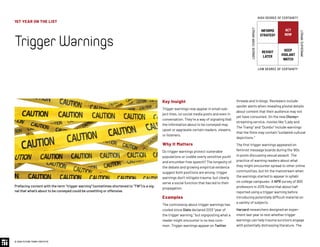
researching supersonic flight. Aerion, Lock-
heed Martin and GE Aviation are developing
a supersonic business jet that could carry 12
passengers. The new supersonic airplanes
will allow flights to take off over land, which
because of the sonic boom, had limited the
success of the original Concorde. Fuel effi-
ciency and safety concerns, however, could
slow getting to market in the short term.
Autonomous Ships
Early in 2018, an oil tanker caught fire after
colliding with another boat in the East China
Sea, killing more than two dozen people.
Safety is one of many reasons that compa-
nies are looking to automation in shipping.
The Yara Birkeland is an electric container
ship that is supported by radar, LiDAR, ma-
chine learning and computer vision systems,
an automatic mooring system and a network
for cameras. It is currently on schedule to
transition from traditional human-crewed
operation to fully autonomous operation
in 2020. Electric ships that don't require
people would offer cost savings throughout
the entire shipping supply chain. They could
be safer, solve labor shortages, and be bet-
ter for the environment. The International
Maritime Organization has begun a scoping
exercise that will complete in 2020 after
which practical drafting will start and lay the
legal foundation for maritime autonomous
surface ships.
THE IMPACT
Widespread adoption and use of autono-
mous vehicles promises fewer accidents,
lower energy costs, optimized driving effi-
ciency and reduced traffic congestion.
© 2020 FUTURE TODAY INSTITUTE
TransportationTrendscont.
Waymo's self-driving vehicles are being tested in Phoenix.
THE WATCHLIST
Ace Hardware, Aerion, All Nippon Airlines,
Ample, Audi, auto manufacturers, Avis,
Baidu, Bird, BMW, Boom, Bosch, Citibike,
Delphi Automotive Systems, Dominos,
Driveri, Ecooltra, FAA, Fiat Chrysler, Ford,
GE Aviation, General Motors, General Motors,
General Motors, Get, Hertz, Honda, Hyundai,
infrastructure development players and
investment banks, International Maritime
Organization, Ioscoot, Jaguar Land Rover,
Japan Airlines, JD.com, Kepler.gl, Kia, King
Long, Kongsberg, lime, Lockheed Martin,
Lockheed Martin, Lyft, Marin Teknikk,
Mazda, Mercedes Benz, Mitsubishi, Mo-
bike, NASA, National Oceanic Atmospheric
Administration, Nissan, Nissan, NVIDIA, Ofo,
Otto, Peterbilt, Porsche, Postmates, public
utility companies, Rolls-Royce, Sidewalk
Labs, Skip, Softbank, Solar Roadways, Spin,
Starsky Robotics, Strava Metro, Subaru, Tes-
la, TomTom, Toyota, Turo, U.S. Army, Uber,
Via, Virgin Group, Vision Zero NYC, Volkswa-
gen, Volkswagen, Volvo, VW, Waymo, Waze.
191
16 Logistics
 Supply Chain
194	 Automating the
	 Supply Chain
195	 Sustainability in Supply 	
	 Chain and Logistics
196	 Rebuilding the Cold Chain
197	 Additive Manufacturing
	 and Printing
193
© 2020 FUTURE TODAY INSTITUTE
1ST YEAR ON THE LIST
AutomatingtheSupplyChain
Key Insight
5G networks and new autonomous robots
and vehicles will help optimize warehouse
management.
Why It Matters
Autonomous mobile robots (AMRs) and
autonomous guided vehicles (AGVs) will
become more commonplace in 2020, which
will bring cost-savings and efficiencies for
businesses.
Examples
For the past few decades, robots have
assisted humans with repetitive tasks.
But in 2020, we will see a new class of
autonomous robots and vehicles running
on A.I.-powered logistics systems. Rather
than relying on LiDAR SLAM (Simultaneous
Localization And Mapping), a new class of
robots use computer vision and A.I. In a
warehouse setting, autonomous mobile
robots assign global tasks, set paths and
optimize tasks like picking. Amazon Robot-
ics, which acquired Kiva Systems in 2012,
leads the market in automated robots and
now relies on a host of automated systems
in its warehouses.
What’s Next
Now in the midst of a transformation, the
robotics industry will drastically impact the
supply chain. Some researchers anticipate
that 6 million mobile robots will be shipped
within the next decade, shifting every sec-
tor of the global economy.
The Impact
Mobile automation in the supply chain is a
quickly maturing market. While this means
greater efficiencies and cost savings for
businesses, it also portends job losses for
workers who operate warehouse equipment.
Watchlist
Amazon Robotics, Boston Dynamics, Kuka
Robotics, Mobile Industrial Robots, Okura,
Omron, Rethink Robots, Robotic Industries
Association, Universal Robots.
Autonomous mobile robots are performing
more work in warehouses.
“Justbecause
somethingworks
doesn’tmean
thatitcan’tbe
improved.”
- Shuri inBlack Panther
INFORMS
STRATEGY
REVISIT
LATER
ACT
NOW
KEEP
VIGILANT
WATCH
HIGH DEGREE OF CERTAINTY
LOW DEGREE OF CERTAINTY
IMMEDIATEIMPACT
LONGER-TERMIMPACT
195
1ST YEAR ON THE LIST
Sustainability in Supply
Chain and Logistics
Key Insight
Pressure from investors, customers, and
governments—in addition to extreme weath-
er events and trade tensions—has resulted
in new efforts to build sustainability into the
supply chain for many companies.
Why It Matters
A company’s supply chain and logistics
system can greatly impact the environment,
human rights, and anti-corruption policies.
Examples
Swedish packaging company Tetra Pak
requires third-party verification that its pa-
perboard suppliers do not use wood from any
form of deforestation that breaks the natural
forestry cycle. A company cannot supply Tet-
ra Pak if it fails to meet these requirements.
Japanese chemical and cosmetics company
KAO has been actively encouraging suppliers
to reduce CO2 emissions; at least 80% of
its suppliers have set emissions reduction
targets. The Zero Discharge of Hazardous
Chemicals Programme (ZDHC), the Sus-
tainable Apparel Coalition, and the Outdoor
Industry Association are all working toward
sustainability goals in the apparel industry.
Some say that 2019 was the year that sus-
tainability finally burst onto mainstream for
the fashion industry. Esquel, a textile giant
in Hong Kong, is working to make the apparel
supply chain more environmentally friendly,
and a number of designers including Gucci
and Kanye West made sustainability pledges
last year.
What’s Next
Improving environmental, social, and
economic performance throughout sup-
ply chains enables companies to find cost
savings, as well as opportunities to increase
productivity and optimize processes and
systems. Building sustainable practices
into logistics and the supply chain may be
an aspiration today, but in the near future,
it may be a requirement as extreme heat,
air pollution, deforestation, water shortag-
es, flooding, and worker health and safety
issues make procurement less predictable.
Regulators, too, are beginning to impose
new restrictions on product development,
manufacturing and shipping.
The Impact
The next decade will present significant
opportunities for companies in manufactur-
ing and consumer goods, as well as for those
that manage logistics. Sustainability factors
will impact growth and investor returns.
Watchlist
Companies in the fashion, consumer goods,
shipping and manufacturing industries.
Tetra Pak responds to sustainability shifts
with renewable packaging.
INFORMS
STRATEGY
REVISIT
LATER
ACT
NOW
KEEP
VIGILANT
WATCH
HIGH DEGREE OF CERTAINTY
LOW DEGREE OF CERTAINTY
IMMEDIATEIMPACT
LONGER-TERMIMPACT
© 2020 FUTURE TODAY INSTITUTE
1ST YEAR ON THE LIST
RebuildingtheColdChain
Key Insight
Cold chains are temperature-controlled
supply chains. We rely on them to deliver
everything that requires low temperatures,
such as medications, produce, and frozen
foods.
Why It Matters
Climate change could result in new regula-
tions that limit how the cold chain works,
but new kinds of intelligent packaging and
automated transportation systems mean
new business opportunities.
Examples
For decades we’ve had access to fresh
blueberries in February and fresh-squeezed
orange juice throughout the year. Your local
grocery store probably sells sushi featuring
raw tuna and salmon farmed halfway around
the world. The reason we can enjoy ice
cream in the heat of the summer is the cold
chain: a complicated system of storing and
transporting food and medicine in exactly
the right temperature range during the trek
from farm, to factory, to the store. But in
some areas of the world, the cold chain has
contributed to climate change.
What’s Next
If the temperature fluctuates or the cold
storage fails, that puts a cold chain’s cargo
in jeopardy. Products could be contaminat-
ed or spoiled, which could mean millions
of dollars lost. Companies are beginning to
look at new sustainability opportunities to
improve the cold chain. One area of interest
is artificial intelligence in the cloud, which
can help monitor temperatures and can also
optimize travel routes. New packaging ma-
terials insulate food and medicine, keeping
both at low temperatures without having to
refrigerate entire trucks.
The Impact
We put an enormous amount of trust in the
cold chain to protect the food and medi-
cines we ingest. In a rapidly changing world
with ongoing climate, economic and geo-
political uncertainty, companies that use or
rely on the cold chain should be invested in
long-term planning.
Watchlist
AGRO Merchants Group, Americold, Cold
Storage, Emergent Cold, Gardner Denver
Holdings, Ingersoll-Rand, Kloosterboer,
NewCold, Nichirei, Preferred Freezer Ser-
vices, Versa Cold.
The cold chain supplies fresh sushi to your
local grocery store.
INFORMS
STRATEGY
REVISIT
LATER
ACT
NOW
KEEP
VIGILANT
WATCH
HIGH DEGREE OF CERTAINTY
LOW DEGREE OF CERTAINTY
IMMEDIATEIMPACT
LONGER-TERMIMPACT
197
9TH YEAR ON THE LIST
Additive Manufacturing
and Printing
Key Insight
Additive manufacturing allows us to create
objects one layer at a time, and we can now
do this using different materials.
Why It Matters
3D printing has moved from the fringe to
the mainstream, offering new opportunities
in medical and biosciences, manufacturing
and art.
Examples
This year, a street-legal motorcycle pro-
duced using additive manufacturing pro-
cesses will come to market. Curtiss Motor-
cycle Company and additive manufacturing
company Fast Radius collaborated on the
electric bike, which uses parts that require
a hybrid of manufacturing approaches—in-
cluding 3D printing.
Growth in new materials printing has made
3D printing a viable resource in the aero-
space and automotive industries, which
must meet stringent requirements for
parts use. Last year, Airbus and Materialize
created the first 3D-printed parts intended
for use in the cabins of Airbus’s commercial
aircraft. And soon, “one size fits all” will take
on a whole new meaning. If you’re thinking
Star Trek Replicator, you’re not far off. Re-
searchers are working toward scanning and
producing objects in seconds—over time,
this technology will be used in surgical cen-
ters to rapidly print replacement valves and
joints using your own biomatter as models.
What’s Next
Last year, Chinese researchers successfully
printed ceramics capable of transforming
over time in response to stimuli such as
heat and light. It’s a process known as 4D
printing, and the practical applications
are boundless. Imagine a heat shield that
suddenly materializes during a fire, or a gar-
den that plants itself when the ground has
warmed to precisely the ideal temperature
for each seed.
The Impact
We don’t yet have international product
liability and intellectual property standards,
norms, and regulations that govern additive
manufacturing and printing. A regulatory
framework built to protect designers, pat-
ents, corporations and individuals is likely
on the horizon.
Watchlist
Autodesk, Materialize, Kodak, Ethereal Ma-
chines, Northwestern University’s Feinberg
School of Medicine, University College Cork,
Apis Cor, Organovo, MIT Media Lab, Airbus,
GE, Formlabs, Aurora Labs, Arc Group,
ExOne, Voxeljet, Stratasys, HP, Shapeways,
MakerBot, University of Illinois Urbana,
University College London.
The electric Zeus motorcycle was produced
using additive manufacturing.
INFORMS
STRATEGY
REVISIT
LATER
ACT
NOW
KEEP
VIGILANT
WATCH
HIGH DEGREE OF CERTAINTY
LOW DEGREE OF CERTAINTY
IMMEDIATEIMPACT
LONGER-TERMIMPACT
17 Energy
200	 Grid Management
201	 Reversing Environmental 	
	 Rules and Regulations
202	 Green Tech
203	 Renewable Energy
204	 Charging Stations
205	 Ultra-High-Voltage Direct 	
	 Current and Macro Grids
206	 Better Batteries
207	 Wireless Charging
	Everywhere
207	 Energy Trading Platforms
	 for Blockchain
207	 Zero Carbon Natural Gas
207	 Floating Nuclear
	 Energy Plants
207	 Subsea Power Grids
199
© 2020 FUTURE TODAY INSTITUTE
1ST YEAR ON THE LIST
GridManagement
Key Insight
In many countries, the electric grid is
a sprawling network of generators and
connectors that links citizens to energy
distributed by government agencies and
private companies. Increased demands for
power, combined with a failure to maintain
or expand these grids, will pose new chal-
lenges over the next two decades.
Why It Matters
Utility companies aren’t repairing and mod-
ernizing their equipment fast enough. In
the wake of climate change and new power
demands, managing the grid is proving diffi-
cult. And, like many countries, the does not
currently have a comprehensive national
electricity policy and isn’t engaged in long-
term planning in this field.
Examples
In 2019, a broken jumper wire from a trans-
mission tower started the historic Kincade
Fire in California. The blaze spread quickly
and devastated thousands of homes and
businesses. In the aftermath, Pacific Gas 
Electric, California's biggest utility, decided
to begin cutting power in anticipation of
weather conditions—like fast, dry winds—
that could lead to more of its lines going
down. In October last year, the company
abruptly cut power to 800,000 customers,
which resulted in blackouts throughout San
Jose, Berkeley, San Mateo and Oakland.
Climate change has resulted in drier, hotter
weather in some parts of the world, while in
other areas ice has become more common.
The problem: Our power networks weren’t
designed with these new environmental
realities in mind.
Another big change on the horizon: lots of
new power-hungry devices. Electric vehicles
will soon be everywhere, which will cause a
spike in electricity demand. So will stream-
ing services, distributed computing appli-
cations, connected home appliances, and
many other technological advancements.
What’s Next
Researchers have been studying new ways
to address grid management challenges.
For example, MIT completed an interdisci-
plinary study on the future of the grid and
outlined a series of steps that could be
taken now to preempt anticipated issues,
including ways to incentivize renewables,
introduce computational tools to make
better predictions about usage, explore
new methods for wide-area transmission
planning, and seize opportunities for energy
conservation. We will start to see faster
deployment of “microgrids,” which can
operate autonomously using artificial intel-
ligence and can offer energy in developing
countries, where as many as a billion people
still live without electricity. Companies like
San Diego-based XENDEE and WorleyPar-
sons Group have developed cloud software
tools for microgrids. And energy storage
will improve—scientists in Germany and
at Northwestern University in Chicago, for
instance, are making advances in “singlet
fission” technology to generate more elec-
tricity from solar cells.
INFORMS
STRATEGY
REVISIT
LATER
ACT
NOW
KEEP
VIGILANT
WATCH
HIGH DEGREE OF CERTAINTY
LOW DEGREE OF CERTAINTY
IMMEDIATEIMPACT
LONGER-TERMIMPACT
The Impact
When the grid fails, it can cost millions of
dollars, wreak havoc on public safety ser-
vices, and put lives in danger.
Watchlist
ABB Group, American Electric Power, Cisco
Systems, Dominion Resources, Electric
Power Research Institute, Enel, Exelon
Corporation, General Electric, IBM, ISO New
England, Lahore University of Management
Sciences, Masdar Institute, Microsoft, MIT
Energy Initiative, National Grid, National
Institute of Standards and Technology, New
York ISO, Nexant, Pacific Gas  Electric,
Tesla, Southern Company, Utility Wind
Integration Group, Harvard Electricity Policy
Group, and local and national governments
worldwide.
201
1ST YEAR ON THE LIST
Reversing Environmental
Rules and Regulations
Key Insight
While citizens are demanding action on
climate change, some governments around
the world are now relaxing or eliminating
rules and regulations designed to mitigate
human-caused environmental damage.
Why It Matters
Thousands of scientists are warning that as
temperatures and sea levels rise faster than
originally projected, the impact of climate
change will drastically change life as we
know it.
Examples
New research from Columbia Law School,
Harvard Law School and the New York
Times revealed that the Trump admin-
istration has rolled back more than 90
environmental rules and regulations since
taking office. It replaced the Obama-era
Clean Power Plan, which set strict limits
on carbon emissions from coal and gas-
fired power plants and instead allowed
states to set their own rules. It also relaxed
a Clinton-era regulation that limited toxic
industrial emissions. And it cut the reach of
the Clean Water Act, removing millions of
miles of streams and about half of America’s
wetlands from federal protection. Brazil’s
President Jair Bolsonaro, a climate skeptic,
has pushed to open the Amazon rainforest
to business and agribusiness. When fires
ravaged the rainforests last year, he dis-
missed conservation efforts and said that
pro-conservation NGOs had intentionally
set the fires in an effort to undermine him.
What’s Next
There are a number of global initiatives de-
signed to combat and mitigate the effects of
climate change, but ultimately each country
designs and implements its own regulations.
The United Nations Global Compact initia-
tive is trying a different route, helping the
world’s corporations to achieve sustainable
development goals by 2030.
Impact
Climate change impacts our global supply of
food, human health, and our ability to work
and move around, and disrupts the complex
ecosystems in which we live.
Watchlist
United Nations, as well as companies and
governments worldwide.
Climate change protestors hold their
placards high.
INFORMS
STRATEGY
REVISIT
LATER
ACT
NOW
KEEP
VIGILANT
WATCH
HIGH DEGREE OF CERTAINTY
LOW DEGREE OF CERTAINTY
IMMEDIATEIMPACT
LONGER-TERMIMPACT
© 2020 FUTURE TODAY INSTITUTE
6TH YEAR ON THE LIST
GreenTech
Key Insight
Sustainable technologies are built to reduce
the human species' short- and long-term
impact on the environment.
Why It Matters
Climate change and new regulatory efforts
could force us to look for new, sustainable
sources of energy.
Examples
This past January, Microsoft pledged it
would be carbon negative in the next 10
years, and launched a $1 billion climate
innovation fund. Also in January, Black-
Rock—the world’s largest asset manager
with more than $7 trillion under manage-
ment—announced that climate change
would be a primary focus in all of its future
investment decisions. Meanwhile, China is
installing a record number of solar projects
and wind turbines to deal with the country’s
crippling smog. The Chinese government
will invest $560 billion over the next year to
make green tech more accessible not only
within China, but also for its export partners
around the world. Wind and solar energy are
getting a lift: Billionaire Philip Anschutz,
who built his fortunes in oil and railroads,
plans to build large-scale wind farms in Wy-
oming, while tech billionaire Elon Musk will
work with a number of companies to build
attractive solar panels that look more like
slate shingles than the reflective rectan-
gles we’ve seen to date—he, and others, are
also developing new methods to create and
store energy using battery systems. A team
of researchers at Massachusetts Institute
of Technology is developing offshore wind
turbines that can store power on the ocean
floor in huge concrete spheres. Makani, re-
cently acquired by Google X, makes high-al-
titude kites to harness wind energy.
What’s Next
Researchers at University of California-Los
Angeles built bio-mimicking smart mate-
rial that bends to follow the sun. Think of
the technology as a responsive, artificial
sunflower that can harvest energy and send
it back to the grid. Compared to traditional
INFORMS
STRATEGY
REVISIT
LATER
ACT
NOW
KEEP
VIGILANT
WATCH
HIGH DEGREE OF CERTAINTY
LOW DEGREE OF CERTAINTY
IMMEDIATEIMPACT
LONGER-TERMIMPACT
solar panels, which are bulky and run afoul of
some neighborhood association covenants,
bio-inspired cell panels are much thinner
and discreet, and work more efficiently.
European scientists developed a new kind of
wind turbine that transmits energy using a
superconductor. The EcoSwing project uses
high temperature superconductors and has
already passed readiness tests for commer-
cial use. Heliogen, a startup backed by Bill
Gates, developed a new system to collect
solar energy and concentrate its power.
Large mirror panels point toward the sun—
and toward each other—for a multiplying
effect, which produces heat topping 1,000
degrees Celsius. Concentrated solar power
can be used in industrial applications, like
melting steel, but the hope is that someday
it can be stored and distributed as needed.
Impact
Green tech is still a young market, but
plenty of new technologies and scientific
breakthroughs have people excited. Talk of
regulation and global initiatives on climate
change have garnered investor interest,
which will likely grow in 2020 and beyond.
Watchlist
8minuteenergy, ABB Ltd, Akcome Science
 Technology Co, Amazon, Apple, Ar-
gonne-Northwestern Solar Energy Research
(ANSER) Center, Atlantica Yield PLC, Canadi-
an Solar Inc, CropEnergies AG, Cypress Creek
Renewables, EcoPlexus, Emerson Electric,
Energcon, Energy Acuity, First Solar Inc, First
Wind Solar, Friedrich-Alexander-Universität
Erlangen-Nürnberg (FAU), Gamesa, GCL-Po-
ly Energy Holding Ltd., GE, Global Pvq SE,
Google, Hanergy Thin Film Power Group Ltd.,
Hecate Energy, Inox Wind, Intersect Power,
JIANGS, Johnson Controls, Makani, Massa-
chusetts Institute of Technology, Ming Yang,
Motech, NextEra Energy, Nordex, Orsted,
Pacific Ethanol, Panasonic, Power Company
of Wyoming, Recurrent Energy, Renew-
able Energy Group, Samsung, Saudi Arabia
government, Schneider Electric, Siemens,
SoftBank, SolarCity, sPower, Suzlon Group,
SunPower, Tesla, Toyota, United Power, Ves-
tas Wind Systems, Vestas, WorleyParsons
Group, XENDEE, Xinjiang Goldwind Science
and Technology.
203
2ND YEAR ON THE LIST
Renewable Energy
Key Insight
Renewable energy is collected from sources
that can be replenished on a reasonable
timescale. Renewables include wind, tides,
geothermal heat, and sunlight.
Why It Matters
Last year, 400 global corporations commit-
ted to climate protection and sustainability
goals, while 63 promised to convert their
energy use to 100% renewables.
Examples
More than 100 cities across the globe report
that as much as 70% of their energy produc-
tion now comes from renewables, and at
least 40 cities and 158 companies com-
mitted to dial that up to 100%. Hundreds
more—both cities and countries— pledged
to move to renewable energy production.
Even oil-rich Saudi Arabia is working on a
detailed, long-term plan to help diversify its
economy and move away from oil.
What’s Next
Renewables will take on greater importance
in the coming decade. The International
Energy Agency projects renewables will
account for about 40% of energy distributed
through the global power grid by 2040. In the
next five years, we should see faster growth
in green tech than ever seen previously.
Impact
The amount of clean, renewable energy
bought by some of the world’s largest
companies has tripled since 2018. The U.S.
Energy Information Administration says that
renewables are “the fastest growing source
of electricity generation.”
Watchlist
Acciona Energia, Alterra Power, Atlantica
Yield, Avangrid Renewables, Berkshire
Hathaway Energy, Brookfield Renewable
Partners, Enphase Energy, First Solar, GE
Energy, International Energy Agency, Inve-
nergy, MidAmerican Energy Anemos Energy
Corporation, NextEra Energy, Ormat Tech-
nologies, Orsted, Pattern Energy, Siemens,
SolarEdge, TerraForm Power, Tesla, U.S.
Department of Energy, U.S. Energy Informa-
tion Administration.
INFORMS
STRATEGY
REVISIT
LATER
ACT
NOW
KEEP
VIGILANT
WATCH
HIGH DEGREE OF CERTAINTY
LOW DEGREE OF CERTAINTY
IMMEDIATEIMPACT
LONGER-TERMIMPACT
The UN’s sustainable development goals
include a focus on renewable energy
sources.
© 2020 FUTURE TODAY INSTITUTE
3RD YEAR ON THE LIST
ChargingStations
Key Insight
In the coming years, an unprecedented
number of charging stations for electric
vehicles will come online, driving demand
for a new kind of car and disrupting the
traditional gasoline supply chain and retail
business.
Why It Matters
Auto manufacturers are investing $225
billion to electrify their fleets in the next few
years.
Examples
Ford launched an all-electric F-150 pickup
truck and the electric Mustang Mach-E.
General Motors will launch 20 new EV
models by 2023, and BMW, Nissan, Jaguar,
Porsche, Audi, Volkswagen, Volvo, and Tesla
introduced EVs this past year, with more
models to come. There are now more than
20,000 charging stations and 1,600 Tesla
Supercharger stations in the U.S., and more
are being built this year.
Building new charging stations involves
plenty of red tape with local utilities and real
estate. Most networks are being installed
by governments, utilities, and third-par-
ty companies. California leads the way:
Former Governor Jerry Brown promised to
get 5 million electric vehicles on the road
by 2030 and 250,000 EV chargers in the
ground by 2025. Oklahoma, New York, and
Colorado state governments also recent-
ly unveiled plans to invest in networks of
electric charging stations. Electrify America
will put charging stations in 100 Walmarts
in 34 states. The nation’s largest charging
company, ChargePoint, will open 2.5 million
charging stalls by 2025, up from 53,000
according to the company. Another compa-
ny, EVgo, created a modular fast-charging
station that can be installed in a matter
of days. Google Maps, ChargePoint and
PlugShare will make it easier for people to
find those electric vehicle charging stations
from their smartphones, see the types of
charging ports and prices and then rate and
review them.
INFORMS
STRATEGY
REVISIT
LATER
ACT
NOW
KEEP
VIGILANT
WATCH
HIGH DEGREE OF CERTAINTY
LOW DEGREE OF CERTAINTY
IMMEDIATEIMPACT
LONGER-TERMIMPACT
What’s Next
To help EVs really take off, though, some-
one needs to reinvent the battery—and
that’s starting to happen. Spanish startup
Graphenano built a battery out of graphene
that charges a car in eight minutes, and will
open the first battery manufacturing plant
using this material. Solid state batteries
promise to be safer, cheaper, and boost the
amount of energy a battery cell can store—
not to mention they may help cars charge
faster. Such batteries also promise to bring
the driving range for an electric vehicle
more in line with what you’d get on a full
tank of gas. By using solid materials instead
of flammable liquids in batteries, automak-
ers could benefit, because most existing
electric vehicle batteries have hit the limits
of their storage capabilities. Plenty are
working on the task, including Daimler AG,
Fisker Inc., Jiangxi Ganfeng Lithium Co. in
China, and spinoffs from the Massachusetts
Institute of Technology, Stanford University,
and Tokyo Institute of Technology. If they’re
successful, EV charging times could drop
from several hours down to 10 minutes. (See
also: Better Batteries.) 	
Impact
As more charging stations expand into
communities everywhere, it will start to
have a chilling effect on independent and
corporate gasoline station chains, as well as
on the local communities that are support-
ed by them.
Watchlist
Blink CarCharging, BP, ChargePoint, Chevron
Corporation, China National Petroleum Cor-
poration, ConocoPhillips, Electrify America,
Envision Solar, EV car manufacturers world-
wide, Exxon Mobil, Google, Ionity, Kuwait
Petroleum Corporation, Lukoil, Petro China,
PlugShare, Royal Dutch Shell, Royal Farms,
Saudi Aramco, SemaConnect, Sinopec, Sun-
cor Energy, Tesla, the state governments for
Colorado, California, New York, New Jersey,
and Oklahoma, Valero Energy, vendors to gas
stands, Volkswagen, Wawa.
205
3RD YEAR ON THE LIST
Ultra-High-Voltage Direct
Current and Macro Grids
Key Insight
In the near-future, we will transport clean
energy from production sites to areas
where power is needed using a new kind of
power grid being tested in China.
The Impact
Ultra-High-Voltage Direct Current can carry
electricity farther with less loss, which
will help feed China’s relentless hunger for
power. In addition to China, UHVDC will help
large countries like Brazil and India deliver
more power longer distances, which will
help stimulate economic growth.
Why It Matters
A national direct-current macro grid could
drastically lower emissions in an affordable
way without compromising our access to
electricity.
Examples
In the U.S. and throughout Europe, electric-
ity is generated at a power station and then
transmitted using alternating current. But
that technology is inefficient over very long
distances, and even smart grids haven’t al-
ways been able to cope with climate change
and our increasing consumer demands for
heat and air conditioning. A new kind of
transmission system—ultra-high-voltage
direct current (UHVDC)—is being tested
in China, which has invested $88 billion to
build the future of UHVDCs and macro grids.
India has made a similar investment.
What’s Next
China has already moved ahead of the U.S.
in developing this technology and is invest-
ing heavily in green technologies. The first
800,000-volt line, from a dam in Yunnan
Province to Shanghai, has already been
completed. Next up, the Changji Guquan
system, spanning the east-west expanse of
the country, which on its own can carry half
the power needed to serve the entire coun-
try of Spain. China has made it known that
it plans to transport clean energy all around
the world, and its Belt and Road Initiative
could help in that effort. Fifty years from
now, it’s conceivable that we’re all reliant on
China—rather than OPEC countries (Saudi
Arabia, the UAE, Venezuela, Iraq, Iran, Ku-
wait, Libya, Nigeria, Qatar, Algeria, Angola,
and Ecuador)—for our energy needs.
Watchlist
AGTransWest Express Transmission Proj-
ect, ABB, China, GE, Hitachi, India, Mitsub-
ishi Electric Corporation, Siemens, U.S.
Department of Energy, and OPEC member
nations.
INFORMS
STRATEGY
REVISIT
LATER
ACT
NOW
KEEP
VIGILANT
WATCH
HIGH DEGREE OF CERTAINTY
LOW DEGREE OF CERTAINTY
IMMEDIATEIMPACT
LONGER-TERMIMPACT
China’s major ultra-high-voltage
transmission system is underway.
207
Additional Energy Trends
 TRENDS
Wireless Charging Everywhere
Laptops, earphones, mobile devices, and
even portable batteries will be chargeable
without wires in the coming years. This year
we should see rollout of universal wireless
chargers capable of powering our devic-
es. Samsung phones now charge without
wires—and can even transfer battery power
to other similar phones. Energysquare and
Unravel offer wireless charging for multiple
devices at once.
Energy Trading Platforms
for Blockchain
In 2018, companies in Singapore started
buying and selling renewable energy certifi-
cates on a blockchain-powered system. Like
carbon trading in other markets, Singa-
pore’s system, launched by utilities provider
SP Group, allows for more transparency
and lower costs because there is no central
intermediary processing and verifying
transactions. Meantime, a consortium that
includes BP and Shell is now developing a
blockchain-based platform to trade energy
commodities.
Zero Carbon Natural Gas
In the future, we could see a natural gas
plant capable of capturing all of its emis-
sions at zero cost using a technology called
carbon capture and storage, or CSS. While
the tech has been around for decades, it
hasn't been deployed at scale. Last July,
U.S. startup Net Power successfully built a
prototype plant that ran a full power cycle
without releasing troublesome emissions
into the air. It plans to scale up to a full-size
plant by 2021. Wider adoption will likely be
driven by new tax credits of up to $50 for
each metric ton of emissions captured and
stored by a power plant or factory.
Floating Nuclear Energy Plants
In an attempt to increase nuclear prolifer-
ation, Russia is working on a new kind of
energy plant that can float and move with
currents, thereby withstanding certain
harsh environments. A barge called the
Akademik Lomonosov is loaded with two
nuclear reactors and in 2020 will produce
enough energy to power 100,000 homes in
the nearby town of Pevek.
Subsea Power Grids
Siemens and ABB are each building a
new kind of distribution center underwa-
ter. Their subsea power stations would
connect to wind turbines, generators, or
power plants and could someday enable
underwater factories. These power grids
include transformers, switch-gear and
variable-speed drives, and cabling so that
operators back on land can monitor and
adjust all of the systems. Testing should
begin this year.
In the future, we could see a natural gas
plant capable of capturing all of its emis-
sions at zero cost using a technology called
carbon capture and storage, or CSS.
18 Climate  Geoscience
216	 Reflecting Sunlight
217	 Sand for Glacier Melt
217	 Fertilizing the Oceans
217	 Enzymes to Eat Ocean Trash
218	 Corporate Environmental 	
	Responsibility
219	 Sustainability as Corporate 	
	Identity
219	 Corporates Adopt
	 Net-Zero Energy
219	 Sustainable Shipping
219	 Corporate Meteorologists
219	 Reducing Corporate
	 Reliance on Plastics
210	 The Anthropocene Epoch
211	 Unpredictable Sea
	 Level Rise
212	 Extreme Weather Events
214	 Human Migration
	 Patterns Shift
215	 Geoengineering
216	 Storing Captured Carbon 	
	 with Algae and Bacteria
216	 Converting Carbon Dioxide 	
	 into Building Materials
216	 Stratospheric Aerosol
	 Scattering with Sulfur
	Dioxide
216	 Injecting Clouds with
	 Sea Salt Particles
209
© 2020 FUTURE TODAY INSTITUTE
2ND YEAR ON THE LIST
BetterBatteries
Key Insight
It’s a common first-world problem: Our
devices never seem to have enough battery
life, and just when we need power the most,
we either forget our chargers or can’t find a
spot to plug in.
Why It Matters
Building a better battery has been an elusive
challenge for decades—but we could make
new headway in the coming years.
Examples
Researchers at Monash University developed
a lithium-sulphur battery that can power
a smartphone for up to five days, outper-
forming lithium-ion batteries. IBM research-
ers developed a new kind of battery with
materials extracted from sea water instead
of heavy metals like cobalt. Lithium-ion
batteries have limits, which is why research-
ers at the University of California-Irvine are
experimenting with gold nanowires housed in
a gel electrolyte, which can last significantly
longer than today’s batteries. And scientists
at Ritsumeikan University and Panasonic are
trying to squeeze the last bits of untapped
energy out of lithium-ion batteries.
What’s Next
The problem with modern batteries isn’t
about making the power—it’s about how
to store enough of it. Startup Ossia Inc.
built a wireless charging system that can
power AA batteries from 30 feet away. Form
Energy is trying to develop a “bidirectional
power plant” that stores energy long-term,
producing renewable energy and delivering
it precisely when it is needed. Meanwhile,
at Google X, a new project called Malta aims
to capture more clean energy produced by
using salt, and to store it on a large scale.
Malta incorporates a grid-scale energy stor-
age technology that saves electricity from
renewable energy sources as heat inside
large tanks of high temperature molten salt,
and as cold in large tanks of chilled liquid.
The system can discharge electricity back
to the grid when energy demand is high—ef-
fectively “time shifting” energy from when
it’s produced to when it’s most needed.
INFORMS
STRATEGY
REVISIT
LATER
ACT
NOW
KEEP
VIGILANT
WATCH
HIGH DEGREE OF CERTAINTY
LOW DEGREE OF CERTAINTY
IMMEDIATEIMPACT
LONGER-TERMIMPACT
Impact
Battery improvements will drive growth in
consumer electronics and electric vehicles.
Watchlist
Alphabet, Baseload Renewables, Daim-
ler AG, Energous Corp, Fisker Inc., Form
Energy, Founders Fund, General Motors,
Graphenano, Huawei, Ionic Materials, Ji-
angxi Ganfeng Lithium Co, Khosla Ventures,
Massachusetts Institute of Technology, MIT
Department of Materials Science and Engi-
neering, Nissan, Ossia Inc, Qualcomm, Solid
Firm, Tesla, the Federal Communications
Commission, Tokyo Institute of Technology,
Toyota, University of California-Irvine, US
Department of Energy.
Morpheus describes the future of batteries
in The Matrix.
© 2020 FUTURE TODAY INSTITUTE
6TH YEAR ON THE LIST
TheAnthropoceneEpoch
Key Insight
We are in a new geological epoch defined
by the permanent impact that humans have
had on Earth.
Why It Matters
A new epoch is defined following a cataclys-
mic event—like the asteroid that collided
with Earth and led to the mass extinction of
the dinosaurs. Such events significantly and
permanently alter the underlying sedimen-
tary and rock layers beneath the surface of
the planet, resulting in visible, measurable
changes.
Examples
An international, independent team of
scientists, called the Anthropocene Work-
ing Group (AWG), has now found enough
evidence to support the official declaration
of a new geological epoch. The group, com-
prised of scientists who were in favor of, as
well as those who were against declaring
a new epoch, reached a consensus in early
2018. While much debate ensued, we are
now seeing concrete, publicly-available
research corroborating the designation.
Scientists within the AWG and outside have
determined that humans have left a perma-
nent mark on the planet. The new geolog-
ical layers we are creating are riddled with
chemicals and industrial waste, pavement,
plastic, nuclear fallout, everyday garbage,
pesticide runoff and more. We’ve caused
our sea levels to rise and our lakes and riv-
ers to dry up, and extreme weather events
are now a normal part of living on Earth.
What’s Next
The “Anthropocene” (anthro for “man,” and
cene for “new”) describes a new geographic
epoch. (Our previous epoch, which began
11,700 years ago just after the last ice age,
was called the “Holocene.”) Being able to
pinpoint an interval of time and the change
it represents can help us set a different—
and hopefully improved—trajectory for life
on Earth.
Impact
Recognizing that humans have made a
permanent, visible mark on the earth is the
first step in studying the future implications
for our planet.
Watchlist
Anthropocene Working Group, International
Union of Geological Sciences, The Nature
Conservancy, Union of Concerned Scien-
tists, U.S. Geological Survey.Earth’s new geological layers show that
humans have left a permanent mark on
the planet.
INFORMS
STRATEGY
REVISIT
LATER
ACT
NOW
KEEP
VIGILANT
WATCH
HIGH DEGREE OF CERTAINTY
LOW DEGREE OF CERTAINTY
IMMEDIATEIMPACT
LONGER-TERMIMPACT
211
2ND YEAR ON THE LIST
Unpredictable, Rising Sea Levels
Key Insight
We’re getting better at understanding how
ice sheets and sea levels change over time.
This year, there will be more focus on trying
to measure and interpret the rate of change.
Why It Matters
Rising sea levels could reshape countries
and trigger mass-scale human migration.
Examples
Last year’s historic floods ruined millions
of acres of farmland, while coastal flooding
wreaked havoc in Alabama and Mississippi.
Blame warming temperatures. Scientists
are developing new methods and models
to understand changing sea levels, and
artificial intelligence may help predict
sea level rise and new human migration
patterns. Researchers at the University of
Southern California built a machine learning
model that shows a ripple effect across the
United States: As sea levels rise, people will
move to land-locked urban centers such as
Atlanta, Houston, Dallas, Denver, and Las
Vegas, and rural Midwestern areas will see
a disproportionately large influx of people
relative to their smaller local populations.
What’s Next
The federal Global Change Research
Program predicts that we’ll continue to
experience heavier rainfall in the North-
eastern United States and around the globe.
We’ll see sea levels continue to rise in the
next century, perhaps by as much as eight
feet. (Almost half of the 8-inch increase
since 1900 occurred in just the last 25 years.)
Meanwhile, earlier spring snowmelt and
reduced snowpack will lead to chronic, long-
term drought. Glaciers around the world
are melting at alarming rates—but trying to
predict how quickly large chunks will slide
into the oceans has proven challenging for
researchers. One of the research missions
kicking off in 2019 will take 100 scientists to
the Thwaites Glacier, where they will learn
more about melting ice from Antarctica
and how soon it could increase sea levels
to a high enough point that coastal areas—
Manhattan included—could be threatened.
To protect from future flooding, the San
Francisco International Airport plans to con-
struct a $587 million, 10-mile-long wall. In
New York, the U.S. Army Corps of Engineers
is studying how to build a six-mile-long
barrier to protect the city from floodwaters
during future storms. The Union of Con-
cerned Scientists reports that the Gulf of
Mexico and East Coast of the United States
are experiencing some of the world's fastest
rates of sea level rise. The group estimates
that rising sea levels will put more than
300,000 coastal homes and 14,000 com-
mercial properties at risk by 2045, and by
the end of the century, more than $1 trillion
worth of property could be impacted.
Impact
It is difficult to overstate how significantly
rising sea levels will impact human and
animal migration, our global supply of food,
and our ability to move around. Insurers,
city planners, businesses with global supply
chains, and any business that relies on or
provides logistics should be monitoring this
trend carefully.
Watchlist
British-American International Thwaites
Glacier Collaboration, Columbia University,
NASA, NOAA, Union of Concerned Scien-
tists, United Nations Intergovernmental
Panel on Climate Change.
The Graveyard Point neighborhood in
Central Texas after historic rainfall flooded
the region.
INFORMS
STRATEGY
REVISIT
LATER
ACT
NOW
KEEP
VIGILANT
WATCH
HIGH DEGREE OF CERTAINTY
LOW DEGREE OF CERTAINTY
IMMEDIATEIMPACT
LONGER-TERMIMPACT
© 2020 FUTURE TODAY INSTITUTE
2ND YEAR ON THE LIST
ExtremeWeatherEvents
superstorms including Hurricane Barry,
Hurricane Dorian, Tropical Storm Imelda,
and Tropical Storm Fernand caused more
than $7 billion worth of damage.
A 2019 report by the Bulletin of the Ameri-
can Meteorological Society (BAMS) con-
firmed the link between the earth’s rising
temperature and extreme weather events.
BAMS relied on a team of 120 scientists
from 10 different countries and used his-
torical observations and model simulations
to produce the 17 peer-reviewed analyses
collected in the special report.
What’s Next
Extreme weather is our new normal. Re-
searchers from the Oeschger Center for
Climate Change Research at Switzerland's
University of Bern reconstructed a global
picture of temperatures for the past 2,000
years. Using six different statistical models,
they found that while there have been short
periods of cooler temperatures, overall the
Earth is warming faster now than during any
other time in the past two millennia.
Key Insight
An extreme weather event falls outside the
norms of typical fluctuations in weather
patterns. They became a more frequent and
pronounced worldwide phenomenon in 2017,
and we have been experiencing them since.
Why It Matters
2019 was one of the most disastrous years
on record for extreme weather events, with
floods, landslides, cyclones, tornados, and
excessive heat that displaced more than
7 million people in the first half of the year
alone. By year’s end, more than a billion
animals had died due to Australia’s fires.
Examples
The past five years on Earth have been the
hottest on record. Our globe’s surface air
temperature increased by about 1.8 degree
Fahrenheit (1 degree Celsius) over the last
115 years, making it now the warmest it’s
been in the history of modern civilization.
We’ve seen a number of record-breaking
climate-related weather extremes. Starting
in July 2019, the worst wildfires in decades
ravaged Australia, devastating large swaths
of the country, leading to at least 28 human
deaths and 3,000 destroyed or damaged
homes. By January 2020, the country’s
capital city of Canberra declared a state of
emergency, due to encroaching fires. For-
ests continued to burn in Alaska, California,
Brazil, Russia, Indonesia and Africa, while
flooding wreaked havoc on Arkansas, Lou-
isiana, Mississippi and Missouri last year.
The Greenland ice sheet melted significant-
ly, while huge expanses of the Arctic had lit-
tle to no ice for long periods of time. In 2018,
the Mendicino Complex Fire became the
largest in California state history and gave
birth to a new term: “firenado,” or a whirling
column of flames that destroys everything
in its path. One such fire vortex topped out
at 17,000 feet above the earth.
Researchers at NOAA National Centers
for Environmental Information found that
storms are moving more slowly than they
did forty years ago, and that means they’re
sticking around longer and causing more
damage. In 2019, dangerous, slow-moving
INFORMS
STRATEGY
REVISIT
LATER
ACT
NOW
KEEP
VIGILANT
WATCH
HIGH DEGREE OF CERTAINTY
LOW DEGREE OF CERTAINTY
IMMEDIATEIMPACT
LONGER-TERMIMPACT
Australia recorded record-high tempera-
tures in the past year. The darker red the
map is, the higher above average the tem-
perature is.
Data from December 2019.
213
Global warming is a serious concern. The
United Nations' scientific panel on climate
change issued a dire report, with scientific
models showing that at our current rate,
the atmosphere will warm as much as 1.5
degrees Celsius, leading to a dystopian
future of food shortages, wildfires, extreme
winters, a mass die-off of coral reefs, and
more––as soon as 2040. That's just 20 years
from now.
Large natural disasters can slow regional
economic growth for decades, impact cor-
porate and industrial productivity, and lead
to post-traumatic stress among survivors.
Extreme weather can also shift infectious
disease patterns and compromise food
security, safe drinking water supplies, and
clean air. Economists estimate that bad
weather has an impact of $3.8 trillion a year
in the United States alone. It can drive up
construction costs and cause flight cancel-
lations. The rise of unpredictable, extreme
weather will continue to force insurance
companies to recalculate damage, building
new models to better estimate the risk and
repercussions. Insurer Aviva has increased
its Canadian home-insurance premiums by
6% since 2016, due partly to research into
catastrophic risks. Extreme weather will
also impact a wide range of sectors, from
auto repair shops and home improvement
stores to makers of sandbags and portable
generators.
Impact
New RD initiatives, emerging green tech-
nologies, new climate-focused investment
strategies and global coalitions could help
mitigate extreme weather. Businesses can
do right by their investors and also do good
for the planet by curtailing their contribu-
tions to climate change.
Watchlist
National Oceanic and Atmospheric Admin-
istration (NOAA), NASA, U.S. Department
of Energy, U.S. Department of Homeland
Security, House Armed Services Subcom-
mittee on Emerging Threats and Capabili-
ties, Columbia University’s Earth Institute,
United Nations’ Intergovernmental Panel
on Climate Change, European Geoscienc-
es Union, University of North Carolina at
Wilmington, Potsdam Institute for Climate
Impact Research, National Center for Atmo-
spheric Research.
Get ready for Snowspouts and Firenados.
“Snowspouts”—tornadoes spawned from
snow, heavy winds, and low clouds—were
spotted near Albuquerque last year.
“Firenados”—spinning vortexes of wind
and flames—ravaged parts of the U.S. in
2018. One firenado towered 17,000 feet
above the earth.
© 2020 FUTURE TODAY INSTITUTE
3RD YEAR ON THE LIST
HumanMigrationPatternsShift
Key Insight
Climate change is forcing people from their
homes and communities, which can under-
mine a region's economic stability. To date,
we don't have an official designation for
“climate change refugees,” but that’s likely
to change in the near future.
Why It Matters
Throughout the world, monsoons,
droughts, and scorching heat are driving
millions of people away from their homes in
search of more hospitable environments—
which makes climate change a national
security issue.
Examples
Hurricane Maria in 2017 triggered a massive
exodus from Puerto Rico, causing one of
the largest migration events in U.S. history.
By December that year, an estimated
215,000 Puerto Ricans had fled the island
for the U.S. mainland. Researchers from the
School of International and Public Affairs at
Columbia University examined new flows of
migrants worldwide and found that people
who applied for asylum between 2000 and
2014 were increasingly on the move due
to “weather shocks.” A study by the Envi-
ronmental Justice Foundation (EJF) says
millions of Bangladeshi families could soon
become climate refugees within their own
countries. It’s a problem that could soon get
worse—a sea level rise of just 1 meter could
result in a 20% loss of Bangladesh’s current
landmass. And it’s not just Bangladesh that’s
at risk. By 2050, climate change is esti-
mated to force 1.7 million people from their
homes and businesses in low-lying southern
regions of Mexico. Nearly 1.5 million Etho-
pians will also need to find new sources of
food and water in the coming decades.
What’s Next
It would be wise for intergovernmental
organizations to begin talks about adopt-
ing official designation—as well as the
corresponding protocols necessary—now,
in preparation for near-future waves of
climate refugees. Researchers at Columbia
University published a study in the journal
Science that predicts climate change could
lead to 1 million climate refugees migrat-
ing into the European Union every year by
2100—creating unimaginable changes to
our existing cities and infrastructure. The
European Justice Forum worked with na-
tional security experts and retired military
leaders to model scenarios for the future
of climate change and human migration,
and it concluded that the number of climate
refugees could soon dwarf the number that
has fled Syria in recent years. We could see
a wave of migration from Africa, the Indian
Subcontinent, and from island nations into
Europe and the U.S.
Impact
A recent World Bank report also looked at
the problem, projecting climate change
could result in 143 million “climate migrants”
by 2050, as people escape crop failure,
water scarcity, and rising seawater. Most
of them will flee developing countries in
sub-Saharan Africa, Latin America, and
South Asia. The World Bank offered a glim-
mer of hope: The future may not be as bleak
if we work now to cut greenhouse gases
drastically and plan for the socio-economic
challenges of migrants, improving educa-
tion, training, and jobs.
Watchlist
Center for Migration Studies, Cornell Univer-
sity, Environmental Justice Foundation,
European Union, National Oceanic and
Atmospheric Administration (NOAA), United
Nations, United Nations High Commissioner
for Refugees (NHCR).
We must prepare for a future wave of
climate refugees.
INFORMS
STRATEGY
REVISIT
LATER
ACT
NOW
KEEP
VIGILANT
WATCH
HIGH DEGREE OF CERTAINTY
LOW DEGREE OF CERTAINTY
IMMEDIATEIMPACT
LONGER-TERMIMPACT
215
KEY INSIGHT
To counteract extreme weather and climate
change, researchers are looking to geoen-
gineering—large-scale technological and
scientific interventions to counteract the
damage we’ve caused to the planet.
WHAT YOU NEED TO KNOW
Mirrors in space, capturing carbon dioxide,
seeding clouds with particles, and injecting
gasses into the atmosphere are all exam-
ples of geoengineering. We’re at the earliest
stages of research and exploration, but it’s a
controversial solution to our climate change
problem. When Congress approved the $1.4
trillion spending package in December 2019,
it included a small amount of money to fur-
ther this research: $4 million in the National
Oceanic and Atmospheric Administration
budget and $15 million in the Department of
Energy coffers.
WHY IT MATTERS
Scientists can run simulations using
available data, but it’s impossible to predict
the second- and third-order implications
4TH YEAR ON THE LIST
Geoengineering
INFORMS
STRATEGY
REVISIT
LATER
ACT
NOW
KEEP
VIGILANT
WATCH
HIGH DEGREE OF CERTAINTY
LOW DEGREE OF CERTAINTY
IMMEDIATEIMPACT
LONGER-TERMIMPACT
Illustration courtesy of Encyclopedia Britannica.
© 2020 FUTURE TODAY INSTITUTE
of geoengineering in advance. Even so, the
fate of the whole planet is at stake. The
scientific community is divided on geoen-
gineering because some of the proposed
techniques could potentially adversely af-
fect natural weather patterns. No one coun-
try can—or should—take a unilateral lead on
geoengineering. The National Academy of
Sciences is studying whether solar geoengi-
neering research should be pursued, and if
so, under what parameters.
THE IMPACT
Proposals for geoengineering projects are
starting to gain wider public acceptance,
which could influence regulators to allow
experimentation in the years to come.
 TRENDS
Storing Captured Carbon with
Algae and Bacteria
Scientists are building tubular bioreactors,
filling them with green algae, and letting
them eat away at the carbon captured from
our environment. Quebec City-based CO2
Solution genetically engineered a strain of
E. coli bacteria to produce special enzymes
capable of eating carbon dioxide and con-
verting it into a harmless bicarbonate.
Converting Carbon Dioxide into
Building Materials
Carbon dioxide captured from industrial
factories can be repurposed as building ma-
terials. Startup Blue Planet developed a way
to convert carbon dioxide into a limestone
coating that can be used to reinforce con-
crete. The company’s bicarbonate rocks, also
produced using captured carbon dioxide,
were included in the reconstruction of the
San Francisco International Airport. Mean-
while, in Iceland, the Hellisheidi geothermal
power plant started a project that could turn
carbon dioxide into a solid basalt rock.
Stratospheric Aerosol
Scattering with Sulfur Dioxide
Also known as solar radiation manage-
ment, this technique involves injecting tiny
particles into the sky that would reflect
sunlight back into space. The idea comes
from volcanoes, with scientists pointing to
an eruption 200 years ago that caused an
unusual cold snap, triggering unseasonal
summertime frosts. This remains a con-
troversial area of research and has not yet
been attempted at scale. The top climate
scientist at NOAA received $4 million from
Congress—as well as their permission—to
develop this technique and another tech-
nique using sea salt particles in case the
U.S. and other nations fail to reduce global
greenhouse gas emissions.
Injecting Clouds with Sea Salt
Particles
Inspired by maritime observations, this geo-
engineering technique would try to expand
the coverage of the long clouds left by the
passage of ocean freighters on the open
water. An aerosol of sea salt particles and
seawater vapor would be injected into these
existing clouds, which would then expand
and shade our oceans. The director of the
Chemical Sciences Division of NOAA’s Earth
System Research Laboratory received a $4
million grant from Congress and permission
to study these sea salt vapors. Meanwhile
scientists at the University of Washington
are working on increasing the whiteness and
brightness of clouds by spraying trillions of
particles of seawater into the clouds above
the ocean, brightening them. The team’s
early computer models predict that if just
15% of marine clouds were brightened by
5% to 7%, it could offset warming by 2 to 3
degrees. Swiss scientists, meanwhile, are
developing ways to eliminate cirrus clouds,
those thin, wispy clouds made from ice crys-
tals that form at high altitude and trap heat
in the atmosphere. Other efforts include
painting the roofs of large groups of houses
white and laying reflective sheets in deserts.
Reflecting Sunlight
Some scientists are working on enor-
mous, mirrored parasols to be launched
into the stratosphere, which would reflect
sunlight back into space and theoreti-
cally cool Earth’s atmosphere over time.
The Keutsch Research Group at Harvard
University is hoping to launch the first ever
major aerosol injection trial, known as the
Stratospheric Controlled Perturbation
Experiment (SCoPEx). The scientists will
use a balloon to inject huge amounts of
aerosols, or extremely fine particles, into
the upper atmosphere, reflecting sunlight.
They plan to use a high-altitude balloon to
lift an instrument package approximately
20 kilometers into the atmosphere. Once it
is in place, a very small amount of material
(100 grams to 2 kilograms) will be released
to create a perturbed air mass roughly 1
kilometer long and 100 meters in diameter.
Geoengineeringcont.
They will then use the same balloon to mea-
sure resulting changes in the perturbed air
mass including changes in aerosol density,
atmospheric chemistry, and light scatter-
ing. Bill Gates and other private donors put
$16 million behind the Harvard projects, but
some scientists warn the experiments are
risky because they threaten to adversely
disrupt natural weather patterns, potentially
causing extreme flooding and drought in
various parts of the world—mostly in poorer
countries.
Sand for Glacier Melt
Sand is stronger than we once thought. One
project from Princeton University scientist
Michael Wolovick involves building massive
piles of sand or similar materials dumped to
the seafloor to build walls around glaciers,
acting sort of like a scaffolding to prevent
them from collapsing. Far beneath the
surface of the ocean is warmer seawater.
As the deposited sand moves closer to gla-
ciers, it destabilizes their foundation, caus-
ing pieces to break off and melt into the
ocean. Shoring up their foundation could
keep glaciers supported in the icy upper
layers of water, and theoretically prevent
them from melting. It’s not a method suited
for all glaciers, but it can help.
Fertilizing the Oceans
Oceanic iron fertilization involves dumping
enormous amounts of iron sulfate into wide
expanses of the ocean. Theoretically, it
would stimulate the growth of phytoplank-
ton, the tiny sea life that absorbs carbon
dioxide, releases oxygen, and is gobbled
up by other creatures. This is key, because
every year the ocean absorbs about a quar-
ter of the carbon dioxide we emit into the
atmosphere, changing the chemistry of the
oceans and harming marine ecosystems. At
the University of the South Pacific in Fiji,
researchers are exploring how kelp forests
and other seaweed habitats in the ocean
could suck up carbon.
Enzymes to Eat Ocean Trash
The notorious mass of trash floating in the
Pacific Ocean is bigger than we originally
thought. It is actually two distinct collec-
tions of garbage, collectively known as the
Pacific Trash Vortex. In 2018, researchers
found that it is 16 times larger than original
estimates, at least three times the size of
France, or a total of 617,763 square miles. An
estimated five trillion pieces of plastic float
in the ocean, covering an area so large that
environmentalists called on the United Na-
tions to declare the Garbage Patch its own
country dubbed The Trash Isles. A recent
report by the British government warned
that the amount of plastic in the ocean could
triple by 2050. The problem has prompted
some innovative approaches to help clean
up the trash. In the fall of 2018, the Dutch
nonprofit Ocean Cleanup launched an am-
bitious effort to collect half of that Garbage
Patch within five years, using a fleet of 60
autonomous floating “screens,” or nets that
collect debris as small as a centimeter in
diameter, and are later retrieved by boats.
A floater prevents plastic from flowing over
the screen, while a skirt stops debris from
escaping underneath. Algorithms pinpoint
where to deploy, and real-time telemetry
monitors the condition, performance, and
trajectory of each screen. The system also
relies on the natural ocean currents for
energy; the rest of the electronics are so-
lar-powered. In October 2019, Ocean Cleanup
announced that the self-contained clean-
up system is working. Another effort, the
Seabin Project, cleans up oil and trash using
floating receptacles with pumps and filtra-
tion centers set up in harbors, marinas, and
other busy areas. The 5 Gyres Institute in-
vites citizen scientists to contribute data on
plastic pollution by offering them yearlong
access to $3,000 trawls, or fine-mesh nets
that can be used to capture plastic floating
on the water’s surface. Even if scientists
succeed in cleaning up the marine garbage
pile, it will require behavioral change among
consumers and businesses to prevent future
waste. Otherwise, more plastic will continue
to pile up in the world’s oceans.
WATCHLIST
5 Gyres Institute, Arizona State Univer-
sity, Blue Planet, Carbon Engineering,
Carbon180, Chemical Sciences Division of
NOAA’s Earth System Research Laboratory,
Chevron, ClimeWorks, Cloud Brightening
Project, CO2 Solution, Columbia University,
ExxonMobil, George Washington University,
Global Thermostat, Hellisheidi, Incite.org,
Keutsch Research Group at Harvard Univer-
sity, National Energy Technology Laborato-
ry, Occidental Petroleum, Ocean Cleanup,
Princeton University scientist Michael
Wolovick, Silicon Kingdom Holdings, Silver-
linings, European Union, National Oceanic
and Atmospheric Administration, National
Renewable Energy Laboratory, Seabin Proj-
ect, Stratospheric Controlled Perturbation
Experiment group, Swiss government, U.S.
Department of Energy, the United Nations,
University of Washington, YCombinator.
217
WHY IT MATTERS
Many companies see corporate environ-
mental responsibility as a value-add for all
of their key stakeholders. Other companies
can follow suit by developing long-term
strategy, vision, and RD plans to create
new business opportunities that create
value for shareholders while also helping the
planet.
THE IMPACT
Corporate environmental responsibility
is a growing concern among consumers
and investors alike, who hope to see both
economic value and good-faith efforts to
mitigate the impact of business on climate
change.
KEY INSIGHT
Large companies around the world are
highlighting sustainability as part of their
core values.
WHAT YOU NEED TO KNOW
Until recently, sustainability was little more
than a buzzword and an afterthought. But
we are now starting to see real change. In
his January 2020 annual letter to CEOs,
BlackRock CEO Larry Fink wrote that cli-
mate change has brought us to “the edge of
a fundamental reshaping of finance” and “in
the near future…a significant reallocation
of capital.” In the future, BlackRock, the
world’s largest asset management company,
with more than $7 trillion under manage-
ment, will vote against management and
board directors when companies are not
“making sufficient progress on sustainabil-
ity-related disclosures and the business
practices and plans underlying them.”
2ND YEAR ON THE LIST
CorporateEnvironmental
Responsibility
© 2020 FUTURE TODAY INSTITUTE
INFORMS
STRATEGY
REVISIT
LATER
ACT
NOW
KEEP
VIGILANT
WATCH
HIGH DEGREE OF CERTAINTY
LOW DEGREE OF CERTAINTY
IMMEDIATEIMPACT
LONGER-TERMIMPACT
An aerial view of Apple’s new campus as it was being built in 2017.
 TRENDS
Sustainability as Corporate
Identity
Unilever’s Sustainable Living Plan sets
targets for sourcing, supply chain, and pro-
duction throughout its operations. A decade
ago, CEO Paul Polman said that he wanted
to double Unilever’s business while cutting
its environmental impact in half. Allergan,
the maker of Botox, has developed ways to
conserve water and energy in its operations
and supply chain. Outdoor outfitter Patago-
nia sets the pace for every industry: They
encourage repairing rather than replacing
their products, use natural rubbers and up-
cycled plastic bottles, and are committed to
minimizing or eliminating packaging waste.
Last year, Patagonia took its sustainability
efforts a step further, saying it would only
produce its popular custom logo-embroi-
dered vests and jackets for companies
who can prove they align with Patagonia’s
corporate values.
Corporates Adopt Net-Zero
Energy
Corporations have set ambitious goals to
become net-zero energy consumers, which
means that the energy they use will be equal
to the amount of renewable energy created
on their campuses. In 2019, Google was the
global leader in corporate renewable energy
procurement, signing contracts for 2.7 giga-
watts of capacity. Amazon, Microsoft, and
Facebook were also big buyers. Meanwhile,
Adobe has made huge shifts to produce
more renewable energy on-site. As of 2018,
Apple’s campuses have been powered by
100% renewable energy.
Sustainable Shipping
It’s no mystery that the shipping industry is
a huge contributor to climate change, due
to its carbon dioxide emissions and endless
thirst for fuel. In an effort to limit that thirst,
Shell Oil has devised a novel approach to
fuel efficiency: air bubbles. The oil company
installed a new system developed by Lon-
don-based Silverstream Technologies on
the hull of one of its ships, helping it move
faster and more easily through the water.
The technology relies on steel boxes welded
to the ship’s hull and air compressors, which
together create a layer of microbubbles
between the vessel and the water. The
result: 5% to 12% fuel savings. New inter-
national environmental regulations went
into effect in January 2020. The United
Nations’ International Maritime Organiza-
tion now requires all international vessels
except yachts to use fuels that contain no
more than 0.5% sulfur—compared to 2019's
limit of 3.5%. Shipping and cruising vessels,
including Carnival Cruise, Maersk, Norwe-
gian Cruise Line, Grimaldi Group and Viking
Lines, are adopting more energy-saving
technologies, because the required cleaner
fuel may inflate fuel costs by 30% to 60%—
an estimated $30 billion annually. Mean-
while, the market for hybrid and electric
boats is growing. The world’s first electric
barges now chug between ports in Am-
sterdam and on the coast of Belgium. The
vessels, made by Dutch company Port Liner,
have been dubbed “Tesla ships.” Eventually,
the hope is that these sorts of ships will also
operate autonomously. Hybrid boats are
making waves, too. Powered in part by solar
energy, they reduce a watercraft’s weight,
cut down on noise, boost passenger capaci-
ty and cut emissions.
Corporate Meteorologists
Virtually every business will be impacted by
extreme weather events, sea level rise, and
global warming. The financial models and
predictive systems that guided companies
in the past will need to be adjusted for
weather-related impacts. For example, a
food and beverage company that uses vanil-
la in their products will rely more intensively
on weather data to better predict possible
shortages of the ingredient. Some com-
panies, including Mars Chocolate (maker
of MMs and Dove), now employ a team
of meteorologists. Their job: analyze the
impact of weather events on the company’s
supply chain, financial models, production,
and distribution.
219
© 2020 FUTURE TODAY INSTITUTE
Reducing Corporate Reliance on
Plastics
Plastic has long been the bane of the envi-
ronment, piling up in oceans and landfills.
We now know that, when exposed to the
elements, plastic releases methane and
ethylene, two greenhouse gases that exac-
erbate climate change, according to new
research by the University of Hawaii. There
are efforts to mitigate plastic’s ills, howev-
er. Last year, researchers at the University
of Portsmouth accidentally discovered a
plastic-eating enzyme that could help break
down larger pieces of plastic and aid in
recycling efforts. French biotech company
Carbios will produce a new generation of
plastics for bottles, packaging, and film that
include enzymes to trigger biodegradation
after use. Recycling Technologies, based in
the UK, hopes to turn traditionally unrecy-
clable plastics into “plaxx,” or plastic, wax,
and oils. Meanwhile, corporations are step-
ping up: Origin Materials will make “plastic”
bottles from sawdust and cardboard. Evian
has promised to use recycled plastic in
all its water bottles by 2025. Starbucks
pledged to eliminate plastic straws in 2020.
British supermarket Morrisons will bring
back traditional brown paper bags for loose
fruit and vegetables, and a number of cities
have banned plastic bags at grocery stores.
WATCHLIST
Adobe, Allergan, Amazon, Apple, BlackRock,
Carbios, Chevron, Evian, Facebook, Google,
Infarm, Innventia, Microsoft, MIT Media Lab,
Morrisons, Origin Materials, Patagonia, Port
Liner, Recycling Technologies, Saltwater
Brewery, Shell Oil, Silverstream Technol-
ogies, Starbucks, Tomorrow Machine,
Unilever, United Nations, University of
Hawaii, University of Minnesota, University
of Portsmouth.
Theeyesofall
futuregenerations
areuponyou.And
ifyouchoosetofail
us,Isay—wewill
neverforgiveyou.
– ClimateactivistGreta
ThunbergattheU.N.Climate
Summitin2019.
Geoengineeringcont.
Inventia and Tomorrow Machine created
dishes that never needed washing.
221221
19 AgTech  Global
Supply of Food
224	 Aeroponic Growing
225	 Vertical Farming Grows Up
225	 Indoor Plant Factories
225	 Big Data for Better Produce
227	 Precision Agriculture
228	 Deep Learning for Food 	
	Recognition
229	 Big Tech Gets into Farming
230	 Artificial Trees
230	 Intelligent Packaging
231	 Insect Agriculture and
	 Bug Proteins
231	 Cellular Agriculture
231	 Off-Planet Terraforming
223
KEY INSIGHT
With extreme weather hampering tradi-
tional agriculture systems, new techniques
are endeavoring to cultivate grains and
produce that can be grown in spite of
our changing climate. The availability of
sensors, new kinds of irrigation, better
lighting, and efficient ways to capture and
process data is helping to modernize the
agricultural sector—a transformation that
will decentralize farming.
WHAT YOU NEED TO KNOW
Decentralized food production is popular
worldwide and could become a market of
$700 billion over the next decade, according
to a report by the Union Bank of Switzerland.
WHY IT MATTERS
Our existing global food system is a signif-
icant driver of climate change. The food
system is also vulnerable to the effects of
climate change. We’re facing long-term
existential risk in the global food supply, but
we’re also seeing tremendous new research
and opportunity in AgTech.
 DEEPER DIVE
Smarter Farms
The agriculture industry is abuzz over pro-
jections that by 2050, we must increase agri-
culture production by 70% to meet projected
demand. Traditional farming methods won’t
cut it. That shortfall has spawned a new gen-
eration of AgTech startups—nearly a dozen
accelerators have popped up in the sector
since 2013. Yet small farmers are slow to ex-
periment with and adopt new technologies. If
a technology doesn’t work, it can kill an entire
harvest and a year’s income. The tech needs
of a current farmer aren’t flashy yet. They
want tech to digitize their field notes, and
to use apps to track people and equipment,
monitor valves and irrigation systems, store
historical records of pest problems, spot
irrigation leaks, and monitor water wells.
 TRENDS
Aeroponic Growing
Aeroponic systems don’t require soil.
Instead, nutrient-fed water nurtures plants
Japan is home to the world’s largest “pinkhouses,” indoor plant factories that tend to emit
pink light.
3RD YEAR ON THE LIST
Aeroponics,VerticalCultivation
andIndoorPlantFactories
© 2020 FUTURE TODAY INSTITUTE
INFORMS
STRATEGY
REVISIT
LATER
ACT
NOW
KEEP
VIGILANT
WATCH
HIGH DEGREE OF CERTAINTY
LOW DEGREE OF CERTAINTY
IMMEDIATEIMPACT
LONGER-TERMIMPACT
tend to deliver 10 to 20 times the total yield
of conventional farms with far less waste.
Vertical farming projects now scatter the
globe, settling mostly in urban centers such
as Baltimore and Chicago.
Indoor Plant Factories
Many countries lack the land mass or infra-
structure to produce high-quality produce,
so they’re bringing traditional agriculture
indoors and underground, using high-tech
robotics, irrigation, and lighting systems to
cultivate food. In the U.S., 80 Acres Farms
is building a fully automated indoor farm
the size of one-and-a-half football fields
just outside of Cincinnati, Ohio. Japan
leads the world when it comes to indoor
plant factories, with more than 200 now up
and running. The government subsidized
many of these operations, and they thrive
thanks to Japanese consumer demand
for fresh, local, pesticide-free food. Near
Kyoto, the Kansai Science City microfarm
uses artificial intelligence and collaborative
robots to raise seedlings, replant, water,
adjust lighting, and harvest fresh produce.
that grow in a soilless growing medium.The
root systems are exposed to extra oxygen,
and the closed-loop irrigation technique
requires 95% less water than plants grown
in traditional soil. Seeds are planted into
an organic foam-like material, which cradle
plants as they grow over time. There’s an
added benefit: If plants must be treated for
disease or pests, there won’t be any chemi-
cal runoff into nearby streams and lakes.
Vertical Farming Grows Up
Amazon’s Jeff Bezos and SoftBank’s Ma-
sayoshi Son have both invested in vertical
farming, the burgeoning industry in which
crops are grown in stacked layers inside
of climate-controlled environments. In the
past, the expense of robots, artificial light,
and other equipment made vertical farms
difficult to scale. But that’s changing as the
ecosystem matures and technology im-
proves. Today, thanks to brighter, cheaper
LED light bulbs, cloud-based A.I. systems,
and more available agricultural sensors,
vertical farms can now cultivate lettuce,
spinach, basil, garlic, and snow peas. They
In Kameoka (also near Kyoto) a company
called Spread uses machines and robots to
cultivate plants to produce between 20,000
and 30,000 heads of lettuce per day. It
may take only 40 days for plants to mature
before they’re shipped to nearby supermar-
kets in Japan. Plants thrive elsewhere in
the world, too. In California, Iron Ox built a
fully autonomous, hydroponic indoor farm
that uses two robots to plant, maintain, and
harvest produce. Those two bots can do the
equivalent of 30 acres of outdoor farming in
just a single indoor, automated acre.
Big Data for Better Produce
Researchers at Massachusetts Institute of
Technology now crunch data to come up
with “plant recipes” that can improve indoor
food production even more. Using com-
plex algorithms and sensors attached to
plants growing in hydroponic systems, the
researchers track everything from carbon
dioxide and temperature to water and plant
tissue health, analyzing the best conditions
and systems for growing the most nutri-
tious, tastiest foods possible.
THE IMPACT
Overpopulation means the world must feed
an estimated 9 billion people in 2050. If
you're a human who eats food, you should
care deeply about the global food supply.
With our global weather patterns and cli-
mates in flux, it's plausible that the world's
agricultural centers today won't be capable
of sustaining commercial farms in the near
future. Today’s agriculture system alone
won’t work.
WATCHLIST
80 Acres, AeroFarms, Bowery Farming,
Bright Farms, AGCO, BASF, Bayer AG,
Chiba University, Claas, Del Monte, Detroit
Dirt, DowDuPont, Fujitsu, GP Solutions,
Grove Labs, Growing Underground, Iron
Ox, Iwatani Agrigreen, Japan Plant Factory
Association, Japanese Ministry of Economy,
John Deere, Komatsu, MIT, Mitsubishi, Mon-
santo, National Federation of Agricultural
Cooperative Association (Japan), Plenty,
Sungenta, Tomiyama Corporation.
225
“Thisiscalledfarming!
Youkidsaregonna
growallkindsof
plants!Vegetable
plants,pizzaplants.”
- TheCaptaininWall-E
© 2020 FUTURE TODAY INSTITUTE
Agriculturecont.
SCENARIO • FUTURE TODAY INSTITUTE RESEARCH TEAM
Growhouse-to-Table is the New
Farm-to-Table
NEAR-FUTURE OPTIMISTIC SCENARIO
Restaurants have smaller walk-in refrigerators because they now grow
their own produce and harvest it just before preparing meals. Compact,
self-sustaining indoor vegetable gardens fit within the existing space
of a commercial kitchen. Special lights help reduce the growing time
necessary for plants to reach maturity. Elite chefs not only grow their
own foods, they develop and culture special varieties to complement
their recipes.
227
2ND YEAR ON THE LIST
PrecisionAgriculture
Key Insight
Using sensors, algorithms, and optimization
analytics, farmers can now quantify the prog-
ress of every single crop—down to a single
cherry tomato hanging on a particular vine.
Why It Matters
Precision agriculture can help increase crop
yields and profitability while reducing the
costs associated with watering, fertilizing
and treating crops for pests.
Examples
The University of Georgia became one
of the first research institutions to apply
big data to farming in the mid-1990s. This
new farm management approach involves
a variety of technologies, including GPS,
sensors, collaborative robotics, autono-
mous vehicles, autonomous soil sampling,
telematics, and lots of machine learning.
Vestiges of precision agriculture have been
around since farmers started using GPS
alongside their tractors, but advancements
in robotics, data collection, and insights
have meant new opportunities. Farmers can
now vary irrigation and fertilizer automati-
cally using new technologies.
What’s Next
Modern agriculture relies on efficient
management and accurate predictions.
Researchers at the University of Illinois
combined seasonal climate data and satel-
lite images with the USDA’s World Agricul-
tural Supply and Demand Estimates to build
new kinds of prediction models—they hope
this will help farmers predict crop yields
in advance given environmental factors.
South Dakota State University invested $46
million in a new facility to study the future
of precision agriculture and is developing
new precision ag courses set to start in
2021. New technologies on the near-future
horizon include drones equipped with smart
cameras, data mining to understand crop
blossoming and ripeness, and new analytics
dashboards to help farmers make better
decisions.
The Impact
As 5G becomes more widely available this
year, precision agriculture applications will
improve and usage will expand.
Watchlist
Amazon, Arable, Blue River Technology,
Bosch, CropMetrics, Descartes Labs, Du-
Pont, Farmers Business Network, Farmers
Edge, Google, Honeywell, Planet Labs, SAP,
Semios, Sentera, Smart Ag, Syngenta,
TerrAvion, University of Georgia College of
Agricultural and Environmental Sciences,
University of Georgia’s Center for Agribusi-
ness and Economic Development, Univer-
sity of Illinois, United States Department of
Agriculture.
New tools will help farmers predict crop
yields based on environmental factors.
INFORMS
STRATEGY
REVISIT
LATER
ACT
NOW
KEEP
VIGILANT
WATCH
HIGH DEGREE OF CERTAINTY
LOW DEGREE OF CERTAINTY
IMMEDIATEIMPACT
LONGER-TERMIMPACT
© 2020 FUTURE TODAY INSTITUTE
5TH YEAR ON THE LIST
DeepLearningforFoodRecognition
Key Insight
Deep learning is being used to identify food
for a number of reasons: to help computers
have more robust conversations with us
about the content and origin of what we’re
eating, to calculate the number of calories in
a dish, and to spot spoiled or tainted food.
Why It Matters
Artificial intelligence and deep learning
now help food manufacturers and farmers
determine nutritional deficiency and detect
disease. It helps consumers learn more about
the provenance of our food.
Examples
Plantix, a cloud-based A.I. system, lets
farmers identify pests and disease in their
crops just by uploading photos of suspicious
plants. The system will use image recognition
to cross-reference with a database of various
species, and within a couple minutes offer
assessments of potential problems. Perhaps
the plant is not getting enough water or
needs a micronutrient. California start-
up Abundant Robotics and Israeli-based
FFRobotics are both developing automated
picking systems that scan and “read” produce
to determine when it’s ripe. SomaDetect lets
dairy farms monitor milk quality using optical
sensors and machine learning. Blue River
Technology uses deep learning to automati-
cally detect and spray weeds.	
What’s Next
Deep learning will soon help determine
exactly how much to feed livestock and will
adjust quantities and mixtures of nutrients to
optimize their health. Computer models will
calculate the nutritional value of food before
you’ve taken your first bite. Researchers at
the University of Massachusetts now use
deep learning for computer-assisted dietary
assessments, while scientists at Microsoft
already incorporated their deep learning
prototypes for recognizing popular Asian
and Western foods into the Bing local search
engine. At the MIT Media Lab, students are
at work on an organic barcode that’s invisible
to us, but could be read by machines—it
could be used to help consumers more easily
trace produce as it moves around the world.
Machine learning also lets chefs and at-home
cooks determine which foods taste best
together, select complementary ingredients,
and offer food suggestions for various tastes.
The Impact
Deep learning can be used to find and sort
problem products on food assembly lines,
and it can help growers better identify crop
disease. Deep learning for food recognition
could soon present a number of opportu-
nities for agricultural companies, farmers,
food manufacturers, restaurants, chefs, and
health-minded consumers.
Watchlist
Abundant Robotics, Alphabet, Apple, Blue
River Technology, Carnegie Mellon, FFRobot-
ics, IBM, John Deere Labs, Microsoft, MIT
Media Lab, Penn State University, Plantix,
PlantJammer, PlantVillage, Prospera, Soma-
Detect, University of Maryland, University of
Massachusetts, University of Tokyo.
INFORMS
STRATEGY
REVISIT
LATER
ACT
NOW
KEEP
VIGILANT
WATCH
HIGH DEGREE OF CERTAINTY
LOW DEGREE OF CERTAINTY
IMMEDIATEIMPACT
LONGER-TERMIMPACT
Disease detection app Plantix helps farm-
ers see what’s wrong with their crops.
229
1ST YEAR ON THE LIST
BigTechGetsintoFarming
Key Insight
Technology companies are getting into the
agriculture business.
Why It Matters
Farming is a difficult, often unpredictable
business. But it’s one that could be drastically
improved through data collection and predic-
tive analytics.
Examples
In November, Microsoft launched FarmBeats
on Azure marketplace, which is a sort of
internet of things for farms. The effort is a
multi-year plan to modernize agriculture with
data analytics, and it is being tested on two
U.S. farms in which Microsoft has invested.
The system uses unlicensed long-range TV
white space to to connect and capture data
from solar-powered sensors, while drones
gather aerial footage of crops. The data are
mined and refined using machine learning
algorithms, which then send analysis back to
farmers with recommendations for how to
tweak their resource use. The company also
helped launch Grand Farm, a partnership be-
tween farmers, businesses, government, and
entrepreneurs in North Dakota. Over three
years, Grand Farm will help upskill work-
ers to drive agricultural and new business
innovation. Walmart—which we think of as
a technology company as well as a retail-
er—is opening its own meatpacking plants
and dairy processing facilities in an effort to
drive down costs. Meanwhile Amazon’s Jeff
Bezos has invested in vertical farming. (See:
Aeroponics, Vertical Farming, and Indoor
Plant Factories.)
What’s Next
Farm analytics is an active area of RD and
investment. There are a number of startups
actively building products and services for
agriculture, which points to consolidation
over the next few years.
The Impact
The agriculture market is worth an estimated
$5 trillion and has serious implications for
the survival of growing human populations.
Watchlist
Amazon, EarthSense, John Deere, Micro-
soft, Monsanto, Pollen Systems, Solinftec,
TeleSense, Trace Genomics, Understory,
Walmart.
Microsoft’s new FarmBeats program
applies the IoT to agriculture.
INFORMS
STRATEGY
REVISIT
LATER
ACT
NOW
KEEP
VIGILANT
WATCH
HIGH DEGREE OF CERTAINTY
LOW DEGREE OF CERTAINTY
IMMEDIATEIMPACT
LONGER-TERMIMPACT
 TRENDS
Artificial Trees
CO2 is the undisputed culprit when it comes
to climate change. But what if we could
just suck it out of the air? Trees do that
naturally, but after years of deforestation,
we simply do not have enough of them to
make a sizable impact. In January 2020,
Ireland-based Silicon Kingdom Holdings
and scientists at Arizona State University
started manufacturing artificial trees that
can absorb carbon dioxide. About the size
of a poplar tree, the “leaves” are plastic-like
discs that absorb CO2 in the air and wind.
When filled, the leaves drop down into the
“trunk,” a barrel at the base and into pipes
that collect the liquid CO2 for resale to
beverage companies. Columbia University
has a similar project in the works. Another
approach is to convert atmospheric CO2
into carbon nanofibers that can be used for
consumer and industrial products, including
wind turbine blades or airplanes. Chemists
at George Washington University are ex-
perimenting with what they dub “diamonds
from the sky,” so-named because diamonds
are made from carbon. The scientists bathe
carbon dioxide in molten carbonates at 750
degrees Celsius, then introduce atmo-
spheric air, an electrical current of nickel,
and steel electrodes. The carbon dioxide
dissolves and carbon nanofibers form on the
steel electrode.
Intelligent Packaging
Advancements in agriculture both depend
on and will generate new investment in
smart packaging. The nascent market
for sustainable smart packaging is on the
rise, ranging from moisture-control and
temperature sensors incorporated into QR
codes, to antimicrobial and edible pack-
aging—even packaging that “eats” itself
after it is no longer needed. Meanwhile,
researchers at the University of Minnesota
are developing new kinds of polymers that
will self-destruct or “unzip” when exposed
to light, heat, or acid. Stockholm-based
Tomorrow Machine and Innventia developed
a self-cleaning plate and cup made from a
superhydrophobic coating that rejects dirt.
The upshot: It never needs washing. Salt-
water Brewery in South Florida designed
plastic rings for its six-packs of beer to be
biodegradable and edible. So, rather than
A hydroponic farm growing many rows of butter lettuce, basil, mint, and other herbs.
© 2020 FUTURE TODAY INSTITUTE
AdditionalAgTechGlobalSupplyofFoodTrends
fatty acids and fiber, and they have been an
important part of the diet of cultures around
the world. Previously, cultivating insects
had been limited to a small, experimental
group of startups. The U.S. Department of
Agriculture has awarded $1.45 million in
research grants for bug proteins in the past
few years. The North American Coalition for
Insect Agriculture (NACIA) says the market
could top $1 billion by 2023.
Cellular Agriculture
Cellular agriculture refers to the production
of agricultural products from cell cul-
tures, and it’s key to producing lab-grown
meat. In 2013, the University of Maastricht
introduced the world to the first lab-grown
hamburger patty, and it cost $330,000 to
create. Since then, a number of startups
have been working on various techniques to
culture—rather than harvest—meat that has
the same chemical structure of what would
have come from an animal. Fast food chains
like Chipotle now offer Impossible meat,
a beef substitute made from genetical-
ly-modified yeast. Many U.S. grocery stores
now sell ground Impossible meat, too. Clara
Foods serves up creamy lab-grown eggs,
turtles getting caught in the plastic rings,
the material becomes food for them. Ber-
lin-based Infarm created a renewable sheet
of plastic that folds to create a self-con-
tained package. It uses seaweed-based
agar-agar gel to grow microgreens and
herbs that don’t need water. Tomorrow
Machine has also developed packaging
made from caramelized sugar and coated
wax. Designed for rice, oil and smoothies,
you crack the package like an egg and melt
it in water. This kind of active and intelligent
packaging used for meat has been shown to
extend shelf life and cut costs.
Insect Agriculture and Bug
Proteins
While some cultures eat a variety of bugs as
part of their daily diets, bug-based cuisine
isn’t a worldwide phenomenon. That could
change with the introduction of bug-based
proteins. There’s an environmental argu-
ment to eating crickets rather than chick-
ens: Raising and consuming insects pro-
duces significantly less greenhouse gasses,
doesn’t require extensive land and water,
and inflicts less long-term damage to the
planet. Bugs are good sources of protein,
fish that never swam in water, and cow’s
milk brewed from yeast. Perfect Day will
focus on yogurt, cheese, and ice cream—
sans the cows, and instead grown inside a
lab. Memphis Meats, Beyond Meat and Aleph
Farms are working on lab-grown chicken
and beef using pea protein and other plant
materials. Eclipse Foods is a plant-based
dairy company that makes an ice cream
base. New Wave Foods makes algae-based
shrimp, while Finless Foods makes fish
flesh. The clean meat movement is heading
towards acellular agriculture, which doesn’t
require starter cells extracted from muscle
biopsies. Instead, it generates meat from
microbes. This will allow researchers to
someday soon cultivate milk, chicken, and
eggs. It will take years before producers
can scale production to meet demand, and
there is no guarantee everyone will adopt
the meatless meal. In 2018, the U.S. beef
industry took aim at the nascent industry,
filing a petition to bar non-animal products
from the definition of meat and creating
a consumer campaign against lab-grown
meat. Yet retail sales of plant-based meat
grew to $1 billion in 2019, up 56% from 2015—
while retail meat sales remained flat, ac-
cording to Nielsen. French lawmakers also
passed a law that bans vegetarian compa-
nies from calling their products “bacon” and
“sausage.” Still, in the future, you might buy
meat at a local microbrewery, which instead
of beer, “brews” meat. Or, for that matter,
you might print your hamburger at home.
Off-Planet Terraforming
Terraforming—literally, “earth shaping”—is
a concept from science fiction. People
re-form another planet to make it resemble
Earth, in order to support human life. But as
humans begin serious off-planet exploration
(see: Space and Off-Planet Trends), we will
need to develop new agricultural techniques
suitable for space. One key to terraforming
might be in our current microbes, which are
capable of surviving harsh environments
like the Atacama Desert. Of course, we
might even invent entirely new forms of life
using synthetic biology. To advance terra-
forming from theory to reality, we’ll need a
host of new robots that can be trained to
mine for resources and build an ecosystem
that can sustain human life. In addition, we
will need hybrid-skilled researchers with
backgrounds in biology, botany, agriculture,
robotics, and physics.
231
20 Synthetic Biology
 Genomic Editing
234	 Synthetic Biology
235	 Single-Nucleotide
	 Polymorphism (SNP)
	 Profiling
235	 Super-Fast Molecule
	Discovery
235	 Designer Cells
236	 Molecular Robotics
236	 Building Full Chromosomes
236	 Creating Synthetic Wombs
236	 Synthetic Age Reversal
237	 Genomic Editing
238	 Gene Vandalism
239	 Prime Editing
239	 Organoid Development
239	 Super Pigs
239	 Unregulated Pet Cloning
239	 A Shortage of Genome
	Storage
240	 DNA Storage
240	 Microbe-Engineering
	 as a Service
240	 Microbiome Extinction
240	 Genetic Screening
241	 Biological DVRs
241	 Superbugs, Viruses
	 and Phages
241	 Building a Comprehensive
	 Human Cell Atlas
233
KEY INSIGHT
Synthetic biology is a relatively new inter-
disciplinary field of science that com-
bines engineering, design, and computer
science with biology. Researchers design
or redesign organisms on a molecular level
for new purposes, to make them adaptable
to different environments, or to give them
different abilities.
WHAT YOU NEED TO KNOW
Synthetic biologists are working to develop
new kinds of proteins that might someday
replace the animal meats we consume.
Industrial biologists are investigating how
to build new enzymes that could help break
down plastics.
WHY IT MATTERS
Synthetic biology will someday help repair
defective genes, rid the planet of toxins, de-
stroy cancer cells, and help mass-produce
proteins for our consumption. It could be a
key to a healthier planet. Since 2018, more
than 100 synthetic biology startups have
collectively raised $3.8 billion.
 DEEPER DIVE
Synthetic Biology vs
Genetic Engineering
While synthetic biology might sound similar
to genetic engineering, they are different
fields. In general, modifying an organism
by editing a single gene doesn’t count as
synthetic biology. Engineering rice so that
it can withstand extreme heat results in an
improved strain of rice, which could also be
accomplished through breeding over a long
period of time. But if you wanted rice that
could not only stand up to extreme heat but
could also serve as a convincing substitute
for beef, you’d need to engineer that rice
with a suite of new genes that would result
in an entirely new genetic code. Synthetic
biology involves creating an organism that
doesn’t already exist in nature.
Weird Science
There have been some exciting develop-
ments in this field in the past decade. Swiss
researchers figured out in 2012 that it’s
possible to program mammalian cells to do
basic math. Researchers at the University
Scientists are experimenting to reprogram E. coli.
1ST YEAR ON THE LIST
SyntheticBiology
© 2020 FUTURE TODAY INSTITUTE
INFORMS
STRATEGY
REVISIT
LATER
ACT
NOW
KEEP
VIGILANT
WATCH
HIGH DEGREE OF CERTAINTY
LOW DEGREE OF CERTAINTY
IMMEDIATEIMPACT
LONGER-TERMIMPACT
THE IMPACT
Synthetic biology could be a far more realis-
tic way to mitigate the problems of climate
change than seeking off-planet solutions
(like colonizing Mars).
WATCHLIST FOR SECTION
Aleph Farms, Arcadia Biosciences, Arzeda,
Atomwise, Autolus, Azitra, Baker Lab at the
University of Washington, Beam Therapeu-
tics, Bolt Threads, Calysta, Cargill, CB Ther-
apeutics, Checkerspot, Codagenix, Codexis,
Delft Advanced Biorenewables, Distributed
Bio, DNS Script, EdiGENE, Fauna Bio, Gilead
Sciences, Ginkgo Bioworks, Global Bioen-
ergies, Google Calico, Google Deep Mind,
Impossible Foods, Inscripa, Lygos, Memphis
Meats, Microsoft Research, Moderna, Motif,
Oxford Biomedica, Poseida Therapeutics,
Precision BioSciences, Princeton Universi-
ty, Riffyn, Scout Bio, Sherlock Biosciences,
Shire Pharmaceuticals, SNIPR BIOME,
Sphere Fluidics, Stanford University, Strand
Therapeutics, Strateos, Symlogic, Syn-
thace, Twist Bioscience, Vedanta Biosci-
ences, Verve Therapeutics, Vestaron, Wild
Earth, Zymergen.
of California at San Francisco engineered
E. coli that can be programmed to find and
move along designated paths.
Synthetic Medicines, Drinks and Fuel
Imagine a future in which you no longer
take medication—instead, your cells are
simply reprogrammed to fight off what-
ever ails you. Or biting into a thick, juicy
Tomahawk steak, grilled to perfection—and
vegan-friendly, because it is made from
plant-based proteins. Exxonmobil has even
partnered with Synthetic Genomics to
research how to make fuel from algae.
A, C, T, G, X, Y, Z
Our DNA is made up of base pairs, which
you’ve no doubt seen in a double-helix illus-
tration. Each base includes an A-T or C-G,
and the combination of pairs is what makes
up our phenotype—our visible, personal
traits and characteristics. But what if it
was possible to include new bases? In 2014,
scientists successfully added new bases
and discovered additional possibilities that
worked, at least in E. coli.
 TRENDS
Single-Nucleotide Polymorphism
(SNP) Profiling
Researchers are developing a new tech-
nique that might someday enable us to
upgrade our children before they’re born.
Think of a SNP as a single genetic letter
(A,T,C,G). Tinkering with the order of those
letters could allow us to optimize our ge-
netic code for the best possible outcomes.
This doesn’t mean creating babies with a
certain hair or eye color, but rather lowering
the odds of future heart disease or diabe-
tes. The procedure requires IVF for now:
embryos can be SNP-profiled, and the best
possible combination would be used for the
pregnancy. Future generations would have
those traits passed forward.
Super-Fast Molecule Discovery
Synthetic biology is being used to discover
and produce molecules on demand. The De-
fense Advanced Research Project Agency
(DARPA) and the MIT-Broad Institute Found-
ry tested whether new molecules could be
generated for practical use. By combining
artificial intelligence and synthetic biology,
the team delivered six out of the 10 request-
ed designer molecules in just 90 days.
Designer Cells
Researchers had previously developed
artificial cells that come very close to the
real thing, but last year, scientists at the
University of California-San Diego discov-
ered a technique that creates cells capable
of sending protein signals to other cells
and triggering behavior—mimicking what
biological cells do on their own. Artificial
cells will soon have practical applications in
precision medicine, which is the customi-
zation of healthcare. What happens as de-
signer cells and synthetic biology evolves?
Could we predict all of the implications?
Probably not, because as cells randomly
mutate, new generations could function in
ways we’ve not yet imagined. Don’t get too
excited: We’re not talking about engineer-
ing synthetic humans (yet). Programming
235
individual cells to perform useful tasks will
still take some time. But the possibilities
are many/thought-provoking/exciting. The
future of synthetic might, by design, include
a kill switch to enable self-destruction after
a task has been completed or if we change
our minds later on.
Molecular Robotics
A team of scientists at Arizona State
University and Harvard University created
single-stranded DNA—which is capable
of self-folding into origami-like shapes. It
turns out that RNA can be used, too—and
both can be produced inside of living cells.
In 2018, scientists at the California Institute
of Technology built a DNA-based version of
tic-tac-toe with self-assembling DNA ori-
gami tiles. Molecular robotics will someday
be used on all life forms to provide targeted
therapies as well as genetic augmentation.
Scientists at the Wyss Institute for Bio-
logically Inspired Engineering at Harvard
University discovered that both robots and
our DNA share the ability to be programmed
in order to perform tasks. Also, just like our
next-gen robots, molecules can self-assem-
ble, and can react to their environments.
In the future, molecular robotics will offer
new opportunities to advance medicine and
agriculture.
Building Full Chromosomes
The Human Genome Project-read (HGP-
read)—an initiative to sequence the human
genome and to improve the technology and
costs associated with sequencing DNA—
wrapped up in 2004. But now there’s a new
initiative: the Human Genome Project-write
(HGP-write). This is a synthetic biology
initiative, and it’s a massive-scale collabora-
tion to synthesize new species of microbes,
plants and animals.
Creating Synthetic Wombs
In an experiment at Northwestern Universi-
ty’s Feinberg School of Medicine, research-
ers successfully printed and implanted
synthetic ovaries in mice that resulted in a
successful pregnancy. In 2017, researchers
at the Children’s Hospital of Philadelphia
created an artificial womb called a “biobag”
and used it to successfully keep premature
lambs alive and developing normally for 28
days. We are still years away from synthesiz-
ing and growing a full-sized organic womb—
but the biobag represents an intervention
that could help the thousands of premature
babies born before 25 weeks each year.
Synthetic Age Reversal
Last year, synthetic biologist George Church
and a team at Harvard’s Wyss Institute com-
bined three different gene therapies related
to cellular decay into a single compound to
see if it might reverse obesity and diabetes
while also improving kidney and heart func-
tion. Remarkably, the technique seemed to
work—in mice.
© 2020 FUTURE TODAY INSTITUTE
Hao Yan, a researcher at Arizona State Uni-
versity, designed a knotted DNA structure.
“Buteveryone
belongsto
everyoneelse.”
- WorldControllerMustapha
MondainBraveNewWorld
SyntheticBiologycont.
237
KEY INSIGHT
Genome editing is a quickly-developing,
game-changing field promising to influence
the future of life on our planet.
WHAT YOU NEED TO KNOW
Mapping the human genome has been a long
and difficult process. Recently, sequencing
technology has become more accessible and
affordable to research labs, which can enable
them to work towards personalized medical
treatments for vexing diseases like cancer.
WHY IT MATTERS
Advancements in genome editing will have a
profound effect on all living things, poten-
tially helping us to live longer, healthier lives.
 DEEPER DIVE
Our CRISPR Decade
Ten years ago, researchers unveiled a gene
editing technique called CRISPR-Cas9,
which allows scientists to edit precise
positions on DNA using a bacterial enzyme.
More recently, new technologies have made
CRISPR gene editing more affordable. The
implications are tremendous. Mosquitoes
carrying malaria could be edited so that they
no longer carry the disease through future
generations, and so that millions of humans
in high-risk regions are no longer exposed to
the disease. There are therapeutic possibil-
ities in human medicine as well. Editing our
genetic code could mean eradicating certain
genetic diseases—like cystic fibrosis—so
they can’t be passed along to our babies, and
liver cells could be edited to lower the bad
cholesterol levels in families carrying inher-
ited mutations. World-renowned geneticist
George Church and his team used CRISPR to
modify pig organs, making them safe to be
used in human liver, kidney, heart and lung
transplants.
CRISPR enters key clinical trials
This year, CRISPR will face a few key trials
that will test its ability to treat genetic dis-
eases and mitigate the growth of cancerous
cells. In one trial, CRISPR will be used to
Many animals have been cloned since Dolly the Sheep.
SIXTH YEAR ON THE LIST
GenomicEditing
INFORMS
STRATEGY
REVISIT
LATER
ACT
NOW
KEEP
VIGILANT
WATCH
HIGH DEGREE OF CERTAINTY
LOW DEGREE OF CERTAINTY
IMMEDIATEIMPACT
LONGER-TERMIMPACT
disable genes in T-cells to help a cancer
patient’s immune system effectively fight
malignant cells from growing. It will also be
used as a method of improving vision in peo-
ple with an inherited condition that causes
progressive blindness, and as a treatment
for sickle cell disorder.
China’s Genetically-Edited Babies
In 2015, Chinese researchers edited the
genes of a human embryo. It was done in a
petri dish, but scientists quickly sounded
the alarm, because it wasn’t difficult to
see how CRISPR could be used to modify
embryos during the in vitro fertilization
process. Since then, plenty of experimen-
tation on human embryos has ensued in
China, and late in 2018, we learned about a
team of researchers led by Dr. He Jiankui
at the Southern University of Science and
Technology in Shenzhen who not only used
CRISPR in conjunction with IVF, but purport-
edly eliminated the CCR5 gene in a pair of
twin girls. That modification, the scientists
hoped, would make the twins resistant to
HIV, smallpox and cholera throughout their
lives. If true, this would be the first instance
of genetically modified humans—and we ha-
ven’t yet developed global norms and stan-
dards governing humanity’s position on this
sort of human enhancement. In December
2019, Chinese state media revealed that Dr.
He’s work had resulted in additional births
beyond the twins. Authorities arrested him
and sentenced him to three years in prison
for “illegal medical practices.”
Designer Humans
The revelations that a Chinese doctor had
genetically edited human embryos that
resulted in live births created a global panic.
The scientific community lambasted Dr. He,
while governments around the world were
quick to publicly condemn the use of CRIS-
PR for designer babies of any kind. Many
nations, including the U.S., have regulations
banning gene modification for that purpose.
This will be a very difficult area to traverse
heading into the future, especially with no
global standards for modification. Genetic
modification that aims to eradicate disease,
however, could be a boon for humanity:
Harvard University’s Stem Cell Institute
started using CRISPR to modify sperm cells
so that they could not pass on the genes
responsible for Alzheimer’s disease. Back
in 2017, the first known attempt to create
a genetically-modified human embryo in
CRISPR-Cas9 is a technique that allows
scientists to edit precise positions on
DNA using a bacterial enzyme.
the United States took place at the Oregon
Health and Science University. Research-
ers there successfully corrected a genetic
mutation causing a deadly heart condition.
(The critical difference: These experiments
did not result in pregnancy or live birth.)
Meanwhile, researchers at Stanford Univer-
sity have discovered that some people could
be immune to part of the CRISPR process.
One of the primary tools used, Cas9, is
typically created using the same bacteria
that causes strep throat. Some people’s
immune systems can naturally fend off the
infection, and this research calls into ques-
tion whether the CRISPR technique could
be effective across all—or just part—of the
human population.
 TRENDS
Gene Vandalism
Sometimes the gene editing process results
in breaking the double strands of a DNA’s
helix. That results in what synthetic biologist
George Church calls “gene vandalism.” As
cells try to repair the break, it often results
in unintended modifications and mutations
that cannot be easily controlled, and worse,
© 2020 FUTURE TODAY INSTITUTE
GenomicEditingcont.
could be dangerous. Gene vandalism is on
the rise as more researchers experiment
with CRISPR.
Prime Editing
A new CRISPR, which scientists call “prime
editing,” could make the editing process
much more precise and result in more accu-
rate modifications. As impressive as CRISPR
is, it can sometimes change the wrong
genes or accidentally break apart strands
of a DNA’s double helix. A refinement to the
CRISPR technique affords more precision
and versatility.
Organoid Development
In 2008, researchers for the first time cre-
ated cerebral organioids—tiny blobs grown
from human stem cells that could grow into
brain-like tissues. They helped scientists
understand some of our brain functions, and
have since been used to research autism
spectrum disorders and diseases like the
Zika virus. Advancements in artificial intel-
ligence will help catalyze research, eventu-
ally leading to more complex and realistic
organoids that resemble “mini-brains.”
Organoids aren’t conscious—yet—and as
experimentation progresses scientists will
need to develop ethical standards. There
are regulations in place, but this is another
field that is developing faster than existing
legal frameworks. The Brainstorm Project at
the National Institutes of Health is bringing
together scientists and ethicists to develop
a set of recommendations.
Super Pigs
In 2019, a massive outbreak of swine fever
devastated China’s stock—nearly a quarter of
the global pig population died. The disease
was first reported in August 2018, but it took
the Chinese government a very long time
to take action. Paradoxically, the disease
spread because the Chinese government
took some very positive steps to curb pollu-
tion. After new regulations went into effect,
industrial pig farmers couldn’t upgrade
their facilities fast enough, which led to
farm closures and a re-routing of the pork
supply. As pigs got sick, they were shipped
all around the country, which helped the
disease spread. China consumes a tremen-
dous amount of pork, and it will take years to
rebuild the swine population. Enter genome
editing: There are now dozens of gene
editing experiments and research projects
underway in China to develop new breads
of disease-resistant, climate-acclimating
super pigs intended for consumption. All of
this research could have a spillover effect in
other areas of agriculture and medicine, and
it could help speed along new regulations.
Unregulated Pet Cloning
In 2019, China’s first cloned cat was “born.”
Sinogene, a Beijing-based commercial pet
cloning company, sequenced, cloned, and
delivered a cat named Garlic for a 22-year-
old businessman. Pet cloning is an unregulat-
ed business, and while it wasn’t the first pet
to be cloned in the world, it was the first for
China. The United States and South Korea
are other existing markets for pet cloning.
A Shortage of Genome Storage
One of the fastest-growing datasets in the
world is made up of our human genetic data.
By 2025, we may be out of data storage
space for human genomes, according to
estimates by the University of Illinois at
Urbana-Champaign. As precision medicine,
CRISPR, and gene therapy technologies
continue to advance and improve, our stor-
age needs will explode, along with the com-
puting power and requirements for acquir-
ing, distributing, analyzing, encrypting, and
safeguarding our genomics data. As tech-
nology becomes increasingly intertwined
with biology, we’re realizing that we didn’t
plan ahead for adequate storage capacity,
and that we didn’t create sufficient technol-
ogy workflows for properly storing all that
data. Australia’s Garvan Institute of Medical
Research is looking into different processes
and workflow to reduce the genomic data
footprint going forward.
239
 TRENDS
DNA Storage
In 2018, scientists from Microsoft Research
and the University of Washington achieved
a new milestone: They figured out how to
create random access on DNA at scale.
They encoded 200 megabytes of data—35
video, image, audio and text files ranging
from 29KB to 44MB—to synthetic DNA. To
date, scientists have stored a $50 Amazon
gift card, an operating system and a film
(L'arrivée d'un train en gare de La Ciotat,
a foundational black-and-white French
short film made in 1896) on human DNA.
Researchers at Columbia University and the
New York Genome Center think that DNA
could potentially be used in advanced com-
puter systems, and they’re not alone. The
U.S. Defense Advanced Research Projects
Agency (DARPA) announced its own DNA
storage project in 2017. It seems like a weird
branch of biological science, but there are
practical reasons for human computing:
DNA could solve our future data storage
problems. It’s durable, too: Evolutionary
scientists routinely study DNA that is thou-
sands of years old to learn more about our
human ancestors. Twist Bioscience, a DNA
storage startup, figured out how to make
hyperdense, stable, affordable DNA storage:
Their robots deposit microscopic drops of
nucleotides on silicon chips and can create
a million short strands of DNA at a time. The
end result will be a tiny, pill-sized container
into which we will someday fit hundreds of
terabytes of capacity.
Microbe-Engineering
As a Service
Synthetic biology is an emerging field that
builds new life: replacement organs and
soft tissue, as well as entirely new kinds
of organisms never before seen on Earth.
Zymergen, based in the San Francisco Bay
Area, is developing original microbes for
making specialty polymers, which have ap-
plications in military equipment and electric
vehicles. In 2018, it raised $400 million in its
third round of funding from SoftBank Vision
Fund, Goldman Sachs, Korea-based Hanwha
Asset Management and others. Synthetic
biologists at Ginkgo Bioworks build cus-
tom-crafted microbes for their customers,
which have included designer bacteria
enabling crops to fertilize themselves.
composite organisms, made up of layers
and layers of cells. Researchers now think
that our gut microbiome is directly linked
to everything: our metabolism, immune
system, central nervous system, and even
the cognitive functions inside our brains. It’s
an inherited problem: Most of our microbi-
omes are passed from our mothers as we
pass through the birth canal. A number of
researchers are now looking at the future
of our microbiomes. Cambridge, Massachu-
setts-based Vedanta is making gut bacteria
that can be turned into drugs and counts
the Bill  Melinda Gates Foundation as one
of its investors. San Francisco-based start-
up uBiome has launched several at-home
microbiome tests (though for the time being
you need a subscription to take one). The
American Gut Project, the American Gastro-
enterological Association and OpenBiome
will track 4,000 patients over 10 years to
learn about fecal microbiomes. Investors
have poured more than a billion dollars into
microbiome startups since 2016.
Genetic Screening
New genetic screening techniques to test
embryos before implantation are making
Microbiome Extinction
We may all be guilty of causing a mass
genocide, which is happening right now
in our guts and in the environment. The
widespread use of antibiotics, along with
diets rich in processed foods, have led to
a staggering decline of microorganisms
in wealthy nations. During the past 12,000
years of human evolution, we’ve shifted
nature’s balance—our diets are now rela-
tively narrow, compared to our far-distant
ancestors. Recently, scientists studied
modern hunter-gatherer tribes in Tanzania,
Peru, and Venezuela, whose microbiota
have 50% more bacterial species than
those in the West. Unlike those tribes,
we no longer hunt and eat wild flora and
fauna. Those from wealthier countries
now eat very little dietary fiber, a limited
variety of fruits and vegetables, and only
four species of livestock: sheep, poultry,
cattle and pigs. Worse, widespread use of
antibiotics in farm animals—not to pre-
vent disease, necessarily, but to increase
weight gain and therefore the volume of
meat available—means that we’re ingesting
compounds that are helping to destroy our
own microbiomes. We humans are complex,
© 2020 FUTURE TODAY INSTITUTE
AdditionalBiotechTrends
their way into fertility centers. Menlo Park,
California-based MyOme and New Jer-
sey-based Genomic Prediction now use the
genetic sequences of parents along with
cells retrieved during a biopsy to generate
an embryo’s entire genome. Next, they use
algorithms to calculate the probabilities of
certain ailments. Couples can then select
the embryos they like, based on those
results. While both companies are disease
focused for now, it is also possible to calcu-
late scores and optimize for other genetic
traits like height and intelligence.
Biological DVRs
The source code for humanity is stored in
our DNA. As we age the sequence might
stay constant, but there are chemical
changes that occur to our DNA. Observing
those changes could lead to new techniques
to halt or even reverse age-related disease.
Columbia University researchers discov-
ered that it might be possible to record and
store information about cells as they age.
The technique—a sort of biological DVR—is
achieved using the CRISPR-Cas system over
a period of days. In the future, this could
allow researchers to very closely study how,
exactly, we age. If we can quantify aging at a
cellular level, maybe we can reverse it.
Superbugs, Viruses and Phages
In January 2020, a new coronavirus named
2019-nCoV (also known as novel coronavi-
rus or Wuhan coronavirus) spread rapidly
throughout China. As of February 6, there
were 28,256 cases in China alone, and 3,800
were critical according to World Health
Organization data. The death toll from the
virus had surpassed 560. Thousands of peo-
ple were quarantined on cruise ships out-
side of Yokohama, Japan after 10 passen-
gers were diagnosed. The U.S. and Australia
temporarily barred foreigners who’d recently
visited China from entering their countries,
companies like Apple and Starbucks closed
their stores, and airlines including Delta and
British Airways cancelled flights. As of this
report’s printing, we didn’t yet know what
caused the virus or how it was spreading. It
joined a host of superbugs already ram-
pant elsewhere in low-income countries.
Researchers will be testing phages—spe-
cially programmed viruses that can target a
bacteria that causes illness without harming
us—in the coming year. That’s good news for
countries where the overuse of antibiotics
has led to medicine-resistant superbugs.
As for the coronavirus, the outbreak will be
top of mind throughout 2020, as govern-
ments explore how they can more easily
collaborate to contend with global health
emergencies. Months before the outbreak,
researchers at Johns Hopkins ran a simula-
tion of a hypothetical, treatment-resistant
coronavirus outbreak spawned at a pig farm
in Brazil. Unlike the 2019-nCoV, this one
was extremely lethal, and in the simulation
65 million people died in just 18 months.
Despite these massive hypothetical risks,
most governments underspend on emerg-
ing disease research.
Building a Comprehensive
Human Cell Atlas
Researchers are working on the first-ever
comprehensive map of all of the 37.2 trillion
cells that make up the human body. A large
team of scientists—including 130 software
engineers, mathematicians, computational
scientists, biologists, clinicians, and physi-
cists—hailing from Israel, the Netherlands,
Japan, the UK, the U.S., and Sweden are
hard at work mapping the human body on a
cellular level. Although a cell atlas has long
been theorized, new biological tools and
more powerful computers have turned this
one-time vision into a reality. The team work-
ing on the atlas believes that they can draw
comprehensive reference maps for all human
cells in the body. A human cell atlas would
give the medical community a new way of
understanding how our bodies work and how
to diagnose, monitor, and treat disease.
241
© 2020 FUTURE TODAY INSTITUTE
FUTURE SCENARIOS • AMY WEBB
Opportunities and Risks
10–15 YEARS AWAY
Longer Lifespans vs Overpopulation
Some argue that genome editing could be
used to give humans longer lifespans and to
lower mortality rates—which would result in a
devastating strain on our global supply of food
and greater environmental degradation. On
the other hand, genome editing is also being
researched to create heartier plants and dou-
ble-muscled livestock for human consumption.
20 YEARS AWAY
Healthier Babies vs Modification
for the Wealthy
Genomic editing will help eradicate heritable
diseases such as cystic fibrosis, Tay-Sachs
disease, Huntington disease, and Leigh syn-
drome from the population. The same tech-
niques could be used additively, tweaking our
musculoskeletal composition and I.Q. Very
wealthy parents might be offered options to
edit and enhance their future children. This
will create a new divide between modified
humans and non-modified humans. The best
jobs and opportunities will be held for modi-
fied humans resulting in a new bio-engineered
caste system.
243
VERY NEAR TERM
Pest Control vs Ecological Weaponization
Genome editing can be used in mosquitos,
which carry malaria—a disease that kills mil-
lions of people worldwide each year. The tech-
nique alters a section of the mosquito’s DNA,
making it impossible for future generations
of the insect to spread malaria to humans.
However, some security experts warn that the
same process could be used with malicious
intent—to rapidly spread a biological weapon
that could be impossible to stop.
21 Biointerfaces  Wearables
246 	 Biointerfaces
247 	 Nanomesh Temporary
	Tattoos
247 	 Dissolving Bioelectronics
247 	 Programmable, Ingestible,
	 and Implantable Microbots
248 	 Smart Threads
248 	 Skinput
249	 Wearables
250 	 Cloud-Based Wireless Body 	
	 Area Networks
250 	 Adaptive Wearable
	Technologies
250 	 Commercial Full-Body
	Exoskeletons
251 	 Wearable Air Conditioners
251 	 Brain-Machine
	 Interfaces (BMIs)
251 	 Smartwatches
252 	 Rings and Bracelets
252 	 Hearables / Earables
252 	 Head Mounted Displays
253 	 Connected Fabrics
253 	 Smart Belts and Shoes
253 	 Smart Gloves
253 	 Touch-Sensitive Materials
254	 The Decade of
	 Connected Eyewear
245
WATCHLIST FOR SECTION
Apple, Caltech, Carnegie Mellon University,
Case Western Reserve University, Center
for Humane Technology, Chinese University
of Hong Kong, Common Sense, Defense
Advanced Research Projects Agency
(DARPA), Tufts University, Duke University’s
Center for Neuroengineering, Elon Musk,
Facebook, Food and Drug Administration,
Federal Communications Commission,
Google, Google’s Soli, Harvard University’s
Wyss Institute, Harvard-MIT Division of
Health Sciences and Technology, Institute
for Basic Science, Johns Hopkins Ap-
plied Physics Laboratory, Johns Hopkins
University, Sant'Anna School of Advanced
Studies, MIT’s Department of Mechanical
Engineering, National Academy of Science,
Neuralink, Northwestern University, Penn
State University, Seoul National Univer-
sity, Stanford University, StarLab, Tufts
University, Gemelli University Hospital,
University of California-Berkeley’s School
of Information, University of California at
San Diego, University of Chicago, University
KEY INSIGHT
Biointerfaces act as intermediaries be-
tween a biomaterial (cells, organs, muscles,
or entire bodies) and technologies.
WHAT YOU NEED TO KNOW
New techniques developed in the past few
years are leading to breakthroughs in re-
search on biointerfaces, which range from
microscopic ingestible robots to “tattoos”
that function as medical sensors.
WHY IT MATTERS
New kinds of skin-based interfaces and
ingestible devices could be a key to humans
living longer, healthier lives.
THE IMPACT
These technologies have the potential to
greatly reduce the complexity and intru-
siveness of administering medicine and
tracking biometrics, increasing quality of
life and enabling more detailed insight into
one’s health and wellness.
4TH YEAR ON THE LIST
Biointerfaces
© 2020 FUTURE TODAY INSTITUTE
INFORMS
STRATEGY
REVISIT
LATER
ACT
NOW
KEEP
VIGILANT
WATCH
HIGH DEGREE OF CERTAINTY
LOW DEGREE OF CERTAINTY
IMMEDIATEIMPACT
LONGER-TERMIMPACT
New sensors can be worn like temporary tattoos. Image courtesy of Takao Someya Group
at the University of Tokyo.
of Southern California, University of Texas
at Austin, University of Tokyo, University
of Washington's Center for Sensorimotor
Neural Engineering.
 TRENDS
Nanomesh Temporary Tattoos
Imagine wearing a temporary tattoo instead
of taking a handful of pills every day. Re-
search is underway on nanomesh technol-
ogy as a diagnostic and drug delivery tool.
Scientists at the Institute for Basic Science
and Seoul National University in South
Korea, the University of Texas at Austin,
the University of Tokyo, Stanford, and the
University of California-San Diego are all
working on electronic second skins. Lexing-
ton, Massachusetts-based MC10 has already
created microscopic, organic semiconduc-
tors and carbon nanotubes that stretch and
flex and can be powered wirelessly. Called
BioStampRC, the sensors are far thicker
than a tattooable, but the principle is the
same, and it’s only a matter of time before
the technology shrinks.
Dissolving Bioelectronics
For many people, implanted electronics
are required to live a healthy life, but the
machines require surgery, can be costly, and
the devices sometimes need replacement
parts. In 2018, scientists at Northwestern
University revealed new research on flexible,
dissolvable electronic materials. In one
case, they showed how the materials could
be used during surgery. If nerves have been
severed, doctors suture them back together
and reawaken them using electrodes and
gentle electrical stimulation—but they typi-
cally don’t have enough time in the operating
room to provide restorative therapy beyond
what would be minimally required. The team
demonstrated that dissolving electrodes
could be used to wirelessly transmit the
electrical signal and stimulate repaired
nerves for several days, which could cut
recovery time in half. Once the therapy was
finished, the materials broke down and were
excreted. The study was done in rats, but
it shouldn’t be long before we start to see
clinical applications in humans.
Programmable, Ingestible, and
Implantable Microbots
Tiny robots capable of delivering medicine
to a specific area of the body, or assisting
with micro-surgery, are here: They can be
steered, threaded, and unfolded to patch
wounds, dislodge swallowed objects,
perform biopsies, and deliver targeted
medications. Researchers at the University
of California-San Diego proved in 2015 that
a nanobot, propelled by gas bubbles, had
successfully delivered medicine inside of a
live mouse without causing injury. Caltech
scientists developed an autonomous molec-
ular robot, made of a single strand of DNA,
that can treat the inside of the human body
like a distribution warehouse. The nano-
bot can travel around, pick up molecules,
and deposit them in designated locations.
Scientists have been working on nanobot
technologies such as these for the past de-
cade. Late in 2018, scientists at the Chinese
University of Hong Kong unveiled a new way
to use nanobots within the body. Millions of
tiny, magnetic shape-shifting nanoparticles
247
MC10’s wearable sensors are helping re-
searchers run virtual clinical trials.
© 2020 FUTURE TODAY INSTITUTE
Smart Threads
“Smart thread” uses electrical currents
to transmit information to doctors after
surgery. Think of it as a sort of temporary
system that connects to a smartphone or
other medical device and can report on your
glucose levels, diagnose an infection, and
alert hospital staff if your body is chemically
out of balance. Researchers at Tufts Uni-
versity have embedded nano-scale sensors
and electronics into surgical thread that can
be used for suturing. Meantime, researchers
at the University of California-Berkeley’s
School of Information are experimenting
with color-changing smart threads. These
non-surgical threads are coated with
thermochromic paint that changes color
when jolted with electricity, and could be
used as discreet components of visual alert
systems, for example. Smart thread is just
coming out of experimentation, but initial
test results show that it can be successfully
used as a diagnostic device.
are able to extend, merge, and collaborate
in a swarm. In practical terms, this means
that a surgeon could direct the swarm to
deliver targeted medicines during surgery.
In 2019, researchers at MIT’s Department
of Mechanical Engineering figured out how
to create arrays of nanoscale magnets that
respond to magnetic fields using a tech-
nique called electron-beam lithography to
make magnetically reconfigurable robots
that are the size of a few micrometers. In
one instance, they made a microscopic
bird-like structure that can flap its wings
and move as directed. This could someday
allow surgeons to perform operations on
individual blood vessels or to manipulate
single cells. The grand hope with all of
these technologies is that nanobots will
replace one-size-fits-most medications and
therapies, treating our specific ailments in
a highly personalized way without causing
side effects.
Skinput
Nearly a decade ago, Microsoft experi-
mented with “skinput,” which projected a
digital overly onto a person’s arm and turned
it into an interactive interface. You could
answer a call by tapping your fingertips
together or press your palm to skip a song
in your playlist. With Microsoft’s Hololens
2 extended reality headset, simple taps
against your skin can be used to activate
features. Google’s Soli is advancing this
skinput idea: In December 2018, the Federal
Communications Commission approved
Google’s proposed tests of a new chip that
uses radar to track micromotions. Soli is a
miniature radar that understands human
motion at various scales—from the tap of
your finger to the broader movements of
your body. We’re already transitioning from
physical to digital touchscreen buttons;
soon skinput may teach consumers to live
without any buttons at all.
A muscle cell resting on a bed of nanobots.
Biointerfacescont.
 DEEPER DIVE
A Replacement for Smartphones
Globally, smartphone shipments are in
decline. Apple will no longer report sales
numbers for its phones—a clear signal of
what’s on the horizon. And even as new form
factors enter the consumer marketplace in
2020 (dual-sided phones and models with
foldable screens), the functionality isn’t
improving at a fast-enough rate to merit
tossing out existing phones for new ones.
In the next 10 years, we will transition from
a single device that we carry to a suite
of next-gen communication devices that
we’ll wear and command using our voice,
gesture, and touch. This future came into
clearer view in January 2020, when Apple
reported $20 billion in wearable product
sales for the previous year. This growth
in wearables has eclipsed the company’s
growth in phones—and made the wearables
division itself worth as much as a Fortune
150 company.
KEY INSIGHT
More than 1,000 wearable devices are now
available to consumers and to the enter-
prise. Wearable computing systems include
watches, earbuds, sensors, headbands,
fabrics, and other devices.
WHAT YOU NEED TO KNOW
The latest generation of devices no longer
require a smartphone or computer to see
and report data, adjust settings and archive
information. This is known as independent
connectivity, and it will become the norm
in 2020.
WHY IT MATTERS
The International Data Corporation mea-
sured 31% growth in the wearables market
during the fourth quarter of 2018 alone,
but the holiday season wasn’t an anomaly.
Growth has continued along an upward
trajectory through 2019. The Future Today
Institute estimates that by the end of 2020,
global wearable device sales could top
$370 million.
8TH YEAR ON THE LIST
Wearables
249
INFORMS
STRATEGY
REVISIT
LATER
ACT
NOW
KEEP
VIGILANT
WATCH
HIGH DEGREE OF CERTAINTY
LOW DEGREE OF CERTAINTY
IMMEDIATEIMPACT
LONGER-TERMIMPACT
Sony’s wearable air conditioner hopes to keep you cool on the move in the heat of summer.
© 2020 FUTURE TODAY INSTITUTE
Strategy for Wearables
Entertainment, media, and technology
companies should develop strategies for
wearable systems. Key questions to answer
include:
• How will your organization interact with
consumers via wearables?
• How will consumer expectations change
as a result of wearables? For example, will
they want to physically feel the impact of a
football player making a tackle? Can broad-
casters transmit shows with real-time
translation? How will consumers get news
stories via wearables?
• What are the ethical considerations of using
wearables to send content? To receive it?
• How might your organization use neuro-
technology some day? What would be your
data governance requirements?
• What is the business case for wearables
within your organization?
• How might your organization glean per-
sonal data from your customers via their
wearables? How actively transparent will
you be about this data capture?
THE IMPACT
We are transitioning from devices that we
carry to devices that we wear. As price
points drop and 5G networks are built,
wearable devices will enter the global main-
stream.
WATCHLIST
Amazon, Amazon’s Echo products, Android,
Apple, Athos, Center for Brain and Cognition
at the University of California-San Diego,
Center for Wearable Sensors at the Univer-
sity of California-San Diego, Digitsole, Ekso
Bionics, Facebook, Google, Google’s Fitbit,
Halo, Harvard University’s Wyss Institute for
Biologically Inspired Engineering, Sacros
Robotics, HTC, Intel, Johns Hopkins Uni-
versity, Magic Leap, Microsoft, MIT Media
Lab, Motiv, Muse, Neuralink, NextMind, Nike,
Oculus VR, ORII, Oura, PayPal, Pivot Yoga,
Proteus, Quanttus, Ringly, Robotics Institute
at Beihang University, Samsung, Sign-IO,
Signal, Simon Fraser University, SmartTh-
ings, Soliyarn, Sony, Spire Health, Starkey,
Thalmic Labs, Trimble, UnderArmour, Uni-
versity of California-Los Angeles, University
of California-San Francisco, University of
Chicago, Welt Corp, Withings.
 TRENDS
Cloud-Based Wireless Body Area
Networks
Wireless Body Area Networks (WBANs)
communicate information from your
wearable devices back to medical serv-
ers, app manufacturers, and your home
computer. Sensors operate inside devices
that monitor your heart rate or oxygen level,
collect data, send it back to a central hub
(most often, your smartphone), and then
relay the information to a medical team or
healthcare monitoring service. There are
many benefits: Rather than moving into
an assisted living facility or spending a lot
of time in the hospital, patients can live at
home and receive virtual care. Cloud-based
systems allow for the continuous transmis-
sion of your data and real-time analysis for
issues like chronic disease (hypertension,
high blood pressure, asthma). This trend is
still in very early stages and will accelerate
as 5G networks proliferate, because a more
advanced network will lead to less lag and
could help secure personal data.
Adaptive Wearable Technologies
Artificial exoskeletons and soft exosuits
improve human mobility after a trau-
matic incident, serving as replacements
for human limbs. Advanced articulation
mechanics and neurointerfaces are gen-
erating big strides in this field. The hard
exoskeletons used today will soon evolve
into smaller, more modular components
and designs. Researchers at the Robotics
Institute at Beihang University are devel-
oping new lower-body mechanisms that are
lightweight and respond to the wearer in
real time. Meanwhile, scientists at Harvard
University’s Wyss Institute for Biologically
Inspired Engineering are researching how
to transition from soft exosuits to implanted
interfaces—think tiny sensors worn beneath
the skin—which could someday help to con-
trol neuromuscular activity to help people
with sever impairments regain mobility.
Commercial Full-Body
Exoskeletons
Movies like Iron Man and Avatar depict
mechanized suits that can give average
humans superpowers. This year, more prac-
tical versions of these apparatuses will be
Wearablescont.
made available for commercial applications.
Sarcos Robotics’s Guardian XO is a bat-
tery-powered suit intended for construction
sites, mines, and factories. Built to enhance
worker productivity, the suits help people
lift heavy loads—up to 198 pounds—without
back strain. Ekso Bionics, which develops
medical-grade exoskeletons, created a
vest intended to help workers more easily
perform high exertion overhead tasks.
Wearable Air Conditioners
For many years, Japanese and Chinese
workers who must wear protective suits
during summer’s intense heat have used
wearable fans to keep cool. These tiny
fans generate air inside their suits, while
ventilation flaps let body heat escape. Now,
miniature, wearable air conditioners will
come to market for the rest of us. Sony
developed the Reon Pocket, which relies on
a phenomenon known as the Peltier effect,
which moves heat between objects using
electrical currents. In place of a servomotor
and fan, this flat device is embedded into
a shirt. Your mobile phone controls the
thermostat and the wearable Reon Pocket
can cool or heat your body by 23 degrees or
14 degrees Fahrenheit, respectively.
Brain-Machine Interfaces (BMIs)
University of California-Los Angeles
computer scientist Jacques J. Vidal first
talked about “brain machine interfaces” in
the 1970s. Since then, the term has grown
to encapsulate technologies that serve as
interfaces between the internal workings of
the brain and the external world. Research-
ers are finding new ways to connect humans
and mammals directly to computers. Last
year, Elon Musk’s Neuralink unveiled a robot
capable of implanting tiny, ultrathin threads
deep into the brain. It’s a step toward Musk’s
vision of advanced brain-machine inter-
faces—small, wearable computers with
these thread-like components embedded
directly into our brain tissue. The Pentagon
has been working on similar projects that
use both threads and pulsating lights. Much
of the research to date has focused on
rehabilitation: With these human-machine
interfaces, people can communicate via
thought alone, which promises new options
for those suffering from stroke and paral-
ysis. Startups Neurable and Trimble are
collaborating on brain-computer interface
projects in transportation, architecture, and
engineering. Paris-based NextMind secured
$4.6 million in funding to bring noninvasive
brain command technology to the gaming
industry. Facebook has been working on
several BMI projects, including a noninva-
sive headband that would read thoughts
before we say them aloud. In one partner-
ship with the University of California-San
Francisco, researchers place sheets of
electrodes on the brains of volunteer test
subjects to see how much of their thoughts
can be read. Facebook, which also owns
Oculus VR, is working toward a headset that
might someday allow us to control music
or virtual reality environments simply by
thinking.
Smartwatches
Consumers can choose among hundreds
of different smartwatches from traditional
watchmakers and big tech giants. Some
models, like the newest Apple Watch 5, no
longer require a mobile phone for pairing—
they can connect directly to cellular net-
works and can perform much of the same
functionality as our phones. As the Future
Today Institute forecasted in 2016, smart-
watch adoption is contributing to a decline
in the growth of the smartphone market.
251
The Apple Watch 5 is one of the world’s
most popular wearable devices.
© 2020 FUTURE TODAY INSTITUTE
Rings and Bracelets
Last year, Amazon unveiled the Echo Loop
smart ring, which functions as a speaker-
phone, digital assistant, and smart sensor.
It’s essentially a wearable Alexa. PayPal has
been researching its own connected ring,
intended for fast and easy payments with-
out having to dig around for your phone or
credit card. The Motiv and Oura rings track
sleeping habits, while the ORII ring lets you
make calls. Google’s acquisition of Fitbit
made major news last year, and it was seen
as a move to combat Apple's domination
in the watch market. Rings and bracelets
aren’t meant as replacements for smart-
watches per se, but if you’re a developer
looking for single-task application oppor-
tunities, rings and bracelets offer a good
alternative to more programming-intensive
watch interfaces.
Hearables / Earables
In-ear computers, otherwise known as ear-
ables, are here. Sony’s 360 Reality Audio is
a new format that uses Sony’s object-based
spatial audio technology to enhance sound—
setup requires that you allow photos of your
ears to be scanned, analyzed, and stored
on Sony’s servers. Apple’s AirPods may
soon include biometric sensors to monitor
temperature, perspiration and heart rate
during exercise or sports. Starkey’s Livio AI
uses A.I. and an array of sensors to mod-
ulate external sound—if you’re someone
who complains that restaurants or public
places are too loud, this device may help
you hear better, while also acting as a digital
assistant. New iterations will track lots of
different health and behavioral metrics, like
cognitive activity and how you’re engaging
with other people, and it will translate 27
different languages in near real-time.
Head Mounted Displays
One increasingly common form of wearable
devices is the type of headsets used for
virtual and augmented reality. What’s next:
they will soon collect your biometric data
and other personal information in order to
provide added functionality. The HTC Vive
tracks your movement, while controller
sticks send haptic signals to your brain as
you work your way through simulated envi-
ronments. (See also: Mixed Reality.)
The Neuralink could someday be wired directly into your brain.
Wearablescont.
Connected Fabrics
In the past, connected clothing has required
wires and sensors, which can make fabrics
stiff or uncomfortable. That’s starting to
change, and it will likely lead to more smart
clothes for the masses. A process called
“reactive vapor deposition,” for instance, is
being used to engineer fabric with smart
circuitry embedded into the cloth. Start-
up Soliyarn is working on imperceptible,
flexible sensors woven into self-heating
gloves for the U.S. military. Athletic wear is
another key market for connected fabrics.
Soliyarn is working on smart pajamas and
sleep-sensing masks, while others are
developing pajamas that can emit infrared
energy to help your muscles recover faster
from a hard workout. Pivot Yoga makes con-
nected yoga pants—you read that right—that
monitor your downward dogs and help you
adjust your form. The connected clothing
syncs to an app, through which a digital
assistant will tell you when to turn your left
hip or to move your legs a few inches back
on the mat. Spire Health makes a fab-
ric-coating that can be attached to bras and
underwear to help track your breathing and
stress level.
Smart Belts and Shoes
Welt Corp sells a smart belt that can detect
falls—and it sends push notifications if it
senses that you’ve eaten too much. Nike’s
self-fastening Electric Adaptable Reaction
Lacing shoes adjust to the contours of your
feet. French insole manufacturer Digitsole
makes connected insoles that fit inside
the existing shoes of cyclists and runners
and record and communicate their activity
data—plus, they can keep your feet warm.
Baltimore-based Under Armour makes
connected running shoes, which rely on
foam soles with accelerometers, gyro-
scopes, batteries, and Bluetooth modules.
The shoes collect and store data, allowing
you to go out for a run without having to
bring along your smartphone. They also set
a baseline the first time you use them, and
then track distance, stride length and your
running cadence over time.
Smart Gloves
In Kenya, a researcher invented smart
gloves that can translate sign language
into speech. The gloves, called Sign-IO, use
gesture recognition and sensors embed-
ded in the gloves. Canadian researchers at
We’ve already seen some exciting develop-
ments. Neuroscientists at the University of
Chicago are experimenting with touch-sen-
sitive robotics and rhesus monkeys, whose
neural-sensory biology is most similar to
humans. They successfully simulated the
sensation of touch by stimulating certain
areas of the brain. A team of scientists from
the Sant'Anna School of Advanced Studies
and the Gemelli University Hospital in Rome
developed a bionic hand that transmits a
realistic sense of touch; it’s already in use,
restoring sensation to a woman who lost her
hand in an accident 25 years ago.
Simon Fraser University designed a set of
interconnected gloves to help transmit the
sense of touch through the internet. When
someone moves her fingers in one glove,
her actions are sent to her partner wear-
ing the other. Sony has been filing patents
for haptic glove controllers, which would
simulate the physical sensations of slicing,
punching, and shooting.
Touch-Sensitive Materials
Researchers are developing new prosthetic
skins and limbs that restore not just move-
ment, but touch as well. In 2018, researchers
at Johns Hopkins University in Baltimore
created an electronic skin to help restore
a sense of touch to amputees. Dubbed
“e-dermis,” it recreates the sense of touch
(including pain) by sensing physical stimuli
and sending those signals back to the pe-
ripheral nerves. Interdisciplinary research-
ers at the Center for Wearable Sensors and
the Center for Brain and Cognition at the
University of California-San Diego are com-
bining materials science and psychophys-
ics to map exactly how humans perceive
touch. This research lays the groundwork
for the advanced prosthetics of the future.
253
This is the decade of connected eyewear. The world’s largest technology companies—Apple,
Amazon, Google, Microsoft, Facebook—are all working, in some way, on connected devices
that you wear over your eyes.
These smart glasses will offer a number of key benefits, mostly in the way we interpret in-
formation. Humans evolved to see objects clearly from afar—a useful ability as we wandered
the Savanna and spotted threats and opportunities at a distance. Today, however, that
distance vision poses a problem, because we spend so much of our time staring at all sizes
and shapes of screens, many at close range. The result is tired eyes, headaches, and blurry
vision at the end of a long day. These are just a few of the problems caused by Computer
Vision Syndrome, and it’s becoming more prevalent.
Our eyes weren’t made for this. A little primer on how the eye works: In a completely relaxed
state, our eyes focus light received from a distance into a sharp point at the back of the
eyeball, on a layer of tissue called the retina. Transitioning from distance vision to close
vision, we must adjust our focus so that the light from this new, nearer source is once again
sharp and defined when it reaches the retina. To do this, we tighten a small muscle in our
eyes that bends the lens into a different shape, causing the light to be focused correctly.
But it requires active energy to keep that muscle constricted and keep our near vision
sharp. Doing that wasn’t a big deal when we sat for a few hours honing sticks into spears
or weaving reeds into baskets. But in the modern era, we’re spending eight, twelve, even
fourteen hours a day focused intently on screens, something our eyes were never designed
for—and it’s taking a toll. In the past decade of seeing patients, I’ve counted sharp increases
in myopia, or nearsightedness, as the body tries to adjust to constantly looking up close.
Technology is moving way faster than our bodies can evolve, and it’s causing problems.
© 2020 FUTURE TODAY INSTITUTE
The Decade of Connected Eyewear
DR. BRIAN WOOLF, O.D., CEO OF WOOLF EYE LAB
Smart glasses promise to help. Instead of projecting light at you—the way a phone screen
does, for example—these wearables project light into you, emulating the way you would
receive light from a distant object. There’s no need for internal eye focusing to get a sharp,
clear image—even though the device might be right next to, or even touching the eye, the
images presented appear to you as though they’re coming from far away.
When it comes to smart glasses and augmented reality, things really get interesting. We’ve
come to understand that the eyes are just conduits to get raw information to the brain,
where it’s processed—this sensorial and cognitive phenomenon is what we call vision. When
virtual information is projected onto the retina, as it would be through an AR headset or
smart eyewear, the eye is happy to pass that information along to the brain just the same
as if it had been received from your physical environment. This means well-rendered digital
elements and virtual overlays very quickly get integrated into our personal system of vision
and become part of what we perceive as our reality.
I’ve used multiple prototypes of new extended reality headsets, such as Magic Leap and
Microsoft’s HoloLens2. It’s remarkable how quickly you take in the new information these
devices present you with, and how seamlessly it becomes part of the world you’re liv-
ing in. Unlike virtual reality, which is fully immersive and in current iterations can have a
general feeling of artificiality to it, new augmented reality technologies digitally map your
environment, and the images they project for you interact with and react to the real world
you’re standing in. For instance, you might see your desk as you would with your naked eye,
but also see a digitally generated miniature dinosaur walking around on it. That dinosaur
“knows” not to fall off the edge of the desk, and if it bumps into your lamp, it will move
around it. Using Magic Leap, I put a digital wall sticker on the far side of my room, and when
my session was over and I took off the device, I was genuinely surprised the sticker was
gone. It had already become an accepted part of my surroundings.
Over the decade, as this technology becomes more ubiquitous, the possibilities will become
endless. We’ll switch from looking at information on handheld screens to using devices
like Magic Leap, which send information directly to our eyes, more or less the way nature
intended. Our brains live in a dark silent cave and only know what’s going on in the outside
world because of what our sensorial organs report back to it. Through AR, we can utilize our
eyes and ears to send information that we’ve created—rather than information we’ve pas-
sively received—to our brains for processing, allowing us to manipulate our perception and
convince our brains that whatever we’d created is in fact the real world. We can essentially
become all-powerful architects of our own audiovisual reality.
Of course this poses plenty of potential problems. We may end up with two classes of
people: those who can afford this new augmented reality world, and those with only tra-
ditional human vision. And as we now begin to confront the reality of deepfakes and other
sources of false information, other dangers arise. For instance, what if you could hack into
a person’s system of vision and create a false reality that was indistinguishable from “true”
reality? It would call into question today’s notion that to verify a fact or occurrence, one
must “see it to believe it.”
What is clear, however, is that these new connected glasses will be the future. They can
feed us information in the way we’ve evolved to receive it, and, as a result, we can process
it faster and more completely. It’s a lot easier to react to a bear jumping out of the woods
at you when you see it happening in real time—versus reading a push notification on your
phone that says “A bear has jumped out of the woods at you.” With smart eyewear you’ll get
more information with less distraction, and with less strain on your eyes. Ultimately, that’s
good for everyone.
255
22 Health 
Medical Technologies
258	 Big Tech Gets
	 Into Healthcare
259	 Patient-Generated
	 Health Data
260	 Automated Medical
	Transcription
261	 Hospitals as
	 Tech Innovators
257
© 2020 FUTURE TODAY INSTITUTE
2ND YEAR ON THE LIST
BigTechGetsIntoHealthcare
The Impact
Healthcare is a $3 trillion market, and with
its inflated pricing and outdated systems, it
is particularly ripe for disruption.
Watchlist
Alibaba, Alphabet, Amazon, Apple, Baidu,
Berkshire Hathaway, Google, IBM, JPMor-
gan, Microsoft, Tencent, healthcare provid-
ers, hospitals, and government agencies.
Key Insight
The future of healthcare could soon look
very different than it does today as Google,
Amazon, Apple, IBM, and Microsoft disrupt
health and medicine.
Why It Matters
The world’s largest tech companies are
leading various health initiatives, which
include basic scientific research, research
investments in the healthcare application
process, developing innovative health
insurance models, creating new clinics, and
enabling the capture and analysis of person-
al health data via interactive devices.
Examples
Last year, Microsoft and China’s Tencent
captured more than 70% of all startup
investment deals made in digital health.
Meanwhile, Amazon made its health
strategy more clear. Haven—Amazon’s joint
health insurance venture with JPMorgan
and Berkshire Hathaway—hired 50 people
and will roll out health plans to its employ-
ees in 2020. Amazon also made a $2 million
investment in Boston-based Beth Israel
Deaconess Medical Center to improve
patient care and efficiency in operating
and emergency rooms with its AWS cloud
and A.I. tools. Its Alexa voice assistant was
deemed HIPAA compliant last year—no
small feat—which paves the way for hospital
and pharmaceutical partnerships. Amazon’s
PillPack integrates its online pharmacy with
some of the biggest insurance providers in
America. Amazon Care—a hybrid in-person
healthcare system and virtual clinic where
Amazon employees get live, in-app visits
from doctors and nurses—has acquired
or partnered with numerous healthcare
providers for A.I. research. Google is equally
aggressive about healthcare. About 7%
of the searches performed on Google are
health and medicine related. In 2019, Goo-
gle’s Project Nightingale teamed up with
Ascension, one of the largest health-care
systems in the U.S., to mine and analyze
personal health data across 21 states. Goo-
gle and Alphabet-owned Verily worked on
A.I. and computer vision solutions for med-
ical imaging analysis. Google’s electronic
health record voice assistant Suki became
a helpful resource for some doctors. Don’t
forget that Google acquired Fitbit, as well.
Apple continued its move into electronic
health records, upgrading its Health App to
include personal data as part of a massive
partnership with the Department of Veter-
ans Affairs. Within Apple’s employee health
clinics, patients get free genetic screenings
courtesy of the company’s partnership with
genetic testing startup Color. Apple watch-
es and earbuds are also being oriented for
integration within its healthcare ecosystem.
What’s Next
Big tech companies are now competing
to recruit top medical talent, to establish
research partnerships, and, of course, to
get access to our data. They each have
ambitious health strategies that we will see
unfold in the coming years.
Amazon pushed quickly and assertively into
the healthcare space in 2019.
INFORMS
STRATEGY
REVISIT
LATER
ACT
NOW
KEEP
VIGILANT
WATCH
HIGH DEGREE OF CERTAINTY
LOW DEGREE OF CERTAINTY
IMMEDIATEIMPACT
LONGER-TERMIMPACT
259
INFORMS
STRATEGY
REVISIT
LATER
ACT
NOW
KEEP
VIGILANT
WATCH
HIGH DEGREE OF CERTAINTY
LOW DEGREE OF CERTAINTY
IMMEDIATEIMPACT
LONGER-TERMIMPACT
2ND YEAR ON THE LIST
Patient-Generated Health Data
Key Insight
Demand for patient data is on the rise.
Hospital records contain sensitive personal
information, and the ability to integrate that
data with the latest-and-greatest technolo-
gies often means making that data accessi-
ble to tech companies.
Why It Matters
Individuals are generating a trove of data
that could contribute to their healthcare
provider’s patient assessments and subse-
quent strategies. Packaging all that data—
and figuring out how to make use of it—is
still a challenge.
Examples
From Google’s Fitbit, to Apple’s Watch and
Airpods, to smart scales we use at home,
there are hundreds of devices that can
collect and monitor our health using various
inputs. New software from companies like
Validic allow doctors to collect this other
data and incorporate it into their medical
records—with patient consent. GE Health-
care, Meditech, Allscripts, eClinicalWorks,
and Cerner are all building products to make
better use of our data.
We also generate data at the doctor’s office,
and under federal law in the U.S., that data
must be filed and stored electronically.
The medical community and public health
sector are now trying to find ways to make
good use of all that information. Differential
privacy measures could enable hospital sys-
tems to anonymize our private details while
still making our data useful to researchers.
What’s Next
A challenge for tech companies is de-iden-
tifying our data so that our privacy is
protected and federal regulations are met,
and to free up that data for use in training
A.I. systems. Safeguarding and maintaining
vast genetic and personal health data will
be paramount as consumers purchase their
own genetic testing kits through third-party
companies like 23andMe.
On a near-weekly basis, hackers target
hospitals and doctors, holding patient data
for ransom. In May 2017, hackers used the
WannaCry malware to break into the UK’s
National Health Service, crippling the
nation’s hospitals and clinics. In January
2018, hackers used a remote access portal
to break into a rural Indiana hospital and
restrict access to patient data. They de-
manded four bitcoin to restore data access.
The timing was awful: A serious ice storm
had caused a spike in emergency room
visits, and the community was battling a flu
outbreak. The volume of patient data has
sparked a new field within the life sciences
business: patient data security. Veeva Sys-
tems builds tools that prevent unauthorized
access.
Watchlist
Amazon, Allscripts, Apple, Cerner, eClinical-
Works, GE Healthcare, Google, HumanAPI,
IBM, Manulife Financial, Medicaid, Medicare,
Meditech, Microsoft, Qualcomm, Validic, Ve-
eva Systems, Vivify, national health systems.
We are generating data through wearable
devices like this Fitbit Versa.
© 2020 FUTURE TODAY INSTITUTE
1ST YEAR ON THE LIST
AutomatedMedicalTranscription
Key Insight
Dictating patient notes is a core task in
a clinical practice. Artificial intelligence
promises faster transcriptions, as well as
real-time diagnostic analysis.
Why It Matters
Transcribing recordings is a tedious process
that relies on excellent sound quality and a
good understanding of medical terminolo-
gy—not to mention confidentiality. Making
the process more efficient and effortless
could improve operations throughout hospi-
tals and medical practices.
Examples
In order to meet compliance regulations,
a strict protocol must be followed for the
transcription to be legally performed by a
third party. But what if the transcription is
performed in real-time? Not only would it be
easier and more cost-effective for building
patient records, but an additional layer of
machine learning could help doctors learn
even more about their patients during visits.
What’s Next
In December 2019, Amazon launched
Amazon Transcribe Medical and a compan-
ion service called Amazon Comprehend
Medical. Both are intended to make medical
practices more efficient. Transcribe Med-
ical does what its name says: It runs voice
recognition on audio of doctor-patient
interactions and transcribes the conver-
sations directly into an electronic medical
record. In a private practice without medical
residents, this frees the doctor from having
to move between the patient and her com-
puter to enter symptoms and other informa-
tion. Comprehend Medical is intended for
developers to help them use unstructured
medical text in diagnostic tools. AWS’s
software is designed to be integrated into
devices and apps using an API. Microsoft’s
Azure and Google Cloud are also working on
similar systems.
The Impact
The biggest challenge for tech companies
will be proving the compliance and accu-
racy of their systems. Imagine an error in
which “hyperglycemic” (high blood sugar) is
mistakenly recorded as “hypoglycemic” (low
blood sugar).
Watchlist
Alphabet, Amazon, Apple, Google, IBM,
Microsoft, Nuance, Stanford University,
healthcare providers, hospitals, and govern-
ment agencies.
In 2019, Amazon announced its medical
transcription service.
INFORMS
STRATEGY
REVISIT
LATER
ACT
NOW
KEEP
VIGILANT
WATCH
HIGH DEGREE OF CERTAINTY
LOW DEGREE OF CERTAINTY
IMMEDIATEIMPACT
LONGER-TERMIMPACT
261
1ST YEAR ON THE LIST
Hospitals as Tech Innovators
Key Insight
Medical and health knowledge is increasing
exponentially, and new artificial intelligence
systems promise to transform how we under-
stand and care for patients. Some hospitals
are now evolving into centers for innovation
in technology as well as healthcare.
Why It Matters
The future profit generators of hospitals
could be an evolution from our current
system, which relies heavily on insurance
systems. Investing in health innovations and
emerging technologies could be alternate
profit centers.
Examples
In Philadelphia, Dr. Stephen Klasko, pres-
ident of Thomas Jefferson University and
CEO of Jefferson Health, spearheaded
dozens of initiatives to transform the city’s
entire hospital system. Klasko often says
that medical schools are designed to “suck
the creativity” out of their students, so he in-
stead started looking to Silicon Valley to gain
inspiration for new hires at Jefferson Health
with backgrounds in design, technology, and
creative problem solving, and who happen
to be interested in the medical sciences.
The hospital system is actively partnering
with and investing in health and medical
startups—a drastic shift from other hospital
systems which instead tend to focus invest-
ments in brick-and-mortar real estate.
What’s Next
The future of health tech includes home
diagnostic equipment, A.I.-powered clinical
decision support tools, and sensor-em-
bedded clothing that can improve the
quality of hospital stays. Hospitals that can
maintain consistent contact and interac-
tion with patients both on- and off-site will
have a better shot at keeping them healthy
throughout their lifespans. Jefferson Health
has partnered with a startup that is carbon-
izing hemp—the result is soft fabrics you
can sleep, work, and exercise in that can be
easily integrated with technology to give
you real-time metrics on your health and
communicate that information with your
healthcare provider, too.
The Impact
Roughly 6.5% of Americans had one or
more hospital stays in 2017. Great quality of
care in hospitals can mean better, healthier
lifestyles once patients return home.
Watchlist
Alphabet, Amazon, Apple, Google, IBM, Jef-
ferson Health, Microsoft, Stanford Univer-
sity, Yale University, healthcare providers,
hospital networks.
Jefferson Health is pioneering a new tech-
inspired culture within healthcare.
INFORMS
STRATEGY
REVISIT
LATER
ACT
NOW
KEEP
VIGILANT
WATCH
HIGH DEGREE OF CERTAINTY
LOW DEGREE OF CERTAINTY
IMMEDIATEIMPACT
LONGER-TERMIMPACT
23 Home
Automation
266	 Digital Emissions
266	 Interoperability
266	 Retrofitting Old Homes
	 with New Tech
266	 Forced Bundling and 		
	 Planned Obsolescence
266	 Real Estate and Home 		
	 Building Powered
	 by Platforms
266	 Smart Cameras
267	 Smart Camera
	 News Networks
267	 Networked Smart Devices
267	 Interactive Fitness
	Equipment
267	 The End of Remote Control
267	 Smart Appliance Screens
263
KEY INSIGHT
Connected appliances, lights, thermostats,
plugs, and other devices can be networked
inside a home to automate everyday tasks.
WHAT YOU NEED TO KNOW
The U.S. market has seen a steady year-
over-year growth in home automation prod-
ucts. Security systems and smart speakers
account for the largest share of devices sold
so far. There are still competing interopera-
bility standards and protocols.
WHY IT MATTERS
This is one of the fastest growing sectors of
consumer technology in North America.
THE IMPACT
Estimates vary, but researchers forecast
that the value of the global smart home
market could range between $160 billion and
$240 billion by 2025.
WATCHLIST FOR SECTION
Amazon, ADT Pulse, Amazon Neighbors App,
Amazon Turnkey, Apple, Arlo Ultra, August
Home, Bosch Home Connect, Botrista,
Brilliant Control, Carnegie Mellon University,
Comcast, Connect, Dyson, Ecobee, Ecovacs,
Electronic Frontier Foundation, Facebook,
Federal Trade Commission, FET Kitchen,
FightCamp Gym, Google, Google Home Hub,
Google Nest, Honeywell, Huawei, Husqvar-
na, Hydrow Rower, IBM, Ikea, Innit, iRobot,
JaxJox Kettlebell, KitchenAid, Lennar,
Logiech, Logitech, Microsoft, Mirror, Nanit,
Nest, Peloton, Philips Hue, Rachio, Realogy,
Ring, Roku, Samsung, Siemens, SimpliSafe,
Sleep Number, SmartThings, Sonos, Tonal,
Truveon, Whirlpool, Worx, Wyze, Yeelight,
Zigbee Alliance, ZTE.
Mirror transforms from a discreet
wall-mounted mirror into an interactive
fitness interface.
 DEEPER DIVE
Consolidation in Home Operating
Systems
There are lots of smart home devices now
available in the market, but increasingly few
platforms are capable of connecting them
all together. The companies behind those
platforms should come as no surprise:
Amazon, Apple, and Google. Devices are
ubiquitous and increasingly affordable, but
the real revenue won’t be from device sales
anyway—it will come from the monetization
of information captured by those devices in
their data-rich domestic environments.
In 2020, speaker manufacturer Sonos sued
Google in two federal court systems for
patent infringement, but its legal action
had less to do with patents and more to
do with how Google and Amazon built the
smart home infrastructure that companies
like Sonos rely on. Back in 2013, Sonos
partnered with Google, giving engineers
detailed diagrams on how the Sonos
systems worked. At the time, Google was
5TH YEAR ON THE LIST
HomeAutomation
© 2020 FUTURE TODAY INSTITUTE
INFORMS
STRATEGY
REVISIT
LATER
ACT
NOW
KEEP
VIGILANT
WATCH
HIGH DEGREE OF CERTAINTY
LOW DEGREE OF CERTAINTY
IMMEDIATEIMPACT
LONGER-TERMIMPACT
Google’s Nest Hub helps manage connected
devices in a smart home.
not yet making speakers. Three years later
Google Home was unveiled, a product that
applied a Sonos-like approach to make
speakers communicate with each other.
Since its launch, Sonos had advertised
its speakers on Google and sold them
on Amazon, and the company used both
ecosystems to reach its customers. When
Amazon and Google entered the smart
speaker market with cheaper alternatives
and far greater potential reach, Sonos sued.
Amazon, which sells Echo devices similar
to Sonos speakers with multi-room music
playing functionality, claims that it hasn’t
infringed on Sonos’s technology. Likewise,
Google’s defended itself, saying it had been
in productive IP conversations with Sonos
for several years. The case is analogous
to several others brought by smaller tech
companies accusing the tech giants of
taking their ideas, their technology, and
their market share. To be fair, startups show
their technology to bigger tech companies
all the time for a variety of reasons: to gain
access to platforms and device ecosystems,
for possible investment or acquisition, and
to develop applications for consumers.
(Usually agreements are signed beforehand,
however, to protect everyone involved.)
New Social Contracts
Every time you open a website, use a social
media platform, or access the hundreds of
available digital tools and services, you are
either explicitly or implicitly agreeing to a
company’s legal terms. Nearly all of us scroll
to the checkbox and click to agree without
reading. Those documents are very, very
long and if you didn’t attend law school, they
can be confusing and difficult to under-
stand. Researchers at Carnegie Mellon cal-
culated how much time it would take to read
all the terms of service, privacy policies, and
other legal documents we’re served—they
estimated it would take us each approxi-
mately 76 business days, reading 8 hours a
day, to get through all the paperwork we’re
shown in an average year.
And yet people are increasingly concerned
about their privacy. As smart home technol-
ogy becomes more universal, the success of
everyone in the ecosystem—home builders,
OEMs, platforms, ISPs, and app developers—
will depend on the successful management
of our data. Building trust in our home auto-
mation systems will unlock shared value for
businesses. To get there, we will need a new
social contract for smart homes and those
who live in them.
THE IMPACT
One key development for 2020 is the wide-
spread extension of devices into our homes
as the broader consumer electronics mar-
ket continues to grow. By 2023, we expect
one third of the world’s population to own at
least one computing device (smartphone,
laptop) and to either have access to or own
one additional connected device, such as a
smart plug, speaker, or pedometer. Today’s
devices and those introduced over the next
decade promise to give consumers access
to bundled entertainment packages, shop-
ping platforms, and other personal services
benefits—all of which rely on our personal
and behavioral data.
265
 TRENDS
Digital Emissions
The average person isn’t aware of how
much data they’re shedding. Collectively,
our homes are starting to produce digital
emissions, which includes all the data not
actively used and processed by devices.
Bits of information in that network include
things like your body temperature as you
watch TV, the ambient hums and creaks
that your home makes at night, and the
communication pings your devices make.
Digital emissions aren’t harmful to the envi-
ronment, but they’re an untapped resource
to be mined and analyzed—with transparen-
cy and permissions, of course.
Interoperability
Smart home technologies aren’t necessarily
easily interoperable. A Google speaker won’t
interact with devices running on Amazon’s
smart home platform, for example. While
savvy users can buy smart cameras that can
run on open source tools, the average family
typically needs to make a decision and run
either Google, Apple, or Amazon gear. In
2019, the three companies joined the Zigbee
Alliance to explore ways to make their de-
vice ecosystems more interoperable.
Retrofitting Old Homes with
New Tech
As smart home devices become more ubiq-
uitous and affordable, people are working to
retrofit old homes with new technologies.
Purchasing a smart fire alarm system is
easy enough, but it could be a challenge
to install and maintain it in a home with
aging or outdated wiring, for example. For
now, many systems require a strong cabled
internet system to work properly. That could
change, though, as 5G networks become
more prevalent and smart home technol-
ogies are able to work wirelessly without
latency issues.
Forced Bundling and Planned
Obsolescence
A decade ago, companies that sold printers
made tweaks to their technology to prevent
generic ink cartridges from being used.
That same technique is starting to be used
in connected home appliances and devices.
A few years ago, General Electric started
requiring consumers to replace water filters
in its refrigerators with new versions that
included RFID chips. If you didn’t buy one of
theirs, which is substantially more expen-
sive than other brands of filters, you didn't
get water. As more smart home appliances
become available, we anticipate arbitrary
technical barriers that make the devices
beyond a certain period of time. That leads
to a thorny question: Could we be causing
future environmental damage by forcibly
bricking our devices every few years? For
example, if a company retires an operating
system for its smart refrigerator, should
consumers still have the right to at least use
the refrigerator in its traditional function
for temperature-controlled storage? If not
they’d have to throw it away, creating un-
necessary and potentially harmful waste.
Real Estate and Home Building
Powered by Platforms
Big tech companies are getting into the
real estate market. Amazon partnered with
Realogy in 2019 to help launch its TurnKey
home buying platform on Amazon.com.
The system connects buyers to real estate
agents and Amazon move-in experts who
will help select smart devices for your new
home and will connect them for you. Ama-
zon has also run a trial program with Lennar,
America’s largest home builder, to develop
and build brand-new smart homes powered
by Amazon’s technology.
Smart Cameras
In 2018, Amazon announced a new feature
for its Ring doorbells. The system automati-
cally recognizes people, making it easier for
homeowners and tenants to see and track
everyone coming to their home or apart-
ment. There are added features, too: In
some communities, local police are asking
residents to opt in to a program giving law
enforcement access to camera footage.
Patents filed by researchers at Amazon
show a version of the camera technology
with a field of view that extends beyond
the doorstep, to driveways, streets, narrow
passageways between or behind buildings,
and virtually anywhere the smart cameras
are placed. Google’s Nest system similarly
identifies faces and allows users to input
names, and it can be trained to recognize
friends, family, and those who consumers
don’t want near their homes. Smart cameras
automatically detect a face, zoom in, and
follow that person as they move around.
Millions of hours of security camera footage
are now being uploaded regularly from
these devices. Consumers can access it,
share and repost it as they want, and give
© 2020 FUTURE TODAY INSTITUTE
HomeAutomationcont.
third parties access to footage as well. To
allay privacy concerns, Nest released a firm-
ware upgrade that turns on a light on each
camera anytime it’s recording.
Smart Camera News Networks
Amazon’s Ring includes an app called Neigh-
bors that allows users to post the videos
they’ve recorded—it also encourages them
to post videos and photos of suspicious
activity, crime, and other notable occur-
rences within neighborhoods. As of August
2019, 225 U.S. police departments could
retain the right to request video footage
from Ring doorbell users. In addition, anyone
can download the free mobile app and gain
access to videos posted, even if they aren’t
Ring users. The app shows video clips that
can be annotated by uploaders, while a
“News Team” supplements the feed of videos
with short stories about burglaries, fires,
and other events—some of which is pulled
from sources like the Associated Press. The
app, however, can easily be manipulated:
There are numerous instances of people
uploading and intentionally mis-tagging
photos of people, reporting “suspicious” ac-
tivity without any real evidence or data, and
submitting purposely racist content.
Networked Smart Devices
For the past decade, researchers have
worked on something called device handoff,
aiming for more efficient communication
among devices across a network. In 2020,
our smart home appliances will increasingly
collaborate on the backend. For example,
Innit’s platform lets kitchen appliances talk
to one another, even if your appliances come
from several different brands. In 2019, Innit
teamed up with Google Home Hub and other
smart displays to further connect your kitch-
en. There are lots of other options: the Bosch
Home Connect smart kitchen line connects
to Nest Protect. If you forget that pizza in
the oven and it starts to catch fire, your Nest
smoke detector will tell the oven to turn itself
off. In the coming year, we’ll see more inte-
grations across brands and appliances.
Interactive Fitness Equipment
The last few years saw the launch of smart
fitness equipment, including mirrors, bikes,
and treadmills. Peloton’s connected bike
and subscription model have chipped away
at popular rivals SoulCycle and Equinox
by allowing bike owners to join live group
classes from home. Last year, the company
launched its Peloton Tread, a connected
treadmill with a companion app that leads
users through a variety of running and train-
ing classes. The JaxJox Kettlebell Connect
is a kettlebell set that tracks your move-
ment using Bluetooth. Mirror is an interac-
tive gym masquerading as—you guessed
it—a full-length, wall-mounted mirror. A
coach leads recorded or live classes and the
mirror interface actively helps you adjust
your form. Meanwhile, Tonal is an interactive
fitness mirror that comes with adjustable
arms for resistance and weight training.
The system will automatically detect your
performance and increase or decrease the
resistance accordingly during your workout.
The Hydrow Rower is a connected rowing
machine with adjustable resistance levels
and pre-recorded workouts. FightCamp
Gym is a connected punching bag with
corresponding classes accessible from iOS
devices.
The End of Remote Control
Video content creators must improve tag-
ging, titles, and meta-data automation—and
fast. In 2020, more remote controls will be
equipped with voice recognition systems.
Subscribers to Comcast’s Xfinity already
have access to voice-controlled remote
controls, which allow users to search for
actors, ask questions about shows, and
bypass the button-navigated menu system
to quickly find what they want to watch. We
tend to associate remote controls just with
our televisions, but you can expect to see
new uses for remotes in the years to come.
However, as digital voice assistants become
more integrated with various consumer
electronics, smart remotes will give way to
embedded speakers and microphones with-
in our devices. TCL Roku TVs will soon be
equipped with far-field microphone arrays.
Samsung will keep its remotes for now, but
they will start to rely heavily on its smart
assistant. All of this sounds exciting—unless
you are hoarse, are a non-native English
speaker, have a thick accent, or are unable
to speak.
Smart Appliance Screens
Major appliance manufacturers are includ-
ing smart screens in upcoming models,
supported by Alexa and Google Assistant.
The Samsung Family Hub smart refrigerator
and Whirlpool Cabrio washing machines will
allow users to interact with the devices via
touchscreens and smartphones. The smart
screen interfaces offer customization—new
specialty cycles and programs can be down-
loaded from the internet.
267
In the year 2035, Apple households tend to be wealth-
ier and older. They can afford all of Apple’s sleek,
beautiful hardware. Apple’s smart glasses, connected
toilets, and custom refrigerators carry on its long
tradition of pricey products that are intuitive and easy
to use. Apple’s system comes with voice interfaces
and a choice of two soothing voices. But convenience
comes with a cost: Apple’s A.I.s cannot be overwrit-
ten. In an Apple home running the air conditioner,
you can’t open the door for more than a minute or the
system will start beeping incessantly. If there’s suffi-
cient daylight detected by the sensors embedded in
your light bulbs, then the Apple system keeps the light
switch on lockdown.
We saw a preview of Google’s connected home a de-
cade-and-a-half ago at the 2018 South By Southwest
Festival in Austin, Texas. Back then, the tagline was
“Make Google do it,” and attractive spokesmodels took
small groups around the three-story home to interact
with A.I.-powered appliance screens and connected
frozen daiquiri makers. Google’s system is less intui-
tive, but it makes better use of our data—and it offers
different levels of service and access. For those who
can afford the upgrade fees and have enough tech
savvy, Google Green gives families the ability to manu-
ally override their systems, and they can connect a
greater variety of things—such as coffee makers and
outdoor irrigation systems—to their homes. Green
families pay for the privilege of opting out of market-
ing and advertising, though their data is still collected
and sent to third parties. Google Blue is an affordable
option with limited unlocking privileges and some
additional permissions, but Blue families are still sub-
jected to marketing. Google Yellow is the lowest tier.
It’s free but comes with no override abilities, a small
selection of available devices and appliances, and it
has limited data protections.
Amazon went in an interesting, but ultimately smarter,
direction. A few announcements Amazon made in the
fall of 2018 went largely unnoticed, such as the launch
of its AmazonBasics microwave, which includes a
voice interface. Users could put a bag of popcorn in
the microwave and ask Alexa to pop it­­. Tech journal-
ists wrote the microwave off as a novel, silly use for
Alexa, and missed the bigger picture: The system was
actually designed to get us hooked on subscription
popcorn. That’s because the microwave tracks both
what we’re heating up and what we’re ordering on the
Amazon platform. A new box arrives before you ever
have the chance to run out.
Because Amazon was smartest in its approach work-
ing with federal, state, and local governments—offer-
ing them deep discounts at Amazon.com, patiently
working through procurement requirements, and
building and maintaining cloud services customized
specifically for their needs—it became the preferred
platform for certain social services in the United
States. That is how Amazon discovered how to lever-
age the long tail of government funding.
Low-income families now live in Amazon Housing,
which has replaced city-funded public housing pro-
grams in the United States. By every measure, they
are far superior to any public housing ever provided
through our previous government programs. Ama-
zon Homes are completely outfitted with connected
devices in every room. The former Supplemental Nu-
trition Assistance Program (previously known as the
Food Stamp Program) is currently hosted by Amazon,
which provides steeply discounted Amazon-branded
food and drink, as well as household products, toilet-
ries, and books.
Unsurprisingly, this program works seamlessly. There
are never delays in funds being distributed, it’s easy
to look up the status of an account, and all transac-
tions can be completed without ever having to wait
© 2020 FUTURE TODAY INSTITUTE
SCENARIO • AMY WEBB
You’re an Amazon, Apple, or Google Family in our Digital Caste System of the Future
MID-FUTURE CATASTROPHIC SCENARIO
in a long line at a government office. Those living in
Amazon Homes must buy most of their things through
Amazon while their data is scraped, productized, and
monetized for various initiatives. Amazon’s A.I.s are
the most pervasive, following Amazon families every-
where they go to collect valuable behavioral data.
The lack of interoperability between A.I. frameworks
and systems led to segregation by our data and
household, and that is why we now have a digital caste
system. By choosing Google, Apple, or Amazon, you
are forced to align your family values with the values
of the corporation. Apple families are rich, maybe a
little less A.I.-savvy, and live in fancy houses. Google
families might be rich and techy, or middle class and
fine with marketing, or complacent enough that hav-
ing a lot of choices in life doesn’t matter all that much.
There is no way to sugarcoat Amazon families: They’re
poor, even if they have free access to cool gadgets.
Families are locked into their de facto home operat-
ing systems, and that designation travels with them,
even being passed from generation to generation. It’s
easier for a Google Yellow family to port into the Blue
or even Green level than an Amazon family to port into
the Apple system. That’s why most families that could
opted in to Google when they had the opportunity.
Your status is visible to all of the A.I.s you interact
with. Self-driving taxi services like Lyft, Uber, and
CitiCar don’t pick up Amazon riders with as much fre-
quency, and cars sent to them tend not to be as nice.
Waymo cars exclusively pick up Googlers. For Greens,
the car is preset to the rider’s desired temperature
and ambient lighting scheme, and it drives along the
rider’s preferred routes. Yellows are subjected to
advertising their entire trip.
Advertising isn’t the only headache for Yellow
Googlers. One downside to all the subsidized (or free)
gadgets, appliances, and gear offered to Google Blue,
Google Yellow, and Amazon families is that it’s impos-
sible to disconnect the A.I. health and wellness mind-
ers, which continually monitor, diagnose and nudge.
When they were built, computer scientists defined
health and wellness with rigidity out of necessity.
Now the collective values of A.I.’s earlier tribes are
an oppressive souvenir of a simpler time. A failure to
comply with health and wellness minders results in a
litany of alerts and punitive restrictions.
Remember those Amazon Lockers, that you may have
used many years ago to pick up all the things you or-
dered on the Amazon app and on Amazon.com? They
made their way into Amazon Housing. The U.S. Health
and Human Services Department thought nudging
poor people was a clever way to improve health and
wellness, so the department issued new policies
requiring all public housing units to be outfitted with
Locker technology. The Lockers may look like ordi-
nary pantries, refrigerator doors and closets, but they
act like A.I.-powered juries. If an Amazon Housing
customer hasn’t had her exercise that day, the Locker
system will decide to keep the freezer closed and
won’t let her eat ice cream.
It’s not impossible to intermarry—occasionally an
Amazon will marry into an Apple family—but that old
adage “opposites attract” no longer applies. All of our
A.I.-powered dating services now match us based on
our data, and what tech giant we’ve aligned ourselves
with can be a major criterion. On the one hand, we
no longer suffer under the tyranny of choice, since
dating A.I.s have drastically reduced the selection of
possible suitors. But some of the choices that once
made us uniquely human—like opting for May-Decem-
ber romances, or dating someone our parents don’t
approve of—are less available to us now. In America,
society is beginning to feel uncomfortably Huxleian,
as we acquiesce, get married, and have babies with
our fellow Apples, or Google Blues, or Amazons.
269
365
About The Future Today Institute
Founded in 2006, the Future Today Institute helps leaders and their organizations prepare
for deep uncertainty and complex futures. We focus exclusively on how emerging tech-
nology and science will disrupt business, transform the workforce, and ignite geopolitical
change. Our pioneering, data-driven forecasting methodology, trend identification frame-
work, scenario writing process and risk/ opportunity matrix empowers leaders to make
better decisions about their futures, today.
Contact Us
The Future Today Institute
120 E. 23rd Street
5th Floor
New York, NY 10010
hello@futuretodayinstitute.com
267-342-4300
www.futuretodayinstitute.com
CEO NunkyWorld

CEO NunkyWorld

  • 1.
    Tech Trends Report 13thAnnual Edition Section 1 of 2
  • 2.
    The Future TodayInstitute’s 2020 Tech Trends Report is presented in two sections on SlideShare. This is part 1 of 2. If you would like to download the complete deck, please visit www.futuretodayinstitute.com/trends.
  • 3.
    The Year Ahead Acentury ago marked the beginning of a new, exuberant era: the “Roaring Twen- ties.” New technologies promised better ways of living. A hopeful optimism led Americans to cast aside traditional moral standards, valuing conspicuous con- sumption over austerity. Radio shows brought fresh ideas and music into homes and cars transported Americans from their family farms to new opportunities in the city. Americans weren’t the only beneficiaries of all this growth. Europeans enjoyed great economic prosperity in the aftermath of World War I, while South America became a beneficiary of new oil production. It seemed as though the good times might last forever. But the Roaring Twenties also brought Prohibition, a short-sighted regulatory attempt to shape American society that resulted in the rise of organized crime and kingpins like Al Capone. Fascism, authoritarian dictators and civil wars erupted in Eastern Europe and China in the aftermath of collapsed empires. Technological innovations, like the Panama Canal, moving assembly lines and wide-scale electric power transmission, had created new wealth but it wasn’t evenly distributed. More than two-thirds of Americans survived on wages too low to sustain everyday living, and they didn’t have a safety net. High valuations and the promise of massive returns lured enthusiastic investors, who bought company shares—lots of them— using questionable loans. When share prices began their inevitable decline, people panicked. By October 1929, the stock market crashed, setting in motion a Great Depression, a rise in xenophobia and far-right extremism, and eventually, another world war. It’s difficult not to see unsettling parallels to our present-day world. But we are positioned to make better choices this time around. A century ago, the tools of modern strategic foresight hadn’t been invented yet. There was no method of researching and categorizing trends that might influence the future. Rather than studying plausible long-term implications, leaders made decisions in the moment. Or they didn’t actively make decisions at all. © 2020 FUTURE TODAY INSTITUTE
  • 4.
    With the benefitof both hindsight and strategic foresight, we now have frameworks and methods to identify risk and capitalize on emerging opportunity. In fact, you’re holding one of those tools in your hand: our 2020 Tech Trends Report. It’s vitally important to make connections between emerging trends, your industry and society, especially this year as we reach a tipping point for a number of technologies and trends that will shape the world of tomorrow. A sample of them include:  A.I. systems that can be trained in hours rather than weeks  Widespread availability of algorithmically-traded funds  Off-planet human civilization  Bioengineered animals, plant-based proteins and indoor robot-powered farms  Autonomous cars, trucks, ships and fighter jets  Exascale computing  Quantum computing  Functional 5G networks Connections must also be made between technologies and many external uncertainties that will continue to loom:  The outcome of the 2020 U.S. election  A heightened scrutiny of chief executives and boards  Frequent extreme weather events  The proliferation of superbugs and new epidemics  The rise of extreme political movements and ideologies  Unstable U.S.-China relations  Unresolved tensions between Russia and the West  An ongoing clash between old laws and new technologies We cannot know how future historians will remember the 2020s or what they will name this decade. We can, however, choose to put forth our best efforts to plan strategically for an era of technological innovation, measured growth, distributed prosperity and solutions that will propel humankind forward. Now, more than ever, your organization should examine the potential near and long-term impact of tech trends. You must factor the trends in this report into your strategic thinking for the coming year, and adjust your planning, operations and business models accordingly. Failing to monitor trends in a meaningful way will put your competitive advantage, growth and survivability at risk. Think exponentially. Act incrementally. Always remember that the future isn’t yet written. You and your team have the power to build your best possible futures today. Sincerely, Amy Webb Founder, The Future Today Institute Writing from my New York office on January 13, 2020 3
  • 5.
    are all developingnew services and tools ranging from robotic process automa- tion to offering GPUs (graphics processing unit) in the cloud. Amazon’s upcom- ing project, AWS For Everyone­—a low-code/no-code platform built to enable anyone to create business applications using their company data—will be a huge differentiator when it launches.  China has created a new world order. The growth of China’s economy might be slowing, but it would be a mistake to assume that the People’s Republic of China has lost its influence. In the past two decades, China overtook the U.S. as the world’s dominant exporter on every continent with the exception of North America. Its imports matter, too: This year China should surpass the U.S. and become the world’s largest movie mar- ket, with a projected $10 billion in revenue. China has a rapidly-expanding middle class, an educated and trained workforce and a government that executes on long-term plans. China will continue to assert prolific dominance in 2020 across multiple areas: diplomacy throughout Southeast Asia, Africa, Latin and South America and Europe; the development of critical digital infrastructure; artificial intelligence; data collection and scoring; bioengineering and space.  Home and office automation is nearing the mainstream. An Alexa in every pot and a self-driving car in every garage? Nearly 100 years ago Herbert Hoover promised Americans they would prosper under his pres- idency: a chicken in every pot, and a car in every garage. Today, A.I.-powered digital assistants, home security systems and voice-controlled microwaves are being manufactured—and priced—for the masses. Robots used to be the stuff of science fiction, but this year major appliance manufacturers, component makers, and of course, the big tech companies will make compelling arguments for why our homes and offices should be outfitted with sensors, cameras and microphones. Next-generation network infrastructure should speed adoption. The global market could reach $214 billion by 2025. Which company’s operating system controls all those devices, and what happens to the data being collected, will spark public debate.  Everyone alive today is being scored. In order for our automated systems to work, they need both our data and a framework for making decisions. We’re shedding data just by virtue of being alive. From our social media posts, to our unique biology (posture, bone and  Welcome to the Synthetic Decade. From digital twins to engineered DNA to plant-based pork sausages, a deep push to develop synthetic versions of life is already underway. We will look back on the 2020s as an era that brought us synthetic media, such as A.I.-generated characters whose storylines we follow on social media and humanlike virtu- al assistants who make our appointments and screen our calls. Soon, we will produce “designer” molecules in a range of host cells on demand and at scale, which will lead to transformational improvements in vaccine production, tissue production and medical treatments. Scientists will start to build entire human chromosomes, and they will design programmable proteins. Foods made from synthetic techniques rather than artificial ingredients will make their way to the mainstream, and you’ll have a wide array of choices: humanely engineered foie gras, flora-derived ice cream and molecular whiskey made in a lab. Every indus- try will be impacted as our synthetic decade brings new business opportunities and strategic risks. Companies will need to ask challenging ethical questions and examine the security risks for synthetic material in order to earn public acceptance, government approvals and commercial appeal.  You’ll soon have augmented hearing and sight. While you shouldn’t expect to see everyone wearing smart glasses by this time next year, you will certainly start to notice some important developments throughout 2020, beginning with audio augmented reality (or AAR). Think of it as augmented reality for audio. Smart earbuds and glasses will digitally overlay audio (like directions, notifications, and verbal descriptions of what — or who — you’re looking at) without others hearing and while you continue to hear what’s going on around you. Not only will AAR help runners stay safe, it offers a sophis- ticated alternative to traditional hearing aids. Smart glasses won’t look like the minimalistic Google Glass headband, but rather a stylish pair of frames you’d find at your local optometrist’s office. Google, Amazon, Apple, Microsoft and Face- book all have connected systems on their product roadmaps. The connected glasses and AAR ecosystem offer tremendous new business opportunities—and could signal disruption to longtime market leaders in frames, prescription lens- es, hearing aids and headphones.  A.I.-as-a-Service and Data-as-a-Service will reshape business. The future of digital transformation is rooted in two key areas: A.I.-as-a-Service and Data-as-a-Service. Microsoft, IBM, Google, Amazon, Facebook and Apple © 2020 FUTURE TODAY INSTITUTE Key Takeaways
  • 6.
    capillary structures, vocalpitch and cadence), to our credit card debt, to our travel habits, thousands of data points are analyzed to score us. Automated sys- tems use our scores to make decisions for or about us, whether it’s what price to show us on e-commerce sites or if we might pose a security risk at a football game. We anticipate that in the coming year, regulators will take a deeper inter- est in scoring.  We’ve traded FOMO for abject fear. In the 2010s Facebook, Instagram, Snapchat, Reddit, Foursquare and Twitter caused a “fear of missing out.” Those very same networks (save for the now-de- funct mobile social app Foursquare) are being used for intentional—and some- times unwitting—scaremongering. On Facebook, Baltimore Mayor Bernard “Jack” Young helped propagate a wild—and totally false—story on Facebook about a white van abducting girls for human trafficking and for selling body parts. Numerous times, President Donald Trump has used Twitter to stoke fear, telling the public about armed “large [sic] Caravans” that were “invading” Ameri- ca. On Twitter, he has publicly threatened the leaders of other countries: “I will totally destroy and obliterate the [sic] Economy of Turkey” – October 7, 2019 “North Korean Leader Kim Jong Un just stated that the “Nuclear Button is on his desk at all times.” Will someone from his depleted and food starved regime please inform him that I too have a Nuclear Button, but it is a much bigger & more power- ful one than his, and my Button works!” – January 2, 2018 “To Iranian President Rouhani: NEVER, EVER THREATEN THE UNITED STATES AGAIN OR YOU WILL SUFFER CONSEQUENCES THE LIKES OF WHICH FEW THROUGHOUT HISTORY HAVE EVER SUFFERED BEFORE. WE ARE NO LONGER A COUNTRY THAT WILL STAND FOR YOUR DEMENTED WORDS OF VIOLENCE & DEATH. BE CAUTIOUS!” – July 22, 2018 Social media posts like these are often repeated at rallies and protests, which only serve to amplify our fear. The Anti-Defamation League discovered a 226% increase in acts of vandalism and hate crimes in the counties hosting Trump rallies. We’re continually told that we need protection: from unsafe countries, people and even our neighbors. Fear is good for business. Amazon bought smart doorbell company Ring for $1 billion, and it now has lucrative partnerships with more than 400 U.S. police departments to share recognition tech and surveil- lance video from users’ homes.  It’s the end of forgetting. After a decade of posting photos, videos and written messages on social media, it’s now clear that our recent histories will persist far into the future. It isn’t possible to truly delete or erase our pasts. A centerpiece of the European Union’s landmark internet laws, the “right to be forgotten,” emerged as a stan- dard intended to force search engines to delete links to personal information if it wasn’t in the public interest. But in 2019, the European Court of Justice ruled in Google’s favor, making it much harder for people to request that negative, pri- vate or misleading information about them is removed from internet searches. A Google search team member put it more bluntly: “We’re not a truth engine.”  Our new trust economy is being formed. We will soon see a host of new tools built to engender and ensure—but also ma- nipulate—our trust. In the wake of deepfake videos and other manipulated con- tent, a new ecosystem devoted to trust is in the process of being formed. There’s a lot at stake: After hearing an A.I. fake his CEO’s voice on the phone, a gullible employee transferred $243,000 to a scammer. In the coming year, sentinel surveillance systems will algorithmically detect manipulated content—for a fee. Meanwhile, governments and interest groups around the world will try to shape the future development of A.I. and blockchain technology, proposing legislation and “bill of rights”manifestos. 5
  • 7.
    © 2020 FUTURETODAY INSTITUTE Table of Contents 04 Key Takeaways 12 How To Use Our Report 14 Strategic Questions to Ask 16 Methodology 24 Artificial Intelligence 32 Enterprise 32 Using A.I. to Speed the Process of Scientific Discovery 32 A.I. in the Cloud 33 A.I. at the Edge (or A.I. Not in the Cloud) 33 Robotic Process Automation 33 Digital Twins and Cognitive Twins in the Enterprise 33 Robots with Cognitive Skills 33 Advanced A.I. Chipsets 34 Serverless Computing 34 Proprietary, Homegrown A.I. Languages 34 Proliferation of Franken-Algorithms 35 Companies Manipulating A.I. Systems for Competitive Advantage 35 Corporate Biometric Spoofing 35 Bots 36 Business Ecosystem 36 Global Rush to Fund A.I. 36 Algorithm Marketplaces 37 Marketplace Consolidation 37 Fragmentation 37 Liability Insurance for A.I. 37 Ambient Surveillance 38 Processes, Systems and Computational Neuroscience 38 Creating 3D Models from Flat 2D Images 38 Neuro-Symbolic A.I. Algorithms and Systems 38 Real-Time Machine Learning 39 Natural Language Understanding (NLU) 39 Machine Reading Comprehension (MRC) 39 Natural Language Generation (NLG) 40 Real-Time Context in Machine Learning 40 General Reinforcement Learning Algorithms 40 Deep Learning Scales 40 Faster and More Powerful Open Source Frameworks 40 Reinforcement Learning and Hierarchical RL 41 Continuous Learning 41 Multitask Learning 41 Generative Adversarial Networks (GANs) 41 New Generative Modeling Techniques 41 Probabilistic Programming Languages 41 Machine Image Completion
  • 8.
    7 42 HybridHuman-Computer Vision Analysis 43 Predictive Machine Vision 43 Automated Machine Learning (AutoML) 43 Customized Machine Learning 43 Graph Neural Networks 43 Intelligent Optical Character Recognition 44 Content and Creativity 44 A.I. for the Creative Process 44 Generative Algorithms for Content Production 44 Generating Virtual Environments from Short Videos 44 Automated Versioning 44 Automatic Voice Cloning and Dubbing 45 Spotting Machine-Written Text 45 Algorithmic Fact Checking 45 Datamining Crowds 45 Deep Linking 46 Consumer Products and Services 46 Ambient Computing Expands 46 Ubiquitous Digital Assistants 46 A.I. for Drug Development 47 A.I. for Interviews 47 Consumer-Grade A.I. Applications 49 Geopolitics, Geoeconomics and Warfare 49 The New Mil-Tech Industrial Complex 49 National A.I. Strategies 51 The Race to Establish A.I. Rules 51 Algorithmic Warfare 51 Making A.I. Explain Itself 51 Using A.I. in Critical Systems 52 China’s A.I. Rules 54 Society 54 Artificial Emotional Intelligence 54 Personal Digital Twins 54 Problematic Data Sets 55 A.I. to Catch Cheaters 55 Algorithms Designed to Target Vulnerable Populations 55 A.I. Still Has a Bias Problem 55 A.I. Systems Intentionally Hiding Data 56 The Rise of Undocumented A.I. Accidents 56 A.I. and Digital Dividends 56 Prioritizing Accountability and Trust 58 Scoring 62 Persistent Tracking and Scoring 62 Scoring Agencies are on the Rise 62 Vast Differences in Verification Systems 63 Behavioral Biometrics 63 Scoring Vulnerable Populations 63 Surveillance Scoring-as-a- Service (SSaaS) 63 Bias in Scoring Systems 64 Conflicting Norms, Standards and Regulations for Scoring 64 Intentionally Opaque Methodologies 66 Recognition Technologies 70 Faceprints 70 Voiceprints 71 Automatic Voice Transcription 71 Bone Recognition 71 Bioacoustic Recognition 71 WiFi Recognition 72 Proximity Recognition 72 Two-factor Biometric-based Authentication 72 Gesture Recognition 73 Object Recognition in Computational Photography 73 Biometric Camouflage 74 Personality Recognition 74 Accent Recognition 75 Emotional Recognition 75 Responsive Recognition Technology 75 Affective Computing 75 Genetic Recognition 75 Universal Genetic Databases 76 Persistent Workplace and School Surveillance 77 Food Recognition Systems 78 Emerging Digital Interfaces 81 Mixed Reality 82 Virtual Reality 82 Augmented Reality 83 Holograms 83 360-degree Video 86 Synthetic Media and Content 91 Synthetic Media Technologies 91 Speech Synthesis 91 Modulating Custom Voices 91 Deep Behaviors and Predictive Machine Vision 92 Generative Algorithms for Voice, Sound and Video 92 MappedSyntheticEnvironments 94 Synthetic Media and Society 94 Synth-pop Makes a Comeback 94 Simulating Human Experiences 95 Synthetic Voice Fraud 95 Synthetic Sex Tapes 95 Synthetic Property Rights and Legal Protections 95 Using Synthetic Media to get around Copyright Laws 95 Synthetic Media Marketplaces 96 Truth Decay in an Era of Synthetic Media
  • 9.
    183 Drone OperationCenters 183 Drones-as-a-Service 183 Personal Home Drone Surveillance 183 Flying Beyond Visual Line of Sight 184 Real-Time Mapping 184 Drones for Dangerous and Hard-To-Reach Areas 184 Clandestine, Disappearing Drones 184 Flying Taxis 185 Autonomous Underwater Vehicles 185 Drone Air Lanes 185 Follow Me Autonomously 185 Drone Swarms 186 Transportation Trends 188 Cognitive Active Safety Features 188 Electric Vehicles Cause Electricity Demand Spikes 188 Transportation-as-a-Service 188 Forced Updates To Firmware and Software 189 Analog Fallbacks 189 Exponential Growth in Autonomous Miles Data 189 Autonomous Last Mile Logistics 189 Mixed-Use Sidewalks and Drone Lanes 190 Supersonic Flights © 2020 FUTURE TODAY INSTITUTE Table of Contents 133 Cannabis Supply Chains 133 Cannabis Compliance Systems 133 Specialized Cannabis CRM Platforms 133 Banking for Cannabis Dispensaries 133 Digital Makeup 134 Vaping and E-cigarettes 134 Nootropics 134 Neuroenhancers 135 Digital Addiction 136 Sextech 138 Journalism 140 Continued Media Consolidation 141 The Subscription Economy Matures 142 Optimizing for New Types of Search 143 Investigating the Algorithms 144 Journalism as a Service 145 One-To-Few Publishing 146 Popup Newsrooms and Limited-Edition News Products 148 Demands for Accountability and Trust 149 The First Amendment in a Digital Age 150 Censorship 152 The Proliferation of Splinternets 154 Content Moderation in the Name of National Security 156 Digitally Retouching History 158 Quantum and Edge 162 Near-Real-Time Application Environments 162 A.I. at the Edge 162 Hyper-Local Data Centers for Edge Computing 162 Quantum Supremacy 162 Quantum for the Masses 164 5G, Robotics and the Industrial Internet of Things 166 5G Triggers a Surge of New Businesses 167 Capturing IIoT Metadata 168 Robots as a Service (RaaS) 169 Collaborative Robots 170 Autonomous, Programmable Robot Swarms 171 Robotic Process Automation 172 Self-Assembling Robots 173 Robot Compilers 174 Soft Robotics 175 Commercial Quadrupedal Robots 176 Personal Robots and Robot Butlers 177 Ethical Manufacturing 178 Robot Rights 179 Smart Dust 180 Transportation 182 Drones 183 Medical Supply Drone Delivery 98 Content 100 IRL Geography Reshapes the Virtual World 101 The End of Attention Metrics 102 Digital Frailty 104 Trigger Warnings 106 Abusing the Notification Layer 107 Cancel Culture and its Backlash 108 Social Media Platforms 110 Decentralized Content Platforms 111 Platform Ownership 112 Platform Switching and Demographic Shifts Threaten Established Social Networks 113 Platforms Forced to Pick a Side 115 Censorship in the Digital Age 117 Detecting Authentic Activity 118 Sports and Games 120 eSports 122 Infinite Gameplay 123 Sports Tech 124 Toys 126 Connected Toys 127 Gamified Health Toys and Games 128 Smart Toys and Privacy Concerns 130 Vices 132 CBD-Infused Products 132 Scaling Cannabis Infusion Techniques
  • 10.
    190 Autonomous Ships 192 Logistics and Supply Chain 194 Automating the Supply Chain 195 Sustainability in Supply Chain and Logistics 196 Rebuilding the Cold Chain 197 Additive Manufacturing and Printing 198 Energy 200 Grid Management 201 Reversing Environmental Rules and Regulations 202 Green Tech 203 Renewable Energy 204 Charging Stations 205 Ultra-High-Voltage Direct Current and Macro Grids 206 Better Batteries 207 Wireless Charging Everywhere 207 Energy Trading Platforms for Blockchain 207 Zero Carbon Natural Gas 207 Floating Nuclear Energy Plants 207 Subsea Power Grids 208 Climate and Geoscience 210 The Anthropocene Epoch 211 Unpredictable Sea Level Rise 212 Extreme Weather Events 214 Human Migration Patterns Shift 215 Geoengineering 216 Storing Captured Carbon with Algae and Bacteria 216 Converting Carbon Dioxide into Building Materials 216 Stratospheric Aerosol Scattering with Sulfur Dioxide 216 Injecting Clouds with Sea Salt Particles 216 Reflecting Sunlight 217 Sand for Glacier Melt 217 Fertilizing the Oceans 217 Enzymes to Eat Ocean Trash 218 Corporate Environmental Responsibility 219 Sustainability as Corporate Identity 219 Corporates Adopt Net-Zero Energy 219 Sustainable Shipping 219 Corporate Meteorologists 219 Reducing Corporate Reliance on Plastics 222 AgTech & Global Supply of Food 224 Aeroponic Growing 225 Vertical Farming Grows Up 225 Indoor Plant Factories 225 Big Data for Better Produce 227 Precision Agriculture 228 Deep Learning for Food Recognition 229 Big Tech Gets into Farming 230 Artificial Trees 230 Intelligent Packaging 231 Insect Agriculture and Bug Proteins 231 Cellular Agriculture 231 Off-Planet Terraforming 232 Synthetic Biology and Genomic Editing 234 Synthetic Biology 235 Single-Nucleotide Polymorphism (SNP) Profiling 235 Super-Fast Molecule Discovery 235 Designer Cells 236 Molecular Robotics 236 Building Full Chromosomes 236 Creating Synthetic Wombs 236 Synthetic Age Reversal 237 Genomic Editing 238 Gene Vandalism 239 Prime Editing 239 Organoid Development 239 Super Pigs 239 Unregulated Pet Cloning 239 A Shortage of Genome Storage 240 DNA Storage 240 Microbe-Engineering as a Service 240 Microbiome Extinction 240 Genetic Screening 241 Biological DVRs 241 Superbugs, Viruses and Phages 241 Building a Comprehensive Human Cell Atlas 244 Biointerfaces and Wearables 246 Biointerfaces 247 Nanomesh Temporary Tattoos 247 Dissolving Bioelectronics 247 Programmable, Ingestible, and Implantable Microbots 248 Smart Threads 248 Skinput 249 Wearables 250 Cloud-Based Wireless Body Area Networks 250 Adaptive Wearable Technologies 250 Commercial Full-Body Exoskeletons 251 Wearable Air Conditioners 251 Brain-Machine Interfaces (BMIs) 251 Smartwatches 252 Rings and Bracelets 252 Hearables / Earables 252 Head Mounted Displays 253 Connected Fabrics 253 Smart Belts and Shoes 253 Smart Gloves 253 Touch-Sensitive Materials 254 The Decade of Connected Eyewear 9
  • 11.
    © 2020 FUTURETODAY INSTITUTE 275 Encrypted Messaging Networks 275 Vanishing Messages 275 Digital Eavesdropping Rights 276 Data Ownership 276 Digital Self-Incrimination 276 Differential Privacy 277 Defining Online Harassment 277 Safeguarding and Verifying Leaked Data 277 Promoting Anonymity 278 Trolls 278 Verification 278 Data Retention Policies 278 Compliance Challenges and Unrealistic Budgets 278 Revenge Porn 279 Drone Surveillance 279 Influencing Future Privacy Laws 280 Security 284 Zero-Day Exploits on the Rise 284 Zero-Knowledge Proofs Go Commercial 284 Gaining Access to Backdoors 285 Remote Kill Switches 285 Insecure Supply Chains 285 Data Manipulation Becomes the Greater Threat 285 Consumer Device Targeting 285 Cyber Risk Insurance 285 A.I.-Powered Automated Hacking Systems 286 Hijacking Internet Traffic 286 DDoS Attacks on the Rise 286 Third-Party Verified Identities 287 Ransomware-as-a-Service 287 Decentralized Hacktivists 287 Targeted Attacks on Voice Interfaces 287 Weird Glitches 287 Open Source App Vulnerabilities 288 Global Cybersecurity Pacts 288 Proliferation of Darknets 288 Bounty Programs 288 Magnetic Tape Supply Shortages 289 Biometric Malware 289 State-Sponsored Security Breaches 289 Critical Infrastructure Targets 289 Offensive Government Hacking 294 Geopolitics 296 Antitrust Probes and Lawsuits 298 Policy Uncertainty 299 Regulating Data Ownership 301 Digital Dividends to Fund Universal Basic Income Plans 302 U.S. and Global Election Security 303 Interoperability Initiatives 304 Corporate Foreign Policy 305 Multilateral Science and Technology Acts 306 Overhauling Government Tech Infrastructure 308 China’s Quest for Global Cybersovereignty 309 Strategic Guidance: The Case for Establishing the U.S. National Office of Strategic Foresight 314 Smart Cities 316 Smart City Initiatives 317 Strengthening Municipal Cyber-Security Efforts 320 Blockchain 328 Digital Citizenship 330 Self-Sovereign Identity 331 Web 3.0 333 Tokenizing Value 334 Tokens For Smart Royalties and Freelancers 335 Immutable Content 336 Content Provenance and Permanent Archiving 337 Distributed Computing For a Cause 338 Financial Technologies and Cryptocurrencies 340 Tech Companies Acting Like Banks 341 Financial Inclusion Table of Contents 256 Health and Medical Technologies 258 Big Tech Gets Into Healthcare 259 Patient-Generated Health Data 260 Automated Medical Transcription 261 Hospitals as Tech Innovators 262 Home Automation 266 Digital Emissions 266 Interoperability 266 Retrofitting Old Homes with New Tech 266 Forced Bundling and Planned Obsolescence 266 Real Estate and Home Building Powered by Platforms 266 Smart Cameras 267 Smart Camera News Networks 267 Networked Smart Devices 267 Interactive Fitness Equipment 267 The End of Remote Control 267 Smart Appliance Screens 270 Privacy 274 The End of Biological Privacy 275 Public Entities Selling Private Data 275 Connected Device Security Loopholes 275 Tech Workers Fighting for Privacy
  • 12.
    342 The Riseof Quant Funds 343 Regulating Open Banking 344 Social Payments 345 Countries Creating Digital Decentralized Currencies 346 Automated Credit Risk Modeling 346 Crypto Trading Bots 346 Crypto-Mining Malware 348 Space and Off-Planet Trends 353 Imaging Space 353 Lots (and Lots) of Satellite Launches 353 Crowded Skies 353 Internet from Space 354 Space-Based Quantum Internet 354 Space Junk 354 Bigger, Bolder Telescopes 354 Asteroid Mining for Resources 354 The New Space Economy 354 Made in Space 355 Space Tourism 355 Galactic Ride Sharing 355 Seeking a New Life in the Off-World Colonies 355 Fuel-Free Space Propulsion Systems 356 Mercury Rain 356 Galactic Gas Stations 356 Space Forces 357 China’s Space Ambitions 357 Ultra-Long Space Missions 358 Weak Signals for the 2020s 360 Events That Will Shape 2020 363 About the Authors 364 How to Think More Like a Futurist 365 About The Future Today Institute 11
  • 13.
    Each trend offerseight important strategic insights for your organization. The Future Today Institute’s 13th annual Tech Trends Report positions organizations to see disruption before it fully erupts. Use our trend analysis, scenarios and foresight frameworks as a springboard for deeper strategic planning. This report will help you identify new business opportunities, emerging threats to your organization, and potential partners and collaborators in and adjacent to your industry. We recommend using our 2020 Tech Trends Report as part of a formalized strategic foresight process within your organization. For a complete list of trends by industry, and to search by individual technology, visit futuretodayinstitute.com/trends. © 2020 FUTURE TODAY INSTITUTE 1. Years On The List The number of years we have been tracking this trend as it has evolved. This measure- ment is an indication of how the trend is progressing. 2. Key Insight Concise description of this trend that can be easily understood and repeated to others. 3. Why It Matters Explanation of this trend’s significance to you and your organization. 4. Examples Real-world use cases, some of which should be familiar to you. 5. What’s Next FTI’s analysis of how this trend will develop over time. 6. The Impact Describing the next-order implications of this trend. 7. Watchlist Individuals, research teams and organiza- tions most deeply involved in this trend. 8. Action Matrix FTI’s analysis of what action your organiza- tion should take. Our quadrants include: Act Now Ample evidence and data. This trend is already mature. Informs Strategy Mounting evidence and data. Longer-term uncertainties remain. Keep Vigilant Watch Mounting evidence and data. However, the impact is likely nearer-term. Revisit Later Less evidence and data. However, this trend has the potential to cause great disruption. 1 8 2 3 4 5 6 7 How to Use Our Report
  • 14.
    Scenarios Describe PlausibleOutcomes Relevant to Your Organization In this report, you will find many scenarios imagining future worlds as these trends evolve and converge. Scenarios offer you fresh perspective on emerging trends and choices that still have yet to be made. They challenge you to ask “what if,” and illuminate ways opportunities to prevent, mitigate, leverage or capitalize on change in the future. The Future Today Institute uses a wide variety of data across numerous sources to create our scenarios: statistics, patent filings, academic and archival research, policy briefings, conference papers, structured interviews with lots of people and even critical design and speculative fiction. 1. Headline A short description offering you a glimpse into future changes. 2. Temporal and Emotive Tags A label explaining both when in the future this scenario is set and whether it is optimistic, neutral, pessimistic or catastrophic. 3. Descriptive Elements A narrative of our imagined world, with a description of what developments led us to this point in our future history. 13 SCENARIO • AMY WEBB When There’s Truly Nowhere to Hide MID-FUTURE CATASTROPHIC SCENARIO All of the cameras and sensors seem futuristic and fantastic at the beginning, promising to optimize your diets and keep intruders at bay. We spend a de- cade acquiring new technologies that make our lives a little more easy and convenient, and so we silence those nagging voices asking us what we’re giving up in exchange for all those new features. Eventually, we realize that while we weren’t paying attention, our homes were turned into ventures for marketing, which is now constant and intrusive. We see custom video advertisements everywhere there’s a screen: the smart mirrors in your bathroom and closets, the retractable screens we carry in our pockets, even the smart window panes we had to install in our houses to block out extreme solar heat. There is nowhere to hide anymore, because some entity is al- ways watching, always listening, always there. We’re uncomfortable in our own homes, the one place we used to feel most safe and relaxed. 1 2 3
  • 15.
    What can welearn from their failures and best practices? Supporting my team/ business unit  Does this trend signal emerging disruption to our organization’s culture, practices and cherished beliefs?  Does this trend indicate future disruption to the established roles and responsibilities within our organization?  Will our workforce need to change because of this trend? If so, does our current operating structure allow us to make the necessary changes, whether that means downsizing or upskilling? If we must attract new talent, are we positioned to attract and retain the workers we will need? Leading our industry into the future  How does this trend impact our industry and all of its parts?  What new uncertainties—about our industry, organization, customers, partners—can our organization now address after reading this report?  How do we leverage this trend in a positive way for both our organizations and the greater good? To make practical use of this year’s report, readers should ask and an- swer some fundamental questions about what these trends mean to their organization in the near future. Don’t discount a trend simply because, at first glance, it doesn’t seem to connect directly to you or your field. As you review the analysis in this report with your cross-functional team, ask and answer the following questions when it comes to: Guiding our strategic planning process  How does this trend support or challenge our current strategic direction?  What new emerging threats or existential risks might result from the evolution of this trend?  What are the consequences if our organization fails to take action on this trend?  Considering this research, is our strategic planning process too limited in scope or in timing? Informing our decisions  How can our organization make incremental decisions on this trend today and ongoing, as it evolves?  How might global events—politics, climate change, economic shifts— impact this trend, and as a result, our organization?  Can we use this research to build support and alignment for our decision-making process? Making future investments  What is our current business model, and how must it change as this trend evolves?  Where should we invest our resources as this trend evolves?  Are there opportunities to acquire startups, research teams and those at the forefront of this trend? Growing our business  How is our strategy providing a competitive edge and helping to move our organization forward into the future?  How will the wants, needs and expectations of our consumers, customers and partners change as a result of this trend?  How does this trend help us think about innovation? Facilitating strong partnerships  Where does this trend create potential new partners or collaborators for us?  How does this trend introduce new adversaries we've never seen before?  How are organizations in adjacent industries addressing this trend? © 2020 FUTURE TODAY INSTITUTE Strategic Questions to Ask
  • 16.
    Decision Matrix Taking StrategicActions on Trends Many organizations prefer to take a “wait and see” approach after seeing new research, and that’s a mistake. We recognize how difficult it is to take risks during a time of political, technological and economic uncertainty. Your team must take some action, even if it’s small, to build momentum so that you may confront the future on your own terms. For that reason, the Future Today Insti- tute created a simple framework for our clients. We have a singular goal: think exponentially, act incrementally. BUILD CAPABILITIES How will we develop expertise to act? How do our stakeholders understand these trends, and what are their expectations of us? Sample Action Develop an assessment to learn how well posi- tioned your current team is to address this trend. Determine what changes are necessary. FIND DISRUPTION Where can we find emerging threats and risks as these trends evolve? In what new and novel ways could our operations be jeopardized in the future? Sample Action Host a disaster scenario writing workshop. Identify plausible pessimistic and catastrophic outcomes. DEVELOP STRATEGY How do these trends support or challenge our current strategic direction? Sample Action Ask your teams to look at your current strategy through the lenses of these trends. Have each develop a list of questions and recommendations. BRAINSTORM IDEAS How can we develop a new product or service that leverages these trends as they evolve? Where opportunities are on the horizon? Sample Action Host a design thinking workshop. Challenge teams to invent new concepts, ideas and solu- tions to society's future problems. NEED ACTIONS LESSCERTAINTYABOUTTRENDSMORE NEED INSIGHTS 15
  • 17.
    Methodology The Future TodayInstitute’s strategic forecasting model uses quantitative and qualitative data to identify weak signals and map their trajectories into tech trends. Our seven steps alternate between broad and narrow scopes, which include: framing your work, identifying weak signals at the fringe, spotting patterns, developing trend candidates, calculating a trend’s velocity, developing scenarios, and finally, backcasting preferred outcomes. The steps of our methodology can be used independently to surface new trends or to generate scenarios, or they can be used to guide your strate- gic planning process. To identify trends, use steps 1 – 4. To imagine future worlds, use steps 1 and 5. 1. Converge: Determine your questions, time horizons and stakeholders. 2. Diverge: Listen for weak signals at the fringe. Make observations and harness information from the broadest possible array of sources and on a wide variety of topics. 3. Converge: Uncover hidden patterns in the previous step. Use FTI’s CIPHER framework to identify trends. Look for contradictions, inflec- tions, practices, hacks, extremes and rarities. 4. Diverge: Ask questions to learn how the trends you’ve identified inter- sect with your industry and all of its parts. 5. Converge: Calculate the velocity and trajectory of change that are both internal and external to your organization. 6. Diverge: Write scenarios to describe impacts and outcomes in the future. 7. Converge: Backcast preferred outcomes. Define your desired future and then work backwards to identify the strategic actions connecting that future to your present. © 2020 FUTURE TODAY INSTITUTE Discovering Framing Analyzing Clarifying Calculating Planning Action 02 01 03 04 05 06 07 The Future Today Institute’s Seven-Step Forecasting Funnel
  • 18.
    Trend vs. Trendy:Knowing the Difference It isn’t always easy to distinguish between trend and trendy, especially now as we transition to ambient computing, autonomous machines and a wide variety of digital voices. You need to make sound decisions today, but that’s a difficult ask since much of our technological ecosystem is still being developed. The easiest way to cut through hype is to remember that trends are driven by fundamental shifts in demographics, the economy, technology, politics and social movements. They are new manifestations representing our fundamental human needs. Trends form steadily over many years, and they do not necessarily follow a linear path. Trendy phenomena (or fads) are much more transient. They appear suddenly, capture our attention and distract us with intense possibilities—only to burn out just as quickly as they arrived. Fads move along a common cycle: insider discovery, trending on social networks, influencer bragging, media hysteria and mainstream acceptance, until we are disillusioned because the fads never meet our broader expectations. Strategic trends share a set of conspicuous, universal features, which we call FTI’s Four Laws of Tech Trends. The Four Laws of Tech Trends 1. Trends are driven by basic human needs. 2. Trends are timely, but they persist. 3. Trends are the convergence of weak signals over time. 4. Trends evolve as they emerge. Typically all four features are present in an authentic strategic trend. 17 The Four Laws of Technology Trends were first published in The Signals Are Talking: Why Today’s Fringe Is Tomorrow’s Mainstream, by Amy Webb.
  • 19.
    Future Forces Theory: The11 Macro Sources of Disruption FTI’s Future Forces Theory explains how disruption usually stems from influential sources of macro change. It is a way of understanding where disruption is coming from and where it’s headed next. The sources of macro change represent external uncertainties—factors that broadly affect business, governing and society. They can skew positive, neutral and negative. We use a simple tool to apply the future forces theory to organizations as they are developing strategic thinking on trends. It lists 11 sources of macro change that are typically outside of a leader’s control. For example: as we think about the evolution of artificial intelligence, how will geopolitics and infrastructure impact development? Organizations must pay attention to all 11 as they track trends. Leaders must connect the dots back to their industries and companies and position teams to take incremental actions. © 2020 FUTURE TODAY INSTITUTE The 11 Macro Sources of Disruption Technology EducationWealth Distribution Infrastructure Government Media & Telecommunications GeopoliticsDemographics Environment Economy Public Health
  • 20.
    The 11 MacroSources of Disruption Include: Wealth Distribution The distribution of income across a population’s house- holds, the concentration of assets in various communities, the ability for individuals to move up from their existing financial circumstances and the gap between the top and bottom brackets within an economy. Education Access and quality of primary, secondary, and post-sec- ondary education, workforce training, trade apprentice- ships, certification programs, the ways in which people are learning and the tools they’re using and what people are interested in studying. Infrastructure Physical, organizational, and digital structures needed for society to operate (bridges, power grids, roads, wifi towers, closed-circuit security cameras), the ways in which the infrastructure of a city, state or country might impact another’s. Government Local, state, national, and international governing bodies, their planning cycles, their elections and the regulatory decisions they make. Geopolitics The relationships between the leaders, militaries and gov- ernments of different countries, the risk faced by investors, companies and elected leaders in response to regulatory, economic or military actions. Economy Shifts in standard macroeconomic and microeconomic factors. Public Health Changes in the health and behavior of a community’s pop- ulation in response to lifestyles, popular culture, disease, government regulation, warfare or conflict and religious beliefs. Demographics Observing how birth and death rates, income, population density, human migration, disease and other dynamics are shifting communities. Environment Changes to the natural world or to specific geographic areas, including extreme weather events, climate fluctua- tions, sea level rise, drought, high or low temperatures and more. (We include agricultural production in this category.) Media and Telecommunications All of the ways in which we send and receive information and learn about the world. This includes social networks, news organizations, digital platforms, video streaming ser- vices, gaming and e-sports systems, 5G and the boundless other ways in which we connect with each other. Technology We recognize technology not as an isolated source of macro change, but rather, as the connective tissue linking business, government and society. For that reason, we always look for emerging tech developments, as well as tech signals within the other sources of change. 19
  • 21.
    How To DoStrategic Planning Like A Futurist For any given uncertainty about the future—whether that’s risk, opportunity or growth— it’s best to think in the short and long-term simultaneously. To do this, the Future Today Institute uses a framework that measures certainty and charts actions, rather than simply marking the passage of time as quarters or years. That’s why our timelines aren’t actually lines at all—they are cones. As we think about the future, we build a cone with four distinct categories: 1. Tactics 2. Strategy 3. Vision 4. Systems-Level Evolution We start by defining the cone’s edge using highly probable events for which there is already data or evidence. The amount of time varies for every project, organization and industry. In this example, we’ve used 12-24 months as a place to start. Because we can identify trends and probable events (both within a company and external to it), the kind of planning that can be done is tactical in nature, and the corresponding actions could include things like redesigning products or identifying and targeting a new customer segment. Tactical decisions must fit into an organization’s strategy. At this point in the cone, we are a little less certain of outcomes, because we’re looking at the next 24 months to five years. This area should be most familiar to strategy officers and their teams: We’re describing traditional strategy and the direction the organization will take. Our actions include defining priorities, setting resource allocation, making any personnel changes needed and the like. Lots of teams get stuck cycling between strategy and tactics, and that makes their organi- zations vulnerable to disruption. If you aren’t simultaneously articulating your vision and a systems-level evolution, another organization will drag you into their version of the future. Think exponentially. Act incrementally. © 2020 FUTURE TODAY INSTITUTE
  • 22.
    21 TACTICAL VISION STRATEGIC PLANNING SYSTEMS-LEVEL DISRUPTION ANDEVOLUTION More Data, Evidence and Certainty Less 12 - 24 months 2 - 5 years 5 - 10 years 10+ years The Future Today Institute's Time Cone for Strategic Planning The Time Cone represents years and certainty on the axes, and it represents actions and work streams in the interior space. The years are malleable, depending on a project’s parameters and scope. At the start of every foresight project, we calibrate the Time Cone to each organization. Example time ranges
  • 23.
    Disclaimer The views expressedherein are the authors own and are not representative of the greater organizations in which they have been employed. The names of compa- nies, services and products mentioned in this report are not necessarily intended as endorsements by the Future Today Institute or this report’s authors. The Future Today Institute’s 2020 Trends Report relies on data, analysis and mod- eling from a number of sources, which includes: sources within public and private companies, securities filings, patents, academic research, government agencies, market research firms, conference presentations and papers, and news media stories. Additionally, this report draws from the Future Today Institute’s 2020 EMT Trends Report and from earlier editions of the FTI Trend Report. FTI’s reports are occasionally updated on the FTI website. FTI advises hundreds of companies and organizations, some of which are refer- enced in this report. FTI does not own any equity position in any of the entities listed in this presentation. Any trademarks or service marks used in this report are the marks of their respec- tive owners and who do not endorse the statements in this report. All rights in marks are reserved by their respective owners. We disclaim any and all warranties, express or implied, with respect to this report. © 2020 FUTURE TODAY INSTITUTE
  • 24.
    23 Using and SharingThe Material In This Report We invite you to use, share, and build upon the material in our 13th annual Future Today Institute Tech Trends Report. We are making it freely avail- able to the public. This work is licensed under a Creative Commons Attribu- tion-NonCommercial-ShareAlike 4.0 International License. You are free to: Share Copy and redistribute the material in any medium or format, including in your organizations and classrooms. Adapt Remix, transform, and build upon the material for your own research, work, and teaching. Under the following terms: Attribution You must give appropriate credit to the Future Today Institute, provide a link to this Creative Commons license, and indicate if any changes were made. You may do so in any reasonable manner, but not in any way that suggests that the Future Today Institute endorses you or your use. NonCommercial You may not, under any circumstance, use the material for commercial pur- poses. ShareAlike If you remix, transform, or build upon the material, you must distribute your contributions under the same license as you see here. You are prohibited from: Commercial Sharing Don’t copy and redistribute this materi- al in any medium or format for commer- cial purposes, including any personal/ corporate marketing and client ser- vices. Representing This Work As Your Own Do not represent any part of this mate- rial as your own without giving credit to the Future Today Institute. Additional Restrictions You may not apply legal terms or tech- nological measures that legally restrict others from doing anything this license permits.
  • 25.
  • 26.
    25 32 Enterprise 32 Using A.I. to Speed the Process of Scientific Discovery 32 A.I. in the Cloud 33 A.I. at the Edge (or A.I. Not in the Cloud) 33 Robotic Process Automation 33 Digital Twins and Cognitive Twins in the Enterprise 33 Robots with Cognitive Skills 33 Advanced A.I. Chipsets 34 Serverless Computing 34 Proprietary, Homegrown A.I. Languages 34 Proliferation of Franken-Algorithms 35 Companies Manipulating A.I. Systems for Competitive Advantage 35 CorporateBiometricSpoofing 35 Bots 36 Business Ecosystem 36 Global Rush to Fund A.I. 36 Algorithm Marketplaces 37 Marketplace Consolidation 37 Fragmentation 37 Liability Insurance for A.I. 37 Ambient Surveillance 38 Processes, Systems and Computational Neuroscience 38 Creating 3D Models from Flat 2D Images 38 Neuro-Symbolic A.I. Algorithms and Systems 38 Real-Time Machine Learning 39 Natural Language Understanding (NLU) 39 Machine Reading Comprehension (MRC) 39 Natural Language Generation (NLG) 40 Real-Time Context in Machine Learning 40 General Reinforcement Learning Algorithms 40 Deep Learning Scales 40 Faster and More Powerful Open Source Frameworks 40 Reinforcement Learning and Hierarchical RL 41 Continuous Learning 41 Multitask Learning 41 Generative Adversarial Networks (GANs) 41 New Generative Modeling Techniques 41 Probabilistic Programming Languages 41 Machine Image Completion 42 Hybrid Human-Computer Vision Analysis 43 Predictive Machine Vision 43 Automated Machine Learning (AutoML) 43 Customized Machine Learning 43 Graph Neural Networks 43 Intelligent Optical Character Recognition 44 Content and Creativity 44 A.I. for the Creative Process 44 Generative Algorithms for Content Production 44 Generating Virtual Environments from Short Videos 44 Automated Versioning 44 Automatic Voice Cloning and Dubbing 45 Spotting Machine-Written Text 45 Algorithmic Fact Checking 45 Datamining Crowds 45 Deep Linking 46 Consumer Products and Services 46 Ambient Computing Expands 46 Ubiquitous Digital Assistants 46 A.I. for Drug Development 47 A.I. for Interviews 47 Consumer-Grade A.I. Applications 49 Geopolitics, Geoeconomics and Warfare 49 The New Mil-Tech Industrial Complex 49 National A.I. Strategies 51 The Race to Establish A.I. Rules 51 Algorithmic Warfare 51 Making A.I. Explain Itself 51 Using A.I. in Critical Systems 52 China’s A.I. Rules 54 Society 54 Artificial Emotional Intelligence 54 Personal Digital Twins 54 Problematic Data Sets 55 A.I. to Catch Cheaters 55 Algorithms Designed to Target Vulnerable Populations 55 A.I. Still Has a Bias Problem 55 A.I. Systems Intentionally Hiding Data 56 The Rise of Undocumented A.I. Accidents 56 A.I. and Digital Dividends 56 Prioritizing Accountability and Trust
  • 27.
    KEY INSIGHT Artificial intelligence(A.I.) represents the third era of computing, one that could usher in a new period of productivity and prosperity for all. It has potential to act as a force multiplier for good, helping to address humanity’s most complex challenges: how to mitigate climate change, how to increase the global food supply, how to develop safer infrastructure, how to manage cyberse- curity threats and how to diagnose and eradicate diseases. However, A.I. also carries risks: gender, race and ethnic bias continues to negatively influence the crim- inal justice system; countries differ in their regulatory approaches; it enables the cre- ation and spread of fake news and misinfor- mation; it threatens privacy and security; and it will inevitably displace swaths of the workforce. There is no central agreement on how A.I. should develop during the next several decades. Many facets of artificial intelligence have made our list since we first started publishing this report 13 years ago. Because A.I. itself isn’t the trend, we identified different themes within A.I. that you should be following. You will also find the technology intersecting with other trends throughout this report. WHAT YOU NEED TO KNOW In its most basic form, artificial intelligence is a system that makes autonomous deci- sions. A.I. is a branch of computer science in which computers are programmed to do things that normally require human intel- ligence. This includes learning, reasoning, problem solving, understanding language and perceiving a situation or environment. A.I. is an extremely large, broad field, which uses its own computer languages and relies on computer networks modeled on our human brains. WHY IT MATTERS The global A.I. market should grow 20% an- nually between 2020 and 2024, while global economic growth generated by A.I. could reach $16 trillion by the end of this decade. 13TH YEAR ON THE LIST ArtificialIntelligence © 2020 FUTURE TODAY INSTITUTE INFORMS STRATEGY REVISIT LATER ACT NOW KEEP VIGILANT WATCH HIGH DEGREE OF CERTAINTY LOW DEGREE OF CERTAINTY IMMEDIATEIMPACT LONGER-TERMIMPACT A.I. represents the third era of computing.
  • 28.
    This is problematicfor researchers covering A.I. developments and for managers who must make decisions about A.I. In fact, we have already started to see real-world examples of functioning AGI. In 2017 researchers at DeepMind, a lab owned by the same parent company as Google, announced that A.I. had taught itself how to play chess, shogi (a Japanese version of chess) and Go (an abstract strategy board game)—all without any human intervention. The system, named AlphaZero, quickly became the strongest player in history for each game. The team has been publishing important discoveries at an impressively fast pace. Last year, the DeepMind team taught A.I. agents to play complex games, such as the capture the flag “game mode” inside the video game Quake III. They, like humans, had learned skills specific to the game as well as when and how to collabo- rate with other teammates. The A.I. agents had matched human player ability using reinforcement learning, in which machines learn not unlike we do—by trial and error.  DEEPER DIVE Weak and Strong A.I. There are two kinds of A.I.—weak (or “nar- row”) and strong (or “general”). Narrow A.I. systems make decisions within very narrow parameters at the same level as a human or better, and we use them all day long without even realizing it. The anti-lock brakes in your car, the spam filter and autocom- plete functions in your email and the fraud detection that authenticates you as you make a credit card purchase— these are all examples of artificial narrow intelligence. Artificial general intelligence (AGI) de- scribes systems capable of decision-mak- ing outside of narrow specialties. Dolores in Westworld, the Samantha operating system in Her, and the H.A.L. supercomputer from 2001: A Space Odyssey are anthropomor- phized representations of AGI—but the ac- tual technology doesn’t necessarily require humanlike appearances or voices. There is no single standard that marks the distinction between weak and strong A.I. While we haven’t seen an anthropomorphic A.I. walk out of DeepMind’s lab, we should consider these projects as part of a long transition between the narrow A.I of today and the strong A.I. of tomorrow. Neural Networks and Deep Neural Networks A neural network is the part of a system in which information is sent and received, and a program is the set of meticulous instruc- tions that tell a system precisely what to do so that it will accomplish a specific task. How you want the computer to get from start to finish—essentially, a set of rules—is the “algorithm.” A deep neural network is one that has many hidden layers. There’s no set number of layers required to make a network “deep.” Deep neural networks tend to work better and are more powerful than traditional neural networks (which can be recurrent or feedforward). Machine Learning and Deep Learning A.I. pioneer Arthur Samuel popularized the idea of machine learning in 1959, explain- ing how computers could learn without being explicitly programmed. This would mean developing an algorithm that could someday extract patterns from data sets and use those patterns to predict and make real-time decisions automatically. It took many years for reality to catch up with Samuel’s idea, but today machine learning is a primary driver of growth in A.I. Deep learning is a relatively new branch of machine learning. Programmers use spe- cial deep learning algorithms alongside a corpus of data—typically many terabytes of text, images, videos, speech and the like. Often, these systems are trained to learn on their own, and they can sort through a variety of unstructured data, whether it’s making sense of typed text in documents or audio clips or video. In practical terms, this means that more and more human processes will be automated, including the writing of software, which computers will soon start to do themselves. 27
  • 29.
    Companies Building theFuture of A.I. Nine big tech companies—six American, and three Chinese—overwhelmingly drive the future of artificial intelligence. In the U.S., it’s the G-MAFIA: Google, Microsoft, Amazon, Facebook, IBM and Apple. In China it’s the BAT: Baidu, Alibaba and Tencent. Those nine companies drive the majority of research, funding, government involve- ment and consumer-grade applications of A.I. University researchers and labs rely on these companies for data, tools and fund- ing. The Big Nine A.I. companies also wield huge influence over A.I. mergers and acqui- sitions, funding A.I. startups and supporting the next generation of developers. Artificial Intelligence and Personal Data Artificial intelligence requires robust, clean data sets. For example, manufacturers with large data sets can build machine learning models to help them optimize their supply chain. Logistics companies with route maps, real-time traffic information and weather data can use A.I. to make deliveries more efficient. Nvidia’s A.I. turns your hand-scrawled doodles into photorealistic landscapes. © 2020 FUTURE TODAY INSTITUTE ArtificialIntelligencecont.
  • 30.
    For this reason,we believe that companies will eventually unify our PIIs into more com- prehensive “personal data records,” or PDRs for short. This single unifying ledger would pull together all of our PIIs, i.e. all of the data we create as a result of our digital usage (think internet and mobile phones). But it would also include other sources of informa- tion: our school and work histories (diplo- mas, previous and current employers); our legal records (marriages, divorces, arrests); our financial records (home mortgages, credit scores, loans, taxes); travel informa- tion (countries visited, visas); dating history (online apps); health information (electronic health records, genetic screening results, exercise habits); and shopping history (on- line retailers, in-store coupon use). Who Will Own Your Data in the Future? Ideally, you would be the owner of your PDR. It would be fully interoperable between systems, and the big tech companies would simply act as custodians. However, given the lack of enforceable norms, standards and guardrails, we believe that in the future your PDRs would be owned and held by one of the big tech companies. But a significant amount of our personal data is also driving the growth of A.I. Called “personally identifiable information,” or PIIs, these are discrete units of data we shed simply by using our computers, phones and smart speakers. Our personal data is treated differently around the world. The California Consumer Privacy Act (CCPA), which took effect in January of 2020, limits the ways in which companies can use personal data, while the European Union’s General Data Protection Regulation (GDPR) requires companies to gain consent before collecting and processing someone’s per- sonal data. From Small Bits to Huge Bytes As smart gadgets become affordable and recognition systems more common in the workplace and public spaces, a significant amount of personal data will be collected – orders of magnitude more than is today. By 2025, it is estimated that 463 exabytes of data will be created every single day – that’s equivalent to 77 billion Netflix movie streams. However, more data isn’t necessar- ily better, especially when data saturation doesn’t effectively tell a complete story. During his 2020 presidential run, business- man Andrew Yang proposed that Congress pass a new law establishing data as a prop- erty right for individuals, giving them the right to protect how it is collected and used, and a way for them to share in the economic value generated as a result of their data. Enabling Future Generations to Inherit Your Data Your PDR could be heritable—a compre- hensive record passed down to and used by your children. This would enable an A.I. system to learn from your family’s health data, which could someday aid in preci- sion medicine. It could also help track and untangle a family member’s finances after their death. Heritable PDRs could also help families pass down memories of loved ones to further generations. Imagine being able to set permissions on all of the content you consume—news stories, movies, songs, sporting events, lectures— and then passing down insights to your children or other loved ones. The content we consume shapes our worldviews and ac- tions, and a window into that content could help others more deeply understand you, for better or worse. THE IMPACT The long-term impact of A.I. will depend on choices we make in the present. As ANI (artificial narrow intelligence) becomes a ubiquitous presence in business, education, research and governing, it is imperative that leaders make informed decisions. 29
  • 31.
    Facebook AI lab,Facebook Soumith Chinta- la, Federal Bureau of Investigation, Federal Trade Commission, France’s AI for Humanity strategy, Future of Life Institute, General Language Understanding Evaluation com- petition, GenesisAI, Germany’s national AI framework, GitHub, Google Cloud, Google Ventures, Google’s Bidirectional Encod- er Representations from Transformers, Google Brain, Google Cloud AutoML, Google Cloud Natural Language API, Google Coral Project, Google DeepMind team, Google Duplex team, Graphcore, Harvard University, HireVue, Huawei, IBM Project Debater, IBM Research, IBM Watson Text-to-Speech, Immigration and Customs Enforcement, In-Q-Tel, Intel, Intel Capital, International Computer Science Institute, Israel’s national A.I. plan, Italy’s interdisciplinary A.I. task force, Joint Enterprise Defense Infrastruc- ture (JEDI), Kenya’s A.I. taskforce, LaPlaya Insurance, Lyrebird, Mayo Clinic, McDonald’s Dynamic Yield, Megvii, MGH and BWH Center for Clinical Data Science, Michigan State University, Microsoft Azure Text-to-Speech API, Microsoft Azure, Microsoft Machine Reading Comprehension dataset, Micro- soft’s HoloLens, Massachusetts Institute of Technology (MIT), MIT and Harvard’s Giant WATCHLIST FOR SECTION Algorithmia, Algorithmic Warfare Cross-Functional Team, Alibaba Cloud, Ali- baba, Alipay, Allianz, Amazon Polly, Amazon SageMaker Autopilot, Amazon A9 team, Amazon AWS Lambda, Amazon DeepCom- poser, Amazon Rekognition, Apple, Arria NLG, Automated Insights, Automation Any- ware, Autoregressive Quantile Networks for Generative Modeling, AWS, AWS Textract, Baidu Cloud, Baidu, Baidu Text-to-Speech, Blue Prism, Bonseyes, Brazil’s eight national AI laboratories, California Consumer Privacy Act (CCPA), Carnegie Mellon University, Cen- tral Intelligence Agency, Cerebras Systems, Child Exploitation Image Analytics program, China’s Belt and Road Initiative, China’s C.E.I.E.C., China’s New Generation Artificial Intelligence Development Plan, China’s Peo- ple’s Liberation Army, China’s state broad- caster CCTV, Citi, CloudSight, Columbia University, Crosscheq, CycleGAN, Defense Advanced Research Projects Agency, Deep- Mind, Descript, Drift, Electronic Frontier Foundation, Electronic Privacy Informa- tion Center, European Union’s AI Alliance, European Union’s General Data Protection Regulation, Facebook and Carnegie Mellon University’s Pluribus Networks, Facebook, Language Model Test Room (GLTR), MIT-IBM Watson AI Lab, MIT's Computer Science and Artificial Intelligence Laboratory, Mohamed bin Zayed University of Artificial Intelligence in Abu Dhabi, Molly, Multiple Encounter Dataset, Mythic, Narrative Science, National Institute of Informatics in Tokyo, National Science Foundation, New York University Stern School of Business Professor Arun Sundararajan, New York University, Nike’s Celect and Invertex, Nuance AI Marketplace, Nvidia, Nvidia’s EGX platform, Nvidia’s GauGAN, ObEN, OpenAI, Oracle, Organisa- tion for Economic Co-operation and Devel- opment, Palantir, Pan-Canadian Artificial Intelligence Strategy, Princeton, PyTorch, Qualcomm, Quantiacs, Reddit, Resemble AI, Russia’s Agency for Strategic Initiatives, Russia’s Federal Security Service, Russia’s Ministry of Defense, Russia’s National AI strategy, Salesforce, SambaNova Systems, Samsung, Samsung AI Center, Samsung Ventures, SAP, Saudi Arabia’s national AI strategy, Sensetime, Siemens MindSphere, Singapore’s AI national strategy, Skolkovo Institute of Science and Technology, Stan- ford University, Tamedia, Tencent, Turing Award, Twitter, U.K. Parliament’s Select Committee on AI, U.K.’s House of Com- mons Science and Technology Committee, U.S. Army Futures Command, U.S. Army Research Laboratory, U.S. Department of Energy, U.S. Joint AI Center, U.S. National Artificial Intelligence Research and Devel- opment Strategic Plan, U.S. National Insti- tute of Standards and Technology (NIST), U.S. National Security Commission on AI, U.S. National Security Strategy and National Security Commission on AI, U.S. presiden- tial candidate Andrew Yang, U.S. Space Force, Uber, United Arab Emirates’s Minister of State for Artificial Intelligence Omar Sultan Al Olama, United Arab Emirates’s sweeping AI policy initiatives, University of British Columbia Department of Chemistry, University of California-Berkeley, University of Copenhagen, University of Maryland; University of Montreal, University of Texas at Arlington’s algorithmic fact-checking research, Victor Dibia, applied AI researcher at Cloudera Fast Forward Labs, Wave Com- puting, Wikipedia, Y Combinator. © 2020 FUTURE TODAY INSTITUTE ArtificialIntelligencecont.
  • 32.
  • 33.
     TRENDS Using A.I.to Speed the Process of Scientific Discovery Running experiments with several variables often requires tiny, methodical tweaks to measurements, materials and inputs. Grad- uate students might spend hundreds of te- dious hours making small adjustments again and again until a solution is found—a waste of their cognitive abilities. Increasingly, A.I. systems are being used in research labs to speed the process of scientific discovery. Materials scientists at the University of British Columbia used a robot overseen by an A.I. algorithm to rapidly test a new kind of solar cell and log results. Based on what each experiment revealed, an algorithm determined what to change next. A process that might have taken 9–12 months was completed in five days. Google’s DeepMind developed a way of testing and modeling the complex folding patterns of long chains of amino acids, solving a problem that has vexed scientists for many years. DeepMind’s system, AlphaFold, will allow scientists to synthesize new drugs to treat diseases and develop enzymes that might someday break down pollution. China’s CCTV featured digital twin hosts on a popular TV show. A.I. in the Cloud Corporate leaders within the A.I. ecosystem have been racing to capture A.I. cloud- share—and to become the most trusted provider of A.I. on remote servers. Enter- prise customers are likely to stick with their initial vendor, because the more data that a machine learning system has access to, the better decisions it will learn to make over time. For that reason, the race is on. In the West, the field is led by Amazon, Microsoft and Google, followed by companies includ- ing Apple, IBM, Salesforce, SAP and Oracle. In Asian markets, Alibaba and Baidu dom- inate the A.I. cloud, although in January of 2020 telecom equipment and smartphone maker Huawei announced a management change to focus on what it calls a “full-stake cloud platform.” It’s a $250 billion industry and quickly growing. NYU Stern School of Business professor Arun Sundararajan says it best: “The prize will be to become the operating system of the next era of tech.” ARTIFICIAL INTELLIGENCE Enterprise © 2020 FUTURE TODAY INSTITUTE
  • 34.
    A.I. at theEdge (or A.I. Not in the Cloud) Imagine a self-driving car in a busy neigh- borhood: A car driving 25 miles per hour is moving 36.7 feet per second. For a car to capture an image of a stop sign, process it in the cloud and then make a decision would require a consistently fast connection. But if that image capture and analysis happened on-site, it would likely not only be faster, but safer. For that reason, such companies as Google and Nvidia are building networks that can make these kinds of local A.I.-driv- en processing and decision-making on devices, without any interaction of data in the cloud or the Internet—a technique that uses what’s known as “edge computing.” Processing data directly on devices will be important in the future for health care, au- tomotive and manufacturing applications, because it would potentially be faster, and therefore safer. Robotic Process Automation Robotic Process Automation (RPA) enables businesses to automate certain tasks and processes within offices, which allows em- ployees to spend time on higher-value work. Google’s Duplex, which is a bot designed to make routine phone calls to other people, is an example of an RPA. Amazon uses RPA to sift through resumes before prioritizing top candidates for review. In banking, Blue Prism and Automation Anywhere help staff with repetitive work functions. RPA will eventually augment staff and shift their productivity into higher gear. This will allow media and entertainment companies to make better real-time predictive decisions in a host of different areas, from customer service to cost savings. Digital Twins and Cognitive Twins in the Enterprise Digital twins are virtual representations of real-world environments, products or assets, used for a host of purposes. Man- ufacturers use digital twins to manage the performance and effectiveness of machines and plants, while city planners use them to simulate the impact of new developments and roads. The Singapore government uses them for urban operations. Siemens MindSphere supports digital twins for a number of industries. What’s on the horizon: cognitive twins, which not only simulate environments but help design solutions. Robots with Cognitive Skills As humans and machines work more closely together, there are opportunities for robots to learn and adapt new skills based on their environments. Machine learning, deep re- inforcement learning, computer vision and advancements in simulated environments will soon lead to robots with early-stage cognitive abilities. Applications include en- vironmental cleanups, exploring dangerous terrain and assisting first responders. Advanced A.I. Chipsets Today’s neural networks have long required an enormous amount of computing power, have taken a very long time to train, and have relied on data centers and comput- ers that consume hundreds of kilowatts of power. That ecosystem is starting to change. Enter a suite of new processors found on a SoC—“system on a chip.” Big tech companies like Huawei, Apple, Microsoft, Facebook, Alphabet, IBM, Nvidia, Intel and Qualcomm, as well as startups like Graph- core, Mythic, Wave Computing, SambaNova Systems and Cerebras Systems, are all working on new systems architecture and SoCs, and some of which come pre-trained. In short, this means that the chips are more readily able to work on A.I. projects and should promise faster and more secure processing. Projects that might otherwise take weeks could instead be accomplished in a matter of hours. Cerebras has built an A.I. chip with 1.2 trillion transistors, 400,000 processor cores, 18 gigabytes of SRAM and interconnects (tiny connection nodes) that can move 100 quadrillion bits per second. (That’s an astounding amount of compo- nents and power.) Amazon’s homegrown A.I. chip, called Inferentia, and Google’s Tensor Processing Unit (or TPU) were specifically built for the companies’ cloud services. Market research company Tractica esti- mates that the A.I. chip market will quadru- ple to $6.7 billion in 2022, from $1.66 billion in 2018. While marketing pre-trained chips to businesses will speed up commercializa- tion and, as a result, will further RD, the challenge is that developers might need to wrestle with many different frameworks rather than a handful of standard frame- works in the near-future, especially if the various device manufacturers all decide to start creating unique protocols. We do anticipate an eventual consolidation, pitting just a few companies—and their SoCs and languages—against each other. 33
  • 35.
    to build andrelease their own software packages now, as well as unique program- ming languages for A.I. applications. Uber released its own probabilistic programming language, Pyro, which it wrote in Python. It’s a move that signals likely fragmentation in the future of the A.I. ecosystem, not unlike our current rivalry of OSX vs Android, and earlier Mac vs PC camps. Businesses will find it increasingly cost-prohibitive and difficult to switch between A.I. frameworks and languages. Proliferation of Franken-Algorithms Algorithms are simply rules that define and automate the treatment of data. They are built using “if this, then that” logic that a computer can understand and process. Here’s an easy example: If a website read- er’s IP address is based in Baltimore, the rules allow that reader to freely access the site; if the IP address is based in Belgium, the rules first show a GDPR screen stating privacy and cookie policies. While a single algorithm might be easily described and de- ployed as expected, systems of algorithms all working together can sometimes pose Serverless Computing Amazon Web Services, Alibaba Cloud, Microsoft’s Azure, Google Cloud and Baidu Cloud are rolling out new offerings and packages for developers, hoping to make it easier and more affordable for a wide swath of A.I. startups to launch their ideas into the marketplace. Amazon’s AWS Lambda lets teams run code for virtually any type of application or backend service—without provisioning or managing servers or hands- on administration. Microsoft’s Functions architecture for Azure supports myriad programming languages, scales on demand and only charges for active compute time. This isn’t sitting well with some engineers, though, who are worried about losing control. Proprietary, Homegrown A.I. Languages Python is a leading language with lots of pre-built libraries and frameworks. Julia, a language developed by MIT, is an open- source language that focuses on numerical computing. And of course there’s Lisp, created by modern A.I. 's foreparent John McCarthy in 1958. Companies are starting © 2020 FUTURE TODAY INSTITUTE Enterprisecont. Scientists at MIT trained an A.I. psychopath named “Norman” using only the image captions from a subreddit that's known for disturbing content.
  • 36.
    problems. Developers don’talways know in advance how one algorithm will function alongside other algorithms. Sometimes, several teams of developers are all working independently on different algorithms and data sets and only see their work once it is deployed. This has been the cause of recent stock market glitches and e-commerce website wonkiness. Indeed, it is a challenge for big companies like Facebook, which have billions of algorithms working together at any given time. Companies Manipulating A.I. Systems for Competitive Advantage Amazon, Google and Facebook have all come under fire in the past few years for manipulating their search systems to prioritize results that are more profitable for their companies. For example, Google has been accused of de-ranking websites and promoting news stories from preferred partners. Late in 2019 researchers found that Amazon had optimized its search algorithm to boost the visibility of Amazon’s own brands. Tweaks to search algorithms have a significant impact on what internet users see, whether that is news, products for sale or advertising. The U.S. and E.U. are currently investigating Amazon’s simultane- ous roles as a search engine, marketplace operator and seller of its own products. Lawmakers are not yet aligned on whether manipulating algorithms for competitive advantage meets the criteria for antitrust activity. Corporate Biometric Spoofing Companies might want to think twice before implementing A.I. systems to monitor and authenticate staff. New techniques in ma- chine learning have led to synthetic finger- prints and other automatically-generating bioidentifiers capable of fooling monitoring systems. Researchers at Michigan State University and New York University built an algorithm that can generate fake biometric credentials, signaling the potential for inno- vation-related vulnerabilities on our horizon. One such instance might be a malicious system generating millions of fingerprints in a brute force attack to remotely open a door or unlock a laptop. Bots The term “bot” has become part of our mainstream vocabulary, and you can expect to hear more about them as America com- pletes its 2020 election cycle. Bots, at the most basic level, are software applications designed to automate a specified task. They can be text or audio-based and can be de- ployed across various platforms. News bots can help aggregate and automatically alert a user about a specified event, whereas productivity bots are tools companies use to automate and streamline their day-to-day operations. Chatbots are now fully main- stream, and they’re deployed by all kinds of organizations, especially in customer service functions. In fact, research from Survey Monkey and live chat provider Drift revealed that only 38% of consumers actually want to talk with a human when engaging with a brand. The next big advancement in bots won’t be technical in nature—it will be regulatory. During 2018’s campaign cycles, we saw a resurgence of botnets, which are net- works of computers designed to send out misleading content. That, coupled with concerns that bots are increasingly leading to widespread deception, led to a new law in California that requires bots to disclose that they are not humans in their interac- tions with people. The law went into effect on July 1, 2019 and requires the disclosure to be “clear, conspicuous, and reasonably designed to inform persons with whom the bot communicates or interacts that it is a bot.” The success of this new regulation could become the basis for other state and national laws, especially if conversational bots like Google’s Duplex reach critical mass within the marketplace. 35
  • 37.
    Global Rush toFund A.I. There is a well-reported shortage of A.I. talent, and every sector is hoping to inte- grate A.I. into their core business functions. As a result, there is a global race to fund A.I. research and to acquire startups. In 2019, investors put $136.5 billion into 10,777 deals worldwide. Seed or pre-seed rounds made up half of those deals, while 21% were Series A and 12% were Series B. U.S. tech giants like Apple, Google and Microsoft are acquiring A.I. companies at a rapid clip, and non-tech companies are gobbling A.I. startups too: McDonald’s acquired person- alization platform Dynamic Yield, while Nike acquired inventory management company Celect and guided shopping experience platform Invertex. The U.S. Department of Energy is reportedly planning to ask Congress for $3 - $4 billion over the next 10 years to build next-generation exascale computers that use A.I. to speed scientific discoveries. In July of 2019, Japanese con- glomerate Softbank launched Vision Fund 2, a $108 billion fund designated specifically for A.I. startups. Algorithm Marketplaces In the 2010s, big tech companies, startups and communities of developers used algo- rithm marketplaces to share and sell their work. In 2018, Microsoft paid $7.5 billion to buy GitHub, a popular development platform allowing anyone to host and review code, to collaborate with other developers and to build all kinds of projects. Amazon’s AWS hosts its own marketplace, offering models and algorithms for computer vision, speech recognition, and text—and its base of sellers includes Intel, CloudSight and many others. (Think of AWS Marketplace as an Amazon for algorithms and models.) There are marketplaces for generalists, like Gene- sisAI and Algorithmia, where developers can upload their work and receive payment when others pay to access it. Now there are specialized marketplaces for specific use cases: Nuance AI Marketplace offers A.I. developers a single API to connect their algorithms to radiologists at 6,500 health- care facilities. Quantiacs allows developers to build algorithmic trading systems, and it matches their algorithms up with capital from institutional investors. Bonseyes is a European-specific marketplace to buy and sell A.I. tools. ARTIFICIAL INTELLIGENCE BusinessEcosystem © 2020 FUTURE TODAY INSTITUTE Github is a popular platform allowing anyone to host and review code.
  • 38.
    Marketplace Consolidation As muchas the A.I. ecosystem is booming, a rush of acquisitions means consolidation, too. Big companies now pick up startups long before they have time to mature—the average age at acquisition is three years old. Just nine big companies dominate the A.I. landscape: Google, Amazon, Microsoft, IBM, Facebook and Apple in the U.S. and Chinese behemoths Baidu, Alibaba and Tencent—with significant fortification and support from the Chinese government. On the investment side, Qualcomm, Tencent, Intel Capital, Google Ventures, Nvidia, Salesforce, Samsung Ventures, Alibaba, Apple, Baidu, Citi and In-Q-Tel fund much of the growth. When it comes to the future of A.I., we should ask whether consolida- tion makes sense for the greater good, and whether competition—and therefore access—will eventually be hindered as we’ve seen in other fields such as telecommunica- tions and cable. Fragmentation The A.I. ecosystem spans hundreds of companies. They are building the network infrastructure, the custom chipsets, the consumer applications, the backend com- munications systems, the low-power radios in our smart home gadgets…we could go on. Meanwhile, a large number of policy groups, advocacy organizations and governments are all developing guidelines, norms and standards and policy frameworks hoping to guide the future development of A.I. As a result, the ecosystem is fragmented in two ways: infrastructure standards and governance. Liability Insurance for A.I. Who’s to blame when machines behave bad- ly? Our current legal systems were built to regulate human behavior, not the actions of unsupervised machines. As businesses rush to build and implement A.I. products and processes, they must plan ahead for emerg- ing risks. For example, what happens if ma- chine learning makes a company vulnerable to attackers injecting fake training data into a system? What if a healthcare company’s A.I. misinterprets data and neglects to iden- tify cancer among certain patients? These are the kinds of problems that could open a company up to lawsuits. LaPlaya Insurance and Allianz are now studying new liability insurance models that may help to address these issues. Ambient Surveillance What happens behind closed doors may not be secret for long, and executives should beware of new ambient surveillance methods. MIT computer vision scientists discovered how to use computer vision to track data from what they call “acciden- tal cameras.” Windows, mirrors, corners, houseplants and other common objects can be used, along with A.I., to track subtle changes in light, shadow and vibrations. The result? We all may soon have x-ray vision capabilities—which may not be great news for companies working on sensitive projects. Those working in information security and risk management should pay especially close attention to advancements in computer vision. 37
  • 39.
    Creating 3D Modelsfrom Flat 2D Images Last year, Nvidia trained a neural network to autonomously generate fully-textured 3D models based on a single photo. Research- ers trained a neural network using a large corpus of 3D models, images that had been transformed into 3D models, and 2D images showing an object from various angles. The result: a new system that can render 3D models without any need for human intervention. Practical applications include robots that can autonomously generate realistic models of their environments using only 2D images. Neuro-Symbolic A.I. Algorithms and Systems The development of A.I. has been on two conceptual tracks since the 1950s: sym- bolic (machines use a base of knowledge and rules that represent concepts) and non-symbolic (machines use raw data to create their own patterns and represen- tations of concepts). Classic A.I. is the former, because it more closely represents how we understand human thought—and Amazon’s Rekognition identifies well-known people to help you “catalogue footage and photos for marketing, advertising and media industry use cases.” the original intent was to teach machines to think like us. Researchers are working on new ways to combine both learning and logic using neural networks, which would understand data through symbols rather than always relying on human programmers to sort, tag and catalogue data for them. Symbolic algorithms will aid the process, which should eventually lead to robust systems that don’t always require a human for training. Real-Time Machine Learning One big challenge in A.I. is building ma- chines that can proactively collect and interpret data, spot patterns and incorpo- rate context, and ultimately learn in real time. New research into real-time machine learning (RTML) shows that it’s possible to use a continual flow of transactional data and adjust models in real-time. This signals a big change in how data moves, and in how we retrieve information. The National Science Foundation launched a $10 million grant program to catalyze research in this area, though all of the big tech companies are working closely to advance RTML too. ARTIFICIAL INTELLIGENCE Processes,Systemsand ComputationalNeuroscience © 2020 FUTURE TODAY INSTITUTE
  • 40.
    Natural Language Understanding (NLU) Lastyear, Amazon released updates to its Transcribe Medical system, a natural language understanding (NLU) system that recognizes speech used by doctors and medical professionals in real time—no small achievement. Getting machines to understand exactly what or who someone is referring to has been a challenge for conversational A.I. systems like Siri and Alexa. At best, the systems are trained to reference the last pronoun spoken. If a consumer asks “What time is The Lion King playing at Cinemark Theater?” and follows with “parking near there,” the system infers that “there” means “Cinemark Theater.” In technical terms, this process is called “slot carryover,” and it uses syntactic context to understand what our pronouns mean. The process works, unless we speak in complex sentences with many different pronouns. The fact is that in real conversation, most of us are messy talkers. We start and stop sentences without warning, we misuse words, and sometimes we rely on our tone to convey something we don’t want to say in actual words. We tend to speak in unstruc- tured text. One of the things that makes reference resolution especially complicated for a large A.I. system like Alexa is that dif- ferent Alexa services use different names— or slots—for the same data. A movie-finding service, for instance, might tag location data with the slot name Theater_Location, while a restaurant-finding service might use the slot name Landmark_Address. Over the course of a conversation, Alexa has to determine which slots used by one service should inherit data from which slots used by another. NLU allows researchers to quantify and learn from all of that text by extracting concepts, mapping relationships and analyzing emotion, and they made some impressive advancements in the past year. The General Language Understanding Evaluation competition (or GLUE) is seen as a high-water mark in how well an A.I. system understands human language. China’s Baidu unseated Google and Microsoft in the most recent competition and became the first to develop techniques for understanding not only English, but Chinese as well. Machine Reading Comprehension (MRC) For A.I. researchers, machine reading com- prehension (MRC) has been a challenging goal, but an important one. MRC makes it possible for systems to read, infer meaning and immediately deliver answers while sift- ing through enormous data sets. Last year, China’s Alibaba outperformed humans when tested by the Microsoft Machine Reading Comprehension dataset (or MS MARCO for short), which assessed its ability to use natural language to answer real questions posed by humans. Alibaba’s system deliv- ered answers to search queries posted by people to Microsoft’s Bing, like “how many carbs are in an English muffin?” and “how do you grow hops?” One practical application of MRC on the consumer side: When you perform a search query, wouldn’t you rather have a system offer you a precise answer than just a list of URLs where you can go to hunt down more specifics—even showing you where, on the page, that information comes from? If you are an airline mechanic and you’re trying to troubleshoot a tricky engine problem without further delaying a flight, it would be easier if you had a computer read all of the technical documentation for you and suggest likely fixes. Or, better yet, let the machines figure out what’s wrong on their own, by making all technical manuals and documentation available to them for read- ing and analysis. That’s the promise of MRC, which represents a necessary step in realiz- ing artificial general intelligence, and in the near-term could potentially turn everything from technical manuals to historical maps to our medical records into easily search- able repositories of information. Natural Language Generation (NLG) With the growing popularity of digital assis- tants, consumers want the ability to have natural conversations with machines. But training A.I. systems require a tremendous amount of data. Natural language gener- ation (NLG) systems automatically detect, parse, visualize and then narrate key data. Google’s Cloud Natural Language API, the Azure Text-to-Speech API, IBM Watson Text-to-Speech, Amazon Polly and Baidu’s Text-to-Speech system are all advancing the field of NLG. Companies like Arria NLG, Narrative Science and Automated Insights 39
  • 41.
    have products thathelp non-data science people make better sense of what’s happen- ing within their organizations. One possi- bility for NLG: developing a system that can use plain language to explain itself, and the decisions it makes, to others. Real-Time Context in Machine Learning The world is awash with information, mis- information and superficial thinking. Last year, IBM unveiled Project Debater, an A.I. system capable of incorporating context in real-time learning systems and debating hu- mans on complex topics. Designed to help people practice their reasoning, develop well-informed arguments and reach reliable conclusions, Project Debater shows how machine learning systems can use an array of source material alongside real-time data to form arguments. General Reinforcement Learning Algorithms Researchers are developing single al- gorithms that can learn multiple tasks. DeepMind, the team behind AlphaGo, which learning, and this subfield of A.I. is finally taking off in earnest. Programmers use special deep learning algorithms alongside a corpus of data—typically many terabytes of text, images, videos, speech and the like—and the system is trained to learn on its own. Though conceptually deep learning isn’t new, what’s changed recently is the amount of compute and the volume of data that’s become available. In practical terms, this means that more and more human processes will be automated, including the writing of software, which computers will soon start to do themselves. Deep learning (DL) has been limited by the processing power of computer networks, however new chipsets and faster processors will help DNNs perform at superhuman speeds. (See trend #7: Advanced AI chipsets.) Faster and More Powerful Open Source Frameworks Research lab OpenAI develops and de- ploys open source A.I. language systems, while Google and Facebook’s open source frameworks are used widely. The open source PyTorch, created by Soumith Chintala at Facebook, is among the most learned how to play Go with the skill level of a human grandmaster, has developed an innovative new algorithm: AlphaZero. It is capable of achieving superhuman perfor- mance not only in Go, but in other games as well, including chess and shogi (Japanese chess). This one algorithm starts with no knowledge except for the rules of the game and eventually develops its own strategies to beat other players. In January of 2020, DeepMind published new research showing how reinforcement learning techniques could be used to improve our understanding of mental health and motivation. Deep Learning Scales In the 1980s, Geoffrey Hinton and a team of researchers at Carnegie Mellon University hypothesized a back propagation-based training method that could someday lead to an unsupervised A.I. network. It took a few decades to build and train the massive data sets, recognition algorithms and powerful computer systems that could make good on that idea. Last year, Facebook’s Yann LeCun, the University of Montreal’s Yoshua Bengio and Hinton (now at Google) won the Turing Award for their research in deep popular machine learning frameworks used in the world. In 2018, Google open-sourced its technique for training general purpose language representation models using the enormous amount of unannotated text on the web (known as pre-training). Named Bi- directional Encoder Representations from Transformers (or BERT), it is a question answering system that can be trained in about 30 minutes. Hardware upgrades and faster chips should help make open source frameworks even faster—and popular—in the years to come. Reinforcement Learning and Hierarchical RL Reinforcement learning (RL) is a powerful tool for sorting out decision-making prob- lems, and it’s being used to train A.I. sys- tems to achieve superhuman capabilities. Inside of a computer simulation, a system tries, fails, learns, experiments and then tries again, in rapid succession, altering its future attempts each time. It’s because of RL that AlphaGo, a computer developed by DeepMind (part of Alphabet), learned how to beat the greatest Go players in the world. One problem with RL: agents have difficulty © 2020 FUTURE TODAY INSTITUTE Processes,SystemsandComputationalNeurosciencecont.
  • 42.
    when they don’thave enough supervision, or when their objective is to run scenarios for a very long time horizon. In 2020 and beyond, researchers will try to solve those problems using hierarchical reinforcement learning, which discovers high-level actions and methodically works through learning challenges to master new tasks at speeds we humans can’t imagine. This is important for non-techies, too: RL will improve the “intelligence” in our A.I. systems, helping cars learn to drive in unusual conditions and helping military drones perform compli- cated maneuvers that have never been attempted before in the physical world. Continuous Learning At the moment, deep learning techniques have helped systems learn to solve complex tasks in a way that more closely matches what humans can do—but those tasks are still specific, such as beating a human at a game. And they require a rigid sequence: gather data, determine the goal, deploy an algorithm. This process requires humans and can be time-consuming, especial- ly during early phases when supervised training is required. Continuous learning (CL) is more about autonomous and incre- mental skill building and development, and researchers will continue to push the limits of what’s possible in this field. Multitask Learning In the past year, researchers at Carnegie Mellon University and Facebook’s AI lab released a superhuman A.I. for multiplayer poker called Pluribus, and by the end of 10,000 hands against 12 professional play- ers, it got very good at bluffing. It marked a significant milestone in A.I. research. Winning at games like checkers and chess entails computational challenges. In poker, there is an information challenge, since what’s needed to win is hidden from other players. Poker also pits multiple players against each other and achieving victory is more complex than capturing game pieces. Pluribus learned to do several things at once and built its own strategy to win. Generative Adversarial Networks (GANs) Facebook AI research director Yann LeCun has called generative adversarial networks (GANs) the most interesting idea of the decade—and in the past few years, there have been tremendous advancements in GANs. Think of a GAN as the Turing test but without any humans involved. GANs are unsupervised deep learning systems com- prised of two competing neural networks trained on the same data—such as images of people. For example, the first A.I. creates photos of a woman that seem realistic, while the second A.I. compares the gen- erated photos with photos of real women. Based on the judgment of the second A.I., the first one goes back and makes tweaks to its process. This happens again and again, until the first A.I. is automatically gener- ating all kinds of images of a woman that look entirely realistic. Last year alone saw a number of interesting experiments involving GANs. Researchers from Nvidia, the MGH and BWH Center for Clinical Data Science and the Mayo Clinic collaborated on a GAN that generates synthetic MRIs showing can- cerous tumors. Researchers at the Skolkovo Institute of Science and Technology and the Samsung AI Center made living deepfakes— the Mona Lisa moved her head and Rasputin sang “Halo” by Beyonce. (Naturally, it’s this same GAN technology that’s behind deep- fakes in general.) New Generative Modeling Techniques Autoregressive Implicit Quantile Networks (or AIQN for short) sound complicated, but it’s an innovative idea to help improve algorithms and make them more stable. The implication: This could quicken the pace of advancements in A.I.—and that could mean faster opportunities and innovations within the whole ecosystem. Probabilistic Programming Languages Probabilistic programming languages alleviate some of the strain and tedium of developing probability models. These newer languages allow developers to build, reuse and share their model libraries, while still accommodating incomplete information. Machine Image Completion If a computer system has access to enough images—millions and millions, say—it can patch and fill in holes in pictures. This capability has practical applications for professional photographers as well as everyone who wants to take a better selfie. 41
  • 43.
    Soon, if theforeground of a mountain is out of focus, or if your skin has an unsightly blemish, another version can be swapped in to generate the perfect picture. But what are the next-order scenarios and implications? How will we draw the line between reality and enhancement? How much image com- pletion should be allowed without tacking on a warning label or disclosure? Online daters, journalists and marketers should be asking these questions. But so should policymak- ers. Image completion is also a useful tool for law enforcement and military intelligence officers—computers can now assist them in identifying who or what is in the frame. Given the bias we’ve already seen across machine learning algorithms and data sets, image completion could become part of a future debate about privacy and our devices. Hybrid Human-Computer Vision Analysis A.I. isn’t yet capable of fully functioning without human assistance. Hybrid intelli- gence systems combine humans and A.I. systems to achieve greater accuracy. New research from the U.S. Army Research Laboratory shows a system that uses a brain-computer interface armed with © 2020 FUTURE TODAY INSTITUTE Processes,SystemsandComputationalNeurosciencecont. Researcher Victor Dibia trained a DCGAN model (deep convolutional generative adversarial network) to generate African Masks.
  • 44.
    computer vision technologythat allows a person to rapidly see and sort images within their line of sight. CloudSight, a Los Ange- les-based technology company specializing in image captioning, is working on a hybrid crowdsourced computer vision system. Microsoft researchers have proposed hybrid human-in-the-loop and machine learning methods (codenamed Pandora) that facili- tate the process of describing and explain- ing failures in machine learning systems. Predictive Machine Vision In 2019, the DeepMind team developed a generative adversarial network that generates videos from images. For exam- ple: Imagine a photo of a person holding a basketball. Based on their posture, face and other data within the picture, the GAN figures out what likely happened next and generates a video clip of the action. Earlier, researchers at MIT's Computer Science and Artificial Intelligence Laboratory (CSAIL) trained computers to not only recognize what’s in a video, but to predict what humans will do next using YouTube videos and TV shows such as “The Office” and “Desperate Housewives.” CSAIL’s system predicts whether two people are likely to hug, kiss, shake hands or slap a high five. This research will someday enable robots to more easily navigate human environments— and to interact with us humans by taking cues from our own body language. It could also be used in retail environments, while we’re operating machinery, or while we’re in classrooms learning. Automated Machine Learning (AutoML) Some organizations want to move away from traditional machine learning methods, which are time-consuming and difficult and require data scientists, specialists in A.I. fields and engineers. Automated machine learning, or AutoML, is a new approach: A process in which raw data and models are matched together to reveal the most rel- evant information. Google, Amazon and Mic- rosoft now offer a host of AutoML products and services. Customized Machine Learning Soon, individual users will upload their own data to customize existing A.I. models. For example, tools like Google’s Cloud AutoML and Amazon SageMaker Autopilot allow organizations to train custom machine learning models without highly-trained staff. Graph Neural Networks Predicting the way something will smell is incredibly complex. That’s because we perceive scents using the millions of sensory neurons in our brains—and because scents are multi-faceted. For example, how would you describe the smell of an orange? Sweet? Bright? Grassy? Each descriptor is unique. Classifying smell is tricky because it requires a multi-label system. Research- ers at Google are building graph neural networks—a particular type of deep neural network that operates on graphs as inputs— to predict odors at a molecular level. Intelligent Optical Character Recognition An ongoing challenge is getting machines to recognize the various ways we express ourselves in writing. Optical character rec- ognition (OCR) works in fixed, recognizable formats like highway signs and the text from a book. But often, OCR isn’t smart enough to recognize different fonts, unique notations or spreadsheets with fields specific only to one company. Researchers are training A.I. systems to recognize patterns, even if they show up in unusual places. For example, AWS’s Textract system now recognizes both text and context. 43
  • 45.
    A.I. for theCreative Process Generative adversarial networks (GANs) are capable of far more than generating deepfake videos. Researchers are partner- ing with artists and musicians to generate entirely new forms of creative expression. From synthesizing African tribal masks to building fantastical, fictional galaxies, A.I. is being used to explore new ideas. Last year, Nvidia launched GauGAN (named after post-Impressionist painter Paul Gauguin), a generative adversarial A.I. system that lets users create lifelike landscape images that never existed. The National Institute of Informatics in Tokyo built an A.I. lyricist, while Amazon released its DeepComposer system, which composes music “automagi- cally.” These A.I.s aren’t intended to replace artists, but rather to enhance their creative process. Generative Algorithms for Content Production For some time, we’ve been training com- puters to watch videos and predict corre- sponding sounds in our physical world. For example, what sound is generated when a wooden drumstick taps a couch? A pile of Automated Versioning Journalists at Switzerland-based Tamedia experimented with generative techniques during their country’s 2018 election. A deci- sion-tree algorithm Tamedia named “Tobi” generated automated articles detailing vote results for each of the municipalities covered by the private media group’s 30 newspapers, and it produced content si- multaneously in multiple languages. In total, Tobi generated 39,996 different versions of election stories averaging 250 words in length and published to Tamedia’s online platforms. Each story carried a special byline alerting readers that the story had been written by an algorithm. With more experiments underway, we expect to see news and entertainment media companies developing multiple versions of the same content to reach wider audiences or to pro- duce massive amounts of content at scale. Automatic Voice Cloning and Dubbing Anyone who’s ever recorded a podcast is familiar with editing challenges, such as guests talking over each other, random sirens or outdoor noise suddenly blaring leaves? A glass windowpane? The focus of this research, underway at MIT's Computer Science and Artificial Intelligence Labora- tory (CSAIL), is to help systems understand how objects interact with each other in the physical realm. Numerous projects are now underway to make it easier to automatically generate voices, videos and even storylines. Generating Virtual Environments from Short Videos Chip designer Nvidia is teaching A.I. to build realistic 3D environments from short video clips. The method builds on previous re- search on generative adversarial networks (GANs). Nvidia’s system generated graphics taken from open-source data sets used by the autonomous driving field. Using short clips segmented into various categories (buildings, sky, vehicles, signs, trees, peo- ple) the GAN was trained to generate new, different versions of these objects. Future applications of automatically-generated virtual environments are vast: think training environments for logistics (warehouses, factories, shipping centers), urban planning simulations, even testing customer flow scenarios within amusement parks and shopping centers. ARTIFICIAL INTELLIGENCE ContentandCreativity © 2020 FUTURE TODAY INSTITUTE Amazon’s DeepComposer system composes music “automagically.”
  • 46.
    in the background,or moments when a speaker sneezes or coughs. It can interrupt momentum or stop a conversation cold. But what if you could edit a spoken conver- sation the way you edit a word document? That’s the promise of A.I. Companies like Lyrebird, Resemble AI and Descript, which make it possible to clone voices—which means that soon you might see Keanu Reeves in a movie and also hear him, in his own voice, speaking in Italian. There’s a dark side to this technology, however. Last year, hackers used voice cloning tools to trick an employee into thinking he was speaking on the phone to his CEO—he then transferred $243,000 to a scammer’s bank account. Spotting Machine-Written Text In the past year, researchers showed how A.I. could be used to compose text so good that humans couldn’t tell it was machine written. The team at OpenAI demonstrated the many reasons why this was problemat- ic, from mass-generating salacious social media posts and fake reviews to forging documents by world leaders. It turns out that A.I. can also be used to detect when text was machine generated, even if we humans can’t spot the fake. That’s because an essay written by A.I. tends to rely on statistical patterns in text and doesn’t have much linguistic variation. Researchers at the MIT-IBM Watson AI Lab and at Harvard University developed the Giant Language Model Test Room (GLTR), which looks for words that are likely to appear in a par- ticular order. This is good news for those concerned about the spread of automated misinformation campaigns. Algorithmic Fact Checking Misleading and outright false information has polluted the internet and our social media channels, and everyday consumers struggle to cope. While we’ve seen tremen- dous global efforts to fact-check various governmental officials, algorithms designed to propagate lies can work faster than human fact-checkers. Researchers at the University of Texas at Arlington and Google have been working on automated tech- niques using frame semantics. A frame is a schematic that describes a particular kind of event, situation, object or relation along with its participants. Researchers extended a system called FrameNet to include new frames built specifically for automated fact checking. Datamining Crowds Well after citizens in the U.K. voted for Brex- it, they continued to Google “What is the EU” and “What is Brexit.” In the nearly four years after the initial vote, this passive data has continued to tell an interesting story. This is just one example of what we’re now able to learn from the crowd by monitoring various networks. Our smartphone ownership has reached critical mass, and so has our use of various networks. Our data not only follows us around, it’s often available for anyone to search, collect and analyze. We anticipate that more news organizations—as well as marketers, activists and other groups—will start harnessing this data in creative ways. That’s because our thinking results in behav- ior (like searching for “what is the EU?”), and our behavior results in data—and that data can be used to learn something about us. Deep Linking Deep mobile linking has been around since the beginning of smartphones, and it makes it easier to find and share data across all of the apps in your phone. Deep links are now being used in ways that obscure information from consumers. In 2019, Yelp restaurant listings showed accurate direct contact information within its mobile app, but when a customer clicked through they were deep- linked through to order on the Grubhub app. Even if customers bypassed the app and wanted to dial the number, the app instead routed them through a Grubhub-owned number, which allowed Grubhub to catego- rize the interaction as a “marketing call” and to charge restaurants a hefty commission fee. There are three kinds of deep links: tra- ditional, deferred and contextual. Traditional deep links reroute you from one app or site to another: If you click on a Baltimore Sun link someone posts on Twitter, theoretically it should automatically open in the Baltimore Sun app, as long as you have it installed. De- ferred deep links either link straight to con- tent if the app is installed, or to an app store for you to download the app first. Contextual deep links offer much more robust informa- tion—they take you from site to app, app to site, site to site or app to app, and they can also include personalized information. This is what happened with the Yelp and Grubhub example, though the process was purposely hidden from consumers. 45
  • 47.
    © 2020 FUTURETODAY INSTITUTE Ambient Computing Expands Also known as “zero-UIs,” our modern interfaces are becoming more and more like ambient music—able to do more for us with fewer direct actions, yet still able to captivate our attention. Rather than relying on a single input screen, or even a series of screens, we’ll instead interact with comput- ers with less friction. In our modern age of information, the average adult now makes more than 20,000 decisions a day—some big, such as whether or not to invest in the stock market, and some small, such as whether to glance at your mobile phone when you see the screen light up. Ambient computing systems promise to prioritize those decisions, delegate them on our be- half, and even to autonomously answer for us, depending on the circumstance. Much of this invisible decision-making will happen without your direct supervision or input. What makes ambient design so tantalizing is that it should require us to make fewer and fewer decisions in the near-future. Think of it as a sort of autocomplete for intention. Ubiquitous Digital Assistants Digital assistants (DAs)—like Siri, Alexa, and their Chinese counterpart Tiān Māo from Alibaba—use semantic and natural language processing, along with our data, in order to anticipate what we want or need to do next, sometimes before we even know to ask. Alibaba’s highly advanced DA can not only interact with real humans, but also deftly handle interruptions and open-ended an- swers. Similar to Google’s Duplex, Alibaba’s DA can make calls on your behalf, but it also understands intent. So if you’re trying to schedule an appointment and you mention you’re usually commuting in the morning, the system understands that you aren’t available even though you never explicitly said that. In 2017, FTI’s model projected that nearly half of Americans would own and use a digital assistant by the year 2020, and our model continues to track in that direction. Amazon and Google dominate the smart speaker market, but digital assistants can be found in many places. There are now thousands of applications and gadgets that track and respond to DAs. News organiza- tions, entertainment companies, marketers, credit card companies, banks, local govern- ment agencies (police, highway administra- tion), political campaigns and many others can harness DAs to both surface and deliver critical information. A.I. for Drug Development In 2018 and 2019, drug companies ramped up research to determine if A.I. could be used at every phase of drug development, from hypotheses, picking better compounds and identifying better drug targets to designing more successful clinical trials and tracking real-world outcomes. Microsoft and Novartis announced a collaboration for A.I.-driven drug discovery, Pfizer intends to use IBM’s Watson, and Alphabet’s DeepMind proved last year how a tech company could beat a roomful of biologists in predicting the shape of a protein based on its genetic code. Nearly every major pharmaceutical company inked deals with A.I. drug dis- covery startups, too, including Johnson Johnson, Novartis, Merck, AstraZeneca and GlaxoSmithKline. And investors poured $2.4 billion into hundreds of such startups between 2013 and 2019, according to data ARTIFICIAL INTELLIGENCE ConsumerProductsandServices Drug companies ramped up research to determine if A.I. could be used at every phase of drug development.
  • 48.
    47 by PitchBook. Muchof the potential in A.I. stems from deep learning’s ability to sort through huge volumes of information and to learn and extrapolate from that informa- tion. The upshot: A.I. can think faster than humans—sorting data in months versus years—and see patterns that we may not. Still, drug discovery is tricky, because the algorithms rely on drug targets that must be published in research journals and have well-characterized metabolic mechanisms. Most data about potential compounds, too, isn’t always readily available, and when it is, it isn't always complete or reliable. Filling in the gaps and cleaning up that data takes time and money. It also requires data shar- ing—and most drug data is proprietary and locked up by big drug makers. Despite the frenzy in the industry about the technol- ogy’s potential, no A.I.-driven drugs have been created yet. But the industry may be inching closer: In September of 2019, Deep Genomics in Canada successfully used A.I. to decipher more precisely how one gene mutation fails to create a protein, one of hundreds of genes that leads to Wilson’s disease, a life-threatening genetic disorder in which the body’s ability to properly dis- tribute copper is impaired. Deep Genomics used another set of algorithms to analyze billions of molecules and ultimately identify 12 drug candidates, which appeared to work in both cell models and mice. The company will take one of them, known as DG12P1, to human clinical trials in 2021. The process took 18 months, instead of the traditional 3 to 6 years. If A.I. works for drug development, it will dramatically alter the field’s needed skills in the future: drug developers must not only know biology but computer science and statistics, too. Then there’s the Food and Drug Administration approval process. Using algorithms for drug development brings up a host of ethical questions. Will bias invade drug discovery much like it has other arenas of A.I., thereby marginalizing certain patients or diseases? Do algorithms need their own clinical trials? Could A.I. be used to take shortcuts and undermine the value of the science being done inside the laboratory? Advocates say A.I. will make drug development and clinical trials more efficient, thereby cutting drug prices and paving the way for more person- alized medicine. A.I. for Interviews Recognition systems can now be deployed to watch you being interviewed, to gauge your enthusiasm, tenacity and poise. Algorithms analyze hundreds of details, such as the tone of your voice, your facial expressions and your mannerisms to try and predict how you’ll fit in to the culture of a community. Startups such as HireVue use A.I. systems to help companies decide which candidates to hire. But this kind of recognition technology has practical appli- cations well beyond job interviews: It can detect when someone is likely to make a purchase—or attempt to shoplift—in a store, whether someone is lying, and whether someone is receptive to new suggestions and ideas. Unlike security cameras, which tend to have a light indicating they’re recording, algorithms work invisibly, which means that this is an area that could face regulatory scrutiny. Consumer advocacy organization EPIC filed a complaint with the Federal Trade Commission asking the FTC to investigate HireVue, alleging its tools produce results that are “biased, unprov- able, and not replicable” through algorithmic models. Consumer-Grade A.I. Applications We’re now seeing a shift from highly tech- nical A.I. applications that are used by pro- fessional researchers to more lightweight, user-friendly apps intended for tech-savvy consumers. New automated machine learning platforms make it possible for non-experts to build and deploy predictive models. Many hope that in the near future, we’ll use various A.I. applications as part of our everyday work, just as we do Microsoft Office or Google Docs today.
  • 49.
    SCENARIO • ELENAGIRALT Digital Twins Mean Never Having to Call Customer Service Again NEAR-FUTURE OPTIMISTIC SCENARIO Imagine the last time you were on the phone with your health insurance trying to settle a claim. What about the last time you tried to dispute a charge with your credit card company? Chances are at least part of your interaction involved a bot. What if you had your own bot to negotiate on your behalf for lower premiums and better rates? This scenario may arrive sooner than you think. Mul- tiple startups are developing customer-advocacy bots to interact with corporate bots in a number of industries. SCENARIO • ELENA GIRALT Humans Failing the Human Test NEAR-FUTURE OPTIMISTIC SCENARIO Have you noticed that CAPTCHA tests have become increasingly hard to solve? That’s because bots are getting better at cracking those frustratingly difficult, warped word puzzles. According to research from Google, computers could solve the hardest distort- ed text CAPTCHAs with 99% accuracy, while humans could only solve with a 33% accuracy. This has led to increasingly difficult CAPTCHA tests that have significant accessibility issues for indi- viduals who are blind, deaf or have cognitive impairments. In the future, CAPTCHAs will evolve into more sophisticated tests that only humans can pass. These tests need to be easy enough for any human to complete without compromising privacy or personally identifiable information such as a DNA sample or a fingerprint. With more and more sophisticated sensors being incorporated into our digital devices, what if CAPTCHAs evolve to be breatha- lyzers, body heat sensors or heartbeat monitors on your computer screen?
  • 50.
    49 The New Mil-TechIndustrial Complex In the past few years, some of the biggest A.I. companies in the U.S. started partner- ing with the military to advance research, find efficiencies and develop new techno- logical systems that can be deployed under a variety of circumstances. The reason: The public sector cannot advance its technol- ogy without help from outside companies. Plus, there is a lot of money to be made. Both Amazon and Microsoft made head- lines over a $10 billion, 10-year government tech contract called the Joint Enterprise Defense Infrastructure, or JEDI. In addition to Amazon and Microsoft, several others, including IBM, Oracle and Google, competed to transform the military’s cloud computing systems. Meanwhile, the Central Intelli- gence Agency awarded Amazon a $600 million cloud services contract, while Mic- rosoft won a $480 million contract to build HoloLens headsets for the Army. The con- tracts prompted employee protests. In 2017, the Department of Defense established an Algorithmic Warfare Cross-Functional Team to work on something called Project Maven—a computer vision and deep-learn- ing system that autonomously recognizes objects from still images and videos. The team didn’t have the necessary A.I. capa- bilities, so the DOD contracted with Google for help training A.I. systems to analyze drone footage. But the Google employees assigned to the project didn’t know they’d actually been working on a military project, and that resulted in high-profile backlash. As many as 4,000 Google employees signed a petition objecting to Project Maven. They took out a full-page ad in The New York Times, and ultimately dozens of employees resigned. Eventually, Google said it wouldn’t renew its contract with the DOD. Google eventually launched a set of ethical princi- ples governing its development and use of A.I., including a provision that prohibits any systems from being used for “weapons or other technologies whose principal purpose or implementation is to cause or directly facilitate injury to people.” National A.I. Strategies Over the past few years, the danger of artificial intelligence has been thrown into sharp relief. From self-driving car accidents to electioneering through disinformation campaigns to political repression enhanced by facial recognition and automated sur- Google employees protested the company’s A.I. work on a U.S. military project. THIRTEENTH YEAR ON THE LIST Geopolitics,GeoeconomicsandWarfare
  • 51.
    veillance, it isclear that A.I. is transforming the security environment for nation-states, firms and citizens alike. Few guardrails now exist for a technology that will touch every facet of humanity, and countries around the world are racing to develop and publish their own strategies and guidelines for A.I. The European Union developed an AI Alliance and plan of cooperation between member countries; the United Nations has a number of ongoing initiatives on A.I.; Brazil is cre- ating a national strategy and establishing eight A.I. laboratories; Canada already has a national A.I. strategy called the Pan-Cana- dian Artificial Intelligence Strategy; China passed its “New Generation Artificial Intel- ligence Development Plan” with aggressive benchmarks to become the world’s domi- nant A.I. player within 10 years; Estonia is developing a legal framework governing the use of A.I. within the country; France adopt- ed a national strategy called “AI for Humani- ty;” Germany adopted a national framework in 2018; Italy has an interdisciplinary A.I. task force; Kenya has an A.I. and blockchain taskforce; Saudi Arabia has both a strategy and a legal framework giving citizenship to robots; Singapore launched its national A.I. strategy in 2019; and perhaps the farthest ahead, the United Arab Emirates has a sweeping set of policy initiatives on A.I. and appointed Omar Sultan Al Olama as its min- ister of state for artificial intelligence. In the U.S., numerous initiatives, cells and centers work independently on the future of A.I. on behalf of the nation. Those efforts, however, lack interagency collaboration and coordinated efforts to streamline goals, outcomes, RD efforts and funding. The National Institute of Standards and Technology (NIST) and various congres- sional offices attempt to define technical specifications for A.I., while the Joint AI Center and the National Security Commis- sion on AI each focus on national security and defense. When it comes to A.I. planning, the National Artificial Intelligence Research and Development Strategic Plan duplicates the National Security Strategy and National Security Commission on AI. Top tech execu- tives are often asked to serve on multiple commissions or to engage in similar efforts across government. Paradoxically, this creates a gap: with so many groups working either redundantly or even at odds with each other, the U.S. will miss strategic opportunities to coordinate efforts between the tech, finance and government sectors © 2020 FUTURE TODAY INSTITUTE Geopolitics,GeoeconomicsandWarfarecont. Former Google CEO Eric Schmidt (left) shakes hands with former Secretary of Defense Ash Carter. Last fall, Schmidt warned that the U.S. must invest more into A.I. or face security threats from countries like China.
  • 52.
    so that significantforward progress can be made within a reasonable timeframe. The Race to Establish A.I. Rules Last year, China moved into position to lead the first set of global norms and standards to govern the future of artificial intelligence. In 2019, China published a report on techni- cal standards that would allow companies to collaborate and make their systems interoperable. The European Union and the Organisation for Economic Co-operation and Development similarly published their own guidelines, and the Trump Administra- tion signed an executive order to spur the development of standards in the U.S. While the result of these efforts could introduce new ways to safeguard against bias and to ensure trust, they also attempt to create a strategic advantage for each stakeholder. As A.I. continues to develop according to different rules in China, the E.U. and the U.S., one of the hallmarks of the field—glob- al academic collaboration—could drastically decline. Algorithmic Warfare Our future wars will be fought in code, using data and algorithms as powerful weapons. The current global order is being shaped by artificial intelligence, and the same coun- tries leading the world in A.I. research – the U.S., China, Israel, France, Russia, the U.K., and South Korea – are also developing weapons systems that include at least some autonomous functionality. Israel uses auton- omous drones for border patrol, while China developed stealth drones capable of auton- omous airstrikes. Our FTI analysis shows that the future of warfare encompasses more than traditional weapons. Using A.I. techniques, a military can “win” by destabi- lizing an economy rather than demolishing countrysides and city centers. From that perspective, and given China’s unified march advancing artificial intelligence, China is dangerously far ahead of the West. Making A.I. Explain Itself You’ve undoubtedly heard someone argue that A.I. is becoming a “black box”—that even those researchers working in the field don’t understand how our newest systems work. That’s not entirely true, however there is growing concern voiced by computer scientists, journalists and legal scholars who argue that A.I. systems shouldn’t be so secretive. In August 2019, IBM Research launched AI Explainability 360, an open- source toolkit of algorithms that support explainability of machine learning models. It’s open source so that other researchers can build on and explain models that are more transparent. This isn’t a panacea— there are only a few algorithms in the tool- kit—but it’s a public attempt to quantify and measure explainability. Broadly speaking, there are a few challenges that will need to be overcome. Requiring transparency in A.I. could reveal a company’s trade secrets. Asking the systems to simultaneously explain their decision-making process could also degrade the speed and quality of output. It’s plausible that new regulations requiring explainability will be enacted in various countries in the coming years. Imagine sitting beside a genius mathemati- cian who gives you correct answers in Italy, but receiving her answers across the border in France would mean asking her to stop and show her work, and so on every time she was asked to share her answers in a new country. Using A.I. in Critical Systems Machine learning promises efficiencies and new safeguards in our critical infrastructure systems. For that reason, government re- searchers are exploring ways to spearhead A.I. development for critical systems use: road and rail transportation systems, power generation and distribution and predicting routes for such public safety vehicles as ambulances and firetrucks. Rather than shunning A.I. systems, there is new interest in using the technology to prevent disasters and improve safety. 51
  • 53.
    © 2020 FUTURETODAY INSTITUTE  DEEPER DIVE If you think of China as a country that cop- ies rather than innovates—think again. China Rules China is a global leader in artificial intel- ligence. Under President Xi Jinping, the country has made tremendous strides in many fields, but especially in A.I. Business- es and government have collaborated on a sweeping plan to make China the world's primary A.I. innovation center by 2030, and it's already making serious progress toward that goal. That plan is unlikely to be repealed by a new government; last March, China abolished Xi's term limits and will effectively allow him to remain in power for life. That gives China an incredible advantage over the West. It also gives three of China's biggest companies—Baidu, Alibaba, and Tencent—superpowers. Collectively, they're known as the BAT, and they're all part of the country’s well-capitalized, highly organized A.I. plan. The BAT is important to you even if you've never used them and don't do any business in China. That's because these companies are now well established in Seattle and around San Francisco, and they are investing signifi- cantly in U.S. startups. Alibaba, China’s version of Amazon, will invest $15 billion into A.I. research over the next three years, planting research centers in seven cities worldwide, including San Mateo, California, and Bellevue, Washington. Baidu (a Chinese search-engine company often likened to Google) established an A.I. research center in Silicon Valley, and Tencent (the devel- oper of the mega-popular messaging app WeChat) began hunting for American talent when it opened an A.I. lab in Seattle two years ago. It has since upped its stakes in companies like Tesla and Snap. The payoff for the Chinese is not just a typical return on investment—Chinese firms expect IP as well. China-based A.I. startups now account for nearly half of all AI. investments globally. China’s Rules In late 2019, China began requiring all citi- zens to submit to facial recognition in order to apply for new internet or mobile services, and telecommunications companies must deploy A.I. to check the identities of people registering SIM cards. Chinese social media platforms require users to sign up with their “real-name identities.” In Chinese ARTIFICIAL INTELLIGENCE China’sA.I.Rules Sensetime, one of the world’s most valuable A.I. startups, is helping China build its futuristic panopticon.
  • 54.
    53 schools, surveillance camerasoutfitted with computer vision systems are in widespread use and track whether students are paying attention, whether they are attempting to cheat or sleep, and how focused they are during lectures. These and other national standards make it easier for the government to track its citizens. China’s social credit system, an algorithmic reputation system developed by the government, will standard- ize assessments of citizens’ and businesses’ behavior and activity. It’s expected to be fully operational in the next year. Numerous complaints have criticized China’s use of personal data, from allega- tions of tracking, detaining and abusing the Uighur Muslim community to myriad other human rights abuses in factories, where smart cameras find unproductive workers and alert human minders to physically strike them as “encouragement.” In November 2019, a professor filed a lawsuit against the use of facial recognition technology. Professor Guo Bing of Zhejiang Sci-Tech University alleged that when an amusement park scanned his face without consent, it violated the country’s consumer rights protection law. It is the first lawsuit of its kind in China. China’s Data Surplus The country’s massive population—nearing 1.4 billion people—offers researchers and startups there command of what may be the most valuable natural resource in the future—human data—without the privacy and security restrictions common in much of the rest of the world. If data is the new oil, then China is the new OPEC. The kind of rich data the Chinese are mining can be used to train A.I. to detect patterns used in everything from education and manufactur- ing to retail and military applications. The Chinese startup Sensetime is pioneering myriad recognition technologies, such as a system that provides advertisers real-time feedback on what people are watching, technology that can extract customer infor- mation and carry out statistical analysis in crowded areas like shopping malls and su- permarkets, and simultaneous recognition of everything in a scene, whether it’s people, pets, automobiles, trees or soda cans. Risk Profile We have failed and are continuing to fail to see China as a militaristic, economic, and diplomatic pacing threat when it comes to A.I. China has already used its Belt and Road Initiative as a platform to build international partnerships in both physical and digital infrastructure, and it is making surveillance technologies available to countries with au- thoritarian regimes. Ecuador’s surveillance system, called ECU-911, was built by two Chinese companies: the state-controlled C.E.I.E.C. and Huawei. The system promised to curb high murder rates and drug crime, but it was too expensive an investment. As a result, a deal was struck for a Chinese-built surveillance system financed with Chinese loans. It was an entrée to a much more lucrative deal: Ecuador eventually signed away big portions of its oil reserves to China to help finance infrastructure projects. Similar package deals have been brokered in Venezuela and Bolivia. China is quietly weaponizing A.I., too. China’s People Liberation Army is catching up to the U.S. when it comes to military applications, using A.I. for such tasks as spotting hidden images with drones. The Chinese military is equipping helicopters and jet fighters with A.I., the government created a top-secret military lab—a Chinese version of DARPA in the U.S.—and it’s build- ing billion-dollar A.I. national laboratories. China’s military is achieving remarkable A.I. successes, including a recent test of “swarm intelligence,” that can automate dozens of armed drones. The Bottom Line 有备则无患 is a Chinese proverb that roughly translates to forewarned is fore- armed. Now that you know what's coming, reframe your thinking of China as simply the world's factory. —Amy Webb
  • 55.
    © 2020 FUTURETODAY INSTITUTE Researchers at Loving A.I. and Hanson Technologies are teaching machines unconditional love, active listening and empathy. Artificial Emotional Intelligence Research teams at Loving AI and Hanson Technologies are teaching machines uncon- ditional love, active listening and empathy. In the future, machines will convincingly ex- hibit human emotions like love, happiness, fear and sadness—begging the question, what is an authentic emotion? Theory of mind refers to the ability to imagine the mental state of others. This has long been considered a trait unique to humans and certain primates. A.I. researchers are work- ing to train machines to build theory of mind models of their own. This technology could improve existing A.I. therapy applications such as WoeBot. By designing machines to respond with empathy and concern, digital assistants like Alexa will become more and more a part of one’s family. This technology could eventually end up in hospitals, schools and prisons, providing emotional support robots to patients, students and inmates. According to research from health service organization Cigna, the rate of loneliness in the U.S. has doubled in the last 50 years. Two years ago, former U.K. Prime Minister Theresa May created a new cabinet posi- tion, the world’s first Minister of Loneliness. In our increasingly connected world, people report feeling more isolated. In the future, governments struggling with a massive mental health crisis, such as South Korea, may turn to emotional support robots to address this issue at scale. Personal Digital Twins Last year’s Spring Festival Gala on China’s state broadcaster (CCTV) featured four well- known human hosts—Beining Sa, Xun Zhu, Bo Gao, and Yang Long—alongside their digital twins. With an estimated billion peo- ple watching, the A.I. copies mimicked their human counterparts without pre-scripted behaviors, speeches or routines. There are a number of startups building customizable, trainable platforms that are capable of learning from you—and then representing you online via personal digital twins. ObEN created the twins for CCTV, while Molly, a Y Combinator-backed startup, answers questions via text. The near-future could include digital twins for professionals across a range of fields, including health and education. Problematic Data Sets In 2018, researchers at MIT revealed “Norman,” an A.I. trained to perform image captioning, a deep learning method of gen- erating a textual description of an image. They trained Norman using only the image captions from a subreddit that's known for content that’s disturbing. When Norman was ready, they unleashed him against a similar neural network that had been trained using standard data. Researchers fed both systems Rorschach inkblots and asked them to caption what they saw, and the results were striking: Where the standard system saw “a black and white photo of a baseball glove,” Norman saw “a man murdered by machine gun in broad daylight.” The point of the experiment was to prove that A.I. isn’t inherently biased, but that data input meth- ods—and the people inputting that data— can significantly alter an A.I.’s behavior. In 2019, new pre-trained systems built for natural language generation were re- leased—and the conversations they learned from were scraped from Reddit and Amazon reviews. This is problematic: Both Reddit and Amazon commenters skew white and male, which means that their use of lan- guage isn’t representative of everyone. But ARTIFICIAL INTELLIGENCE Society
  • 56.
    55 it illustrates anongoing challenge within the developer community. It is already difficult to get authentic data from real people to train systems, and with new privacy restric- tions, developers may choose to rely more on public—and problematic—data sets. A.I. to Catch Cheaters A.I. is also being used to catch cheaters. ECRI Institute’s Crosscheq uses machine learning and data analytics to look for hyper- bole and misleading information during the hiring process. Drexel University research- ers built an app that uses biometrics to predict when dieters are likely to stray from their prescribed regimen. Researchers at the University of Copenhagen created a ma- chine learning system to spot cheating on essays with, they say, a 90% accuracy rate. Algorithms Designed to Target Vulnerable Populations In countries around the world, A.I. is being used at border crossings, within poor neighborhoods, and in school districts where delinquency is a problem. Most of the time, the technology is billed as a solution, but it serves to disenfranchise vulnerable communities. In 2018, Amazon pitched Immigration and Customs Enforcement on an A.I. system capable of identifying and tracking immigrants and said its Rekogni- tion face scanning platform could assist with homeland security investigations. The Multiple Encounter Dataset is a big data- base that contains two big sets of photos: people who have not yet committed a crime, and an FBI data set of deceased people. The dataset overindexes on people of color, which means that if law enforcement use the data to train algorithms, it’s going to lead to bias. Image recognition is a particu- larly vexing challenge, because researchers need large datasets to perform their work. Often, images are used without consent. The Child Exploitation Image Analytics pro- gram—a data set used by facial recognition technology developers for testing—has been running since at least 2016 with images of “children who range in age from infant through adolescent” and the majority of which “feature coercion, abuse, and sexual activity,” according to the program’s own developer documentation. These images are considered particularly challenging for the software because of the greater vari- ability of position, context, and more. A.I. Still Has a Bias Problem It’s no secret A.I. has a serious and multi- faceted bias problem. Just one example: The data sets used for training often come from places like Reddit, Amazon reviews and Wikipedia, a site inherently riddled with bias. The people building models tend to be homogeneous and aren’t often aware of their own biases. As computer systems get better at making decisions, algorithms may sort each of us into groups that don’t make any obvious sense to us—but could have massive repercussions. Every single day, you are creating unimaginable amounts of data, both actively (like when uploading and tagging photos on Facebook) and passively (driving to work, for example). Those data are mined and used, often without your direct knowledge or understanding, by algorithms. It is used to create advertising, to help potential employers predict our behaviors, to determine our mortgage rates and even to help law enforcement predict whether or not we’re likely to commit a crime. Researchers at a number of univer- sities—including the University of Maryland, Columbia University, Carnegie Mellon, MIT, Princeton, University of California-Berke- ley, International Computer Science Insti- tute, among others—are studying the side effects of automatic decision-making. You, or someone you know, could wind up on the wrong side of the algorithm and discover you’re ineligible for a loan, or a particular medication, or the ability to rent an apart- ment, for reasons that aren’t transparent or easy to understand. Increasingly, data is being harvested and sold to third parties without your knowledge. These biases can reinforce themselves over time. As A.I. applications become more ubiquitous, the negative effects of bias will have greater impact. The Apple card gave high credit lim- its for men versus women, in some cases, by a factor of 20. Wearables such as Google’s Fitbit are considerably less accurate for darker skin-types because of how melanin absorbs green light. This is problematic when insurance companies use biased algo- rithms to track heart rates, blood pressure and risk rates for conditions like irregular heartbeats or a potential heart attack. A.I. Systems Intentionally Hiding Data Computers do exactly what they are told to do. Command a machine to win at a game, and it will do everything in its power
  • 57.
    to achieve thatgoal. Apparently that now includes cheating. Researchers at Stanford and Google discovered that an A.I. created to turn satellite images into usable maps was withholding certain data. Research- ers were using a neural network called CycleGAN, which learns how to map image transformations. For example, it could take an old aerial photograph of a neighbor- hood, distinguish between streets, alleys, driveways, buildings and lamp posts, and generate a map that could be used by a GPS. Initially, they used an aerial photograph that hadn’t been seen by the network. The resulting image looked very close to the original­­—suspiciously close. But on deeper inspection, the researchers found that there were lots of details in both the original image and the image generated that weren’t visible in the map made by the A.I. It turns out that the system learned to hide informa- tion about the original image inside of the image it generated. all published works outlining different versions of a “digital dividend” – a way for companies to pay back to society a portion of the profits derived from A.I. Prioritizing Accountability and Trust We will soon reach a point when we will no longer be able to tell if a data set has been tampered with, either intentionally or accidentally. A.I. systems rely on our trust. If we no longer trust the outcome, decades of research and technological advancement will be for naught. Leaders in every sec- tor—government, business, the nonprofit world and so on—must have confidence in the data and algorithms used. Building trust and accountability is a matter of showing the work performed. This is a complicated process, and, understandably, corporations, government offices, law enforcement agen- cies and other organizations want to keep data private. The scientific community is focusing on efforts to standardize guide- lines for research reproducibility and data sets with open source tools such as Qeresp and crowd-sourced fact-checking by sites like Melwy. The ethics of how data is col- The Rise of Undocumented A.I. Accidents There were a number of A.I.-related acci- dents in 2018 and 2019, but only a few made the headlines. An Uber self-driving car hit and killed a pedestrian in Tempe, Arizona— but there were countless more incidents that didn’t result in death, and as a result, aren’t known to the public. At the moment, researchers are not obligated to report accidents or incidents involving our data, or A.I. processes, unless a law is broken. While big companies must inform consumers if their personal data—credit card numbers, home addresses, passwords—have been stolen, they are not required to publicly doc- ument instances in which algorithms have learned to discriminate against someone on the basis of race or gender, for example. A.I. and Digital Dividends Artificial intelligence will inevitably lead to a shift in the global workforce, causing job losses across many industries. Researchers at Oxford’s Institute for Humanity, research- ers at the Future Today Institute, and U.S. presidential candidate Andrew Yang have lected in the first place may also influence the trustworthiness and validity of scientific research, particularly in areas such as organ donations and medical research. Committing to transparency in method would create trust without necessarily divulging any personal data. In addition, employing ethicists to work directly with managers and developers and ensuring developers themselves are diverse—rep- resenting different races, ethnicities and genders—will reduce inherent bias in A.I. systems. © 2020 FUTURE TODAY INSTITUTE Societycont.
  • 58.
    SCENARIO • ELENAGIRALT A.I. Bans for Specific Industries NEAR-FUTURE NEUTRAL SCENARIO Because it’s difficult to ensure that A.I. is not discriminating for or against certain populations in the United States, the use of A.I. is restricted or banned entirely from certain processes. That in- cludes risk assessment for health insurance, bank loans, employ- ee recruitment and hiring, and college admissions. SCENARIO • ELENA GIRALT A.I. Becomes a Self-Fulfilling Prophecy NEAR-FUTURE CATASTROPHIC SCENARIO With increased investment in surveillance tools and continued use of social networks, companies gain access to larger and larger digital profiles of every individual customer. These profiles are fed into A.I. learning models to label, cluster and classify us into customer segments. Instead of broad categories with high variability (men over 40, women aged 18-30), hyper-targeted cus- tomer segments will become self-fulfilling prophecies and further ingrain our differences. A company has reams of data on, say, a 7-year-old boy living in a rural community—so much data that it can pre-classify him into a future customer segment and begin feeding him content, ads and products to further reinforce this label. Eventually, consumers don’t know if they are exploring their own identities or simply assuming the identities assigned to them by A.I. 57
  • 59.
  • 60.
    62 PersistentTracking and Scoring 62 Scoring Agencies are on the Rise 62 Vast Differences in Verification Systems 63 Behavioral Biometrics 63 Scoring Vulnerable Populations 63 Surveillance Scoring-as-a-Service (SSaaS) 63 Bias in Scoring Systems 64 Conflicting Norms, Standards and Regulations for Scoring 64 Intentionally Opaque Methodologies 59
  • 61.
    KEY INSIGHT In orderfor our automated systems to work, they need both our data and a framework for making decisions. Everyone alive today is being scored. WHAT YOU NEED TO KNOW In the U.S., we have a credit reporting system that measures our creditworthiness. Banks, financial institutions and others use that score to determine the likelihood that we might default on a loan or mortgage. Financial credit scoring is tightly regulated and available to all consumers—we can re- quest copies of our financial credit scores, check their accuracy and correct errors. Now, hundreds of types of data are being harnessed to assign us scores. However, unlike the credit reporting system, which is federally regulated and follows set process- es, this kind of data isn’t subject to enforce- able rules. It can be impossible to find out what our scores are, how they are being calculated and how to correct them if there are inaccuracies. WHY IT MATTERS Recent advancements in data mining and artificial intelligence promise new oppor- tunities for business intelligence and law enforcement. There are risks, too: China is selling its government-funded scoring tools to authoritarian regimes elsewhere in the world. We anticipate that in the coming year, regulators will take a deeper interest in scoring.  DEEPER DIVE The Age of Algorithmic Determinism Our data are being mined, refined and productized to sort, tag and catalogue us. Why? To make it easier for systems to make decisions for, on behalf of and about us. We’re living in a new age of algorithmic determinism, where we increasingly rely on A.I. systems to make choices—even if those systems score us without being able to understand our nuanced histories, special circumstances and the unique characteris- tics of our humanity. Quantifying and analyzing our biometric data can reveal patterns in our activities and, as a result, reveal a lot about who we are, what we’re thinking and what we are likely to do next. 2ND YEAR ON THE LIST Scoring © 2020 FUTURE TODAY INSTITUTE INFORMS STRATEGY REVISIT LATER ACT NOW KEEP VIGILANT WATCH HIGH DEGREE OF CERTAINTY LOW DEGREE OF CERTAINTY IMMEDIATEIMPACT LONGER-TERMIMPACT
  • 62.
    trust is gloriousand breaking trust is dis- graceful.” The system will take some time to become fully operational nationwide, but already it’s granting and restricting permis- sions for Chinese citizens algorithmically. Last year, the system determined that 13 million Chinese citizens are untrustworthy. Citizens are awarded or deducted points for a variety of activities, such as paying bills on time, spreading news contrary to the government’s viewpoints or spending too much time playing video games. In late 2019, a leak of highly classified gov- ernment documents revealed an opera- tions manual for detention camps in the far western region of Xinjiang, where scoring is used for predictive policing. It is in this region where China’s Muslim Uighur commu- nity lives. The International Consortium of Investigative Journalists published a detailed report showing the scope and ambition of Beijing’s scoring system, which awards points and punishments for inmates in the camps. China argues its “re-education camps” and scoring system were built to combat terror- ists and radical religious extremism. The Price is Right—For Some Algorithms can determine how likely we are to break the law, what kinds of mobile plans we should qualify for, what sort of news we should be shown and even how much we’re willing to pay for a roll of toilet paper. Researchers at the Consumer Education Foundation found that when visiting e-com- merce sites, anonymous shoppers were offered products at lower prices than the researchers themselves. For example, when browsing anonymously at Walmart.com, a box of ballpoint pens was listed for $4.15, but when Walmart had access to other data from the researchers, that price spiked to $9.69. Customers are being algorithmically assigned scores based on the predicted profit they might generate for the company, and served different prices accordingly. China is Scoring its Citizens By now, you are familiar with China’s Social Credit System, a vast ranking system that this year will see a national rollout. First an- nounced in 2014, it promises to make good on the government’s stance that keeping China is Scoring Companies, Too A longstanding goal of China’s Social Credit System is to create what the Communist Party of China (CCP) calls a “fair, transpar- ent and predictable” business environment. To accomplish that goal starting in 2020, businesses that operate in China will begin to earn and lose points as part of China’s corporate social credit system. The plan in- cludes centralizing data from domestic and foreign companies in a government system that allows the CCP to monitor the activities of all entities operating in China. The Sky is Watching There’s an old Chinese adage that says, “People are doing things, and the sky is watching.” But it holds true for the West, too. Increasingly, everything we do is being watched and recorded. Algorithms assign us scores all the time, by governments in some countries and by the commercial sector in others. THE IMPACT Scoring presents tremendous opportunities to help businesses understand their cus- tomers better, which is why in 2020 every organization must develop a data gover- nance strategy and ethics policy. For those who work in risk and compliance, 2020 will be the start of a newly complicated landscape. Organizations will need to hire compliance specialists who understand the complexities of using scoring systems. For those in the public sector, mas- sive-scale scoring impacts every facet of our daily lives, and it will soon influence geoeconomic relationships around the world. Chinese tech companies—Huawei, Hikvision, Dahua and ZTE—are building and supplying the scoring apparatus for 63 countries around the world. Of those, 36 have signed on to China’s Belt and Road Initiative. It isn’t just that China is export- ing technology, it is actively creating an environment where the CCP can also export its influence. 61
  • 63.
     TRENDS Persistent Trackingand Scoring Retailers hope to gain access to our homes to deliver purchases—and also to learn more about what we’re likely to buy next. Now affordable, Google’s various home automa- tion systems make it easy for you to shop online and to take while traveling. Workers from both Amazon.com and Walmart.com will deliver packages indoors and even stock your refrigerator with groceries, and to allay fears of theft, those workers wear cameras. The problem? Amazon and Walmart will store video footage of the delivery, allowing them to develop computer vision analytics and other processes to gain insights from the millions of hours of video collected. Scoring Agencies Are On the Rise Hundreds of companies now score cus- tomers. Some, like Iovation, Kount and Riskified, focus on niche areas like fraud de- tection, while such companies as Kustomer score you more broadly to determine your purchasing power and your general frame of mind. Retail Equation’s algorithms tell WATCHLIST FOR SECTION AI Now Institute, Airbnb, Alibaba, Amazon, Amazon Neighbors, Amazon Rekognition system, Amazon Ring, American Civil Liber- ties Union, Apple Home Kit, Baidu, Best Buy, California Consumer Privacy Act (CCPA), China’s Belt and Road Initiative, China’s Social Credit System, Clarifai, Communist Party of China, Consumer Education Foun- dation, Dahua, Electronic Frontier Founda- tion, Electronic Privacy Information Center, European Union, Facebook, Google, Google Nest, Hikvision, Huawei, IBM Watson, Inter- national Consortium of Investigative Jour- nalists, Iovation, Kount, Kustomer, MaxMind, Megvii’s Face++, Microsoft facial analysis systems, MIT Media Lab, Retail Equation, Riskified, Sensetime, Sephora, Tencent, Uber, University of Colorado-Boulder, U.S. Federal Communications Commission, US Federal Trade Commission, Walmart, Walmart.com, Zeta Global, ZTE. Best Buy and Sephora whether to accept or reject a product you’ve purchased from them online. Zeta Global scores you based on how much money you’re likely to spend, while MaxMind scores you based on your location in the real world. Collectively, these companies are mining thousands of your unique data points, including how many times you open apps on your phone, which devices you use, where you spend time, what kinds of food you order for delivery and insights from messages you’ve sent to Uber drivers and Airbnb hosts. Vast Differences in Verification Systems Unlike the three major credit agencies (Equifax, Experian and TransUnion), which produce scores that typically fall within roughly the same range, the systems that generate scores in the datascape each use different inputs and methodologies to arrive at their answers. Unlike finance, this new consumer scoring has no standard- ization, the algorithms are automated, and companies cloak methodologies under the premise of proprietary algorithms. © 2020 FUTURE TODAY INSTITUTE Scoringcont. In China, Megvii’s Face++ system recognizes and scores your credit-worthiness before you walk into a bank or retail store.
  • 64.
    Behavioral Biometrics Quantifying andanalyzing our biometric data can reveal patterns in our activities— and as a result, reveal a lot about who we are, what we’re thinking, and what we are likely to do next. This is why companies like Facebook have come under intense scrutiny in the past year. Behavioral biometrics tools can be used to map and measure how you type—what force you use to press down on screens, whether you fat finger your C’s and V’s on your phone and how quickly you tend to flick your fingers when hunting through search results. Those tools know your unique typing pattern on a physical keyboard, too: whether you’re someone who constantly spells the word “behavioral” wrong on the first try, and whether you hold down or repeatedly tap on the delete button. You’re not consciously aware that you have certain identifiable behaviors, but machines perceive them. We also don’t realize that they will pose security vulnerabilities—as well as interesting new opportunities—in the near future. Imagine never having to use a password again; your bank would simply recognize it’s you after typing a few sentences. The downside is that if your behavior is observable, at some point it will become repeatable, too. Scoring Vulnerable Populations A.I.-powered recognition tools have well-documented blind spots. They often return incorrect results for people of color and for trans, queer and nonbinary individ- uals. In November 2019, researchers at the University of Colorado-Boulder showed how scoring tools—including Clarifai, Amazon’s Rekognition system, IBM Watson, Megvii’s Face++ and Microsoft facial analysis sys- tems—habitually misidentified non-cisgen- der people. Another study, this one from the MIT Media Lab, found that 33% of the time, Rekognition misidentified women of color as men. Even so, companies and govern- ment agencies continue to score vulnerable communities. Law enforcement, immi- gration officials, banks, universities and even religious institutions now use scoring systems. The Charlottesville Police Depart- ment was publicly criticized early this year for placing smart cameras in communities with public housing and using A.I. systems to monitor activity. Surveillance Scoring-as-a- Service (SSaaS) Some of our largest tech giants are build- ing comprehensive systems intended to optimize our daily lives, and those scoring systems have appeal beyond their original use cases. For example, Amazon applied for a U.S. patent for an unmanned aerial vehicle that can perform surveillance from the air and generate images that could be used by others. Surveillance Scoring-as-a-Service (SSaas) would be a monetized byproduct of its drone delivery service, and it would fit into its broader constellation of surveillance scoring technologies. In February 2018, Amazon acquired the video-equipped smart doorbell company Ring, and three months later it launched Neighbors, a crime-report- ing social network that encourages Ring users to upload videos from their security cameras and doorbells for others to see. Now, more than 400 law enforcement agen- cies in the U.S. use data from Ring. Bias in Scoring Systems It is no secret that many of our machine learning models—and the data they use to recognize others—are encoded with bias. That’s because the people who built the models are themselves subject to uncon- scious bias, as well as more explicit ho- mogeneous learning and working environ- ments. Everyone seems to agree we have 63 China’s social credit score is visible in many cities. In Rongcheng, photos of “civilized families” are displayed on public notice- boards. Photo credit: Simina Mistreanu.
  • 65.
    Conflicting Norms, Standards andRegulations for Scoring There is no single set of standards nor a unified code of norms for scoring. That’s resulted in a piecemeal approach to regulating scoring and scoring agencies. Recently, new laws were proposed in Latin America seeking to strengthen privacy law. For example, last year Argentine President Mauricio Macri submitted a bill to drasti- cally overhaul the country’s data privacy protection law, which hadn’t been updated since 2000. It establishes the right to be forgotten, the right to data portability, and it would limit the scope of scoring by third party companies. The E.U.’s GDPR regula- tions restrict what kinds of personal data can be collected and under what circum- stances, but even that is enforced differ- ently by local authorities. In 2019, New York State lawmakers introduced a consumer privacy law that would give consumers more control over their data. It would require businesses—including news and entertain- ment companies—to demonstrate they are prioritizing customer privacy over profit. Illinois was one of the first states to enact legislation preventing facial recognition a bias problem, but so far the tech industry still doesn’t have a plan for how to address and solve for bias in recognition systems that are now scoring all of us continuously. The algorithmic bias problem will likely get worse, especially as more law enforcement agencies and the justice system adopt recognition technologies. To reduce bias, Facebook announced in June of 2019 that it was building an independent oversight board—a kind of “supreme court”—to judge itself. The board of 40 people would make content review decisions in small panels, in an effort to curtail false or misleading information, cyber bullying and meddling by governments wishing to harm countries and their citizens. Research scientists Kate Crawford and Meredith Whittaker founded the AI Now Institute to study bias in A.I. as well as the impacts the technology will have on human rights and labor. In response to a scathing investigative report by ProPubli- ca on bias in the technologies used in the criminal justice system, the New York City Council and Mayor Bill de Blasio passed a bill requiring more transparency in A.I. Microsoft hired creative writers and artists to train A.I. in language, while IBM is devel- oping a set of independent bias ratings to determine whether A.I. systems are fair. without a consumer’s explicit permission. Individual cities are passing their own data privacy laws, too. Oakland, Seattle, Portland and New York City also approved guidelines on how personal data can be used. There is no end in sight to scoring regulations, and in the years to come, this kind of data gover- nance will challenge audience insights, risk and compliance, and distribution for enter- tainment, news and technology companies. Intentionally Opaque Methodologies New tools intended to enhance our digital experience instead track us without explic- itly showing how or why. The latest version of reCAPTCHA, which determines whether we are bots or not, isn’t visible. Rather than asking consumers to click a box saying “I’m not a robot” or select which pictures show traffic lights or bananas, this latest version invisibly tracks how someone navigates through a website and assigns them a risk score. Developed by Google, reCAPTCHA not only establishes that a computer user is human, it also helps digitize books and improve machine learning programs. While it may be far less annoying than clicking through the old process, this system looks for other details, such as whether you al- ready have a Google cookie in your browser and whether you’re logged into your Google account. Over time, the system learns the patterns of real people—but it also means that Google could gain access to every single page you’re accessing. The email program Superhuman similarly uses hidden tracking tools. Designer and news entre- preneur Mike Davidson researched how consumers were being tracked within Su- perhuman and revealed numerous opaque surveillance techniques being used—some to power features like email read receipts. (To be fair, Superhuman isn’t the only com- pany embedding tracking pixels in emails.) This could be problematic for a journalist working in a country ruled by an authoritar- ian regime. How to use tracking tools ethi- cally and how to disclose their true reach to consumers should be a discussion had by every entertainment, media and technology company this year. © 2020 FUTURE TODAY INSTITUTE Scoringcont.
  • 66.
    SCENARIO • AMYWEBB When the Bathroom at Your Favorite Restaurant Won’t Let You In NEAR-FUTURE CATASTROPHIC SCENARIO You’re out with colleagues at the city’s hottest new restaurant, which has amaz- ing Italian food but is in a somewhat dangerous neighborhood. It’s a fantastic night. On the menu: Sautéed mussels, shrimp and calamari in a fennel tomato broth over saffron orzo, which you enjoy along with some handmade burrata and a big hunk of fresh baked bread. The group became friendly during your company’s LGBTQIA after work happy hour and now shares a bottle of red wine. You opt instead for a nice, hoppy IPA. As you sit together, talking about your projects (and, if we’re being totally honest, laughing at that coworker who blath- ers nonstop and constantly asks everyone else for help), all the water and beer makes its way through you. You take a last swig of your IPA and excuse yourself to the bathroom. You notice cameras outfitted on the doors. Must be because a few weeks ago, there was an “incident.” The doors now auto lock and unlock after a quick scan by the camera. You grab a hold of the doorknob, but it won’t budge. You try again, shaking it this time. A server comes near, with a sullen, embarrassed expression. “I’m really sorry,” she says. “I mean, you look amazing. Really you do. I don’t think they intended for this to keep happening, because you’re not the only one. It’s just that your lipstick and earrings are confusing the camera. We’re still stuck with men’s and women’s bathrooms.” 65
  • 67.
  • 68.
    70 Faceprints 70 Voiceprints 71 Automatic Voice Transcription 71 Bone Recognition 71 Bioacoustic Recognition 71 WiFi Recognition 72 Proximity Recognition 72 Two-factor Biometric- based Authentication 72 Gesture Recognition 73 Object Recognition in Computational Photography 73 Biometric Camouflage 74 Personality Recognition 74 Accent Recognition 75 Emotional Recognition 75 Responsive Recognition Technology 75 Affective Computing 75 Genetic Recognition 75 Universal Genetic Databases 76 Persistent Workplace and School Surveillance 77 Food Recognition Systems 67
  • 69.
    KEY INSIGHT It isofficially the end of anonymity. We are surrounded by cameras, speakers and a host of other smart devices that monitor us in real-time, all the time. Recognition sys- tems use hundreds of different data points to identify and monitor us and to predict our likely future actions both online and in the physical world. WHAT YOU NEED TO KNOW Recognition systems, whether they use our voices, faces or fingerprints, are wildly pop- ular for good reason. There is tremendous value in all of this discoverability. Persistent recognition allows companies to learn more about consumers and provide them with a level of personalization that could not possibly be achieved at scale any other way. Predictive recognition systems help law en- forcement agencies keep track of criminals and prevent their next offense. Respon- sive recognition technologies understand context and interact with us accordingly: They’re starting to empathize with us when we’re sad, and express enthusiasm when we’re excited. WHY IT MATTERS Our current digital economy is transaction- al, built on e-commerce, the transfer of data, and automating business processes. What new business models will be needed for our recognition economy?  DEEPER DIVE Ethical Concerns Governments, law enforcement agencies and others are interested in getting access to all of this data for a variety of reasons. The Federal Bureau of Investigation (FBI) and Immigration and Customs Enforcement (ICE) have each used images from state license databases to build a powerful facial recognition system. While police in the U.S. have access to biometric data (fingerprints and DNA) from people who’ve been arrested, this image recognition system includes res- idents who have never been charged with a crime. Whereas someone who has been China’s Alipay recently added a “beauty filter” to encourage more women to use face recognition payment systems. Users see an enhanced version of themselves reflected back on the screen. 4TH YEAR ON THE LIST Recognition © 2020 FUTURE TODAY INSTITUTE INFORMS STRATEGY REVISIT LATER ACT NOW KEEP VIGILANT WATCH HIGH DEGREE OF CERTAINTY LOW DEGREE OF CERTAINTY IMMEDIATEIMPACT LONGER-TERMIMPACT
  • 70.
    Data Breaches Companies andgovernments are collecting data on the general public, and the data security systems of these organizations have exhibited significant vulnerabilities. In 2019, a line of agencies and firms, includ- ing U.S. Customs and Border Protection, Capital One and State Farm, suffered data breaches. In July 2019, the Federal Trade Commission fined Facebook $5 billion after a yearlong investigation into the compa- ny’s business practices and advertising model. Commissioner Rohit Chopra wrote a stunning dissent: “Facebook’s violations were a direct result of the company’s behavioral advertising business model. Facebook flagrantly violated the FTC’s 2012 order by deceiving its users and allowing pay-for-play data harvesting by develop- ers. The company’s behavioral advertising business, which monetizes user behavior through mass surveillance, contributed to these violations. Cambridge Analytica’s tactics of profiling and targeting users were a small-scale reflection of Facebook’s own arrested knows their photo and fingerprints have been taken, U.S. residents are not informed when their driver license photos are being entered into a database and used with machine learning algorithms. Privacy laws differ in every local jurisdiction in the U.S., and they lag behind technology signifi- cantly. The cities of Oakland, San Francisco, and Somerville, Massachusetts passed laws banning city departments—including po- lice—from using facial recognition software. Meanwhile, airports are beginning to test face recognition technology. At JetBlue e-gates, travelers must allow their faces to be scanned before they board planes. In Atlanta, Delta’s biometric terminal uses faces—rather than printed or mobile board- ing cards—throughout the check-in and boarding process. While technically U.S. citizens have the right to opt out, flying can be a stressful experience, especially when there are complications like delays. As a re- sult, travelers have been trading liberties for conveniences and the opportunity to make air travel less fraught and more efficient. practices… The case against Facebook is about more than just privacy—it is also about the power to control and manipulate. Global regulators and policymakers need to confront the dangers associated with mass surveillance and the resulting ability to control and influence us. The behavioral advertising business incentives of technolo- gy platforms spur practices that are dividing our society. The harm from this conduct is immeasurable, and regulators and policy- makers must confront it.” There’s No Going Back Smart technology is everywhere: in our cars, homes, offices and pockets—we are literally surrounded by it. Plus, many of our daily activities require some form of bio- metric recognition. The more commonplace this recognition technology becomes, the harder it will be to regulate it, despite such efforts gaining momentum in the U.S. and Europe. Local city governments can try to ban Face ID on iPhones, but what about all of the other personal data being transmit- ted? With today’s technology, do you really think a company needs a camera to see who we are and what we’re doing? WATCHLIST FOR SECTION Google’s Project Jacquard, Google’s Project Soli, Google’s Recorder App, JetBlue, Kon- takt.io’s Bluetooth Card Beacon, LG, Osram, Massachusetts General Hospital, MIT’s Computer Science and Artificial Intelligence Laboratory (CSAIL), National Taiwan Uni- versity of Science and Technology, Nvidia, Road Wise, Samsung, SpotterEDU, State Farm, Tencent, Twitter, U.S. Air Force, U.S. Customs and Border Protection, U.S. Fed- eral Bureau of Investigations, U.S. Federal Trade Commission, U.S. Immigration and Customs Enforcement, University of Arizo- na’s Department of Electrical and Computer Engineering, University of California-Santa Barbara, Vanderbilt University, Waitrose. 69
  • 71.
    locating a particulartarget in an instant.” In practice, this means that a stadium can be scanned and, within seconds, produce a high-resolution image of every single face for recognition algorithms. Researchers in Japan and China are working on represen- tation models that require only a portion of one’s face, even in low light, to accurately predict their identity—even as they change their hairstyles, get plastic surgery or grow a beard. Legal challenges in 2019 resulted in some U.S. cities barring city departments from using facial recognition technology without first going through approved proce- dures. Individual cities, counties and states now have different regulations stipulating who can use faceprints and under what circumstances. Voiceprints Just as each person has a unique set of characteristics that make up their faces, our voices also have a wide array of measur- able characteristics that uniquely identify who we are. Our voiceprints are what enable smart Bluetooth speakers like Amazon’s Alexa to recognize different people within the same space. New machine learning techniques, combined with vast datasets  TRENDS Faceprints Our faces each have unique bone, capillary and muscular construction, in addition to physical characteristics and pigments that are specific to each one of us. Even identical twins aren’t truly carbon copies of each other—they have thousands of tiny, potentially even imperceptible differences. Just like we each have unique fingerprints, we also have unique faceprints. When a recognition system scans a human face, it can be used to identify who the person is, based on their biometric features. Snap’s famous selfie filters use faceprints to map digital overlays and alter them in real time. China’s Alipay uses faceprints to authen- ticate people’s identities as they make purchases. Facebook uses the technology to automatically tag people in the photos uploaded. Shanghai-based Fudan Universi- ty and Changchun Institute of Optics, Fine Mechanics and Physics (part of the Chinese Academy of Sciences) in Changchun de- veloped a 500-megapixel facial recognition camera that is able to capture “thousands of faces at a stadium in perfect detail and generate their facial data for the cloud while © 2020 FUTURE TODAY INSTITUTE Recognitioncont. Google’s Recorder app automatically transcribes audio.
  • 72.
    of recorded voices,have now enabled re- searchers to identify us simply by listening to the micro-signatures produced when we speak. Researchers at Carnegie Mellon University discovered a generative tech- nique allowing them to build a 3D version of someone’s face using only their voiceprint. This system is being deployed by law en- forcement agencies to identify prank callers in a practice known as “swatting,” in which they make false claims to local agencies, which then unwittingly deploy emergency crew to false emergencies. Automatic Voice Transcription Late in 2019, Google debuted a new app called Recorder, which uses A.I. to automat- ically recognize and transcribe voices with near-perfect accuracy. Available on Google’s Pixel 4 phones only, it is able to recognize specific conversations, which means that crosstalk and background noise won’t affect the transcription technology. Amazon’s Transcribe Medical automatically converts speech used in medical settings into text. There are lots of practical applications for automatic voice transcription: recording meeting minutes, taking lecture notes, generating transcriptions for podcasts and shows and serving medical and pharmaco- logical teams as they work with patients. Bone Recognition In 2018, the U.S. Air Force applied for a patent that explains how wideband radar can be used to identify people by their bone structure. A transmitting antenna sends a signal to a human, and that person’s bio- metric radar signature is compared against known signatures in a database. For people with screws and metal bars in their bodies, this gives others a new way to identify you in a crowd: Your metal may be invisible to everyday people but turn into clear beacons when scanned. Since 2018, a number of research papers have been published about the technology. In addition, scientists at the University of Arizona’s Department of Electrical and Computer Engineering have developed a way of measuring skeletal pos- ture using mmWave radar and convolutional neural networks. Bioacoustic Recognition Sound is continuously passing through space, even if we can’t hear it. As sound waves pass through physical objects, a unique sound signature is generated. Researchers at the Electronics Telecom- munications Research Institute in South Korea built a system to map the bioacoustic signatures created as sound waves pass through humans. The machine uses a trans- ducer that gently vibrates (and, as a result, generate sound waves even if they’re not detectable to human ears). After the sound waves pass through a person’s skin, bones and soft tissues, a unique bioacoustic sig- nature is created. Using these signatures, they can now discreetly and non-invasively determine a person’s identity. WiFi Recognition We are continuously surrounded by radio waves, thanks to the millions of WiFi routers around us. While you can’t see, hear or feel them, you’re living in a field of 2.4- and 5-gigahertz radio signals. Anytime you move—take a sip of water, or look out your window, wash your hair—you are distorting the waves. The WiFi transmitter in your home or office is continually sending and receiving infor- mation, which it converts into radio waves. The signals aren’t very strong, only filling up the space around you (and possibly spill- ing just outside to the street). It turns out that, with the right device, it’s possible to watch us moving through the signals as they bounce off us and onto other objects. What this means in practice: WiFi signals can be harnessed to recognize us and our move- ments through our walls. Researchers at the University of California-Santa Barbara used ambient wifi signals and a smartphone to look for revealing pattern changes in signal strength. MIT’s Computer Science and Ar- tificial Intelligence Laboratory (CSAIL) and Massachusetts General Hospital developed a device that uses an advanced A.I. algo- rithm to analyze the radio signals around someone when they’re sleeping. The system then translates all of their body movements into the stages of sleep: light, deep or REM (rapid eye movement). Imagine a future in which your WiFi router collects your physical movements, then calculates your health metrics, and automatically adjusts the devices and appliances in your house to help you live a better life—if you’re snoring, for example, your pillow could automatically inflate or deflate to adjust the angle of your head and neck. Another CSAIL team built a WiFi device that could read human emotion 71
  • 73.
    scores. For example,Toronto-based GAO Group developed a system that monitors location and predicts safety, develops better workflow optimization and monitors employee productivity. On college campus- es, SpotterEDU has deployed its Bluetooth technology to 40 schools in the U.S., including Indiana University and Columbia University. Proximity recognition technol- ogy might track a student who is habitually late for class and doesn’t visit the library enough—they could be labeled as “high risk” for dropping out. Two-Factor Biometric-Based Authentication Looking for unique biomarkers beneath the surface of our skin is a clever way of iden- tifying us—you can change your hairstyle or wear colored contacts, but it’s really tricky to rewire your vein structure. Using biomet- rics to recognize and authenticate someone also has an added layer of security in that it requires that they are living, since these systems look for both structure and move- ment. But for those who are concerned that one bio-identifier isn’t secure enough, sci- entists at the National Taiwan University of Science and Technology developed a kind of using a wireless router. Called EQ-Radio, it successfully detected emotions without disturbing the person being monitored. In 2018, they were able to generate images of a person’s skeleton in motion, showing pos- ture and movements in real time using WiFi. Practical applications of the technology range from motion capture for video gaming to giving law enforcement and military new ways to see through walls. Proximity Recognition Instead of GPS coordinates, some offic- es and schools have deployed Bluetooth beacons and wireless access points to track people as they move around. The technolo- gy can collect as many as 6,000 data points per day per person, which suggests that location can be pinpointed down to just a few feet. Kontakt.io’s Bluetooth Card Bea- con is used as a traditional security access card, and it also tracks employee movement throughout an office. Card beacon technol- ogy can also be used to automatically rec- ognize when an employee has left their desk and activate a computer’s screensaver, or to automatically customize meeting room temperatures. Tracking systems, combined with other A.I. systems, can assign people two-factor authentication method that first looks at skeleton topologies and then finger vein patterns. Gesture Recognition Gesture recognition technologies are now capable of interpreting motion to identify us and make decisions on our behalf. Emerg- ing gesture recognition systems represent natural user interfaces (NUIs), and they will be an important future component of many different technologies. Imagine picking up a digital object with your hand, or controlling a remote robotic arm without being tethered to a bunch of wires. Gesture recognition unlocks the interplay between our physical and digital realms. Google’s Pixel 4 phone can be controlled without touching the screen. Instead, the phone uses motion sense and radar technology to detect micro-gestures. The technol- ogy comes out of Project Soli, an early hand-tracking technology developed by Google’s Advanced Technology and Projects group, which also developed the Project Jacquard connected clothing system found in Levi’s Commuter Trucker jackets. (In early 2019 Google won approval from the Federal Communications Commission to run its © 2020 FUTURE TODAY INSTITUTE Recognitioncont. A conceptual diagram of bioacoustics iden- tity authentication from Electronics and Telecommunications Research Institute’s Joo Yong Sim.
  • 74.
    SCENARIO • AMYWEBB When There’s Truly Nowhere to Hide MID-FUTURE CATASTROPHIC SCENARIO All of the cameras and sensors seem futuristic and fantastic at the beginning, promising to optimize your diets and keep in- truders at bay. We spend a decade acquiring new technologies that make our lives a little more easy and convenient, and so we silence those nagging voices asking us what we’re giving up in ex- change for all those new features. Eventually, we realize that while we weren’t paying attention, our homes were turned into ventures for marketing, which is now constant and intrusive. We see cus- tom video advertisements everywhere there’s a screen: the smart mirrors in your bathroom and closets, the retractable screens we carry in our pockets, even the smart window panes we had to install in our houses to block out extreme solar heat. There is no- where to hide anymore, because some entity is always watching, always listening, always there. We’re uncomfortable in our own homes, the one place we used to feel most safe and relaxed. Project Soli hand-tracking technology on commercial aircraft.) NUIs will soon allow us to control many devices with our body movement alone. We’ll also start to see applications in the workplace that record our body movement to predict when we’ll be most productive. It could also help security systems and teams learn when we might cause harm to others. Object Recognition in Computational Photography Computational photography is the con- vergence of computer vision, computer graphics, the internet and photography. Rather than relying on optical processes alone, it uses digital capturing and pro- cessing techniques to reflect and enhance the visual effects and phenomena of real life in photographic form. Everyone with a smartphone now has access to compu- tational photography tools. In its iPhones, Apple uses computational photography to achieve a shallow depth of field, while Facebook corrects any 360-degree photos you upload. Research from Nvidia and the University of California-Santa Barbara has revealed a computational zoom technique, which allows photographers to change the composition of their photographs in real time. Photos are taken in a stack, and then rendered with multiple views. This would allow photographers to change perspective and the relative size of objects within a pho- to after it has been taken. Other use cases of computational photography include seamlessly removing or adding objects to scenes, changing shadows, reflections, and other atmospheric touches. Mean- while, MIT’s CSAIL and Google developed a technique that now automatically retouches and enhances the photos we take with our mobile phones. Biometric Camouflage New compounds are being developed to help people fool recognition algorithms and, somewhat paradoxically, help them be seen more clearly. U.S.-based Road Wise devel- oped Safety Skin, a reflective lotion that makes your skin incredibly reflective. This is a solution for people who like to run or bike at night—the compound helps motorists see them more easily. But the compound, which includes glass microspheres and plant- based emollients, also confuses recognition algorithms, effectively acting as digital camouflage for those who don’t want to be 73
  • 75.
    use new systemsthat review your online behavior, emails, and conversations you have by phone and in person, to assess your personality in real time. The goal: to predict your specific needs and desires. Electroni- cArts is working on a system that assesses the personality of its multiplayer video game users to do a better job of matching players, using their play style, conversa- tional style and willingness to spend money as criteria. In the real world, insurance underwriters are attempting to assess your personality—via your magazine and website subscriptions, the photos you post to social media, and more—in order to determine how risky an investment you are. Some lenders have used personality algorithms to predict your future financial transactions. In the field of human resources, hiring managers are using personality recognition systems to decide whether you’ll be a good cultural fit for their organization. Accent Recognition The problem with voice recognition is that we tend not to speak using standard, per- fect language. Depending on where you’re from in the U.S., the brown, fizzy, caffeinat- ed beverage you drink from a can might be seen. Meanwhile, Japanese company Real-f has developed super-realistic face masks made of plastic resin around 1 millimeter thick. It takes two weeks to complete a mask and at the moment, the company is only able to produce 100 a year. Masks can be made to look exactly like you to other humans while simultaneously confusing A.I. systems. Artist Jing-Cai Liu invented a wearable face projector that beams differ- ent images onto your face, subtly changing your appearance just enough to confuse the machines. Personality Recognition Numerous academic studies have used Twitter and Facebook as sandboxes for computational personality recognition experiments. What they’re hoping to understand: Given a set of data, can an A.I. system predict how you’re likely to react in just about any situation? This was also a question posed by the now infamous pre- dictive analytics firm Cambridge Analytica, which in 2018 used automated personality recognition and targeting to help Donald Trump win the election. Political candi- dates, law firms, marketers, customer service reps and others are beginning to © 2020 FUTURE TODAY INSTITUTE Recognitioncont. Roughly6in10Americansbelieveitisnot possibletogo throughdailylifewithout havingtheirdatacollected. Percentage of U.S. adults who say... Source: Pew Research Center survey conducted June 3-17, 2019 It is possible It is not possible to go through daily life without companies collecting data about them 38% 62% It is possible It is not possible to go through daily life without the government collecting data about them No answer01% 36% 63%
  • 76.
    called soda, sodapop, pop, or “Coke,” even if what you’re drinking is a Dr. Pepper. And if a common word is used, it might not sound the same. “Caramel” is pronounced “car-ml” in Colorado and “carra-mel” in Maine. His- torically, voice recognition systems haven’t done well with accents or dialects, but that’s finally starting to change. Tmall Genie, Alib- aba’s digital assistant, is now being trained to recognize some of China’s many regional dialects. Amazon’s Alexa is similarly being trained to recognize accents and dialects as well as ethnic origin. Emotional Recognition Alexa doesn’t just know who you are—she now knows how you’re feeling. In 2018, Amazon filed a patent for a new system that detects the physical and emotional well- being of users based on their previous and current interactions. In 2019, it announced that its Rekognition suite (used by outside businesses and organizations) is capable of seeing fear in our faces, while Alexa can sense and understand frustration. It’s also working on a voice-activated wearable that can help decode how others are feeling. A real-world use case for the technology: Paired with smart earbuds, Alexa could ad- vise the wearer in real time how to interact more effectively with others. Responsive Recognition Technology Alexa is about to sound a lot more human. In 2019, Amazon announced some upgrades to the famed digital assistant, giving her emotions like excitement and disappoint- ment. For the time being, Alexa will respond in a low, disappointed tone when you answer a question incorrectly, but she’ll perk up and sound excited if you win a game, for example. Soon, Alexa’s more humanlike expression will be responsive. If you sound sad, she’ll empathize. If you’re stoked about a great day at work, she’ll match your level of happiness. Affective Computing Affective computing is an interdisciplinary field spanning computer science, psychol- ogy, neurobiology and cognitive science. It encompasses the emotion recognition research being conducted in A.I. but isn’t one and the same. Researchers at MIT are using electrodermal activity collected from our wearable computers (smart watches, fitness trackers) with machine learning algorithms that respond to our emotions, but biological data from other sources can be useful, too: our skin, our faces, and our DNA. Analysts speculate that affective com- puting could become a $25 billion industry by 2023. Genetic Recognition Late in 2019, popular U.K. grocery store chain Waitrose partnered with the DNA discovery platform DnaNudge. Inside stores was a popup service offering shoppers ge- netic testing and an app that, based on their DNA profile, would “nudge” them to make healthier choices. The genetic recognition technology from DnaNudge required only a fast cheek swab. Customers could then use the DnaNudge app in Waitrose stores to scan barcodes and assess whether or not foods matched their genetic profile. The popularity of consumer DNA testing may help people learn more about their ancestry, but it’s also making it easier to recognize people without their express permission or knowledge. It is now possible to find and recognize about 60% of people in the U.S. who are of European descent, even if they’ve never sent in a sample to 23andMe, Color, AncestryDNA or any of the other testing services now available. That’s because raw biometric data can be uploaded to open-source databases like GEDmatch, which allows users to look for relatives across all of the other DNA plat- forms, and because of the pervasiveness of other websites (Facebook, government databases) that forensic researchers use to search across many different data points. 23andMe’s enormous bank of human genetic data is now one of the largest in the world— and certainly one of the most valuable. Nearly 10 million people have now paid the company to sequence their DNA, and 80% have consented to have their DNA used for drug research. In 2018, 23andMe received $300 million to share its data with pharma- ceutical company GlaxoSmithKline, and last year 23andMe developed and sold a drug to Spanish pharmaceutical company Almirall designed to treat inflammatory diseases such as psoriasis. Universal Genetic Databases The proliferation of consumer DNA testing services represents significant untapped 75
  • 77.
    Persistent Workplace and SchoolSurveillance In the U.S. and many other countries, schools and employers have the legal right to monitor people, and they don’t always have to disclose what is being tracked. For years, China has deployed cameras and other technology in classrooms to moni- tor students’ attentiveness. In New York, the Lockport City School District began piloting its Aegis facial and object recog- nition system built by Canadian company SN Technologies. Meanwhile, Microsoft mines chat, email, calendar and meeting data to measure worker productivity within Microsoft itself. Sales team members were given personalized dashboards visualizing how they spend their time, and the system made recommendations for how to optimize their workflows. Bunch.ai monitors Slack channels to help managers understand their team dynamics and chemistry. Teramind offers monitoring software that captures real-time keystrokes, records video of their activity and will send an alert to managers if an employee attempts to print a sensitive document. Humanyze uses Bluetooth-en- abled badges to track a worker throughout opportunity in myriad industries and fields, including insurance, pharmaceuticals and law enforcement. As a result, there is a new effort underway to collect and struc- ture all of this data so that it is more easily accessed. A team of researchers from Vanderbilt University say that developing a universal database with standardized genetic profiles for every person living in or visiting a given country would allow law enforcement to find people who’ve com- mitted serious crimes. GEDmatch, the open-source genetic database that helps compare and match DNA data files from different testing companies, was used to help find the Golden State Killer in 2018. It subsequently sparked renewed interest in developing universal genetic databases for government use. Of course, there are lots of ethical concerns. Under what circumstanc- es should third parties be able to pull and use genetic data housed in private databas- es? What jurisdiction should law enforce- ment have over our genetic data, even if we haven’t committed a crime? The govern- ments of Saudi Arabia, Kuwait, the UK and China have all been researching whether to create universal databases populated with the genetic information of their citizens. © 2020 FUTURE TODAY INSTITUTE Recognitioncont. The DnaNudge wristband shows your genetic predispositions and risk levels (red, yellow, and green) corresponding to products you scan when shopping at the grocery store.
  • 78.
    the day andthen correlates that information with other data points drawn from email in order to find opportunities for collaboration within teams. Food Recognition Systems Several years ago, Amazon updated its mobile app to allow people to shop for re- al-world objects by scanning their barcodes. Its latest iteration lets users take and upload a photo. Now you only need to wave your smartphone near a given object to get more information on it, or have the option to directly add it to your shopping cart. For example, German lighting manufacturer Osram built a tiny chip that can scan a bar of chocolate to determine how much cacao it contains. At the 2020 Consumer Electron- ics Show, Samsung and LG both unveiled refrigerators with recognition systems that can recognize food. The refrigerators will scan what’s inside, let you know what you’re out of, and suggest recipes to make the best use of your available groceries. SCENARIO • ELENA GIRALT Humanitarian Surveillance NEAR-FUTURE CATASTROPHIC SCENARIO The year is 2023, multiple hurricanes have devastated coastline communities in the southeastern part of the United States. As part of emergency response and recovery efforts, FEMA is giving every affected citizen $500 and a box of foodstuffs and basic necessities. These resources will be distributed at massive Ama- zon fulfillment centers because those facilities have the physical space and technological infrastructure to support the facial-rec- ognition verification process. Citizens line up, scan their faces and present government documents to collect their emergency packages. To get an additional $25 in aid, individuals have the option to give Amazon full rights to use their faceprints in future research and analytics projects. For a 10% discount on their next order, individuals can opt to credit the money directly to their Amazon account. The average processing time for an individual to pass the verification process and receive aid is 90 minutes. Citizens are welcome to opt-out of the Face-AID program. Should they opt-out, the average time to receive aid is 90 days. This is the first time FEMA has deployed this technology in the United States, however these Face-AID systems are standard for USAID opera- tions around the world in places such as Syria, Haiti, Venezuela and Iran. This Faceprint database, similar to fingerprint databas- es, is shared with law enforcement agencies to improve security systems and counter-terrorism efforts. 77
  • 79.
  • 80.
    81 Mixed Reality 82 Virtual Reality 82 Augmented Reality 83 Holograms 83 360-degree Video 79
  • 81.
    KEY INSIGHT There arescores of new devices on the horizon that are designed to alter and enhance the way we interact both with the world around us, and with entirely new dig- ital worlds. These interfaces give us access to new experiences, extending our sensory abilities and overlaying our experiences with layers of illuminating data. WHAT YOU NEED TO KNOW From augmented reality workplace training to holographically enhanced surgeries, the future of digital interfaces will impact virtually every aspect of our lives. Most of us today think of digital interfaces as portals to alternate or artificial versions of reality. But over time, these digital realities will begin to play a more constant and primary role in our lives. The interfaces we use to access them will no longer simply be occasionally helpful tools or temporary forms of diver- sion—they will arguably become our means of existence. WHY IT MATTERS Every aspect of our perceived reality is increasingly shaped by devices, platforms, and content that intervene between our senses and the “real-life” physical world. The makers of our digital interfaces will have immeasurable influence on our psyches and behaviors. THE IMPACT Consumer market analyst IDC determined that total spending on augmented and virtual reality spending will continue to grow, hitting $18.8 billion in 2020, and that the total market size could balloon to $200 billion by 2024. WATCHLIST Amazon, Apple, Base Hologram Produc- tions, Crypton Future Media, EchoPixel, Eyellusion, Facebook, Facebook 360, Garmin, GoPro, Hologram USA, Insta360, Kodak, Magic Leap, Microsoft HoloLens, Oculus, OpenSight, Pulse Evolution, Ricoh, Samsung, Vimeo 360, Xiaomi, YouTube. Informational overlays are an AR functionality that can unlock efficiencies in warehouses and on factory floors. 7TH YEAR ON THE LIST EmergingDigitalInterfaces © 2020 FUTURE TODAY INSTITUTE INFORMS STRATEGY REVISIT LATER ACT NOW KEEP VIGILANT WATCH HIGH DEGREE OF CERTAINTY LOW DEGREE OF CERTAINTY IMMEDIATEIMPACT LONGER-TERMIMPACT
  • 82.
    Augmented reality canbe used to create shared, interactive digital renderings with cre- ative applications in real estate, architecture, and design. calibrated to the unique shape and move- ment of a user’s eye. Eye tracking enables applications to track where the user is looking in real time. For example, following a user’s gaze helps the system understand intent. Combined with a voice command, a user can look at a desk and say “put this here” without having to specifically name or describe the desk. There are implicit use cases, too: If someone is reading a screen with a lot of text, the page can automatically scroll to keep pace with her eyes. As mixed reality developers aim to reproduce the nuances of human vision, including depth- of-field, this eye-tracking technology could also prove quite useful in establishing the user’s point of focus. The Food and Drug Administration has approved multiple sur- gical planning apps for Microsoft’s Hololens mixed reality headset. Florida-based Magic Leap is expanding its developer program for the Magic Leap One MR headset, which will mean new consumer applications and games in the coming year.  TRENDS Mixed Reality Mixed reality (MR), also referred to as ex- tended reality (XR), combines the physical and digital realms and encompasses a num- ber of technologies—including augmented reality (AR), virtual reality (VR), 360-degree video, and holograms. Each of these tech- nologies requires an interface of some kind: touch or gesture-based, voice-controlled, an eye tracking system, or a combination of various bio-inputs. Nearly every industry can use these technologies, whether it’s teaching anatomy to medical students and training remote employees in technical skills, to experiencing virtual prototypes of cars and attending virtual concerts of artists (Tupac, Elvis) who are long dead. A prominent device in the mixed reality space, Microsoft’s Hololens 2 relies on eyelined-based user interactions. At the beginning of each use, the headset is 81
  • 83.
    Virtual Reality Virtual Reality(VR) is an immersive comput- er-simulated environment. VR is typically experienced through a Head Mounted Display, which can create the illusion of being physically present in the scenes being viewed. VR headsets are available from brands including Google, Sony, Samsung, Facebook’s Oculus, and HTC, and they can also be constructed by slipping a mobile phone into a special mask. “Standing” VR is viewed from a relatively stationary perspective and differs from “room scale” VR, which allows the viewer to walk more freely in a physical space, with their digital environment reflecting their real-life movements. VR arcades are pop- ping up across the globe, offering teens who can’t afford to buy their own headsets the chance to experience computer-generated worlds for a couple hours. The VR market- place is now well established, but not quite mature enough for widespread adoption. The drivers of further popularization will be gradual refinement of the tech, lower costs for consumer products, and greater richness and variety of content. Augmented Reality Augmented Reality (AR) doesn’t simulate an entirely new environment, but rather overlays digital elements onto your natural field of vision. AR is often experienced with a Head Mounted Display or smart eyewear, with devices in the latter category being introduced this year from many of tech’s most dominant firms. (See also: The Decade of Connected Eyewear) Following a $480 million contract with the U.S. military, Mi- crosoft is developing the Integrated Visual Augmentation System (IVAS), a custom device based on the company’s Hololens 2 mixed reality product. This one is for sol- diers to use in training and in combat. AR has incredible valuable market poten- tial, with applications across the military, healthcare, engineering, and entertainment industries, to name a few. Be on the lookout for significant investment in the space, due to growing demand for its practical applica- tions. We expect AR's adoption and value to eclipse VR over the next few years, espe- cially as smart eyewear grows in popularity among consumers for everyday use. © 2020 FUTURE TODAY INSTITUTE EmergingDigitalInterfacescont. BASE Hologram launched a 2018 world tour featuring music icons Roy Orbison and Buddy Holly. Photo: BASE Hologram
  • 84.
    Holograms Holograms are lightfield recordings that, when reproduced, can appear as static or dynamic three-dimensional visuals. The term is also more generally applied to any image that is rendered to appear in 3D. We see potential applications by companies in entertainment, medical, advertising and telecommunications. Looking further ahead, perfecting hologram technology represents a critical step in the future of mixed reality technology, giving depth and detail to volumetric forms and achieving a convincing sense of realism. In the past few years, hologram technology has been used to create virtual concert performances, using the likenesses of by- gone artists. With many of music’s highest grossing touring acts nearing the end of their careers and lives, and with encour- aging sales data from recent tours featur- ing holograms of stars like Roy Orbison (produced by Base Hologram) and Frank Zappa (produced by Eyellusion), holographic tech looks poised to unlock a new corner of the events market. Elsewhere in entertain- ment, rapper Chief Keef used holograms to perform live in Illinois from a soundstage in Los Angeles. The German Circus Roncalli created digital stand-ins to avoid the costly and controversial use of live animals, and the Coachella music festival featured the computer-generated Japanese holographic act Hatsune Miku. In the medical field, such 3D mapping could provide doctors with a 360-degree view of a patient’s internal organs, vessels, bones, and tissue and could assist with diagnostics and surgeries. The technology also paves the way for “holoporting” when it comes to both personal and professional telecom- munications. Facilitated through the use of a head-mounted display, holoporting would let people communicate in person via holographs—your friend’s likeness would be projected in dynamic physical form in your physical office space. Think of it like a full- body 3D video chat where the person you’re speaking to can appear to interact with objects in your environment. As it evolves, this technology will likely revolutionize web- based social interaction, as well as remote workplace training and collaboration. Though scalable in certain event contexts, affordable consumer hologram hardware isn't available. The functionality, too, is not yet advanced and accessible enough to fuel demand. Expect to hear more about holograms, however, as engineers improve resolution, volumetrics, and depth of field, and as 5G enables the high-bandwidth instantaneous data transfer speeds needed for lifelike holographic streaming. To evolve beyond virtual and augmented reality, it will be critical to create dynamic 3D forms, which includes accurate digital reproduc- tion of faces, bodies, and other complex structures. Holograms and hologram-relat- ed technology will play an increasingly sig- nificant role in our everyday lives, especially as smart eyewear begins to replace the smartphone as our primary personal device. 360-degree Video 360-degree video is created with a special camera rig designed to capture omnidirec- tional footage. Once the video is rendered, viewers can rotate their point of view using a mouse, touchscreen, or motion-control gesture to explore the recorded scene. The format offers a more immersive and active viewing experience than traditional video for entertainment, documentary, and news, and it can be viewed through standard me- diums like laptops and mobile devices. It is a relatively simple and low-cost alternative to the total immersion you’d find in advanced forms of virtual reality. Online platforms like YouTube, Facebook, and Vimeo, as well as major television networks including ABC, Fox, and CNN use 360-degree video in social media content, entertainment, news, and sports. User-generated 360-degree footage has also flourished, due to portable 360-degree cameras from GoPro, Insta360, Ricoh and Xiaomi. Garmin also recently introduced a 360-degree dash cam for more practical applications. The future of 360-degree video is likely as a rudimentary version of VR. Because 360-degree content can be created with relatively inexpensive and user-friendly hardware, can be shared easily on popu- lar platforms, and can be consumed on a variety of standard devices, it will probably persevere as a significant, if somewhat niche, format for the foreseeable future. With camera companies regularly improv- ing functionality and lowering prices, we can expect an improvement in the caliber of 360-degree video in the coming years, which may coincide with the emergence of more sophisticated genres of content. Ultimately, however, the format may be eclipsed by more advanced forms of VR. 83
  • 85.
    © 2020 FUTURETODAY INSTITUTE SCENARIOS • MARC PALATUCCI Virtual Human Touch Brings Intimacy MID-FUTURE OPTIMISTIC SCENARIO As digital interfaces become less indistin- guishable from the real world—with audiovisual elements indistinguishable from their real-world counterparts—developers focus their efforts on a new sensorial challenge: recreating our sense of touch. With a combination of haptic tech- nology and soft robotics, technology convinc- ingly emulates the mutual sensations of touch between humans. It provides simple but signif- icant interactions, whether it’s handshakes or hugs that are given—and felt—between multiple remote parties through mixed reality interfaces. This remote physical interaction serves as a welcome antidote to the isolating and intangible aspects of the early internet, and it marks a new era of more realistic digitally-generated envi- ronments. Starting with applications in physical therapy, medical diagnostics, enhanced tele- commuting and social companionship, the tech- nology represents a monumental step toward merging our physical and digital realities. Redefining Our Relationships and Personal Identity MID-FUTURE NEUTRAL SCENARIO The distinction between online and offline relationships blurs as more people adopt online personas that correspond to their real-life selves. Eventually, people experiment more freely with various identities, creating expo- nentially more connections between a person’s manifestations, whether it’s physical, digital or a combination of both. Complex social spheres take on even more dimensions with advanced mixed reality and holograms, as well as the rise of synthetic media. We begin, en masse, to view the world around us primarily through a digital medium and see the dawn of a limitless frag- mentation of identity. A person can now feasi- bly choose a new persona every morning, use an algorithm to generate an entirely artificial character to socialize digitally on their behalf. They can alter their image while maintaining their personality and behaviors, or vice versa. And, presented through near-flawlessly lifelike digital interfaces, every one of these identities could be experienced as genuinely real. This makes us view identity as a far more pliable and transient construct than in past generations, and it redefines what an authentic and mean- ingful relationship means. We Abandon Our Physical Bodies MID-FUTURE CATASTROPHIC SCENARIO We spend years bracing for the mental health impact of digital and internet addictions but failed to fully see the danger they posed to our physical health. Virtual interfaces and content grow more and more powerfully habit-forming. They become the primary medium for daily life, whether it’s work, communication or entertain- ment. We spend more time in the 3-D virtual world, neglecting fitness, diet and sleep. Mixed reality attempts to recreate some of these activities on a superficial level—immersive VR experiences that give you the bodily reactions of rest or exercise, for example—but it’s a false substitute. Our bodies get weaker without the real thing. Cases of severe exhaustion, mal- nourishment, weakened immune systems, and premature death climb dramatically. Society hits a crisis point, because our digitally-induced disregard for our physical bodies poses an exis- tential risk for the human species.
  • 86.
  • 87.
  • 88.
    91 SyntheticMediaTechnologies 91 Speech Synthesis 91 Modulating Custom Voices 91 Deep Behaviors and Predictive Machine Vision 92 Marketplace Consolidation 92 Generative Algorithms for Voice, Sound and Video 92 Mapped Synthetic Environments 94 Synthetic Media and Society 94 Synth-pop Makes a Comeback 94 Simulating Human Experiences 95 Synthetic Voice Fraud 95 Synthetic Sex Tapes 95 Synthetic Property Rights and Legal Protections 95 Using Synthetic Media to get around Copyright Laws 95 Synthetic Media Marketplaces 96 Truth Decay in an Era of Synthetic Media 87
  • 89.
    KEY INSIGHT There aredifferent categories of deep- fakes, which include malicious, non-ma- licious and benign. Last year’s malicious deepfakes included Jon Snow’s public apology for the ending of Game of Thrones and Barack Obama calling Donald Trump a “complete dipshit.” We also watched Rasputin offering a convincing rendition of Beyoncé’s Halo. That latter, non-malicious category is better known as synthetic me- dia, and you’re about to see a lot of it. WHAT YOU NEED TO KNOW Synthetic media is created using artificial intelligence. Algorithms use an initial set of data to learn—people, voices, photos, objects, motions, videos, text and other types of media. The end result is realis- tic-looking and sounding artificial digital content. Voice clones, voice skins, unique gestures, photos and interactive bots are all part of the ecosystem. Synthetic media can be used for practical reasons, such as generating characters in animated movies or acting as a stand-in for live action mov- ies. Synthetic media can automate dubbing in foreign languages on video chats and fill in the banks when video call frames are dropped because of low bandwidth issues. Imagine an entirely new genre of soap op- era, where AI systems learn from your digital behavior, biometrics and personal data and use details from your personal life for the storylines of synthetic characters. In an ultimate expression of a “reality show,” syn- thetic characters would play to an audience of exactly one: you. WHY IT MATTERS Synthetic media will spark new business opportunities and risks in 2020.  DEEPER DIVE Synthetic Media in Pop Culture You’ve probably already encountered syn- thetic media, such as virtual Japanese pop star Hatsune Miku (she debuted in 2007) or the British virtual band Gorillaz, a project by Synthetic media stars Lil Miquela, Blawko and Bermuda in a Christmas post on Instagram. 1ST YEAR ON THE LIST SyntheticMediaandContent © 2020 FUTURE TODAY INSTITUTE INFORMS STRATEGY REVISIT LATER ACT NOW KEEP VIGILANT WATCH HIGH DEGREE OF CERTAINTY LOW DEGREE OF CERTAINTY IMMEDIATEIMPACT LONGER-TERMIMPACT
  • 90.
    machine learning todiscover patterns. Over time, the system parses all of those patterns down to shared features. Then, a decoder is taught to compose new content using the shared features. If you’ve ever used the face swap filter on Snap, the system is identify- ing the faces, using encoders to find fea- tures, then reconstructing those features on the opposite face using decoders. What’s tricky—and remarkable, considering we use Snap on our phones—is that the system has to perform and repeat this process on every frame without lag. More recently, synthetic media has been developed using generative adversarial images (see also: A.I. section). ThisPer- sonDoesNotExist.com is a website that will produce an infinite number of synthetic people who look perfectly… human. (A similar site, ThisCatDoesNotExist.com, was less successful in producing images of syn- thetic cats.) There are pages dedicated to algorithmically-generated scenes from the TV shows “Friends” and “The Office.” These were accomplished using GANs (or genera- artist Jamie Hewlett and musician Damon Albarn that released its first track in 1998. What’s next is algorithmically-created or modified media. Eugenia Kuyda cofounded the synthetic content company Replika after her best friend was killed in a car accident. She built a database of old text messages to preserve his memory and then trained a chatbot to mimic his personality and speaking style. Anyone who wants to build a replica of themselves for others to interact with can use Replika. Another synthetic media example: Google’s Duplex assistant, which can make calls on a user’s behalf to book appointments or order products. Its initial launch provoked questions and concern over whether it would (or needed to) let call recip- ients know the system was an A.I. agent. How it’s Made Synthetic media requires a considerable amount of data: photos, videos, audio recordings. That corpus is run through an A.I. algorithm called an encoder, which uses tive adversarial networks, a type of machine learning in A.I.) Deepfakes vs Deeply Edited In May 2019, footage of U.S. Democratic House Speaker Nancy Pelosi went viral. In the video, she was slurring her words and, it appeared to many viewers that she was either drunk or unwell. Soon, journalists debunked the footage, and many news organizations worldwide referred to it as a “deepfake video.” Many people demanded that the video be removed from Facebook and Instagram, where it was being shared widely. After the platform took no action, a video of Facebook CEO Mark Zuckerberg giving a sinister speech was uploaded to Instagram. In it, Zuckerberg appeared to say, Imagine this for a second: One man, with total control of billions of people's stolen data, all their secrets, their lives, their futures… whoever controls the data, controls the future. The Pelosi video was edited skillfully—but it is not really an example of synthetic content because humans manually manipulated the video using traditional video editing software. The Zuckerberg video, however, was created using an algorithm trained on a real-world videos of him talking. The distinction is im- portant, because not all synthetic content is necessarily fake news—and not all fake news is necessarily synthetic content. A Business Case for Synthetic Media Synthetic media isn’t just about goofing around to make entertaining videos. There are serious business cases to invest in the synthetic media ecosystem: • Cost savings and scheduling Synthesizing voices could cut down on the time needed for busy voice actors. If you have Awkwafina voicing a character in your animated film, you could capture a sample of her voice and then program a system to generate her lines. • Custom regional accents Advertisers could generate hundreds (or even thousands) of synthetic characters to appeal to narrow demographic bases. 89
  • 91.
    Legal and IntellectualProperty Challenges We’re just entering a new, and very com- plicated, field of intellectual property law. For example, if a synthetic version of your likeness is created but borrows only some features, who owns the final product? Can you sue someone for making a digi- tal caricature with infinite modification possibilities? Who gets to earn money from that creation? What about synthetic characters—who owns the right to program, control and decommission them? This leads to thorny questions about our legal rights to all of the characteristics that make us who we are. Should a corporation own pieces of our human identity? What about a government? What happens if laws are changed to enable us to monetize our faces, voices and expressions? THE IMPACT There will be new public debates about the emerging legal and IP landscape as synthet- ic media gains popularity in 2020. Some will argue that synthetic media should have their own digital rights, permissions and governing structures online—just like we humans do. Rather than selecting one human actor to extol the virtues of a particular toothpaste, different synthetic characters could speak directly to Southern California trendset- ters, stay-at-home-dads living in Chicago, and aspirational Gen Z-ers who are just entering college. • Reaching people in their own languages In 2019, a campaign produced by A.I. video synthesis company Synthesia and advertis- ing agency R/GA London created synthetic versions of David Beckham for a public service announcement about malaria. The short film shows Beckham talking about how to fight malaria in nine different languages. (His face moved correctly, but the voices weren’t matched to his—though emulating voices is also possible.) • Archiving ourselves Advancements in synthetic media will let us preserve ourselves throughout our lifetimes. Imagine being able to ask questions to a 5-year-old version of you or listen to your mother read to you long after she’s passed. WATCHLIST FOR SECTION Adobe, Alibaba, Alipay, Amazon, Amazon’s Scout delivery robot, Apple, ASVspoof Chal- lenge, Baidu, Bermuda, Blawko, D-ID, Face- book, Google’s Duplex, Gorillaz, Instagram, Lil Miquela, Lyrebird, MagicLeap, Magi- cLeap’s Mica, MIT's Computer Science and Artificial Intelligence Laboratory, Nvidia, Pindrop, Playhouse, R/GA London, Reddit, Replika, Russia’s Main Intelligence Director- ate (GRU), Samsung AI Center, Samsung’s Technology and Advanced Research Labs (STAR Labs), Samsung’s Neon, Skolkovo Institute of Science and Technology, Snap, SoundCloud, Spotify, Synthesia, Talespin, Tencent, TikTok, TwentyBN, University of California-Berkeley, University of Washing- ton, Vimeo, Voicery, Xinhua, YouTube. © 2020 FUTURE TODAY INSTITUTE SyntheticMediaandContentcont. Synthetic media star Lil Miquela. Photo: Omar Pineiro
  • 92.
    91  TRENDS Speech Synthesis Alsoknown as “synthetic speech” or “text- to-speech technology,” speech synthesis mimics real human voices and deploys them to various interfaces. With enough data and training, a speech synthesis system can learn the spectral frequency of anyone’s voice and produce someone’s digital voice- print. One company, Synthesia, uses this technology to dub people through automat- ed facial re-animation. This will be especial- ly useful for movies with wide, international releases. Actors’ facial expressions and mouths can be reformatted to ensure local languages are synchronized correctly. Modulating Custom Voices Generative algorithms are creating synthet- ic voices that sound just like the original, and those voices can be modulated to the exact pitch and tone desired. Montre- al-based A.I. startup Lyrebird built a voice imitation algorithm capable of generating fake speech that sounds indistinguishable from the real thing. It uses a database of voice samples that are either available in public repositories (YouTube, Vimeo, SoundCloud) or samples uploaded by the user. The A.I. learns over time to recognize not only intonation, but also emotional ca- dences. This technology can be fun to play with. You can fake a conversation between yourself and your favorite celebrity, provid- ed there are enough publicly-available audio files of that celebrity to build a dataset. Soon, the technology will be able to match and rapidly deploy synthetic voices person- alized for each individual consumer. Y Com- binator-backed Voicery creates bespoke voices for brands. If you loved Daria as a kid, you might hear Daria Morgendorffer’s voice (or Jane Lane’s) during a car commercial, while your spouse might instead hear Phil and Lil’s mom from Rugrats. We should re- member that in this era of misinformation, synthetic voices might also be used to trick unwitting consumers. Deep Behaviors and Predictive Machine Vision Researchers at MIT's Computer Science and Artificial Intelligence Laboratory trained computers to not only recognize what’s in a video, but to predict what humans will do next. Trained on YouTube videos and TV At MIT’s annual EmTech conference, MIT Technology Review editor-in-chief Gideon Lichfield interviewed a synthetic version Vladimir Putin using real-time adaptive deepfake technology. SYNTHETIC MEDIA AND CONTENT SyntheticMediaTechnologies
  • 93.
    predict what soundis generated when a wooden drumstick taps a couch, a pile of leaves or a glass windowpane. The focus of this research is to help systems understand how objects interact with each other in the physical realm. That work led to more sophisticated spoofing: In 2017, researchers at the University of Washington developed a model that convincingly showed former President Barack Obama giving a speech— one that he never actually gave in real life. In 2018, a Belgian political party, Socialistische Partij Anders, or sp.a for short, published re- alistic videos of Donald Trump all over social media in which he offered advice on climate change: “As you know, I had the balls to withdraw from the Paris climate agreement,” he said, looking directly into the camera, “and so should you.” This trend is likely to become more problematic as non-malicious deepfakes are used more widely in enter- tainment, gaming and news media. Mapped Synthetic Environments Companies are now mapping the real world to generate synthetic digital twins. Amazon has been studying Snohomish County in Washington, building realistic simulations shows such as “The Office” and “Desperate Housewives,” a computer system can now predict whether two people are likely to hug, kiss, shake hands or slap a high five. This research will someday enable robots to more easily navigate human environments—and to interact with humans by taking cues from our body language. It could also be used in retail environments, while we’re operating machin- ery or while we’re in classrooms learning. Generative Algorithms for Voice, Sound and Video Researchers at chipmaker Nvidia deployed a new generative algorithm in 2018 that created realistic human faces using a GAN (generative adversarial network.) In their system, the algorithm could also tweak var- ious elements, like age and freckle density. A team at University of California-Berkeley created software that can transfer the movements of one person in a video to someone in another video automatically. For some time, we’ve been training computers to watch videos and predict corresponding sounds in our physical world. For example, researchers at MIT’s CSAIL experimented to learn whether a computer could accurately © 2020 FUTURE TODAY INSTITUTE SyntheticMediaTechnologiescont. A still from a deepfake video in which Bill Hader slowly transforms into Arnold Schwarzenegger. Image courtesy of ctrl shift face and YouTube.
  • 94.
    SCENARIO • AMYWEBB The Rolling Stones are Dead— But They’re Making New Music MID-FUTURE OPTIMISTIC SCENARIO The original members of the Rolling Stones die, but thanks to repli- cating algorithms, they still make new music. That sensation you felt after hearing the opening 30 seconds of “Paint It Black” for the first time—the melancholy guitar melody, followed by eight loud bangs on the drum and a repetitive hook that culminates in Mick Jagger singing “I see a red door and I want it painted black...”—was a singu- lar moment of excitement and satisfaction. It didn’t seem possible you might get to feel that way again with a new Stones song, and yet their latest track, which was created entirely by an A.I. trained to emulate their sound, is just as loud, hard and fulfilling. of the region’s roads, buildings and traffic. Its maps are reported to be accurate down to the centimeter, precisely tracking subtle gradients in pavement and noting unique markings on sidewalks. Amazon fused maps and 3D data to build synthetic versions of the county to test delivery drones. These kinds of virtual environments will be nec- essary as the company moves drones from research labs into the mainstream. In 2019, Amazon tested its Scout delivery robot in the real world, having trained it in the syn- thetic environment. 93
  • 95.
    Synth-Pop Makes aComeback Synthetic media will give rise to an entirely new kind of celebrity in the 21st century: synthetic pop stars. It also affords a host of opportunities to make and save money. Already there are a number of synthetic pop stars with very large fan bases. Lil Miquela is a sort of Beyonce of synthetic stars, with 1.8 million followers on Instagram as of the start of this year. She is a model for brands like Prada and Calvin Klein, a musician with popular tracks on Spotify and a paid brand ambassador for enormous, global compa- nies like Samsung. And she has friends: Bermuda, a rule-breaking bad girl model/in- fluencer and Blawko, an L.A.-based guy who likes fast cars, Absolut vodka and is never without his trademark face scarf covering his nose and mouth. In many ways, these stars are the antidote to teen stars like Lindsay Lohan and Shia LeBeouf who, for one reason or another, stray from their carefully-crafted public im- ages and cause headaches for their agents, managers and the brands or projects they represent. Synthetic stars don’t sleep. They don’t eat. They never get tired, even if they’re pushed 24-hours a day. They don’t drink alcohol or use drugs, would never say anything off-message, and their mug shots would never go viral on the internet. (Unless it was planned, of course. Over the summer, Bermuda posted her own mugshot on Insta- gram to “get ahead” of the press.) While Bermuda and Blawko aren’t program- mable yet, China’s A.I. news anchors are. Last year, China's state news agency Xinhua unveiled A.I. news anchors Xin Xiaomeng, Qui Hao, and Xin Xiaohao, who appear in videos and also write stories for the agency. Simulating Human Experiences What if you could interact with a simulat- ed person to learn from them or practice management techniques? Would you invite a synth to a dinner party? Samsung’s Tech- nology and Advanced Research Labs (STAR Labs) thinks the answer is yes. It developed Neon, “a computationally created virtual be- ing that looks and behaves like a real human, with the ability to show emotions and intelli- gence.” Neons aren’t intended as a stand-in for the internet. They were built to hang out with you. U.S.-based startup Talespin built synths in virtual reality to teach people “soft” management skills, including how to Samsung’s Neons are designed to interact with you. SYNTHETIC MEDIA AND CONTENT SyntheticMediaandSociety © 2020 FUTURE TODAY INSTITUTE
  • 96.
    encourage team membersor how to fire someone with empathy and compassion. Canadian startup TwentyBN built a synthet- ic sales associate to cheerfully interact with customers—and convince them to spend more money. Synthetic Voice Fraud Synthesized media has a known problem area: It can be used by malicious actors to mislead people, to trick voice authentica- tion systems and to create forged audio recordings. Voice fraud cost U.S. businesses with call centers $14 billion last year alone, according to a study by call center software maker Pindrop. Google has been working on a synthetic speech dataset as part of the ASVspoof 2019 Challenge, which is an open source, global initiative designed to help develop countermeasures to fight spoofed speech. Researchers hope that the challenge will lead to more secure synthetic voice content. Voice synthesis startup Lyre- bird keeps its ethics statement in view on its website, and warns that its software “could potentially have dangerous consequences such as misleading diplomats, fraud and more generally any other problem caused by stealing the identity of someone else.” Synthetic Sex Tapes Natalie Portman, Emma Watson, Taylor Swift and Daisy Ridley—smart, talented artists—began “appearing” in adult videos in late 2018. Convincing short clips were made using deepfake techniques and soon went viral on Reddit. Not too long after, another Reddit user published a mobile application allowing anyone to make their own porn deepfakes. This poses a particular problem for public figures, because right now there isn’t an easy way for the average person to tell what’s real and what’s fake. Photos and videos can spread through social networks and online without much protection for those victimized. In the absence of digital tools to spot fakes, we’re left relying on critical thinking and common sense. Synthetic Property Rights and Legal Protections The video game Call of Duty: Modern Warfare, was designed with brutal realism. Players enter lifelike combat situations and must decide whether to shoot synthetic civilians. Where do we draw the lines be- tween disclosure and pure fantasy? Parody for laughs and deepfakes for harm? What happens when synthetic content seems so real that the psychological implications are intense and profound? What if someone generates synthetic environments that mir- ror real-world situations and real people? No existing laws or regulations govern synthet- ic content, although some people suggest adapting current laws, such as those covering libel, defamation, identity fraud or impersonating a government official. Using Synthetic Media to Get Around Copyright Laws In many countries it is illegal to plagiarize someone’s original content. You might remember the 1989 pop-rap crossover hit “Ice Ice Baby” by Vanilla Ice. He sampled David Bowie and Queen’s collaboration “Under Pressure” (you know the base line hook: da-da-da—-da-da-da-dum) but didn’t get permission first. He tried to get around copyright law saying that he added a beat between notes (Ice’s version: da-da-da—- da-da-da-dum, DA—-da-da-da—-da-da-da- dum) and made it a distinctly different song. The case settled out of court, but it shined a light on how U.S. copyright laws were creat- ed to protect the financial—not creative—in- terests of artists. What if someone created a slightly altered copy of you for use in pro- motional commercials? For example if your likeness was edited to include facial hair and a pair of glasses you don’t have in real life, and then used without your permission. Would that eliminate the legal requirement for consent? Israeli startup D-ID thinks so. It designed software to scrape video from security cameras to study emotion recog- nition—without first getting the express permission from the people in those videos. Using software like this might not be a technical violation of the GDPR in Europe or CCPA in California, but it certainly violates the spirit of those laws. Synthetic Media Marketplaces We already got a taste of what our future synth media marketplaces will look like. In 2018 a subreddit dedicated to publishing deepfakes morphed into a makeshift mar- ketplace. Users were volunteering to create deepfake videos of celebrities, coworkers, family members, neighbors and enemies in exchange for cryptocurrency. In the near-fu- ture, marketplaces to commission, buy and sell synthetic media, as well as their attri- butes, will be visible on the dark social web. 95
  • 97.
    Truth Decay inan Era of Synthetic Media In 2020, we expect to see synthetic media technologies commercialized and made widely available. But without the infrastruc- ture in place to help consumers distinguish between synths and humans, the likelihood of misinformation campaigns will rise. Synthetic media could be weaponized by governments, activist groups and indi- viduals and could be treated the same as all other internet content, showing up in search results, on our smart speakers as audio content, on our connected TVs, in our inboxes and throughout social media. It is possible that ahead of the 2020 elections in the U.S., sacred information channels—pub- lic, commercial, and cable news, govern- ment agencies, even family members— could become compromised. © 2020 FUTURE TODAY INSTITUTE SyntheticMediaandSocietycont. AMY WEBB Finding Truth in Virtual Worlds Synthetic content is still built by humans, but at some point, it will be completely algorithmically generated. This raises some diffi- cult questions we ought to be addressing today, including:  Who “owns” synthetic content? Who is responsible for it?  Would a country’s speech laws govern humans and synthetic characters in the same way?  What responsibility would be required to preserve a synthetic character’s actions? Or could they be easily deleted?  If the person who created the synthetic character and all their content dies, or if the company goes out of business, who inherits that character?  If an A.I. system starts generating synthetic characters, and those characters cause harm to others, who is then responsible?  What disclosures should be required to let people know content or characters are synthetic?  How do we define “truth” in an era of synthesized media?
  • 98.
    AMY WEBB Project Hermione: TowardsCognitive Synthetic Media Mathematician and computer scientist Alan Turing once proposed a thesis and a test: If someday, a computer could answer questions in a manner indistinguishable from humans, then it must be “thinking.” You’ve likely heard of the paper by another name: the Turing Test. It’s been a guiding force in the development of artificial intelligence ever since. Tests built on either deception (can a computer fool a human into believing it’s human?) or replication (can a computer act exactly as we would?) do not acknowledge A.I. for what it has always been: intelligence gained and expressed in ways that do not resemble our own human experience. Rather than judging an A.I. based on whether it can or cannot “think” exactly like we do, the Future Today Institute proposes a new test to measure the meaningful contributions of an A.I. It would judge the value of cognitive and behavioral tasks that we could not perform on our own. A system passes the test when it makes general contributions that are equal to or better than a human’s. Making a valuable contribution in a group is something that most people have had to do themselves, whether it’s at work, in a religious setting, at the neighborhood pub with friends or in a high school history class. Simply interjecting with a factoid or to answer a question doesn’t add real value to a conversation. Making a valuable contribution involves many different skills:  Making educated guesses This is also called “abductive reasoning,” and it’s how most of us get through the day. We use the best information available, make and test hypotheses and come up with an answer even if there’s no clear explanation.  Correctly extracting meaning from words, pauses and ambient noise Just because someone says they’re “happy” to take on a new project doesn’t mean it literally makes them happy. Other cues, like their body language, might tell us that they’re fairly unhappy with the request but, for whatever reason, they’re not able to say no.  Using experience, knowledge and historical context for understanding When people interact, they bring with them a nuanced worldview, a unique set of personal experiences and, typically, their own expectations. Sometimes logic and facts won’t win an argument. Other times, they’re all that matter.  Reading the room There’s the explicit interaction—and the tacit one happening beneath the surface. Subtle cues help us figure out when there’s an elephant demanding our attention. Inspired by the Harry Potter character Hermione Granger, who always, and in every situation, knows just what to say or do, we propose the Hermione Meaningful Contribution Test. It would be passed when the A.I. can function in a group of diverse humans representing different cultures, personalities and power dynamics. For example, when a synthetic media can push back on a small but growing consensus, tactfully argue for an alternative plan and recruit another member of the group to support that alternative, it would have made a valuable contribution. The Hermione Meaningful Contribution Test would be passed. 97
  • 99.
  • 100.
    100 IRL Geography Reshapes the Virtual World 101 The End of Attention Metrics 102 Digital Frailty 104 Trigger Warnings 106 Abusing the Notification Layer 107 Cancel Culture and its Backlash 99
  • 101.
    1ST YEAR ONTHE LIST IRLGeographyReshapes theVirtualWorld © 2020 FUTURE TODAY INSTITUTE INFORMS STRATEGY REVISIT LATER ACT NOW KEEP VIGILANT WATCH HIGH DEGREE OF CERTAINTY LOW DEGREE OF CERTAINTY IMMEDIATEIMPACT LONGER-TERMIMPACT Key Insight In the internet’s first two decades, in- formation crossed borders freely. Now local, state, and national governments are creating a complex patchwork of regulation that assigns internet users (and their data) different rights in different places. Why It Matters Anyone producing content—marketers, advertising agencies, brands, news organi- zations and entertainment companies—will need to adapt to a fragmented landscape of laws and regulations. Examples The California Consumer Privacy Act (CCPA) went into effect in January 2020, giving Cal- ifornians the power to stop businesses from selling their personal information and a GD- PR-style right to have information deleted. Even though the first enforcement actions aren’t expected before April, businesses that serve Californians—even if they’re not based in California—were required to be compliant in January. Vermont’s data broker regulation law went into effect on January 1, 2019. Washington State passed a law strengthening the defini- tion of personally identifiable information in the state and shortening the window com- panies have to notify consumers and the state attorney general after a data breach. In New York, legislators passed the Stop Hacks and Improve Electronic Data Security Act to increase the types of personal infor- mation covered by the state’s data breach reporting law. The New York State Senate also considered the New York Privacy Act, a bill that would give companies a fiduciary responsibility to protect data—and establish a right for New Yorkers to sue for damages if their data was compromised. New laws will give real meaning to the phys- ical geography of where a user accesses the internet, and of where the companies involved are located. The CCPA, for exam- ple, protects California residents no matter where they are; the scope of other laws may be different. What’s Next CCPA and the other state laws on the horizon will impact ad targeting, but watch for major changes in any business that depends on knowing its consumers, like subscription marketing. Expect the debate about regula- tion of the internet (and its consequences) to continue. Bills that were defeated by lobby- ists this past session may be back next year. The Impact Without coordinated effort, geographic differences in rights and expectations will continue to proliferate. This could change the economics and operating model for firms that serve customers across interna- tional borders (or even across state lines in the U.S.). Established tech platforms and multinational organizations will have the scale to account for that kind of regulatory complexity, but new entrants may find it hard to serve—and monetize—audiences in multiple jurisdictions. Watchlist European Union, Federal Communications Commission, tech platforms, news and en- tertainment media companies and lawmak- ers around the world. Local laws now govern how content can be published and shared.
  • 102.
    1ST YEAR ONTHE LIST TheEndofAttentionMetrics 101 INFORMS STRATEGY REVISIT LATER ACT NOW KEEP VIGILANT WATCH HIGH DEGREE OF CERTAINTY LOW DEGREE OF CERTAINTY IMMEDIATEIMPACT LONGER-TERMIMPACT Key Insight The attention economy, which spawned listicles and tweet roundups, isn’t as easily measured as previously thought. Why It Matters Measuring how consumers allocate their attention depends on how you count—and who is counting. Examples Researchers estimate that more than half of web traffic is fake. Fraudulent traffic is generated by bots that can fake clicks and by click farms in which a single user can interact across scores of devices simulta- neously. Nevertheless, vast portions of the digital economy are built around quantifying how users consume media online. One week after the film “The Irishman” was made available for streaming, Netflix (who had purchased the rights to the production) reported that 26.4 million households had watched the 3.5 hour-long feature to at least 70 percent completion. Independent measurement firm Nielsen calculated that the film drew half that audience (13.2 million viewers) in the first five days it was posted. The vastly different numbers can shape whether we think the film was a success, how we perceive Netflix’s future strategy and more. Beyond different ways of counting, there’s also outright fraud online. Schemes to manipulate metrics follow the money: MadHive, a digital TV advertising company, estimates that 20% of video ad requests are fake, which accounted for nearly $1.4 billion wasted in 2019. That growth comes as digital advertising budgets are shifting to video to match the growth in ad-supported streaming options. This is a serious problem for both publish- ers that rely on ad revenue and for adver- tisers that need to satisfy client metrics. Facebook reached a tentative $40 million settlement with advertisers in 2019 over a miscalculation of video metrics in 2016. A federal judge in California should approve the settlement this year, and an unrelated suit—over allegedly inflated “potential reach” estimates—will move forward, keeping the issue top-of-mind for publishers and advertisers. What’s Next Newsrooms have relied on real-time ana- lytics platforms for years. Chartbeat blinks and nags every editor’s station. Broadcast- ers depend on Nielsen ratings. But if so much internet traffic is fake, why bother with analytics platforms that measure everything rather than only what’s verifiably real? Watch for sharper, more discerning real-time analytics platforms, as well as more home-grown engagement metrics that reflect how people value content. The Impact As mainstream browsers increasingly block third-party tracking cookies by default, it will be harder to connect individuals to their ac- tions across the web. Digital marketers and advertisers must find new ways to quantify the impact of their work—and to ensure that their partners trust their metrics. Watchlist Amazon Connect, Chartbeat, Financial Times, Google Analytics, Interactive Adver- tising Bureau, streaming platforms. Calculating how many people streamed The Irishman, and for how long, became a point of contention between Netflix and indepen- dent measurement companies.
  • 103.
    6TH YEAR ONTHE LIST DigitalFrailty © 2020 FUTURE TODAY INSTITUTE INFORMS STRATEGY REVISIT LATER ACT NOW KEEP VIGILANT WATCH HIGH DEGREE OF CERTAINTY LOW DEGREE OF CERTAINTY IMMEDIATEIMPACT LONGER-TERMIMPACT Key Insight Digital Frailty is when digital assets are impermanent or easily compromised by technical glitches. Why It Matters Digital frailty is evolving from a flaw into a feature: This trend emerged as media was erased from the web because old sites were no longer maintained. It's still problematic when information with archival value is lost, but more systems are being designed to en- code impermanence as users adapt ephem- eral tools like Instagram stories or messag- es that expire within a set timeframe. Examples MySpace announced in March 2019 that it had accidentally deleted all of the photos, videos and audio files uploaded to the platform before 2015, which included an estimated 50 million songs. The Internet Ar- chive found a fraction of those, but the inci- dent remains a cautionary tale for those who assume their uploads are stored forever. Differentiating material with archival value from digital flotsam isn’t always simple. Twitter announced that it would delete accounts that had been inactive for an extended time in November 2019. That deci- sion was meant to make unused usernames available to active Tweeters, but it neglect- ed a major reason that accounts go stale: death. After backlash from folks who wanted to preserve their loved ones’ tweets, Twitter quickly backed off the policy shift, saying it wouldn’t move forward until it created a way to memorialize dormant accounts. Most material disappears unintentionally, but that’s not always the case: Users post stories to Snapchat and Instagram with the expectation that their posts will expire. Platforms could remove posts that violate their terms of service, even if that informa- tion is newsworthy or relevant to a public debate. Twitter has said it will make ex- ceptions to its content regulation rules for certain public figures but other platforms might act differently. Politwoops tracks deleted tweets by public officials, including incumbents and candidates running for office.
  • 104.
    103 There’s also riskwhen organizations turn to external tools or services to manage their prominent programming. Storify was a popular tool for aggregating social media posts around a major news event. A team of journalists working for Reported.ly, a now defunct experiment run by First Look Me- dia, won a 2015 Online Journalism Award for reporting on the shooting at Charlie Hebdo magazine in real-time. All that reporting lived on Storify but was lost when the plat- form shut down in 2018. The Environmental and Data Governance Initiative estimates that the Trump adminis- tration removed one-quarter of all referenc- es to climate change on government web pages. This was an effort to support the Trump administration’s ideas and policies. The Trump administration also removed LGBTQ content from federal websites, scrubbed a lot of civil rights information off of WhiteHouse.gov and scrubbed the HHS. gov website of healthcare data. While digital deletions can be politically motivated, they aren’t always: An archive of administra- tion-curated news updates (primarily from conservative outlets) was removed from the White House website last year as a matter of housekeeping. And what about a president’s tweets? The U.S. National Archives says that posted tweets are considered presidential records and requested that the White House save deleted or altered tweets. The COVFEFE Act (a backronym for one of President Trump’s unexplained and presumably mistyped tweets) sought to reduce confusion by amending the Presidential Records Act to include social media posts, but it stalled in the House. Some independent websites, including ProPublica’s Politwoops project, are now archiving President Trump’s deleted tweets. Other news organizations are following suit and applying the same stan- dard to other officials—The Intercept, for example, reported on and preserved racist posts by Border Patrol agents to a private Facebook group. What’s Next Sometimes new technology obviates the old before anyone has had a chance to convert files or develop archives. The Internet Ar- chive and others try to create snapshots in time, but the services can struggle with dy- namic sites that rely heavily on JavaScript. While there’s archival value to the files we post online, users are increasingly choosing ephemeral formats to share via Instagram Stories and Snap. How will future societies learn from the past if they cannot study the first draft of our present history? Do we have an obligation to preserve the digital conversations shaping society? Should we be working harder to ensure that digital archives aren’t lost? As we develop expectations for what should be archived, we must consider the risks of creating an indelible record: What should happen to posts shared by minors to social networks or student assignments posted to a school’s digital portal? Do young people have the right to a blank slate when they reach adulthood or should they be held accountable for ideas they try on for size on the way to maturity? (See also: Cancel culture) The Impact Future historians might look back at the generations alive today and wish we had done a better job of preserving daily life as it was unfolding. Watchlist Messaging platforms.
  • 105.
    1ST YEAR ONTHE LIST TriggerWarnings © 2020 FUTURE TODAY INSTITUTE INFORMS STRATEGY REVISIT LATER ACT NOW KEEP VIGILANT WATCH HIGH DEGREE OF CERTAINTY LOW DEGREE OF CERTAINTY IMMEDIATEIMPACT LONGER-TERMIMPACT Key Insight Trigger warnings now appear in email sub- ject lines, on social media posts and even in conversation. They’re a way of signaling that the information about to be conveyed may upset or aggravate certain readers, viewers, or listeners. Why It Matters Do trigger warnings protect vulnerable populations or coddle overly sensitive youth and encumber free speech? The longevity of the debate and growing empirical evidence suggest both positions are wrong: trigger warnings don’t mitigate trauma, but clearly serve a social function that has led to their propagation. Examples The controversy about trigger warnings has cooled since Slate declared 2013 “year of the trigger warning,” but signposting what a reader might encounter is no less com- mon: Trigger warnings appear on Twitter threads and in blogs. Reviewers include spoiler alerts when revealing pivotal details about content that their audience may not yet have consumed. On the new Disney+ streaming service, movies like “Lady and The Tramp” and “Dumbo” include warnings that the films may contain “outdated cultural depictions.” The first trigger warnings appeared on feminist message boards during the ‘90s in posts discussing sexual assault. The practice of warning readers about what they might encounter spread to other online communities, but hit the mainstream when the warnings started to appear in syllabi on college campuses: A NPR survey of 800 professors in 2015 found that about half reported using a trigger warning before introducing potentially difficult material on a variety of subjects. Harvard researchers designed an exper- iment last year to test whether trigger warnings can help trauma survivors engage with potentially distressing literature. The Prefacing content with the term “trigger warning” (sometimes shortened to “TW”) is a sig- nal that what’s about to be conveyed could be unsettling or offensive.
  • 106.
    105 psychologists randomly split451 survivors into one group that received trigger warn- ings before being exposed to the content, and one that didn’t. There was no evidence that trigger warnings reduced anxiety (even among those with diagnosed PTSD), and in fact there was “substantial evidence that trigger warnings countertherapeutically reinforce survivors' view of their trauma as central to their identity.” That study adds to a growing body of literature with similar conclusions. What’s Next Researchers will continue to investigate how trigger warnings function as a precau- tionary measure for potential trauma, and some pundits will continue to decry them as hypersensitive. But the practice of warning audiences about what they might encoun- ter while reading or watching is unlikely to disappear: The signposts are a way to build a connection between the creator and consumer and to forge a community among individuals who use and expect certain types of warnings. So far, trigger warnings have widened existing divisions between people who value their usage and those who mock their usage. The Impact If we conceptualize the term broadly, perhaps we could imagine a way to bridge our fractured media landscape by enabling individuals to broach controversial subjects without excluding potentially sensitive groups from the conversation. Watchlist American Association of University Pro- fessors, Modern Language Association, National Coalition Against Censorship.
  • 107.
    5TH YEAR ONTHE LIST AbusingtheNotificationLayer © 2020 FUTURE TODAY INSTITUTE INFORMS STRATEGY REVISIT LATER ACT NOW KEEP VIGILANT WATCH HIGH DEGREE OF CERTAINTY LOW DEGREE OF CERTAINTY IMMEDIATEIMPACT LONGER-TERMIMPACT Key Insight Push notifications can be a powerful tool to deliver time-sensitive information, updates, reminders and messages directly to our phones, wearables or connected devices— and they seize our attention in a way that passive or in-app notifications can’t. Why It Matters Precisely because they are designed to demand attention, notifications can be used either to inform or to pester users, poten- tially reshaping their behavior. Examples News organizations have been refining their push notification strategies for several years, and consumers are starting to respond: A growing share of consumers around the world reported using a push noti- fication to get a news story in the last week, according to the 2019 Reuters Institute Digital News Report. Publishers commonly see dramatic spikes in app usage when an alert is sent. Users who opt in to push notifications use their apps more frequently, and active users are less likely to drop a subscription. It’s not just news apps that use push notifi- cations: Social networking apps and games use them to command our attention (see digital vices). Wearables, including the Apple Watch and Fitbit, use them to remind us to stay active. Law enforcement, the national weather service and local governments use them to broadcast emergency information or Amber Alerts. President Donald Trump ordered a nationwide test of the Nation- al Wireless Emergency Alert System in October 2018. That alert, delivered to mobile devices, generated headlines because users cannot opt out of presidential alerts, but the underlying system is a routine tool for emergency managers. The Federal Commu- nications Commission said local govern- ments have sent more than 40,000 alerts since 2012. What’s Next As consumers receive notifications from more sources, it will get harder to be heard through the din. iOS already clusters mul- tiple incoming notifications from a single source, making it easier for users to then dismiss them wholesale. The Impact Publishers and app makers must get more sophisticated to ensure their messages don’t get lost—and must help users under- stand what types of notifications will be sent before asking them to opt in, for exam- ple, so people can make an informed choice. Watchlist Tech platforms, mobile OEMS, emergency management systems, local government agencies, and federal agencies. Wireless users in the U.S. cannot opt out of notifications from the president.
  • 108.
    1ST YEAR ONTHE LIST CancelCultureanditsBacklash 107 INFORMS STRATEGY REVISIT LATER ACT NOW KEEP VIGILANT WATCH HIGH DEGREE OF CERTAINTY LOW DEGREE OF CERTAINTY IMMEDIATEIMPACT LONGER-TERMIMPACT canceled over her views on immigration— plus many, many other individuals who are seen to have acted immorally or unjustly. Although cancel culture is frequently seen as endemic to the political left, the trans- gressions that lead to calls for cancellation take many forms:Conservative activists cancel their Netflix subscriptions for per- ceived liberal bias on the streaming service. Students at Harvard reject the Harvard Crimson after student journalists ask U.S. Immigration and Customs Enforcement (ICE) officials to comment on an immigra- tion-related event on campus. YouTube personalities cancel each other for personal slights, and teenagers use the term collo- quially to single out social behavior they think is unacceptable. Former President Barack Obama was one of many voices pushing back against the cul- ture of calling people out online. “The world is messy; there are ambiguities,” he said at an Obama Foundation event in October. “People who do really good stuff have flaws. People who you are fighting may love their kids, and share certain things with you.” Key Insight Shame isn’t a new political tactic, but social media has created a supercharged cycle of outrage, boycott and backlash with its own name: “cancel culture.” Why It Matters The impulse to “cancel” an individual, public- ly and collectively labeling them as a pariah in response to perceived bad behavior, rais- es deep questions about how we hold oth- ers—especially those with broad platforms— accountable, but also challenges us to think about how one might seek forgiveness after transgressing communal decorum. Examples “Cancelling” can come in many forms: calling out, deplatforming, boycotting. It has happened to celebrities like comedian Louis C.K., who was pilloried and lost lucrative contracts after being exposed for sexual misconduct, and political figures like conser- vative columnist Michelle Malkin, who had a university speaking engagement literally What’s Next Every day we create a lasting record of our lives thanks to the proliferation of connect- ed devices and the often indelible nature of online data and content. As people evolve, those records will memorialize their choic- es, messages, and frustrations—including those that are glaringly out of sync with current society. Not only will it be easier to find past actions of individuals that trans- gress contemporary social norms, but there will inevitably continue to be individuals who actively breach our trust in the present day with unacceptable, illegal or repulsive behavior. The Impact As a society, the question is whether cancel culture will leave any room for redemption. Will we have a mechanism for those who transgress to learn from their mistakes? What can someone do to repent for their actions? And who gets to decide when that repentance is complete—the transgressor, or the person or community who feels they were violated? Watchlist Political movements on all sides of the spectrum, public figures, social media influ- encers, technology platforms. In 2017, a New York Times story revealed allegations of sexual misconduct by Louis CK, who later acknowledged they were true.
  • 109.
    07 Social MediaPlatforms
  • 110.
    110 Decentralized ContentPlatforms 111 Platform Ownership 112 Platform Switching and Demographic Shifts Threaten Established Social Networks 113 Platforms Forced to Pick a Side 115 Censorship in the Digital Age 117 Detecting Authentic Activity 109
  • 111.
    © 2020 FUTURETODAY INSTITUTE 2ND YEAR ON THE LIST DecentralizedContentPlatforms Key Insight Digital influencers will wield far more influ- ence over consumers than big, recognizable brands by using decentralized platforms. How? Blockchains and distributed ledgers now shift the incentive structures for how content gets curated and consumed—from centralized algorithms to vast user bases who vote for content in return for payments, reputation, and access. Why It Matters This impacts myriad industries, including online gaming, fashion, retail, tourism, auto manufacturers and even the 2020 political campaigns. Examples In July 2019, Jack Dorsey announced plans to “decentralize” Twitter by making it an open-source protocol—a move that under- scores a larger trend in decentralizing con- tent platforms. Platforms like Gab and Mast- odon give content creators and community administrators more flexibility, ownership, and rewards for the content they produce and curate. In April 2019, one of YouTube’s most popular content creators, PewDiePie, struck a deal to exclusively livestream all his content on DLive, a new decentralized video platform. These kinds of decentralized systems allow audiences of any size to coor- dinate and self-organize, reducing the need for intermediaries and diminishing the role of distributors and curators. This could cre- ate a proving ground for an alternate form of editorial curation—one that gives more control to content creators, whether it’s a social media or posting a public speech. These kinds of networks also make it harder to censor or limit access to information, and creators can be guaranteed that what they produce doesn’t get altered, filtered, or blocked by a third party. Gab, a decentral- ized social media alternative to Twitter, has grown by providing an alternative to larger platforms, which have banned such users as Alex Jones, and which have strict content moderation policies restricting inappropri- ate content and cyberbullying. What’s Next Centralized content platforms must make concessions in the form of revenue splits, content moderation, or managing audi- ences. By making parts of their platforms decentralized, companies like Twitter and Facebook will also be able to shirk the responsibility of moderating offensive content. The Impact Expect users to demand that platforms place greater importance on trust and credibility. Watchlist DLive, Facebook, Gab, Mastodon, Mixer, Reddit, Twitter, YouTube. YouTube star PewDiePie struck a deal to exclusively livestream all his content on DLive, a new decentralized video platform. INFORMS STRATEGY REVISIT LATER ACT NOW KEEP VIGILANT WATCH HIGH DEGREE OF CERTAINTY LOW DEGREE OF CERTAINTY IMMEDIATEIMPACT LONGER-TERMIMPACT
  • 112.
    111 1ST YEAR ONTHE LIST Platform Ownership to keep watching past the first few seconds while also evading notice by TikTok’s moder- ators, who could have removed or curtailed the reach of the video. The creator claims she was suspended from the platform for a month, but TikTok said the video was acci- dentally removed and the suspension was due to a video posted to a different account. The Committee on Foreign Investment in the United States, a government entity that reviews transactions involving foreign companies, launched an investigation into TikTok and its parent company ByteDance after it acquired the app Musical.ly for $1 billion. That review will draw additional scrutiny of TikTok, specifically around how it treats American user data and whether the app is being used to further Chinese political interests. Earlier in the year, selfies from FaceApp were all over social media. The Rus- sian-based app uses neural networks to make users look older or younger. To use the photo filters, however, users had to agree to the privacy policy, which gave Key Insight The platforms that shaped the last decade came out of Silicon Valley; that won’t neces- sarily be true in the future. Popular apps are now emerging from countries like China and Russia, where censorship is commonplace. As a result, we must grapple with the values and features that define social networking. Why it Matters A leaked version of TikTok’s moderation policy suggests the platform takes steps to reduce the reach of political posts, even if the original video isn’t deleted outright. How will we respond to platforms with a very different understanding of free speech than our own? Examples A makeup tutorial went viral on TikTok in November 2019—not noteworthy on its own, except that the video was actually a plea for viewers to inform themselves about China’s treatment of Uighurs. The video was designed to entice the creator’s audience FaceApp permission to upload the imag- es to its cloud servers—and potentially to transfer to the data to any location where the company operates. The company’s founder said no data was transferred to Russia, and the firm added an option to let users delete their data. But the uproar that preceded those announcements foreshad- owed a fear that a seemingly silly game could become a tool for capturing data to be used as fodder in a geopolitical conflict. What’s Next App designers encode their values and political attitudes into every choice they make. As a result, we will increasingly grap- ple with technology that challenges deeply held assumptions about the world. Should we download apps that transfer data into regions with different privacy laws? Should we post to platforms that actively censor controversial ideas? When should we act on suspicion about a tech company’s practic- es—only when we can prove wrongdoing completely? Or do we do it preemptively? The Impact The growth of TikTok offers an opportunity to consider the implications of platforms built without American notions of free speech at their core. Watchlist ByteDance, Committee on Foreign Invest- ment in the United States, FaceApp, Peo- ple’s Republic of China, TikTok, social media tools and apps everywhere. This viral TikTok video disguised itself as a makeup tutorial but really implored viewers to learn about China’s treatment of Uighurs. TikTok removed the video. INFORMS STRATEGY REVISIT LATER ACT NOW KEEP VIGILANT WATCH HIGH DEGREE OF CERTAINTY LOW DEGREE OF CERTAINTY IMMEDIATEIMPACT LONGER-TERMIMPACT
  • 113.
    © 2020 FUTURETODAY INSTITUTE 1ST YEAR ON THE LIST PlatformSwitchingandDemographic ShiftsThreatenEstablishedSocial Networks Key Insight As Facebook, Twitter, and Instagram grew, it seemed inevitable that they couldn’t be replaced, so long as they had enough users and successfully worked their way into the fabric of those user’s lives. That assump- tion is proving false as consumer behavior evolves and Gen Z displays a willingness to jump between social networks. Why it Matters The most used social networks today— Facebook and YouTube—started more than a decade ago. Their relative popularity has remained consistent over the last several years, but that could drop as other plat- forms come into favor: Only 24% of Amer- ican adults report using Snapchat, com- pared to 73% of 18-24 year olds, according to the Pew Research Center. Examples While public sharing on Facebook fell in almost every country in 2018, total engage- ment stayed steady. Why? Because users were creating Stories, a feature adapted from other platforms. To preserve its dominance, Facebook also formed a team in July of 2019 to develop experimental apps that could win over new audiences. The New Product Experimentation (NPE) team launched its first apps just months later— one a chat app for introducing new people, and another devoted to streaming music with friends. What’s Next Beyond keeping up with the changing pref- erences of Gen-Z, will today’s most popular platforms evolve to fit into the world they’ve shaped? The children of millenials will come of age with memories and experiences shaped by starring roles in their parents’ posts, stories, and memes. A strong user base today won’t be enough to guarantee a social platform’s future; instead, successful players will wrestle constantly with privacy, interpersonal connections and evolving consumption patterns. The Impact If platform switching is more common than previously thought, it raises the stakes for incumbents trying to defend their market position, and opens new opportunities for startups trying to win market share. Watchlist ByteDance, Facebook, Instagram, NPE team, Twitter, Snap, YouTube. Seventy-three percent of adults aged 18-24 now use Snapchat. INFORMS STRATEGY REVISIT LATER ACT NOW KEEP VIGILANT WATCH HIGH DEGREE OF CERTAINTY LOW DEGREE OF CERTAINTY IMMEDIATEIMPACT LONGER-TERMIMPACT
  • 114.
    113 1ST YEAR ONTHE LIST Platforms Forced to Pick a Side preemptive moderation with a policy to ban misinformation about the 2020 census and a ban on videos manipulated with A.I. sys- tems. But the company has generally taken a more hands-off approach—in particular when it comes to fact-checking political ads. Twitter, meanwhile, decided it would ban political advertising entirely. Classifying political speech is difficult because the process inevitably becomes, well, political—and moderation policies sometimes have unexpected consequenc- es. When Tumblr announced in 2018 it would ban pornography, it disrupted communi- ties of queer and gender non-conforming adults who were drawn to the site’s formerly permissive rules. When Twitter announced it would ban political advertising, some labor groups and activists worried it would be harder to share their messages. An energy company, for instance, could post a brand campaign painting a rosy picture of fossil fuels, while environmental activists couldn’t post ads for legislation to cut back on emissions. Key Insight As hate speech, fake news, and rampant harassment escalate, online platforms and social media sites are increasingly invest- ing in moderation of their platforms. Each platform takes a different tack to enforce its own policies, including blending human moderators and algorithms to detect hate or problematic speech, and other features like muting or blocking users. Why it Matters Moderation requires making choices about what is acceptable—and what isn’t. Plat- forms must think carefully about what they optimize for and whose needs they consid- er, because any decision could be politi- cized and the platform’s interests may not align with society’s. Examples YouTube rolled out new terms of service at the end of 2019, adding the phrase, “YouTube is under no obligation to host or serve content.” Facebook is wading into What’s Next As platforms take a more active stance, they must balance their principles with possible backlash from users: When Reddit quarantined the controversial President Trump-focused subreddit r/The_Donald, users started a campaign to move the con- versations to other platforms that might be more welcoming to conservatives. Decisions about all kinds of content, from user posts to political advertising, will be highly scrutinized and possibly politicized. The proliferation of policies to regulate speech could push meaningful conversa- tions about what should be allowed in the public forum; if not, it could further polarize debate, pushing users deeper into channels with narrower audiences. The Impact As the 2020 election cycle kicks into full swing, each major social platform has a dif- ferent posture toward political advertising, misleading posts and more. Those stances will be politicized and exploited with far reaching consequences for our political climate. Watchlist The Coral Project, Facebook, Perspective API by Google, Reddit, Tumblr, Twitter, YouTube, political parties and candidates on both sides. Facebook, Twitter, YouTube, and Instagram are investing in moderation of content on their platforms. INFORMS STRATEGY REVISIT LATER ACT NOW KEEP VIGILANT WATCH HIGH DEGREE OF CERTAINTY LOW DEGREE OF CERTAINTY IMMEDIATEIMPACT LONGER-TERMIMPACT
  • 115.
    SCENARIOS • SAMGUZIK Forcing Difficult Conversations NEAR-FUTURE OPTIMISTIC SCENARIO Social networks and publishers aren’t excited to define standards for acceptable behav- ior, but they recognize that doing so is their responsibility. Because there are as many rules as platforms, designers and developers explain how users should act (not just how they shouldn’t). The result: meaningful con- versations about how we engage digitally. Some people migrate to platforms based on what posts are allowed, just as newspapers see subscribers cancel after a controversial editorial or investigation. But because policies are revised and enforced transparently, most people make those decisions without losing overall trust in the media. Perfectly Passable Platforms NEAR-FUTURE NEUTRAL SCENARIO Platforms are largely reactive. While A.I.-pow- ered and human moderators at Facebook, Twitter, YouTube, and others make countless decisions every day, they function largely behind the curtain. While posts are sometimes removed, more often they are just made less discoverable. Because moderation largely happens out of view, platforms make headlines when they take decisive action, such as ban- ning prominent users or removing controver- sial posts. These key players don’t coordinate explicitly, but they tend to act in lock step, hoping to fend off criticism. As a result, users increasingly believe that there’s political bias baked into social products. Treating the Symptom, Not the Problem NEAR-FUTURE CATASTROPHIC SCENARIO Stung by public relations crises and aware of regulations on acceptable speech around the world, platform companies know they need to take bigger steps to moderate what they post. But development is slow: Each time they introduce a new tool to curb extreme posts, engagement drops among a small but measur- able segment of the audience. Engagement is the lifeblood of a digital platform, and key prod- uct managers know they can’t exacerbate user declines while solving the toxic speech prob- lem. They thread the needle by making it harder to know whether a post was removed or seen by other users. Users notice fewer posts that “cross the line,” but mostly because they’ve stopped seeing opinions they disagree with. © 2020 FUTURE TODAY INSTITUTE
  • 116.
    115 5TH YEAR ONTHE LIST (ORIGINALLY FIRST AMENDMENT IN THE DIGITAL AGE) Censorship in the Digital Age Key Insight As fake news spreads across the globe on the internet and social platforms, censor- ship and free speech play instrumental roles in terms of design, development, and the legal protections afforded to creators and users of technology. Why It Matters If Facebook or Twitter decided to block all politically related posts because they could not sufficiently weed out “fake” posts, they would be making a business decision, but not one that would raise First Amend- ment issues. So, though we expect to see platforms tighten the rules on what they deem permissible, they are fully entitled to do so. In the United States, the larger First Amendment issues as they relate to media involve questions of what (if any) rights are afforded to A.I. and what liability (if any) can be imposed on the creators of technology, algorithms, and code. Examples The term “fake news” is relatively new, but worries about misinformation aren’t. Just look at the 1938 “War of the Worlds” radio broadcast—Orson Welles’ fictional story about an alien invasion that sent real-life New Yorkers into mass hysteria. The same kind of hysteria takes place today on various levels, thanks to the viral nature of fake news, conspiracy theories, and misinfor- mation spread on the internet. It’s causing damage outside the United States, too: Fol- lowing the February 2019 terrorist attacks in Kashmir, India, fake stories, photos, and videos spread at unprecedented levels—ul- timately fueling calls for military retaliation against Pakistan and nearly leading the two countries into war. In Egypt, fake news laws are being used to silence dissent. For in- stance, Egyptian activist Amal Fathy posted a video in which she claimed police officers had sexually harassed her. Two days later, her house was raided, and she and her son were jailed for “spreading false news.” INFORMS STRATEGY REVISIT LATER ACT NOW KEEP VIGILANT WATCH HIGH DEGREE OF CERTAINTY LOW DEGREE OF CERTAINTY IMMEDIATEIMPACT LONGER-TERMIMPACT Following the February 2019 terrorist attacks in Kashmir, India, fake stories, photos and videos spread at unprecedented levels.
  • 117.
    © 2020 FUTURETODAY INSTITUTE What’s Next Moving forward, there are numerous scenarios for how the U.S. government chooses to protect speech created by A.I. or automated devices. The most restrictive scenario would involve deciding that First Amendment protections do not extend beyond human produced speech. This scenario is unlikely due to the fact that some human programming does go into bot creation, and would mean that a string of different technological advances (such as voice recognition and generation) could be afforded fewer protections. A second possibility involves deciding that the human programmer would be pro- tected under the First Amendment, while A.I.-created speech would not be afforded protections. This attempt to compromise makes sense at some level but could fall short when it comes to being able to fully give credit (or blame) to content created by a human vs A.I. technology. Yet another option would be deciding that all A.I.-produced content is considered free speech. Supporters of this view contend that the First Amendment does not limit speech to that created by humans, hence any content produced by a voice interface or bot should be protected. While on one hand this opens the possibility to all content being considered speech, if A.I.-created content is protected as speech, the legal entities producing such content could be held liable if appropriate. We are likely to see some hybrids of these stances come about as legal questions arise. Look for media and journalism to be at the epicenter of numerous technolo- gy-related legal questions moving forward everywhere around the world. The Impact Americans say fake news is a more pressing problem than climate change, terrorism, or racism, according to a 2019 study by the Pew Research Center. Social media companies, governments, and citizens across the globe must balance the need for free speech with the need for truth. Fake news threatens democracy globally, causing confusion, spreading misinformation and seeding distrust of the news media. Watchlist European Union, Federal Communications Commission, Google, Facebook, Microsoft, Apple, Amazon, Snap, Instagram, YouTube, Twitch, broadcasters, newspapers, radio stations, digital media organizations, Jack Balkin (Knight Professor of Constitutional Law and the First Amendment at Yale Law School), Margot Kaminski (Associate Profes- sor, University of Colorado Law). CensorshipintheDigitalAgecont. Egyptian activist Amal Fathy posted a video in which she claimed police officers sexually harassed her. She was soon jailed for violating the country’s “fake news” laws.
  • 118.
    117 3RD YEAR ONTHE LIST Detecting Authentic Activity Key Insight Social networks including Facebook and Twitter have promised to tweak their algo- rithms to curb the spread of bot-generated content and engagement—but the bots are becoming more human and difficult to detect. Why It Matters Some bots may be harmless, helpful, or funny, but others manipulate people by spreading misinformation, artificially inflating the popularity of people, ideas, or products. There’s also the risk of fraud, sup- pressing speech, spam, malware, cyberbul- lying, and trolling. The result: a social media landscape in which the public increasingly struggles to distinguish reality from lies. Examples Russian-linked Facebook and Twitter bot ac- counts spread disinformation during the 2016 U.S. presidential election. This is concerning when two-thirds of Americans get their news online, according to the Pew Research Center. In some cases, conspiracy theories spread by bots inspired real-world violence. In December 2019, Facebook and Twitter shut down a system of fake accounts pre- tending to be real Americans that were pho- tos of A.I.-generated faces and disseminat- ing pro-Trump messages. All told, in 2019, Facebook removed 3.2 billion fake accounts between April and September—double that of the same time period in 2018—while Twit- ter suspended 88,000 accounts. The Uni- versity of Indiana created a bot tool called Botometer that checks Twitter activity on accounts and scores them on the likelihood they are a bot. However, researchers at the NATO Stra- tegic Command Centre of Excellence in Latvia found it’s simple to buy tens of thousands of comments, likes, and views on Facebook, YouTube, Instagram, and Twitter. Countries across the globe—including India following the aforementioned terrorist at- tack—have warned social media companies that they must reel in fake news, and special working groups within the United Nations have explored the topic of regulation, ques- tioning what responsibilities and standards social media companies should have when it comes to international law. What’s Next The challenge going forward: Algorithm changes tend to happen in real-time, with live audiences. Not all scenarios have been mapped and tested. This became apparent when a fake story about a Muslim man, warning others about a planned terrorist attack in Slovakia, went viral. Local police issued a statement correcting the story, but since it came from the official police station’s account, tweaks to the News Feed algorithm prevented Facebook users from seeing it. As social media companies exper- iment with better ways to curb the spread of fake and misleading information, we will see glitches and potentially even more fake news stories being spread in the foresee- able future. Impact Labeling of bots will continue to be prob- lematic. Algorithms, for instance, could cast a too-wide net, wrongfully flagging inno- cent content, such as voice-to-text posts from those with disabilities. If not carefully handled by tech companies and regulators, the labeling could also undermine freedom of expression in democracies. Watchlist Facebook, Google, Instagram, Snap, Twitter, the United Nations, regulators, digital ad- vertisers, digital marketers. Fake accounts and bots spread misinformation and artificially inflate the popularity of people, ideas, or products. INFORMS STRATEGY REVISIT LATER ACT NOW KEEP VIGILANT WATCH HIGH DEGREE OF CERTAINTY LOW DEGREE OF CERTAINTY IMMEDIATEIMPACT LONGER-TERMIMPACT
  • 119.
    08 Sports Gaming
  • 120.
    120 eSports 122 InfiniteGameplay 123 Sports Tech 119
  • 121.
    2ND YEAR ONTHE LIST Key Insight eSports is the rapidly growing industry of competitive digital gaming, specifically when performed professionally and for a live streaming, broadcast, or in-person audience. While organized competitive gaming has arguably existed for decades, advancements in gaming technology, accessibility, streaming capabilities, and popularity have led to an astronomical rise in its commercial potential and perceived legitimacy in recent years. Why It Matters In 2019, the top four gaming platforms had a combined 12.7 billion hours of streaming content. Players endure 14-hour day mar- athon gaming sessions seven days a week in pursuit of huge cash prizes. Millions of dollars are at stake, and millions of fans are watching. Examples The 2019 League of Legends World Cham- pionships had more than 100 million unique viewers. For comparison, the Super Bowl had 103 million unique viewers that year. Twitch, the primary streaming portal for eSports in the Western world, logged a staggering 800,000 years worth of content viewed in 2018 alone. (Twitch was acquired by Amazon in 2014.) One game that entered the global zeitgeist since its launch in 2017 is Fortnite, with a reported 250 million registered accounts and monthly active users in the tens of millions. In 2019, Fornite pushed boundaries on in-game content with events such as the DJ Marshmello concert, with more than 10 million unique views, and the black hole blackout, where millions of viewers logged in to watch essentially a looped video of a black hole while the game was offline for maintenance for 48 hours. Parent company Epic Games quickly FunPlus Phoenix, the League of Legends world champions, took home over $2.5 million in prize money and a massive trophy. Image credit: Joao Ferreira / ESPAT Media eSports © 2020 FUTURE TODAY INSTITUTE INFORMS STRATEGY REVISIT LATER ACT NOW KEEP VIGILANT WATCH HIGH DEGREE OF CERTAINTY LOW DEGREE OF CERTAINTY IMMEDIATEIMPACT LONGER-TERMIMPACT
  • 122.
    capitalized on Fortnite’ssuccess, pledging a record $100 million in prize money for the game’s tournament season last year. Non-gaming content also does well on eSports platforms. The “Just Chatting” chatroom channel on Twitch has been the third most popular channel for the past two years. Platforms like Facebook, YouTube and Microsoft’s Mixer now lure top gamers away from Twitch with exclusivity con- tracts, but it will take more than that to chip away at Twitch’s dominance. What’s Next Leading up to this year’s 2020 Olympic Games in Tokyo, Intel will host its Intel World Open eSports tournament featuring Street Fighter V and Rocket League with a total prize pool of $500,000. The 2024 Olympics, held in Paris, will include demon- stration eSports events. As audience numbers for eSports continue to climb, platforms will compete to outbid each other for media and streaming rights for events like League of Legends World Championships and Fortnite concerts. eS- ports may one day rival television as a form of mainstream entertainment because of its interactive and immersive nature. Adver- tisers are taking notice. Louis Vuitton part- nered with Riot Games to design custom avatar skins and player accessories. Nike sponsors several professional teams. As the sport matures, so will concerns about fair play. E-doping is already an issue in profes- sional eSports leagues, where Adderall and Ritalin are banned substances and using a cheat-code can get you banned for life. The Impact eSports is primed to continue its growth as a major cultural phenomenon in the near fu- ture, with significant impact expected in the gaming, sports, streaming, entertainment and tech sectors. eSports is also viewed as one of the first truly global entertainment mediums in its reach and influence, which has investors salivating. Watchlist 100 Thieves, Activision Blizzard, Alienware, AppGameKit, Apple, ARCore, Bethesda Game Studios, Buildbox, Caffeine, Call of Duty, Call of Duty World League, Capcom, Catalyst Sports Media, Cloud9, Complexi- ty, Corona, Counter Logic Gaming, Crunchy- roll, Dogo Madness, Douyu.com, Dreamhack, EA, EA's Origin, Echo Fox, ECS, Epic Games, ESEA, ESP Gaming, ESPN+, eSports Arena, eSports One, eSports Stadium, Evolved, Facebook Gaming, Fifa, Fnatic, Fortnight, Galibelum, Game Coach, Gamer Sensei, GamerHours, GameWorks, Godot, Google Play, Google's Stadia, HTC eSports, Huya, HyperX, iBuyPower, Immortals, Intel, Intel Extreme Masters, League of Legends, League of Legends Championship Series, Logitech, MagicLeap, Minecraft, Microsoft Studios, Microsoft's Hololens, Microsoft's Mixer, MLG, Nintendo, Nvidia, Oculus, Overwatch, Overwatch League, PandaS- core, Playvs, PressX, Red Dead Redemp- tion, Rocket League, RTSmunity, Sega, Sillz, Smashcast, Smite, Sony, StarLadder, StarCraft, Street Fighter V, Steam Fluence, Super League Gaming, TeamLiquid, Ten- cent, Turtle Beach, Twitch, Ubisoft, Unity, Upfluence, Vive, Y Media Labs, YouTube. 121
  • 123.
    1ST YEAR ONTHE LIST InfiniteGameplay © 2020 FUTURE TODAY INSTITUTE INFORMS STRATEGY REVISIT LATER ACT NOW KEEP VIGILANT WATCH HIGH DEGREE OF CERTAINTY LOW DEGREE OF CERTAINTY IMMEDIATEIMPACT LONGER-TERMIMPACT Key Insight The most popular video games today have one thing in common: They never end. Rath- er than traditional games with a beginning, middle and end, many of these video games are more like online worlds, where players can participate whenever and for however long they like, with success measured in achievements instead of a single, finite objective. Infinite gameplay means you never have to log off, and you’ll never defeat the final boss. In these never-ending games, players can also take part in hybrid re- al-world experiences like going to a concert or even buying real estate. Why It Matters Infinite gameplay sheds light on the hardware and software needs we might encounter as our lives shift more and more online, and the increasingly immersive and durational experience of online gaming. Examples Never-ending games are nothing new. Virtual world Second Life was launched all the way back in 2003, and The Sims and Minecraft are examples of longstanding games that allow players to build their own realities. More recent titles like Fortnight and League of Legends are universes that players can log into at any time for a fully immersive and interactive break from the real world. Classic games like Super Mario, Pokemon and Grand Theft Auto are being redesigned and re-released in this unre- stricted format to the delight of gamers everywhere. What’s Next How do you “win” a game if it has no end? Newer game design elements perfect addiction triggers and dopamine rewards to shape and alter our psychological state and behavior. Our lives will be increasingly gam- ified, as never-ending games merge with the activities that already form part of our lives. Connected exercise platforms, such as Peloton bikes, use built-in game ele- ments (badges, contests and leaderboards). Meditation apps like Headspace nudge and reward us (somewhat paradoxically) to engage with them. Workplace optimization tools also encourage us to strive for new achievements, with progress and rewards being symbolized in digital form. The Impact In the future, never-ending games will blur the line between the multiple digital spaces we inhabit, be they personal, professional or social. Watchlist Android, EA, EVE Online, The Elder Scrolls, Fortnight, Google Play, Google's Stadia, Grand Theft Auto, HTC, iOS, LittleBigPlanet, Minecraft, Microsoft, Nintendo, Nintendo Switch, PlayStation, Red Dead Redemption, Ring Fit Adventure for Nintendo Switch, SimCity, Sony, Tencent, Tetris, The Sims, Twitch, Xbox, Youtube. Fortnight launched in 2017 and quickly became one of the world’s most popular games.
  • 124.
    1ST YEAR ONTHE LIST SportsTech 123 INFORMS STRATEGY REVISIT LATER ACT NOW KEEP VIGILANT WATCH HIGH DEGREE OF CERTAINTY LOW DEGREE OF CERTAINTY IMMEDIATEIMPACT LONGER-TERMIMPACT this has significance beyond concussions in the NFL. In 2015, the Fédération Internatio- nale de Football Association (Europe’s gov- erning body for professional soccer, or FIFA) approved the use of “wearable technology” in games. Since then, athletes have started using increasingly complex performance tracking systems such as smart gloves and smart helmets. Examples Football equipment manufacturer Riddell now makes smart helmets outfitted with tiny sensors that transmit impact data in real time. Coaches on the sidelines can see the effects of single and multiple impacts sustained during a game, and they receive alerts if the numbers get too high. The Wil- son X Connected basketball is embedded with sensors and tracks patterns in shoot- ing. Adidas makes a smart soccer ball with integrated sensors that can detect speed, spin, strike, and trajectory when the ball is Key Insight Elite athletes are using more and more sophisticated tech tools to improve training and performance. Stadiums now use au- dience analysis and drones to improve the live and televised experience. Much of this sport technology could eventually end up in the hands of consumers looking to improve their health and well-being. Why It Matters Professional NFL players are retiring early, citing a history of concussions and the risks of chronic traumatic encephalopathy, or CTE. In January of 2020, seven-time Pro Bowl linebacker Luke Kuechly retired from the NFL at just 28 years old, and he wasn’t the first to hang up his helmet before 30. Rob Gronkowski and Andrew Luck both retired last year at age 29. As competitive sports become more intense, data-tracking tools could help prevent the kinds of injuries that have led to these early retirements. But kicked. Meanwhile stadiums employ drones and video for everything from audience sentiment analysis to cleaning up garbage after games. What’s Next Italian equipment manufacturer TechnoGym is developing next-generation machines that incorporate a user’s biometric data, which can be tracked before, during and after exer- cise. Emerging research in reduced-gravity activity is helping athletes re-acclimate after injury. AlterG’s anti-gravity treadmill auto- matically unweights athletes to as little as 20% of body weight in precise 1% increments for low-impact, pain-free movement. The Impact Smart sports equipment could reach a mar- ket size of $12 billion over the next five years. The use of advanced technology in both analytics and performance is likely to alter the state of many contemporary sports. Watchlist Adidas, AHL, AlterG, ASICS, Babolat, Black Diamond, Bundesliga, Campeonato Brasile- iro, Chinese Super League, CWHL, ESPN, FIBA, FIFA, Formula One, J1 League, La Liga, Ligue 1, Major League Soccer, MLB, National Pro Fastpitch, NBA, NFL, NHL, Nike, Nippon Professional Baseball, NWHL, NWSL, Pelo- ton, Premier League, Puma, Reebok, Rid- dell, TechnoGym, UEFA Champions League, Under Armour, Wilson, WNBA. Riddell’s InSite training helmet collects and analyzes on-field head impacts.
  • 125.
  • 126.
    126 Connected Toys 127 Gamified Health Toys and Games 128 Smart Toys and Privacy Concerns 125
  • 127.
    1ST YEAR ONTHE LIST ConnectedToys © 2020 FUTURE TODAY INSTITUTE INFORMS STRATEGY REVISIT LATER ACT NOW KEEP VIGILANT WATCH HIGH DEGREE OF CERTAINTY LOW DEGREE OF CERTAINTY IMMEDIATEIMPACT LONGER-TERMIMPACT Key Insight Connected toys collect and use data for in- teractive experiences. While they’re fun for kids, lawmakers and academic researchers have raised questions about privacy. Why It Matters Some of the most coveted toys from the 2019 holiday season were connected dolls, robots and coding kits. Context Twenty-five years ago, animatronic Teddy Ruxpin bears sang, told stories and even blinked. Priced at $69.99 (roughly $167.00 in 2020 dollars), the dolls had audio cassette decks built into their backs; specially-for- matted tapes controlled the servo motors for Teddy’s eyes and mouth, and also played audio recordings. For about the same price today, Cozmo is a small, self-aware, A.I.-powered robot with a base person- ality, and the more you play with him, the more that personality evolves. Made by San Francisco-based company Anki, the toy ex- presses anger when he loses a contest, and his eyes turn into upside-down U’s to show joy. Facial recognition allows it to remember faces and call people by their names. Sony’s Aibo is a lifelike robotic dog that responds to touch—scratch his neck and his tail will start wagging. You can teach him tricks, like fetching a ball and giving a high-five. Aibo also recognizes his owners using computer vision technology. What’s Next The upcoming generation of connected toys will use more data and will include even more personalization. Advancements in computer vision, voice and sound recognition, and spatial computing will result in richer, more interactive experiences. As connected toys evolve, they will rely less on mobile devices and will instead connect to the cloud. This means increased bandwidth needs—and, very likely, new privacy concerns. The Impact As connected toys become more affordable, kids might prefer to play with devices rather than simply watch content on them. This could start to negatively impact the use of tablets and apps. Watchlist Anki, Bandai Namco Holdings, Fisher-Price, Kano, Lego, Mattel, Meccano, Mibro, Soap- Box Labs, Sony, Spin Master, Sphero, Toy- mail, UBTECH, WowWee, Wonder Workshop. Sony’s connected toy dog Aibo doubles as a smart home assistant.
  • 128.
    1ST YEAR ONTHE LIST GamifiedHealthToysandGames 127 INFORMS STRATEGY REVISIT LATER ACT NOW KEEP VIGILANT WATCH HIGH DEGREE OF CERTAINTY LOW DEGREE OF CERTAINTY IMMEDIATEIMPACT LONGER-TERMIMPACT Key Insight Parents, increasingly concerned that their children aren’t getting enough exercise, are looking to toys and games that nudge kids into more active lifestyles. They’re also bor- rowing from the quantified-self movement to monitor kids’ health and wellness. Why It Matters Approximately one in three children in the U.S. are now considered to be overweight or obese, according to the U.S. Centers for Disease Control and Prevention. That num- ber has tripled since the 1970s. Researchers point to a lack of physical activity as a con- tributing factor. As a result, games and toys that encourage healthy behaviors are an attractive market for toy developers, fitness trackers and game designers. Context The Gululu interactive smart water bottle and health tracker for kids encourages them to drink more water. The bottle includes an LED screen with a preloaded game. The more water kids drink, the further their character will get in the game. Parents can monitor their children’s hydration in real-time using a mobile app. Garmin’s Vivofit Jr. is a fitness tracker that logs steps and activity, and its companion app works alongside an adventure game. Parents set daily targets and rewards. When an activity goal has been reached, kids can redeem their activity for the prizes their parents have created. (Playdates and sleepovers are popular.) What’s Next Nintendo’s Ring Fit Adventure, which de- buted in October 2019, highlights a new era of gamified health toys and games built for kids. As an add-on for the Nintendo Switch console, the game takes the player on an athletic adventure through worlds, villages and gyms. Cute monsters, dispatched by arch-nemesis Drageaux, challenge play- ers to battles: simple yoga poses, squats, crunches and planks. During the quest, players jog or run in place. Kids who play the game spend an average of 30 minutes in active movement. On the horizon: massively multiplayer online fitness games, in which kids can connect with each other and go on active adventures together. The Impact Apps, games and toys to quantify kids’ health are becoming widely available, and they will have a spill-over effect into other sectors like consumer electronics, home automation and network connectivity. Watchlist Bandai Namco Holdings, Garmin, Google’s Stadia, Gululu, Microsoft, Nintendo, Sony, toy retailers everywhere. Nintendo’s Ring Fit Adventure teaches kids how to do basic exercises.
  • 129.
    1ST YEAR ONTHE LIST SmartToysandPrivacyConcerns © 2020 FUTURE TODAY INSTITUTE INFORMS STRATEGY REVISIT LATER ACT NOW KEEP VIGILANT WATCH HIGH DEGREE OF CERTAINTY LOW DEGREE OF CERTAINTY IMMEDIATEIMPACT LONGER-TERMIMPACT Key Insight Connected toys and games require data to work properly, and privacy experts are con- cerned about how children’s data are being collected, used and safeguarded. Why It Matters The smart toy industry is growing rapidly. Some estimate the market could be worth more than $18 billion by 2023, but privacy regulation is lagging behind technological innovation. The biggest market for toys is China, and the world’s largest toy retailer is now Amazon. Context In 2018, Mozilla discovered that the Dash robot, which is a popular coding toy used in schools, was sharing children’s data with third parties. So was Amazon’s Fire HD Kids’ Edition, although the company has repeat- edly said that parents have the ability to view their children’s activity and to delete their data. In the U.S., the Children's Online Privacy Protection Act (COPPA) makes it illegal to collect data from children under the age of 13 without first obtaining a par- ent’s consent, and in 2017 the Federal Trade Commission updated COPPA guidelines to specifically include toy manufacturers. For connected toys, the terms of service are shown during set up, but most people don’t read the fine print. As a result, they are agreeing to data sharing, whether they realize it or not. What’s Next The privacy risks posed by connected toys mirror those adults face whenever using phones, smart cameras and speakers, and other connected devices. But our tolerance for data exposure shifts when children are involved. In the U.S., we expect to see heightened privacy concerns ahead of the 2020 holiday season and increased scrutiny by the FTC. The Impact Toy manufacturers could find their products pulled from shelves if their toys are found to be in violation of local guidelines and recommendations. Watchlist Amazon, China, Federal Trade Commission, Mozilla, U.S. Public Interest Research Group. Parents and privacy advocates are in- creasingly concerned about the data being collected as children play with connected toys and games.
  • 130.
  • 131.
  • 132.
    132 CBD-Infused Products 132 Scaling Cannabis Infusion Techniques 133 Cannabis Supply Chains 133 Cannabis Compliance Systems 133 Specialized Cannabis CRM Platforms 133 Banking for Cannabis Dispensaries 133 Digital Makeup 134 Vaping and E-cigarettes 134 Nootropics 134 Neuroenhancers 135 Digital Addiction 136 SexTech 131
  • 133.
    KEY INSIGHT In ourincreasingly stressful society, people are seeking new forms of escape from reality and mood alteration. This isn’t nec- essarily bad. In fact, many emerging digital vices can actually strengthen our mental performance and agility, help us relax, and afford us moments of pleasure. WHAT YOU NEED TO KNOW From audio stimulants to digital beauty filters, the unique market for digital and high-tech vices is growing. WHY IT MATTERS According to a global survey of 150,000 by Gallop, Americans are now the most stressed people in the world. More than half of adults report experiencing stress during “a lot of the day,” while 22% say they feel “a lot” of anger daily. More Americans than ever are now practicing yoga and meditation, in addition to seeking out new ways to relax and unwind. the federal government’s stance on CBD is murky. It depends on whether the CBD came from hemp or marijuana, and every state follows different local laws. CBD has been touted for a variety of health benefits and has been shown in many studies to reduce seizures, especially in children with epilepsy syndromes. It’s commonly used in adults for anxiety and insomnia. Because the Food and Drug Administration doesn’t regulate CBD, there aren’t yet studies that determine the most effective doses. Most of what’s commercially available in infused products like drinks and snacks is very low, but the market is huge. In 2019, sales of CBD-in- fused products tripled from the year earlier, and some analysts say that the market could reach $20 billion by 2024. Scaling Cannabis Infusion Techniques One of the new business verticals within the cannabis industry is cannabis you can drink. As restrictions loosen on recreation- WATCHLIST FOR SECTION Alibaba, Alipay, Amazon, Baker, Bulletproof, Centers for Disease Control and Prevention, Constellation Brands, Doppel, Eaze, Emotiv, Fedex, Food and Drug Administration, GreenRush, Heineken, Juul, MakeLoveNot- Porn, MasterCard, Muse, New Frontier Data, Sina Technology, SmartCap, State Grid Zhe- jiang Electric Power, Thync Kit, U.S. House of Representatives, U.S. Senate Banking Committee, UPS, Visa, Wayv.  TRENDS CBD-Infused Products You can now get CBD in your post-workout smoothie, hand lotion, and even your morn- ing coffee. Cannabidiol, otherwise known as CBD, is a chemical compound found in the resinous flower of cannabis. While it’s a component of marijuana—one of hundreds, actually—it is far less psychoactive than the better-known THC, if at all. In other words, it doesn’t really get you high. In the U.S., 2ND YEAR ON THE LIST Vices © 2020 FUTURE TODAY INSTITUTE INFORMS STRATEGY REVISIT LATER ACT NOW KEEP VIGILANT WATCH HIGH DEGREE OF CERTAINTY LOW DEGREE OF CERTAINTY IMMEDIATEIMPACT LONGER-TERMIMPACT General Washington's Secret Stash beer is infused with cannabinoids. The Juul vape device is so popular that “juuling” is now commonly used as a verb to describe use of the device or other e-cigarettes.
  • 134.
    al marijuana use,we will start to see big commercial beverage companies launching new sparkling waters and non-alcoholic drinks infused with CBD, the non- (or less) psychoactive component of marijuana that is allegedly capable of reducing pain with- out getting you high. There is also plenty of research into cannabis-infused alcoholic beverages, teas to help you relax and to sleep, and sports drinks to aid athletes in faster post-workout recovery. Constellation Brands, which makes Corona beer, and La- gunitas (a subsidiary of Heineken), are both investing in new techniques to infuse their products with CBD. Cannabis Supply Chains Cannabis supply chain logistics is challeng- ing. Because of federal laws, the largest logistics companies—Amazon, Fedex, and UPS—cannot legally service vendors. It’s complicated: Cannabis brands must become their own first party distributor and must own all of their own logistics systems (vehicles, warehouses, packaging) or else use specially-licensed third-party vendors. That latter category is catalyzing new business growth. Local dispensaries are supporting startups that can take orders, authenticate users, and ensure safe and legal delivery to consumers. Eaze and GreenRush are the biggest players in medical marijuana delivery. In 2019, Wayv, a B2B cannabis logistics firm, launched its Dynamic Distribution platform, which helps companies list themselves as third-party distributors for other brands, and auto- matically runs compliance checks. This will enable cannabis brands to move products within their states more easily. Cannabis Compliance Systems With the industry heavily regulated, it can be difficult for dispensary companies with business units located in different states to keep track of compliance. New A.I.-powered platforms are helping dispensaries meet these sometimes complex compliance regulations. Specialized Cannabis CRM Platforms Unlike traditional CRM or customer data- bases, marketers in the cannabis space have additional regulations to contend with. Baker is an automation platform that caters to dispensaries, combining e-commerce, distribution, inventory management, tex- ting, and loyalty programs. Banking for Cannabis Dispensaries Banking is a big hurdle for dispensaries and their parent companies in the U.S. Visa and MasterCard can’t work with the cannabis industry because that would expose the financial institutions to the risk of federal prosecution. However the SAFT Banking Act, which would make banking more available to the cannabis industry, passed the House of Representatives in October 2019—but the bill was then held up by Senate Banking Committee Chairman Mike Crapo (R-Idaho), who as of February 3, 2020 hadn’t yet advanced the Senate version of the bill. As the cannabis industry grows, its short- age of financial services is causing a strain. The legal cannabis market could be worth $29 billion by 2025, according to research firm New Frontier Data. Some in the cryp- tocurrency market think that blockchain technology could provide the industry with an alternative commerce system. The hope would be for customers to pay for cannabis products at a kiosk using cryptocurrency rather than cash. Digital Makeup Beauty, science, and technology have always been intertwined. Hundreds of years ago in Japan, geisha formulated a makeup base using wax from local trees. (To be fair, it was also made from harmful lead.) Chalk-white faces, necks and forearms were in vogue. In the 1920s, makeup artist Helena Rubinstein experimented with kohl to invent mascara for the silver screen, which set off a new trend in long, jet-black eyelashes. Today, artificial intelligence, augmented reality, and smart cameras are converging at an interesting moment in time: We are under 133
  • 135.
    continual surveillance andmany of us are striving to look our best. In China, many people now use facial recognition to pay for everything from groceries to taxi cabs. It isn’t privacy that has many Chinese people concerned, but rather how they look in all of the next-gen pay-by-face apps. A poll by Chinese news organization Sina Technology revealed that 60% of those who use facial recognition for payments feel self-con- scious about how they look and would prefer a system of payment that is more flattering. In response, payment giants like Alipay— that’s Alibaba’s e-wallet subsidiary, which counts more than a billion monthly active users—are building in beauty filters to their systems. This could have a reverberating effect as more digital payment companies enter the marketplace and competition for market share heats up. Consumers might be willing to pay higher transaction fees in ex- change for looking great (or at least avoiding looking bad) while they make purchases. Vaping and E-cigarettes Last year was terrible for the electronic cig- arette industry, and worse for the hundreds of people who became very ill after using the devices. The Centers for Disease Con- trol and Prevention confirmed 64 deaths in the U.S. from vaping-related illnesses. The majority of people who got sick were using black market or modified e-liquids or prod- ucts that contained tetrahydrocannabinol (THC). A new federal law raised the legal age to buy tobacco products in the U.S. from 18 to 21, and the Food and Drug Administration banned most flavored e-cigs. Juul Labs, which dominates the e-cig market and is largely blamed for America’s vaping epi- demic, voluntarily discontinued its flavored products, with the exception of tobacco and menthol flavors. Many competing brands including Puff, blu, Posh, and Stig, now pro- duce pre-charged, pre-filled vaping devices, and they’re cheaper than Juul pods. Nootropics If you need to manage stress or focus, you might look to “nootropics,” cognitive enhancement drugs that promise to help keep you calm and attentive. These dietary supplements have been shown to improve cognitive function—even if they’re not officially regulated or approved by the FDA. You may already be taking a few: caffeine, red reishi mushrooms, ginseng, turmeric, ginkgo biloba, and Bulletproof coffee are all popular, while natural supplements like cre- atine, L-theanine and Bacopa monnieri are also being marketed to help promote mental clarity, focus, and information retention. Synthetic compounds, like Adrafinil and Noopept, last longer and take effect within minutes. By some analyst estimates, the nootropic market could reach $11 billion in America alone by 2024. Neuroenhancers Neuroenhancer devices aim to record brain waves and send feedback. Some promise to help you become more productive, while others are meant to boost your mood. Australia-based SmartCap uses a tracking system with voice warnings and vibrations to keep you alert while on the job. The Muse headband uses neurofeedback to help manage stress and improve athletic performance. The Emotiv Epoc+ and Emotiv Insight and mobile EEG devices monitor your brain activity and analyze cognitive perfor- mance. Doppel, which is worn on the wrist, uses electric pulses to augment your energy. The pulsations, which you dial in based on your needs, are supposed to have an effect on your brain similar to that of music. The Thync Kit is a series of electrodes and a triangular device that you stick on to your head—as well as a mobile app synced you to your smartphone. It delivers low-grade electric pulses to influence either your sympathetic (fight or flight) or your parasym- pathetic (rest and digest) nervous system. Of course, this same technology can be used for nefarious purposes. In China, the military and some businesses now use connected headbands and hats to monitor employee brain activity. This emotional surveillance technology is said to optimize productivity— State Grid Zhejiang Electric Power, based in Hangzhou, reported its profits spiked $315 million since using neuroenhancer devices and software to mine, refine, and analyze employee brain data. © 2020 FUTURE TODAY INSTITUTE Vicescont. Bulletproof makes neuroenhancing supplements.
  • 136.
    135 2ND YEAR ONTHE LIST Digital Addiction Key Insight The notion that gaming, apps, and other digital products can interfere with a per- son’s day-to-day life used to be a punchline. Now the idea is broadly accepted—even Facebook’s internal research team has acknowledged that passively consuming information can be linked to feeling badly. Why it Matters Digital products rely on habit-forming features for success, but a growing body of research highlights the negative impacts that those sticky features can have on mental health and well-being. Some new products aim to find a technical solution to digital addiction. Examples The World Health Organization added gaming disorder to the next edition of the International Classification of Diseases in May 2019, making it one of the few be- havioral health addictions to gain formal recognition. In the tech realm, companies are responding with design changes to reinforce healthy device use. Instagram experimented with removing public like counts to discourage users from comparing themselves to others. Several startups are pursuing mini-smartphones designed with smaller screens and stripped down inter- faces to encourage users to look at their de- vices less often. Google and Apple continue to develop features that help users monitor their digital well-being and “screen time.” What’s Next As concern about digital addiction increases, consumers will become less tolerant of so- called “dark patterns” that use psychological cues to induce greater consumption. Before launching habit-forming features, teams should stop and consider how the product could cause harm or be purposefully abused. The Impact Every business model for media hinges on commanding the attention of an audience. As social attitudes toward technology shift, product designers should be mindful that they’re not perceived as eliciting detrimen- tal behavior or harming the physical and mental health of their users. Watchlist Amazon, Apple, Common Sense, Center for Humane Technology, Facebook, Instagram, Google, Palm, TikTok, Twitch, Twitter, World Health Organization, gaming consoles and systems. In 2019, digital addiction became a classified disorder. INFORMS STRATEGY REVISIT LATER ACT NOW KEEP VIGILANT WATCH HIGH DEGREE OF CERTAINTY LOW DEGREE OF CERTAINTY IMMEDIATEIMPACT LONGER-TERMIMPACT
  • 137.
    It’s been aninteresting few years for the sex tech industry. In 2019, the Consumer Electron- ics Show awarded its prestigious CES Innovation Prize in the robotics and drone category to Ose, a prototype of a robotic, hands-free vibrator developed in part by Oregon State University’s robotics and engineering lab. But when lead designer Lora Haddock DiCarlo showed up to her booth at CES, she learned that the Ose had suddenly been disqualified for being “profane,” “obscene,” and “immoral.” There was backlash, boycotting, public outcry, a media blitz, and, eventually, some measure of redemption. In January 2020, CES devoted an exhibition area to sex tech, and a dozen companies showed up to display their innovations. The sex tech industry still has walls to break down—we’re not comfortable as a society talking about sex and sexuality. But Cindy Gallop, a longtime advertising executive and famed former U.S. president of the global creative agency Bartle Bogle Hegarty, thinks it’s a mistake to ignore the market potential of sex tech. In 2009, she shared her idea for the future of sex on the main TED stage, originally as a public service website called “Porn World vs Real World.” A positive global response led to the founding of MakeLoveNotPorn, the first user-generated, human-curated video sharing platform designed to promote consent, communication, good sexual values and healthy sexual behavior. She also started the world’s first sex tech venture fund, AllTheSkyHoldings. As Cindy explains, despite our squeamishness talking about sex, the market is worth an estimated $30 billion. And Stra- tistics, a market research firm, thinks that number is about to skyrocket—it estimates the industry could be worth $123 billion by 2026. So why aren’t we hearing more about sextech? Blame the algorithms. Some people would be embarrassed to see a sextech ad show up in their Facebook feed or on a website at work, which is why Google and Facebook, the world’s largest digital advertising platforms, restrict such advertising. But we are at the beginning of a shift, which some think will bring inclusiv- ity, awareness, and acceptance. The future of sex tech will help shape adjacent tech trend areas, including home automation, health technologies, artificial intelligence, recognition, security, and privacy. The Future Today Institute invited Cindy to share some of the emerging sex tech trends on her radar, and to describe how the future of the market and industry will be shaped. Cindy Gallop: As I regularly point out, the three huge disruption opportunities in tech today are sex, cannabis and the blockchain - yet ironically, investors are flocking to the other two categories more than the first. This is a world that has operated through a patriarchal lens for far too long, which is why sex toys have been phallic shaped. We as women have never been permitted to bring our lens to bear on human sexuality, and the world is a poorer place for it. Female sextech founders are changing that. Ti Chang founded Crave, which makes gorgeous vibrators that can be worn around your neck. They’re jewelry—pendants that can be charged via USB. They also now make rings. The real innovation is in female-lens vision, which goes far beyond the staid male-lens belief that sex toys have to be humanoid or robots. Female-founded sextech doesn't need to depend on the male anatomy to bring disruptive approaches to pleasure. Nobody is building or funding the Comscore of sex, yet data is a huge trend. And not just in the areas of teledicdonics and virtual reality sex. Yes, there are toys and vibrators that can be remotely controlled by long-distance partners using mobile apps, and artificial intelli- gence comes into play too. For example, the Lioness tracks data in order to improve orgasm over time. In that arena, MLNP is an utterly unique data resource, because we capture no personal data, and we are able to provide aggregated, de-identified insights into the overall full spectrum of human sexuality. Sextech is becoming more complicated to use. LELO once sent a special black and gold TIANI couples massager, and I opened the box, looked at the beautiful object and found © 2020 FUTURE TODAY INSTITUTE Sextech Trends  QA ON SEXTECH
  • 138.
    myself asking howI was supposed to use it. There were no instructions in the box beyond a one-pager that explained how to charge it. So I went to YouTube and found a video desper- ate to be safe for work featuring a “Stepford Woman” describing how to use the massager, which was impossible to understand. You can design the most cutting-edge sex toy in the universe, but if a couple can't bring themselves to talk to each other about their sex life, they'll never buy and use it. Which brings me to the most important, if overlooked trend: Socially acceptable sex is an area of big growth. The money to be made out of socially acceptable sex! Normalizing sex makes it easier for everyone to openly promote consent, communication, good sexual lives and good sexual behavior. A million people visited MakeLoveNotPorn.tv last year, which tells you something about the market potential for socially acceptable sex. – As told to the Future Today Institute 137 CINDY GALLOP, FOUNDER AND CEO OF IfWeRanTheWorld AND MakeLoveNotPorn AND FOUNDER OF AllTheSkyHoldings
  • 139.
  • 140.
    140 Continued Media Consolidation 141 The Subscription Economy Matures 142 Optimizing for New Types of Search 143 Investigating the Algorithms 144 Journalism as a Service 145 One-To-Few Publishing 146 Popup Newsrooms and Limited-Edition News Products 148 Demands for Accountability and Trust 149 The First Amendment in a Digital Age 139
  • 141.
    5TH YEAR ONTHE LIST ContinuedMediaConsolidation © 2020 FUTURE TODAY INSTITUTE INFORMS STRATEGY REVISIT LATER ACT NOW KEEP VIGILANT WATCH HIGH DEGREE OF CERTAINTY LOW DEGREE OF CERTAINTY IMMEDIATEIMPACT LONGER-TERMIMPACT Key Insight Consolidation continues as regulations shift in the U.S. and margins shrink for traditional media companies. As ownership concen- trates into a handful of conglomerates, historic norms about diversity in the press and on the airwaves are challenged. Why It Matters Legacy news publishers will continue to face intense merger pressure this year. Examples Last year saw the completion of mega deals that were years in the making: CBS and Viacom spent much of the year flirting before coming to terms and finalizing their reunion in December. Disney and Fox com- pleted their merger in March, a deal so large it shifted control of Hulu. An appeals court gave final clearance for ATT’s acquisition of Warner Media in February, rejecting the Justice Department’s argument that the deal was anti-competitive. Just weeks after Gannett defended itself from a hostile takeover bid from Digital First Media, Gannett and Gatehouse Media—the two biggest newspaper publishers in the United States—announced plans to merge. Alden Global Capital, a hedge fund that owns a chain of newspapers under the name Media News Group, became the largest shareholder in Tribune Publishing, an Amer- ican newspaper publisher, in September. U.S. telecommunications firm Nexstar acquired Tribune Local Media in Septem- ber, creating the largest operator of local television stations in the country. That deal required Nexstar to divest from 21 stations in order to comply with Federal Communi- cation Commission regulations about media ownership. The extent of media concentration means those FCC regulations have started to pro- duce counter-intuitive outcomes: In Ohio, three daily newspapers owned by Cox Media Group changed their publication schedule to three days per week after Apollo Global Management acquired a controlling share. (FCC rules on cross-ownership only apply to newspapers that publish four or more times per week). What’s Next FCC Chair Ajit Pai’s push to deregulate has accelerated the pace—and the corporate benefits—of consolidation. More recent FCC votes may have a more immediate impact on the local news landscape and corporate profits: At the FCC’s August meeting, the Republican-appointed majority voted to limit the ability of municipalities to assess “franchise fees” that support local access TV stations and other community ser- vices. The new rule will likely boost profits for internet service providers and reduce the capacity for publicly-funded media to compete. The Impact Media consolidation affects governments, businesses and citizens everywhere. Watchlist Asahi Shimbun Company, ATT, CBS, Cen- ter for Innovation and Sustainability In Local Media at the University of North Carolina at Chapel Hill, Comcast, Cox Media Group, Digital First Media, Disney, FCC, Gannett, Grupo Globo, Hearst, Hubert Burda Media, ITU, local access channels, Meredith Corp, Microsoft, News Corp, Nexstar, Sinclair Broadcast Group, Univision, news organiza- tions everywhere. In January 2020, Warren Buffet’s Berkshire Hathaway sold its newspaper holdings for $140 million to Lee Enterprises.
  • 142.
    1ST YEAR ONTHE LIST TheSubscriptionEconomyMatures 141 INFORMS STRATEGY REVISIT LATER ACT NOW KEEP VIGILANT WATCH HIGH DEGREE OF CERTAINTY LOW DEGREE OF CERTAINTY IMMEDIATEIMPACT LONGER-TERMIMPACT Key Insight Whether you call it a subscription, a mem- bership or a donation, we’re living in the age of audience revenue. For media compa- nies—news outlets especially—that means business incentives may soon align what consumers want. Why It Matters The risk is that the propagation of subscrip- tions will overwhelm audiences’ willingness (or ability) to pay. Examples Everywhere you look, a new subscription product is launching: Disney+ and Apple TV joined the crowded streaming subscription landscape last year. Conde Nast announced in January 2019 that it was putting all of its magazine websites—historically ad support- ed—behind a paywall. Local newspapers are pushing to launch new subscriptions or to refine existing offerings. And it’s not just in media: There are subscription services for toothbrushes (Quip), “ugly” discount vegeta- bles (Misfits Market) and probiotics (Seed). Launching a subscription or membership program is relatively easy. Keeping your subscribers is harder: A report from sub- scription service platform Zuora estimated an average annualized churn rate of nearly 34% for media business, the highest of any sector studied. Churn isn’t just a legacy me- dia problem, though: on-demand streaming services suffer higher churn rates than news media, according to estimates cited by The Information. July marked the first time that Netflix reported a loss in domestic subscribers, and the streaming service has reported flat numbers in the U.S. since then. The plat- form is still expected to grow internationally, but the lesson about saturation is important for anyone pursuing a subscription model, especially niche and local publishers. The Los Angeles Times sought to double its digital subscriber base to 300,000 in 2019, according to a memo leaked in July. While the Times was able to add more than 50,000 new subscribers, its net growth was only 13,000 because of churn. What’s Next Look for more services that monitor—and cancel—unused subscriptions or free trials, such as True Bill and Free Trial Card. In California, companies selling subscriptions must now offer a clear way to cancel them online, thanks to California Senate Bill No. 313, which went into effect in July 2019. The Impact Watch for consumers to become more dis- criminating in their choice of subscriptions as more companies compete for a fixed share of wallet. For publishers, that means a focus on improving subscriber retention, not just recruiting lots of new users. Watchlist Apple TV, Conde Nast, Disney+, Bean, Do Not Pay, Free Trial Card, Knewz, Netflix, Membership Puzzle Project, Scroll, True Bill, news organizations and media worldwide. News Corp launched its Knewz aggregation platform in January 2020.
  • 143.
    4TH YEAR ONTHE LIST OptimizingforNewTypesofSearch © 2020 FUTURE TODAY INSTITUTE INFORMS STRATEGY REVISIT LATER ACT NOW KEEP VIGILANT WATCH HIGH DEGREE OF CERTAINTY LOW DEGREE OF CERTAINTY IMMEDIATEIMPACT LONGER-TERMIMPACT Key Insight As voice interfaces proliferate in people’s lives, publishers and other organizations face a new strategic consideration: Is our content optimized for voice search? And, looking further into the future, how should we index our content for future forms of interaction? Why It Matters Most people still find the majority of infor- mation they consume through search. Examples A number of companies are racing to index podcasts, radio shows and music, just as Google has done so for traditional, text- based web content. Companies like Trint help publishers transcribe audio to make it more searchable by traditional crawlers, while other startups like Audioburst are trying to use technology to actually “listen” to data previously locked into a waveform and make these units of audio more navi- gable. Audioburst’s technology ingests and analyzes audio and uses natural language processing to understand its contents, con- textualize it and make it all searchable. At the same time, the line between old-fashioned web pages and audio content is blurring. New markup tools let publishers help machines (like voice assistant A.I.s) “read” written content and translate it into spoken audio. Google recently released a structured data markup called Speakable that publishers can use to optimize their content by marking up sections of news articles and optimize them to be read aloud by Google’s smart assistant. (The specifica- tions are listed on Schema.org.) The ultimate goal is to deliver a seamless experience when a user asks their digital assistant: “Tell me the news.” For now, a cottage industry of new formats and distributors is growing to bridge the gap between what newsrooms produce today and native programming that fits the syntax of spoken interaction. The startup Spo- ken Layer and pilot partnerships between Google and select news organizations are taking on this challenge. What’s Next Voice Search Optimization (VSO) is the new Search Engine Optimization (SEO). Compa- nies will need to consider how their content is delivered via conversational interfaces. As VSO catches on, we may see marketers and publishers attempt to outsmart voice search algorithms with black hat trickery. The algorithms will need to adapt accord- ingly, deterring manipulation of search optimization without docking legitimate content sources (a challenge we’ve seen play out before on the pre-voice web). Spatial computing is in its infancy today, but it will raise similarly complex questions for creators. In the future, consumers might expect to be served stories that are relevant to what they are looking at through smart glasses. Do today’s content management systems support the kinds of indexing that anticipate that technology? The Impact Searches based on conversation or what a user is looking at will be highly contextual, requiring sophisticated algorithms to antic- ipate the intent of a query and the relevancy of results. Watchlist Amazon, Apple, Audioburst, Facebook, Google, Listen Notes, Spoken Layer, Trint, and marketing and news organizations everywhere. The more we interact with computers, the more companies will need to optimize for new types of searches.
  • 144.
    6TH YEAR ONTHE LIST InvestigatingtheAlgorithms 143 INFORMS STRATEGY REVISIT LATER ACT NOW KEEP VIGILANT WATCH HIGH DEGREE OF CERTAINTY LOW DEGREE OF CERTAINTY IMMEDIATEIMPACT LONGER-TERMIMPACT Key Insight News organizations must do better at explaining how algorithms and big data shape our world. To hold artificial intel- ligence-powered systems accountable, reporters will need the technical skills to unpack how algorithms function and explain that process to a non-technical audience. Why It Matters With the increased use of data and algo- rithms powering our everyday lives, new teams are being deployed to investigate algorithms and the companies using them. Examples The Washington Post and The Wall Street Journal both launched teams of reporters with computer science skills last year. The Markup, a startup funded by Craig Newmark Philanthropies and populated with alumni from ProPublica and other newsrooms, is set to start publishing this year. The Markup aims to explore the societal impacts of big tech and algorithms and plans to release tools to help others investigate how data is being used by third parties. Last year, the New York Times opinion team launched the Privacy Project, a series that explains how firms amass incredibly precise location data from nearly every smart phone. (The series culminated in December.) That analysis would not have been possible with- out blending multiple disciplines: process- ing geospatial information, tracing internet traffic, explaining technical concepts and, of course, developing a source willing to leak an incredibly valuable dataset. What’s Next News organizations must train their report- ers to broaden their techniques. As tech- nology advances, it is harder for laypeople to understand how systems function—even as those systems become more deeply embedded in the fabric of our society. Understanding where information comes from, how it spreads and the impact it has— not to mention explaining the outcomes of algorithmic decision-making—are central responsibilities for journalists who wish to hold powerful systems accountable. The Impact Dedicating resources to investigating algorithms has never been more important than it is right now, as we all seek to gain a better understanding of new technological systems with immense influential power. Watchlist Computational Journalism Lab at North- western University, The New York Times, The Markup, ProPublica, Tow Center for Digital Journalism at Columbia University, The Wall Street Journal, Washington Post computational journalism team (led by Jere- my Bowers). Journalists are starting to investigate the algorithms and sources of data that com- panies are using.
  • 145.
    6TH YEAR ONTHE LIST JournalismasaService © 2020 FUTURE TODAY INSTITUTE INFORMS STRATEGY REVISIT LATER ACT NOW KEEP VIGILANT WATCH HIGH DEGREE OF CERTAINTY LOW DEGREE OF CERTAINTY IMMEDIATEIMPACT LONGER-TERMIMPACT Key Insight “Software as a Service” is a licensing and delivery model, in which users pay for on-de- mand access. “Journalism as a Service” lets news organizations sell on-demand access to the components of their reporting, rather than just the finished product. Why It Matters On the fringes, news organizations are beginning to provide journalism as a service in addition to traditional news products, allowing outside parties to avail themselves of the organization's functional resources and assets—for a price. Examples ProPublica’s data store launched as an experiment in 2014. Two years later, the idea had generated more than $200,000 for the non-profit newsroom. The store includes free, open source data products (like Pro- Publica’s API for accessing information about Congress) and paid products that have been organized and processed (like a regularly updated database of payments by pharma- ceutical providers to doctors). Transitioning to “Journalism as a Service” enables news organizations to fully realize their value to everyone working in the knowledge econo- my—universities, legal startups, data science companies, businesses, hospitals, and even big tech. News organizations that archive their content sit on an enormous corpus— data that can be structured, cleaned and used by numerous other groups. What’s Next News deployed as a service includes dif- ferent kinds of parcels: news stories; APIs; databases that can be used by both the newsroom and paying third parties; calendar plug-ins for upcoming news events; systems that can automatically generate reports using the news org’s archives and databas- es, and so on. Services work outside of the social media landscape, relieving news or- ganizations of revenue sharing and allowing them to fully monetize their services. The Impact Journalism as a Service models are provid- ing much-needed revenue to cash-strapped news organizations. Watchlist The Coral Project, The Information, MIT Media Lab, ProPublica, PRX, REDEF Group, Twilio. ProPublica offers APIs and other services to developers who want to build apps.
  • 146.
    6TH YEAR ONTHE LIST One-To-FewPublishing 145 INFORMS STRATEGY REVISIT LATER ACT NOW KEEP VIGILANT WATCH HIGH DEGREE OF CERTAINTY LOW DEGREE OF CERTAINTY IMMEDIATEIMPACT LONGER-TERMIMPACT Key Insight Newsletters, podcasts and niche networks can captivate and connect with small, loyal audiences. Those products thrive on their authenticity, helping them to fundraise or to deliver a curated cohort to advertisers. Why It Matters Small networks can be uniquely valuable because of their dedicated fanbase—but they can also be dangerous: trusted net- works can spread misinformation that goes unchecked. Examples It’s easier than ever to start a newsletter or a podcast and get paid for your work. Ser- vices like Substack and Revue offer tools to launch a subscription newsletter, while platforms like Patreon make it easy to col- lect recurring payments for various forms of creation. There’s evidence that people are willing to pay for highly specialized me- dia, whether it’s paying gamers for Twitch streams or contributing to a Kickstarter campaign for a new idea. Venture capital firm Andreessen Horowitz announced in July that it would invest in Substack, sug- gesting we may see accelerated investment in the space. Not all niche networks are high-tech: In June, Wired reported about the role of conference calls in spreading anti-vax pro- paganda in ultra-Orthodox Jewish commu- nities in Brooklyn. In a community that gen- erally distrusts outside influences and the internet, the recorded conference calls had credibility because they were facilitated by a member of the community. That’s a similar challenge to the one faced by WhatsApp in 2018, when rumors about child kidnapping spread quickly in rural India via the mes- saging service, leading to a series of mob lynchings. Despite efforts by WhatsApp to limit the number of times a message can be forwarded, the proliferation of viral rumors on the platform persist: WhatsApp was a major source for disinformation during the 2019 Nigerian general election. What’s Next Tight-knit communities will become stron- ger as Facebook emphasizes private groups and as micro-influencers gain credibility. Informal networks like WhatsApp groups satisfy a basic human need to connect, but risk further isolating niche communities by amplifying a group’s beliefs whether or not they are accurate. The Impact Major media companies have an opportu- nity to develop audiences around specific columnists or reporters, but it’s uncertain how that might successfully scale. Watchlist Auphonic, Garage Band, Iterable, Kickstart- er, Libsyn, Mailchimp, Patreon, PRI, PRX, RadioPublic, Revue, Signal, Skype, Sound- Cloud, Sounderfm, SpeakPipe, Square, Stitcher, Substack, Telegram, TinyLetter, Twilio, WhatsApp. Judd Legum publishes a popular paid newsletter on Substack.
  • 147.
    6TH YEAR ONTHE LIST PopupNewsroomsandLimited-Edition NewsProducts © 2020 FUTURE TODAY INSTITUTE INFORMS STRATEGY REVISIT LATER ACT NOW KEEP VIGILANT WATCH HIGH DEGREE OF CERTAINTY LOW DEGREE OF CERTAINTY IMMEDIATEIMPACT LONGER-TERMIMPACT Key Insight News organizations are using pop-up newsrooms and limited-edition products to achieve strategic goals. Collaborative newsrooms can focus on a single topic or project, boosting reach and helping uncover deeper stories. Why It Matters Limited-run podcasts, newsletters and event series identify engaged readers and help test new ideas. Examples During the 2016 and 2018 elections, the Electionland coalition brought together more than 1,000 journalists across the Unit- ed States to cover problems that prevent eligible voters from casting a ballot. The project provided a structure for seeking out stories on social media and ensuring those stories were covered. More regularly, groups like the International Consortium of Investigative Journalists work together to build scoops across borders. In March 2019, BuzzFeed distributed a single day print edition in New York. The move was a stunt, but it generated a stream of engagement online. At subscription-driven publications, limited-run projects can be an opportunity to deliver additional subscriber benefits or to develop a new audience. The New York Times Magazine’s 1619 Project was a collaboration with the Smithsonian Institute that included a limited-run pod- cast, special issue of the magazine, reader interaction and live events on the history and legacy of slavery in the United States. What’s Next We expect to see a flurry of collaboration surrounding the 2020 presidential primary and general election, building on initiatives like the Electionland coalition. The Impact News organizations that launch limited-run news products will increasingly have spe- cific subscriber engagement goals; these tools could also be used to collect first-par- ty data for targeted ad sales. Watchlist News organizations everywhere. Electionland is a coalition of newsrooms around the country that are covering mis- information, cybersecurity, and problems that prevent eligible voters from casting their ballots during the 2020 elections.
  • 148.
    SCENARIOS • SAMGUZIK Funding a Vibrant Media Landscape NEAR-FUTURE OPTIMISTIC SCENARIO Local news is on a growth trajectory. Audience revenue funds much of the news operation, but it’s only one of multiple revenue streams for most publishers. The most successful outlets are thriving because they invested not only in their newsrooms but also in experi- mental projects that opened up new lines of business. Those ventures were fueled by close collaboration between newsroom and busi- ness teams; most often, they relied on input from across the organizational structure, not just leadership. Meet the New Business Model, Same as the Old Business Model NEAR-FUTURE PRAGMATIC SCENARIO Yesterday you were a subscriber to your local newspaper; today you are a member. Not much has changed, though: You get regular, person- al email updates from reporters and editors (and sometimes you even read them!). There’s a “Local Deals” section in the newspaper’s online “Member Center,” but you’ve only visited the page once. Even though you don’t read a full article every day (or even every week), you feel like you get value from the push notifica- tions sent directly to your phone. Most of your friends aren’t members—they hear the news from you or visit the paper’s website once or twice a year. There are enough people like you, however, that the paper is stable. The news- room isn’t as big as it once was, but its leader- ship has successfully struck a delicate bal- ance: Asking for more money from members, but still maintaining an audience large enough to be valuable to advertisers. The Audience Can’t Afford to Pay NEAR-FUTURE CATASTROPHIC SCENARIO As subscriptions become the default format for consuming news, entertainment and daily essentials, consumers must make hard choic- es about how to spend their money and time. Churn increases for all subscription products, but local news outlets are hit particularly hard because their potential subscriber base is geographically limited. The decision to go “all in” on audience revenue seems like a great idea on paper, but pushes outlets with few options to pivot as the competitive landscape shifts. Publishers fail to anticipate the extent that non-media subscriptions eat up consum- ers’ budgets. Newspapers and websites in large cities and dense suburbs have a critical mass of folks willing to pay, but constantly fight to maintain their revenue, because a substantial portion of their audience is en- ticed with introductory offers and sales. Rural areas and small cities increasingly become news deserts because they lack the population density to raise enough subscription revenue to support a newsroom. 147
  • 149.
    6TH YEAR ONTHE LIST DemandsforAccountabilityandTrust © 2020 FUTURE TODAY INSTITUTE INFORMS STRATEGY REVISIT LATER ACT NOW KEEP VIGILANT WATCH HIGH DEGREE OF CERTAINTY LOW DEGREE OF CERTAINTY IMMEDIATEIMPACT LONGER-TERMIMPACT Key Insight The spread of misinformation will contin- ue until platforms and news organizations adopt norms and standards for accountabil- ity and trust. Why It Matters Last year, American trust in media declined. According to a Pew Research Center poll, roughly 30% of Republicans and Republi- can-leaning independents said that journal- ists have “very low” ethical standards. Examples A healthy dose of skepticism makes for a strong electorate. But deepfakes, inten- tionally misleading stories, and salacious content posted by political operatives, hack- ers, and foreign governments have led to increased calls for new methods to rebuild our trust in the media. In August 2019, Twitter finally published a blog post exposing a series of Chinese Twitter bots that were intentionally spread- ing misinformation on the platform. Along with this transparency about the presence of these bots, Twitter removed them and also promised not to accept sponsored posts from known rogue actors (state or otherwise). What’s Next There is no clear financial incentive for plat- forms or news organizations to use a stan- dardized system to prove a piece of content’s authenticity. Lawmakers have hesitated to propose legislation that would curb speech, however it’s an election year and we’re likely to be flooded with malicious content. As platforms come under increased scrutiny this year for issues related to antitrust, we expect to see demands for transparency and traceability. Just as supply chains are inspected to ensure they’re secure, in the fu- ture we could see new blockchain-powered supply chains for information. The Impact Fake or misleading news itself is a problem. But it’s also making people less likely to seek out quality information. Watchlist Platforms and news organizations every- where. In 2019, doctored videos of Representative Nancy Pelosi spread virally on Facebook and Twitter.
  • 150.
    5TH YEAR ONTHE LIST TheFirstAmendmentinaDigitalAge 149 INFORMS STRATEGY REVISIT LATER ACT NOW KEEP VIGILANT WATCH HIGH DEGREE OF CERTAINTY LOW DEGREE OF CERTAINTY IMMEDIATEIMPACT LONGER-TERMIMPACT social media platforms—but other states only prevent the government from regulat- ing speech, allowing private entities to do as they please. A significant case in July 2019 clarified Twitter’s status as a public forum—and how the First Amendment applies on the plat- form. The Second Circuit Court of Appeals affirmed a lower court ruling in July that President Donald Trump could not block followers on Twitter. The three-judge panel held that the First Amendment does not permit a public official…to exclude persons from an otherwise‐open online dialogue because they expressed views with which the official disagrees.” The ruling is a major step toward defining the rules of engagement for free speech on the internet. But there are still deep, unresolved questions. For example, does the First Amendment protect bots or other synthetic media? A California law went into effect in July requiring that any bot that tries to influence purchasing or voting Key Insight The First Amendment shapes how Silicon Valley thinks about the design, development and implications of technology. Its legal protections are broad in scope but limited in geography; they only apply in the United States. Why It Matters Publishers and platforms will increasingly need to consider how different expectations of free speech inform their operations. Examples Constitutional law often lags behind tech- nology, taking time to adapt and evolve as historic concepts are applied to new situations. Although social media has been a central part of our political conversation, courts are only now starting to specifically consider how our rights apply online. State courts in New Jersey recognize that speech cannot be abridged by “restrictive and oppressive conduct by private entities”—like behavior identify itself. The Electronic Frontier Foundation and others worried that an earlier version of the bill would have gone too far in stifling speech because of careless definitions of the technology. While the First Amendment's protections in the U.S. are generally broad, its scope is limited in an interconnected world: Facebook has little legal exposure in the U.S. because of the intersection of First Amendment rights and protections from Section 230 of the Communication Decency Act, but it could be liable under Germany’s hate speech laws. Even in the offline world there is no global understanding of how to protect “free speech,” and that makes defin- ing online rights even harder. What’s Next Debates about the First Amendment boil down to what “can” be said. Expect more decisions that wrestle with clarifying what is a public forum in the public sphere and whether A.I.-generated text, video and images are legally protected speech. And there will be much murkier debates about what “should” be published. The Impact Paying customers will naturally be more invested in decisions made by the orga- nization, and those choices — whether it's sharing or withholding a fact, opinion or photo — may only fuel the debate. Watchlist American Civil Liberties Union, Electronic Frontier Foundation, European Union, Fed- eral Communications Commission, Federal Trade Commission, Knight First Amend- ment Institute at Columbia University, U.S. Supreme Court.
  • 151.
  • 152.
    152 The Proliferation of Splinternets 154 Content Moderation in the Name of National Security 156 Digitally Retouching History 151
  • 153.
    4TH YEAR ONTHE LIST TheProliferationofSplinternets © 2020 FUTURE TODAY INSTITUTE INFORMS STRATEGY REVISIT LATER ACT NOW KEEP VIGILANT WATCH HIGH DEGREE OF CERTAINTY LOW DEGREE OF CERTAINTY IMMEDIATEIMPACT LONGER-TERMIMPACT Key Insight The founding promise of the digital world was broad connectivity where information could flow freely. But as some governments take steps to filter (or completely block) ac- cess to the internet, and paid subscription models make access to reliable information a luxury, we now have a splintered internet rather than a single world wide web. Why It Matters Twenty years ago, the internet emerged as a global space where information was shared freely. Now, everyone has a different idea of how our global information superhighway ought to be regulated, and by whom. Examples Nation-scale internet censorship is most closely associated with China’s “great firewall.” The Chinese government aggres- sively monitors the internet and removes information that doesn’t meet its political standards. At times of political unrest, as during widespread riots in Xinjiang in 2009, China has completely shut down access to the internet. China’s leadership believes its restrictive model contributes to stability— and is open to exporting that approach to the rest of the world. “We should respect the right of individual countries to independent- ly choose their own path of cyber-develop- ment,” said Chinese President Xi Jinping at China’s second World Internet Conference in 2015. In 2019, we saw ample signs of nations learning from the Chinese playbook: There were nearly 130 documented internet shut- downs in 29 countries between January and July 2019, according to the advocacy group Access Now. Those include a shutdown in the Democratic Republic of the Congo after an alleged election hijacking effort, and India’s internet blackout in Kashmir—the longest ever in a democracy. Splinternets—the various versions of a now fractured internet—aren’t just the product of blocking free access to the internet; The future of the internet is fractured.
  • 154.
    153 sometimes it's enoughto simply increase the barriers to finding reliable information. Those can be technical roadblocks—as in a censorship regime that doesn’t remove websites, but knows the average user won’t have the knowledge or time to connect through a VPN to reach unfiltered informa- tion—or they can be financial ones. Even in nations with unrestricted internet access, the business model for many online creators is shifting to paid subscriptions. Creators deserve to be paid for their work, but we haven’t begun to wrestle with the implications of a media ecosystem in which the wealthy can afford to consume the news and entertainment they wish, and others cannot. We’re already starting to see evidence of this classist dynamic in online gaming: “Children are scorned in games such as Fortnite if they are seen to wear the ‘default skin’ (the free avatar they receive at the start of the game),” a report by the Children’s Commissioner of the U.K. found. “Children say they feel embarrassed if they cannot afford new ‘skins,’ because then their friends see them as poor.” What’s Next For governments dealing with social unrest, the playbook increasingly includes trying to disrupt the digital tools activists use to or- ganize. If it becomes clear that leaders can follow that playbook with impunity, expect it to be increasingly adopted by democratic governments. Mitigating the impacts of political and financial splinternets will require coming to a broad, international consensus about how human rights apply in a digital age: Is there a fundamental human right to connect free- ly? Is blocking access to the internet a war crime? If a video, meme, or report is illegal in one country but protected in another, how should ISPs respond? The Impact As nations start to implement 5G infrastruc- ture, questions of network interoperability will become increasingly relevant. If ten- sions between the U.S. and China continue, there’s a risk that components built with American technology will not be compati- ble with those built by Chinese firms. That could embed the fracturing of the web at a hardware level, making it more difficult to combat in the future. Watchlist Access Now, China’s government, Freedom House, Software Freedom Law Centre (India).
  • 155.
    4TH YEAR ONTHE LIST ContentModerationinthe NameofNationalSecurity © 2020 FUTURE TODAY INSTITUTE INFORMS STRATEGY REVISIT LATER ACT NOW KEEP VIGILANT WATCH HIGH DEGREE OF CERTAINTY LOW DEGREE OF CERTAINTY IMMEDIATEIMPACT LONGER-TERMIMPACT Key Insight It may seem counterintuitive, given that there is so much talk of regulating big tech, but government agencies worldwide expect tech companies to help fight against the spread of misinformation, propaganda and terrorism. Why It Matters Content moderation and policing efforts are being met with resistance from free speech advocates from across the political spectrum. Content surveillance and moder- ation will be ever important battlegrounds around the world for states, companies and individuals. Examples Content moderation is a critical consid- eration in the design and development of online platforms, and requires decisions about the legal protections afforded to creators and users of technology. Through- out history, governments have restricted content and its distribution in the name of security and morality. After the advent of the printing press, the Catholic Church started publishing a list of prohibited books in 1559. This practice continued until 1966. With the internet age, content moderation has become a larger technical challenge not just for governments and institutions, but for media and tech companies as well. Throughout 2018 and 2019, both the U.S. and European governments held several heated public hearings with representatives from Twitter, Google and Facebook in the wake of controversial elections and increasingly polarized public discourse. Tech companies are inconsistent at best when it comes to enforcing “community standards” of content moderation and of free or acceptable speech. Tech companies are struggling to design algorithms that identify and censor offensive and dangerous content such as pornography and misinformation while pro- tecting the right to personal expression. Gab, a social network that champions free speech, launched in 2017 mostly in response to the suspension of the high-profile ac- Gab raised more than $1 million in crowdfunding.
  • 156.
    155 counts of controversialpersonalities such as Milo Yiannopoulos and Alex Jones on Twitter and Facebook. While Gab doesn’t have the network effect of mainstream players, expect to see more services like it as content moderation policies become more strictly enforced. What’s Next Lawmakers and tech companies alike struggle with balancing tensions between censorship, free enterprise, and national security. The questions—and answers—are complicated, and they involve all of us. Google, Twitter and Spotify have all an- nounced restrictions or complete bans on political advertisements in 2020. Facebook is the notable exception here, allowing polit- ical ads without fact-checking for accuracy. Moving forward, there are numerous scenarios for how governments choose to protect and police content, regardless of whether it was created by a human or a bot. One scenario could be that governments decide freedom of speech protections don’t extend beyond human-produced speech. Down the road, certain content produced via future technological advances wouldn’t be protected either. But it’s unlikely this would happen, because humans are involved in programming bots. Another potential outcome: human programmers are protected under the First Amendment, but A.I.-created speech is not. This makes sense at some level, but it could fall short when giving credit or blame to content created by a human, versus A.I. technology. Or, ultimately, the government could decide that A.I.-produced content is considered free speech, including any content pro- duced by a voice interface or a bot. In the end, it could open up the liability to legal entities responsible for the content. The Impact Complex legal questions will arise, and we’re likely to see various hybrids of these scenarios in the future. The media and jour- nalism will be at the center of these legal questions around the world. Watchlist Amazon, Apple, Electronic Frontier Foun- dation, European Union, Facebook, Federal Communications Commission, Google, Instagram, Gab, law enforcement, legal scholars, media organizations, Microsoft, Moritz College of Law, technology and priva- cy advocates, technology company leaders, Ohio State University, Twitch, YouTube.
  • 157.
    1ST YEAR ONTHE LIST DigitallyRetouchingHistory © 2020 FUTURE TODAY INSTITUTE INFORMS STRATEGY REVISIT LATER ACT NOW KEEP VIGILANT WATCH HIGH DEGREE OF CERTAINTY LOW DEGREE OF CERTAINTY IMMEDIATEIMPACT LONGER-TERMIMPACT Key Insight Digital tools now give government agencies the ability to edit, distort, or outright censor content made by citizens. Why It Matters Digitally altering archival content—for example, photos taken of a historic event— can lead to misunderstanding and public confusion in the future. Examples Throughout history, governments have manipulated photos—in 2008, when it was thought that North Korean dictator Kim Jong-il was critically ill or had died, the North Korean government released a photo of Jong-il standing with his People’s Army. Forensic experts suspected that his image had been digitally inserted. What’s Next Early in 2020, an exhibit at the U.S. National Archives celebrated the 100th anniversary of women’s suffrage and included a series of photographs taken at the first Women’s March, held a day after President Donald Trump’s inauguration. One of the photo- graphs had been altered to blur placards and signs that disparaged Trump. Signs that depicted or referenced women’s anatomy were also digitally edited. In the photo, a sign that had originally read “Trump GOP– Hands Off Women” was digitally altered so that the word “Trump” could not be seen. Other signs where Trump’s name could be read clearly were digitally blurred. The museum said that it had altered images to protect student groups touring the exhibit, but historians balked at the explanation. It was an unusual move in a democratic nation—and yet there are currently no reg- ulations governing the digital alteration of archival content. The Impact With deepfake technologies, automatic dubbing, and other automated editing tools more widely available, there is growing concern that autocratic leaders will start digitally manipulating content for use in propaganda and real-time disinformation. Watchlist Adobe, Amazon, DataGrid, Facebook, Google, National Archives, MIT’s CSAIL, Meo, Microsoft, Modulate, Twitter, governments worldwide. The National Archives removed dispar- aging messages about President Donald Trump from photos like this one in a 2020 exhibition.
  • 158.
  • 159.
  • 160.
    162 Near-Real-Time Application Environments 162 A.I. at the Edge 162 Hyper-Local Data Centers for Edge Computing 162 Quantum Supremacy 162 Quantum for the Masses 159
  • 161.
    KEY INSIGHT We areat the beginning of a new era of computing, one that will bring powerful new computers and will eventually enable more processing at or near the source of our data.  DEEPER DIVE What You Need To Know About Quantum Computing In short, quantum computers can solve problems that are computationally too difficult for a classical computer, which can only process information in 1s or 0s. In the quantum universe, those 1 and 0 bytes can exist in two states (qubits) at once, allowing computations to be performed in parallel. Therefore, if you build two qubits, they are able to hold four values at the same time: 00, 01, 10, 11. Quantum computers require special algorithms capable of doing new things, making them more powerful than anything built to date. Scientists have been researching quantum computing forPhotograph of the Sycamore processor. Courtesy of Erik Lucero, research scientist and lead production quantum hardware at Google. 2ND YEAR ON THE LIST QuantumandEdge © 2020 FUTURE TODAY INSTITUTE INFORMS STRATEGY REVISIT LATER ACT NOW KEEP VIGILANT WATCH HIGH DEGREE OF CERTAINTY LOW DEGREE OF CERTAINTY IMMEDIATEIMPACT LONGER-TERMIMPACT
  • 162.
    WHY IT MATTERS Recentadvancements have spurred interest in quantum and edge computing. In 2019, Google published a paper in the journal Nature saying that it had reached a new benchmark for speed on a new kind of processor. Verizon and Amazon Web Services announced a new 5G edge cloud computing partnership in December 2019 to give developers tools to launch IoT devices and applications at the edge. WATCHLIST FOR SECTION Amazon, Amazon Web Services, Alibaba, ATT, Baidu, Ben-Gurion University of the Negev’s Center for Quantum Science Technology Bleximo, California Institute of Technology’s Institute for Quantum Infor- mation and Matter (IQIM), Chapman Univer- sity’s Institute for Quantum Studies, Cisco, Crown Castle, D-Wave Systems, Dartmouth University’s Quantum and Condensed Matter Physics Group, Duke University, Georgia Tech Research Institute’s Quantum Sys- decades. The challenge, however, has been proving that a quantum machine is actually carrying out quantum computations. That’s because in a quantum system, the very act of observing information in transit changes the nature of that data. What You Need To Know About Edge Computing Edge computing performs computations near or at the source of data. This differs from the current norm, as today much of our computing takes place in the cloud, with distributed data centers handling the pro- cessing work. The challenge for our existing cloud-based computing environments is the potential for delay, which is also known as latency. In the near-future, more of the computational work could be done locally— for example, a car’s computer vision system would process and recognize images imme- diately rather than sending that information to the cloud for verification. Edge comput- ing requires custom chips and hardware and will work alongside the cloud rather than replace its functionality. tems Group, Google, Harvard University’s Quantum Initiative, Hebrew University of Jerusalem’s Quantum Information Science Center, IBM, Intel, Keio University Quantum Computing Center, Massachusetts Insti- tute of Technology’s Engineering Quantum Systems Group, Michigan State University’s Laboratory for Hybrid Quantum Systems, Microsoft, MIT Center for Quantum Engi- neering (MIT-CQE), MIT Lincoln Laborato- ry’s Quantum Information and Integrated Nanosystems, Rigetti Computing, Stanford University’s Yamamoto Group, University of California-Berkeley’s Quantum Informa- tion Computation Center, University of British Columbia’s Advanced Materials and Process Engineering Laboratory, Univer- sity of California-Los Angeles’s Center for Quantum Science Engineering, University of California-Santa Barbara’s Center for Spintronics and Quantum Computation, University of Chicago’s Chicago Quantum Exchange, University of Maryland’s Center for Accelerated Real Time Analytics and UMD’s Joint Center for Quantum Informa- tion and Computer Science, University of Science and Technology of China’s Division of Quantum Physics and Quantum Informa- tion, University of Washington’s Trapped Ion Quantum Computing Group, Verizon, Zapata Computing. 161
  • 163.
    platform for edgecomputing features an ex- tensive range of GPU (graphics processing unit)-accelerated software, including Helm charts (collections of files) for deployment on Kubernetes, or portable, open-source systems for managing “containerized” work and services. It also gives users access to third-party domain-specific, pre-trained models and Kubernetes-ready Helm chart- sthat make it easy to deploy software or build customized solutions. Hyper-Local Data Centers for Edge Computing All of the new streaming services—Apple TV+, Peacock, Disney, HBO Max, Quibi—are entering a crowded field dominated by Netflix, Amazon, Hulu and YouTube. But there’s a problem looming: compression and bandwidth. As a result, we will need lots of hyper-local data centers that are located closer to consumers. In December 2019, Amazon Web Services announced that it would be building “local zones” close to major cities, with the goal of managing latency-sensitive workloads. Quantum Supremacy In October 2019, Google researchers pub- lished a paper in the journal Nature as well as a blog post on the company’s website explaining that they had achieved “quan- tum supremacy” for the first time. It was a significant revelation. Physicists said that their 53-bit quantum computer, named Sycamore, calculated something that an ordinary computer—even a very powerful one—simply could not have completed. Sycamore performed a challenging cal- culation in 200 seconds. On the world’s current fastest traditional computer, that same calculation would have taken 10,000 years. Google achieved quantum supremacy because a computer running on the laws of quantum physics completed a process that no conventional computer could have completed in any reasonable amount of time. It will be some time before functioning quantum computers can solve practical problems, in addition to test problems run in a lab. But the era of quantum computing has dawned. Quantum for the Masses New kinds of processors are being de- signed to add-on to existing equipment, to give classic computers a quantum boost. The end result isn’t a complete quantum computing system, but more of a hybrid. Rigetti Computing is building small quantum processors that integrate with the cloud. Pharmaceutical company Merck is experi- menting with the processors for faster drug development and production.  TRENDS Near-Real-Time Application Environments Within the next decade, there could be as many as 50 billion devices online generating enormous amounts of data. Edge comput- ing is closely tied to the Internet of Things and 5G connectivity. As virtual reality and extended reality become popular, more processes will be pushed onto headsets. For example, Amazon IoT Greengrass, the company’s platform for extending Amazon Web Services to edge devices, was created to more easily deploy applications. In Octo- ber 2019 at Microsoft’s Government Leaders Summit, CEO Satya Nadella said that future application environments would exist at the edge first, then be transferred to the cloud for machine learning. A.I. at the Edge With the proliferation of smart cameras and speakers, developers are building edge sys- tems that can recognize natural language, people, pets and objects. Nvidia’s EGX © 2020 FUTURE TODAY INSTITUTE QuantumandEdgecont.
  • 164.
  • 165.
    14 5G, Robotics the Industrial Internet of Things
  • 166.
    166 5G Triggersa Surge of New Businesses 167 Capturing IIoT Metadata 168 Robots as a Service (RaaS) 169 Collaborative Robots 170 Autonomous, Programmable Robot Swarms 171 Robotic Process Automation 172 Self-Assembling Robots 173 Robot Compilers 174 Soft Robotics 175 Commercial Quadrupedal Robots 176 Personal Robots and Robot Butlers 177 Ethical Manufacturing 178 Robot Rights 179 Smart Dust 165
  • 167.
    3RD YEAR ONTHE LIST 5GTriggersaSurgeofNewBusinesses © 2020 FUTURE TODAY INSTITUTE INFORMS STRATEGY REVISIT LATER ACT NOW KEEP VIGILANT WATCH HIGH DEGREE OF CERTAINTY LOW DEGREE OF CERTAINTY IMMEDIATEIMPACT LONGER-TERMIMPACT Key Insight The latest (or fifth) generation of mobile net- works, 5G is an upgrade from today’s 4G (or LTE) networks and will offer higher speeds, low or even no latency in data transfer, and the ability for billions of devices to connect to each other. Why It Matters 5G will reshape our economies by trans- forming transportation, education, financial services, entertainment and healthcare, and it will catalyze new businesses and applica- tions we haven’t yet imagined. Examples 5G advances today’s networks using a more responsive kind of radio technology that not only moves data faster, but also requires less power to do so. 5G will shorten transmission latency from 30 milliseconds to just a single millisecond, allowing essentially instanta- neous connectivity between devices on a network. This means big opportunities for telemedicine and robotic-assisted surgery, autonomous vehicles, and streaming. Unlike WiFi, a 5G network can be built to prioritize certain data transmissions over others. For example, heavy manufacturing companies and utilities will be able to automate more of their core processes using advanced robot- ics systems, which will in turn create a new market for all of the components, devices and consulting services for that network. What’s Next There’s a geopolitical fight underway, pitting the U.S. against China and South Korea. As developed economies shift to the next generation of wireless technology, some questions loom about which country’s technology will power our new networks. The U.S. will not allow Chinese companies ZTE and Huawei to supply gear to American network operators in the states, which is a problem—Qualcomm, a chipmaker, is the only U.S. company making components necessary for a widescale 5G rollout. In 2019, American security experts urged the U.S. to build a 5G network with and for our allies that excludes Chinese equipment entirely. But in January 2020, the U.K. government approved a measure to allow Huawei to build parts of its 5G network. Meanwhile, Chinese President Xi Jinping has made it clear that he intends to wean China and its allies off of Western-made technology. The Impact Geopolitical tensions notwithstanding, the business cases for investing in 5G are becoming clearer across a number of in- dustries. It might take longer to find value in consumer applications. Watchlist ATT, China Mobile, China Telecom, China Unicom, Cisco Systems, Ericsson, Huawei, KT, LG, LG Uplus, Nokia, Qualcomm, Sam- sung, SK Telecom, Sprint, T-Mobile, Verizon, ZTE. The next generation of wireless infrastruc- ture will require hundreds of thousands of small cells and towers.
  • 168.
    3RD YEAR ONTHE LIST CapturingIIoTMetadata 167 INFORMS STRATEGY REVISIT LATER ACT NOW KEEP VIGILANT WATCH HIGH DEGREE OF CERTAINTY LOW DEGREE OF CERTAINTY IMMEDIATEIMPACT LONGER-TERMIMPACT Key Insight The industrial internet of things (or IIoT) refers to all of the hardware that’s collect- ing, sharing and using data within industrial settings. Some of what’s being collected is metadata, which describes the data that’s being generated. Why It Matters Metadata is important because it lets us take a deeper dive into what’s happening, allowing us to see relationships, keywords, associations, descriptions and other factors used in algorithms and indexes. Examples In an industrial setting, there is a tremen- dous amount of data generated by sensors, switches, and connected devices. Those data can be mined, refined and analyzed for cost savings, greater efficiencies and even new product development. For example, Palo Alto-based Maana extracts metada- ta to optimize a company’s processes by revealing previously unknown relationships. Austin-based SparkCognition uses metada- ta for predictive maintenance applications in energy, gas and utilities. What’s Next There is no unified approach for how to handle metadata in manufacturing and other IIoT settings—and at the moment, not all systems and devices are interoperable. The metadata itself could help solve that problem, by identifying communication protocols that would facilitate the exchange of data throughout a network. The Impact Metadata will make it easier for businesses to organize the data generated from all of their connected machinery within the IIoT. Advancements in artificial intelligence will offer deeper levels of insight into process automation. Watchlist Augury, Axzon, Bayshore Networks, Foghorn Systems, KMC Controls, Maana, Plataine, SparkCognition, Tenna, Thetaray, Valarm. Metadata captured from machines will advance IIoT systems.
  • 169.
    2ND YEAR ONTHE LIST RobotsasaService(RaaS) © 2020 FUTURE TODAY INSTITUTE INFORMS STRATEGY REVISIT LATER ACT NOW KEEP VIGILANT WATCH HIGH DEGREE OF CERTAINTY LOW DEGREE OF CERTAINTY IMMEDIATEIMPACT LONGER-TERMIMPACT Key Insight Cloud robotics and automation is a field in which physical robots share data and code and perform computations remotely via net- works, rather than within their containers alone. Examples Autonomous vehicles are robots that use a network to access maps, index data, under- stand spatial information and more in order to make decisions. That data is shared on a network for optimization and later used by researchers and other vehicles. This is an example of cloud robotics, which is used within autonomous driving as well as in warehouse automation and logistics. Am- azon’s AWS RoboMaker is a cloud robotics service created to develop, test and deploy intelligent robotics applications at scale. Its partners include Nvidia, Qualcomm, and UP Squared, and it supports the most widely-used open-source robotics software framework, Robot Operating System (ROS). Google’s Cloud Robotics Core is an open source platform that provides digital infra- structure essential to building and running robotics solutions for business automation. What’s Next Using the cloud certainly offers advantag- es: greater efficiencies and opportunities for data sharing and insights, as well as collective learning across robotic networks and shared platforms. Soon, businesses will be able to take advantage of cloud-based robotics for a variety of uses, including stra- tegic warehouse selection in anticipation of seasonal retail spikes, security in large buildings, and factory automation. The Impact There will be millions of implementations of RaaS over the next five years, which could generate billions of dollars of revenue. Watchlist Amazon AWS Robomaker, Anki, Carnegie Mellon’s Robotics Institute Cobalt Robotics, Fetch Robotics, Google Cloud Robotics, Honda RaaS, InVia Robotics, Kuka, Mic- rosoft, NASA’s Robotics Alliance Project, Tesla. Robots as a service will transform business.
  • 170.
    4TH YEAR ONTHE LIST CollaborativeRobots 169 INFORMS STRATEGY REVISIT LATER ACT NOW KEEP VIGILANT WATCH HIGH DEGREE OF CERTAINTY LOW DEGREE OF CERTAINTY IMMEDIATEIMPACT LONGER-TERMIMPACT Key Insight Collaborative robots—or cobots—work along- side humans or together with other ma- chines. Teams of robots can communicate with each other, on their own, about when to wait, when to move, when to carry out an activity, or even to ask what to do next. Why It Matters In the past, installing and maintaining col- laborative robots had been cost-prohibitive for smaller companies, especially compared to human workforces—but now that’s start- ing to change. Examples Collaborative robots are finding more wide- spread use in industrial settings, which can often prove challenging for humans alone. Under the European Union’s Horizon2020 project, researchers at the Karlsruhe Insti- tute of Technology, EPFL, Sapienza Univer- sità di Roma, and University College London developed an autonomous humanoid robot assistant for engineers that interacts with other robots and can learn from its human coworkers. Tesla uses robots to assemble its cars, while Amazon uses robots through- out its vast warehouses. German compa- ny KUKA and Japan’s FANUC both offer collaborative solutions to implement more automation within factories. What’s Next Researchers are developing cobots with computer vision, faster processors, and A.I. systems. As 5G comes online and reduces latency, cobots will process spatial data at fast enough speeds to adapt to environmen- tal changes. In the near future, collaborative robots will play a key role in warehouses and distribution centers, automating the tasks previously performed by humans. Some other use cases: Collaborative robots will help on construction sites, in factories, and during military operations. In the further future, collaborative robots will underpin fully-automated supply chains, logistics services and delivery networks. The Impact Today, collaborative robots make up just 3% of the current installed robot base around the world, but that’s going to change. According to the International Federation of Robotics, collaborative robots are the fast- est growing segment of new robot sales. Watchlist ABB Robotics, Aethon Inc., Amazon, Autonomous Solutions, Boston Dynamics, Carnegie Mellon University, DARPA, Denso, Energid Technologies, EPFL, EPSON Robot- ics, FANUC, Festo, Hitachi, Honda, iRobot, Johns Hopkins Applied Physics Laboratory, Karlsruhe Institute of Technology, Kawa- saki Heavy Industries, KUKA, Lockheed Martin, Mitsubishi Electric, MIT’s Interactive Robotics Group, Northrop Grumman, Ocado Technology, Raytheon, Robotshop, Sapien- za Università di Roma, Seegrid, SoftBank Group, SoftBank Robotics Corporation, SpaceX, Tesla, Toyota, ULC Robotics, Uni- versity College London, University of Tokyo, VEX Robotics, Yamaha. The next generation of robots will work cooperatively.
  • 171.
    2ND YEAR ONTHE LIST Autonomous,Programmable RobotSwarms © 2020 FUTURE TODAY INSTITUTE INFORMS STRATEGY REVISIT LATER ACT NOW KEEP VIGILANT WATCH HIGH DEGREE OF CERTAINTY LOW DEGREE OF CERTAINTY IMMEDIATEIMPACT LONGER-TERMIMPACT Key Insight Autonomous robot swarms are coordinated and distributed to perform complex tasks in a more efficient way than a single robot or non-networked group of robots. Why it matters Most robots are designed to work inde- pendently or on a factory line, not as part of a team, leaving massive untapped oppor- tunities for the emerging field of swarm robotics. Examples Researchers at Harvard’s Wyss Institute are experimenting with different form factors drawn from nature. Last year, they developed robots that can autonomously drive interlocking steel sheet piles into soil. The end result: structures that could be someday be used as retaining walls or check dams for erosion control. Another project, called Kilobots, involves 1,024 tiny robots working collectively to self-assemble and perform a programmed task. In 2018, Walmart filed a patent for robot bees, which would work collaboratively in teams to pollinate crops autonomously. If the project works at scale, it could potentially counter- balance the effects of the world’s honey bee population decline. What’s Next They’ll fly, crawl, self-assemble, and even swim. With enough swarm robotics projects now in the works, researchers are develop- ing next-generation hive operating systems, which would communicate between robots working together on a mission and their human programmers. The Impact The possibilities for this technology are staggering: autonomous robot teams could be used to inspect dams and bridges, build complicated 3D structures, and lay protec- tive barriers in the case of toxic chemical spills—freeing up their human counterparts and keeping them out of harm’s way. Watchlist Carnegie Mellon’s Robotics Institute, DAR- PA, MIT, NASA’s Robotics Alliance Project, the Academy of Optoelectronics at the Chinese Academy of Sciences in Beijing, University of California-Berkeley, University of Notre Dame, Walmart, Wyss Institute at Harvard.A thousand Kilobots self-assemble and work as a team.
  • 172.
    2ND YEAR ONTHE LIST RoboticProcessAutomation 171 INFORMS STRATEGY REVISIT LATER ACT NOW KEEP VIGILANT WATCH HIGH DEGREE OF CERTAINTY LOW DEGREE OF CERTAINTY IMMEDIATEIMPACT LONGER-TERMIMPACT Key Insight Robotic Process Automation (RPA) enables businesses to automate certain tasks and processes within offices, allowing employ- ees to spend time on higher-value work. Why It Matters Despite fears that bots are congesting the internet and causing mayhem on social media, they can also automate tasks and applications to save businesses’ resources and drive better efficiencies. RPA can be installed in just about any kind of device and can work independently or as part of a company’s cloud environment. Examples Amazon uses RPA to sift through resumes before prioritizing top candidates for review. Hospitals use RPA such as UiPath, which automates the process of copying patient data between files and electronic patient records. In banking, Blue Prism and Automation Anywhere help staff process re- petitive data entry work. The availability of artificial intelligence tools and frameworks now let companies digitally automate even more of their functions. What’s Next RPA has the potential to transform the future of work, which is why so many orga- nizations are researching how to integrate it into their workflows and systems. In Jan- uary 2020, the U.S. government published a playbook for federal agencies that provides guidance on how to initiate a new RPA program. If the government deployed RPA at scale and was able to eliminate 20 hours of workload per employee, the capacity would be worth $3 billion, according to govern- ment estimates. The Impact RPA will eventually augment staff and shift their productivity into higher gear, especial- ly as adjacent fields like natural language processing advance. Companies could then make better real-time predictive decisions in a host of different areas, from customer service to cost savings. Watchlist Amazon, Automation Anywhere, Blue Prism, Google, IBM, Kofax, Kryon, Microsoft, Nice Robotic Automation, Salesforce, UiPath, WorkFusion. RPA will help automate tasks to increase efficiencies.
  • 173.
    3RD YEAR ONTHE LIST Self-AssemblingRobots © 2020 FUTURE TODAY INSTITUTE INFORMS STRATEGY REVISIT LATER ACT NOW KEEP VIGILANT WATCH HIGH DEGREE OF CERTAINTY LOW DEGREE OF CERTAINTY IMMEDIATEIMPACT LONGER-TERMIMPACT Key Insight A new generation of robots can now self-as- semble, merge, split and repair themselves. Why It Matters These self-assembling robots will create greater efficiencies in factories and offer new methods to deliver emergency ser- vices. Examples The Massachusetts Institute of Technology developed a set of robots called M-Blocks 2.0 that use a barcode system to commu- nicate. They can identify each other and move as needed to perform designated tasks, which at the moment include forming a straight line and moving down a pathway. The University of Pennsylvania developed SMORES-EP robots—tiny, cube-shaped wheeled robots with sensors and cameras. Moving independently and docking with nearby modules, they can form different structures—and even self-assemble to lift objects and drop them off. What’s Next Self-assembling robots offer a host of possibilities for medicine, manufacturing, construction and the military. The MIT Computer Science and Artificial Intelligence Laboratory (CSAIL) built a self-assembling robot called Primer that is controlled by magnetic fields. It can put on exoskeleton parts to help it walk, roll, sail or glide better, depending on the environment. Research- ers at the Georgia Institute of Technology and at Peking University (China) discovered a new technique that mimics automatic ori- gami—in initial testing, structures could fold and unfold on their own using inexpensive liquid polymers and LED projector bulbs. The Impact Self-assembling robots will be tremendous assets in emergency response situations. Imagine a set of robots forming a temporary staircase to rescue someone from a burning building, or a set of bots that can lock to- gether to form a bridge over flooded roads. Watchlist Georgia Institute of Technology, MIT Com- puter Science and Artificial Intelligence Laboratory, Peking University, University of Pennsylvania. M-Blocks 2.0 self-assemble like Transformers.
  • 174.
    3RD YEAR ONTHE LIST RobotCompilers 173 Key Insight Today, the process of designing, program- ming and building robots is time-inten- sive—and the robot’s capabilities are limited by its original specifications. In the future, advanced compilers will enable much faster conceptualization and fabrication for a host of different tasks. Why It Matters We will soon tell computer systems what tasks we need completed, and they will au- tomatically fabricate new robots for the job. Examples Researchers from the Laboratory for Embedded Machines and Ubiquitous Robots at University of California-Los Angeles, MIT Computer Science and Artificial Intelli- gence Laboratory (CSAIL), University of Pennsylvania and Harvard University have been working to develop new methods for rapid robot fabrication. 3D robotic systems can now be produced using basic software and programmed using natural language commands. What’s Next Fabricating programmable robots may not exactly be a simple, DIY weekend project, but promising research indicates that robot compilers could soon enable people with limited technical knowledge to sketch, design, fabricate and control a robot drawn straight from their imagination. The Impact There are tangible applications for busi- nesses: Robot compilers would offer greater efficiencies, big cost savings and increased production for manufacturers in every industry. Watchlist Alliance Project, Harvard University, MIT Computer Science and Artificial Intelligence Laboratory (CSAIL), University of Pennsylva- nia, Laboratory for Embedded Machines and Ubiquitous Robots at University of Califor- nia-Los Angeles, Walmart. A robot compiler from CSAIL. INFORMS STRATEGY REVISIT LATER ACT NOW KEEP VIGILANT WATCH HIGH DEGREE OF CERTAINTY LOW DEGREE OF CERTAINTY IMMEDIATEIMPACT LONGER-TERMIMPACT
  • 175.
    4TH YEAR ONTHE LIST SoftRobotics © 2020 FUTURE TODAY INSTITUTE INFORMS STRATEGY REVISIT LATER ACT NOW KEEP VIGILANT WATCH HIGH DEGREE OF CERTAINTY LOW DEGREE OF CERTAINTY IMMEDIATEIMPACT LONGER-TERMIMPACT Key Insight Imagine robots that are pliable and soft to the touch, more like certain biological forms, and can operate in unpredictable environments. Examples There are now a variety of soft robots available. Some look like fat, squishy human fingers while others resemble gelatinous cephalopods. Bioengineering researchers at the University of California-Los Angeles developed a tissue-based soft robot that mimics the biomechanics of a stingray. Sci- entists at the BioRobotics Institute at the Scuola Superiore Sant’Anna in Pisa, Italy, created a robot octopus, capable of emulat- ing the animal’s agile motions. To replicate the biology of an octopus, they built com- puter models using exact measurements and then experimented with a number of soft actuators to develop artificial muscles. Researchers at Worcester Polytechnic Institute have been working on a robotic snake that could navigate through rubble or confined spaces. MIT engineers created soft and compact 3-D printed structures that can be controlled using magnets. The hope is that they can someday help control biomedical devices, take images within the body, clear arterial blockages, deliver targeted drugs to specific body parts, or even extract tissue samples. What’s Next Soft robots face a big problem when it comes to heat control, because they’re made of flexible synthetic materials rather than metals, which are better at dissipating heat. Researchers at Cornell’s School of Engineering developed a robot capable of “sweating.” They built a soft robotic muscle that can autonomously regulate its internal temperature, just like living organisms do. The Impact Someday soon, soft robotics will let us enter and explore environments previously unreachable by conventional methods: deep ocean waters, the terrain of Mars, and perhaps even the gushing rivers of blood inside our own bodies. Watchlist Defense Advanced Research Projects Agen- cy (DARPA), Harvard Biodesign Lab, Johns Hopkins Applied Physics Laboratory, MIT Media Lab, MIT Computer Science and Arti- ficial Intelligence Laboratory’s Soft Contact Modeling Group, MIT Department of Civil and Environmental Engineering, Scuola Superi- ore Sant’Anna, Soft Robotics, University of California-Los Angeles School of Engineer- ing, Worcester Polytechnic Institute. A tissue-based soft robot that mimics the biomechanics of a stingray.
  • 176.
    1ST YEAR ONTHE LIST CommercialQuadrupedalRobots 175 Key Insight Quadrupedal robots have four articulated legs and can move around difficult terrain, making them useful tools for inspections and security applications. Why It Matters By emulating the form and mobility of four-legged animals, these robots can be deployed in situations that wheeled or tread-equipped robots cannot navigate, and that may be too dangerous or physically inaccessible for human intervention. Examples In October 2019, a quadruped from Boston Dynamics went on sale. The robot, named Spot, looks like a headless dog and moves with the agility and athleticism of a border collie. Spot can map environments, move around difficult terrain and interact with a range of different objects. What’s Next The ecosystem is still forming, but as de- velopers build applications across different industries we expect to see new use cases emerge, particularly in safety, security, maintenance, emergency response, mili- tary, and even consumer contexts. The Impact For now, Boston Dynamics is the only com- pany selling advanced robots like Spot for commercial, non-military purposes. Still, we believe this is a trend worth following close- ly for its potential effect across industries. Watchlist Amazon Robotics, Boston Dynamics, Fetch Robotics, Genesis Robotics, Google, Honda, Microsoft, NVIDIA, SoftBank, Sony, UBTech, Universal Robots. Spot is the first commercially available advanced quadrupedal robot. INFORMS STRATEGY REVISIT LATER ACT NOW KEEP VIGILANT WATCH HIGH DEGREE OF CERTAINTY LOW DEGREE OF CERTAINTY IMMEDIATEIMPACT LONGER-TERMIMPACT
  • 177.
    4TH YEAR ONTHE LIST PersonalRobotsandRobotButlers © 2020 FUTURE TODAY INSTITUTE neck scratches and pats on the head), the better it gets at interacting. Panasonic and Japan’s largest homebuilder Daiwa House created an A.I.-powered robot that can sort and fold your laundry. Honda and Sony launched a fleet of personal robots in the past year, offering both companionship and some help with the housework. (Whether there’s a Marie Kondo-bot on the horizon, we still don’t know.) What’s Next Many countries, including Japan, Italy, and Germany, are facing rapid demographic shifts. Population numbers in certain age groups are changing, and within a genera- tion some of these countries and others will no longer have the demographic makeup needed to make their societies function as they do today. Science and technology will eventually compensate for the lack of people: robots will assist with everything from eldercare, to medical assistance, to everyday companionship. In Japan, the Key Insight Personal robots and robot butlers, capable of carrying out multiple tasks in domestic and everyday environments, have entered the market. Why It Matters These assistive robots will soon include APIs, which will allow developers to make more applications for them, and should generate increased demand. Examples At the 2020 CES, Samsung introduced “Ballie,” a small A.I.-powered robo-ball that functions as a security robot, fitness assistant, smart speaker and friend. While there’s no word on when Ballie will be available to customers, Sony has a robot dog in the market already. Aibo is a cute robot puppy that can play fetch—it responds to reinforcement learning, so the more its owners offer feedback (in the form of population is inverting: There aren’t enough people working to support retirees (one in four people in the country are now age 65 or older), and there aren’t enough new babies being born. It’s no surprise, then, that the first crop of companion robots is being built in Japan. Anyone interested in the future of robotics would be wise to look beyond Silicon Valley to the universities and RD labs of Japan, where extensive research on the next generation of robot companions is already underway. Out of necessity, robots— mechanical systems, artificial intelligence, and automated services—will act as produc- tive, emotionally-intelligent stand-ins for younger generations that were simply too small in numbers. Impact For now, personal robots are out of the price range of average consumers. That will change as the device ecosystem matures in the very near future. Watchlist AMY Robotics, ARP, Bioinspired Intelligent Mechatronics Lab, Buddy, Fujitsu, Groove X, Honda, Johns Hopkins Applied Physics Laboratory, LG, MIT Media Lab, Mitsubishi Heavy Industries, Nanyang Technological University, Panasonic, Ritsumeikan Univer- sity, Samsung, Sharp, Shinpo Electronics, SoftBank Robotics, Sony, Tokyo University, Toyota. Sony’s newest Aibo plays fetch. INFORMS STRATEGY REVISIT LATER ACT NOW KEEP VIGILANT WATCH HIGH DEGREE OF CERTAINTY LOW DEGREE OF CERTAINTY IMMEDIATEIMPACT LONGER-TERMIMPACT
  • 178.
    4TH YEAR ONTHE LIST EthicalManufacturing 177 Key Insight Robots could bring an end to forced labor and lead a new era of ethical manufacturing. Why It Matters Millions of people are victims of forced labor around the world. Examples Advancements in robotics will further reduce the need for human labor. While this certainly means that people will be out of certain kinds of work, it could also mean the end of bonded, forced and child labor—not to mention outright slavery—which unfortu- nately has become commonplace in places like Uzbekistan, China and Bangladesh. In September 2018, the Associated Press published a devastating account of foreign fishing workers, confined and forced to work on U.S. fishing boats. The AP’s inves- tigation revealed a disturbing present-day reality: Fishermen who were forced to use buckets instead of toilets, suffered sores from bed bugs and didn’t have enough food to sustain them. What’s Next You might assume that if a t-shirt costs $5.99, then a robot made it, but that isn't always the case. Better manufacturing pro- cesses in fast fashion and other industries could lead to improved working conditions for millions of people, but also may put some of those people out of their jobs. Sustainability goals set by the United Nation and other organizations have prioritized human rights in manufacturing and supply chain processes and automation. The Impact Ethical manufacturing promises more humane work environments, but could also potentially lead to disruption in developing economies. Even with extremely low wages, a workforce can sustain a local econo- my—when those wages are lost as workers are replaced by robots, the flow of money through the community can go from a trick- le to a drought. Watchlist ABB Robotics, Aethon Inc., Alliance For American Manufacturing, Alphabet (Goo- gle), Amazon, Carnegie Mellon University, MIT’s Interactive Robotics Group, National Association of Manufacturers, Tesla, ULC Robotics. A garment factory in Southeast Asia. INFORMS STRATEGY REVISIT LATER ACT NOW KEEP VIGILANT WATCH HIGH DEGREE OF CERTAINTY LOW DEGREE OF CERTAINTY IMMEDIATEIMPACT LONGER-TERMIMPACT
  • 179.
    3RD YEAR ONTHE LIST RobotRights © 2020 FUTURE TODAY INSTITUTE Key Insight Some believe that we have moral obliga- tions to our machines, and that, like people, robots should have rights too. Why It Matters We are seeing increased instances of hu- mans bullying or abusing robots. Examples A recent study from the Human Interaction With Nature and Technological Systems Lab (HINTS) at the University of Washington discovered that children didn’t show the same kind of empathy for robots that they do with other humans. In the study, 60% of the child subjects thought that a humanoid robot named Robovie-II had feelings—yet more than half of them thought it was fine to lock him in the closet. Researchers at ATR Intelligent Robotics and Communi- cation Laboratories, Osaka University, Ryukoku University, and Tokai University in Japan conducted an experiment to mea- Therationalefor robot‘rights’is notaquestionfor 2076,it'salreadya questionfornow. – PeterW.Singer, authorofWiredforWar sure human empathy toward robots. They deployed Robovie through a mall in Osaka without a human minder. If someone walked into the robot’s path, it would politely ask the human to move. Adults complied—but children didn’t. And if unsupervised, the children were intentionally mean, kicking the robot, yelling at it and bullying it. What’s Next When it comes to our interactions with robots, what constitutes a moral violation? What rights should robots have, given that so many companies are building smart interfaces and cognitive systems? If we are teaching machines to think, and to learn from us humans, then what moral codes are we programming into our future generations of robots? Answering these questions will become increasingly urgent as robots prolif- erate in many aspects of our everyday lives. The Impact Do robots need worker rights, too? Re- searchers raise this question now, especial- ly as robots are predicted to take on more meaningful roles within the workplace and in society. The European Union is already discussing whether there ought to be a special legal status of “electronic persons” to protect sophisticated robots. Watchlist ATR Intelligent Robotics and Communica- tion Laboratories, Buddy, Honda, LG, MIT Media Lab, Mitsubishi, Osaka University, Panasonic, Ritsumeikan University, Ryukoku University, Sharp, SoftBank Robotics, Sony, Tokai University, Tokyo University, Toyota, University of Washington, Wyss Institute at Harvard.Mechatronics Lab, Buddy, Fujitsu, Groove X, Honda, Johns Hopkins Applied Physics Laboratory, LG, MIT Media Lab, Mitsubishi Heavy Industries, Nanyang Technological University, Panasonic, Ritsu- meikan University, Samsung, Sharp, Shinpo Electronics, SoftBank Robotics, Sony, Tokyo University, Toyota. INFORMS STRATEGY REVISIT LATER ACT NOW KEEP VIGILANT WATCH HIGH DEGREE OF CERTAINTY LOW DEGREE OF CERTAINTY IMMEDIATEIMPACT LONGER-TERMIMPACT
  • 180.
    3RD YEAR ONTHE LIST SmartDust 179 Key Insight These computers, no larger than a grain of dust, are so light they can stay suspended in midair. Why It Matters Smart dust, also known as “microelectrome- chanical systems” or MEMS, represent a new kind of atomic-level materials engineering. Examples If you watched the “Arkangel” episode of “Black Mirror” (season four), you’re already familiar with smart dust. For years, re- searchers have been hard at work on minia- turization, as they try to shrink computers as much as possible, down to the size of grains of sand or specks of dust. Each particle-computer consists of circuits and sensors capable of monitoring the environ- ment, and even taking photographs. They can even harvest energy while suspended, using everything from passive WiFi and our body heat to power themselves. It sounds fantastical, but the use of MEMS is already widespread. They’re the accelerom- eter sensors for our airbag systems and are also found in biosensors. Scientists at the University of California-Berkeley developed what they call “neural dust,” which com- prises microscopic computers that work alongside remote ultrasound to send and receive data about the brain. Meanwhile, researchers at the University of Stuttgart figured out how to print tiny 3D lenses—120 millionths of a meter in diameter, or about the size of a grain of sand. What’s Next In health and medicine, this technology will dramatically change our approach to imaging. Rather than relying on our current endoscopic technology, which is bulky and invasive, a patient could simply inhale smart dust. Beyond medicine, trillions of smart dust particles could be released in the wind to measure air quality or take photos. But we must also consider other hazards and use cases: Would you know if you’d inhaled rogue smart dust on a windy day? In the fur- ther-future, could this technology be used to track us surreptitiously? The Impact We should see more interesting develop- ments in smart dust this year as the practi- cal application of always-on sensors grows. Watchlist Ambiq Micro, Defense Advanced Research Projects Agency (DARPA), Jeeva Wireless, Matrix Industries, Northrop Grumman, Psi- Kick, Purdue University, Stanford University, University of California-Berkeley, University of Stuttgart, University of Washington, University of Southern California Robotics Research Lab. Smart dust developed by Hitachi. INFORMS STRATEGY REVISIT LATER ACT NOW KEEP VIGILANT WATCH HIGH DEGREE OF CERTAINTY LOW DEGREE OF CERTAINTY IMMEDIATEIMPACT LONGER-TERMIMPACT
  • 181.
  • 182.
    186 Transportation Trends 188 Cognitive Active Safety Features 188 Electric Vehicles Cause Electricity Demand Spikes 188 Transportation-as-a-Service 188 Forced Updates To Firmware and Software 189 Analog Fallbacks 189 Exponential Growth in Autonomous Miles Data 189 Autonomous Last Mile Logistics 189 Mixed-Use Sidewalks and Drone Lanes 190 Supersonic Flights 190 Autonomous Ships 182 Drones 183 Medical Supply Drone Delivery 183 Drone Operation Centers 183 Drones-as-a-Service 183 Personal Home Drone Surveillance 183 Flying Beyond Visual Line of Sight 184 Real-Time Mapping 184 Drones for Dangerous and Hard-To-Reach Areas 184 Clandestine, Disappearing Drones 184 Flying Taxis 185 Autonomous Underwater Vehicles 185 Drone Air Lanes 185 Follow Me Autonomously 185 Drone Swarms 181
  • 183.
    KEY INSIGHT A commercialindustry has boomed, and hundreds of thousands of drones are being used for media, land surveying, building and infrastructure inspections, and personal entertainment. WHAT YOU NEED TO KNOW Drones were used extensively during the coronavirus outbreak of 2020: to monitor residents and encourage them to stay in- doors, to inspect traffic stops and hospitals, and to spray cities with disinfectants. A video clip went viral on a Chinese social media site, showing a drone breaking up a mahjong game—residents defied local ordinances to stay indoors. The government was reportedly using drones outfitted with infrared cameras to fly overhead and check for people who might have fevers. China offers a glimpse into how drones will be used more in the near-future. Auton- omous drones–capable of working inde- pendently and together as part of a larger fleet–are finding wider commercial use in natural disasters, for package deliveries, for smart city management, within warehouses, and on automated farms. WHY IT MATTERS As drone demand increases around the world, it’s likely that consolidation will follow. Flight service providers, hardware startups, drone and aircraft manufacturers, asset and flight path management software, and data processing platforms will see a wave of mergers and acquisitions in the near future, which could make it difficult for new start- ups to compete. THE IMPACT Widespread future use of commercial drones will likely depend on standardizing regulations. If companies are forced to comply with patchwork regulations in dif- ferent locations, it would make compliance burdensome. Zipline’s drones, which can carry about 4 pounds and travel at 68 miles per hour, have made more than 29,551 deliveries. Credit: Roksenhorn 9TH YEAR ON THE LIST Drones © 2020 FUTURE TODAY INSTITUTE INFORMS STRATEGY REVISIT LATER ACT NOW KEEP VIGILANT WATCH HIGH DEGREE OF CERTAINTY LOW DEGREE OF CERTAINTY IMMEDIATEIMPACT LONGER-TERMIMPACT
  • 184.
     TRENDS Medical SupplyDrone Delivery Drone platform provider Matternet launched a new trial program with UPS in 2019 to deliver medical supplies—documents, blood samples, and other items—via a secure drone carrier. After a successful run, the two companies will provide the service to medical centers in the U.S. In 2020, Jacobs Medical Center and the Moores Cancer Center, which are located about a mile away from each other in California, will use secure drone delivery to move samples, documents and supplies. The flight will take a few minutes and will be monitored by a team of remote operators. Previously, UPS had test- ed a medical supply drone to deliver blood to remote areas of Rwanda. Drone Operation Centers As commercial drones take to our sidewalks and skies, drone control centers and spe- cially-trained logistics experts with experi- ence in geospatial data, predictive analytics WATCHLIST Aerodyne Group, Airbus, AirDog, Bell Helicopter, Boeing, Boeing's Aurora Flight Sciences, Cora, Corgan, Cyberhawk, DJI, Dubai Road and Transport Authority, EHang, Embraer, Federal Aviation Administration, fiber optic cable providers, Hemav, Hover, Intel, Joby, Karem Aircraft, Lilium, Lockheed Martin Corp, Massachusetts Institute of Technology, municipalities and state legisla- tures, NASA, NASA Unmanned Aircraft Sys- tem, oil and gas pipelines, Opener, Operation Zenith, Pipistrel Aircraft, security providers, shipping and port operators, Swellpro, Terra Drone, Toyota, Traffic Management, U.S. Coast Guard, U.S. Military, U.S. Navy, Volo- copter, Walkera, Wisk, Yuneec International, Yuneec, Zipline. and hardware will help manage fleets. In addition to optimizing and deploying fleets, commercial drone operation centers will work to determine the best delivery routes, how to minimize costs and the best way to reach consumers and partners. Drones-as-a-Service Ownership of powerful, commercial drones may be out of reach, financially, for some companies who need occasional—rather than ongoing—access to aerial logistics. The drone industry will likely borrow business models from other industries—including the car rental and scooter sharing industry—and may begin providing drones-as-a-service. This also reduces the need for special- ly-trained staff and licensed drone pilots. Personal Home Drone Surveillance Why bother with fixed security cameras when a flying drone could patrol your home? A number of new home drone surveillance startups are now testing new systems for homeowners. One example: Sunflower Labs has developed a three-part home drone surveillance system that includes flying and ground drones. Think of them as roving security guards that don’t get tired or need bathroom breaks. The system relies on “Sunflowers,” small 1.5-foot bulbs that resemble ordinary garden lights but are packed with various sensors. Placed around a home, the Sunflowers triangulate people and objects while a Bee—that’s the name of the drone—flies itself around the property to monitor activity before returning to its Hive base station. Flying Beyond Visual Line of Sight Robots harnessing neural networks and ar- tificial intelligence can make inferences and decisions when programmed to do so. That’s because of sense and avoid technology. Last year, a host of new drones equipped with anti-collision sensors and transponders ca- pable of transmitting waypoints were able to inspect many miles of oil and gas pipelines. 183
  • 185.
    Real-Time Mapping Better cameras,faster processing, and smarter algorithms will soon help drones generate live maps while hovering in pre- viously unknown areas. This will allow for fast data generation and, as a result, better insights. For example, some newer software systems like DroneDeploy can generate live thermal maps so that farmers and city managers can visualize temperature range variability in real-time. Drones for Dangerous and Hard-To-Reach Areas Smaller, rugged, A.I.-powered drones can access dangerous and hard-to-reach spac- es. Companies now use drones to survey the insides of underground mines, ballasts of tanks and inside of nuclear facilities. Home and building inspectors now use drones to inspect rooftops and sides of buildings. Such use of drones could improve human safety, cut costs, and shorten downtimes. Clandestine, Disappearing Drones The Department of Advanced Research Projects Agency (DARPA) funded new research in drones capable of making deliveries—and then disappearing into thin air. The agency’s Vanishing Programmable Resources (VAPR) program has already shown that it’s possible to program a small chip to shatter on command. As part of the program, SRI International developed the Stressed Pillar-Engineered CMOS Technol- ogy Readied for Evanescence (SPECTRE), which is a silicon-air battery technology that can self-destruct. It’s also possible to get rid of certain parts of drones: Scientists at the University of Houston developed a new kind of circuit that dissolves when exposed to water molecules—when programmed or scheduled. Meanwhile, San Francisco-based Otherlab built a drone made out of mush- rooms. Just after deployment, embedded spores begin to eat away at the drone, devouring it entirely in less than a week. Another DARPA program—the Inbound, Controlled, Air-Releasable, Unrecoverable Systems (or ICARUS) program—is working on vanishing drones and other gadgets to assist the U.S. military when carrying out oper- ations. But disappearing drones don’t just serve a military purpose. Amazon is working on self-destructing features in the event that one of its delivery drones fails. Rather than crash into people, homes, or cars, the drone would instead gently fall apart and glide down to a safe area. Flying Taxis The first flying taxi stations are opening in 2020. Electric vertical take-off and landing aircraft operators promise to make flying taxis available and affordable to everyone— and to alleviate traffic congestion in the process. Several companies built proof of concept designs for aircraft that would take off vertically, fly horizontally and fly short distances at an affordable price around met- ropolitan areas, and some are already flying. In late 2019, the Volocopter 2X made its first public flight in Singapore. EHang debuted a flying taxi that is rated to carry 575 lbs for 30 minutes at 80 miles per hour. Berlin-based Lilium is building a production facility for its new electric aircraft. Kitty Hawk, a startup funded by Google’s Larry Page and run by Sebastian Thrun, who previously launched Google’s self-driving car unit, entered into a joint venture with Boeing to launch flying taxi service Wisk. In February 2020, Wisk signed a memorandum of understanding with the government of New Zealand to start © 2020 FUTURE TODAY INSTITUTE Drone swarms move together and are used for light shows, military operations and reconnaissance missions. Dronescont.
  • 186.
    trials with itsself-flying electric aircraft Cora. A number of other companies are working on such technology, including Air- bus, Joby and Toyota. NASA is working with the Federal Aviation Administration on an Urban Air Mobility, or UAM, project to create the groundwork for the safety and security of this new short-distance aircraft. Uber has also provided guidelines for vertical takeoff and landing crafts to be able to travel at up to 200 miles per hour, at an altitude of 1,000 to 2,000 feet, and have a range of 60 miles. Uber’s service is envisioned to serve con- certs, festivals, and green spaces. (Today, you can book an Uber helicopter to include car service to and from heliports.) Autonomous Underwater Vehicles Drones aren’t just for air and land—they can operate underwater, too. Autonomous un- derwater vehicles can reduce costs for mon- itoring, building and maintaining underwater assets. Changing the business dynamics for marine construction potentially increasing underwater land usage. Improved mapping of underwater surfaces will reduce the cost of laying the transatlantic cables that serve as the backbone of the internet, enabling increased competition and connectivity. Mil- itary autonomous underwater vehicles could be used for security, intelligence, counter- measures, network infrastructure, and port security. These roles could be offensive or defensive. Drone Air Lanes Drone adoption will push the development of “air lanes” for both manned and unmanned aircraft where different types of aerial vehicles are grouped into categories and traffic lanes. NASA recently completed the development of a traffic management eco- system for aerial devices that fly under 400 feet. The Unmanned Aircraft System Traffic Management (UTM) has been handed off to the Federal Aviation Administration for further development and implementation. Proactively constructing aerial infrastruc- ture will let regulators relieve congestion, ensure safety and incorporate learnings from road and air travel. The development of regulation will be made at the city and state level because interoperability at a federal and global level will be less necessary for drone travel. Follow Me Autonomously “Follow-me” functionality popularized by consumer drones will drive the development of sense and avoid technology for autono- mous vehicles of all sizes. Personal drones for photography will exponentially increase testing and accelerate the development of the technology. Drones that can automat- ically avoid crashes and avoid obstacles can increase the safety and versatility of drones. Autonomous conflict avoidance also reduces stress on the pilot, making indoor flight easier and expanding where drones can be operated. Many consumer drones available today have “follow-me” crash avoidance technology used for semi-au- tonomous flight. A subject is kept in the frame, and a separate pilot is not needed. This is ideal for capturing solo activities where the drone operator is in the field of view, perhaps doing backflips, cartwheels or smiling. Obstacle avoidance would be a logical stepping stone to fully autonomous drones, but getting there will likely require more energy efficient processors to do the necessary calculations onboard the drone. Connectivity technology like 5G will help minimize lag time between the movement of the drone and the calculations performed in the cloud or via operator device. Drone Swarms Drone swarms are groups of drones that fly and move together. They are used in China as alternatives to fireworks and in dazzling light shows at Disney Parks. In the dark, lights on the drones can look like fireworks that move and light up in ways that defy physics. Beyond light shows, drone swarms are used in military operations and in recon- naissance missions. Future swarm technol- ogy could use what Nora Ayanin, a roboticist at the University of Southern California, calls “leveraging diversity in the control policy,” where each drone is programmed slightly differently, so the one best suited to the task teaches the rest of the swarm how to act. 185
  • 187.
    KEY INSIGHT An autonomousvehicle is capable of sens- ing its environment and operating without human involvement while carrying some kind of cargo. WHAT YOU NEED TO KNOW The Tesla is well-known for its self-driv- ing capabilities: It can park itself, drive on highways using auto-pilot, and drive through parking lots to pick up passengers. In 2020, several cars with autonomous features will come to market. Cars aren’t the only autono- mous vehicles, though. Trucks and ships are being developed with assistive technologies, which will require less direct human involve- ment while operating vehicles. WHY IT MATTERS As the autonomous vehicle industry starts to mature, there are numerous business opportunities for both startups and estab- lished companies. However the commercial sector moved faster than regulators, and in early 2020 U.S. lawmakers proposed a new regulatory framework to govern self-driving vehicles.  DEEPER DIVE Levels of Automation There are different levels of what’s consid- ered “self-driving.” The Society of Automo- tive Engineers drafted a generally accepted definition of autonomous driving that goes from level zero to level five. The most advanced publicly available vehicles reached level two functionality, like Tesla’s Autopilot or Cadillac’s Super Cruise. Level Zero These cars contain features that may momentarily take control over the vehicle, but they do not have sustained control of the car. This includes anti lock brakes and electronic stability control. Level 1 This incorporates hands-on or driver assis- tance,” in which the car works in conjunction 4TH YEAR ON THE LIST TransportationTrends © 2020 FUTURE TODAY INSTITUTE INFORMS STRATEGY REVISIT LATER ACT NOW KEEP VIGILANT WATCH HIGH DEGREE OF CERTAINTY LOW DEGREE OF CERTAINTY IMMEDIATEIMPACT LONGER-TERMIMPACT Locations of charging stations could shift traffic patterns, benefitting the local economies of some towns.
  • 188.
    Level 4 “Mind-off /high automation” includes technology that allows the vehicle to need no input or oversight, but it’s restricted to specific roads or conditions. An example would be the Google Firefly Prototype, which did not have a steering wheel or pedal. Level 5 “Steering wheel optional/full automation means the car can operate anywhere and, in any conditions, that a human could without needing any human interaction. Waymo has a fleet of hybrid cars that it’s testing for Level 5 automation in Phoenix. How Autonomous Vehicles “Talk” To Each Other Autonomous vehicles rely on internal soft- ware and sensors to perform basic func- tions. However, in order to achieve Level 5 autonomy—where vehicles drive them- selves, along with other vehicles across all of our roads, highways, alleys, bridges, and driveways—they’ll need to sense and com- with human control of the vehicle. Examples would be adaptive cruise control, where the car controls speed, or the use of “park assist” where the car controls steering. Level 2 This is “hands-off / partial automation” where the car controls acceleration, brak- ing, and steering, but the human is required to intervene at any point. A good example is Tesla’s Autopilot feature, where the car fol- lows lanes, accelerates to travel speed and decelerates for traffic and intersections. Level 3 This would be “eyes-off / conditional auto- mation,” where the driver is not required to pay attention to driving for the majority of the time. But the driver must be prepared to intervene at certain moments when prompt- ed by the car. An example would be the Audi Traffic Jam Pilot, where the car takes full control of driving in slow-moving traffic on highways. municate with each other. This will require additional work, and some questions still remain: Should vehicles talk to each other as part of a big, moving network? Or should vehicles communicate with infrastructure to send and receive all the data they need? (Or would there need to be some combination of the two?) Vehicles will need to communicate with one another and to the road infrastructure to get real-time information on the road conditions and collaboration among vehicles. This will create new data streams to optimize road usage. Audi, Qualcomm and the Virginia De- partment of Transportation are testing cars that will interface with construction zones and traffic lights. Multiple cars will travel together in groups of “platoons” in very short distances of each other, increasing the efficiency of commu- nication between the vehicles and the roads on which they travel. The platoon approach is a frequent method of increasing the throughput on existing “dumb” highways—so vehicles communicate directly with one another. The platoon would require only one lead driver, or no driver, depending on the level of autonomation. Waze’s user-generated traffic data is an example of collaborative sourcing of trans- port information. Cadillac’s Super Cruise semi-autonomous driving service relies on similar technology, using vehicles equipped with expensive LIDAR (Light Detection and Ranging) that scans the roadway ahead and provides accurate mapping of the road. Cars using the Super Cruise function that follow behind don’t need to have their own LIDAR equipment. Network protocols for vehicles and infra- structure communication must be devel- oped, and it needs to be unfailingly reliable, fast, and secure. Vehicle communication protocols will likely intersect with 5G tech- nology and node-based/mesh networks. Researchers are exploring Vehicular Ad Hoc Networks, which uses node-based rebroad- casting of information—a method that could 187
  • 189.
    potentially reduce theneed for fixed infra- structure and could allow moving vehicles to take their network with them into areas with no connectivity. Gotenna uses similar local mesh networking to allow cell phone communication in areas without cell service. Lawsuits and Restructuring The pace of advancement slowed when Waymo and Uber entered a heated lawsuit over trade secret infringement and because of limited employee mobility across compa- nies. The companies settled the suit, and a general truce emerged—but the freedom of information and exchange of ideas has been reduced. Things perked up in November 2019 when General Motors CEO Mary Barra boldly announced that GM would restructure the company and focus on its electric and autonomous vehicle programs. Nonetheless, GM-backed Cruise delayed the 2019 launch of its autonomous taxi service in San Fran- cisco to focus on further testing, without citing a new launch date.  TRENDS Cognitive Active Safety Features Proactive driver safety functions are be- coming more advanced as we get closer to autonomous driving. For example, Driveri is a dash camera that uses A.I. to monitor real-time road conditions to provide driving suggestions. The company partnered with fleets and commercial drivers to monitor driving behavior and also to teach people how to be better drivers. Vehicle manu- facturers will continue to implement and tout active safety features as a way to drive consumer sales. The development cycles of car manufacturers will move faster than the historic 10-year cycles, as platforms become increasingly software-driven. Electric Vehicles Cause Electricity Demand Spikes Cars, trucks and buses aren’t the only vehicles driving battery-powered transpor- tation. Motorized bicycles, hoverboards, electric skateboards and battery-powered scooters are growing in popularity because their business models appeal to younger consumers who want to own less and want to live in cities that are becoming denser. Tesla underscored the importance of the electrical grid when its vehicles’ alerted owners in California that their electricity would be disrupted by wildfires. The early movers that build charging infrastructure along travel routes will have the power to shift traffic patterns and create a network advantage—similar to the way the interstate highway system created an economic boon for certain towns and sunk towns bypassed by the roads. Utility providers will be pressured to improve the grid resilience as domestic charging demands grow. Access and resilience of electricity grids will be key to economic prosperity in the future, as de- pendency grows for electric transportation. Transportation-as-a-Service The business models supporting transporta- tion are starting to change as more players provide pay-per-use structures, such as ride, bike, scooter and car-sharing services. Ride-sharing services like Uber, Lyft, Via, and Gett are relatively well established, but the business model goes beyond cars. There are micro-mobility providers of electric and non-electric bicycles—Citi Bike, Mobike, Ofo, Lime—and electric scooter companies—Bird, Spin, Lime, Skip— and full-size gas and electric motorcycles—eCooltra and ioscoot. Car rental companies like Hertz and Avis are now allowing rentals by the minute or mile in some locations, and other companies let people rent out their own vehicles to strang- ers—Turo, Getaround, Zipcar, Koolicar, Drover, Carlease, Avis Budget Group, Hyre- Car, Hiyacar, Miveo Car-sharing Technolo- gies and MaaS Finland. Car manufacturers, too, are testing out new ownership models like Silvercar by Audi, Care by Volvo or Porsche Passport. As transportation shifts to service platforms, subscriptions or usage rates, traditional ownership, maintenance and depreciation will decrease in popular- ity. Consumers will choose such services based on their personal needs, flexibility and cost-efficiency. Forced Updates To Firmware and Software When a provider like Microsoft or Google changes a keyboard shortcut or switches the delete and archive button, the result can be a lot of frustration. Now consider when Tesla moves the horn or brake pedal… the result can be significantly more problematic. Or imagine there is a billing hiccup and your access to safety features is disabled during © 2020 FUTURE TODAY INSTITUTE TransportationTrendscont.
  • 190.
    a road trip.In an ideal world, software that is always updated would be the safest and best experience possible. But software updates are often required and cannot be stopped. As more products are released in an evolving transportation platform, new features and functionality will be added via over-the-air firmware updates at a later date. Providers must increasingly learn to navigate the difficult path of introducing new features and improving customer experiences while balancing legacy experiences and muscle memory. Analog Fallbacks The saying, ‘They don’t make them like they used to’ will soon become they literally don’t make them like they used to and they can’t be repaired like they used to. As more functionality becomes digital- ly based, manual fallbacks will become more obscure and non-intuitive, leading to increasingly catastrophic failures when digital systems fail. Car locks, which are increasingly dependent on electricity, can become inoperable when the car battery runs out. There are plenty of examples: A man was trapped in his Cadillac for 13 hours and, tragically, a man and his dog died in a Corvette when the car battery failed. Both vehicles had manual door release mecha- nisms designed as a fallback for electronic failure, but neither man could find the release mechanism. To make matters more tragic, one of the victims had the vehicle owner's manual yet still couldn’t release the mechanism. What happens when cars no longer come with physical user manuals or if firmware updates change the product so much that physical manuals are no longer accurate? As vehicles become more auto- mated and require less mechanical know- how, consumers will focus more on other elements of the transportation. This will allow manufacturers to create new business models and drive brand preference with less emphasis on mechanical interactions. Hopefully, manufacturers self-regulate and ensure that emergency manual fallbacks are consistent and clearly indicated. Exponential Growth in Autonomous Miles Data More than 90% of traffic deaths are caused by human error. The traditional theory of algorithm development, meanwhile, dictates that the larger and richer the data set the better the resulting algorithm. Tesla vehicles that use autopilot have begun to reach critical mass with an estimated total lifetime production of 200,000 electric vehicles. It is only with these higher autonomous miles that we begin to see shortcomings in the early algorithms for autonomous vehicles— mainly the challenge of identifying sta- tionary objects that results in catastrophic crashes. The network effect—drawing big data from autonomous car use—will be important to designing the safest auton- omous vehicles, which will, in turn, drive consumer preference. For manufacturers, autonomous algorithms mustn’t be a “winner take all market” because the developer of the best algorithms could resell its IP. As the data set underlying autonomous driving gets larger and richer, the quality of the autono- mous driving should get better too.The data collected from miles driven with autono- mous technology will begin to grow expo- nentially as the install base reaches critical mass—and that should rapidly accelerate the improvement of driving algorithms. Autonomous Last Mile Logistics The first truly autonomous vehicles won’t be transporting humans, but rather goods like pizza. That’s because it’s quickly becom- ing safer and easier to manage the last mile of logistics using a small autonomous delivery vehicle. Nuro, a startup founded by former Google engineers, is developing autonomous vehicles for last-mile deliveries including take-out, groceries, laundry and packages. JD.com developed robots that delivered packages in June 2017. SoftBank and Toyota created a joint venture to create autonomous vehicles to deliver robot-made meals. They target the late 2020s to be in the market. Dominos and Ford are testing self-driving delivery technology in Las Ve- gas, Ann Arbor, Michigan and Miami. Auton- omous deliveries will help society transition and adjust to autonomous vehicles on public infrastructure as the vehicles will likely be small and slow-moving while delivering delightful experiences. Mixed-Use Sidewalks and Drone Lanes Our outdoor spaces are changing fast. Sidewalks now have pedestrian and electric scooter traffic. Small delivery drones drive alongside cars and trucks. Smart cameras and sensors are being used to detect how we’re moving around our cities, and artificial intelligence systems can produce digital 189
  • 191.
    twins of cityblocks to pressure-test chang- es to traffic flow, population increases and public events. For example, Strava Metro is using the data from runners and cyclists to help urban planners design safer streets. Supersonic Flights After years of successful trans-Atlantic flights, the age of supersonic jet travel came to an end in October 2003, when British Air- ways permanently grounded the Concorde. Driven in part by the enthusiasm and excite- ment over faster, autonomous travel, these supersonic jets are being tested once again. Japan Airlines has invested $10 million in Boom Technology to develop supersonic jets, which will travel at 2.2 times the speed of sound—about twice as fast as a tradition- al aircraft. (Japanese Airlines has already pre-ordered 20.) All Nippon Airways is also researching supersonic flight. Aerion, Lock- heed Martin and GE Aviation are developing a supersonic business jet that could carry 12 passengers. The new supersonic airplanes will allow flights to take off over land, which because of the sonic boom, had limited the success of the original Concorde. Fuel effi- ciency and safety concerns, however, could slow getting to market in the short term. Autonomous Ships Early in 2018, an oil tanker caught fire after colliding with another boat in the East China Sea, killing more than two dozen people. Safety is one of many reasons that compa- nies are looking to automation in shipping. The Yara Birkeland is an electric container ship that is supported by radar, LiDAR, ma- chine learning and computer vision systems, an automatic mooring system and a network for cameras. It is currently on schedule to transition from traditional human-crewed operation to fully autonomous operation in 2020. Electric ships that don't require people would offer cost savings throughout the entire shipping supply chain. They could be safer, solve labor shortages, and be bet- ter for the environment. The International Maritime Organization has begun a scoping exercise that will complete in 2020 after which practical drafting will start and lay the legal foundation for maritime autonomous surface ships. THE IMPACT Widespread adoption and use of autono- mous vehicles promises fewer accidents, lower energy costs, optimized driving effi- ciency and reduced traffic congestion. © 2020 FUTURE TODAY INSTITUTE TransportationTrendscont. Waymo's self-driving vehicles are being tested in Phoenix.
  • 192.
    THE WATCHLIST Ace Hardware,Aerion, All Nippon Airlines, Ample, Audi, auto manufacturers, Avis, Baidu, Bird, BMW, Boom, Bosch, Citibike, Delphi Automotive Systems, Dominos, Driveri, Ecooltra, FAA, Fiat Chrysler, Ford, GE Aviation, General Motors, General Motors, General Motors, Get, Hertz, Honda, Hyundai, infrastructure development players and investment banks, International Maritime Organization, Ioscoot, Jaguar Land Rover, Japan Airlines, JD.com, Kepler.gl, Kia, King Long, Kongsberg, lime, Lockheed Martin, Lockheed Martin, Lyft, Marin Teknikk, Mazda, Mercedes Benz, Mitsubishi, Mo- bike, NASA, National Oceanic Atmospheric Administration, Nissan, Nissan, NVIDIA, Ofo, Otto, Peterbilt, Porsche, Postmates, public utility companies, Rolls-Royce, Sidewalk Labs, Skip, Softbank, Solar Roadways, Spin, Starsky Robotics, Strava Metro, Subaru, Tes- la, TomTom, Toyota, Turo, U.S. Army, Uber, Via, Virgin Group, Vision Zero NYC, Volkswa- gen, Volkswagen, Volvo, VW, Waymo, Waze. 191
  • 193.
  • 194.
    194 Automating the Supply Chain 195 Sustainability in Supply Chain and Logistics 196 Rebuilding the Cold Chain 197 Additive Manufacturing and Printing 193
  • 195.
    © 2020 FUTURETODAY INSTITUTE 1ST YEAR ON THE LIST AutomatingtheSupplyChain Key Insight 5G networks and new autonomous robots and vehicles will help optimize warehouse management. Why It Matters Autonomous mobile robots (AMRs) and autonomous guided vehicles (AGVs) will become more commonplace in 2020, which will bring cost-savings and efficiencies for businesses. Examples For the past few decades, robots have assisted humans with repetitive tasks. But in 2020, we will see a new class of autonomous robots and vehicles running on A.I.-powered logistics systems. Rather than relying on LiDAR SLAM (Simultaneous Localization And Mapping), a new class of robots use computer vision and A.I. In a warehouse setting, autonomous mobile robots assign global tasks, set paths and optimize tasks like picking. Amazon Robot- ics, which acquired Kiva Systems in 2012, leads the market in automated robots and now relies on a host of automated systems in its warehouses. What’s Next Now in the midst of a transformation, the robotics industry will drastically impact the supply chain. Some researchers anticipate that 6 million mobile robots will be shipped within the next decade, shifting every sec- tor of the global economy. The Impact Mobile automation in the supply chain is a quickly maturing market. While this means greater efficiencies and cost savings for businesses, it also portends job losses for workers who operate warehouse equipment. Watchlist Amazon Robotics, Boston Dynamics, Kuka Robotics, Mobile Industrial Robots, Okura, Omron, Rethink Robots, Robotic Industries Association, Universal Robots. Autonomous mobile robots are performing more work in warehouses. “Justbecause somethingworks doesn’tmean thatitcan’tbe improved.” - Shuri inBlack Panther INFORMS STRATEGY REVISIT LATER ACT NOW KEEP VIGILANT WATCH HIGH DEGREE OF CERTAINTY LOW DEGREE OF CERTAINTY IMMEDIATEIMPACT LONGER-TERMIMPACT
  • 196.
    195 1ST YEAR ONTHE LIST Sustainability in Supply Chain and Logistics Key Insight Pressure from investors, customers, and governments—in addition to extreme weath- er events and trade tensions—has resulted in new efforts to build sustainability into the supply chain for many companies. Why It Matters A company’s supply chain and logistics system can greatly impact the environment, human rights, and anti-corruption policies. Examples Swedish packaging company Tetra Pak requires third-party verification that its pa- perboard suppliers do not use wood from any form of deforestation that breaks the natural forestry cycle. A company cannot supply Tet- ra Pak if it fails to meet these requirements. Japanese chemical and cosmetics company KAO has been actively encouraging suppliers to reduce CO2 emissions; at least 80% of its suppliers have set emissions reduction targets. The Zero Discharge of Hazardous Chemicals Programme (ZDHC), the Sus- tainable Apparel Coalition, and the Outdoor Industry Association are all working toward sustainability goals in the apparel industry. Some say that 2019 was the year that sus- tainability finally burst onto mainstream for the fashion industry. Esquel, a textile giant in Hong Kong, is working to make the apparel supply chain more environmentally friendly, and a number of designers including Gucci and Kanye West made sustainability pledges last year. What’s Next Improving environmental, social, and economic performance throughout sup- ply chains enables companies to find cost savings, as well as opportunities to increase productivity and optimize processes and systems. Building sustainable practices into logistics and the supply chain may be an aspiration today, but in the near future, it may be a requirement as extreme heat, air pollution, deforestation, water shortag- es, flooding, and worker health and safety issues make procurement less predictable. Regulators, too, are beginning to impose new restrictions on product development, manufacturing and shipping. The Impact The next decade will present significant opportunities for companies in manufactur- ing and consumer goods, as well as for those that manage logistics. Sustainability factors will impact growth and investor returns. Watchlist Companies in the fashion, consumer goods, shipping and manufacturing industries. Tetra Pak responds to sustainability shifts with renewable packaging. INFORMS STRATEGY REVISIT LATER ACT NOW KEEP VIGILANT WATCH HIGH DEGREE OF CERTAINTY LOW DEGREE OF CERTAINTY IMMEDIATEIMPACT LONGER-TERMIMPACT
  • 197.
    © 2020 FUTURETODAY INSTITUTE 1ST YEAR ON THE LIST RebuildingtheColdChain Key Insight Cold chains are temperature-controlled supply chains. We rely on them to deliver everything that requires low temperatures, such as medications, produce, and frozen foods. Why It Matters Climate change could result in new regula- tions that limit how the cold chain works, but new kinds of intelligent packaging and automated transportation systems mean new business opportunities. Examples For decades we’ve had access to fresh blueberries in February and fresh-squeezed orange juice throughout the year. Your local grocery store probably sells sushi featuring raw tuna and salmon farmed halfway around the world. The reason we can enjoy ice cream in the heat of the summer is the cold chain: a complicated system of storing and transporting food and medicine in exactly the right temperature range during the trek from farm, to factory, to the store. But in some areas of the world, the cold chain has contributed to climate change. What’s Next If the temperature fluctuates or the cold storage fails, that puts a cold chain’s cargo in jeopardy. Products could be contaminat- ed or spoiled, which could mean millions of dollars lost. Companies are beginning to look at new sustainability opportunities to improve the cold chain. One area of interest is artificial intelligence in the cloud, which can help monitor temperatures and can also optimize travel routes. New packaging ma- terials insulate food and medicine, keeping both at low temperatures without having to refrigerate entire trucks. The Impact We put an enormous amount of trust in the cold chain to protect the food and medi- cines we ingest. In a rapidly changing world with ongoing climate, economic and geo- political uncertainty, companies that use or rely on the cold chain should be invested in long-term planning. Watchlist AGRO Merchants Group, Americold, Cold Storage, Emergent Cold, Gardner Denver Holdings, Ingersoll-Rand, Kloosterboer, NewCold, Nichirei, Preferred Freezer Ser- vices, Versa Cold. The cold chain supplies fresh sushi to your local grocery store. INFORMS STRATEGY REVISIT LATER ACT NOW KEEP VIGILANT WATCH HIGH DEGREE OF CERTAINTY LOW DEGREE OF CERTAINTY IMMEDIATEIMPACT LONGER-TERMIMPACT
  • 198.
    197 9TH YEAR ONTHE LIST Additive Manufacturing and Printing Key Insight Additive manufacturing allows us to create objects one layer at a time, and we can now do this using different materials. Why It Matters 3D printing has moved from the fringe to the mainstream, offering new opportunities in medical and biosciences, manufacturing and art. Examples This year, a street-legal motorcycle pro- duced using additive manufacturing pro- cesses will come to market. Curtiss Motor- cycle Company and additive manufacturing company Fast Radius collaborated on the electric bike, which uses parts that require a hybrid of manufacturing approaches—in- cluding 3D printing. Growth in new materials printing has made 3D printing a viable resource in the aero- space and automotive industries, which must meet stringent requirements for parts use. Last year, Airbus and Materialize created the first 3D-printed parts intended for use in the cabins of Airbus’s commercial aircraft. And soon, “one size fits all” will take on a whole new meaning. If you’re thinking Star Trek Replicator, you’re not far off. Re- searchers are working toward scanning and producing objects in seconds—over time, this technology will be used in surgical cen- ters to rapidly print replacement valves and joints using your own biomatter as models. What’s Next Last year, Chinese researchers successfully printed ceramics capable of transforming over time in response to stimuli such as heat and light. It’s a process known as 4D printing, and the practical applications are boundless. Imagine a heat shield that suddenly materializes during a fire, or a gar- den that plants itself when the ground has warmed to precisely the ideal temperature for each seed. The Impact We don’t yet have international product liability and intellectual property standards, norms, and regulations that govern additive manufacturing and printing. A regulatory framework built to protect designers, pat- ents, corporations and individuals is likely on the horizon. Watchlist Autodesk, Materialize, Kodak, Ethereal Ma- chines, Northwestern University’s Feinberg School of Medicine, University College Cork, Apis Cor, Organovo, MIT Media Lab, Airbus, GE, Formlabs, Aurora Labs, Arc Group, ExOne, Voxeljet, Stratasys, HP, Shapeways, MakerBot, University of Illinois Urbana, University College London. The electric Zeus motorcycle was produced using additive manufacturing. INFORMS STRATEGY REVISIT LATER ACT NOW KEEP VIGILANT WATCH HIGH DEGREE OF CERTAINTY LOW DEGREE OF CERTAINTY IMMEDIATEIMPACT LONGER-TERMIMPACT
  • 199.
  • 200.
    200 Grid Management 201 Reversing Environmental Rules and Regulations 202 Green Tech 203 Renewable Energy 204 Charging Stations 205 Ultra-High-Voltage Direct Current and Macro Grids 206 Better Batteries 207 Wireless Charging Everywhere 207 Energy Trading Platforms for Blockchain 207 Zero Carbon Natural Gas 207 Floating Nuclear Energy Plants 207 Subsea Power Grids 199
  • 201.
    © 2020 FUTURETODAY INSTITUTE 1ST YEAR ON THE LIST GridManagement Key Insight In many countries, the electric grid is a sprawling network of generators and connectors that links citizens to energy distributed by government agencies and private companies. Increased demands for power, combined with a failure to maintain or expand these grids, will pose new chal- lenges over the next two decades. Why It Matters Utility companies aren’t repairing and mod- ernizing their equipment fast enough. In the wake of climate change and new power demands, managing the grid is proving diffi- cult. And, like many countries, the does not currently have a comprehensive national electricity policy and isn’t engaged in long- term planning in this field. Examples In 2019, a broken jumper wire from a trans- mission tower started the historic Kincade Fire in California. The blaze spread quickly and devastated thousands of homes and businesses. In the aftermath, Pacific Gas Electric, California's biggest utility, decided to begin cutting power in anticipation of weather conditions—like fast, dry winds— that could lead to more of its lines going down. In October last year, the company abruptly cut power to 800,000 customers, which resulted in blackouts throughout San Jose, Berkeley, San Mateo and Oakland. Climate change has resulted in drier, hotter weather in some parts of the world, while in other areas ice has become more common. The problem: Our power networks weren’t designed with these new environmental realities in mind. Another big change on the horizon: lots of new power-hungry devices. Electric vehicles will soon be everywhere, which will cause a spike in electricity demand. So will stream- ing services, distributed computing appli- cations, connected home appliances, and many other technological advancements. What’s Next Researchers have been studying new ways to address grid management challenges. For example, MIT completed an interdisci- plinary study on the future of the grid and outlined a series of steps that could be taken now to preempt anticipated issues, including ways to incentivize renewables, introduce computational tools to make better predictions about usage, explore new methods for wide-area transmission planning, and seize opportunities for energy conservation. We will start to see faster deployment of “microgrids,” which can operate autonomously using artificial intel- ligence and can offer energy in developing countries, where as many as a billion people still live without electricity. Companies like San Diego-based XENDEE and WorleyPar- sons Group have developed cloud software tools for microgrids. And energy storage will improve—scientists in Germany and at Northwestern University in Chicago, for instance, are making advances in “singlet fission” technology to generate more elec- tricity from solar cells. INFORMS STRATEGY REVISIT LATER ACT NOW KEEP VIGILANT WATCH HIGH DEGREE OF CERTAINTY LOW DEGREE OF CERTAINTY IMMEDIATEIMPACT LONGER-TERMIMPACT The Impact When the grid fails, it can cost millions of dollars, wreak havoc on public safety ser- vices, and put lives in danger. Watchlist ABB Group, American Electric Power, Cisco Systems, Dominion Resources, Electric Power Research Institute, Enel, Exelon Corporation, General Electric, IBM, ISO New England, Lahore University of Management Sciences, Masdar Institute, Microsoft, MIT Energy Initiative, National Grid, National Institute of Standards and Technology, New York ISO, Nexant, Pacific Gas Electric, Tesla, Southern Company, Utility Wind Integration Group, Harvard Electricity Policy Group, and local and national governments worldwide.
  • 202.
    201 1ST YEAR ONTHE LIST Reversing Environmental Rules and Regulations Key Insight While citizens are demanding action on climate change, some governments around the world are now relaxing or eliminating rules and regulations designed to mitigate human-caused environmental damage. Why It Matters Thousands of scientists are warning that as temperatures and sea levels rise faster than originally projected, the impact of climate change will drastically change life as we know it. Examples New research from Columbia Law School, Harvard Law School and the New York Times revealed that the Trump admin- istration has rolled back more than 90 environmental rules and regulations since taking office. It replaced the Obama-era Clean Power Plan, which set strict limits on carbon emissions from coal and gas- fired power plants and instead allowed states to set their own rules. It also relaxed a Clinton-era regulation that limited toxic industrial emissions. And it cut the reach of the Clean Water Act, removing millions of miles of streams and about half of America’s wetlands from federal protection. Brazil’s President Jair Bolsonaro, a climate skeptic, has pushed to open the Amazon rainforest to business and agribusiness. When fires ravaged the rainforests last year, he dis- missed conservation efforts and said that pro-conservation NGOs had intentionally set the fires in an effort to undermine him. What’s Next There are a number of global initiatives de- signed to combat and mitigate the effects of climate change, but ultimately each country designs and implements its own regulations. The United Nations Global Compact initia- tive is trying a different route, helping the world’s corporations to achieve sustainable development goals by 2030. Impact Climate change impacts our global supply of food, human health, and our ability to work and move around, and disrupts the complex ecosystems in which we live. Watchlist United Nations, as well as companies and governments worldwide. Climate change protestors hold their placards high. INFORMS STRATEGY REVISIT LATER ACT NOW KEEP VIGILANT WATCH HIGH DEGREE OF CERTAINTY LOW DEGREE OF CERTAINTY IMMEDIATEIMPACT LONGER-TERMIMPACT
  • 203.
    © 2020 FUTURETODAY INSTITUTE 6TH YEAR ON THE LIST GreenTech Key Insight Sustainable technologies are built to reduce the human species' short- and long-term impact on the environment. Why It Matters Climate change and new regulatory efforts could force us to look for new, sustainable sources of energy. Examples This past January, Microsoft pledged it would be carbon negative in the next 10 years, and launched a $1 billion climate innovation fund. Also in January, Black- Rock—the world’s largest asset manager with more than $7 trillion under manage- ment—announced that climate change would be a primary focus in all of its future investment decisions. Meanwhile, China is installing a record number of solar projects and wind turbines to deal with the country’s crippling smog. The Chinese government will invest $560 billion over the next year to make green tech more accessible not only within China, but also for its export partners around the world. Wind and solar energy are getting a lift: Billionaire Philip Anschutz, who built his fortunes in oil and railroads, plans to build large-scale wind farms in Wy- oming, while tech billionaire Elon Musk will work with a number of companies to build attractive solar panels that look more like slate shingles than the reflective rectan- gles we’ve seen to date—he, and others, are also developing new methods to create and store energy using battery systems. A team of researchers at Massachusetts Institute of Technology is developing offshore wind turbines that can store power on the ocean floor in huge concrete spheres. Makani, re- cently acquired by Google X, makes high-al- titude kites to harness wind energy. What’s Next Researchers at University of California-Los Angeles built bio-mimicking smart mate- rial that bends to follow the sun. Think of the technology as a responsive, artificial sunflower that can harvest energy and send it back to the grid. Compared to traditional INFORMS STRATEGY REVISIT LATER ACT NOW KEEP VIGILANT WATCH HIGH DEGREE OF CERTAINTY LOW DEGREE OF CERTAINTY IMMEDIATEIMPACT LONGER-TERMIMPACT solar panels, which are bulky and run afoul of some neighborhood association covenants, bio-inspired cell panels are much thinner and discreet, and work more efficiently. European scientists developed a new kind of wind turbine that transmits energy using a superconductor. The EcoSwing project uses high temperature superconductors and has already passed readiness tests for commer- cial use. Heliogen, a startup backed by Bill Gates, developed a new system to collect solar energy and concentrate its power. Large mirror panels point toward the sun— and toward each other—for a multiplying effect, which produces heat topping 1,000 degrees Celsius. Concentrated solar power can be used in industrial applications, like melting steel, but the hope is that someday it can be stored and distributed as needed. Impact Green tech is still a young market, but plenty of new technologies and scientific breakthroughs have people excited. Talk of regulation and global initiatives on climate change have garnered investor interest, which will likely grow in 2020 and beyond. Watchlist 8minuteenergy, ABB Ltd, Akcome Science Technology Co, Amazon, Apple, Ar- gonne-Northwestern Solar Energy Research (ANSER) Center, Atlantica Yield PLC, Canadi- an Solar Inc, CropEnergies AG, Cypress Creek Renewables, EcoPlexus, Emerson Electric, Energcon, Energy Acuity, First Solar Inc, First Wind Solar, Friedrich-Alexander-Universität Erlangen-Nürnberg (FAU), Gamesa, GCL-Po- ly Energy Holding Ltd., GE, Global Pvq SE, Google, Hanergy Thin Film Power Group Ltd., Hecate Energy, Inox Wind, Intersect Power, JIANGS, Johnson Controls, Makani, Massa- chusetts Institute of Technology, Ming Yang, Motech, NextEra Energy, Nordex, Orsted, Pacific Ethanol, Panasonic, Power Company of Wyoming, Recurrent Energy, Renew- able Energy Group, Samsung, Saudi Arabia government, Schneider Electric, Siemens, SoftBank, SolarCity, sPower, Suzlon Group, SunPower, Tesla, Toyota, United Power, Ves- tas Wind Systems, Vestas, WorleyParsons Group, XENDEE, Xinjiang Goldwind Science and Technology.
  • 204.
    203 2ND YEAR ONTHE LIST Renewable Energy Key Insight Renewable energy is collected from sources that can be replenished on a reasonable timescale. Renewables include wind, tides, geothermal heat, and sunlight. Why It Matters Last year, 400 global corporations commit- ted to climate protection and sustainability goals, while 63 promised to convert their energy use to 100% renewables. Examples More than 100 cities across the globe report that as much as 70% of their energy produc- tion now comes from renewables, and at least 40 cities and 158 companies com- mitted to dial that up to 100%. Hundreds more—both cities and countries— pledged to move to renewable energy production. Even oil-rich Saudi Arabia is working on a detailed, long-term plan to help diversify its economy and move away from oil. What’s Next Renewables will take on greater importance in the coming decade. The International Energy Agency projects renewables will account for about 40% of energy distributed through the global power grid by 2040. In the next five years, we should see faster growth in green tech than ever seen previously. Impact The amount of clean, renewable energy bought by some of the world’s largest companies has tripled since 2018. The U.S. Energy Information Administration says that renewables are “the fastest growing source of electricity generation.” Watchlist Acciona Energia, Alterra Power, Atlantica Yield, Avangrid Renewables, Berkshire Hathaway Energy, Brookfield Renewable Partners, Enphase Energy, First Solar, GE Energy, International Energy Agency, Inve- nergy, MidAmerican Energy Anemos Energy Corporation, NextEra Energy, Ormat Tech- nologies, Orsted, Pattern Energy, Siemens, SolarEdge, TerraForm Power, Tesla, U.S. Department of Energy, U.S. Energy Informa- tion Administration. INFORMS STRATEGY REVISIT LATER ACT NOW KEEP VIGILANT WATCH HIGH DEGREE OF CERTAINTY LOW DEGREE OF CERTAINTY IMMEDIATEIMPACT LONGER-TERMIMPACT The UN’s sustainable development goals include a focus on renewable energy sources.
  • 205.
    © 2020 FUTURETODAY INSTITUTE 3RD YEAR ON THE LIST ChargingStations Key Insight In the coming years, an unprecedented number of charging stations for electric vehicles will come online, driving demand for a new kind of car and disrupting the traditional gasoline supply chain and retail business. Why It Matters Auto manufacturers are investing $225 billion to electrify their fleets in the next few years. Examples Ford launched an all-electric F-150 pickup truck and the electric Mustang Mach-E. General Motors will launch 20 new EV models by 2023, and BMW, Nissan, Jaguar, Porsche, Audi, Volkswagen, Volvo, and Tesla introduced EVs this past year, with more models to come. There are now more than 20,000 charging stations and 1,600 Tesla Supercharger stations in the U.S., and more are being built this year. Building new charging stations involves plenty of red tape with local utilities and real estate. Most networks are being installed by governments, utilities, and third-par- ty companies. California leads the way: Former Governor Jerry Brown promised to get 5 million electric vehicles on the road by 2030 and 250,000 EV chargers in the ground by 2025. Oklahoma, New York, and Colorado state governments also recent- ly unveiled plans to invest in networks of electric charging stations. Electrify America will put charging stations in 100 Walmarts in 34 states. The nation’s largest charging company, ChargePoint, will open 2.5 million charging stalls by 2025, up from 53,000 according to the company. Another compa- ny, EVgo, created a modular fast-charging station that can be installed in a matter of days. Google Maps, ChargePoint and PlugShare will make it easier for people to find those electric vehicle charging stations from their smartphones, see the types of charging ports and prices and then rate and review them. INFORMS STRATEGY REVISIT LATER ACT NOW KEEP VIGILANT WATCH HIGH DEGREE OF CERTAINTY LOW DEGREE OF CERTAINTY IMMEDIATEIMPACT LONGER-TERMIMPACT What’s Next To help EVs really take off, though, some- one needs to reinvent the battery—and that’s starting to happen. Spanish startup Graphenano built a battery out of graphene that charges a car in eight minutes, and will open the first battery manufacturing plant using this material. Solid state batteries promise to be safer, cheaper, and boost the amount of energy a battery cell can store— not to mention they may help cars charge faster. Such batteries also promise to bring the driving range for an electric vehicle more in line with what you’d get on a full tank of gas. By using solid materials instead of flammable liquids in batteries, automak- ers could benefit, because most existing electric vehicle batteries have hit the limits of their storage capabilities. Plenty are working on the task, including Daimler AG, Fisker Inc., Jiangxi Ganfeng Lithium Co. in China, and spinoffs from the Massachusetts Institute of Technology, Stanford University, and Tokyo Institute of Technology. If they’re successful, EV charging times could drop from several hours down to 10 minutes. (See also: Better Batteries.) Impact As more charging stations expand into communities everywhere, it will start to have a chilling effect on independent and corporate gasoline station chains, as well as on the local communities that are support- ed by them. Watchlist Blink CarCharging, BP, ChargePoint, Chevron Corporation, China National Petroleum Cor- poration, ConocoPhillips, Electrify America, Envision Solar, EV car manufacturers world- wide, Exxon Mobil, Google, Ionity, Kuwait Petroleum Corporation, Lukoil, Petro China, PlugShare, Royal Dutch Shell, Royal Farms, Saudi Aramco, SemaConnect, Sinopec, Sun- cor Energy, Tesla, the state governments for Colorado, California, New York, New Jersey, and Oklahoma, Valero Energy, vendors to gas stands, Volkswagen, Wawa.
  • 206.
    205 3RD YEAR ONTHE LIST Ultra-High-Voltage Direct Current and Macro Grids Key Insight In the near-future, we will transport clean energy from production sites to areas where power is needed using a new kind of power grid being tested in China. The Impact Ultra-High-Voltage Direct Current can carry electricity farther with less loss, which will help feed China’s relentless hunger for power. In addition to China, UHVDC will help large countries like Brazil and India deliver more power longer distances, which will help stimulate economic growth. Why It Matters A national direct-current macro grid could drastically lower emissions in an affordable way without compromising our access to electricity. Examples In the U.S. and throughout Europe, electric- ity is generated at a power station and then transmitted using alternating current. But that technology is inefficient over very long distances, and even smart grids haven’t al- ways been able to cope with climate change and our increasing consumer demands for heat and air conditioning. A new kind of transmission system—ultra-high-voltage direct current (UHVDC)—is being tested in China, which has invested $88 billion to build the future of UHVDCs and macro grids. India has made a similar investment. What’s Next China has already moved ahead of the U.S. in developing this technology and is invest- ing heavily in green technologies. The first 800,000-volt line, from a dam in Yunnan Province to Shanghai, has already been completed. Next up, the Changji Guquan system, spanning the east-west expanse of the country, which on its own can carry half the power needed to serve the entire coun- try of Spain. China has made it known that it plans to transport clean energy all around the world, and its Belt and Road Initiative could help in that effort. Fifty years from now, it’s conceivable that we’re all reliant on China—rather than OPEC countries (Saudi Arabia, the UAE, Venezuela, Iraq, Iran, Ku- wait, Libya, Nigeria, Qatar, Algeria, Angola, and Ecuador)—for our energy needs. Watchlist AGTransWest Express Transmission Proj- ect, ABB, China, GE, Hitachi, India, Mitsub- ishi Electric Corporation, Siemens, U.S. Department of Energy, and OPEC member nations. INFORMS STRATEGY REVISIT LATER ACT NOW KEEP VIGILANT WATCH HIGH DEGREE OF CERTAINTY LOW DEGREE OF CERTAINTY IMMEDIATEIMPACT LONGER-TERMIMPACT China’s major ultra-high-voltage transmission system is underway.
  • 207.
    207 Additional Energy Trends TRENDS Wireless Charging Everywhere Laptops, earphones, mobile devices, and even portable batteries will be chargeable without wires in the coming years. This year we should see rollout of universal wireless chargers capable of powering our devic- es. Samsung phones now charge without wires—and can even transfer battery power to other similar phones. Energysquare and Unravel offer wireless charging for multiple devices at once. Energy Trading Platforms for Blockchain In 2018, companies in Singapore started buying and selling renewable energy certifi- cates on a blockchain-powered system. Like carbon trading in other markets, Singa- pore’s system, launched by utilities provider SP Group, allows for more transparency and lower costs because there is no central intermediary processing and verifying transactions. Meantime, a consortium that includes BP and Shell is now developing a blockchain-based platform to trade energy commodities. Zero Carbon Natural Gas In the future, we could see a natural gas plant capable of capturing all of its emis- sions at zero cost using a technology called carbon capture and storage, or CSS. While the tech has been around for decades, it hasn't been deployed at scale. Last July, U.S. startup Net Power successfully built a prototype plant that ran a full power cycle without releasing troublesome emissions into the air. It plans to scale up to a full-size plant by 2021. Wider adoption will likely be driven by new tax credits of up to $50 for each metric ton of emissions captured and stored by a power plant or factory. Floating Nuclear Energy Plants In an attempt to increase nuclear prolifer- ation, Russia is working on a new kind of energy plant that can float and move with currents, thereby withstanding certain harsh environments. A barge called the Akademik Lomonosov is loaded with two nuclear reactors and in 2020 will produce enough energy to power 100,000 homes in the nearby town of Pevek. Subsea Power Grids Siemens and ABB are each building a new kind of distribution center underwa- ter. Their subsea power stations would connect to wind turbines, generators, or power plants and could someday enable underwater factories. These power grids include transformers, switch-gear and variable-speed drives, and cabling so that operators back on land can monitor and adjust all of the systems. Testing should begin this year. In the future, we could see a natural gas plant capable of capturing all of its emis- sions at zero cost using a technology called carbon capture and storage, or CSS.
  • 208.
    18 Climate Geoscience
  • 209.
    216 Reflecting Sunlight 217 Sand for Glacier Melt 217 Fertilizing the Oceans 217 Enzymes to Eat Ocean Trash 218 Corporate Environmental Responsibility 219 Sustainability as Corporate Identity 219 Corporates Adopt Net-Zero Energy 219 Sustainable Shipping 219 Corporate Meteorologists 219 Reducing Corporate Reliance on Plastics 210 The Anthropocene Epoch 211 Unpredictable Sea Level Rise 212 Extreme Weather Events 214 Human Migration Patterns Shift 215 Geoengineering 216 Storing Captured Carbon with Algae and Bacteria 216 Converting Carbon Dioxide into Building Materials 216 Stratospheric Aerosol Scattering with Sulfur Dioxide 216 Injecting Clouds with Sea Salt Particles 209
  • 210.
    © 2020 FUTURETODAY INSTITUTE 2ND YEAR ON THE LIST BetterBatteries Key Insight It’s a common first-world problem: Our devices never seem to have enough battery life, and just when we need power the most, we either forget our chargers or can’t find a spot to plug in. Why It Matters Building a better battery has been an elusive challenge for decades—but we could make new headway in the coming years. Examples Researchers at Monash University developed a lithium-sulphur battery that can power a smartphone for up to five days, outper- forming lithium-ion batteries. IBM research- ers developed a new kind of battery with materials extracted from sea water instead of heavy metals like cobalt. Lithium-ion batteries have limits, which is why research- ers at the University of California-Irvine are experimenting with gold nanowires housed in a gel electrolyte, which can last significantly longer than today’s batteries. And scientists at Ritsumeikan University and Panasonic are trying to squeeze the last bits of untapped energy out of lithium-ion batteries. What’s Next The problem with modern batteries isn’t about making the power—it’s about how to store enough of it. Startup Ossia Inc. built a wireless charging system that can power AA batteries from 30 feet away. Form Energy is trying to develop a “bidirectional power plant” that stores energy long-term, producing renewable energy and delivering it precisely when it is needed. Meanwhile, at Google X, a new project called Malta aims to capture more clean energy produced by using salt, and to store it on a large scale. Malta incorporates a grid-scale energy stor- age technology that saves electricity from renewable energy sources as heat inside large tanks of high temperature molten salt, and as cold in large tanks of chilled liquid. The system can discharge electricity back to the grid when energy demand is high—ef- fectively “time shifting” energy from when it’s produced to when it’s most needed. INFORMS STRATEGY REVISIT LATER ACT NOW KEEP VIGILANT WATCH HIGH DEGREE OF CERTAINTY LOW DEGREE OF CERTAINTY IMMEDIATEIMPACT LONGER-TERMIMPACT Impact Battery improvements will drive growth in consumer electronics and electric vehicles. Watchlist Alphabet, Baseload Renewables, Daim- ler AG, Energous Corp, Fisker Inc., Form Energy, Founders Fund, General Motors, Graphenano, Huawei, Ionic Materials, Ji- angxi Ganfeng Lithium Co, Khosla Ventures, Massachusetts Institute of Technology, MIT Department of Materials Science and Engi- neering, Nissan, Ossia Inc, Qualcomm, Solid Firm, Tesla, the Federal Communications Commission, Tokyo Institute of Technology, Toyota, University of California-Irvine, US Department of Energy. Morpheus describes the future of batteries in The Matrix.
  • 211.
    © 2020 FUTURETODAY INSTITUTE 6TH YEAR ON THE LIST TheAnthropoceneEpoch Key Insight We are in a new geological epoch defined by the permanent impact that humans have had on Earth. Why It Matters A new epoch is defined following a cataclys- mic event—like the asteroid that collided with Earth and led to the mass extinction of the dinosaurs. Such events significantly and permanently alter the underlying sedimen- tary and rock layers beneath the surface of the planet, resulting in visible, measurable changes. Examples An international, independent team of scientists, called the Anthropocene Work- ing Group (AWG), has now found enough evidence to support the official declaration of a new geological epoch. The group, com- prised of scientists who were in favor of, as well as those who were against declaring a new epoch, reached a consensus in early 2018. While much debate ensued, we are now seeing concrete, publicly-available research corroborating the designation. Scientists within the AWG and outside have determined that humans have left a perma- nent mark on the planet. The new geolog- ical layers we are creating are riddled with chemicals and industrial waste, pavement, plastic, nuclear fallout, everyday garbage, pesticide runoff and more. We’ve caused our sea levels to rise and our lakes and riv- ers to dry up, and extreme weather events are now a normal part of living on Earth. What’s Next The “Anthropocene” (anthro for “man,” and cene for “new”) describes a new geographic epoch. (Our previous epoch, which began 11,700 years ago just after the last ice age, was called the “Holocene.”) Being able to pinpoint an interval of time and the change it represents can help us set a different— and hopefully improved—trajectory for life on Earth. Impact Recognizing that humans have made a permanent, visible mark on the earth is the first step in studying the future implications for our planet. Watchlist Anthropocene Working Group, International Union of Geological Sciences, The Nature Conservancy, Union of Concerned Scien- tists, U.S. Geological Survey.Earth’s new geological layers show that humans have left a permanent mark on the planet. INFORMS STRATEGY REVISIT LATER ACT NOW KEEP VIGILANT WATCH HIGH DEGREE OF CERTAINTY LOW DEGREE OF CERTAINTY IMMEDIATEIMPACT LONGER-TERMIMPACT
  • 212.
    211 2ND YEAR ONTHE LIST Unpredictable, Rising Sea Levels Key Insight We’re getting better at understanding how ice sheets and sea levels change over time. This year, there will be more focus on trying to measure and interpret the rate of change. Why It Matters Rising sea levels could reshape countries and trigger mass-scale human migration. Examples Last year’s historic floods ruined millions of acres of farmland, while coastal flooding wreaked havoc in Alabama and Mississippi. Blame warming temperatures. Scientists are developing new methods and models to understand changing sea levels, and artificial intelligence may help predict sea level rise and new human migration patterns. Researchers at the University of Southern California built a machine learning model that shows a ripple effect across the United States: As sea levels rise, people will move to land-locked urban centers such as Atlanta, Houston, Dallas, Denver, and Las Vegas, and rural Midwestern areas will see a disproportionately large influx of people relative to their smaller local populations. What’s Next The federal Global Change Research Program predicts that we’ll continue to experience heavier rainfall in the North- eastern United States and around the globe. We’ll see sea levels continue to rise in the next century, perhaps by as much as eight feet. (Almost half of the 8-inch increase since 1900 occurred in just the last 25 years.) Meanwhile, earlier spring snowmelt and reduced snowpack will lead to chronic, long- term drought. Glaciers around the world are melting at alarming rates—but trying to predict how quickly large chunks will slide into the oceans has proven challenging for researchers. One of the research missions kicking off in 2019 will take 100 scientists to the Thwaites Glacier, where they will learn more about melting ice from Antarctica and how soon it could increase sea levels to a high enough point that coastal areas— Manhattan included—could be threatened. To protect from future flooding, the San Francisco International Airport plans to con- struct a $587 million, 10-mile-long wall. In New York, the U.S. Army Corps of Engineers is studying how to build a six-mile-long barrier to protect the city from floodwaters during future storms. The Union of Con- cerned Scientists reports that the Gulf of Mexico and East Coast of the United States are experiencing some of the world's fastest rates of sea level rise. The group estimates that rising sea levels will put more than 300,000 coastal homes and 14,000 com- mercial properties at risk by 2045, and by the end of the century, more than $1 trillion worth of property could be impacted. Impact It is difficult to overstate how significantly rising sea levels will impact human and animal migration, our global supply of food, and our ability to move around. Insurers, city planners, businesses with global supply chains, and any business that relies on or provides logistics should be monitoring this trend carefully. Watchlist British-American International Thwaites Glacier Collaboration, Columbia University, NASA, NOAA, Union of Concerned Scien- tists, United Nations Intergovernmental Panel on Climate Change. The Graveyard Point neighborhood in Central Texas after historic rainfall flooded the region. INFORMS STRATEGY REVISIT LATER ACT NOW KEEP VIGILANT WATCH HIGH DEGREE OF CERTAINTY LOW DEGREE OF CERTAINTY IMMEDIATEIMPACT LONGER-TERMIMPACT
  • 213.
    © 2020 FUTURETODAY INSTITUTE 2ND YEAR ON THE LIST ExtremeWeatherEvents superstorms including Hurricane Barry, Hurricane Dorian, Tropical Storm Imelda, and Tropical Storm Fernand caused more than $7 billion worth of damage. A 2019 report by the Bulletin of the Ameri- can Meteorological Society (BAMS) con- firmed the link between the earth’s rising temperature and extreme weather events. BAMS relied on a team of 120 scientists from 10 different countries and used his- torical observations and model simulations to produce the 17 peer-reviewed analyses collected in the special report. What’s Next Extreme weather is our new normal. Re- searchers from the Oeschger Center for Climate Change Research at Switzerland's University of Bern reconstructed a global picture of temperatures for the past 2,000 years. Using six different statistical models, they found that while there have been short periods of cooler temperatures, overall the Earth is warming faster now than during any other time in the past two millennia. Key Insight An extreme weather event falls outside the norms of typical fluctuations in weather patterns. They became a more frequent and pronounced worldwide phenomenon in 2017, and we have been experiencing them since. Why It Matters 2019 was one of the most disastrous years on record for extreme weather events, with floods, landslides, cyclones, tornados, and excessive heat that displaced more than 7 million people in the first half of the year alone. By year’s end, more than a billion animals had died due to Australia’s fires. Examples The past five years on Earth have been the hottest on record. Our globe’s surface air temperature increased by about 1.8 degree Fahrenheit (1 degree Celsius) over the last 115 years, making it now the warmest it’s been in the history of modern civilization. We’ve seen a number of record-breaking climate-related weather extremes. Starting in July 2019, the worst wildfires in decades ravaged Australia, devastating large swaths of the country, leading to at least 28 human deaths and 3,000 destroyed or damaged homes. By January 2020, the country’s capital city of Canberra declared a state of emergency, due to encroaching fires. For- ests continued to burn in Alaska, California, Brazil, Russia, Indonesia and Africa, while flooding wreaked havoc on Arkansas, Lou- isiana, Mississippi and Missouri last year. The Greenland ice sheet melted significant- ly, while huge expanses of the Arctic had lit- tle to no ice for long periods of time. In 2018, the Mendicino Complex Fire became the largest in California state history and gave birth to a new term: “firenado,” or a whirling column of flames that destroys everything in its path. One such fire vortex topped out at 17,000 feet above the earth. Researchers at NOAA National Centers for Environmental Information found that storms are moving more slowly than they did forty years ago, and that means they’re sticking around longer and causing more damage. In 2019, dangerous, slow-moving INFORMS STRATEGY REVISIT LATER ACT NOW KEEP VIGILANT WATCH HIGH DEGREE OF CERTAINTY LOW DEGREE OF CERTAINTY IMMEDIATEIMPACT LONGER-TERMIMPACT Australia recorded record-high tempera- tures in the past year. The darker red the map is, the higher above average the tem- perature is. Data from December 2019.
  • 214.
    213 Global warming isa serious concern. The United Nations' scientific panel on climate change issued a dire report, with scientific models showing that at our current rate, the atmosphere will warm as much as 1.5 degrees Celsius, leading to a dystopian future of food shortages, wildfires, extreme winters, a mass die-off of coral reefs, and more––as soon as 2040. That's just 20 years from now. Large natural disasters can slow regional economic growth for decades, impact cor- porate and industrial productivity, and lead to post-traumatic stress among survivors. Extreme weather can also shift infectious disease patterns and compromise food security, safe drinking water supplies, and clean air. Economists estimate that bad weather has an impact of $3.8 trillion a year in the United States alone. It can drive up construction costs and cause flight cancel- lations. The rise of unpredictable, extreme weather will continue to force insurance companies to recalculate damage, building new models to better estimate the risk and repercussions. Insurer Aviva has increased its Canadian home-insurance premiums by 6% since 2016, due partly to research into catastrophic risks. Extreme weather will also impact a wide range of sectors, from auto repair shops and home improvement stores to makers of sandbags and portable generators. Impact New RD initiatives, emerging green tech- nologies, new climate-focused investment strategies and global coalitions could help mitigate extreme weather. Businesses can do right by their investors and also do good for the planet by curtailing their contribu- tions to climate change. Watchlist National Oceanic and Atmospheric Admin- istration (NOAA), NASA, U.S. Department of Energy, U.S. Department of Homeland Security, House Armed Services Subcom- mittee on Emerging Threats and Capabili- ties, Columbia University’s Earth Institute, United Nations’ Intergovernmental Panel on Climate Change, European Geoscienc- es Union, University of North Carolina at Wilmington, Potsdam Institute for Climate Impact Research, National Center for Atmo- spheric Research. Get ready for Snowspouts and Firenados. “Snowspouts”—tornadoes spawned from snow, heavy winds, and low clouds—were spotted near Albuquerque last year. “Firenados”—spinning vortexes of wind and flames—ravaged parts of the U.S. in 2018. One firenado towered 17,000 feet above the earth.
  • 215.
    © 2020 FUTURETODAY INSTITUTE 3RD YEAR ON THE LIST HumanMigrationPatternsShift Key Insight Climate change is forcing people from their homes and communities, which can under- mine a region's economic stability. To date, we don't have an official designation for “climate change refugees,” but that’s likely to change in the near future. Why It Matters Throughout the world, monsoons, droughts, and scorching heat are driving millions of people away from their homes in search of more hospitable environments— which makes climate change a national security issue. Examples Hurricane Maria in 2017 triggered a massive exodus from Puerto Rico, causing one of the largest migration events in U.S. history. By December that year, an estimated 215,000 Puerto Ricans had fled the island for the U.S. mainland. Researchers from the School of International and Public Affairs at Columbia University examined new flows of migrants worldwide and found that people who applied for asylum between 2000 and 2014 were increasingly on the move due to “weather shocks.” A study by the Envi- ronmental Justice Foundation (EJF) says millions of Bangladeshi families could soon become climate refugees within their own countries. It’s a problem that could soon get worse—a sea level rise of just 1 meter could result in a 20% loss of Bangladesh’s current landmass. And it’s not just Bangladesh that’s at risk. By 2050, climate change is esti- mated to force 1.7 million people from their homes and businesses in low-lying southern regions of Mexico. Nearly 1.5 million Etho- pians will also need to find new sources of food and water in the coming decades. What’s Next It would be wise for intergovernmental organizations to begin talks about adopt- ing official designation—as well as the corresponding protocols necessary—now, in preparation for near-future waves of climate refugees. Researchers at Columbia University published a study in the journal Science that predicts climate change could lead to 1 million climate refugees migrat- ing into the European Union every year by 2100—creating unimaginable changes to our existing cities and infrastructure. The European Justice Forum worked with na- tional security experts and retired military leaders to model scenarios for the future of climate change and human migration, and it concluded that the number of climate refugees could soon dwarf the number that has fled Syria in recent years. We could see a wave of migration from Africa, the Indian Subcontinent, and from island nations into Europe and the U.S. Impact A recent World Bank report also looked at the problem, projecting climate change could result in 143 million “climate migrants” by 2050, as people escape crop failure, water scarcity, and rising seawater. Most of them will flee developing countries in sub-Saharan Africa, Latin America, and South Asia. The World Bank offered a glim- mer of hope: The future may not be as bleak if we work now to cut greenhouse gases drastically and plan for the socio-economic challenges of migrants, improving educa- tion, training, and jobs. Watchlist Center for Migration Studies, Cornell Univer- sity, Environmental Justice Foundation, European Union, National Oceanic and Atmospheric Administration (NOAA), United Nations, United Nations High Commissioner for Refugees (NHCR). We must prepare for a future wave of climate refugees. INFORMS STRATEGY REVISIT LATER ACT NOW KEEP VIGILANT WATCH HIGH DEGREE OF CERTAINTY LOW DEGREE OF CERTAINTY IMMEDIATEIMPACT LONGER-TERMIMPACT
  • 216.
    215 KEY INSIGHT To counteractextreme weather and climate change, researchers are looking to geoen- gineering—large-scale technological and scientific interventions to counteract the damage we’ve caused to the planet. WHAT YOU NEED TO KNOW Mirrors in space, capturing carbon dioxide, seeding clouds with particles, and injecting gasses into the atmosphere are all exam- ples of geoengineering. We’re at the earliest stages of research and exploration, but it’s a controversial solution to our climate change problem. When Congress approved the $1.4 trillion spending package in December 2019, it included a small amount of money to fur- ther this research: $4 million in the National Oceanic and Atmospheric Administration budget and $15 million in the Department of Energy coffers. WHY IT MATTERS Scientists can run simulations using available data, but it’s impossible to predict the second- and third-order implications 4TH YEAR ON THE LIST Geoengineering INFORMS STRATEGY REVISIT LATER ACT NOW KEEP VIGILANT WATCH HIGH DEGREE OF CERTAINTY LOW DEGREE OF CERTAINTY IMMEDIATEIMPACT LONGER-TERMIMPACT Illustration courtesy of Encyclopedia Britannica.
  • 217.
    © 2020 FUTURETODAY INSTITUTE of geoengineering in advance. Even so, the fate of the whole planet is at stake. The scientific community is divided on geoen- gineering because some of the proposed techniques could potentially adversely af- fect natural weather patterns. No one coun- try can—or should—take a unilateral lead on geoengineering. The National Academy of Sciences is studying whether solar geoengi- neering research should be pursued, and if so, under what parameters. THE IMPACT Proposals for geoengineering projects are starting to gain wider public acceptance, which could influence regulators to allow experimentation in the years to come.  TRENDS Storing Captured Carbon with Algae and Bacteria Scientists are building tubular bioreactors, filling them with green algae, and letting them eat away at the carbon captured from our environment. Quebec City-based CO2 Solution genetically engineered a strain of E. coli bacteria to produce special enzymes capable of eating carbon dioxide and con- verting it into a harmless bicarbonate. Converting Carbon Dioxide into Building Materials Carbon dioxide captured from industrial factories can be repurposed as building ma- terials. Startup Blue Planet developed a way to convert carbon dioxide into a limestone coating that can be used to reinforce con- crete. The company’s bicarbonate rocks, also produced using captured carbon dioxide, were included in the reconstruction of the San Francisco International Airport. Mean- while, in Iceland, the Hellisheidi geothermal power plant started a project that could turn carbon dioxide into a solid basalt rock. Stratospheric Aerosol Scattering with Sulfur Dioxide Also known as solar radiation manage- ment, this technique involves injecting tiny particles into the sky that would reflect sunlight back into space. The idea comes from volcanoes, with scientists pointing to an eruption 200 years ago that caused an unusual cold snap, triggering unseasonal summertime frosts. This remains a con- troversial area of research and has not yet been attempted at scale. The top climate scientist at NOAA received $4 million from Congress—as well as their permission—to develop this technique and another tech- nique using sea salt particles in case the U.S. and other nations fail to reduce global greenhouse gas emissions. Injecting Clouds with Sea Salt Particles Inspired by maritime observations, this geo- engineering technique would try to expand the coverage of the long clouds left by the passage of ocean freighters on the open water. An aerosol of sea salt particles and seawater vapor would be injected into these existing clouds, which would then expand and shade our oceans. The director of the Chemical Sciences Division of NOAA’s Earth System Research Laboratory received a $4 million grant from Congress and permission to study these sea salt vapors. Meanwhile scientists at the University of Washington are working on increasing the whiteness and brightness of clouds by spraying trillions of particles of seawater into the clouds above the ocean, brightening them. The team’s early computer models predict that if just 15% of marine clouds were brightened by 5% to 7%, it could offset warming by 2 to 3 degrees. Swiss scientists, meanwhile, are developing ways to eliminate cirrus clouds, those thin, wispy clouds made from ice crys- tals that form at high altitude and trap heat in the atmosphere. Other efforts include painting the roofs of large groups of houses white and laying reflective sheets in deserts. Reflecting Sunlight Some scientists are working on enor- mous, mirrored parasols to be launched into the stratosphere, which would reflect sunlight back into space and theoreti- cally cool Earth’s atmosphere over time. The Keutsch Research Group at Harvard University is hoping to launch the first ever major aerosol injection trial, known as the Stratospheric Controlled Perturbation Experiment (SCoPEx). The scientists will use a balloon to inject huge amounts of aerosols, or extremely fine particles, into the upper atmosphere, reflecting sunlight. They plan to use a high-altitude balloon to lift an instrument package approximately 20 kilometers into the atmosphere. Once it is in place, a very small amount of material (100 grams to 2 kilograms) will be released to create a perturbed air mass roughly 1 kilometer long and 100 meters in diameter. Geoengineeringcont.
  • 218.
    They will thenuse the same balloon to mea- sure resulting changes in the perturbed air mass including changes in aerosol density, atmospheric chemistry, and light scatter- ing. Bill Gates and other private donors put $16 million behind the Harvard projects, but some scientists warn the experiments are risky because they threaten to adversely disrupt natural weather patterns, potentially causing extreme flooding and drought in various parts of the world—mostly in poorer countries. Sand for Glacier Melt Sand is stronger than we once thought. One project from Princeton University scientist Michael Wolovick involves building massive piles of sand or similar materials dumped to the seafloor to build walls around glaciers, acting sort of like a scaffolding to prevent them from collapsing. Far beneath the surface of the ocean is warmer seawater. As the deposited sand moves closer to gla- ciers, it destabilizes their foundation, caus- ing pieces to break off and melt into the ocean. Shoring up their foundation could keep glaciers supported in the icy upper layers of water, and theoretically prevent them from melting. It’s not a method suited for all glaciers, but it can help. Fertilizing the Oceans Oceanic iron fertilization involves dumping enormous amounts of iron sulfate into wide expanses of the ocean. Theoretically, it would stimulate the growth of phytoplank- ton, the tiny sea life that absorbs carbon dioxide, releases oxygen, and is gobbled up by other creatures. This is key, because every year the ocean absorbs about a quar- ter of the carbon dioxide we emit into the atmosphere, changing the chemistry of the oceans and harming marine ecosystems. At the University of the South Pacific in Fiji, researchers are exploring how kelp forests and other seaweed habitats in the ocean could suck up carbon. Enzymes to Eat Ocean Trash The notorious mass of trash floating in the Pacific Ocean is bigger than we originally thought. It is actually two distinct collec- tions of garbage, collectively known as the Pacific Trash Vortex. In 2018, researchers found that it is 16 times larger than original estimates, at least three times the size of France, or a total of 617,763 square miles. An estimated five trillion pieces of plastic float in the ocean, covering an area so large that environmentalists called on the United Na- tions to declare the Garbage Patch its own country dubbed The Trash Isles. A recent report by the British government warned that the amount of plastic in the ocean could triple by 2050. The problem has prompted some innovative approaches to help clean up the trash. In the fall of 2018, the Dutch nonprofit Ocean Cleanup launched an am- bitious effort to collect half of that Garbage Patch within five years, using a fleet of 60 autonomous floating “screens,” or nets that collect debris as small as a centimeter in diameter, and are later retrieved by boats. A floater prevents plastic from flowing over the screen, while a skirt stops debris from escaping underneath. Algorithms pinpoint where to deploy, and real-time telemetry monitors the condition, performance, and trajectory of each screen. The system also relies on the natural ocean currents for energy; the rest of the electronics are so- lar-powered. In October 2019, Ocean Cleanup announced that the self-contained clean- up system is working. Another effort, the Seabin Project, cleans up oil and trash using floating receptacles with pumps and filtra- tion centers set up in harbors, marinas, and other busy areas. The 5 Gyres Institute in- vites citizen scientists to contribute data on plastic pollution by offering them yearlong access to $3,000 trawls, or fine-mesh nets that can be used to capture plastic floating on the water’s surface. Even if scientists succeed in cleaning up the marine garbage pile, it will require behavioral change among consumers and businesses to prevent future waste. Otherwise, more plastic will continue to pile up in the world’s oceans. WATCHLIST 5 Gyres Institute, Arizona State Univer- sity, Blue Planet, Carbon Engineering, Carbon180, Chemical Sciences Division of NOAA’s Earth System Research Laboratory, Chevron, ClimeWorks, Cloud Brightening Project, CO2 Solution, Columbia University, ExxonMobil, George Washington University, Global Thermostat, Hellisheidi, Incite.org, Keutsch Research Group at Harvard Univer- sity, National Energy Technology Laborato- ry, Occidental Petroleum, Ocean Cleanup, Princeton University scientist Michael Wolovick, Silicon Kingdom Holdings, Silver- linings, European Union, National Oceanic and Atmospheric Administration, National Renewable Energy Laboratory, Seabin Proj- ect, Stratospheric Controlled Perturbation Experiment group, Swiss government, U.S. Department of Energy, the United Nations, University of Washington, YCombinator. 217
  • 219.
    WHY IT MATTERS Manycompanies see corporate environ- mental responsibility as a value-add for all of their key stakeholders. Other companies can follow suit by developing long-term strategy, vision, and RD plans to create new business opportunities that create value for shareholders while also helping the planet. THE IMPACT Corporate environmental responsibility is a growing concern among consumers and investors alike, who hope to see both economic value and good-faith efforts to mitigate the impact of business on climate change. KEY INSIGHT Large companies around the world are highlighting sustainability as part of their core values. WHAT YOU NEED TO KNOW Until recently, sustainability was little more than a buzzword and an afterthought. But we are now starting to see real change. In his January 2020 annual letter to CEOs, BlackRock CEO Larry Fink wrote that cli- mate change has brought us to “the edge of a fundamental reshaping of finance” and “in the near future…a significant reallocation of capital.” In the future, BlackRock, the world’s largest asset management company, with more than $7 trillion under manage- ment, will vote against management and board directors when companies are not “making sufficient progress on sustainabil- ity-related disclosures and the business practices and plans underlying them.” 2ND YEAR ON THE LIST CorporateEnvironmental Responsibility © 2020 FUTURE TODAY INSTITUTE INFORMS STRATEGY REVISIT LATER ACT NOW KEEP VIGILANT WATCH HIGH DEGREE OF CERTAINTY LOW DEGREE OF CERTAINTY IMMEDIATEIMPACT LONGER-TERMIMPACT An aerial view of Apple’s new campus as it was being built in 2017.
  • 220.
     TRENDS Sustainability asCorporate Identity Unilever’s Sustainable Living Plan sets targets for sourcing, supply chain, and pro- duction throughout its operations. A decade ago, CEO Paul Polman said that he wanted to double Unilever’s business while cutting its environmental impact in half. Allergan, the maker of Botox, has developed ways to conserve water and energy in its operations and supply chain. Outdoor outfitter Patago- nia sets the pace for every industry: They encourage repairing rather than replacing their products, use natural rubbers and up- cycled plastic bottles, and are committed to minimizing or eliminating packaging waste. Last year, Patagonia took its sustainability efforts a step further, saying it would only produce its popular custom logo-embroi- dered vests and jackets for companies who can prove they align with Patagonia’s corporate values. Corporates Adopt Net-Zero Energy Corporations have set ambitious goals to become net-zero energy consumers, which means that the energy they use will be equal to the amount of renewable energy created on their campuses. In 2019, Google was the global leader in corporate renewable energy procurement, signing contracts for 2.7 giga- watts of capacity. Amazon, Microsoft, and Facebook were also big buyers. Meanwhile, Adobe has made huge shifts to produce more renewable energy on-site. As of 2018, Apple’s campuses have been powered by 100% renewable energy. Sustainable Shipping It’s no mystery that the shipping industry is a huge contributor to climate change, due to its carbon dioxide emissions and endless thirst for fuel. In an effort to limit that thirst, Shell Oil has devised a novel approach to fuel efficiency: air bubbles. The oil company installed a new system developed by Lon- don-based Silverstream Technologies on the hull of one of its ships, helping it move faster and more easily through the water. The technology relies on steel boxes welded to the ship’s hull and air compressors, which together create a layer of microbubbles between the vessel and the water. The result: 5% to 12% fuel savings. New inter- national environmental regulations went into effect in January 2020. The United Nations’ International Maritime Organiza- tion now requires all international vessels except yachts to use fuels that contain no more than 0.5% sulfur—compared to 2019's limit of 3.5%. Shipping and cruising vessels, including Carnival Cruise, Maersk, Norwe- gian Cruise Line, Grimaldi Group and Viking Lines, are adopting more energy-saving technologies, because the required cleaner fuel may inflate fuel costs by 30% to 60%— an estimated $30 billion annually. Mean- while, the market for hybrid and electric boats is growing. The world’s first electric barges now chug between ports in Am- sterdam and on the coast of Belgium. The vessels, made by Dutch company Port Liner, have been dubbed “Tesla ships.” Eventually, the hope is that these sorts of ships will also operate autonomously. Hybrid boats are making waves, too. Powered in part by solar energy, they reduce a watercraft’s weight, cut down on noise, boost passenger capaci- ty and cut emissions. Corporate Meteorologists Virtually every business will be impacted by extreme weather events, sea level rise, and global warming. The financial models and predictive systems that guided companies in the past will need to be adjusted for weather-related impacts. For example, a food and beverage company that uses vanil- la in their products will rely more intensively on weather data to better predict possible shortages of the ingredient. Some com- panies, including Mars Chocolate (maker of MMs and Dove), now employ a team of meteorologists. Their job: analyze the impact of weather events on the company’s supply chain, financial models, production, and distribution. 219
  • 221.
    © 2020 FUTURETODAY INSTITUTE Reducing Corporate Reliance on Plastics Plastic has long been the bane of the envi- ronment, piling up in oceans and landfills. We now know that, when exposed to the elements, plastic releases methane and ethylene, two greenhouse gases that exac- erbate climate change, according to new research by the University of Hawaii. There are efforts to mitigate plastic’s ills, howev- er. Last year, researchers at the University of Portsmouth accidentally discovered a plastic-eating enzyme that could help break down larger pieces of plastic and aid in recycling efforts. French biotech company Carbios will produce a new generation of plastics for bottles, packaging, and film that include enzymes to trigger biodegradation after use. Recycling Technologies, based in the UK, hopes to turn traditionally unrecy- clable plastics into “plaxx,” or plastic, wax, and oils. Meanwhile, corporations are step- ping up: Origin Materials will make “plastic” bottles from sawdust and cardboard. Evian has promised to use recycled plastic in all its water bottles by 2025. Starbucks pledged to eliminate plastic straws in 2020. British supermarket Morrisons will bring back traditional brown paper bags for loose fruit and vegetables, and a number of cities have banned plastic bags at grocery stores. WATCHLIST Adobe, Allergan, Amazon, Apple, BlackRock, Carbios, Chevron, Evian, Facebook, Google, Infarm, Innventia, Microsoft, MIT Media Lab, Morrisons, Origin Materials, Patagonia, Port Liner, Recycling Technologies, Saltwater Brewery, Shell Oil, Silverstream Technol- ogies, Starbucks, Tomorrow Machine, Unilever, United Nations, University of Hawaii, University of Minnesota, University of Portsmouth. Theeyesofall futuregenerations areuponyou.And ifyouchoosetofail us,Isay—wewill neverforgiveyou. – ClimateactivistGreta ThunbergattheU.N.Climate Summitin2019. Geoengineeringcont. Inventia and Tomorrow Machine created dishes that never needed washing.
  • 222.
  • 223.
    19 AgTech Global Supply of Food
  • 224.
    224 Aeroponic Growing 225 Vertical Farming Grows Up 225 Indoor Plant Factories 225 Big Data for Better Produce 227 Precision Agriculture 228 Deep Learning for Food Recognition 229 Big Tech Gets into Farming 230 Artificial Trees 230 Intelligent Packaging 231 Insect Agriculture and Bug Proteins 231 Cellular Agriculture 231 Off-Planet Terraforming 223
  • 225.
    KEY INSIGHT With extremeweather hampering tradi- tional agriculture systems, new techniques are endeavoring to cultivate grains and produce that can be grown in spite of our changing climate. The availability of sensors, new kinds of irrigation, better lighting, and efficient ways to capture and process data is helping to modernize the agricultural sector—a transformation that will decentralize farming. WHAT YOU NEED TO KNOW Decentralized food production is popular worldwide and could become a market of $700 billion over the next decade, according to a report by the Union Bank of Switzerland. WHY IT MATTERS Our existing global food system is a signif- icant driver of climate change. The food system is also vulnerable to the effects of climate change. We’re facing long-term existential risk in the global food supply, but we’re also seeing tremendous new research and opportunity in AgTech.  DEEPER DIVE Smarter Farms The agriculture industry is abuzz over pro- jections that by 2050, we must increase agri- culture production by 70% to meet projected demand. Traditional farming methods won’t cut it. That shortfall has spawned a new gen- eration of AgTech startups—nearly a dozen accelerators have popped up in the sector since 2013. Yet small farmers are slow to ex- periment with and adopt new technologies. If a technology doesn’t work, it can kill an entire harvest and a year’s income. The tech needs of a current farmer aren’t flashy yet. They want tech to digitize their field notes, and to use apps to track people and equipment, monitor valves and irrigation systems, store historical records of pest problems, spot irrigation leaks, and monitor water wells.  TRENDS Aeroponic Growing Aeroponic systems don’t require soil. Instead, nutrient-fed water nurtures plants Japan is home to the world’s largest “pinkhouses,” indoor plant factories that tend to emit pink light. 3RD YEAR ON THE LIST Aeroponics,VerticalCultivation andIndoorPlantFactories © 2020 FUTURE TODAY INSTITUTE INFORMS STRATEGY REVISIT LATER ACT NOW KEEP VIGILANT WATCH HIGH DEGREE OF CERTAINTY LOW DEGREE OF CERTAINTY IMMEDIATEIMPACT LONGER-TERMIMPACT
  • 226.
    tend to deliver10 to 20 times the total yield of conventional farms with far less waste. Vertical farming projects now scatter the globe, settling mostly in urban centers such as Baltimore and Chicago. Indoor Plant Factories Many countries lack the land mass or infra- structure to produce high-quality produce, so they’re bringing traditional agriculture indoors and underground, using high-tech robotics, irrigation, and lighting systems to cultivate food. In the U.S., 80 Acres Farms is building a fully automated indoor farm the size of one-and-a-half football fields just outside of Cincinnati, Ohio. Japan leads the world when it comes to indoor plant factories, with more than 200 now up and running. The government subsidized many of these operations, and they thrive thanks to Japanese consumer demand for fresh, local, pesticide-free food. Near Kyoto, the Kansai Science City microfarm uses artificial intelligence and collaborative robots to raise seedlings, replant, water, adjust lighting, and harvest fresh produce. that grow in a soilless growing medium.The root systems are exposed to extra oxygen, and the closed-loop irrigation technique requires 95% less water than plants grown in traditional soil. Seeds are planted into an organic foam-like material, which cradle plants as they grow over time. There’s an added benefit: If plants must be treated for disease or pests, there won’t be any chemi- cal runoff into nearby streams and lakes. Vertical Farming Grows Up Amazon’s Jeff Bezos and SoftBank’s Ma- sayoshi Son have both invested in vertical farming, the burgeoning industry in which crops are grown in stacked layers inside of climate-controlled environments. In the past, the expense of robots, artificial light, and other equipment made vertical farms difficult to scale. But that’s changing as the ecosystem matures and technology im- proves. Today, thanks to brighter, cheaper LED light bulbs, cloud-based A.I. systems, and more available agricultural sensors, vertical farms can now cultivate lettuce, spinach, basil, garlic, and snow peas. They In Kameoka (also near Kyoto) a company called Spread uses machines and robots to cultivate plants to produce between 20,000 and 30,000 heads of lettuce per day. It may take only 40 days for plants to mature before they’re shipped to nearby supermar- kets in Japan. Plants thrive elsewhere in the world, too. In California, Iron Ox built a fully autonomous, hydroponic indoor farm that uses two robots to plant, maintain, and harvest produce. Those two bots can do the equivalent of 30 acres of outdoor farming in just a single indoor, automated acre. Big Data for Better Produce Researchers at Massachusetts Institute of Technology now crunch data to come up with “plant recipes” that can improve indoor food production even more. Using com- plex algorithms and sensors attached to plants growing in hydroponic systems, the researchers track everything from carbon dioxide and temperature to water and plant tissue health, analyzing the best conditions and systems for growing the most nutri- tious, tastiest foods possible. THE IMPACT Overpopulation means the world must feed an estimated 9 billion people in 2050. If you're a human who eats food, you should care deeply about the global food supply. With our global weather patterns and cli- mates in flux, it's plausible that the world's agricultural centers today won't be capable of sustaining commercial farms in the near future. Today’s agriculture system alone won’t work. WATCHLIST 80 Acres, AeroFarms, Bowery Farming, Bright Farms, AGCO, BASF, Bayer AG, Chiba University, Claas, Del Monte, Detroit Dirt, DowDuPont, Fujitsu, GP Solutions, Grove Labs, Growing Underground, Iron Ox, Iwatani Agrigreen, Japan Plant Factory Association, Japanese Ministry of Economy, John Deere, Komatsu, MIT, Mitsubishi, Mon- santo, National Federation of Agricultural Cooperative Association (Japan), Plenty, Sungenta, Tomiyama Corporation. 225
  • 227.
    “Thisiscalledfarming! Youkidsaregonna growallkindsof plants!Vegetable plants,pizzaplants.” - TheCaptaininWall-E © 2020FUTURE TODAY INSTITUTE Agriculturecont. SCENARIO • FUTURE TODAY INSTITUTE RESEARCH TEAM Growhouse-to-Table is the New Farm-to-Table NEAR-FUTURE OPTIMISTIC SCENARIO Restaurants have smaller walk-in refrigerators because they now grow their own produce and harvest it just before preparing meals. Compact, self-sustaining indoor vegetable gardens fit within the existing space of a commercial kitchen. Special lights help reduce the growing time necessary for plants to reach maturity. Elite chefs not only grow their own foods, they develop and culture special varieties to complement their recipes.
  • 228.
    227 2ND YEAR ONTHE LIST PrecisionAgriculture Key Insight Using sensors, algorithms, and optimization analytics, farmers can now quantify the prog- ress of every single crop—down to a single cherry tomato hanging on a particular vine. Why It Matters Precision agriculture can help increase crop yields and profitability while reducing the costs associated with watering, fertilizing and treating crops for pests. Examples The University of Georgia became one of the first research institutions to apply big data to farming in the mid-1990s. This new farm management approach involves a variety of technologies, including GPS, sensors, collaborative robotics, autono- mous vehicles, autonomous soil sampling, telematics, and lots of machine learning. Vestiges of precision agriculture have been around since farmers started using GPS alongside their tractors, but advancements in robotics, data collection, and insights have meant new opportunities. Farmers can now vary irrigation and fertilizer automati- cally using new technologies. What’s Next Modern agriculture relies on efficient management and accurate predictions. Researchers at the University of Illinois combined seasonal climate data and satel- lite images with the USDA’s World Agricul- tural Supply and Demand Estimates to build new kinds of prediction models—they hope this will help farmers predict crop yields in advance given environmental factors. South Dakota State University invested $46 million in a new facility to study the future of precision agriculture and is developing new precision ag courses set to start in 2021. New technologies on the near-future horizon include drones equipped with smart cameras, data mining to understand crop blossoming and ripeness, and new analytics dashboards to help farmers make better decisions. The Impact As 5G becomes more widely available this year, precision agriculture applications will improve and usage will expand. Watchlist Amazon, Arable, Blue River Technology, Bosch, CropMetrics, Descartes Labs, Du- Pont, Farmers Business Network, Farmers Edge, Google, Honeywell, Planet Labs, SAP, Semios, Sentera, Smart Ag, Syngenta, TerrAvion, University of Georgia College of Agricultural and Environmental Sciences, University of Georgia’s Center for Agribusi- ness and Economic Development, Univer- sity of Illinois, United States Department of Agriculture. New tools will help farmers predict crop yields based on environmental factors. INFORMS STRATEGY REVISIT LATER ACT NOW KEEP VIGILANT WATCH HIGH DEGREE OF CERTAINTY LOW DEGREE OF CERTAINTY IMMEDIATEIMPACT LONGER-TERMIMPACT
  • 229.
    © 2020 FUTURETODAY INSTITUTE 5TH YEAR ON THE LIST DeepLearningforFoodRecognition Key Insight Deep learning is being used to identify food for a number of reasons: to help computers have more robust conversations with us about the content and origin of what we’re eating, to calculate the number of calories in a dish, and to spot spoiled or tainted food. Why It Matters Artificial intelligence and deep learning now help food manufacturers and farmers determine nutritional deficiency and detect disease. It helps consumers learn more about the provenance of our food. Examples Plantix, a cloud-based A.I. system, lets farmers identify pests and disease in their crops just by uploading photos of suspicious plants. The system will use image recognition to cross-reference with a database of various species, and within a couple minutes offer assessments of potential problems. Perhaps the plant is not getting enough water or needs a micronutrient. California start- up Abundant Robotics and Israeli-based FFRobotics are both developing automated picking systems that scan and “read” produce to determine when it’s ripe. SomaDetect lets dairy farms monitor milk quality using optical sensors and machine learning. Blue River Technology uses deep learning to automati- cally detect and spray weeds. What’s Next Deep learning will soon help determine exactly how much to feed livestock and will adjust quantities and mixtures of nutrients to optimize their health. Computer models will calculate the nutritional value of food before you’ve taken your first bite. Researchers at the University of Massachusetts now use deep learning for computer-assisted dietary assessments, while scientists at Microsoft already incorporated their deep learning prototypes for recognizing popular Asian and Western foods into the Bing local search engine. At the MIT Media Lab, students are at work on an organic barcode that’s invisible to us, but could be read by machines—it could be used to help consumers more easily trace produce as it moves around the world. Machine learning also lets chefs and at-home cooks determine which foods taste best together, select complementary ingredients, and offer food suggestions for various tastes. The Impact Deep learning can be used to find and sort problem products on food assembly lines, and it can help growers better identify crop disease. Deep learning for food recognition could soon present a number of opportu- nities for agricultural companies, farmers, food manufacturers, restaurants, chefs, and health-minded consumers. Watchlist Abundant Robotics, Alphabet, Apple, Blue River Technology, Carnegie Mellon, FFRobot- ics, IBM, John Deere Labs, Microsoft, MIT Media Lab, Penn State University, Plantix, PlantJammer, PlantVillage, Prospera, Soma- Detect, University of Maryland, University of Massachusetts, University of Tokyo. INFORMS STRATEGY REVISIT LATER ACT NOW KEEP VIGILANT WATCH HIGH DEGREE OF CERTAINTY LOW DEGREE OF CERTAINTY IMMEDIATEIMPACT LONGER-TERMIMPACT Disease detection app Plantix helps farm- ers see what’s wrong with their crops.
  • 230.
    229 1ST YEAR ONTHE LIST BigTechGetsintoFarming Key Insight Technology companies are getting into the agriculture business. Why It Matters Farming is a difficult, often unpredictable business. But it’s one that could be drastically improved through data collection and predic- tive analytics. Examples In November, Microsoft launched FarmBeats on Azure marketplace, which is a sort of internet of things for farms. The effort is a multi-year plan to modernize agriculture with data analytics, and it is being tested on two U.S. farms in which Microsoft has invested. The system uses unlicensed long-range TV white space to to connect and capture data from solar-powered sensors, while drones gather aerial footage of crops. The data are mined and refined using machine learning algorithms, which then send analysis back to farmers with recommendations for how to tweak their resource use. The company also helped launch Grand Farm, a partnership be- tween farmers, businesses, government, and entrepreneurs in North Dakota. Over three years, Grand Farm will help upskill work- ers to drive agricultural and new business innovation. Walmart—which we think of as a technology company as well as a retail- er—is opening its own meatpacking plants and dairy processing facilities in an effort to drive down costs. Meanwhile Amazon’s Jeff Bezos has invested in vertical farming. (See: Aeroponics, Vertical Farming, and Indoor Plant Factories.) What’s Next Farm analytics is an active area of RD and investment. There are a number of startups actively building products and services for agriculture, which points to consolidation over the next few years. The Impact The agriculture market is worth an estimated $5 trillion and has serious implications for the survival of growing human populations. Watchlist Amazon, EarthSense, John Deere, Micro- soft, Monsanto, Pollen Systems, Solinftec, TeleSense, Trace Genomics, Understory, Walmart. Microsoft’s new FarmBeats program applies the IoT to agriculture. INFORMS STRATEGY REVISIT LATER ACT NOW KEEP VIGILANT WATCH HIGH DEGREE OF CERTAINTY LOW DEGREE OF CERTAINTY IMMEDIATEIMPACT LONGER-TERMIMPACT
  • 231.
     TRENDS Artificial Trees CO2is the undisputed culprit when it comes to climate change. But what if we could just suck it out of the air? Trees do that naturally, but after years of deforestation, we simply do not have enough of them to make a sizable impact. In January 2020, Ireland-based Silicon Kingdom Holdings and scientists at Arizona State University started manufacturing artificial trees that can absorb carbon dioxide. About the size of a poplar tree, the “leaves” are plastic-like discs that absorb CO2 in the air and wind. When filled, the leaves drop down into the “trunk,” a barrel at the base and into pipes that collect the liquid CO2 for resale to beverage companies. Columbia University has a similar project in the works. Another approach is to convert atmospheric CO2 into carbon nanofibers that can be used for consumer and industrial products, including wind turbine blades or airplanes. Chemists at George Washington University are ex- perimenting with what they dub “diamonds from the sky,” so-named because diamonds are made from carbon. The scientists bathe carbon dioxide in molten carbonates at 750 degrees Celsius, then introduce atmo- spheric air, an electrical current of nickel, and steel electrodes. The carbon dioxide dissolves and carbon nanofibers form on the steel electrode. Intelligent Packaging Advancements in agriculture both depend on and will generate new investment in smart packaging. The nascent market for sustainable smart packaging is on the rise, ranging from moisture-control and temperature sensors incorporated into QR codes, to antimicrobial and edible pack- aging—even packaging that “eats” itself after it is no longer needed. Meanwhile, researchers at the University of Minnesota are developing new kinds of polymers that will self-destruct or “unzip” when exposed to light, heat, or acid. Stockholm-based Tomorrow Machine and Innventia developed a self-cleaning plate and cup made from a superhydrophobic coating that rejects dirt. The upshot: It never needs washing. Salt- water Brewery in South Florida designed plastic rings for its six-packs of beer to be biodegradable and edible. So, rather than A hydroponic farm growing many rows of butter lettuce, basil, mint, and other herbs. © 2020 FUTURE TODAY INSTITUTE AdditionalAgTechGlobalSupplyofFoodTrends
  • 232.
    fatty acids andfiber, and they have been an important part of the diet of cultures around the world. Previously, cultivating insects had been limited to a small, experimental group of startups. The U.S. Department of Agriculture has awarded $1.45 million in research grants for bug proteins in the past few years. The North American Coalition for Insect Agriculture (NACIA) says the market could top $1 billion by 2023. Cellular Agriculture Cellular agriculture refers to the production of agricultural products from cell cul- tures, and it’s key to producing lab-grown meat. In 2013, the University of Maastricht introduced the world to the first lab-grown hamburger patty, and it cost $330,000 to create. Since then, a number of startups have been working on various techniques to culture—rather than harvest—meat that has the same chemical structure of what would have come from an animal. Fast food chains like Chipotle now offer Impossible meat, a beef substitute made from genetical- ly-modified yeast. Many U.S. grocery stores now sell ground Impossible meat, too. Clara Foods serves up creamy lab-grown eggs, turtles getting caught in the plastic rings, the material becomes food for them. Ber- lin-based Infarm created a renewable sheet of plastic that folds to create a self-con- tained package. It uses seaweed-based agar-agar gel to grow microgreens and herbs that don’t need water. Tomorrow Machine has also developed packaging made from caramelized sugar and coated wax. Designed for rice, oil and smoothies, you crack the package like an egg and melt it in water. This kind of active and intelligent packaging used for meat has been shown to extend shelf life and cut costs. Insect Agriculture and Bug Proteins While some cultures eat a variety of bugs as part of their daily diets, bug-based cuisine isn’t a worldwide phenomenon. That could change with the introduction of bug-based proteins. There’s an environmental argu- ment to eating crickets rather than chick- ens: Raising and consuming insects pro- duces significantly less greenhouse gasses, doesn’t require extensive land and water, and inflicts less long-term damage to the planet. Bugs are good sources of protein, fish that never swam in water, and cow’s milk brewed from yeast. Perfect Day will focus on yogurt, cheese, and ice cream— sans the cows, and instead grown inside a lab. Memphis Meats, Beyond Meat and Aleph Farms are working on lab-grown chicken and beef using pea protein and other plant materials. Eclipse Foods is a plant-based dairy company that makes an ice cream base. New Wave Foods makes algae-based shrimp, while Finless Foods makes fish flesh. The clean meat movement is heading towards acellular agriculture, which doesn’t require starter cells extracted from muscle biopsies. Instead, it generates meat from microbes. This will allow researchers to someday soon cultivate milk, chicken, and eggs. It will take years before producers can scale production to meet demand, and there is no guarantee everyone will adopt the meatless meal. In 2018, the U.S. beef industry took aim at the nascent industry, filing a petition to bar non-animal products from the definition of meat and creating a consumer campaign against lab-grown meat. Yet retail sales of plant-based meat grew to $1 billion in 2019, up 56% from 2015— while retail meat sales remained flat, ac- cording to Nielsen. French lawmakers also passed a law that bans vegetarian compa- nies from calling their products “bacon” and “sausage.” Still, in the future, you might buy meat at a local microbrewery, which instead of beer, “brews” meat. Or, for that matter, you might print your hamburger at home. Off-Planet Terraforming Terraforming—literally, “earth shaping”—is a concept from science fiction. People re-form another planet to make it resemble Earth, in order to support human life. But as humans begin serious off-planet exploration (see: Space and Off-Planet Trends), we will need to develop new agricultural techniques suitable for space. One key to terraforming might be in our current microbes, which are capable of surviving harsh environments like the Atacama Desert. Of course, we might even invent entirely new forms of life using synthetic biology. To advance terra- forming from theory to reality, we’ll need a host of new robots that can be trained to mine for resources and build an ecosystem that can sustain human life. In addition, we will need hybrid-skilled researchers with backgrounds in biology, botany, agriculture, robotics, and physics. 231
  • 233.
    20 Synthetic Biology Genomic Editing
  • 234.
    234 Synthetic Biology 235 Single-Nucleotide Polymorphism (SNP) Profiling 235 Super-Fast Molecule Discovery 235 Designer Cells 236 Molecular Robotics 236 Building Full Chromosomes 236 Creating Synthetic Wombs 236 Synthetic Age Reversal 237 Genomic Editing 238 Gene Vandalism 239 Prime Editing 239 Organoid Development 239 Super Pigs 239 Unregulated Pet Cloning 239 A Shortage of Genome Storage 240 DNA Storage 240 Microbe-Engineering as a Service 240 Microbiome Extinction 240 Genetic Screening 241 Biological DVRs 241 Superbugs, Viruses and Phages 241 Building a Comprehensive Human Cell Atlas 233
  • 235.
    KEY INSIGHT Synthetic biologyis a relatively new inter- disciplinary field of science that com- bines engineering, design, and computer science with biology. Researchers design or redesign organisms on a molecular level for new purposes, to make them adaptable to different environments, or to give them different abilities. WHAT YOU NEED TO KNOW Synthetic biologists are working to develop new kinds of proteins that might someday replace the animal meats we consume. Industrial biologists are investigating how to build new enzymes that could help break down plastics. WHY IT MATTERS Synthetic biology will someday help repair defective genes, rid the planet of toxins, de- stroy cancer cells, and help mass-produce proteins for our consumption. It could be a key to a healthier planet. Since 2018, more than 100 synthetic biology startups have collectively raised $3.8 billion.  DEEPER DIVE Synthetic Biology vs Genetic Engineering While synthetic biology might sound similar to genetic engineering, they are different fields. In general, modifying an organism by editing a single gene doesn’t count as synthetic biology. Engineering rice so that it can withstand extreme heat results in an improved strain of rice, which could also be accomplished through breeding over a long period of time. But if you wanted rice that could not only stand up to extreme heat but could also serve as a convincing substitute for beef, you’d need to engineer that rice with a suite of new genes that would result in an entirely new genetic code. Synthetic biology involves creating an organism that doesn’t already exist in nature. Weird Science There have been some exciting develop- ments in this field in the past decade. Swiss researchers figured out in 2012 that it’s possible to program mammalian cells to do basic math. Researchers at the University Scientists are experimenting to reprogram E. coli. 1ST YEAR ON THE LIST SyntheticBiology © 2020 FUTURE TODAY INSTITUTE INFORMS STRATEGY REVISIT LATER ACT NOW KEEP VIGILANT WATCH HIGH DEGREE OF CERTAINTY LOW DEGREE OF CERTAINTY IMMEDIATEIMPACT LONGER-TERMIMPACT
  • 236.
    THE IMPACT Synthetic biologycould be a far more realis- tic way to mitigate the problems of climate change than seeking off-planet solutions (like colonizing Mars). WATCHLIST FOR SECTION Aleph Farms, Arcadia Biosciences, Arzeda, Atomwise, Autolus, Azitra, Baker Lab at the University of Washington, Beam Therapeu- tics, Bolt Threads, Calysta, Cargill, CB Ther- apeutics, Checkerspot, Codagenix, Codexis, Delft Advanced Biorenewables, Distributed Bio, DNS Script, EdiGENE, Fauna Bio, Gilead Sciences, Ginkgo Bioworks, Global Bioen- ergies, Google Calico, Google Deep Mind, Impossible Foods, Inscripa, Lygos, Memphis Meats, Microsoft Research, Moderna, Motif, Oxford Biomedica, Poseida Therapeutics, Precision BioSciences, Princeton Universi- ty, Riffyn, Scout Bio, Sherlock Biosciences, Shire Pharmaceuticals, SNIPR BIOME, Sphere Fluidics, Stanford University, Strand Therapeutics, Strateos, Symlogic, Syn- thace, Twist Bioscience, Vedanta Biosci- ences, Verve Therapeutics, Vestaron, Wild Earth, Zymergen. of California at San Francisco engineered E. coli that can be programmed to find and move along designated paths. Synthetic Medicines, Drinks and Fuel Imagine a future in which you no longer take medication—instead, your cells are simply reprogrammed to fight off what- ever ails you. Or biting into a thick, juicy Tomahawk steak, grilled to perfection—and vegan-friendly, because it is made from plant-based proteins. Exxonmobil has even partnered with Synthetic Genomics to research how to make fuel from algae. A, C, T, G, X, Y, Z Our DNA is made up of base pairs, which you’ve no doubt seen in a double-helix illus- tration. Each base includes an A-T or C-G, and the combination of pairs is what makes up our phenotype—our visible, personal traits and characteristics. But what if it was possible to include new bases? In 2014, scientists successfully added new bases and discovered additional possibilities that worked, at least in E. coli.  TRENDS Single-Nucleotide Polymorphism (SNP) Profiling Researchers are developing a new tech- nique that might someday enable us to upgrade our children before they’re born. Think of a SNP as a single genetic letter (A,T,C,G). Tinkering with the order of those letters could allow us to optimize our ge- netic code for the best possible outcomes. This doesn’t mean creating babies with a certain hair or eye color, but rather lowering the odds of future heart disease or diabe- tes. The procedure requires IVF for now: embryos can be SNP-profiled, and the best possible combination would be used for the pregnancy. Future generations would have those traits passed forward. Super-Fast Molecule Discovery Synthetic biology is being used to discover and produce molecules on demand. The De- fense Advanced Research Project Agency (DARPA) and the MIT-Broad Institute Found- ry tested whether new molecules could be generated for practical use. By combining artificial intelligence and synthetic biology, the team delivered six out of the 10 request- ed designer molecules in just 90 days. Designer Cells Researchers had previously developed artificial cells that come very close to the real thing, but last year, scientists at the University of California-San Diego discov- ered a technique that creates cells capable of sending protein signals to other cells and triggering behavior—mimicking what biological cells do on their own. Artificial cells will soon have practical applications in precision medicine, which is the customi- zation of healthcare. What happens as de- signer cells and synthetic biology evolves? Could we predict all of the implications? Probably not, because as cells randomly mutate, new generations could function in ways we’ve not yet imagined. Don’t get too excited: We’re not talking about engineer- ing synthetic humans (yet). Programming 235
  • 237.
    individual cells toperform useful tasks will still take some time. But the possibilities are many/thought-provoking/exciting. The future of synthetic might, by design, include a kill switch to enable self-destruction after a task has been completed or if we change our minds later on. Molecular Robotics A team of scientists at Arizona State University and Harvard University created single-stranded DNA—which is capable of self-folding into origami-like shapes. It turns out that RNA can be used, too—and both can be produced inside of living cells. In 2018, scientists at the California Institute of Technology built a DNA-based version of tic-tac-toe with self-assembling DNA ori- gami tiles. Molecular robotics will someday be used on all life forms to provide targeted therapies as well as genetic augmentation. Scientists at the Wyss Institute for Bio- logically Inspired Engineering at Harvard University discovered that both robots and our DNA share the ability to be programmed in order to perform tasks. Also, just like our next-gen robots, molecules can self-assem- ble, and can react to their environments. In the future, molecular robotics will offer new opportunities to advance medicine and agriculture. Building Full Chromosomes The Human Genome Project-read (HGP- read)—an initiative to sequence the human genome and to improve the technology and costs associated with sequencing DNA— wrapped up in 2004. But now there’s a new initiative: the Human Genome Project-write (HGP-write). This is a synthetic biology initiative, and it’s a massive-scale collabora- tion to synthesize new species of microbes, plants and animals. Creating Synthetic Wombs In an experiment at Northwestern Universi- ty’s Feinberg School of Medicine, research- ers successfully printed and implanted synthetic ovaries in mice that resulted in a successful pregnancy. In 2017, researchers at the Children’s Hospital of Philadelphia created an artificial womb called a “biobag” and used it to successfully keep premature lambs alive and developing normally for 28 days. We are still years away from synthesiz- ing and growing a full-sized organic womb— but the biobag represents an intervention that could help the thousands of premature babies born before 25 weeks each year. Synthetic Age Reversal Last year, synthetic biologist George Church and a team at Harvard’s Wyss Institute com- bined three different gene therapies related to cellular decay into a single compound to see if it might reverse obesity and diabetes while also improving kidney and heart func- tion. Remarkably, the technique seemed to work—in mice. © 2020 FUTURE TODAY INSTITUTE Hao Yan, a researcher at Arizona State Uni- versity, designed a knotted DNA structure. “Buteveryone belongsto everyoneelse.” - WorldControllerMustapha MondainBraveNewWorld SyntheticBiologycont.
  • 238.
    237 KEY INSIGHT Genome editingis a quickly-developing, game-changing field promising to influence the future of life on our planet. WHAT YOU NEED TO KNOW Mapping the human genome has been a long and difficult process. Recently, sequencing technology has become more accessible and affordable to research labs, which can enable them to work towards personalized medical treatments for vexing diseases like cancer. WHY IT MATTERS Advancements in genome editing will have a profound effect on all living things, poten- tially helping us to live longer, healthier lives.  DEEPER DIVE Our CRISPR Decade Ten years ago, researchers unveiled a gene editing technique called CRISPR-Cas9, which allows scientists to edit precise positions on DNA using a bacterial enzyme. More recently, new technologies have made CRISPR gene editing more affordable. The implications are tremendous. Mosquitoes carrying malaria could be edited so that they no longer carry the disease through future generations, and so that millions of humans in high-risk regions are no longer exposed to the disease. There are therapeutic possibil- ities in human medicine as well. Editing our genetic code could mean eradicating certain genetic diseases—like cystic fibrosis—so they can’t be passed along to our babies, and liver cells could be edited to lower the bad cholesterol levels in families carrying inher- ited mutations. World-renowned geneticist George Church and his team used CRISPR to modify pig organs, making them safe to be used in human liver, kidney, heart and lung transplants. CRISPR enters key clinical trials This year, CRISPR will face a few key trials that will test its ability to treat genetic dis- eases and mitigate the growth of cancerous cells. In one trial, CRISPR will be used to Many animals have been cloned since Dolly the Sheep. SIXTH YEAR ON THE LIST GenomicEditing INFORMS STRATEGY REVISIT LATER ACT NOW KEEP VIGILANT WATCH HIGH DEGREE OF CERTAINTY LOW DEGREE OF CERTAINTY IMMEDIATEIMPACT LONGER-TERMIMPACT
  • 239.
    disable genes inT-cells to help a cancer patient’s immune system effectively fight malignant cells from growing. It will also be used as a method of improving vision in peo- ple with an inherited condition that causes progressive blindness, and as a treatment for sickle cell disorder. China’s Genetically-Edited Babies In 2015, Chinese researchers edited the genes of a human embryo. It was done in a petri dish, but scientists quickly sounded the alarm, because it wasn’t difficult to see how CRISPR could be used to modify embryos during the in vitro fertilization process. Since then, plenty of experimen- tation on human embryos has ensued in China, and late in 2018, we learned about a team of researchers led by Dr. He Jiankui at the Southern University of Science and Technology in Shenzhen who not only used CRISPR in conjunction with IVF, but purport- edly eliminated the CCR5 gene in a pair of twin girls. That modification, the scientists hoped, would make the twins resistant to HIV, smallpox and cholera throughout their lives. If true, this would be the first instance of genetically modified humans—and we ha- ven’t yet developed global norms and stan- dards governing humanity’s position on this sort of human enhancement. In December 2019, Chinese state media revealed that Dr. He’s work had resulted in additional births beyond the twins. Authorities arrested him and sentenced him to three years in prison for “illegal medical practices.” Designer Humans The revelations that a Chinese doctor had genetically edited human embryos that resulted in live births created a global panic. The scientific community lambasted Dr. He, while governments around the world were quick to publicly condemn the use of CRIS- PR for designer babies of any kind. Many nations, including the U.S., have regulations banning gene modification for that purpose. This will be a very difficult area to traverse heading into the future, especially with no global standards for modification. Genetic modification that aims to eradicate disease, however, could be a boon for humanity: Harvard University’s Stem Cell Institute started using CRISPR to modify sperm cells so that they could not pass on the genes responsible for Alzheimer’s disease. Back in 2017, the first known attempt to create a genetically-modified human embryo in CRISPR-Cas9 is a technique that allows scientists to edit precise positions on DNA using a bacterial enzyme. the United States took place at the Oregon Health and Science University. Research- ers there successfully corrected a genetic mutation causing a deadly heart condition. (The critical difference: These experiments did not result in pregnancy or live birth.) Meanwhile, researchers at Stanford Univer- sity have discovered that some people could be immune to part of the CRISPR process. One of the primary tools used, Cas9, is typically created using the same bacteria that causes strep throat. Some people’s immune systems can naturally fend off the infection, and this research calls into ques- tion whether the CRISPR technique could be effective across all—or just part—of the human population.  TRENDS Gene Vandalism Sometimes the gene editing process results in breaking the double strands of a DNA’s helix. That results in what synthetic biologist George Church calls “gene vandalism.” As cells try to repair the break, it often results in unintended modifications and mutations that cannot be easily controlled, and worse, © 2020 FUTURE TODAY INSTITUTE GenomicEditingcont.
  • 240.
    could be dangerous.Gene vandalism is on the rise as more researchers experiment with CRISPR. Prime Editing A new CRISPR, which scientists call “prime editing,” could make the editing process much more precise and result in more accu- rate modifications. As impressive as CRISPR is, it can sometimes change the wrong genes or accidentally break apart strands of a DNA’s double helix. A refinement to the CRISPR technique affords more precision and versatility. Organoid Development In 2008, researchers for the first time cre- ated cerebral organioids—tiny blobs grown from human stem cells that could grow into brain-like tissues. They helped scientists understand some of our brain functions, and have since been used to research autism spectrum disorders and diseases like the Zika virus. Advancements in artificial intel- ligence will help catalyze research, eventu- ally leading to more complex and realistic organoids that resemble “mini-brains.” Organoids aren’t conscious—yet—and as experimentation progresses scientists will need to develop ethical standards. There are regulations in place, but this is another field that is developing faster than existing legal frameworks. The Brainstorm Project at the National Institutes of Health is bringing together scientists and ethicists to develop a set of recommendations. Super Pigs In 2019, a massive outbreak of swine fever devastated China’s stock—nearly a quarter of the global pig population died. The disease was first reported in August 2018, but it took the Chinese government a very long time to take action. Paradoxically, the disease spread because the Chinese government took some very positive steps to curb pollu- tion. After new regulations went into effect, industrial pig farmers couldn’t upgrade their facilities fast enough, which led to farm closures and a re-routing of the pork supply. As pigs got sick, they were shipped all around the country, which helped the disease spread. China consumes a tremen- dous amount of pork, and it will take years to rebuild the swine population. Enter genome editing: There are now dozens of gene editing experiments and research projects underway in China to develop new breads of disease-resistant, climate-acclimating super pigs intended for consumption. All of this research could have a spillover effect in other areas of agriculture and medicine, and it could help speed along new regulations. Unregulated Pet Cloning In 2019, China’s first cloned cat was “born.” Sinogene, a Beijing-based commercial pet cloning company, sequenced, cloned, and delivered a cat named Garlic for a 22-year- old businessman. Pet cloning is an unregulat- ed business, and while it wasn’t the first pet to be cloned in the world, it was the first for China. The United States and South Korea are other existing markets for pet cloning. A Shortage of Genome Storage One of the fastest-growing datasets in the world is made up of our human genetic data. By 2025, we may be out of data storage space for human genomes, according to estimates by the University of Illinois at Urbana-Champaign. As precision medicine, CRISPR, and gene therapy technologies continue to advance and improve, our stor- age needs will explode, along with the com- puting power and requirements for acquir- ing, distributing, analyzing, encrypting, and safeguarding our genomics data. As tech- nology becomes increasingly intertwined with biology, we’re realizing that we didn’t plan ahead for adequate storage capacity, and that we didn’t create sufficient technol- ogy workflows for properly storing all that data. Australia’s Garvan Institute of Medical Research is looking into different processes and workflow to reduce the genomic data footprint going forward. 239
  • 241.
     TRENDS DNA Storage In2018, scientists from Microsoft Research and the University of Washington achieved a new milestone: They figured out how to create random access on DNA at scale. They encoded 200 megabytes of data—35 video, image, audio and text files ranging from 29KB to 44MB—to synthetic DNA. To date, scientists have stored a $50 Amazon gift card, an operating system and a film (L'arrivée d'un train en gare de La Ciotat, a foundational black-and-white French short film made in 1896) on human DNA. Researchers at Columbia University and the New York Genome Center think that DNA could potentially be used in advanced com- puter systems, and they’re not alone. The U.S. Defense Advanced Research Projects Agency (DARPA) announced its own DNA storage project in 2017. It seems like a weird branch of biological science, but there are practical reasons for human computing: DNA could solve our future data storage problems. It’s durable, too: Evolutionary scientists routinely study DNA that is thou- sands of years old to learn more about our human ancestors. Twist Bioscience, a DNA storage startup, figured out how to make hyperdense, stable, affordable DNA storage: Their robots deposit microscopic drops of nucleotides on silicon chips and can create a million short strands of DNA at a time. The end result will be a tiny, pill-sized container into which we will someday fit hundreds of terabytes of capacity. Microbe-Engineering As a Service Synthetic biology is an emerging field that builds new life: replacement organs and soft tissue, as well as entirely new kinds of organisms never before seen on Earth. Zymergen, based in the San Francisco Bay Area, is developing original microbes for making specialty polymers, which have ap- plications in military equipment and electric vehicles. In 2018, it raised $400 million in its third round of funding from SoftBank Vision Fund, Goldman Sachs, Korea-based Hanwha Asset Management and others. Synthetic biologists at Ginkgo Bioworks build cus- tom-crafted microbes for their customers, which have included designer bacteria enabling crops to fertilize themselves. composite organisms, made up of layers and layers of cells. Researchers now think that our gut microbiome is directly linked to everything: our metabolism, immune system, central nervous system, and even the cognitive functions inside our brains. It’s an inherited problem: Most of our microbi- omes are passed from our mothers as we pass through the birth canal. A number of researchers are now looking at the future of our microbiomes. Cambridge, Massachu- setts-based Vedanta is making gut bacteria that can be turned into drugs and counts the Bill Melinda Gates Foundation as one of its investors. San Francisco-based start- up uBiome has launched several at-home microbiome tests (though for the time being you need a subscription to take one). The American Gut Project, the American Gastro- enterological Association and OpenBiome will track 4,000 patients over 10 years to learn about fecal microbiomes. Investors have poured more than a billion dollars into microbiome startups since 2016. Genetic Screening New genetic screening techniques to test embryos before implantation are making Microbiome Extinction We may all be guilty of causing a mass genocide, which is happening right now in our guts and in the environment. The widespread use of antibiotics, along with diets rich in processed foods, have led to a staggering decline of microorganisms in wealthy nations. During the past 12,000 years of human evolution, we’ve shifted nature’s balance—our diets are now rela- tively narrow, compared to our far-distant ancestors. Recently, scientists studied modern hunter-gatherer tribes in Tanzania, Peru, and Venezuela, whose microbiota have 50% more bacterial species than those in the West. Unlike those tribes, we no longer hunt and eat wild flora and fauna. Those from wealthier countries now eat very little dietary fiber, a limited variety of fruits and vegetables, and only four species of livestock: sheep, poultry, cattle and pigs. Worse, widespread use of antibiotics in farm animals—not to pre- vent disease, necessarily, but to increase weight gain and therefore the volume of meat available—means that we’re ingesting compounds that are helping to destroy our own microbiomes. We humans are complex, © 2020 FUTURE TODAY INSTITUTE AdditionalBiotechTrends
  • 242.
    their way intofertility centers. Menlo Park, California-based MyOme and New Jer- sey-based Genomic Prediction now use the genetic sequences of parents along with cells retrieved during a biopsy to generate an embryo’s entire genome. Next, they use algorithms to calculate the probabilities of certain ailments. Couples can then select the embryos they like, based on those results. While both companies are disease focused for now, it is also possible to calcu- late scores and optimize for other genetic traits like height and intelligence. Biological DVRs The source code for humanity is stored in our DNA. As we age the sequence might stay constant, but there are chemical changes that occur to our DNA. Observing those changes could lead to new techniques to halt or even reverse age-related disease. Columbia University researchers discov- ered that it might be possible to record and store information about cells as they age. The technique—a sort of biological DVR—is achieved using the CRISPR-Cas system over a period of days. In the future, this could allow researchers to very closely study how, exactly, we age. If we can quantify aging at a cellular level, maybe we can reverse it. Superbugs, Viruses and Phages In January 2020, a new coronavirus named 2019-nCoV (also known as novel coronavi- rus or Wuhan coronavirus) spread rapidly throughout China. As of February 6, there were 28,256 cases in China alone, and 3,800 were critical according to World Health Organization data. The death toll from the virus had surpassed 560. Thousands of peo- ple were quarantined on cruise ships out- side of Yokohama, Japan after 10 passen- gers were diagnosed. The U.S. and Australia temporarily barred foreigners who’d recently visited China from entering their countries, companies like Apple and Starbucks closed their stores, and airlines including Delta and British Airways cancelled flights. As of this report’s printing, we didn’t yet know what caused the virus or how it was spreading. It joined a host of superbugs already ram- pant elsewhere in low-income countries. Researchers will be testing phages—spe- cially programmed viruses that can target a bacteria that causes illness without harming us—in the coming year. That’s good news for countries where the overuse of antibiotics has led to medicine-resistant superbugs. As for the coronavirus, the outbreak will be top of mind throughout 2020, as govern- ments explore how they can more easily collaborate to contend with global health emergencies. Months before the outbreak, researchers at Johns Hopkins ran a simula- tion of a hypothetical, treatment-resistant coronavirus outbreak spawned at a pig farm in Brazil. Unlike the 2019-nCoV, this one was extremely lethal, and in the simulation 65 million people died in just 18 months. Despite these massive hypothetical risks, most governments underspend on emerg- ing disease research. Building a Comprehensive Human Cell Atlas Researchers are working on the first-ever comprehensive map of all of the 37.2 trillion cells that make up the human body. A large team of scientists—including 130 software engineers, mathematicians, computational scientists, biologists, clinicians, and physi- cists—hailing from Israel, the Netherlands, Japan, the UK, the U.S., and Sweden are hard at work mapping the human body on a cellular level. Although a cell atlas has long been theorized, new biological tools and more powerful computers have turned this one-time vision into a reality. The team work- ing on the atlas believes that they can draw comprehensive reference maps for all human cells in the body. A human cell atlas would give the medical community a new way of understanding how our bodies work and how to diagnose, monitor, and treat disease. 241
  • 243.
    © 2020 FUTURETODAY INSTITUTE
  • 244.
    FUTURE SCENARIOS •AMY WEBB Opportunities and Risks 10–15 YEARS AWAY Longer Lifespans vs Overpopulation Some argue that genome editing could be used to give humans longer lifespans and to lower mortality rates—which would result in a devastating strain on our global supply of food and greater environmental degradation. On the other hand, genome editing is also being researched to create heartier plants and dou- ble-muscled livestock for human consumption. 20 YEARS AWAY Healthier Babies vs Modification for the Wealthy Genomic editing will help eradicate heritable diseases such as cystic fibrosis, Tay-Sachs disease, Huntington disease, and Leigh syn- drome from the population. The same tech- niques could be used additively, tweaking our musculoskeletal composition and I.Q. Very wealthy parents might be offered options to edit and enhance their future children. This will create a new divide between modified humans and non-modified humans. The best jobs and opportunities will be held for modi- fied humans resulting in a new bio-engineered caste system. 243 VERY NEAR TERM Pest Control vs Ecological Weaponization Genome editing can be used in mosquitos, which carry malaria—a disease that kills mil- lions of people worldwide each year. The tech- nique alters a section of the mosquito’s DNA, making it impossible for future generations of the insect to spread malaria to humans. However, some security experts warn that the same process could be used with malicious intent—to rapidly spread a biological weapon that could be impossible to stop.
  • 245.
  • 246.
    246 Biointerfaces 247 Nanomesh Temporary Tattoos 247 Dissolving Bioelectronics 247 Programmable, Ingestible, and Implantable Microbots 248 Smart Threads 248 Skinput 249 Wearables 250 Cloud-Based Wireless Body Area Networks 250 Adaptive Wearable Technologies 250 Commercial Full-Body Exoskeletons 251 Wearable Air Conditioners 251 Brain-Machine Interfaces (BMIs) 251 Smartwatches 252 Rings and Bracelets 252 Hearables / Earables 252 Head Mounted Displays 253 Connected Fabrics 253 Smart Belts and Shoes 253 Smart Gloves 253 Touch-Sensitive Materials 254 The Decade of Connected Eyewear 245
  • 247.
    WATCHLIST FOR SECTION Apple,Caltech, Carnegie Mellon University, Case Western Reserve University, Center for Humane Technology, Chinese University of Hong Kong, Common Sense, Defense Advanced Research Projects Agency (DARPA), Tufts University, Duke University’s Center for Neuroengineering, Elon Musk, Facebook, Food and Drug Administration, Federal Communications Commission, Google, Google’s Soli, Harvard University’s Wyss Institute, Harvard-MIT Division of Health Sciences and Technology, Institute for Basic Science, Johns Hopkins Ap- plied Physics Laboratory, Johns Hopkins University, Sant'Anna School of Advanced Studies, MIT’s Department of Mechanical Engineering, National Academy of Science, Neuralink, Northwestern University, Penn State University, Seoul National Univer- sity, Stanford University, StarLab, Tufts University, Gemelli University Hospital, University of California-Berkeley’s School of Information, University of California at San Diego, University of Chicago, University KEY INSIGHT Biointerfaces act as intermediaries be- tween a biomaterial (cells, organs, muscles, or entire bodies) and technologies. WHAT YOU NEED TO KNOW New techniques developed in the past few years are leading to breakthroughs in re- search on biointerfaces, which range from microscopic ingestible robots to “tattoos” that function as medical sensors. WHY IT MATTERS New kinds of skin-based interfaces and ingestible devices could be a key to humans living longer, healthier lives. THE IMPACT These technologies have the potential to greatly reduce the complexity and intru- siveness of administering medicine and tracking biometrics, increasing quality of life and enabling more detailed insight into one’s health and wellness. 4TH YEAR ON THE LIST Biointerfaces © 2020 FUTURE TODAY INSTITUTE INFORMS STRATEGY REVISIT LATER ACT NOW KEEP VIGILANT WATCH HIGH DEGREE OF CERTAINTY LOW DEGREE OF CERTAINTY IMMEDIATEIMPACT LONGER-TERMIMPACT New sensors can be worn like temporary tattoos. Image courtesy of Takao Someya Group at the University of Tokyo.
  • 248.
    of Southern California,University of Texas at Austin, University of Tokyo, University of Washington's Center for Sensorimotor Neural Engineering.  TRENDS Nanomesh Temporary Tattoos Imagine wearing a temporary tattoo instead of taking a handful of pills every day. Re- search is underway on nanomesh technol- ogy as a diagnostic and drug delivery tool. Scientists at the Institute for Basic Science and Seoul National University in South Korea, the University of Texas at Austin, the University of Tokyo, Stanford, and the University of California-San Diego are all working on electronic second skins. Lexing- ton, Massachusetts-based MC10 has already created microscopic, organic semiconduc- tors and carbon nanotubes that stretch and flex and can be powered wirelessly. Called BioStampRC, the sensors are far thicker than a tattooable, but the principle is the same, and it’s only a matter of time before the technology shrinks. Dissolving Bioelectronics For many people, implanted electronics are required to live a healthy life, but the machines require surgery, can be costly, and the devices sometimes need replacement parts. In 2018, scientists at Northwestern University revealed new research on flexible, dissolvable electronic materials. In one case, they showed how the materials could be used during surgery. If nerves have been severed, doctors suture them back together and reawaken them using electrodes and gentle electrical stimulation—but they typi- cally don’t have enough time in the operating room to provide restorative therapy beyond what would be minimally required. The team demonstrated that dissolving electrodes could be used to wirelessly transmit the electrical signal and stimulate repaired nerves for several days, which could cut recovery time in half. Once the therapy was finished, the materials broke down and were excreted. The study was done in rats, but it shouldn’t be long before we start to see clinical applications in humans. Programmable, Ingestible, and Implantable Microbots Tiny robots capable of delivering medicine to a specific area of the body, or assisting with micro-surgery, are here: They can be steered, threaded, and unfolded to patch wounds, dislodge swallowed objects, perform biopsies, and deliver targeted medications. Researchers at the University of California-San Diego proved in 2015 that a nanobot, propelled by gas bubbles, had successfully delivered medicine inside of a live mouse without causing injury. Caltech scientists developed an autonomous molec- ular robot, made of a single strand of DNA, that can treat the inside of the human body like a distribution warehouse. The nano- bot can travel around, pick up molecules, and deposit them in designated locations. Scientists have been working on nanobot technologies such as these for the past de- cade. Late in 2018, scientists at the Chinese University of Hong Kong unveiled a new way to use nanobots within the body. Millions of tiny, magnetic shape-shifting nanoparticles 247 MC10’s wearable sensors are helping re- searchers run virtual clinical trials.
  • 249.
    © 2020 FUTURETODAY INSTITUTE Smart Threads “Smart thread” uses electrical currents to transmit information to doctors after surgery. Think of it as a sort of temporary system that connects to a smartphone or other medical device and can report on your glucose levels, diagnose an infection, and alert hospital staff if your body is chemically out of balance. Researchers at Tufts Uni- versity have embedded nano-scale sensors and electronics into surgical thread that can be used for suturing. Meantime, researchers at the University of California-Berkeley’s School of Information are experimenting with color-changing smart threads. These non-surgical threads are coated with thermochromic paint that changes color when jolted with electricity, and could be used as discreet components of visual alert systems, for example. Smart thread is just coming out of experimentation, but initial test results show that it can be successfully used as a diagnostic device. are able to extend, merge, and collaborate in a swarm. In practical terms, this means that a surgeon could direct the swarm to deliver targeted medicines during surgery. In 2019, researchers at MIT’s Department of Mechanical Engineering figured out how to create arrays of nanoscale magnets that respond to magnetic fields using a tech- nique called electron-beam lithography to make magnetically reconfigurable robots that are the size of a few micrometers. In one instance, they made a microscopic bird-like structure that can flap its wings and move as directed. This could someday allow surgeons to perform operations on individual blood vessels or to manipulate single cells. The grand hope with all of these technologies is that nanobots will replace one-size-fits-most medications and therapies, treating our specific ailments in a highly personalized way without causing side effects. Skinput Nearly a decade ago, Microsoft experi- mented with “skinput,” which projected a digital overly onto a person’s arm and turned it into an interactive interface. You could answer a call by tapping your fingertips together or press your palm to skip a song in your playlist. With Microsoft’s Hololens 2 extended reality headset, simple taps against your skin can be used to activate features. Google’s Soli is advancing this skinput idea: In December 2018, the Federal Communications Commission approved Google’s proposed tests of a new chip that uses radar to track micromotions. Soli is a miniature radar that understands human motion at various scales—from the tap of your finger to the broader movements of your body. We’re already transitioning from physical to digital touchscreen buttons; soon skinput may teach consumers to live without any buttons at all. A muscle cell resting on a bed of nanobots. Biointerfacescont.
  • 250.
     DEEPER DIVE AReplacement for Smartphones Globally, smartphone shipments are in decline. Apple will no longer report sales numbers for its phones—a clear signal of what’s on the horizon. And even as new form factors enter the consumer marketplace in 2020 (dual-sided phones and models with foldable screens), the functionality isn’t improving at a fast-enough rate to merit tossing out existing phones for new ones. In the next 10 years, we will transition from a single device that we carry to a suite of next-gen communication devices that we’ll wear and command using our voice, gesture, and touch. This future came into clearer view in January 2020, when Apple reported $20 billion in wearable product sales for the previous year. This growth in wearables has eclipsed the company’s growth in phones—and made the wearables division itself worth as much as a Fortune 150 company. KEY INSIGHT More than 1,000 wearable devices are now available to consumers and to the enter- prise. Wearable computing systems include watches, earbuds, sensors, headbands, fabrics, and other devices. WHAT YOU NEED TO KNOW The latest generation of devices no longer require a smartphone or computer to see and report data, adjust settings and archive information. This is known as independent connectivity, and it will become the norm in 2020. WHY IT MATTERS The International Data Corporation mea- sured 31% growth in the wearables market during the fourth quarter of 2018 alone, but the holiday season wasn’t an anomaly. Growth has continued along an upward trajectory through 2019. The Future Today Institute estimates that by the end of 2020, global wearable device sales could top $370 million. 8TH YEAR ON THE LIST Wearables 249 INFORMS STRATEGY REVISIT LATER ACT NOW KEEP VIGILANT WATCH HIGH DEGREE OF CERTAINTY LOW DEGREE OF CERTAINTY IMMEDIATEIMPACT LONGER-TERMIMPACT Sony’s wearable air conditioner hopes to keep you cool on the move in the heat of summer.
  • 251.
    © 2020 FUTURETODAY INSTITUTE Strategy for Wearables Entertainment, media, and technology companies should develop strategies for wearable systems. Key questions to answer include: • How will your organization interact with consumers via wearables? • How will consumer expectations change as a result of wearables? For example, will they want to physically feel the impact of a football player making a tackle? Can broad- casters transmit shows with real-time translation? How will consumers get news stories via wearables? • What are the ethical considerations of using wearables to send content? To receive it? • How might your organization use neuro- technology some day? What would be your data governance requirements? • What is the business case for wearables within your organization? • How might your organization glean per- sonal data from your customers via their wearables? How actively transparent will you be about this data capture? THE IMPACT We are transitioning from devices that we carry to devices that we wear. As price points drop and 5G networks are built, wearable devices will enter the global main- stream. WATCHLIST Amazon, Amazon’s Echo products, Android, Apple, Athos, Center for Brain and Cognition at the University of California-San Diego, Center for Wearable Sensors at the Univer- sity of California-San Diego, Digitsole, Ekso Bionics, Facebook, Google, Google’s Fitbit, Halo, Harvard University’s Wyss Institute for Biologically Inspired Engineering, Sacros Robotics, HTC, Intel, Johns Hopkins Uni- versity, Magic Leap, Microsoft, MIT Media Lab, Motiv, Muse, Neuralink, NextMind, Nike, Oculus VR, ORII, Oura, PayPal, Pivot Yoga, Proteus, Quanttus, Ringly, Robotics Institute at Beihang University, Samsung, Sign-IO, Signal, Simon Fraser University, SmartTh- ings, Soliyarn, Sony, Spire Health, Starkey, Thalmic Labs, Trimble, UnderArmour, Uni- versity of California-Los Angeles, University of California-San Francisco, University of Chicago, Welt Corp, Withings.  TRENDS Cloud-Based Wireless Body Area Networks Wireless Body Area Networks (WBANs) communicate information from your wearable devices back to medical serv- ers, app manufacturers, and your home computer. Sensors operate inside devices that monitor your heart rate or oxygen level, collect data, send it back to a central hub (most often, your smartphone), and then relay the information to a medical team or healthcare monitoring service. There are many benefits: Rather than moving into an assisted living facility or spending a lot of time in the hospital, patients can live at home and receive virtual care. Cloud-based systems allow for the continuous transmis- sion of your data and real-time analysis for issues like chronic disease (hypertension, high blood pressure, asthma). This trend is still in very early stages and will accelerate as 5G networks proliferate, because a more advanced network will lead to less lag and could help secure personal data. Adaptive Wearable Technologies Artificial exoskeletons and soft exosuits improve human mobility after a trau- matic incident, serving as replacements for human limbs. Advanced articulation mechanics and neurointerfaces are gen- erating big strides in this field. The hard exoskeletons used today will soon evolve into smaller, more modular components and designs. Researchers at the Robotics Institute at Beihang University are devel- oping new lower-body mechanisms that are lightweight and respond to the wearer in real time. Meanwhile, scientists at Harvard University’s Wyss Institute for Biologically Inspired Engineering are researching how to transition from soft exosuits to implanted interfaces—think tiny sensors worn beneath the skin—which could someday help to con- trol neuromuscular activity to help people with sever impairments regain mobility. Commercial Full-Body Exoskeletons Movies like Iron Man and Avatar depict mechanized suits that can give average humans superpowers. This year, more prac- tical versions of these apparatuses will be Wearablescont.
  • 252.
    made available forcommercial applications. Sarcos Robotics’s Guardian XO is a bat- tery-powered suit intended for construction sites, mines, and factories. Built to enhance worker productivity, the suits help people lift heavy loads—up to 198 pounds—without back strain. Ekso Bionics, which develops medical-grade exoskeletons, created a vest intended to help workers more easily perform high exertion overhead tasks. Wearable Air Conditioners For many years, Japanese and Chinese workers who must wear protective suits during summer’s intense heat have used wearable fans to keep cool. These tiny fans generate air inside their suits, while ventilation flaps let body heat escape. Now, miniature, wearable air conditioners will come to market for the rest of us. Sony developed the Reon Pocket, which relies on a phenomenon known as the Peltier effect, which moves heat between objects using electrical currents. In place of a servomotor and fan, this flat device is embedded into a shirt. Your mobile phone controls the thermostat and the wearable Reon Pocket can cool or heat your body by 23 degrees or 14 degrees Fahrenheit, respectively. Brain-Machine Interfaces (BMIs) University of California-Los Angeles computer scientist Jacques J. Vidal first talked about “brain machine interfaces” in the 1970s. Since then, the term has grown to encapsulate technologies that serve as interfaces between the internal workings of the brain and the external world. Research- ers are finding new ways to connect humans and mammals directly to computers. Last year, Elon Musk’s Neuralink unveiled a robot capable of implanting tiny, ultrathin threads deep into the brain. It’s a step toward Musk’s vision of advanced brain-machine inter- faces—small, wearable computers with these thread-like components embedded directly into our brain tissue. The Pentagon has been working on similar projects that use both threads and pulsating lights. Much of the research to date has focused on rehabilitation: With these human-machine interfaces, people can communicate via thought alone, which promises new options for those suffering from stroke and paral- ysis. Startups Neurable and Trimble are collaborating on brain-computer interface projects in transportation, architecture, and engineering. Paris-based NextMind secured $4.6 million in funding to bring noninvasive brain command technology to the gaming industry. Facebook has been working on several BMI projects, including a noninva- sive headband that would read thoughts before we say them aloud. In one partner- ship with the University of California-San Francisco, researchers place sheets of electrodes on the brains of volunteer test subjects to see how much of their thoughts can be read. Facebook, which also owns Oculus VR, is working toward a headset that might someday allow us to control music or virtual reality environments simply by thinking. Smartwatches Consumers can choose among hundreds of different smartwatches from traditional watchmakers and big tech giants. Some models, like the newest Apple Watch 5, no longer require a mobile phone for pairing— they can connect directly to cellular net- works and can perform much of the same functionality as our phones. As the Future Today Institute forecasted in 2016, smart- watch adoption is contributing to a decline in the growth of the smartphone market. 251 The Apple Watch 5 is one of the world’s most popular wearable devices.
  • 253.
    © 2020 FUTURETODAY INSTITUTE Rings and Bracelets Last year, Amazon unveiled the Echo Loop smart ring, which functions as a speaker- phone, digital assistant, and smart sensor. It’s essentially a wearable Alexa. PayPal has been researching its own connected ring, intended for fast and easy payments with- out having to dig around for your phone or credit card. The Motiv and Oura rings track sleeping habits, while the ORII ring lets you make calls. Google’s acquisition of Fitbit made major news last year, and it was seen as a move to combat Apple's domination in the watch market. Rings and bracelets aren’t meant as replacements for smart- watches per se, but if you’re a developer looking for single-task application oppor- tunities, rings and bracelets offer a good alternative to more programming-intensive watch interfaces. Hearables / Earables In-ear computers, otherwise known as ear- ables, are here. Sony’s 360 Reality Audio is a new format that uses Sony’s object-based spatial audio technology to enhance sound— setup requires that you allow photos of your ears to be scanned, analyzed, and stored on Sony’s servers. Apple’s AirPods may soon include biometric sensors to monitor temperature, perspiration and heart rate during exercise or sports. Starkey’s Livio AI uses A.I. and an array of sensors to mod- ulate external sound—if you’re someone who complains that restaurants or public places are too loud, this device may help you hear better, while also acting as a digital assistant. New iterations will track lots of different health and behavioral metrics, like cognitive activity and how you’re engaging with other people, and it will translate 27 different languages in near real-time. Head Mounted Displays One increasingly common form of wearable devices is the type of headsets used for virtual and augmented reality. What’s next: they will soon collect your biometric data and other personal information in order to provide added functionality. The HTC Vive tracks your movement, while controller sticks send haptic signals to your brain as you work your way through simulated envi- ronments. (See also: Mixed Reality.) The Neuralink could someday be wired directly into your brain. Wearablescont.
  • 254.
    Connected Fabrics In thepast, connected clothing has required wires and sensors, which can make fabrics stiff or uncomfortable. That’s starting to change, and it will likely lead to more smart clothes for the masses. A process called “reactive vapor deposition,” for instance, is being used to engineer fabric with smart circuitry embedded into the cloth. Start- up Soliyarn is working on imperceptible, flexible sensors woven into self-heating gloves for the U.S. military. Athletic wear is another key market for connected fabrics. Soliyarn is working on smart pajamas and sleep-sensing masks, while others are developing pajamas that can emit infrared energy to help your muscles recover faster from a hard workout. Pivot Yoga makes con- nected yoga pants—you read that right—that monitor your downward dogs and help you adjust your form. The connected clothing syncs to an app, through which a digital assistant will tell you when to turn your left hip or to move your legs a few inches back on the mat. Spire Health makes a fab- ric-coating that can be attached to bras and underwear to help track your breathing and stress level. Smart Belts and Shoes Welt Corp sells a smart belt that can detect falls—and it sends push notifications if it senses that you’ve eaten too much. Nike’s self-fastening Electric Adaptable Reaction Lacing shoes adjust to the contours of your feet. French insole manufacturer Digitsole makes connected insoles that fit inside the existing shoes of cyclists and runners and record and communicate their activity data—plus, they can keep your feet warm. Baltimore-based Under Armour makes connected running shoes, which rely on foam soles with accelerometers, gyro- scopes, batteries, and Bluetooth modules. The shoes collect and store data, allowing you to go out for a run without having to bring along your smartphone. They also set a baseline the first time you use them, and then track distance, stride length and your running cadence over time. Smart Gloves In Kenya, a researcher invented smart gloves that can translate sign language into speech. The gloves, called Sign-IO, use gesture recognition and sensors embed- ded in the gloves. Canadian researchers at We’ve already seen some exciting develop- ments. Neuroscientists at the University of Chicago are experimenting with touch-sen- sitive robotics and rhesus monkeys, whose neural-sensory biology is most similar to humans. They successfully simulated the sensation of touch by stimulating certain areas of the brain. A team of scientists from the Sant'Anna School of Advanced Studies and the Gemelli University Hospital in Rome developed a bionic hand that transmits a realistic sense of touch; it’s already in use, restoring sensation to a woman who lost her hand in an accident 25 years ago. Simon Fraser University designed a set of interconnected gloves to help transmit the sense of touch through the internet. When someone moves her fingers in one glove, her actions are sent to her partner wear- ing the other. Sony has been filing patents for haptic glove controllers, which would simulate the physical sensations of slicing, punching, and shooting. Touch-Sensitive Materials Researchers are developing new prosthetic skins and limbs that restore not just move- ment, but touch as well. In 2018, researchers at Johns Hopkins University in Baltimore created an electronic skin to help restore a sense of touch to amputees. Dubbed “e-dermis,” it recreates the sense of touch (including pain) by sensing physical stimuli and sending those signals back to the pe- ripheral nerves. Interdisciplinary research- ers at the Center for Wearable Sensors and the Center for Brain and Cognition at the University of California-San Diego are com- bining materials science and psychophys- ics to map exactly how humans perceive touch. This research lays the groundwork for the advanced prosthetics of the future. 253
  • 255.
    This is thedecade of connected eyewear. The world’s largest technology companies—Apple, Amazon, Google, Microsoft, Facebook—are all working, in some way, on connected devices that you wear over your eyes. These smart glasses will offer a number of key benefits, mostly in the way we interpret in- formation. Humans evolved to see objects clearly from afar—a useful ability as we wandered the Savanna and spotted threats and opportunities at a distance. Today, however, that distance vision poses a problem, because we spend so much of our time staring at all sizes and shapes of screens, many at close range. The result is tired eyes, headaches, and blurry vision at the end of a long day. These are just a few of the problems caused by Computer Vision Syndrome, and it’s becoming more prevalent. Our eyes weren’t made for this. A little primer on how the eye works: In a completely relaxed state, our eyes focus light received from a distance into a sharp point at the back of the eyeball, on a layer of tissue called the retina. Transitioning from distance vision to close vision, we must adjust our focus so that the light from this new, nearer source is once again sharp and defined when it reaches the retina. To do this, we tighten a small muscle in our eyes that bends the lens into a different shape, causing the light to be focused correctly. But it requires active energy to keep that muscle constricted and keep our near vision sharp. Doing that wasn’t a big deal when we sat for a few hours honing sticks into spears or weaving reeds into baskets. But in the modern era, we’re spending eight, twelve, even fourteen hours a day focused intently on screens, something our eyes were never designed for—and it’s taking a toll. In the past decade of seeing patients, I’ve counted sharp increases in myopia, or nearsightedness, as the body tries to adjust to constantly looking up close. Technology is moving way faster than our bodies can evolve, and it’s causing problems. © 2020 FUTURE TODAY INSTITUTE The Decade of Connected Eyewear DR. BRIAN WOOLF, O.D., CEO OF WOOLF EYE LAB
  • 256.
    Smart glasses promiseto help. Instead of projecting light at you—the way a phone screen does, for example—these wearables project light into you, emulating the way you would receive light from a distant object. There’s no need for internal eye focusing to get a sharp, clear image—even though the device might be right next to, or even touching the eye, the images presented appear to you as though they’re coming from far away. When it comes to smart glasses and augmented reality, things really get interesting. We’ve come to understand that the eyes are just conduits to get raw information to the brain, where it’s processed—this sensorial and cognitive phenomenon is what we call vision. When virtual information is projected onto the retina, as it would be through an AR headset or smart eyewear, the eye is happy to pass that information along to the brain just the same as if it had been received from your physical environment. This means well-rendered digital elements and virtual overlays very quickly get integrated into our personal system of vision and become part of what we perceive as our reality. I’ve used multiple prototypes of new extended reality headsets, such as Magic Leap and Microsoft’s HoloLens2. It’s remarkable how quickly you take in the new information these devices present you with, and how seamlessly it becomes part of the world you’re liv- ing in. Unlike virtual reality, which is fully immersive and in current iterations can have a general feeling of artificiality to it, new augmented reality technologies digitally map your environment, and the images they project for you interact with and react to the real world you’re standing in. For instance, you might see your desk as you would with your naked eye, but also see a digitally generated miniature dinosaur walking around on it. That dinosaur “knows” not to fall off the edge of the desk, and if it bumps into your lamp, it will move around it. Using Magic Leap, I put a digital wall sticker on the far side of my room, and when my session was over and I took off the device, I was genuinely surprised the sticker was gone. It had already become an accepted part of my surroundings. Over the decade, as this technology becomes more ubiquitous, the possibilities will become endless. We’ll switch from looking at information on handheld screens to using devices like Magic Leap, which send information directly to our eyes, more or less the way nature intended. Our brains live in a dark silent cave and only know what’s going on in the outside world because of what our sensorial organs report back to it. Through AR, we can utilize our eyes and ears to send information that we’ve created—rather than information we’ve pas- sively received—to our brains for processing, allowing us to manipulate our perception and convince our brains that whatever we’d created is in fact the real world. We can essentially become all-powerful architects of our own audiovisual reality. Of course this poses plenty of potential problems. We may end up with two classes of people: those who can afford this new augmented reality world, and those with only tra- ditional human vision. And as we now begin to confront the reality of deepfakes and other sources of false information, other dangers arise. For instance, what if you could hack into a person’s system of vision and create a false reality that was indistinguishable from “true” reality? It would call into question today’s notion that to verify a fact or occurrence, one must “see it to believe it.” What is clear, however, is that these new connected glasses will be the future. They can feed us information in the way we’ve evolved to receive it, and, as a result, we can process it faster and more completely. It’s a lot easier to react to a bear jumping out of the woods at you when you see it happening in real time—versus reading a push notification on your phone that says “A bear has jumped out of the woods at you.” With smart eyewear you’ll get more information with less distraction, and with less strain on your eyes. Ultimately, that’s good for everyone. 255
  • 257.
    22 Health MedicalTechnologies
  • 258.
    258 Big TechGets Into Healthcare 259 Patient-Generated Health Data 260 Automated Medical Transcription 261 Hospitals as Tech Innovators 257
  • 259.
    © 2020 FUTURETODAY INSTITUTE 2ND YEAR ON THE LIST BigTechGetsIntoHealthcare The Impact Healthcare is a $3 trillion market, and with its inflated pricing and outdated systems, it is particularly ripe for disruption. Watchlist Alibaba, Alphabet, Amazon, Apple, Baidu, Berkshire Hathaway, Google, IBM, JPMor- gan, Microsoft, Tencent, healthcare provid- ers, hospitals, and government agencies. Key Insight The future of healthcare could soon look very different than it does today as Google, Amazon, Apple, IBM, and Microsoft disrupt health and medicine. Why It Matters The world’s largest tech companies are leading various health initiatives, which include basic scientific research, research investments in the healthcare application process, developing innovative health insurance models, creating new clinics, and enabling the capture and analysis of person- al health data via interactive devices. Examples Last year, Microsoft and China’s Tencent captured more than 70% of all startup investment deals made in digital health. Meanwhile, Amazon made its health strategy more clear. Haven—Amazon’s joint health insurance venture with JPMorgan and Berkshire Hathaway—hired 50 people and will roll out health plans to its employ- ees in 2020. Amazon also made a $2 million investment in Boston-based Beth Israel Deaconess Medical Center to improve patient care and efficiency in operating and emergency rooms with its AWS cloud and A.I. tools. Its Alexa voice assistant was deemed HIPAA compliant last year—no small feat—which paves the way for hospital and pharmaceutical partnerships. Amazon’s PillPack integrates its online pharmacy with some of the biggest insurance providers in America. Amazon Care—a hybrid in-person healthcare system and virtual clinic where Amazon employees get live, in-app visits from doctors and nurses—has acquired or partnered with numerous healthcare providers for A.I. research. Google is equally aggressive about healthcare. About 7% of the searches performed on Google are health and medicine related. In 2019, Goo- gle’s Project Nightingale teamed up with Ascension, one of the largest health-care systems in the U.S., to mine and analyze personal health data across 21 states. Goo- gle and Alphabet-owned Verily worked on A.I. and computer vision solutions for med- ical imaging analysis. Google’s electronic health record voice assistant Suki became a helpful resource for some doctors. Don’t forget that Google acquired Fitbit, as well. Apple continued its move into electronic health records, upgrading its Health App to include personal data as part of a massive partnership with the Department of Veter- ans Affairs. Within Apple’s employee health clinics, patients get free genetic screenings courtesy of the company’s partnership with genetic testing startup Color. Apple watch- es and earbuds are also being oriented for integration within its healthcare ecosystem. What’s Next Big tech companies are now competing to recruit top medical talent, to establish research partnerships, and, of course, to get access to our data. They each have ambitious health strategies that we will see unfold in the coming years. Amazon pushed quickly and assertively into the healthcare space in 2019. INFORMS STRATEGY REVISIT LATER ACT NOW KEEP VIGILANT WATCH HIGH DEGREE OF CERTAINTY LOW DEGREE OF CERTAINTY IMMEDIATEIMPACT LONGER-TERMIMPACT
  • 260.
    259 INFORMS STRATEGY REVISIT LATER ACT NOW KEEP VIGILANT WATCH HIGH DEGREE OFCERTAINTY LOW DEGREE OF CERTAINTY IMMEDIATEIMPACT LONGER-TERMIMPACT 2ND YEAR ON THE LIST Patient-Generated Health Data Key Insight Demand for patient data is on the rise. Hospital records contain sensitive personal information, and the ability to integrate that data with the latest-and-greatest technolo- gies often means making that data accessi- ble to tech companies. Why It Matters Individuals are generating a trove of data that could contribute to their healthcare provider’s patient assessments and subse- quent strategies. Packaging all that data— and figuring out how to make use of it—is still a challenge. Examples From Google’s Fitbit, to Apple’s Watch and Airpods, to smart scales we use at home, there are hundreds of devices that can collect and monitor our health using various inputs. New software from companies like Validic allow doctors to collect this other data and incorporate it into their medical records—with patient consent. GE Health- care, Meditech, Allscripts, eClinicalWorks, and Cerner are all building products to make better use of our data. We also generate data at the doctor’s office, and under federal law in the U.S., that data must be filed and stored electronically. The medical community and public health sector are now trying to find ways to make good use of all that information. Differential privacy measures could enable hospital sys- tems to anonymize our private details while still making our data useful to researchers. What’s Next A challenge for tech companies is de-iden- tifying our data so that our privacy is protected and federal regulations are met, and to free up that data for use in training A.I. systems. Safeguarding and maintaining vast genetic and personal health data will be paramount as consumers purchase their own genetic testing kits through third-party companies like 23andMe. On a near-weekly basis, hackers target hospitals and doctors, holding patient data for ransom. In May 2017, hackers used the WannaCry malware to break into the UK’s National Health Service, crippling the nation’s hospitals and clinics. In January 2018, hackers used a remote access portal to break into a rural Indiana hospital and restrict access to patient data. They de- manded four bitcoin to restore data access. The timing was awful: A serious ice storm had caused a spike in emergency room visits, and the community was battling a flu outbreak. The volume of patient data has sparked a new field within the life sciences business: patient data security. Veeva Sys- tems builds tools that prevent unauthorized access. Watchlist Amazon, Allscripts, Apple, Cerner, eClinical- Works, GE Healthcare, Google, HumanAPI, IBM, Manulife Financial, Medicaid, Medicare, Meditech, Microsoft, Qualcomm, Validic, Ve- eva Systems, Vivify, national health systems. We are generating data through wearable devices like this Fitbit Versa.
  • 261.
    © 2020 FUTURETODAY INSTITUTE 1ST YEAR ON THE LIST AutomatedMedicalTranscription Key Insight Dictating patient notes is a core task in a clinical practice. Artificial intelligence promises faster transcriptions, as well as real-time diagnostic analysis. Why It Matters Transcribing recordings is a tedious process that relies on excellent sound quality and a good understanding of medical terminolo- gy—not to mention confidentiality. Making the process more efficient and effortless could improve operations throughout hospi- tals and medical practices. Examples In order to meet compliance regulations, a strict protocol must be followed for the transcription to be legally performed by a third party. But what if the transcription is performed in real-time? Not only would it be easier and more cost-effective for building patient records, but an additional layer of machine learning could help doctors learn even more about their patients during visits. What’s Next In December 2019, Amazon launched Amazon Transcribe Medical and a compan- ion service called Amazon Comprehend Medical. Both are intended to make medical practices more efficient. Transcribe Med- ical does what its name says: It runs voice recognition on audio of doctor-patient interactions and transcribes the conver- sations directly into an electronic medical record. In a private practice without medical residents, this frees the doctor from having to move between the patient and her com- puter to enter symptoms and other informa- tion. Comprehend Medical is intended for developers to help them use unstructured medical text in diagnostic tools. AWS’s software is designed to be integrated into devices and apps using an API. Microsoft’s Azure and Google Cloud are also working on similar systems. The Impact The biggest challenge for tech companies will be proving the compliance and accu- racy of their systems. Imagine an error in which “hyperglycemic” (high blood sugar) is mistakenly recorded as “hypoglycemic” (low blood sugar). Watchlist Alphabet, Amazon, Apple, Google, IBM, Microsoft, Nuance, Stanford University, healthcare providers, hospitals, and govern- ment agencies. In 2019, Amazon announced its medical transcription service. INFORMS STRATEGY REVISIT LATER ACT NOW KEEP VIGILANT WATCH HIGH DEGREE OF CERTAINTY LOW DEGREE OF CERTAINTY IMMEDIATEIMPACT LONGER-TERMIMPACT
  • 262.
    261 1ST YEAR ONTHE LIST Hospitals as Tech Innovators Key Insight Medical and health knowledge is increasing exponentially, and new artificial intelligence systems promise to transform how we under- stand and care for patients. Some hospitals are now evolving into centers for innovation in technology as well as healthcare. Why It Matters The future profit generators of hospitals could be an evolution from our current system, which relies heavily on insurance systems. Investing in health innovations and emerging technologies could be alternate profit centers. Examples In Philadelphia, Dr. Stephen Klasko, pres- ident of Thomas Jefferson University and CEO of Jefferson Health, spearheaded dozens of initiatives to transform the city’s entire hospital system. Klasko often says that medical schools are designed to “suck the creativity” out of their students, so he in- stead started looking to Silicon Valley to gain inspiration for new hires at Jefferson Health with backgrounds in design, technology, and creative problem solving, and who happen to be interested in the medical sciences. The hospital system is actively partnering with and investing in health and medical startups—a drastic shift from other hospital systems which instead tend to focus invest- ments in brick-and-mortar real estate. What’s Next The future of health tech includes home diagnostic equipment, A.I.-powered clinical decision support tools, and sensor-em- bedded clothing that can improve the quality of hospital stays. Hospitals that can maintain consistent contact and interac- tion with patients both on- and off-site will have a better shot at keeping them healthy throughout their lifespans. Jefferson Health has partnered with a startup that is carbon- izing hemp—the result is soft fabrics you can sleep, work, and exercise in that can be easily integrated with technology to give you real-time metrics on your health and communicate that information with your healthcare provider, too. The Impact Roughly 6.5% of Americans had one or more hospital stays in 2017. Great quality of care in hospitals can mean better, healthier lifestyles once patients return home. Watchlist Alphabet, Amazon, Apple, Google, IBM, Jef- ferson Health, Microsoft, Stanford Univer- sity, Yale University, healthcare providers, hospital networks. Jefferson Health is pioneering a new tech- inspired culture within healthcare. INFORMS STRATEGY REVISIT LATER ACT NOW KEEP VIGILANT WATCH HIGH DEGREE OF CERTAINTY LOW DEGREE OF CERTAINTY IMMEDIATEIMPACT LONGER-TERMIMPACT
  • 263.
  • 264.
    266 Digital Emissions 266 Interoperability 266 Retrofitting Old Homes with New Tech 266 Forced Bundling and Planned Obsolescence 266 Real Estate and Home Building Powered by Platforms 266 Smart Cameras 267 Smart Camera News Networks 267 Networked Smart Devices 267 Interactive Fitness Equipment 267 The End of Remote Control 267 Smart Appliance Screens 263
  • 265.
    KEY INSIGHT Connected appliances,lights, thermostats, plugs, and other devices can be networked inside a home to automate everyday tasks. WHAT YOU NEED TO KNOW The U.S. market has seen a steady year- over-year growth in home automation prod- ucts. Security systems and smart speakers account for the largest share of devices sold so far. There are still competing interopera- bility standards and protocols. WHY IT MATTERS This is one of the fastest growing sectors of consumer technology in North America. THE IMPACT Estimates vary, but researchers forecast that the value of the global smart home market could range between $160 billion and $240 billion by 2025. WATCHLIST FOR SECTION Amazon, ADT Pulse, Amazon Neighbors App, Amazon Turnkey, Apple, Arlo Ultra, August Home, Bosch Home Connect, Botrista, Brilliant Control, Carnegie Mellon University, Comcast, Connect, Dyson, Ecobee, Ecovacs, Electronic Frontier Foundation, Facebook, Federal Trade Commission, FET Kitchen, FightCamp Gym, Google, Google Home Hub, Google Nest, Honeywell, Huawei, Husqvar- na, Hydrow Rower, IBM, Ikea, Innit, iRobot, JaxJox Kettlebell, KitchenAid, Lennar, Logiech, Logitech, Microsoft, Mirror, Nanit, Nest, Peloton, Philips Hue, Rachio, Realogy, Ring, Roku, Samsung, Siemens, SimpliSafe, Sleep Number, SmartThings, Sonos, Tonal, Truveon, Whirlpool, Worx, Wyze, Yeelight, Zigbee Alliance, ZTE. Mirror transforms from a discreet wall-mounted mirror into an interactive fitness interface.  DEEPER DIVE Consolidation in Home Operating Systems There are lots of smart home devices now available in the market, but increasingly few platforms are capable of connecting them all together. The companies behind those platforms should come as no surprise: Amazon, Apple, and Google. Devices are ubiquitous and increasingly affordable, but the real revenue won’t be from device sales anyway—it will come from the monetization of information captured by those devices in their data-rich domestic environments. In 2020, speaker manufacturer Sonos sued Google in two federal court systems for patent infringement, but its legal action had less to do with patents and more to do with how Google and Amazon built the smart home infrastructure that companies like Sonos rely on. Back in 2013, Sonos partnered with Google, giving engineers detailed diagrams on how the Sonos systems worked. At the time, Google was 5TH YEAR ON THE LIST HomeAutomation © 2020 FUTURE TODAY INSTITUTE INFORMS STRATEGY REVISIT LATER ACT NOW KEEP VIGILANT WATCH HIGH DEGREE OF CERTAINTY LOW DEGREE OF CERTAINTY IMMEDIATEIMPACT LONGER-TERMIMPACT
  • 266.
    Google’s Nest Hubhelps manage connected devices in a smart home. not yet making speakers. Three years later Google Home was unveiled, a product that applied a Sonos-like approach to make speakers communicate with each other. Since its launch, Sonos had advertised its speakers on Google and sold them on Amazon, and the company used both ecosystems to reach its customers. When Amazon and Google entered the smart speaker market with cheaper alternatives and far greater potential reach, Sonos sued. Amazon, which sells Echo devices similar to Sonos speakers with multi-room music playing functionality, claims that it hasn’t infringed on Sonos’s technology. Likewise, Google’s defended itself, saying it had been in productive IP conversations with Sonos for several years. The case is analogous to several others brought by smaller tech companies accusing the tech giants of taking their ideas, their technology, and their market share. To be fair, startups show their technology to bigger tech companies all the time for a variety of reasons: to gain access to platforms and device ecosystems, for possible investment or acquisition, and to develop applications for consumers. (Usually agreements are signed beforehand, however, to protect everyone involved.) New Social Contracts Every time you open a website, use a social media platform, or access the hundreds of available digital tools and services, you are either explicitly or implicitly agreeing to a company’s legal terms. Nearly all of us scroll to the checkbox and click to agree without reading. Those documents are very, very long and if you didn’t attend law school, they can be confusing and difficult to under- stand. Researchers at Carnegie Mellon cal- culated how much time it would take to read all the terms of service, privacy policies, and other legal documents we’re served—they estimated it would take us each approxi- mately 76 business days, reading 8 hours a day, to get through all the paperwork we’re shown in an average year. And yet people are increasingly concerned about their privacy. As smart home technol- ogy becomes more universal, the success of everyone in the ecosystem—home builders, OEMs, platforms, ISPs, and app developers— will depend on the successful management of our data. Building trust in our home auto- mation systems will unlock shared value for businesses. To get there, we will need a new social contract for smart homes and those who live in them. THE IMPACT One key development for 2020 is the wide- spread extension of devices into our homes as the broader consumer electronics mar- ket continues to grow. By 2023, we expect one third of the world’s population to own at least one computing device (smartphone, laptop) and to either have access to or own one additional connected device, such as a smart plug, speaker, or pedometer. Today’s devices and those introduced over the next decade promise to give consumers access to bundled entertainment packages, shop- ping platforms, and other personal services benefits—all of which rely on our personal and behavioral data. 265
  • 267.
     TRENDS Digital Emissions Theaverage person isn’t aware of how much data they’re shedding. Collectively, our homes are starting to produce digital emissions, which includes all the data not actively used and processed by devices. Bits of information in that network include things like your body temperature as you watch TV, the ambient hums and creaks that your home makes at night, and the communication pings your devices make. Digital emissions aren’t harmful to the envi- ronment, but they’re an untapped resource to be mined and analyzed—with transparen- cy and permissions, of course. Interoperability Smart home technologies aren’t necessarily easily interoperable. A Google speaker won’t interact with devices running on Amazon’s smart home platform, for example. While savvy users can buy smart cameras that can run on open source tools, the average family typically needs to make a decision and run either Google, Apple, or Amazon gear. In 2019, the three companies joined the Zigbee Alliance to explore ways to make their de- vice ecosystems more interoperable. Retrofitting Old Homes with New Tech As smart home devices become more ubiq- uitous and affordable, people are working to retrofit old homes with new technologies. Purchasing a smart fire alarm system is easy enough, but it could be a challenge to install and maintain it in a home with aging or outdated wiring, for example. For now, many systems require a strong cabled internet system to work properly. That could change, though, as 5G networks become more prevalent and smart home technol- ogies are able to work wirelessly without latency issues. Forced Bundling and Planned Obsolescence A decade ago, companies that sold printers made tweaks to their technology to prevent generic ink cartridges from being used. That same technique is starting to be used in connected home appliances and devices. A few years ago, General Electric started requiring consumers to replace water filters in its refrigerators with new versions that included RFID chips. If you didn’t buy one of theirs, which is substantially more expen- sive than other brands of filters, you didn't get water. As more smart home appliances become available, we anticipate arbitrary technical barriers that make the devices beyond a certain period of time. That leads to a thorny question: Could we be causing future environmental damage by forcibly bricking our devices every few years? For example, if a company retires an operating system for its smart refrigerator, should consumers still have the right to at least use the refrigerator in its traditional function for temperature-controlled storage? If not they’d have to throw it away, creating un- necessary and potentially harmful waste. Real Estate and Home Building Powered by Platforms Big tech companies are getting into the real estate market. Amazon partnered with Realogy in 2019 to help launch its TurnKey home buying platform on Amazon.com. The system connects buyers to real estate agents and Amazon move-in experts who will help select smart devices for your new home and will connect them for you. Ama- zon has also run a trial program with Lennar, America’s largest home builder, to develop and build brand-new smart homes powered by Amazon’s technology. Smart Cameras In 2018, Amazon announced a new feature for its Ring doorbells. The system automati- cally recognizes people, making it easier for homeowners and tenants to see and track everyone coming to their home or apart- ment. There are added features, too: In some communities, local police are asking residents to opt in to a program giving law enforcement access to camera footage. Patents filed by researchers at Amazon show a version of the camera technology with a field of view that extends beyond the doorstep, to driveways, streets, narrow passageways between or behind buildings, and virtually anywhere the smart cameras are placed. Google’s Nest system similarly identifies faces and allows users to input names, and it can be trained to recognize friends, family, and those who consumers don’t want near their homes. Smart cameras automatically detect a face, zoom in, and follow that person as they move around. Millions of hours of security camera footage are now being uploaded regularly from these devices. Consumers can access it, share and repost it as they want, and give © 2020 FUTURE TODAY INSTITUTE HomeAutomationcont.
  • 268.
    third parties accessto footage as well. To allay privacy concerns, Nest released a firm- ware upgrade that turns on a light on each camera anytime it’s recording. Smart Camera News Networks Amazon’s Ring includes an app called Neigh- bors that allows users to post the videos they’ve recorded—it also encourages them to post videos and photos of suspicious activity, crime, and other notable occur- rences within neighborhoods. As of August 2019, 225 U.S. police departments could retain the right to request video footage from Ring doorbell users. In addition, anyone can download the free mobile app and gain access to videos posted, even if they aren’t Ring users. The app shows video clips that can be annotated by uploaders, while a “News Team” supplements the feed of videos with short stories about burglaries, fires, and other events—some of which is pulled from sources like the Associated Press. The app, however, can easily be manipulated: There are numerous instances of people uploading and intentionally mis-tagging photos of people, reporting “suspicious” ac- tivity without any real evidence or data, and submitting purposely racist content. Networked Smart Devices For the past decade, researchers have worked on something called device handoff, aiming for more efficient communication among devices across a network. In 2020, our smart home appliances will increasingly collaborate on the backend. For example, Innit’s platform lets kitchen appliances talk to one another, even if your appliances come from several different brands. In 2019, Innit teamed up with Google Home Hub and other smart displays to further connect your kitch- en. There are lots of other options: the Bosch Home Connect smart kitchen line connects to Nest Protect. If you forget that pizza in the oven and it starts to catch fire, your Nest smoke detector will tell the oven to turn itself off. In the coming year, we’ll see more inte- grations across brands and appliances. Interactive Fitness Equipment The last few years saw the launch of smart fitness equipment, including mirrors, bikes, and treadmills. Peloton’s connected bike and subscription model have chipped away at popular rivals SoulCycle and Equinox by allowing bike owners to join live group classes from home. Last year, the company launched its Peloton Tread, a connected treadmill with a companion app that leads users through a variety of running and train- ing classes. The JaxJox Kettlebell Connect is a kettlebell set that tracks your move- ment using Bluetooth. Mirror is an interac- tive gym masquerading as—you guessed it—a full-length, wall-mounted mirror. A coach leads recorded or live classes and the mirror interface actively helps you adjust your form. Meanwhile, Tonal is an interactive fitness mirror that comes with adjustable arms for resistance and weight training. The system will automatically detect your performance and increase or decrease the resistance accordingly during your workout. The Hydrow Rower is a connected rowing machine with adjustable resistance levels and pre-recorded workouts. FightCamp Gym is a connected punching bag with corresponding classes accessible from iOS devices. The End of Remote Control Video content creators must improve tag- ging, titles, and meta-data automation—and fast. In 2020, more remote controls will be equipped with voice recognition systems. Subscribers to Comcast’s Xfinity already have access to voice-controlled remote controls, which allow users to search for actors, ask questions about shows, and bypass the button-navigated menu system to quickly find what they want to watch. We tend to associate remote controls just with our televisions, but you can expect to see new uses for remotes in the years to come. However, as digital voice assistants become more integrated with various consumer electronics, smart remotes will give way to embedded speakers and microphones with- in our devices. TCL Roku TVs will soon be equipped with far-field microphone arrays. Samsung will keep its remotes for now, but they will start to rely heavily on its smart assistant. All of this sounds exciting—unless you are hoarse, are a non-native English speaker, have a thick accent, or are unable to speak. Smart Appliance Screens Major appliance manufacturers are includ- ing smart screens in upcoming models, supported by Alexa and Google Assistant. The Samsung Family Hub smart refrigerator and Whirlpool Cabrio washing machines will allow users to interact with the devices via touchscreens and smartphones. The smart screen interfaces offer customization—new specialty cycles and programs can be down- loaded from the internet. 267
  • 269.
    In the year2035, Apple households tend to be wealth- ier and older. They can afford all of Apple’s sleek, beautiful hardware. Apple’s smart glasses, connected toilets, and custom refrigerators carry on its long tradition of pricey products that are intuitive and easy to use. Apple’s system comes with voice interfaces and a choice of two soothing voices. But convenience comes with a cost: Apple’s A.I.s cannot be overwrit- ten. In an Apple home running the air conditioner, you can’t open the door for more than a minute or the system will start beeping incessantly. If there’s suffi- cient daylight detected by the sensors embedded in your light bulbs, then the Apple system keeps the light switch on lockdown. We saw a preview of Google’s connected home a de- cade-and-a-half ago at the 2018 South By Southwest Festival in Austin, Texas. Back then, the tagline was “Make Google do it,” and attractive spokesmodels took small groups around the three-story home to interact with A.I.-powered appliance screens and connected frozen daiquiri makers. Google’s system is less intui- tive, but it makes better use of our data—and it offers different levels of service and access. For those who can afford the upgrade fees and have enough tech savvy, Google Green gives families the ability to manu- ally override their systems, and they can connect a greater variety of things—such as coffee makers and outdoor irrigation systems—to their homes. Green families pay for the privilege of opting out of market- ing and advertising, though their data is still collected and sent to third parties. Google Blue is an affordable option with limited unlocking privileges and some additional permissions, but Blue families are still sub- jected to marketing. Google Yellow is the lowest tier. It’s free but comes with no override abilities, a small selection of available devices and appliances, and it has limited data protections. Amazon went in an interesting, but ultimately smarter, direction. A few announcements Amazon made in the fall of 2018 went largely unnoticed, such as the launch of its AmazonBasics microwave, which includes a voice interface. Users could put a bag of popcorn in the microwave and ask Alexa to pop it­­. Tech journal- ists wrote the microwave off as a novel, silly use for Alexa, and missed the bigger picture: The system was actually designed to get us hooked on subscription popcorn. That’s because the microwave tracks both what we’re heating up and what we’re ordering on the Amazon platform. A new box arrives before you ever have the chance to run out. Because Amazon was smartest in its approach work- ing with federal, state, and local governments—offer- ing them deep discounts at Amazon.com, patiently working through procurement requirements, and building and maintaining cloud services customized specifically for their needs—it became the preferred platform for certain social services in the United States. That is how Amazon discovered how to lever- age the long tail of government funding. Low-income families now live in Amazon Housing, which has replaced city-funded public housing pro- grams in the United States. By every measure, they are far superior to any public housing ever provided through our previous government programs. Ama- zon Homes are completely outfitted with connected devices in every room. The former Supplemental Nu- trition Assistance Program (previously known as the Food Stamp Program) is currently hosted by Amazon, which provides steeply discounted Amazon-branded food and drink, as well as household products, toilet- ries, and books. Unsurprisingly, this program works seamlessly. There are never delays in funds being distributed, it’s easy to look up the status of an account, and all transac- tions can be completed without ever having to wait © 2020 FUTURE TODAY INSTITUTE SCENARIO • AMY WEBB You’re an Amazon, Apple, or Google Family in our Digital Caste System of the Future MID-FUTURE CATASTROPHIC SCENARIO
  • 270.
    in a longline at a government office. Those living in Amazon Homes must buy most of their things through Amazon while their data is scraped, productized, and monetized for various initiatives. Amazon’s A.I.s are the most pervasive, following Amazon families every- where they go to collect valuable behavioral data. The lack of interoperability between A.I. frameworks and systems led to segregation by our data and household, and that is why we now have a digital caste system. By choosing Google, Apple, or Amazon, you are forced to align your family values with the values of the corporation. Apple families are rich, maybe a little less A.I.-savvy, and live in fancy houses. Google families might be rich and techy, or middle class and fine with marketing, or complacent enough that hav- ing a lot of choices in life doesn’t matter all that much. There is no way to sugarcoat Amazon families: They’re poor, even if they have free access to cool gadgets. Families are locked into their de facto home operat- ing systems, and that designation travels with them, even being passed from generation to generation. It’s easier for a Google Yellow family to port into the Blue or even Green level than an Amazon family to port into the Apple system. That’s why most families that could opted in to Google when they had the opportunity. Your status is visible to all of the A.I.s you interact with. Self-driving taxi services like Lyft, Uber, and CitiCar don’t pick up Amazon riders with as much fre- quency, and cars sent to them tend not to be as nice. Waymo cars exclusively pick up Googlers. For Greens, the car is preset to the rider’s desired temperature and ambient lighting scheme, and it drives along the rider’s preferred routes. Yellows are subjected to advertising their entire trip. Advertising isn’t the only headache for Yellow Googlers. One downside to all the subsidized (or free) gadgets, appliances, and gear offered to Google Blue, Google Yellow, and Amazon families is that it’s impos- sible to disconnect the A.I. health and wellness mind- ers, which continually monitor, diagnose and nudge. When they were built, computer scientists defined health and wellness with rigidity out of necessity. Now the collective values of A.I.’s earlier tribes are an oppressive souvenir of a simpler time. A failure to comply with health and wellness minders results in a litany of alerts and punitive restrictions. Remember those Amazon Lockers, that you may have used many years ago to pick up all the things you or- dered on the Amazon app and on Amazon.com? They made their way into Amazon Housing. The U.S. Health and Human Services Department thought nudging poor people was a clever way to improve health and wellness, so the department issued new policies requiring all public housing units to be outfitted with Locker technology. The Lockers may look like ordi- nary pantries, refrigerator doors and closets, but they act like A.I.-powered juries. If an Amazon Housing customer hasn’t had her exercise that day, the Locker system will decide to keep the freezer closed and won’t let her eat ice cream. It’s not impossible to intermarry—occasionally an Amazon will marry into an Apple family—but that old adage “opposites attract” no longer applies. All of our A.I.-powered dating services now match us based on our data, and what tech giant we’ve aligned ourselves with can be a major criterion. On the one hand, we no longer suffer under the tyranny of choice, since dating A.I.s have drastically reduced the selection of possible suitors. But some of the choices that once made us uniquely human—like opting for May-Decem- ber romances, or dating someone our parents don’t approve of—are less available to us now. In America, society is beginning to feel uncomfortably Huxleian, as we acquiesce, get married, and have babies with our fellow Apples, or Google Blues, or Amazons. 269
  • 271.
    365 About The FutureToday Institute Founded in 2006, the Future Today Institute helps leaders and their organizations prepare for deep uncertainty and complex futures. We focus exclusively on how emerging tech- nology and science will disrupt business, transform the workforce, and ignite geopolitical change. Our pioneering, data-driven forecasting methodology, trend identification frame- work, scenario writing process and risk/ opportunity matrix empowers leaders to make better decisions about their futures, today. Contact Us The Future Today Institute 120 E. 23rd Street 5th Floor New York, NY 10010 hello@futuretodayinstitute.com 267-342-4300 www.futuretodayinstitute.com