TOPIC
ELUTRIATION METHOD
MADE BY KASHISH WILSON
ASSISTANT PROFESSOR
MM COLLEGE OF PHARMACY
Introduction
 Elutriation is a process for separating particles based on their size, shape and
density, using a stream of gas or liquid flowing in a direction usually opposite to
the direction of sedimentation. This method is mainly used for particles smaller
than 1 μm.
 The size separation of powder is based on the low density of fine particles and
high density of the coarse particles. Elutriating tank is used to separate the coarse
and fine particles of powder after levigation
Working:-
 The dry powder or paste made by levigation process is kept in an elutriating tank
and mixed with a large quantity of water.
 The solid particles are uniformly distributed in the liquid by stirring and then it is
allowed to settle down. Depending on the density of solid particles, it will either
settle down or remain suspended in water.
 The sample is withdrawn at different heights through the outlets. These are dried
and thus the powder with various size fractions are collected
Continue...
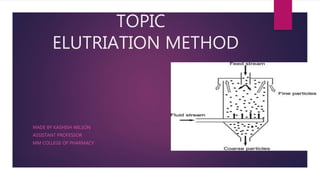
 Nowadays in elutriation process, the particles are suspended in a moving fluid,
Generally water or air. The apparatus consists of a vertical column with an inlet near
the bottom for suspension, an outlet at the base for coarse particles and an overflow
near the top for fluid and fine articles. One column will give single separation into two
fractions. If more than one fraction is required a number of tubes of increasing area of
cross section can be connected in series. The velocity of the fluid decreases in
succeeding tubes as the area of cross section increases, thus giving a number of
fractions. These fractions are separated and dried.
Advantages & Disadvantages
 Advantages
1. The process is continuous.
2. Depending on the number of fractions required, the same number of tubes of
different area of cross section can be connected.
3. The separation is quick as compare to other methods of separation.
4. The apparatus is more compact than as that used in sedimentation methods.
 Disadvantage
1. The suspension of solid particles has to be diluted which may not be desired in certain
cases.

ELUTRIATION METHOD.pptx

  • 1.
    TOPIC ELUTRIATION METHOD MADE BYKASHISH WILSON ASSISTANT PROFESSOR MM COLLEGE OF PHARMACY
  • 2.
    Introduction  Elutriation isa process for separating particles based on their size, shape and density, using a stream of gas or liquid flowing in a direction usually opposite to the direction of sedimentation. This method is mainly used for particles smaller than 1 μm.  The size separation of powder is based on the low density of fine particles and high density of the coarse particles. Elutriating tank is used to separate the coarse and fine particles of powder after levigation
  • 3.
    Working:-  The drypowder or paste made by levigation process is kept in an elutriating tank and mixed with a large quantity of water.  The solid particles are uniformly distributed in the liquid by stirring and then it is allowed to settle down. Depending on the density of solid particles, it will either settle down or remain suspended in water.  The sample is withdrawn at different heights through the outlets. These are dried and thus the powder with various size fractions are collected
  • 4.
    Continue...  Nowadays inelutriation process, the particles are suspended in a moving fluid, Generally water or air. The apparatus consists of a vertical column with an inlet near the bottom for suspension, an outlet at the base for coarse particles and an overflow near the top for fluid and fine articles. One column will give single separation into two fractions. If more than one fraction is required a number of tubes of increasing area of cross section can be connected in series. The velocity of the fluid decreases in succeeding tubes as the area of cross section increases, thus giving a number of fractions. These fractions are separated and dried.
  • 5.
    Advantages & Disadvantages Advantages 1. The process is continuous. 2. Depending on the number of fractions required, the same number of tubes of different area of cross section can be connected. 3. The separation is quick as compare to other methods of separation. 4. The apparatus is more compact than as that used in sedimentation methods.  Disadvantage 1. The suspension of solid particles has to be diluted which may not be desired in certain cases.