


CENTRE STAGE:
Supporting small theatres in the capital
ECONOMY COMMITTEE
INVESTIGATION
1
We visited theatres across the capital , spoke to experts, and
consulted with venues, audiences, theatre professionals and
actors to feed into our action plan for boosting small theatres.
Our investigation examined the challenges facing small London
theatres and suggested how the Mayor and the Greater London
Authority (GLA) could assist these important venues.
2
Our action plan sets out ways that Mayor Boris Johnson and
Greater London Authority (GLA) can support these theatres.
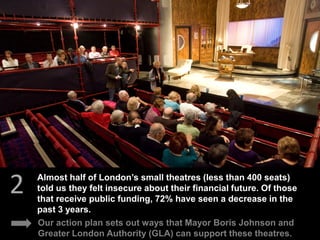
Almost half of London’s small theatres (less than 400 seats)
told us they felt insecure about their financial future. Of those
that receive public funding, 72% have seen a decrease in the
past 3 years.
The following slides set out some of our recommendations.
3 London has a large and diverse theatre industry. Apart from the
bright lights of the West End, the capital is the home to 105 small
theatres. We added these to the Tube map, which could be a way
of telling people about London’s fringe venues.
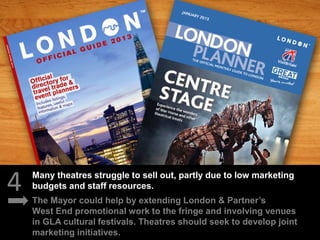
4 The Mayor could help by extending London & Partner’s
West End promotional work to the fringe and involving venues
in GLA cultural festivals. Theatres should seek to develop joint
marketing initiatives.
Many theatres struggle to sell out, partly due to low marketing
budgets and staff resources.
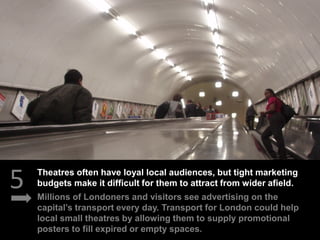
5 Millions of Londoners and visitors see advertising on the
capital’s transport every day. Transport for London could help
local small theatres by allowing them to supply promotional
posters to fill expired or empty spaces.
Theatres often have loyal local audiences, but tight marketing
budgets make it difficult for them to attract from wider afield.
6
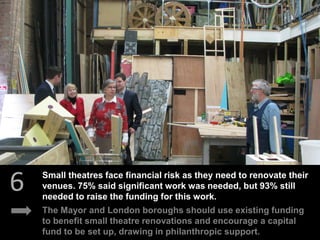
The Mayor and London boroughs should use existing funding
to benefit small theatre renovations and encourage a capital
fund to be set up, drawing in philanthropic support.
Small theatres face financial risk as they need to renovate their
venues. 75% said significant work was needed, but 93% still
needed to raise the funding for this work.
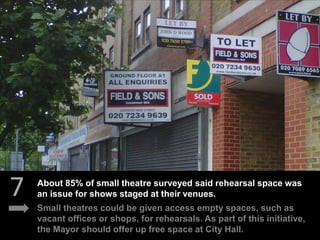
7
Small theatres could be given access empty spaces, such as
vacant offices or shops, for rehearsals. As part of this initiative,
the Mayor should offer up free space at City Hall.
About 85% of small theatre surveyed said rehearsal space was
an issue for shows staged at their venues.
8 The GLA could invite theatres to express interest in running joint
apprenticeships and act as a lead organisation bidding for
funding from the Creative Employment programme.
Small theatres play a vital role in developing London’s cultural
workforce and there are opportunities to strengthen this role.
For more details about all the
recommendations in our action
plan, please visit:
Click on the report to visit investigation page
www.london.gov.uk/theatreplan

Centre Stage: action plan to boost London's theatres (London Assembly)

  • 1.
    CENTRE STAGE: Supporting smalltheatres in the capital ECONOMY COMMITTEE INVESTIGATION
  • 2.
    1 We visited theatresacross the capital , spoke to experts, and consulted with venues, audiences, theatre professionals and actors to feed into our action plan for boosting small theatres. Our investigation examined the challenges facing small London theatres and suggested how the Mayor and the Greater London Authority (GLA) could assist these important venues.
  • 3.
    2 Our action plansets out ways that Mayor Boris Johnson and Greater London Authority (GLA) can support these theatres. Almost half of London’s small theatres (less than 400 seats) told us they felt insecure about their financial future. Of those that receive public funding, 72% have seen a decrease in the past 3 years.
  • 4.
    The following slidesset out some of our recommendations. 3 London has a large and diverse theatre industry. Apart from the bright lights of the West End, the capital is the home to 105 small theatres. We added these to the Tube map, which could be a way of telling people about London’s fringe venues.
  • 5.
    4 The Mayorcould help by extending London & Partner’s West End promotional work to the fringe and involving venues in GLA cultural festivals. Theatres should seek to develop joint marketing initiatives. Many theatres struggle to sell out, partly due to low marketing budgets and staff resources.
  • 6.
    5 Millions ofLondoners and visitors see advertising on the capital’s transport every day. Transport for London could help local small theatres by allowing them to supply promotional posters to fill expired or empty spaces. Theatres often have loyal local audiences, but tight marketing budgets make it difficult for them to attract from wider afield.
  • 7.
    6 The Mayor andLondon boroughs should use existing funding to benefit small theatre renovations and encourage a capital fund to be set up, drawing in philanthropic support. Small theatres face financial risk as they need to renovate their venues. 75% said significant work was needed, but 93% still needed to raise the funding for this work.
  • 8.
    7 Small theatres couldbe given access empty spaces, such as vacant offices or shops, for rehearsals. As part of this initiative, the Mayor should offer up free space at City Hall. About 85% of small theatre surveyed said rehearsal space was an issue for shows staged at their venues.
  • 9.
    8 The GLAcould invite theatres to express interest in running joint apprenticeships and act as a lead organisation bidding for funding from the Creative Employment programme. Small theatres play a vital role in developing London’s cultural workforce and there are opportunities to strengthen this role.
  • 10.
    For more detailsabout all the recommendations in our action plan, please visit: Click on the report to visit investigation page www.london.gov.uk/theatreplan