Li-ion Cell Venting Risks
and Detection
Brian Engle
Director, Business Development
brian.engle@amphenol-sensors.com
US: 248 978 5736
amphenol-sensors.com
Chair: SAE J2990 First/Second Responders Task
Force
Vice President, NAATBATT
www.amphenol.com
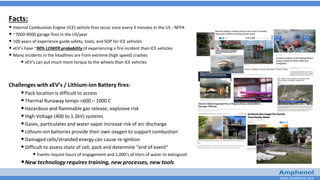
Why do EV incidents make headlines?
Challenges with xEV’s / Lithium-ion Battery fires:
•Pack location is difficult to access
•Thermal Runaway temps >600 – 1000 C
•Hazardous and flammable gas release; explosive risk
•High Voltage (400 to 1.2kV) systems
•Gases, particulates and water vapor increase risk of arc discharge
•Lithium-ion batteries provide their own oxygen to support combustion
•Damaged cells/stranded energy can cause re-ignition
•Difficult to assess state of cell, pack and determine “end of event”
• Events require hours of engagement and 1,000’s of liters of water to extinguish
•New technology requires training, new processes, new tools
Facts:
• Internal Combustion Engine (ICE) vehicle fires occur once every 3 minutes in the US - NFPA
• ~7000-9000 garage fires in the US/year
• 100 years of experience guide safety, tools, and SOP for ICE vehicles
• xEV’s have ~90% LOWER probability of experiencing a fire incident than ICE vehicles
• Many incidents in the headlines are from extreme (high speed) crashes
• xEV’s can put much more torque to the wheels than ICE vehicles
www.amphenol.com
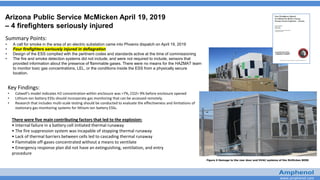
Arizona Public Service McMicken April 19, 2019
– 4 firefighters seriously injured
Summary Points:
• A call for smoke in the area of an electric substation came into Phoenix dispatch on April 19, 2019
• Four firefighters seriously injured in deflagration
• Design of the ESS complied with the pertinent codes and standards active at the time of commissioning
• The fire and smoke detection systems did not include, and were not required to include, sensors that
provided information about the presence of flammable gases. There were no means for the HAZMAT team
to monitor toxic gas concentrations, LEL, or the conditions inside the ESS from a physically secure
location.
Key Findings:
• Colwell’s model indicates H2 concentration within enclosure was >7%, CO2> 9% before enclosure opened
• Lithium-ion battery ESSs should incorporate gas monitoring that can be accessed remotely.
• Research that includes multi-scale testing should be conducted to evaluate the effectiveness and limitations of
stationary gas monitoring systems for lithium-ion battery ESSs.
There were five main contributing factors that led to the explosion:
• Internal failure in a battery cell initiated thermal runaway
• The fire suppression system was incapable of stopping thermal runaway
• Lack of thermal barriers between cells led to cascading thermal runaway
• Flammable off-gases concentrated without a means to ventilate
• Emergency response plan did not have an extinguishing, ventilation, and entry
procedure
www.amphenol.com
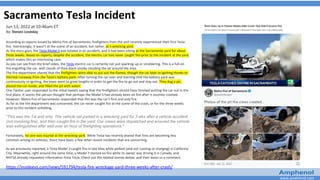
Sacramento Tesla Incident
Jun 13, 2022 at 10:46am ET
By: Steven Loveday
According to reports issued by Metro Fire of Sacramento, firefighters from the unit recently experienced their first Tesla
fire. Interestingly, it wasn't at the scene of an accident, but rather, at a wrecking yard.
As the story goes, the Tesla Model S was totaled in an accident, and it had been sitting at the Sacramento yard for about
three weeks. Based on reports, despite the accident, the electric car had never caught fire prior to the incident at the yard,
which makes this an interesting case.
As you can see from the brief video, the Tesla electric car is certainly not just sparking up or smoldering. This is a full-on
fire engulfing the car, with clouds of thick black smoke clouding the air around the area.
The fire department shared that the firefighters were able to put out the flames, though the car kept re-igniting thanks to
thermal runaway from the Tesla's battery pack. After turning the car over and learning that the battery pack was
continuously re-igniting, the team went to great lengths in order to get the fire to go out and stay out. They dug a pit,
placed the car inside, and filled the pit with water.
One Twitter user responded to the initial tweets saying that the firefighters should have finished putting the car out in the
first place. It seems the person thought that perhaps the Model S had already been on fire after it recently crashed.
However, Metro Fire of Sacramento responded that this was the car's first and only fire.
As far as the fire department was concerned, the car never caught fire at the scene of the crash, or for the three weeks
prior to this incident unfolding.
“This was the 1st and only. The vehicle sat parked in a wrecking yard for 3 wks after a vehicle accident
(not involving fire), and then caught fire in the yard. Our crews were dispatched and ensured the vehicle
was extinguished after well over an hour of firefighting operations."
Fortunately, no one was injured at the wrecking yard. While Tesla has recently shared that fires are becoming less
common among its vehicles, there have been a few other recent incidents that are concerning.
As we previously reported, a Tesla Model 3 caught fire in late May while parked (and not running or charging) in California
City. Meanwhile, right around the same time, a Model Y started on fire while its owner was driving it in Canada, and
NHTSA already requested information from Tesla. Check out the related stories below, and then leave us a comment.
https://insideevs.com/news/591794/tesla-fire-wreckage-yard-three-weeks-after-crash/
www.amphenol.com
Hyundai Kona Garage Explosion - Montreal
Jul 28, 2019 at 2:16pm ET
Lithium has offered us the most efficient battery until now, but it is also very flammable. This is why any fire
situation with a huge lithium-ion battery may be very difficult to extinguish. The newest such case comes from
Canada. More specifically from Île-Bizard, Montreal. And it involves a vehicle that had not presented any similar
problem until now, the Hyundai Kona Electric.
Piero Cosentino bought his last March. On July 26, he was about to have lunch when he heard an explosion and
the fire alarm went off. Thick black smoke was coming from the door that leads to his garage.
“As soon as I saw that, I immediately turned off the breaker,” he told CBC. “My first instinct was to go out and
run outside so I did not have to open doors and feed the fire.” Cosentino then started to fight the fire with the
help of a garden hose while he waited for the firefighters.
It was only there Cosentino could see the extent of the damage. The explosion set his garage door to the other
side of the street. Part of the roof of the garage went down.
Around 30 men managed to put out the fire. Louise Desrosiers, a Division Chief from the Montreal Fire
Department, said they found no other possible cause to the fire apart from the Hyundai Kona.
“It was a fully electric vehicle, and there was nothing around that could have caused the explosion. We will be
following up [...] closely with the owner to understand the problem in anticipation of other cases,” she told
Radio Canada, which also took the pictures in this article.
The story gets even weirder. Cosentino claims his Kona was not charging. And that is was not even connected to
a socket.
www.amphenol.com
Vancouver, BC incident
May 27, 2022 at 11:19am ET
By: Steven Loveday
There have been a few Tesla electric car fires in the news recently, and some media outlets and individuals seem to be getting
confused about which is which. To be clear, the US National Highway Traffic Safety Administration (NHTSA) is now requesting
information about the Model Y fire in Canada that happened while the car was in motion.
Another recent Tesla fire, which we also covered, happened in the States. It involved a Model 3 that was parked in California City.
The Model 3 wasn't running or charging. We'll have to wait and see what comes of this related fire. NHTSA told Reuters it "is aware
of the incident and has reached out to the manufacturer for information."
At any rate, as we previously reported, Tesla Model Y owner Jamil Jutha was driving his electric crossover when it alerted him of an
error, powered down, started smoking, and suddenly caught fire. He ended up breaking the driver's side window to escape from
the vehicle before it was in flames.
Tesla's cars have an emergency door release, which is often confused with an actual door-opening handle and can be used as such.
However, Jutha said it was difficult to figure out amid the high-stress situation. He shared:
“The doors wouldn’t open. The windows wouldn’t go down. I kicked through the window, climbed out, and called 911 right away."
Just yesterday, May 26, 2022, the NHTSA explained that it had requested information from Tesla about the Model Y's spontaneous
combustion that occurred in Vancouver, British Columbia. More specifically, the NHTSA provided that same comment to Reuters as
it did about the Model 3 fire. The organization "is aware of the incident and has reached out to the manufacturer for information."
As of the time of writing, Tesla hadn't responded to a request for comment about the Model Y fire in Canada. The same appears to
be true about the Model 3 fire in California City.
www.amphenol.com
California City, CA incident
May 24, 2022 at 11:18am ET
By: Steven Loveday
As you may have heard, a Tesla Model 3 recently caught fire in California City. Thankfully, it was parked with no one inside, and there are no reports of anyone
being hurt. However, the EV is clearly totaled, the owner won't get a new car until around October, and many of his belongings were destroyed.
According to Bakersfield Now, Ediel Ruiz was on a trip to visit his partner Edith Parker's family after she recently graduated from USC. Ruiz was inside a home,
away from the Model 3 when he says he got a Tesla app notification about the car's alarm. When he headed out to see what was happening, the car was smoking.
Ruiz went on to share that he opened the rear door to find flames engulfing the interior. The fire was melting his infant's car seat. He also explained that all of his
partner's "graduation stuff" was burned, as well as a stroller and some baby formula. The Tesla owner noted that the fire appeared to start beneath the car seat
in the second row.
The couple had plans to head to Bakersfield for dinner, but the plans were canceled at the last minute. Ruiz said:
"Luckily, it didn't happen while we were driving."
According to Bakersfield Now, HowItBroke.com founder Robert Swaim explained that EV fires are uncommon, but they're difficult to put out. This is especially true
if the fire department hasn't had much experience with such fires. In addition, even after the fire appears to be successfully extinguished, a phenomenon called
thermal runaway can cause it to reignite.
Swaim also suggested that Tesla has improved its models and battery chemistry over the years to make them less prone to fire. That said, he also said that "EVs
within two years of being new seem to have more of a propensity to spontaneously ignite.“
The California City Fire Department arrived on the scene, responding to the Model 3 owner's 911 call. The team was reportedly successful in putting out the fire
quickly, though they've had training specific to dealing with EV fires. However, Tesla's Roadside Assistance wasn't able to move the car right away due to the
severity of the damage. Ruiz also added that he had the car insured through Tesla's new in-house insurance program.
The fire department's public information officer David Orr shared that electric car fires aren't something he sees often. Andrew Freeborn of the Kent Country Fire
Department agreed, but added that the statistics could change as more people begin to adopt electric vehicles.
www.amphenol.com
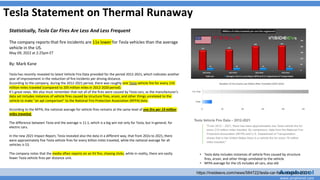
Tesla Statement on Thermal Runaway
https://insideevs.com/news/584722/tesla-car-fires-statistic-2021/
Statistically, Tesla Car Fires Are Less And Less Frequent
The company reports that fire incidents are 11x lower for Tesla vehicles than the average
vehicle in the US.
May 09, 2022 at 2:25pm ET
By: Mark Kane
Tesla has recently revealed its latest Vehicle Fire Data provided for the period 2012-2021, which indicates another
year of improvement in the reduction of fire incidents per driving distance.
According to the company, during the 2012-2021 period, there was roughly one Tesla vehicle fire for every 210
million miles traveled (compared to 205 million miles in 2012-2020 period).
It's great news. We also must remember that not all of the fires were caused by Tesla cars, as the manufacturer's
data set includes instances of vehicle fires caused by structure fires, arson, and other things unrelated to the
vehicle to make "an apt comparison" to the National Fire Protection Association (NFPA) data.
According to the NFPA, the national average for vehicle fires remains at the same level of one fire per 19 million
miles traveled.
The difference between Tesla and the average is 11:1, which is a big win not only for Tesla, but in general, for
electric cars.
In the new 2021 Impact Report, Tesla revealed also the data in a different way, that from 202o to 2021, there
were approximately five Tesla vehicle fires for every billion miles traveled, while the national average for all
vehicles is 53.
The company notes that the media often reports on an EV fire, chasing clicks, while in reality, there are vastly
fewer Tesla vehicle fires per distance unit.
• Tesla data includes instances of vehicle fires caused by structure
fires, arson, and other things unrelated to the vehicle
• NFPA average for the US includes all cars, also old
www.amphenol.com
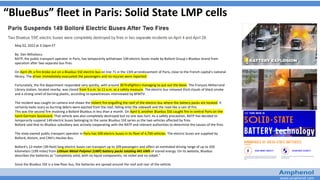
“BlueBus” fleet in Paris: Solid State LMP cells
May 02, 2022 at 3:16pm ET
By: Dan Mihalascu
RATP, the public transport operator in Paris, has temporarily withdrawn 149 electric buses made by Bolloré Group’s Bluebus brand from
operation after two separate bus fires.
On April 29, a fire broke out on a Bluebus 5SE electric bus on line 71 in the 13th arrondissement of Paris, close to the French capital's national
library. The driver immediately evacuated the passengers and no injuries were reported.
Fortunately, the fire department responded very quickly, with around 30 firefighters managing to put out the blaze. The François Mitterrand
Library station, located nearby, was closed from 9 a.m. to 11 a.m. as a safety measure. The electric bus released thick clouds of black smoke
and a strong smell of burning plastic, according to eyewitnesses interviewed by BFMTV.
The incident was caught on camera and shows the violent fire engulfing the roof of the electric bus where the battery packs are located. It
certainly looks scary as burning debris were ejected from the roof, falling onto the sidewalk and the road like a rain of fire.
This was the second fire involving a Bolloré Bluebus in less than a month. On April 4, another Bluebus 5SE caught fire in central Paris on the
Saint-Germain boulevard. That vehicle was also completely destroyed but no one was hurt. As a safety precaution, RATP has decided to
temporarily suspend 149 electric buses belonging to the same Bluebus 5SE series as the two vehicles affected by fires.
Bolloré said that its Bluebus subsidiary was actively cooperating with the RATP and relevant authorities to determine the causes of the fires.
The state-owned public transport operator in Paris has 500 electric buses in its fleet of 4,700 vehicles. The electric buses are supplied by
Bolloré, Alstom, and CNH's Heuliez Bus.
Bolloré's 12-meter (39-foot) long electric buses can transport up to 109 passengers and offers an estimated driving range of up to 320
kilometers (199 miles) from Lithium Metal Polymer (LMP) battery packs totaling 441 kWh of stored energy. On its website, Bluebus
describes the batteries as "completely solid, with no liquid components, no nickel and no cobalt."
Since the Bluebus 5SE is a low-floor bus, the batteries are spread around the roof and rear of the vehicle.
www.amphenol.com
Renault Zoe: Holland Dealership
The company warned European Union authorities that units produced between January 13,
2021, and February 22, 2021, present the risk of “an internal short circuit (..:) in the battery.”
According to Renault’s own words, such an issue “will lead to increased risk of fire.”
Renault did not disclose exactly which battery is involved with the problem. However, the
information document suggests that it is related to the high-voltage battery pack, more
specifically to the BT4 XLR (Extra Long Range). We suspect the French carmaker is talking about
what it publicly refers to as the "E.V. 50 battery pack."
https://en.wikipedia.org/wiki/Plug-in_electric_vehicle_fire_incidents#Renault_Zoe
Electric car burns out at car dealer in Velserbroek
Tuesday, January 18, 2022
An electric car spontaneously caught fire at the Renault dealer in Velserbroek on Tuesday morning.
The car fire was accompanied by a lot of smoke. As a precaution, many emergency services were present.
It is a brand new electric car that spontaneously started to burn.
Employees got the burning vehicle out of the showroom, after which the car burned out further outside.
Firefighters struggled to extinguish the fire. A number of those involved were treated at the scene by
ambulance personnel. Two people have been taken to hospital for a check-up.
www.amphenol.com
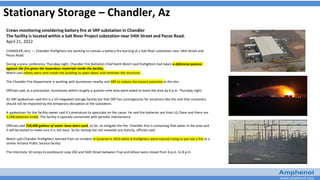
Stationary Storage – Chandler, Az
Crews monitoring smoldering battery fire at SRP substation in Chandler
The facility is located within a Salt River Project substation near 54th Street and Pecos Road.
April 21, 2022
CHANDLER, Ariz. — Chandler firefighters are working to contain a battery fire burning at a Salt River substation near 54th Street and
Pecos Road.
During a press conference Thursday night, Chandler Fire Battalion Chief Keith Welch said firefighters had taken a defensive posture
against the fire given the hazardous materials inside the facility.
Welch said robots were sent inside the building to open doors and ventilate the structure.
The Chandler Fire Department is working with businesses nearby and SRP to reduce the hazard potential at the site.
Officials said, as a precaution, businesses within roughly a quarter-mile area were asked to leave the area by 6 p.m. Thursday night.
An SRP spokesman said this is a 10-megawatt storage facility but that SRP has contingencies for situations like this and that customers
should not be impacted by the temporary disruption at the substation.
A spokesman for the facility owner said it’s premature to speculate on the cause. He said the batteries are from LG Chem and there are
3,248 batteries inside. The facility is typically unmanned with periodic maintenance.
Officials said 750,000 gallons of water have been used, so far, to mitigate the fire. Chandler Fire is containing that water in the area and
it will be tested to make sure it is not toxic. So far testing has not revealed any toxicity, officials said.
Welch said Chandler firefighters learned from an incident in Surprise in 2019 when 8 firefighters were injured trying to put out a fire at a
similar Arizona Public Service facility.
The Interstate 10 ramps to eastbound Loop 202 and 56th Street between Frye and Allison were closed from 6 p.m. to 8 p.m.
www.amphenol.com
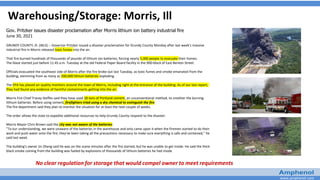
Warehousing/Storage: Morris, Ill
Gov. Pritzker issues disaster proclamation after Morris lithium ion battery industrial fire
June 30, 2021
GRUNDY COUNTY, Ill. (WLS) -- Governor Pritzker issued a disaster proclamation for Grundy County Monday after last week's massive
industrial fire in Morris released toxic fumes into the air.
That fire burned hundreds of thousands of pounds of lithium ion batteries, forcing nearly 5,000 people to evacuate their homes.
The blaze started just before 11:45 a.m. Tuesday at the old Federal Paper Board facility in the 900-block of East Benton Street.
Officials evacuated the southeast side of Morris after the fire broke out last Tuesday, as toxic fumes and smoke emanated from the
building, stemming from as many as 200,000 lithium batteries exploding.
The EPA has placed air quality monitors around the town of Morris, including right at the entrance of the building. As of our last report,
they had found any evidence of harmful contaminants getting into the air.
Morris Fire Chief Tracey Steffes said they have used 28 tons of Portland cement, an unconventional method, to smother the burning
lithium batteries. Before using cement, firefighters tried using a dry chemical to extinguish the fire.
The fire department said they plan to monitor the situation for at least the next couple of weeks.
The order allows the state to expedite additional resources to help Grundy County respond to the disaster.
Morris Mayor Chris Brown said the city was not aware of the batteries.
"To our understanding, we were unaware of the batteries in the warehouse and only came upon it when the firemen started to do their
work and push water onto the fire; they've been taking all the precautions necessary to make sure everything is safe and contained," he
said last week.
The building's owner Jin Zheng said he was on the scene minutes after the fire started, but he was unable to get inside. He said the thick
black smoke coming from the building was fueled by explosions of thousands of lithium batteries he had inside.
No clear regulation for storage that would compel owner to meet requirements
www.amphenol.com
Regulations and Standards
Battery Regulations & Standards:
 NFPA 855: Standard for the Installation of Stationary Energy Storage Systems
 IFC: 2024; Chapter 3: Section 321 Rechargeable Battery Storage
 GTR-20: Electric Vehicle Safety
 UL 1973: Batteries for use in Stationary, Vehicle Aux Power and light rail apps
 UL9540: Safety for Energy Storage Systems
 NFPA 70: Electrical Safety
 ISO-17840: Road vehicles — Information for first and second responders
 SAE J2990: Hybrid and Electric Vehicle Safety Systems Information Report
 SAE 3235 (Draft) BEST- PRACTICES FOR THE STORAGE OF LITHIUM-ION BATTERIES
www.amphenol.com
CHINA EV Safety & EV Battery Safety Regulation: GB 18384 2020, GB 38031 2020, GB 38032 2020
New regulation effective 1/1/2021.
AUTOMOTIVE THERMAL INCIDENT WARNING:
5 Minute Warning Requirement:
• Initiate thermal runaway
• Detect and alert occupants
• Allow occupants to safely exit vehicle within 5 minute window
• Expected to extend beyond 5 minutes in 2026+
UN GTR 20 (EV Safety) cites requirement to protect occupants
• Phase 2 to implement “vehicle off”/”full vehicle” test identifying gas release risk in cabin and proximate to vehicle
NA: FMVSS only specifies requirement to limit electrolyte leakage, retain batteries and isolate HV
• Will change to reflect GTR-20
Amphenol working with Research and Industry Partners:
• Part of IWG for Global Technical Regulations (GTR)
• Amphenol support of SAE H/EV Committee, First Responders Task Force, Industry Consortia including NAATBATT
• R&D efforts at OEM’s, Research laboratories across the globe focused on improving battery safety
• DoE / NREL/ JRC/ViV / NASA
• CDC/NIOSH (OSHA), UL , EPRI
• Universities and Research Institutions
1
xEV Thermal Runaway Regulations
www.amphenol.com
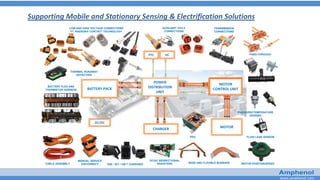
BATTERY PACK
CHARGER MOTOR
POWER
DISTRIBUTION
UNIT
MOTOR
CONTROL UNIT
DC/DC
AC
LOW AND HIGH VOLTAGE CONNECTIONS
FT. RADSOK® CONTACT TECHNOLOGY
AUXILIARY HV/LV
CONNECTIONS
PASS-THROUGH
BATTERY FLEX AND
THERMISTOR HARNESS
CABLE ASSEMBLY
MANUAL SERVICE
DISCONNECT SAE / IEC / GB-T CHARGING
PDU
RIGID AND FLEXIBLE BUSBARS
MOTOR
CONTROL UNIT
MOTOR
CONTROL UNIT
DC/AC BIDIRECTIONAL
INVERTERS
THERMAL RUNAWAY
DETECTION
PTC
Supporting Mobile and Stationary Sensing & Electrification Solutions
FLUID LEAK SENSOR
PRESSURE/TEMPERATURE
SENSING
MOTOR POSITION/SPEED
TRANSMISSION
CONNECTIONS
www.amphenol.com
1
6
Validation
Instruments
Air Quality
(Gas, PM2.5)
Vibration,
Acceleration
Condition Monitoring
Position
Temperature
Pressure
Ceramic
Pressure
Piezoelectric Ceramics
Accelerometers
Shaft Sensing
Potentiometers
Measurement of toxic gases & oxygen
PM2.5 dust sensing
MEMS type
gas sensor
Pressure Sensors
Gas Sensing – CO2
Humidity &
Dust sensing
Validation system
Digital pressure sensors
Level
Concentration
Speed
Pressure
Fluid level &
concentratio
n
Ultrasonic
, Speed &
Pressure
Pressure
Temperature
Gas, Humidity
Moisture
Piezoceramics
Ultrasonic/Acousti
c
Temperature
Epoxy Coated NTC
Chip Thermistor
Air in Line sensors
NAVSEA Sensor
Coolant Temp
Combo Temp & Pressure
Oil Temp
Def
og
Outside Air Temp
Boiler Probes
Vibration, acceleration,
Condition monitoring,
force,
Pressure, linear position,
and level sensing
Sensing:
• Temperature
• Pressure
• Fluid Level
• Concentration
• Speed
• Rotary/Linear Position
• Accoustic /ultrasonics
• Vibration / Acceleration
• Force
• Air Quality
• Gas concentration
• Particulates / Dust
• Moisture / Humidity
• Process Controls
• Validation Instruments
www.amphenol.com
Working Together to Improve Battery Safety, Diagnostics, & Robustness
• Robust Early Detection of Thermal Runaway (REDTR)
• Mobile and Stationary applications
• Cell & Pack Diagnostics
• Coolant breach/water intrusion sensor
• EMC immune Temperature sensors
• Battery / xEV Heat Pump / HX Sensors
• Full suite of thermal management sensors
• Pressure and Temperature
• Cell Connection Systems
• World’s largest supplier of Cell Connection Systems
Amphenol Battery Sensor Portfolio
www.amphenol.com
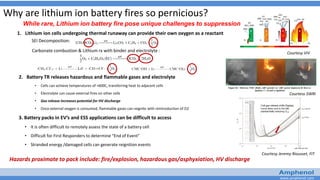
Why are lithium ion battery fires so pernicious?
While rare, Lithium ion battery fire pose unique challenges to suppression
1. Lithium ion cells undergoing thermal runaway can provide their own oxygen as a reactant
Courtesy SWRI
Courtesy ViV
SEI Decomposition:
Carbonate combustion & Lithium rx with binder and electrolyte :
2. Battery TR releases hazardous and flammable gases and electrolyte
• Cells can achieve temperatures of >600C, transferring heat to adjacent cells
• Electrolyte can cause external fires on other cells
• Gas release increases potential for HV discharge
• Once external oxygen is consumed, flammable gases can reignite with reintroduction of O2
3. Battery packs in EV’s and ESS applications can be difficult to access
• It is often difficult to remotely assess the state of a battery cell
• Difficult for First Responders to determine “End of Event”
• Stranded energy /damaged cells can generate reignition events
Courtesy Jeremy Riousset, FIT
Hazards proximate to pack include: fire/explosion, hazardous gas/asphyxiation, HV discharge
www.amphenol.com
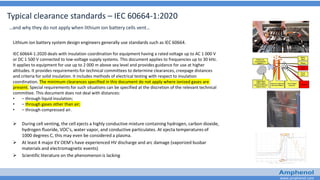
Typical clearance standards – IEC 60664-1:2020
…and why they do not apply when lithium ion battery cells vent…
Lithium ion battery system design engineers generally use standards such as IEC 60664.
IEC 60664-1:2020 deals with insulation coordination for equipment having a rated voltage up to AC 1 000 V
or DC 1 500 V connected to low-voltage supply systems. This document applies to frequencies up to 30 kHz.
It applies to equipment for use up to 2 000 m above sea level and provides guidance for use at higher
altitudes. It provides requirements for technical committees to determine clearances, creepage distances
and criteria for solid insulation. It includes methods of electrical testing with respect to insulation
coordination. The minimum clearances specified in this document do not apply where ionized gases are
present. Special requirements for such situations can be specified at the discretion of the relevant technical
committee. This document does not deal with distances:
• – through liquid insulation;
• – through gases other than air;
• – through compressed air.
 During cell venting, the cell ejects a highly conductive mixture containing hydrogen, carbon dioxide,
hydrogen fluoride, VOC’s, water vapor, and conductive particulates. At ejecta temperatures of
1000 degrees C, this may even be considered a plasma.
 At least 4 major EV OEM’s have experienced HV discharge and arc damage (vaporized busbar
materials and electromagnetic events)
 Scientific literature on the phenomenon is lacking
www.amphenol.com
2
Incidents: Need for robust gas detection
Summary/Guidance:
• Systems that can detect off-gases in low concentrations can provide an
early warning of an impending thermal runaway – and trigger shut
down systems to electrically isolate the individual, or bank of, or rack of
battery cells – and thus avoid thermal runaway occurring in a single cell.
Such systems generally rely on a degree of enclosure around the
batteries, such as an ESS container or a room housing large banks of
batteries
• Note, the presence and build-up of significant quantities of H2 and
Hydrocarbon gases may present an explosion hazard. While such
matters are beyond the scope of this document, it is worth noting that
ventilation is an important feature in the mitigation of potentially
explosive risks.
• Similar requests from NFPA, IFC, US DOT, FAA, FEMA, and others for
detection of flammable and hazardous gases
Fire Industry Association Guidance (UK, Jan 2021)
www.amphenol.com
2
Indicator:
• Voltage/Current drop
• Heat generation
• Gas generation
• Pressure in pack airspace
• Swelling of cell
• Smoke generation
Detection Technologies:
• Voltage monitoring (slow / not effective for parallel strings)
• Temperature sensing (slow / not enough sense points)
• Gas sensing (need to prevent cross sensitivity / drift)
• Pressure sensing (cell v air volume/venting; pack shell breach)
• Force sensing (deconfound thermal/intercalation; signal/noise)
• Particulate / Smoke sensing (need particulate products)
Anatomy of Cell Failure and available detection technology:
Each sensor technology has strengths & weaknesses
www.amphenol.com
2
Challenges:
• Defining the threshold for failure generating a hazard: Electrolyte leakage, initial/soft venting, thermal runaway, fire
Once a cell vents flammable gas, the hazard is present
• Do lab tests accurately represent real world Thermal Runaway? (soft vents, electrolyte leakage)
System Level Requirements:
• Stable Detection capability over entire pack service life (>20 years?)
• Continuous Lifetime operation, two operational states:
• Vehicle driving/charging (fast response)
• Vehicle parked for extended periods (low power consumption; < 5 mA @ 3V)
• TR venting can happen in seconds, requiring fast sampling
• Robust solution must be agnostic to:
• Cell / module/ pack configuration
• Electrochemistry
• Cell size
• Must not exhibit Type 1 (Missed Detection) or Type 2 (False Positive) faults
• Meet ASIL (Safety Integrity Level) Requirements
• Value/Cost sensitive
Requirements for Detection:
www.amphenol.com
2
Explosive Gases
Cell venting :
• Venting products include 4 combustible gases above their Lower Explosion Limit (LEL)*
• Electrolyte leakage can release Ethyl/Methyl based compounds with low vaporization temperatures
Combustible gases concentrations are far above the Lower Explosive Limit (LEL) (4% for H2, 4.4% for CH4, 12.5% for CO, 2.7% for Ethylene (C2H4), 3% for Ethane (C2H6)
• Typical pack dilution volumes from ~1l to 400L
• Testing has shown H2 in pack > 4x LEL (~160 000ppm) from single cell
• CO2 in high concentration has dilutive effect, displacing available O2 in the enclosure
Cell Venting, even without fire, releases flammable gases into pack vapor space, where any ignition source can initiate fire/explosion
RSC Advances (2015) 5, 57171; Thermal runaway of commercial 18650 Li-ion batteries with LFP and NCA cathodes – impact of state of
charge and overcharge.
Energy sufficient to generate fire/explosion
www.amphenol.com
2
Thermal energy available for gas ignition
Cascading TR within enclosures:
Flash point - the lowest temperature at which vapor of a volatile material can be ignited with an
ignition source present
• H2 flash point: -253°C
• Ethylene flash point: −136 °C
• Methane flash point: −188 °C
• Ethane flash point: −135 °C
Autoignition temperature = kindling point
• is the temperature at which a material spontaneously ignites in a normal atmosphere without an
external source of ignition.
• is the temperature required to supply the activation energy for combustion
• is usually applied to combustible fuel mixture
• H2 autoignition temp: 585°C
• Ethylene autoignition temp : 450°C
• Methane autoignition temp: 580°C
• Ethane autoignition temp: 472°C
Cell temps during venting/TR can approach 1000°C, providing ample thermal energy
for gas autoignition provided sufficient reactants and oxygen are present between
LEL and UFL
www.amphenol.com
Hazardous Gas Release (Lebedeva, Prenmath, et al)
Summary Conclusions:
• (JRC) Li-ion cells contain enough free electrolyte in amounts sufficient for the formation of potentially toxic atmosphere in
enclosed spaces from the electrolyte from a single cell
• Thermal Runaway vaporizes the electrolyte and creates hazardous decomposition products
• A single EV pack can contain 100’s of cells
• Substantial amounts of HF gas have been found in independent studies as well as real world incidents (Morris, Il)
(SWRi) Venting emission particulate rates are 5 to 6 orders of magnitude higher than those typically emitted from
the exhaust of a modern heavy-duty diesel engine.
• (SWRi) LFP overcharge tests yielded HF that exceeded IDLH limits (30ppm) while the NMC nail penetration test
yielded formaldehyde beyond IDLH limits (20 ppm).
www.amphenol.com
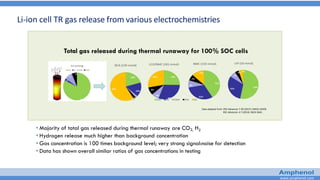
Data adapted from: RSC Advances 7.39 (2017):24425-24429.
RSC Advances 4.7 (2014): 3633-3642.
Total gas released during thermal runaway for 100% SOC cells
• Majority of total gas released during thermal runaway are CO2, H2
• Hydrogen release much higher than background concentration
• Gas concentration is 100 times background level; very strong signal:noise for detection
• Data has shown overall similar ratios of gas concentrations in testing
Li-ion cell TR gas release from various electrochemistries
www.amphenol.com
2
Gas sensor Selection Process
From the available technologies, it is critical to understand sensor response to analyte, cross sensitivity, signal to noise ratio as well as
aging properties.
TC and Spectroscopy measure physics behavior, not chemical behavior
Electrolyte
Hydrogen
CO
2
www.amphenol.com
• Gas detection operates on the principal of thermal conductivity
• The sensing elements are made up of a micro machined diaphragm with intrinsically safe embedded planar heater
resistor meander
• The typical maximum operating temperature of the heater is 450°C at 3Vdc
• A Wheatstone bridge circuit is used for monitoring the sensing elements
• The bridge circuit is supplied with 3Vdc and is pulsed on and off through an N-Channel MOSFET
• A microcontroller is used to control the MOSFET and subsequently the power consumption of the bridge
• Power consumption of the bridge circuit is approximately 150mW in continuous operation, but is cycled for 35msec
“on time”/350 msec “off time”
• The bridge circuit provides a difference voltage between the reference leg and sensing leg reducing the affect of
bridge supply voltage variation
• In the current configuration, gas detection uses an active and reference sensing element
• Using active and reference elements built on the same technology in a bridge circuit allows for temperature compensation
• In operation as the thermal conductivity of the atmosphere varies, the effective resistance of the heater varies
causing a bridge output voltage differential change
H2 Sensor: Principle of operation
OPERATING PRINCIPLE
The elements operate on the thermal conductivity principle. The sensing element is open to the atmosphere under test
and the reference element is supplied sealed in reference air in a second similar package. The response of the devices
is dependent upon the difference between the thermal conductivity of the atmosphere under test and the reference air.
When the atmosphere under test has a thermal conductivity higher than the reference air, the sensing element loses
more heat to the surroundings than the reference element. This increased heat loss causes a cooling of the sensing
element and a subsequent reduction in the resistance of the sensing element compared to the reference element. Two
identical MEMS devices are glued on separated ceramic headers and wire bonded.
www.amphenol.com
2
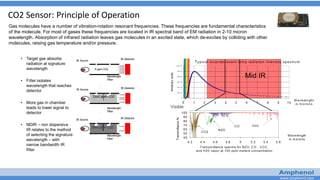
CO2 Sensor: Principle of Operation
Gas molecules have a number of vibration-rotation resonant frequencies. These frequencies are fundamental characteristics
of the molecule. For most of gases these frequencies are located in IR spectral band of EM radiation in 2-10 micron
wavelength. Absorption of infrared radiation leaves gas molecules in an excited state, which de-excites by colliding with other
molecules, raising gas temperature and/or pressure.
www.amphenol.com
3
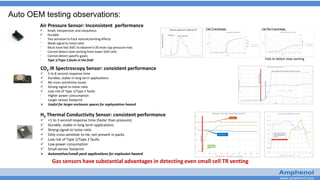
Auto OEM testing observations:
Air Pressure Sensor: Inconsistent performance
 Small, inexpensive, and ubiquitous
 Durable
⁻ Too sensitive to Pack volume/venting effects
⁻ Weak signal to noise ratio
⁻ Must have fast ASIC to observe (<20 msec typ pressure rise)
⁻ Cannot detect slow venting from lower SOH cells
⁻ Cannot detect specific gases
⁻ Type 1/Type 2 faults in the field
Gas sensors have substantial advantages in detecting even small cell TR venting
CO2 IR Spectroscopy Sensor: consistent performance
 5 to 8 second response time
 Durable, stable in long term applications
 No cross sensitivity issues
 Strong signal to noise ratio
 Low risk of Type 1/Type 2 faults
⁻ Higher power consumption
⁻ Larger sensor footprint
 Useful for larger enclosure spaces for asphyxiation hazard
H2 Thermal Conductivity Sensor: consistent performance
 <1 to 3 second response time (faster than pressure)
 Durable, stable in long term applications
 Strong signal to noise ratio
 Only cross sensitive to He, not present in packs
 Low risk of Type 1/Type 2 faults
 Low power consumption
 Small sensor footprint
 Automotive/small pack applications for explosion hazard
Fails to detect slow venting
www.amphenol.com
TR plasma plume velocity:
H2 sensor location not critical
Ejecta plume velocities:
(Srinivasan, ECS 2020)
• LG HG2 18650 cells in pack arrangement
• Velocity profile modeled and verified with HS camera
• Ejecta plume velocity can exceed 200m/s and can even approach Mach
• Plume velocities and superheated gas substantially accelerate gas diffusion
within the vapor space of a pack/enclosure
Testing performed in large format traction battery pack:
Multiple tests performed with sensor proximate to trigger cell and at
maximum distance from trigger cell (approximately 2m)
• Gas sensor response characteristics support conclusions of Srinivasan’s
study
• Sensor location within the enclosure space has little to no impact on
response time
• Response data within measurement error
Velocity flow field within pack
Gas Sensors anywhere in “airspace” of pack can detect within seconds
www.amphenol.com
Gas evolution and cascading TR
Relationship between signals and environment:
• Ratio of cell SOC/SOH(thermal capacity) to free air volume will drive sensor location,
response characteristics (ie, smaller cells with lower SOC’s venting will generate less gas to
detect in large dilution volumes
• Current approach has been generally insensitive to dilution volumes
• Superheated plume will initially drive gases to top of enclosure space, CO2 will cool and settle,
hydrogen will try to escape via leaks/permeation
• Gases can remain above LEL for hours inside enclosure
Cascading TR:
• Shown at right, prismatic cells in cascading TR in traction pack of ~150L dilution volume
• Concentration of H2 (yellow) continues to rise after consuming available oxygen in the pack
with each incremental cell venting
• Gas temperatures throughout the pack increase and sensor data limited by electronics
overtemperature condition
• Gases can linger within enclosure for extended period
• Once above LEL, diurnal temp changes can affect oxygen available for gas combustion
Prismatic cascading TR
Multiphysics sensors with high concentration calibrations can track performance of TR countermeasures
1 2 3 4 5 6 7 8
H2
Pressure
Temperature
Fire
20 000l dilution volume (ISO container)
Fire
21700 cell
www.amphenol.com
Surface Mount REDTR MiniModules for BMS mounting:
Components for BMS or assembly:
• H2,CO2 sensors for surface mount
• Auxiliary P, RH, T sensors
• Analog/CAN/I2C/SPI/LIN communications
• Power management on board
• Can operate independent of BMS with «wakeup»
• Small package size
• >20 year design life
• Can detect single v cascade TR
• AEC Q
• In production with multiple OEM’s
Components to surface Mount on BMS, or as “sentinel” standalone device with CAN BMS wakeup
www.amphenol.com
RedCAN: Plug and Play fully compensated detection capabilities
Content and Features:
• H2/Rh/T/P Sensor
• CAN communications
• Fully compensated gas sensor assembly
• >20 year design life
• Can detect single v cascade TR
• Plastic enclosure with integrated mounting
features
• Designed to meet ASIL requirements
Ideal for:
• Applications with remote or “off shelf” BMS
• Aerospace eVTOL, eAero, applications
• Mobile energy storage
www.amphenol.com
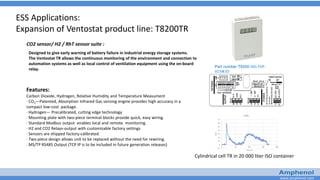
CO2 sensor/ H2 / RhT sensor suite :
ESS Applications:
Expansion of Ventostat product line: T8200TR
Designed to give early warning of battery failure in industrial energy storage systems.
The Ventostat TR allows the continuous monitoring of the environment and connection to
automation systems as well as local control of ventilation equipment using the on-board
relay.
Part number T8200-HD-50P-
H2MOD
Features:
Carbon Dioxide, Hydrogen, Relative Humidity and Temperature Measument
· CO2—Patented, Absorption Infrared Gas sensing engine provides high accuracy in a
compact low-cost package.
· Hydrogen— Precalibrated, cutting edge technology
· Mounting plate with two-piece terminal blocks provide quick, easy wiring.
· Standard Modbus output enables local and remote monitoring.
· H2 and CO2 Relays-output with customizable factory settings
· Sensors are shipped factory-calibrated.
· Two-piece design allows unit to be replaced without the need for rewiring.
. MS/TP RS485 Output (TCP IP is to be included in future generation releases)
Cylindrical cell TR in 20 000 liter ISO container
www.amphenol.com
** Note: Any Amphenol variant can be installed in custom plastic housing as needed
Amphenol TR family
Amphenol Amphenol Amphenol Amphenol Amphenol Amphenol
CO2 Detection
select solder or
module assembly
Gen 2.0 H2
miniPCB
Surface
T8200 NPB surface
mount pressure
sensor
BLD1
Fully packaged H2
w/ CAN
BLD2
Fully packaged H2
& CO w/ CAN
AX221058 AX221042
Production In Development
Pressure Range
260 to 1260 mBar 20mbar to 2500mbar 50 to 200 kPa 260 to 1260 mBar Optional 260 to 1260 mBar 260 to 1260 mBar or 50
to 300 kPa (other pressure
ranges available)
N/A N/A
Pressure accuracy
± 1% FSO ± 0.1 mBar ± 1.5% FSO ± 0.1 mBar ± 0.1 mBar N/A N/A
CO2 Co2 / H2/ Rh/T
Temperature (-40 to 150C ;
<±2 °C )
Y -40°C to 85°C -55 to 105C Y Y Y Optional -40 to 85C -40 to 85C
5% - 95% ± 3% RH
Power Supply
10 to 32V DC max 9-18V 12V / 24V 6 to 12V, 32V DC max 3V to 5V 6 to 12V, 32V DC max 1.7V~3.6V 9 V to 18V 9V to 18V
Power mode
single single variable variable single single mode/ relay single single single
10 mA / < 25uA* 10 mA / < 25uA* 12mA / <0.1mA * 35uA <25mA / <100uA sleep
mode
<25mA / <100uA sleep
mode
*sensor not active *sensor not active *sensor not active
CAN 2.0A CAN 2.0A LIN 2.1 MS/TP RS485
ISO 11898 ISO 11898 TCP IP
SAE J2284 SAE J2284
No* N/A*
*BMS continuous powered *(capable if CANFD
xceiver chip is used)
Physical Dimension
(module)
66 x 42x 12mm 35 x 39 x 37mm 38 x 51 x 48mm 47 x 2 x 10mm 25 x 20 x 1.5 mm surface
mount
116 x 81 x 27mm 4 x 4mm QFN surface
mount
35 x 39 x 37mm 35 x 39 x 37mm
Automotive
UL94 Planned AEC Q104 N/A AEC Q100 AEC Q104 N/A AEC Q100 AECQ-104 AECQ-104
Additional features
IP5K0, w/ hsg; optional
coolant breach/water
intrusion detection
IP6K7 w/ hsg IP6K7 IP6K7 IP6K4K UL94 5VA; CE and RoHS,
REACH, and WEEE
compliant
IP5K0 IP6K7 IP6K7
Samples
4 wks ARO 4 wks ARO 4 wks ARO 4 wks ARO 4 wks ARO 4 wks ARO 4 wks ARO 4 wks ARO 4 wks ARO
Available
Yes Yes Yes Yes Yes Yes Yes Yes Yes
AX221087
Production In validation Production
18-30 VAC RMS, 50/60
Hz, or 10.8 to 42 VDC,
polarity protected
0.50 A at 125 VAC, 1A 24
VDC
Gas
H2 / CO2 / P/ RhT H2/P/CO/NH3 with
RhT compensation
H2/P/Rh/T Press only
System/
Configuration
Amphenol
Development Tool
Amphenol TRDU5 Amphenol
RedCAN
Fully packaged
H2/RhT assembly
w/ CAN
AX220054
Engineering Tool
Production AX221075
Production
Relative Humidity (0 to
100%; <±4%)
Y Y Y N/A
N/A
Q Current (μA)
30mA <80mA
Interfaces
LIN 2.1
No No
Wake up BECM
Yes Optional Relays on H2 nd Co2
sensors
No
Yes
Production
H2 w/ RhT
compensation
18 bit DSP I2C & SPI
H2/CO with RhT
compensation
Optional 0 to 95% RH 0 to 95% RH
Ratiometric HS CAN HS CAN
H2 with RhT
compensation
www.amphenol.com
Good News: State of the Industry for Thermal Propagation countermeasures
o On vehicle:
 “Livestream” data to secure server
 Aggressive HX
• Coolant
• refrigerant
 load dump from affected modules (as with MegaPack)
 Phase change materials that absorb heat
 Disable regen braking contribution to pack charging
 Disable charging
 Thermal isolation (Mica, aerogels)
 On board extinguishing agents (busses)
 Dielectric coolant
 Access port
o Off vehicle:
 ISO bath (ISO 17840 / SAE J2990)
 E lance
 Lots of water
 See First Responder Survey Recommendations
www.amphenol.com
Background
www.amphenol.com
OEM / Amphenol Dialog on
Battery Cell Venting
October 2021
Countermeasures and Field
Experiences
www.amphenol.com
Benchmarks: Renault Zoe
“Fire Hose Access” allows for direct battery immersion
Information on design is in Emergency Response Guide
www.amphenol.com
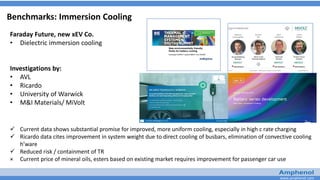
Benchmarks: Immersion Cooling
Faraday Future, new xEV Co.
• Dielectric immersion cooling
Investigations by:
• AVL
• Ricardo
• University of Warwick
• M&I Materials/ MiVolt
 Current data shows substantial promise for improved, more uniform cooling, especially in high c rate charging
 Ricardo data cites improvement in system weight due to direct cooling of busbars, elimination of convective cooling
h’ware
 Reduced risk / containment of TR
× Current price of mineral oils, esters based on existing market requires improvement for passenger car use
www.amphenol.com
NTSB Report – Jan 2021 (T. Barth)
https://youtu.be/J6eS6JzBn0k
Safety Issues:
• Inadequacy of emergency response guides for minimizing risks to first and
secondary responders from Li-ion battery fires
• Gaps in safety standards for high-speed, high-severity crashes involving
Li-ion battery vehicles
Recommendations:
NHTSA:
• Incorporate Emergency Response Guides (ERGs) into NCAP
• Continue research on mitigating or de-energizing stranded
Energy
EV Manufacturers (cars, trucks, buses in USA)
• Model ERGs on ISO 17840 and SAE J2990
• Vehicle specific information on fire fighting, stranded energy, safe storage
Responder Associations (NFPA, IAFC, IAFF, AFTC, NVFC, TRAA
• Inform members of risks and available guidance
www.amphenol.com
Benchmarks:
Stranded Energy & Immersion:
“Fire Hose Access” allows for direct battery immersion
Firefighters in Leuven, Belgium posted photos of their approach to cooling battery
cells after a hybrid vehicle.&
When crews were called to the car fire, they "found a strong smoke development,
which pointed to the battery's thermal runaway" which caused the battery cell
temperatures to rise. Shortly after, the smoke turned to fire and the crew knocked
down the fire.
The department posted the next steps to cool the battery cells on their Facebook
page: they "refrigerated the vehicle abundantly and placed it in a special
#waterdipping container."
They loaded the vehicle into a special container with filled with water using a
crane.
The container was placed in a remote parking lot. As soon as the vehicle has
completely cooled down, a branch service will remove it from the container and
transport it towards scrap dealer. Not for the sake of immersion, but because a car
like this is completely destroyed when the battery catches on fire anyway," the
department posted on Facebook.
The contaminated water from the container was collected to be examined after the
vehicle was removed and hauled off to a scrap yard.
www.amphenol.com
Current
“Water Immersion”
& “Large amounts of water”
New Development:
AVL Water “spike” into pack substantially
reduced water usage
New field Tools for First Responders:
“Spike” systems from Murer, Rosenbauer
Surface vehicle standard practice to supress fire and relieve stranded energy
Response vehicles typically only have ~500 to 1500 gallons of water available on board
• “Spike systems” need identified locations for piercing to avoid striking HV bussing & cables
• Pouch cells will self discharge when exposed to water, CID’s in prismatic and cylindrical cells may prevent discharge
Stranded Energy and Second Responder safety need to be addressed
5,000 to 30,000 gallons 80 gallons
www.amphenol.com
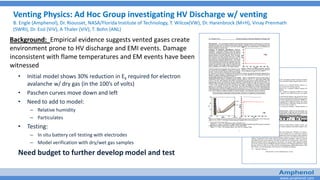
Venting Physics: Ad Hoc Group investigating HV Discharge w/ venting
B. Engle (Amphenol), Dr. Riousset, NASA/Florida Institute of Technology, T. Wilcox(VW), Dr. Harenbrock (M+H), Vinay Prenmath
(SWRI), Dr. Essl (ViV), A Thaler (ViV), T. Bohn (ANL)
• Initial model shows 30% reduction in Ek required for electron
avalanche w/ dry gas (in the 100’s of volts)
• Paschen curves move down and left
• Need to add to model:
– Relative humidity
– Particulates
• Testing:
– In situ battery cell testing with electrodes
– Model verification with dry/wet gas samples
Need budget to further develop model and test
Background: Empirical evidence suggests vented gases create
environment prone to HV discharge and EMI events. Damage
inconsistent with flame temperatures and EM events have been
witnessed
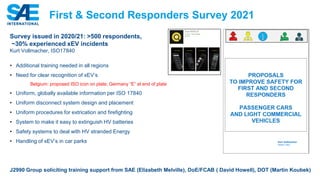
Survey issued in 2020/21: >500 respondents,
~30% experienced xEV incidents
Kurt Vollmacher, ISO17840
• Additional training needed in all regions
• Need for clear recognition of xEV’s
Belgium: proposed ISO icon on plate; Germany “E” at end of plate
• Uniform, globally available information per ISO 17840
• Uniform disconnect system design and placement
• Uniform procedures for extrication and firefighting
• System to make it easy to extinguish HV batteries
• Safety systems to deal with HV stranded Energy
• Handling of xEV’s in car parks
J2990 Group soliciting training support from SAE (Elizabeth Melville), DoE/FCAB ( David Howell), DOT (Martin Koubek)
First & Second Responders Survey 2021
Andrew Klock, NFPA
• In US, 300k trained; >800k need training
• Interest from NA OEM to support training
With the increasing prevalence of electric (EV) and hybrid vehicles all over the world, it
is important for the first and second responder communities to be educated on the
various unique safety risk these vehicles may present. Since 2010, the National Fire
Protection Association's (NFPA) Alternative Fuel Vehicle Safety Training Program has
teamed up with major auto manufactures, subject matter experts, fire, law enforcement
and safety organizations in order to address these safety needs. Through our years of
research and work in this field we have developed a comprehensive curriculum for first
responders when dealing with alternatively fueled vehicles which include instructor led
classroom courses, free interactive online learning, an Emergency Field Guide, and
informational/educational videos.
Here are a few important takeaways on EV and hybrid fire safety for first responders:
1. When suppressing a vehicle fire involving an EV or hybrid, water is the recommended
extinguishment agent. Large amounts of water may be required, so be sure to establish a
sufficient water supply before operations commence.
2. As with all vehicle fires, toxic byproducts will be given off, so NFPA compliant firefighting
PPE and SCBA should be utilized at all times.
3. DO NOT attempt to pierce the engine or battery compartment of the vehicle to allow water
permeation, as you could accidentally penetrate high voltage components.
4. Following extinguishment, use a thermal imaging camera to determine the temperature
fluctuation of the high voltage battery before terminating the incident, to reduce re-ignition
potential.
First Responder Training

Cell venting presentation on battery heating.pdf

  • 1.
    Li-ion Cell VentingRisks and Detection Brian Engle Director, Business Development brian.engle@amphenol-sensors.com US: 248 978 5736 amphenol-sensors.com Chair: SAE J2990 First/Second Responders Task Force Vice President, NAATBATT
  • 2.
    www.amphenol.com Why do EVincidents make headlines? Challenges with xEV’s / Lithium-ion Battery fires: •Pack location is difficult to access •Thermal Runaway temps >600 – 1000 C •Hazardous and flammable gas release; explosive risk •High Voltage (400 to 1.2kV) systems •Gases, particulates and water vapor increase risk of arc discharge •Lithium-ion batteries provide their own oxygen to support combustion •Damaged cells/stranded energy can cause re-ignition •Difficult to assess state of cell, pack and determine “end of event” • Events require hours of engagement and 1,000’s of liters of water to extinguish •New technology requires training, new processes, new tools Facts: • Internal Combustion Engine (ICE) vehicle fires occur once every 3 minutes in the US - NFPA • ~7000-9000 garage fires in the US/year • 100 years of experience guide safety, tools, and SOP for ICE vehicles • xEV’s have ~90% LOWER probability of experiencing a fire incident than ICE vehicles • Many incidents in the headlines are from extreme (high speed) crashes • xEV’s can put much more torque to the wheels than ICE vehicles
  • 3.
    www.amphenol.com Arizona Public ServiceMcMicken April 19, 2019 – 4 firefighters seriously injured Summary Points: • A call for smoke in the area of an electric substation came into Phoenix dispatch on April 19, 2019 • Four firefighters seriously injured in deflagration • Design of the ESS complied with the pertinent codes and standards active at the time of commissioning • The fire and smoke detection systems did not include, and were not required to include, sensors that provided information about the presence of flammable gases. There were no means for the HAZMAT team to monitor toxic gas concentrations, LEL, or the conditions inside the ESS from a physically secure location. Key Findings: • Colwell’s model indicates H2 concentration within enclosure was >7%, CO2> 9% before enclosure opened • Lithium-ion battery ESSs should incorporate gas monitoring that can be accessed remotely. • Research that includes multi-scale testing should be conducted to evaluate the effectiveness and limitations of stationary gas monitoring systems for lithium-ion battery ESSs. There were five main contributing factors that led to the explosion: • Internal failure in a battery cell initiated thermal runaway • The fire suppression system was incapable of stopping thermal runaway • Lack of thermal barriers between cells led to cascading thermal runaway • Flammable off-gases concentrated without a means to ventilate • Emergency response plan did not have an extinguishing, ventilation, and entry procedure
  • 4.
    www.amphenol.com Sacramento Tesla Incident Jun13, 2022 at 10:46am ET By: Steven Loveday According to reports issued by Metro Fire of Sacramento, firefighters from the unit recently experienced their first Tesla fire. Interestingly, it wasn't at the scene of an accident, but rather, at a wrecking yard. As the story goes, the Tesla Model S was totaled in an accident, and it had been sitting at the Sacramento yard for about three weeks. Based on reports, despite the accident, the electric car had never caught fire prior to the incident at the yard, which makes this an interesting case. As you can see from the brief video, the Tesla electric car is certainly not just sparking up or smoldering. This is a full-on fire engulfing the car, with clouds of thick black smoke clouding the air around the area. The fire department shared that the firefighters were able to put out the flames, though the car kept re-igniting thanks to thermal runaway from the Tesla's battery pack. After turning the car over and learning that the battery pack was continuously re-igniting, the team went to great lengths in order to get the fire to go out and stay out. They dug a pit, placed the car inside, and filled the pit with water. One Twitter user responded to the initial tweets saying that the firefighters should have finished putting the car out in the first place. It seems the person thought that perhaps the Model S had already been on fire after it recently crashed. However, Metro Fire of Sacramento responded that this was the car's first and only fire. As far as the fire department was concerned, the car never caught fire at the scene of the crash, or for the three weeks prior to this incident unfolding. “This was the 1st and only. The vehicle sat parked in a wrecking yard for 3 wks after a vehicle accident (not involving fire), and then caught fire in the yard. Our crews were dispatched and ensured the vehicle was extinguished after well over an hour of firefighting operations." Fortunately, no one was injured at the wrecking yard. While Tesla has recently shared that fires are becoming less common among its vehicles, there have been a few other recent incidents that are concerning. As we previously reported, a Tesla Model 3 caught fire in late May while parked (and not running or charging) in California City. Meanwhile, right around the same time, a Model Y started on fire while its owner was driving it in Canada, and NHTSA already requested information from Tesla. Check out the related stories below, and then leave us a comment. https://insideevs.com/news/591794/tesla-fire-wreckage-yard-three-weeks-after-crash/
  • 5.
    www.amphenol.com Hyundai Kona GarageExplosion - Montreal Jul 28, 2019 at 2:16pm ET Lithium has offered us the most efficient battery until now, but it is also very flammable. This is why any fire situation with a huge lithium-ion battery may be very difficult to extinguish. The newest such case comes from Canada. More specifically from Île-Bizard, Montreal. And it involves a vehicle that had not presented any similar problem until now, the Hyundai Kona Electric. Piero Cosentino bought his last March. On July 26, he was about to have lunch when he heard an explosion and the fire alarm went off. Thick black smoke was coming from the door that leads to his garage. “As soon as I saw that, I immediately turned off the breaker,” he told CBC. “My first instinct was to go out and run outside so I did not have to open doors and feed the fire.” Cosentino then started to fight the fire with the help of a garden hose while he waited for the firefighters. It was only there Cosentino could see the extent of the damage. The explosion set his garage door to the other side of the street. Part of the roof of the garage went down. Around 30 men managed to put out the fire. Louise Desrosiers, a Division Chief from the Montreal Fire Department, said they found no other possible cause to the fire apart from the Hyundai Kona. “It was a fully electric vehicle, and there was nothing around that could have caused the explosion. We will be following up [...] closely with the owner to understand the problem in anticipation of other cases,” she told Radio Canada, which also took the pictures in this article. The story gets even weirder. Cosentino claims his Kona was not charging. And that is was not even connected to a socket.
  • 6.
    www.amphenol.com Vancouver, BC incident May27, 2022 at 11:19am ET By: Steven Loveday There have been a few Tesla electric car fires in the news recently, and some media outlets and individuals seem to be getting confused about which is which. To be clear, the US National Highway Traffic Safety Administration (NHTSA) is now requesting information about the Model Y fire in Canada that happened while the car was in motion. Another recent Tesla fire, which we also covered, happened in the States. It involved a Model 3 that was parked in California City. The Model 3 wasn't running or charging. We'll have to wait and see what comes of this related fire. NHTSA told Reuters it "is aware of the incident and has reached out to the manufacturer for information." At any rate, as we previously reported, Tesla Model Y owner Jamil Jutha was driving his electric crossover when it alerted him of an error, powered down, started smoking, and suddenly caught fire. He ended up breaking the driver's side window to escape from the vehicle before it was in flames. Tesla's cars have an emergency door release, which is often confused with an actual door-opening handle and can be used as such. However, Jutha said it was difficult to figure out amid the high-stress situation. He shared: “The doors wouldn’t open. The windows wouldn’t go down. I kicked through the window, climbed out, and called 911 right away." Just yesterday, May 26, 2022, the NHTSA explained that it had requested information from Tesla about the Model Y's spontaneous combustion that occurred in Vancouver, British Columbia. More specifically, the NHTSA provided that same comment to Reuters as it did about the Model 3 fire. The organization "is aware of the incident and has reached out to the manufacturer for information." As of the time of writing, Tesla hadn't responded to a request for comment about the Model Y fire in Canada. The same appears to be true about the Model 3 fire in California City.
  • 7.
    www.amphenol.com California City, CAincident May 24, 2022 at 11:18am ET By: Steven Loveday As you may have heard, a Tesla Model 3 recently caught fire in California City. Thankfully, it was parked with no one inside, and there are no reports of anyone being hurt. However, the EV is clearly totaled, the owner won't get a new car until around October, and many of his belongings were destroyed. According to Bakersfield Now, Ediel Ruiz was on a trip to visit his partner Edith Parker's family after she recently graduated from USC. Ruiz was inside a home, away from the Model 3 when he says he got a Tesla app notification about the car's alarm. When he headed out to see what was happening, the car was smoking. Ruiz went on to share that he opened the rear door to find flames engulfing the interior. The fire was melting his infant's car seat. He also explained that all of his partner's "graduation stuff" was burned, as well as a stroller and some baby formula. The Tesla owner noted that the fire appeared to start beneath the car seat in the second row. The couple had plans to head to Bakersfield for dinner, but the plans were canceled at the last minute. Ruiz said: "Luckily, it didn't happen while we were driving." According to Bakersfield Now, HowItBroke.com founder Robert Swaim explained that EV fires are uncommon, but they're difficult to put out. This is especially true if the fire department hasn't had much experience with such fires. In addition, even after the fire appears to be successfully extinguished, a phenomenon called thermal runaway can cause it to reignite. Swaim also suggested that Tesla has improved its models and battery chemistry over the years to make them less prone to fire. That said, he also said that "EVs within two years of being new seem to have more of a propensity to spontaneously ignite.“ The California City Fire Department arrived on the scene, responding to the Model 3 owner's 911 call. The team was reportedly successful in putting out the fire quickly, though they've had training specific to dealing with EV fires. However, Tesla's Roadside Assistance wasn't able to move the car right away due to the severity of the damage. Ruiz also added that he had the car insured through Tesla's new in-house insurance program. The fire department's public information officer David Orr shared that electric car fires aren't something he sees often. Andrew Freeborn of the Kent Country Fire Department agreed, but added that the statistics could change as more people begin to adopt electric vehicles.
  • 8.
    www.amphenol.com Tesla Statement onThermal Runaway https://insideevs.com/news/584722/tesla-car-fires-statistic-2021/ Statistically, Tesla Car Fires Are Less And Less Frequent The company reports that fire incidents are 11x lower for Tesla vehicles than the average vehicle in the US. May 09, 2022 at 2:25pm ET By: Mark Kane Tesla has recently revealed its latest Vehicle Fire Data provided for the period 2012-2021, which indicates another year of improvement in the reduction of fire incidents per driving distance. According to the company, during the 2012-2021 period, there was roughly one Tesla vehicle fire for every 210 million miles traveled (compared to 205 million miles in 2012-2020 period). It's great news. We also must remember that not all of the fires were caused by Tesla cars, as the manufacturer's data set includes instances of vehicle fires caused by structure fires, arson, and other things unrelated to the vehicle to make "an apt comparison" to the National Fire Protection Association (NFPA) data. According to the NFPA, the national average for vehicle fires remains at the same level of one fire per 19 million miles traveled. The difference between Tesla and the average is 11:1, which is a big win not only for Tesla, but in general, for electric cars. In the new 2021 Impact Report, Tesla revealed also the data in a different way, that from 202o to 2021, there were approximately five Tesla vehicle fires for every billion miles traveled, while the national average for all vehicles is 53. The company notes that the media often reports on an EV fire, chasing clicks, while in reality, there are vastly fewer Tesla vehicle fires per distance unit. • Tesla data includes instances of vehicle fires caused by structure fires, arson, and other things unrelated to the vehicle • NFPA average for the US includes all cars, also old
  • 9.
    www.amphenol.com “BlueBus” fleet inParis: Solid State LMP cells May 02, 2022 at 3:16pm ET By: Dan Mihalascu RATP, the public transport operator in Paris, has temporarily withdrawn 149 electric buses made by Bolloré Group’s Bluebus brand from operation after two separate bus fires. On April 29, a fire broke out on a Bluebus 5SE electric bus on line 71 in the 13th arrondissement of Paris, close to the French capital's national library. The driver immediately evacuated the passengers and no injuries were reported. Fortunately, the fire department responded very quickly, with around 30 firefighters managing to put out the blaze. The François Mitterrand Library station, located nearby, was closed from 9 a.m. to 11 a.m. as a safety measure. The electric bus released thick clouds of black smoke and a strong smell of burning plastic, according to eyewitnesses interviewed by BFMTV. The incident was caught on camera and shows the violent fire engulfing the roof of the electric bus where the battery packs are located. It certainly looks scary as burning debris were ejected from the roof, falling onto the sidewalk and the road like a rain of fire. This was the second fire involving a Bolloré Bluebus in less than a month. On April 4, another Bluebus 5SE caught fire in central Paris on the Saint-Germain boulevard. That vehicle was also completely destroyed but no one was hurt. As a safety precaution, RATP has decided to temporarily suspend 149 electric buses belonging to the same Bluebus 5SE series as the two vehicles affected by fires. Bolloré said that its Bluebus subsidiary was actively cooperating with the RATP and relevant authorities to determine the causes of the fires. The state-owned public transport operator in Paris has 500 electric buses in its fleet of 4,700 vehicles. The electric buses are supplied by Bolloré, Alstom, and CNH's Heuliez Bus. Bolloré's 12-meter (39-foot) long electric buses can transport up to 109 passengers and offers an estimated driving range of up to 320 kilometers (199 miles) from Lithium Metal Polymer (LMP) battery packs totaling 441 kWh of stored energy. On its website, Bluebus describes the batteries as "completely solid, with no liquid components, no nickel and no cobalt." Since the Bluebus 5SE is a low-floor bus, the batteries are spread around the roof and rear of the vehicle.
  • 10.
    www.amphenol.com Renault Zoe: HollandDealership The company warned European Union authorities that units produced between January 13, 2021, and February 22, 2021, present the risk of “an internal short circuit (..:) in the battery.” According to Renault’s own words, such an issue “will lead to increased risk of fire.” Renault did not disclose exactly which battery is involved with the problem. However, the information document suggests that it is related to the high-voltage battery pack, more specifically to the BT4 XLR (Extra Long Range). We suspect the French carmaker is talking about what it publicly refers to as the "E.V. 50 battery pack." https://en.wikipedia.org/wiki/Plug-in_electric_vehicle_fire_incidents#Renault_Zoe Electric car burns out at car dealer in Velserbroek Tuesday, January 18, 2022 An electric car spontaneously caught fire at the Renault dealer in Velserbroek on Tuesday morning. The car fire was accompanied by a lot of smoke. As a precaution, many emergency services were present. It is a brand new electric car that spontaneously started to burn. Employees got the burning vehicle out of the showroom, after which the car burned out further outside. Firefighters struggled to extinguish the fire. A number of those involved were treated at the scene by ambulance personnel. Two people have been taken to hospital for a check-up.
  • 11.
    www.amphenol.com Stationary Storage –Chandler, Az Crews monitoring smoldering battery fire at SRP substation in Chandler The facility is located within a Salt River Project substation near 54th Street and Pecos Road. April 21, 2022 CHANDLER, Ariz. — Chandler firefighters are working to contain a battery fire burning at a Salt River substation near 54th Street and Pecos Road. During a press conference Thursday night, Chandler Fire Battalion Chief Keith Welch said firefighters had taken a defensive posture against the fire given the hazardous materials inside the facility. Welch said robots were sent inside the building to open doors and ventilate the structure. The Chandler Fire Department is working with businesses nearby and SRP to reduce the hazard potential at the site. Officials said, as a precaution, businesses within roughly a quarter-mile area were asked to leave the area by 6 p.m. Thursday night. An SRP spokesman said this is a 10-megawatt storage facility but that SRP has contingencies for situations like this and that customers should not be impacted by the temporary disruption at the substation. A spokesman for the facility owner said it’s premature to speculate on the cause. He said the batteries are from LG Chem and there are 3,248 batteries inside. The facility is typically unmanned with periodic maintenance. Officials said 750,000 gallons of water have been used, so far, to mitigate the fire. Chandler Fire is containing that water in the area and it will be tested to make sure it is not toxic. So far testing has not revealed any toxicity, officials said. Welch said Chandler firefighters learned from an incident in Surprise in 2019 when 8 firefighters were injured trying to put out a fire at a similar Arizona Public Service facility. The Interstate 10 ramps to eastbound Loop 202 and 56th Street between Frye and Allison were closed from 6 p.m. to 8 p.m.
  • 12.
    www.amphenol.com Warehousing/Storage: Morris, Ill Gov.Pritzker issues disaster proclamation after Morris lithium ion battery industrial fire June 30, 2021 GRUNDY COUNTY, Ill. (WLS) -- Governor Pritzker issued a disaster proclamation for Grundy County Monday after last week's massive industrial fire in Morris released toxic fumes into the air. That fire burned hundreds of thousands of pounds of lithium ion batteries, forcing nearly 5,000 people to evacuate their homes. The blaze started just before 11:45 a.m. Tuesday at the old Federal Paper Board facility in the 900-block of East Benton Street. Officials evacuated the southeast side of Morris after the fire broke out last Tuesday, as toxic fumes and smoke emanated from the building, stemming from as many as 200,000 lithium batteries exploding. The EPA has placed air quality monitors around the town of Morris, including right at the entrance of the building. As of our last report, they had found any evidence of harmful contaminants getting into the air. Morris Fire Chief Tracey Steffes said they have used 28 tons of Portland cement, an unconventional method, to smother the burning lithium batteries. Before using cement, firefighters tried using a dry chemical to extinguish the fire. The fire department said they plan to monitor the situation for at least the next couple of weeks. The order allows the state to expedite additional resources to help Grundy County respond to the disaster. Morris Mayor Chris Brown said the city was not aware of the batteries. "To our understanding, we were unaware of the batteries in the warehouse and only came upon it when the firemen started to do their work and push water onto the fire; they've been taking all the precautions necessary to make sure everything is safe and contained," he said last week. The building's owner Jin Zheng said he was on the scene minutes after the fire started, but he was unable to get inside. He said the thick black smoke coming from the building was fueled by explosions of thousands of lithium batteries he had inside. No clear regulation for storage that would compel owner to meet requirements
  • 13.
    www.amphenol.com Regulations and Standards BatteryRegulations & Standards:  NFPA 855: Standard for the Installation of Stationary Energy Storage Systems  IFC: 2024; Chapter 3: Section 321 Rechargeable Battery Storage  GTR-20: Electric Vehicle Safety  UL 1973: Batteries for use in Stationary, Vehicle Aux Power and light rail apps  UL9540: Safety for Energy Storage Systems  NFPA 70: Electrical Safety  ISO-17840: Road vehicles — Information for first and second responders  SAE J2990: Hybrid and Electric Vehicle Safety Systems Information Report  SAE 3235 (Draft) BEST- PRACTICES FOR THE STORAGE OF LITHIUM-ION BATTERIES
  • 14.
    www.amphenol.com CHINA EV Safety& EV Battery Safety Regulation: GB 18384 2020, GB 38031 2020, GB 38032 2020 New regulation effective 1/1/2021. AUTOMOTIVE THERMAL INCIDENT WARNING: 5 Minute Warning Requirement: • Initiate thermal runaway • Detect and alert occupants • Allow occupants to safely exit vehicle within 5 minute window • Expected to extend beyond 5 minutes in 2026+ UN GTR 20 (EV Safety) cites requirement to protect occupants • Phase 2 to implement “vehicle off”/”full vehicle” test identifying gas release risk in cabin and proximate to vehicle NA: FMVSS only specifies requirement to limit electrolyte leakage, retain batteries and isolate HV • Will change to reflect GTR-20 Amphenol working with Research and Industry Partners: • Part of IWG for Global Technical Regulations (GTR) • Amphenol support of SAE H/EV Committee, First Responders Task Force, Industry Consortia including NAATBATT • R&D efforts at OEM’s, Research laboratories across the globe focused on improving battery safety • DoE / NREL/ JRC/ViV / NASA • CDC/NIOSH (OSHA), UL , EPRI • Universities and Research Institutions 1 xEV Thermal Runaway Regulations
  • 15.
    www.amphenol.com BATTERY PACK CHARGER MOTOR POWER DISTRIBUTION UNIT MOTOR CONTROLUNIT DC/DC AC LOW AND HIGH VOLTAGE CONNECTIONS FT. RADSOK® CONTACT TECHNOLOGY AUXILIARY HV/LV CONNECTIONS PASS-THROUGH BATTERY FLEX AND THERMISTOR HARNESS CABLE ASSEMBLY MANUAL SERVICE DISCONNECT SAE / IEC / GB-T CHARGING PDU RIGID AND FLEXIBLE BUSBARS MOTOR CONTROL UNIT MOTOR CONTROL UNIT DC/AC BIDIRECTIONAL INVERTERS THERMAL RUNAWAY DETECTION PTC Supporting Mobile and Stationary Sensing & Electrification Solutions FLUID LEAK SENSOR PRESSURE/TEMPERATURE SENSING MOTOR POSITION/SPEED TRANSMISSION CONNECTIONS
  • 16.
    www.amphenol.com 1 6 Validation Instruments Air Quality (Gas, PM2.5) Vibration, Acceleration ConditionMonitoring Position Temperature Pressure Ceramic Pressure Piezoelectric Ceramics Accelerometers Shaft Sensing Potentiometers Measurement of toxic gases & oxygen PM2.5 dust sensing MEMS type gas sensor Pressure Sensors Gas Sensing – CO2 Humidity & Dust sensing Validation system Digital pressure sensors Level Concentration Speed Pressure Fluid level & concentratio n Ultrasonic , Speed & Pressure Pressure Temperature Gas, Humidity Moisture Piezoceramics Ultrasonic/Acousti c Temperature Epoxy Coated NTC Chip Thermistor Air in Line sensors NAVSEA Sensor Coolant Temp Combo Temp & Pressure Oil Temp Def og Outside Air Temp Boiler Probes Vibration, acceleration, Condition monitoring, force, Pressure, linear position, and level sensing Sensing: • Temperature • Pressure • Fluid Level • Concentration • Speed • Rotary/Linear Position • Accoustic /ultrasonics • Vibration / Acceleration • Force • Air Quality • Gas concentration • Particulates / Dust • Moisture / Humidity • Process Controls • Validation Instruments
  • 17.
    www.amphenol.com Working Together toImprove Battery Safety, Diagnostics, & Robustness • Robust Early Detection of Thermal Runaway (REDTR) • Mobile and Stationary applications • Cell & Pack Diagnostics • Coolant breach/water intrusion sensor • EMC immune Temperature sensors • Battery / xEV Heat Pump / HX Sensors • Full suite of thermal management sensors • Pressure and Temperature • Cell Connection Systems • World’s largest supplier of Cell Connection Systems Amphenol Battery Sensor Portfolio
  • 18.
    www.amphenol.com Why are lithiumion battery fires so pernicious? While rare, Lithium ion battery fire pose unique challenges to suppression 1. Lithium ion cells undergoing thermal runaway can provide their own oxygen as a reactant Courtesy SWRI Courtesy ViV SEI Decomposition: Carbonate combustion & Lithium rx with binder and electrolyte : 2. Battery TR releases hazardous and flammable gases and electrolyte • Cells can achieve temperatures of >600C, transferring heat to adjacent cells • Electrolyte can cause external fires on other cells • Gas release increases potential for HV discharge • Once external oxygen is consumed, flammable gases can reignite with reintroduction of O2 3. Battery packs in EV’s and ESS applications can be difficult to access • It is often difficult to remotely assess the state of a battery cell • Difficult for First Responders to determine “End of Event” • Stranded energy /damaged cells can generate reignition events Courtesy Jeremy Riousset, FIT Hazards proximate to pack include: fire/explosion, hazardous gas/asphyxiation, HV discharge
  • 19.
    www.amphenol.com Typical clearance standards– IEC 60664-1:2020 …and why they do not apply when lithium ion battery cells vent… Lithium ion battery system design engineers generally use standards such as IEC 60664. IEC 60664-1:2020 deals with insulation coordination for equipment having a rated voltage up to AC 1 000 V or DC 1 500 V connected to low-voltage supply systems. This document applies to frequencies up to 30 kHz. It applies to equipment for use up to 2 000 m above sea level and provides guidance for use at higher altitudes. It provides requirements for technical committees to determine clearances, creepage distances and criteria for solid insulation. It includes methods of electrical testing with respect to insulation coordination. The minimum clearances specified in this document do not apply where ionized gases are present. Special requirements for such situations can be specified at the discretion of the relevant technical committee. This document does not deal with distances: • – through liquid insulation; • – through gases other than air; • – through compressed air.  During cell venting, the cell ejects a highly conductive mixture containing hydrogen, carbon dioxide, hydrogen fluoride, VOC’s, water vapor, and conductive particulates. At ejecta temperatures of 1000 degrees C, this may even be considered a plasma.  At least 4 major EV OEM’s have experienced HV discharge and arc damage (vaporized busbar materials and electromagnetic events)  Scientific literature on the phenomenon is lacking
  • 20.
    www.amphenol.com 2 Incidents: Need forrobust gas detection Summary/Guidance: • Systems that can detect off-gases in low concentrations can provide an early warning of an impending thermal runaway – and trigger shut down systems to electrically isolate the individual, or bank of, or rack of battery cells – and thus avoid thermal runaway occurring in a single cell. Such systems generally rely on a degree of enclosure around the batteries, such as an ESS container or a room housing large banks of batteries • Note, the presence and build-up of significant quantities of H2 and Hydrocarbon gases may present an explosion hazard. While such matters are beyond the scope of this document, it is worth noting that ventilation is an important feature in the mitigation of potentially explosive risks. • Similar requests from NFPA, IFC, US DOT, FAA, FEMA, and others for detection of flammable and hazardous gases Fire Industry Association Guidance (UK, Jan 2021)
  • 21.
    www.amphenol.com 2 Indicator: • Voltage/Current drop •Heat generation • Gas generation • Pressure in pack airspace • Swelling of cell • Smoke generation Detection Technologies: • Voltage monitoring (slow / not effective for parallel strings) • Temperature sensing (slow / not enough sense points) • Gas sensing (need to prevent cross sensitivity / drift) • Pressure sensing (cell v air volume/venting; pack shell breach) • Force sensing (deconfound thermal/intercalation; signal/noise) • Particulate / Smoke sensing (need particulate products) Anatomy of Cell Failure and available detection technology: Each sensor technology has strengths & weaknesses
  • 22.
    www.amphenol.com 2 Challenges: • Defining thethreshold for failure generating a hazard: Electrolyte leakage, initial/soft venting, thermal runaway, fire Once a cell vents flammable gas, the hazard is present • Do lab tests accurately represent real world Thermal Runaway? (soft vents, electrolyte leakage) System Level Requirements: • Stable Detection capability over entire pack service life (>20 years?) • Continuous Lifetime operation, two operational states: • Vehicle driving/charging (fast response) • Vehicle parked for extended periods (low power consumption; < 5 mA @ 3V) • TR venting can happen in seconds, requiring fast sampling • Robust solution must be agnostic to: • Cell / module/ pack configuration • Electrochemistry • Cell size • Must not exhibit Type 1 (Missed Detection) or Type 2 (False Positive) faults • Meet ASIL (Safety Integrity Level) Requirements • Value/Cost sensitive Requirements for Detection:
  • 23.
    www.amphenol.com 2 Explosive Gases Cell venting: • Venting products include 4 combustible gases above their Lower Explosion Limit (LEL)* • Electrolyte leakage can release Ethyl/Methyl based compounds with low vaporization temperatures Combustible gases concentrations are far above the Lower Explosive Limit (LEL) (4% for H2, 4.4% for CH4, 12.5% for CO, 2.7% for Ethylene (C2H4), 3% for Ethane (C2H6) • Typical pack dilution volumes from ~1l to 400L • Testing has shown H2 in pack > 4x LEL (~160 000ppm) from single cell • CO2 in high concentration has dilutive effect, displacing available O2 in the enclosure Cell Venting, even without fire, releases flammable gases into pack vapor space, where any ignition source can initiate fire/explosion RSC Advances (2015) 5, 57171; Thermal runaway of commercial 18650 Li-ion batteries with LFP and NCA cathodes – impact of state of charge and overcharge. Energy sufficient to generate fire/explosion
  • 24.
    www.amphenol.com 2 Thermal energy availablefor gas ignition Cascading TR within enclosures: Flash point - the lowest temperature at which vapor of a volatile material can be ignited with an ignition source present • H2 flash point: -253°C • Ethylene flash point: −136 °C • Methane flash point: −188 °C • Ethane flash point: −135 °C Autoignition temperature = kindling point • is the temperature at which a material spontaneously ignites in a normal atmosphere without an external source of ignition. • is the temperature required to supply the activation energy for combustion • is usually applied to combustible fuel mixture • H2 autoignition temp: 585°C • Ethylene autoignition temp : 450°C • Methane autoignition temp: 580°C • Ethane autoignition temp: 472°C Cell temps during venting/TR can approach 1000°C, providing ample thermal energy for gas autoignition provided sufficient reactants and oxygen are present between LEL and UFL
  • 25.
    www.amphenol.com Hazardous Gas Release(Lebedeva, Prenmath, et al) Summary Conclusions: • (JRC) Li-ion cells contain enough free electrolyte in amounts sufficient for the formation of potentially toxic atmosphere in enclosed spaces from the electrolyte from a single cell • Thermal Runaway vaporizes the electrolyte and creates hazardous decomposition products • A single EV pack can contain 100’s of cells • Substantial amounts of HF gas have been found in independent studies as well as real world incidents (Morris, Il) (SWRi) Venting emission particulate rates are 5 to 6 orders of magnitude higher than those typically emitted from the exhaust of a modern heavy-duty diesel engine. • (SWRi) LFP overcharge tests yielded HF that exceeded IDLH limits (30ppm) while the NMC nail penetration test yielded formaldehyde beyond IDLH limits (20 ppm).
  • 26.
    www.amphenol.com Data adapted from:RSC Advances 7.39 (2017):24425-24429. RSC Advances 4.7 (2014): 3633-3642. Total gas released during thermal runaway for 100% SOC cells • Majority of total gas released during thermal runaway are CO2, H2 • Hydrogen release much higher than background concentration • Gas concentration is 100 times background level; very strong signal:noise for detection • Data has shown overall similar ratios of gas concentrations in testing Li-ion cell TR gas release from various electrochemistries
  • 27.
    www.amphenol.com 2 Gas sensor SelectionProcess From the available technologies, it is critical to understand sensor response to analyte, cross sensitivity, signal to noise ratio as well as aging properties. TC and Spectroscopy measure physics behavior, not chemical behavior Electrolyte Hydrogen CO 2
  • 28.
    www.amphenol.com • Gas detectionoperates on the principal of thermal conductivity • The sensing elements are made up of a micro machined diaphragm with intrinsically safe embedded planar heater resistor meander • The typical maximum operating temperature of the heater is 450°C at 3Vdc • A Wheatstone bridge circuit is used for monitoring the sensing elements • The bridge circuit is supplied with 3Vdc and is pulsed on and off through an N-Channel MOSFET • A microcontroller is used to control the MOSFET and subsequently the power consumption of the bridge • Power consumption of the bridge circuit is approximately 150mW in continuous operation, but is cycled for 35msec “on time”/350 msec “off time” • The bridge circuit provides a difference voltage between the reference leg and sensing leg reducing the affect of bridge supply voltage variation • In the current configuration, gas detection uses an active and reference sensing element • Using active and reference elements built on the same technology in a bridge circuit allows for temperature compensation • In operation as the thermal conductivity of the atmosphere varies, the effective resistance of the heater varies causing a bridge output voltage differential change H2 Sensor: Principle of operation OPERATING PRINCIPLE The elements operate on the thermal conductivity principle. The sensing element is open to the atmosphere under test and the reference element is supplied sealed in reference air in a second similar package. The response of the devices is dependent upon the difference between the thermal conductivity of the atmosphere under test and the reference air. When the atmosphere under test has a thermal conductivity higher than the reference air, the sensing element loses more heat to the surroundings than the reference element. This increased heat loss causes a cooling of the sensing element and a subsequent reduction in the resistance of the sensing element compared to the reference element. Two identical MEMS devices are glued on separated ceramic headers and wire bonded.
  • 29.
    www.amphenol.com 2 CO2 Sensor: Principleof Operation Gas molecules have a number of vibration-rotation resonant frequencies. These frequencies are fundamental characteristics of the molecule. For most of gases these frequencies are located in IR spectral band of EM radiation in 2-10 micron wavelength. Absorption of infrared radiation leaves gas molecules in an excited state, which de-excites by colliding with other molecules, raising gas temperature and/or pressure.
  • 30.
    www.amphenol.com 3 Auto OEM testingobservations: Air Pressure Sensor: Inconsistent performance  Small, inexpensive, and ubiquitous  Durable ⁻ Too sensitive to Pack volume/venting effects ⁻ Weak signal to noise ratio ⁻ Must have fast ASIC to observe (<20 msec typ pressure rise) ⁻ Cannot detect slow venting from lower SOH cells ⁻ Cannot detect specific gases ⁻ Type 1/Type 2 faults in the field Gas sensors have substantial advantages in detecting even small cell TR venting CO2 IR Spectroscopy Sensor: consistent performance  5 to 8 second response time  Durable, stable in long term applications  No cross sensitivity issues  Strong signal to noise ratio  Low risk of Type 1/Type 2 faults ⁻ Higher power consumption ⁻ Larger sensor footprint  Useful for larger enclosure spaces for asphyxiation hazard H2 Thermal Conductivity Sensor: consistent performance  <1 to 3 second response time (faster than pressure)  Durable, stable in long term applications  Strong signal to noise ratio  Only cross sensitive to He, not present in packs  Low risk of Type 1/Type 2 faults  Low power consumption  Small sensor footprint  Automotive/small pack applications for explosion hazard Fails to detect slow venting
  • 31.
    www.amphenol.com TR plasma plumevelocity: H2 sensor location not critical Ejecta plume velocities: (Srinivasan, ECS 2020) • LG HG2 18650 cells in pack arrangement • Velocity profile modeled and verified with HS camera • Ejecta plume velocity can exceed 200m/s and can even approach Mach • Plume velocities and superheated gas substantially accelerate gas diffusion within the vapor space of a pack/enclosure Testing performed in large format traction battery pack: Multiple tests performed with sensor proximate to trigger cell and at maximum distance from trigger cell (approximately 2m) • Gas sensor response characteristics support conclusions of Srinivasan’s study • Sensor location within the enclosure space has little to no impact on response time • Response data within measurement error Velocity flow field within pack Gas Sensors anywhere in “airspace” of pack can detect within seconds
  • 32.
    www.amphenol.com Gas evolution andcascading TR Relationship between signals and environment: • Ratio of cell SOC/SOH(thermal capacity) to free air volume will drive sensor location, response characteristics (ie, smaller cells with lower SOC’s venting will generate less gas to detect in large dilution volumes • Current approach has been generally insensitive to dilution volumes • Superheated plume will initially drive gases to top of enclosure space, CO2 will cool and settle, hydrogen will try to escape via leaks/permeation • Gases can remain above LEL for hours inside enclosure Cascading TR: • Shown at right, prismatic cells in cascading TR in traction pack of ~150L dilution volume • Concentration of H2 (yellow) continues to rise after consuming available oxygen in the pack with each incremental cell venting • Gas temperatures throughout the pack increase and sensor data limited by electronics overtemperature condition • Gases can linger within enclosure for extended period • Once above LEL, diurnal temp changes can affect oxygen available for gas combustion Prismatic cascading TR Multiphysics sensors with high concentration calibrations can track performance of TR countermeasures 1 2 3 4 5 6 7 8 H2 Pressure Temperature Fire 20 000l dilution volume (ISO container) Fire 21700 cell
  • 33.
    www.amphenol.com Surface Mount REDTRMiniModules for BMS mounting: Components for BMS or assembly: • H2,CO2 sensors for surface mount • Auxiliary P, RH, T sensors • Analog/CAN/I2C/SPI/LIN communications • Power management on board • Can operate independent of BMS with «wakeup» • Small package size • >20 year design life • Can detect single v cascade TR • AEC Q • In production with multiple OEM’s Components to surface Mount on BMS, or as “sentinel” standalone device with CAN BMS wakeup
  • 34.
    www.amphenol.com RedCAN: Plug andPlay fully compensated detection capabilities Content and Features: • H2/Rh/T/P Sensor • CAN communications • Fully compensated gas sensor assembly • >20 year design life • Can detect single v cascade TR • Plastic enclosure with integrated mounting features • Designed to meet ASIL requirements Ideal for: • Applications with remote or “off shelf” BMS • Aerospace eVTOL, eAero, applications • Mobile energy storage
  • 35.
    www.amphenol.com CO2 sensor/ H2/ RhT sensor suite : ESS Applications: Expansion of Ventostat product line: T8200TR Designed to give early warning of battery failure in industrial energy storage systems. The Ventostat TR allows the continuous monitoring of the environment and connection to automation systems as well as local control of ventilation equipment using the on-board relay. Part number T8200-HD-50P- H2MOD Features: Carbon Dioxide, Hydrogen, Relative Humidity and Temperature Measument · CO2—Patented, Absorption Infrared Gas sensing engine provides high accuracy in a compact low-cost package. · Hydrogen— Precalibrated, cutting edge technology · Mounting plate with two-piece terminal blocks provide quick, easy wiring. · Standard Modbus output enables local and remote monitoring. · H2 and CO2 Relays-output with customizable factory settings · Sensors are shipped factory-calibrated. · Two-piece design allows unit to be replaced without the need for rewiring. . MS/TP RS485 Output (TCP IP is to be included in future generation releases) Cylindrical cell TR in 20 000 liter ISO container
  • 36.
    www.amphenol.com ** Note: AnyAmphenol variant can be installed in custom plastic housing as needed Amphenol TR family Amphenol Amphenol Amphenol Amphenol Amphenol Amphenol CO2 Detection select solder or module assembly Gen 2.0 H2 miniPCB Surface T8200 NPB surface mount pressure sensor BLD1 Fully packaged H2 w/ CAN BLD2 Fully packaged H2 & CO w/ CAN AX221058 AX221042 Production In Development Pressure Range 260 to 1260 mBar 20mbar to 2500mbar 50 to 200 kPa 260 to 1260 mBar Optional 260 to 1260 mBar 260 to 1260 mBar or 50 to 300 kPa (other pressure ranges available) N/A N/A Pressure accuracy ± 1% FSO ± 0.1 mBar ± 1.5% FSO ± 0.1 mBar ± 0.1 mBar N/A N/A CO2 Co2 / H2/ Rh/T Temperature (-40 to 150C ; <±2 °C ) Y -40°C to 85°C -55 to 105C Y Y Y Optional -40 to 85C -40 to 85C 5% - 95% ± 3% RH Power Supply 10 to 32V DC max 9-18V 12V / 24V 6 to 12V, 32V DC max 3V to 5V 6 to 12V, 32V DC max 1.7V~3.6V 9 V to 18V 9V to 18V Power mode single single variable variable single single mode/ relay single single single 10 mA / < 25uA* 10 mA / < 25uA* 12mA / <0.1mA * 35uA <25mA / <100uA sleep mode <25mA / <100uA sleep mode *sensor not active *sensor not active *sensor not active CAN 2.0A CAN 2.0A LIN 2.1 MS/TP RS485 ISO 11898 ISO 11898 TCP IP SAE J2284 SAE J2284 No* N/A* *BMS continuous powered *(capable if CANFD xceiver chip is used) Physical Dimension (module) 66 x 42x 12mm 35 x 39 x 37mm 38 x 51 x 48mm 47 x 2 x 10mm 25 x 20 x 1.5 mm surface mount 116 x 81 x 27mm 4 x 4mm QFN surface mount 35 x 39 x 37mm 35 x 39 x 37mm Automotive UL94 Planned AEC Q104 N/A AEC Q100 AEC Q104 N/A AEC Q100 AECQ-104 AECQ-104 Additional features IP5K0, w/ hsg; optional coolant breach/water intrusion detection IP6K7 w/ hsg IP6K7 IP6K7 IP6K4K UL94 5VA; CE and RoHS, REACH, and WEEE compliant IP5K0 IP6K7 IP6K7 Samples 4 wks ARO 4 wks ARO 4 wks ARO 4 wks ARO 4 wks ARO 4 wks ARO 4 wks ARO 4 wks ARO 4 wks ARO Available Yes Yes Yes Yes Yes Yes Yes Yes Yes AX221087 Production In validation Production 18-30 VAC RMS, 50/60 Hz, or 10.8 to 42 VDC, polarity protected 0.50 A at 125 VAC, 1A 24 VDC Gas H2 / CO2 / P/ RhT H2/P/CO/NH3 with RhT compensation H2/P/Rh/T Press only System/ Configuration Amphenol Development Tool Amphenol TRDU5 Amphenol RedCAN Fully packaged H2/RhT assembly w/ CAN AX220054 Engineering Tool Production AX221075 Production Relative Humidity (0 to 100%; <±4%) Y Y Y N/A N/A Q Current (μA) 30mA <80mA Interfaces LIN 2.1 No No Wake up BECM Yes Optional Relays on H2 nd Co2 sensors No Yes Production H2 w/ RhT compensation 18 bit DSP I2C & SPI H2/CO with RhT compensation Optional 0 to 95% RH 0 to 95% RH Ratiometric HS CAN HS CAN H2 with RhT compensation
  • 37.
    www.amphenol.com Good News: Stateof the Industry for Thermal Propagation countermeasures o On vehicle:  “Livestream” data to secure server  Aggressive HX • Coolant • refrigerant  load dump from affected modules (as with MegaPack)  Phase change materials that absorb heat  Disable regen braking contribution to pack charging  Disable charging  Thermal isolation (Mica, aerogels)  On board extinguishing agents (busses)  Dielectric coolant  Access port o Off vehicle:  ISO bath (ISO 17840 / SAE J2990)  E lance  Lots of water  See First Responder Survey Recommendations
  • 38.
  • 39.
    www.amphenol.com OEM / AmphenolDialog on Battery Cell Venting October 2021 Countermeasures and Field Experiences
  • 40.
    www.amphenol.com Benchmarks: Renault Zoe “FireHose Access” allows for direct battery immersion Information on design is in Emergency Response Guide
  • 41.
    www.amphenol.com Benchmarks: Immersion Cooling FaradayFuture, new xEV Co. • Dielectric immersion cooling Investigations by: • AVL • Ricardo • University of Warwick • M&I Materials/ MiVolt  Current data shows substantial promise for improved, more uniform cooling, especially in high c rate charging  Ricardo data cites improvement in system weight due to direct cooling of busbars, elimination of convective cooling h’ware  Reduced risk / containment of TR × Current price of mineral oils, esters based on existing market requires improvement for passenger car use
  • 42.
    www.amphenol.com NTSB Report –Jan 2021 (T. Barth) https://youtu.be/J6eS6JzBn0k Safety Issues: • Inadequacy of emergency response guides for minimizing risks to first and secondary responders from Li-ion battery fires • Gaps in safety standards for high-speed, high-severity crashes involving Li-ion battery vehicles Recommendations: NHTSA: • Incorporate Emergency Response Guides (ERGs) into NCAP • Continue research on mitigating or de-energizing stranded Energy EV Manufacturers (cars, trucks, buses in USA) • Model ERGs on ISO 17840 and SAE J2990 • Vehicle specific information on fire fighting, stranded energy, safe storage Responder Associations (NFPA, IAFC, IAFF, AFTC, NVFC, TRAA • Inform members of risks and available guidance
  • 43.
    www.amphenol.com Benchmarks: Stranded Energy &Immersion: “Fire Hose Access” allows for direct battery immersion Firefighters in Leuven, Belgium posted photos of their approach to cooling battery cells after a hybrid vehicle.& When crews were called to the car fire, they "found a strong smoke development, which pointed to the battery's thermal runaway" which caused the battery cell temperatures to rise. Shortly after, the smoke turned to fire and the crew knocked down the fire. The department posted the next steps to cool the battery cells on their Facebook page: they "refrigerated the vehicle abundantly and placed it in a special #waterdipping container." They loaded the vehicle into a special container with filled with water using a crane. The container was placed in a remote parking lot. As soon as the vehicle has completely cooled down, a branch service will remove it from the container and transport it towards scrap dealer. Not for the sake of immersion, but because a car like this is completely destroyed when the battery catches on fire anyway," the department posted on Facebook. The contaminated water from the container was collected to be examined after the vehicle was removed and hauled off to a scrap yard.
  • 44.
    www.amphenol.com Current “Water Immersion” & “Largeamounts of water” New Development: AVL Water “spike” into pack substantially reduced water usage New field Tools for First Responders: “Spike” systems from Murer, Rosenbauer Surface vehicle standard practice to supress fire and relieve stranded energy Response vehicles typically only have ~500 to 1500 gallons of water available on board • “Spike systems” need identified locations for piercing to avoid striking HV bussing & cables • Pouch cells will self discharge when exposed to water, CID’s in prismatic and cylindrical cells may prevent discharge Stranded Energy and Second Responder safety need to be addressed 5,000 to 30,000 gallons 80 gallons
  • 45.
    www.amphenol.com Venting Physics: AdHoc Group investigating HV Discharge w/ venting B. Engle (Amphenol), Dr. Riousset, NASA/Florida Institute of Technology, T. Wilcox(VW), Dr. Harenbrock (M+H), Vinay Prenmath (SWRI), Dr. Essl (ViV), A Thaler (ViV), T. Bohn (ANL) • Initial model shows 30% reduction in Ek required for electron avalanche w/ dry gas (in the 100’s of volts) • Paschen curves move down and left • Need to add to model: – Relative humidity – Particulates • Testing: – In situ battery cell testing with electrodes – Model verification with dry/wet gas samples Need budget to further develop model and test Background: Empirical evidence suggests vented gases create environment prone to HV discharge and EMI events. Damage inconsistent with flame temperatures and EM events have been witnessed
  • 46.
    Survey issued in2020/21: >500 respondents, ~30% experienced xEV incidents Kurt Vollmacher, ISO17840 • Additional training needed in all regions • Need for clear recognition of xEV’s Belgium: proposed ISO icon on plate; Germany “E” at end of plate • Uniform, globally available information per ISO 17840 • Uniform disconnect system design and placement • Uniform procedures for extrication and firefighting • System to make it easy to extinguish HV batteries • Safety systems to deal with HV stranded Energy • Handling of xEV’s in car parks J2990 Group soliciting training support from SAE (Elizabeth Melville), DoE/FCAB ( David Howell), DOT (Martin Koubek) First & Second Responders Survey 2021
  • 47.
    Andrew Klock, NFPA •In US, 300k trained; >800k need training • Interest from NA OEM to support training With the increasing prevalence of electric (EV) and hybrid vehicles all over the world, it is important for the first and second responder communities to be educated on the various unique safety risk these vehicles may present. Since 2010, the National Fire Protection Association's (NFPA) Alternative Fuel Vehicle Safety Training Program has teamed up with major auto manufactures, subject matter experts, fire, law enforcement and safety organizations in order to address these safety needs. Through our years of research and work in this field we have developed a comprehensive curriculum for first responders when dealing with alternatively fueled vehicles which include instructor led classroom courses, free interactive online learning, an Emergency Field Guide, and informational/educational videos. Here are a few important takeaways on EV and hybrid fire safety for first responders: 1. When suppressing a vehicle fire involving an EV or hybrid, water is the recommended extinguishment agent. Large amounts of water may be required, so be sure to establish a sufficient water supply before operations commence. 2. As with all vehicle fires, toxic byproducts will be given off, so NFPA compliant firefighting PPE and SCBA should be utilized at all times. 3. DO NOT attempt to pierce the engine or battery compartment of the vehicle to allow water permeation, as you could accidentally penetrate high voltage components. 4. Following extinguishment, use a thermal imaging camera to determine the temperature fluctuation of the high voltage battery before terminating the incident, to reduce re-ignition potential. First Responder Training