Cell Nutrition and
Culture Media
Dr. Vidya
• Different organisms need different complements of nutrients,
• Some nutrients, called macronutrients, are required in large amounts,
• Others, called micronutrients, are required in just trace amounts.
Chemical Makeup of a Cell
• All microbial nutrients are compounds constructed from the chemical
elements.
• Hydrogen (H), oxygen (O), carbon (C), nitrogen (N), phosphorus (P), sulfur (S)
• In addition to these, at least 50 other elements are metabolized in some
way by microorganisms
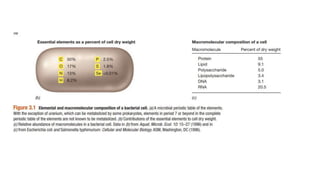
• Besides water, which makes up 70–80% of the wet weight cells consist
primarily of macromolecules—proteins, nucleic acids, lipids, and
polysaccharides.
• The building blocks (monomers) of these macromolecules are the amino
acids, nucleotides, fatty acids, and sugars, respectively.
• Proteins dominate the macromolecular composition of a cell, making up 55% of
total cell dry weight.
• Moreover, the diversity of proteins exceeds that of all other macromolecules
combined.
• DNA contributes a very small percentage of a cell’s dry weight; RNA is far
more abundant
Carbon, Nitrogen, and Other Macronutrients
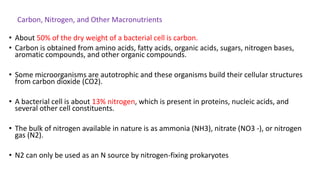
• About 50% of the dry weight of a bacterial cell is carbon.
• Carbon is obtained from amino acids, fatty acids, organic acids, sugars, nitrogen bases,
aromatic compounds, and other organic compounds.
• Some microorganisms are autotrophic and these organisms build their cellular structures
from carbon dioxide (CO2).
• A bacterial cell is about 13% nitrogen, which is present in proteins, nucleic acids, and
several other cell constituents.
• The bulk of nitrogen available in nature is as ammonia (NH3), nitrate (NO3 -), or nitrogen
gas (N2).
• N2 can only be used as an N source by nitrogen-fixing prokaryotes
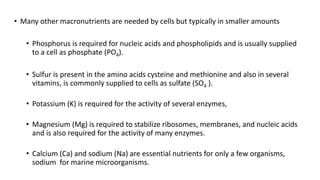
• Many other macronutrients are needed by cells but typically in smaller amounts
• Phosphorus is required for nucleic acids and phospholipids and is usually supplied
to a cell as phosphate (PO4).
• Sulfur is present in the amino acids cysteine and methionine and also in several
vitamins, is commonly supplied to cells as sulfate (SO4 ).
• Potassium (K) is required for the activity of several enzymes,
• Magnesium (Mg) is required to stabilize ribosomes, membranes, and nucleic acids
and is also required for the activity of many enzymes.
• Calcium (Ca) and sodium (Na) are essential nutrients for only a few organisms,
sodium for marine microorganisms.
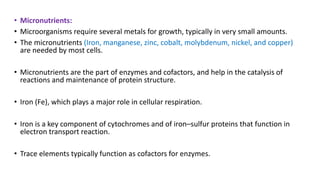
• Micronutrients:
• Microorganisms require several metals for growth, typically in very small amounts.
• The micronutrients (Iron, manganese, zinc, cobalt, molybdenum, nickel, and copper)
are needed by most cells.
• Micronutrients are the part of enzymes and cofactors, and help in the catalysis of
reactions and maintenance of protein structure.
• Iron (Fe), which plays a major role in cellular respiration.
• Iron is a key component of cytochromes and of iron–sulfur proteins that function in
electron transport reaction.
• Trace elements typically function as cofactors for enzymes.
• Organic compounds required because they are essential cell components or
precursors and cannot be synthesized by the organism are called growth
factors.
• Common growth factors include the vitamins, but amino acids, purines,
pyrimidines, or various other organic molecules may be growth factors for one
or another microorganism.
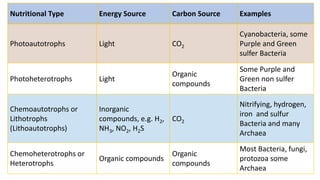
Nutritional Type Energy Source Carbon Source Examples
Photoautotrophs Light CO2
Cyanobacteria, some
Purple and Green
sulfer Bacteria
Photoheterotrophs Light
Organic
compounds
Some Purple and
Green non sulfer
Bacteria
Chemoautotrophs or
Lithotrophs
(Lithoautotrophs)
Inorganic
compounds, e.g. H2,
NH3, NO2, H2S
CO2
Nitrifying, hydrogen,
iron and sulfur
Bacteria and many
Archaea
Chemoheterotrophs or
Heterotrophs
Organic compounds
Organic
compounds
Most Bacteria, fungi,
protozoa some
Archaea
Media and Laboratory Culture
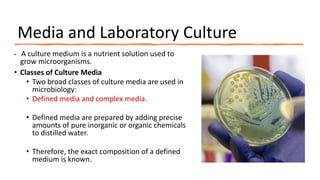
• A culture medium is a nutrient solution used to
grow microorganisms.
• Classes of Culture Media
• Two broad classes of culture media are used in
microbiology:
• Defined media and complex media.
• Defined media are prepared by adding precise
amounts of pure inorganic or organic chemicals
to distilled water.
• Therefore, the exact composition of a defined
medium is known.
• For culturing many microorganisms, complex media may be
advantageous.
• Complex media are made from digests of microbial, animal, or plant
products, such as casein (milk protein), beef (beef extract), soybeans
(tryptic soy broth), yeast cells (yeast extract), or any of a number of other
highly nutritious substances.
• Such digests are commercially available in dehydrated form .
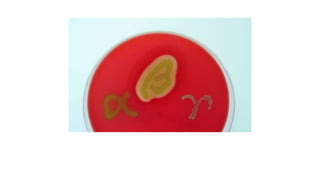
• An enriched medium, used for the culture of nutritionally demanding
(fastidious) microorganisms (pathogens) and then is embellished with
additional highly nutritious substances serum or blood
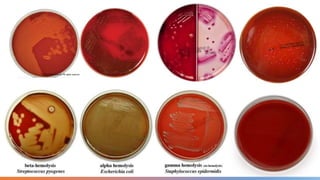
• Culture media are sometimes prepared as a selective or differential (or both),
especially media used in diagnostic microbiology.
• A selective medium contains compounds that inhibit the growth of some
microorganisms but not others.
• For example, selective media are available for the isolation of certain pathogens,
such as strains of Salmonella or Escherichia coli that cause foodborne illnesses.
• A differential medium is one in which an indicator, typically a dye, is added, which
reveals by a color change whether a particular metabolic reaction has occurred
during growth.
• The media employed are selective, differential, or both.
• Eosin– methylene blue (EMB) agar, is a widely used selective and differential
medium for the isolation and differentiation of enteric bacteria.
• Methylene blue is selective because it inhibits the growth of gram-positive
bacteria, and thus only gram-negative organisms can grow.
• EMB agar has an initial pH of 7.2 and contains lactose and sucrose, but not
glucose, as energy sources.
• Acidification changes eosin, the differential media component, from colorless
to red or black.
• Eosin Y and methylene blue are pH indicator dyes that combine to form a
dark purple precipitate at low pH
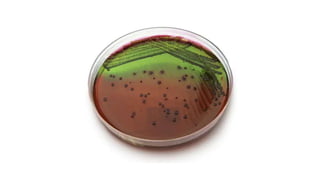
• Strong lactose-fermenting bacteria such as Escherichia coli acidify the medium
and the colonies appear black with a greenish sheen.
• Enteric bacteria such as Klebsiella or Enterobacter produce less acid, and colonies
on EMB are pink to red.
• Non-lactose fermenters increase the pH of the medium by deamination of proteins
and produce colorless or light pink colonies.
MacConkey agar
• MacConkey agar is selective for Gram-negative organisms due to bile salts and
crystal violet, which inhibit the growth of Gram-positive bacteria.
• This means that only Gram-negative bacteria will be able to grow and form colonies
on MacConkey agar.
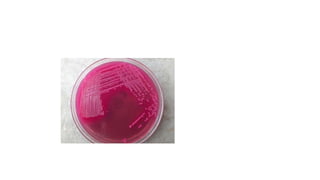
• MacConkey agar is differential for lactose metabolism. Lactose fermenting bacteria
lower the pH of the medium.
• In response, the pH indicator neutral red turns the colonies and medium pink.
• Non-lactose fermenting organisms remain white or colorless and the medium
changes color to yellow.
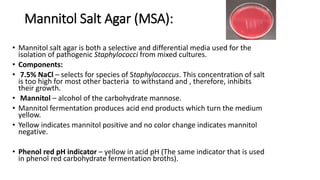
Mannitol Salt Agar (MSA):
• Mannitol salt agar is both a selective and differential media used for the
isolation of pathogenic Staphylococci from mixed cultures.
• Components:
• 7.5% NaCl – selects for species of Staphylococcus. This concentration of salt
is too high for most other bacteria to withstand and , therefore, inhibits
their growth.
• Mannitol – alcohol of the carbohydrate mannose.
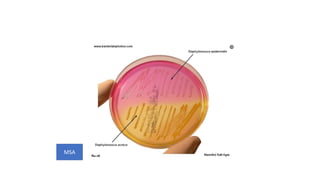
• Mannitol fermentation produces acid end products which turn the medium
yellow.
• Yellow indicates mannitol positive and no color change indicates mannitol
negative.
• Phenol red pH indicator – yellow in acid pH (The same indicator that is used
in phenol red carbohydrate fermentation broths).
MSA
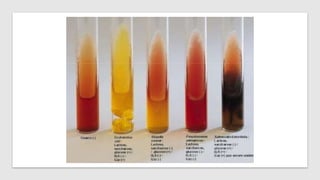
• TSI Agar contains three fermentative sugars, lactose and sucrose in 1% concentrations
and glucose in 0.1% concentration.
• Due to the building of acid during fermentation, the pH falls.
• The acid base indicator Phenol red is incorporated for detecting carbohydrate
fermentation that is indicated by the change in color of the carbohydrate medium from
orange red to yellow in the presence of acids.
• In case of oxidative decarboxylation of peptone, alkaline products are built and the pH
rises.
• This is indicated by the change in color of the medium from orange red to deep red.
• Sodium thiosulfate and ferrous ammonium sulfate present in the medium detects the
production of hydrogen sulfide and is indicated by the black color in the butt of the
tube.
• Many differential media incorporate biochemical tests to measure the presence or
absence of enzymes involved in catabolism of a specific substrate or substrates.
• One example is the differential triple-sugar iron (TSI) agar test used to differentiate enteric
pathogens.
• The fermentation and gas production patterns differentiate these bacteria at the genus
and sometimes species levels.
• Another testing method uses chromogenic substrates that alter the color of colonies of
targeted organisms.
• For instance, CHROM agar, a proprietary selective and differential media, inhibits the
growth of most microorganisms.
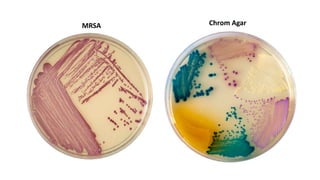
• Methicillin-resistant Staphylococcus aureus (MRSA), however, produces distinctive pink
colonies; the fluorogenic medium contains compounds that fluoresce when metabolized
by MRSA.
MRSA Chrom Agar

Cell Nutrition.pptx,................................

  • 1.
  • 2.
    • Different organismsneed different complements of nutrients, • Some nutrients, called macronutrients, are required in large amounts, • Others, called micronutrients, are required in just trace amounts.
  • 3.
    Chemical Makeup ofa Cell • All microbial nutrients are compounds constructed from the chemical elements. • Hydrogen (H), oxygen (O), carbon (C), nitrogen (N), phosphorus (P), sulfur (S) • In addition to these, at least 50 other elements are metabolized in some way by microorganisms • Besides water, which makes up 70–80% of the wet weight cells consist primarily of macromolecules—proteins, nucleic acids, lipids, and polysaccharides. • The building blocks (monomers) of these macromolecules are the amino acids, nucleotides, fatty acids, and sugars, respectively.
  • 4.
    • Proteins dominatethe macromolecular composition of a cell, making up 55% of total cell dry weight. • Moreover, the diversity of proteins exceeds that of all other macromolecules combined. • DNA contributes a very small percentage of a cell’s dry weight; RNA is far more abundant
  • 6.
    Carbon, Nitrogen, andOther Macronutrients • About 50% of the dry weight of a bacterial cell is carbon. • Carbon is obtained from amino acids, fatty acids, organic acids, sugars, nitrogen bases, aromatic compounds, and other organic compounds. • Some microorganisms are autotrophic and these organisms build their cellular structures from carbon dioxide (CO2). • A bacterial cell is about 13% nitrogen, which is present in proteins, nucleic acids, and several other cell constituents. • The bulk of nitrogen available in nature is as ammonia (NH3), nitrate (NO3 -), or nitrogen gas (N2). • N2 can only be used as an N source by nitrogen-fixing prokaryotes
  • 7.
    • Many othermacronutrients are needed by cells but typically in smaller amounts • Phosphorus is required for nucleic acids and phospholipids and is usually supplied to a cell as phosphate (PO4). • Sulfur is present in the amino acids cysteine and methionine and also in several vitamins, is commonly supplied to cells as sulfate (SO4 ). • Potassium (K) is required for the activity of several enzymes, • Magnesium (Mg) is required to stabilize ribosomes, membranes, and nucleic acids and is also required for the activity of many enzymes. • Calcium (Ca) and sodium (Na) are essential nutrients for only a few organisms, sodium for marine microorganisms.
  • 8.
    • Micronutrients: • Microorganismsrequire several metals for growth, typically in very small amounts. • The micronutrients (Iron, manganese, zinc, cobalt, molybdenum, nickel, and copper) are needed by most cells. • Micronutrients are the part of enzymes and cofactors, and help in the catalysis of reactions and maintenance of protein structure. • Iron (Fe), which plays a major role in cellular respiration. • Iron is a key component of cytochromes and of iron–sulfur proteins that function in electron transport reaction. • Trace elements typically function as cofactors for enzymes.
  • 9.
    • Organic compoundsrequired because they are essential cell components or precursors and cannot be synthesized by the organism are called growth factors. • Common growth factors include the vitamins, but amino acids, purines, pyrimidines, or various other organic molecules may be growth factors for one or another microorganism.
  • 10.
    Nutritional Type EnergySource Carbon Source Examples Photoautotrophs Light CO2 Cyanobacteria, some Purple and Green sulfer Bacteria Photoheterotrophs Light Organic compounds Some Purple and Green non sulfer Bacteria Chemoautotrophs or Lithotrophs (Lithoautotrophs) Inorganic compounds, e.g. H2, NH3, NO2, H2S CO2 Nitrifying, hydrogen, iron and sulfur Bacteria and many Archaea Chemoheterotrophs or Heterotrophs Organic compounds Organic compounds Most Bacteria, fungi, protozoa some Archaea
  • 11.
    Media and LaboratoryCulture • A culture medium is a nutrient solution used to grow microorganisms. • Classes of Culture Media • Two broad classes of culture media are used in microbiology: • Defined media and complex media. • Defined media are prepared by adding precise amounts of pure inorganic or organic chemicals to distilled water. • Therefore, the exact composition of a defined medium is known.
  • 12.
    • For culturingmany microorganisms, complex media may be advantageous. • Complex media are made from digests of microbial, animal, or plant products, such as casein (milk protein), beef (beef extract), soybeans (tryptic soy broth), yeast cells (yeast extract), or any of a number of other highly nutritious substances. • Such digests are commercially available in dehydrated form . • An enriched medium, used for the culture of nutritionally demanding (fastidious) microorganisms (pathogens) and then is embellished with additional highly nutritious substances serum or blood
  • 15.
    • Culture mediaare sometimes prepared as a selective or differential (or both), especially media used in diagnostic microbiology. • A selective medium contains compounds that inhibit the growth of some microorganisms but not others. • For example, selective media are available for the isolation of certain pathogens, such as strains of Salmonella or Escherichia coli that cause foodborne illnesses. • A differential medium is one in which an indicator, typically a dye, is added, which reveals by a color change whether a particular metabolic reaction has occurred during growth.
  • 16.
    • The mediaemployed are selective, differential, or both. • Eosin– methylene blue (EMB) agar, is a widely used selective and differential medium for the isolation and differentiation of enteric bacteria. • Methylene blue is selective because it inhibits the growth of gram-positive bacteria, and thus only gram-negative organisms can grow. • EMB agar has an initial pH of 7.2 and contains lactose and sucrose, but not glucose, as energy sources. • Acidification changes eosin, the differential media component, from colorless to red or black. • Eosin Y and methylene blue are pH indicator dyes that combine to form a dark purple precipitate at low pH
  • 18.
    • Strong lactose-fermentingbacteria such as Escherichia coli acidify the medium and the colonies appear black with a greenish sheen. • Enteric bacteria such as Klebsiella or Enterobacter produce less acid, and colonies on EMB are pink to red. • Non-lactose fermenters increase the pH of the medium by deamination of proteins and produce colorless or light pink colonies.
  • 19.
    MacConkey agar • MacConkeyagar is selective for Gram-negative organisms due to bile salts and crystal violet, which inhibit the growth of Gram-positive bacteria. • This means that only Gram-negative bacteria will be able to grow and form colonies on MacConkey agar. • MacConkey agar is differential for lactose metabolism. Lactose fermenting bacteria lower the pH of the medium. • In response, the pH indicator neutral red turns the colonies and medium pink. • Non-lactose fermenting organisms remain white or colorless and the medium changes color to yellow.
  • 21.
    Mannitol Salt Agar(MSA): • Mannitol salt agar is both a selective and differential media used for the isolation of pathogenic Staphylococci from mixed cultures. • Components: • 7.5% NaCl – selects for species of Staphylococcus. This concentration of salt is too high for most other bacteria to withstand and , therefore, inhibits their growth. • Mannitol – alcohol of the carbohydrate mannose. • Mannitol fermentation produces acid end products which turn the medium yellow. • Yellow indicates mannitol positive and no color change indicates mannitol negative. • Phenol red pH indicator – yellow in acid pH (The same indicator that is used in phenol red carbohydrate fermentation broths).
  • 22.
  • 23.
    • TSI Agarcontains three fermentative sugars, lactose and sucrose in 1% concentrations and glucose in 0.1% concentration. • Due to the building of acid during fermentation, the pH falls. • The acid base indicator Phenol red is incorporated for detecting carbohydrate fermentation that is indicated by the change in color of the carbohydrate medium from orange red to yellow in the presence of acids. • In case of oxidative decarboxylation of peptone, alkaline products are built and the pH rises. • This is indicated by the change in color of the medium from orange red to deep red. • Sodium thiosulfate and ferrous ammonium sulfate present in the medium detects the production of hydrogen sulfide and is indicated by the black color in the butt of the tube.
  • 25.
    • Many differentialmedia incorporate biochemical tests to measure the presence or absence of enzymes involved in catabolism of a specific substrate or substrates. • One example is the differential triple-sugar iron (TSI) agar test used to differentiate enteric pathogens. • The fermentation and gas production patterns differentiate these bacteria at the genus and sometimes species levels. • Another testing method uses chromogenic substrates that alter the color of colonies of targeted organisms. • For instance, CHROM agar, a proprietary selective and differential media, inhibits the growth of most microorganisms. • Methicillin-resistant Staphylococcus aureus (MRSA), however, produces distinctive pink colonies; the fluorogenic medium contains compounds that fluoresce when metabolized by MRSA.
  • 26.