CCSDS based File Delivery Protocol (CFDP)
for future SSRs
Srinidhi M.S. – Namrata Kar – Aritra Sarkar
• Study of CFDP features
• Feasibility for CFDP in future SSRs (pruning to a CFDP
like Protocol for upcoming ISRO Missions)
• Implementation of CFDP in software platform (basic RtOS
with File Management)
• Hardware (FPGA + IP Core) porting of developed RtOS
and customizing for Project Requirements
Aim and Scope
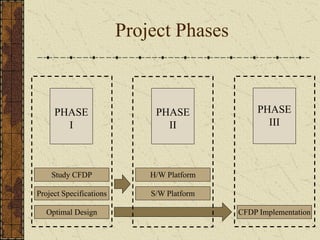
Project Phases
PHASE
I
PHASE
II
PHASE
III
Study CFDP
Project Specifications
Optimal Design
H/W Platform
S/W Platform
CFDP Implementation
• ‘FTP for Space’
• Proposed by ESA (1998)
• Was made CCSDS standard in 2002
• Space File Transfer Requirement as articulated by NASA,
ESA, BNSC, CNES, JAXA
• Current Blue Book Standard: CCSDS 727.0-B-4 (2007)
CFDP: Overview
• 1st used on space mission operation by NASA (JHU/APL +
JPL developed ‘CFDP Lite’) in Messenger Mission to
Mercury in 2004-15
• NASA’s Deep Impact Probe Mission
• James Webb Space Telescope (JWST)
• SSR to SpaceWire Link in NASA’s Lunar Reconnaissance
Orbiter (LRO)
CFDP: Success Stories
• Highly specialized protocol designed to overcome space
communication operation challenges
• Reliability despite long data propagation delays and frequent,
lengthy interruptions in connectivity
• Forward error correction coding that minimizes data loss in
communication across deep space
• Files can be transmitted with a unidirectional link, a half-duplex
link, or a full-duplex link, with near-Earth and deep space delays
CFDP: Features
• Class 1 (Best Effort – similar to UDP)
• Class 2 (Reliable – similar to TCP)
• Class 3 & 4 (for Waypoint communications)
• Acknowledgement Types: None, Immediate, Periodic,
Asynchronous (automatic retransmission if ACK fails)
• Configuration of Link Entity: a set of parameters which define
the behavior (e.g. timers, fault handlers, file segment size,…).
• These are modifiable in-flight, allowing integration in
heterogenous networks, or evolving travel times (e.g.
interplanetary mission)
CFDP: Features
• Encapsulation protocol for each Link for multi-hop capabilities
(e.g. Rover-Orbiter-Ground; Satellite-Ground-PayloadTeam)
• CFDP allows an instrument to record an observation in a file and
transmit the file to Earth without having to consider whether or
not physical transmission is possible at that time thus can
simplify flight and ground software management.
CFDP: Features
Protocol Implementations
CFDP Entity
Onboard
Storage
Data
Users
Mission
Management
• Spacecraft mass memory accessed with ‘file’ structure and
associated ‘metadata’
• File Operations: Open/Close, Read/Write(with offset or seek),
Get/Set file size, Rename, Append, Create, Delete file/directory
• Files are segmented at source into the maximum underlying
transmission unit (packet) and reconstituted at the destination
• Files are protected by a checksum
• Meta data: Meta data is used to convey the file name and file
size to the destination and to setup the file transfer by conveying
requests between CFDP user applications
CFDP based Data Storage
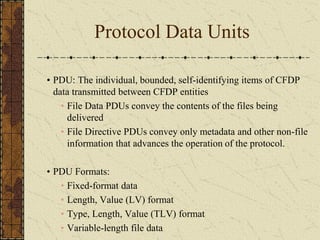
• PDU: The individual, bounded, self-identifying items of CFDP
data transmitted between CFDP entities
• File Data PDUs convey the contents of the files being
delivered
• File Directive PDUs convey only metadata and other non-file
information that advances the operation of the protocol.
• PDU Formats:
• Fixed-format data
• Length, Value (LV) format
• Type, Length, Value (TLV) format
• Variable-length file data
Protocol Data Units
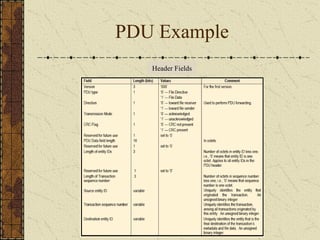
PDU Example
Header Fields
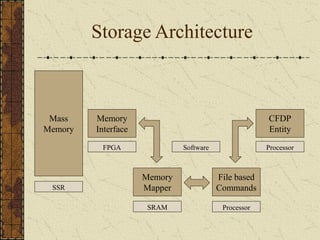
Storage Architecture
CFDP
Entity
File based
Commands
Memory
Mapper
Mass
Memory
Memory
Interface
ProcessorFPGA
ProcessorSRAM
SSR
Software
• Protocol Class 1
• Processor LEON 3 – UT699
• FPGA ProASIC3E
• TMTC MIL-STD-1553B UT63T143
• Project Linkage CARTOSAT3, RISAT-2A
• Programming Platform ADA’2015
• Program Memory NOR Flash
• Mass Memory NAND Flash
• Power 5V DC
TDP Specifications
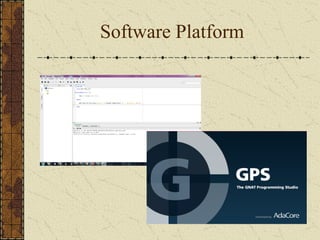
Software Platform
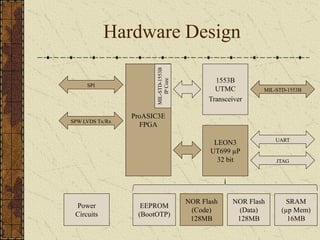
Hardware Design
LEON3
UT699 µP
32 bit
UART
JTAG
1553B
UTMC
Transceiver
MIL-STD-1553B
NOR Flash
(Code)
128MB
NOR Flash
(Data)
128MB
SRAM
(µp Mem)
16MB
EEPROM
(BootOTP)
ProASIC3E
FPGA
MIL-STD-1553B
IPCore
Power
Circuits
SPI
SPW LVDS Tx/Rx
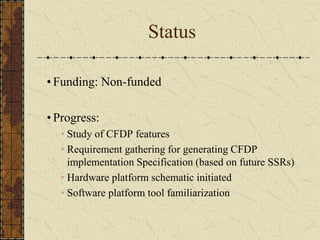
• Funding: Non-funded
• Progress:
• Study of CFDP features
• Requirement gathering for generating CFDP
implementation Specification (based on future SSRs)
• Hardware platform schematic initiated
• Software platform tool familiarization
Status
Thank You
Q & A

Ccsds based file delivery protocol (cfdp) v1p3

  • 1.
    CCSDS based FileDelivery Protocol (CFDP) for future SSRs Srinidhi M.S. – Namrata Kar – Aritra Sarkar
  • 2.
    • Study ofCFDP features • Feasibility for CFDP in future SSRs (pruning to a CFDP like Protocol for upcoming ISRO Missions) • Implementation of CFDP in software platform (basic RtOS with File Management) • Hardware (FPGA + IP Core) porting of developed RtOS and customizing for Project Requirements Aim and Scope
  • 3.
    Project Phases PHASE I PHASE II PHASE III Study CFDP ProjectSpecifications Optimal Design H/W Platform S/W Platform CFDP Implementation
  • 4.
    • ‘FTP forSpace’ • Proposed by ESA (1998) • Was made CCSDS standard in 2002 • Space File Transfer Requirement as articulated by NASA, ESA, BNSC, CNES, JAXA • Current Blue Book Standard: CCSDS 727.0-B-4 (2007) CFDP: Overview
  • 5.
    • 1st usedon space mission operation by NASA (JHU/APL + JPL developed ‘CFDP Lite’) in Messenger Mission to Mercury in 2004-15 • NASA’s Deep Impact Probe Mission • James Webb Space Telescope (JWST) • SSR to SpaceWire Link in NASA’s Lunar Reconnaissance Orbiter (LRO) CFDP: Success Stories
  • 6.
    • Highly specializedprotocol designed to overcome space communication operation challenges • Reliability despite long data propagation delays and frequent, lengthy interruptions in connectivity • Forward error correction coding that minimizes data loss in communication across deep space • Files can be transmitted with a unidirectional link, a half-duplex link, or a full-duplex link, with near-Earth and deep space delays CFDP: Features
  • 7.
    • Class 1(Best Effort – similar to UDP) • Class 2 (Reliable – similar to TCP) • Class 3 & 4 (for Waypoint communications) • Acknowledgement Types: None, Immediate, Periodic, Asynchronous (automatic retransmission if ACK fails) • Configuration of Link Entity: a set of parameters which define the behavior (e.g. timers, fault handlers, file segment size,…). • These are modifiable in-flight, allowing integration in heterogenous networks, or evolving travel times (e.g. interplanetary mission) CFDP: Features
  • 8.
    • Encapsulation protocolfor each Link for multi-hop capabilities (e.g. Rover-Orbiter-Ground; Satellite-Ground-PayloadTeam) • CFDP allows an instrument to record an observation in a file and transmit the file to Earth without having to consider whether or not physical transmission is possible at that time thus can simplify flight and ground software management. CFDP: Features
  • 9.
  • 10.
    • Spacecraft massmemory accessed with ‘file’ structure and associated ‘metadata’ • File Operations: Open/Close, Read/Write(with offset or seek), Get/Set file size, Rename, Append, Create, Delete file/directory • Files are segmented at source into the maximum underlying transmission unit (packet) and reconstituted at the destination • Files are protected by a checksum • Meta data: Meta data is used to convey the file name and file size to the destination and to setup the file transfer by conveying requests between CFDP user applications CFDP based Data Storage
  • 11.
    • PDU: Theindividual, bounded, self-identifying items of CFDP data transmitted between CFDP entities • File Data PDUs convey the contents of the files being delivered • File Directive PDUs convey only metadata and other non-file information that advances the operation of the protocol. • PDU Formats: • Fixed-format data • Length, Value (LV) format • Type, Length, Value (TLV) format • Variable-length file data Protocol Data Units
  • 12.
  • 13.
  • 14.
    • Protocol Class1 • Processor LEON 3 – UT699 • FPGA ProASIC3E • TMTC MIL-STD-1553B UT63T143 • Project Linkage CARTOSAT3, RISAT-2A • Programming Platform ADA’2015 • Program Memory NOR Flash • Mass Memory NAND Flash • Power 5V DC TDP Specifications
  • 15.
  • 16.
    Hardware Design LEON3 UT699 µP 32bit UART JTAG 1553B UTMC Transceiver MIL-STD-1553B NOR Flash (Code) 128MB NOR Flash (Data) 128MB SRAM (µp Mem) 16MB EEPROM (BootOTP) ProASIC3E FPGA MIL-STD-1553B IPCore Power Circuits SPI SPW LVDS Tx/Rx
  • 17.
    • Funding: Non-funded •Progress: • Study of CFDP features • Requirement gathering for generating CFDP implementation Specification (based on future SSRs) • Hardware platform schematic initiated • Software platform tool familiarization Status
  • 18.