ISP Services


              Working at a Small-to-Medium Business or ISP –
              Chapter 7


Version 4.1                                 © 2007 Cisco Systems, Inc. All rights reserved.   Cisco Public   1
Objectives
 Describe the network services provided by an ISP.
 Describe the protocols that support the network
  services provided by an ISP.
 Describe the purpose, function, and hierarchical nature
  of the Domain Name System (DNS).
 Describe and enable common services and their
  protocols.


                            © 2007 Cisco Systems, Inc. All rights reserved.   Cisco Public   2
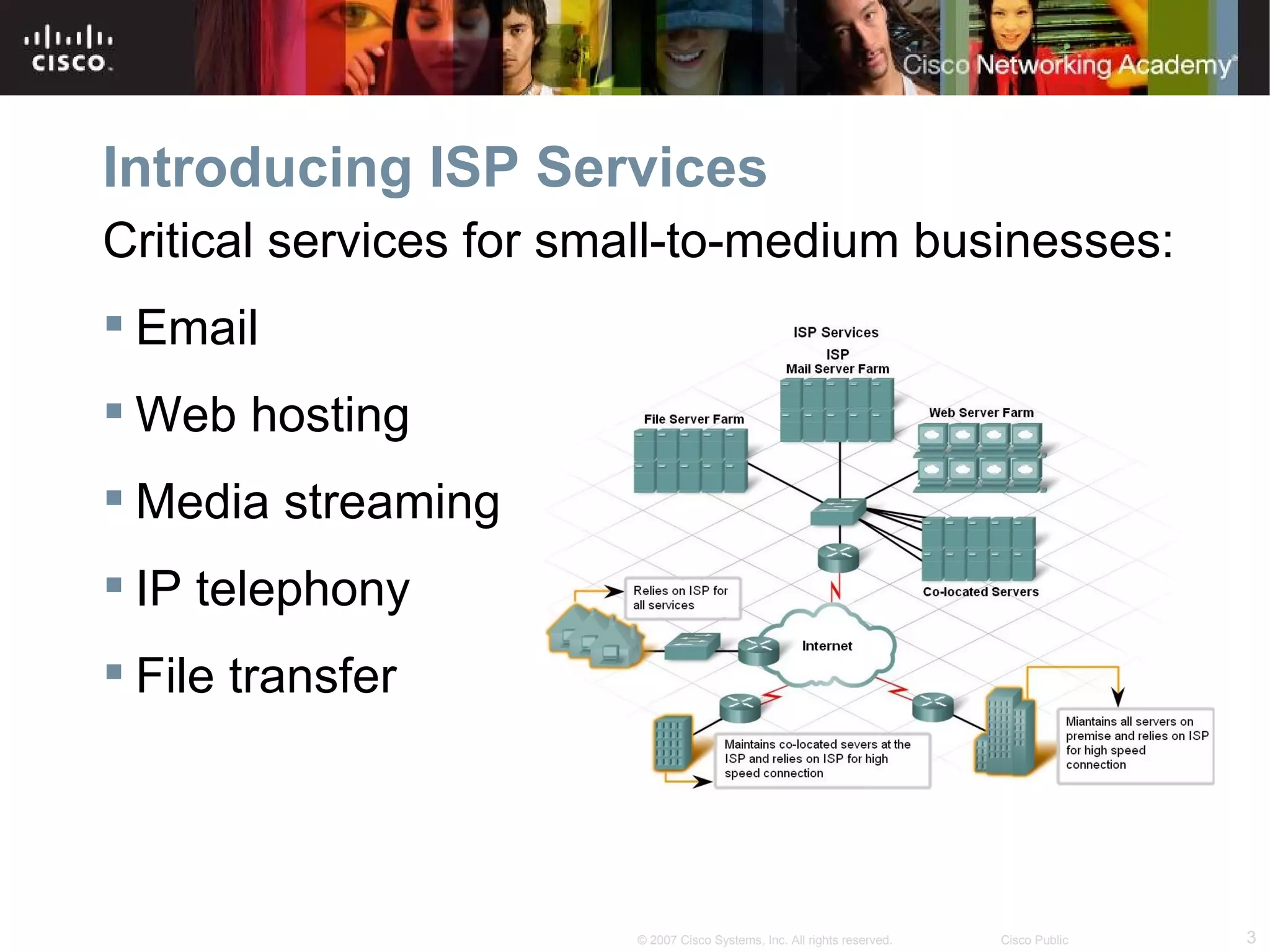
Introducing ISP Services
Critical services for small-to-medium businesses:
 Email
 Web hosting
 Media streaming
 IP telephony
 File transfer


                        © 2007 Cisco Systems, Inc. All rights reserved.   Cisco Public   3
Introducing ISP Services
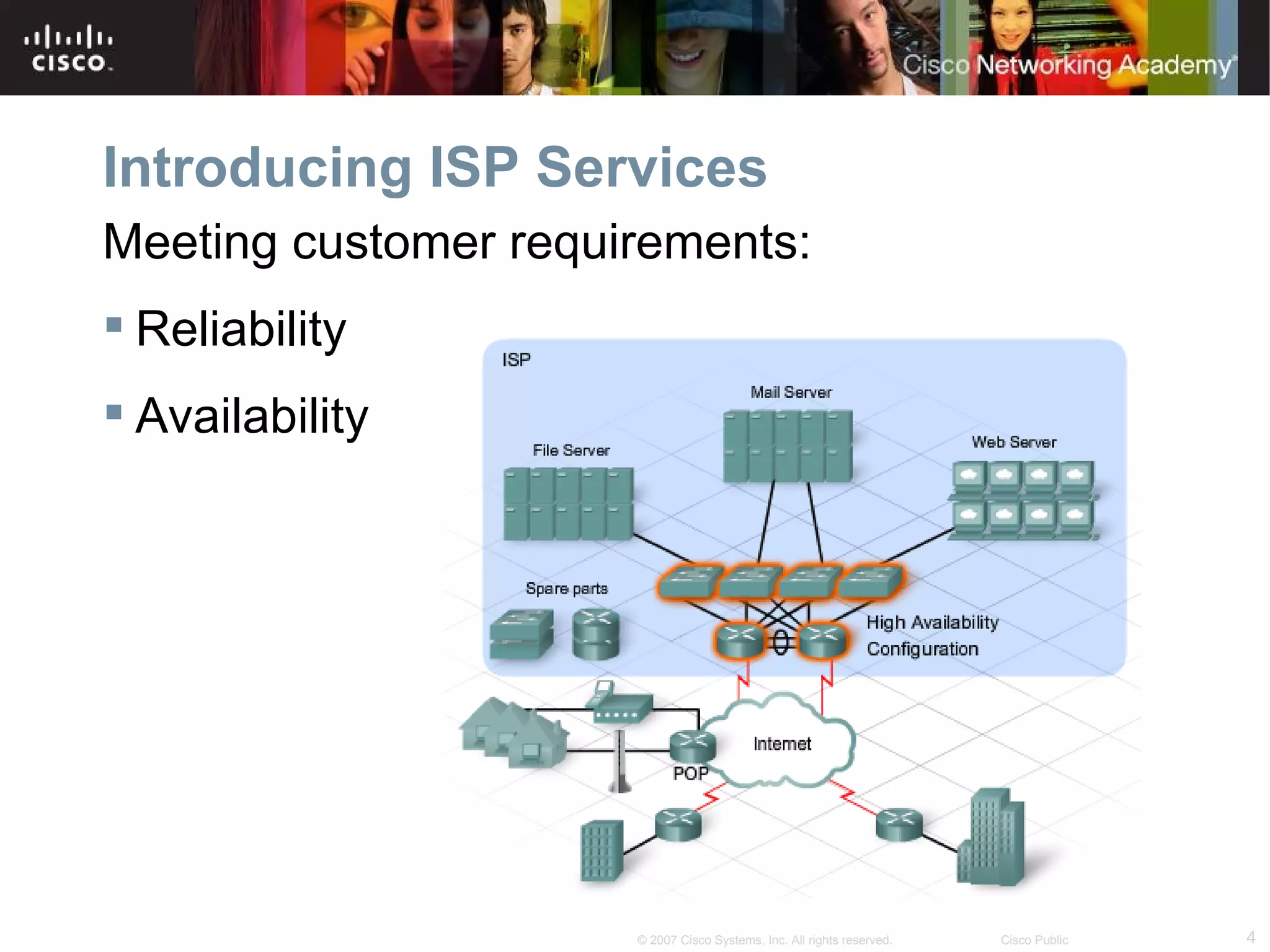
Meeting customer requirements:
 Reliability
 Availability


                      © 2007 Cisco Systems, Inc. All rights reserved.   Cisco Public   4
Protocols That Support ISP Services
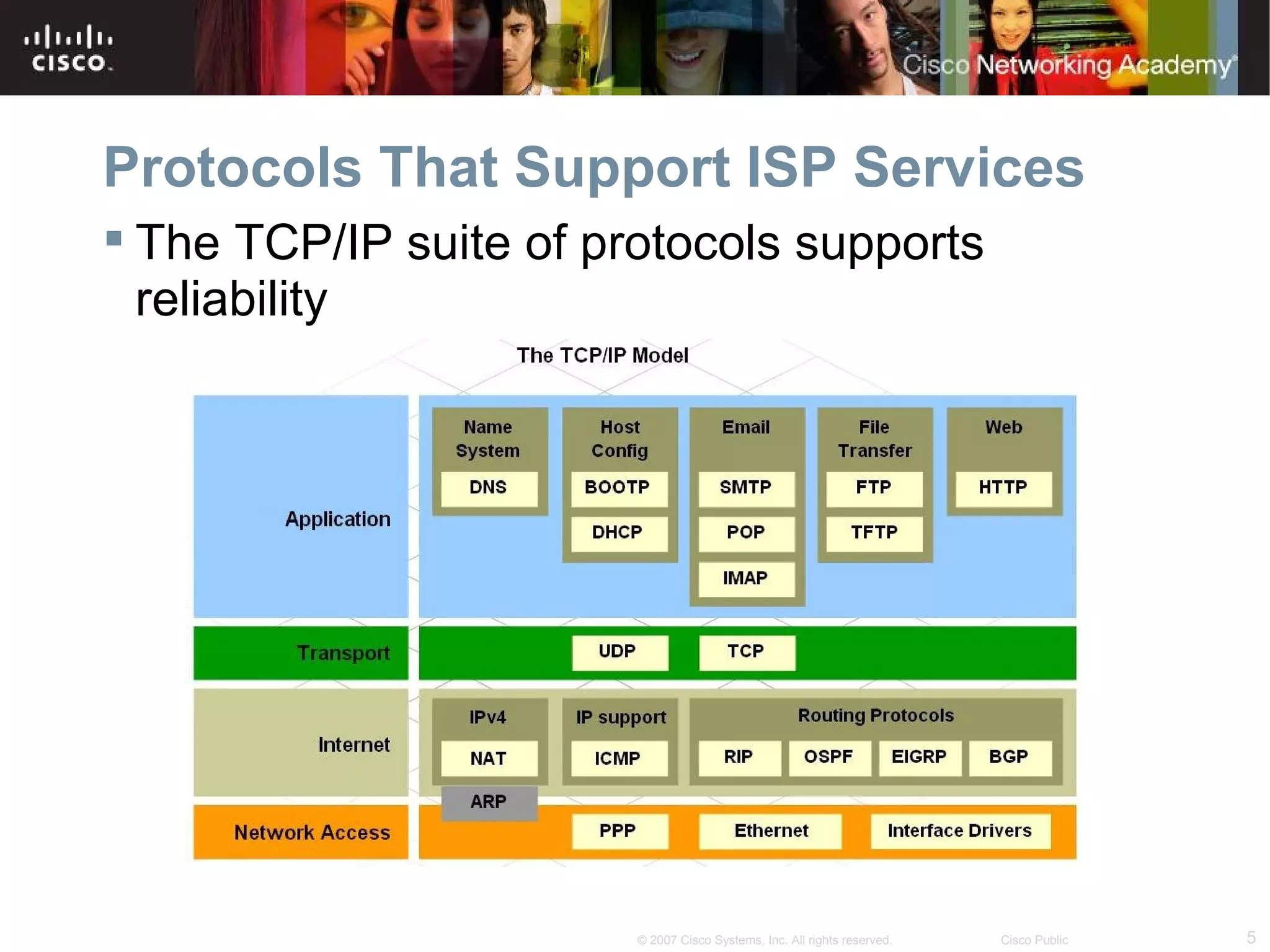
 The TCP/IP suite of protocols supports
  reliability


                        © 2007 Cisco Systems, Inc. All rights reserved.   Cisco Public   5
Protocols That Support ISP Services
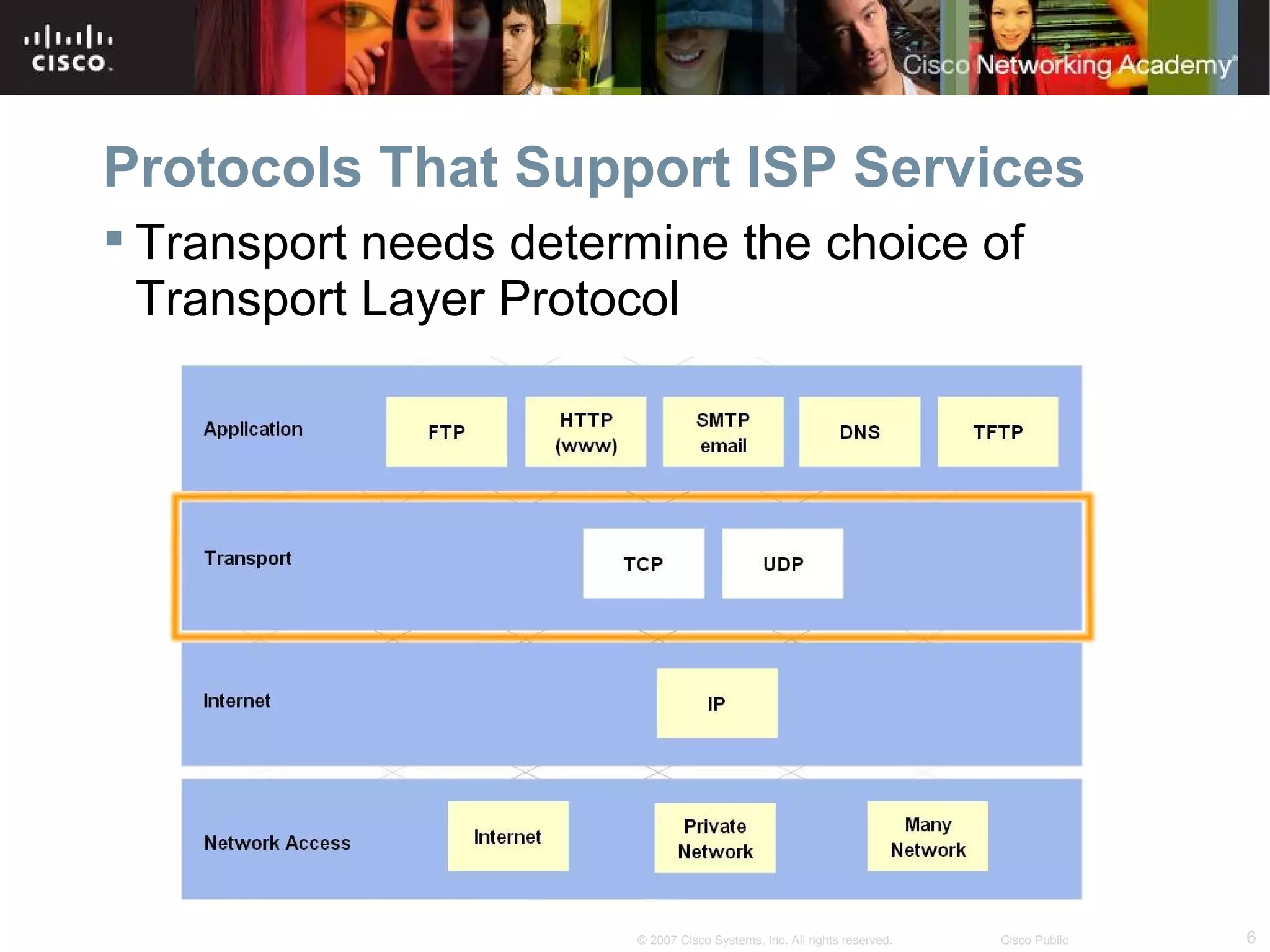
 Transport needs determine the choice of
  Transport Layer Protocol


                       © 2007 Cisco Systems, Inc. All rights reserved.   Cisco Public   6
Protocols That Support ISP Services
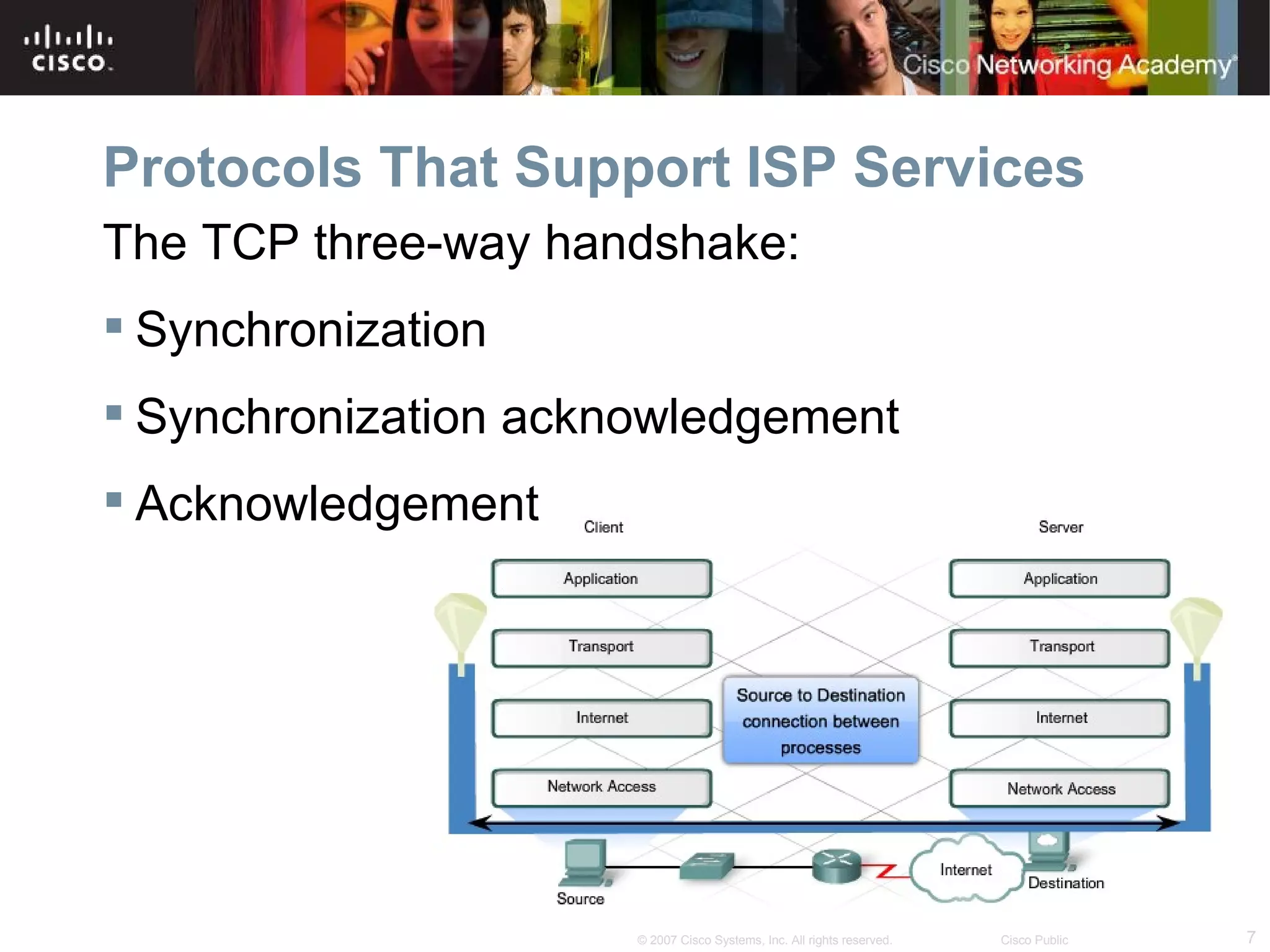
The TCP three-way handshake:
 Synchronization
 Synchronization acknowledgement
 Acknowledgement


                      © 2007 Cisco Systems, Inc. All rights reserved.   Cisco Public   7
Protocols That Support ISP Services
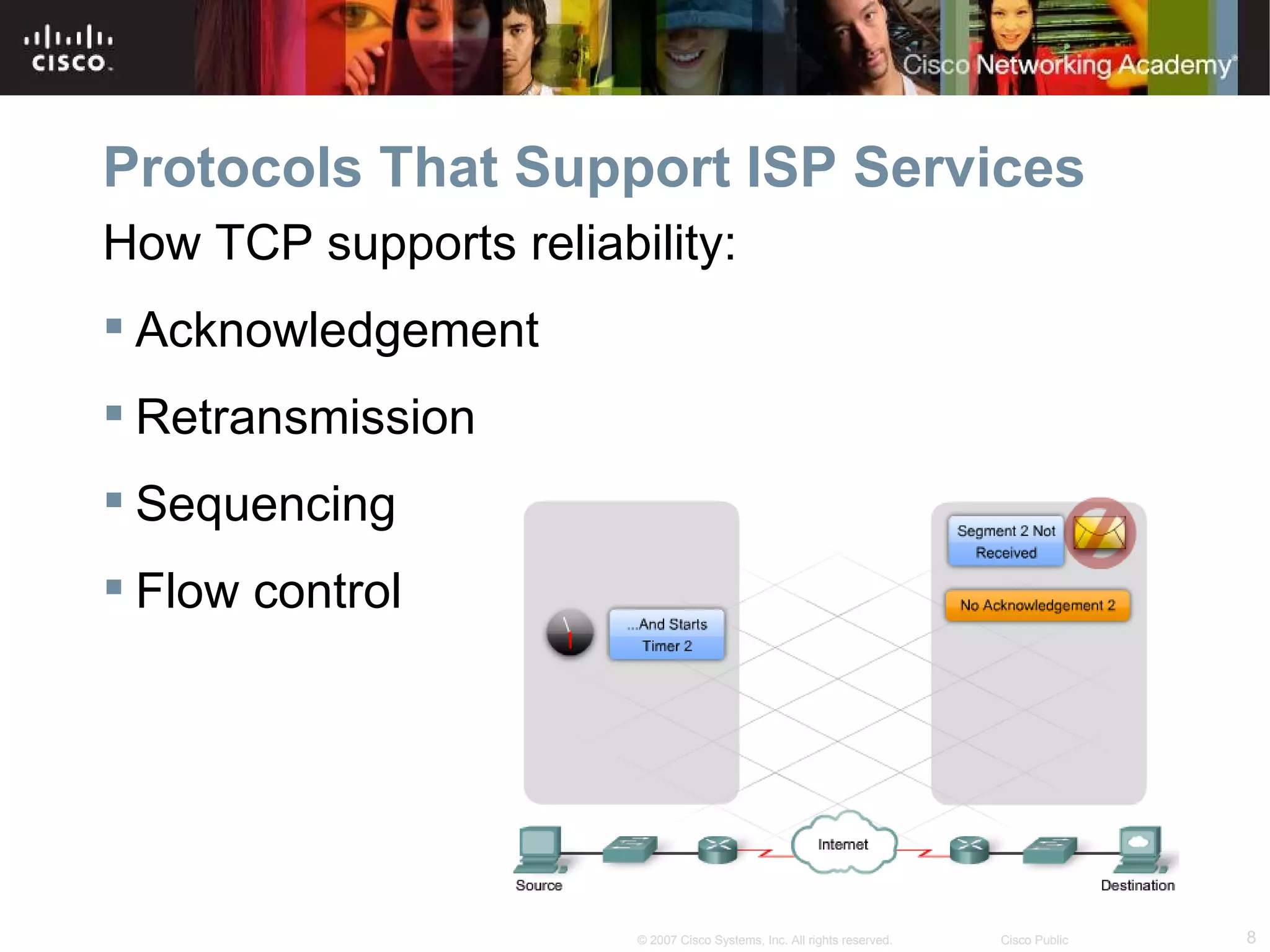
How TCP supports reliability:
 Acknowledgement
 Retransmission
 Sequencing
 Flow control


                        © 2007 Cisco Systems, Inc. All rights reserved.   Cisco Public   8
Protocols That Support ISP Services
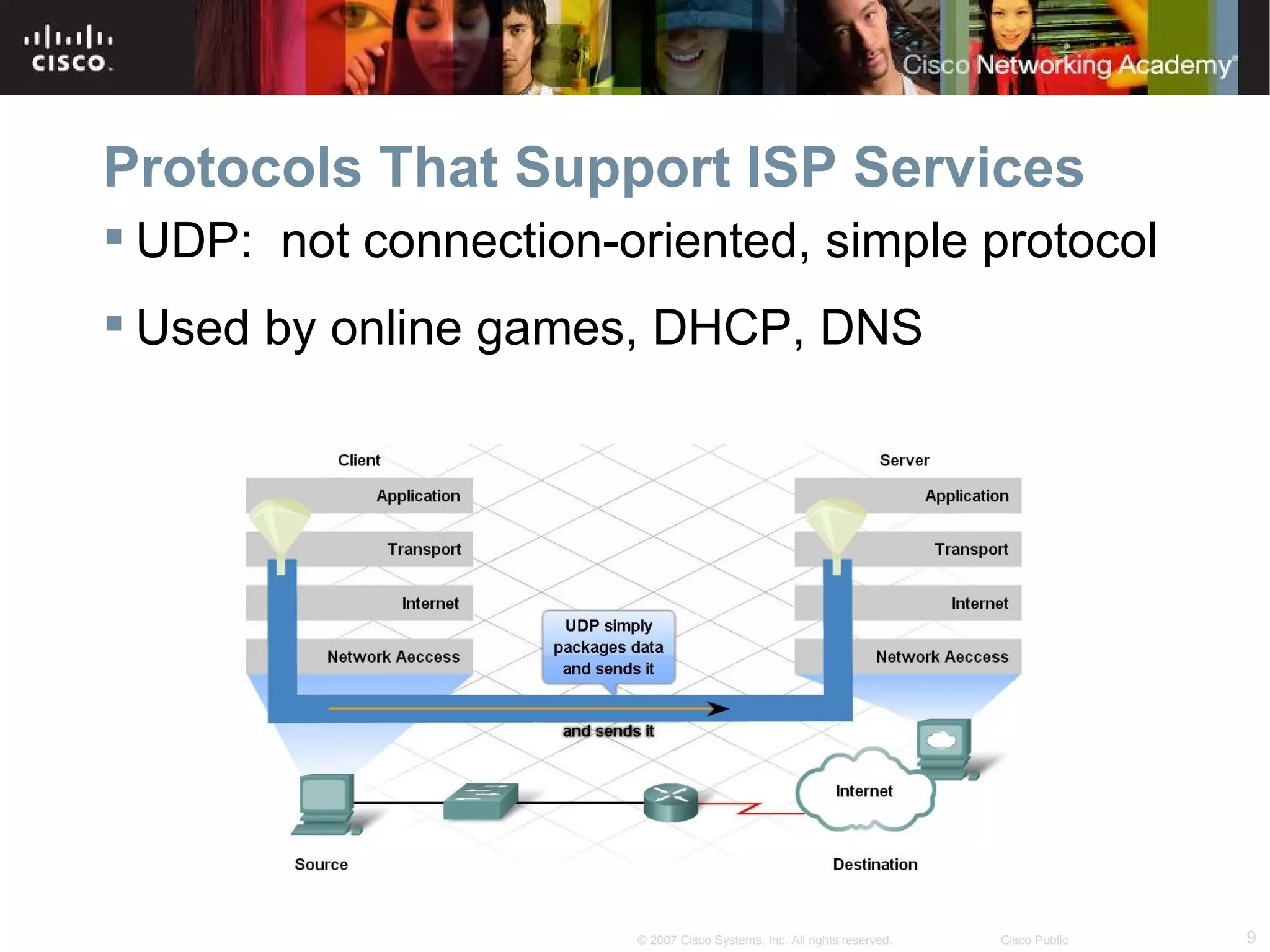
 UDP: not connection-oriented, simple protocol
 Used by online games, DHCP, DNS


                       © 2007 Cisco Systems, Inc. All rights reserved.   Cisco Public   9
Protocols That Support ISP Services
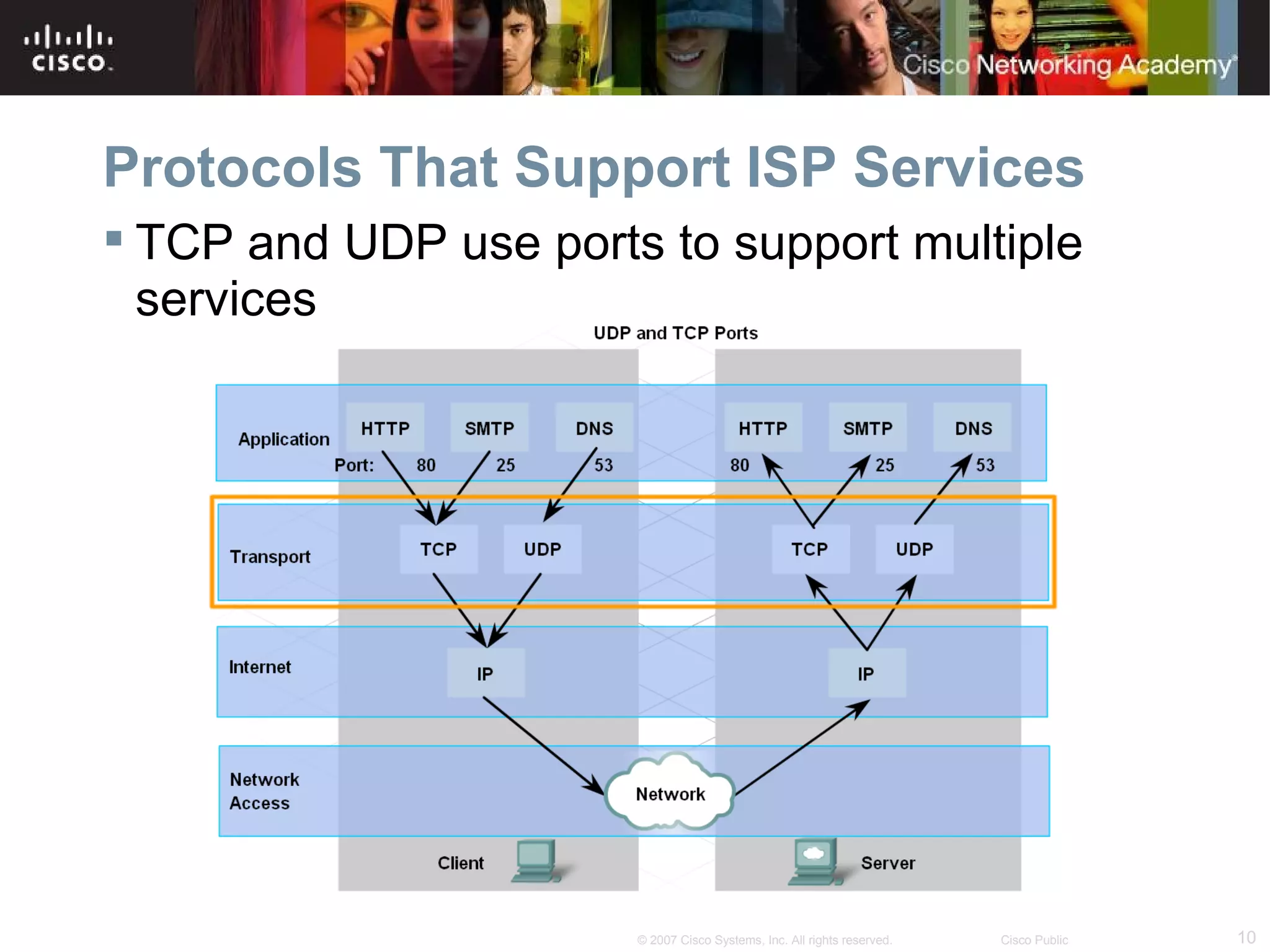
 TCP and UDP use ports to support multiple
  services


                       © 2007 Cisco Systems, Inc. All rights reserved.   Cisco Public   10
Protocols That Support ISP Services
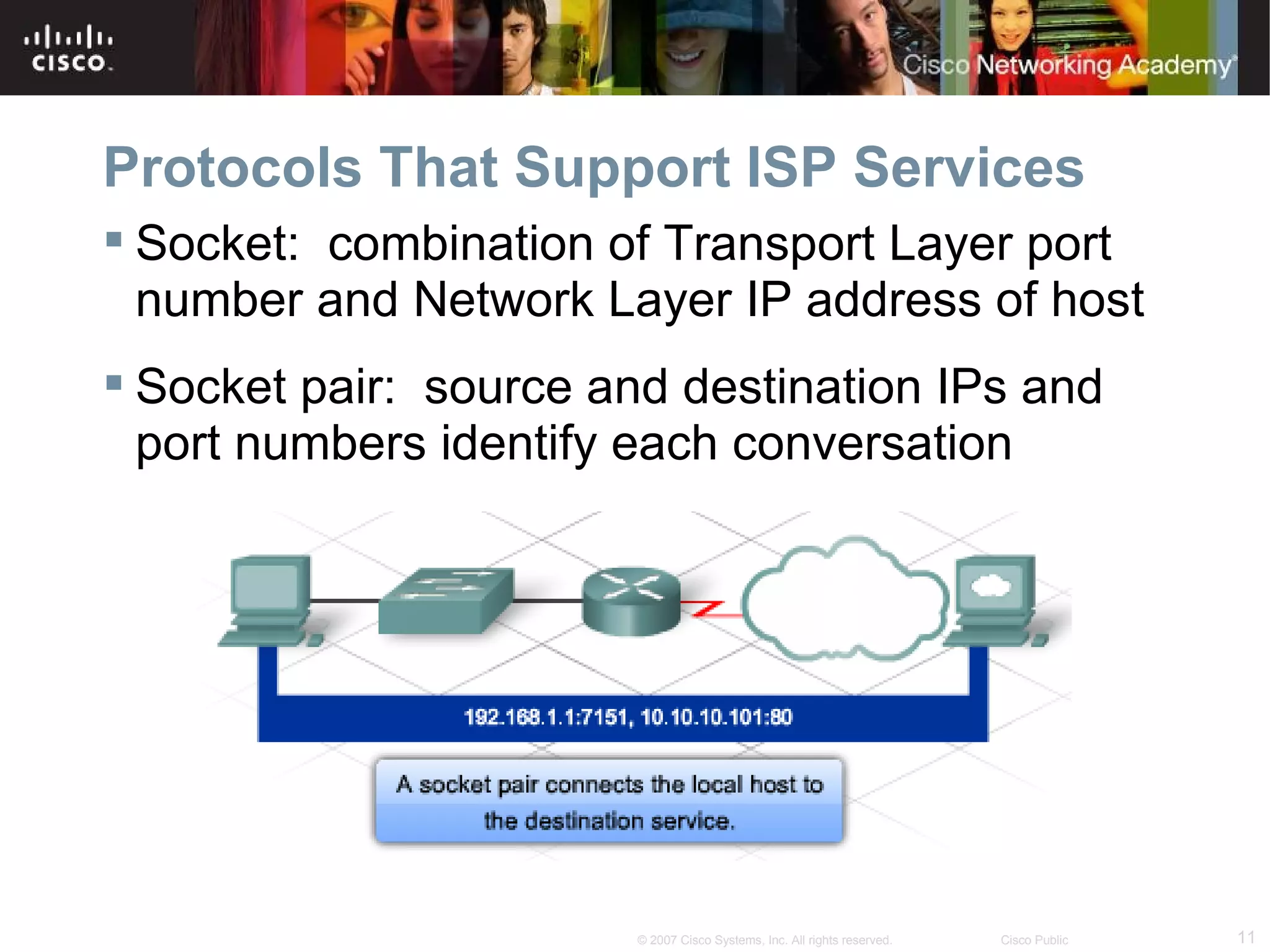
 Socket: combination of Transport Layer port
  number and Network Layer IP address of host
 Socket pair: source and destination IPs and
  port numbers identify each conversation


                        © 2007 Cisco Systems, Inc. All rights reserved.   Cisco Public   11
Domain Name System (DNS)
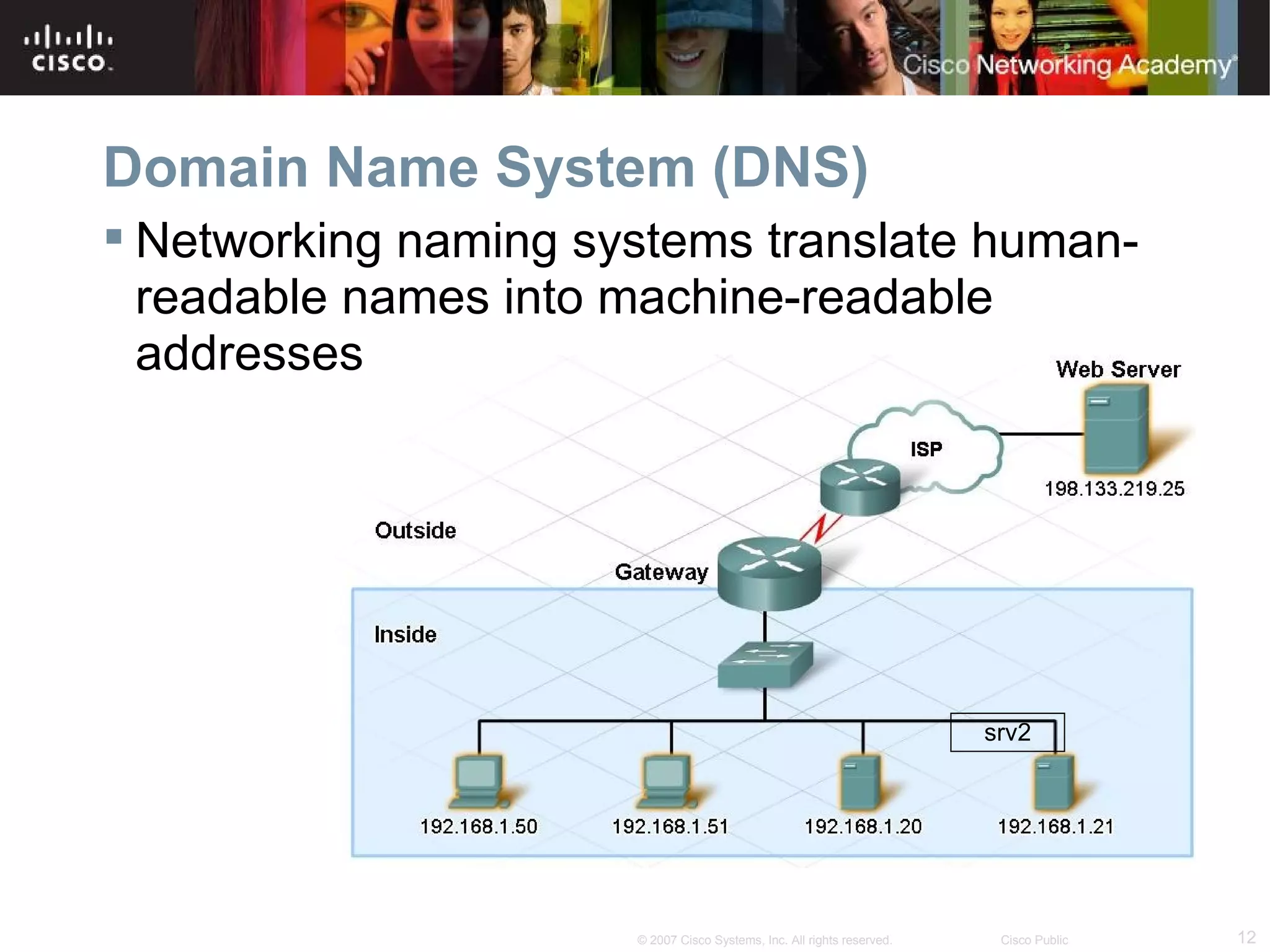
 Networking naming systems translate human-
  readable names into machine-readable
  addresses


                                                                        srv2


                      © 2007 Cisco Systems, Inc. All rights reserved.    Cisco Public   12
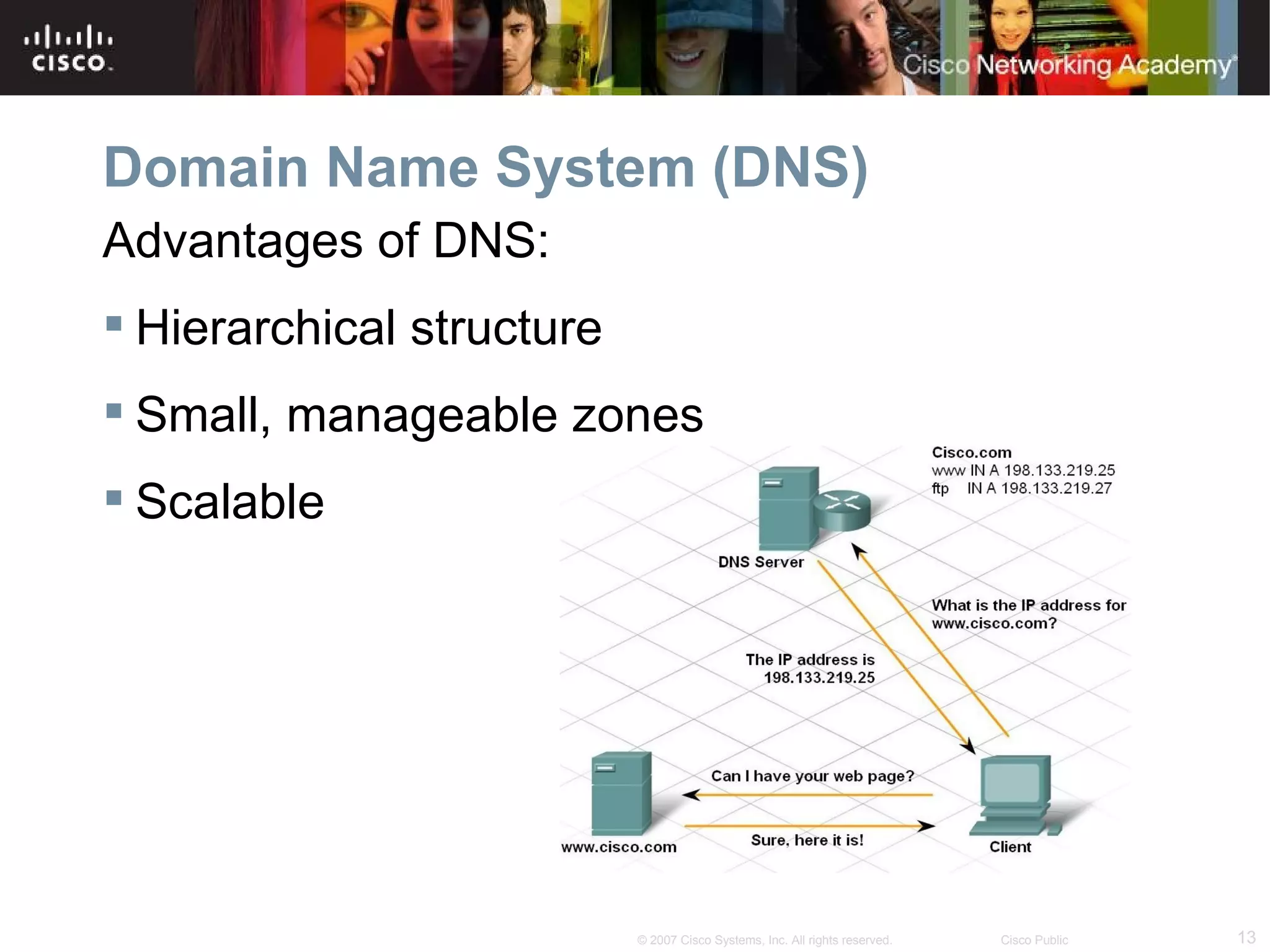
Domain Name System (DNS)
Advantages of DNS:
 Hierarchical structure
 Small, manageable zones
 Scalable


                           © 2007 Cisco Systems, Inc. All rights reserved.   Cisco Public   13
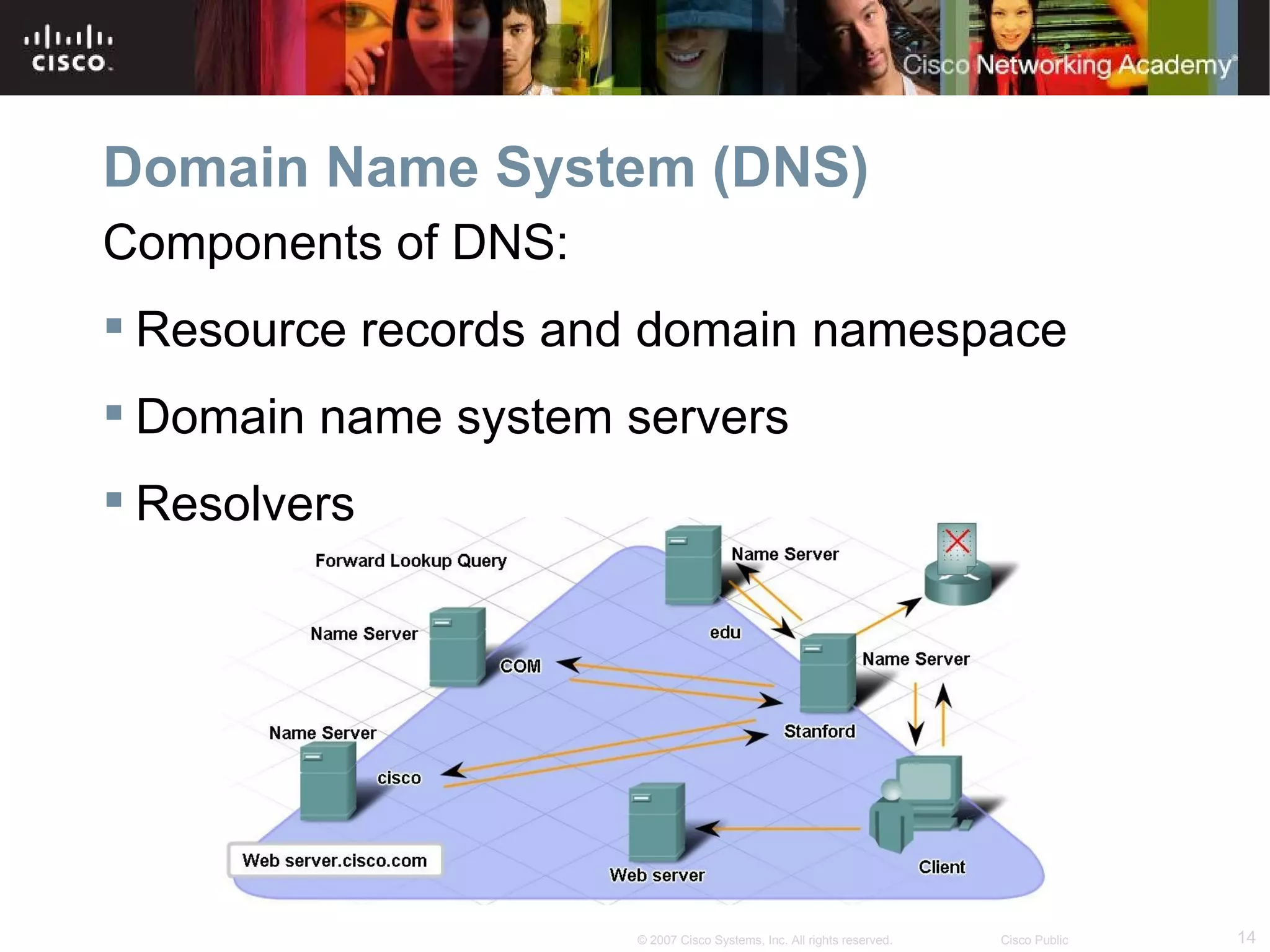
Domain Name System (DNS)
Components of DNS:
 Resource records and domain namespace
 Domain name system servers
 Resolvers


                     © 2007 Cisco Systems, Inc. All rights reserved.   Cisco Public   14
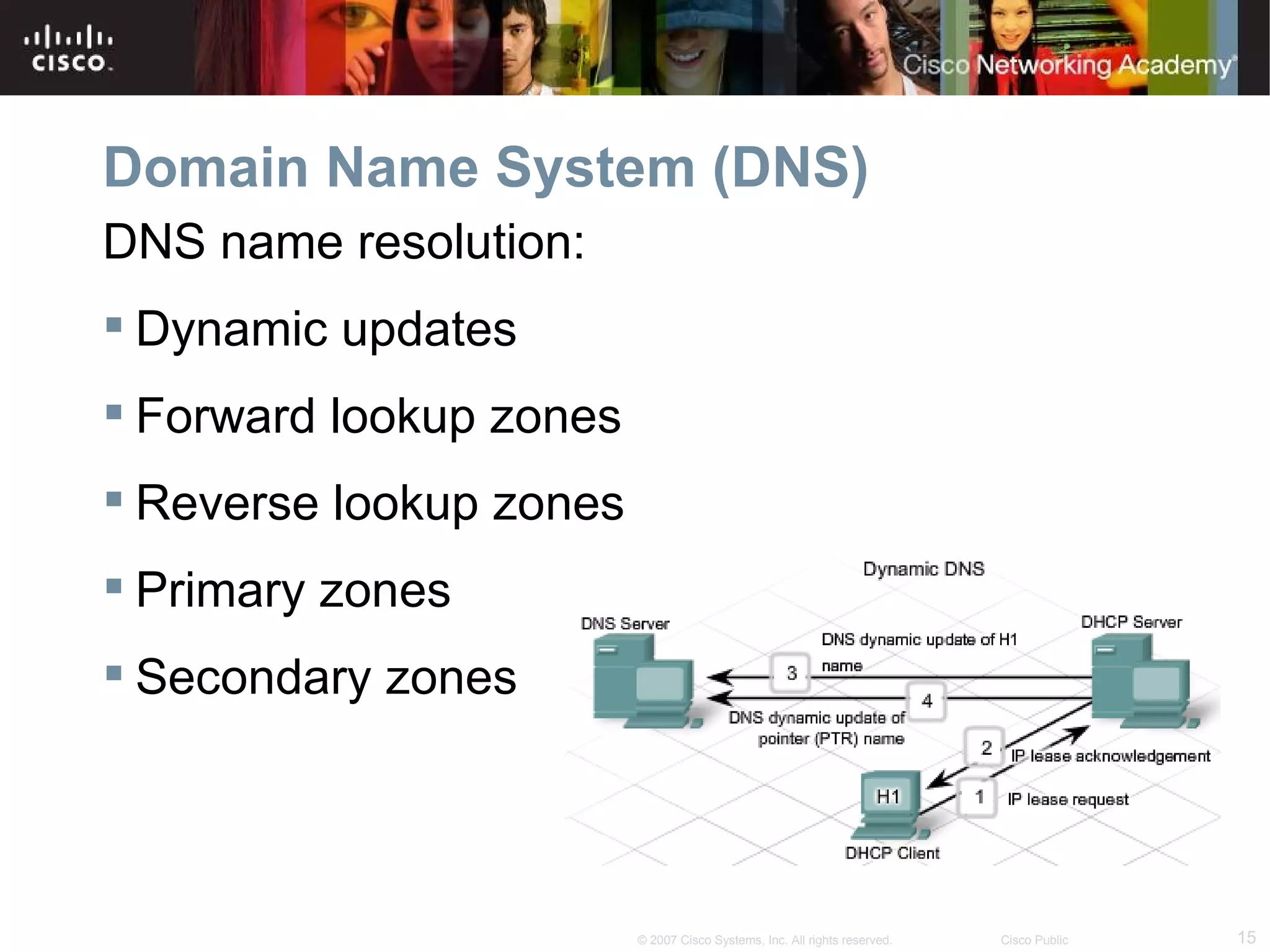
Domain Name System (DNS)
DNS name resolution:
 Dynamic updates
 Forward lookup zones
 Reverse lookup zones
 Primary zones
 Secondary zones


                         © 2007 Cisco Systems, Inc. All rights reserved.   Cisco Public   15
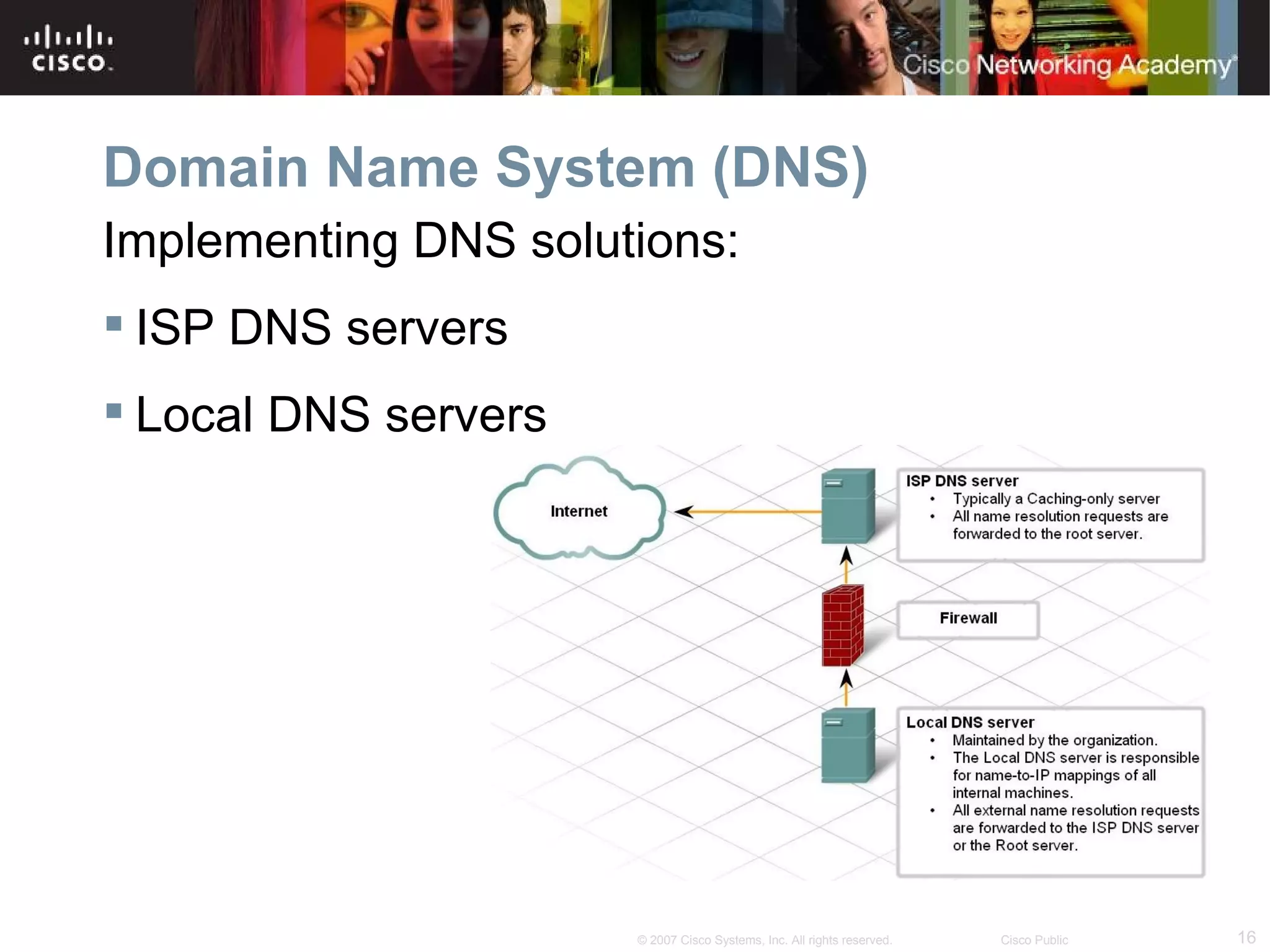
Domain Name System (DNS)
Implementing DNS solutions:
 ISP DNS servers
 Local DNS servers


                      © 2007 Cisco Systems, Inc. All rights reserved.   Cisco Public   16
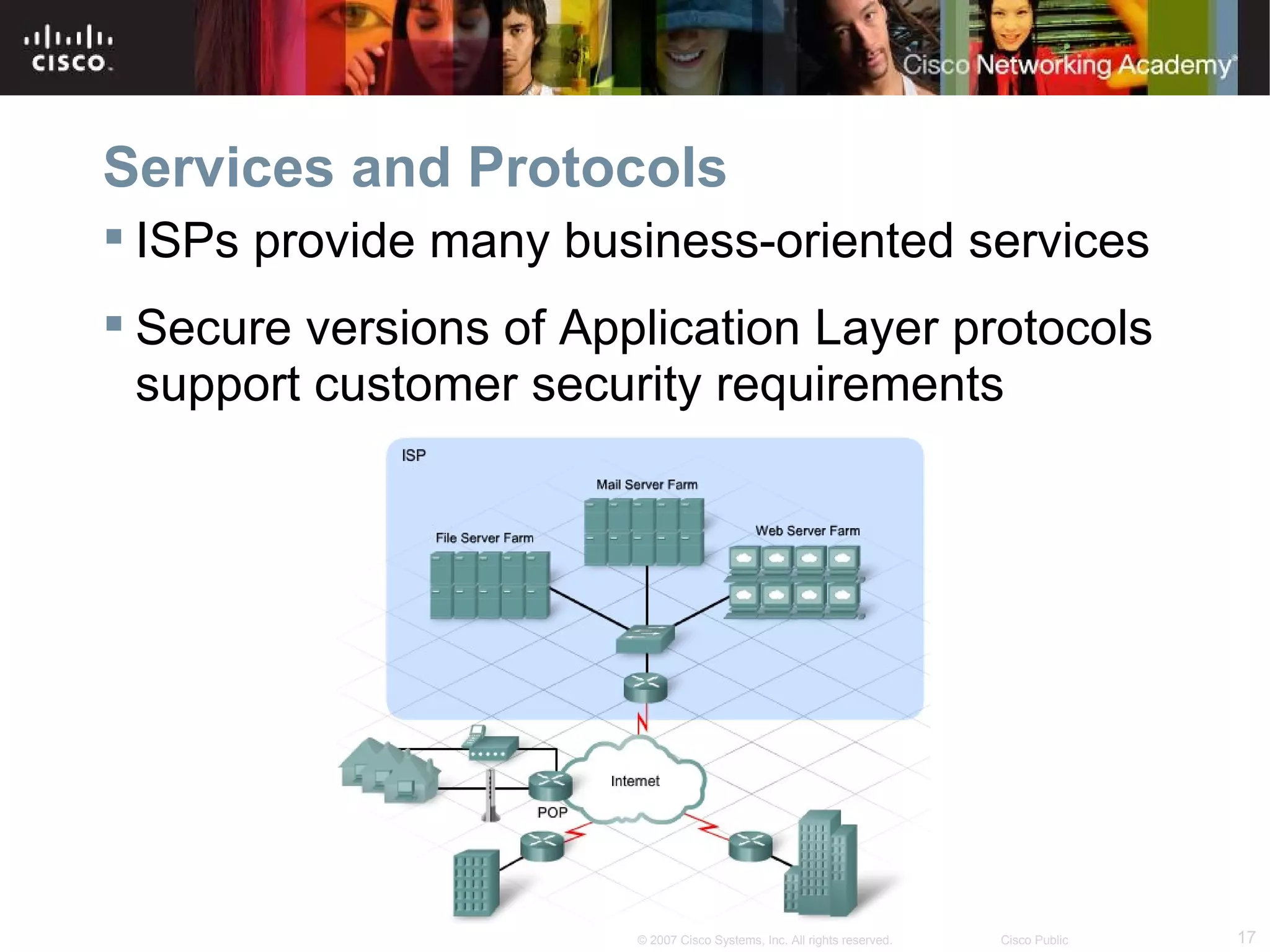
Services and Protocols
 ISPs provide many business-oriented services
 Secure versions of Application Layer protocols
  support customer security requirements


                        © 2007 Cisco Systems, Inc. All rights reserved.   Cisco Public   17
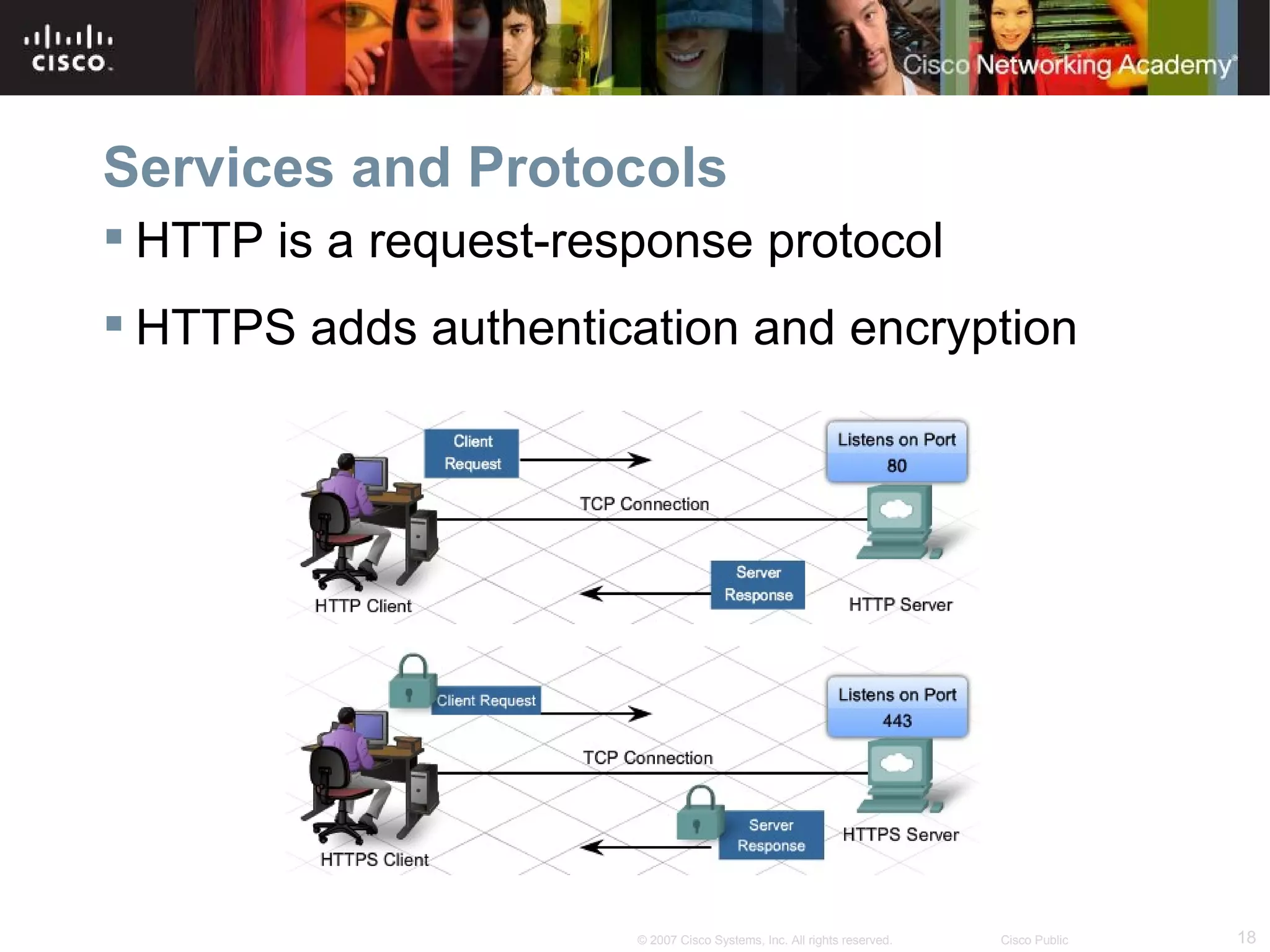
Services and Protocols
 HTTP is a request-response protocol
 HTTPS adds authentication and encryption


                       © 2007 Cisco Systems, Inc. All rights reserved.   Cisco Public   18
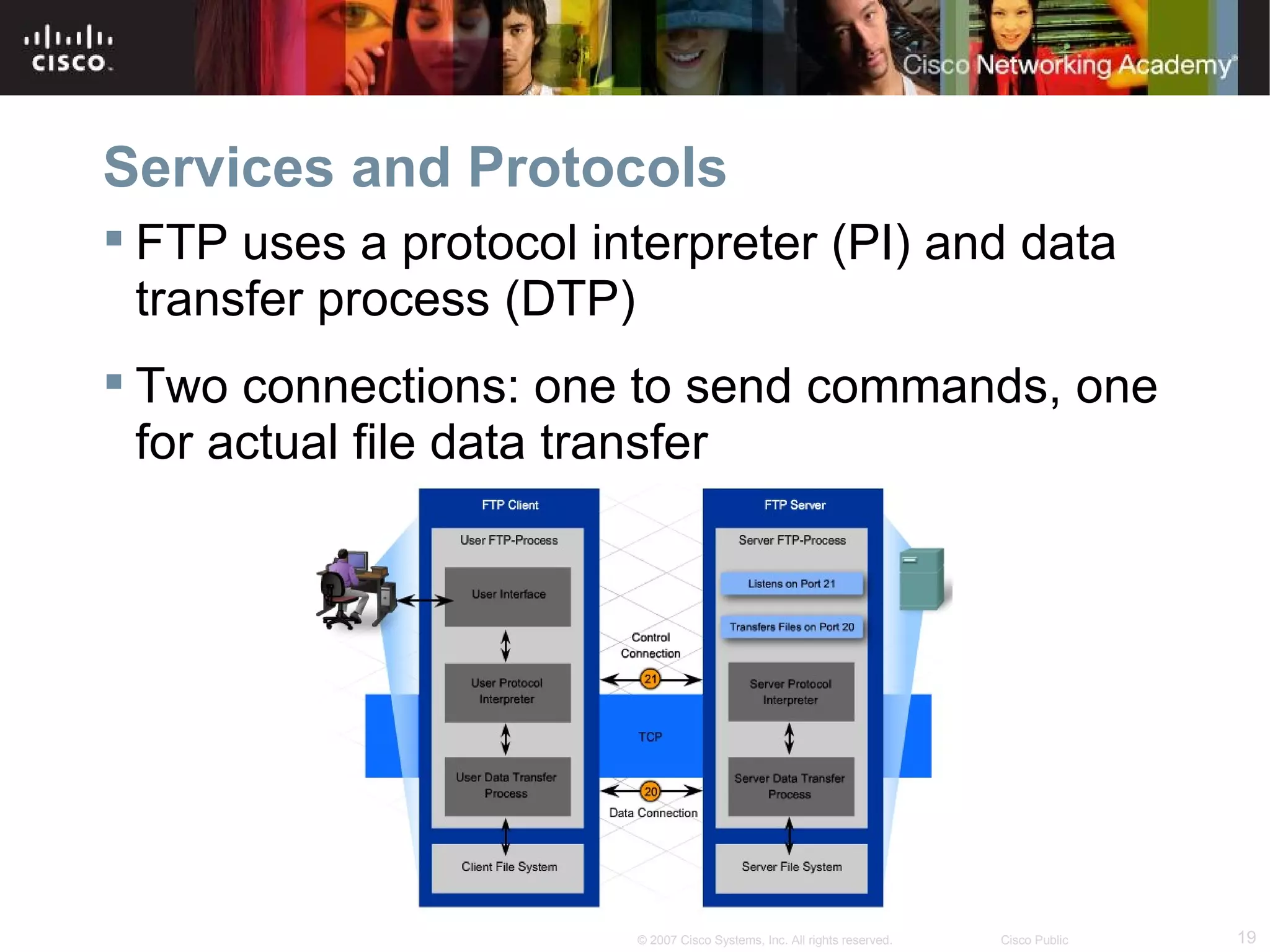
Services and Protocols
 FTP uses a protocol interpreter (PI) and data
  transfer process (DTP)
 Two connections: one to send commands, one
  for actual file data transfer


                        © 2007 Cisco Systems, Inc. All rights reserved.   Cisco Public   19
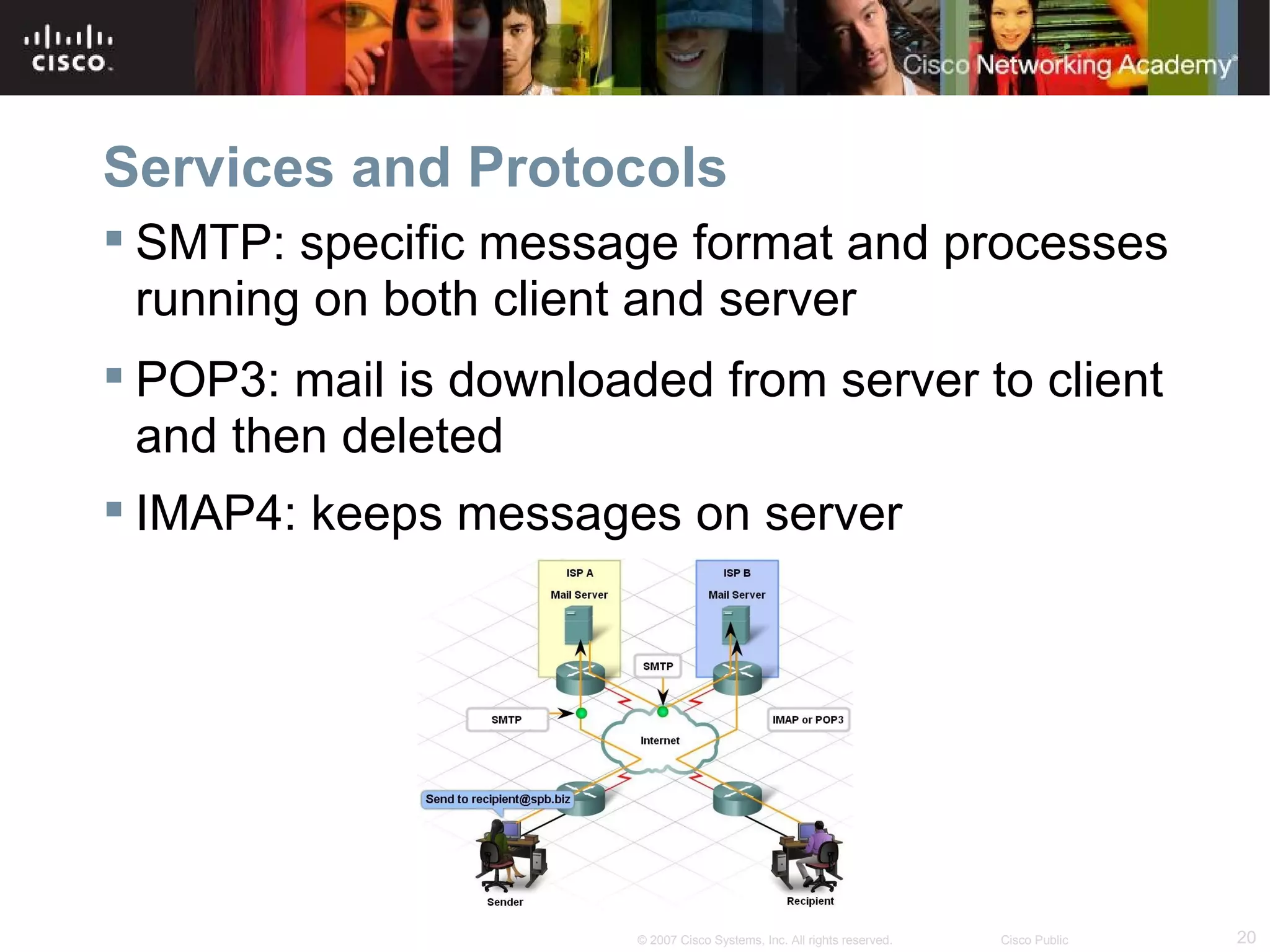
Services and Protocols
 SMTP: specific message format and processes
  running on both client and server
 POP3: mail is downloaded from server to client
  and then deleted
 IMAP4: keeps messages on server


                        © 2007 Cisco Systems, Inc. All rights reserved.   Cisco Public   20
Summary
 TCP and UDP use port numbers to provide multiple
  services to hosts.
 DNS uses a hierarchical system of databases to
  resolve names and IP addresses of known hosts within
  networks and across the Internet.
 The most common services used on the Internet
  include FTP, FTPS, HTTP, HTTPS and SMTP.
 ISPs use high-performance servers to support these
  services.


                           © 2007 Cisco Systems, Inc. All rights reserved.   Cisco Public   21
© 2007 Cisco Systems, Inc. All rights reserved.   Cisco Public   22

CCNA Discovery 2 - Chapter 7

  • 1.
    ISP Services Working at a Small-to-Medium Business or ISP – Chapter 7 Version 4.1 © 2007 Cisco Systems, Inc. All rights reserved. Cisco Public 1
  • 2.
    Objectives  Describe thenetwork services provided by an ISP.  Describe the protocols that support the network services provided by an ISP.  Describe the purpose, function, and hierarchical nature of the Domain Name System (DNS).  Describe and enable common services and their protocols. © 2007 Cisco Systems, Inc. All rights reserved. Cisco Public 2
  • 3.
    Introducing ISP Services Criticalservices for small-to-medium businesses:  Email  Web hosting  Media streaming  IP telephony  File transfer © 2007 Cisco Systems, Inc. All rights reserved. Cisco Public 3
  • 4.
    Introducing ISP Services Meetingcustomer requirements:  Reliability  Availability © 2007 Cisco Systems, Inc. All rights reserved. Cisco Public 4
  • 5.
    Protocols That SupportISP Services  The TCP/IP suite of protocols supports reliability © 2007 Cisco Systems, Inc. All rights reserved. Cisco Public 5
  • 6.
    Protocols That SupportISP Services  Transport needs determine the choice of Transport Layer Protocol © 2007 Cisco Systems, Inc. All rights reserved. Cisco Public 6
  • 7.
    Protocols That SupportISP Services The TCP three-way handshake:  Synchronization  Synchronization acknowledgement  Acknowledgement © 2007 Cisco Systems, Inc. All rights reserved. Cisco Public 7
  • 8.
    Protocols That SupportISP Services How TCP supports reliability:  Acknowledgement  Retransmission  Sequencing  Flow control © 2007 Cisco Systems, Inc. All rights reserved. Cisco Public 8
  • 9.
    Protocols That SupportISP Services  UDP: not connection-oriented, simple protocol  Used by online games, DHCP, DNS © 2007 Cisco Systems, Inc. All rights reserved. Cisco Public 9
  • 10.
    Protocols That SupportISP Services  TCP and UDP use ports to support multiple services © 2007 Cisco Systems, Inc. All rights reserved. Cisco Public 10
  • 11.
    Protocols That SupportISP Services  Socket: combination of Transport Layer port number and Network Layer IP address of host  Socket pair: source and destination IPs and port numbers identify each conversation © 2007 Cisco Systems, Inc. All rights reserved. Cisco Public 11
  • 12.
    Domain Name System(DNS)  Networking naming systems translate human- readable names into machine-readable addresses srv2 © 2007 Cisco Systems, Inc. All rights reserved. Cisco Public 12
  • 13.
    Domain Name System(DNS) Advantages of DNS:  Hierarchical structure  Small, manageable zones  Scalable © 2007 Cisco Systems, Inc. All rights reserved. Cisco Public 13
  • 14.
    Domain Name System(DNS) Components of DNS:  Resource records and domain namespace  Domain name system servers  Resolvers © 2007 Cisco Systems, Inc. All rights reserved. Cisco Public 14
  • 15.
    Domain Name System(DNS) DNS name resolution:  Dynamic updates  Forward lookup zones  Reverse lookup zones  Primary zones  Secondary zones © 2007 Cisco Systems, Inc. All rights reserved. Cisco Public 15
  • 16.
    Domain Name System(DNS) Implementing DNS solutions:  ISP DNS servers  Local DNS servers © 2007 Cisco Systems, Inc. All rights reserved. Cisco Public 16
  • 17.
    Services and Protocols ISPs provide many business-oriented services  Secure versions of Application Layer protocols support customer security requirements © 2007 Cisco Systems, Inc. All rights reserved. Cisco Public 17
  • 18.
    Services and Protocols HTTP is a request-response protocol  HTTPS adds authentication and encryption © 2007 Cisco Systems, Inc. All rights reserved. Cisco Public 18
  • 19.
    Services and Protocols FTP uses a protocol interpreter (PI) and data transfer process (DTP)  Two connections: one to send commands, one for actual file data transfer © 2007 Cisco Systems, Inc. All rights reserved. Cisco Public 19
  • 20.
    Services and Protocols SMTP: specific message format and processes running on both client and server  POP3: mail is downloaded from server to client and then deleted  IMAP4: keeps messages on server © 2007 Cisco Systems, Inc. All rights reserved. Cisco Public 20
  • 21.
    Summary  TCP andUDP use port numbers to provide multiple services to hosts.  DNS uses a hierarchical system of databases to resolve names and IP addresses of known hosts within networks and across the Internet.  The most common services used on the Internet include FTP, FTPS, HTTP, HTTPS and SMTP.  ISPs use high-performance servers to support these services. © 2007 Cisco Systems, Inc. All rights reserved. Cisco Public 21
  • 22.
    © 2007 CiscoSystems, Inc. All rights reserved. Cisco Public 22