Peer-to-peer protocols
Dr. Ajay Singh Raghuvanshi
Electronics & Telecommunication
Engineering, NIT, Raipur
2
Review of seven layers
Application
Layer
Presentation
Layer
Session
Layer
Transport
Layer
Network
Layer
Data Link
Layer
Physical
Layer
Application
Layer
Presentation
Layer
Session
Layer
Transport
Layer
Network
Layer
Data Link
Layer
Physical
Layer
Network
Layer
Electrical and/or Optical Signals
Application A Application B
Data Link
Layer
Physical
Layer
Network
Layer
Data Link
Layer
Physical
Layer
Communication Network
Peer-to-Peer Protocol
Dr.Ajay Singh Raghuvanshi 3
09/09/2024
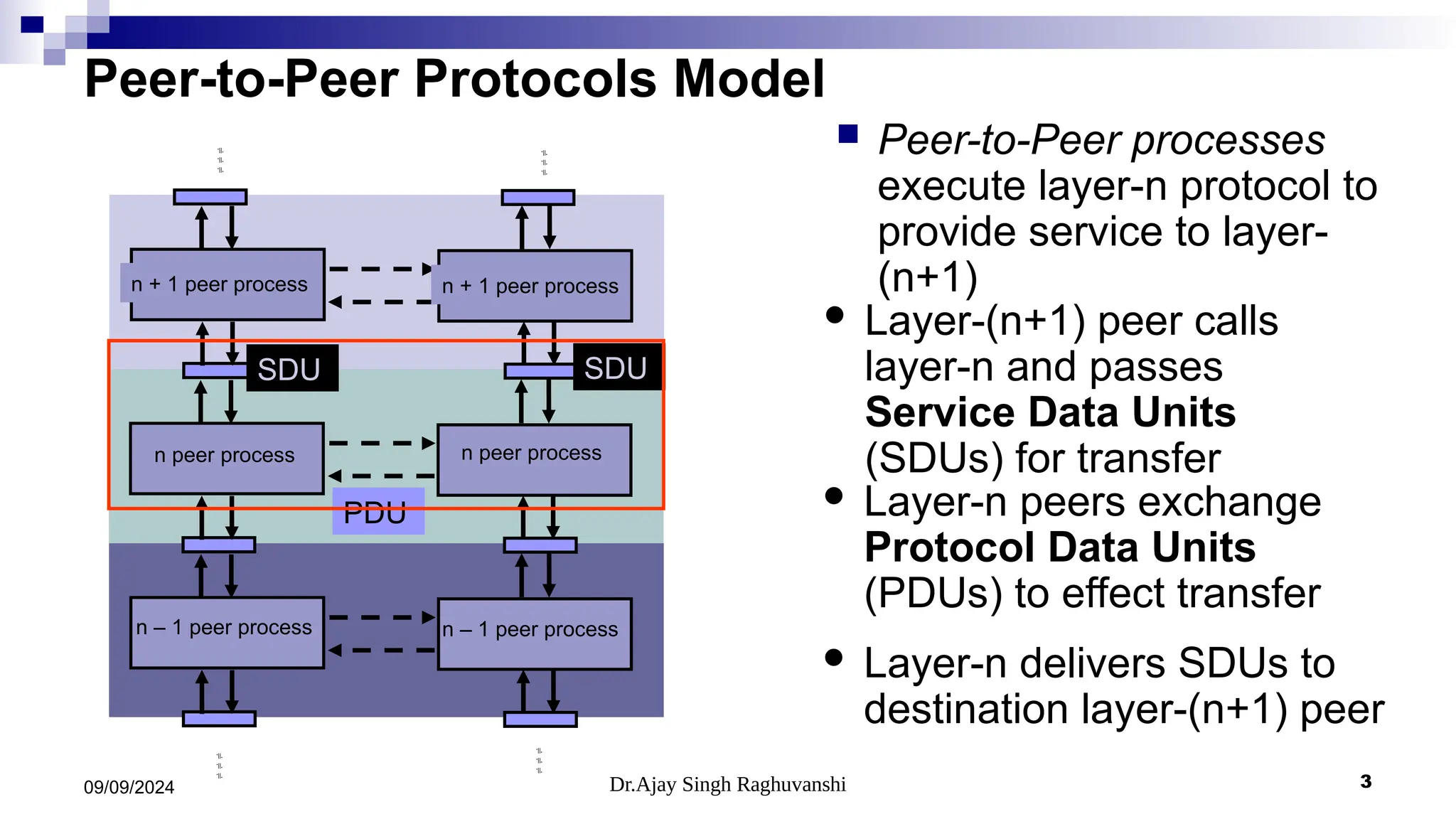
Peer-to-Peer Protocols Model
 Peer-to-Peer processes
execute layer-n protocol to
provide service to layer-
(n+1)
 Layer-(n+1) peer calls
layer-n and passes
Service Data Units
(SDUs) for transfer
 Layer-n peers exchange
Protocol Data Units
(PDUs) to effect transfer
 Layer-n delivers SDUs to
destination layer-(n+1) peer
n – 1 peer process n – 1 peer process
n peer process n peer process
n + 1 peer process n + 1 peer process












SDU SDU
PDU
Dr.Ajay Singh Raghuvanshi 4
09/09/2024
Service Models
 The service model specifies the information transfer service
layer-n provides to layer-(n+1)
 The most important distinction is whether the service is:
Connection-oriented
Connectionless
 Service model possible features:
Arbitrary message size or structure
Sequencing and Reliability
Timing, Pacing, and Flow control
Multiplexing
Privacy, integrity, authentication and Non-repudiation
Dr.Ajay Singh Raghuvanshi 5
09/09/2024
 Connection Establishment
 Connection must be established between layer-(n+1) peers
 Layer-n protocol must: Set initial parameters, e.g. sequence numbers; and Allocate
resources, e.g. buffers
 Message transfer phase
 Exchange of SDUs
 Disconnect phase
 Example: TCP, PPP
Connection-Oriented Transfer Service
n + 1 peer process
send
n + 1 peer process
receive
Layer n connection-oriented service
SDU SDU
Dr.Ajay Singh Raghuvanshi 6
09/09/2024
n + 1 peer process
send
n + 1 peer process
receive
SDU Layer n connectionless service
 No Connection setup, simply send SDU
 Each message send independently
 Must provide all address information per message
 Simple & quick
 Example: UDP, IP
Connectionless Transfer Service
Dr.Ajay Singh Raghuvanshi 7
09/09/2024
Message Size and Structure
 What message size and structure will a service model accept?
 Different services impose restrictions on size & structure of data it will
transfer
 Single bit? Block of bytes? Byte stream?
 Ex: Transfer of voice mail = 1 long message
 Ex: Transfer of voice call = byte stream
1 voice mail= 1 message = entire sequence of speech samples
(a)
1 call = sequence of 1-byte messages byte stream
(b)
Dr.Ajay Singh Raghuvanshi 8
09/09/2024
1 long message
2 or more blocks
2 or more short messages
1 block
Segmentation & Blocking
 To accommodate arbitrary message size, a layer may have to deal
with messages that are too long or too short for its protocol
 Segmentation & Reassembly: a layer breaks long messages into
smaller blocks and reassembles these at the destination
 Blocking & Unblocking: a layer combines small messages into
bigger blocks prior to transfer
Dr.Ajay Singh Raghuvanshi 9
09/09/2024
Reliability & Sequencing
 Reliability: Are messages or information stream delivered
error-free and without loss or duplication? TCP
 Sequencing: Are messages or information stream
delivered in order? VOIP
 ARQ protocols combine error detection, retransmission,
and sequence numbering to provide reliability.
Dr.Ajay Singh Raghuvanshi 10
09/09/2024
Pacing and Flow Control
 Messages can be lost if receiving system does not have
sufficient buffering to store arriving messages. Buffering
 If destination layer-(n+1) does not retrieve its information
fast enough, destination layer-n buffers may overflow
 Pacing & Flow Control provide backpressure mechanisms
that control transfer according to availability of buffers at
the destination
 Examples: TCP and HDLC
Dr.Ajay Singh Raghuvanshi 11
09/09/2024
Timing
 Applications involving voice and video generate units of information
that are related temporally
 Destination application must reconstruct temporal relation in
voice/video units
 Network transfer introduces delay & jitter
 Timing Recovery protocols use timestamps & sequence numbering
to control the delay & jitter in delivered information
 Examples: RTP & associated protocols in Voice over IP
Dr.Ajay Singh Raghuvanshi 12
09/09/2024
Multiplexing
 Multiplexing enables multiple layer-(n+1) users to share a
layer-n service
 A multiplexing tag is required to identify specific users at
the destination
 Examples: TCP, UDP
Dr.Ajay Singh Raghuvanshi 13
09/09/2024
Privacy, Integrity, Authentication & Non-Repudiation
 Privacy: ensuring that information transferred cannot be
read by others (Confidentiality)
 Integrity: ensuring that information is not altered during
transfer
 Authentication: verifying that sender and/or receiver are
who they claim to be
 Non-repudiation is the assurance that someone cannot
deny something
 Security protocols provide these services Examples:
IPSec, SSL
14
Dr.Ajay Singh Raghuvanshi
09/09/2024
Reliable End-to-End and Hop by Hop
1 2 5
Data
ACK/NAK
A B
End-to-end
1 2 5
Data
A B
ACK/NAK
Hop-by-hop
3
Data
ACK/NAK
4
Data
ACK/NAK
Data
ACK/NAK
3
Data
4
Data Data
Dr.Ajay Singh Raghuvanshi 15
09/09/2024
Data link
layer
Physical
layer
Physical
layer
Data link
layer
A B
Packets Packets
Frames
3 2 1
1 2
2
1
3 2 1
1 2
2
1
2
1
Medium
A B
 Data Link operates over
wire-like, directly-connected
systems
 Frames can be corrupted or
lost, but arrive in order
 Data link performs error-
checking & retransmission
 Ensures error-free packet
transfer between two
systems
Hop by Hop Peer Service

CCN_Lecture 005Peer to Peer Protocol.pptx

  • 1.
    Peer-to-peer protocols Dr. AjaySingh Raghuvanshi Electronics & Telecommunication Engineering, NIT, Raipur
  • 2.
    2 Review of sevenlayers Application Layer Presentation Layer Session Layer Transport Layer Network Layer Data Link Layer Physical Layer Application Layer Presentation Layer Session Layer Transport Layer Network Layer Data Link Layer Physical Layer Network Layer Electrical and/or Optical Signals Application A Application B Data Link Layer Physical Layer Network Layer Data Link Layer Physical Layer Communication Network Peer-to-Peer Protocol
  • 3.
    Dr.Ajay Singh Raghuvanshi3 09/09/2024 Peer-to-Peer Protocols Model  Peer-to-Peer processes execute layer-n protocol to provide service to layer- (n+1)  Layer-(n+1) peer calls layer-n and passes Service Data Units (SDUs) for transfer  Layer-n peers exchange Protocol Data Units (PDUs) to effect transfer  Layer-n delivers SDUs to destination layer-(n+1) peer n – 1 peer process n – 1 peer process n peer process n peer process n + 1 peer process n + 1 peer process             SDU SDU PDU
  • 4.
    Dr.Ajay Singh Raghuvanshi4 09/09/2024 Service Models  The service model specifies the information transfer service layer-n provides to layer-(n+1)  The most important distinction is whether the service is: Connection-oriented Connectionless  Service model possible features: Arbitrary message size or structure Sequencing and Reliability Timing, Pacing, and Flow control Multiplexing Privacy, integrity, authentication and Non-repudiation
  • 5.
    Dr.Ajay Singh Raghuvanshi5 09/09/2024  Connection Establishment  Connection must be established between layer-(n+1) peers  Layer-n protocol must: Set initial parameters, e.g. sequence numbers; and Allocate resources, e.g. buffers  Message transfer phase  Exchange of SDUs  Disconnect phase  Example: TCP, PPP Connection-Oriented Transfer Service n + 1 peer process send n + 1 peer process receive Layer n connection-oriented service SDU SDU
  • 6.
    Dr.Ajay Singh Raghuvanshi6 09/09/2024 n + 1 peer process send n + 1 peer process receive SDU Layer n connectionless service  No Connection setup, simply send SDU  Each message send independently  Must provide all address information per message  Simple & quick  Example: UDP, IP Connectionless Transfer Service
  • 7.
    Dr.Ajay Singh Raghuvanshi7 09/09/2024 Message Size and Structure  What message size and structure will a service model accept?  Different services impose restrictions on size & structure of data it will transfer  Single bit? Block of bytes? Byte stream?  Ex: Transfer of voice mail = 1 long message  Ex: Transfer of voice call = byte stream 1 voice mail= 1 message = entire sequence of speech samples (a) 1 call = sequence of 1-byte messages byte stream (b)
  • 8.
    Dr.Ajay Singh Raghuvanshi8 09/09/2024 1 long message 2 or more blocks 2 or more short messages 1 block Segmentation & Blocking  To accommodate arbitrary message size, a layer may have to deal with messages that are too long or too short for its protocol  Segmentation & Reassembly: a layer breaks long messages into smaller blocks and reassembles these at the destination  Blocking & Unblocking: a layer combines small messages into bigger blocks prior to transfer
  • 9.
    Dr.Ajay Singh Raghuvanshi9 09/09/2024 Reliability & Sequencing  Reliability: Are messages or information stream delivered error-free and without loss or duplication? TCP  Sequencing: Are messages or information stream delivered in order? VOIP  ARQ protocols combine error detection, retransmission, and sequence numbering to provide reliability.
  • 10.
    Dr.Ajay Singh Raghuvanshi10 09/09/2024 Pacing and Flow Control  Messages can be lost if receiving system does not have sufficient buffering to store arriving messages. Buffering  If destination layer-(n+1) does not retrieve its information fast enough, destination layer-n buffers may overflow  Pacing & Flow Control provide backpressure mechanisms that control transfer according to availability of buffers at the destination  Examples: TCP and HDLC
  • 11.
    Dr.Ajay Singh Raghuvanshi11 09/09/2024 Timing  Applications involving voice and video generate units of information that are related temporally  Destination application must reconstruct temporal relation in voice/video units  Network transfer introduces delay & jitter  Timing Recovery protocols use timestamps & sequence numbering to control the delay & jitter in delivered information  Examples: RTP & associated protocols in Voice over IP
  • 12.
    Dr.Ajay Singh Raghuvanshi12 09/09/2024 Multiplexing  Multiplexing enables multiple layer-(n+1) users to share a layer-n service  A multiplexing tag is required to identify specific users at the destination  Examples: TCP, UDP
  • 13.
    Dr.Ajay Singh Raghuvanshi13 09/09/2024 Privacy, Integrity, Authentication & Non-Repudiation  Privacy: ensuring that information transferred cannot be read by others (Confidentiality)  Integrity: ensuring that information is not altered during transfer  Authentication: verifying that sender and/or receiver are who they claim to be  Non-repudiation is the assurance that someone cannot deny something  Security protocols provide these services Examples: IPSec, SSL
  • 14.
    14 Dr.Ajay Singh Raghuvanshi 09/09/2024 ReliableEnd-to-End and Hop by Hop 1 2 5 Data ACK/NAK A B End-to-end 1 2 5 Data A B ACK/NAK Hop-by-hop 3 Data ACK/NAK 4 Data ACK/NAK Data ACK/NAK 3 Data 4 Data Data
  • 15.
    Dr.Ajay Singh Raghuvanshi15 09/09/2024 Data link layer Physical layer Physical layer Data link layer A B Packets Packets Frames 3 2 1 1 2 2 1 3 2 1 1 2 2 1 2 1 Medium A B  Data Link operates over wire-like, directly-connected systems  Frames can be corrupted or lost, but arrive in order  Data link performs error- checking & retransmission  Ensures error-free packet transfer between two systems Hop by Hop Peer Service