CC0  Update and Workshop 3 rd  COMMUNIA Conference Marking the Public Domain:  Certification & Relinquishment 20 October 2008 Diane Peters, General Counsel
High-Level Goals Share CC’s core understandings about  CC0 and its objectives Discussion of work that remains Highlight next steps & where CC is heading
Agenda Background and Objectives for CC0 Jurisdictional Survey Interactive Discussion:  Overview of CC0 Next Steps
Filling a Need: Legal tool to enable authors and © owners Returning control to those who create
Existing Tools CC’s Public Domain Dedication:  limitations US-Centric Porting required Complicated on at least two levels assertion & conclusion dedication Others, e.g., Pubic Domain Dedication License (PDDL) by Open Data Commons Databases and Data
CC0 Overall Design Principles:  Further iteration of PDD, compliant with Open Access Data Protocol Easy to use and understand Legally accurate Reduce transaction costs Applicabiilty: Universal (no porting) For use with any kind of copyrightable works, not just data
CC0 and Norms Attribution versus Citation Attribution stacking as a problem Norms as a solution
CC0 and Norms Open Access Data Protocol “ Requesting behavior, such as citation, through norms rather than as a legal requirement based on copyright or contracts, allows for different scientific disciplines to develop different norms for citation. This allows for legal certainty without constraining one community to the norms of another.”
 
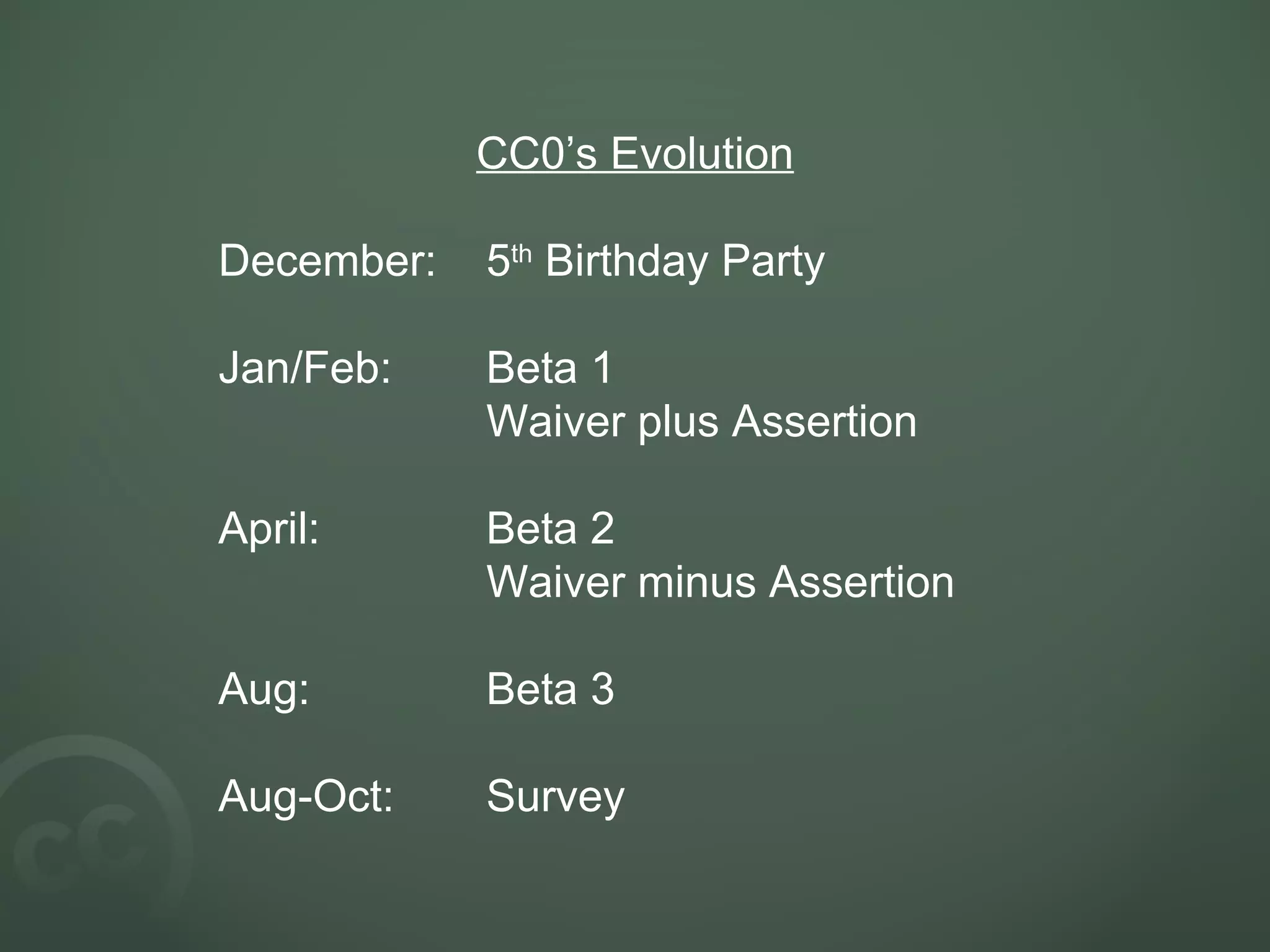
CC0’s Evolution December: 5 th  Birthday Party Jan/Feb: Beta 1 Waiver plus Assertion April: Beta 2 Waiver minus Assertion Aug: Beta 3 Aug-Oct: Survey
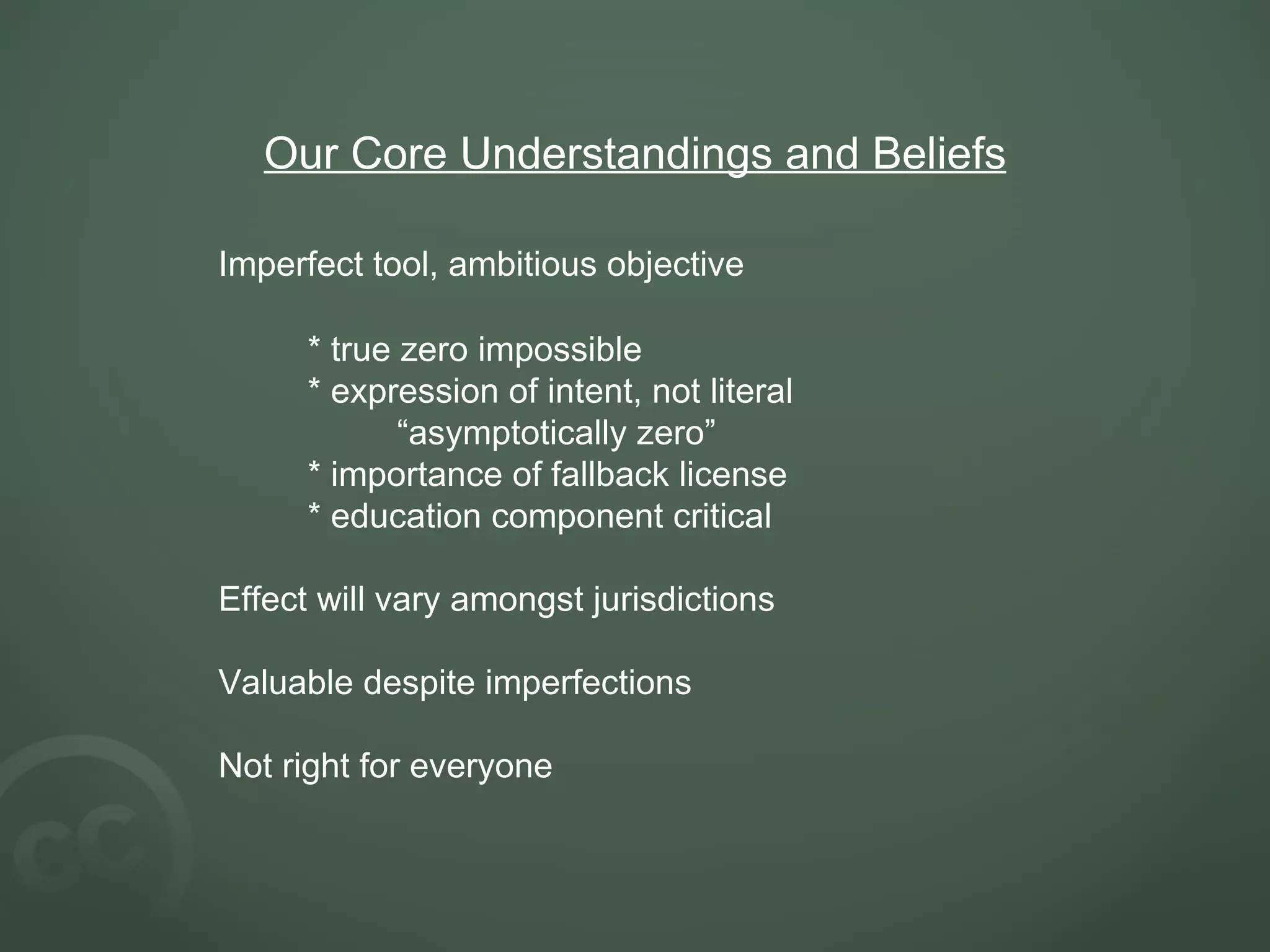
Our Core Understandings and Beliefs Imperfect tool, ambitious objective * true zero impossible * expression of intent, not literal “ asymptotically zero” * importance of fallback license * education component critical Effect will vary amongst jurisdictions Valuable despite imperfections Not right for everyone
CC0 Survey
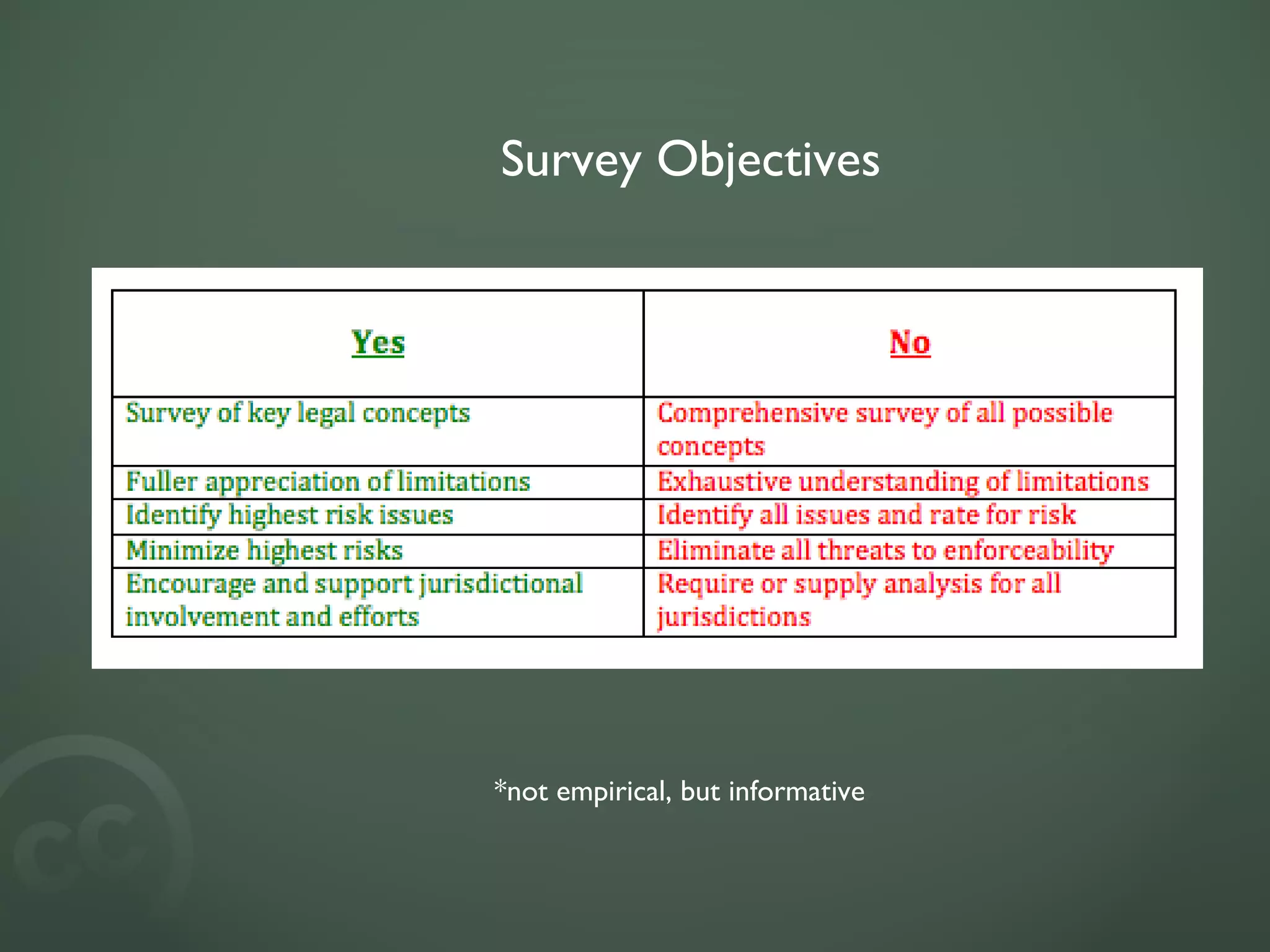
Survey Objectives *not empirical, but informative
Scope of Survey Public domain generally Existence Processes Other legal concepts Waiver and abandonment Covenants not to assert Licenses Moral rights Concepts of equity as defense Form requirements throughout
Survey Results and Learnings
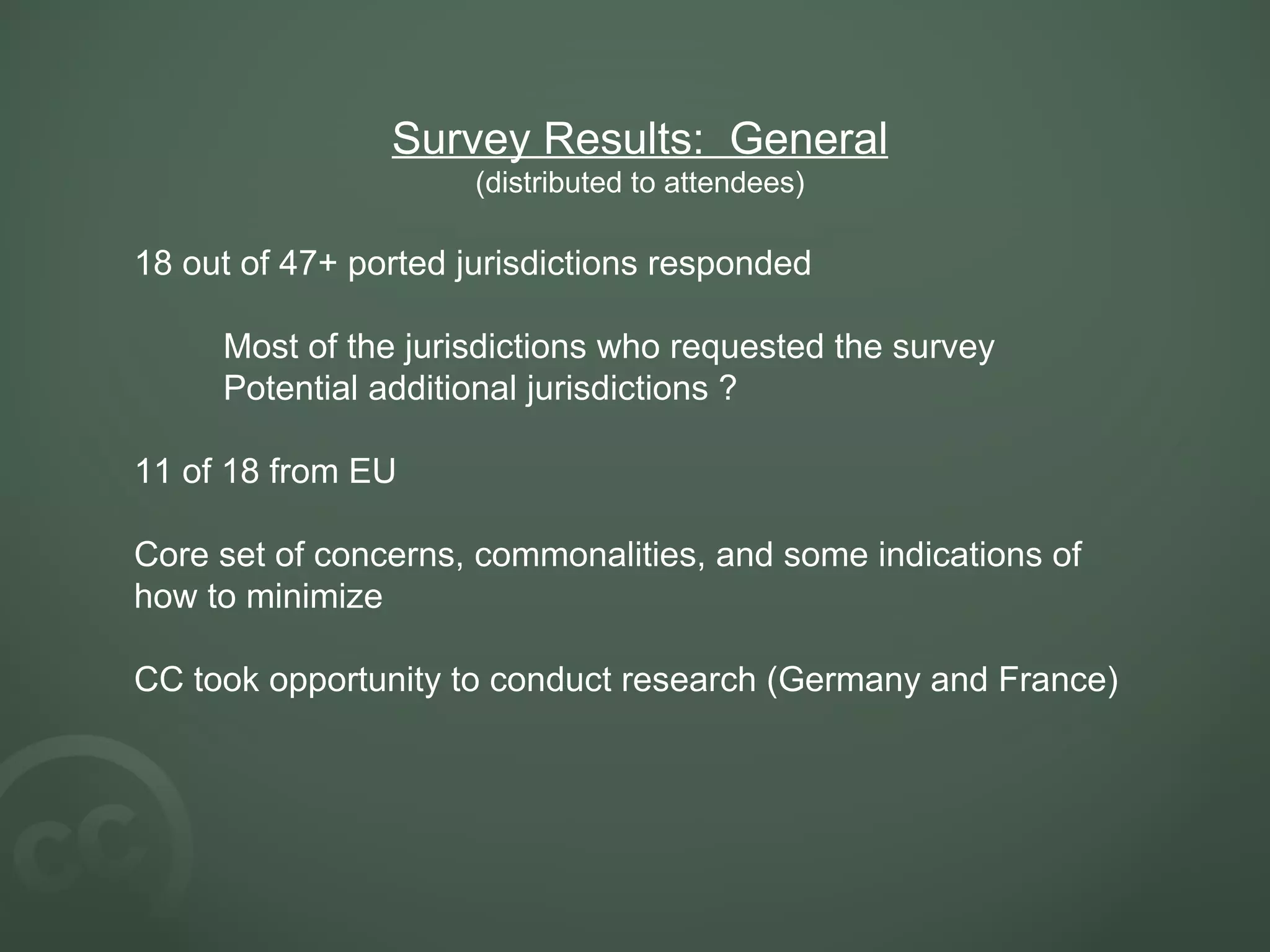
Survey Results:  General (distributed to attendees) 18 out of 47+ ported jurisdictions responded Most of the jurisdictions who requested the survey Potential additional jurisdictions ? 11 of 18 from EU Core set of concerns, commonalities, and some indications of how to minimize CC took opportunity to conduct research (Germany and France)
Select Highlights Public domain * End of protection, or by definition not protected * No good process other than patience Although some indications to contrary e.g. China Mainland, Japan, Columbia * Complicated by collecting societies and moral rights Waiver, when allowed, generally limited to economic rights * Emphasizes importance of license
Important Take-Aways Fallback license important * Specificity Potential uses/unknown usages Rights licensed Statement of Intention/Knowledge * For scope of license and reliance * For fairness/equity when considered on balance Consideration/reliance * Revocability * Form requirements for “donations”
More Important Take-Aways Moral rights are not always absolute * Attempt to mitigate risks appears worthwhile Identify motivations Consideration Intended uses identified (eg. Commercial) Will not enforce contrary to stated intentions  (instead of waiving and if license fails)
Discussion:  An Overview of CC0 (showing changes from Beta 3) Statement of Purpose Importance of its role Copyright and Related Rights Waiver Public License Fallback Limitations and Disclaimers
Next Steps
Finalize legal code:  publish for final read Upgrade deed and technical implementation/process Educational materials Publish for adoption, messaging important Linguistic translations Possible jurisdiction-specific activities
Presentation Attribution: Author - Diane Peters License - CC BY - http://creativecommons.org/licenses/by/3.0/

Cc0 Update (Amsterdam) (Final)

  • 1.
    CC0 Updateand Workshop 3 rd COMMUNIA Conference Marking the Public Domain: Certification & Relinquishment 20 October 2008 Diane Peters, General Counsel
  • 2.
    High-Level Goals ShareCC’s core understandings about CC0 and its objectives Discussion of work that remains Highlight next steps & where CC is heading
  • 3.
    Agenda Background andObjectives for CC0 Jurisdictional Survey Interactive Discussion: Overview of CC0 Next Steps
  • 4.
    Filling a Need:Legal tool to enable authors and © owners Returning control to those who create
  • 5.
    Existing Tools CC’sPublic Domain Dedication: limitations US-Centric Porting required Complicated on at least two levels assertion & conclusion dedication Others, e.g., Pubic Domain Dedication License (PDDL) by Open Data Commons Databases and Data
  • 6.
    CC0 Overall DesignPrinciples: Further iteration of PDD, compliant with Open Access Data Protocol Easy to use and understand Legally accurate Reduce transaction costs Applicabiilty: Universal (no porting) For use with any kind of copyrightable works, not just data
  • 7.
    CC0 and NormsAttribution versus Citation Attribution stacking as a problem Norms as a solution
  • 8.
    CC0 and NormsOpen Access Data Protocol “ Requesting behavior, such as citation, through norms rather than as a legal requirement based on copyright or contracts, allows for different scientific disciplines to develop different norms for citation. This allows for legal certainty without constraining one community to the norms of another.”
  • 9.
  • 10.
    CC0’s Evolution December:5 th Birthday Party Jan/Feb: Beta 1 Waiver plus Assertion April: Beta 2 Waiver minus Assertion Aug: Beta 3 Aug-Oct: Survey
  • 11.
    Our Core Understandingsand Beliefs Imperfect tool, ambitious objective * true zero impossible * expression of intent, not literal “ asymptotically zero” * importance of fallback license * education component critical Effect will vary amongst jurisdictions Valuable despite imperfections Not right for everyone
  • 12.
  • 13.
    Survey Objectives *notempirical, but informative
  • 14.
    Scope of SurveyPublic domain generally Existence Processes Other legal concepts Waiver and abandonment Covenants not to assert Licenses Moral rights Concepts of equity as defense Form requirements throughout
  • 15.
  • 16.
    Survey Results: General (distributed to attendees) 18 out of 47+ ported jurisdictions responded Most of the jurisdictions who requested the survey Potential additional jurisdictions ? 11 of 18 from EU Core set of concerns, commonalities, and some indications of how to minimize CC took opportunity to conduct research (Germany and France)
  • 17.
    Select Highlights Publicdomain * End of protection, or by definition not protected * No good process other than patience Although some indications to contrary e.g. China Mainland, Japan, Columbia * Complicated by collecting societies and moral rights Waiver, when allowed, generally limited to economic rights * Emphasizes importance of license
  • 18.
    Important Take-Aways Fallbacklicense important * Specificity Potential uses/unknown usages Rights licensed Statement of Intention/Knowledge * For scope of license and reliance * For fairness/equity when considered on balance Consideration/reliance * Revocability * Form requirements for “donations”
  • 19.
    More Important Take-AwaysMoral rights are not always absolute * Attempt to mitigate risks appears worthwhile Identify motivations Consideration Intended uses identified (eg. Commercial) Will not enforce contrary to stated intentions (instead of waiving and if license fails)
  • 20.
    Discussion: AnOverview of CC0 (showing changes from Beta 3) Statement of Purpose Importance of its role Copyright and Related Rights Waiver Public License Fallback Limitations and Disclaimers
  • 21.
  • 22.
    Finalize legal code: publish for final read Upgrade deed and technical implementation/process Educational materials Publish for adoption, messaging important Linguistic translations Possible jurisdiction-specific activities
  • 23.
    Presentation Attribution: Author- Diane Peters License - CC BY - http://creativecommons.org/licenses/by/3.0/