GAIUS VALERIUS
  CATULLUS
Verona, Cisalpine Gaul 87 (84) BC -
         Rome 57 (54) BC
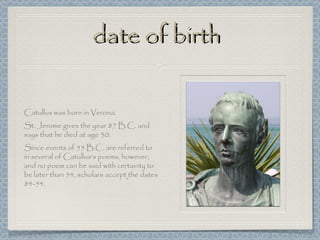
date of birth

Catullus was born in Verona.
St. Jerome gives the year 87 B.C. and
says that he died at age 30.
Since events of 55 B.C. are referred to
in several of Catullus's poems, however,
and no poem can be said with certainty to
be later than 54, scholars accept the dates
84-54.
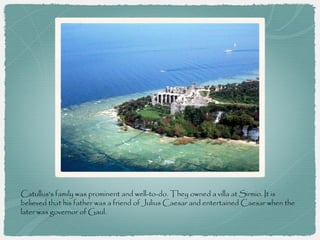
Catullus's family was prominent and well-to-do. They owned a villa at Sirmio. It is
believed that his father was a friend of Julius Caesar and entertained Caesar when the
later was governor of Gaul.
Catullus’ style and education

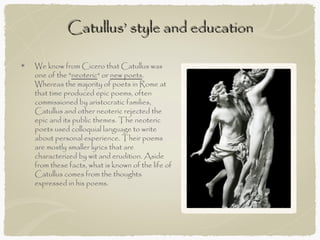
We know from Cicero that Catullus was
one of the "neoteric" or new poets.
Whereas the majority of poets in Rome at
that time produced epic poems, often
commissioned by aristocratic families,
Catullus and other neoteric rejected the
epic and its public themes. The neoteric
poets used colloquial language to write
about personal experience. Their poems
are mostly smaller lyrics that are
characterized by wit and erudition. Aside
from these facts, what is known of the life of
Catullus comes from the thoughts
expressed in his poems.
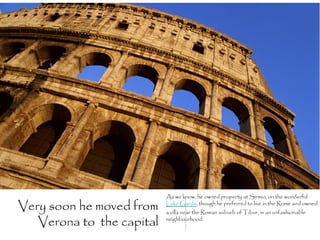
As we know, he owned property at Sirmio, on the wonderful

Very soon he moved from    Lake Garda, though he preferred to live in the Rome and owned
                           a villa near the Roman suburb of Tibur, in an unfashionable

   Verona to the capital   neighbourhood.
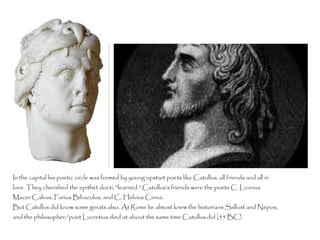
In the capital his poetic circle was formed by young upstart poets like Catullus, all friends and all in
love. They cherished the epithet docti, "learned." Catullus's friends were the poets C. Licinius
Macer Calvus, Furius Bibaculus, and C. Helvius Cinna.
But Catullus did know some greats also. At Rome he almost knew the historians Sallust and Nepos,
and the philosopher/poet Lucretius died at about the same time Catullus did (55 BC).
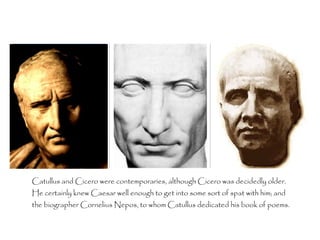
Catullus and Cicero were contemporaries, although Cicero was decidedly older.
He certainly knew Caesar well enough to get into some sort of spat with him; and
the biographer Cornelius Nepos, to whom Catullus dedicated his book of poems.
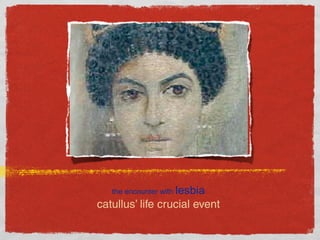
the encounter with lesbia
catullus’ life crucial event
ODI ET AMO
 
Odi et amo. Quare id faciam,             fortasse   requiris.
nescio, sed fieri sentio et excrucior.

I hate and I love. Wherefore I do this, perhaps you ask.
I do not know, but I feel it being done and I am tormented.


(Catullus 85)
 
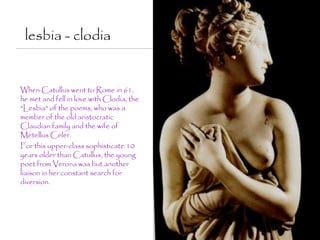
lesbia - clodia


When Catullus went to Rome in 61,
he met and fell in love with Clodia, the
"Lesbia" of the poems, who was a
member of the old aristocratic
Claudian family and the wife of
Metellus Celer.
For this upper-class sophisticate 10
years older than Catullus, the young
poet from Verona was but another
liaison in her constant search for
diversion.
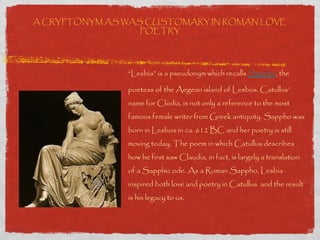
A CRYPTONYM AS WAS CUSTOMARY IN ROMAN LOVE
                  POETRY


               “Lesbia” is a pseudonym which recalls Sappho, the

               poetess of the Aegean island of Lesbos. Catullus’
               name for Clodia, is not only a reference to the most
               famous female writer from Greek antiquity. Sappho was
               born in Lesbos in ca. 612 BC and her poetry is still
               moving today. The poem in which Catullus describes
               how he first saw Claudia, in fact, is largely a translation
               of a Sapphic ode. As a Roman Sappho, Lesbia
               inspired both love and poetry in Catullus and the result
               is his legacy to us.
He appears to me, that one, equal to the gods,
the man who, facing you,
is seated and, up close, that sweet voice of yours
he listens to

And how you laugh your charming laugh. Why it
makes my heart flutter within my breast,
because the moment I look at you, right then, for me,
to make any sound at all won’t work any more.

My tongue has a breakdown and a delicate
— all of a sudden — fire rushes under my skin.
With my eyes I see not a thing, and there is a roar
that my ears make.

Sweat pours down me and a trembling
seizes all of me; paler than grass
am I, and a little short of death
do I appear to me.

But all may be ventured, since even [the poor]...

(Saffo, fragment 31)
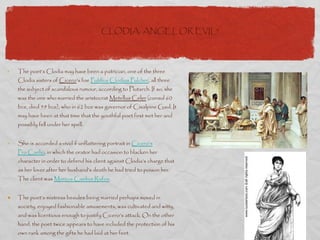
CLODIA: ANGEL OR EVIL?


The poet’s Clodia may have been a patrician, one of the three
Clodia sisters of Cicero’s foe Publius Clodius Pulcher, all three
the subject of scandalous rumour, according to Plutarch. If so, she
was the one who married the aristocrat Metellus Celer (consul 60
bce, died 59 bce), who in 62 bce was governor of Cisalpine Gaul. It
may have been at that time that the youthful poet first met her and
possibly fell under her spell.


She is accorded a vivid if unflattering portrait in Cicero’s
Pro Caelio, in which the orator had occasion to blacken her
character in order to defend his client against Clodia’s charge that
as her lover after her husband’s death he had tried to poison her.
The client was Marcus Caelius Rufus.


The poet’s mistress besides being married perhaps moved in
society, enjoyed fashionable amusements, was cultivated and witty,
and was licentious enough to justify Cicero’s attack. On the other
hand, the poet twice appears to have included the protection of his
own rank among the gifts he had laid at her feet.
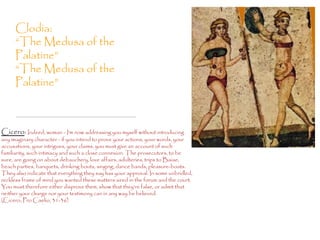
Clodia:
     “The Medusa of the
     Palatine”
     “The Medusa of the
     Palatine”


Cicero: Indeed, woman - I'm now addressing you myself without introducing
any imaginary character - if you intend to prove your actions, your words, your
accusations, your intrigues, your claims, you must give an account of such
familiarity, such intimacy and such a close connexion. The prosecutors, to be
sure, are going on about debauchery, love affairs, adulteries, trips to Baiae,
beach parties, banquets, drinking bouts, singing, dance bands, pleasure-boats.
They also indicate that everything they say has your approval. In some unbridled,
reckless frame of mind you wanted these matters aired in the forum and the court.
You must therefore either disprove them, show that they're false, or admit that
neither your charge nor your testimony can in any way be believed.
(Cicero, Pro Caelio, 31-36)
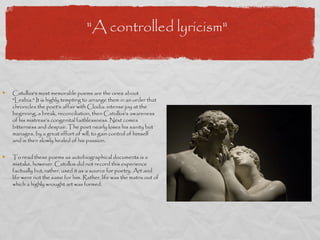
"A controlled lyricism"


Catullus's most memorable poems are the ones about
"Lesbia." It is highly tempting to arrange them in an order that
chronicles the poet's affair with Clodia: intense joy at the
beginning, a break, reconciliation, then Catullus's awareness
of his mistress's congenital faithlessness. Next comes
bitterness and despair. The poet nearly loses his sanity but
manages, by a great effort of will, to gain control of himself
and is then slowly healed of his passion.

To read these poems as autobiographical documents is a
mistake, however. Catullus did not record this experience
factually but, rather, used it as a source for poetry. Art and
life were not the same for him. Rather, life was the matrix out of
which a highly wrought art was formed.
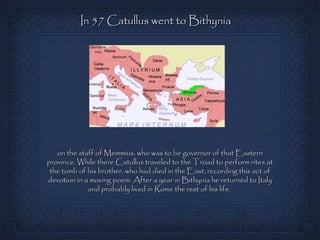
In 57 Catullus went to Bithynia


   on the staff of Memmius, who was to be governor of that Eastern
province. While there Catullus traveled to the Troad to perform rites at
 the tomb of his brother, who had died in the East, recording this act of
devotion in a moving poem. After a year in Bithynia he returned to Italy
             and probably lived in Rome the rest of his life.
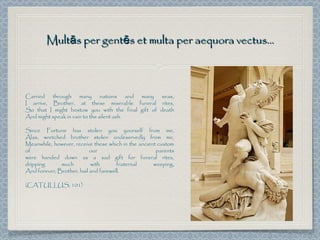
Multās per gentēs et multa per aequora vectus...


Carried through many nations and many seas,
I arrive, Brother, at these miserable funeral rites,
So that I might bestow you with the final gift of death
And might speak in vain to the silent ash.

Since Fortune has stolen you yourself from me,
Alas, wretched brother stolen undeservedly from me,
Meanwhile, however, receive these which in the ancient custom
of                         our                        parents
were handed down as a sad gift for funeral rites,
dripping      much         with       fraternal      weeping,
And forever, Brother, hail and farewell.

(CATULLUS, 101)
 
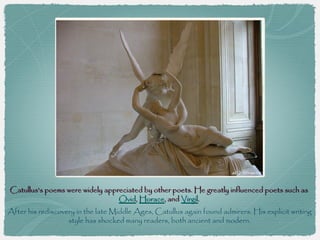
Catullus's poems were widely appreciated by other poets. He greatly influenced poets such as
                                 Ovid, Horace, and Virgil.
After his rediscovery in the late Middle Ages, Catullus again found admirers. His explicit writing
                   style has shocked many readers, both ancient and modern.

Catullus pp copy

  • 1.
    GAIUS VALERIUS CATULLUS Verona, Cisalpine Gaul 87 (84) BC - Rome 57 (54) BC
  • 2.
    date of birth Catulluswas born in Verona. St. Jerome gives the year 87 B.C. and says that he died at age 30. Since events of 55 B.C. are referred to in several of Catullus's poems, however, and no poem can be said with certainty to be later than 54, scholars accept the dates 84-54.
  • 3.
    Catullus's family wasprominent and well-to-do. They owned a villa at Sirmio. It is believed that his father was a friend of Julius Caesar and entertained Caesar when the later was governor of Gaul.
  • 4.
    Catullus’ style andeducation We know from Cicero that Catullus was one of the "neoteric" or new poets. Whereas the majority of poets in Rome at that time produced epic poems, often commissioned by aristocratic families, Catullus and other neoteric rejected the epic and its public themes. The neoteric poets used colloquial language to write about personal experience. Their poems are mostly smaller lyrics that are characterized by wit and erudition. Aside from these facts, what is known of the life of Catullus comes from the thoughts expressed in his poems.
  • 5.
    As we know,he owned property at Sirmio, on the wonderful Very soon he moved from Lake Garda, though he preferred to live in the Rome and owned a villa near the Roman suburb of Tibur, in an unfashionable Verona to the capital neighbourhood.
  • 6.
    In the capitalhis poetic circle was formed by young upstart poets like Catullus, all friends and all in love. They cherished the epithet docti, "learned." Catullus's friends were the poets C. Licinius Macer Calvus, Furius Bibaculus, and C. Helvius Cinna. But Catullus did know some greats also. At Rome he almost knew the historians Sallust and Nepos, and the philosopher/poet Lucretius died at about the same time Catullus did (55 BC).
  • 7.
    Catullus and Cicerowere contemporaries, although Cicero was decidedly older. He certainly knew Caesar well enough to get into some sort of spat with him; and the biographer Cornelius Nepos, to whom Catullus dedicated his book of poems.
  • 8.
    the encounter withlesbia catullus’ life crucial event
  • 9.
    ODI ET AMO   Odiet amo. Quare id faciam, fortasse requiris. nescio, sed fieri sentio et excrucior. I hate and I love. Wherefore I do this, perhaps you ask. I do not know, but I feel it being done and I am tormented. (Catullus 85)  
  • 10.
    lesbia - clodia WhenCatullus went to Rome in 61, he met and fell in love with Clodia, the "Lesbia" of the poems, who was a member of the old aristocratic Claudian family and the wife of Metellus Celer. For this upper-class sophisticate 10 years older than Catullus, the young poet from Verona was but another liaison in her constant search for diversion.
  • 11.
    A CRYPTONYM ASWAS CUSTOMARY IN ROMAN LOVE POETRY “Lesbia” is a pseudonym which recalls Sappho, the poetess of the Aegean island of Lesbos. Catullus’ name for Clodia, is not only a reference to the most famous female writer from Greek antiquity. Sappho was born in Lesbos in ca. 612 BC and her poetry is still moving today. The poem in which Catullus describes how he first saw Claudia, in fact, is largely a translation of a Sapphic ode. As a Roman Sappho, Lesbia inspired both love and poetry in Catullus and the result is his legacy to us.
  • 12.
    He appears tome, that one, equal to the gods, the man who, facing you, is seated and, up close, that sweet voice of yours he listens to And how you laugh your charming laugh. Why it makes my heart flutter within my breast, because the moment I look at you, right then, for me, to make any sound at all won’t work any more. My tongue has a breakdown and a delicate — all of a sudden — fire rushes under my skin. With my eyes I see not a thing, and there is a roar that my ears make. Sweat pours down me and a trembling seizes all of me; paler than grass am I, and a little short of death do I appear to me. But all may be ventured, since even [the poor]... (Saffo, fragment 31)
  • 13.
    CLODIA: ANGEL OREVIL? The poet’s Clodia may have been a patrician, one of the three Clodia sisters of Cicero’s foe Publius Clodius Pulcher, all three the subject of scandalous rumour, according to Plutarch. If so, she was the one who married the aristocrat Metellus Celer (consul 60 bce, died 59 bce), who in 62 bce was governor of Cisalpine Gaul. It may have been at that time that the youthful poet first met her and possibly fell under her spell. She is accorded a vivid if unflattering portrait in Cicero’s Pro Caelio, in which the orator had occasion to blacken her character in order to defend his client against Clodia’s charge that as her lover after her husband’s death he had tried to poison her. The client was Marcus Caelius Rufus. The poet’s mistress besides being married perhaps moved in society, enjoyed fashionable amusements, was cultivated and witty, and was licentious enough to justify Cicero’s attack. On the other hand, the poet twice appears to have included the protection of his own rank among the gifts he had laid at her feet.
  • 14.
    Clodia: “The Medusa of the Palatine” “The Medusa of the Palatine” Cicero: Indeed, woman - I'm now addressing you myself without introducing any imaginary character - if you intend to prove your actions, your words, your accusations, your intrigues, your claims, you must give an account of such familiarity, such intimacy and such a close connexion. The prosecutors, to be sure, are going on about debauchery, love affairs, adulteries, trips to Baiae, beach parties, banquets, drinking bouts, singing, dance bands, pleasure-boats. They also indicate that everything they say has your approval. In some unbridled, reckless frame of mind you wanted these matters aired in the forum and the court. You must therefore either disprove them, show that they're false, or admit that neither your charge nor your testimony can in any way be believed. (Cicero, Pro Caelio, 31-36)
  • 15.
    "A controlled lyricism" Catullus'smost memorable poems are the ones about "Lesbia." It is highly tempting to arrange them in an order that chronicles the poet's affair with Clodia: intense joy at the beginning, a break, reconciliation, then Catullus's awareness of his mistress's congenital faithlessness. Next comes bitterness and despair. The poet nearly loses his sanity but manages, by a great effort of will, to gain control of himself and is then slowly healed of his passion. To read these poems as autobiographical documents is a mistake, however. Catullus did not record this experience factually but, rather, used it as a source for poetry. Art and life were not the same for him. Rather, life was the matrix out of which a highly wrought art was formed.
  • 16.
    In 57 Catulluswent to Bithynia on the staff of Memmius, who was to be governor of that Eastern province. While there Catullus traveled to the Troad to perform rites at the tomb of his brother, who had died in the East, recording this act of devotion in a moving poem. After a year in Bithynia he returned to Italy and probably lived in Rome the rest of his life.
  • 17.
    Multās per gentēset multa per aequora vectus... Carried through many nations and many seas, I arrive, Brother, at these miserable funeral rites, So that I might bestow you with the final gift of death And might speak in vain to the silent ash. Since Fortune has stolen you yourself from me, Alas, wretched brother stolen undeservedly from me, Meanwhile, however, receive these which in the ancient custom of our parents were handed down as a sad gift for funeral rites, dripping much with fraternal weeping, And forever, Brother, hail and farewell. (CATULLUS, 101)  
  • 18.
    Catullus's poems werewidely appreciated by other poets. He greatly influenced poets such as Ovid, Horace, and Virgil. After his rediscovery in the late Middle Ages, Catullus again found admirers. His explicit writing style has shocked many readers, both ancient and modern.