World Meeting of

DISABILITIES
November 25TH - 26TH, 2013
Guayaquil - Ecuador

Secretaría Técnica
de Discapacidades
Technical Secretariat of Disabilities

Technical Secretariat of Disabilities
PART I
In Ecuador, the majority of people with disabilities
were unprotected, invisible, abandoned, poor and
excluded from society and the State, mainly due to
the absence of a comprehensive public policy to
ensure their rights.
The Government of Ecuador decided to change
that. In 2007, it declared that the focus on persons
with disabilities would be a State Policy, and joined
and ratified the Convention on the Rights of Persons
with Disabilities. In 2008, it declared disabilities a
crosscutting state policy.
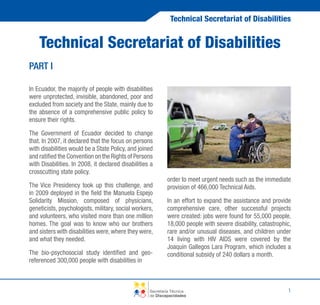
The Vice Presidency took up this challenge, and
in 2009 deployed in the field the Manuela Espejo
Solidarity Mission, composed of physicians,
geneticists, psychologists, military, social workers,
and volunteers, who visited more than one million
homes. The goal was to know who our brothers
and sisters with disabilities were, where they were,
and what they needed.
The bio-psychosocial study identified and georeferenced 300,000 people with disabilities in

order to meet urgent needs such as the immediate
provision of 466,000 Technical Aids.
In an effort to expand the assistance and provide
comprehensive care, other successful projects
were created: jobs were found for 55,000 people,
18,000 people with severe disability, catastrophic,
rare and/or unusual diseases, and children under
14 living with HIV AIDS were covered by the
Joaquin Gallegos Lara Program, which includes a
conditional subsidy of 240 dollars a month.

Secretaría Técnica
de Discapacidades

1
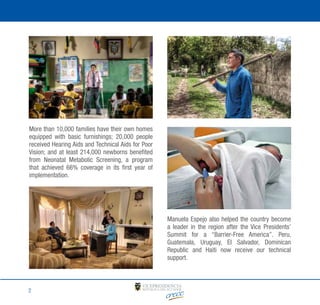
More than 10,000 families have their own homes
equipped with basic furnishings; 20,000 people
received Hearing Aids and Technical Aids for Poor
Vision; and at least 214,000 newborns benefited
from Neonatal Metabolic Screening, a program
that achieved 66% coverage in its first year of
implementation.

Manuela Espejo also helped the country become
a leader in the region after the Vice Presidents’
Summit for a “Barrier-Free America”. Peru,
Guatemala, Uruguay, El Salvador, Dominican
Republic and Haiti now receive our technical
support.

2
Technical Secretariat of Disabilities
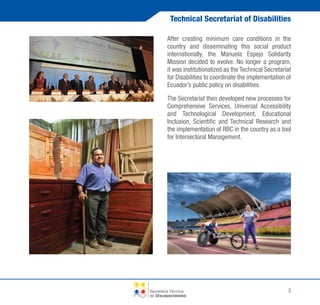
After creating minimum care conditions in the
country and disseminating this social product
internationally, the Manuela Espejo Solidarity
Mission decided to evolve. No longer a program,
it was institutionalized as the Technical Secretariat
for Disabilities to coordinate the implementation of
Ecuador’s public policy on disabilities.
The Secretariat then developed new processes for
Comprehensive Services, Universal Accessibility
and Technological Development, Educational
Inclusion, Scientific and Technical Research and
the implementation of RBC in the country as a tool
for Intersectoral Management.

Secretaría Técnica
de Discapacidades

3
MISSION

VISION

To promote and ensure the full enjoyment of rights
by persons with disabilities in Ecuador through
interagency and intersectoral coordination, policy
monitoring and implementation of plans, programs
and projects, and the promotion of actions for
prevention, care, research and integration.

To be the guiding institution for the coordination,
monitoring and evaluation of the implementation
of public policy for the fulfillment of the rights of
Persons with Disabilities, to be a regional and
global benchmark in the framework of the United
Nations Convention on the Rights of Persons with
Disabilities, the Constitution and the Organic Law
on Disabilities.

4
Technical Secretariat of Disabilities

INTER-SECTORIAL
MANAGEMENT

INTEGRATION
& INCLUSION

INTEGRAL
SERVICES AND
RESPONSE

UNIVERSAL
ACCESSIBILITY
& TECHNOLOGIC
DEVELOPMENT

SCIENTIFIC
INVESTIGATION,
MONITORING
AND EVALUATION

Secretaría Técnica
de Discapacidades

INTERNATIONAL COOPERATION

COMMUNICATION

STRATEGIC AXES

5
PART II
INFORMATION ON THE MEETING

6
Technical Secretariat of Disabilities
Background
According to World Health Organization (WHO)
estimates, more than one billion people in the
world live with some form of disability, and nearly
200 million experience considerable difficulty in
functioning. 785 million are 15 or older and live
with a disability. Undoubtedly, the most worrying
statistic shows that children have a high degree of
disability and in some cases their disabilities could
be prevented.
The World Report on Disability states that the
situation of people with disabilities in the world
is exacerbated by disabling barriers that involve
inadequate policies and regulations, negative
attitudes, lack of services, problems delivering
services, insufficient funding, lack of accessibility,
lack of consultation and participation, and lack of
data and evidence.
To face these challenges, severfal regional
integration
initiatives
and
international
organizations have promoted mandates and
resolutions that call for an approach that involves
the adoption of specific action plans, the inclusion
of the matter as a cross-cutting theme for
interventions by the States, and inclusion of people
with disabilities in decision-making on issues that
have a positive or negative affect on their lives.

A common recommendation of these mandates and
resolutions is also the implementation of specific
national plans and actions to address disabilities
based on effective programs and appropriate
practices developed in the different regions with
regard to disabilities and inclusion.
In order to provide a meeting place for the different
countries of the world that have developed
successful initiatives, the Government of Ecuador,
through the Secretariat of Disabilities, an agency
of the Vice Presidency, is committed to holding
an International Conference on Best Practices on
guaranteeing the rights of people with disabilities
that can be shared, discussed and implemented in
the different countries.

General Objective
To create a space for discussing several policies,
programs, projects, innovations and technologies
that have been successfully implemented globally
to ensure the rights of persons with disabilities and
identify concrete actions for their implementation
in the different countries.

Main outcomes of the meeting
•	 Quito Declaration on the Rights of Persons with
Disabilities.

Secretaría Técnica
de Discapacidades

7
•	 Signing of Treaties and Bilateral Cooperation
Agreements on disabilities by the participating
countries.
•	 Identification of potential public - private
partnerships on innovations and technologies
for people with disabilities.

Location:
Guayaquil, Ecuador
Guayaquil Convention Center

Date:
November 25th and 26th, 2013

Participants:
People with Disabilities and their families
Representatives of Governments worldwide
Representatives of International and Multilateral
Organizations
Civil Society Representatives
Academia
Public and private companies

CONTENT
Keynote Addresses
Roundtables
Panel Discussions
Exhibitions
Negotiation tables
Artistic and recreational events
Stands (technology, products, services)

8

THEMES
Situation of disability worldwide
Disability and Development after the High Level UN
meeting
Best practices regarding accessibility
Role of Civil Society and actions involving the rights
of persons with disabilities
Community Based Rehabilitation
Successful experiences in cooperation on disability
Educational Inclusion
Workplace Inclusion
Technological Development

OFFICIAL LAUNCH OF THE MEETING
Thursday October 3 at 10:00 am on www.
encuentromundialdiscapacidades.com

For more information:
Links (beginning with october 3th):
www.encuentromundialdiscapacidades.com
www.setedis.gob.ec
Email contact:
encuentromundial@setedis.gob.ec
Teléfonos:
(593) 2 3933940 Ext. 1130 –1131-1132
Technical Secretariat of Disabilities

Part III
Basic Information on Tourism
“Discover Ecuador, Four Worlds, One Destination”
Located in South America on the Pacific coast, it
is one of the most popular tourist destinations of
2013. Quito, the capital, was recognized this year
as the best tourist destination in South America.
Visit Ecuador because “Ecuador loves life.”

Guayaquil
An historic and cosmopolitan city known as “The
Pearl of the Pacific”, it is a well-known financial
and economic center and has one of the largest
ports in maritime trade in Latin America and the
world. Inhabited by enterprising, friendly people,
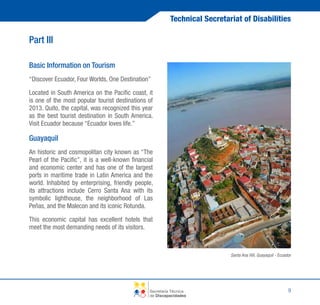
its attractions include Cerro Santa Ana with its
symbolic lighthouse, the neighborhood of Las
Peñas, and the Malecon and its iconic Rotunda.
This economic capital has excellent hotels that
meet the most demanding needs of its visitors.

Santa Ana Hill, Guayaquil - Ecuador

Secretaría Técnica
de Discapacidades

9
Galapagos
Known worldwide as the “Enchanted Islands”, they
are located in the insular region, and constitute
one of the largest and most important ecological
reserves in the world. Puerto Baquerizo Moreno is
the capital and the largest city is Puerto Ayora.
Due to their climate, location and geography, “The
Enchanted Islands” are a true living laboratory
for scientific research, the most important tourist
attraction of Ecuador, and undoubtedly a marvel
for Ecuador and the world.
Tortuga Bay, Galapagos - Ecuador

Fauna, Galapagos - Ecuador

10
Technical Secretariat of Disabilities
CUENCA
“Santa Ana of the Four Rivers,” better known as
Cuenca, the capital of Azuay, is located 2550 meters
above sea level. Its historic center decorated with
cobblestone streets, a Cathedral built from pink
marble, and a rich past, won it the title of World
Heritage Site in December 1999.

Main Cathedral, Cuenca - Ecuador

Tomebamba River, Cuenca - Ecuador

Secretaría Técnica
de Discapacidades

11
QUITO
The Capital of Ecuador, located at 2800 meters
above sea level, is the second largest city in
the country. In recognition of the architecture,
monuments, and churches of the Historic or
Colonial Center, its history and tradition, it was
declared a World Heritage Site in 1978.

The Plaza Grande, Quito - Ecuador

Panoramic view, Quito - Ecuador

More information: www.turismo.gob.ec

12
Secretaría Técnica
de Discapacidades

Catalogo setedis ingles_baja

  • 1.
    World Meeting of DISABILITIES November25TH - 26TH, 2013 Guayaquil - Ecuador Secretaría Técnica de Discapacidades
  • 3.
    Technical Secretariat ofDisabilities Technical Secretariat of Disabilities PART I In Ecuador, the majority of people with disabilities were unprotected, invisible, abandoned, poor and excluded from society and the State, mainly due to the absence of a comprehensive public policy to ensure their rights. The Government of Ecuador decided to change that. In 2007, it declared that the focus on persons with disabilities would be a State Policy, and joined and ratified the Convention on the Rights of Persons with Disabilities. In 2008, it declared disabilities a crosscutting state policy. The Vice Presidency took up this challenge, and in 2009 deployed in the field the Manuela Espejo Solidarity Mission, composed of physicians, geneticists, psychologists, military, social workers, and volunteers, who visited more than one million homes. The goal was to know who our brothers and sisters with disabilities were, where they were, and what they needed. The bio-psychosocial study identified and georeferenced 300,000 people with disabilities in order to meet urgent needs such as the immediate provision of 466,000 Technical Aids. In an effort to expand the assistance and provide comprehensive care, other successful projects were created: jobs were found for 55,000 people, 18,000 people with severe disability, catastrophic, rare and/or unusual diseases, and children under 14 living with HIV AIDS were covered by the Joaquin Gallegos Lara Program, which includes a conditional subsidy of 240 dollars a month. Secretaría Técnica de Discapacidades 1
  • 4.
    More than 10,000families have their own homes equipped with basic furnishings; 20,000 people received Hearing Aids and Technical Aids for Poor Vision; and at least 214,000 newborns benefited from Neonatal Metabolic Screening, a program that achieved 66% coverage in its first year of implementation. Manuela Espejo also helped the country become a leader in the region after the Vice Presidents’ Summit for a “Barrier-Free America”. Peru, Guatemala, Uruguay, El Salvador, Dominican Republic and Haiti now receive our technical support. 2
  • 5.
    Technical Secretariat ofDisabilities After creating minimum care conditions in the country and disseminating this social product internationally, the Manuela Espejo Solidarity Mission decided to evolve. No longer a program, it was institutionalized as the Technical Secretariat for Disabilities to coordinate the implementation of Ecuador’s public policy on disabilities. The Secretariat then developed new processes for Comprehensive Services, Universal Accessibility and Technological Development, Educational Inclusion, Scientific and Technical Research and the implementation of RBC in the country as a tool for Intersectoral Management. Secretaría Técnica de Discapacidades 3
  • 6.
    MISSION VISION To promote andensure the full enjoyment of rights by persons with disabilities in Ecuador through interagency and intersectoral coordination, policy monitoring and implementation of plans, programs and projects, and the promotion of actions for prevention, care, research and integration. To be the guiding institution for the coordination, monitoring and evaluation of the implementation of public policy for the fulfillment of the rights of Persons with Disabilities, to be a regional and global benchmark in the framework of the United Nations Convention on the Rights of Persons with Disabilities, the Constitution and the Organic Law on Disabilities. 4
  • 7.
    Technical Secretariat ofDisabilities INTER-SECTORIAL MANAGEMENT INTEGRATION & INCLUSION INTEGRAL SERVICES AND RESPONSE UNIVERSAL ACCESSIBILITY & TECHNOLOGIC DEVELOPMENT SCIENTIFIC INVESTIGATION, MONITORING AND EVALUATION Secretaría Técnica de Discapacidades INTERNATIONAL COOPERATION COMMUNICATION STRATEGIC AXES 5
  • 8.
  • 9.
    Technical Secretariat ofDisabilities Background According to World Health Organization (WHO) estimates, more than one billion people in the world live with some form of disability, and nearly 200 million experience considerable difficulty in functioning. 785 million are 15 or older and live with a disability. Undoubtedly, the most worrying statistic shows that children have a high degree of disability and in some cases their disabilities could be prevented. The World Report on Disability states that the situation of people with disabilities in the world is exacerbated by disabling barriers that involve inadequate policies and regulations, negative attitudes, lack of services, problems delivering services, insufficient funding, lack of accessibility, lack of consultation and participation, and lack of data and evidence. To face these challenges, severfal regional integration initiatives and international organizations have promoted mandates and resolutions that call for an approach that involves the adoption of specific action plans, the inclusion of the matter as a cross-cutting theme for interventions by the States, and inclusion of people with disabilities in decision-making on issues that have a positive or negative affect on their lives. A common recommendation of these mandates and resolutions is also the implementation of specific national plans and actions to address disabilities based on effective programs and appropriate practices developed in the different regions with regard to disabilities and inclusion. In order to provide a meeting place for the different countries of the world that have developed successful initiatives, the Government of Ecuador, through the Secretariat of Disabilities, an agency of the Vice Presidency, is committed to holding an International Conference on Best Practices on guaranteeing the rights of people with disabilities that can be shared, discussed and implemented in the different countries. General Objective To create a space for discussing several policies, programs, projects, innovations and technologies that have been successfully implemented globally to ensure the rights of persons with disabilities and identify concrete actions for their implementation in the different countries. Main outcomes of the meeting • Quito Declaration on the Rights of Persons with Disabilities. Secretaría Técnica de Discapacidades 7
  • 10.
    • Signing ofTreaties and Bilateral Cooperation Agreements on disabilities by the participating countries. • Identification of potential public - private partnerships on innovations and technologies for people with disabilities. Location: Guayaquil, Ecuador Guayaquil Convention Center Date: November 25th and 26th, 2013 Participants: People with Disabilities and their families Representatives of Governments worldwide Representatives of International and Multilateral Organizations Civil Society Representatives Academia Public and private companies CONTENT Keynote Addresses Roundtables Panel Discussions Exhibitions Negotiation tables Artistic and recreational events Stands (technology, products, services) 8 THEMES Situation of disability worldwide Disability and Development after the High Level UN meeting Best practices regarding accessibility Role of Civil Society and actions involving the rights of persons with disabilities Community Based Rehabilitation Successful experiences in cooperation on disability Educational Inclusion Workplace Inclusion Technological Development OFFICIAL LAUNCH OF THE MEETING Thursday October 3 at 10:00 am on www. encuentromundialdiscapacidades.com For more information: Links (beginning with october 3th): www.encuentromundialdiscapacidades.com www.setedis.gob.ec Email contact: encuentromundial@setedis.gob.ec Teléfonos: (593) 2 3933940 Ext. 1130 –1131-1132
  • 11.
    Technical Secretariat ofDisabilities Part III Basic Information on Tourism “Discover Ecuador, Four Worlds, One Destination” Located in South America on the Pacific coast, it is one of the most popular tourist destinations of 2013. Quito, the capital, was recognized this year as the best tourist destination in South America. Visit Ecuador because “Ecuador loves life.” Guayaquil An historic and cosmopolitan city known as “The Pearl of the Pacific”, it is a well-known financial and economic center and has one of the largest ports in maritime trade in Latin America and the world. Inhabited by enterprising, friendly people, its attractions include Cerro Santa Ana with its symbolic lighthouse, the neighborhood of Las Peñas, and the Malecon and its iconic Rotunda. This economic capital has excellent hotels that meet the most demanding needs of its visitors. Santa Ana Hill, Guayaquil - Ecuador Secretaría Técnica de Discapacidades 9
  • 12.
    Galapagos Known worldwide asthe “Enchanted Islands”, they are located in the insular region, and constitute one of the largest and most important ecological reserves in the world. Puerto Baquerizo Moreno is the capital and the largest city is Puerto Ayora. Due to their climate, location and geography, “The Enchanted Islands” are a true living laboratory for scientific research, the most important tourist attraction of Ecuador, and undoubtedly a marvel for Ecuador and the world. Tortuga Bay, Galapagos - Ecuador Fauna, Galapagos - Ecuador 10
  • 13.
    Technical Secretariat ofDisabilities CUENCA “Santa Ana of the Four Rivers,” better known as Cuenca, the capital of Azuay, is located 2550 meters above sea level. Its historic center decorated with cobblestone streets, a Cathedral built from pink marble, and a rich past, won it the title of World Heritage Site in December 1999. Main Cathedral, Cuenca - Ecuador Tomebamba River, Cuenca - Ecuador Secretaría Técnica de Discapacidades 11
  • 14.
    QUITO The Capital ofEcuador, located at 2800 meters above sea level, is the second largest city in the country. In recognition of the architecture, monuments, and churches of the Historic or Colonial Center, its history and tradition, it was declared a World Heritage Site in 1978. The Plaza Grande, Quito - Ecuador Panoramic view, Quito - Ecuador More information: www.turismo.gob.ec 12
  • 16.