Case Review (2nd edition)
By- Subodh Khedkar
Legend
• RISK- PURPLE
• Localisation- GREEN
• Symptom- ORANGE
• Dermatological description/Name- RED
• Treatment done- BLUE
• Hint -
Let's describe our case
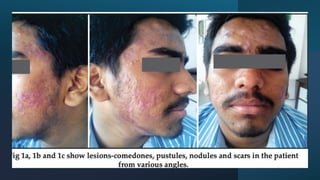
• A 21 year old boy arrived with his face
covered with comedones, papules,
pustules, nodules and scars . An exam
going student, he accumulated a
collective stress of his final
examinations, disoriented diet,and
messed up sleeping schedule.
Before we go
ahead, some
questions
1. What kind of lesion is a comedo?
a. Primary
b. Secondary
c.Allergic
d. Specialised
2. How do you describe a comedo?
a. A fluid filled blister
b. Itchy, scaly rash on face
c. a clogged hair follicle (pore) in the skin
Pt. History
• Patient history revealed he had acne since
the age of 15 and still had this
presentation after visiting different
doctors and taking various medications. A
history of acne in his father and brother in
their youth further suggested a strong
genetic preponderance for the severity of
his acne.
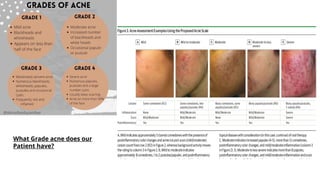
What Grade acne does our
Patient have?
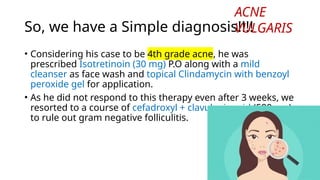
So, we have a Simple diagnosis!!!!
• Considering his case to be 4th grade acne, he was
prescribed Isotretinoin (30 mg) P.O along with a mild
cleanser as face wash and topical Clindamycin with benzoyl
peroxide gel for application.
• As he did not respond to this therapy even after 3 weeks, we
resorted to a course of cefadroxyl + clavulanic acid (500 mg)
to rule out gram negative folliculitis.
ACNE
VULGARIS
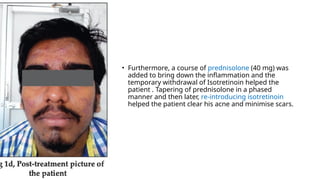
• Furthermore, a course of prednisolone (40 mg) was
added to bring down the inflammation and the
temporary withdrawal of Isotretinoin helped the
patient . Tapering of prednisolone in a phased
manner and then later, re-introducing isotretinoin
helped the patient clear his acne and minimise scars.
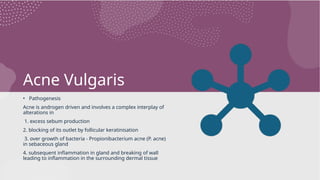
Acne Vulgaris
• Pathogenesis
Acne is androgen driven and involves a complex interplay of
alterations in
1. excess sebum production
2. blocking of its outlet by follicular keratinisation
3. over growth of bacteria - Propionibacterium acne (P. acne)
in sebaceous gland
4. subsequent inflammation in gland and breaking of wall
leading to inflammation in the surrounding dermal tissue
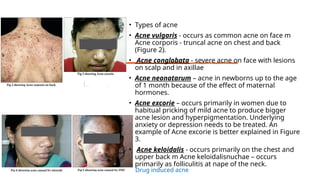
• Types of acne
• Acne vulgaris - occurs as common acne on face m
Acne corporis - truncal acne on chest and back
(Figure 2).
• Acne conglobata - severe acne on face with lesions
on scalp and in axillae
• Acne neonatarum – acne in newborns up to the age
of 1 month because of the effect of maternal
hormones.
• Acne excorie – occurs primarily in women due to
habitual pricking of mild acne to produce bigger
acne lesion and hyperpigmentation. Underlying
anxiety or depression needs to be treated. An
example of Acne excorie is better explained in Figure
3.
• Acne keloidalis - occurs primarily on the chest and
upper back m Acne keloidalisnuchae – occurs
primarily as folliculitis at nape of the neck.
Drug induced acne
case review 2 Subbooo ..................pptx

case review 2 Subbooo ..................pptx

  • 1.
    Case Review (2ndedition) By- Subodh Khedkar
  • 2.
    Legend • RISK- PURPLE •Localisation- GREEN • Symptom- ORANGE • Dermatological description/Name- RED • Treatment done- BLUE • Hint -
  • 3.
    Let's describe ourcase • A 21 year old boy arrived with his face covered with comedones, papules, pustules, nodules and scars . An exam going student, he accumulated a collective stress of his final examinations, disoriented diet,and messed up sleeping schedule.
  • 4.
    Before we go ahead,some questions 1. What kind of lesion is a comedo? a. Primary b. Secondary c.Allergic d. Specialised 2. How do you describe a comedo? a. A fluid filled blister b. Itchy, scaly rash on face c. a clogged hair follicle (pore) in the skin
  • 6.
    Pt. History • Patienthistory revealed he had acne since the age of 15 and still had this presentation after visiting different doctors and taking various medications. A history of acne in his father and brother in their youth further suggested a strong genetic preponderance for the severity of his acne.
  • 7.
    What Grade acnedoes our Patient have?
  • 8.
    So, we havea Simple diagnosis!!!! • Considering his case to be 4th grade acne, he was prescribed Isotretinoin (30 mg) P.O along with a mild cleanser as face wash and topical Clindamycin with benzoyl peroxide gel for application. • As he did not respond to this therapy even after 3 weeks, we resorted to a course of cefadroxyl + clavulanic acid (500 mg) to rule out gram negative folliculitis. ACNE VULGARIS
  • 9.
    • Furthermore, acourse of prednisolone (40 mg) was added to bring down the inflammation and the temporary withdrawal of Isotretinoin helped the patient . Tapering of prednisolone in a phased manner and then later, re-introducing isotretinoin helped the patient clear his acne and minimise scars.
  • 10.
    Acne Vulgaris • Pathogenesis Acneis androgen driven and involves a complex interplay of alterations in 1. excess sebum production 2. blocking of its outlet by follicular keratinisation 3. over growth of bacteria - Propionibacterium acne (P. acne) in sebaceous gland 4. subsequent inflammation in gland and breaking of wall leading to inflammation in the surrounding dermal tissue
  • 11.
    • Types ofacne • Acne vulgaris - occurs as common acne on face m Acne corporis - truncal acne on chest and back (Figure 2). • Acne conglobata - severe acne on face with lesions on scalp and in axillae • Acne neonatarum – acne in newborns up to the age of 1 month because of the effect of maternal hormones. • Acne excorie – occurs primarily in women due to habitual pricking of mild acne to produce bigger acne lesion and hyperpigmentation. Underlying anxiety or depression needs to be treated. An example of Acne excorie is better explained in Figure 3. • Acne keloidalis - occurs primarily on the chest and upper back m Acne keloidalisnuchae – occurs primarily as folliculitis at nape of the neck. Drug induced acne