
Case presentation on epilepsy
Presented by :
METI.BHARATH KUMAR
16DK1T0014
Pharm-D(Intern)
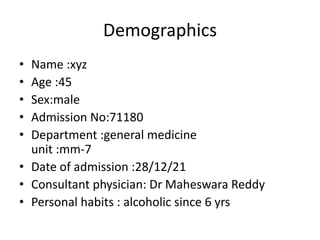
Demographics
• Name :xyz
• Age :45
• Sex:male
• Admission No:71180
• Department :general medicine
unit :mm-7
• Date of admission :28/12/21
• Consultant physician: Dr Maheswara Reddy
• Personal habits : alcoholic since 6 yrs
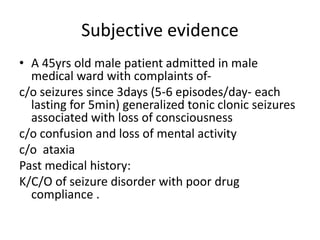
Subjective evidence
• A 45yrs old male patient admitted in male
medical ward with complaints of-
c/o seizures since 3days (5-6 episodes/day- each
lasting for 5min) generalized tonic clonic seizures
associated with loss of consciousness
c/o confusion and loss of mental activity
c/o ataxia
Past medical history:
K/C/O of seizure disorder with poor drug
compliance .
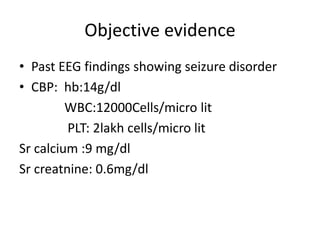
Objective evidence
• Past EEG findings showing seizure disorder
• CBP: hb:14g/dl
WBC:12000Cells/micro lit
PLT: 2lakh cells/micro lit
Sr calcium :9 mg/dl
Sr creatnine: 0.6mg/dl
Assessment
• Based on subjective and objective evidence
present condition diagnosed as “EPILEPSY”
• Rule out of wernicke encephalopathy is
necessasry
Planning
vitals
• BP:130/90mmhg
• Saturation of oxygen : 98%
• RR: 18/min
• PR: 90bpm
• Temp : normal
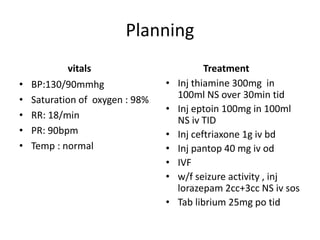
Treatment
• Inj thiamine 300mg in
100ml NS over 30min tid
• Inj eptoin 100mg in 100ml
NS iv TID
• Inj ceftriaxone 1g iv bd
• Inj pantop 40 mg iv od
• IVF
• w/f seizure activity , inj
lorazepam 2cc+3cc NS iv sos
• Tab librium 25mg po tid
Drug chart
S.N
O
GENERIC NAME BRAND
NAME
INDICATION DOSE RO
A
FREQUE
NCY
1 Ceftriaxone To reduce infection 1g iv Bd
2 Thiamine Vitamin supplement 300m
g
Iv Tid
3 Phenytoin Eptoin To control seizures 100m
g
Iv Tid
4 Pantoprazole Pantop To reduce gi irritation 40mg Iv Od
5 chlordiazepoxide Librium To reduce anxiety 25mg po Tid
Pharmaceutical care issues
• No pharmaceutical care issues
Discusssion
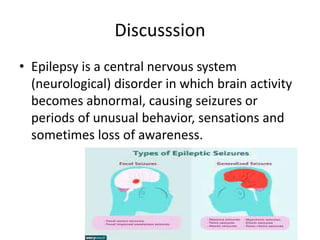
• Epilepsy is a central nervous system
(neurological) disorder in which brain activity
becomes abnormal, causing seizures or
periods of unusual behavior, sensations and
sometimes loss of awareness.
Clinical manifestations
focal seizures
When seizures appear to result from abnormal activity in just one area of
your brain, they're called focal seizures. These seizures fall into two
categories:
• Focal seizures without loss of consciousness. Once called simple partial
seizures, these seizures don't cause a loss of consciousness. They may
alter emotions or change the way things look, smell, feel, taste or sound.
Some people experience deja vu. This type of seizure may also result in
involuntary jerking of one body part, such as an arm or leg, and
spontaneous sensory symptoms such as tingling, dizziness and flashing
lights.
• Focal seizures with impaired awareness. Once called complex partial
seizures, these seizures involve a change or loss of consciousness or
awareness. This type of seizure may seem like being in a dream. During a
focal seizure with impaired awareness, you may stare into space and not
respond normally to your environment or perform repetitive movements,
such as hand rubbing, chewing, swallowing or walking in circles.
Generalized seizures
Seizures that appear to involve all areas of the brain are called
generalized seizures. Six types of generalized seizures exist.
• Absence seizures. Absence seizures, previously known as petit mal
seizures, typically occur in children. They're characterized by staring
into space with or without subtle body movements such as eye
blinking or lip smacking and only last between 5-10 seconds. These
seizures may occur in clusters, happening as often as 100 times per
day, and cause a brief loss of awareness.
• Tonic seizures. Tonic seizures cause stiff muscles and may affect
consciousness. These seizures usually affect muscles in your back,
arms and legs and may cause you to fall to the ground.
• Atonic seizures. Atonic seizures, also known as drop seizures, cause
a loss of muscle control. Since this most often affects the legs, it
often causes you to suddenly collapse or fall down.
• Clonic seizures. Clonic seizures are associated with
repeated or rhythmic, jerking muscle movements. These
seizures usually affect the neck, face and arms.
• Myoclonic seizures. Myoclonic seizures usually appear as
sudden brief jerks or twitches and usually affect the upper
body, arms and legs.
• Tonic-clonic seizures. Tonic-clonic seizures, previously
known as grand mal seizures, are the most dramatic type of
epileptic seizure. They can cause an abrupt loss of
consciousness and body stiffening, twitching and shaking.
They sometimes cause loss of bladder control or biting your
tongue.
stiffening of the body
shaking
loss of bladder or bowel control
biting of the tongue
loss of consciousness
commonly reported triggers are:
• lack of sleep
• illness or fever
• stress
• bright lights, flashing lights, or patterns
• caffeine, alcohol, medicines, or drugs
• skipping meals, overeating, or specific food
ingredients
Causes
Epilepsy has no identifiable cause in about half the people with the condition.
In the other half, the condition may be traced to various factors, including:
• Genetic influence. Some types of epilepsy, which are categorized by the
type of seizure you experience or the part of the brain that is affected, run
in families. In these cases, it's likely that there's a genetic influence.
• Researchers have linked some types of epilepsy to specific genes, but for
most people, genes are only part of the cause of epilepsy. Certain genes
may make a person more sensitive to environmental conditions that
trigger seizures.
• Head trauma. Head trauma as a result of a car accident or other traumatic
injury can cause epilepsy.
• Brain abnormalities. Abnormalities in the brain, including brain tumors or
vascular malformations such as arteriovenous malformations (AVMs) and
cavernous malformations, can cause epilepsy. Stroke is a leading cause of
epilepsy in adults older than age 35.
• Infections. Meningitis, HIV, viral encephalitis and some parasitic infections
can cause epilepsy.
• Prenatal injury. Before birth, babies are sensitive to brain damage that
could be caused by several factors, such as an infection in the mother,
poor nutrition or oxygen deficiencies. This brain damage can result in
epilepsy or cerebral palsy.
• Developmental disorders. Epilepsy can sometimes be associated with
developmental disorders, such as autism.
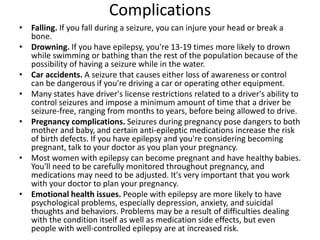
Complications
• Falling. If you fall during a seizure, you can injure your head or break a
bone.
• Drowning. If you have epilepsy, you're 13-19 times more likely to drown
while swimming or bathing than the rest of the population because of the
possibility of having a seizure while in the water.
• Car accidents. A seizure that causes either loss of awareness or control
can be dangerous if you're driving a car or operating other equipment.
• Many states have driver's license restrictions related to a driver's ability to
control seizures and impose a minimum amount of time that a driver be
seizure-free, ranging from months to years, before being allowed to drive.
• Pregnancy complications. Seizures during pregnancy pose dangers to both
mother and baby, and certain anti-epileptic medications increase the risk
of birth defects. If you have epilepsy and you're considering becoming
pregnant, talk to your doctor as you plan your pregnancy.
• Most women with epilepsy can become pregnant and have healthy babies.
You'll need to be carefully monitored throughout pregnancy, and
medications may need to be adjusted. It's very important that you work
with your doctor to plan your pregnancy.
• Emotional health issues. People with epilepsy are more likely to have
psychological problems, especially depression, anxiety, and suicidal
thoughts and behaviors. Problems may be a result of difficulties dealing
with the condition itself as well as medication side effects, but even
people with well-controlled epilepsy are at increased risk.
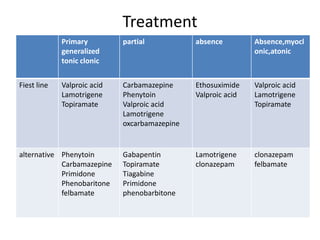
Treatment
Primary
generalized
tonic clonic
partial absence Absence,myocl
onic,atonic
Fiest line Valproic acid
Lamotrigene
Topiramate
Carbamazepine
Phenytoin
Valproic acid
Lamotrigene
oxcarbamazepine
Ethosuximide
Valproic acid
Valproic acid
Lamotrigene
Topiramate
alternative Phenytoin
Carbamazepine
Primidone
Phenobaritone
felbamate
Gabapentin
Topiramate
Tiagabine
Primidone
phenobarbitone
Lamotrigene
clonazepam
clonazepam
felbamate
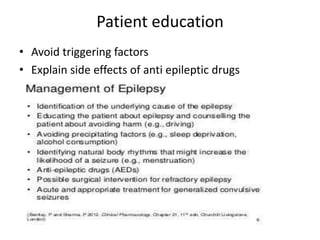
Patient education
• Avoid triggering factors
• Explain side effects of anti epileptic drugs

Case Presentation on Epilepsy

  • 1.
    Case presentation onepilepsy Presented by : METI.BHARATH KUMAR 16DK1T0014 Pharm-D(Intern)
  • 2.
    Demographics • Name :xyz •Age :45 • Sex:male • Admission No:71180 • Department :general medicine unit :mm-7 • Date of admission :28/12/21 • Consultant physician: Dr Maheswara Reddy • Personal habits : alcoholic since 6 yrs
  • 3.
    Subjective evidence • A45yrs old male patient admitted in male medical ward with complaints of- c/o seizures since 3days (5-6 episodes/day- each lasting for 5min) generalized tonic clonic seizures associated with loss of consciousness c/o confusion and loss of mental activity c/o ataxia Past medical history: K/C/O of seizure disorder with poor drug compliance .
  • 4.
    Objective evidence • PastEEG findings showing seizure disorder • CBP: hb:14g/dl WBC:12000Cells/micro lit PLT: 2lakh cells/micro lit Sr calcium :9 mg/dl Sr creatnine: 0.6mg/dl
  • 5.
    Assessment • Based onsubjective and objective evidence present condition diagnosed as “EPILEPSY” • Rule out of wernicke encephalopathy is necessasry
  • 6.
    Planning vitals • BP:130/90mmhg • Saturationof oxygen : 98% • RR: 18/min • PR: 90bpm • Temp : normal Treatment • Inj thiamine 300mg in 100ml NS over 30min tid • Inj eptoin 100mg in 100ml NS iv TID • Inj ceftriaxone 1g iv bd • Inj pantop 40 mg iv od • IVF • w/f seizure activity , inj lorazepam 2cc+3cc NS iv sos • Tab librium 25mg po tid
  • 7.
    Drug chart S.N O GENERIC NAMEBRAND NAME INDICATION DOSE RO A FREQUE NCY 1 Ceftriaxone To reduce infection 1g iv Bd 2 Thiamine Vitamin supplement 300m g Iv Tid 3 Phenytoin Eptoin To control seizures 100m g Iv Tid 4 Pantoprazole Pantop To reduce gi irritation 40mg Iv Od 5 chlordiazepoxide Librium To reduce anxiety 25mg po Tid
  • 8.
    Pharmaceutical care issues •No pharmaceutical care issues
  • 9.
    Discusssion • Epilepsy isa central nervous system (neurological) disorder in which brain activity becomes abnormal, causing seizures or periods of unusual behavior, sensations and sometimes loss of awareness.
  • 10.
    Clinical manifestations focal seizures Whenseizures appear to result from abnormal activity in just one area of your brain, they're called focal seizures. These seizures fall into two categories: • Focal seizures without loss of consciousness. Once called simple partial seizures, these seizures don't cause a loss of consciousness. They may alter emotions or change the way things look, smell, feel, taste or sound. Some people experience deja vu. This type of seizure may also result in involuntary jerking of one body part, such as an arm or leg, and spontaneous sensory symptoms such as tingling, dizziness and flashing lights. • Focal seizures with impaired awareness. Once called complex partial seizures, these seizures involve a change or loss of consciousness or awareness. This type of seizure may seem like being in a dream. During a focal seizure with impaired awareness, you may stare into space and not respond normally to your environment or perform repetitive movements, such as hand rubbing, chewing, swallowing or walking in circles.
  • 11.
    Generalized seizures Seizures thatappear to involve all areas of the brain are called generalized seizures. Six types of generalized seizures exist. • Absence seizures. Absence seizures, previously known as petit mal seizures, typically occur in children. They're characterized by staring into space with or without subtle body movements such as eye blinking or lip smacking and only last between 5-10 seconds. These seizures may occur in clusters, happening as often as 100 times per day, and cause a brief loss of awareness. • Tonic seizures. Tonic seizures cause stiff muscles and may affect consciousness. These seizures usually affect muscles in your back, arms and legs and may cause you to fall to the ground. • Atonic seizures. Atonic seizures, also known as drop seizures, cause a loss of muscle control. Since this most often affects the legs, it often causes you to suddenly collapse or fall down.
  • 12.
    • Clonic seizures.Clonic seizures are associated with repeated or rhythmic, jerking muscle movements. These seizures usually affect the neck, face and arms. • Myoclonic seizures. Myoclonic seizures usually appear as sudden brief jerks or twitches and usually affect the upper body, arms and legs. • Tonic-clonic seizures. Tonic-clonic seizures, previously known as grand mal seizures, are the most dramatic type of epileptic seizure. They can cause an abrupt loss of consciousness and body stiffening, twitching and shaking. They sometimes cause loss of bladder control or biting your tongue. stiffening of the body shaking loss of bladder or bowel control biting of the tongue loss of consciousness
  • 13.
    commonly reported triggersare: • lack of sleep • illness or fever • stress • bright lights, flashing lights, or patterns • caffeine, alcohol, medicines, or drugs • skipping meals, overeating, or specific food ingredients
  • 14.
    Causes Epilepsy has noidentifiable cause in about half the people with the condition. In the other half, the condition may be traced to various factors, including: • Genetic influence. Some types of epilepsy, which are categorized by the type of seizure you experience or the part of the brain that is affected, run in families. In these cases, it's likely that there's a genetic influence. • Researchers have linked some types of epilepsy to specific genes, but for most people, genes are only part of the cause of epilepsy. Certain genes may make a person more sensitive to environmental conditions that trigger seizures. • Head trauma. Head trauma as a result of a car accident or other traumatic injury can cause epilepsy. • Brain abnormalities. Abnormalities in the brain, including brain tumors or vascular malformations such as arteriovenous malformations (AVMs) and cavernous malformations, can cause epilepsy. Stroke is a leading cause of epilepsy in adults older than age 35. • Infections. Meningitis, HIV, viral encephalitis and some parasitic infections can cause epilepsy. • Prenatal injury. Before birth, babies are sensitive to brain damage that could be caused by several factors, such as an infection in the mother, poor nutrition or oxygen deficiencies. This brain damage can result in epilepsy or cerebral palsy. • Developmental disorders. Epilepsy can sometimes be associated with developmental disorders, such as autism.
  • 15.
    Complications • Falling. Ifyou fall during a seizure, you can injure your head or break a bone. • Drowning. If you have epilepsy, you're 13-19 times more likely to drown while swimming or bathing than the rest of the population because of the possibility of having a seizure while in the water. • Car accidents. A seizure that causes either loss of awareness or control can be dangerous if you're driving a car or operating other equipment. • Many states have driver's license restrictions related to a driver's ability to control seizures and impose a minimum amount of time that a driver be seizure-free, ranging from months to years, before being allowed to drive. • Pregnancy complications. Seizures during pregnancy pose dangers to both mother and baby, and certain anti-epileptic medications increase the risk of birth defects. If you have epilepsy and you're considering becoming pregnant, talk to your doctor as you plan your pregnancy. • Most women with epilepsy can become pregnant and have healthy babies. You'll need to be carefully monitored throughout pregnancy, and medications may need to be adjusted. It's very important that you work with your doctor to plan your pregnancy. • Emotional health issues. People with epilepsy are more likely to have psychological problems, especially depression, anxiety, and suicidal thoughts and behaviors. Problems may be a result of difficulties dealing with the condition itself as well as medication side effects, but even people with well-controlled epilepsy are at increased risk.
  • 16.
    Treatment Primary generalized tonic clonic partial absenceAbsence,myocl onic,atonic Fiest line Valproic acid Lamotrigene Topiramate Carbamazepine Phenytoin Valproic acid Lamotrigene oxcarbamazepine Ethosuximide Valproic acid Valproic acid Lamotrigene Topiramate alternative Phenytoin Carbamazepine Primidone Phenobaritone felbamate Gabapentin Topiramate Tiagabine Primidone phenobarbitone Lamotrigene clonazepam clonazepam felbamate
  • 17.
    Patient education • Avoidtriggering factors • Explain side effects of anti epileptic drugs