

CASE PRESENTATION ON
CEREBROVASCUALAR ACCIDENT
WITH ISCHEMIC STROKE
SUBMITTED BY
METI.BHARATH KUMAR
16DK1T0014
Pharm.D INTERNSHIP
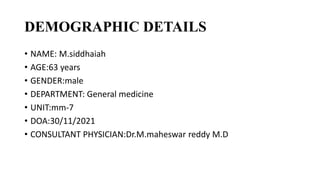
DEMOGRAPHIC DETAILS
• NAME: M.siddhaiah
• AGE:63 years
• GENDER:male
• DEPARTMENT: General medicine
• UNIT:mm-7
• DOA:30/11/2021
• CONSULTANT PHYSICIAN:Dr.M.maheswar reddy M.D
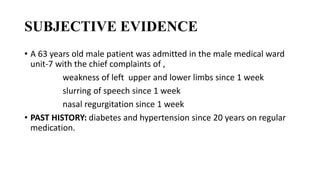
SUBJECTIVE EVIDENCE
• A 63 years old male patient was admitted in the male medical ward
unit-7 with the chief complaints of ,
weakness of left upper and lower limbs since 1 week
slurring of speech since 1 week
nasal regurgitation since 1 week
• PAST HISTORY: diabetes and hypertension since 20 years on regular
medication.
OBJECTIVE EVIDENCE
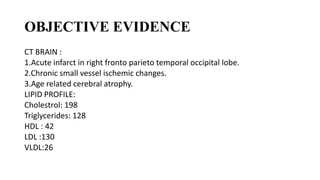
CT BRAIN :
1.Acute infarct in right fronto parieto temporal occipital lobe.
2.Chronic small vessel ischemic changes.
3.Age related cerebral atrophy.
LIPID PROFILE:
Cholestrol: 198
Triglycerides: 128
HDL : 42
LDL :130
VLDL:26
OBJECTIVE EVIDENCE
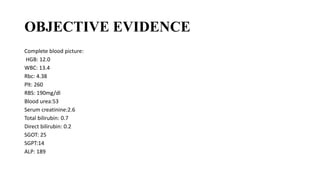
Complete blood picture:
HGB: 12.0
WBC: 13.4
Rbc: 4.38
Plt: 260
RBS: 190mg/dl
Blood urea:53
Serum creatinine:2.6
Total bilirubin: 0.7
Direct bilirubin: 0.2
SGOT: 25
SGPT:14
ALP: 189
ASSESSMENT
• Based on the subjective and objective evidence the case is confirmed
as “ CVA WITH ISCHEMIC STROKE”.
PLAN OF TREATMENT
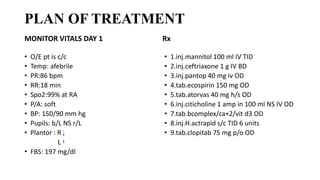
MONITOR VITALS DAY 1
• O/E pt is c/c
• Temp: afebrile
• PR:86 bpm
• RR:18 min
• Spo2:99% at RA
• P/A: soft
• BP: 150/90 mm hg
• Pupils: b/L NS r/L
• Plantor : R
L
• FBS: 197 mg/dl
Rx
• 1.inj.mannitol 100 ml IV TID
• 2.inj.ceftriaxone 1 g IV BD
• 3.inj.pantop 40 mg iv OD
• 4.tab.ecospirin 150 mg OD
• 5.tab.atorvas 40 mg h/s OD
• 6.inj.citicholine 1 amp in 100 ml NS IV OD
• 7.tab.bcomplex/ca+2/vit d3 OD
• 8.inj.H.actrapid s/c TID 6 units
• 9.tab.clopitab 75 mg p/o OD
PLAN OF TREATMENT
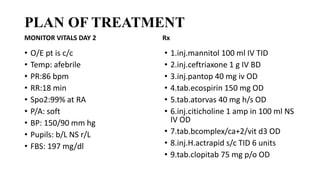
MONITOR VITALS DAY 2
• O/E pt is c/c
• Temp: afebrile
• PR:86 bpm
• RR:18 min
• Spo2:99% at RA
• P/A: soft
• BP: 150/90 mm hg
• Pupils: b/L NS r/L
• FBS: 197 mg/dl
Rx
• 1.inj.mannitol 100 ml IV TID
• 2.inj.ceftriaxone 1 g IV BD
• 3.inj.pantop 40 mg iv OD
• 4.tab.ecospirin 150 mg OD
• 5.tab.atorvas 40 mg h/s OD
• 6.inj.citicholine 1 amp in 100 ml NS
IV OD
• 7.tab.bcomplex/ca+2/vit d3 OD
• 8.inj.H.actrapid s/c TID 6 units
• 9.tab.clopitab 75 mg p/o OD
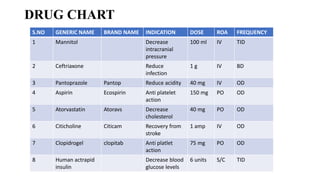
DRUG CHART
S.NO GENERIC NAME BRAND NAME INDICATION DOSE ROA FREQUENCY
1 Mannitol Decrease
intracranial
pressure
100 ml IV TID
2 Ceftriaxone Reduce
infection
1 g IV BD
3 Pantoprazole Pantop Reduce acidity 40 mg IV OD
4 Aspirin Ecospirin Anti platelet
action
150 mg PO OD
5 Atorvastatin Atoravs Decrease
cholesterol
40 mg PO OD
6 Citicholine Citicam Recovery from
stroke
1 amp IV OD
7 Clopidrogel clopitab Anti platlet
action
75 mg PO OD
8 Human actrapid
insulin
Decrease blood
glucose levels
6 units S/C TID
PHARMACEUTICAL CARE ISSUES
• No pharmaceutical care issues found the prescription was rational.
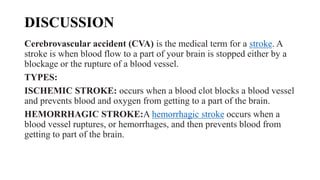
DISCUSSION
Cerebrovascular accident (CVA) is the medical term for a stroke. A
stroke is when blood flow to a part of your brain is stopped either by a
blockage or the rupture of a blood vessel.
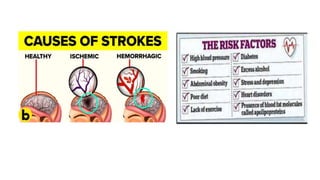
TYPES:
ISCHEMIC STROKE: occurs when a blood clot blocks a blood vessel
and prevents blood and oxygen from getting to a part of the brain.
HEMORRHAGIC STROKE:A hemorrhagic stroke occurs when a
blood vessel ruptures, or hemorrhages, and then prevents blood from
getting to part of the brain.
CLINICAL MANIFESTATIONS
• difficulty walking
• dizziness
• loss of balance and coordination
• difficulty speaking or understanding others who are speaking
• numbness or paralysis in the face, leg, or arm, most likely on just one
side of the body
• blurred or darkened vision
• a sudden headache, especially when accompanied by nausea,
vomiting, or dizziness
DIAGNOSIS
• Blood test
• MRI BRAIN
• CT SCAN
• ECG
Treatment for stroke depends on the type of stroke you’ve had. The goal of
treatment for ischemic stroke, for instance, is to restore the blood flow. Treatments
for hemorrhagic stroke are aimed at controlling the bleeding.
ISCHEMIC STROKE
• To treat an ischemic stroke, you
may be given a clot-dissolving
drug or a blood thinner. You may
also be given aspirin to prevent a
second stroke.
HEMORRHAGIC STROKE
• For a hemorrhagic stroke, you
may be given a drug that lowers
the pressure in your brain caused
by the bleeding. If the bleeding is
severe, you may need surgery to
remove excess blood.
PREVENTION AND COUNSELLING
• Maintain normal blood pressure.
• Limit saturated fat and cholesterol intake.
• Refrain from smoking, and drink alcohol in moderation.
• Control diabetes.
• Maintain a healthy weight.
• Get regular exercise.
• Eat a diet rich in vegetables and fruits.
CASE PRESENTATION ON CVA STROKE

CASE PRESENTATION ON CVA STROKE

  • 1.
    CASE PRESENTATION ON CEREBROVASCUALARACCIDENT WITH ISCHEMIC STROKE SUBMITTED BY METI.BHARATH KUMAR 16DK1T0014 Pharm.D INTERNSHIP
  • 2.
    DEMOGRAPHIC DETAILS • NAME:M.siddhaiah • AGE:63 years • GENDER:male • DEPARTMENT: General medicine • UNIT:mm-7 • DOA:30/11/2021 • CONSULTANT PHYSICIAN:Dr.M.maheswar reddy M.D
  • 3.
    SUBJECTIVE EVIDENCE • A63 years old male patient was admitted in the male medical ward unit-7 with the chief complaints of , weakness of left upper and lower limbs since 1 week slurring of speech since 1 week nasal regurgitation since 1 week • PAST HISTORY: diabetes and hypertension since 20 years on regular medication.
  • 4.
    OBJECTIVE EVIDENCE CT BRAIN: 1.Acute infarct in right fronto parieto temporal occipital lobe. 2.Chronic small vessel ischemic changes. 3.Age related cerebral atrophy. LIPID PROFILE: Cholestrol: 198 Triglycerides: 128 HDL : 42 LDL :130 VLDL:26
  • 5.
    OBJECTIVE EVIDENCE Complete bloodpicture: HGB: 12.0 WBC: 13.4 Rbc: 4.38 Plt: 260 RBS: 190mg/dl Blood urea:53 Serum creatinine:2.6 Total bilirubin: 0.7 Direct bilirubin: 0.2 SGOT: 25 SGPT:14 ALP: 189
  • 6.
    ASSESSMENT • Based onthe subjective and objective evidence the case is confirmed as “ CVA WITH ISCHEMIC STROKE”.
  • 7.
    PLAN OF TREATMENT MONITORVITALS DAY 1 • O/E pt is c/c • Temp: afebrile • PR:86 bpm • RR:18 min • Spo2:99% at RA • P/A: soft • BP: 150/90 mm hg • Pupils: b/L NS r/L • Plantor : R L • FBS: 197 mg/dl Rx • 1.inj.mannitol 100 ml IV TID • 2.inj.ceftriaxone 1 g IV BD • 3.inj.pantop 40 mg iv OD • 4.tab.ecospirin 150 mg OD • 5.tab.atorvas 40 mg h/s OD • 6.inj.citicholine 1 amp in 100 ml NS IV OD • 7.tab.bcomplex/ca+2/vit d3 OD • 8.inj.H.actrapid s/c TID 6 units • 9.tab.clopitab 75 mg p/o OD
  • 8.
    PLAN OF TREATMENT MONITORVITALS DAY 2 • O/E pt is c/c • Temp: afebrile • PR:86 bpm • RR:18 min • Spo2:99% at RA • P/A: soft • BP: 150/90 mm hg • Pupils: b/L NS r/L • FBS: 197 mg/dl Rx • 1.inj.mannitol 100 ml IV TID • 2.inj.ceftriaxone 1 g IV BD • 3.inj.pantop 40 mg iv OD • 4.tab.ecospirin 150 mg OD • 5.tab.atorvas 40 mg h/s OD • 6.inj.citicholine 1 amp in 100 ml NS IV OD • 7.tab.bcomplex/ca+2/vit d3 OD • 8.inj.H.actrapid s/c TID 6 units • 9.tab.clopitab 75 mg p/o OD
  • 9.
    DRUG CHART S.NO GENERICNAME BRAND NAME INDICATION DOSE ROA FREQUENCY 1 Mannitol Decrease intracranial pressure 100 ml IV TID 2 Ceftriaxone Reduce infection 1 g IV BD 3 Pantoprazole Pantop Reduce acidity 40 mg IV OD 4 Aspirin Ecospirin Anti platelet action 150 mg PO OD 5 Atorvastatin Atoravs Decrease cholesterol 40 mg PO OD 6 Citicholine Citicam Recovery from stroke 1 amp IV OD 7 Clopidrogel clopitab Anti platlet action 75 mg PO OD 8 Human actrapid insulin Decrease blood glucose levels 6 units S/C TID
  • 10.
    PHARMACEUTICAL CARE ISSUES •No pharmaceutical care issues found the prescription was rational.
  • 11.
    DISCUSSION Cerebrovascular accident (CVA)is the medical term for a stroke. A stroke is when blood flow to a part of your brain is stopped either by a blockage or the rupture of a blood vessel. TYPES: ISCHEMIC STROKE: occurs when a blood clot blocks a blood vessel and prevents blood and oxygen from getting to a part of the brain. HEMORRHAGIC STROKE:A hemorrhagic stroke occurs when a blood vessel ruptures, or hemorrhages, and then prevents blood from getting to part of the brain.
  • 12.
    CLINICAL MANIFESTATIONS • difficultywalking • dizziness • loss of balance and coordination • difficulty speaking or understanding others who are speaking • numbness or paralysis in the face, leg, or arm, most likely on just one side of the body • blurred or darkened vision • a sudden headache, especially when accompanied by nausea, vomiting, or dizziness
  • 14.
    DIAGNOSIS • Blood test •MRI BRAIN • CT SCAN • ECG
  • 15.
    Treatment for strokedepends on the type of stroke you’ve had. The goal of treatment for ischemic stroke, for instance, is to restore the blood flow. Treatments for hemorrhagic stroke are aimed at controlling the bleeding. ISCHEMIC STROKE • To treat an ischemic stroke, you may be given a clot-dissolving drug or a blood thinner. You may also be given aspirin to prevent a second stroke. HEMORRHAGIC STROKE • For a hemorrhagic stroke, you may be given a drug that lowers the pressure in your brain caused by the bleeding. If the bleeding is severe, you may need surgery to remove excess blood.
  • 16.
    PREVENTION AND COUNSELLING •Maintain normal blood pressure. • Limit saturated fat and cholesterol intake. • Refrain from smoking, and drink alcohol in moderation. • Control diabetes. • Maintain a healthy weight. • Get regular exercise. • Eat a diet rich in vegetables and fruits.