Team 3
Internet of Things
IoT - the concept of space in which all of the analog and digital worlds can be combined.
Internet of Things can be regarded as the link of
networks, in which a small combined into one the
larger network.
This term was
suggested in 1999 by
Kevin Ashton, one of
the first enthusiasts,
fascinated by RFID, and
now heads the Research
Center Auto-ID Center
at MIT.
The number of devices in the IoE is expected to increase
dramatically in the forecasted period (and probably beyond).
Sources: BI Intelligence estimates, Geektimes
Internet of Things: Russia
335
527
980
+57.3%
20202013 2015
+86.0%
Internet of Things in Russia is expected
to increase almost twofold over 5 years
period, with a CAGR of almost 10%.
Russian IoT market, $
mln
Even though there are certain downfalls in Russian market of Internet of Things, it is still expected to grow 86% in
the next 5 years to a total of $980 million.
Main drawbacks to the
development of Russian IoT:
Absence of manuals
for foreign
technologies
Old thinking + old
technologies
Current crisis may
limit investments
As a result, the Russian IoT Market is
forecasted to grow at a slower pace
than Global:
2020
0,030
2015
0,014
-53,3%
Share of
Russian IoT of
Global IoT
market, %
Source: J'son &
Partners
Consulting
Source: J'son &
Partners Consulting,
IDC
We expect following
categories as growth
drivers for IoT in Russia:
• Healthcare
• Smart Home
• Transport
• Buildings
M-Health market’s volume, 2017
World - $25,4 bln
Russia -$0,8 bln
Internet of things: Healthcare
The “digital health” sector of Russian IoT market includes about 60 active startups and less than 10 active investors,
whose work is extremely uncoordinated.
Wearable devices
Search & reservation
Clinic management systems
Other Most active investors
• IIDF (7+ startups in portfolio)
• Bright Capital Digital & Aurora Venture Capital (“Doctor na
rabote”)
• Skolkovo (accelerated “Medesk”; now primarily invests in
biotech)
Forecast for the future
Russian “digital health” sector will develop at a slow pace
because of:
• Nonadapted laws;
• Poor Internet coverage;
• Insufficient financing.
Sources: Rusbase, Crunchbase, Brookings, McKinsey&Co.
Sources: Analisys of our team, J'son & Partners Consulting, Nielson company
Domestic companies are inferior to foreign analogues in
functionality as well as in marketshare
Price-is an obvious advantage of Russian’s systems “SmartHouse”
The key needs of users on the Russian market
4
86
112
142
176
33 30 27
28
0
10
20
30
40
0
50
100
150
200
2014 2015E 2016E 2017E
Volume of market, mln usd
Growth rate, %
The dynamics of market growth in Russia
vs
Refrigerator – Enables remote viewing of its content and
recommends recipes based on stored items;
Light bulb – Turns off when no one is nearby and can be
remotely activated;
Sprinkler system – Monitors weather over time and
determines when to turn on and shut off;
Scale –Aggregates data from other devices and provides a
constantly updated personal health plan;
Laundry washer and dryer – Sends an alert when the cycle is
done and can be remotely activated;
Tap water filter – Automatically shuts off when nothing in the
sink.
LOOK.in Z-wave WeMo
Devices
Typical light and outlet configuration
2 in-wall dimmers
1 in-wall switch
3 motion sensors
2 wall plugs
2 rgbw bulbs
In total
(includes
controller)
460 $ 857 $ 619 $
Internet of things: Smart Home
Internet of things: Transport
Most active investors
• IIDF (The investment amounts to $500.000; 10+ startups in
portfolio)
• Cloud4Auto Ventures (The investment amounts to $350.000;
4+ startups in portfolio)
Auto Transport &
Logistics
Sources: IIDF, Rusbase
0
200
400
600
800
1000
1200
2010 2013 2015 2020
Number of devices, mln Market's volume, mln$
Forecast for the market’s proxy
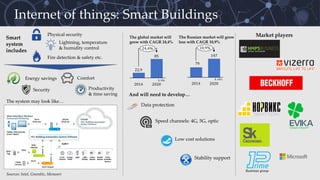
Internet of things: Smart Buildings
Smart
system
includes
Sources: Intel, Greenbiz, Memoori
Physical security
Lightning, temperature
& humidity control
Fire detection & safety etc.
The system may look like…
Energy savings
Security
Comfort
Productivity
& time saving
24,4%
2020
22,9
85
2014
The global market will
grow with CAGR 24,4%
$, bln.
79
10,9%
20202014
147
$, mln.
The Russian market will grow
less with CAGR 10,9%
And will need to develop…
Data protection
Speed channels: 4G, 5G, optic
Low cost solutions
Stability support
Market players
Smart buildings is a fast growing
share of IoT, its main growth drivers
are technology development and a
strong demand from the real estate
owners
Summary
Russian sector “Transport” has
potential for development, but it is
very slow for several reasons:
Poor Internet coverage;
Insufficient financing.
The “Digital Health” sector of
Russian IoT market is pretty active,
but uncoordinated.
The “Smart House” market in
Russia is growing by 30% per year
and it’s volume about 200 mln. $
Russian IoT market is still
behind Western countries
and will continue to be
such in the future. Still, it
will increase 86% by 2020.
Meet our brilliant team
• Daniil Gagarin - Internet of Things&Transport
• Alex Demachev - Internet of Things: Russia
• Kirill Yatsushko - Internet of things: Healthcare
• Kirill Medvedev- Internet of things: Smart Home
• Julia Rusinova - Internet of things: Buildings
• Anna Rakovskaya - Design

Case (iidf) team 3 (eng)

  • 1.
  • 2.
    Internet of Things IoT- the concept of space in which all of the analog and digital worlds can be combined. Internet of Things can be regarded as the link of networks, in which a small combined into one the larger network. This term was suggested in 1999 by Kevin Ashton, one of the first enthusiasts, fascinated by RFID, and now heads the Research Center Auto-ID Center at MIT. The number of devices in the IoE is expected to increase dramatically in the forecasted period (and probably beyond). Sources: BI Intelligence estimates, Geektimes
  • 3.
    Internet of Things:Russia 335 527 980 +57.3% 20202013 2015 +86.0% Internet of Things in Russia is expected to increase almost twofold over 5 years period, with a CAGR of almost 10%. Russian IoT market, $ mln Even though there are certain downfalls in Russian market of Internet of Things, it is still expected to grow 86% in the next 5 years to a total of $980 million. Main drawbacks to the development of Russian IoT: Absence of manuals for foreign technologies Old thinking + old technologies Current crisis may limit investments As a result, the Russian IoT Market is forecasted to grow at a slower pace than Global: 2020 0,030 2015 0,014 -53,3% Share of Russian IoT of Global IoT market, % Source: J'son & Partners Consulting Source: J'son & Partners Consulting, IDC We expect following categories as growth drivers for IoT in Russia: • Healthcare • Smart Home • Transport • Buildings
  • 4.
    M-Health market’s volume,2017 World - $25,4 bln Russia -$0,8 bln Internet of things: Healthcare The “digital health” sector of Russian IoT market includes about 60 active startups and less than 10 active investors, whose work is extremely uncoordinated. Wearable devices Search & reservation Clinic management systems Other Most active investors • IIDF (7+ startups in portfolio) • Bright Capital Digital & Aurora Venture Capital (“Doctor na rabote”) • Skolkovo (accelerated “Medesk”; now primarily invests in biotech) Forecast for the future Russian “digital health” sector will develop at a slow pace because of: • Nonadapted laws; • Poor Internet coverage; • Insufficient financing. Sources: Rusbase, Crunchbase, Brookings, McKinsey&Co.
  • 5.
    Sources: Analisys ofour team, J'son & Partners Consulting, Nielson company Domestic companies are inferior to foreign analogues in functionality as well as in marketshare Price-is an obvious advantage of Russian’s systems “SmartHouse” The key needs of users on the Russian market 4 86 112 142 176 33 30 27 28 0 10 20 30 40 0 50 100 150 200 2014 2015E 2016E 2017E Volume of market, mln usd Growth rate, % The dynamics of market growth in Russia vs Refrigerator – Enables remote viewing of its content and recommends recipes based on stored items; Light bulb – Turns off when no one is nearby and can be remotely activated; Sprinkler system – Monitors weather over time and determines when to turn on and shut off; Scale –Aggregates data from other devices and provides a constantly updated personal health plan; Laundry washer and dryer – Sends an alert when the cycle is done and can be remotely activated; Tap water filter – Automatically shuts off when nothing in the sink. LOOK.in Z-wave WeMo Devices Typical light and outlet configuration 2 in-wall dimmers 1 in-wall switch 3 motion sensors 2 wall plugs 2 rgbw bulbs In total (includes controller) 460 $ 857 $ 619 $ Internet of things: Smart Home
  • 6.
    Internet of things:Transport Most active investors • IIDF (The investment amounts to $500.000; 10+ startups in portfolio) • Cloud4Auto Ventures (The investment amounts to $350.000; 4+ startups in portfolio) Auto Transport & Logistics Sources: IIDF, Rusbase 0 200 400 600 800 1000 1200 2010 2013 2015 2020 Number of devices, mln Market's volume, mln$ Forecast for the market’s proxy
  • 7.
    Internet of things:Smart Buildings Smart system includes Sources: Intel, Greenbiz, Memoori Physical security Lightning, temperature & humidity control Fire detection & safety etc. The system may look like… Energy savings Security Comfort Productivity & time saving 24,4% 2020 22,9 85 2014 The global market will grow with CAGR 24,4% $, bln. 79 10,9% 20202014 147 $, mln. The Russian market will grow less with CAGR 10,9% And will need to develop… Data protection Speed channels: 4G, 5G, optic Low cost solutions Stability support Market players
  • 8.
    Smart buildings isa fast growing share of IoT, its main growth drivers are technology development and a strong demand from the real estate owners Summary Russian sector “Transport” has potential for development, but it is very slow for several reasons: Poor Internet coverage; Insufficient financing. The “Digital Health” sector of Russian IoT market is pretty active, but uncoordinated. The “Smart House” market in Russia is growing by 30% per year and it’s volume about 200 mln. $ Russian IoT market is still behind Western countries and will continue to be such in the future. Still, it will increase 86% by 2020.
  • 9.
    Meet our brilliantteam • Daniil Gagarin - Internet of Things&Transport • Alex Demachev - Internet of Things: Russia • Kirill Yatsushko - Internet of things: Healthcare • Kirill Medvedev- Internet of things: Smart Home • Julia Rusinova - Internet of things: Buildings • Anna Rakovskaya - Design