Good Morning
Case History Taking
Under Graduate
For
Aim
1. To streamline our thought process towards teaching UG’s
2. To prevent contradicting each other
3. To make the teaching process simple and easy for students
to understand.
4. To upgrade the standard of Teaching.
Name
Age
Gender
Address
Date
OP No.
Chief Complaint
In patients own words.
Determines Provisional Diagnosis.
History Of Presenting Illness
1. History of chief complaint.
2. History of associated complaint.
3. History taking of :-
a) Pain
b) Swelling
c) Ulcer
Medical History
Do not miss history of Pregnancy,
Liver diseases
Kidney diseases
History of Drug Allergy
Allergy to :- 1. Amoxycillin
2. Local anaesthesia
3. Paracetamol
Family History
Dental History
Personal History
Oral Hygiene Habbits
Habits of Substance Misuse
Parafunctional Habbits
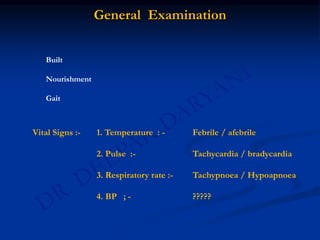
General Examination
Built
Nourishment
Gait
Vital Signs :- 1. Temperature : - Febrile / afebrile
2. Pulse :- Tachycardia / bradycardia
3. Respiratory rate :- Tachypnoea / Hypoapnoea
4. BP ; - ?????
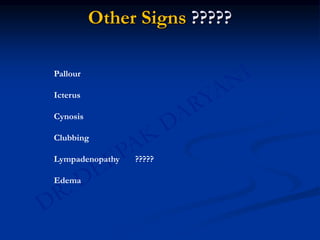
Other Signs ?????
Pallour
Icterus
Cynosis
Clubbing
Lympadenopathy ?????
Edema
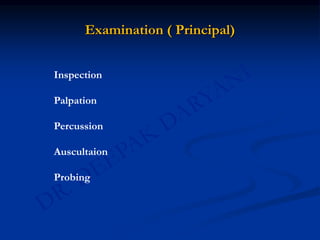
Examination ( Principal)
Inspection
Palpation
Percussion
Auscultaion
Probing
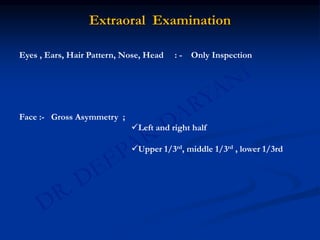
Extraoral Examination
Eyes , Ears, Hair Pattern, Nose, Head : - Only Inspection
Face :- Gross Asymmetry ;
Left and right half
Upper 1/3rd, middle 1/3rd , lower 1/3rd
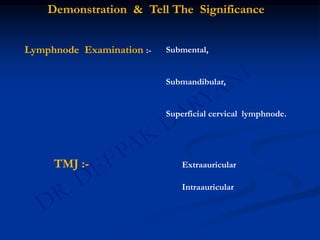
Lymphnode Examination :-
Demonstration & Tell The Significance
TMJ :- Extraauricular
Intraauricular
Submental,
Submandibular,
Superficial cervical lymphnode.
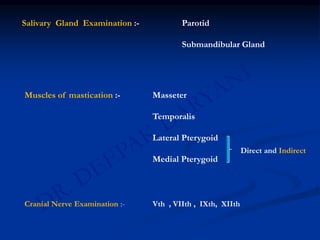
Salivary Gland Examination :- Parotid
Submandibular Gland
Muscles of mastication :- Masseter
Temporalis
Lateral Pterygoid
Medial Pterygoid
Direct and Indirect
Cranial Nerve Examination :- Vth , VIIth , IXth, XIIth
Before You Demonstrate
 Students should be asked to read about the anatomy of the
structures
 Ask them questions about the anatomy
Intraoral Examination
1. Demonstrate Each intraoral structure
2.Explain its significance
3. Explain the diseases which can occur in that
region
GINGIVA ; -- 1. Inspection
2. Palpation
3. Probing
Soft Tissue Examination
Hard Tissue Examination
Teeth :-
1. Inspection
2. Probing
3. Palpation
4. Percussion
Summery Of Clinical Findings
WHAT IS IT ????
Why ?????
Provisional Diagnosis
It Has To Be Only One
For all practical purposes
Other Associated Clinical Diagnosis
Investigations
1. Chair side investigations ;-
2. Radiological Investigations
3. Blood Investigations
4. Specialized Investigation
5. Biopsy
Demonstration of Electric Pulp Testing.
Final Diagnosis
Treatment Planning
1. Emergency treatment
2. Removal of hopeless teeth
3. Oral prophylaxis
4. Restorative treatment
5. Orthodontic treatment
6. Prosthetic rehabilitation
Follow Up
Immediate
Long Term
Prescription Writing
Patients ;- Name, Age , Gender
Tab/ Cap , Brand name, No Of times in a day , No of days, Total No of Tab/cap
Regimen and Dose
Amoxycillin
Amoxycillin + clavulinic acid
Metronidazole
Doxycycllin
Paracetamol
Diclofinac sodium
Ibuprofen
Reporting of Radiographs
IOPA
BITEWING
PANAROMIC

Case history