Carnaval #2
Nicolas Pelicioni de OLIVEIRA
Licenciatura em Letras - Ibilce, UNESP
http://nicolas-pelicioni.blogspot.com/
nicolaspelicioni@hotmail.com
English revision by Chantell Irene Smith
Thanks to Prof Dra Nilze M. Azeredo Reguera


The hero
Brazilian society had, on the one hand, the aristocracy, and on the
other, the so-called “Senhores Feudais,” the owners of farm lands; in
the middle was the population forgotten by the authorities. This
population was made up of Indians, slaves, and the poor workers, all
of them illiterate. There were also the sons of slave women who were
raped by landlords; these children born to one black and one white
parent were called “mulato.” According to DaMatta (1986), this word
is derived from the word “mule” (which in Portuguese is “mula”).
DaMatta is an anthropologist and in his book O que faz o brasil,
Brasil?,   he   remembers   an  apocalyptic   forecast   by   another
anthropologist, the Count of Gobineau, who was a friend of Emperor D.
Pedro II, in the XIX century. The Count of Gabineau said that in
about 200 years, Brazil would come to an end due to the mixing of the
races.


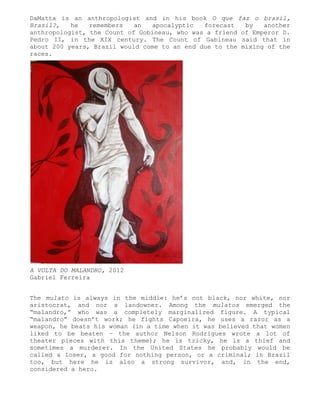
A VOLTA DO MALANDRO, 2012
Gabriel Ferreira


The mulato is always in the middle: he’s not black, nor white, nor
aristocrat, and nor a landowner. Among the mulatos emerged the
“malandro,” who was a completely marginalized figure. A typical
“malandro” doesn’t work; he fights Capoeira, he uses a razor as a
weapon, he beats his woman (in a time when it was believed that women
liked to be beaten – the author Nelson Rodrigues wrote a lot of
theater pieces with this theme); he is tricky, he is a thief and
sometimes a murderer. In the United States he probably would be
called a loser, a good for nothing person, or a criminal; in Brazil
too, but here he is also a strong survivor, and, in the end,
considered a hero.
In a Carnaval celebration, people dress up according to their
fantasies: Some people want to be kings, some women wear men’s
clothes and some men wear women’s clothes; some want to be monsters,
some want to be pirates, etc., but all of them want to be a malandro.
Carnaval is closely connected with malandragem – the behavior of a
malandro.
The book Macunaíma – o herói sem caráter (1928), by Mário de Andrade,
is a story who has a malandro as its hero; A Ópera do Malandro
(1979), by Chico Buarque, is a musical about the malandro. Cazuza
wrote “Malandragem,” a song recorded by Cássia Éller in the 1990s
whose chorus could be literally translated as ‘I just ask God for
some malandragem, because I’m a child, and I don’t know the truth.’
In the 1990s the malandro became a marginal, that is, an outsider,
and now he is just a criminal connected with illegal drugs and
violent crimes. In the 1980s our politicians became malandros. Chico
Buarque has a song about this in his A Ópera do Malandro. Here is a
literal translation:


   Homenagem ao Malandro
       In honor of Malandro
   Eu fui fazer um samba em homenagem à nata da malandragem, que
   conheço de outros carnavais.
         I wanted to do a samba in honor of the cream of malandragem
         that I’ve known since ancient Carnavals.

   Eu fui à Lapa e perdi a viagem, que aquela tal malandragem não
   existe mais.
         I went to the Lapa but I lost my trip ‘cause that old
         malandragem doesn’t exist anymore.

   Agora já não é normal, o que dá de malandro regular profissional.
         Nowadays it’s not common, due to the great number of
         registered and professional malandros.

   Malandro com o aparato de malandro oficial,
   malandro candidato a malandro federal,
   malandro com retrato na coluna social,
   malandro com contrato, com gravata e capital, que nunca se dá
   mal.
         Malandro with the support of the official malandro,
         malandro candidate to a federal malandro,
         malandro with a portrait in the gossip column
         malandro with a contract, wearing a tie, with money, and
         he’s never too badly off.
Mas o malandro para valer, não espalha, aposentou a navalha, tem
   mulher e filho e tralha e tal.
         But the real malandro, speaks quietly, put away his razor,
         and got a wife and kids, and he’s the real deal.

   Dizem as más línguas que ele até trabalha, mora lá longe,
   chacoalha no trem da central.
         The gossip says that he even works, lives far away, and
         gets jostled in a train from downtown.


References
DAMATTA, Roberto. O que faz o brasil, Brasil? Rio de Janeiro: Rocco:
1986.


HISTÓRIA          DO           SAMBA.          Disponível          em
<http://aochiadobrasileiro.webs.com/principal.htm>. Acessado em 30 de
janeiro de 2013.


HOLLANDA, Chico Buarque. Ópera do malandro. Rio de Janeiro: Polygram,
1979.

Carnaval #2

  • 1.
    Carnaval #2 Nicolas Pelicionide OLIVEIRA Licenciatura em Letras - Ibilce, UNESP http://nicolas-pelicioni.blogspot.com/ nicolaspelicioni@hotmail.com English revision by Chantell Irene Smith Thanks to Prof Dra Nilze M. Azeredo Reguera The hero Brazilian society had, on the one hand, the aristocracy, and on the other, the so-called “Senhores Feudais,” the owners of farm lands; in the middle was the population forgotten by the authorities. This population was made up of Indians, slaves, and the poor workers, all of them illiterate. There were also the sons of slave women who were raped by landlords; these children born to one black and one white parent were called “mulato.” According to DaMatta (1986), this word is derived from the word “mule” (which in Portuguese is “mula”).
  • 2.
    DaMatta is ananthropologist and in his book O que faz o brasil, Brasil?, he remembers an apocalyptic forecast by another anthropologist, the Count of Gobineau, who was a friend of Emperor D. Pedro II, in the XIX century. The Count of Gabineau said that in about 200 years, Brazil would come to an end due to the mixing of the races. A VOLTA DO MALANDRO, 2012 Gabriel Ferreira The mulato is always in the middle: he’s not black, nor white, nor aristocrat, and nor a landowner. Among the mulatos emerged the “malandro,” who was a completely marginalized figure. A typical “malandro” doesn’t work; he fights Capoeira, he uses a razor as a weapon, he beats his woman (in a time when it was believed that women liked to be beaten – the author Nelson Rodrigues wrote a lot of theater pieces with this theme); he is tricky, he is a thief and sometimes a murderer. In the United States he probably would be called a loser, a good for nothing person, or a criminal; in Brazil too, but here he is also a strong survivor, and, in the end, considered a hero.
  • 3.
    In a Carnavalcelebration, people dress up according to their fantasies: Some people want to be kings, some women wear men’s clothes and some men wear women’s clothes; some want to be monsters, some want to be pirates, etc., but all of them want to be a malandro. Carnaval is closely connected with malandragem – the behavior of a malandro. The book Macunaíma – o herói sem caráter (1928), by Mário de Andrade, is a story who has a malandro as its hero; A Ópera do Malandro (1979), by Chico Buarque, is a musical about the malandro. Cazuza wrote “Malandragem,” a song recorded by Cássia Éller in the 1990s whose chorus could be literally translated as ‘I just ask God for some malandragem, because I’m a child, and I don’t know the truth.’ In the 1990s the malandro became a marginal, that is, an outsider, and now he is just a criminal connected with illegal drugs and violent crimes. In the 1980s our politicians became malandros. Chico Buarque has a song about this in his A Ópera do Malandro. Here is a literal translation: Homenagem ao Malandro In honor of Malandro Eu fui fazer um samba em homenagem à nata da malandragem, que conheço de outros carnavais. I wanted to do a samba in honor of the cream of malandragem that I’ve known since ancient Carnavals. Eu fui à Lapa e perdi a viagem, que aquela tal malandragem não existe mais. I went to the Lapa but I lost my trip ‘cause that old malandragem doesn’t exist anymore. Agora já não é normal, o que dá de malandro regular profissional. Nowadays it’s not common, due to the great number of registered and professional malandros. Malandro com o aparato de malandro oficial, malandro candidato a malandro federal, malandro com retrato na coluna social, malandro com contrato, com gravata e capital, que nunca se dá mal. Malandro with the support of the official malandro, malandro candidate to a federal malandro, malandro with a portrait in the gossip column malandro with a contract, wearing a tie, with money, and he’s never too badly off.
  • 4.
    Mas o malandropara valer, não espalha, aposentou a navalha, tem mulher e filho e tralha e tal. But the real malandro, speaks quietly, put away his razor, and got a wife and kids, and he’s the real deal. Dizem as más línguas que ele até trabalha, mora lá longe, chacoalha no trem da central. The gossip says that he even works, lives far away, and gets jostled in a train from downtown. References DAMATTA, Roberto. O que faz o brasil, Brasil? Rio de Janeiro: Rocco: 1986. HISTÓRIA DO SAMBA. Disponível em <http://aochiadobrasileiro.webs.com/principal.htm>. Acessado em 30 de janeiro de 2013. HOLLANDA, Chico Buarque. Ópera do malandro. Rio de Janeiro: Polygram, 1979.