Cardiac Arrhythmias
A heart arrhythmia (uh-RITH-me-uh) is an irregular heartbeat.
Heart rhythm problems (heart arrhythmias) occur when the
electrical signals that coordinate the heart's beats don't work
properly. The faulty signaling causes the heart to beat too fast
(tachycardia), too slow (bradycardia) or irregularly.
Heart arrhythmias may feel like a fluttering or racing heart and
may be harmless. However, some heart arrhythmias may cause
bothersome — sometimes even life-threatening — signs and
symptoms.
However, sometimes it's normal for a person to have a fast or slow
heart rate. For example, the heart rate may increase with exercise
or slow down during sleep.
Heart arrhythmia treatment may include medications, catheter
procedures, implanted devices or surgery to control or eliminate
fast, slow or irregular heartbeats. A heart-healthy lifestyle can help
prevent heart damage that can trigger certain heart arrhythmias.
Types of cardiac arrhythmias:
•Bradyarrhythmias
•Tachyarrhythmias
•Bradyarrhythmias: treat with atropine, pacing
•Tachyarrhythmias can occur due to:
Enhanced automaticity
Afterdepolarization and triggered activity
Re-entry
Tachyarrhythmias:
•Enhanced automaticity:
In tissues undergoing spontaneous depolarization
-stimulation, hypokalemia, mechanical stretch of cardiac muscle
Automatic behaviour in tissues that normally lack spontaneous
pacemaker activity e.g. ventricular ischaemia depolarizes ventricular
cells and can cause abnormal rhythm
•Afterdepolarization:
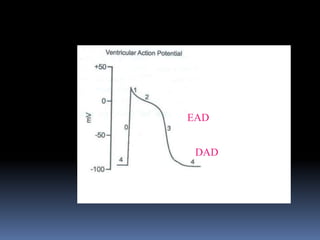
EAD: when APD is markedly prolonged
Occur in phase 3
May be due to inwards Na+ or Ca2+ current
Excessive prolongation of APD- torsades de pointes syndrome
EAD
DAD
Torsades de pointes: polymorphic ventricular tachycardia along
with prolonged QT interval
DAD: precipitating conditions are intracellular or sarcoplasmic
Ca2+ overload, adrenergic stress, digitalis intoxication, heart
failure
If afterdepolarizations reach a threshold, an AP is genererated
which is called ‘triggered beat’
DAD occur when the HR is fast, EAD occur when the HR is
slow
•Re-entry: when a cardiac impulse travels in a path such as to
return to and reactivate its original site and self perpetuate rapid
reactivation independent of normal sinus node conduction
Requirements for re-entry rhythm:
slowing or conduction failure due to either an anatomic or
functional barrier
Anatomic barrier- Wolff-Parkinson-White syndrome
Functional barrier- ischaemia, differences in refractoriness
Presence of an anatomically defined circuit
Heterogenecity in refractoriness among regions in the circuit
Slow conduction in one part of the circuit
•What are channels? – they are macromolecular complexes
consisting of a pore forming  subunit,  subunits and accessory
proteins
•They are:
Transmembrane proteins
Consist of a voltage sensitive domain
A selectivity filter
A conducting pore and,
An inactivating particle
•In response to changes in membrane voltage, the channel changes
conformation so as to allow or prevent the flow of ions through it
along their concentration gradient
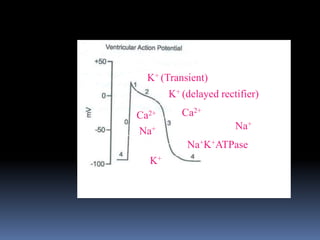
Na+
K+ (Transient)
Ca2+
K+ (delayed rectifier)
Ca2+
Na+K+ATPase
K+
Na+
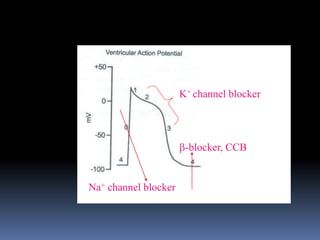
Na+ channel blocker
K+ channel blocker
-blocker, CCB
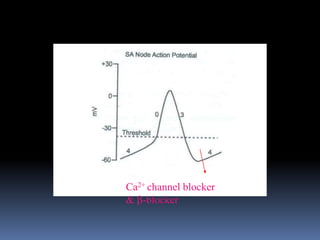
Ca2+ channel blocker
& -blocker
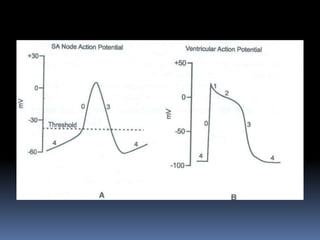
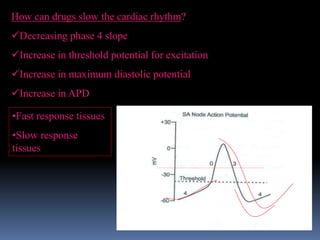
How can drugs slow the cardiac rhythm?
Decreasing phase 4 slope
Increase in threshold potential for excitation
Increase in maximum diastolic potential
Increase in APD
•Fast response tissues
•Slow response
tissues
Na+ channel blocker:
•Na+ channel block depends on:
HR
Membrane potential
Drug specific physiochemical characteristic-  recovery
•Blockade of Na+ channels results in:
Threshold for excitability is increased (more current)
Increase in pacing and defibrillation threshold
Decrease conduction velocity in fast response tissues
Increase QRS interval
Some drugs tend to prolong PR interval- flecainide (possibly
Ca2+ channel blockade)
•Some sodium channel blockers shorten the PR interval (quinidine;
vagolytic effect)
•APD unaffected or shortened
•Increase in threshold for excitation also decreases automaticity
•Can also inhibit DAD/EAD
•Delays conduction so can block re-entry
•In some cases, it can exacerbate re-entry by delaying conduction
•Shift voltage dependence of recovery of sodium channels from
inactivated state to more negative potentials and so increases
refractoriness
•Net effect- whether it will suppress or exacerbate re-entry
arrhythmia depends on its effect on both factors- conduction velocity
and refractoriness
•Most Na+ channel blockers bind to either open or inactivated state
and have very little affinity for channels in closed state, drug binds to
channels during systole & dissociates during diastole
•ADRs:
Decrease in conduction rate in atrial flutter- slows rate of flutter
and increases HR due to decrease in AV blockade
Especially common with quinidine due to its vagolytic property;
also seen with flecainide and propafenone
Cases of ventricular tachycardia due to re-entrant rhythm following
MI may worsen due to slowing of conduction rate
Slowing of conduction allows the re-entrant rhythm to persist
within the circuit so that complicated arrhythmias can occur
Several Na+ channel blockers have been reported to exacerbate
neuromuscular paralysis by d-tubocurarine
•K+ Channel blockers:
Prolong APD (QT interval) and reduces automaticity
Increase in APD also increases refractoriness
Effective in treating re-entrant arrhythmias
Reduce energy requirement for defibrillation
Inhibit ventricular arrhythmias in cases of myocardial ischemia
Many K+ channel blockers also have  blocking activity also like
sotalol
Disproportionate prolongation of APD can result in torsaides de
pointes, specially when basal HR is slow
•CCBs:
Major effect on nodal tissues
Verapamil, diltiazem and bepridil cause slowing of HR, nifedipine
and other dihydropyridines reflexly increase HR
Decrease AV nodal conduction so PR interval increases
AV nodal block occurs due to decremental conduction and increase
in AV nodal refractoriness
DAD leading to ventricular tachycardia respond to verapamil
Verapamil and diltiazem are recommended for treatment of PSVT
Bepridil increases APD in many tissues and can exert
antiarrhythmic action in atria and ventricles but it use is associated
with increased incidence of torsades de pointes- rarely used

CARDIAC ARRHYTHMIA.ppt

  • 1.
    Cardiac Arrhythmias A heartarrhythmia (uh-RITH-me-uh) is an irregular heartbeat. Heart rhythm problems (heart arrhythmias) occur when the electrical signals that coordinate the heart's beats don't work properly. The faulty signaling causes the heart to beat too fast (tachycardia), too slow (bradycardia) or irregularly. Heart arrhythmias may feel like a fluttering or racing heart and may be harmless. However, some heart arrhythmias may cause bothersome — sometimes even life-threatening — signs and symptoms. However, sometimes it's normal for a person to have a fast or slow heart rate. For example, the heart rate may increase with exercise or slow down during sleep. Heart arrhythmia treatment may include medications, catheter procedures, implanted devices or surgery to control or eliminate fast, slow or irregular heartbeats. A heart-healthy lifestyle can help prevent heart damage that can trigger certain heart arrhythmias.
  • 2.
    Types of cardiacarrhythmias: •Bradyarrhythmias •Tachyarrhythmias •Bradyarrhythmias: treat with atropine, pacing •Tachyarrhythmias can occur due to: Enhanced automaticity Afterdepolarization and triggered activity Re-entry
  • 3.
    Tachyarrhythmias: •Enhanced automaticity: In tissuesundergoing spontaneous depolarization -stimulation, hypokalemia, mechanical stretch of cardiac muscle Automatic behaviour in tissues that normally lack spontaneous pacemaker activity e.g. ventricular ischaemia depolarizes ventricular cells and can cause abnormal rhythm •Afterdepolarization: EAD: when APD is markedly prolonged Occur in phase 3 May be due to inwards Na+ or Ca2+ current Excessive prolongation of APD- torsades de pointes syndrome
  • 4.
  • 5.
    Torsades de pointes:polymorphic ventricular tachycardia along with prolonged QT interval DAD: precipitating conditions are intracellular or sarcoplasmic Ca2+ overload, adrenergic stress, digitalis intoxication, heart failure If afterdepolarizations reach a threshold, an AP is genererated which is called ‘triggered beat’ DAD occur when the HR is fast, EAD occur when the HR is slow •Re-entry: when a cardiac impulse travels in a path such as to return to and reactivate its original site and self perpetuate rapid reactivation independent of normal sinus node conduction
  • 6.
    Requirements for re-entryrhythm: slowing or conduction failure due to either an anatomic or functional barrier Anatomic barrier- Wolff-Parkinson-White syndrome Functional barrier- ischaemia, differences in refractoriness Presence of an anatomically defined circuit Heterogenecity in refractoriness among regions in the circuit Slow conduction in one part of the circuit
  • 7.
    •What are channels?– they are macromolecular complexes consisting of a pore forming  subunit,  subunits and accessory proteins •They are: Transmembrane proteins Consist of a voltage sensitive domain A selectivity filter A conducting pore and, An inactivating particle •In response to changes in membrane voltage, the channel changes conformation so as to allow or prevent the flow of ions through it along their concentration gradient
  • 9.
    Na+ K+ (Transient) Ca2+ K+ (delayedrectifier) Ca2+ Na+K+ATPase K+ Na+
  • 10.
    Na+ channel blocker K+channel blocker -blocker, CCB
  • 11.
  • 12.
    How can drugsslow the cardiac rhythm? Decreasing phase 4 slope Increase in threshold potential for excitation Increase in maximum diastolic potential Increase in APD •Fast response tissues •Slow response tissues
  • 13.
    Na+ channel blocker: •Na+channel block depends on: HR Membrane potential Drug specific physiochemical characteristic-  recovery •Blockade of Na+ channels results in: Threshold for excitability is increased (more current) Increase in pacing and defibrillation threshold Decrease conduction velocity in fast response tissues Increase QRS interval Some drugs tend to prolong PR interval- flecainide (possibly Ca2+ channel blockade)
  • 14.
    •Some sodium channelblockers shorten the PR interval (quinidine; vagolytic effect) •APD unaffected or shortened •Increase in threshold for excitation also decreases automaticity •Can also inhibit DAD/EAD •Delays conduction so can block re-entry •In some cases, it can exacerbate re-entry by delaying conduction •Shift voltage dependence of recovery of sodium channels from inactivated state to more negative potentials and so increases refractoriness •Net effect- whether it will suppress or exacerbate re-entry arrhythmia depends on its effect on both factors- conduction velocity and refractoriness
  • 15.
    •Most Na+ channelblockers bind to either open or inactivated state and have very little affinity for channels in closed state, drug binds to channels during systole & dissociates during diastole •ADRs: Decrease in conduction rate in atrial flutter- slows rate of flutter and increases HR due to decrease in AV blockade Especially common with quinidine due to its vagolytic property; also seen with flecainide and propafenone Cases of ventricular tachycardia due to re-entrant rhythm following MI may worsen due to slowing of conduction rate Slowing of conduction allows the re-entrant rhythm to persist within the circuit so that complicated arrhythmias can occur Several Na+ channel blockers have been reported to exacerbate neuromuscular paralysis by d-tubocurarine
  • 16.
    •K+ Channel blockers: ProlongAPD (QT interval) and reduces automaticity Increase in APD also increases refractoriness Effective in treating re-entrant arrhythmias Reduce energy requirement for defibrillation Inhibit ventricular arrhythmias in cases of myocardial ischemia Many K+ channel blockers also have  blocking activity also like sotalol Disproportionate prolongation of APD can result in torsaides de pointes, specially when basal HR is slow
  • 17.
    •CCBs: Major effect onnodal tissues Verapamil, diltiazem and bepridil cause slowing of HR, nifedipine and other dihydropyridines reflexly increase HR Decrease AV nodal conduction so PR interval increases AV nodal block occurs due to decremental conduction and increase in AV nodal refractoriness DAD leading to ventricular tachycardia respond to verapamil Verapamil and diltiazem are recommended for treatment of PSVT Bepridil increases APD in many tissues and can exert antiarrhythmic action in atria and ventricles but it use is associated with increased incidence of torsades de pointes- rarely used