Carcinoma Colon
Dr Nataraj Y S
DEPT. OF SURGICAL ONCOLOGY
SIMSRC,Bengaluru
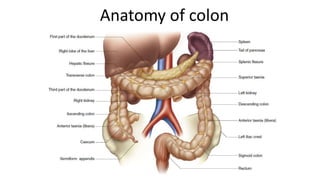
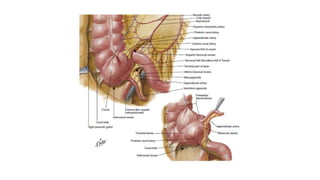
Anatomy of colon
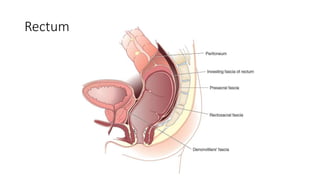
Rectum
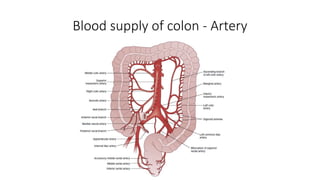
Blood supply of colon - Artery
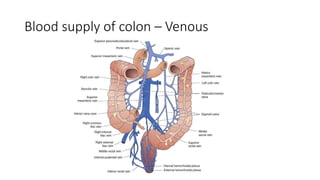
Blood supply of colon – Venous
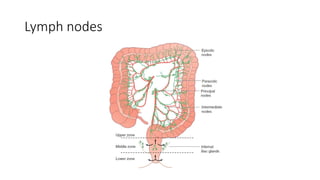
Lymph nodes
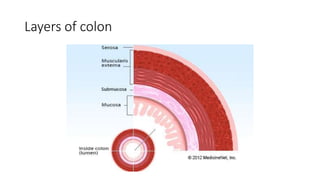
Layers of colon
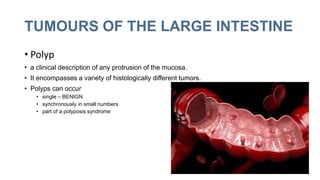
TUMOURS OF THE LARGE INTESTINE
• Polyp
• a clinical description of any protrusion of the mucosa.
• It encompasses a variety of histologically different tumors.
• Polyps can occur
• single – BENIGN
• synchronously in small numbers
• part of a polyposis syndrome
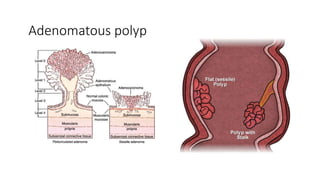
Adenomatous polyp
Adenomatous polyp
• The tubular adenoma like a berry on a stalk
• The villous adenoma like a flat spreading lesion.
• The risk of malignancy developing in an adenoma increases with size
• There is a 10% risk of cancer in a 1-cm diameter tubular adenoma
• one-third of large (>3 cm) colonic adenomas will have an area of invasive
malignancy within them.
• Adenomas larger than 5 mm in diameter are usually excised because of
their malignant potential.
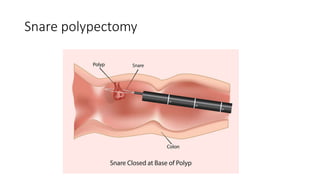
Snare polypectomy
Familial adenomatous polyposis
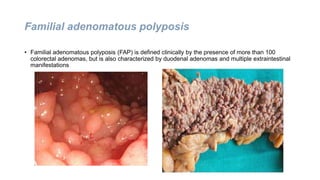
• Familial adenomatous polyposis (FAP) is defined clinically by the presence of more than 100
colorectal adenomas, but is also characterized by duodenal adenomas and multiple extraintestinal
manifestations
• Over 80% of cases come from patients with a positive family history.
• The remainder arise as a result of new mutations in the adenomatous
polyposis coli (APC) gene on the short arm of chromosome 5.
• FAP is inherited as an autosomal dominant condition
• Equal in men and women.
• The lifetime risk of colorectal cancer is 100% in patients with FAP.
• FAP can also be associated with benign mesodermal tumours such as
desmoid tumours and osteomas.
• Epidermoid cysts can also occur (Gardner’s syndrome)
• Carcinoma of the large bowel develops 10–20 years after the
onset of the polyposis.
• Malignant change is rare before the age of 20 years.
• If there are no adenomas by the age of 30 years, FAP is
unlikely
• Adolescence -surgery is usually deferred to the age of 17 or 18
years unless symptoms develop.
• Examination of blood relatives, including cousins, nephews and
nieces, is essential
• Referral to a medical geneticist is essential.
• If over 100 adenomas are present at colonoscopy, the diagnosis
can be made confidently
Treatment
• The aim of surgery in FAP is to prevent the development of
colorectal cancer.
• SURGERY - COLECTOMY
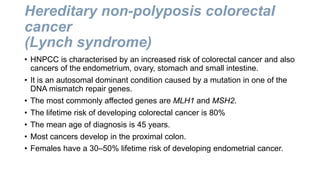
Hereditary non-polyposis colorectal
cancer
(Lynch syndrome)
• HNPCC is characterised by an increased risk of colorectal cancer and also
cancers of the endometrium, ovary, stomach and small intestine.
• It is an autosomal dominant condition caused by a mutation in one of the
DNA mismatch repair genes.
• The most commonly affected genes are MLH1 and MSH2.
• The lifetime risk of developing colorectal cancer is 80%
• The mean age of diagnosis is 45 years.
• Most cancers develop in the proximal colon.
• Females have a 30–50% lifetime risk of developing endometrial cancer.
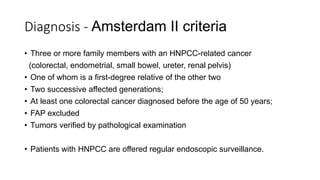
Diagnosis - Amsterdam II criteria
• Three or more family members with an HNPCC-related cancer
(colorectal, endometrial, small bowel, ureter, renal pelvis)
• One of whom is a first-degree relative of the other two
• Two successive affected generations;
• At least one colorectal cancer diagnosed before the age of 50 years;
• FAP excluded
• Tumors verified by pathological examination
• Patients with HNPCC are offered regular endoscopic surveillance.
Carcinoma colon - Epidemiology
• Colorectal cancer is the second most common cause of cancer death.
• Approximately 35 000 patients are diagnosed with colorectal cancer every
year
• Approximately one-third of these tumours are in the rectum and two-thirds
in the colon.
• The burden of disease is similar in men and women.
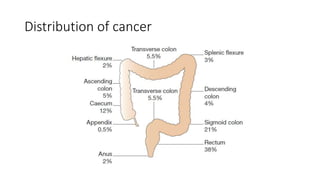
Distribution of cancer
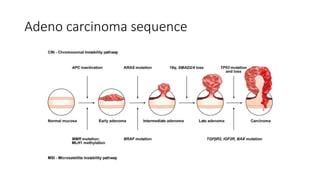
Adeno carcinoma sequence
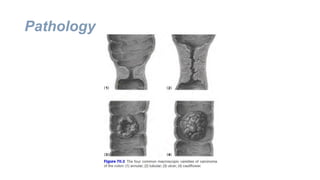
Pathology
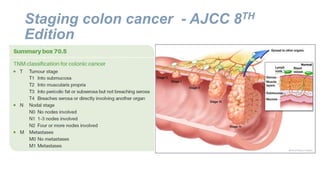
Staging colon cancer - AJCC 8TH
Edition
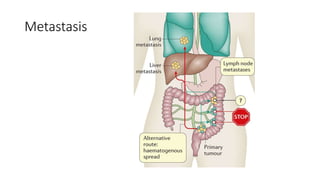
Metastasis
Clinical features
• 50 years of age
• Emergency presentation occurs in 20% of cases
• A careful family history should be taken.
• Those with first-degree relatives who have developed colorectal cancer before the age of 45 years
may be part of one of the colorectal cancer familial syndromes.
• Tumours of the left side of the colon usually present with a change in bowel habit or rectal bleeding,
• Right side lesion present later with iron deficiency anaemia or a mass
• Patients commonly present with metastatic disease.
• Lesions of the flexures may present with vague upper abdominal symptoms for many months
before symptoms suggestive of colonic disease appear
Investigation of colon cancer
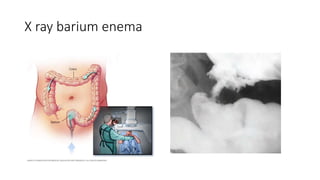
• X ray barium enema
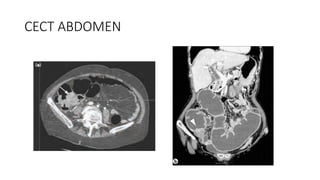
• CECT ABDOMEN
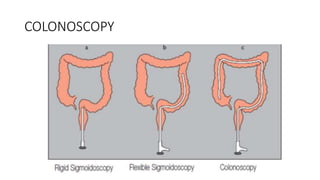
• Rigid sigmoidoscopy
• Flexible sigmoidoscopy
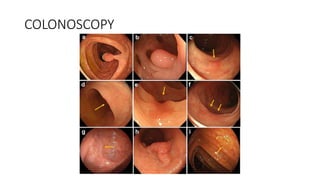
• Colonoscopy
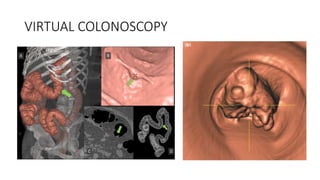
• Virtual colonoscopy
X ray barium enema
CECT ABDOMEN
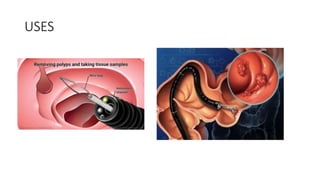
COLONOSCOPY
COLONOSCOPY
USES
VIRTUAL COLONOSCOPY
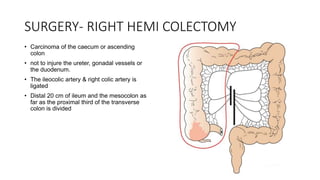
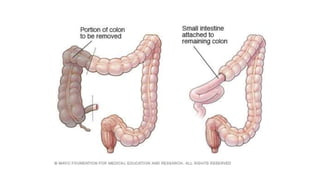
SURGERY- RIGHT HEMI COLECTOMY
• Carcinoma of the caecum or ascending
colon
• not to injure the ureter, gonadal vessels or
the duodenum.
• The ileocolic artery & right colic artery is
ligated
• Distal 20 cm of ileum and the mesocolon as
far as the proximal third of the transverse
colon is divided
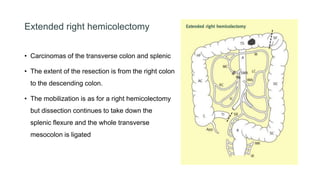
Extended right hemicolectomy
• Carcinomas of the transverse colon and splenic
• The extent of the resection is from the right colon
to the descending colon.
• The mobilization is as for a right hemicolectomy
but dissection continues to take down the
splenic flexure and the whole transverse
mesocolon is ligated
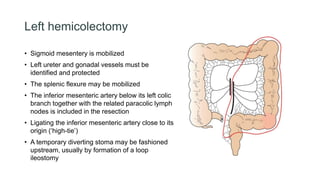
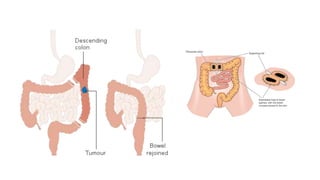
Left hemicolectomy
• Sigmoid mesentery is mobilized
• Left ureter and gonadal vessels must be
identified and protected
• The splenic flexure may be mobilized
• The inferior mesenteric artery below its left colic
branch together with the related paracolic lymph
nodes is included in the resection
• Ligating the inferior mesenteric artery close to its
origin (‘high-tie’)
• A temporary diverting stoma may be fashioned
upstream, usually by formation of a loop
ileostomy
Surgery for FAP
• The aim of surgery in FAP is to prevent the development of colorectal
cancer.
• The surgical options are:
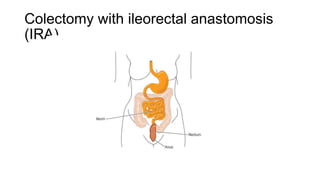
1 colectomy with ileorectal anastomosis (IRA)
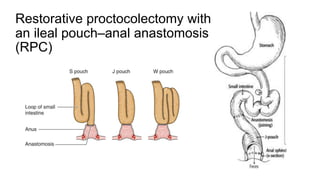
2 restorative proctocolectomy with an ileal pouch–anal anastomosis (RPC)
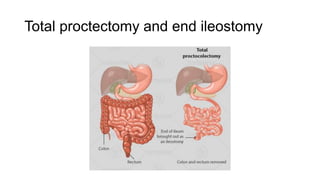
3 total proctectomy and end ileostomy
Colectomy with ileorectal anastomosis
(IRA)
Restorative proctocolectomy with
an ileal pouch–anal anastomosis
(RPC)
Total proctectomy and end ileostomy
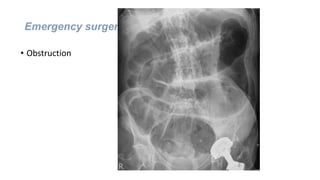
Emergency surgery
• Obstruction
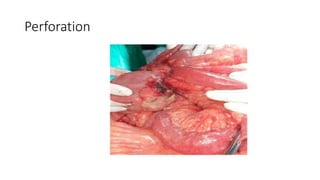
Perforation
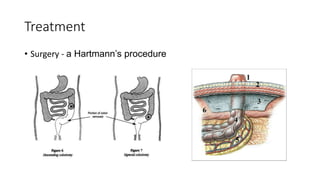
Treatment
• Surgery - a Hartmann’s procedure
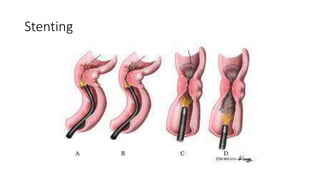
Stenting
Metastatic disease
• Hepatic metastases can be resected and series have demonstrated 5-year
survival of over 30% in resectable disease
• Isolated lung metastases may occasionally be suitable for resection
• In patients with widespread disease, palliative chemotherapy is offered
alongside symptomatic treatment and support by a palliative care team.
FOLLOW UP
• Up to a half of all patients with colorectal cancer will develop
liver metastases at some point
• Regular imaging of the liver (by ultrasound and CT scan)
• Measurement of carcinoembryonic antigen (CEA)

Carcinoma Colon presentation for surgery

  • 1.
    Carcinoma Colon Dr NatarajY S DEPT. OF SURGICAL ONCOLOGY SIMSRC,Bengaluru
  • 2.
  • 4.
  • 5.
    Blood supply ofcolon - Artery
  • 6.
    Blood supply ofcolon – Venous
  • 7.
  • 8.
  • 10.
    TUMOURS OF THELARGE INTESTINE • Polyp • a clinical description of any protrusion of the mucosa. • It encompasses a variety of histologically different tumors. • Polyps can occur • single – BENIGN • synchronously in small numbers • part of a polyposis syndrome
  • 11.
  • 12.
    Adenomatous polyp • Thetubular adenoma like a berry on a stalk • The villous adenoma like a flat spreading lesion. • The risk of malignancy developing in an adenoma increases with size • There is a 10% risk of cancer in a 1-cm diameter tubular adenoma • one-third of large (>3 cm) colonic adenomas will have an area of invasive malignancy within them. • Adenomas larger than 5 mm in diameter are usually excised because of their malignant potential.
  • 13.
  • 14.
    Familial adenomatous polyposis •Familial adenomatous polyposis (FAP) is defined clinically by the presence of more than 100 colorectal adenomas, but is also characterized by duodenal adenomas and multiple extraintestinal manifestations
  • 15.
    • Over 80%of cases come from patients with a positive family history. • The remainder arise as a result of new mutations in the adenomatous polyposis coli (APC) gene on the short arm of chromosome 5. • FAP is inherited as an autosomal dominant condition • Equal in men and women. • The lifetime risk of colorectal cancer is 100% in patients with FAP. • FAP can also be associated with benign mesodermal tumours such as desmoid tumours and osteomas. • Epidermoid cysts can also occur (Gardner’s syndrome)
  • 16.
    • Carcinoma ofthe large bowel develops 10–20 years after the onset of the polyposis. • Malignant change is rare before the age of 20 years. • If there are no adenomas by the age of 30 years, FAP is unlikely • Adolescence -surgery is usually deferred to the age of 17 or 18 years unless symptoms develop. • Examination of blood relatives, including cousins, nephews and nieces, is essential • Referral to a medical geneticist is essential. • If over 100 adenomas are present at colonoscopy, the diagnosis can be made confidently
  • 17.
    Treatment • The aimof surgery in FAP is to prevent the development of colorectal cancer. • SURGERY - COLECTOMY
  • 18.
    Hereditary non-polyposis colorectal cancer (Lynchsyndrome) • HNPCC is characterised by an increased risk of colorectal cancer and also cancers of the endometrium, ovary, stomach and small intestine. • It is an autosomal dominant condition caused by a mutation in one of the DNA mismatch repair genes. • The most commonly affected genes are MLH1 and MSH2. • The lifetime risk of developing colorectal cancer is 80% • The mean age of diagnosis is 45 years. • Most cancers develop in the proximal colon. • Females have a 30–50% lifetime risk of developing endometrial cancer.
  • 19.
    Diagnosis - AmsterdamII criteria • Three or more family members with an HNPCC-related cancer (colorectal, endometrial, small bowel, ureter, renal pelvis) • One of whom is a first-degree relative of the other two • Two successive affected generations; • At least one colorectal cancer diagnosed before the age of 50 years; • FAP excluded • Tumors verified by pathological examination • Patients with HNPCC are offered regular endoscopic surveillance.
  • 20.
    Carcinoma colon -Epidemiology • Colorectal cancer is the second most common cause of cancer death. • Approximately 35 000 patients are diagnosed with colorectal cancer every year • Approximately one-third of these tumours are in the rectum and two-thirds in the colon. • The burden of disease is similar in men and women.
  • 21.
  • 22.
  • 23.
  • 24.
    Staging colon cancer- AJCC 8TH Edition
  • 25.
  • 26.
    Clinical features • 50years of age • Emergency presentation occurs in 20% of cases • A careful family history should be taken. • Those with first-degree relatives who have developed colorectal cancer before the age of 45 years may be part of one of the colorectal cancer familial syndromes. • Tumours of the left side of the colon usually present with a change in bowel habit or rectal bleeding, • Right side lesion present later with iron deficiency anaemia or a mass • Patients commonly present with metastatic disease. • Lesions of the flexures may present with vague upper abdominal symptoms for many months before symptoms suggestive of colonic disease appear
  • 27.
    Investigation of coloncancer • X ray barium enema • CECT ABDOMEN • Rigid sigmoidoscopy • Flexible sigmoidoscopy • Colonoscopy • Virtual colonoscopy
  • 28.
  • 29.
  • 30.
  • 31.
  • 32.
  • 33.
  • 34.
    SURGERY- RIGHT HEMICOLECTOMY • Carcinoma of the caecum or ascending colon • not to injure the ureter, gonadal vessels or the duodenum. • The ileocolic artery & right colic artery is ligated • Distal 20 cm of ileum and the mesocolon as far as the proximal third of the transverse colon is divided
  • 36.
    Extended right hemicolectomy •Carcinomas of the transverse colon and splenic • The extent of the resection is from the right colon to the descending colon. • The mobilization is as for a right hemicolectomy but dissection continues to take down the splenic flexure and the whole transverse mesocolon is ligated
  • 37.
    Left hemicolectomy • Sigmoidmesentery is mobilized • Left ureter and gonadal vessels must be identified and protected • The splenic flexure may be mobilized • The inferior mesenteric artery below its left colic branch together with the related paracolic lymph nodes is included in the resection • Ligating the inferior mesenteric artery close to its origin (‘high-tie’) • A temporary diverting stoma may be fashioned upstream, usually by formation of a loop ileostomy
  • 39.
    Surgery for FAP •The aim of surgery in FAP is to prevent the development of colorectal cancer. • The surgical options are: 1 colectomy with ileorectal anastomosis (IRA) 2 restorative proctocolectomy with an ileal pouch–anal anastomosis (RPC) 3 total proctectomy and end ileostomy
  • 40.
    Colectomy with ileorectalanastomosis (IRA)
  • 41.
    Restorative proctocolectomy with anileal pouch–anal anastomosis (RPC)
  • 42.
    Total proctectomy andend ileostomy
  • 43.
  • 44.
  • 45.
    Treatment • Surgery -a Hartmann’s procedure
  • 46.
  • 47.
    Metastatic disease • Hepaticmetastases can be resected and series have demonstrated 5-year survival of over 30% in resectable disease • Isolated lung metastases may occasionally be suitable for resection • In patients with widespread disease, palliative chemotherapy is offered alongside symptomatic treatment and support by a palliative care team.
  • 48.
    FOLLOW UP • Upto a half of all patients with colorectal cancer will develop liver metastases at some point • Regular imaging of the liver (by ultrasound and CT scan) • Measurement of carcinoembryonic antigen (CEA)