Bitcoin, Boom or Bust a Financial valuation
Framework
Brian Leemoon, Wilkes University
December 1, 2017
Research Motivation and Purpose
• The exponential rise in the price of Bitcoin over the last two years raises
questions as to its valuation basis and the possibility of a financial bubble of
epic proportions.
Momo
Literature Review
• Bitcoin research can be summarized into four main Areas;
• The technological issues, such as cryptographic issues, security, and
blockchain technology, (Eyal & Sirer, 2014). Okupski (2016)
• The public policy and legal issues, including the tax treatment, anti-
money laundering regulations and the legality of Bitcoin transactions Polasik
et Al (2014), (European Central Bank, 2015. IRS (2014).
• The political issues (Karlstrom, 2014). China, Japan, New economy.
• The economic and financial issues as to whether Bitcoin performs the
functions of money, (Wang, 2014), and its investment potential Yermack,
(2013).
Research Motivation and Purpose
• No Clarity: As to the type of Investment Bitcoin represents:
• No clear model on how to approach a financial valuation of
Bitcoin
• Lack of guidance on Bitcoin’s valuation implications
What is Bitcoin?
• “A purely peer-to-peer version of electronic cash would
allow online payments to be sent directly from one party to
another without going through a financial institution ...
• We propose a solution to the double-spending problem using
a peer-to-peer network. The network timestamps transactions
... forming a record that cannot be changed without redoing
the proof-of-work” Nakamoto (2009)
• The blockchain records all Bitcoin transactions in a public
ledger that is distributed worldwide, with no single authority.
Research Questions
ď‚§ Why are traditional
valuation methods
insufficient to arrive at a
valuation of Bitcoin?
ď‚§ The valuation
framework is
examined through the
lens of key
stakeholders and
offers implications for
researchers, investors,
and policymakers.
ď‚§ How can companies &
individuals build on
the insights developed
in this framework for
Bitcoin valuation
Timeline of Bitcoin events
Year Main Events
2009The Bitcoin Whitepaper by Satoshi Nakamoto and the Genesis Block
2010
The first real-world transaction took place to purchase a pizza. 10,000 BTC sent from the USA to a person in the U.K. in return for two pizzas from Papa
John’s
First mining poll & BTC market cap of $1 Million
2011Silk Road started (Black-market Darknet outlet). Parity of Bitcoin & the US Dollar (Feb 2011)
2012Coinbase Exchange started (Also started to deal in Ethereum & Litecoin)
2013Oct Silk road closed. Bitcoin reaches $1000 during Q4 2013
2014
Collapse of Mt Gor exchange (At one time >70% of Bitcoin transactions) 850,000 coins ($850 Million) hacked. 200,000 recovered. Today worth $2 Billion. Creditors will
receive $100% back . Owner of Mt Gor could receive the surplus value approx $1.2 Billion
2015Bitcoin price falls to $229 from a peak of over $500 in 2014
2016Bitcoin price rises to $1000. Mining reward halves, doubling production costs rise of 100s of altcoins
20172 Bitcoin forks (Free bitcoin Gold & Bitcoin Cash). Price rises to exceed $10,000 & predictions by some on wall street for a $40,000 + price
• It is assumed that the market is right (Damodaran, 1996) and it is
up to the analyst to convince others that his valuation is a better
estimate of value than the market.
• The 4 types of Investments are: Assets, Commodities, Currencies
& Alternative investments.
• Assets, these generate cash flows, which can be valued
currently and into the future. Also risk analysis is factored into
the computation as cashflows are expected to be higher for more
risk assumed. E.g. Discounting future cashflows (DCF)
Basic valuation methods
• Commodities, these are investments that have a value
because they meet a need. commodities are often valued
relative to their long pricing history and the inflation rate.
• Currencies, can be priced relative to other currencies. And
are judged on three key attributes; Unit of account;
Medium of exchange and Store of value
• The total market capitalization of crypto currencies in
November of 2017 was approximately $300 Billion Dollars.
With Bitcoin having a 53% market share
Basic valuation methods
• Bitcoin has remained relatively stagnant in it’s transactional
adoption. Due to 1) resistance to change from Fiat currencies
2) High volatility 3) Competing crypto currencies with
lower transactional costs & faster transfer. (<$1 v $11 & <1 min v
<2 hours.
• Out of the leading 500 internet sellers, just three accept bitcoin,
down from five last year
• The value of bitcoin has increased more than 1000X, since the start of
2012, to July 2017. However the # of transactions increased only 32X .
Basic valuation methods
Alternative Investments
the 4th type of Investment
Some analysts now view Bitcoin as an alternative investment, explaining why traditional
methods of valuation are insufficient.
Derived from Yau, J., Schneeweis, T., Robinson, T., & Weiss, L. (2007)
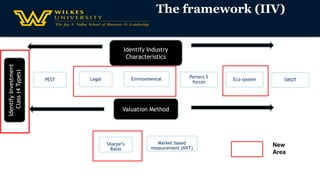
• A framework identifies key concepts and their
relationships and acts as a guide.
• The framework advocated in this research paper,
adapts a financial valuation framework derived from
Whalen, Baginski, & Bradshaw, (2011).
• (a) The industry characteristics
• (b) the valuation method(s).
Developing the framework
Market based
measurement (NVT)
LegalPEST
Valuation Method
Identify Industry
Characteristics
IdentifyInvestment
Class(4Types)
Porters 5
forces
Eco system SWOT
Sharpe’s
Ratio
Environmental
The framework (IIV)
New
Area
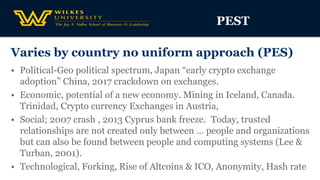
Varies by country no uniform approach (PES)
• Political-Geo political spectrum, Japan “early crypto exchange
adoption” China, 2017 crackdown on exchanges.
• Economic, potential of a new economy. Mining in Iceland, Canada.
Trinidad, Crypto currency Exchanges in Austria,
• Social; 2007 crash , 2013 Cyprus bank freeze. Today, trusted
relationships are not created only between … people and organizations
but can also be found between people and computing systems (Lee &
Turban, 2001).
• Technological, Forking, Rise of Altcoins & ICO, Anonymity, Hash rate
PEST
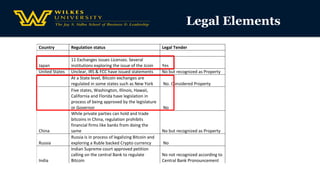
Country Regulation status Legal Tender
Japan
11 Exchanges issues Licenses. Several
institutions exploring the issue of the Jcoin Yes
United States Unclear, IRS & FCC have issued statements No but recognized as Property
At a State level, Bitcoin exchanges are
regulated in some states such as New York No. Considered Property
Five states, Washington, Illinois, Hawaii,
California and Florida have legislation in
process of being approved by the legislature
or Governor No
China
While private parties can hold and trade
bitcoins in China, regulation prohibits
financial firms like banks from doing the
same No but recognized as Property
Russia
Russia is in process of legalizing Bitcoin and
exploring a Ruble backed Crypto currency No
India
Indian Supreme court approved petition
calling on the central Bank to regulate
Bitcoin
No not recognized according to
Central Bank Pronouncement
Legal Elements
• Visa’s two US data
centers use < 4% of the
electrical consumption of
bitcoin but have over 800x the
transaction levels.
• Bitcoin uses >30 TWh.
(Enough to power over 3
Million US households.)
Environmental Elements
Bitcoin’s use of energy could become an emerging environmental issue
Bitcoin is relatively immune to any single new entrant.
Low, many
customers
Low – due to
Blockchain
technology
This is considered medium, the bitcoin
network is decentralized with no
specific single supplier.
The industry rivalry is considered High be high
Porters 5 Forces
Users 6-12
Million
Inventors
(Developers-
New
Applications)
Issuers (New
Coinage)
(1600)
Miners
(>100,000)
Other actors
Exchanges
>120
Trading
Platforms
Bitcoin Eco System
Dily Daily Transactions
Between 218K-398K
(2017)
Hedge
funds
ETFs-IRAs
Developing
Economies
New Areas of
opportunity
2017/2018
Financial futures commence trading on CBOE Friday Dec 10th 2017
Crypto Currency Exchange
Leverage up to 5x your
Deposit
”
Ethereum one of 1600 “Alt Coins”
(Issuer)
SWOT-Bitcoin
• Strengths: Most recognized crypto currency, highest
store of value, secure , highest market share. 6-10
Million users.
• Weakness: Technological limitations, relatively high
transaction cost, transaction takes too long for retailers.
• Opportunity: Wider financial market adoption,
Regulatory acceptance. Store of value.
• Threats: New crypto currencies, Especially Ethereum smart
contracts, Ripple supported by banking industry, etc. Forks,
single country legislation, use by underworld elements.
Market based
measurement (NVT)
LegalPEST
Valuation Method
Identify Industry
Characteristics
IdentifyInvestment
Class(4Types)
Porters 5
forces
Eco system SWOT
Sharpe’s
Ratio
Environmental
The framework (IIV)
• The Sharpe ratio is a widely used financial industry measurement
that uses standard deviation to measure a fund’s risk adjusted return.
• The higher the ratio, the better the fund has performed relative to the
risk it has assumed.
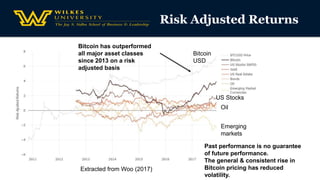
• Bitcoin has outperformed all major asset classes since Mid 2013
to October 2017 on a risk adjusted basis.
• Also one of the main characteristics of Bitcoin is that it is
uncorrelated or has low correlation (-0.4 to 0.4), to most major asset
classes. (Burniske & White, 2017)
Valuation Method Sharpe Ratio
Risk Adjusted Returns
Bitcoin has outperformed
all major asset classes
since 2013 on a risk
adjusted basis
US Stocks
Oil
Emerging
markets
Bitcoin
USD
Extracted from Woo (2017)
Past performance is no guarantee
of future performance.
The general & consistent rise in
Bitcoin pricing has reduced
volatility.
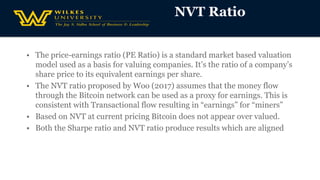
• The price-earnings ratio (PE Ratio) is a standard market based valuation
model used as a basis for valuing companies. It’s the ratio of a company’s
share price to its equivalent earnings per share.
• The NVT ratio proposed by Woo (2017) assumes that the money flow
through the Bitcoin network can be used as a proxy for earnings. This is
consistent with Transactional flow resulting in “earnings” for “miners”
• Based on NVT at current pricing Bitcoin does not appear over valued.
• Both the Sharpe ratio and NVT ratio produce results which are aligned
NVT Ratio
Bitcoin NVT ratio
Network
Value
NVT ratio 28 day
average
Based on the NVT
Bitcoin does not
appear to be
overvalued relative
to NVT history
since 2012
Collapse of
Mt Gor
Extracted from Woo (2017)
Past performance is no guarantee
of future performance.
The general & consistent rise in
Bitcoin pricing has reduced
volatility.
Implications
ď‚§ Governments need to
address crypto currency
assets before they are “Too
big to fail”. By Issuing
Guidelines & Regulations
ď‚§ This research
highlights the high,
risk adjusted returns &
diversification offered
by Bitcoin. Possible
maturing into a
financial instrument
ď‚§ The medium term
potential for Bitcoin may
be limited to a ”store of
value.” However
Blockchain technology
has enormous potential,
similar to the start of the
internet in the early
1990s. “The focus will
be on the Blockchain
first, bitcoin second” Jay
Sidhu 2017
Discussion and Implications
• This research is the first to integrate, industry characteristics, investment class and
valuation methods into a framework for the financial valuation of crypto currencies.
• The Framework provides a useful tool for researchers to understand the current state of
bitcoin in the short term. It also explains why some commentators call Bitcoin a Bubble
(Identified in the PESTLE) and others an investment.
• The industry analysis raises precautionary flags, particularly in relation to the
Governmental impact on Bitcoin. For instance a crackdown on Bitcoin exchanges in
China in September 2017 resulted in Bitcoin falling by 12%. over 2 days. Governments
worldwide, ignore Bitcoin regulation at their financial peril.
Limitations and Future Research
• The framework needs to be further tested empirically in future research.
• The Framework is limited to a Financial framework. An economic framework, including
economic valuation techniques such as money supply, cost of production etc.. were
outside of the current research scope but offer the opportunity for future research.
• The impact on portfolio diversification due to Bitcoin’s unique lack of correlation to
the main asset classes , is a promising practical area of future research particularly
applicable to hedge funds and the investment sector.
• It is clear from the research, that valuation methods need to be supplemented by analysis of
the industry characteristics to enhance decision making and provide an overall assessment
of value.
• The industry analysis reveals headwinds and legal, technological, economic, political and
environmental risks for Bitcoin. (Key risk factors)
• A new and novel approach could be to use investments in Bitcoin as a diversification and
risk reducing tool (Bitcoin futures?). Thereby providing 2 positive income benefits for
investor portfolios, enhanced diversification & superior risk adjusted positive returns.
Conclusion
References
Adler, J. (2014). American Banker. Retrieved from Should the CFPB Regulate Bitcoin?:
https://www.americanbanker.com/news/should-the-cfpb-regulate-bitcoin
Blockchain Info. (2017). Retrieved from https://blockchain.info/charts/n-transactions?timespan=all
Böhme, R., Christin, N., Edelman, B., & Moore, T. ( 2015). Bitcoin: Economics, Technology, and Governance. Journal of
Economic Perspectives, 213–238. Retrieved from Bitcoin: Economics, Technology, and:
http://pubs.aeaweb.org/doi/pdfplus/10.1257/jep.29.2.213
http://komar.bitcheese.net/files/Measuring%20the%20Intrinsic%20Value%20of%20Cryptocurrency.pdf
Brito, J., & Castillo, A. (2016). Bitcoin A Primer for Policymakers. Retrieved from Mercatus Centre George Washington
University: https://www.mercatus.org/system/files/GMU_Bitcoin_042516_WEBv2_0.pdf
Buntinx, J. (2017, February). 4 Cryptocurrencies With Much Faster Block Times Than Bitcoin. Retrieved from The Merkel:
https://themerkle.com/4-cryptocurrencies-with-much-faster-block-times-than-bitcoin/
Burniske, C., & White, A. (2017, January). Bitcoin Ringing the bell on a new asset class White Paper. Retrieved from Ark
Research: http://research.ark-invest.com/hubfs/1_Download_Files_ARK-Invest/White_Papers/Bitcoin-Ringing-The-Bell-
For-A-New-Asset-Class.pdf
Cheng, E. (2017, June). Bitcoin speculators are the new day traders. Retrieved from CNBC:
https://www.cnbc.com/2017/06/23/bitcoin-speculation-markets-trading.html
CTFC. (2015). Retrieved from In First Action against an Unregistered Bitcoin Options Trading Platform, CFTC Holds that
Bitcoin and Other Virtual Currencies Are a Commodity Covered by the Commodity Exchange Act:
http://www.cftc.gov/PressRoom/PressReleases/pr7231-15
Damodaran, A. (1996). Investment Valuation Tools and Techniques for determining the value of any asset. John Wiley &
Sons.
Damodaran, A. (2017, October 24th). The Bitcoin Boom: Asset, Currency, Commodity or Collectible? Retrieved from Musings
on the Market: http://aswathdamodaran.blogspot.com/2017/10/the-bitcoin-boom-asset-currency.html
Damodaran, A. (2017). The Crypto Currency Debate: Future of Money or Speculative Hype? Retrieved from
http://aswathdamodaran.blogspot.com/2017/08/the-crypto-currency-debate-future-of.html
European Central Bank. (2015). Retrieved from Virtual currency schemes:
https://www.ecb.europa.eu/pub/pdf/other/virtualcurrencyschemesen.pdf
Fyookball, D. (2017). Why does Bitcoin have Ridiculously High Fees and Slow Confirmations? Retrieved from Medium
Corporation: https://medium.com/@jonaldfyookball/why-does-bitcoin-have-ridiculously-high-fees-and-slow-
confirmations-e3fd58258a6d
References
• Hileman, G., & Rauchs, M. (2017). GLOBAL CRYPTOCURRENCY. Retrieved from
https://www.jbs.cam.ac.uk/fileadmin/user_upload/research/centres/alternative-finance/downloads/2017-global-
cryptocurrency-benchmarking-study.pdf
• History of Bitcoin Wikipedia. (n.d.). Retrieved from Wikipedia: https://en.wikipedia.org/wiki/History_of_bitcoin
• IRS. (2014). Retrieved from IRS Virtual Currency Guidance: Virtual Currency Is Treated as Property for U.S. Federal Tax
• Purposes; General Rules for Property Transactions Apply: https://www.irs.gov/newsroom/irs-virtual-currency-guidance
• , 20(3), 397-403. Retrieved from http://www.independent.org/pdf/tir/tir_20_03_12_luther.pdf
• Nakamoto, S. (2008). Bitcoin: A Peer-to-Peer Electronic Cash System. Retrieved from https://bitcoin.org/bitcoin.pdf
• orter, M. (1979). How Competitive Forces Shape Strategy. Harvard Business Review, 57, no. 2 137–145.
• Rauss, M. (2016). Cyrpto Currencies Meeting Business Ecosystems The case for Bitcoin. Grenoble Graduate School of
Business.
• Whalen, J., Baginski, S., & Bradshaw, M. (2011). Financial Reporting, Financial Statement Analysis and Valuation . A
strategic perspective. Mason: South West Centage Learning.
• What is Blockchain Technology? A Step-by-Step Guide For Beginners. (n.d.). Retrieved from Blockgeeks:
https://blockgeeks.com/guides/what-is-blockchain-technology/
• Yau, J., Schneeweis, T., Robinson, T., & Weiss, L. (2007). Alternative Investments Portfolio Management. In J. Magnin, D.
Tuttle, J. Pinto, & D. Mvleavey , Managing Investment Portfolios A dynamic Process (pp. 477-578). Hoboken: CFA
Institute.
References

Bitcoin Valuation Framework

  • 1.
    Bitcoin, Boom orBust a Financial valuation Framework Brian Leemoon, Wilkes University December 1, 2017
  • 2.
    Research Motivation andPurpose • The exponential rise in the price of Bitcoin over the last two years raises questions as to its valuation basis and the possibility of a financial bubble of epic proportions. Momo
  • 3.
    Literature Review • Bitcoinresearch can be summarized into four main Areas; • The technological issues, such as cryptographic issues, security, and blockchain technology, (Eyal & Sirer, 2014). Okupski (2016) • The public policy and legal issues, including the tax treatment, anti- money laundering regulations and the legality of Bitcoin transactions Polasik et Al (2014), (European Central Bank, 2015. IRS (2014). • The political issues (Karlstrom, 2014). China, Japan, New economy. • The economic and financial issues as to whether Bitcoin performs the functions of money, (Wang, 2014), and its investment potential Yermack, (2013).
  • 4.
    Research Motivation andPurpose • No Clarity: As to the type of Investment Bitcoin represents: • No clear model on how to approach a financial valuation of Bitcoin • Lack of guidance on Bitcoin’s valuation implications
  • 5.
    What is Bitcoin? •“A purely peer-to-peer version of electronic cash would allow online payments to be sent directly from one party to another without going through a financial institution ... • We propose a solution to the double-spending problem using a peer-to-peer network. The network timestamps transactions ... forming a record that cannot be changed without redoing the proof-of-work” Nakamoto (2009) • The blockchain records all Bitcoin transactions in a public ledger that is distributed worldwide, with no single authority.
  • 6.
    Research Questions ď‚§ Whyare traditional valuation methods insufficient to arrive at a valuation of Bitcoin? ď‚§ The valuation framework is examined through the lens of key stakeholders and offers implications for researchers, investors, and policymakers. ď‚§ How can companies & individuals build on the insights developed in this framework for Bitcoin valuation
  • 7.
    Timeline of Bitcoinevents Year Main Events 2009The Bitcoin Whitepaper by Satoshi Nakamoto and the Genesis Block 2010 The first real-world transaction took place to purchase a pizza. 10,000 BTC sent from the USA to a person in the U.K. in return for two pizzas from Papa John’s First mining poll & BTC market cap of $1 Million 2011Silk Road started (Black-market Darknet outlet). Parity of Bitcoin & the US Dollar (Feb 2011) 2012Coinbase Exchange started (Also started to deal in Ethereum & Litecoin) 2013Oct Silk road closed. Bitcoin reaches $1000 during Q4 2013 2014 Collapse of Mt Gor exchange (At one time >70% of Bitcoin transactions) 850,000 coins ($850 Million) hacked. 200,000 recovered. Today worth $2 Billion. Creditors will receive $100% back . Owner of Mt Gor could receive the surplus value approx $1.2 Billion 2015Bitcoin price falls to $229 from a peak of over $500 in 2014 2016Bitcoin price rises to $1000. Mining reward halves, doubling production costs rise of 100s of altcoins 20172 Bitcoin forks (Free bitcoin Gold & Bitcoin Cash). Price rises to exceed $10,000 & predictions by some on wall street for a $40,000 + price
  • 8.
    • It isassumed that the market is right (Damodaran, 1996) and it is up to the analyst to convince others that his valuation is a better estimate of value than the market. • The 4 types of Investments are: Assets, Commodities, Currencies & Alternative investments. • Assets, these generate cash flows, which can be valued currently and into the future. Also risk analysis is factored into the computation as cashflows are expected to be higher for more risk assumed. E.g. Discounting future cashflows (DCF) Basic valuation methods
  • 9.
    • Commodities, theseare investments that have a value because they meet a need. commodities are often valued relative to their long pricing history and the inflation rate. • Currencies, can be priced relative to other currencies. And are judged on three key attributes; Unit of account; Medium of exchange and Store of value • The total market capitalization of crypto currencies in November of 2017 was approximately $300 Billion Dollars. With Bitcoin having a 53% market share Basic valuation methods
  • 10.
    • Bitcoin hasremained relatively stagnant in it’s transactional adoption. Due to 1) resistance to change from Fiat currencies 2) High volatility 3) Competing crypto currencies with lower transactional costs & faster transfer. (<$1 v $11 & <1 min v <2 hours. • Out of the leading 500 internet sellers, just three accept bitcoin, down from five last year • The value of bitcoin has increased more than 1000X, since the start of 2012, to July 2017. However the # of transactions increased only 32X . Basic valuation methods
  • 11.
    Alternative Investments the 4thtype of Investment Some analysts now view Bitcoin as an alternative investment, explaining why traditional methods of valuation are insufficient. Derived from Yau, J., Schneeweis, T., Robinson, T., & Weiss, L. (2007)
  • 12.
    • A frameworkidentifies key concepts and their relationships and acts as a guide. • The framework advocated in this research paper, adapts a financial valuation framework derived from Whalen, Baginski, & Bradshaw, (2011). • (a) The industry characteristics • (b) the valuation method(s). Developing the framework
  • 13.
    Market based measurement (NVT) LegalPEST ValuationMethod Identify Industry Characteristics IdentifyInvestment Class(4Types) Porters 5 forces Eco system SWOT Sharpe’s Ratio Environmental The framework (IIV) New Area
  • 14.
    Varies by countryno uniform approach (PES) • Political-Geo political spectrum, Japan “early crypto exchange adoption” China, 2017 crackdown on exchanges. • Economic, potential of a new economy. Mining in Iceland, Canada. Trinidad, Crypto currency Exchanges in Austria, • Social; 2007 crash , 2013 Cyprus bank freeze. Today, trusted relationships are not created only between … people and organizations but can also be found between people and computing systems (Lee & Turban, 2001). • Technological, Forking, Rise of Altcoins & ICO, Anonymity, Hash rate PEST
  • 15.
    Country Regulation statusLegal Tender Japan 11 Exchanges issues Licenses. Several institutions exploring the issue of the Jcoin Yes United States Unclear, IRS & FCC have issued statements No but recognized as Property At a State level, Bitcoin exchanges are regulated in some states such as New York No. Considered Property Five states, Washington, Illinois, Hawaii, California and Florida have legislation in process of being approved by the legislature or Governor No China While private parties can hold and trade bitcoins in China, regulation prohibits financial firms like banks from doing the same No but recognized as Property Russia Russia is in process of legalizing Bitcoin and exploring a Ruble backed Crypto currency No India Indian Supreme court approved petition calling on the central Bank to regulate Bitcoin No not recognized according to Central Bank Pronouncement Legal Elements
  • 16.
    • Visa’s twoUS data centers use < 4% of the electrical consumption of bitcoin but have over 800x the transaction levels. • Bitcoin uses >30 TWh. (Enough to power over 3 Million US households.) Environmental Elements Bitcoin’s use of energy could become an emerging environmental issue
  • 17.
    Bitcoin is relativelyimmune to any single new entrant. Low, many customers Low – due to Blockchain technology This is considered medium, the bitcoin network is decentralized with no specific single supplier. The industry rivalry is considered High be high Porters 5 Forces
  • 18.
    Users 6-12 Million Inventors (Developers- New Applications) Issuers (New Coinage) (1600) Miners (>100,000) Otheractors Exchanges >120 Trading Platforms Bitcoin Eco System Dily Daily Transactions Between 218K-398K (2017) Hedge funds ETFs-IRAs Developing Economies New Areas of opportunity 2017/2018 Financial futures commence trading on CBOE Friday Dec 10th 2017
  • 19.
    Crypto Currency Exchange Leverageup to 5x your Deposit
  • 20.
    ” Ethereum one of1600 “Alt Coins” (Issuer)
  • 21.
    SWOT-Bitcoin • Strengths: Mostrecognized crypto currency, highest store of value, secure , highest market share. 6-10 Million users. • Weakness: Technological limitations, relatively high transaction cost, transaction takes too long for retailers. • Opportunity: Wider financial market adoption, Regulatory acceptance. Store of value. • Threats: New crypto currencies, Especially Ethereum smart contracts, Ripple supported by banking industry, etc. Forks, single country legislation, use by underworld elements.
  • 22.
    Market based measurement (NVT) LegalPEST ValuationMethod Identify Industry Characteristics IdentifyInvestment Class(4Types) Porters 5 forces Eco system SWOT Sharpe’s Ratio Environmental The framework (IIV)
  • 23.
    • The Sharperatio is a widely used financial industry measurement that uses standard deviation to measure a fund’s risk adjusted return. • The higher the ratio, the better the fund has performed relative to the risk it has assumed. • Bitcoin has outperformed all major asset classes since Mid 2013 to October 2017 on a risk adjusted basis. • Also one of the main characteristics of Bitcoin is that it is uncorrelated or has low correlation (-0.4 to 0.4), to most major asset classes. (Burniske & White, 2017) Valuation Method Sharpe Ratio
  • 24.
    Risk Adjusted Returns Bitcoinhas outperformed all major asset classes since 2013 on a risk adjusted basis US Stocks Oil Emerging markets Bitcoin USD Extracted from Woo (2017) Past performance is no guarantee of future performance. The general & consistent rise in Bitcoin pricing has reduced volatility.
  • 25.
    • The price-earningsratio (PE Ratio) is a standard market based valuation model used as a basis for valuing companies. It’s the ratio of a company’s share price to its equivalent earnings per share. • The NVT ratio proposed by Woo (2017) assumes that the money flow through the Bitcoin network can be used as a proxy for earnings. This is consistent with Transactional flow resulting in “earnings” for “miners” • Based on NVT at current pricing Bitcoin does not appear over valued. • Both the Sharpe ratio and NVT ratio produce results which are aligned NVT Ratio
  • 26.
    Bitcoin NVT ratio Network Value NVTratio 28 day average Based on the NVT Bitcoin does not appear to be overvalued relative to NVT history since 2012 Collapse of Mt Gor Extracted from Woo (2017) Past performance is no guarantee of future performance. The general & consistent rise in Bitcoin pricing has reduced volatility.
  • 27.
    Implications  Governments needto address crypto currency assets before they are “Too big to fail”. By Issuing Guidelines & Regulations  This research highlights the high, risk adjusted returns & diversification offered by Bitcoin. Possible maturing into a financial instrument  The medium term potential for Bitcoin may be limited to a ”store of value.” However Blockchain technology has enormous potential, similar to the start of the internet in the early 1990s. “The focus will be on the Blockchain first, bitcoin second” Jay Sidhu 2017
  • 28.
    Discussion and Implications •This research is the first to integrate, industry characteristics, investment class and valuation methods into a framework for the financial valuation of crypto currencies. • The Framework provides a useful tool for researchers to understand the current state of bitcoin in the short term. It also explains why some commentators call Bitcoin a Bubble (Identified in the PESTLE) and others an investment. • The industry analysis raises precautionary flags, particularly in relation to the Governmental impact on Bitcoin. For instance a crackdown on Bitcoin exchanges in China in September 2017 resulted in Bitcoin falling by 12%. over 2 days. Governments worldwide, ignore Bitcoin regulation at their financial peril.
  • 29.
    Limitations and FutureResearch • The framework needs to be further tested empirically in future research. • The Framework is limited to a Financial framework. An economic framework, including economic valuation techniques such as money supply, cost of production etc.. were outside of the current research scope but offer the opportunity for future research. • The impact on portfolio diversification due to Bitcoin’s unique lack of correlation to the main asset classes , is a promising practical area of future research particularly applicable to hedge funds and the investment sector.
  • 30.
    • It isclear from the research, that valuation methods need to be supplemented by analysis of the industry characteristics to enhance decision making and provide an overall assessment of value. • The industry analysis reveals headwinds and legal, technological, economic, political and environmental risks for Bitcoin. (Key risk factors) • A new and novel approach could be to use investments in Bitcoin as a diversification and risk reducing tool (Bitcoin futures?). Thereby providing 2 positive income benefits for investor portfolios, enhanced diversification & superior risk adjusted positive returns. Conclusion
  • 31.
    References Adler, J. (2014).American Banker. Retrieved from Should the CFPB Regulate Bitcoin?: https://www.americanbanker.com/news/should-the-cfpb-regulate-bitcoin Blockchain Info. (2017). Retrieved from https://blockchain.info/charts/n-transactions?timespan=all Böhme, R., Christin, N., Edelman, B., & Moore, T. ( 2015). Bitcoin: Economics, Technology, and Governance. Journal of Economic Perspectives, 213–238. Retrieved from Bitcoin: Economics, Technology, and: http://pubs.aeaweb.org/doi/pdfplus/10.1257/jep.29.2.213 http://komar.bitcheese.net/files/Measuring%20the%20Intrinsic%20Value%20of%20Cryptocurrency.pdf Brito, J., & Castillo, A. (2016). Bitcoin A Primer for Policymakers. Retrieved from Mercatus Centre George Washington University: https://www.mercatus.org/system/files/GMU_Bitcoin_042516_WEBv2_0.pdf Buntinx, J. (2017, February). 4 Cryptocurrencies With Much Faster Block Times Than Bitcoin. Retrieved from The Merkel: https://themerkle.com/4-cryptocurrencies-with-much-faster-block-times-than-bitcoin/ Burniske, C., & White, A. (2017, January). Bitcoin Ringing the bell on a new asset class White Paper. Retrieved from Ark Research: http://research.ark-invest.com/hubfs/1_Download_Files_ARK-Invest/White_Papers/Bitcoin-Ringing-The-Bell- For-A-New-Asset-Class.pdf
  • 32.
    Cheng, E. (2017,June). Bitcoin speculators are the new day traders. Retrieved from CNBC: https://www.cnbc.com/2017/06/23/bitcoin-speculation-markets-trading.html CTFC. (2015). Retrieved from In First Action against an Unregistered Bitcoin Options Trading Platform, CFTC Holds that Bitcoin and Other Virtual Currencies Are a Commodity Covered by the Commodity Exchange Act: http://www.cftc.gov/PressRoom/PressReleases/pr7231-15 Damodaran, A. (1996). Investment Valuation Tools and Techniques for determining the value of any asset. John Wiley & Sons. Damodaran, A. (2017, October 24th). The Bitcoin Boom: Asset, Currency, Commodity or Collectible? Retrieved from Musings on the Market: http://aswathdamodaran.blogspot.com/2017/10/the-bitcoin-boom-asset-currency.html Damodaran, A. (2017). The Crypto Currency Debate: Future of Money or Speculative Hype? Retrieved from http://aswathdamodaran.blogspot.com/2017/08/the-crypto-currency-debate-future-of.html European Central Bank. (2015). Retrieved from Virtual currency schemes: https://www.ecb.europa.eu/pub/pdf/other/virtualcurrencyschemesen.pdf Fyookball, D. (2017). Why does Bitcoin have Ridiculously High Fees and Slow Confirmations? Retrieved from Medium Corporation: https://medium.com/@jonaldfyookball/why-does-bitcoin-have-ridiculously-high-fees-and-slow- confirmations-e3fd58258a6d References
  • 33.
    • Hileman, G.,& Rauchs, M. (2017). GLOBAL CRYPTOCURRENCY. Retrieved from https://www.jbs.cam.ac.uk/fileadmin/user_upload/research/centres/alternative-finance/downloads/2017-global- cryptocurrency-benchmarking-study.pdf • History of Bitcoin Wikipedia. (n.d.). Retrieved from Wikipedia: https://en.wikipedia.org/wiki/History_of_bitcoin • IRS. (2014). Retrieved from IRS Virtual Currency Guidance: Virtual Currency Is Treated as Property for U.S. Federal Tax • Purposes; General Rules for Property Transactions Apply: https://www.irs.gov/newsroom/irs-virtual-currency-guidance • , 20(3), 397-403. Retrieved from http://www.independent.org/pdf/tir/tir_20_03_12_luther.pdf • Nakamoto, S. (2008). Bitcoin: A Peer-to-Peer Electronic Cash System. Retrieved from https://bitcoin.org/bitcoin.pdf • orter, M. (1979). How Competitive Forces Shape Strategy. Harvard Business Review, 57, no. 2 137–145. • Rauss, M. (2016). Cyrpto Currencies Meeting Business Ecosystems The case for Bitcoin. Grenoble Graduate School of Business. • Whalen, J., Baginski, S., & Bradshaw, M. (2011). Financial Reporting, Financial Statement Analysis and Valuation . A strategic perspective. Mason: South West Centage Learning. • What is Blockchain Technology? A Step-by-Step Guide For Beginners. (n.d.). Retrieved from Blockgeeks: https://blockgeeks.com/guides/what-is-blockchain-technology/ • Yau, J., Schneeweis, T., Robinson, T., & Weiss, L. (2007). Alternative Investments Portfolio Management. In J. Magnin, D. Tuttle, J. Pinto, & D. Mvleavey , Managing Investment Portfolios A dynamic Process (pp. 477-578). Hoboken: CFA Institute. References