Cambodia Agriculture in
Transition Field Team
Training
How to Facilitate Focus Group Discussions
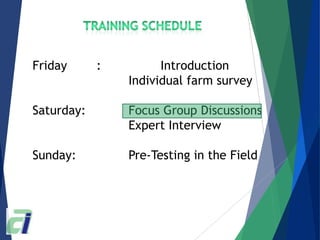
Friday : Introduction
Individual farm survey
Saturday: Focus Group Discussions
Expert Interview
Sunday: Pre-Testing in the Field
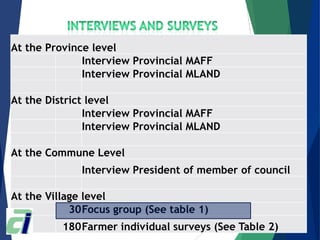
At the Province level
Interview Provincial MAFF
Interview Provincial MLAND
At the District level
Interview Provincial MAFF
Interview Provincial MLAND
At the Commune Level
Interview President of member of council
At the Village level
30Focus group (See table 1)
180Farmer individual surveys (See Table 2)
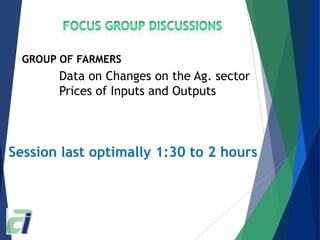
GROUP OF FARMERS
Data on Changes on the Ag. sector
Prices of Inputs and Outputs
Session last optimally 1:30 to 2 hours
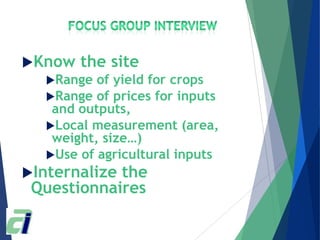
Know the site
Range of yield for crops
Range of prices for inputs
and outputs,
Local measurement (area,
weight, size…)
Use of agricultural inputs
Internalize the
Questionnaires
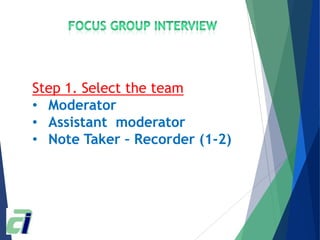
Step 1. Select the team
• Moderator
• Assistant moderator
• Note Taker – Recorder (1-2)
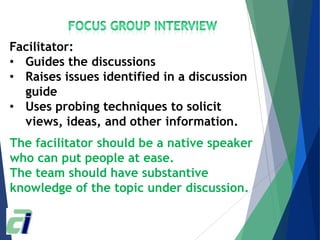
The facilitator should be a native speaker
who can put people at ease.
The team should have substantive
knowledge of the topic under discussion.
Facilitator:
• Guides the discussions
• Raises issues identified in a discussion
guide
• Uses probing techniques to solicit
views, ideas, and other information.
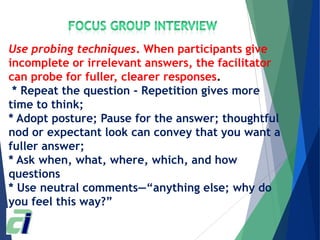
Use probing techniques. When participants give
incomplete or irrelevant answers, the facilitator
can probe for fuller, clearer responses.
* Repeat the question - Repetition gives more
time to think;
* Adopt posture; Pause for the answer; thoughtful
nod or expectant look can convey that you want a
fuller answer;
* Ask when, what, where, which, and how
questions
* Use neutral comments—―anything else; why do
you feel this way?‖
Control the discussion. In most groups a few individuals
dominate the discussion. To balance out participation:
* Address questions to individuals who are reluctant to
talk;
* give nonverbal cues (look in another direction or stop
taking notes when an individual talks for an extended
period);
* Intervene politely, summarize the point, then refocus
the discussion; and take advantage of a pause and say,
―thank you for that interesting idea, perhaps we can
discuss it in a separate session. Meanwhile with your
consent, I would like to move on to another item.‖
Team Members:
• Prepare Flipchart
• Write on Flipchart
• Note Responses
• Overall ambiance
• If there are issues that would preclude
some participants from speaking
• See if participants need something…
• Check if the Moderator has left some
key-questions undiscussed
IDEALLY: Participants should be
homogenous, from similar socioeconomic
and cultural backgrounds and should share
common traits related to the discussion
topic: GROWING CROP X.
Step 2. Select the Participants
• Help and Suggestions from
Commune/Village
• Based on specific criteria
Focus groups in a small village arouse
curiosity and can result in uninvited
participants.
Open places are not good spots for
discussions.
Step 3. Decide on timing and location.
Discussions last one to two hours and
should be conducted in a convenient
location with some degree of privacy.
Choose a setting with little distraction.
Explain the purpose of the FGD.
Address terms of confidentiality.
Explain the format and Indicate how long
the FGD usually takes: No more than 2
hours
Discuss the rules for the FGD: Speaking,
Asking questions, Needs to get out –
Participants lead this.
Ask them if they have any questions before
you both get started with the FGD.
Ask Neutral question, Word question clearly
Ask one question at a time
Ask clarification – Do not interpret if unclear
responses
Don’t lost control of the interview
Ask permission to use recorder
Active Listening Body Language
Paraphrasing
Restating
Summarizing
Clarifying questions
Empathy
Mirroring
Basic Interview Dialogue Skills
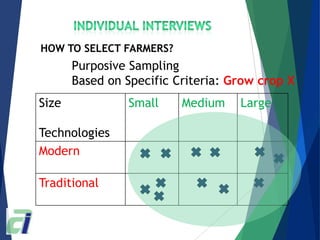
HOW TO SELECT FARMERS?
Purposive Sampling
Based on Specific Criteria: Grow crop X
Size
Technologies
Small Medium Large
Modern
Traditional
A.When did you start to grow crop X?
B. What decided you to start growing crop X?
C.Could you tell us the changes on the production
of crop X over the past 3 years?
D.What modern inputs did you use for the
production of crop X?
E. What kind of Agricultural Services did you
receive for the production of crop X?
F. What kind of Agricultural Machineries did you use
for the production of crop X?
G.How do you envision the production of crop X in
5 years?
H. What is the current areas of your total
cultivated agricultural land?
I. What is your land allocation by crop during the
wet and dry seasons?
J. How many family labor are present in your farm?
K.Among the following constraints, how do you
assess their impact on your farm production?
Supervisor TAKES THE LEAD
BUT
ALL members of the team are RESPONSIBLE
CHECK COMPLETENESS
CHECK CONSISTENCY
CHECK VALIDITY – ACCURACY
EXAMPLES OF ISSUES
• TYPO - MISCHECK
• LACK OF CLARITY
• OUTLIERS
FOR EACH
QUESTIONNAIRE
DO NOT LEAVE A VILLAGE WITHOUT
MAKING SURE THAT THE TEAM FINISHED
QUALITY CONTROL FOR ALL
QUESTIONNAIRES

Cambodia Agriculture in Transition Field Team Training: How to do Focus Group Discussions

  • 1.
    Cambodia Agriculture in TransitionField Team Training How to Facilitate Focus Group Discussions
  • 2.
    Friday : Introduction Individualfarm survey Saturday: Focus Group Discussions Expert Interview Sunday: Pre-Testing in the Field
  • 3.
    At the Provincelevel Interview Provincial MAFF Interview Provincial MLAND At the District level Interview Provincial MAFF Interview Provincial MLAND At the Commune Level Interview President of member of council At the Village level 30Focus group (See table 1) 180Farmer individual surveys (See Table 2)
  • 4.
    GROUP OF FARMERS Dataon Changes on the Ag. sector Prices of Inputs and Outputs Session last optimally 1:30 to 2 hours
  • 5.
    Know the site Rangeof yield for crops Range of prices for inputs and outputs, Local measurement (area, weight, size…) Use of agricultural inputs Internalize the Questionnaires
  • 6.
    Step 1. Selectthe team • Moderator • Assistant moderator • Note Taker – Recorder (1-2)
  • 7.
    The facilitator shouldbe a native speaker who can put people at ease. The team should have substantive knowledge of the topic under discussion. Facilitator: • Guides the discussions • Raises issues identified in a discussion guide • Uses probing techniques to solicit views, ideas, and other information.
  • 8.
    Use probing techniques.When participants give incomplete or irrelevant answers, the facilitator can probe for fuller, clearer responses. * Repeat the question - Repetition gives more time to think; * Adopt posture; Pause for the answer; thoughtful nod or expectant look can convey that you want a fuller answer; * Ask when, what, where, which, and how questions * Use neutral comments—―anything else; why do you feel this way?‖
  • 9.
    Control the discussion.In most groups a few individuals dominate the discussion. To balance out participation: * Address questions to individuals who are reluctant to talk; * give nonverbal cues (look in another direction or stop taking notes when an individual talks for an extended period); * Intervene politely, summarize the point, then refocus the discussion; and take advantage of a pause and say, ―thank you for that interesting idea, perhaps we can discuss it in a separate session. Meanwhile with your consent, I would like to move on to another item.‖
  • 10.
    Team Members: • PrepareFlipchart • Write on Flipchart • Note Responses • Overall ambiance • If there are issues that would preclude some participants from speaking • See if participants need something… • Check if the Moderator has left some key-questions undiscussed
  • 11.
    IDEALLY: Participants shouldbe homogenous, from similar socioeconomic and cultural backgrounds and should share common traits related to the discussion topic: GROWING CROP X. Step 2. Select the Participants • Help and Suggestions from Commune/Village • Based on specific criteria
  • 12.
    Focus groups ina small village arouse curiosity and can result in uninvited participants. Open places are not good spots for discussions. Step 3. Decide on timing and location. Discussions last one to two hours and should be conducted in a convenient location with some degree of privacy.
  • 13.
    Choose a settingwith little distraction. Explain the purpose of the FGD.
  • 14.
    Address terms ofconfidentiality. Explain the format and Indicate how long the FGD usually takes: No more than 2 hours Discuss the rules for the FGD: Speaking, Asking questions, Needs to get out – Participants lead this. Ask them if they have any questions before you both get started with the FGD.
  • 15.
    Ask Neutral question,Word question clearly Ask one question at a time Ask clarification – Do not interpret if unclear responses Don’t lost control of the interview Ask permission to use recorder
  • 16.
    Active Listening BodyLanguage Paraphrasing Restating Summarizing Clarifying questions Empathy Mirroring Basic Interview Dialogue Skills
  • 17.
    HOW TO SELECTFARMERS? Purposive Sampling Based on Specific Criteria: Grow crop X Size Technologies Small Medium Large Modern Traditional
  • 18.
    A.When did youstart to grow crop X? B. What decided you to start growing crop X? C.Could you tell us the changes on the production of crop X over the past 3 years? D.What modern inputs did you use for the production of crop X? E. What kind of Agricultural Services did you receive for the production of crop X? F. What kind of Agricultural Machineries did you use for the production of crop X? G.How do you envision the production of crop X in 5 years?
  • 19.
    H. What isthe current areas of your total cultivated agricultural land? I. What is your land allocation by crop during the wet and dry seasons? J. How many family labor are present in your farm? K.Among the following constraints, how do you assess their impact on your farm production?
  • 20.
    Supervisor TAKES THELEAD BUT ALL members of the team are RESPONSIBLE CHECK COMPLETENESS CHECK CONSISTENCY CHECK VALIDITY – ACCURACY EXAMPLES OF ISSUES • TYPO - MISCHECK • LACK OF CLARITY • OUTLIERS FOR EACH QUESTIONNAIRE DO NOT LEAVE A VILLAGE WITHOUT MAKING SURE THAT THE TEAM FINISHED QUALITY CONTROL FOR ALL QUESTIONNAIRES

Editor's Notes

  • #14 Avoid too much light and NoiseAsk if respondent is comfortable
  • #15 Avoid too much light and NoiseAsk if respondent is comfortable
  • #16 Avoid too much light and NoiseAsk if respondent is comfortable
  • #17 Avoid too much light and NoiseAsk if respondent is comfortable
  • #19 Avoid too much light and NoiseAsk if respondent is comfortable
  • #20 Avoid too much light and NoiseAsk if respondent is comfortable
  • #21 Avoid too much light and NoiseAsk if respondent is comfortable