PMB 3004: Calculus
                                                       Tutorial 3

1. Use your calculator to complete the table, and use your results to estimate the given limit.
                          2x 2  x  1
          a)         lim
                     x 1     x 1
                 x             0.9         0.99       0.999   1.001       1.01   1.1
               f (x)


                          4x 2  x  1
          b)         lim
                     x 1     x 1
                 x             0.9         0.99       0.999   1.001       1.01   1.1
               f (x)


                   x2   x 2
4. Given f ( x)              , find lim f ( x)
                  6  x x  2        x2


                  x                 x 1
5. Given f ( x)                         , find
                  2                 x1

      a) lim f ( x)
            
                                        b) lim f ( x)
                                              
                                                              c) lim f ( x)
          x 1                             x 1                   x1


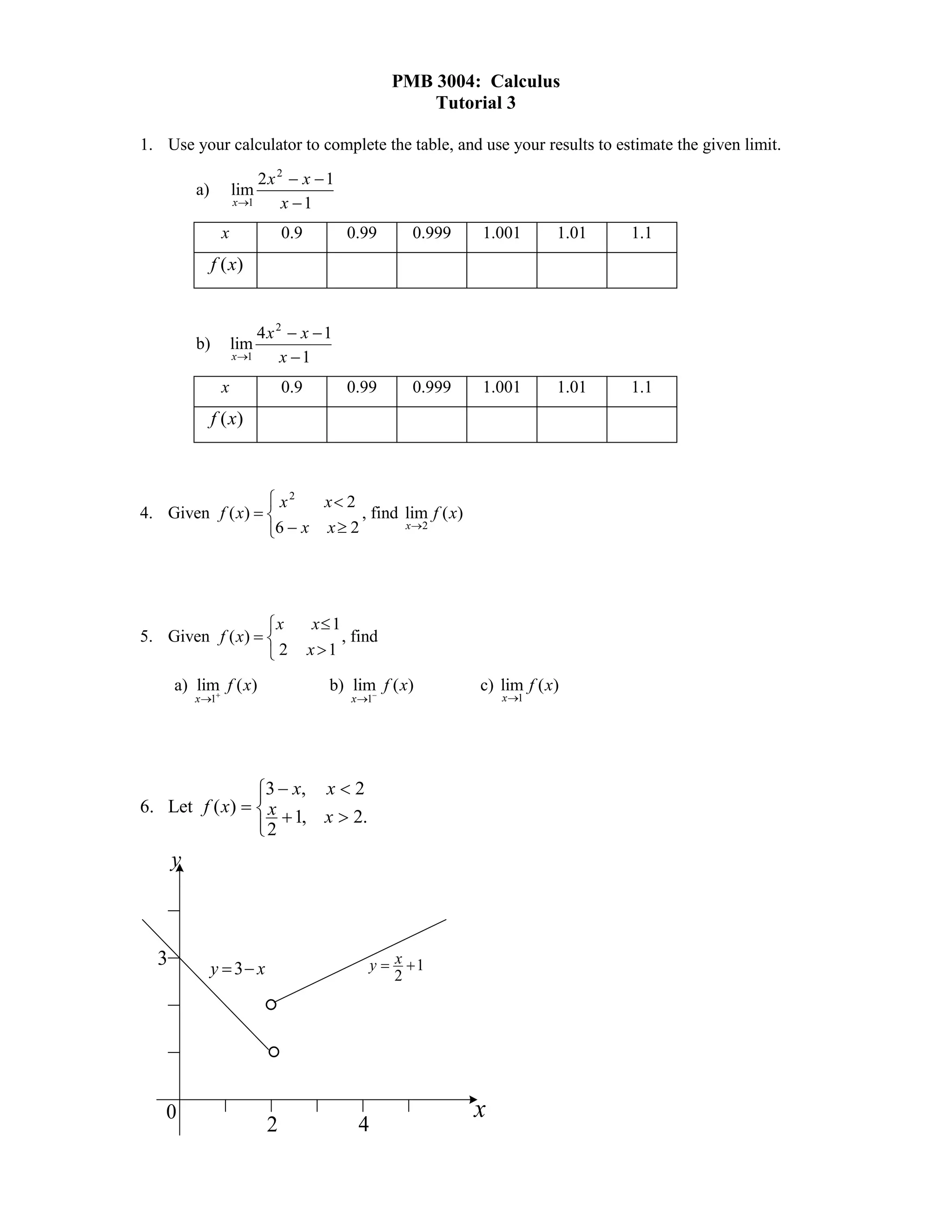
                3  x, x  2
                
6. Let f ( x)   x
                 2  1, x  2.
                
      y


  3            y  3 x                         y  x 1
                                                    2

                           
                           
   0                                                          x
                           2                4
(a) Find lim f ( x) and lim f ( x) .
                 x 2           x 2

    (b) Does lim f ( x) exist? If so, what is it? If not, why not?
                     x2

    (c) Find lim f ( x) and lim f ( x) .
                 x 4           x 4

    (d) Does lim f ( x) exist? If so, what is it? If not, why not?
                     x4


7. Find the limits for each of the following below:


    a)   lim 5
         x 3
                                                                 ( 2  h) 2  4
                                                       p)   lim
                                                            h 0        h
    b) lim c
         x 1                                                      2
                                                       q)   lim
                                                            x  x  1
    c)   lim x 3
         x3
                                                                 2x  4
                                                       r)   lim
    d) lim( x  x  1)
                 4
                                                            x  3  2 x
         x 1

    e)   lim( y  1)(x  3)                                      x2
                                                       s)   lim
         y 2                                               x    x3
    f)   lim( y 3  y)                                             r3
         y 2                                          t)   lim
                                                            r  r 2  1

              3x 2  4
    g) lim
         x 2
                                                                 5t 2  2t  1
                  x                                    u) lim
                                                            t      4t  7
              2x2  x  3
    h)   lim                                                      3  4x  2x 2
         x 2   x3  4                                 v)   lim
                                                            x  5 x 3  8 x  1
                1
    i)   lim                                                          x2 1
         x0    x2                                     w) lim
                                                            x  x 3  4 x  3
                x2
    j)   lim
         x 2 x  3 x  4
                   3                                               x2 1
                                                       x)   lim
                                                            x  (3 x  2) 2
                x5
    k)   lim
         x 5 x 2  25


              x2  x  2
    l)   lim
         x 2   x2
             t2 9
    m) lim
         t 3 t  3


                   x2 1
    n) lim
         x 1 4 x 2  2 x  2


              ( x  3) 2  9
    o) lim
         x 0        x
8. Find the limits.
    a) lim 2 x  3                        b) lim x  3x  10 .
                                                   2

       x 3 x  4 x  3                     x 5   x5
   c) lim x  1
       x 1
              x3 2                      d) lim x  3 .
                                             x 9 x  9


9. Show          that      the function
         f ( x)  x  x  6 continuous
                    2

                     x2  4
        at x  3 .


10. Show that the function

                 x  2   if x  1,
                 
       f ( x )  2 x     if x  1,
                  x  3 if x  1.
                 

    is continuous at x  1

Calculus :Tutorial 3

  • 1.
    PMB 3004: Calculus Tutorial 3 1. Use your calculator to complete the table, and use your results to estimate the given limit. 2x 2  x  1 a) lim x 1 x 1 x 0.9 0.99 0.999 1.001 1.01 1.1 f (x) 4x 2  x  1 b) lim x 1 x 1 x 0.9 0.99 0.999 1.001 1.01 1.1 f (x)  x2 x 2 4. Given f ( x)   , find lim f ( x) 6  x x  2 x2 x x 1 5. Given f ( x)   , find 2 x1 a) lim f ( x)  b) lim f ( x)  c) lim f ( x) x 1 x 1 x1 3  x, x  2  6. Let f ( x)   x  2  1, x  2.  y 3 y  3 x y  x 1 2   0 x 2 4
  • 2.
    (a) Find limf ( x) and lim f ( x) . x 2 x 2 (b) Does lim f ( x) exist? If so, what is it? If not, why not? x2 (c) Find lim f ( x) and lim f ( x) . x 4 x 4 (d) Does lim f ( x) exist? If so, what is it? If not, why not? x4 7. Find the limits for each of the following below: a) lim 5 x 3 ( 2  h) 2  4 p) lim h 0 h b) lim c x 1 2 q) lim x  x  1 c) lim x 3 x3 2x  4 r) lim d) lim( x  x  1) 4 x  3  2 x x 1 e) lim( y  1)(x  3) x2 s) lim y 2 x  x3 f) lim( y 3  y) r3 y 2 t) lim r  r 2  1 3x 2  4 g) lim x 2 5t 2  2t  1 x u) lim t  4t  7 2x2  x  3 h) lim 3  4x  2x 2 x 2 x3  4 v) lim x  5 x 3  8 x  1 1 i) lim x2 1 x0 x2 w) lim x  x 3  4 x  3 x2 j) lim x 2 x  3 x  4 3 x2 1 x) lim x  (3 x  2) 2 x5 k) lim x 5 x 2  25 x2  x  2 l) lim x 2 x2 t2 9 m) lim t 3 t  3 x2 1 n) lim x 1 4 x 2  2 x  2 ( x  3) 2  9 o) lim x 0 x
  • 3.
    8. Find thelimits. a) lim 2 x  3 b) lim x  3x  10 . 2 x 3 x  4 x  3 x 5 x5 c) lim x  1 x 1 x3 2 d) lim x  3 . x 9 x  9 9. Show that the function f ( x)  x  x  6 continuous 2 x2  4 at x  3 . 10. Show that the function x  2 if x  1,  f ( x )  2 x if x  1,  x  3 if x  1.  is continuous at x  1