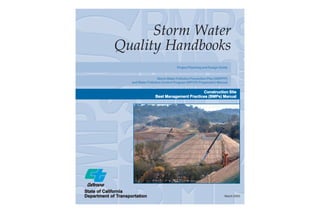
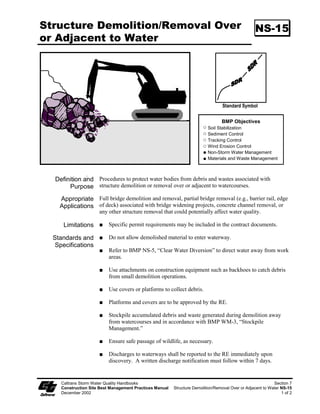
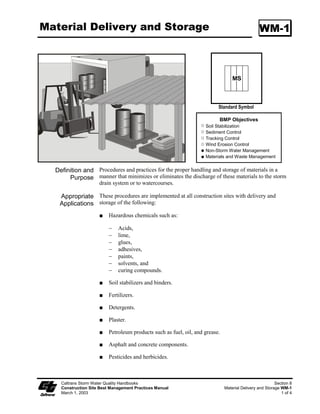
Storm Water
              Quality Handbooks
                                                   Project Planning and Design Guide


                                             Water
                                       Storm Water Pollution Prevention Plan (SWPPP)
                          Water
                      and Water Pollution Control Program (WPCP) Preparation Manual


                                                            Construction Site
                                     Best Management Practices (BMPs) Manual


State of California
                Transportation
Department of Transportation                                                      March 2003
Contents

Section 1 – Construction Site Best Management Practices
        1.1     Introduction........................................................................................................................ 1-1
        1.2     Storm Water Pollution Control Plan (SWPPP) and
                Water Pollution Control Program (WPCP)........................................................................ 1-1
        1.3     Organization of this Manual .............................................................................................. 1-2
        1.4     Caltrans Construction Site BMPs ...................................................................................... 1-2
                1.4.1         Approved Construction Site BMPs for Statewide Use....................................... 1-3
                1.4.2         Approved Construction Site BMPs for Use on a Project-by-Project Basis ........ 1-3

Section 2 – Selecting and Implementing Construction Site Best Management
            Practices
        2.1     Definitions ......................................................................................................................... 2-1
                2.1.1         Disturbed Soil Area (DSA)................................................................................. 2-1
                2.1.2         Active Areas and Non-Active Areas .................................................................. 2-1
                2.1.3         Slope Length and Benches ................................................................................. 2-2
                2.1.4         Rainy Season ...................................................................................................... 2-2


        2.2     Temporary Soil Stabilization and Sediment Control Implementation Guidance............... 2-4
                2.2.1         Scheduling .......................................................................................................... 2-4
                2.2.2         Preservation of Existing Vegetation ................................................................... 2-4
                2.2.3         Storm Water Run-on and Concentrated Flows................................................... 2-4
                2.2.4         Disturbed Soil Area Management ...................................................................... 2-5
                              2.2.4.1          Disturbed Soil Area Size Limitations ............................................... 2-5
                2.2.5         DSA Protection by Temporary Soil Stabilization and Temporary Sediment
                              Controls .............................................................................................................. 2-5
                2.2.6         Procedures for Rainfall Area 7 ........................................................................... 2-6
                2.2.7         Basins ............................................................................................................... 2-10
                2.2.8         Stockpile Management ..................................................................................... 2-10
        2.3     Guidance for Implementation of Other BMPs ................................................................ 2-10
                2.3.1         Mobile Operations ............................................................................................ 2-10
                2.3.2         Wind Erosion Controls ..................................................................................... 2-10
                2.3.3         Tracking Controls ............................................................................................. 2-10
                2.3.4         Non-Storm Water and Waste Management
                              and Materials Pollution Controls ...................................................................... 2-10
        2.4     BMP Inspections.............................................................................................................. 2-11


       Caltrans Storm Water Quality Handbooks
       Construction Site Best Management Practices Manual                                                                                     Contents
       March 1, 2003                                                                                                                                  i
Contents


Section 3 – Temporary Soil Stabilization Best Management Practices
        3.1     Temporary Soil Stabilization ............................................................................................. 3-1
                3.1.1        Temporary Concentrated Flow Conveyance Controls........................................ 3-1
        Working Details for Temporary Soil Stabilization BMPs
                SS-1         Scheduling
                SS-2         Preservation of Existing Vegetation
                SS-3         Hydraulic Mulch
                SS-4         Hydroseeding
                SS-5         Soil Binders
                SS-6         Straw Mulch
                SS-7         Geotextiles, Plastic Covers & Erosion Control Blankets/Mats
                SS-8         Wood Mulching
                SS-9         Earth Dikes/Drainage Swales & Lined Ditches
                SS-10        Outlet Protection/Velocity Dissipation Devices
                SS-11        Slope Drains
                SS-12        Streambank Stabilization

Section 4 – Temporary Sediment Control Best Management Practices
        4.1     Temporary Sediment Controls........................................................................................... 4-1
        Working Details for Temporary Sediment Control BMPs
                SC-1         Silt Fence
                SC-2         Sediment/Desilting Basin
                SC-3         Sediment Trap
                SC-4         Check Dam
                SC-5         Fiber Rolls
                SC-6         Gravel Bag Berm
                SC-7         Street Sweeping and Vacuuming
                SC-8         Sandbag Barrier
                SC-9         Straw Bale Barrier
                SC-10        Storm Drain Inlet Protection


Section 5 – Wind Erosion Control Best Management Practices
        5.1     Wind Erosion Control........................................................................................................ 5-1
        Working Details for Wind Erosion Control BMPs
                WE-1         Wind Erosion Control


       Caltrans Storm Water Quality Handbooks
       Construction Site Best Management Practices Manual                                                                            Contents
       March 1, 2003                                                                                                                        ii
Contents


Section 6 – Tracking Control Best Management Practices
        6.1   Tracking Control................................................................................................................ 6-1
        Working Details for Tracking Control BMPs
              TC-1     Stabilized Construction Entrance/Exit
              TC-2     Stabilized Construction Roadway
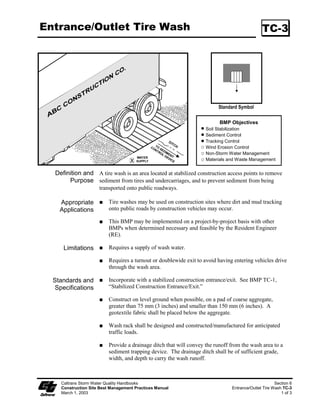
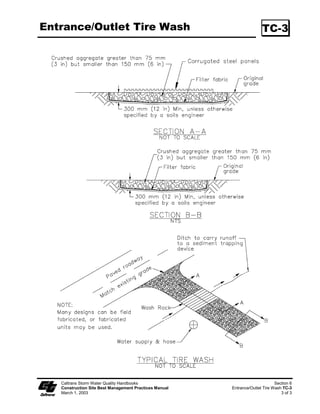
              TC-3     Entrance/Outlet Tire Wash

Section 7 – Non-Storm Water Management Best Management Practices
        7.1   Non-Storm Water Management......................................................................................... 7-1
        Working Details for Non-Storm Water Management BMPs
              NS-1     Water Conservation Practices
              NS-2     Dewatering Operations
              NS-3     Paving and Grinding Operations
              NS-4     Temporary Stream Crossing
              NS-5     Clear Water Diversion
              NS-6     Illicit Connection/Illegal Discharge Detection and Reporting
              NS-7     Potable Water/Irrigation
              NS-8     Vehicle and Equipment Cleaning
              NS-9     Vehicle and Equipment Fueling
              NS-10 Vehicle and Equipment Maintenance
              NS-11 Pile Driving Operations
              NS-12 Concrete Curing
              NS-13 Material and Equipment Use Over Water
              NS-14 Concrete Finishing
              NS-15 Structure Demolition/Removal Over or Adjacent to Water
Section 8 –Waste Management and Materials Pollution Control Best Management
           Practices
        8.1   Waste Management and Materials Pollution Control ........................................................ 8-1
              8.1.1    Waste Management BMPs ................................................................................. 8-1
              8.1.2    Materials Pollution Control BMPs ..................................................................... 8-1
        Working Details for Waste Management and Materials Pollution Control BMPs
              WM-1 Material Delivery and Storage
              WM-2 Material Use
              WM-3 Stockpile Management
              WM-4 Spill Prevention and Control
              WM-5 Solid Waste Management
              WM-6 Hazardous Waste Management
              WM-7 Contaminated Soil Management
              WM-8 Concrete Waste Management
              WM-9 Sanitary/Septic Waste Management
              WM-10 Liquid Waste Management
       Caltrans Storm Water Quality Handbooks
       Construction Site Best Management Practices Manual                                                                              Contents
       March 1, 2003                                                                                                                         iii
Contents


Appendices
       Appendix A Abbreviations, Acronyms, and Definition of Terms
       Appendix B Selection of Temporary Soil Stabilization Controls
               B.1       Antecedent Moisture.......................................................................................... B-1
               B.2       Availability ........................................................................................................ B-1
               B.3       Ease of Clean-Up............................................................................................... B-1
               B.4       Installation Cost................................................................................................. B-2
               B.5       Degradability ..................................................................................................... B-2
               B.6       Length of Drying Time...................................................................................... B-2
               B.7       Time to Effectiveness ........................................................................................ B-2
               B.8       Erosion Control Effectiveness ........................................................................... B-3
               B.9       Longevity........................................................................................................... B-3
               B.10      Mode of Application.......................................................................................... B-3
               B.11      Residual Impact ................................................................................................. B-3
               B.12      Native ................................................................................................................ B-3
               B.13      Runoff Effect ..................................................................................................... B-3


      Caltrans Storm Water Quality Handbooks
      Construction Site Best Management Practices Manual                                                                                 Contents
      March 1, 2003                                                                                                                            iv
Contents


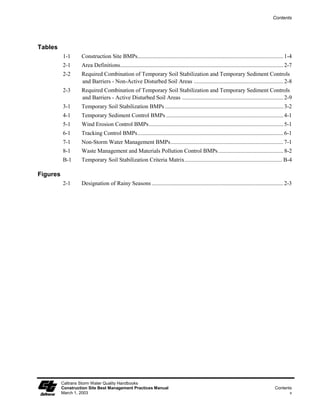
Tables
          1-1      Construction Site BMPs..................................................................................................... 1-4
          2-1      Area Definitions................................................................................................................. 2-7
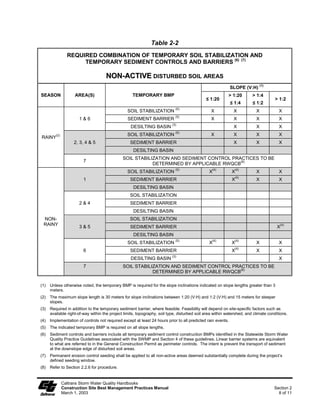
          2-2      Required Combination of Temporary Soil Stabilization and Temporary Sediment Controls
                   and Barriers - Non-Active Disturbed Soil Areas .............................................................. 2-8
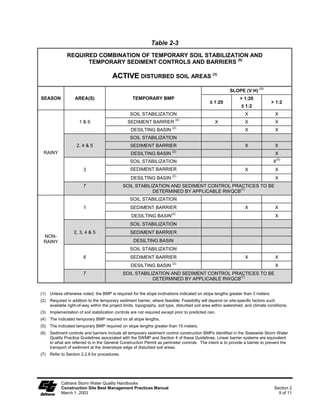
          2-3      Required Combination of Temporary Soil Stabilization and Temporary Sediment Controls
                   and Barriers - Active Disturbed Soil Areas ...................................................................... 2-9
          3-1      Temporary Soil Stabilization BMPs .................................................................................. 3-2
          4-1      Temporary Sediment Control BMPs ................................................................................. 4-1
          5-1      Wind Erosion Control BMPs............................................................................................. 5-1
          6-1      Tracking Control BMPs..................................................................................................... 6-1
          7-1      Non-Storm Water Management BMPs.............................................................................. 7-1
          8-1      Waste Management and Materials Pollution Control BMPs ............................................. 8-2
          B-1      Temporary Soil Stabilization Criteria Matrix ................................................................... B-4

Figures
          2-1      Designation of Rainy Seasons ........................................................................................... 2-3


          Caltrans Storm Water Quality Handbooks
          Construction Site Best Management Practices Manual                                                                                 Contents
          March 1, 2003                                                                                                                             v
Section 1
                             Construction Site
                        Best Management Practices

1.1    Introduction
On July 15, 1999, the State Water Resources Control Board (SWRCB) issued the “National
Pollutant Discharge Elimination System (NPDES) Permit, Statewide Storm Water Permit and Waste
Discharge Requirements (WDRs) for the State of California, Department of Transportation
(Caltrans)” (Order No. 99-06-DWQ, NPDES No. CAS000003) hereby called “Permit”. The Permit
regulates storm water discharges from Caltrans properties, facilities and activities, and requires that
Caltrans’ construction program comply with the requirements of the “NPDES General Permit,
Waste Discharge Requirements (WDRs) for Discharges of Storm Water Runoff Associated with
Construction Activity” (Order No. 99-08-DWQ, NPDES No. CAS000002) (General Permit) issued
by the SWRCB, to regulate discharges from construction sites that disturb 5 acres or more.
Beginning March 10, 2003, U.S. Environmental Protection Agency (EPA) and SWRCB regulations
will regulate discharges from projects with soil disturbance of 1 acre or more by amending the
General Permit and thus including coverage of projects with soil disturbance of 1 acre or more.
SWRCB Resolution No. 2001-46 modified provisions of the General Permit that require permittees
to implement specific water quality sampling and analytical procedures implemented on a
construction site.


1.2    Storm Water Pollution Prevention Plan (SWPPP) and Water
       Pollution Control Program (WPCP)
Caltrans requires contractors to prepare and implement a program to control water pollution
effectively during the construction of all projects (see Standard Specification Section 7-1.01G Water
Pollution). Projects resulting in 0.4 hectares (ha) [1 ac] or more of soil disturbance are subject to the
General Permit. Caltrans Special Provisions require that for larger projects, defined as those
resulting in 0.4 ha (1 ac) or more of soil disturbance, Contractors prepare and submit a Storm Water
Pollution Prevention Plan (SWPPP). When a SWPPP is required for a project, it will satisfy the
requirements of Standard Specification Section 7-1.01G, in addition to meeting other permit
requirements.

Caltrans requires that a Water Pollution Control Program (WPCP) addressing control measures be
prepared and implemented by the construction contractor for projects resulting in soil disturbance of
less than 0.4 ha (1ac). For detailed step-by-step procedures, instructions and templates to prepare a
SWPPP or a WPCP, refer to the Caltrans Storm Water Quality Handbooks, Storm Water Pollution
Prevention Plan (SWPPP) and Water Pollution Control Program (WPCP) Preparation Manual.


         Caltrans Storm Water Quality Handbooks
         Construction Site Best Management Practices Manual                                      Section 1
         March 1, 2003                                                                              1 of 5
If two (2) or more small projects [less than 0.4 ha (1 ac) of soil disturbance] in the same corridor are
part of a larger common plan of development [0.4 ha (1 ac) or more], then these small projects are
also subject to the requirements of the General Permit to develop and implement a SWPPP.

1.3    Organization of this Manual
This Storm Water Quality Handbooks, Construction Site Best Management Practices Manual
(manual) is intended to provide Contractors and Caltrans staff with detailed information of
construction site BMPs. This Manual is organized as follows:

   Section 1 provides an introduction to the Construction Site Best Management Practices (BMPs)
   Manual.

   Section 2 provides instructions for the selection and implementation of construction site BMPs.

   Section 3 provides listing and working details for Caltrans construction site BMPs for
   Temporary Soil Stabilization.

   Section 4 provides listing and working details for Caltrans construction site BMPs for
   Temporary Sediment Control.

   Section 5 provides listing and working details for Caltrans construction site BMPs for Wind
   Erosion Control.

   Section 6 provides listing and working details for Caltrans construction site BMPs for Tracking
   Control.

   Section 7 provides listing and working details for Caltrans construction site BMPs for Non-
   Storm Water Management.

   Section 8 provides listing and working details for Caltrans construction site BMPs for Waste
   Management and Materials Pollution Control.

   Appendix A provides a listing of frequently used abbreviations, acronyms, and definitions of
   terms used throughout this Manual.

   Appendix B provides guidance on the selection of temporary soil stabilization controls.

1.4    Caltrans Construction Site BMPs
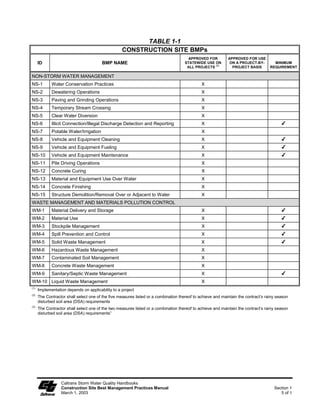
This section lists those BMPs considered during the construction of Caltrans projects. Construction
site BMPs (also called temporary control practices) are best conventional technology/best available
technology (BCT/BAT)-based BMPs that are consistent with the BMPs and control practices
required under the General Permit. Caltrans construction site BMPs are divided into six categories
(see Table 1-1):


         Caltrans Storm Water Quality Handbooks
         Construction Site Best Management Practices Manual                                      Section 1
         March 1, 2003                                                                              2 of 5
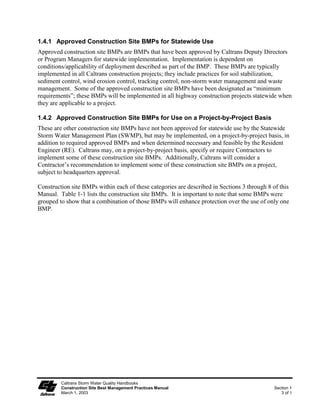
1.4.1 Approved Construction Site BMPs for Statewide Use
Approved construction site BMPs are BMPs that have been approved by Caltrans Deputy Directors
or Program Managers for statewide implementation. Implementation is dependent on
conditions/applicability of deployment described as part of the BMP. These BMPs are typically
implemented in all Caltrans construction projects; they include practices for soil stabilization,
sediment control, wind erosion control, tracking control, non-storm water management and waste
management. Some of the approved construction site BMPs have been designated as “minimum
requirements”; these BMPs will be implemented in all highway construction projects statewide when
they are applicable to a project.

1.4.2 Approved Construction Site BMPs for Use on a Project-by-Project Basis
These are other construction site BMPs have not been approved for statewide use by the Statewide
Storm Water Management Plan (SWMP), but may be implemented, on a project-by-project basis, in
addition to required approved BMPs and when determined necessary and feasible by the Resident
Engineer (RE). Caltrans may, on a project-by-project basis, specify or require Contractors to
implement some of these construction site BMPs. Additionally, Caltrans will consider a
Contractor’s recommendation to implement some of these construction site BMPs on a project,
subject to headquarters approval.

Construction site BMPs within each of these categories are described in Sections 3 through 8 of this
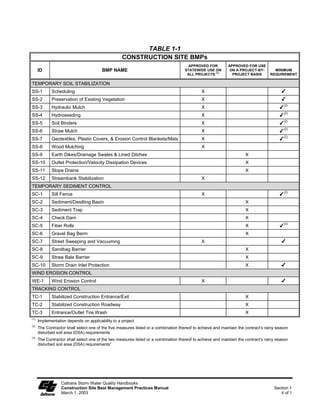
Manual. Table 1-1 lists the construction site BMPs. It is important to note that some BMPs were
grouped to show that a combination of those BMPs will enhance protection over the use of only one
BMP.


         Caltrans Storm Water Quality Handbooks
         Construction Site Best Management Practices Manual                                   Section 1
         March 1, 2003                                                                           3 of 5
TABLE 1-1
                                                   CONSTRUCTION SITE BMPs
                                                                                       APPROVED FOR          APPROVED FOR USE
      ID                                BMP NAME                                     STATEWIDE USE ON
                                                                                                   (1)
                                                                                                              ON A PROJECT-BY-        MINIMUM
                                                                                      ALL PROJECTS             PROJECT BASIS        REQUIREMENT

TEMPORARY SOIL STABILIZATION
SS-1         Scheduling                                                                        X                                          ,
SS-2         Preservation of Existing Vegetation                                               X                                          ,
                                                                                                                                           (2)
SS-3         Hydraulic Mulch                                                                   X                                         ,
                                                                                                                                           (2)
SS-4         Hydroseeding                                                                      X                                         ,
                                                                                                                                           (2)
SS-5         Soil Binders                                                                      X                                         ,
                                                                                                                                           (2)
SS-6         Straw Mulch                                                                       X                                         ,
                                                                                                                                           (2)
SS-7         Geotextiles, Plastic Covers, & Erosion Control Blankets/Mats                      X                                         ,
SS-8         Wood Mulching                                                                     X
SS-9         Earth Dikes/Drainage Swales & Lined Ditches                                                              X
SS-10        Outlet Protection/Velocity Dissipation Devices                                                           X
SS-11        Slope Drains                                                                                             X
SS-12        Streambank Stabilization                                                          X
TEMPORARY SEDIMENT CONTROL
                                                                                                                                           (3)
SC-1         Silt Fence                                                                        X                                         ,
SC-2         Sediment/Desilting Basin                                                                                 X
SC-3         Sediment Trap                                                                                            X
SC-4         Check Dam                                                                                                X
                                                                                                                                           (3)
SC-5         Fiber Rolls                                                                                              X                  ,
SC-6         Gravel Bag Berm                                                                                          X
SC-7         Street Sweeping and Vacuuming                                                     X                                          ,
SC-8         Sandbag Barrier                                                                                          X
SC-9         Straw Bale Barrier                                                                                       X
SC-10        Storm Drain Inlet Protection                                                                             X                   ,
WIND EROSION CONTROL
WE-1         Wind Erosion Control                                                              X                                          ,
TRACKING CONTROL
TC-1         Stabilized Construction Entrance/Exit                                                                    X
TC-2         Stabilized Construction Roadway                                                                          X
TC-3         Entrance/Outlet Tire Wash                                                                                X
(1)
      Implementation depends on applicability to a project
(2)
      The Contractor shall select one of the five measures listed or a combination thereof to achieve and maintain the contract’s rainy season
      disturbed soil area (DSA) requirements
(3)
      The Contractor shall select one of the two measures listed or a combination thereof to achieve and maintain the contract’s rainy season
      disturbed soil area (DSA) requirements”


                  Caltrans Storm Water Quality Handbooks
                  Construction Site Best Management Practices Manual                                                                  Section 1
                  March 1, 2003                                                                                                          4 of 5
TABLE 1-1
                                                   CONSTRUCTION SITE BMPs
                                                                                       APPROVED FOR          APPROVED FOR USE
      ID                                BMP NAME                                     STATEWIDE USE ON
                                                                                                   (1)
                                                                                                              ON A PROJECT-BY-        MINIMUM
                                                                                      ALL PROJECTS             PROJECT BASIS        REQUIREMENT

NON-STORM WATER MANAGEMENT
NS-1         Water Conservation Practices                                                      X
NS-2         Dewatering Operations                                                             X
NS-3         Paving and Grinding Operations                                                    X
NS-4         Temporary Stream Crossing                                                         X
NS-5         Clear Water Diversion                                                             X
NS-6         Illicit Connection/Illegal Discharge Detection and Reporting                      X                                          ,
NS-7         Potable Water/Irrigation                                                          X
NS-8         Vehicle and Equipment Cleaning                                                    X                                          ,
NS-9         Vehicle and Equipment Fueling                                                     X                                          ,
NS-10        Vehicle and Equipment Maintenance                                                 X                                          ,
NS-11        Pile Driving Operations                                                           X
NS-12        Concrete Curing                                                                   X
NS-13        Material and Equipment Use Over Water                                             X
NS-14        Concrete Finishing                                                                X
NS-15        Structure Demolition/Removal Over or Adjacent to Water                            X
WASTE MANAGEMENT AND MATERIALS POLLUTION CONTROL
WM-1         Material Delivery and Storage                                                     X                                          ,
WM-2         Material Use                                                                      X                                          ,
WM-3         Stockpile Management                                                              X                                          ,
WM-4         Spill Prevention and Control                                                      X                                          ,
WM-5         Solid Waste Management                                                            X                                          ,
WM-6         Hazardous Waste Management                                                        X
WM-7         Contaminated Soil Management                                                      X
WM-8         Concrete Waste Management                                                         X
WM-9         Sanitary/Septic Waste Management                                                  X                                          ,
WM-10 Liquid Waste Management                                                                  X
(1)
      Implementation depends on applicability to a project
(2)
      The Contractor shall select one of the five measures listed or a combination thereof to achieve and maintain the contract’s rainy season
      disturbed soil area (DSA) requirements
(3)
      The Contractor shall select one of the two measures listed or a combination thereof to achieve and maintain the contract’s rainy season
      disturbed soil area (DSA) requirements”


                  Caltrans Storm Water Quality Handbooks
                  Construction Site Best Management Practices Manual                                                                  Section 1
                  March 1, 2003                                                                                                          5 of 5
Section 2
              Selecting and Implementing
      Construction Site Best Management Practices

This section provides instructions for the selection and implementation of construction site best
management practices (BMPs). It is important to note that the requirements of this Section are
Caltrans minimum requirements, and that Caltrans Districts may impose more stringent requirements
on a project-by-project basis, and that the Contractor implements additional construction site BMPs
if deemed necessary. Changes in field implementation of construction site BMPs require written
approval of the Resident Engineer (RE). Any additional requirements will be included in the
project’s Standard Special Provisions (SSPs). Working details of construction site BMPs are
presented in Sections 3 through 8 of this Manual.

2.1    Definitions
2.1.1 Disturbed Soil Area (DSA)
Disturbed soil areas (DSAs) are areas of exposed, erodible soil that are within the construction limits
and that result from construction activities. The following are not considered DSAs:

   Areas where soil stabilization, erosion control, highway planting, or slope protection are applied
   and associated drainage facilities are in place and functional.

   Roadways, construction roads, access roads or contractor’s yards that have been stabilized by the
   placement of compacted subbase or base material or paved surfacing.

   Areas where construction has been completed in conformance with the contract plans and
   permanent erosion control is in place and functional.

Erosion control is considered functional when a uniform vegetative cover equivalent to 70 percent of
the native background vegetation coverage has been established or equivalent stabilization measures
have been employed.

2.1.2 Active Areas and Non-Active Areas
Active Areas are construction areas where soil-disturbing activities have already occurred and
continue to occur or will occur during the ensuing 21 days.

Non-Active Areas are construction areas (formerly active areas) that will be idle for at least 21 days.

The RE will conduct a review of the existing active areas on a regular basis to determine if a non-
active status should be applied to some DSAs.


         Caltrans Storm Water Quality Handbooks
         Construction Site Best Management Practices Manual                                      Section 2
         March 1, 2003                                                                             1 of 11
2.1.3 Slope Length and Benches
Slope length is measured or calculated along the continuous inclined surface. Each discrete slope is
between one of the following: top to toe, top to bench, bench to bench, and bench to toe.

Benches are drainage facilities that intercept surface flow and convey the resulting concentrated flow
away from a slope. For the purpose of determining slope lengths, fiber rolls or other appropriate
BMPs (used for temporary sediment control) can be considered equivalent to a bench.

2.1.4 Rainy Season
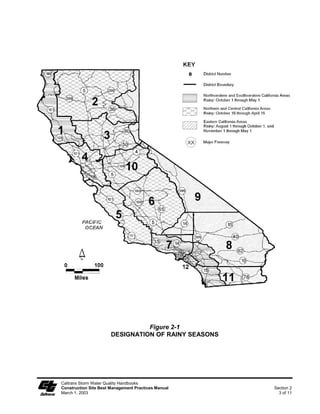
The average rainfall in California varies greatly from region to region. To account for the various
rainfall patterns (time frame, intensities, and amounts) the state is separated into several rainy
seasons. Shown in Figure 2-1 is a map identifying the rainy seasons throughout the state. These
rainy seasons are used to identify the appropriate level of soil stabilization and sediment control
protection.


         Caltrans Storm Water Quality Handbooks
         Construction Site Best Management Practices Manual                                    Section 2
         March 1, 2003                                                                           2 of 11
Figure 2-1
                       DESIGNATION OF RAINY SEASONS


Caltrans Storm Water Quality Handbooks
Construction Site Best Management Practices Manual    Section 2
March 1, 2003                                           3 of 11
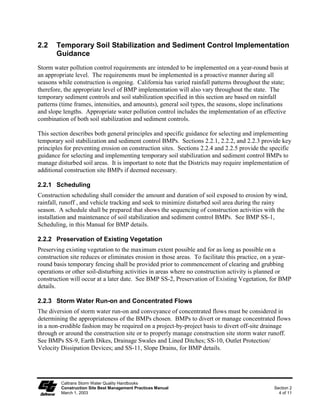
2.2    Temporary Soil Stabilization and Sediment Control Implementation
       Guidance
Storm water pollution control requirements are intended to be implemented on a year-round basis at
an appropriate level. The requirements must be implemented in a proactive manner during all
seasons while construction is ongoing. California has varied rainfall patterns throughout the state;
therefore, the appropriate level of BMP implementation will also vary throughout the state. The
temporary sediment controls and soil stabilization specified in this section are based on rainfall
patterns (time frames, intensities, and amounts), general soil types, the seasons, slope inclinations
and slope lengths. Appropriate water pollution control includes the implementation of an effective
combination of both soil stabilization and sediment controls.

This section describes both general principles and specific guidance for selecting and implementing
temporary soil stabilization and sediment control BMPs. Sections 2.2.1, 2.2.2, and 2.2.3 provide key
principles for preventing erosion on construction sites. Sections 2.2.4 and 2.2.5 provide the specific
guidance for selecting and implementing temporary soil stabilization and sediment control BMPs to
manage disturbed soil areas. It is important to note that the Districts may require implementation of
additional construction site BMPs if deemed necessary.

2.2.1 Scheduling
Construction scheduling shall consider the amount and duration of soil exposed to erosion by wind,
rainfall, runoff , and vehicle tracking and seek to minimize disturbed soil area during the rainy
season. A schedule shall be prepared that shows the sequencing of construction activities with the
installation and maintenance of soil stabilization and sediment control BMPs. See BMP SS-1,
Scheduling, in this Manual for BMP details.

2.2.2 Preservation of Existing Vegetation
Preserving existing vegetation to the maximum extent possible and for as long as possible on a
construction site reduces or eliminates erosion in those areas. To facilitate this practice, on a year-
round basis temporary fencing shall be provided prior to commencement of clearing and grubbing
operations or other soil-disturbing activities in areas where no construction activity is planned or
construction will occur at a later date. See BMP SS-2, Preservation of Existing Vegetation, for BMP
details.

2.2.3 Storm Water Run-on and Concentrated Flows
The diversion of storm water run-on and conveyance of concentrated flows must be considered in
determining the appropriateness of the BMPs chosen. BMPs to divert or manage concentrated flows
in a non-erodible fashion may be required on a project-by-project basis to divert off-site drainage
through or around the construction site or to properly manage construction site storm water runoff.
See BMPs SS-9, Earth Dikes, Drainage Swales and Lined Ditches; SS-10, Outlet Protection/
Velocity Dissipation Devices; and SS-11, Slope Drains, for BMP details.


         Caltrans Storm Water Quality Handbooks
         Construction Site Best Management Practices Manual                                     Section 2
         March 1, 2003                                                                            4 of 11
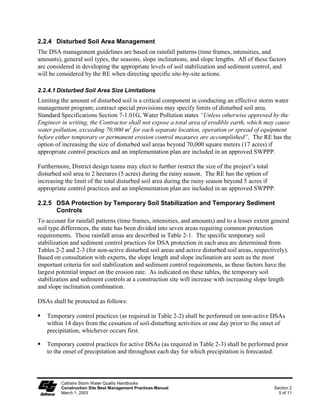
2.2.4 Disturbed Soil Area Management
The DSA management guidelines are based on rainfall patterns (time frames, intensities, and
amounts), general soil types, the seasons, slope inclinations, and slope lengths. All of these factors
are considered in developing the appropriate levels of soil stabilization and sediment control, and
will be considered by the RE when directing specific site-by-site actions.

2.2.4.1 Disturbed Soil Area Size Limitations
Limiting the amount of disturbed soil is a critical component in conducting an effective storm water
management program; contract special provisions may specify limits of disturbed soil area.
Standard Specifications Section 7-1.01G, Water Pollution states “Unless otherwise approved by the
Engineer in writing, the Contractor shall not expose a total area of erodible earth, which may cause
water pollution, exceeding 70,000 m2 for each separate location, operation or spread of equipment
before either temporary or permanent erosion control measures are accomplished”. The RE has the
option of increasing the size of disturbed soil areas beyond 70,000 square meters (17 acres) if
appropriate control practices and an implementation plan are included in an approved SWPPP.

Furthermore, District design teams may elect to further restrict the size of the project’s total
disturbed soil area to 2 hectares (5 acres) during the rainy season. The RE has the option of
increasing the limit of the total disturbed soil area during the rainy season beyond 5 acres if
appropriate control practices and an implementation plan are included in an approved SWPPP.

2.2.5 DSA Protection by Temporary Soil Stabilization and Temporary Sediment
      Controls
To account for rainfall patterns (time frames, intensities, and amounts) and to a lesser extent general
soil type differences, the state has been divided into seven areas requiring common protection
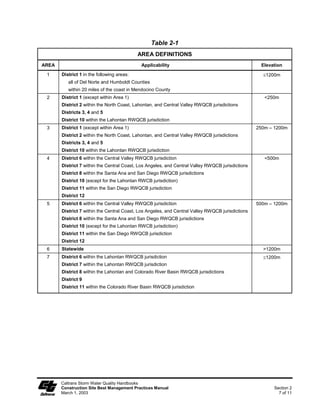
requirements. These rainfall areas are described in Table 2-1. The specific temporary soil
stabilization and sediment control practices for DSA protection in each area are determined from
Tables 2-2 and 2-3 (for non-active disturbed soil areas and active disturbed soil areas, respectively).
Based on consultation with experts, the slope length and slope inclination are seen as the most
important criteria for soil stabilization and sediment control requirements, as these factors have the
largest potential impact on the erosion rate. As indicated on these tables, the temporary soil
stabilization and sediment controls at a construction site will increase with increasing slope length
and slope inclination combination.

DSAs shall be protected as follows:

   Temporary control practices (as required in Table 2-2) shall be performed on non-active DSAs
   within 14 days from the cessation of soil-disturbing activities or one day prior to the onset of
   precipitation, whichever occurs first.

   Temporary control practices for active DSAs (as required in Table 2-3) shall be performed prior
   to the onset of precipitation and throughout each day for which precipitation is forecasted.


         Caltrans Storm Water Quality Handbooks
         Construction Site Best Management Practices Manual                                      Section 2
         March 1, 2003                                                                             5 of 11
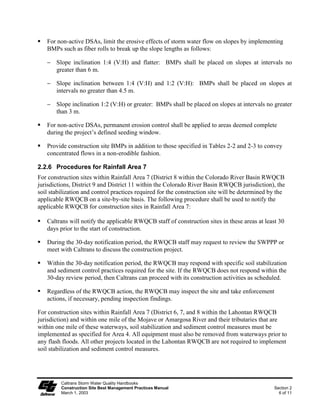
For non-active DSAs, limit the erosive effects of storm water flow on slopes by implementing
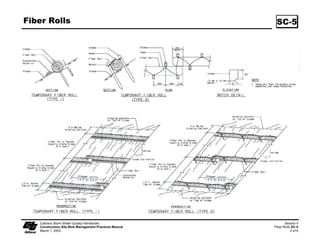
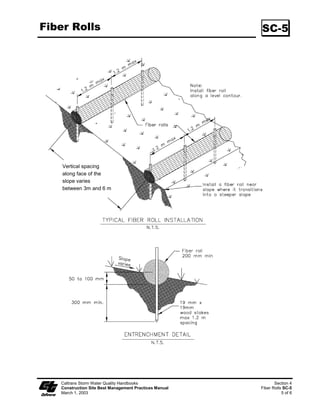
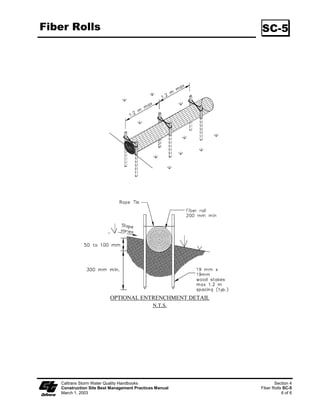
   BMPs such as fiber rolls to break up the slope lengths as follows:

   ϑ Slope inclination 1:4 (V:H) and flatter: BMPs shall be placed on slopes at intervals no
     greater than 6 m.

   ϑ Slope inclination between 1:4 (V:H) and 1:2 (V:H): BMPs shall be placed on slopes at
     intervals no greater than 4.5 m.

   ϑ Slope inclination 1:2 (V:H) or greater: BMPs shall be placed on slopes at intervals no greater
     than 3 m.

   For non-active DSAs, permanent erosion control shall be applied to areas deemed complete
   during the project’s defined seeding window.

   Provide construction site BMPs in addition to those specified in Tables 2-2 and 2-3 to convey
   concentrated flows in a non-erodible fashion.

2.2.6 Procedures for Rainfall Area 7
For construction sites within Rainfall Area 7 (District 8 within the Colorado River Basin RWQCB
jurisdictions, District 9 and District 11 within the Colorado River Basin RWQCB jurisdiction), the
soil stabilization and control practices required for the construction site will be determined by the
applicable RWQCB on a site-by-site basis. The following procedure shall be used to notify the
applicable RWQCB for construction sites in Rainfall Area 7:

   Caltrans will notify the applicable RWQCB staff of construction sites in these areas at least 30
   days prior to the start of construction.

   During the 30-day notification period, the RWQCB staff may request to review the SWPPP or
   meet with Caltrans to discuss the construction project.

   Within the 30-day notification period, the RWQCB may respond with specific soil stabilization
   and sediment control practices required for the site. If the RWQCB does not respond within the
   30-day review period, then Caltrans can proceed with its construction activities as scheduled.

   Regardless of the RWQCB action, the RWQCB may inspect the site and take enforcement
   actions, if necessary, pending inspection findings.

For construction sites within Rainfall Area 7 (District 6, 7, and 8 within the Lahontan RWQCB
jurisdiction) and within one mile of the Mojave or Amargosa River and their tributaries that are
within one mile of these waterways, soil stabilization and sediment control measures must be
implemented as specified for Area 4. All equipment must also be removed from waterways prior to
any flash floods. All other projects located in the Lahontan RWQCB are not required to implement
soil stabilization and sediment control measures.


         Caltrans Storm Water Quality Handbooks
         Construction Site Best Management Practices Manual                                     Section 2
         March 1, 2003                                                                            6 of 11
Table 2-1
                                            AREA DEFINITIONS
AREA                                         Applicability                                         Elevation

 1     District 1 in the following areas:                                                           1200m
          all of Del Norte and Humboldt Counties
          within 20 miles of the coast in Mendocino County
 2     District 1 (except within Area 1)                                                             <250m
       District 2 within the North Coast, Lahontan, and Central Valley RWQCB jurisdictions
       Districts 3, 4 and 5
       District 10 within the Lahontan RWQCB jurisdiction
 3     District 1 (except within Area 1)                                                          250m – 1200m
       District 2 within the North Coast, Lahontan, and Central Valley RWQCB jurisdictions
       Districts 3, 4 and 5
       District 10 within the Lahontan RWQCB jurisdiction
 4     District 6 within the Central Valley RWQCB jurisdiction                                       <500m
       District 7 within the Central Coast, Los Angeles, and Central Valley RWQCB jurisdictions
       District 8 within the Santa Ana and San Diego RWQCB jurisdictions
       District 10 (except for the Lahontan RWCB jurisdiction)
       District 11 within the San Diego RWQCB jurisdiction
       District 12
 5     District 6 within the Central Valley RWQCB jurisdiction                                    500m – 1200m
       District 7 within the Central Coast, Los Angeles, and Central Valley RWQCB jurisdictions
       District 8 within the Santa Ana and San Diego RWQCB jurisdictions
       District 10 (except for the Lahontan RWCB jurisdiction)
       District 11 within the San Diego RWQCB jurisdiction
       District 12
 6     Statewide                                                                                    >1200m
 7     District 6 within the Lahontan RWQCB jurisdiction                                            1200m
       District 7 within the Lahontan RWQCB jurisdiction
       District 8 within the Lahontan and Colorado River Basin RWQCB jurisdictions
       District 9
       District 11 within the Colorado River Basin RWQCB jurisdiction


       Caltrans Storm Water Quality Handbooks
       Construction Site Best Management Practices Manual                                               Section 2
       March 1, 2003                                                                                      7 of 11
Table 2-2
                 REQUIRED COMBINATION OF TEMPORARY SOIL STABILIZATION AND
                      TEMPORARY SEDIMENT CONTROLS AND BARRIERS (6) (7)

                                     NON-ACTIVE DISTURBED SOIL AREAS
                                                                                                                              (1)
                                                                                                             SLOPE (V:H)
SEASON               AREA(S)                        TEMPORARY BMP                                         > 1:20        > 1:4
                                                                                              ” 1:20                                 > 1:2
                                                                                                             ” 1:4      ” 1:2
                                                                             (5)
                                                 SOIL STABILIZATION                             X             X           X            X
                                                                             (5)
                       1&6                       SEDIMENT BARRIER                               X             X           X            X
                                                                           (3)
                                                   DESILTING BASIN                                            X           X            X
                                                                             (5)
         (2)                                     SOIL STABILIZATION                             X             X           X            X
RAINY
                    2, 3, 4 & 5                    SEDIMENT BARRIER                                           X           X            X
                                                     DESILTING BASIN
                                               SOIL STABILIZATION AND SEDIMENT CONTROL PRACTICES TO BE
                         7                                                                (8)
                                                           DETERMINED BY APPLICABLE RWQCB
                                                                             (5)                 (4)           (4)
                                                 SOIL STABILIZATION                            X             X            X            X
                                                                                                               (4)
                         1                         SEDIMENT BARRIER                                          X            X            X
                                                     DESILTING BASIN
                                                   SOIL STABILIZATION
                       2&4                         SEDIMENT BARRIER
                                                     DESILTING BASIN
 NON-                                              SOIL STABILIZATION
 RAINY                                                                                                                                 (4)
                       3&5                         SEDIMENT BARRIER                                                                   X
                                                     DESILTING BASIN
                                                                             (5)                 (4)           (4)
                                                 SOIL STABILIZATION                            X             X            X            X
                                                                                                               (4)
                         6                         SEDIMENT BARRIER                                          X            X            X
                                                                           (3)
                                                   DESILTING BASIN                                                                     X
                         7                     SOIL STABILIZATION AND SEDIMENT CONTROL PRACTICES TO BE
                                                                                          (8)
                                                           DETERMINED BY APPLICABLE RWQCB

(1)   Unless otherwise noted, the temporary BMP is required for the slope inclinations indicated on slope lengths greater than 3
      meters.
(2)   The maximum slope length is 30 meters for slope inclinations between 1:20 (V:H) and 1:2 (V:H) and 15 meters for steeper
      slopes.
(3)   Required in addition to the temporary sediment barrier, where feasible. Feasibility will depend on site-specific factors such as
      available right-of-way within the project limits, topography, soil type, disturbed soil area within watershed, and climate conditions.
(4)   Implementation of controls not required except at least 24 hours prior to all predicted rain events.
(5)   The indicated temporary BMP is required on all slope lengths.
(6)   Sediment controls and barriers include all temporary sediment control construction BMPs identified in the Statewide Storm Water
      Quality Practice Guidelines associated with the SWMP and Section 4 of these guidelines. Linear barrier systems are equivalent
      to what are referred to in the General Construction Permit as perimeter controls. The intent is prevent the transport of sediment
      at the downslope edge of disturbed soil areas.
(7)   Permanent erosion control seeding shall be applied to all non-active areas deemed substantially complete during the project’s
      defined seeding window.
(8)   Refer to Section 2.2.6 for procedure.


               Caltrans Storm Water Quality Handbooks
               Construction Site Best Management Practices Manual                                                                   Section 2
               March 1, 2003                                                                                                          8 of 11
Table 2-3
               REQUIRED COMBINATION OF TEMPORARY SOIL STABILIZATION AND
                     TEMPORARY SEDIMENT CONTROLS AND BARRIERS (6)

                                         ACTIVE DISTURBED SOIL AREAS (3)
                                                                                                                            (1)
                                                                                                           SLOPE (V:H)
SEASON              AREA(S)                         TEMPORARY BMP                                                > 1:20
                                                                                                ” 1:20                            > 1:2
                                                                                                                 ” 1:2
                                                   SOIL STABILIZATION                                               X                X
                                                                             (4)
                      1&6                         SEDIMENT BARRIER                                 X                X                X
                                                                           (2)
                                                   DESILTING BASIN                                                  X                X
                                                   SOIL STABILIZATION
                     2, 4 & 5                      SEDIMENT BARRIER                                                 X                X
 RAINY                                                                     (2)
                                                   DESILTING BASIN                                                                   X
                                                                                                                                     (5)
                                                   SOIL STABILIZATION                                                               X
                         3                         SEDIMENT BARRIER                                                 X                X
                                                                           (2)
                                                   DESILTING BASIN                                                                   X
                         7                     SOIL STABILIZATION AND SEDIMENT CONTROL PRACTICES TO BE
                                                                                          (7)
                                                           DETERMINED BY APPLICABLE RWQCB
                                                   SOIL STABILIZATION
                         1                         SEDIMENT BARRIER                                                 X                X
                                                                           (2)
                                                    DESILTING BASIN                                                                  X
                                                   SOIL STABILIZATION
                   2, 3, 4 & 5                     SEDIMENT BARRIER
 NON-
 RAINY                                               DESILTING BASIN
                                                   SOIL STABILIZATION
                         6                         SEDIMENT BARRIER                                                 X                X
                                                                           (2)
                                                   DESILTING BASIN                                                                   X
                         7                     SOIL STABILIZATION AND SEDIMENT CONTROL PRACTICES TO BE
                                                                                          (7)
                                                           DETERMINED BY APPLICABLE RWQCB


(1)   Unless otherwise noted, the BMP is required for the slope inclinations indicated on slope lengths greater than 3 meters.
(2)   Required in addition to the temporary sediment barrier, where feasible. Feasibility will depend on site-specific factors such
      available right-of-way within the project limits, topography, soil type, disturbed soil area within watershed, and climate conditions.
(3)   Implementation of soil stabilization controls are not required except prior to predicted rain.
(4)   The indicated temporary BMP required on all slope lengths.
(5)   The indicated temporary BMP required on slope lengths greater than 15 meters.
(6)   Sediment controls and barriers include all temporary sediment control construction BMPs identified in the Statewide Storm Water
      Quality Practice Guidelines associated with the SWMP and Section 4 of these Guidelines. Linear barrier systems are equivalent
      to what are referred to in the General Construction Permit as perimeter controls. The intent is to provide a barrier to prevent the
      transport of sediment at the downslope edge of disturbed soil areas.
(7)   Refer to Section 2.2.6 for procedures.


            Caltrans Storm Water Quality Handbooks
            Construction Site Best Management Practices Manual                                                                      Section 2
            March 1, 2003                                                                                                             9 of 11
2.2.7 Basins
The practices described herein are typical of those that will be implemented on a project-by-project
basis. However, it is important to note that there will be instances where project and site conditions
require deviation from the BMPs and the descriptions provided in this manual. For instance, the
proposed implementation of sediment/desilting basins (see BMP SC-2, “Sediment/Desilting Basin”)
is a new commitment that has not been incorporated into existing designs. In addition, the nature of
linear projects and constrained rights-of-way inherent to Caltrans work may prohibit the use of
sediment/desilting basins at some locations on certain projects and on some projects altogether.
Implementation of sediment/desilting basins will be considered on a project-by-project basis.
Caltrans is committed to refining the sediment/desilting basin implementation criteria during the
term of the Permit while implementing the sediment/desilting basins on projects as practicable.

2.2.8 Stockpile Management
Soil stabilization and sediment control requirements as they apply to stockpiles of various materials
are presented in BMP WM-3, Stockpile Management, in Section 8 of this Manual.


2.3    Guidance for Implementation of Other BMPs
2.3.1 Mobile Operations
Mobile operations common to the construction of a project include asphalt recycling, concrete
mixing, crushing and the storage of materials. BMPs shall be implemented year-round, as
appropriate, to control the individual situations these mobile operations can create.

2.3.2 Wind Erosion Controls
Wind erosion controls shall be considered year-round for all disturbed soils on the project site that
are subject to wind erosion and when significant wind and dry conditions are anticipated during
construction of the project. See BMP WE-1, Wind Erosion, for BMP details.

2.3.3 Tracking Controls
Tracking controls shall be implemented year-round, as needed, to reduce the tracking of sediment
and debris from the construction site. At a minimum, entrances and exits shall be inspected daily,
and controls implemented as needed. See Section 6 of this Manual for BMP details.

2.3.4 Non-Storm Water and Waste Management and Materials Pollution Controls
The objective of the non-storm water and waste management and materials pollution controls is to
reduce the discharge of materials other than storm water to the storm water drainage system or to
receiving waters. These controls shall be implemented year-round for all applicable activities,
material usage, and site conditions. Sections 7 and 8 of this Manual provide guidance on
implementation of BMPs related to the specific activity being conducted.


         Caltrans Storm Water Quality Handbooks
         Construction Site Best Management Practices Manual                                     Section 2
         March 1, 2003                                                                           10 of 11
2.4    BMP Inspections
The BMPs deployed on construction sites will be inspected on a frequency as described below.
Improperly installed or damaged practices shall be corrected immediately, or by a later date and time
if requested by the Contractor and approved by the Resident Engineer (RE) in writing, but not later
than the onset of forecasted rain events. Inspections of construction site BMPs are conducted as
follows:

   Prior to a forecast storm.
   After a rain event that causes runoff from the construction site.
   At 24-hour intervals during extended rain events.
   As specified in the project Special Provisions and/or SWPPP.
   Every two weeks during the non-rainy season.
   Weekly during the rainy season.
   Or as directed by BMP Inspection Requirements or the Resident Engineer (RE).


         Caltrans Storm Water Quality Handbooks
         Construction Site Best Management Practices Manual                                   Section 2
         March 1, 2003                                                                         11 of 11
Section 3
                        Temporary Soil Stabilization
                        Best Management Practices

3.1    Temporary Soil Stabilization
Temporary soil stabilization consists of preparing the soil surface and applying one of the best
management practices (BMPs) shown in Table 3-1, or combination thereof, to disturbed soil areas.
Temporary soil stabilization shall be applied to disturbed soil areas of construction projects in
conformance with the criteria presented in Section 2, Selecting and Implementing Construction Site
BMPs, of this Manual. Refer to Appendix B for additional guidance on the selection of temporary
soil stabilization controls.

3.1.1 Temporary Concentrated Flow Conveyance Controls
Temporary concentrated flow conveyance controls consist of a system of measures or BMPs that are
used alone or in combination to intercept, divert, convey and discharge concentrated flows with a
minimum of soil erosion, both on-site and downstream (off-site). Temporary concentrated flow
conveyance controls may be required to direct run-on around or through the project in a non-erodible
fashion. Temporary concentrated flow conveyance controls include the following BMPs:

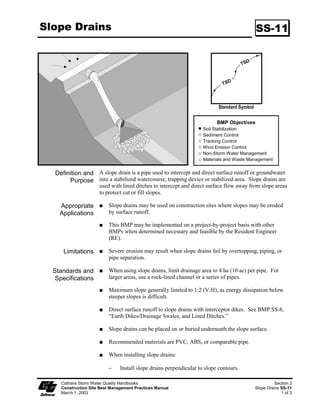
   Earth Dikes/Drainage Swales & Lined Ditches
   Outlet Protection/Velocity Dissipation Devices
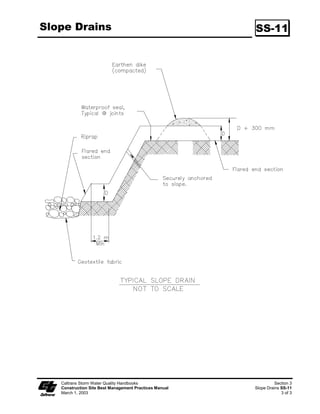
   Slope Drains


         Caltrans Storm Water Quality Handbooks
         Construction Site Best Management Practices Manual                                  Section 3
         March 1, 2003                                                                           1of 2
Table 3-1
                                  TEMPORARY SOIL STABILIZATION BMPs
              ID     BMP NAME

             SS-1    Scheduling

             SS-2    Preservation of Existing Vegetation

             SS-3    Hydraulic Mulch

             SS-4    Hydroseeding

             SS-5    Soil Binders

             SS-6    Straw Mulch

             SS-7    Geotextiles, Plastic Covers, & Erosion Control Blankets/Mats

             SS-8    Wood Mulching

           Temporary Concentrated Flow Conveyance Controls

             SS-9    Earth Dikes/Drainage Swales & Lined Ditches

            SS-10    Outlet Protection/Velocity Dissipation Devices

            SS-11    Slope Drains

            SS-12    Streambank Stabilization


The remainder of this Section shows the working details for each of the temporary soil stabilization
BMPs.


         Caltrans Storm Water Quality Handbooks
         Construction Site Best Management Practices Manual                                   Section 3
         March 1, 2003                                                                           2 of 2
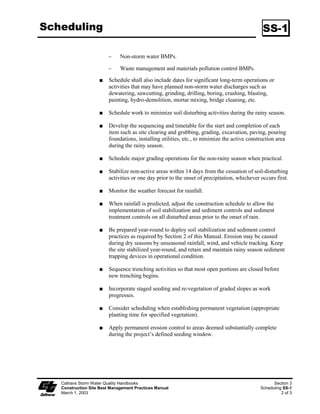
Scheduling                                                                                    SS-1


                                                                           Standard Symbol

                                                                          BMP Objectives
                                                                     Soil Stabilization
                                                                     Sediment Control
                                                                     Tracking Control
                                                                     Wind Erosion Control
                                                                     Non-Storm Water Management
                                                                     Materials and Waste Management


  Definition and This best management practice (BMP) involves developing, for every project, a
       Purpose schedule that includes sequencing of construction activities with the
                      implementation of construction site BMPs such as temporary soil stabilization
                      (erosion control) and temporary sediment controls measures. The purpose is to
                      reduce the amount and duration of soil exposed to erosion by wind, rain, runoff
                      and vehicle tracking, and to perform the construction activities and control
                      practices in accordance with the planned schedule.

    Appropriate Construction sequencing shall be scheduled to minimize land disturbance for all
    Applications projects during the rainy and non-rainy season. Appropriate BMPs shall be
                      implemented during both rainy and non-rainy seasons.

      Limitations None identified.

  Standards and            Developing a schedule and planning the project are the very first steps in an
   Specifications          effective storm water program. The schedule shall clearly show how the rainy
                           season relates to soil-disturbing and re-stabilization activities. The
                           construction schedule shall be incorporated into the SWPPP or WPCP.

                           The schedule shall include detail on the rainy season implementation and
                           deployment of:

                          ϑ     Temporary soil stabilization BMPs.

                          ϑ     Temporary sediment control BMPs.

                          ϑ     Tracking control BMPs.

                          ϑ     Wind erosion control BMPs.

     Caltrans Storm Water Quality Handbooks                                                        Section 3
     Construction Site Best Management Practices Manual                                      Scheduling SS-1
     March 1, 2003                                                                                     1 of 3
Scheduling                                                                                     SS-1

                        ϑ     Non-storm water BMPs.

                        ϑ     Waste management and materials pollution control BMPs.

                         Schedule shall also include dates for significant long-term operations or
                         activities that may have planned non-storm water discharges such as
                         dewatering, sawcutting, grinding, drilling, boring, crushing, blasting,
                         painting, hydro-demolition, mortar mixing, bridge cleaning, etc.

                         Schedule work to minimize soil disturbing activities during the rainy season.

                         Develop the sequencing and timetable for the start and completion of each
                         item such as site clearing and grubbing, grading, excavation, paving, pouring
                         foundations, installing utilities, etc., to minimize the active construction area
                         during the rainy season.

                         Schedule major grading operations for the non-rainy season when practical.

                         Stabilize non-active areas within 4 days from the cessation of soil-disturbing
                         activities or one day prior to the onset of precipitation, whichever occurs first.

                         Monitor the weather forecast for rainfall.

                         When rainfall is predicted, adjust the construction schedule to allow the
                         implementation of soil stabilization and sediment controls and sediment
                         treatment controls on all disturbed areas prior to the onset of rain.

                         Be prepared year-round to deploy soil stabilization and sediment control
                         practices as required by Section 2 of this Manual. Erosion may be caused
                         during dry seasons by unseasonal rainfall, wind, and vehicle tracking. Keep
                         the site stabilized year-round, and retain and maintain rainy season sediment
                         trapping devices in operational condition.

                         Sequence trenching activities so that most open portions are closed before
                         new trenching begins.

                         Incorporate staged seeding and re-vegetation of graded slopes as work
                         progresses.

                         Consider scheduling when establishing permanent vegetation (appropriate
                         planting time for specified vegetation).

                         Apply permanent erosion control to areas deemed substantially complete
                         during the project’s defined seeding window.


   Caltrans Storm Water Quality Handbooks                                                           Section 3
   Construction Site Best Management Practices Manual                                         Scheduling SS-1
   March 1, 2003                                                                                        2 of 3
Scheduling                                                                                    SS-1

Maintenance and            Verify that work is progressing in accordance with the schedule. If progress
      Inspection           deviates, take corrective actions.

                           Amend the schedule when changes are warranted or when directed by the
                           Resident Engineer (RE).

                           The Special Provisions require annual submittal of a rainy season
                           implementation schedule. Amend the schedule prior to the rainy season to
                           show updated information on the deployment and implementation of
                           construction site BMPs.


     Caltrans Storm Water Quality Handbooks                                                        Section 3
     Construction Site Best Management Practices Manual                                      Scheduling SS-1
     March 1, 2003                                                                                     3 of 3
Preservation of Existing Vegetation                                                                 SS-2


                                                                            Standard Symbol

                                                                           BMP Objectives
                                                                     Soil Stabilization
                                                                     Sediment Control
                                                                     Tracking Control
                                                                     Wind Erosion Control
                                                                     Non-Storm Water Management
                                                                     Materials and Waste Management


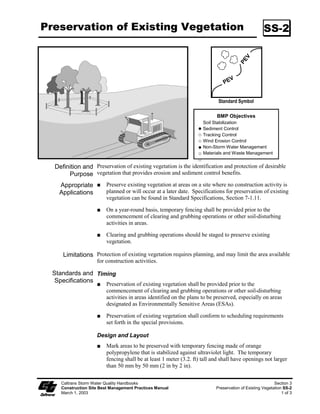
  Definition and Preservation of existing vegetation is the identification and protection of desirable
       Purpose vegetation that provides erosion and sediment control benefits.
    Appropriate          Preserve existing vegetation at areas on a site where no construction activity is
    Applications         planned or will occur at a later date. Specifications for preservation of existing
                         vegetation can be found in Standard Specifications, Section 7-..

                         On a year-round basis, temporary fencing shall be provided prior to the
                         commencement of clearing and grubbing operations or other soil-disturbing
                         activities in areas.

                         Clearing and grubbing operations should be staged to preserve existing
                         vegetation.

     Limitations Protection of existing vegetation requires planning, and may limit the area available
                    for construction activities.

  Standards and Timing
   Specifications
                         Preservation of existing vegetation shall be provided prior to the
                         commencement of clearing and grubbing operations or other soil-disturbing
                         activities in areas identified on the plans to be preserved, especially on areas
                         designated as Environmentally Sensitive Areas (ESAs).

                         Preservation of existing vegetation shall conform to scheduling requirements
                         set forth in the special provisions.

                    Design and Layout
                         Mark areas to be preserved with temporary fencing made of orange
                         polypropylene that is stabilized against ultraviolet light. The temporary
                         fencing shall be at least  meter (3.2. ft) tall and shall have openings not larger
                         than 50 mm by 50 mm (2 in by 2 in).

    Caltrans Storm Water Quality Handbooks                                                                Section 3
    Construction Site Best Management Practices Manual                     Preservation of Existing Vegetation SS-2
    March 1, 2003                                                                                             1 of 3
Preservation of Existing Vegetation                                                               SS-2

                        Fence posts shall be either wood or metal, at the Contractor’s discretion, as
                        appropriate for the intended purpose. The post spacing and depth shall be
                        adequate to completely support the fence in an upright position.

                        Minimize the disturbed areas by locating temporary roadways to avoid stands
                        of trees and shrubs and to follow existing contours to reduce cutting and filling.

                        Consider the impact of grade changes to existing vegetation and the root zone.

                   Installation
                        Construction materials, equipment storage, and parking areas shall be located
                        where they will not cause root compaction.

                        Keep equipment away from trees to prevent trunk and root damage.

                        Maintain existing irrigation systems.

                        Employees and subcontractors shall be instructed to honor protective devices.
                        No heavy equipment, vehicular traffic, or storage piles of any construction
                        materials shall be permitted within the drip line of any tree to be retained.
                        Removed trees shall not be felled, pushed, or pulled into any retained trees.
                        Fires shall not be permitted within 30 m (00 ft) of the drip line of any retained
                        trees. Any fires shall be of limited size, and shall be kept under continual
                        surveillance. No toxic or construction materials (including paint, acid, nails,
                        gypsum board, chemicals, fuels, and lubricants) shall be stored within 5 m (50
                        ft) of the drip line of any retained trees, nor disposed of in any way which
                        would injure vegetation.

                   Trenching and Tunneling
                        Trenching shall be as far away from tree trunks as possible, usually outside of
                        the tree drip line or canopy. Curve trenches around trees to avoid large roots or
                        root concentrations. If roots are encountered, consider tunneling under them.
                        When trenching and/or tunneling near or under trees to be retained, tunnels
                        shall be at least 450 mm (8 in) below the ground surface, and not below the
                        tree center to minimize impact on the roots.

                        Tree roots shall not be left exposed to air; they shall be covered with soil as
                        soon as possible, protected, and kept moistened with wet burlap or peat moss
                        until the tunnel and/or trench can be completed.

                        The ends of damaged or cut roots shall be cut off smoothly.

                        Trenches and tunnels shall be filled as soon as possible. Careful filling and
                        tamping will eliminate air spaces in the soil which can damage roots.

                        Remove any trees intended for retention if those trees are damaged seriously
                        enough to affect their survival. If replacement is desired or required, the new
                        tree shall be of similar species, and at least 50 mm (2 in) caliper, unless

   Caltrans Storm Water Quality Handbooks                                                               Section 3
   Construction Site Best Management Practices Manual                    Preservation of Existing Vegetation SS-2
   March 1, 2003                                                                                            2 of 3
Preservation of Existing Vegetation                                                                   SS-2

                           otherwise required by the contract documents.

                           After all other work is complete, fences and barriers shall be removed last. This
                           is because protected trees may be destroyed by carelessness during the final
                           cleanup and landscaping.

Maintenance and During construction, the limits of disturbance shall remain clearly marked at all
      Inspection times. Irrigation or maintenance of existing vegetation shall conform to the
                      requirements in the landscaping plan. If damage to protected trees still occurs,
                      maintenance guidelines described below shall be followed:

                           Serious tree injuries shall be attended to by an arborist.

                           During construction, District Environmental shall be contacted to ensure that
                           ESAs are protected.


      Caltrans Storm Water Quality Handbooks                                                                Section 3
      Construction Site Best Management Practices Manual                     Preservation of Existing Vegetation SS-2
      March 1, 2003                                                                                             3 of 3
Hydraulic Mulch                                                                                SS-3


                                                                           Standard Symbol

                                                                          BMP Objectives
                                                                    Soil Stabilization
                                                                    Sediment Control
                                                                    Tracking Control
                                                                    Wind Erosion Control
                                                                    Non-Storm Water Management
                                                                    Materials and Waste Management


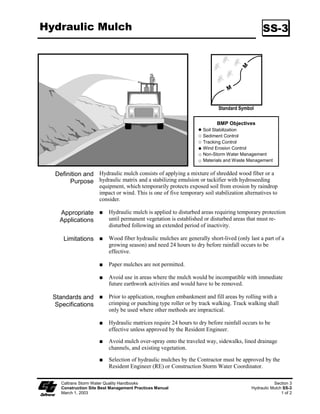
  Definition and Hydraulic mulch consists of applying a mixture of shredded wood fiber or a
       Purpose hydraulic matrix and a stabilizing emulsion or tackifier with hydroseeding
                      equipment, which temporarily protects exposed soil from erosion by raindrop
                      impact or wind. This is one of five temporary soil stabilization alternatives to
                      consider.

    Appropriate            Hydraulic mulch is applied to disturbed areas requiring temporary protection
    Applications           until permanent vegetation is established or disturbed areas that must re-
                           disturbed following an extended period of inactivity.

      Limitations          Wood fiber hydraulic mulches are generally short-lived (only last a part of a
                           growing season) and need 24 hours to dry before rainfall occurs to be
                           effective.

                           Paper mulches are not permitted.

                           Avoid use in areas where the mulch would be incompatible with immediate
                           future earthwork activities and would have to be removed.

  Standards and            Prior to application, roughen embankment and fill areas by rolling with a
   Specifications          crimping or punching type roller or by track walking. Track walking shall
                           only be used where other methods are impractical.

                           Hydraulic matrices require 24 hours to dry before rainfall occurs to be
                           effective unless approved by the Resident Engineer.

                           Avoid mulch over-spray onto the traveled way, sidewalks, lined drainage
                           channels, and existing vegetation.

                           Selection of hydraulic mulches by the Contractor must be approved by the
                           Resident Engineer (RE) or Construction Storm Water Coordinator.

     Caltrans Storm Water Quality Handbooks                                                          Section 3
     Construction Site Best Management Practices Manual                                   Hydraulic Mulch SS-3
     March 1, 2003                                                                                       1 of 2
Hydraulic Mulch                                                                                 SS-3

                           Materials for wood fiber based hydraulic mulches and hydraulic matrices
                           shall conform to Standard Specifications Section 20-2.07.

                           Hydraulic Mulch

                           Wood fiber mulch is a component of hydraulic applications. It is typically
                           applied at the rate of 2,250 to 4,500 kilograms per hectare (kg/ha) (2,000 to
                           4,000 lb/ac) with 0-5% by weight of a stabilizing emulsion or tackifier (e.g.,
                           guar, psyllium, acrylic copolymer) and applied as a slurry. This type of mulch
                           is manufactured from wood or wood waste from lumber mills or from urban
                           sources. Specifications for wood fiber mulch can be found in Standard
                           Specifications Sections 20-2.07 and 20-2.08.

                           Hydraulic matrix is a combination of wood fiber mulch and a tackifier applied
                           as a slurry. It is typically applied at the rate of 2,250 to 4,500 kilograms per
                           hectare (kg/Ha) with 5-0% by weight of a stabilizing emulsion or tackifier
                           (e.g., guar, psyllium, acrylic copolymer).

                           Hydraulic Matrix

                           Hydraulic matrix is a combination of wood fiber mulch and tackifier applied
                           as a slurry. It is typically applied at the rate of 2,250 to 4,500 kg/ha with 5-
                           0% by weight of a stabilizing emulsion or tackifier (e.g., guar, psyllium,
                           acrylic copolymer).

                           Bonded Fiber Matrix

                           Bonded fiber matrix (BFM) is a hydraulically-applied system of fibers and
                           adhesives that upon drying forms an erosion-resistant blanket that promotes
                           vegetation, and prevents soil erosion. BFMs are typically applied at rates
                           from 3,400 kg/ha to 4,500 kg/ha based on the manufacturer’s
                           recommendation. The biodegradable BFM is composed of materials that are
                           00% biodegradable. The binder in the BFM should also be biodegradable
                           and should not dissolve or disperse upon re-wetting. Typically, biodegradable
                           BFMs should not be applied immediately before, during or immediately after
                           rainfall if the soil is saturated. Depending on the product, BFMs require 2 to
                           24 hours to dry to become effective.

Maintenance and            Maintain an unbroken, temporary mulched ground cover throughout the
     Inspections           period of construction when the soils are not being reworked. Inspect before
                           expected rain storms and repair any damaged ground cover and re-mulch
                           exposed areas of bare soil.

                           After any rainfall event, the Contractor is responsible for maintaining all
                           slopes to prevent erosion.


     Caltrans Storm Water Quality Handbooks                                                           Section 3
     Construction Site Best Management Practices Manual                                    Hydraulic Mulch SS-3
     March 1, 2003                                                                                        2 of 2
Hydroseeding                                                                                   SS-4


                                                                            Standard Symbol

                                                                          BMP Objectives
                                                                    Soil Stabilization
                                                                    Sediment Control
                                                                    Tracking Control
                                                                    Wind Erosion Control
                                                                    Non-Storm Water Management
                                                                    Materials and Waste Management


  Definition and Hydroseeding typically consists of applying a mixture of wood fiber, seed,
       Purpose fertilizer, and stabilizing emulsion with hydro-mulch equipment, which
                     temporarily protects exposed soils from erosion by water and wind. This is one of
                     five temporary soil stabilization alternatives to consider.

   Appropriate            Hydroseeding is applied on disturbed soil areas requiring temporary
   Applications           protection until permanent vegetation is established or disturbed soil areas
                          that must be re-disturbed following an extended period of inactivity.

     Limitations          Hydroseeding may be used alone only when there is sufficient time in the
                          season to ensure adequate vegetation establishment and erosion control.
                          Otherwise, hydroseeding must be used in conjunction with a soil binder or
                          mulching (i.e., straw mulch), refer to BMP SS-5, Table  for options.

                          Steep slopes are difficult to protect with temporary seeding.

                          Temporary seeding may not be appropriate in dry periods without
                          supplemental irrigation.

                          Temporary vegetation may have to be removed before permanent vegetation
                          is applied.

                          Temporary vegetation is not appropriate for short-term inactivity.


    Caltrans Storm Water Quality Handbooks                                                         Section 3
    Construction Site Best Management Practices Manual                                     Hydroseeding SS-4
    March 1, 2003                                                                                      1 of 3
Hydroseeding                                                                                      SS-4

  Standards and To select appropriate hydroseeding mixtures, an evaluation of site conditions shall
   Specifications be performed with respect to:
                           –   Soil conditions                        –   Maintenance requirements
                           –   Site topography                        –   Sensitive adjacent areas
                           –   Season and climate                     –   Water availability
                           –   Vegetation types                       –   Plans for permanent vegetation

                           Selection of hydroseeding mixtures shall be approved by the District
                           Landscape Architect and the Construction Storm Water Coordinator.

                      The following steps shall be followed for implementation:

                           Seed mix shall comply with the Standard Specifications Section 20-2.0, and
                           the project’s special provisions.

                           Hydroseeding can be accomplished using a multiple-step or one-step process;
                           refer to the special provisions for specified process. The multiple-step
                           process ensures maximum direct contact of the seeds to soil. When the one-
                           step process is used to apply the mixture of fiber, seed, etc., the seed rate shall
                           be increased to compensate for all seeds not having direct contact with the
                           soil.

                           Prior to application, roughen the slope, fill area, or area to be seeded with the
                           furrows trending along the contours. Rolling with a crimping or punching
                           type roller or track walking is required on all slopes prior to hydroseeding.
                           Track walking shall only be used where other methods are impractical.

                           Apply a straw mulch to keep seeds in place and to moderate soil moisture and
                           temperature until the seeds germinate and grow, refer to Standard
                           Specifications Sections 20-2.06 and 20-3.03.

                           All seeds shall be in conformance with the California State Seed Law of the
                           Department of Agriculture. Each seed bag shall be delivered to the site sealed
                           and clearly marked as to species, purity, percent germination, dealer’s
                           guarantee, and dates of test; provide the Resident Engineer (RE) with such
                           documentation. The container shall be labeled to clearly reflect the amount of
                           Pure Live Seed (PLS) contained. All legume seed shall be pellet-inoculated.
                           Inoculant sources shall be species-specific and shall be applied at a rate of 2
                           kg of inoculant per 00 kg of seed (2-lb inoculant per 00-lb seed), refer to
                           Standard Specifications Section 20-2.0.

                           Commercial fertilizer shall conform to the requirements of the California
                           Food and Agricultural Code. Fertilizer shall be pelleted or granular form.


     Caltrans Storm Water Quality Handbooks                                                            Section 3
     Construction Site Best Management Practices Manual                                        Hydroseeding SS-4
     March 1, 2003                                                                                         2 of 3
Hydroseeding                                                                                    SS-4

                           Follow-up applications shall be made as needed to cover weak spots, and to
                           maintain adequate soil protection.

                           Avoid over-spray onto the traveled way, sidewalks, lined drainage channels,
                           and existing vegetation.

Maintenance and            All seeded areas shall be inspected for failures and re-seeded, fertilized, and
      Inspection           mulched within the planting season, using not less than half the original
                           application rates. Any temporary revegetation efforts that do not provide
                           adequate cover must be reapplied at a scheduled recommended by the
                           Caltrans Landscape Architect or RE.

                           After any rainfall event, the Contractor is responsible for maintaining all
                           slopes to prevent erosion.


     Caltrans Storm Water Quality Handbooks                                                          Section 3
     Construction Site Best Management Practices Manual                                      Hydroseeding SS-4
     March 1, 2003                                                                                       3 of 3
Soil Binders                                                                                      SS-5


                                                                             Standard Symbol

                                                                             BMP Objectives
                                                                      Soil Stabilization
                                                                      Sediment Control
                                                                      Tracking Control
                                                                      Wind Erosion Control
                                                                      Non-Storm Water Management
                                                                      Materials and Waste Management


  Definition and Soil binders consist of applying and maintaining a soil stabilizer to exposed soil
       Purpose surfaces. Soil binders are materials applied to the soil surface to temporarily
                     prevent water-induced erosion of exposed soils on construction sites. Soil binders
                     also provide temporary dust, wind, and soil stabilization (erosion control)
                     benefits. This is one of five temporary soil stabilization alternatives to consider.

   Appropriate Soil binders are typically applied to disturbed areas requiring short-term
   Applications temporary protection. Because soil binders can often be incorporated into the
                     work, they may be a good choice for areas where grading activities will soon
                     resume. Application on stockpiles to prevent water and wind erosion.

     Limitations          Soil binders are temporary in nature and may need reapplication.

                          Soil binders require a minimum curing time until fully effective, as prescribed
                          by the manufacturer, which may be 24 hours or longer. Soil binders may
                          need reapplication after a storm event.

                          Soil binders will generally experience spot failures during heavy rainfall
                          events. If runoff penetrates the soil at the top of a slope treated with a soil
                          binder, it is likely that the runoff will undercut the stabilized soil layer and
                          discharge at a point further down slope.

                          Soil binders do not hold up to pedestrian or vehicular traffic across treated
                          areas.

                          Soil binders may not penetrate soil surfaces made up primarily of silt and
                          clay, particularly when compacted.

                         Storm water quality runoff sampling is required for many soil binders. Soil
                         binders that do not require sampling are identified in the Caltrans
                         SWPPP/WPCP Preparation Manual, Pollutant Table, Attachment S.

    Caltrans Storm Water Quality Handbooks                                                              Section 3
    Construction Site Best Management Practices Manual                                          Soil Binders SS-5
    March 1, 2003                                                                                           1 of 7
Soil Binders                                                                                       SS-5

                           Some soil binders may not perform well with low relative humidity. Under
                           rainy conditions, some agents may become slippery or leach out of the soil.

                           May not cure if low temperatures occur within 24 hours of application.

  Standards and General Considerations
   Specifications Site-specific soil types will dictate appropriate soil binders to be used.

                           A soil binder must be environmentally benign (non-toxic to plant and animal
                           life), easy to apply, easy to maintain, economical, and shall not stain paved or
                           painted surfaces, refer to Standard Specifications Section 20-2..

                           Some soil binders are compatible with existing vegetation.

                           Performance of soil binders depends on temperature, humidity, and traffic
                           across treated areas.

                           Avoid over-spray onto the traveled way, sidewalks, lined drainage channels,
                           and existing vegetation.

                      Soil Binders Applications
                      After selecting an appropriate soil binder, the untreated soil surface must be
                      prepared before applying the soil binder. The untreated soil surface must contain
                      sufficient moisture to assist the agent in achieving uniform distribution. In
                      general, the following steps shall be followed:

                          Follow manufacturer’s recommendations for application rates, pre-wetting of
                          application area, and cleaning of equipment after use.

                          Prior to application, roughen embankment and fill areas by rolling with a
                          crimping or punching type roller or by track walking. Track walking shall
                          only be used where rolling is impractical.

                          Consider the drying time for the selected soil binder and apply with sufficient
                          time before anticipated rainfall. Soil binders shall not be applied during or
                          immediately before rainfall.

                          Avoid over-spray onto the traveled way, sidewalks, lined drainage channels,
                          sound walls, and existing vegetation.

                          Soil binders shall not be applied to frozen soil, areas with standing water,
                          under freezing or rainy conditions, or when the air temperature is below 4oC
                          (40oF) during the curing period.

                          More than one treatment is often necessary, although the second treatment
                          may be diluted or have a lower application rate.

                          Generally, soil binders require a minimum curing time of 24 hours before they
                          are fully effective. Refer to manufacturer’s instructions for specific cure times.

     Caltrans Storm Water Quality Handbooks                                                              Section 3
     Construction Site Best Management Practices Manual                                          Soil Binders SS-5
     March 1, 2003                                                                                           2 of 7
Soil Binders                                                                                  SS-5

                         For liquid agents:

                        ϑ     Crown or slope ground to avoid ponding.

                        ϑ     Uniformly pre-wet ground at 0.4 to .4 L/m2 (0.03 to 0.3 gal/yd2) or
                              according to manufacturer’s recommendations.

                        ϑ     Apply solution under pressure. Overlap solution 50 to 300 mm (6 to
                              2 in).

                        ϑ     Allow treated area to cure for the time recommended by the
                              manufacturer; typically, at least 24 hours.

                        ϑ     In low humidities, reactivate chemicals by re-wetting with water at 0.5 to
                              0.9 L/m2 (0. to 0.2 gal/yd2).


                    Selecting a Soil Binder
                    Properties of common soil binders used for erosion control are provided in
                    Table  and Appendix B. Use Table  to select an appropriate soil binder.

                    Factors to consider when selecting a soil binder include the following:

                         Suitability to situation - Consider where the soil binder will be applied;
                         determine if it needs a high resistance to leaching or abrasion, and whether it
                         needs to be compatible with any existing vegetation. Determine the length of
                         time soil stabilization will be needed, and if the soil binder will be placed in
                         an area where it will degrade rapidly. In general, slope steepness is not a
                         discriminating factor for the listed soil binders.

                         Soil types and surface materials - Fines and moisture content are key
                         properties of surface materials. Consider a soil binder’s ability to penetrate,
                         likelihood of leaching, and ability to form a surface crust on the surface
                         materials.

                         Frequency of application - The frequency of application can be affected by
                         subgrade conditions, surface type, climate, and maintenance schedule.
                         Frequent applications could lead to high costs. Application frequency may be
                         minimized if the soil binder has good penetration, low evaporation, and good
                         longevity. Consider also that frequent application will require frequent
                         equipment clean-up.

                    After considering the above factors, the soil binders in Table  will be generally
                    appropriate as follows:


   Caltrans Storm Water Quality Handbooks                                                           Section 3
   Construction Site Best Management Practices Manual                                       Soil Binders SS-5
   March 1, 2003                                                                                        3 of 7
Soil Binders                                                                                     SS-5

                    Plant-Material Based (Short Lived)
                           -Guar: Guar is a non-toxic, biodegradable, natural galactomannan-based
                           hydrocolloid treated with dispersent agents for easy field mixing. It shall be
                           diluted at the rate of .2 to .8 kg per ,000 liters ( to 5 lb per 00 gallons)
                           of water, depending on application machine capacity. Recommended
                           minimum application rates are as follows:

                                        Application Rates for Guar Soil Stabilizer

                                         Slope (V:H):       Flat    1:4    1:3      1:2    1:1
                                              Kg/Ha:         45     50      56      67      78
                                              lb/ac          40     45      50      60      70


                           -Psyllium: Psyllium is composed of the finely ground muciloid coating of
                           plantago seeds that is applied as a dry powder or in a wet slurry to the
                           surface of the soil. It dries to form a firm but rewettable membrane that
                           binds soil particles together but permits germination and growth of seed.
                           Psyllium requires 2 to 8 hours drying time. Psyllium shall be applied at a
                           rate of 90 to 225 kg/ha (80 to 200 lb/ac), with enough water in solution to
                           allow for a uniform slurry flow.

                           -Starch: Starch is non-ionic, cold-water soluble (pre-gelatinized) granular
                           cornstarch. The material is mixed with water and applied at the rate of
                           70 kg/ha (50 lb/ac). Approximate drying time is 9 to 2 hours.


                    Plant-Material Based (Long Lived)
                           -Pitch and Rosin Emulsion: Generally, a non-ionic pitch and rosin emulsion
                           has a minimum solids content of 48%. The rosin shall be a minimum of
                           26% of the total solids content. The soil stabilizer shall be non-corrosive,
                           water-dilutable emulsion that upon application cures to a water insoluble
                           binding and cementing agent. For soil erosion control applications, the
                           emulsion is diluted and shall be applied as follows:

                           For clayey soil:     5 parts water to  part emulsion

                           For sandy soil:      0 parts water to  part emulsion

                           Application can be by water truck or hydraulic seeder with the
                           emulsion/product mixture applied at the rate specified by the manufacturer.
                           Approximate drying time is 9 to 24 hours.


   Caltrans Storm Water Quality Handbooks                                                             Section 3
   Construction Site Best Management Practices Manual                                         Soil Binders SS-5
   March 1, 2003                                                                                          4 of 7
Soil Binders                                                                                     SS-5

                    Polymeric Emulsion Blends
                           -Acrylic Copolymers and Polymers: Polymeric soil stabilizers shall consist
                           of a liquid or solid polymer or copolymer with an acrylic base that contains
                           a minimum of 55% solids. The polymeric compound shall be handled and
                           mixed in a manner that will not cause foaming or shall contain an anti-
                           foaming agent. The polymeric emulsion shall not exceed its shelf life or
                           expiration date; manufacturers shall provide the expiration date. Polymeric
                           soil stabilizer shall be readily miscible in water, non-injurious to seed or
                           animal life, non-flammable, shall provide surface soil stabilization for
                           various soil types without totally inhibiting water infiltration, and shall not
                           re-emulsify when cured. The applied compound shall air cure within a
                           maximum of 36 to 48 hours. Liquid copolymer shall be diluted at a rate of
                           0 parts water to  part polymer and applied to soil at a rate of ,000
                           liters/hectare (,75 gal/ac).

                           -Liquid Polymers of Methacrylates and Acrylates: This material consists of
                           a tackifier/sealer that is a liquid polymer of methacrylates and acrylates. It
                           is an aqueous 00% acrylic emulsion blend of 40% solids by volume that is
                           free from styrene, acetate, vinyl, ethoxylated surfactants or silicates. For
                           soil stabilization applications, it is diluted with water in accordance with
                           manufacturer’s recommendations, and applied with a hydraulic seeder at the
                           rate of 90 L/ha (20 gal/ac). Drying time is 2 to 8 hours after application.

                           -Copolymers of Sodium Acrylates and Acrylamides: These materials are
                           non-toxic, dry powders that are copolymers of sodium acrylate and
                           acrylamide. They are mixed with water and applied to the soil surface for
                           erosion control at rates that are determined by slope gradient:


                                           Slope Gradient (V:H)          kg/ha (lb/ac)
                                                Flat to 1:5              3.4 – 5.6 (3-5)
                                                1:5 to 1:3              5.6 – 11.2 (5-10)
                                                1:2 to 1:1             11.2 – 22.4 (10-20)


                           -Poly-Acrylamide and Copolymer of Acrylamide: Linear copolymer
                           polyacrylamide is packaged as a dry-flowable solid. When used as a stand-
                           alone stabilizer, it is diluted at a rate of .5 kg/,000 liters ( lb/00 gal) of
                           water and applied at the rate of 5.6 kg/ha (5 lb/ac).

                           -Hydro-Colloid Polymers: Hydro-Colloid Polymers are various
                           combinations of dry-flowable poly-acrylamides, copolymers and hydro-
                           colloid polymers that are mixed with water and applied to the soil surface at
                           rates of 60 to 70 kg/ha (53 to 62 lb/ac). Drying times are 0 to 4 hours.


   Caltrans Storm Water Quality Handbooks                                                              Section 3
   Construction Site Best Management Practices Manual                                          Soil Binders SS-5
   March 1, 2003                                                                                           5 of 7
Soil Binders                                                                                     SS-5

                       Cementitious-Based Binders
                              -Gypsum: This is a formulated gypsum-based product that readily mixes
                              with water and mulch to form a thin protective crust on the soil surface. It
                              is composed of high purity gypsum that is ground, calcined and processed
                              into calcium sulfate hemihydrate with a minimum purity of 86%. It is
                              mixed in a hydraulic seeder and applied at rates 4,500 to 3,500 kg/ha
                              (4,000 to 2,000 lb/ac). Drying time is 4 to 8 hours.

 Maintenance and            Reapplying the selected soil binder may be needed for proper maintenance.
       Inspection           High traffic areas shall be inspected daily, and lower traffic areas shall be
                            inspected weekly.

                            After any rainfall event, the Contractor is responsible for maintaining all
                            slopes to prevent erosion.

                            Maintain an unbroken, temporary stabilized area while DSAs are nonactive.
                            Repair any damaged stabilized area and re-apply soil binder to exposed areas.


      Caltrans Storm Water Quality Handbooks                                                           Section 3
      Construction Site Best Management Practices Manual                                       Soil Binders SS-5
      March 1, 2003                                                                                        6 of 7
Soil Binders                                                                                                  SS-5


                                                        Table 1
                                    Properties of Soil Binders for Erosion Control

                               Plant Material         Plant Material
                                  Based                  Based            Polymeric          Cementitious-Based
        Chemicals              (Short Lived)          (Long Lived)      Emulsion Blends          Binders
  Relative Cost                      Low                   Low                Low                    Low
  Resistance to Leaching             High                  High         Low to Moderate           Moderate
  Resistance to Abrasion          Moderate                 Low          Moderate to High       Moderate to High
  Longevity                   Short to Medium            Medium          Medium to Long            Medium
  Minimum Curing Time           9 to 18 hours         19 to 24 hours      0 to 24 hours          4 to 8 hours
  before Rain
  Compatibility with                Good                   Poor               Poor                   Poor
  Existing Vegetation
  Mode of Degradation          Biodegradable          Biodegradable     Photodegradable/      Photodegradable/
                                                                           Chemically            Chemically
                                                                          Degradable            Degradable
  Labor Intensive                    No                     No                 No                     No
  Specialized Application      Water Truck or        Water Truck or      Water Truck or        Water Truck or
  Equipment                   Hydraulic Mulcher     Hydraulic Mulcher   Hydraulic Mulcher     Hydraulic Mulcher
  Liquid/Powder                    Powder                 Liquid          Liquid/Powder            Powder
  Surface Crusting            Yes, but dissolves            Yes         Yes, but dissolves           Yes
                                on rewetting                              on rewetting
  Clean-Up                          Water                 Water               Water                 Water
  Erosion Control                 Varies (1)             Varies (1)         Varies (1)       4,500 to 13,500 kg/ha
  Application Rate
   (1) Dependant on product, soil type, and slope inclination


     Caltrans Storm Water Quality Handbooks                                                                         Section 3
     Construction Site Best Management Practices Manual                                                     Soil Binders SS-5
     March 1, 2003                                                                                                      7 of 7
Straw Mulch                                                                                     SS-6


                                                                            Standard Symbol

                                                                            BMP Objectives
                                                                      Soil Stabilization
                                                                      Sediment Control
                                                                      Tracking Control
                                                                      Wind Erosion Control
                                                                      Non-Storm Water Management
                                                                      Materials and Waste Management


  Definition and Straw mulch consists of placing a uniform layer of straw and incorporating it into
       Purpose the soil with a studded roller or anchoring it with a stabilizing emulsion. This is
                     one of five temporary soil stabilization alternatives to consider.

   Appropriate            Straw mulch is typically used for soil stabilization as a temporary surface
   Applications           cover on disturbed areas until soils can be prepared for revegetation and
                          permanent vegetation is established.

                          Also typically used in combination with temporary and/or permanent seeding
                          strategies to enhance plant establishment.

     Limitations          Availability of erosion control contractors and straw may be limited prior to
                          the rainy season due to high demand.

                          There is a potential for introduction of weed-seed and unwanted plant
                          material.

                          When straw blowers are used to apply straw mulch, the treatment areas must
                          be within 45 m (50 ft) of a road or surface capable of supporting trucks.

                          Straw mulch applied by hand is more time intensive and potentially costly.

                          May have to be removed prior to permanent seeding or soil stabilization.

                          “Punching” of straw does not work in sandy soils.


    Caltrans Storm Water Quality Handbooks                                                           Section 3
    Construction Site Best Management Practices Manual                                        Straw Mulch SS-6
    March 1, 2003                                                                                        1 of 3
Straw Mulch                                                                                      SS-6

  Standards and            Straw shall be derived from wheat, rice, or barley.
   Specifications
                           All materials shall conform to Standard Specifications Sections 20-2.06,
                           20-2.07 and 20-2..

                           A tackifier is the preferred method for anchoring straw mulch to the soil on
                           slopes.

                           Crimping, punch roller-type rollers, or track-walking may also be used to
                           incorporate straw mulch into the soil on slopes. Track walking shall only be
                           used where other methods are impractical.

                           Avoid placing straw onto the traveled way, sidewalks, lined drainage
                           channels, sound walls, and existing vegetation.

                           Straw mulch with tackifier shall not be applied during or immediately before
                           rainfall.

                      Application Procedures
                           Apply loose straw at a minimum rate of 3,570 kg/ha (4,000 lb/ac), or as
                           indicated in the project’s special provisions, either by machine or by hand
                           distribution.

                           If stabilizing emulsion will be used to anchor the straw mulch in lieu of
                           incorporation, roughen embankment or fill areas by rolling with a crimping or
                           punching-type roller or by track walking before placing the straw mulch.
                           Track walking should only be used where rolling is impractical.

                           The straw mulch must be evenly distributed on the soil surface.

                           Anchor the mulch in place by using a tackifier or by “punching” it into the
                           soil mechanically (incorporating).

                           A tackifier acts to glue the straw fibers together and to the soil surface. The
                           tackifier shall be selected based on longevity and ability to hold the fibers in
                           place.

                           A tackifier is typically applied at a rate of 40 kg/ha (25 lb/ac). In windy
                           conditions, the rates are typically 200 kg/ha (78 lb/ac).

                           Methods for holding the straw mulch in place depend upon the slope
                           steepness, accessibility, soil conditions and longevity. If the selected method
                           is incorporation of straw mulch into the soil, then do as follows:

                          ϑ     Applying and incorporating straw shall follow the requirements in
                                Standard Specifications Section 20-3.03.

                          ϑ     On small areas, a spade or shovel can be used.


     Caltrans Storm Water Quality Handbooks                                                           Section 3
     Construction Site Best Management Practices Manual                                        Straw Mulch SS-6
     March 1, 2003                                                                                        2 of 3
Straw Mulch                                                                                     SS-6

                          ϑ     On slopes with soils, which are stable enough and of sufficient gradient
                                to safely support construction equipment without contributing to
                                compaction and instability problems, straw can be “punched” into the
                                ground using a knife-blade roller or a straight bladed coulter, known
                                commercially as a “crimper.”

                          ϑ     On small areas and/or steep slopes, straw can also be held in place using
                                plastic netting or jute. The netting shall be held in place using  gauge
                                wire staples, geotextile pins or wooden stakes. Refer to BMP SS-7,
                                “Geotextiles, Plastic Covers and Erosion Control Blankets/Mats.”

Maintenance and            The key consideration in Maintenance and Inspection is that the straw needs
     Inspections           to last long enough to achieve erosion control objectives.

                           Maintain an unbroken, temporary mulched ground cover while DSAs are
                           non-active. Repair any damaged ground cover and re-mulch exposed areas.

                           Reapplication of straw mulch and tackifier may be required by the Resident
                           Engineer (RE) to maintain effective soil stabilization over disturbed areas and
                           slopes.

                           After any rainfall event, the Contractor is responsible for maintaining all
                           slopes to prevent erosion.


     Caltrans Storm Water Quality Handbooks                                                          Section 3
     Construction Site Best Management Practices Manual                                       Straw Mulch SS-6
     March 1, 2003                                                                                       3 of 3
*HRWH[WLOHV 0DWV 3ODVWLF RYHUV                                                                 66
DQG (URVLRQ RQWURO %ODQNHWV


                                                                            6WDQGDUG 6PERO

                                                                            %03 2EMHFWLYHV
                                                                    T‚vyÃT‡hivyv“h‡v‚
                                                                    Trqv€r‡Ã8‚‡…‚y
                                                                    U…hpxvtÃ8‚‡…‚y
                                                                    XvqÃ@…‚†v‚Ã8‚‡…‚y
                                                                    I‚T‡‚…€ÃXh‡r…ÃHhhtr€r‡
                                                                    Hh‡r…vhy†ÃhqÃXh†‡rÃHhhtr€r‡

  'HILQLWLRQ DQG 7KLV %HVW 0DQDJHPHQW 3UDFWLFH %03
LQYROYHV WKH SODFHPHQW RI JHRWH[WLOHV
       3XUSRVH PDWV SODVWLF FRYHUV RU HURVLRQ FRQWURO EODQNHWV WR VWDELOL]H GLVWXUEHG VRLO DUHDV
                     DQG SURWHFW VRLOV IURP HURVLRQ E ZLQG RU ZDWHU 7KLV LV RQH RI ILYH WHPSRUDU
                     VRLO VWDELOL]DWLRQ DOWHUQDWLYHV WR FRQVLGHU

   $SSURSULDWH 7KHVH PHDVXUHV DUH XVHG ZKHQ GLVWXUEHG VRLOV PD EH SDUWLFXODUO GLIILFXOW WR
   $SSOLFDWLRQV VWDELOL]H LQFOXGLQJ WKH IROORZLQJ VLWXDWLRQV
                          6WHHS VORSHV JHQHUDOO VWHHSHU WKDQ  9+
6ORSHV ZKHUH WKH HURVLRQ SRWHQWLDO LV KLJK

                          6ORSHV DQG GLVWXUEHG VRLOV ZKHUH PXOFK PXVW EH DQFKRUHG

                          'LVWXUEHG DUHDV ZKHUH SODQWV DUH VORZ WR GHYHORS

                          KDQQHOV ZLWK IORZV H[FHHGLQJ  PV  IWV
KDQQHOV WR EH YHJHWDWHG

                          6WRFNSLOHV

                          6ORSHV DGMDFHQW WR ZDWHU ERGLHV RI (QYLURQPHQWDOO 6HQVLWLYH $UHDV (6$V
8hy‡…h†ÃT‡‚…€ÃXh‡r…ÃRˆhyv‡’ÃChqi‚‚x†                                                               Trp‡v‚Ã
    8‚†‡…ˆp‡v‚ÃTv‡rÃ7r†‡ÃHhhtr€r‡ÃQ…hp‡vpr†ÃHhˆhy      Br‚‡r‘‡vyr†ÃHh‡†ÃQyh†‡vpÃ8‚‰r…†ÃhqÃ@8Ã7yhxr‡†ÃTT
    Hh…puà Ã!                                                                                            ÂsÃ
*HRWH[WLOHV 0DWV 3ODVWLF RYHUV                                                                   66
DQG (URVLRQ RQWURO %ODQNHWV

      /LPLWDWLRQV          %ODQNHWV DQG PDWV DUH PRUH H[SHQVLYH WKDQ RWKHU HURVLRQ FRQWURO PHDVXUHV
                           GXH WR ODERU DQG PDWHULDO FRVWV 7KLV XVXDOO OLPLWV WKHLU DSSOLFDWLRQ WR DUHDV
                           LQDFFHVVLEOH WR KGUDXOLF HTXLSPHQW RU ZKHUH RWKHU PHDVXUHV DUH QRW
                           DSSOLFDEOH VXFK DV FKDQQHOV

                           %ODQNHWV DQG PDWV DUH JHQHUDOO QRW VXLWDEOH IRU H[FHVVLYHO URFN VLWHV RU
                           DUHDV ZKHUH WKH ILQDO YHJHWDWLRQ ZLOO EH PRZHG VLQFH VWDSOHV DQG QHWWLQJ FDQ
                           FDWFK LQ PRZHUV
%ODQNHWV DQG PDWV PXVW EH UHPRYHG DQG GLVSRVHG RI SULRU WR DSSOLFDWLRQ RI
                           SHUPDQHQW VRLO VWDELOL]DWLRQ PHDVXUHV

                           3ODVWLF VKHHWLQJ LV HDVLO YDQGDOL]HG HDVLO WRUQ SKRWRGHJUDGDEOH DQG PXVW
                           EH GLVSRVHG RI DW D ODQGILOO

                           3ODVWLF UHVXOWV LQ  UXQRII ZKLFK PD FDXVH VHULRXV HURVLRQ SUREOHPV LQ
                           WKH DUHDV UHFHLYLQJ WKH LQFUHDVHG IORZ

                           7KH XVH RI SODVWLF VKDOO EH OLPLWHG WR FRYHULQJ VWRFNSLOHV RU YHU VPDOO JUDGHG
                           DUHDV IRU VKRUW SHULRGV RI WLPH VXFK DV WKURXJK RQH LPPLQHQW VWRUP HYHQW
XQWLO DOWHUQDWLYH PHDVXUHV VXFK DV VHHGLQJ DQG PXOFKLQJ PD EH LQVWDOOHG

                           *HRWH[WLOHV PDWV SODVWLF FRYHUV DQG HURVLRQ FRQWURO FRYHUV KDYH PD[LPXP
                           IORZ UDWH OLPLWDWLRQV FRQVXOW WKH PDQXIDFWXUHU IRU SURSHU VHOHFWLRQ

  6WDQGDUGV DQG 0DWHULDO 6HOHFWLRQ
   6SHFLILFDWLRQV 7KHUH DUH PDQ WSHV RI HURVLRQ FRQWURO EODQNHWV DQG PDWV DQG VHOHFWLRQ RI WKH
                      DSSURSULDWH WSH VKDOO EH EDVHG RQ WKH VSHFLILF WSH RI DSSOLFDWLRQ DQG VLWH
                      FRQGLWLRQV 6HOHFWLRQV
PDGH E WKH RQWUDFWRU PXVW EH DSSURYHG E WKH
                      5HVLGHQW (QJLQHHU 5(
FHUWLILFDWLRQ RI FRPSOLDQFH VKDOO EH LQ DFFRUGDQFH ZLWK
                      6WDQGDUG 6SHFLILFDWLRQV 6HFWLRQ 

                      *HRWH[WLOHV
                           0DWHULDO VKDOO EH D ZRYHQ SROSURSOHQH IDEULF ZLWK PLQLPXP WKLFNQHVV RI
                            PP  LQFK
PLQLPXP ZLGWK RI  P  IW
DQG VKDOO KDYH PLQLPXP
                           WHQVLOH VWUHQJWK RI  N1 ZDUS
N1 ILOO
LQ FRQIRUPDQFH ZLWK WKH
                           UHTXLUHPHQWV LQ $670 'HVLJQDWLRQ '  7KH SHUPLWWLYLW RI WKH IDEULF
                           VKDOO EH DSSUR[LPDWHO  VHF ± LQ FRQIRUPDQFH ZLWK WKH UHTXLUHPHQWV LQ
                           $670 'HVLJQDWLRQ ' 7KH IDEULF VKDOO KDYH DQ XOWUDYLROHW 89
VWDELOLW RI  SHUFHQW LQ FRQIRUPDQFH ZLWK WKH UHTXLUHPHQWV LQ $670
                           GHVLJQDWLRQ ' *HRWH[WLOH EODQNHWV VKDOO EH VHFXUHG LQ SODFH ZLWK ZLUH
                           VWDSOHV RU VDQGEDJV DQG E NHLQJ LQWR WRSV RI VORSHV DQG HGJHV WR SUHYHQW
                           LQILOWUDWLRQ RI VXUIDFH ZDWHUV XQGHU *HRWH[WLOH 6WDSOHV VKDOO EH PDGH RI 
                           PP LQFK
VWHHO ZLUH DQG VKDOO EH 8VKDSHG ZLWK PP LQFK
OHJV
                           DQG PP LQFK
FURZQ

                           *HRWH[WLOHV PD EH UHXVHG LI LQ WKH RSLQLRQ RI WKH 5( WKH DUH VXLWDEOH IRU
                           WKH XVH LQWHQGHG

     8hy‡…h†ÃT‡‚…€ÃXh‡r…ÃRˆhyv‡’ÃChqi‚‚x†                                                                Trp‡v‚Ã
     8‚†‡…ˆp‡v‚ÃTv‡rÃ7r†‡ÃHhhtr€r‡ÃQ…hp‡vpr†ÃHhˆhy       Br‚‡r‘‡vyr†ÃHh‡†ÃQyh†‡vpÃ8‚‰r…†ÃhqÃ@8Ã7yhxr‡†ÃTT
     Hh…puà Ã!                                                                                            !ÂsÃ
*HRWH[WLOHV 0DWV 3ODVWLF RYHUV                                                                 66
DQG (URVLRQ RQWURO %ODQNHWV

                    3ODVWLF RYHUV
                         3ODVWLF VKHHWLQJ VKDOO KDYH D PLQLPXP WKLFNQHVV RI  PLO DQG VKDOO EH NHHG
                         LQ DW WKH WRS RI VORSH DQG ILUPO KHOG LQ SODFH ZLWK VDQGEDJV RU RWKHU ZHLJKWV
                         SODFHG QR PRUH WKDQ  P  IW
DSDUW 6HDPV DUH WSLFDOO WDSHG RU ZHLJKWHG
                         GRZQ WKHLU HQWLUH OHQJWK DQG WKHUH VKDOO EH DW OHDVW D  PP WR  PP 
                         WR  LQFKHV
RYHUODS RI DOO VHDPV (GJHV VKDOO EH HPEHGGHG D PLQLPXP RI
                          PP  LQFKHV
LQ VRLO

                         $OO VKHHWLQJ VKDOO EH LQVSHFWHG SHULRGLFDOO DIWHU LQVWDOODWLRQ DQG DIWHU
                         VLJQLILFDQW UDLQVWRUPV WR FKHFN IRU HURVLRQ XQGHUPLQLQJ DQG DQFKRUDJH
                         IDLOXUH $Q IDLOXUHV VKDOO EH UHSDLUHG LPPHGLDWHO ,I ZDVKRXW RU EUHDNDJHV
                         RFFXUV WKH PDWHULDO VKDOO EH UHLQVWDOOHG DIWHU UHSDLULQJ WKH GDPDJH WR WKH
                         VORSH

                    (URVLRQ RQWURO %ODQNHWV0DWV
                         %LRGHJUDGDEOH UROOHG HURVLRQ FRQWURO SURGXFWV 5(3V
DUH WSLFDOO
                         FRPSRVHG RI MXWH ILEHUV FXUOHG ZRRG ILEHUV VWUDZ FRFRQXW ILEHU RU D
                         FRPELQDWLRQ RI WKHVH PDWHULDOV )RU DQ 5(3 WR EH FRQVLGHUHG 
                         ELRGHJUDGDEOH WKH QHWWLQJ VHZLQJ RU DGKHVLYH VVWHP WKDW KROGV WKH
                         ELRGHJUDGDEOH PXOFK ILEHUV WRJHWKHU PXVW DOVR EH ELRGHJUDGDEOH

                         -    -XWH LV D QDWXUDO ILEHU WKDW LV PDGH LQWR D DUQ ZKLFK LV ORRVHO ZRYHQ
                              LQWR D ELRGHJUDGDEOH PHVK ,W LV GHVLJQHG WR EH XVHG LQ FRQMXQFWLRQ ZLWK
                              YHJHWDWLRQ DQG KDV ORQJHYLW RI DSSUR[LPDWHO RQH HDU 7KH PDWHULDO LV
                              VXSSOLHG LQ UROOHG VWULSV ZKLFK VKDOO EH VHFXUHG WR WKH VRLO ZLWK 8VKDSHG
                              VWDSOHV RU VWDNHV LQ DFFRUGDQFH ZLWK PDQXIDFWXUHUV¶ UHFRPPHQGDWLRQV

                         -    ([FHOVLRU FXUOHG ZRRG ILEHU
EODQNHW PDWHULDO VKDOO FRQVLVW RI PDFKLQH
                              SURGXFHG PDWV RI FXUOHG ZRRG H[FHOVLRU ZLWK  SHUFHQW RI WKH ILEHU
                               PP  LQFKHV
RU ORQJHU 7KH H[FHOVLRU EODQNHW VKDOO EH RI
                              FRQVLVWHQW WKLFNQHVV 7KH ZRRG ILEHU VKDOO EH HYHQO GLVWULEXWHG RYHU WKH
                              HQWLUH DUHD RI WKH EODQNHW 7KH WRS VXUIDFH RI WKH EODQNHW VKDOO EH
                              FRYHUHG ZLWK D SKRWRGHJUDGDEOH H[WUXGHG SODVWLF PHVK 7KH EODQNHW
                              VKDOO EH VPROGHU UHVLVWDQW ZLWKRXW WKH XVH RI FKHPLFDO DGGLWLYHV DQG VKDOO
                              EH QRQWR[LF DQG QRQLQMXULRXV WR SODQW DQG DQLPDO OLIH ([FHOVLRU
                              EODQNHW VKDOO EH IXUQLVKHG LQ UROOHG VWULSV D PLQLPXP RI  PP
                               LQFKHV
ZLGH DQG VKDOO KDYH DQ DYHUDJH ZHLJKW RI  NJP
                               OEIW
– SHUFHQW DW WKH WLPH RI PDQXIDFWXUH ([FHOVLRU EODQNHWV
                              VKDOO EH VHFXUHG LQ SODFH ZLWK ZLUH VWDSOHV 6WDSOHV VKDOO EH PDGH RI
                              PP  LQFK
VWHHO ZLUH DQG VKDOO EH 8VKDSHG ZLWK PP 
                              LQFK
OHJV DQG PP LQFK
FURZQ


   8hy‡…h†ÃT‡‚…€ÃXh‡r…ÃRˆhyv‡’ÃChqi‚‚x†                                                                Trp‡v‚Ã
   8‚†‡…ˆp‡v‚ÃTv‡rÃ7r†‡ÃHhhtr€r‡ÃQ…hp‡vpr†ÃHhˆhy       Br‚‡r‘‡vyr†ÃHh‡†ÃQyh†‡vpÃ8‚‰r…†ÃhqÃ@8Ã7yhxr‡†ÃTT
   Hh…puà Ã!                                                                                            ÂsÃ
*HRWH[WLOHV 0DWV 3ODVWLF RYHUV                                                                 66
DQG (URVLRQ RQWURO %ODQNHWV

                         -    6WUDZ EODQNHW VKDOO EH PDFKLQHSURGXFHG PDWV RI VWUDZ ZLWK D
                              OLJKWZHLJKW ELRGHJUDGDEOH QHWWLQJ WRS ODHU 7KH VWUDZ VKDOO EH DWWDFKHG
                              WR WKH QHWWLQJ ZLWK ELRGHJUDGDEOH WKUHDG RU JOXH VWULSV 7KH VWUDZ EODQNHW
                              VKDOO EH RI FRQVLVWHQW WKLFNQHVV 7KH VWUDZ VKDOO EH HYHQO GLVWULEXWHG
                              RYHU WKH HQWLUH DUHD RI WKH EODQNHW 6WUDZ EODQNHW VKDOO EH IXUQLVKHG LQ
                              UROOHG VWULSV D PLQLPXP RI  P  IW
ZLGH D PLQLPXP RI  P  IW
ORQJ DQG D PLQLPXP RI  NJP  OEIW
6WUDZ EODQNHWV VKDOO EH
                              VHFXUHG LQ SODFH ZLWK ZLUH VWDSOHV 6WDSOHV VKDOO EH PDGH RI PP
                               LQFK
VWHHO ZLUH DQG VKDOO EH 8VKDSHG ZLWK PP LQFK
OHJV
                              DQG PP LQFK
FURZQ

                         -    :RRG ILEHU EODQNHW LV FRPSRVHG RI ELRGHJUDGDEOH ILEHU PXOFK ZLWK
                              H[WUXGHG SODVWLF QHWWLQJ KHOG WRJHWKHU ZLWK DGKHVLYHV 7KH PDWHULDO LV
                              GHVLJQHG WR HQKDQFH UHYHJHWDWLRQ 7KH PDWHULDO LV IXUQLVKHG LQ UROOHG
                              VWULSV ZKLFK VKDOO EH VHFXUHG WR WKH JURXQG ZLWK 8VKDSHG VWDSOHV RU
                              VWDNHV LQ DFFRUGDQFH ZLWK PDQXIDFWXUHUV¶ UHFRPPHQGDWLRQV

                         -    RFRQXW ILEHU EODQNHW VKDOO EH PDFKLQHSURGXFHG PDWV RI 
                              FRFRQXW ILEHU ZLWK ELRGHJUDGDEOH QHWWLQJ RQ WKH WRS DQG ERWWRP 7KH
                              FRFRQXW ILEHU VKDOO EH DWWDFKHG WR WKH QHWWLQJ ZLWK ELRGHJUDGDEOH WKUHDG
                              RU JOXH VWULSV 7KH FRFRQXW ILEHU EODQNHW VKDOO EH RI FRQVLVWHQW WKLFNQHVV
                              7KH FRFRQXW ILEHU VKDOO EH HYHQO GLVWULEXWHG RYHU WKH HQWLUH DUHD RI WKH
                              EODQNHW RFRQXW ILEHU EODQNHW VKDOO EH IXUQLVKHG LQ UROOHG VWULSV ZLWK D
                              PLQLPXP RI  P  IW
ZLGH D PLQLPXP RI  P  IW
ORQJ DQG D
                              PLQLPXP RI NJP  OEIW
RFRQXW ILEHU EODQNHWV VKDOO EH
                              VHFXUHG LQ SODFH ZLWK ZLUH VWDSOHV 6WDSOHV VKDOO EH PDGH RI PP
                               LQFK
VWHHO ZLUH DQG VKDOO EH 8VKDSHG ZLWK PP LQFK
OHJV
                              DQG PP LQFK
FURZQ

                         -    RFRQXW ILEHU PHVK LV D WKLQ SHUPHDEOH PHPEUDQH PDGH IURP FRFRQXW
                              RU FRUQ ILEHU WKDW LV VSXQ LQWR D DUQ DQG ZRYHQ LQWR D ELRGHJUDGDEOH PDW
                              ,W LV GHVLJQHG WR EH XVHG LQ FRQMXQFWLRQ ZLWK YHJHWDWLRQ DQG WSLFDOO KDV
                              ORQJHYLW RI VHYHUDO HDUV 7KH PDWHULDO LV VXSSOLHG LQ UROOHG VWULSV
                              ZKLFK VKDOO EH VHFXUHG WR WKH VRLO ZLWK 8VKDSHG VWDSOHV RU VWDNHV LQ
                              DFFRUGDQFH ZLWK PDQXIDFWXUHUV¶ UHFRPPHQGDWLRQV

                         -    6WUDZ FRFRQXW ILEHU EODQNHW VKDOO EH PDFKLQHSURGXFHG PDWV RI 
                              VWUDZ DQG  FRFRQXW ILEHU ZLWK D ELRGHJUDGDEOH QHWWLQJ WRS ODHU DQG D
                              ELRGHJUDGDEOH ERWWRP QHW 7KH VWUDZ DQG FRFRQXW ILEHU VKDOO EH DWWDFKHG
                              WR WKH QHWWLQJ ZLWK ELRGHJUDGDEOH WKUHDG RU JOXH VWULSV 7KH VWUDZ
                              FRFRQXW ILEHU EODQNHW VKDOO EH RI FRQVLVWHQW WKLFNQHVV 7KH VWUDZ DQG
                              FRFRQXW ILEHU VKDOO EH HYHQO GLVWULEXWHG RYHU WKH HQWLUH DUHD RI WKH
                              EODQNHW 6WUDZ FRFRQXW ILEHU EODQNHW VKDOO EH IXUQLVKHG LQ UROOHG VWULSV D
                              PLQLPXP RI  P  IW
ZLGH D PLQLPXP RI  P  IW
ORQJ DQG D
                              PLQLPXP RI  NJP  OEIW
6WUDZ FRFRQXW ILEHU EODQNHWV VKDOO
                              EH VHFXUHG LQ SODFH ZLWK ZLUH VWDSOHV 6WDSOHV VKDOO EH PDGH RI PP
                              LQFK
VWHHO ZLUH DQG VKDOO EH 8VKDSHG ZLWK PP LQFK
OHJV
                              DQG PP LQFK
FURZQ

   8hy‡…h†ÃT‡‚…€ÃXh‡r…ÃRˆhyv‡’ÃChqi‚‚x†                                                                Trp‡v‚Ã
   8‚†‡…ˆp‡v‚ÃTv‡rÃ7r†‡ÃHhhtr€r‡ÃQ…hp‡vpr†ÃHhˆhy       Br‚‡r‘‡vyr†ÃHh‡†ÃQyh†‡vpÃ8‚‰r…†ÃhqÃ@8Ã7yhxr‡†ÃTT
   Hh…puà Ã!                                                                                            #ÂsÃ
*HRWH[WLOHV 0DWV 3ODVWLF RYHUV                                                                 66
DQG (URVLRQ RQWURO %ODQNHWV

                         1RQELRGHJUDGDEOH 5(3V DUH WSLFDOO FRPSRVHG RI SROSURSOHQH
                         SROHWKOHQH QORQ RU RWKHU VQWKHWLF ILEHUV ,Q VRPH FDVHV D FRPELQDWLRQ RI
                         ELRGHJUDGDEOH DQG VQWKHWLF ILEHUV LV XVHG WR FRQVWUXFW WKH 5(3 1HWWLQJ
                         XVHG WR KROG WKHVH ILEHUV WRJHWKHU LV WSLFDOO QRQELRGHJUDGDEOH DV ZHOO

                         -    3ODVWLF QHWWLQJ LV D OLJKWZHLJKW ELD[LDOORULHQWHG QHWWLQJ GHVLJQHG IRU
                              VHFXULQJ ORRVH PXOFKHV OLNH VWUDZ WR VRLO VXUIDFHV WR HVWDEOLVK YHJHWDWLRQ
                              7KH QHWWLQJ LV SKRWRGHJUDGDEOH 7KH QHWWLQJ LV VXSSOLHG LQ UROOHG VWULSV
                              ZKLFK VKDOO EH VHFXUHG ZLWK 8VKDSHG VWDSOHV RU VWDNHV LQ DFFRUGDQFH
                              ZLWK PDQXIDFWXUHUV¶ UHFRPPHQGDWLRQV

                         -    3ODVWLF PHVK LV DQ RSHQZHDYH JHRWH[WLOH WKDW LV FRPSRVHG RI DQ
                              H[WUXGHG VQWKHWLF ILEHU ZRYHQ LQWR D PHVK ZLWK DQ RSHQLQJ VL]H RI OHVV
                              WKDQ  FP  LQFK
,W LV XVHG ZLWK UHYHJHWDWLRQ RU PD EH XVHG WR
                              VHFXUH ORRVH ILEHU VXFK DV VWUDZ WR WKH JURXQG 7KH PDWHULDO LV VXSSOLHG
                              LQ UROOHG VWULSV ZKLFK VKDOO EH VHFXUHG WR WKH VRLO ZLWK 8VKDSHG VWDSOHV
                              RU VWDNHV LQ DFFRUGDQFH ZLWK PDQXIDFWXUHUV¶ UHFRPPHQGDWLRQV

                         -    6QWKHWLF ILEHU ZLWK QHWWLQJ LV D PDW WKDW LV FRPSRVHG RI GXUDEOH
                              VQWKHWLF ILEHUV WUHDWHG WR UHVLVW FKHPLFDOV DQG XOWUDYLROHW OLJKW 7KH PDW
                              LV D GHQVH WKUHHGLPHQVLRQDO PHVK RI VQWKHWLF WSLFDOO SROROHILQ
ILEHUV VWLWFKHG EHWZHHQ WZR SROSURSOHQH QHWV 7KH PDWV DUH GHVLJQHG
                              WR EH UHYHJHWDWHG DQG SURYLGH D SHUPDQHQW FRPSRVLWH VVWHP RI VRLO
                              URRWV DQG JHRPDWUL[ 7KH PDWHULDO LV IXUQLVKHG LQ UROOHG VWULSV ZKLFK
                              VKDOO EH VHFXUHG ZLWK 8VKDSHG VWDSOHV RU VWDNHV LQ DFFRUGDQFH ZLWK
                              PDQXIDFWXUHUV¶ UHFRPPHQGDWLRQV

                         -    %RQGHG VQWKHWLF ILEHUV FRQVLVW RI D WKUHHGLPHQVLRQDO JHRPDWUL[ QORQ
                              RU RWKHU VQWKHWLF
PDWWLQJ 7SLFDOO LW KDV PRUH WKDQ  RSHQ DUHD
                              ZKLFK IDFLOLWDWHV URRW JURZWK ,WV WRXJK URRWUHLQIRUFLQJ VVWHP DQFKRUV
                              YHJHWDWLRQ DQG SURWHFWV DJDLQVW KGUDXOLF OLIW DQG VKHDU IRUFHV FUHDWHG E
                              KLJK YROXPH GLVFKDUJHV ,W FDQ EH LQVWDOOHG RYHU SUHSDUHG VRLO IROORZHG
                              E VHHGLQJ LQWR WKH PDW 2QFH YHJHWDWHG LW EHFRPHV DQ LQYLVLEOH
                              FRPSRVLWH VVWHP RI VRLO URRWV DQG JHRPDWUL[ 7KH PDWHULDO LV IXUQLVKHG
                              LQ UROOHG VWULSV WKDW VKDOO EH VHFXUHG ZLWK 8VKDSHG VWDSOHV RU VWDNHV LQ
                              DFFRUGDQFH ZLWK PDQXIDFWXUHUV¶ UHFRPPHQGDWLRQV

                         -    RPELQDWLRQ VQWKHWLF DQG ELRGHJUDGDEOH 5(3V FRQVLVW RI
                              ELRGHJUDGDEOH ILEHUV VXFK DV ZRRG ILEHU RU FRFRQXW ILEHU ZLWK D KHDY
                              SROSURSOHQH QHW VWLWFKHG WR WKH WRS DQG D KLJKVWUHQJWK FRQWLQXRXV
                              ILODPHQW JHRPDWUL[ RU QHW VWLWFKHG WR WKH ERWWRP 7KH PDWHULDO LV
                              GHVLJQHG WR HQKDQFH UHYHJHWDWLRQ 7KH PDWHULDO LV IXUQLVKHG LQ UROOHG
                              VWULSV ZKLFK VKDOO EH VHFXUHG ZLWK 8VKDSHG VWDSOHV RU VWDNHV LQ
                              DFFRUGDQFH ZLWK PDQXIDFWXUHUV¶ UHFRPPHQGDWLRQV


   8hy‡…h†ÃT‡‚…€ÃXh‡r…ÃRˆhyv‡’ÃChqi‚‚x†                                                                Trp‡v‚Ã
   8‚†‡…ˆp‡v‚ÃTv‡rÃ7r†‡ÃHhhtr€r‡ÃQ…hp‡vpr†ÃHhˆhy       Br‚‡r‘‡vyr†ÃHh‡†ÃQyh†‡vpÃ8‚‰r…†ÃhqÃ@8Ã7yhxr‡†ÃTT
   Hh…puà Ã!                                                                                            $ÂsÃ
*HRWH[WLOHV 0DWV 3ODVWLF RYHUV                                                                 66
DQG (URVLRQ RQWURO %ODQNHWV

                    6LWH 3UHSDUDWLRQ
                         3URSHU VLWH SUHSDUDWLRQ LV HVVHQWLDO WR HQVXUH FRPSOHWH FRQWDFW RI WKH EODQNHW
                         RU PDWWLQJ ZLWK WKH VRLO

                         *UDGH DQG VKDSH WKH DUHD RI LQVWDOODWLRQ

                         5HPRYH DOO URFNV FORGV YHJHWDWLRQ RU RWKHU REVWUXFWLRQV VR WKDW WKH LQVWDOOHG
                         EODQNHWV RU PDWV ZLOO KDYH FRPSOHWH GLUHFW FRQWDFW ZLWK WKH VRLO

                         3UHSDUH VHHGEHG E ORRVHQLQJ  PP  LQ
WR  PP  LQ
RI WRSVRLO

                    6HHGLQJ
                    6HHG WKH DUHD EHIRUH EODQNHW LQVWDOODWLRQ IRU HURVLRQ FRQWURO DQG UHYHJHWDWLRQ
                    6HHGLQJ DIWHU PDW LQVWDOODWLRQ LV RIWHQ VSHFLILHG IRU WXUI UHLQIRUFHPHQW DSSOLFDWLRQ
                    :KHQ VHHGLQJ SULRU WR EODQNHW LQVWDOODWLRQ DOO FKHFN VORWV DQG RWKHU DUHDV
                    GLVWXUEHG GXULQJ LQVWDOODWLRQ PXVW EH UHVHHGHG :KHUH VRLO ILOOLQJ LV VSHFLILHG
                    VHHG WKH PDWWLQJ DQG WKH HQWLUH GLVWXUEHG DUHD DIWHU LQVWDOODWLRQ DQG SULRU WR ILOOLQJ
                    WKH PDW ZLWK VRLO

                    $QFKRULQJ
                         8VKDSHG ZLUH VWDSOHV PHWDO JHRWH[WLOH VWDNH SLQV RU WULDQJXODU ZRRGHQ VWDNHV
                         FDQ EH XVHG WR DQFKRU PDWV DQG EODQNHWV WR WKH JURXQG VXUIDFH

                         6WDSOHV VKDOO EH PDGH RI  PP  LQFK
VWHHO ZLUH DQG VKDOO EH 8
                         VKDSHG ZLWK PP LQFK
OHJV DQG PP LQFK
FURZQ

                         0HWDO VWDNH SLQV VKDOO EH  PP  LQ
GLDPHWHU VWHHO ZLWK D  PP 
                         LQ
VWHHO ZDVKHU DW WKH KHDG RI WKH SLQ

                         :LUH VWDSOHV DQG PHWDO VWDNHV VKDOO EH GULYHQ IOXVK WR WKH VRLO VXUIDFH

                         $OO DQFKRUV VKDOO EH  PP  LQ
WR  PP  LQ
ORQJ DQG KDYH
                         VXIILFLHQW JURXQG SHQHWUDWLRQ WR UHVLVW SXOORXW /RQJHU DQFKRUV PD EH
                         UHTXLUHG IRU ORRVH VRLOV

                    ,QVWDOODWLRQ RQ 6ORSHV
                    ,QVWDOODWLRQ VKDOO EH LQ DFFRUGDQFH ZLWK WKH PDQXIDFWXUHU¶V UHFRPPHQGDWLRQV ,Q
                    JHQHUDO WKHVH ZLOO EH DV IROORZV

                         %HJLQ DW WKH WRS RI WKH VORSH DQG DQFKRU WKH EODQNHW LQ D  PP  LQ
GHHS
                         E  PP  LQ
ZLGH WUHQFK %DFNILOO WUHQFK DQG WDPS HDUWK ILUPO

                         8QUROO EODQNHW GRZQVORSH LQ WKH GLUHFWLRQ RI ZDWHU IORZ


   8hy‡…h†ÃT‡‚…€ÃXh‡r…ÃRˆhyv‡’ÃChqi‚‚x†                                                                Trp‡v‚Ã
   8‚†‡…ˆp‡v‚ÃTv‡rÃ7r†‡ÃHhhtr€r‡ÃQ…hp‡vpr†ÃHhˆhy       Br‚‡r‘‡vyr†ÃHh‡†ÃQyh†‡vpÃ8‚‰r…†ÃhqÃ@8Ã7yhxr‡†ÃTT
   Hh…puà Ã!                                                                                            %ÂsÃ
*HRWH[WLOHV 0DWV 3ODVWLF RYHUV                                                                 66
DQG (URVLRQ RQWURO %ODQNHWV

                         2YHUODS WKH HGJHV RI DGMDFHQW SDUDOOHO UROOV  PP  LQ
WR  PP  LQ
DQG
                         VWDSOH HYHU  P  IW
:KHQ EODQNHWV PXVW EH VSOLFHG SODFH EODQNHWV HQG RYHU HQG VKLQJOH VWOH
ZLWK  PP  LQ
RYHUODS 6WDSOH WKURXJK RYHUODSSHG DUHD DSSUR[LPDWHO
                          PP  LQ
DSDUW

                         /D EODQNHWV ORRVHO DQG PDLQWDLQ GLUHFW FRQWDFW ZLWK WKH VRLO 'R QRW VWUHWFK

                         6WDSOH EODQNHWV VXIILFLHQWO WR DQFKRU EODQNHW DQG PDLQWDLQ FRQWDFW ZLWK WKH
                         VRLO 6WDSOHV VKDOO EH SODFHG GRZQ WKH FHQWHU DQG VWDJJHUHG ZLWK WKH VWDSOHV
                         SODFHG DORQJ WKH HGJHV 6WHHS VORSHV  9+
WR  9+
UHTXLUH D
                         PLQLPXP RI  VWDSOHVP  VWDSOHVG
0RGHUDWH VORSHV  9+
WR 
                         9+
UHTXLUH D PLQLPXP RI ò VWDSOHVP  ò VWDSOHVG
SODFLQJ 
                         VWDSOHP  VWDSOHG
RQ FHQWHUV *HQWOH VORSHV UHTXLUH D PLQLPXP RI 
                         VWDSOHP  VWDSOHG
,QVWDOODWLRQ LQ KDQQHOV
                    ,QVWDOODWLRQ VKDOO EH LQ DFFRUGDQFH ZLWK WKH PDQXIDFWXUHU¶V UHFRPPHQGDWLRQV ,Q
                    JHQHUDO WKHVH ZLOO EH DV IROORZV

                         'LJ LQLWLDO DQFKRU WUHQFK  PP  LQ
GHHS DQG  PP  LQ
ZLGH DFURVV
                         WKH FKDQQHO DW WKH ORZHU HQG RI WKH SURMHFW DUHD

                         ([FDYDWH LQWHUPLWWHQW FKHFN VORWV  PP  LQ
GHHS DQG  PP  LQ
ZLGH DFURVV WKH FKDQQHO DW  P WR  P  IW WR  IW
LQWHUYDOV DORQJ WKH
                         FKDQQHOV

                         XW ORQJLWXGLQDO FKDQQHO DQFKRU VORWV  PP  LQ
GHHS DQG  PP  LQ
ZLGH DORQJ HDFK VLGH RI WKH LQVWDOODWLRQ WR EXU HGJHV RI PDWWLQJ ZKHQHYHU
                         SRVVLEOH H[WHQG PDWWLQJ  PP  LQ
WR  PP  LQ
DERYH WKH FUHVW RI WKH
                         FKDQQHO VLGH VORSHV

                         %HJLQQLQJ DW WKH GRZQVWUHDP HQG DQG LQ WKH FHQWHU RI WKH FKDQQHO SODFH WKH
                         LQLWLDO HQG RI WKH ILUVW UROO LQ WKH DQFKRU WUHQFK DQG VHFXUH ZLWK IDVWHQLQJ
                         GHYLFHV DW  PP  LQ
LQWHUYDOV 1RWH PDWWLQJ ZLOO LQLWLDOO EH XSVLGH
                         GRZQ LQ DQFKRU WUHQFK

                         ,Q WKH VDPH PDQQHU SRVLWLRQ DGMDFHQW UROOV LQ DQFKRU WUHQFK RYHUODSSLQJ WKH
                         SUHFHGLQJ UROO D PLQLPXP RI  PP  LQ
6HFXUH WKHVH LQLWLDO HQGV RI PDWV ZLWK DQFKRUV DW  PP  LQ
LQWHUYDOV
                         EDFNILOO DQG FRPSDFW VRLO

                         8QUROO FHQWHU VWULS RI PDWWLQJ XSVWUHDP 6WRS DW QH[W FKHFN VORW RU WHUPLQDO
                         DQFKRU WUHQFK 8QUROO DGMDFHQW PDWV XSVWUHDP LQ VLPLODU IDVKLRQ PDLQWDLQLQJ
                         D  PP  LQ
RYHUODS


   8hy‡…h†ÃT‡‚…€ÃXh‡r…ÃRˆhyv‡’ÃChqi‚‚x†                                                                Trp‡v‚Ã
   8‚†‡…ˆp‡v‚ÃTv‡rÃ7r†‡ÃHhhtr€r‡ÃQ…hp‡vpr†ÃHhˆhy       Br‚‡r‘‡vyr†ÃHh‡†ÃQyh†‡vpÃ8‚‰r…†ÃhqÃ@8Ã7yhxr‡†ÃTT
   Hh…puà Ã!                                                                                            ÂsÃ
*HRWH[WLOHV 0DWV 3ODVWLF RYHUV                                                                 66
DQG (URVLRQ RQWURO %ODQNHWV

                         )ROG DQG VHFXUH DOO UROOV RI PDWWLQJ VQXJO LQWR DOO WUDQVYHUVH FKHFN VORWV /D
                         PDW LQ WKH ERWWRP RI WKH VORW WKHQ IROG EDFN DJDLQVW LWVHOI $QFKRU WKURXJK
                         ERWK ODHUV RI PDW DW  PP  LQ
LQWHUYDOV WKHQ EDFNILOO DQG FRPSDFW VRLO
                         RQWLQXH UROOLQJ DOO PDW ZLGWKV XSVWUHDP WR WKH QH[W FKHFN VORW RU WHUPLQDO
                         DQFKRU WUHQFK

                         $OWHUQDWH PHWKRG IRU QRQFULWLFDO LQVWDOODWLRQV 3ODFH WZR URZV RI DQFKRUV RQ
                          PP  LQ
FHQWHUV DW  P  IW
WR  P  IW
LQWHUYDOV LQ OLHX RI
                         H[FDYDWHG FKHFN VORWV

                         6KLQJOHODS VSOLFHG HQGV E D PLQLPXP RI  PP  LQ
DSDUW RQ  PP
                          LQ
LQWHUYDOV

                         3ODFH HGJHV RI RXWVLGH PDWV LQ SUHYLRXVO H[FDYDWHG ORQJLWXGLQDO VORWV DQFKRU
                         XVLQJ SUHVFULEHG VWDSOH SDWWHUQ EDFNILOO DQG FRPSDFW VRLO

                         $QFKRU ILOO DQG FRPSDFW XSVWUHDP HQG RI PDW LQ D  PP  LQ
E 
                         PP  LQ
WHUPLQDO WUHQFK

                         6HFXUH PDW WR JURXQG VXUIDFH XVLQJ 8VKDSHG ZLUH VWDSOHV JHRWH[WLOH SLQV RU
                         ZRRGHQ VWDNHV

                         6HHG DQG ILOO WXUI UHLQIRUFHPHQW PDWWLQJ ZLWK VRLO LI VSHFLILHG

                    6RLO )LOOLQJ LI VSHFLILHG IRU WXUI UHLQIRUFHPHQW
$OZDV FRQVXOW WKH PDQXIDFWXUHU¶V UHFRPPHQGDWLRQV IRU LQVWDOODWLRQ

                         'R QRW GULYH WUDFNHG RU KHDY HTXLSPHQW RYHU PDW

                         $YRLG DQ WUDIILF RYHU PDWWLQJ LI ORRVH RU ZHW VRLO FRQGLWLRQV H[LVW

                         8VH VKRYHOV UDNHV RU EURRPV IRU ILQH JUDGLQJ DQG WRXFK XS

                         6PRRWK RXW VRLO ILOOLQJ MXVW H[SRVLQJ WRS QHWWLQJ RI PDW

                    7HPSRUDU 6RLO 6WDELOL]DWLRQ 5HPRYDO
                         :KHQ QR ORQJHU UHTXLUHG IRU WKH ZRUN WHPSRUDU VRLO VWDELOL]DWLRQ VKDOO
                         EHFRPH WKH SURSHUW RI WKH RQWUDFWRU 7HPSRUDU VRLO VWDELOL]DWLRQ UHPRYHG
                         IURP WKH VLWH RI WKH ZRUN VKDOO EH GLVSRVHG RI RXWVLGH WKH KLJKZD ULJKWRI
                         ZD LQ FRQIRUPDQFH ZLWK WKH SURYLVLRQV LQ 6WDQGDUG 6SHFLILFDWLRQV 6HFWLRQ
                          ,I DSSURYHG E WKH 5( WKH FRQWUDFWRU PD OHDYH WKH WHPSRUDU VRLO
                         VWDELOL]HU LQ SODFH


   8hy‡…h†ÃT‡‚…€ÃXh‡r…ÃRˆhyv‡’ÃChqi‚‚x†                                                                Trp‡v‚Ã
   8‚†‡…ˆp‡v‚ÃTv‡rÃ7r†‡ÃHhhtr€r‡ÃQ…hp‡vpr†ÃHhˆhy       Br‚‡r‘‡vyr†ÃHh‡†ÃQyh†‡vpÃ8‚‰r…†ÃhqÃ@8Ã7yhxr‡†ÃTT
   Hh…puà Ã!                                                                                            'ÂsÃ
*HRWH[WLOHV 0DWV 3ODVWLF RYHUV                                                                      66
DQG (URVLRQ RQWURO %ODQNHWV

 0DLQWHQDQFH DQG $UHDV WUHDWHG ZLWK WHPSRUDU VRLO VWDELOL]DWLRQ VKDOO EH LQVSHFWHG DV VSHFLILHG LQ
       ,QVSHFWLRQ WKH VSHFLDO SURYLVLRQV $UHDV WUHDWHG ZLWK WHPSRUDU VRLO VWDELOL]DWLRQ VKDOO EH
                        PDLQWDLQHG WR SURYLGH DGHTXDWH HURVLRQ FRQWURO 7HPSRUDU VRLO VWDELOL]DWLRQ
                        VKDOO EH UHDSSOLHG RU UHSODFHG RQ H[SRVHG VRLOV ZKHQ DUHD EHFRPHV H[SRVHG RU
                        H[KLELWV YLVLEOH HURVLRQ

                             $OO EODQNHWV DQG PDWV VKDOO EH LQVSHFWHG SHULRGLFDOO DIWHU LQVWDOODWLRQ

                             ,QVWDOODWLRQ VKDOO EH LQVSHFWHG DIWHU VLJQLILFDQW UDLQ VWRUPV WR FKHFN IRU
                             HURVLRQ DQG XQGHUPLQLQJ $Q IDLOXUHV VKDOO EH UHSDLUHG LPPHGLDWHO

                             ,I ZDVKRXW RU EUHDNDJH RFFXUV UHLQVWDOO WKH PDWHULDO DIWHU UHSDLULQJ WKH
                             GDPDJH WR WKH VORSH RU FKDQQHO


       8hy‡…h†ÃT‡‚…€ÃXh‡r…ÃRˆhyv‡’ÃChqi‚‚x†                                                                 Trp‡v‚Ã
       8‚†‡…ˆp‡v‚ÃTv‡rÃ7r†‡ÃHhhtr€r‡ÃQ…hp‡vpr†ÃHhˆhy        Br‚‡r‘‡vyr†ÃHh‡†ÃQyh†‡vpÃ8‚‰r…†ÃhqÃ@8Ã7yhxr‡†ÃTT
       Hh…puà Ã!                                                                                             (ÂsÃ
*HRWH[WLOHV 0DWV 3ODVWLF RYHUV                                                             66
DQG (URVLRQ RQWURO %ODQNHWV

                                7SLFDO ,QVWDOODWLRQ 'HWDLO


   8hy‡…h†ÃT‡‚…€ÃXh‡r…ÃRˆhyv‡’ÃChqi‚‚x†                                                            Trp‡v‚Ã
   8‚†‡…ˆp‡v‚ÃTv‡rÃ7r†‡ÃHhhtr€r‡ÃQ…hp‡vpr†ÃHhˆhy   Br‚‡r‘‡vyr†ÃHh‡†ÃQyh†‡vpÃ8‚‰r…†ÃhqÃ@8Ã7yhxr‡†ÃTT
   Hh…puà Ã!                                                                                        ÂsÃ
*HRWH[WLOHV 0DWV 3ODVWLF RYHUV                                                             66
DQG (URVLRQ RQWURO %ODQNHWV

                                7SLFDO ,QVWDOODWLRQ 'HWDLO


   8hy‡…h†ÃT‡‚…€ÃXh‡r…ÃRˆhyv‡’ÃChqi‚‚x†                                                            Trp‡v‚Ã
   8‚†‡…ˆp‡v‚ÃTv‡rÃ7r†‡ÃHhhtr€r‡ÃQ…hp‡vpr†ÃHhˆhy   Br‚‡r‘‡vyr†ÃHh‡†ÃQyh†‡vpÃ8‚‰r…†ÃhqÃ@8Ã7yhxr‡†ÃTT
   Hh…puà Ã!                                                                                         ÂsÃ
Wood Mulching                                                                               SS-8


                                                                         Standard Symbol

                                                                          BMP Objectives
                                                                    Soil Stabilization
                                                                    Sediment Control
                                                                    Tracking Control
                                                                    Wind Erosion Control
                                                                    Non-Storm Water Management
                                                                    Materials and Waste Management


 Definition and Wood mulching consist of applying a mixture of shredded wood mulch, bark or
      Purpose compost. Wood mulch is mostly applicable to landscape projects.
                    The primary function of wood mulching is to reduce erosion by protecting bare
                    soil from rainfall impact, increasing infiltration, and reducing runoff.

  Appropriate Wood mulching is considered a temporary soil stabilization (erosion control)
  Applications alternative in the following situations:
                        As a stand-alone temporary surface cover on disturbed areas until soils can be
                        prepared for revegetation and permanent vegetative cover can be established.

                        As short term, non-vegetative ground cover on slopes to reduce rainfall impact,
                        decrease the velocity of sheet flow, settle out sediment and reduce wind
                        erosion.

    Limitations         Wood mulch may introduce unwanted species.

                        Shredded wood does not withstand concentrated flows and is prone to sheet
                        erosion.

                        Green material has the potential for the presence of unwanted weeds and other
                        plant materials. Delivery system is primarily by manual labor, although
                        pneumatic application equipment is available.


   Caltrans Storm Water Quality Handbooks                                                       Section 3
   Construction Site Best Management Practices Manual                                  Wood Mulching SS-8
   March 1, 2003                                                                                    1 of 3
Wood Mulching                                                                                  SS-8

 Standards and Mulch Selection
  Specifications
                     There are many types of mulches, and selection of the appropriate type shall be
                     based on the type of application and site conditions. Prior to use of wood mulches,
                     there shall be concurrence with the District Landscape Architect since some mulch
                     use on construction projects may not be compatible with planned or future
                     projects. Selection of wood mulches by the Contractor shall comply with Standard
                     Specifications Section 20-2.08, and must be approved by the Resident Engineer
                     (RE).

                     Application Procedures
                     Prior to application, after existing vegetation has been removed, roughen
                     embankment and fill areas by rolling with a punching-type roller or by track
                     walking. The construction-application procedures for mulches vary significantly
                     depending upon the type of mulching method specified. Two (2) methods are
                     highlighted here:

                         Green Material: This type of mulch is produced by recycling vegetation
                         trimmings such as grass, shredded shrubs and trees. Methods of application
                         are generally by hand, although pneumatic methods are available. Mulch shall
                         be composted to kill weed seeds.

                         ϑ    It can be used as a temporary ground cover with or without seeding.

                         ϑ    The green material shall be evenly distributed on site to a depth of not
                              more than 50 mm (2 in).

                         Shredded Wood: Suitable for ground cover in ornamental or revegetated
                         plantings.

                         ϑ    Shredded wood/bark is conditionally suitable; see note under limitations.

                         ϑ    Shall be distributed by hand (although pneumatic methods may be
                              available).

                         ϑ    The mulch shall be evenly distributed across the soil surface to a depth of
                              50 mm (2 in) to 75 mm (3 in).

                         Avoid mulch placement onto the traveled way, sidewalks, lined drainage
                         channels, sound walls, and existing vegetation.

                         All material must be removed before re-starting work on the slopes.


    Caltrans Storm Water Quality Handbooks                                                         Section 3
    Construction Site Best Management Practices Manual                                    Wood Mulching SS-8
    March 1, 2003                                                                                      2 of 3
Wood Mulching                                                                                  SS-8

Maintenance and           Regardless of the mulching technique selected, the key consideration in
      Inspection          Maintenance and Inspection is that the mulch needs to last long enough to
                          achieve erosion-control objectives. If the mulch is applied as a stand-alone
                          erosion control method over disturbed areas (without seed), it shall last the
                          length of time the site will remain barren or until final re-grading and
                          revegetation.

                          Where vegetation is not the ultimate cover, such as ornamental and landscape
                          applications of bark or wood chips, inspection and maintenance shall focus on
                          longevity and integrity of the mulch.


     Caltrans Storm Water Quality Handbooks                                                        Section 3
     Construction Site Best Management Practices Manual                                   Wood Mulching SS-8
     March 1, 2003                                                                                     3 of 3
Earth Dikes/Drainage Swales                                                                       SS-9
and Lined Ditches


                                                                           Standard Symbol

                                                                          BMP Objectives
                                                                   Soil Stabilization
                                                                   Sediment Control
                                                                   Tracking Control
                                                                   Wind Erosion Control
                                                                   Non-Storm Water Management
                                                                   Materials and Waste Management


  Definition and These are structures that intercept, divert and convey surface run-on, generally
       Purpose sheet flow, to prevent erosion.
   Appropriate            Earth dikes/drainage swales and lined ditches may be used to:
   Applications
                         ϑ     Convey surface runoff down sloping land.

                         ϑ     Intercept and divert runoff to avoid sheet flow over sloped surfaces.

                         ϑ     Divert and direct runoff towards a stabilized watercourse, drainage pipe
                               or channel.

                         ϑ     Intercept runoff from paved surfaces.

                          Earth dikes/drainage swales and lined ditches also may be used:

                         ϑ     Below steep grades where runoff begins to concentrate.

                         ϑ     Along roadways and facility improvements subject to flood drainage.

                         ϑ     At the top of slopes to divert run-on from adjacent or undisturbed slopes.

                         ϑ     At bottom and mid-slope locations to intercept sheet flow and convey
                               concentrated flows.
                          This BMP may be implemented on a project-by-project basis with other
                          BMPs when determined necessary and feasible by the Resident Engineer
                          (RE).


    Caltrans Storm Water Quality Handbooks                                                              Section 3
    Construction Site Best Management Practices Manual        Earth Dikes/Drainage Swales and Lined Ditches SS-9
    March 1, 2003                                                                                          1 of 3
Earth Dikes/Drainage Swales                                                                         SS-9
and Lined Ditches

      Limitations          Earth dikes/drainage swales and lined ditches are not suitable as sediment
                           trapping devices.

                           May be necessary to use other soil stabilization and sediment controls, such
                           as check dams, plastics, and blankets, to prevent scour and erosion in newly
                           graded dikes, swales and ditches.

  Standards and            Care must be applied to correctly size and locate earth dikes, drainage swales
   Specifications          and lined ditches. Excessively steep, unlined dikes and swales are subject to
                           erosion and gully formation.

                           Conveyances shall be stabilized.

                           Use a lined ditch for high flow velocities.

                           Select flow velocity based on careful evaluation of the risks due to erosion of
                           the measure, soil types, over topping, flow backups, washout, and drainage
                           flow patterns for each project site.

                           Compact any fills to prevent unequal settlement.

                           Do not divert runoff from the highway right-of-way onto other property.

                           When possible, install and utilize permanent dikes, swales and ditches early
                           in the construction process.

                           Provide stabilized outlets. Refer to SS-0, “Outlet Protection/Velocity/
                           Dissipation Devices.”

Maintenance and            Inspect temporary measures prior to the rainy season, after rainfall events,
     Inspections           and regularly (approximately once per week) during the rainy season.

                           Inspect ditches and berms for washouts. Replace lost riprap, damaged linings
                           or soil stabilizers as needed.

                           Inspect channel linings, embankments, and beds of ditches and berms for
                           erosion and accumulation of debris and sediment. Remove debris and
                           sediment, and repair linings and embankments as needed or as directed by the
                           RE.

                           Temporary conveyances shall be completely removed as soon as the
                           surrounding drainage area has been stabilized, or at the completion of
                           construction.


     Caltrans Storm Water Quality Handbooks                                                               Section 3
     Construction Site Best Management Practices Manual         Earth Dikes/Drainage Swales and Lined Ditches SS-9
     March 1, 2003                                                                                           2 of 3
Earth Dikes/Drainage Swales                                                                 SS-9
and Lined Ditches


   Caltrans Storm Water Quality Handbooks                                                         Section 3
   Construction Site Best Management Practices Manual   Earth Dikes/Drainage Swales and Lined Ditches SS-9
   March 1, 2003                                                                                     3 of 3
Outlet Protection/Velocity                                                                       SS-10
Dissipation Devices


                                                                             Standard Symbol


                                                                             BMP Objectives
                                                                      Soil Stabilization
                                                                      Sediment Control
                                                                      Tracking Control
                                                                      Wind Erosion Control
                                                                      Non-Storm Water Management
                                                                      Materials and Waste Management


  Definition and These devices are placed at pipe outlets to prevent scour and reduce the velocity
       Purpose and/or energy of storm water flows.
   Appropriate            These devices may be used at the following locations:
   Applications
                         ϑ     Outlets of pipes, drains, culverts, slope drains, diversion ditches, swales,
                               conduits or channels.

                         ϑ     Outlets located at the bottom of mild to steep slopes.

                         ϑ     Discharge outlets that carry continuous flows of water.

                         ϑ     Outlets subject to short, intense flows of water, such as flash floods.

                         ϑ     Points where lined conveyances discharge to unlined conveyances.

                          This BMP may be implemented on a project-by-project basis with other
                          BMPs when determined necessary and feasible by the Resident Engineer
                          (RE).

     Limitations          Loose rock may have stones washed away during high flows.

                          Grouted riprap may break up in areas of freeze and thaw.

                          If there is not adequate drainage, and water builds up behind grouted riprap, it
                          may cause the grouted riprap to break up due to the resulting hydrostatic
                          pressure.


    Caltrans Storm Water Quality Handbooks                                                                  Section 3
    Construction Site Best Management Practices Manual          Outlet Protection/Velocity Dissipation Devices SS-10
    March 1, 2003                                                                                              1 of 3
Outlet Protection/Velocity                                                                          SS-10
Dissipation Devices

   Standards and            There are many types of energy dissipaters, with rock being the one that is
   Specifications           represented in the figure on Page 3. Please note that this is only one example
                            and the RE may approve other types of devices proposed by the contractor.

                            Install riprap, grouted riprap, or concrete apron at selected outlet. Riprap
                            aprons are best suited for temporary use during construction.

                            Carefully place riprap to avoid damaging the filter fabric.

                            For proper operation of apron:

                           ϑ     Align apron with receiving stream and keep straight throughout its
                                 length. If a curve is needed to fit site conditions, place it in upper section
                                 of apron.

                           ϑ     If size of apron riprap is large, protect underlying filter fabric with a
                                 gravel blanket.
                            Outlets on slopes steeper than 0% shall have additional protection.

 Maintenance and            Inspect temporary measures prior to the rainy season, after rainfall events,
       Inspection           and regularly (approximately once per week) during the rainy season.

                            Inspect apron for displacement of the riprap and/or damage to the underlying
                            fabric. Repair fabric and replace riprap that has washed away.

                            Inspect for scour beneath the riprap and around the outlet. Repair damage to
                            slopes or underlying filter fabric immediately.

                            Temporary devices shall be completely removed as soon as the surrounding
                            drainage area has been stabilized, or at the completion of construction.


      Caltrans Storm Water Quality Handbooks                                                                   Section 3
      Construction Site Best Management Practices Manual           Outlet Protection/Velocity Dissipation Devices SS-10
      March 1, 2003                                                                                               2 of 3
Outlet Protection/Velocity                                                                          SS-10
Dissipation Devices


    Pipe Diameter                  Discharge                 Apron Length, La          Rip Rap
                                       3
         mm                           m /s                          m             D50 Diameter Min
                                                                                         mm
         300                         0.14                        3                       100
                                     0.28                        4                       150
         450                         0.28                        3                       150
                                     0.57                        5                       200
                                     0.85                        7                       300
                                     1.13                        8                       400
         600                         0.85                        5                       200
                                     1.13                        8                       200
                                     1.42                        8                       300
                                     1.70                        9                       400
                    For larger or higher flows, consult a Registered Civil Engineer
Source: USDA – SCS


        Caltrans Storm Water Quality Handbooks                                                                 Section 3
        Construction Site Best Management Practices Manual         Outlet Protection/Velocity Dissipation Devices SS-10
        March 1, 2003                                                                                             3 of 3
Slope Drains                                                                                 SS-11


                                                                           Standard Symbol

                                                                           BMP Objectives
                                                                     Soil Stabilization
                                                                     Sediment Control
                                                                     Tracking Control
                                                                     Wind Erosion Control
                                                                     Non-Storm Water Management
                                                                     Materials and Waste Management


  Definition and A slope drain is a pipe used to intercept and direct surface runoff or groundwater
       Purpose into a stabilized watercourse, trapping device or stabilized area. Slope drains are
                      used with lined ditches to intercept and direct surface flow away from slope areas
                      to protect cut or fill slopes.

    Appropriate            Slope drains may be used on construction sites where slopes may be eroded
    Applications           by surface runoff.

                           This BMP may be implemented on a project-by-project basis with other
                           BMPs when determined necessary and feasible by the Resident Engineer
                           (RE).

      Limitations          Severe erosion may result when slope drains fail by overtopping, piping, or
                           pipe separation.

  Standards and            When using slope drains, limit drainage area to 4 ha (0 ac) per pipe. For
   Specifications          larger areas, use a rock-lined channel or a series of pipes.

                           Maximum slope generally limited to :2 (V:H), as energy dissipation below
                           steeper slopes is difficult.

                           Direct surface runoff to slope drains with interceptor dikes. See BMP SS-8,
                           “Earth Dikes/Drainage Swales, and Lined Ditches.”

                           Slope drains can be placed on or buried underneath the slope surface.

                           Recommended materials are PVC, ABS, or comparable pipe.

                           When installing slope drains:

                          ϑ     Install slope drains perpendicular to slope contours.

     Caltrans Storm Water Quality Handbooks                                                            Section 3
     Construction Site Best Management Practices Manual                                      Slope Drains SS-11
     March 1, 2003                                                                                        1 of 3
Slope Drains                                                                                 SS-11

                          ϑ     Compact soil around and under entrance, outlet, and along length of
                                pipe.

                          ϑ     Securely anchor and stabilize pipe and appurtenances into soil.

                          ϑ     Check to ensure that pipe connections are water tight.

                          ϑ     Protect area around inlet with filter cloth. Protect outlet with riprap or
                                other energy dissipation device. For high energy discharges, reinforce
                                riprap with concrete or use reinforced concrete device.

                          ϑ     Protect inlet and outlet of slope drains; use standard flared end section at
                                entrance and exit for pipe slope drains 300 mm (2in) and larger.

Maintenance and            Inspect before and after each rain storm, and twice monthly until the tributary
      Inspection           drainage area has been stabilized. Follow routine inspection procedures for
                           inlets thereafter.

                           Inspect outlet for erosion and downstream scour. If eroded, repair damage
                           and install additional energy dissipation measures. If downstream scour is
                           occurring, it may be necessary to reduce flows being discharged into the
                           channel unless other preventative measures are implemented.

                           Inspect slope drainage for accumulations of debris and sediment.

                           Remove built-up sediment from entrances, outlets, and within drains as
                           required.

                           Make sure water is not ponding onto inappropriate areas (e.g., active traffic
                           lanes, material storage areas, etc.).


     Caltrans Storm Water Quality Handbooks                                                            Section 3
     Construction Site Best Management Practices Manual                                      Slope Drains SS-11
     March 1, 2003                                                                                        2 of 3
Slope Drains                                            SS-11


   Caltrans Storm Water Quality Handbooks                         Section 3
   Construction Site Best Management Practices Manual   Slope Drains SS-11
   March 1, 2003                                                     3 of 3
Streambank Stabilization                                                                      SS-12


                                                                            Standard Symbol

                                                                            BMP Objectives
                                                                     Soil Stabilization
                                                                     Sediment Control
                                                                     Tracking Control
                                                                     Wind Erosion Control
                                                                     Non-Storm Water Management
                                                                     Materials and Waste Management


  Definition and Drainage systems including the stream channel, streambank, and associated
       Purpose riparian areas, are dynamic and sensitive ecosystems that respond to changes in
                     land use activity. Streambank and channel disturbance resulting from
                     construction activities can increase the stream’s sediment load, which can cause
                     channel erosion or sedimentation and have adverse affects on the biotic system.
                     Best Management Practices can reduce the discharge of sediment and other
                     pollutants and minimize the impact of construction activities on watercourses.
                     Streams included on the 303(d) list by the State Water Resources Control Board
                     (SWRCB) may require careful evaluation to prevent any increases in
                     sedimentation, siltation and/or turbidity to the stream.

    Appropriate These procedures typically apply to all construction projects that disturb or occur
    Applications within stream channels and their associated riparian areas.
     Limitations Specific permit requirements or mitigation measures such as Regional Water
                     Quality Control Board (RWQCB) 401 Certification, U.S. Army Corps of
                     Engineers 404 permit and approval by California Department of Fish and Game
                     may be included in contract documents. If numerical-based water quality
                     standards are mentioned in any of these and other related permits, testing and
                     sampling may be required. Streams included on the 303(d) list by the State Water
                     Resources Control Board because of being impaired by sediment, silt, or turbidity
                     are required to conduct sampling to verify that there is no net increase in sediment
                     load due to construction activities.

  Standards and PLANNING
   Specifications
                          Proper planning, design, and construction techniques can minimize impacts
                          normally associated with in-stream construction activities. Poor planning can
                          adversely affect soil, fish, and wildlife resources, land uses, or land users.
                          Planning should take into account: scheduling, avoidance of in-stream
                          construction; minimizing disturbance area and construction time period; using

    Caltrans Storm Water Quality Handbooks                                                            Section 3
    Construction Site Best Management Practices Manual                          Streambank Stabilization SS-12
    March 1, 2003                                                                                        1 of 9
Streambank Stabilization                                                                      SS-12

                         pre-disturbed areas; selecting crossing location; and selecting equipment.
                    Scheduling (SS-1)
                         Construction activities should be scheduled according to the relative
                         sensitivity of the environmental concerns and in accordance with SS-1,
                         “Scheduling.” Scheduling considerations will be different when working near
                         perennial streams vs. ephemeral streams and are as follows:

                         ϑ   Construction work in perennial streams should optimally be performed
                             during the rainy season. This is because in the summer, any sediment-
                             containing water that is discharged into the watercourse will cause a large
                             change in both water clarity and water chemistry. During the rainy
                             season, there is typically more and faster flowing water in the stream so
                             discharges are diluted faster. However, should in-stream work be
                             scheduled for summer, establishing an isolation area, or diverting the
                             stream will significantly decrease the amount of sediment stirred up by
                             construction work. Construction work near perennial streams should
                             optimally be performed during the dry season (see below).

                         ϑ   When working in or near ephemeral streams, or near perennial streams,
                             work should be performed during the dry season. By their very nature,
                             ephemeral streams are usually dry in the summer, and therefore, in-stream
                             construction activities will not cause significant water quality problems.
                             However, when closing the site at the end of the project, wash any fines
                             (see Washing Fines) that accumulated in the channel back into the bed
                             material, to decrease pollution from the first rainstorm (“first flush”) of
                             the season. When working near ephemeral or perennial streams, erosion
                             and sediment controls (see silt fences, straw bale barriers, etc.) should be
                             implemented to keep sediment out of stream channel.
                    Minimize Disturbance
                         Minimize disturbance through: selection of the narrowest crossing location;
                         limiting the number of equipment trips across a stream during construction;
                         and, minimizing the number and size of work areas (equipment staging areas
                         and spoil storage areas). Place work areas at least 15 m (50 ft) from the
                         stream channel. Provide stabilized access to the stream when in-stream work
                         is required. Field reconnaissance should be conducted during the planning
                         stage to identify work areas.
                    Use of Pre-Disturbed Areas
                         Locate project sites and work areas in pre-disturbed areas when possible.
                    Selection of Project Site
                         Avoid steep and unstable banks, highly erodible or saturated soils, or highly
                         fractured rock.
                         Select project site that minimizes disturbance to aquatic species or habitat.

   Caltrans Storm Water Quality Handbooks                                                             Section 3
   Construction Site Best Management Practices Manual                           Streambank Stabilization SS-12
   March 1, 2003                                                                                         2 of 9
Streambank Stabilization                                                                         SS-12

                    Equipment Selection
                         Select equipment that reduces the amount of pressure exerted on the ground
                         surface, and therefore, reduces erosion potential and/or use overhead or aerial
                         access for transporting equipment across drainage channels. Use equipment
                         that exerts ground pressures of less than 5 or 6 pounds per square inch (PSI),
                         where possible. Low ground pressure equipment includes: wide or high
                         flotation tires (860 to 1850 mm [34 to 72 in] wide); dual tires; bogie axle
                         systems; tracked machines; lightweight equipment; and, central tire inflation
                         systems.
                    STREAMBANK STABILIZATION
                    Preservation of Existing Vegetation (SS-2)
                         Preserve existing vegetation in accordance with SS-2, “Preservation of
                         Existing Vegetation.” In a streambank environment preservation of existing
                         vegetation provides the following benefits:
                        Water Quality Protection:
                        Vegetated buffers on slopes trap sediment and promote groundwater recharge.
                        The buffer width needed to maintain water quality ranges from 5 to 30 m (16 to
                        98 ft). On gradual slopes, most of the filtering occurs within the first 10 m (33 ft).
                        Steeper slopes require a greater width of vegetative buffer to provide water
                        quality benefits.
                        Streambank Stabilization:
                        The root system of riparian vegetation stabilizes streambanks by increasing
                        tensile strength in the soil. The presence of vegetation modifies the moisture
                        condition of slopes (infiltration, evapotranspiraton, interception) and increases
                        bank stability.
                        Riparian Habitat
                        Buffers of diverse riparian vegetation provide food and shelter for riparian
                        and aquatic organisms. Minimizing impacts to fisheries habitat is a major
                        concern when working near streams and rivers. Riparian vegetation provides
                        shade, shelter, organic matter (leaf detritus and large woody debris), and other
                        nutrients that are necessary for fish and other aquatic organisms. Buffer
                        widths for habitat concerns are typically wider than those recommended for
                        water quality concerns (30 to 500 m [98 to 1,640 ft]).
                        When working near watercourses, it is important to understand the work site’s
                        placement in the watershed. Riparian vegetation in the headwater streams has
                        a greater impact on overall water quality than vegetation in downstream
                        reaches. Preserving existing vegetation upstream is necessary to maintain
                        water quality, minimize bank failure, and maximize riparian habitat
                        downstream of the work site.


   Caltrans Storm Water Quality Handbooks                                                                Section 3
   Construction Site Best Management Practices Manual                              Streambank Stabilization SS-12
   March 1, 2003                                                                                            3 of 9
Streambank Stabilization                                                                      SS-12

                    Limitations:
                         Local county and municipal ordinances regarding width, extent and type of
                         vegetative buffer required may exceed the specifications provided here; these
                         ordinances should be investigated prior to construction.
                    Streambank Stabilization Specific Installation:
                         As a general rule, the width of a buffer strip between a road and the stream is
                         recommended to be 15 m (48 ft) plus four times the percent slope of the land,
                         measured between the road and the top of stream bank.
                    Hydraulic Mulch (SS-3)
                         Apply hydraulic mulch on disturbed streambanks above the mean high water
                         level in accordance with SS-3, “Hydraulic Mulch” to provide temporary soil
                         stabilization.
                    Limitations
                         Do not place hydraulic mulch or tackifiers below the mean high water level,
                         as these materials could wash into the channel and impact water quality or
                         possibly cause eutrophication.
                    Hydroseeding (SS-4)
                         Hydroseed disturbed streambanks in accordance with SS-4, “Hydroseeding.”
                    Limitations
                         Do not place tackifiers or fertilizers below the mean high water level, as these
                         materials could wash into the channel and impact water quality or possibly
                         cause eutrophication.
                    Soil Binders (SS-5)
                         Apply soil binders to disturbed streambanks in accordance with SS-5, “Soil
                         Binders.”
                    Limitations
                         Do not place soil binders below the mean high water level. Soil binder must
                         be environmentally benign and non-toxic to aquatic organisms.
                    Straw Mulch (SS-6)
                         Apply straw mulch to disturbed streambanks in accordance with SS-6, “Straw
                         Mulch.”
                    Limitations
                         Do not place straw mulch below the mean high water level, as this material could
                         wash into the channel and impact water quality or possibly cause eutrophication.


   Caltrans Storm Water Quality Handbooks                                                             Section 3
   Construction Site Best Management Practices Manual                           Streambank Stabilization SS-12
   March 1, 2003                                                                                         4 of 9
Streambank Stabilization                                                                      SS-12

                    Geotextiles, Plastic Covers,  Erosion Control Blankets/Mats (SS-7)
                         Install geotextiles, erosion control blankets and plastic as described in SS-7,
                         “Geotextiles, Plastic Covers,  Erosion Control Blankets/Mats” to stabilize
                         disturbed channels and streambanks. Not all applications should be in the
                         channel, for example, certain geotextile netting may snag fish gills and are not
                         appropriate in fish-bearing streams. Geotextile fabrics that are not
                         biodegradable are not appropriate for in-stream use. Additionally, geotextile
                         fabric or blankets placed in channels must be adequate to sustain anticipated
                         hydraulic forces.
                    Earth Dikes/Drainage Swales, and Lined Ditches (SS-9)
                         Convey, intercept, or divert runoff from disturbed streambanks using SS-9,
                         “Earth Dikes/Drainage Swales, and Lined Ditches.”
                    Limitations
                         Do not place earth dikes in watercourses, as these structures are only suited
                         for intercepting sheet flow, and should not be used to intercept concentrated
                         flow.
                         Place appropriately sized outlet protection and energy dissipation in
                         accordance with SS-10, “Outlet Protection/Velocity dissipation Devices.”
                    Outlet Protection/Velocity Dissipation Devices (SS-10)
                         Place outlet protection or velocity dissipation devices at outlets of pipes,
                         drains, culverts, slope drains, diversion ditches, swales, conduits or channels
                         in accordance with SS-10.
                    Slope Drains (SS-11)
                         Use slope drains to intercept and direct surface runoff or groundwater into a
                         stabilized watercourse, trapping device or stabilized area in accordance with
                         SS-11, “Slope Drains.”
                    Limitations
                         Appropriately sized outlet protection/velocity dissipation devices must be
                         placed at outlets to minimize erosion and scour.
                    STREAMBANK SEDIMENT CONTROL
                    Silt Fences (SC-1)
                         Install silt fences in accordance with SC-1, “Silt Fence” to control sediment.
                         Silt fences should only be installed where sediment-laden water can pond,
                         thus allowing the sediment to settle out.


   Caltrans Storm Water Quality Handbooks                                                             Section 3
   Construction Site Best Management Practices Manual                           Streambank Stabilization SS-12
   March 1, 2003                                                                                         5 of 9
Streambank Stabilization                                                                       SS-12

                    Fiber Rolls (SC-5)
                         Install fiber rolls in accordance with SC-5, “Fiber Rolls” along slope contour
                         above the high water level to intercept runoff, reduce flow velocity, release
                         the runoff as sheet flow and provide removal of sediment from the runoff. In
                         a stream environment, fiber rolls should be used in conjunction with other
                         sediment control methods such as SC-1, “Silt Fence” or SC-9, “Straw Bale
                         Barrier.” Install silt fence, straw bale barrier, or other erosion control methods
                         along the toe of slope above the high water level.
                    Gravel Bag Berm (SC-6)
                         A gravel bag berm or barrier can be utilized to intercept and slow the flow of
                         sediment-laden sheet flow runoff in accordance with SC-6, “Gravel Bag
                         Berm.” In a stream environment gravel bag barriers can allow sediment to
                         settle from runoff before water leaves the construction site and can be used to
                         isolate the work area from the stream.
                    Limitations:
                         Gravel bag barriers are not recommended as a perimeter sediment control
                         practice around streams.
                    Straw Bale Barrier (SC-9)
                         Install straw bale barriers in accordance with SC-9, “Straw Bale Barrier” to
                         control sediment. Straw bale barriers should only be installed where
                         sediment-laden water can pond, thus allowing the sediment to settle out.
                         Install a silt fence in accordance with SC-1, “Silt Fence” on the down-slope
                         side of the straw bale barrier closest to stream channel to provide added
                         sediment control.
                    Rock Filter
                    Description and Purpose:
                         Rock filters are temporary erosion-control barriers composed of rock that is
                         anchored in place. Rock filters detain the sediment-laden runoff, retain the
                         sediment, and release the water as sheet flow at a reduced velocity. Typical
                         rock filter installations are illustrated at the end of this Section.
                    Applications:
                         Near the toe of slopes that may be subject to flow and rill erosion.
                    Limitations:
                         Inappropriate for drainage areas greater than 2 ha (5 ac).
                         Requires sufficient space for ponded water.
                         Ineffective for diverting runoff because filters allow water to slowly seep
                         through.

   Caltrans Storm Water Quality Handbooks                                                              Section 3
   Construction Site Best Management Practices Manual                            Streambank Stabilization SS-12
   March 1, 2003                                                                                          6 of 9
Streambank Stabilization                                                                       SS-12

                         Rock filter berms are difficult to remove when construction is complete.
                         Unsuitable in developed areas or locations where esthetics is a concern.
                    Specifications:
                         Rock: open-graded rock, 19 to 125 mm (0.75 to 5 inches) for concentrated
                         flow applications.
                         Woven wire sheathing: 25 mm (1 inch) diameter, hexagonal mesh, galvanized
                         20-gauge (used with rock filters in areas of concentrated flow).
                         In construction traffic areas, maximum rock berm heights should be 300 mm
                         (12 in). Berms should be constructed every 90 m (300 ft) on slopes less than
                         5:100 (V:H) (5%), every 60 m (200 ft) on slopes between 5:100 (V:H) (5%)
                         and 10:100 (V:H) (10%), and every 30 m (100 ft) on slopes greater than
                         10:100 (V:H) (10%).
                    Maintenance and Inspection:
                         Inspect berms before and after each significant rainfall event and weekly
                         throughout the rainy season.
                         Reshape berms as needed and replace lost or dislodged rock, and/or filter
                         fabric.
                         Inspect for sediment accumulation, remove sediment when depth reaches
                         one-third of the berm height or 300 mm (12 in), whichever occurs first.
                    K-rail
                    Description and Purpose:
                         This is temporary sediment control that uses K-rails to form the sediment
                         deposition area, or to isolate the near-bank construction area. Install K-rails
                         at toe of slope in accordance with procedures described in NS-5, “Clear Water
                         Diversion.”
                         Barriers are placed end-to-end in a pre-designed configuration and gravel-
                         filled bags are used at the toe of the barrier and also at their abutting ends to
                         seal and prevent movement of sediment beneath or through the barrier walls.
                    Appropriate Applications:
                         This technique is useful at the toe of embankments, cut or fill slopes.
                    Limitations:
                         The K-rail method is not watertight and its proper use should be considered
                         accordingly.


   Caltrans Storm Water Quality Handbooks                                                              Section 3
   Construction Site Best Management Practices Manual                            Streambank Stabilization SS-12
   March 1, 2003                                                                                          7 of 9
Streambank Stabilization                                                            SS-12

  Inspection and          Inspect BMPs daily during construction.
    Maintenance
                          Maintain and repair BMPs.
                          Remove accumulated sediment as necessary.


    Caltrans Storm Water Quality Handbooks                                                  Section 3
    Construction Site Best Management Practices Manual                Streambank Stabilization SS-12
    March 1, 2003                                                                              8 of 9
Streambank Stabilization                                              SS-12


   Caltrans Storm Water Quality Handbooks                                     Section 3
   Construction Site Best Management Practices Manual   Streambank Stabilization SS-12
   March 1, 2003                                                                 9 of 9
Section 4
                       Temporary Sediment Control
                       Best Management Practices

4.1    Temporary Sediment Controls
Temporary sediment control practices include those practices that intercept and slow or detain the
flow of storm water to allow sediment to settle and be trapped. These practices can consist of
installing temporary linear sediment barriers (such as silt fences, sandbag barriers, and straw bale
barriers); providing fiber rolls, gravel bag berms, or check dams to break up slope length or flow; or
constructing a temporary sediment/desilting basin on sediment trap. Linear sediment barriers are
typically placed below the toe of exposed and erodible slopes, downslope of exposed soil areas,
around temporary stockpiles, and at other appropriate locations along the site perimeter.

Temporary sediment control practices shall be implemented in conformance with the criteria
presented in Section 2, Selecting and Implementing Construction Site Best Management Practices,
of this Manual. Temporary sediment control practices include the BMPs listed in Table 4-1.


                                                    Table 4-1
                                TEMPORARY SEDIMENT CONTROL BMPs
                      ID     BMP NAME

                     SC-1    Silt Fence

                     SC-2    Sediment/Desilting Basin

                     SC-3    Sediment Trap

                     SC-4    Check Dam

                     SC-5    Fiber Rolls

                     SC-6    Gravel Bag Berm

                     SC-7    Street Sweeping and Vacuuming

                     SC-8    Sandbag Barrier

                     SC-9    Straw Bale Barrier

                    SC-10    Storm Drain Inlet Protection


The remainder of this Section shows the working details for each of the temporary sediment control
BMPs.


         Caltrans Storm Water Quality Handbooks
         Construction Site Best Management Practices Manual                                     Section 4
         March 1, 2003                                                                             1 of 1
Silt Fence                                                                                    SC-1


                                                                          Standard Symbol

                                                                         BMP Objectives
                                                                   Soil Stabilization
                                                                   Sediment Control
                                                                   Tracking Control
                                                                   Wind Erosion Control
                                                                   Non-Storm Water Management
                                                                   Materials and Waste Management


  Definition and A silt fence is a temporary linear sediment barrier of permeable fabric designed to
       Purpose intercept and slow the flow of sediment-laden sheet flow runoff. Silt fences allow
                     sediment to settle from runoff before water leaves the construction site.

   Appropriate Silt fences are placed:
   Applications     Below the toe of exposed and erodible slopes.

                          Down-slope of exposed soil areas.

                          Around temporary stockpiles.

                          Along streams and channels.

                          Along the perimeter of a project.

     Limitations          Not effective unless trenched and keyed in.

                          Not intended for use as mid-slope protection on slopes greater than :4 (V:H).

                          Must be maintained.

                          Must be removed and disposed of.

                          Don’t use below slopes subject to creep, slumping, or landslides.

                          Don’t use in streams, channels, drain inlets, or anywhere flow is concentrated.

                          Don’t use silt fences to divert flow.


    Caltrans Storm Water Quality Handbooks                                                           Section 4
    Construction Site Best Management Practices Manual                                        Silt Fence SC-1
    March 1, 2003                                                                                       1 of 6
Silt Fence                                                                                      SC-1


  Standards and Design and Layout
   Specifications  The maximum length of slope draining to any point along the silt fence shall
                          be 6 m (200 ft) or less.

                          Slope of area draining to silt fence shall be less than : (V:H).

                          Limit to locations suitable for temporary ponding or deposition of sediment.

                          Fabric life span generally limited to between five and eight months. Longer
                          periods may require fabric replacement.

                          Silt fences shall not be used in concentrated flow areas.

                          Lay out in accordance with Pages 5 and 6 of this BMP.

                          For slopes steeper than :2 (V:H) and that contain a high number of rocks or
                          large dirt clods that tend to dislodge, it may be necessary to install additional
                          protection immediately adjacent to the bottom of the slope, prior to installing
                          silt fence. Additional protection may be a chain link fence or a cable fence.

                          For slopes adjacent to water bodies or Environmentally Sensitive Areas
                          (ESAs), additional temporary soil stabilization BMPs shall be used.

                      Materials
                           Silt fence fabric shall be woven polypropylene with a minimum width of
                           900 mm (36 inches) and a minimum tensile strength of 0.45-kN. The fabric
                           shall conform to the requirements in ASTM designation D4632 and shall
                           have an integral reinforcement layer. The reinforcement layer shall be a
                           polypropylene, or equivalent, net provided by the manufacturer. The
                           permittivity of the fabric shall be between 0. sec- and 0.5 sec- in
                           conformance with the requirements in ASTM designation D449. Contractor
                           must submit certificate of compliance in accordance with Standard
                           Specifications Section 6-.07.

                           Wood stakes shall be commercial quality lumber of the size and shape shown
                           on the plans. Each stake shall be free from decay, splits or cracks longer than
                           the thickness of the stake or other defects that would weaken the stakes and
                           cause the stakes to be structurally unsuitable.

                           Bar reinforcement may be used, and its size shall be equal to a number four
                           (4) or greater. End protection shall be provided for any exposed bar
                           reinforcement.

                           Staples used to fasten the fence fabric to the stakes shall be not less than
                           45 mm (.75 inches) long and shall be fabricated from .57 mm (0.06 inch) or
                           heavier wire. The wire used to fasten the tops of the stakes together when
     Caltrans Storm Water Quality Handbooks                                                            Section 4
     Construction Site Best Management Practices Manual                                         Silt Fence SC-1
     March 1, 2003                                                                                        2 of 6
Silt Fence                                                                                      SC-1

                            joining two sections of fence shall be 3.05 mm (0.2 inch) or heavier wire.
                            Galvanizing of the fastening wire is not required.

                       Installation
                            Generally, silt fences shall be used in conjunction with soil stabilization
                            source controls up slope to provide effective erosion and sediment control.

                            Bottom of the silt fence shall be keyed-in a minimum of 50 mm (2 inches).

                            Trenches shall not be excavated wider and deeper than necessary for proper
                            installation of the temporary linear sediment barriers.

                            Excavation of the trenches shall be performed immediately before installation
                            of the temporary linear sediment barriers.

                            Construct silt fences with a set-back of at least m (3 ft) from the toe of a
                            slope. Where a silt fence is determined to be not practical due to specific site
                            conditions, the silt fence may be constructed at the toe of the slope, but shall
                            be constructed as far from the toe of the slope as practical.

                            Construct the length of each reach so that the change in base elevation along
                            the reach does not exceed /3 the height of the barrier; in no case shall the
                            reach exceed 50 meters (490 ft).

                            Cross barriers shall be a minimum of /3 and a maximum of /2 the height of
                            the linear barrier.

                            Install in accordance with Pages 5 and 6 of this BMP.

 Maintenance and            Repair undercut silt fences.
       Inspection
                            Repair or replace split, torn, slumping, or weathered fabric.

                            Inspect silt fence when rain is forecast. Perform necessary maintenance, or
                            maintenance required by the Resident Engineer (RE).

                            Inspect silt fence following rainfall events. Perform maintenance as
                            necessary, or as required by the RE.

                            Maintain silt fences to provide an adequate sediment holding capacity.
                            Sediment shall be removed when the sediment accumulation reaches one-
                            third (/3) of the barrier height. Removed sediment shall be incorporated in
                            the project at locations designated by the RE or disposed of outside the
                            right-of-way in conformance with the Standard Specifications.

                            Silt fences that are damaged and become unsuitable for the intended purpose,
                            as determined by the RE, shall be removed from the site of work, disposed of
                            outside the highway right-of-way in conformance with the Standard
                            Specifications, and replaced with new silt fence barriers.


      Caltrans Storm Water Quality Handbooks                                                            Section 4
      Construction Site Best Management Practices Manual                                         Silt Fence SC-1
      March 1, 2003                                                                                        3 of 6
Silt Fence                                                                                 SC-1

                         Holes, depressions or other ground disturbance caused by the removal of the
                         temporary silt fences shall be backfilled and repaired in conformance with the
                         Standard Specifications.

                         Remove silt fence when no longer needed or as required by the RE. Fill and
                         compact post holes and anchorage trench, remove sediment accumulation,
                         and grade fence alignment to blend with adjacent ground.


   Caltrans Storm Water Quality Handbooks                                                         Section 4
   Construction Site Best Management Practices Manual                                      Silt Fence SC-1
   March 1, 2003                                                                                     4 of 6
Silt Fence                                              SC-1


   Caltrans Storm Water Quality Handbooks                      Section 4
   Construction Site Best Management Practices Manual   Silt Fence SC-1
   March 1, 2003                                                  5 of 6
Silt Fence                                              SC-1


   Caltrans Storm Water Quality Handbooks                      Section 4
   Construction Site Best Management Practices Manual   Silt Fence SC-1
   March 1, 2003                                                  6 of 6
Sediment/Desilting Basin                                                                       SC-2


                                                                          Standard Symbol

                                                                         BMP Objectives
                                                                   Soil Stabilization
                                                                   Sediment Control
                                                                   Tracking Control
                                                                   Wind Erosion Control
                                                                   Non-Storm Water Management
                                                                   Materials and Waste Management


  Definition and A sediment/desilting basin is a temporary basin formed by excavating and/or
       Purpose constructing an embankment so that sediment-laden runoff is temporarily
                     detained under quiescent conditions, allowing sediment to settle out before the
                     runoff is discharged (refer to Figures 1 and 2).

   Appropriate Sediment basins shall be designed in accordance with Section A of the State of
   Applications California NPDES General Permit for Storm Water Discharges Associated with
                     Construction Activities (General Permit). If there is insufficient area to construct
                     a sediment basin in accordance with the General Permit requirements, then the
                     alternate desilting design standards specified herein may be used. This BMP may
                     be implemented on a project-by-project basis with other BMPs when determined
                     necessary and feasible by the RE.

                     Sediment/Desilting Basins shall be considered for use:

                          On construction projects with disturbed areas during the rainy season.

                          Where sediment-laden water may enter the drainage system or watercourses.

                          At outlets of disturbed soil areas with areas between 2 ha and 4 ha (5 ac and
                          10 ac).

     Limitations          Alternative BMPs must be thoroughly investigated for erosion control before
                          selecting temporary desilting basins.

                          Requires large surface areas to permit settling of sediment.

                          Not appropriate for drainage areas greater than 30 ha (75 ac).

                          Not to be located in live streams


    Caltrans Storm Water Quality Handbooks                                                           Section 4
    Construction Site Best Management Practices Manual                           Sediment/Desilting Basin SC-2
    March 1, 2003                                                                                       1 of 10
Sediment/Desilting Basin                                                                          SC-2

                           For safety reasons, basins shall have protective fencing.

                           Size may be limited by availability of right-of-way.

  Standards and            Limit the contributing area to the sediment/desilting basin to only the runoff
   Specifications          from the disturbed soil areas. Use temporary concentrated flow conveyance
                           controls to divert runoff from undisturbed areas away from the
                           sediment/desilting basin.

                      Sediment Basin
                           Sediment basins shall, at a minimum, be designed as follows:

                          ϑ     Option 1: Pursuant to local ordinance for sediment basin design and
                                maintenance, provided that the design efficiency is as protective or more
                                protective of water quality than Option 3.

                                                               OR

                          ϑ     Option 2: Sediment basin(s), as measured from the bottom of the basin
                                to the principal outlet, shall have at least a capacity equivalent to 102
                                cubic meters (3,600 cubic feet) of storage per 0.4 hectare (1 acre)
                                draining into the sediment basin. The length of the basin shall be more
                                than twice the width of the basin. The length is determined by
                                measuring the distance between the inlet and the outlet; and the depth
                                must not be less than 0.9 m (3 ft) nor greater than 1.5 m (5 ft) for safety
                                reasons and for maximum efficiency.

                                                               OR

                          ϑ     Option 3: Sediment basin(s) shall be designed using the standard
                                equation:

                                                          As=1.2Q/Vs      (Eq. 1)

                                Where:
                                As = Minimum surface area for trapping soil particles of a certain size
                                Vs = Settling velocity of the design particle size chosen
                                Q=CIA
                                Where:
                                Q = Discharge rate measured in cubic feet per second
                                C = Runoff coefficient
                                I = Precipitation intensity for the 10-year, 6-hour rain event
                                A = Area draining into the sediment basin in acres

     Caltrans Storm Water Quality Handbooks                                                             Section 4
     Construction Site Best Management Practices Manual                             Sediment/Desilting Basin SC-2
     March 1, 2003                                                                                         2 of 10
Sediment/Desilting Basin                                                                       SC-2

                              The design particle size shall be the smallest soil grain size determined
                              by wet sieve analysis, or the fine silt sized (0.01mm) particle, and the Vs
                              used shall be 100 percent of the calculated settling velocity.

                              The length is determined by measuring the distance between the inlet
                              and the outlet; the length shall be more than twice the dimension as the
                              width; the depth shall not be less than 0.9 m (3 ft) nor greater than 1.5 m
                              (5 ft) for safety reasons and for maximum efficiency [0.6 m (2 ft) of
                              sediment storage, 0.6 m (2 ft) of capacity). The basin(s) shall be located
                              on the site where it can be maintained on a year-round basis and shall be
                              maintained on a schedule to retain the 0.6 m (2 ft) of capacity.

                                                             OR

                        ϑ     Option 4: The use of an equivalent surface area design or equation,
                              provided that the design efficiency is as protective or more protective of
                              water quality than Option 3.

                    Desilting Basin
                         Desilting basins shall be designed to have a capacity equivalent to 100 cubic
                         meters of storage (as measured from the top of the basin to the principal
                         outlet) per hectare of contributory area. This design is less than the required
                         to capture the 0.01 mm particle size but larger than that required to capture
                         particles 0.02 mm or larger.

                         The length of the basin shall be more than twice the width of the basin; the
                         length shall be determined by measuring the distance between the inlet and
                         the outlet.

                         The depth must be no less than one (1) meter nor greater than 1.5 m.

                         Basins with an impounding levee greater than 1.5 m (5 ft) tall, measured from
                         the lowest point to the impounding area to the highest point of the levee, and
                         basins capable of impounding more than 1000 cubic meters (35,300 cubic
                         feet), shall be designed by a professional Civil Engineer registered with the
                         state of California. The design must be submitted to the Resident Engineer
                         (RE) for approval at least 7 days prior to the basin construction. The design
                         shall include maintenance requirements, including sediment and vegetation
                         removal, to ensure continuous function of the basin outlet and bypass
                         structures.

                    General Requirements
                         Design and locate sediment/desilting basins so that they can be maintained.
                         Construct desilting basins prior to the rainy season and construction activities.

                         Sediment/desilting basins, regardless of size and storage volume, shall include
                         features to accommodate overflow or bypass flows that exceed the design storm
                         event. The calculated basin volume and proposed location shall be submitted to

   Caltrans Storm Water Quality Handbooks                                                            Section 4
   Construction Site Best Management Practices Manual                            Sediment/Desilting Basin SC-2
   March 1, 2003                                                                                        3 of 10
Sediment/Desilting Basin                                                                         SC-2

                         the RE for approval at least 3 days prior to the basin construction.

                         Construct an emergency spillway to accommodate flows not carried by the
                         principal spillway. Spillway shall consist of an open channel (earthen or
                         vegetated) over undisturbed material (not fill) or constructed of a non-
                         erodible riprap.

                         Spillway control section, which is a level portion of the spillway channel at
                         the highest elevation in the channel, shall be a minimum of 6 m (20 ft) in
                         length.

                         A forebay, constructed upstream of the basin may be provided to remove
                         debris and larger particles.

                         Basin inlets shall be located to maximize travel distance to the basin outlet.

                         Rock or vegetation shall be used to protect the basin inlet and slopes against
                         erosion.

                         The outflow from the basins shall be provided with outlet protection to
                         prevent erosion and scouring of the embankment and channel. See BMP SS-
                         10, “Outlet Protection/Velocity Dissipation Devices.”

                         Basin shall be located: (1) by excavating a suitable area or where a low
                         embankment can be constructed across a swale, (2) where post-construction
                         (permanent) detention basins will be constructed, (3) where failure would not
                         cause loss of life or property damage, (4) where the basins can be maintained
                         on a year-round basins to provide access for maintenance, including sediment
                         removal and sediment stockpiling in a protected area, and to maintain the
                         basin to provide the required capacity.

                         Areas under embankments, structural works, and sediment/desilting basin
                         must be cleared, stripped of vegetation in accordance with Standard
                         Specifications Section 16 – “Clearing and Grubbing.”

                         Earthwork shall be in accordance with Standard Specifications Section 19 –
                         “Earthwork”. Contractor is specifically directed to Standard Specifications
                         Sections 19-5, “Compaction,” and 19-6, “Embankment Construction.”

                         Structure shall be placed on a firm, smooth foundation with the base securely
                         anchored with concrete or other means to prevent floatation.

                         Discharge from the basin shall be accomplished through a water quality
                         outlet. An example is shown in Figure 3. The Principal outlet shall consist of
                         a corrugated metal, high density polyethylene (HDPE), or reinforced concrete
                         riser pipe with dewatering holes and an anti-vortex device and trash rack
                         attached to the top of the riser, to prevent floating debris from flowing out of
                         the basin or obstructing the system. This principal structure shall be designed


   Caltrans Storm Water Quality Handbooks                                                              Section 4
   Construction Site Best Management Practices Manual                              Sediment/Desilting Basin SC-2
   March 1, 2003                                                                                          4 of 10
Sediment/Desilting Basin                                                                           SC-2

                         to accommodate the inflow design storm.

                         A rock pile or rock-filled gabions can serve as alternatives to the debris
                         screen, although the designer should be aware of the potential for extra
                         maintenance involved should the pore spaces in the rock pile clog.

                         Proper hydraulic design of the outlet is critical to achieving the desired
                         performance of the basin. The water quality outlet should be designed to
                         drain the basin within 24 to 72 hours (also referred to as “drawdown time”).
                         (The 24-hour limit is specified to provide adequate settling time; the 72-hour
                         limit is specified to mitigate vector control concerns.)

                         The two most common outlet problems that occur are: (1) the capacity of the
                         outlet is too great resulting in only partial filling of the basin and drawdown
                         time less than designed for; and (2) the outlet clogs because it is not
                         adequately protected against trash and debris. To avoid these problems, the
                         following outlet types are recommended for use: (1) a single orifice outlet
                         with or without the protection of a riser pipe, and (2) perforated riser. Design
                         guidance for single orifice and perforated riser outlets are as follows:

                        Flow Control Using a Single Orifice At The Bottom Of The Basin
                        (Figure 1): The outlet control orifice should be sized using the following
                        equation:

                              2 A( H ϑ Ho) 0.5 (7 x10 ϑ5 ) A( H ϑ Ho) 0.5
                         aΖ                     Ζ                               (Eq. 2)
                              3600CT (2 g ) 0.5            CT

                        where:
                        a   =     area of orifice (ft2) (1 ft2 =0.0929m2)
                        A =       surface area of the basin at mid elevation (ft2)
                        C =       orifice coefficient
                        T =       drawdown time of full basin (hrs)
                        G =       gravity (32.2 ft/s2)
                        H =       elevation when the basin is full (ft)
                        Ho =      final elevation when basin is empty (ft)

                        With a drawdown time of 40 hours, the equation becomes:

                              (1.75 x10ϑ6 ) A( H ϑ Ho)0.5
                         aΖ                                                      (Eq. 3)
                                           C


                        Flow Control Using Multiple Orifices (see Figure2):


   Caltrans Storm Water Quality Handbooks                                                                Section 4
   Construction Site Best Management Practices Manual                                Sediment/Desilting Basin SC-2
   March 1, 2003                                                                                            5 of 10
Sediment/Desilting Basin                                                                             SC-2

                                              2 A(hmax )
                           at Ζ                                                     (Eq. 4)
                                  CT (2 g[hmax ϑ hcentroid of orifices ]) 0.5
                          With terms as described above except:
                          at                = total area of orifices

                          hmax              = maximum height from lowest orifice to the maximum water
                                              surface (ft)

                          hcentroid of orifices = height from the lowest orifice to the centroid of the orifice
                                                  configuration (ft)

                          Allocate the orifices evenly on two rows; separate the holes by 3x hole
                          diameter vertically, and by 120 degrees horizontally (refer to Figure 3).
                          Because basins are not maintained for infiltration, water loss by infiltration
                          should be disregarded when designing the hydraulic capacity of the outlet
                          structure.
                          Care must be taken in the selection of C; 0.60 is most often recommended
                          and used. However, based on actual tests, GKY (1989), Outlet Hydraulics of
                          Extended Detention Facilities for Northern Virginia Planning District
                          Commission, recommends the following:
                          C = 0.66 for thin materials; where the thickness is equal to or less than
                              the orifice diameter, or

                          C = 0.80 when the material is thicker than the orifice diameter

                           The Contractor shall verify that the outlet is properly designed to handle the
                           design and peak flows.

                           Attach riser pipe (watertight connection) to a horizontal pipe (barrel), which
                           extends through the embankment to toe of fill. Provide anti-seep collars on
                           the barrel.

                           Cleanout level shall be clearly marked on the riser pipe

                           Avoid dewatering of groundwater to the sediment/desilting basin during the
                           rainy season. Insignificant quantities of accumulated precipitation may be
                           dewatered to the sediment/desilting basin unless precipitation is forecasted
                           within 24 hours. Refer to NS-2 “Dewatering Operations.”

                           Chain link fencing shall be provided around each sediment/desilting basin to
                           prevent unauthorized entry to the basin or if safety is a concern. Fencing
                           shall be in accordance with Standard Specifications Section 80 – “Fencing.”

Maintenance and            Inspect sediment/desilting basins before and after rainfall events and weekly
      Inspection           during the rest of the rainy season. During extended rainfall events, inspect at


     Caltrans Storm Water Quality Handbooks                                                                Section 4
     Construction Site Best Management Practices Manual                                Sediment/Desilting Basin SC-2
     March 1, 2003                                                                                            6 of 10
Sediment/Desilting Basin                                                                        SC-2

                         least every 24 hours.

                         Examine basin banks for seepage and structural soundness.

                         Check inlet and outlet structures and spillway for any damage or obstructions.
                         Repair damage and remove obstructions as needed, or as directed by the RE.

                         Remove standing water from the basin within 72 hours after accumulation.

                         Check inlet and outlet area for erosion and stabilize if required, or if directed
                         by the RE.

                         Remove accumulated sediment when its volume reaches one-third the volume
                         of the sediment storage. Properly dispose of sediment and debris removed
                         from the basin.

                         Check fencing for damage and repair as needed or as directed by the RE.


   Caltrans Storm Water Quality Handbooks                                                             Section 4
   Construction Site Best Management Practices Manual                             Sediment/Desilting Basin SC-2
   March 1, 2003                                                                                         7 of 10
Sediment/Desilting Basin                                                    SC-2


   Sediment storage
   depth
   permanent pool


                           FIGURE 1: SINGLE ORIFICE DESIGN
                                               NOT TO SCALE


   Caltrans Storm Water Quality Handbooks                                         Section 4
   Construction Site Best Management Practices Manual         Sediment/Desilting Basin SC-2
   March 1, 2003                                                                     8 of 10
Sediment/Desilting Basin                                              SC-2


                         Anti
                         floatation

                     FIGURE 2: MULTIPLE ORIFICE DESIGN
                               NOT TO SCALE


   Caltrans Storm Water Quality Handbooks                                   Section 4
   Construction Site Best Management Practices Manual   Sediment/Desilting Basin SC-2
   March 1, 2003                                                               9 of 10
Sediment/Desilting Basin                                             SC-2


             FIGURE 3: MULTIPLE ORIFICE OUTLET RISER
                          NOT TO SCALE

   Caltrans Storm Water Quality Handbooks                                   Section 4
   Construction Site Best Management Practices Manual   Sediment/Desilting Basin SC-2
   March 1, 2003                                                             10 of 10
Sediment Trap                                                                                   SC-3


                                                                             Standard Symbol

                                                                            BMP Objectives
                                                                     Soil Stabilization
                                                                     Sediment Control
                                                                     Tracking Control
                                                                     Wind Erosion Control
                                                                     Non-Storm Water Management
                                                                     Materials and Waste Management


  Definition and A sediment trap is a temporary containment area that allows sediment in collected
       Purpose storm water to settle out during infiltration or before the runoff is discharged
                     through a stabilized spillway. Sediment traps are formed by excavating or
                     constructing an earthen embankment across a waterway or low drainage area.

   Appropriate            Sediment traps may be used on construction projects where the drainage area
   Applications           is less than 2 ha (5 ac). Traps should be placed where sediment-laden storm
                          water enters a storm drain or watercourse.

                          This BMP may be implemented on a project-by-project basis with other
                          BMPs when determined necessary and feasible by the Resident Engineer
                          (RE).

                          As a supplemental control, sediment traps provide additional protection for a
                          water body or for reducing sediment before it enters a drainage system.

     Limitations          Requires large surface areas to permit infiltration and settling of sediment.

                          Not appropriate for drainage areas greater than 2 ha (5 ac).

                          Only removes large and medium sized particles and requires upstream erosion
                          control.

                          Attractive and dangerous to children, requiring protective fencing.

                          Not to be located in live streams.

                          Size may be limited by availability of right-of-way.


    Caltrans Storm Water Quality Handbooks                                                           Section 4
    Construction Site Best Management Practices Manual                                     Sediment Trap SC-3
    March 1, 2003                                                                                       1 of 3
Sediment Trap                                                                                    SC-3

  Standards and            Construct sediment traps prior to rainy season and construction activities.
   Specifications
                           Trap shall be situated according to the following criteria: () by excavating a
                           suitable area or where a low embankment can be constructed across a swale,
                           (2) where failure would not cause loss of life or property damage, and (3) to
                           provide access for maintenance, including sediment removal and sediment
                           stockpiling in a protected area.

                           Trap shall be sized to accommodate a settling zone and sediment storage zone
                           with recommended minimum volumes of 30 m3/ha (67 yd3/ac) and 65
                           m3/ha (33 yd3/ac) of contributing drainage area, respectively, based on 2.7
                           mm (0.5 in) of runoff volume over a 24-hr period. Multiple traps and/or
                           additional volume may be required to accommodate site specific rainfall and
                           soil conditions.

                           Traps with an impounding levee greater than .5 m (5 ft) tall, measured from
                           the lowest point to the impounding area to the highest point of the levee, and
                           traps capable of impounding more than 000 cubic meters (35,300 cubic
                           feet), shall be designed by a professional Civil Engineer registered with the
                           state of California. The design must be submitted to the Resident Engineer
                           (RE) for approval at least 7 days prior to the basin construction. The design
                           shall include maintenance requirements, including sediment and vegetation
                           removal, to ensure continuous function of the trap outlet and bypass
                           structures.

                           Earthwork shall be in accordance with Standard Specifications Section 9 –
                           “Earthwork”. Contractor is specifically directed to Standard Specifications
                           Sections 9-5 and 9-6 entitled, “Compaction” and “Embankment
                           Construction,” respectively.

                           Areas under embankments, structural works, and sediment traps shall be
                           cleared and stripped of vegetation in accordance with Standard Specifications
                           Section 6 – “Clearing and Grubbing.”

                           Use rock or vegetation to protect the trap outlets against erosion.

                           Fencing, in accordance with Standard Specifications Section 80 – “Fencing,”
                           shall be provided to prevent unauthorized entry.

Maintenance and            Inspect sediment traps before and after rainfall events and weekly during the
      Inspection           rest of the rainy season. During extended rainfall events, inspect sediment
                           traps at least every 24 hours.

                           If captured runoff has not completely infiltrated within 72 hours then the
                           sediment trap must be dewatered.

                           Inspect trap banks for embankment seepage and structural soundness.


     Caltrans Storm Water Quality Handbooks                                                           Section 4
     Construction Site Best Management Practices Manual                                     Sediment Trap SC-3
     March 1, 2003                                                                                       2 of 3
Sediment Trap                                                                                  SC-3


                         Inspect outlet structure and rock spillway for any damage or obstructions.
                         Repair damage and remove obstructions as needed or as directed by the RE.

                         Inspect outlet area for erosion and stabilize if required, or as directed by the
                         RE.

                         Remove accumulated sediment when the volume has reached one-third the
                         original trap volume.

                         Properly disposed of sediment and debris removed from the trap.

                         Inspect fencing for damage and repair as needed or as directed by the RE.


   Caltrans Storm Water Quality Handbooks                                                            Section 4
   Construction Site Best Management Practices Manual                                      Sediment Trap SC-3
   March 1, 2003                                                                                        3 of 3
Check Dams                                                                                    SC-4


                                                                                    CD

                                                                            CD

                                                                         Standard Symbol

                                                                          BMP Objectives
                                                                    Soil Stabilization
                                                                    Sediment Control
                                                                    Tracking Control
                                                                    Wind Erosion Control
                                                                    Non-Storm Water Management
                                                                    Materials and Waste Management


  Definition and Check dams reduce scour and channel erosion by reducing flow velocity and
       Purpose encouraging sediment settlement. A check dam is a small device constructed of
                     rock, gravel bags, sandbags, fiber rolls, or other proprietary product placed across
                     a natural or man-made channel or drainage ditch.

   Appropriate            Check dams may be installed:
   Applications
                         ϑ     In small open channels that drain 4 ha (0 ac) or less.

                         ϑ     In steep channels where storm water runoff velocities exceed .5 m/s
                               (4.9 ft/sec).

                         ϑ     During the establishment of grass linings in drainage ditches or channels.

                         ϑ     In temporary ditches where the short length of service does not warrant
                               establishment of erosion-resistant linings.

                          This BMP may be implemented on a project-by-project basis with other
                          BMPs when determined necessary and feasible by the Resident Engineer
                          (RE).

     Limitations          Not to be used in live streams.

                          Not appropriate in channels that drain areas greater than 4 ha (0 ac).

                          Not to be placed in channels that are already grass lined unless erosion is
                          expected, as installation may damage vegetation.

                          Require extensive maintenance following high velocity flows.

                          Promotes sediment trapping, which can be re-suspended during subsequent
                          storms or removal of the check dam.


    Caltrans Storm Water Quality Handbooks                                                         Section 4
    Construction Site Best Management Practices Manual                                      Check Dams SC-4
    March 1, 2003                                                                                     1 of 5
Check Dams                                                                                    SC-4

                          Not to be constructed from straw bales or silt fence.

 Standards and            Check dams shall be placed at a distance and height to allow small pools to
  Specifications          form behind them. Install the first check dam approximately 5 meters (6 ft)
                          from the outfall device and at regular intervals based on slope gradient and
                          soil type.

                          For multiple check dam installation, backwater from downstream check dam
                          shall reach the toe of the upstream dam.

                          High flows (typically a 2-year storm or larger) shall safely flow over the
                          check dam without an increase in upstream flooding or damage to the check
                          dam.

                          Where grass is used to line ditches, check dams shall be removed when grass
                          has matured sufficiently to protect the ditch or swale.

                          Rock shall be placed individually by hand or by mechanical methods (no
                          dumping of rock) to achieve complete ditch or swale coverage.

                          Fiber rolls may be used as check dams if approved by the RE or the
                          Construction NPDES Coordinator. Refer to SC-5 “Fiber Rolls.”

                          Gravel bags may be used as check dams with the following specifications:

                         Materials
                         ϑ     Bag Material: Bags shall be either polypropylene, polyethylene or
                               polyamide woven fabric, minimum unit weight 35 g/m2 (four ounces
                               per square yard), mullen burst strength exceeding 2,070 kPa (300 psi) in
                               conformance with the requirements in ASTM designation D3786, and
                               ultraviolet stability exceeding 70% in conformance with the
                               requirements in ASTM designation D4355.

                         ϑ     Bag Size: Each gravel-filled bag shall have a length of 450 mm (8 in),
                               width of 300 mm (2 in), thickness of 75 mm (3 in), and mass of
                               approximately 5 kg (33 lb). Bag dimensions are nominal, and may vary
                               based on locally available materials. Alternative bag sizes shall be
                               submitted to the RE for approval prior to deployment.

                         ϑ     Fill Material: Fill material shall be between 0 mm and 20 mm (0.4 and
                               0.8 inch) in diameter, and shall be clean and free from clay balls, organic
                               matter, and other deleterious materials. The opening of gravel-filled
                               bags shall be secured such that gravel does not escape. Gravel-filled
                               bags shall be between 3 kg and 22 kg (28 and 48 lb) in mass. Fill
                               material is subject to approval by the RE.

                         Installation
                         ϑ     Install along a level contour.

                         ϑ     Tightly abut bags and stack gravel bags using a pyramid approach.

    Caltrans Storm Water Quality Handbooks                                                        Section 4
    Construction Site Best Management Practices Manual                                     Check Dams SC-4
    March 1, 2003                                                                                    2 of 5
Check Dams                                                                                    SC-4

                                Gravel bags shall not be stacked any higher than  meter (3.2 ft).

                          ϑ Upper rows of gravel bags shall overlap joints in lower rows.
Maintenance and           Inspect check dams after each significant rainfall event. Repair damage as
      Inspection          needed or as required by the RE.

                           Remove sediment when depth reaches one-third of the check dam height.

                           Remove accumulated sediment prior to permanent seeding or soil
                           stabilization.

                           Remove check dam and accumulated sediment when check dams are no
                           longer needed or when required by the RE.

                           Removed sediment shall be incorporated in the project at locations designated
                           by the RE or disposed of outside the highway right-of-way in conformance
                           with the Standard Specifications.


     Caltrans Storm Water Quality Handbooks                                                        Section 4
     Construction Site Best Management Practices Manual                                     Check Dams SC-4
     March 1, 2003                                                                                    3 of 5
Check Dams                                                 SC-4


   Caltrans Storm Water Quality Handbooks                      Section 4
   Construction Site Best Management Practices Manual   Check Dams SC-4
   March 1, 2003                                                  4 of 5
Check Dams                                                           SC-4


                                                        0.1 m to
                                                        1 m Max


   Caltrans Storm Water Quality Handbooks                                 Section 4
   Construction Site Best Management Practices Manual              Check Dams SC-4
   March 1, 2003                                                             5 of 5
Fiber Rolls                                                                                   SC-5


                                                                            Standard Symbol

                                                                           BMP Objectives
                                                                     Soil Stabilization
                                                                     Sediment Control
                                                                     Tracking Control
                                                                     Wind Erosion Control
                                                                     Non-Storm Water Management
                                                                     Materials and Waste Management


  Definition and A fiber roll consists of wood excelsior, rice or wheat straw, or coconut fibers that
       Purpose is rolled or bound into a tight tubular roll and placed on the toe and face of slopes
                     to intercept runoff, reduce its flow velocity, release the runoff as sheet flow and
                     provide removal of sediment from the runoff. Fiber rolls may also be used for
                     inlet protection and as check dams under certain situations.

   Appropriate            This BMP may be implemented on a project-by-project basis with other
   Applications           BMPs when determined necessary and feasible by the RE.

                          Along the toe, top, face, and at grade breaks of exposed and erodible slopes to
                          shorten slope length and spread runoff as sheet flow.

                          Below the toe of exposed and erodible slopes.

                          Fiber rolls may be used as check dams in unlined ditches if approved by the
                          Resident Engineer (RE) or the District Construction Storm Water Coordinator
                          (refer to SC-4 “Check Dams”).

                          Fiber rolls may be used for drain inlet protection if approved by the RE or the
                          District Construction Storm Water Coordinator (refer to SC-0 “Storm Drain
                          Inlet Protection”).

                          Down-slope of exposed soil areas.

                          Around temporary stockpiles.

                          Along the perimeter of a project.


    Caltrans Storm Water Quality Handbooks                                                           Section 4
    Construction Site Best Management Practices Manual                                        Fiber Rolls SC-5
    March 1, 2003                                                                                        1 of 6
Fiber Rolls                                                                                    SC-5

     Limitations          Runoff and erosion may occur if fiber roll is not adequately trenched in.

                          Fiber rolls at the toe of slopes greater than :5 may require the use of 500 mm
                          (20” diameter) or installations achieving the same protection (i.e., stacked
                          smaller diameter fiber rolls, etc.).

                          Fiber rolls may be used for drainage inlet protection if they can be properly
                          anchored.

                          Difficult to move once saturated.

                          Fiber rolls could be transported by high flows if not properly staked and
                          trenched in.

                          Fiber rolls have limited sediment capture zone.

                          Do not use fiber rolls on slopes subject to creep, slumping, or landslide.

  Standards and Fiber Roll Materials
   Specifications
                          Fiber rolls shall be either:

                         () Prefabricated rolls.

                         (2) Rolled tubes of erosion control blanket.

                     Assembly of Field Rolled Fiber Roll
                          Roll length of erosion control blanket into a tube of minimum 200 mm (8 in)
                          diameter.

                          Bind roll at each end and every .2 m (4 ft) along length of roll with jute-type
                          twine.

                     Installation
                          Slope inclination of :4 or flatter: fiber rolls shall be placed on slopes 6.0 m
                          apart.

                          Slope inclination of :4 to :2: fiber rolls shall be placed on slopes 4.5 m
                          apart.

                          Slope inclination :2 or greater: fiber rolls shall be placed on slopes 3.0 m
                          apart.

                          Stake fiber rolls into a 50 to 00 mm (2 to 4 in) trench.


    Caltrans Storm Water Quality Handbooks                                                            Section 4
    Construction Site Best Management Practices Manual                                         Fiber Rolls SC-5
    March 1, 2003                                                                                         2 of 6
Fiber Rolls                                                                                       SC-5

                            Drive stakes at the end of each fiber roll and spaced 600 mm (2 ft) apart if
                            Type 2 installation is used (refer to Page 4). Otherwise, space stakes .2 m
                            (4 ft) maximum on center if installed as shown on Pages 5 and 6.

                            Use wood stakes with a nominal classification of 9 by 9 mm (3/4 by 3/4
                            in), and minimum length of 600 mm (24 in).

                            If more than one fiber roll is placed in a row, the rolls shall be overlapped; not
                            abutted.

                       Removal
                            Fiber rolls are typically left in place.

                            If fiber rolls are removed, collect and dispose of sediment accumulation, and
                            fill and compact holes, trenches, depressions or any other ground disturbance
                            to blend with adjacent ground.

 Maintenance and            Repair or replace split, torn, unraveling, or slumping fiber rolls.
       Inspection
                            Inspect fiber rolls when rain is forecast. Perform maintenance as needed or as
                            required by the RE.

                            Inspect fiber rolls following rainfall events and a least daily during prolonged
                            rainfall. Perform maintenance as needed or as required by the RE.

                            Maintain fiber rolls to provide an adequate sediment holding capacity.
                            Sediment shall be removed when the sediment accumulation reaches three
                            quarters (3/4) of the barrier height. Removed sediment shall be incorporated
                            in the project at locations designated by the RE or disposed of outside the
                            highway right-of-way in conformance with the Standard Specifications.


      Caltrans Storm Water Quality Handbooks                                                             Section 4
      Construction Site Best Management Practices Manual                                          Fiber Rolls SC-5
      March 1, 2003                                                                                          3 of 6
Fiber Rolls                                              SC-5


   Caltrans Storm Water Quality Handbooks                      Section 4
   Construction Site Best Management Practices Manual   Fiber Rolls SC-5
   March 1, 2003                                                   4 of 6
Fiber Rolls                                             SC-5


    Vertical spacing
    along face of the
    slope varies
    between 3m and 6 m


   Caltrans Storm Water Quality Handbooks                      Section 4
   Construction Site Best Management Practices Manual   Fiber Rolls SC-5
   March 1, 2003                                                   5 of 6
Fiber Rolls                                             SC-5


                         OPTIONAL ENTRENCHMENT DETAIL
                                             N.T.S.


   Caltrans Storm Water Quality Handbooks                      Section 4
   Construction Site Best Management Practices Manual   Fiber Rolls SC-5
   March 1, 2003                                                   6 of 6
Gravel Bag Berm                                                                              SC-6


                                                                           Standard Symbol

                                                                          BMP Objectives
                                                                    Soil Stabilization
                                                                    Sediment Control
                                                                    Tracking Control
                                                                    Wind Erosion Control
                                                                    Non-Storm Water Management
                                                                    Materials and Waste Management


  Definition and A gravel bag berm consists of a single row of gravel bags that are installed end to
       Purpose end to form a barrier across a slope to intercept runoff, reduce its flow velocity,
                     release the runoff as sheet flow and provide some sediment removal. Gravel bags
                     can be used where flows are moderately concentrated, such as ditches, swales,
                     and storm drain inlets (see BMP SC-10, Storm Drain Inlet Protection) to divert
                     and/or detain flows.

   Appropriate            BMP may be implemented on a project-by-project basis with other BMPs
   Applications           when determined necessary and feasible by the RE.

                          Along streams and channels.

                          Below the toe of exposed and erodible slopes.

                          Down slope of exposed soil areas.

                          Around stockpiles.

                          Across channels to serve as a barrier for utility trenches or provide a
                          temporary channel crossing for construction equipment, to reduce stream
                          impacts.

                          Parallel to a roadway to keep sediment off paved areas.

                          At the top of slopes to divert roadway runoff away from disturbed slopes.

                          Along the perimeter of a site.

                          To divert or direct flow or create a temporary sediment basin.

                          During construction activities in stream beds when the contributing drainage


    Caltrans Storm Water Quality Handbooks                                                         Section 4
    Construction Site Best Management Practices Manual                                 Gravel Bag Berm SC-6
    March 1, 2003                                                                                     1 of 3
Gravel Bag Berm                                                                                SC-6

                          area is less than 2 ha (5 ac).

                          When extended construction period limits the use of either silt fences or straw
                          bale barriers.

                          When site conditions or construction sequencing require adjustments or
                          relocation of the barrier to meet changing field conditions and needs during
                          construction.

                          At grade breaks of exposed and erodible slopes to shorten slope length and
                          spread runoff as sheet flow.

     Limitations          Degraded gravel bags may rupture when removed, spilling contents.

                          Installation can be labor intensive.

                          Limited durability for long term projects.

                          When used to detain concentrated flows, maintenance requirements increase.

  Standards and Materials
   Specifications
                          Bag Material: Bags shall be woven polypropylene, polyethylene or
                          polyamide fabric, minimum unit weight 135 g/m2 (four ounces per square
                          yard), mullen burst strength exceeding 2,070 kPa (300 psi) in conformance
                          with the requirements in ASTM designation D3786, and ultraviolet stability
                          exceeding 70% in conformance with the requirements in ASTM designation
                          D4355.

                          Bag Size: Each gravel-filled bag shall have a length of 450 mm (18 in), width
                          of 300 mm (12 in), thickness of 75 mm (3 in), and mass of approximately
                          15 kg (33 lb). Bag dimensions are nominal, and may vary based on locally
                          available materials. Alternative bag sizes shall be submitted to the RE for
                          approval prior to deployment.

                          Fill Material: Gravel shall be between 10 mm and 20 mm (0.4 and 0.8 inch)
                          in diameter, and shall be clean and free from clay balls, organic matter, and
                          other deleterious materials. The opening of gravel-filled bags shall be
                          between 13 kg and 22 kg (28 and 48 lb) in mass. Fill material is subject to
                          approval by the RE.

                     Installation
                          When used as a linear control for sediment removal:

                          ϑ   Install along a level contour.

                          ϑ   Turn ends of gravel bag row up slope to prevent flow around the ends.

                          ϑ   Generally, gravel bag barriers shall be used in conjunction with temporary
                              soil stabilization controls up slope to provide effective erosion and sediment

    Caltrans Storm Water Quality Handbooks                                                            Section 4
    Construction Site Best Management Practices Manual                                    Gravel Bag Berm SC-6
    March 1, 2003                                                                                        2 of 3
Gravel Bag Berm                                                                                SC-6

                               control.

                           When used for concentrated flows:

                           ϑ   Stack gravel bags to required height using a pyramid approach.

                           ϑ   Upper rows of gravel bags shall overlap joints in lower rows.

                           Construct gravel bag barriers with a set-back of at least 1m from the toe of a
                           slope. Where it is determined to be not practicable due to specific site
                           conditions, the gravel bag barrier may be constructed at the toe of the slope,
                           but shall be constructed as far from the toe of the slope as practicable.

                           Requires Certificate of Compliance per Standard Specifications 6-1.07.

Maintenance and            Inspect gravel bag berms before and after each rainfall event, and weekly
      Inspection           throughout the rainy season.

                           Reshape or replace gravel bags as needed, or as directed by the RE.

                           Repair washouts or other damages as needed, or as directed by the RE.

                           Inspect gravel bag berms for sediment accumulations and remove sediments
                           when accumulation reaches one-third of the berm height. Removed sediment
                           shall be incorporated in the project at locations designated by the RE or
                           disposed of outside the highway right-of-way in conformance with the
                           Standard Specifications.

                           Remove gravel bag berms when no longer needed. Remove sediment
                           accumulations and clean, re-grade, and stabilize the area.


     Caltrans Storm Water Quality Handbooks                                                          Section 4
     Construction Site Best Management Practices Manual                                  Gravel Bag Berm SC-6
     March 1, 2003                                                                                      3 of 3
Street Sweeping and Vacuuming                                                                   SC-7


                                                                             SSV


                                                                           Standard Symbol

                                                                            BMP Objectives
                                                                     Soil Stabilization
                                                                     Sediment Control
                                                                     Tracking Control
                                                                     Wind Erosion Control
                                                                     Non-Storm Water Management
                                                                     Materials and Waste Management


   Definition and Practices to remove tracked sediment to prevent the sediment from entering a
        Purpose storm drain or watercourse.

    Appropriate These practices are implemented anywhere sediment is tracked from the project
    Applications site onto public or private paved roads, typically at points of ingress/egress.

      Limitations Sweeping and vacuuming may not be effective when soil is wet or muddy.

  Standards and            Kick brooms or sweeper attachments shall not be used.
   Specifications
                           Inspect potential sediment tracking locations daily.

                           Visible sediment tracking shall be swept and/or vacuumed daily.

                           If not mixed with debris or trash, consider incorporating the removed
                           sediment back into the project.

Maintenance and            Inspect ingress/egress access points daily and sweep tracked sediment as
      Inspection           needed, or as required by the Resident Engineer (RE).

                           Be careful not to sweep up any unknown substance or any object that may be
                           potentially hazardous.

                           Adjust brooms frequently; maximize efficiency of sweeping operations.

                           After sweeping is finished, properly dispose of sweeper wastes at an approved
                           dumpsite in conformance with the provisions in Standard Specifications
                           Section 7-.3 .


     Caltrans Storm Water Quality Handbooks                                                           Section 4
     Construction Site Best Management Practices Manual                     Street Sweeping and Vacuuming SC-7
     March 1, 2003                                                                                       1 of 1
Sandbag Barrier                                                                               SC-8


                                                                            Standard Symbol

                                                                           BMP Objectives
                                                                     Soil Stabilization
                                                                     Sediment Control
                                                                     Tracking Control
                                                                     Wind Erosion Control
                                                                     Non-Storm Water Management
                                                                     Materials and Waste Management


  Definition and A sandbag barrier is a temporary linear sediment barrier consisting of stacked
       Purpose sandbags, designed to intercept and slow the flow of sediment-laden sheet flow
                     runoff. Sandbag barriers allow sediment to settle from runoff before water leaves
                     the construction site.

   Appropriate            This BMP may be implemented on a project-by-project basis in addition to
   Applications           other BMPs when determined necessary and feasible by the Resident
                          Engineer (RE).

                          Along the perimeter of a site.

                          Along streams and channels.

                          Below the toe of exposed and erodible slopes.

                          Down slope of exposed soil areas.

                          Around stockpiles.

                          Across channels to serve as a barrier for utility trenches or provide a
                          temporary channel crossing for construction equipment, to reduce stream
                          impacts.

                          Parallel to a roadway to keep sediment off paved areas.

                          At the top of slopes to divert roadway runoff away from disturbed slopes.

                          To divert or direct flow or create a temporary sediment/desilting basin.

                          During construction activities in stream beds when the contributing drainage
                          area is less than 2 ha (5 ac).


    Caltrans Storm Water Quality Handbooks                                                        Section 4
    Construction Site Best Management Practices Manual                                  Sandbag Barrier SC-8
    March 1, 2003                                                                                      1 of 5
Sandbag Barrier                                                                                  SC-8

                          When extended construction period limits the use of either silt fences or straw
                          bale barriers.

                          Along the perimeter of vehicle and equipment fueling and maintenance areas
                          or chemical storage areas.

                          To capture and detain non-storm water flows until proper cleaning operations
                          occur.

                          When site conditions or construction sequencing require adjustments or
                          relocation of the barrier to meet changing field conditions and needs during
                          construction.

                          To temporarily close or continue broken, damaged or incomplete curbs.

     Limitations          Limit the drainage area upstream of the barrier to 2 ha (5 ac).

                          Degraded sandbags may rupture when removed, spilling sand.

                          Installation can be labor intensive.

                          Limited durability for long-term projects.

                          When used to detain concentrated flows, maintenance requirements increase.

  Standards and Materials
   Specifications
                          Sandbag Material: Sandbag shall be woven polypropylene, polyethylene or
                          polyamide fabric, minimum unit weight 35 g/m2 (four ounces per square
                          yard), mullen burst strength exceeding 2,070 kPa (300 psi) in conformance
                          with the requirements in ASTM designation D3786, and ultraviolet stability
                          exceeding 70% in conformance with the requirements in ASTM designation
                          D4355. Use of burlap is not acceptable.

                          Sandbag Size: Each sand-filled bag shall have a length of 450 mm (8 in),
                          width of 300 mm (2 in), thickness of 75 mm (3 in), and mass of
                          approximately 5 kg (33 lb.). Bag dimensions are nominal, and may vary
                          based on locally available materials. Alternative bag sizes shall be submitted
                          to the RE for approval prior to deployment.

                          Fill Material: All sandbag fill material shall be non-cohesive, Class  or
                          Class 2 permeable material free from clay and deleterious material,
                          conforming to the provisions in Standard Specifications Section 68-.025
                          “Permeable Material”. The requirements for the Durability Index and Sand
                          Equivalent do not apply. Fill material is subject to approval by the RE.


    Caltrans Storm Water Quality Handbooks                                                            Section 4
    Construction Site Best Management Practices Manual                                      Sandbag Barrier SC-8
    March 1, 2003                                                                                          2 of 5
Sandbag Barrier                                                                                SC-8

                      Installation
                           When used as a linear sediment control:

                           ϑ   Install along a level contour.

                           ϑ   Turn ends of sandbag row up slope to prevent flow around the ends.

                           ϑ   Generally, sandbag barriers shall be used in conjunction with temporary
                               soil stabilization controls up slope to provide effective erosion and
                               sediment control.

                           ϑ   Install as shown in Pages 4 and 5 of this BMP.

                           Construct sandbag barriers with a set-back of at least m (3 ft) from the toe of
                           a slope. Where it is determined to be not practical due to specific site
                           conditions, the sandbag barrier may be constructed at the toe of the slope, but
                           shall be constructed as far from the toe of the slope as practicable.


Maintenance and            Inspect sandbag barriers before and after each rainfall event, and weekly
      Inspection           throughout the rainy season.

                           Reshape or replace sandbags as needed, or as directed by the RE.

                           Repair washouts or other damages as needed, or as directed by the RE.

                           Inspect sandbag barriers for sediment accumulations and remove sediments
                           when accumulation reaches one-third the barrier height. Removed sediment
                           shall be incorporated in the project at locations designated by the RE or
                           disposed of outside the highway right-of-way in conformance with the
                           Standard Specifications.

                           Remove sandbags when no longer needed. Remove sediment accumulation,
                           and clean, re-grade, and stabilized the area.


     Caltrans Storm Water Quality Handbooks                                                         Section 4
     Construction Site Best Management Practices Manual                                   Sandbag Barrier SC-8
     March 1, 2003                                                                                       3 of 5
Sandbag Barrier                                              SC-8


   Caltrans Storm Water Quality Handbooks                         Section 4
   Construction Site Best Management Practices Manual   Sandbag Barrier SC-8
   March 1, 2003                                                       4 of 5
Sandbag Barrier                                              SC-8


   Caltrans Storm Water Quality Handbooks                         Section 4
   Construction Site Best Management Practices Manual   Sandbag Barrier SC-8
   March 1, 2003                                                       5 of 5
Straw Bale Barrier                                                                            SC-9


                                                                          Standard Symbol

                                                                          BMP Objectives
                                                                   Soil Stabilization
                                                                   Sediment Control
                                                                   Tracking Control
                                                                   Wind Erosion Control
                                                                   Non-Storm Water Management
                                                                   Materials and Waste Management


  Definition and A straw bale barrier is a temporary linear sediment barrier consisting of straw
       Purpose bales, designed to intercept and slow sediment-laden sheet flow runoff. Straw
                     bale barriers allow sediment to settle from runoff before water leaves the
                     construction site.

   Appropriate            This BMP may be implemented on a project-by-project basis in addition to
   Applications           other BMPs when determined necessary and feasible by the Resident
                          Engineer (RE).

                          Along the perimeter of a site.

                          Along streams and channels.

                          Below the toe of exposed and erodible slopes.

                          Down slope of exposed soil areas.

                          Around stockpiles.

                          Across minor swales or ditches with small catchments.

                          Around above grade type temporary concrete washouts (See BMP WM-8,
                          “Concrete Waste Management”).

                          Parallel to a roadway to keep sediment off paved areas.


    Caltrans Storm Water Quality Handbooks                                                         Section 4
    Construction Site Best Management Practices Manual                                Straw Bale Barrier SC-9
    March 1, 2003                                                                                       1 of 5
Straw Bale Barrier                                                                              SC-9

     Limitations          Installation can be labor intensive.

                          Straw bale barriers are maintenance intensive.

                          Degraded straw bales may fall apart when removed or left in place for
                          extended periods.

                          Can’t be used on paved surfaces.

                          Not to be used for drain inlet protection.

                          Shall not be used in areas of concentrated flow.

                          Can be an attractive food source for some animals.

                          May introduce undesirable non-native plants to the area.

  Standards and Materials
   Specifications
                          Straw Bale Material: Straw bale materials shall conform to the provisions in
                          Standard Specifications Section 20-2.06, “Straw.”

                          Straw Bale Size: Each straw bale shall be a minimum of 360 mm (4 in)
                          wide, 450 mm (8 in) in height, 900 mm (36 in) in length and shall have a
                          minimum mass of 23 kg (5 lb.) The straw bale shall be composed entirely of
                          vegetative matter, except for the binding material.

                          Bale Bindings: Bales shall be bound by either steel wire, nylon or
                          polypropylene string placed horizontally. Jute and cotton binding shall not be
                          used. Baling wire shall be a minimum diameter of .57 mm (0.06 inch).
                          Nylon or polypropylene string shall be approximately 2 mm (0.08 inch) in
                          diameter with a breaking strength of 360 N.

                          Stakes: Wood stakes shall be commercial quality lumber of the size and
                          shape shown on the plans. Each stake shall be free from decay, splits or
                          cracks longer than the thickness of the stake, or other defects that would
                          weaken the stakes and cause the stakes to be structurally unsuitable. Steel bar
                          reinforcement shall be equal to a number four designation or greater. End
                          protection shall be provided for any exposed bar reinforcement.

                     Installation
                          Limit the drainage area upstream of the barrier to 0.3 ha/00 m
                          (0.25 ac/00ft) or barrier.

                          Limit the slope length draining to the straw bale barrier to 30 m (00 ft.)


    Caltrans Storm Water Quality Handbooks                                                           Section 4
    Construction Site Best Management Practices Manual                                  Straw Bale Barrier SC-9
    March 1, 2003                                                                                         2 of 5
Straw Bale Barrier                                                                                SC-9

                            Slopes of 2:00 (V:H) (2%) or flatter are preferred. If the slope exceeds :0
                            (V:H) (0%), the length of slope upstream of the barrier must be less than
                            5 m (50 ft).

                            Install straw bale barriers along a level contour, with the last straw bale turned
                            up slope.

                            Straw bales must be installed in a trench and tightly abut adjacent bales.

                            Construct straw bale barriers with a set-back of at least  m (3 ft) from the toe
                            of a slope. Where it is determined to be not practical due to specific site
                            conditions, the straw bale barrier may be constructed at the toe of the slope,
                            but shall be constructed as far from the toe of the slope as practical.

                            See pages 4 and 5 of this BMP for installation detail.

 Maintenance and            Inspect straw bale barriers before and after each rainfall event, and weekly
       Inspection           throughout the rainy season.

                            Inspect straw bale barriers for sediment accumulations and remove sediment
                            when depth reaches one-third the barrier height. Removed sediment shall be
                            incorporated in the project at locations designated by the RE or disposed of
                            outside the highway right-of-way in conformance with the Standard
                            Specifications.

                            Replace or repair damage bales as needed or as directed by the RE.

                            Repair washouts or other damages as needed or as directed by the RE.

                            Remove straw bales when no longer needed. Remove sediment
                            accumulation, and clean, re-grade, and stabilized the area.


      Caltrans Storm Water Quality Handbooks                                                           Section 4
      Construction Site Best Management Practices Manual                                  Straw Bale Barrier SC-9
      March 1, 2003                                                                                         3 of 5
Straw Bale Barrier                                              SC-9


   Caltrans Storm Water Quality Handbooks                            Section 4
   Construction Site Best Management Practices Manual   Straw Bale Barrier SC-9
   March 1, 2003                                                          4 of 5
Straw Bale Barrier                                              SC-9


   Caltrans Storm Water Quality Handbooks                            Section 4
   Construction Site Best Management Practices Manual   Straw Bale Barrier SC-9
   March 1, 2003                                                          5 of 5
Storm Drain Inlet Protection                                                                     SC-10


                                                                              Standard Symbol

                                                                              BMP Objectives
                                                                     Soil Stabilization
                                                                     Sediment Control
                                                                     Tracking Control
                                                                     Wind Erosion Control
                                                                     Non-Storm Water Management
                                                                     Materials and Waste Management


  Definition and Devices used at storm drain inlets that are subject to runoff from construction
       Purpose activities to detain and/or to filter sediment-laden runoff to allow sediment to
                     settle and/or to filter sediment prior to discharge into storm drainage systems or
                     watercourses.

   Appropriate            Where ponding will not encroach into highway traffic.
   Applications
                          Where sediment laden surface runoff may enter an inlet.

                          Where disturbed drainage areas have not yet been permanently stabilized.

                          Where the drainage area is 0.4 ha ( ac) or less.

                          Appropriate during wet and snow-melt seasons.

     Limitations          Requires an adequate area for water to pond without encroaching upon
                          traveled way and should not present itself to be an obstacle to oncoming
                          traffic.

                          May require other methods of temporary protection to prevent sediment-laden
                          storm water and non-storm water discharges from entering the storm drain
                          system.

                          Sediment removal may be difficult in high flow conditions or if runoff is
                          heavily sediment laden. If high flow conditions are expected, use other on-
                          site sediment trapping techniques (e.g. check dams) in conjunction with inlet
                          protection.

                          Frequent maintenance is required.

                          For drainage areas larger than 0.4 ha ( ac), runoff shall be routed to a
                          sediment trapping device designed for larger flows. See BMPs SC-2,
                          “Sediment/Desilting Basin,” and SC-3 “Sediment Trap.”

    Caltrans Storm Water Quality Handbooks                                                                 Section 4
    Construction Site Best Management Practices Manual                           Storm Drain Inlet Protection SC-10
    March 1, 2003                                                                                             1 of 7
Storm Drain Inlet Protection                                                                      SC-10

                            Filter fabric fence inlet protection is appropriate in open areas that are subject
                            to sheet flow and for flows not exceeding 0.04 m3/s (0.5 cfs).

                            Gravel bag barriers for inlet protection are applicable when sheet flows or
                            concentrated flows exceed 0.04 m3/s (0.5 cfs), and it is necessary to allow
                            for overtopping to prevent flooding.

                            Fiber rolls and foam barriers are not appropriate for locations where they
                            cannot be properly anchored to the surface.

                            Excavated drop inlet sediment traps are appropriate where relatively heavy
                            flows are expected and overflow capability is needed.

   Standards and Identify existing and/or planned storm drain inlets that have the potential to
    Specifications receive sediment-laden surface runoff. Determine if storm drain inlet protection
                       is needed, and which method to use.
                       Methods and Installation
                            DI Protection Type 1 - Filter Fabric Fence - The filter fabric fence (Type )
                            protection is illustrated on Page 5. Similar to constructing a silt fence. See
                            BMP SC-, “Silt Fence.” Do not place filter fabric underneath the inlet grate
                            since the collected sediment may fall into the drain inlet when the fabric is
                            removed or replaced.

                            DI Protection Type 2 - Excavated Drop Inlet Sediment Trap - The excavated
                            drop inlet sediment trap (Type 2) is illustrated in Page 6. Similar to
                            constructing a temporary silt fence, See BMP SC-, “Silt Fence.” Size
                            excavated trap to provide a minimum storage capacity calculated at the rate of
                            30 m3/ha (67 yd3/ac) of drainage area.

                            DI Protection Type 3 – Gravel bag - The gravel bag barrier (Type 3) is
                            illustrated in Page 7. Flow from a severe storm shall not overtop the curb. In
                            areas of high clay and silts, use filter fabric and gravel as additional filter
                            media. Construct gravel bags in accordance with BMP SC-6, “Gravel Bag
                            Berm.” Gravel bags shall be used due to their high permeability.

                            DI Protection Type 4 – Foam Barriers and Fiber Rolls – Foam barrier or
                            fiber roll (Type 4) is placed around the inlet and keyed and anchored to the
                            surface. Foam barriers and fiber rolls are intended for use as inlet protection
                            where the area around the inlet is unpaved and the foam barrier or fiber roll
                            can be secured to the surface. RE or Construction Storm Water Coordinator
                            approval is required.

 Maintenance and General
       Inspection
                            Inspect all inlet protection devices before and after every rainfall event, and
                            weekly during the rest of the rainy season. During extended rainfall events,
                            inspect inlet protection devices at least once every 24 hours.


      Caltrans Storm Water Quality Handbooks                                                                Section 4
      Construction Site Best Management Practices Manual                          Storm Drain Inlet Protection SC-10
      March 1, 2003                                                                                            2 of 7
Storm Drain Inlet Protection                                                                  SC-10

                         Inspect the storm drain inlet after severe storms in the rainy season to check
                         for bypassed material.

                         Remove all inlet protection devices within thirty days after the site is
                         stabilized, or when the inlet protection is no longer needed.

                         ϑ   Bring the disturbed area to final grade and smooth and compact it.
                             Appropriately stabilize all bare areas around the inlet.

                         ϑ   Clean and re-grade area around the inlet and clean the inside of the storm
                             drain inlet as it must be free of sediment and debris at the time of final
                             inspection.

                    Requirements by Method
                         Type 1 - Filter Fabric Fence

                         ϑ   This method shall be used for drain inlets requiring protection in areas
                             where finished grade is established and erosion control seeding has been
                             applied or is pending.

                         ϑ   Make sure the stakes are securely driven in the ground and are
                             structurally sound (i.e., not bent, cracked, or splintered, and are
                             reasonably perpendicular to the ground). Replace damaged stakes.

                         ϑ   Replace or clean the fabric when the fabric becomes clogged with
                             sediment. Make sure the fabric does not have any holes or tears. Repair
                             or replace fabric as needed or as directed by the RE.

                         ϑ   At a minimum, remove the sediment behind the fabric fence when
                             accumulation reaches one-third the height of the fence or barrier height.
                             Removed sediment shall be incorporated in the project at locations
                             designated by the RE or disposed of outside the highway right-of-way in
                             conformance with the Standard Specifications Section 7-.3.

                         Type 2 – Excavated Drop Inlet Sediment Trap

                         ϑ   This method may be used for drain inlets requiring protection in areas
                             that have been cleared and grubbed, and where exposed soil areas are
                             subject to grading.

                         ϑ   Remove sediment from basin when the volume of the basin has been
                             reduced by one-half.

                         Type 3 - Gravel Bag Barrier

                         ϑ   This method may be used for drain inlets surrounded by AC or paved
                             surfaces.

                         ϑ   Inspect bags for holes, gashes, and snags.

   Caltrans Storm Water Quality Handbooks                                                               Section 4
   Construction Site Best Management Practices Manual                         Storm Drain Inlet Protection SC-10
   March 1, 2003                                                                                           3 of 7
Storm Drain Inlet Protection                                                               SC-10

                         ϑ   Check gravel bags for proper arrangement and displacement. Remove the
                             sediment behind the barrier when it reaches one-third the height of the
                             barrier. Removed sediment shall be incorporated in the project at
                             locations designated by the RE or disposed of outside the highway right-
                             of-way in conformance with the Standard Specifications Section 7-.3.

                         Type 4 Foam Barriers and Fiber Rolls

                         ϑ   This method may be used for drain inlets requiring protection in areas
                             that have been cleared and grubbed, and where exposed soil areas subject
                             to grading. RE or Construction Storm Coordinator approval is required.

                         ϑ   Check foam barrier or fiber roll for proper arrangement and displacement.
                             Remove the sediment behind the barrier when it reaches one-third the
                             height of the barrier. Removed sediment shall be incorporated in the
                             project at locations designated by the RE or disposed of outside the
                             highway right-of-way in conformance with the Standard Specifications.


   Caltrans Storm Water Quality Handbooks                                                            Section 4
   Construction Site Best Management Practices Manual                      Storm Drain Inlet Protection SC-10
   March 1, 2003                                                                                        4 of 7
Storm Drain Inlet Protection                                            SC-10


   Caltrans Storm Water Quality Handbooks                                         Section 4
   Construction Site Best Management Practices Manual   Storm Drain Inlet Protection SC-10
   March 1, 2003                                                                     5 of 7
Storm Drain Inlet Protection                                            SC-10


   Caltrans Storm Water Quality Handbooks                                         Section 4
   Construction Site Best Management Practices Manual   Storm Drain Inlet Protection SC-10
   March 1, 2003                                                                     6 of 7
Storm Drain Inlet Protection                                               SC-10


                                     DI PROTECTION TYPE 3


TYPICAL PROTECTION FOR INLET WITH OPPOSING FLOW DIRECTIONS


      TYPICAL PROTECTION FOR INLET WITH SINGLE FLOW DIRECTION


      Caltrans Storm Water Quality Handbooks                                          Section 4
      Construction Site Best Management Practices Manual    Storm Drain Inlet Protection SC-10
      March 1, 2003                                                                      7 of 7
Section 5
                          Wind Erosion Control
                        Best Management Practices

5.1    Wind Erosion Control
Wind erosion control consists of applying water or other dust palliatives as necessary to prevent or
alleviate dust nuisance. Wind erosion control best management practices (BMPs) are shown in
Table 5-1.


                                                   Table 5-1
                                     WIND EROSION CONTROL BMPs
              ID     BMP NAME

             WE-1    Wind Erosion Control


Other BMPs that are sometimes applied to disturbed soil areas to control wind erosion are BMPs SS-
3 through SS-7, shown in Section 3 of this Manual; BMP TC-2, shown in Section 6; and BMP NS-7,
shown in Section 7. The remainder of this Section shows the working details for the Wind Erosion
Control BMP.


         Caltrans Storm Water Quality Handbooks
         Construction Site Best Management Practices Manual                                    Section 5
         March 1, 2003                                                                            1 of 1
Wind Erosion Control                                                                             WE-1


                                                                             Standard Symbol


                                                                             BMP Objectives
                                                                       Soil Stabilization
                                                                       Sediment Control
                                                                       Tracking Control
                                                                       Wind Erosion Control
                                                                       Non-Storm Water Management
                                                                       Materials and Waste Management


   Definition and Wind erosion control consists of applying water and/or other dust palliatives as
        Purpose necessary to prevent or alleviate erosion by the forces of wind. Dust control shall
                       be applied in accordance with Caltrans standard practices. Covering of small
                       stockpiles or areas is an alternative to applying water or other dust palliatives.

    Appropriate            This practice is implemented on all exposed soils subject to wind erosion.
    Applications
     Limitations           Effectiveness depends on soil, temperature, humidity and wind velocity.

  Standards and            Water shall be applied by means of pressure-type distributors or pipelines
   Specifications          equipped with a spray system or hoses and nozzles that will ensure even
                           distribution.

                           All distribution equipment shall be equipped with a positive means of shutoff.

                           Unless water is applied by means of pipelines, at least one mobile unit shall
                           be available at all times to apply water or dust palliative to the project.

                           If reclaimed water is used, the sources and discharge must meet California
                           Department of Health Services water reclamation criteria and the Regional
                           Water Quality Control Board requirements. Non-potable water shall not be
                           conveyed in tanks or drain pipes that will be used to convey potable water and
                           there shall be no connection between potable and non-potable supplies. Non-
                           potable tanks, pipes and other conveyances shall be marked “NON-
                           POTABLE WATER - DO NOT DRINK.”

                           Materials applied as temporary soil stabilizers and soil binders will also
                           provide wind erosion control benefits.

Maintenance and            Check areas that have been protected to ensure coverage.
      Inspection


     Caltrans Storm Water Quality Handbooks                                                            Section 5
     Construction Site Best Management Practices Manual                                Wind Erosion Control WE-1
     March 1, 2003                                                                                          1 of 1
Section 6
                             Tracking Control
                        Best Management Practices

6.1    Tracking Control
Tracking control consists of preventing or reducing vehicle tracking from entering a storm drain or
watercourse. Tracking control best management practices (BMPs) are shown in Table 6-1.


                                                   Table 6-1
                                        TRACKING CONTROL BMPs
              ID     BMP NAME

             TC-1    Stabilized Construction Entrance/Exit

             TC-2    Stabilized Construction Roadway

             TC-3    Entrance/Outlet Tire Wash


The remainder of this Section shows the working details for the tracking control BMPs.


         Caltrans Storm Water Quality Handbooks
         Construction Site Best Management Practices Manual                                   Section 6
         March 1, 2003                                                                           1 of 1
Stabilized Construction Entrance/Exit TC-1


                                                                              Standard Symbol

                                                                             BMP Objectives
                                                                      Soil Stabilization
                                                                      Sediment Control
                                                                      Tracking Control
                                                                      Wind Erosion Control
                                                                      Non-Storm Water Management
                                                                      Materials and Waste Management


  Definition and A stabilized construction access is defined by a point of entrance/exit to a
       Purpose construction site that is stabilized to reduce the tracking of mud and dirt onto
                      public roads by construction vehicles.

    Appropriate            Use at construction sites:
    Applications
                           ϑ   Where dirt or mud can be tracked onto public roads.

                           ϑ   Adjacent to water bodies.

                           ϑ   Where poor soils are encountered.

                           ϑ   Where dust is a problem during dry weather conditions.
                           This BMP may be implemented on a project-by-project basis in addition to
                           other BMPs when determined necessary and feasible by the Resident
                           Engineer (RE).

      Limitations          Site conditions will dictate design and need.

  Standards and            Limit the points of entrance/exit to the construction site.
   Specifications
                           Limit speed of vehicles to control dust.

                           Properly grade each construction entrance/exit to prevent runoff from leaving
                           the construction site.

                           Route runoff from stabilized entrances/exits through a sediment-trapping
                           device before discharge.

                           Design stabilized entrance/exit to support the heaviest vehicles and equipment
                           that will use it.


     Caltrans Storm Water Quality Handbooks                                                                 Section 6
     Construction Site Best Management Practices Manual                    Stabilized Construction Entrance/Exit TC-1
     March 1, 2003                                                                                              1 of 4
Stabilized Construction Entrance/Exit TC-1

                           Select construction access stabilization (aggregate, asphaltic concrete,
                           concrete) based on longevity, required performance, and site conditions. The
                           use of asphalt concrete (AC) grindings for stabilized construction
                           access/roadway is not allowed.

                           Use of constructed/manufactured steel plates with ribs for entrance/exit
                           access is allowed with written approval from the RE.

                           If aggregate is selected, place crushed aggregate over geotextile fabric to at
                           least 300 mm (2 in) depth, or place aggregate to a depth recommended by
                           the RE. Crushed aggregate greater than 75 mm (3 inches) and smaller than
                           50 mm (6 inches) shall be used.

                           Designate combination or single purpose entrances and exits to the
                           construction site.

                           Implement BMP SC-7, “Street Sweeping and Vacuuming” as needed and as
                           required.

                           Require all employees, subcontractors, and suppliers to utilize the stabilized
                           construction access.

                           All exit locations intended to be used continuously and for a period of time
                           shall have stabilized construction entrance/exit BMPs (TC- “Stabilized
                           Construction Entrance/Exit” or TC-3 “Entrance/Outlet Tire Wash”).

Maintenance and            Inspect routinely for damage and assess effectiveness of the BMP. Remove
      Inspection           aggregate, separate and dispose of sediment if construction entrance/exit is
                           clogged with sediment or as directed by the RE.

                           Keep all temporary roadway ditches clear.

                           Inspect for damage and repair as needed.


     Caltrans Storm Water Quality Handbooks                                                               Section 6
     Construction Site Best Management Practices Manual                  Stabilized Construction Entrance/Exit TC-1
     March 1, 2003                                                                                            2 of 4
Stabilized Construction Entrance/Exit TC-1


                     Stabilized Construction Entrance/Exit (Type 1)


              Stabilized Contraction Entrance/Exit (Type 1)


   Caltrans Storm Water Quality Handbooks                                                     Section 6
   Construction Site Best Management Practices Manual        Stabilized Construction Entrance/Exit TC-1
   March 1, 2003                                                                                  3 of 4
Stabilized Construction Entrance/Exit TC-1


                     Stabilized Construction Entrance/Exit (Type 2)


   Caltrans Storm Water Quality Handbooks                                                     Section 6
   Construction Site Best Management Practices Manual        Stabilized Construction Entrance/Exit TC-1
   March 1, 2003                                                                                  4 of 4
Stabilized Construction Roadway                                                                  TC-2


                                                                           Standard Symbol

                                                                          BMP Objectives
                                                                     Soil Stabilization
                                                                     Sediment Control
                                                                     Tracking Control
                                                                     Wind Erosion Control
                                                                     Non-Storm Water Management
                                                                     Materials and Waste Management


  Definition and A stabilized construction roadway is a temporary access road. It is designed for
       Purpose the control of dust and erosion created by vehicular tracking.

   Appropriate            Construction roadways and short-term detour roads:
   Applications
                          ϑ   Where mud tracking is a problem during wet weather.

                          ϑ   Where dust is a problem during dry weather.

                          ϑ   Adjacent to water bodies.

                          ϑ   Where poor soils are encountered.

                          ϑ   Where there are steep grades and additional traction is needed.

                          This BMP may be implemented on a project-by-project basis with other
                          BMPs when determined necessary and feasible by the Resident Engineer
                          (RE).

     Limitations          Materials will likely need to be removed prior to final project grading and
                          stabilization.

                          Site conditions will dictate design and need.

                          May not be applicable to very short duration projects.

                          Limit speed of vehicles to control dust.


    Caltrans Storm Water Quality Handbooks                                                              Section 6
    Construction Site Best Management Practices Manual                      Stabilized Construction Roadway TC-2
    March 1, 2003                                                                                          1 of 2
Stabilized Construction Roadway                                                                 TC-2

  Standards and            Properly grade roadway to prevent runoff from leaving the construction site.
   Specifications
                           Design stabilized access to support the heaviest vehicles and equipment that
                           will use it.

                           Stabilize roadway using aggregate, asphalt concrete, or concrete based on
                           longevity, required performance, and site conditions. The use of cold mix
                           asphalt or asphalt concrete (AC) grindings for stabilized construction
                           roadway is not allowed.

                           Coordinate materials with those used for stabilized construction entrance/exit
                           points.

                           If aggregate is selected, place crushed aggregate over geotextile fabric to at
                           least 300 mm (2 in) depth, or place aggregate to a depth recommended by
                           the RE or Construction Storm Water Coordinator. Crushed aggregate greater
                           than 75 mm (3 inches) and smaller than 50 mm (6 inches) shall be used.

Maintenance and            Inspect routinely for damage and repair as needed, or as directed by the RE.
      Inspection
                           Keep all temporary roadway ditches clear.

                           When no longer required, remove stabilized construction roadway and re-
                           grade and repair slopes.


     Caltrans Storm Water Quality Handbooks                                                            Section 6
     Construction Site Best Management Practices Manual                    Stabilized Construction Roadway TC-2
     March 1, 2003                                                                                        2 of 2
Entrance/Outlet Tire Wash                                                                      TC-3


                                                                          Standard Symbol

                                                                           BMP Objectives
                                                                     Soil Stabilization
                                                                     Sediment Control
                                                                     Tracking Control
                                                                     Wind Erosion Control
                                                                     Non-Storm Water Management
                                                                     Materials and Waste Management


  Definition and A tire wash is an area located at stabilized construction access points to remove
       Purpose sediment from tires and undercarriages, and to prevent sediment from being
                      transported onto public roadways.

    Appropriate            Tire washes may be used on construction sites where dirt and mud tracking
    Applications           onto public roads by construction vehicles may occur.

                           This BMP may be implemented on a project-by-project basis with other
                           BMPs when determined necessary and feasible by the Resident Engineer
                           (RE).

      Limitations          Requires a supply of wash water.

                           Requires a turnout or doublewide exit to avoid having entering vehicles drive
                           through the wash area.

  Standards and            Incorporate with a stabilized construction entrance/exit. See BMP TC-,
   Specifications          “Stabilized Construction Entrance/Exit.”

                           Construct on level ground when possible, on a pad of coarse aggregate,
                           greater than 75 mm (3 inches) and smaller than 50 mm (6 inches). A
                           geotextile fabric shall be placed below the aggregate.

                           Wash rack shall be designed and constructed/manufactured for anticipated
                           traffic loads.

                           Provide a drainage ditch that will convey the runoff from the wash area to a
                           sediment trapping device. The drainage ditch shall be of sufficient grade,
                           width, and depth to carry the wash runoff.


     Caltrans Storm Water Quality Handbooks                                                           Section 6
     Construction Site Best Management Practices Manual                         Entrance/Outlet Tire Wash TC-3
     March 1, 2003                                                                                       1 of 3
Entrance/Outlet Tire Wash                                                                        TC-3

                           Require all employees, subcontractors, and others that leave the site with
                           mud-caked tires and/or undercarriages to use the wash facility.

                           Implement BMP SC-7, “Street Sweeping and Vacuuming” as needed.

                           Use of constructed or prefabricated steel plate with ribs for entrance/exit
                           access is allowed with written approval of RE.

Maintenance and            Remove accumulated sediment in wash rack and/or sediment trap to maintain
      Inspection           system performance.

                           Inspect routinely for damage and repair as needed.


     Caltrans Storm Water Quality Handbooks                                                             Section 6
     Construction Site Best Management Practices Manual                           Entrance/Outlet Tire Wash TC-3
     March 1, 2003                                                                                         2 of 3
Entrance/Outlet Tire Wash                                              TC-3


   Caltrans Storm Water Quality Handbooks                                     Section 6
   Construction Site Best Management Practices Manual   Entrance/Outlet Tire Wash TC-3
   March 1, 2003                                                                 3 of 3
Section 7
                     Non-Storm Water Management
                      Best Management Practices
7.1    Non-Storm Water Management
Non-storm water management best management practices (BMPs) are source control BMPs that
prevent pollution by limiting or reducing potential pollutants at their source before they come in
contact with storm water. These practices involve day-to-day operations of the construction site and
are usually under the control of the Contractor. These BMPs are also referred to as “good
housekeeping practices”, which involve keeping a clean, orderly construction site.

Table 7-1 lists the non-storm water management BMPs. It is important to note that all these BMPs
have been approved by Caltrans for statewide use and they shall be implemented depending on the
conditions/applicability of deployment described as part of the BMP.

                                                     Table 7-1
                               NON-STORM WATER MANAGEMENT BMPs
                         ID     BMP NAME
                      NS-1      Water Conservation Practices
                      NS-2      Dewatering Operations
                      NS-3      Paving and Grinding Operations
                      NS-4      Temporary Stream Crossing
                      NS-5      Clear Water Diversion
                      NS-6      Illicit Connection/Illegal Discharge Detection and Reporting
                      NS-7      Potable Water/Irrigation
                      NS-8      Vehicle and Equipment Cleaning
                      NS-9      Vehicle and Equipment Fueling
                      NS-10     Vehicle and Equipment Maintenance
                      NS-11     Pile Driving Operations
                      NS-12     Concrete Curing
                      NS-13     Material and Equipment Use Over Water
                      NS-14     Concrete Finishing
                      NS-15     Structure Demolition/Removal Over or Adjacent to Waters


The remainder of this Section shows the working details for each of the non-storm water
management BMPs.


         Caltrans Storm Water Quality Handbooks
         Construction Site Best Management Practices Manual                                    Section 7
         March 1, 2003                                                                            1 of 1
Water Conservation Practices                                                                     NS-1


                                                                            Standard Symbol

                                                                            BMP Objectives
                                                                      Soil Stabilization
                                                                      Sediment Control
                                                                      Tracking Control
                                                                      Wind Erosion Control
                                                                      Non-Storm Water Management
                                                                      Materials and Waste Management


  Definition and Water conservation practices are activities that use water during the construction of
       Purpose a project in a manner that avoids causing erosion and/or the transport of pollutants
                     off site.

   Appropriate            Water conservation practices are implemented on all construction sites and
   Applications           wherever water is used.

                          Applies to all construction projects.

     Limitations          None identified.

 Standards and            Keep water equipment in good working condition.
  Specifications
                          Stabilize water truck filling area.

                          Repair water leaks promptly.

                          Vehicles and equipment washing on the construction site is discouraged.

                          Avoid using water to clean construction areas. Do not use water to clean
                          pavement. Paved areas shall be swept and vacuumed.

                          Direct construction water runoff to areas where it can infiltrate into the ground.

                          Apply water for dust control in accordance with the Standard Specifications
                          Section 0, and WE-, “Wind Erosion Control.”

                          Report discharges to RE immediately.


     Caltrans Storm Water Quality Handbooks                                                             Section 7
     Construction Site Best Management Practices Manual                        Water Conservation Practices NS-1
     March 1, 2003                                                                                         1 of 2
Water Conservation Practices                                                            NS-1

Maintenance and            Inspect water equipment at least weekly.
      Inspection
                           Repair water equipment as needed.


      Caltrans Storm Water Quality Handbooks                                                   Section 7
      Construction Site Best Management Practices Manual              Water Conservation Practices NS-1
      March 1, 2003                                                                               2 of 2
Dewatering Operations                                                                         NS-2


                                                                            Standard Symbol

                                                                            BMP Objectives
                                                                      Soil Stabilization
                                                                      Sediment Control
                                                                      Tracking Control
                                                                      Wind Erosion Control
                                                                      Non-Storm Water Management
                                                                      Materials and Waste Management


  Definition and Dewatering Operations are practices that manage the discharge of pollutants when
       Purpose non-storm water and accumulated precipitation (storm water) must be removed
                     from a work location so that construction work may be accomplished.

   Appropriate            These practices are implemented for discharges of non-storm water and storm
   Applications           water (accumulated rain water) from construction sites. Non-storm water
                          includes, but is not limited to, groundwater, dewatering of piles, water from
                          cofferdams, water diversions, and water used during construction activities that
                          must be removed from a work area.

                          Practices identified in this section are also appropriate for implementation
                          when managing the removal of accumulated precipitation (storm water) from
                          depressed areas at a construction site.

                          Storm water mixed with non-storm water should be managed as non-storm water.

     Limitations          Dewatering operations for non-storm water will require, and must comply
                          with, applicable local permits, project-specific permits, and regulations.

                          Site conditions will dictate design and use of dewatering operations.

                          A dewatering plan shall be submitted as part of the SWPPP/WPCP detailing
                          the location of dewatering activities, equipment, and discharge point.

                          The controls discussed in this best management practice (BMP) address
                          sediment only. If the presence of polluted water with hazardous substances is
                          identified in the contract, the contractor shall implement dewatering pollution
                          controls as required by the contract documents. If the quality of water to be
                          removed by dewatering is not identified as polluted in the contract documents,
                          but is later determined by observation or testing to be polluted, the contractor
                          shall notify the Resident Engineer (RE) and comply with Standard
                          Specifications Section 5-.6, “Differing Site Conditions.”

     Caltrans Storm Water Quality Handbooks                                                           Section 7
     Construction Site Best Management Practices Manual                             Dewatering Operations NS-2
     March 1, 2003                                                                                      1 of 12
Dewatering Operations                                                                            NS-2

                             Avoid dewatering discharges where possible by using the water for dust
                             control, by infiltration, etc.

Standards and                Dewatering shall be conducted in accordance with the Field Guide to
Specifications               Construction Site Dewatering, October 200, CTSW-RT-0-00.

                             Dewatering for accumulated precipitation (storm water) shall follow this BMP
                             and use treatment measures specified herein.

                             The RWQCB may require a separate NPDES permit prior to the dewatering
                             discharge of non-storm water. These permits will have specific testing,
                             monitoring, and discharge requirements and can take significant time to obtain.

                             Except in RWQCB Regions  and 2, the discharge of accumulated
                             precipitation (storm water) to a water body or storm drain is subject to the
                             requirements of Caltrans NPDES permit. Sediment control and other
                             appropriate BMPs (e.g., outlet protection/energy dissipation) must be
                             employed when this water is discharged.

                             RWQCB Regions  and 2 require notification and approval prior to any
                             discharge of water from construction sites.

                             In RWQCB Regions 3, 5, 7, and 9 non-storm water dewatering for discharges
                             meeting certain conditions are allowed under an RWQCB general dewatering
                             NPDES Permit. Notification and approval from the RWQCB is required prior
                             to conducting these operations. This includes storm water that is mixed with
                             groundwater or other non-storm water sources. Once the discharge is allowed,
                             appropriate BMPs must be implemented to ensure that the discharge complies
                             with all permit requirements. Conditions for potential discharge under an
                             RWQCB general dewatering NPDES Permit include:

                             ϑ   Regions 3, 5, 7: Non-storm water discharges, free of pollutants other than
                                 sediment, 0.25 MGD, with a duration of 4 or fewer months.

                             ϑ   Region 9: Groundwater, free of pollutants other than sediment, 0.0
                                 MGD, to surface waters other than San Diego Bay.

                             The flow chart shown on Page 4 shall be utilized to guide dewatering
                             operations.

                             The RE will coordinate monitoring and permit compliance.

                             Discharges must comply with regional and watershed-specific discharge
                             requirements.

                             Additional permits or permissions from other agencies may be required for
                             dewatering cofferdams or diversions.

                             Dewatering discharges must not cause erosion at the discharge point.


       Caltrans Storm Water Quality Handbooks                                                            Section 7
       Construction Site Best Management Practices Manual                              Dewatering Operations NS-2
       March 1, 2003                                                                                       2 of 12
Dewatering Operations                                                                          NS-2

                            Dewatering records shall be maintained for a period of 3 years.

Maintenance and             Inspect all BMPs implemented to comply with permit requirements frequently
      Inspection            and repair or replace to ensure the BMPs function as designed.

                            Accumulated sediment removed during the maintenance of a dewatering
                            device may be incorporated in the project at locations designated by the RE or
                            disposed of outside the right-of-way in conformance with the Standard
                            Specifications.

                            Accumulated sediment that is commingled with other pollutants must be
                            disposed of in accordance with all applicable laws and regulations and as
                            approved by the RE.


      Caltrans Storm Water Quality Handbooks                                                           Section 7
      Construction Site Best Management Practices Manual                             Dewatering Operations NS-2
      March 1, 2003                                                                                      3 of 12
Dewatering Operations                                                NS-2


=

    Caltrans Storm Water Quality Handbooks                                 Section 7
    Construction Site Best Management Practices Manual   Dewatering Operations NS-2
    March 1, 2003                                                            4 of 12
Dewatering Operations                                                                          NS-2

    Sediment A variety of methods can be used to treat water during dewatering operations from
   Treatment the construction site. Several devices are presented in this section that provide
                   options to achieve sediment removal. The size of particles present in the sediment
                   and Permit or receiving water limitations on sediment are key considerations for
                   selecting sediment treatment option(s); in some cases, the use of multiple devices
                   may be appropriate.

                   Category 1: Constructed Settling Technologies
                   The devices discussed in this category are to be used exclusively for dewatering
                   operations only.

                   Sediment/Desilting Basin (SC-2)
                   Description:

                   A desilting basin is a temporary basin with a controlled release structure that is
                   formed by excavation and/or construction of an embankment to detain sediment-
                   laden runoff and allow sediment to settle out before discharging.

                   Appropriate Applications:

                        Effective for the removal of trash, gravel, sand, and silt and some metals that
                         settle out with the sediment.

                   Implementation:

                        Excavation and construction of related facilities is required.

                        Temporary desilting basins must be fenced if safety is a concern.

                        Outlet protection is required to prevent erosion at the outfall location.

                   Maintenance:

                        Maintenance is required for safety fencing, vegetation, embankment, inlet and
                        outfall structures, as well as other features.

                        Removal of sediment is required when the storage volume is reduced by one-
                        third.

                   Sediment Trap (SC-3)
                   Description:

                   A sediment trap is a temporary basin formed by excavation and/or construction of
                   an earthen embankment across a waterway or low drainage area to detain sediment-
                   laden runoff and allow sediment to settle out before discharging.


   Caltrans Storm Water Quality Handbooks                                                             Section 7
   Construction Site Best Management Practices Manual                               Dewatering Operations NS-2
   March 1, 2003                                                                                        5 of 12
Dewatering Operations                                                                         NS-2

                   Appropriate Applications:

                        Effective for the removal of large and medium sized particles (sand and gravel)
                        and some metals that settle out with the sediment.

                   Implementation:

                        Excavation and construction of related facilities is required.

                        Trap inlets shall be located to maximize the travel distance to the trap outlet.

                        Use rock or vegetation to protect the trap outlets against erosion.

                   Maintenance:

                        Maintenance is required for vegetation, embankment, inlet and outfall
                        structures, as well as other features.

                        Removal of sediment is required when the storage volume is reduced by one-
                        third.

                   Category 2: Mobile Settling Technologies
                   The devices discussed in this category are typical of tanks that can be used for
                   sediment treatment of dewatering operations. A variety of vendors are available
                   who supply these tanks.

                   Weir Tank
                   Description:

                   A weir tank separates water and waste by using weirs. The configuration of the
                   weirs (over and under weirs) maximizes the residence time in the tank and
                   determines the waste to be removed from the water, such as oil, grease, and
                   sediments.

                   Appropriate Applications:

                        The tank removes trash, some settleable solids (gravel, sand, and silt), some
                        visible oil and grease, and some metals (removed with sediment). To achieve
                        high levels of flow, multiple tanks can be used in parallel. If additional
                        treatment is desired, the tanks can be placed in series or as pre-treatment for
                        other methods.

                   Implementation:

                        Tanks are delivered to the site by the vendor, who can provide assistance with
                        set-up and operation.

                        Tank size will depend on flow volume, constituents of concern, and residency
                        period required. Vendors shall be consulted to appropriately size tank.


   Caltrans Storm Water Quality Handbooks                                                            Section 7
   Construction Site Best Management Practices Manual                              Dewatering Operations NS-2
   March 1, 2003                                                                                       6 of 12
Dewatering Operations                                                                         NS-2

                   Maintenance:

                        Periodic cleaning is required based on visual inspection or reduced flow.

                        Oil and grease disposal must be by licensed waste disposal company.

                   Schematic Diagrams:


                                                            Weir Tanks


                   Dewatering Tank
                   Description:

                   A dewatering tank removes debris and sediment. Flow enters the tank through the
                   top, passes through a fabric filter, and is discharged through the bottom of the tank.
                   The filter separates the solids from the liquids.

                   Appropriate Applications:

                        The tank removes trash, gravel, sand, and silt, some visible oil and grease, and
                        some metals (removed with sediment). To achieve high levels of flow, multiple
                        tanks can be used in parallel. If additional treatment is desired, the tanks can be
                        placed in series or as pre-treatment for other methods.

                   Implementation:

                        Tanks are delivered to the site by the vendor, who can provide assistance with
                        set-up and operation.

                        Tank size will depend on flow volume, constituents of concern, and residency
                        period required. Vendors shall be consulted to appropriately size tank.

                   Maintenance:

                        Periodic cleaning is required based on visual inspection or reduced flow.

                        Oil and grease disposal must be by licensed waste disposal company.


   Caltrans Storm Water Quality Handbooks                                                            Section 7
   Construction Site Best Management Practices Manual                              Dewatering Operations NS-2
   March 1, 2003                                                                                       7 of 12
Dewatering Operations                                                                          NS-2

                   Schematic Diagrams:


                                                        Dewatering Tanks


                   Category 3: Basic Filtration Technologies

                   Gravity Bag Filter
                   Description:

                   A gravity bag filter, also referred to as a dewatering bag, is a square or rectangular
                   bag made of non-woven geotextile fabric that collects sand, silt, and fines.

                   Appropriate Applications:

                        Effective for the removal of sediments (gravel, sand, and silt). Some metals are
                        removed with the sediment.

                   Implementation:

                        Water is pumped into one side of the bag and seeps through the bottom and
                        sides of the bag.

                        A secondary barrier, such as a rock filter bed or straw/hay bale barrier, is placed
                        beneath and beyond the edges of the bag to capture sediments that escape the bag.

                   Maintenance:

                        Inspection of the flow conditions, bag condition, bag capacity, and the
                        secondary barrier is required.

                        Replace the bag when it no longer filters sediment or passes water at a
                        reasonable rate.

                        The bag is disposed off-site, or on-site as directed by the RE.


   Caltrans Storm Water Quality Handbooks                                                             Section 7
   Construction Site Best Management Practices Manual                               Dewatering Operations NS-2
   March 1, 2003                                                                                        8 of 12
Dewatering Operations                                                                        NS-2

                   Schematic Diagrams:


                                                        Gravity Bag Filter

                   Category 4: Advanced Filtration Technologies

                   Sand Media Particulate Filter
                   Description:

                   Water is treated by passing it through canisters filled with sand media. Generally,
                   sand filters provide a final level of treatment. They are often used as a secondary or
                   higher level of treatment after a significant amount of sediment and other pollutants
                   have been removed.

                   Appropriate Applications:

                        Effective for the removal of trash, gravel, sand, and silt and some metals, as
                        well as the reduction of biochemical oxygen demand (BOD) and turbidity.

                        Sand filters can be used for standalone treatment or in conjunction with bag and
                        cartridge filtration if further treatment is required.

                        Sand filters can also be used to provide additional treatment to water treated via
                        settling or basic filtration.

                   Implementation:

                       The filters require delivery to the site and initial set up. The vendor can provide
                       assistance with installation and operation.

                   Maintenance:

                        The filters require monthly service to monitor and maintain the sand media.


   Caltrans Storm Water Quality Handbooks                                                           Section 7
   Construction Site Best Management Practices Manual                             Dewatering Operations NS-2
   March 1, 2003                                                                                      9 of 12
Dewatering Operations                                                                         NS-2

                   Schematic Diagrams:


                                             Sand Media Particulate Filters


                   Pressurized Bag Filter
                   Description:

                   A pressurized bag filter is a unit composed of single filter bags made from polyester
                   felt material. The water filters through the unit and is discharged through a header,
                   allowing for the discharge of flow in series to an additional treatment unit. Vendors
                   provide pressurized bag filters in a variety of configurations. Some units include a
                   combination of bag filters and cartridge filters for enhanced contaminant removal.

                   Appropriate Applications:

                        Effective for the removal of sediment (sand and silt) and some metals, as well
                        as the reduction of BOD, turbidity, and hydrocarbons. Oil absorbent bags are
                        available for hydrocarbon removal.

                        Filters can be used to provide secondary treatment to water treated via settling
                        or basic filtration.

                   Implementation:

                        The filters require delivery to the site and initial set up. The vendor can provide
                        assistance with installation and operation.

                   Maintenance:

                        The filter bags require replacement when the pressure differential exceeds the
                        manufacturer’s recommendation.


   Caltrans Storm Water Quality Handbooks                                                            Section 7
   Construction Site Best Management Practices Manual                              Dewatering Operations NS-2
   March 1, 2003                                                                                      10 of 12
Dewatering Operations                                                                          NS-2

                   Schematic Diagrams:


                                              Pressurized Bag Filter


                   Cartridge Filter
                   Description:

                   Cartridge filters provide a high degree of pollutant removal by utilizing a number of
                   individual cartridges as part of a larger filtering unit. They are often used as a
                   secondary or higher (polishing) level of treatment after a significant amount of
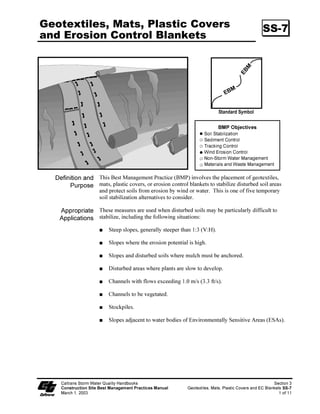
                   sediment and other pollutants are removed. Units come with various cartridge
                   configurations (for use in series with pressurized bag filters) or with a larger single
                   cartridge filtration unit (with multiple filters within).

                   Appropriate Applications:

                        Effective for the removal of sediment (sand, silt, and some clays) and metals, as
                        well as the reduction of BOD, turbidity, and hydrocarbons. Hydrocarbons can
                        effectively be removed with special resin cartridges.

                        Filters can be used to provide secondary treatment to water treated via settling
                        or basic filtration.

                   Implementation:

                        The filters require delivery to the site and initial set up. The vendor can provide
                        assistance.

                   Maintenance:

                        The cartridges require replacement when the pressure differential exceeds the
                        manufacturer’s recommendation.


   Caltrans Storm Water Quality Handbooks                                                             Section 7
   Construction Site Best Management Practices Manual                               Dewatering Operations NS-2
   March 1, 2003                                                                                       11 of 12
Dewatering Operations                                                                 NS-2

                   Schematic Designs:


                                                        Cartridge Filter


   Caltrans Storm Water Quality Handbooks                                                    Section 7
   Construction Site Best Management Practices Manual                      Dewatering Operations NS-2
   March 1, 2003                                                                              12 of 12
Paving and Grinding Operations                                                                   NS-3


                                                                           Standard Symbol

                                                                            BMP Objectives
                                                                      Soil Stabilization
                                                                      Sediment Control
                                                                      Tracking Control
                                                                      Wind Erosion Control
                                                                      Non-Storm Water Management
                                                                      Materials and Waste Management


  Definition and Procedures and practices for conducting paving, saw cutting, and grinding
       Purpose operations to minimize the transport of pollutants to the storm drain system or
                      receiving water body.

    Appropriate These procedures are implemented where paving, surfacing, resurfacing, grinding
    Applications or sawcutting, may pollute storm water runoff or discharge to the storm drain
                      system or watercourses.

      Limitations          Finer solids are not effectively removed by filtration systems.

                           Paving opportunities may be limited during wet weather.

  Standards and            Substances used to coat asphalt transport trucks, asphalt trucks, and asphalt
   Specifications          spreading equipment shall not contain soap and shall be non-foaming and
                           non-toxic.

                           Place plastic materials under asphaltic concrete (AC) paving equipment while
                           not in use, to catch and/or contain drips and leaks. See also BMP WM-4,
                           “Spill Prevention and Control.”

                           When paving involves AC, the following steps shall be implemented to
                           prevent the discharge of uncompacted or loose AC, tack coats, equipment
                           cleaners, or other paving materials:

                           ϑ   Minimize sand and gravel from new asphalt from getting into storm
                               drains, streets, and creeks by sweeping.

                           ϑ   Old or spilled asphalt must be recycled or disposed as approved by the
                               Resident Engineer (RE).


     Caltrans Storm Water Quality Handbooks                                                             Section 7
     Construction Site Best Management Practices Manual                      Paving and Grinding Operations NS-3
     March 1, 2003                                                                                         1 of 4
Paving and Grinding Operations                                                                    NS-3

                         ϑ   AC grindings, pieces, or chunks used in embankments or shoulder backing
                             must not be allowed to enter any storm drain or watercourses. Install silt
                             fence until structure is stabilized or permanent controls are in place.

                         ϑ   Collect and remove all broken asphalt and recycle when practical;
                             otherwise, dispose in accordance with Standard Specification 7-.3.

                         ϑ   Any AC chunks and pieces used in embankments must be placed above
                             the water table and covered by at least 0.3 m ( ft) of material.

                         ϑ   During chip seal application and sweeping operations, petroleum or
                             petroleum covered aggregate must not be allowed to enter any storm
                             drain or water courses. Use silt fence until installation is complete.

                         ϑ   Use only non-toxic substances to coat asphalt transport trucks and asphalt
                             spreading equipment.

                         Drainage inlet structures and manholes shall be covered with filter fabric
                         during application of seal coat, tack coat, slurry seal, and/or fog seal.

                         Seal coat, tack coat, slurry seal, or fog seal shall not be applied if rainfall is
                         predicted to occur during the application or curing period.

                         Paving equipment parked onsite shall be parked over plastic to prevent soil
                         contamination.

                         Clean asphalt-coated equipment off-site whenever possible. When cleaning
                         dry, hardened asphalt from equipment, manage hardened asphalt debris as
                         described in BMP WM-5, “Solid Waste Management.” Any cleaning onsite
                         shall follow BMP NS-8, “Vehicle and Equipment Cleaning.”

                         Do not wash sweepings from exposed aggregate concrete into a storm drain
                         system. Collect and return to aggregate base stockpile, or dispose of properly.

                         Allow aggregate rinse to settle. Then, either allow rinse water to dry in a
                         temporary pit as described in BMP WM-8, “Concrete Waste Management,”
                         or dispose in accordance with Standard Specifications Section 7-.3.

                         Do not allow saw-cut Portland Concrete Cement (PCC) slurry to enter storm
                         drains or watercourses.

                    Pavement Grinding or Removal

                         Residue from PCC grinding operations shall be picked up by means of a
                         vacuum attachment to the grinding machine, shall not be allowed to flow
                         across the pavement, and shall not be left on the surface of the pavement. See
                         also BMP WM-8, “Concrete Waste Management;” and BMP WM-0,
                         “Liquid Waste Management,” and Standard Specifications Section 42-2


   Caltrans Storm Water Quality Handbooks                                                                Section 7
   Construction Site Best Management Practices Manual                         Paving and Grinding Operations NS-3
   March 1, 2003                                                                                            2 of 4
Paving and Grinding Operations                                                                  NS-3

                         “Grindings.”

                         Collect pavement digout material by mechanical or manual methods. This
                         material may be recycled if approved by the RE for use as shoulder backing
                         or base material at locations approved by the RE.

                         If digout material cannot be recycled, transport the material back to a
                         maintenance facility or approved storage site.

                         Digout activities shall not be conducted in the rain.

                         When approved by the RE, stockpile material removed from roadways away
                         from drain inlets, drainage ditches, and watercourses and stored consistent
                         with BMP WM-3, “Stockpile Management.”

                         Disposal or use of AC grindings shall be approved by the RE. See also BMP
                         WM-8, “Concrete Waste Management.”

                    Thermoplastic Striping
                         All thermoplastic striper and pre-heater equipment shutoff valves shall be
                         inspected to ensure that they are working properly to prevent leaking
                         thermoplastic from entering drain inlets, the storm water drainage system, or
                         watercourses.

                         The pre-heater shall be filled carefully to prevent splashing or spilling of hot
                         thermoplastic. Leave six inches of space at the top of the pre-heater container
                         when filling thermoplastic to allow room for material to move when the
                         vehicle is deadheaded.

                         Contractor shall not pre-heat, transfer, or load thermoplastic near drain inlets
                         or watercourses.

                         Clean truck beds daily of loose debris and melted thermoplastic. When
                         possible recycle thermoplastic material. Thermoplastic waste shall be
                         disposed of in accordance with Standard Specification 7-.3.

                    Raised/Recessed Pavement Marker Application and Removal
                         Do not transfer or load bituminous material near drain inlets, the storm water
                         drainage system or watercourses.

                         Melting tanks shall be loaded with care and not filled to beyond six inches
                         from the top to leave room for splashing when vehicle is deadheaded.

                         When servicing or filling melting tanks, ensure all pressure is released before
                         removing lids to avoid spills.

                         On large scale projects, use mechanical or manual methods to collect excess


   Caltrans Storm Water Quality Handbooks                                                              Section 7
   Construction Site Best Management Practices Manual                       Paving and Grinding Operations NS-3
   March 1, 2003                                                                                          3 of 4
Paving and Grinding Operations                                                                 NS-3

                           bituminous material from the roadway after removal of markers.

                           Waste shall be disposed of in accordance with Standard Specification 7-.3.

Maintenance and            Inspect and maintain machinery regularly to minimize leaks and drips.
      Inspection
                           Ensure that employees and subcontractors are implementing appropriate
                           measures during paving operations.


     Caltrans Storm Water Quality Handbooks                                                           Section 7
     Construction Site Best Management Practices Manual                    Paving and Grinding Operations NS-3
     March 1, 2003                                                                                       4 of 4
Temporary Stream Crossing                                                                      NS-4


                                                                          Standard Symbol


                                                                           BMP Objectives
                                                                     Soil Stabilization
                                                                     Sediment Control
                                                                     Tracking Control
                                                                     Wind Erosion Control
                                                                     Non-Storm Water Management
                                                                     Materials and Waste Management


  Definition and A temporary stream crossing is a structure placed across a waterway that allows
       Purpose vehicles to cross the waterway during construction, minimizing, reducing, or
                     managing erosion and downstream sedimentation caused by the vehicles.

   Appropriate Temporary stream crossings are installed at sites:
   Applications
                          Where appropriate permits have been secured (60 Agreements, 404
                          Permits, and 40 Certification).

                          Where construction equipment or vehicles need to frequently cross a waterway.

                          When alternate access routes impose significant constraints.

                          When crossing perennial streams or waterways causes significant erosion.

                          Where construction activities will not last longer than one year.

     Limitations          Will usually disturb the waterway during installation and removal.

                          May require Regional Water Quality Control Board (RWQCB) 40
                          Certification, U.S. Army Corps of Engineers 404 permit and approval by
                          California Department of Fish and Game. If numerical-based water quality
                          standards are mentioned in any of these and other related permits, testing and
                          sampling may be required. If monitoring related to these numerical-based
                          water quality standards is not addressed in the contract documents, contact the
                          Resident Engineer (RE).

                          Installation may require dewatering or temporary diversion of the stream. See
                          BMP NS-2, “Dewatering Operations” and NS-5, “Clear Water Diversion.”

                          May become a constriction in the waterway, which can obstruct flood flow
                          and cause flow backups or washouts. If improperly designed, flow backups
                          can increase the pollutant load through washouts and scouring.

    Caltrans Storm Water Quality Handbooks                                                          Section 7
    Construction Site Best Management Practices Manual                         Temporary Stream Crossing NS-4
    March 1, 2003                                                                                       1 of 8
Temporary Stream Crossing                                                                       NS-4

                           Use of natural or other gravel in the stream for construction of Cellular
                           Confinement System (CCS) (refer to figure at the end of the section) ford
                           crossing will be contingent upon approval by fisheries agencies.

                           Ford crossings may degrade water quality due to contact with vehicles and
                           equipment.

                           CCS should not be used in excessively high or fast flows.

                           Upon completion of construction activities, CCS blocks must be removed
                           from stream.

  Standards and General Considerations
   Specifications Location of the temporary stream crossing shall address:

                           Site selection where erosion potential is low.

                           Areas where the side slopes from highway runoff will not spill into the side
                           slopes of the crossing.

                      The following types of temporary stream crossings shall be considered:

                           Culverts - Used on perennial and intermittent streams.

                           Fords - Appropriate during the dry season in arid areas. Used on dry washes
                           and ephemeral streams, and low flow perennial streams. CCS, a type of ford
                           crossing is also appropriate for use in streams.

                           Bridges - Appropriate for streams with high flow velocities, steep gradients
                           and/or where temporary restrictions in the channel are not allowed.

                      Design and installation requires knowledge of stream flows and soil strength.
                      Designs shall be prepared under direction of, and approved by, a registered civil
                      and/or structural engineer. Both hydraulic and construction loading requirements
                      shall be considered with the following:

                           Comply with the requirements for culvert and bridge crossings, as contained
                           in the Caltrans Highway Design Manual, particularly if the temporary stream
                           crossing will remain through the rainy season.

                           Provide stability in the crossing and adjacent areas to withstand the design
                           flow. The design flow and safety factor shall be selected based on careful
                           evaluation of the risks due to over topping, flow backups, or washout.

                           Avoid oil or other potentially hazardous waste materials for surface treatment.

                      Construction Considerations:
                           Stabilize construction roadways, adjacent work area and stream bottom
                           against erosion.


     Caltrans Storm Water Quality Handbooks                                                          Section 7
     Construction Site Best Management Practices Manual                         Temporary Stream Crossing NS-4
     March 1, 2003                                                                                       2 of 8

Cal Trans Bmp Handbook

  • 1.
    Storm Water Quality Handbooks Project Planning and Design Guide Water Storm Water Pollution Prevention Plan (SWPPP) Water and Water Pollution Control Program (WPCP) Preparation Manual Construction Site Best Management Practices (BMPs) Manual State of California Transportation Department of Transportation March 2003
  • 2.
    Contents Section 1 –Construction Site Best Management Practices 1.1 Introduction........................................................................................................................ 1-1 1.2 Storm Water Pollution Control Plan (SWPPP) and Water Pollution Control Program (WPCP)........................................................................ 1-1 1.3 Organization of this Manual .............................................................................................. 1-2 1.4 Caltrans Construction Site BMPs ...................................................................................... 1-2 1.4.1 Approved Construction Site BMPs for Statewide Use....................................... 1-3 1.4.2 Approved Construction Site BMPs for Use on a Project-by-Project Basis ........ 1-3 Section 2 – Selecting and Implementing Construction Site Best Management Practices 2.1 Definitions ......................................................................................................................... 2-1 2.1.1 Disturbed Soil Area (DSA)................................................................................. 2-1 2.1.2 Active Areas and Non-Active Areas .................................................................. 2-1 2.1.3 Slope Length and Benches ................................................................................. 2-2 2.1.4 Rainy Season ...................................................................................................... 2-2 2.2 Temporary Soil Stabilization and Sediment Control Implementation Guidance............... 2-4 2.2.1 Scheduling .......................................................................................................... 2-4 2.2.2 Preservation of Existing Vegetation ................................................................... 2-4 2.2.3 Storm Water Run-on and Concentrated Flows................................................... 2-4 2.2.4 Disturbed Soil Area Management ...................................................................... 2-5 2.2.4.1 Disturbed Soil Area Size Limitations ............................................... 2-5 2.2.5 DSA Protection by Temporary Soil Stabilization and Temporary Sediment Controls .............................................................................................................. 2-5 2.2.6 Procedures for Rainfall Area 7 ........................................................................... 2-6 2.2.7 Basins ............................................................................................................... 2-10 2.2.8 Stockpile Management ..................................................................................... 2-10 2.3 Guidance for Implementation of Other BMPs ................................................................ 2-10 2.3.1 Mobile Operations ............................................................................................ 2-10 2.3.2 Wind Erosion Controls ..................................................................................... 2-10 2.3.3 Tracking Controls ............................................................................................. 2-10 2.3.4 Non-Storm Water and Waste Management and Materials Pollution Controls ...................................................................... 2-10 2.4 BMP Inspections.............................................................................................................. 2-11 Caltrans Storm Water Quality Handbooks Construction Site Best Management Practices Manual Contents March 1, 2003 i
  • 3.
    Contents Section 3 –Temporary Soil Stabilization Best Management Practices 3.1 Temporary Soil Stabilization ............................................................................................. 3-1 3.1.1 Temporary Concentrated Flow Conveyance Controls........................................ 3-1 Working Details for Temporary Soil Stabilization BMPs SS-1 Scheduling SS-2 Preservation of Existing Vegetation SS-3 Hydraulic Mulch SS-4 Hydroseeding SS-5 Soil Binders SS-6 Straw Mulch SS-7 Geotextiles, Plastic Covers & Erosion Control Blankets/Mats SS-8 Wood Mulching SS-9 Earth Dikes/Drainage Swales & Lined Ditches SS-10 Outlet Protection/Velocity Dissipation Devices SS-11 Slope Drains SS-12 Streambank Stabilization Section 4 – Temporary Sediment Control Best Management Practices 4.1 Temporary Sediment Controls........................................................................................... 4-1 Working Details for Temporary Sediment Control BMPs SC-1 Silt Fence SC-2 Sediment/Desilting Basin SC-3 Sediment Trap SC-4 Check Dam SC-5 Fiber Rolls SC-6 Gravel Bag Berm SC-7 Street Sweeping and Vacuuming SC-8 Sandbag Barrier SC-9 Straw Bale Barrier SC-10 Storm Drain Inlet Protection Section 5 – Wind Erosion Control Best Management Practices 5.1 Wind Erosion Control........................................................................................................ 5-1 Working Details for Wind Erosion Control BMPs WE-1 Wind Erosion Control Caltrans Storm Water Quality Handbooks Construction Site Best Management Practices Manual Contents March 1, 2003 ii
  • 4.
    Contents Section 6 –Tracking Control Best Management Practices 6.1 Tracking Control................................................................................................................ 6-1 Working Details for Tracking Control BMPs TC-1 Stabilized Construction Entrance/Exit TC-2 Stabilized Construction Roadway TC-3 Entrance/Outlet Tire Wash Section 7 – Non-Storm Water Management Best Management Practices 7.1 Non-Storm Water Management......................................................................................... 7-1 Working Details for Non-Storm Water Management BMPs NS-1 Water Conservation Practices NS-2 Dewatering Operations NS-3 Paving and Grinding Operations NS-4 Temporary Stream Crossing NS-5 Clear Water Diversion NS-6 Illicit Connection/Illegal Discharge Detection and Reporting NS-7 Potable Water/Irrigation NS-8 Vehicle and Equipment Cleaning NS-9 Vehicle and Equipment Fueling NS-10 Vehicle and Equipment Maintenance NS-11 Pile Driving Operations NS-12 Concrete Curing NS-13 Material and Equipment Use Over Water NS-14 Concrete Finishing NS-15 Structure Demolition/Removal Over or Adjacent to Water Section 8 –Waste Management and Materials Pollution Control Best Management Practices 8.1 Waste Management and Materials Pollution Control ........................................................ 8-1 8.1.1 Waste Management BMPs ................................................................................. 8-1 8.1.2 Materials Pollution Control BMPs ..................................................................... 8-1 Working Details for Waste Management and Materials Pollution Control BMPs WM-1 Material Delivery and Storage WM-2 Material Use WM-3 Stockpile Management WM-4 Spill Prevention and Control WM-5 Solid Waste Management WM-6 Hazardous Waste Management WM-7 Contaminated Soil Management WM-8 Concrete Waste Management WM-9 Sanitary/Septic Waste Management WM-10 Liquid Waste Management Caltrans Storm Water Quality Handbooks Construction Site Best Management Practices Manual Contents March 1, 2003 iii
  • 5.
    Contents Appendices Appendix A Abbreviations, Acronyms, and Definition of Terms Appendix B Selection of Temporary Soil Stabilization Controls B.1 Antecedent Moisture.......................................................................................... B-1 B.2 Availability ........................................................................................................ B-1 B.3 Ease of Clean-Up............................................................................................... B-1 B.4 Installation Cost................................................................................................. B-2 B.5 Degradability ..................................................................................................... B-2 B.6 Length of Drying Time...................................................................................... B-2 B.7 Time to Effectiveness ........................................................................................ B-2 B.8 Erosion Control Effectiveness ........................................................................... B-3 B.9 Longevity........................................................................................................... B-3 B.10 Mode of Application.......................................................................................... B-3 B.11 Residual Impact ................................................................................................. B-3 B.12 Native ................................................................................................................ B-3 B.13 Runoff Effect ..................................................................................................... B-3 Caltrans Storm Water Quality Handbooks Construction Site Best Management Practices Manual Contents March 1, 2003 iv
  • 6.
    Contents Tables 1-1 Construction Site BMPs..................................................................................................... 1-4 2-1 Area Definitions................................................................................................................. 2-7 2-2 Required Combination of Temporary Soil Stabilization and Temporary Sediment Controls and Barriers - Non-Active Disturbed Soil Areas .............................................................. 2-8 2-3 Required Combination of Temporary Soil Stabilization and Temporary Sediment Controls and Barriers - Active Disturbed Soil Areas ...................................................................... 2-9 3-1 Temporary Soil Stabilization BMPs .................................................................................. 3-2 4-1 Temporary Sediment Control BMPs ................................................................................. 4-1 5-1 Wind Erosion Control BMPs............................................................................................. 5-1 6-1 Tracking Control BMPs..................................................................................................... 6-1 7-1 Non-Storm Water Management BMPs.............................................................................. 7-1 8-1 Waste Management and Materials Pollution Control BMPs ............................................. 8-2 B-1 Temporary Soil Stabilization Criteria Matrix ................................................................... B-4 Figures 2-1 Designation of Rainy Seasons ........................................................................................... 2-3 Caltrans Storm Water Quality Handbooks Construction Site Best Management Practices Manual Contents March 1, 2003 v
  • 7.
    Section 1 Construction Site Best Management Practices 1.1 Introduction On July 15, 1999, the State Water Resources Control Board (SWRCB) issued the “National Pollutant Discharge Elimination System (NPDES) Permit, Statewide Storm Water Permit and Waste Discharge Requirements (WDRs) for the State of California, Department of Transportation (Caltrans)” (Order No. 99-06-DWQ, NPDES No. CAS000003) hereby called “Permit”. The Permit regulates storm water discharges from Caltrans properties, facilities and activities, and requires that Caltrans’ construction program comply with the requirements of the “NPDES General Permit, Waste Discharge Requirements (WDRs) for Discharges of Storm Water Runoff Associated with Construction Activity” (Order No. 99-08-DWQ, NPDES No. CAS000002) (General Permit) issued by the SWRCB, to regulate discharges from construction sites that disturb 5 acres or more. Beginning March 10, 2003, U.S. Environmental Protection Agency (EPA) and SWRCB regulations will regulate discharges from projects with soil disturbance of 1 acre or more by amending the General Permit and thus including coverage of projects with soil disturbance of 1 acre or more. SWRCB Resolution No. 2001-46 modified provisions of the General Permit that require permittees to implement specific water quality sampling and analytical procedures implemented on a construction site. 1.2 Storm Water Pollution Prevention Plan (SWPPP) and Water Pollution Control Program (WPCP) Caltrans requires contractors to prepare and implement a program to control water pollution effectively during the construction of all projects (see Standard Specification Section 7-1.01G Water Pollution). Projects resulting in 0.4 hectares (ha) [1 ac] or more of soil disturbance are subject to the General Permit. Caltrans Special Provisions require that for larger projects, defined as those resulting in 0.4 ha (1 ac) or more of soil disturbance, Contractors prepare and submit a Storm Water Pollution Prevention Plan (SWPPP). When a SWPPP is required for a project, it will satisfy the requirements of Standard Specification Section 7-1.01G, in addition to meeting other permit requirements. Caltrans requires that a Water Pollution Control Program (WPCP) addressing control measures be prepared and implemented by the construction contractor for projects resulting in soil disturbance of less than 0.4 ha (1ac). For detailed step-by-step procedures, instructions and templates to prepare a SWPPP or a WPCP, refer to the Caltrans Storm Water Quality Handbooks, Storm Water Pollution Prevention Plan (SWPPP) and Water Pollution Control Program (WPCP) Preparation Manual. Caltrans Storm Water Quality Handbooks Construction Site Best Management Practices Manual Section 1 March 1, 2003 1 of 5
  • 8.
    If two (2)or more small projects [less than 0.4 ha (1 ac) of soil disturbance] in the same corridor are part of a larger common plan of development [0.4 ha (1 ac) or more], then these small projects are also subject to the requirements of the General Permit to develop and implement a SWPPP. 1.3 Organization of this Manual This Storm Water Quality Handbooks, Construction Site Best Management Practices Manual (manual) is intended to provide Contractors and Caltrans staff with detailed information of construction site BMPs. This Manual is organized as follows: Section 1 provides an introduction to the Construction Site Best Management Practices (BMPs) Manual. Section 2 provides instructions for the selection and implementation of construction site BMPs. Section 3 provides listing and working details for Caltrans construction site BMPs for Temporary Soil Stabilization. Section 4 provides listing and working details for Caltrans construction site BMPs for Temporary Sediment Control. Section 5 provides listing and working details for Caltrans construction site BMPs for Wind Erosion Control. Section 6 provides listing and working details for Caltrans construction site BMPs for Tracking Control. Section 7 provides listing and working details for Caltrans construction site BMPs for Non- Storm Water Management. Section 8 provides listing and working details for Caltrans construction site BMPs for Waste Management and Materials Pollution Control. Appendix A provides a listing of frequently used abbreviations, acronyms, and definitions of terms used throughout this Manual. Appendix B provides guidance on the selection of temporary soil stabilization controls. 1.4 Caltrans Construction Site BMPs This section lists those BMPs considered during the construction of Caltrans projects. Construction site BMPs (also called temporary control practices) are best conventional technology/best available technology (BCT/BAT)-based BMPs that are consistent with the BMPs and control practices required under the General Permit. Caltrans construction site BMPs are divided into six categories (see Table 1-1): Caltrans Storm Water Quality Handbooks Construction Site Best Management Practices Manual Section 1 March 1, 2003 2 of 5
  • 9.
    1.4.1 Approved ConstructionSite BMPs for Statewide Use Approved construction site BMPs are BMPs that have been approved by Caltrans Deputy Directors or Program Managers for statewide implementation. Implementation is dependent on conditions/applicability of deployment described as part of the BMP. These BMPs are typically implemented in all Caltrans construction projects; they include practices for soil stabilization, sediment control, wind erosion control, tracking control, non-storm water management and waste management. Some of the approved construction site BMPs have been designated as “minimum requirements”; these BMPs will be implemented in all highway construction projects statewide when they are applicable to a project. 1.4.2 Approved Construction Site BMPs for Use on a Project-by-Project Basis These are other construction site BMPs have not been approved for statewide use by the Statewide Storm Water Management Plan (SWMP), but may be implemented, on a project-by-project basis, in addition to required approved BMPs and when determined necessary and feasible by the Resident Engineer (RE). Caltrans may, on a project-by-project basis, specify or require Contractors to implement some of these construction site BMPs. Additionally, Caltrans will consider a Contractor’s recommendation to implement some of these construction site BMPs on a project, subject to headquarters approval. Construction site BMPs within each of these categories are described in Sections 3 through 8 of this Manual. Table 1-1 lists the construction site BMPs. It is important to note that some BMPs were grouped to show that a combination of those BMPs will enhance protection over the use of only one BMP. Caltrans Storm Water Quality Handbooks Construction Site Best Management Practices Manual Section 1 March 1, 2003 3 of 5
  • 10.
    TABLE 1-1 CONSTRUCTION SITE BMPs APPROVED FOR APPROVED FOR USE ID BMP NAME STATEWIDE USE ON (1) ON A PROJECT-BY- MINIMUM ALL PROJECTS PROJECT BASIS REQUIREMENT TEMPORARY SOIL STABILIZATION SS-1 Scheduling X , SS-2 Preservation of Existing Vegetation X , (2) SS-3 Hydraulic Mulch X , (2) SS-4 Hydroseeding X , (2) SS-5 Soil Binders X , (2) SS-6 Straw Mulch X , (2) SS-7 Geotextiles, Plastic Covers, & Erosion Control Blankets/Mats X , SS-8 Wood Mulching X SS-9 Earth Dikes/Drainage Swales & Lined Ditches X SS-10 Outlet Protection/Velocity Dissipation Devices X SS-11 Slope Drains X SS-12 Streambank Stabilization X TEMPORARY SEDIMENT CONTROL (3) SC-1 Silt Fence X , SC-2 Sediment/Desilting Basin X SC-3 Sediment Trap X SC-4 Check Dam X (3) SC-5 Fiber Rolls X , SC-6 Gravel Bag Berm X SC-7 Street Sweeping and Vacuuming X , SC-8 Sandbag Barrier X SC-9 Straw Bale Barrier X SC-10 Storm Drain Inlet Protection X , WIND EROSION CONTROL WE-1 Wind Erosion Control X , TRACKING CONTROL TC-1 Stabilized Construction Entrance/Exit X TC-2 Stabilized Construction Roadway X TC-3 Entrance/Outlet Tire Wash X (1) Implementation depends on applicability to a project (2) The Contractor shall select one of the five measures listed or a combination thereof to achieve and maintain the contract’s rainy season disturbed soil area (DSA) requirements (3) The Contractor shall select one of the two measures listed or a combination thereof to achieve and maintain the contract’s rainy season disturbed soil area (DSA) requirements” Caltrans Storm Water Quality Handbooks Construction Site Best Management Practices Manual Section 1 March 1, 2003 4 of 5
  • 11.
    TABLE 1-1 CONSTRUCTION SITE BMPs APPROVED FOR APPROVED FOR USE ID BMP NAME STATEWIDE USE ON (1) ON A PROJECT-BY- MINIMUM ALL PROJECTS PROJECT BASIS REQUIREMENT NON-STORM WATER MANAGEMENT NS-1 Water Conservation Practices X NS-2 Dewatering Operations X NS-3 Paving and Grinding Operations X NS-4 Temporary Stream Crossing X NS-5 Clear Water Diversion X NS-6 Illicit Connection/Illegal Discharge Detection and Reporting X , NS-7 Potable Water/Irrigation X NS-8 Vehicle and Equipment Cleaning X , NS-9 Vehicle and Equipment Fueling X , NS-10 Vehicle and Equipment Maintenance X , NS-11 Pile Driving Operations X NS-12 Concrete Curing X NS-13 Material and Equipment Use Over Water X NS-14 Concrete Finishing X NS-15 Structure Demolition/Removal Over or Adjacent to Water X WASTE MANAGEMENT AND MATERIALS POLLUTION CONTROL WM-1 Material Delivery and Storage X , WM-2 Material Use X , WM-3 Stockpile Management X , WM-4 Spill Prevention and Control X , WM-5 Solid Waste Management X , WM-6 Hazardous Waste Management X WM-7 Contaminated Soil Management X WM-8 Concrete Waste Management X WM-9 Sanitary/Septic Waste Management X , WM-10 Liquid Waste Management X (1) Implementation depends on applicability to a project (2) The Contractor shall select one of the five measures listed or a combination thereof to achieve and maintain the contract’s rainy season disturbed soil area (DSA) requirements (3) The Contractor shall select one of the two measures listed or a combination thereof to achieve and maintain the contract’s rainy season disturbed soil area (DSA) requirements” Caltrans Storm Water Quality Handbooks Construction Site Best Management Practices Manual Section 1 March 1, 2003 5 of 5
  • 12.
    Section 2 Selecting and Implementing Construction Site Best Management Practices This section provides instructions for the selection and implementation of construction site best management practices (BMPs). It is important to note that the requirements of this Section are Caltrans minimum requirements, and that Caltrans Districts may impose more stringent requirements on a project-by-project basis, and that the Contractor implements additional construction site BMPs if deemed necessary. Changes in field implementation of construction site BMPs require written approval of the Resident Engineer (RE). Any additional requirements will be included in the project’s Standard Special Provisions (SSPs). Working details of construction site BMPs are presented in Sections 3 through 8 of this Manual. 2.1 Definitions 2.1.1 Disturbed Soil Area (DSA) Disturbed soil areas (DSAs) are areas of exposed, erodible soil that are within the construction limits and that result from construction activities. The following are not considered DSAs: Areas where soil stabilization, erosion control, highway planting, or slope protection are applied and associated drainage facilities are in place and functional. Roadways, construction roads, access roads or contractor’s yards that have been stabilized by the placement of compacted subbase or base material or paved surfacing. Areas where construction has been completed in conformance with the contract plans and permanent erosion control is in place and functional. Erosion control is considered functional when a uniform vegetative cover equivalent to 70 percent of the native background vegetation coverage has been established or equivalent stabilization measures have been employed. 2.1.2 Active Areas and Non-Active Areas Active Areas are construction areas where soil-disturbing activities have already occurred and continue to occur or will occur during the ensuing 21 days. Non-Active Areas are construction areas (formerly active areas) that will be idle for at least 21 days. The RE will conduct a review of the existing active areas on a regular basis to determine if a non- active status should be applied to some DSAs. Caltrans Storm Water Quality Handbooks Construction Site Best Management Practices Manual Section 2 March 1, 2003 1 of 11
  • 13.
    2.1.3 Slope Lengthand Benches Slope length is measured or calculated along the continuous inclined surface. Each discrete slope is between one of the following: top to toe, top to bench, bench to bench, and bench to toe. Benches are drainage facilities that intercept surface flow and convey the resulting concentrated flow away from a slope. For the purpose of determining slope lengths, fiber rolls or other appropriate BMPs (used for temporary sediment control) can be considered equivalent to a bench. 2.1.4 Rainy Season The average rainfall in California varies greatly from region to region. To account for the various rainfall patterns (time frame, intensities, and amounts) the state is separated into several rainy seasons. Shown in Figure 2-1 is a map identifying the rainy seasons throughout the state. These rainy seasons are used to identify the appropriate level of soil stabilization and sediment control protection. Caltrans Storm Water Quality Handbooks Construction Site Best Management Practices Manual Section 2 March 1, 2003 2 of 11
  • 14.
    Figure 2-1 DESIGNATION OF RAINY SEASONS Caltrans Storm Water Quality Handbooks Construction Site Best Management Practices Manual Section 2 March 1, 2003 3 of 11
  • 15.
    2.2 Temporary Soil Stabilization and Sediment Control Implementation Guidance Storm water pollution control requirements are intended to be implemented on a year-round basis at an appropriate level. The requirements must be implemented in a proactive manner during all seasons while construction is ongoing. California has varied rainfall patterns throughout the state; therefore, the appropriate level of BMP implementation will also vary throughout the state. The temporary sediment controls and soil stabilization specified in this section are based on rainfall patterns (time frames, intensities, and amounts), general soil types, the seasons, slope inclinations and slope lengths. Appropriate water pollution control includes the implementation of an effective combination of both soil stabilization and sediment controls. This section describes both general principles and specific guidance for selecting and implementing temporary soil stabilization and sediment control BMPs. Sections 2.2.1, 2.2.2, and 2.2.3 provide key principles for preventing erosion on construction sites. Sections 2.2.4 and 2.2.5 provide the specific guidance for selecting and implementing temporary soil stabilization and sediment control BMPs to manage disturbed soil areas. It is important to note that the Districts may require implementation of additional construction site BMPs if deemed necessary. 2.2.1 Scheduling Construction scheduling shall consider the amount and duration of soil exposed to erosion by wind, rainfall, runoff , and vehicle tracking and seek to minimize disturbed soil area during the rainy season. A schedule shall be prepared that shows the sequencing of construction activities with the installation and maintenance of soil stabilization and sediment control BMPs. See BMP SS-1, Scheduling, in this Manual for BMP details. 2.2.2 Preservation of Existing Vegetation Preserving existing vegetation to the maximum extent possible and for as long as possible on a construction site reduces or eliminates erosion in those areas. To facilitate this practice, on a year- round basis temporary fencing shall be provided prior to commencement of clearing and grubbing operations or other soil-disturbing activities in areas where no construction activity is planned or construction will occur at a later date. See BMP SS-2, Preservation of Existing Vegetation, for BMP details. 2.2.3 Storm Water Run-on and Concentrated Flows The diversion of storm water run-on and conveyance of concentrated flows must be considered in determining the appropriateness of the BMPs chosen. BMPs to divert or manage concentrated flows in a non-erodible fashion may be required on a project-by-project basis to divert off-site drainage through or around the construction site or to properly manage construction site storm water runoff. See BMPs SS-9, Earth Dikes, Drainage Swales and Lined Ditches; SS-10, Outlet Protection/ Velocity Dissipation Devices; and SS-11, Slope Drains, for BMP details. Caltrans Storm Water Quality Handbooks Construction Site Best Management Practices Manual Section 2 March 1, 2003 4 of 11
  • 16.
    2.2.4 Disturbed SoilArea Management The DSA management guidelines are based on rainfall patterns (time frames, intensities, and amounts), general soil types, the seasons, slope inclinations, and slope lengths. All of these factors are considered in developing the appropriate levels of soil stabilization and sediment control, and will be considered by the RE when directing specific site-by-site actions. 2.2.4.1 Disturbed Soil Area Size Limitations Limiting the amount of disturbed soil is a critical component in conducting an effective storm water management program; contract special provisions may specify limits of disturbed soil area. Standard Specifications Section 7-1.01G, Water Pollution states “Unless otherwise approved by the Engineer in writing, the Contractor shall not expose a total area of erodible earth, which may cause water pollution, exceeding 70,000 m2 for each separate location, operation or spread of equipment before either temporary or permanent erosion control measures are accomplished”. The RE has the option of increasing the size of disturbed soil areas beyond 70,000 square meters (17 acres) if appropriate control practices and an implementation plan are included in an approved SWPPP. Furthermore, District design teams may elect to further restrict the size of the project’s total disturbed soil area to 2 hectares (5 acres) during the rainy season. The RE has the option of increasing the limit of the total disturbed soil area during the rainy season beyond 5 acres if appropriate control practices and an implementation plan are included in an approved SWPPP. 2.2.5 DSA Protection by Temporary Soil Stabilization and Temporary Sediment Controls To account for rainfall patterns (time frames, intensities, and amounts) and to a lesser extent general soil type differences, the state has been divided into seven areas requiring common protection requirements. These rainfall areas are described in Table 2-1. The specific temporary soil stabilization and sediment control practices for DSA protection in each area are determined from Tables 2-2 and 2-3 (for non-active disturbed soil areas and active disturbed soil areas, respectively). Based on consultation with experts, the slope length and slope inclination are seen as the most important criteria for soil stabilization and sediment control requirements, as these factors have the largest potential impact on the erosion rate. As indicated on these tables, the temporary soil stabilization and sediment controls at a construction site will increase with increasing slope length and slope inclination combination. DSAs shall be protected as follows: Temporary control practices (as required in Table 2-2) shall be performed on non-active DSAs within 14 days from the cessation of soil-disturbing activities or one day prior to the onset of precipitation, whichever occurs first. Temporary control practices for active DSAs (as required in Table 2-3) shall be performed prior to the onset of precipitation and throughout each day for which precipitation is forecasted. Caltrans Storm Water Quality Handbooks Construction Site Best Management Practices Manual Section 2 March 1, 2003 5 of 11
  • 17.
    For non-active DSAs,limit the erosive effects of storm water flow on slopes by implementing BMPs such as fiber rolls to break up the slope lengths as follows: ϑ Slope inclination 1:4 (V:H) and flatter: BMPs shall be placed on slopes at intervals no greater than 6 m. ϑ Slope inclination between 1:4 (V:H) and 1:2 (V:H): BMPs shall be placed on slopes at intervals no greater than 4.5 m. ϑ Slope inclination 1:2 (V:H) or greater: BMPs shall be placed on slopes at intervals no greater than 3 m. For non-active DSAs, permanent erosion control shall be applied to areas deemed complete during the project’s defined seeding window. Provide construction site BMPs in addition to those specified in Tables 2-2 and 2-3 to convey concentrated flows in a non-erodible fashion. 2.2.6 Procedures for Rainfall Area 7 For construction sites within Rainfall Area 7 (District 8 within the Colorado River Basin RWQCB jurisdictions, District 9 and District 11 within the Colorado River Basin RWQCB jurisdiction), the soil stabilization and control practices required for the construction site will be determined by the applicable RWQCB on a site-by-site basis. The following procedure shall be used to notify the applicable RWQCB for construction sites in Rainfall Area 7: Caltrans will notify the applicable RWQCB staff of construction sites in these areas at least 30 days prior to the start of construction. During the 30-day notification period, the RWQCB staff may request to review the SWPPP or meet with Caltrans to discuss the construction project. Within the 30-day notification period, the RWQCB may respond with specific soil stabilization and sediment control practices required for the site. If the RWQCB does not respond within the 30-day review period, then Caltrans can proceed with its construction activities as scheduled. Regardless of the RWQCB action, the RWQCB may inspect the site and take enforcement actions, if necessary, pending inspection findings. For construction sites within Rainfall Area 7 (District 6, 7, and 8 within the Lahontan RWQCB jurisdiction) and within one mile of the Mojave or Amargosa River and their tributaries that are within one mile of these waterways, soil stabilization and sediment control measures must be implemented as specified for Area 4. All equipment must also be removed from waterways prior to any flash floods. All other projects located in the Lahontan RWQCB are not required to implement soil stabilization and sediment control measures. Caltrans Storm Water Quality Handbooks Construction Site Best Management Practices Manual Section 2 March 1, 2003 6 of 11
  • 18.
    Table 2-1 AREA DEFINITIONS AREA Applicability Elevation 1 District 1 in the following areas: 1200m all of Del Norte and Humboldt Counties within 20 miles of the coast in Mendocino County 2 District 1 (except within Area 1) <250m District 2 within the North Coast, Lahontan, and Central Valley RWQCB jurisdictions Districts 3, 4 and 5 District 10 within the Lahontan RWQCB jurisdiction 3 District 1 (except within Area 1) 250m – 1200m District 2 within the North Coast, Lahontan, and Central Valley RWQCB jurisdictions Districts 3, 4 and 5 District 10 within the Lahontan RWQCB jurisdiction 4 District 6 within the Central Valley RWQCB jurisdiction <500m District 7 within the Central Coast, Los Angeles, and Central Valley RWQCB jurisdictions District 8 within the Santa Ana and San Diego RWQCB jurisdictions District 10 (except for the Lahontan RWCB jurisdiction) District 11 within the San Diego RWQCB jurisdiction District 12 5 District 6 within the Central Valley RWQCB jurisdiction 500m – 1200m District 7 within the Central Coast, Los Angeles, and Central Valley RWQCB jurisdictions District 8 within the Santa Ana and San Diego RWQCB jurisdictions District 10 (except for the Lahontan RWCB jurisdiction) District 11 within the San Diego RWQCB jurisdiction District 12 6 Statewide >1200m 7 District 6 within the Lahontan RWQCB jurisdiction 1200m District 7 within the Lahontan RWQCB jurisdiction District 8 within the Lahontan and Colorado River Basin RWQCB jurisdictions District 9 District 11 within the Colorado River Basin RWQCB jurisdiction Caltrans Storm Water Quality Handbooks Construction Site Best Management Practices Manual Section 2 March 1, 2003 7 of 11
  • 19.
    Table 2-2 REQUIRED COMBINATION OF TEMPORARY SOIL STABILIZATION AND TEMPORARY SEDIMENT CONTROLS AND BARRIERS (6) (7) NON-ACTIVE DISTURBED SOIL AREAS (1) SLOPE (V:H) SEASON AREA(S) TEMPORARY BMP > 1:20 > 1:4 ” 1:20 > 1:2 ” 1:4 ” 1:2 (5) SOIL STABILIZATION X X X X (5) 1&6 SEDIMENT BARRIER X X X X (3) DESILTING BASIN X X X (5) (2) SOIL STABILIZATION X X X X RAINY 2, 3, 4 & 5 SEDIMENT BARRIER X X X DESILTING BASIN SOIL STABILIZATION AND SEDIMENT CONTROL PRACTICES TO BE 7 (8) DETERMINED BY APPLICABLE RWQCB (5) (4) (4) SOIL STABILIZATION X X X X (4) 1 SEDIMENT BARRIER X X X DESILTING BASIN SOIL STABILIZATION 2&4 SEDIMENT BARRIER DESILTING BASIN NON- SOIL STABILIZATION RAINY (4) 3&5 SEDIMENT BARRIER X DESILTING BASIN (5) (4) (4) SOIL STABILIZATION X X X X (4) 6 SEDIMENT BARRIER X X X (3) DESILTING BASIN X 7 SOIL STABILIZATION AND SEDIMENT CONTROL PRACTICES TO BE (8) DETERMINED BY APPLICABLE RWQCB (1) Unless otherwise noted, the temporary BMP is required for the slope inclinations indicated on slope lengths greater than 3 meters. (2) The maximum slope length is 30 meters for slope inclinations between 1:20 (V:H) and 1:2 (V:H) and 15 meters for steeper slopes. (3) Required in addition to the temporary sediment barrier, where feasible. Feasibility will depend on site-specific factors such as available right-of-way within the project limits, topography, soil type, disturbed soil area within watershed, and climate conditions. (4) Implementation of controls not required except at least 24 hours prior to all predicted rain events. (5) The indicated temporary BMP is required on all slope lengths. (6) Sediment controls and barriers include all temporary sediment control construction BMPs identified in the Statewide Storm Water Quality Practice Guidelines associated with the SWMP and Section 4 of these guidelines. Linear barrier systems are equivalent to what are referred to in the General Construction Permit as perimeter controls. The intent is prevent the transport of sediment at the downslope edge of disturbed soil areas. (7) Permanent erosion control seeding shall be applied to all non-active areas deemed substantially complete during the project’s defined seeding window. (8) Refer to Section 2.2.6 for procedure. Caltrans Storm Water Quality Handbooks Construction Site Best Management Practices Manual Section 2 March 1, 2003 8 of 11
  • 20.
    Table 2-3 REQUIRED COMBINATION OF TEMPORARY SOIL STABILIZATION AND TEMPORARY SEDIMENT CONTROLS AND BARRIERS (6) ACTIVE DISTURBED SOIL AREAS (3) (1) SLOPE (V:H) SEASON AREA(S) TEMPORARY BMP > 1:20 ” 1:20 > 1:2 ” 1:2 SOIL STABILIZATION X X (4) 1&6 SEDIMENT BARRIER X X X (2) DESILTING BASIN X X SOIL STABILIZATION 2, 4 & 5 SEDIMENT BARRIER X X RAINY (2) DESILTING BASIN X (5) SOIL STABILIZATION X 3 SEDIMENT BARRIER X X (2) DESILTING BASIN X 7 SOIL STABILIZATION AND SEDIMENT CONTROL PRACTICES TO BE (7) DETERMINED BY APPLICABLE RWQCB SOIL STABILIZATION 1 SEDIMENT BARRIER X X (2) DESILTING BASIN X SOIL STABILIZATION 2, 3, 4 & 5 SEDIMENT BARRIER NON- RAINY DESILTING BASIN SOIL STABILIZATION 6 SEDIMENT BARRIER X X (2) DESILTING BASIN X 7 SOIL STABILIZATION AND SEDIMENT CONTROL PRACTICES TO BE (7) DETERMINED BY APPLICABLE RWQCB (1) Unless otherwise noted, the BMP is required for the slope inclinations indicated on slope lengths greater than 3 meters. (2) Required in addition to the temporary sediment barrier, where feasible. Feasibility will depend on site-specific factors such available right-of-way within the project limits, topography, soil type, disturbed soil area within watershed, and climate conditions. (3) Implementation of soil stabilization controls are not required except prior to predicted rain. (4) The indicated temporary BMP required on all slope lengths. (5) The indicated temporary BMP required on slope lengths greater than 15 meters. (6) Sediment controls and barriers include all temporary sediment control construction BMPs identified in the Statewide Storm Water Quality Practice Guidelines associated with the SWMP and Section 4 of these Guidelines. Linear barrier systems are equivalent to what are referred to in the General Construction Permit as perimeter controls. The intent is to provide a barrier to prevent the transport of sediment at the downslope edge of disturbed soil areas. (7) Refer to Section 2.2.6 for procedures. Caltrans Storm Water Quality Handbooks Construction Site Best Management Practices Manual Section 2 March 1, 2003 9 of 11
  • 21.
    2.2.7 Basins The practicesdescribed herein are typical of those that will be implemented on a project-by-project basis. However, it is important to note that there will be instances where project and site conditions require deviation from the BMPs and the descriptions provided in this manual. For instance, the proposed implementation of sediment/desilting basins (see BMP SC-2, “Sediment/Desilting Basin”) is a new commitment that has not been incorporated into existing designs. In addition, the nature of linear projects and constrained rights-of-way inherent to Caltrans work may prohibit the use of sediment/desilting basins at some locations on certain projects and on some projects altogether. Implementation of sediment/desilting basins will be considered on a project-by-project basis. Caltrans is committed to refining the sediment/desilting basin implementation criteria during the term of the Permit while implementing the sediment/desilting basins on projects as practicable. 2.2.8 Stockpile Management Soil stabilization and sediment control requirements as they apply to stockpiles of various materials are presented in BMP WM-3, Stockpile Management, in Section 8 of this Manual. 2.3 Guidance for Implementation of Other BMPs 2.3.1 Mobile Operations Mobile operations common to the construction of a project include asphalt recycling, concrete mixing, crushing and the storage of materials. BMPs shall be implemented year-round, as appropriate, to control the individual situations these mobile operations can create. 2.3.2 Wind Erosion Controls Wind erosion controls shall be considered year-round for all disturbed soils on the project site that are subject to wind erosion and when significant wind and dry conditions are anticipated during construction of the project. See BMP WE-1, Wind Erosion, for BMP details. 2.3.3 Tracking Controls Tracking controls shall be implemented year-round, as needed, to reduce the tracking of sediment and debris from the construction site. At a minimum, entrances and exits shall be inspected daily, and controls implemented as needed. See Section 6 of this Manual for BMP details. 2.3.4 Non-Storm Water and Waste Management and Materials Pollution Controls The objective of the non-storm water and waste management and materials pollution controls is to reduce the discharge of materials other than storm water to the storm water drainage system or to receiving waters. These controls shall be implemented year-round for all applicable activities, material usage, and site conditions. Sections 7 and 8 of this Manual provide guidance on implementation of BMPs related to the specific activity being conducted. Caltrans Storm Water Quality Handbooks Construction Site Best Management Practices Manual Section 2 March 1, 2003 10 of 11
  • 22.
    2.4 BMP Inspections The BMPs deployed on construction sites will be inspected on a frequency as described below. Improperly installed or damaged practices shall be corrected immediately, or by a later date and time if requested by the Contractor and approved by the Resident Engineer (RE) in writing, but not later than the onset of forecasted rain events. Inspections of construction site BMPs are conducted as follows: Prior to a forecast storm. After a rain event that causes runoff from the construction site. At 24-hour intervals during extended rain events. As specified in the project Special Provisions and/or SWPPP. Every two weeks during the non-rainy season. Weekly during the rainy season. Or as directed by BMP Inspection Requirements or the Resident Engineer (RE). Caltrans Storm Water Quality Handbooks Construction Site Best Management Practices Manual Section 2 March 1, 2003 11 of 11
  • 23.
    Section 3 Temporary Soil Stabilization Best Management Practices 3.1 Temporary Soil Stabilization Temporary soil stabilization consists of preparing the soil surface and applying one of the best management practices (BMPs) shown in Table 3-1, or combination thereof, to disturbed soil areas. Temporary soil stabilization shall be applied to disturbed soil areas of construction projects in conformance with the criteria presented in Section 2, Selecting and Implementing Construction Site BMPs, of this Manual. Refer to Appendix B for additional guidance on the selection of temporary soil stabilization controls. 3.1.1 Temporary Concentrated Flow Conveyance Controls Temporary concentrated flow conveyance controls consist of a system of measures or BMPs that are used alone or in combination to intercept, divert, convey and discharge concentrated flows with a minimum of soil erosion, both on-site and downstream (off-site). Temporary concentrated flow conveyance controls may be required to direct run-on around or through the project in a non-erodible fashion. Temporary concentrated flow conveyance controls include the following BMPs: Earth Dikes/Drainage Swales & Lined Ditches Outlet Protection/Velocity Dissipation Devices Slope Drains Caltrans Storm Water Quality Handbooks Construction Site Best Management Practices Manual Section 3 March 1, 2003 1of 2
  • 24.
    Table 3-1 TEMPORARY SOIL STABILIZATION BMPs ID BMP NAME SS-1 Scheduling SS-2 Preservation of Existing Vegetation SS-3 Hydraulic Mulch SS-4 Hydroseeding SS-5 Soil Binders SS-6 Straw Mulch SS-7 Geotextiles, Plastic Covers, & Erosion Control Blankets/Mats SS-8 Wood Mulching Temporary Concentrated Flow Conveyance Controls SS-9 Earth Dikes/Drainage Swales & Lined Ditches SS-10 Outlet Protection/Velocity Dissipation Devices SS-11 Slope Drains SS-12 Streambank Stabilization The remainder of this Section shows the working details for each of the temporary soil stabilization BMPs. Caltrans Storm Water Quality Handbooks Construction Site Best Management Practices Manual Section 3 March 1, 2003 2 of 2
  • 25.
    Scheduling SS-1 Standard Symbol BMP Objectives Soil Stabilization Sediment Control Tracking Control Wind Erosion Control Non-Storm Water Management Materials and Waste Management Definition and This best management practice (BMP) involves developing, for every project, a Purpose schedule that includes sequencing of construction activities with the implementation of construction site BMPs such as temporary soil stabilization (erosion control) and temporary sediment controls measures. The purpose is to reduce the amount and duration of soil exposed to erosion by wind, rain, runoff and vehicle tracking, and to perform the construction activities and control practices in accordance with the planned schedule. Appropriate Construction sequencing shall be scheduled to minimize land disturbance for all Applications projects during the rainy and non-rainy season. Appropriate BMPs shall be implemented during both rainy and non-rainy seasons. Limitations None identified. Standards and Developing a schedule and planning the project are the very first steps in an Specifications effective storm water program. The schedule shall clearly show how the rainy season relates to soil-disturbing and re-stabilization activities. The construction schedule shall be incorporated into the SWPPP or WPCP. The schedule shall include detail on the rainy season implementation and deployment of: ϑ Temporary soil stabilization BMPs. ϑ Temporary sediment control BMPs. ϑ Tracking control BMPs. ϑ Wind erosion control BMPs. Caltrans Storm Water Quality Handbooks Section 3 Construction Site Best Management Practices Manual Scheduling SS-1 March 1, 2003 1 of 3
  • 26.
    Scheduling SS-1 ϑ Non-storm water BMPs. ϑ Waste management and materials pollution control BMPs. Schedule shall also include dates for significant long-term operations or activities that may have planned non-storm water discharges such as dewatering, sawcutting, grinding, drilling, boring, crushing, blasting, painting, hydro-demolition, mortar mixing, bridge cleaning, etc. Schedule work to minimize soil disturbing activities during the rainy season. Develop the sequencing and timetable for the start and completion of each item such as site clearing and grubbing, grading, excavation, paving, pouring foundations, installing utilities, etc., to minimize the active construction area during the rainy season. Schedule major grading operations for the non-rainy season when practical. Stabilize non-active areas within 4 days from the cessation of soil-disturbing activities or one day prior to the onset of precipitation, whichever occurs first. Monitor the weather forecast for rainfall. When rainfall is predicted, adjust the construction schedule to allow the implementation of soil stabilization and sediment controls and sediment treatment controls on all disturbed areas prior to the onset of rain. Be prepared year-round to deploy soil stabilization and sediment control practices as required by Section 2 of this Manual. Erosion may be caused during dry seasons by unseasonal rainfall, wind, and vehicle tracking. Keep the site stabilized year-round, and retain and maintain rainy season sediment trapping devices in operational condition. Sequence trenching activities so that most open portions are closed before new trenching begins. Incorporate staged seeding and re-vegetation of graded slopes as work progresses. Consider scheduling when establishing permanent vegetation (appropriate planting time for specified vegetation). Apply permanent erosion control to areas deemed substantially complete during the project’s defined seeding window. Caltrans Storm Water Quality Handbooks Section 3 Construction Site Best Management Practices Manual Scheduling SS-1 March 1, 2003 2 of 3
  • 27.
    Scheduling SS-1 Maintenance and Verify that work is progressing in accordance with the schedule. If progress Inspection deviates, take corrective actions. Amend the schedule when changes are warranted or when directed by the Resident Engineer (RE). The Special Provisions require annual submittal of a rainy season implementation schedule. Amend the schedule prior to the rainy season to show updated information on the deployment and implementation of construction site BMPs. Caltrans Storm Water Quality Handbooks Section 3 Construction Site Best Management Practices Manual Scheduling SS-1 March 1, 2003 3 of 3
  • 28.
    Preservation of ExistingVegetation SS-2 Standard Symbol BMP Objectives Soil Stabilization Sediment Control Tracking Control Wind Erosion Control Non-Storm Water Management Materials and Waste Management Definition and Preservation of existing vegetation is the identification and protection of desirable Purpose vegetation that provides erosion and sediment control benefits. Appropriate Preserve existing vegetation at areas on a site where no construction activity is Applications planned or will occur at a later date. Specifications for preservation of existing vegetation can be found in Standard Specifications, Section 7-.. On a year-round basis, temporary fencing shall be provided prior to the commencement of clearing and grubbing operations or other soil-disturbing activities in areas. Clearing and grubbing operations should be staged to preserve existing vegetation. Limitations Protection of existing vegetation requires planning, and may limit the area available for construction activities. Standards and Timing Specifications Preservation of existing vegetation shall be provided prior to the commencement of clearing and grubbing operations or other soil-disturbing activities in areas identified on the plans to be preserved, especially on areas designated as Environmentally Sensitive Areas (ESAs). Preservation of existing vegetation shall conform to scheduling requirements set forth in the special provisions. Design and Layout Mark areas to be preserved with temporary fencing made of orange polypropylene that is stabilized against ultraviolet light. The temporary fencing shall be at least meter (3.2. ft) tall and shall have openings not larger than 50 mm by 50 mm (2 in by 2 in). Caltrans Storm Water Quality Handbooks Section 3 Construction Site Best Management Practices Manual Preservation of Existing Vegetation SS-2 March 1, 2003 1 of 3
  • 29.
    Preservation of ExistingVegetation SS-2 Fence posts shall be either wood or metal, at the Contractor’s discretion, as appropriate for the intended purpose. The post spacing and depth shall be adequate to completely support the fence in an upright position. Minimize the disturbed areas by locating temporary roadways to avoid stands of trees and shrubs and to follow existing contours to reduce cutting and filling. Consider the impact of grade changes to existing vegetation and the root zone. Installation Construction materials, equipment storage, and parking areas shall be located where they will not cause root compaction. Keep equipment away from trees to prevent trunk and root damage. Maintain existing irrigation systems. Employees and subcontractors shall be instructed to honor protective devices. No heavy equipment, vehicular traffic, or storage piles of any construction materials shall be permitted within the drip line of any tree to be retained. Removed trees shall not be felled, pushed, or pulled into any retained trees. Fires shall not be permitted within 30 m (00 ft) of the drip line of any retained trees. Any fires shall be of limited size, and shall be kept under continual surveillance. No toxic or construction materials (including paint, acid, nails, gypsum board, chemicals, fuels, and lubricants) shall be stored within 5 m (50 ft) of the drip line of any retained trees, nor disposed of in any way which would injure vegetation. Trenching and Tunneling Trenching shall be as far away from tree trunks as possible, usually outside of the tree drip line or canopy. Curve trenches around trees to avoid large roots or root concentrations. If roots are encountered, consider tunneling under them. When trenching and/or tunneling near or under trees to be retained, tunnels shall be at least 450 mm (8 in) below the ground surface, and not below the tree center to minimize impact on the roots. Tree roots shall not be left exposed to air; they shall be covered with soil as soon as possible, protected, and kept moistened with wet burlap or peat moss until the tunnel and/or trench can be completed. The ends of damaged or cut roots shall be cut off smoothly. Trenches and tunnels shall be filled as soon as possible. Careful filling and tamping will eliminate air spaces in the soil which can damage roots. Remove any trees intended for retention if those trees are damaged seriously enough to affect their survival. If replacement is desired or required, the new tree shall be of similar species, and at least 50 mm (2 in) caliper, unless Caltrans Storm Water Quality Handbooks Section 3 Construction Site Best Management Practices Manual Preservation of Existing Vegetation SS-2 March 1, 2003 2 of 3
  • 30.
    Preservation of ExistingVegetation SS-2 otherwise required by the contract documents. After all other work is complete, fences and barriers shall be removed last. This is because protected trees may be destroyed by carelessness during the final cleanup and landscaping. Maintenance and During construction, the limits of disturbance shall remain clearly marked at all Inspection times. Irrigation or maintenance of existing vegetation shall conform to the requirements in the landscaping plan. If damage to protected trees still occurs, maintenance guidelines described below shall be followed: Serious tree injuries shall be attended to by an arborist. During construction, District Environmental shall be contacted to ensure that ESAs are protected. Caltrans Storm Water Quality Handbooks Section 3 Construction Site Best Management Practices Manual Preservation of Existing Vegetation SS-2 March 1, 2003 3 of 3
  • 31.
    Hydraulic Mulch SS-3 Standard Symbol BMP Objectives Soil Stabilization Sediment Control Tracking Control Wind Erosion Control Non-Storm Water Management Materials and Waste Management Definition and Hydraulic mulch consists of applying a mixture of shredded wood fiber or a Purpose hydraulic matrix and a stabilizing emulsion or tackifier with hydroseeding equipment, which temporarily protects exposed soil from erosion by raindrop impact or wind. This is one of five temporary soil stabilization alternatives to consider. Appropriate Hydraulic mulch is applied to disturbed areas requiring temporary protection Applications until permanent vegetation is established or disturbed areas that must re- disturbed following an extended period of inactivity. Limitations Wood fiber hydraulic mulches are generally short-lived (only last a part of a growing season) and need 24 hours to dry before rainfall occurs to be effective. Paper mulches are not permitted. Avoid use in areas where the mulch would be incompatible with immediate future earthwork activities and would have to be removed. Standards and Prior to application, roughen embankment and fill areas by rolling with a Specifications crimping or punching type roller or by track walking. Track walking shall only be used where other methods are impractical. Hydraulic matrices require 24 hours to dry before rainfall occurs to be effective unless approved by the Resident Engineer. Avoid mulch over-spray onto the traveled way, sidewalks, lined drainage channels, and existing vegetation. Selection of hydraulic mulches by the Contractor must be approved by the Resident Engineer (RE) or Construction Storm Water Coordinator. Caltrans Storm Water Quality Handbooks Section 3 Construction Site Best Management Practices Manual Hydraulic Mulch SS-3 March 1, 2003 1 of 2
  • 32.
    Hydraulic Mulch SS-3 Materials for wood fiber based hydraulic mulches and hydraulic matrices shall conform to Standard Specifications Section 20-2.07. Hydraulic Mulch Wood fiber mulch is a component of hydraulic applications. It is typically applied at the rate of 2,250 to 4,500 kilograms per hectare (kg/ha) (2,000 to 4,000 lb/ac) with 0-5% by weight of a stabilizing emulsion or tackifier (e.g., guar, psyllium, acrylic copolymer) and applied as a slurry. This type of mulch is manufactured from wood or wood waste from lumber mills or from urban sources. Specifications for wood fiber mulch can be found in Standard Specifications Sections 20-2.07 and 20-2.08. Hydraulic matrix is a combination of wood fiber mulch and a tackifier applied as a slurry. It is typically applied at the rate of 2,250 to 4,500 kilograms per hectare (kg/Ha) with 5-0% by weight of a stabilizing emulsion or tackifier (e.g., guar, psyllium, acrylic copolymer). Hydraulic Matrix Hydraulic matrix is a combination of wood fiber mulch and tackifier applied as a slurry. It is typically applied at the rate of 2,250 to 4,500 kg/ha with 5- 0% by weight of a stabilizing emulsion or tackifier (e.g., guar, psyllium, acrylic copolymer). Bonded Fiber Matrix Bonded fiber matrix (BFM) is a hydraulically-applied system of fibers and adhesives that upon drying forms an erosion-resistant blanket that promotes vegetation, and prevents soil erosion. BFMs are typically applied at rates from 3,400 kg/ha to 4,500 kg/ha based on the manufacturer’s recommendation. The biodegradable BFM is composed of materials that are 00% biodegradable. The binder in the BFM should also be biodegradable and should not dissolve or disperse upon re-wetting. Typically, biodegradable BFMs should not be applied immediately before, during or immediately after rainfall if the soil is saturated. Depending on the product, BFMs require 2 to 24 hours to dry to become effective. Maintenance and Maintain an unbroken, temporary mulched ground cover throughout the Inspections period of construction when the soils are not being reworked. Inspect before expected rain storms and repair any damaged ground cover and re-mulch exposed areas of bare soil. After any rainfall event, the Contractor is responsible for maintaining all slopes to prevent erosion. Caltrans Storm Water Quality Handbooks Section 3 Construction Site Best Management Practices Manual Hydraulic Mulch SS-3 March 1, 2003 2 of 2
  • 33.
    Hydroseeding SS-4 Standard Symbol BMP Objectives Soil Stabilization Sediment Control Tracking Control Wind Erosion Control Non-Storm Water Management Materials and Waste Management Definition and Hydroseeding typically consists of applying a mixture of wood fiber, seed, Purpose fertilizer, and stabilizing emulsion with hydro-mulch equipment, which temporarily protects exposed soils from erosion by water and wind. This is one of five temporary soil stabilization alternatives to consider. Appropriate Hydroseeding is applied on disturbed soil areas requiring temporary Applications protection until permanent vegetation is established or disturbed soil areas that must be re-disturbed following an extended period of inactivity. Limitations Hydroseeding may be used alone only when there is sufficient time in the season to ensure adequate vegetation establishment and erosion control. Otherwise, hydroseeding must be used in conjunction with a soil binder or mulching (i.e., straw mulch), refer to BMP SS-5, Table for options. Steep slopes are difficult to protect with temporary seeding. Temporary seeding may not be appropriate in dry periods without supplemental irrigation. Temporary vegetation may have to be removed before permanent vegetation is applied. Temporary vegetation is not appropriate for short-term inactivity. Caltrans Storm Water Quality Handbooks Section 3 Construction Site Best Management Practices Manual Hydroseeding SS-4 March 1, 2003 1 of 3
  • 34.
    Hydroseeding SS-4 Standards and To select appropriate hydroseeding mixtures, an evaluation of site conditions shall Specifications be performed with respect to: – Soil conditions – Maintenance requirements – Site topography – Sensitive adjacent areas – Season and climate – Water availability – Vegetation types – Plans for permanent vegetation Selection of hydroseeding mixtures shall be approved by the District Landscape Architect and the Construction Storm Water Coordinator. The following steps shall be followed for implementation: Seed mix shall comply with the Standard Specifications Section 20-2.0, and the project’s special provisions. Hydroseeding can be accomplished using a multiple-step or one-step process; refer to the special provisions for specified process. The multiple-step process ensures maximum direct contact of the seeds to soil. When the one- step process is used to apply the mixture of fiber, seed, etc., the seed rate shall be increased to compensate for all seeds not having direct contact with the soil. Prior to application, roughen the slope, fill area, or area to be seeded with the furrows trending along the contours. Rolling with a crimping or punching type roller or track walking is required on all slopes prior to hydroseeding. Track walking shall only be used where other methods are impractical. Apply a straw mulch to keep seeds in place and to moderate soil moisture and temperature until the seeds germinate and grow, refer to Standard Specifications Sections 20-2.06 and 20-3.03. All seeds shall be in conformance with the California State Seed Law of the Department of Agriculture. Each seed bag shall be delivered to the site sealed and clearly marked as to species, purity, percent germination, dealer’s guarantee, and dates of test; provide the Resident Engineer (RE) with such documentation. The container shall be labeled to clearly reflect the amount of Pure Live Seed (PLS) contained. All legume seed shall be pellet-inoculated. Inoculant sources shall be species-specific and shall be applied at a rate of 2 kg of inoculant per 00 kg of seed (2-lb inoculant per 00-lb seed), refer to Standard Specifications Section 20-2.0. Commercial fertilizer shall conform to the requirements of the California Food and Agricultural Code. Fertilizer shall be pelleted or granular form. Caltrans Storm Water Quality Handbooks Section 3 Construction Site Best Management Practices Manual Hydroseeding SS-4 March 1, 2003 2 of 3
  • 35.
    Hydroseeding SS-4 Follow-up applications shall be made as needed to cover weak spots, and to maintain adequate soil protection. Avoid over-spray onto the traveled way, sidewalks, lined drainage channels, and existing vegetation. Maintenance and All seeded areas shall be inspected for failures and re-seeded, fertilized, and Inspection mulched within the planting season, using not less than half the original application rates. Any temporary revegetation efforts that do not provide adequate cover must be reapplied at a scheduled recommended by the Caltrans Landscape Architect or RE. After any rainfall event, the Contractor is responsible for maintaining all slopes to prevent erosion. Caltrans Storm Water Quality Handbooks Section 3 Construction Site Best Management Practices Manual Hydroseeding SS-4 March 1, 2003 3 of 3
  • 36.
    Soil Binders SS-5 Standard Symbol BMP Objectives Soil Stabilization Sediment Control Tracking Control Wind Erosion Control Non-Storm Water Management Materials and Waste Management Definition and Soil binders consist of applying and maintaining a soil stabilizer to exposed soil Purpose surfaces. Soil binders are materials applied to the soil surface to temporarily prevent water-induced erosion of exposed soils on construction sites. Soil binders also provide temporary dust, wind, and soil stabilization (erosion control) benefits. This is one of five temporary soil stabilization alternatives to consider. Appropriate Soil binders are typically applied to disturbed areas requiring short-term Applications temporary protection. Because soil binders can often be incorporated into the work, they may be a good choice for areas where grading activities will soon resume. Application on stockpiles to prevent water and wind erosion. Limitations Soil binders are temporary in nature and may need reapplication. Soil binders require a minimum curing time until fully effective, as prescribed by the manufacturer, which may be 24 hours or longer. Soil binders may need reapplication after a storm event. Soil binders will generally experience spot failures during heavy rainfall events. If runoff penetrates the soil at the top of a slope treated with a soil binder, it is likely that the runoff will undercut the stabilized soil layer and discharge at a point further down slope. Soil binders do not hold up to pedestrian or vehicular traffic across treated areas. Soil binders may not penetrate soil surfaces made up primarily of silt and clay, particularly when compacted. Storm water quality runoff sampling is required for many soil binders. Soil binders that do not require sampling are identified in the Caltrans SWPPP/WPCP Preparation Manual, Pollutant Table, Attachment S. Caltrans Storm Water Quality Handbooks Section 3 Construction Site Best Management Practices Manual Soil Binders SS-5 March 1, 2003 1 of 7
  • 37.
    Soil Binders SS-5 Some soil binders may not perform well with low relative humidity. Under rainy conditions, some agents may become slippery or leach out of the soil. May not cure if low temperatures occur within 24 hours of application. Standards and General Considerations Specifications Site-specific soil types will dictate appropriate soil binders to be used. A soil binder must be environmentally benign (non-toxic to plant and animal life), easy to apply, easy to maintain, economical, and shall not stain paved or painted surfaces, refer to Standard Specifications Section 20-2.. Some soil binders are compatible with existing vegetation. Performance of soil binders depends on temperature, humidity, and traffic across treated areas. Avoid over-spray onto the traveled way, sidewalks, lined drainage channels, and existing vegetation. Soil Binders Applications After selecting an appropriate soil binder, the untreated soil surface must be prepared before applying the soil binder. The untreated soil surface must contain sufficient moisture to assist the agent in achieving uniform distribution. In general, the following steps shall be followed: Follow manufacturer’s recommendations for application rates, pre-wetting of application area, and cleaning of equipment after use. Prior to application, roughen embankment and fill areas by rolling with a crimping or punching type roller or by track walking. Track walking shall only be used where rolling is impractical. Consider the drying time for the selected soil binder and apply with sufficient time before anticipated rainfall. Soil binders shall not be applied during or immediately before rainfall. Avoid over-spray onto the traveled way, sidewalks, lined drainage channels, sound walls, and existing vegetation. Soil binders shall not be applied to frozen soil, areas with standing water, under freezing or rainy conditions, or when the air temperature is below 4oC (40oF) during the curing period. More than one treatment is often necessary, although the second treatment may be diluted or have a lower application rate. Generally, soil binders require a minimum curing time of 24 hours before they are fully effective. Refer to manufacturer’s instructions for specific cure times. Caltrans Storm Water Quality Handbooks Section 3 Construction Site Best Management Practices Manual Soil Binders SS-5 March 1, 2003 2 of 7
  • 38.
    Soil Binders SS-5 For liquid agents: ϑ Crown or slope ground to avoid ponding. ϑ Uniformly pre-wet ground at 0.4 to .4 L/m2 (0.03 to 0.3 gal/yd2) or according to manufacturer’s recommendations. ϑ Apply solution under pressure. Overlap solution 50 to 300 mm (6 to 2 in). ϑ Allow treated area to cure for the time recommended by the manufacturer; typically, at least 24 hours. ϑ In low humidities, reactivate chemicals by re-wetting with water at 0.5 to 0.9 L/m2 (0. to 0.2 gal/yd2). Selecting a Soil Binder Properties of common soil binders used for erosion control are provided in Table and Appendix B. Use Table to select an appropriate soil binder. Factors to consider when selecting a soil binder include the following: Suitability to situation - Consider where the soil binder will be applied; determine if it needs a high resistance to leaching or abrasion, and whether it needs to be compatible with any existing vegetation. Determine the length of time soil stabilization will be needed, and if the soil binder will be placed in an area where it will degrade rapidly. In general, slope steepness is not a discriminating factor for the listed soil binders. Soil types and surface materials - Fines and moisture content are key properties of surface materials. Consider a soil binder’s ability to penetrate, likelihood of leaching, and ability to form a surface crust on the surface materials. Frequency of application - The frequency of application can be affected by subgrade conditions, surface type, climate, and maintenance schedule. Frequent applications could lead to high costs. Application frequency may be minimized if the soil binder has good penetration, low evaporation, and good longevity. Consider also that frequent application will require frequent equipment clean-up. After considering the above factors, the soil binders in Table will be generally appropriate as follows: Caltrans Storm Water Quality Handbooks Section 3 Construction Site Best Management Practices Manual Soil Binders SS-5 March 1, 2003 3 of 7
  • 39.
    Soil Binders SS-5 Plant-Material Based (Short Lived) -Guar: Guar is a non-toxic, biodegradable, natural galactomannan-based hydrocolloid treated with dispersent agents for easy field mixing. It shall be diluted at the rate of .2 to .8 kg per ,000 liters ( to 5 lb per 00 gallons) of water, depending on application machine capacity. Recommended minimum application rates are as follows: Application Rates for Guar Soil Stabilizer Slope (V:H): Flat 1:4 1:3 1:2 1:1 Kg/Ha: 45 50 56 67 78 lb/ac 40 45 50 60 70 -Psyllium: Psyllium is composed of the finely ground muciloid coating of plantago seeds that is applied as a dry powder or in a wet slurry to the surface of the soil. It dries to form a firm but rewettable membrane that binds soil particles together but permits germination and growth of seed. Psyllium requires 2 to 8 hours drying time. Psyllium shall be applied at a rate of 90 to 225 kg/ha (80 to 200 lb/ac), with enough water in solution to allow for a uniform slurry flow. -Starch: Starch is non-ionic, cold-water soluble (pre-gelatinized) granular cornstarch. The material is mixed with water and applied at the rate of 70 kg/ha (50 lb/ac). Approximate drying time is 9 to 2 hours. Plant-Material Based (Long Lived) -Pitch and Rosin Emulsion: Generally, a non-ionic pitch and rosin emulsion has a minimum solids content of 48%. The rosin shall be a minimum of 26% of the total solids content. The soil stabilizer shall be non-corrosive, water-dilutable emulsion that upon application cures to a water insoluble binding and cementing agent. For soil erosion control applications, the emulsion is diluted and shall be applied as follows: For clayey soil: 5 parts water to part emulsion For sandy soil: 0 parts water to part emulsion Application can be by water truck or hydraulic seeder with the emulsion/product mixture applied at the rate specified by the manufacturer. Approximate drying time is 9 to 24 hours. Caltrans Storm Water Quality Handbooks Section 3 Construction Site Best Management Practices Manual Soil Binders SS-5 March 1, 2003 4 of 7
  • 40.
    Soil Binders SS-5 Polymeric Emulsion Blends -Acrylic Copolymers and Polymers: Polymeric soil stabilizers shall consist of a liquid or solid polymer or copolymer with an acrylic base that contains a minimum of 55% solids. The polymeric compound shall be handled and mixed in a manner that will not cause foaming or shall contain an anti- foaming agent. The polymeric emulsion shall not exceed its shelf life or expiration date; manufacturers shall provide the expiration date. Polymeric soil stabilizer shall be readily miscible in water, non-injurious to seed or animal life, non-flammable, shall provide surface soil stabilization for various soil types without totally inhibiting water infiltration, and shall not re-emulsify when cured. The applied compound shall air cure within a maximum of 36 to 48 hours. Liquid copolymer shall be diluted at a rate of 0 parts water to part polymer and applied to soil at a rate of ,000 liters/hectare (,75 gal/ac). -Liquid Polymers of Methacrylates and Acrylates: This material consists of a tackifier/sealer that is a liquid polymer of methacrylates and acrylates. It is an aqueous 00% acrylic emulsion blend of 40% solids by volume that is free from styrene, acetate, vinyl, ethoxylated surfactants or silicates. For soil stabilization applications, it is diluted with water in accordance with manufacturer’s recommendations, and applied with a hydraulic seeder at the rate of 90 L/ha (20 gal/ac). Drying time is 2 to 8 hours after application. -Copolymers of Sodium Acrylates and Acrylamides: These materials are non-toxic, dry powders that are copolymers of sodium acrylate and acrylamide. They are mixed with water and applied to the soil surface for erosion control at rates that are determined by slope gradient: Slope Gradient (V:H) kg/ha (lb/ac) Flat to 1:5 3.4 – 5.6 (3-5) 1:5 to 1:3 5.6 – 11.2 (5-10) 1:2 to 1:1 11.2 – 22.4 (10-20) -Poly-Acrylamide and Copolymer of Acrylamide: Linear copolymer polyacrylamide is packaged as a dry-flowable solid. When used as a stand- alone stabilizer, it is diluted at a rate of .5 kg/,000 liters ( lb/00 gal) of water and applied at the rate of 5.6 kg/ha (5 lb/ac). -Hydro-Colloid Polymers: Hydro-Colloid Polymers are various combinations of dry-flowable poly-acrylamides, copolymers and hydro- colloid polymers that are mixed with water and applied to the soil surface at rates of 60 to 70 kg/ha (53 to 62 lb/ac). Drying times are 0 to 4 hours. Caltrans Storm Water Quality Handbooks Section 3 Construction Site Best Management Practices Manual Soil Binders SS-5 March 1, 2003 5 of 7
  • 41.
    Soil Binders SS-5 Cementitious-Based Binders -Gypsum: This is a formulated gypsum-based product that readily mixes with water and mulch to form a thin protective crust on the soil surface. It is composed of high purity gypsum that is ground, calcined and processed into calcium sulfate hemihydrate with a minimum purity of 86%. It is mixed in a hydraulic seeder and applied at rates 4,500 to 3,500 kg/ha (4,000 to 2,000 lb/ac). Drying time is 4 to 8 hours. Maintenance and Reapplying the selected soil binder may be needed for proper maintenance. Inspection High traffic areas shall be inspected daily, and lower traffic areas shall be inspected weekly. After any rainfall event, the Contractor is responsible for maintaining all slopes to prevent erosion. Maintain an unbroken, temporary stabilized area while DSAs are nonactive. Repair any damaged stabilized area and re-apply soil binder to exposed areas. Caltrans Storm Water Quality Handbooks Section 3 Construction Site Best Management Practices Manual Soil Binders SS-5 March 1, 2003 6 of 7
  • 42.
    Soil Binders SS-5 Table 1 Properties of Soil Binders for Erosion Control Plant Material Plant Material Based Based Polymeric Cementitious-Based Chemicals (Short Lived) (Long Lived) Emulsion Blends Binders Relative Cost Low Low Low Low Resistance to Leaching High High Low to Moderate Moderate Resistance to Abrasion Moderate Low Moderate to High Moderate to High Longevity Short to Medium Medium Medium to Long Medium Minimum Curing Time 9 to 18 hours 19 to 24 hours 0 to 24 hours 4 to 8 hours before Rain Compatibility with Good Poor Poor Poor Existing Vegetation Mode of Degradation Biodegradable Biodegradable Photodegradable/ Photodegradable/ Chemically Chemically Degradable Degradable Labor Intensive No No No No Specialized Application Water Truck or Water Truck or Water Truck or Water Truck or Equipment Hydraulic Mulcher Hydraulic Mulcher Hydraulic Mulcher Hydraulic Mulcher Liquid/Powder Powder Liquid Liquid/Powder Powder Surface Crusting Yes, but dissolves Yes Yes, but dissolves Yes on rewetting on rewetting Clean-Up Water Water Water Water Erosion Control Varies (1) Varies (1) Varies (1) 4,500 to 13,500 kg/ha Application Rate (1) Dependant on product, soil type, and slope inclination Caltrans Storm Water Quality Handbooks Section 3 Construction Site Best Management Practices Manual Soil Binders SS-5 March 1, 2003 7 of 7
  • 43.
    Straw Mulch SS-6 Standard Symbol BMP Objectives Soil Stabilization Sediment Control Tracking Control Wind Erosion Control Non-Storm Water Management Materials and Waste Management Definition and Straw mulch consists of placing a uniform layer of straw and incorporating it into Purpose the soil with a studded roller or anchoring it with a stabilizing emulsion. This is one of five temporary soil stabilization alternatives to consider. Appropriate Straw mulch is typically used for soil stabilization as a temporary surface Applications cover on disturbed areas until soils can be prepared for revegetation and permanent vegetation is established. Also typically used in combination with temporary and/or permanent seeding strategies to enhance plant establishment. Limitations Availability of erosion control contractors and straw may be limited prior to the rainy season due to high demand. There is a potential for introduction of weed-seed and unwanted plant material. When straw blowers are used to apply straw mulch, the treatment areas must be within 45 m (50 ft) of a road or surface capable of supporting trucks. Straw mulch applied by hand is more time intensive and potentially costly. May have to be removed prior to permanent seeding or soil stabilization. “Punching” of straw does not work in sandy soils. Caltrans Storm Water Quality Handbooks Section 3 Construction Site Best Management Practices Manual Straw Mulch SS-6 March 1, 2003 1 of 3
  • 44.
    Straw Mulch SS-6 Standards and Straw shall be derived from wheat, rice, or barley. Specifications All materials shall conform to Standard Specifications Sections 20-2.06, 20-2.07 and 20-2.. A tackifier is the preferred method for anchoring straw mulch to the soil on slopes. Crimping, punch roller-type rollers, or track-walking may also be used to incorporate straw mulch into the soil on slopes. Track walking shall only be used where other methods are impractical. Avoid placing straw onto the traveled way, sidewalks, lined drainage channels, sound walls, and existing vegetation. Straw mulch with tackifier shall not be applied during or immediately before rainfall. Application Procedures Apply loose straw at a minimum rate of 3,570 kg/ha (4,000 lb/ac), or as indicated in the project’s special provisions, either by machine or by hand distribution. If stabilizing emulsion will be used to anchor the straw mulch in lieu of incorporation, roughen embankment or fill areas by rolling with a crimping or punching-type roller or by track walking before placing the straw mulch. Track walking should only be used where rolling is impractical. The straw mulch must be evenly distributed on the soil surface. Anchor the mulch in place by using a tackifier or by “punching” it into the soil mechanically (incorporating). A tackifier acts to glue the straw fibers together and to the soil surface. The tackifier shall be selected based on longevity and ability to hold the fibers in place. A tackifier is typically applied at a rate of 40 kg/ha (25 lb/ac). In windy conditions, the rates are typically 200 kg/ha (78 lb/ac). Methods for holding the straw mulch in place depend upon the slope steepness, accessibility, soil conditions and longevity. If the selected method is incorporation of straw mulch into the soil, then do as follows: ϑ Applying and incorporating straw shall follow the requirements in Standard Specifications Section 20-3.03. ϑ On small areas, a spade or shovel can be used. Caltrans Storm Water Quality Handbooks Section 3 Construction Site Best Management Practices Manual Straw Mulch SS-6 March 1, 2003 2 of 3
  • 45.
    Straw Mulch SS-6 ϑ On slopes with soils, which are stable enough and of sufficient gradient to safely support construction equipment without contributing to compaction and instability problems, straw can be “punched” into the ground using a knife-blade roller or a straight bladed coulter, known commercially as a “crimper.” ϑ On small areas and/or steep slopes, straw can also be held in place using plastic netting or jute. The netting shall be held in place using gauge wire staples, geotextile pins or wooden stakes. Refer to BMP SS-7, “Geotextiles, Plastic Covers and Erosion Control Blankets/Mats.” Maintenance and The key consideration in Maintenance and Inspection is that the straw needs Inspections to last long enough to achieve erosion control objectives. Maintain an unbroken, temporary mulched ground cover while DSAs are non-active. Repair any damaged ground cover and re-mulch exposed areas. Reapplication of straw mulch and tackifier may be required by the Resident Engineer (RE) to maintain effective soil stabilization over disturbed areas and slopes. After any rainfall event, the Contractor is responsible for maintaining all slopes to prevent erosion. Caltrans Storm Water Quality Handbooks Section 3 Construction Site Best Management Practices Manual Straw Mulch SS-6 March 1, 2003 3 of 3
  • 46.
    *HRWH[WLOHV 0DWV 3ODVWLFRYHUV 66 DQG (URVLRQ RQWURO %ODQNHWV 6WDQGDUG 6PERO %03 2EMHFWLYHV T‚vyÃT‡hivyv“h‡v‚ Trqv€r‡Ã8‚‡…‚y U…hpxvtÃ8‚‡…‚y XvqÃ@…‚†v‚Ã8‚‡…‚y I‚T‡‚…€ÃXh‡r…ÃHhhtr€r‡ Hh‡r…vhy†ÃhqÃXh†‡rÃHhhtr€r‡ 'HILQLWLRQ DQG 7KLV %HVW 0DQDJHPHQW 3UDFWLFH %03
  • 47.
    LQYROYHV WKH SODFHPHQWRI JHRWH[WLOHV 3XUSRVH PDWV SODVWLF FRYHUV RU HURVLRQ FRQWURO EODQNHWV WR VWDELOL]H GLVWXUEHG VRLO DUHDV DQG SURWHFW VRLOV IURP HURVLRQ E ZLQG RU ZDWHU 7KLV LV RQH RI ILYH WHPSRUDU VRLO VWDELOL]DWLRQ DOWHUQDWLYHV WR FRQVLGHU $SSURSULDWH 7KHVH PHDVXUHV DUH XVHG ZKHQ GLVWXUEHG VRLOV PD EH SDUWLFXODUO GLIILFXOW WR $SSOLFDWLRQV VWDELOL]H LQFOXGLQJ WKH IROORZLQJ VLWXDWLRQV 6WHHS VORSHV JHQHUDOO VWHHSHU WKDQ 9+
  • 48.
    6ORSHV ZKHUH WKHHURVLRQ SRWHQWLDO LV KLJK 6ORSHV DQG GLVWXUEHG VRLOV ZKHUH PXOFK PXVW EH DQFKRUHG 'LVWXUEHG DUHDV ZKHUH SODQWV DUH VORZ WR GHYHORS KDQQHOV ZLWK IORZV H[FHHGLQJ PV IWV
  • 49.
    KDQQHOV WR EHYHJHWDWHG 6WRFNSLOHV 6ORSHV DGMDFHQW WR ZDWHU ERGLHV RI (QYLURQPHQWDOO 6HQVLWLYH $UHDV (6$V
  • 50.
    8hy‡…h†ÃT‡‚…€ÃXh‡r…ÃRˆhyv‡’ÃChqi‚‚x† Trp‡v‚Ã 8‚†‡…ˆp‡v‚ÃTv‡rÃ7r†‡ÃHhhtr€r‡ÃQ…hp‡vpr†ÃHhˆhy Br‚‡r‘‡vyr†ÃHh‡†ÃQyh†‡vpÃ8‚‰r…†ÃhqÃ@8Ã7yhxr‡†ÃTT Hh…puà Ã! ÂsÃ
  • 51.
    *HRWH[WLOHV 0DWV 3ODVWLFRYHUV 66 DQG (URVLRQ RQWURO %ODQNHWV /LPLWDWLRQV %ODQNHWV DQG PDWV DUH PRUH H[SHQVLYH WKDQ RWKHU HURVLRQ FRQWURO PHDVXUHV GXH WR ODERU DQG PDWHULDO FRVWV 7KLV XVXDOO OLPLWV WKHLU DSSOLFDWLRQ WR DUHDV LQDFFHVVLEOH WR KGUDXOLF HTXLSPHQW RU ZKHUH RWKHU PHDVXUHV DUH QRW DSSOLFDEOH VXFK DV FKDQQHOV %ODQNHWV DQG PDWV DUH JHQHUDOO QRW VXLWDEOH IRU H[FHVVLYHO URFN VLWHV RU DUHDV ZKHUH WKH ILQDO YHJHWDWLRQ ZLOO EH PRZHG VLQFH VWDSOHV DQG QHWWLQJ FDQ FDWFK LQ PRZHUV
  • 52.
    %ODQNHWV DQG PDWVPXVW EH UHPRYHG DQG GLVSRVHG RI SULRU WR DSSOLFDWLRQ RI SHUPDQHQW VRLO VWDELOL]DWLRQ PHDVXUHV 3ODVWLF VKHHWLQJ LV HDVLO YDQGDOL]HG HDVLO WRUQ SKRWRGHJUDGDEOH DQG PXVW EH GLVSRVHG RI DW D ODQGILOO 3ODVWLF UHVXOWV LQ UXQRII ZKLFK PD FDXVH VHULRXV HURVLRQ SUREOHPV LQ WKH DUHDV UHFHLYLQJ WKH LQFUHDVHG IORZ 7KH XVH RI SODVWLF VKDOO EH OLPLWHG WR FRYHULQJ VWRFNSLOHV RU YHU VPDOO JUDGHG DUHDV IRU VKRUW SHULRGV RI WLPH VXFK DV WKURXJK RQH LPPLQHQW VWRUP HYHQW
  • 53.
    XQWLO DOWHUQDWLYH PHDVXUHVVXFK DV VHHGLQJ DQG PXOFKLQJ PD EH LQVWDOOHG *HRWH[WLOHV PDWV SODVWLF FRYHUV DQG HURVLRQ FRQWURO FRYHUV KDYH PD[LPXP IORZ UDWH OLPLWDWLRQV FRQVXOW WKH PDQXIDFWXUHU IRU SURSHU VHOHFWLRQ 6WDQGDUGV DQG 0DWHULDO 6HOHFWLRQ 6SHFLILFDWLRQV 7KHUH DUH PDQ WSHV RI HURVLRQ FRQWURO EODQNHWV DQG PDWV DQG VHOHFWLRQ RI WKH DSSURSULDWH WSH VKDOO EH EDVHG RQ WKH VSHFLILF WSH RI DSSOLFDWLRQ DQG VLWH FRQGLWLRQV 6HOHFWLRQV
  • 54.
    PDGH E WKHRQWUDFWRU PXVW EH DSSURYHG E WKH 5HVLGHQW (QJLQHHU 5(
  • 55.
    FHUWLILFDWLRQ RI FRPSOLDQFHVKDOO EH LQ DFFRUGDQFH ZLWK 6WDQGDUG 6SHFLILFDWLRQV 6HFWLRQ *HRWH[WLOHV 0DWHULDO VKDOO EH D ZRYHQ SROSURSOHQH IDEULF ZLWK PLQLPXP WKLFNQHVV RI PP LQFK
  • 56.
  • 57.
    DQG VKDOO KDYHPLQLPXP WHQVLOH VWUHQJWK RI N1 ZDUS
  • 58.
  • 59.
    LQ FRQIRUPDQFH ZLWKWKH UHTXLUHPHQWV LQ $670 'HVLJQDWLRQ ' 7KH SHUPLWWLYLW RI WKH IDEULF VKDOO EH DSSUR[LPDWHO VHF ± LQ FRQIRUPDQFH ZLWK WKH UHTXLUHPHQWV LQ $670 'HVLJQDWLRQ ' 7KH IDEULF VKDOO KDYH DQ XOWUDYLROHW 89
  • 60.
    VWDELOLW RI SHUFHQW LQ FRQIRUPDQFH ZLWK WKH UHTXLUHPHQWV LQ $670 GHVLJQDWLRQ ' *HRWH[WLOH EODQNHWV VKDOO EH VHFXUHG LQ SODFH ZLWK ZLUH VWDSOHV RU VDQGEDJV DQG E NHLQJ LQWR WRSV RI VORSHV DQG HGJHV WR SUHYHQW LQILOWUDWLRQ RI VXUIDFH ZDWHUV XQGHU *HRWH[WLOH 6WDSOHV VKDOO EH PDGH RI PP LQFK
  • 61.
    VWHHO ZLUH DQGVKDOO EH 8VKDSHG ZLWK PP LQFK
  • 62.
    OHJV DQG PP LQFK
  • 63.
    FURZQ *HRWH[WLOHV PD EH UHXVHG LI LQ WKH RSLQLRQ RI WKH 5( WKH DUH VXLWDEOH IRU WKH XVH LQWHQGHG 8hy‡…h†ÃT‡‚…€ÃXh‡r…ÃRˆhyv‡’ÃChqi‚‚x† Trp‡v‚Ã 8‚†‡…ˆp‡v‚ÃTv‡rÃ7r†‡ÃHhhtr€r‡ÃQ…hp‡vpr†ÃHhˆhy Br‚‡r‘‡vyr†ÃHh‡†ÃQyh†‡vpÃ8‚‰r…†ÃhqÃ@8Ã7yhxr‡†ÃTT Hh…puà Ã! !ÂsÃ
  • 64.
    *HRWH[WLOHV 0DWV 3ODVWLFRYHUV 66 DQG (URVLRQ RQWURO %ODQNHWV 3ODVWLF RYHUV 3ODVWLF VKHHWLQJ VKDOO KDYH D PLQLPXP WKLFNQHVV RI PLO DQG VKDOO EH NHHG LQ DW WKH WRS RI VORSH DQG ILUPO KHOG LQ SODFH ZLWK VDQGEDJV RU RWKHU ZHLJKWV SODFHG QR PRUH WKDQ P IW
  • 65.
    DSDUW 6HDPV DUHWSLFDOO WDSHG RU ZHLJKWHG GRZQ WKHLU HQWLUH OHQJWK DQG WKHUH VKDOO EH DW OHDVW D PP WR PP WR LQFKHV
  • 66.
    RYHUODS RI DOOVHDPV (GJHV VKDOO EH HPEHGGHG D PLQLPXP RI PP LQFKHV
  • 67.
    LQ VRLO $OO VKHHWLQJ VKDOO EH LQVSHFWHG SHULRGLFDOO DIWHU LQVWDOODWLRQ DQG DIWHU VLJQLILFDQW UDLQVWRUPV WR FKHFN IRU HURVLRQ XQGHUPLQLQJ DQG DQFKRUDJH IDLOXUH $Q IDLOXUHV VKDOO EH UHSDLUHG LPPHGLDWHO ,I ZDVKRXW RU EUHDNDJHV RFFXUV WKH PDWHULDO VKDOO EH UHLQVWDOOHG DIWHU UHSDLULQJ WKH GDPDJH WR WKH VORSH (URVLRQ RQWURO %ODQNHWV0DWV %LRGHJUDGDEOH UROOHG HURVLRQ FRQWURO SURGXFWV 5(3V
  • 68.
    DUH WSLFDOO FRPSRVHG RI MXWH ILEHUV FXUOHG ZRRG ILEHUV VWUDZ FRFRQXW ILEHU RU D FRPELQDWLRQ RI WKHVH PDWHULDOV )RU DQ 5(3 WR EH FRQVLGHUHG ELRGHJUDGDEOH WKH QHWWLQJ VHZLQJ RU DGKHVLYH VVWHP WKDW KROGV WKH ELRGHJUDGDEOH PXOFK ILEHUV WRJHWKHU PXVW DOVR EH ELRGHJUDGDEOH - -XWH LV D QDWXUDO ILEHU WKDW LV PDGH LQWR D DUQ ZKLFK LV ORRVHO ZRYHQ LQWR D ELRGHJUDGDEOH PHVK ,W LV GHVLJQHG WR EH XVHG LQ FRQMXQFWLRQ ZLWK YHJHWDWLRQ DQG KDV ORQJHYLW RI DSSUR[LPDWHO RQH HDU 7KH PDWHULDO LV VXSSOLHG LQ UROOHG VWULSV ZKLFK VKDOO EH VHFXUHG WR WKH VRLO ZLWK 8VKDSHG VWDSOHV RU VWDNHV LQ DFFRUGDQFH ZLWK PDQXIDFWXUHUV¶ UHFRPPHQGDWLRQV - ([FHOVLRU FXUOHG ZRRG ILEHU
  • 69.
    EODQNHW PDWHULDO VKDOOFRQVLVW RI PDFKLQH SURGXFHG PDWV RI FXUOHG ZRRG H[FHOVLRU ZLWK SHUFHQW RI WKH ILEHU PP LQFKHV
  • 70.
    RU ORQJHU 7KHH[FHOVLRU EODQNHW VKDOO EH RI FRQVLVWHQW WKLFNQHVV 7KH ZRRG ILEHU VKDOO EH HYHQO GLVWULEXWHG RYHU WKH HQWLUH DUHD RI WKH EODQNHW 7KH WRS VXUIDFH RI WKH EODQNHW VKDOO EH FRYHUHG ZLWK D SKRWRGHJUDGDEOH H[WUXGHG SODVWLF PHVK 7KH EODQNHW VKDOO EH VPROGHU UHVLVWDQW ZLWKRXW WKH XVH RI FKHPLFDO DGGLWLYHV DQG VKDOO EH QRQWR[LF DQG QRQLQMXULRXV WR SODQW DQG DQLPDO OLIH ([FHOVLRU EODQNHW VKDOO EH IXUQLVKHG LQ UROOHG VWULSV D PLQLPXP RI PP LQFKHV
  • 71.
    ZLGH DQG VKDOOKDYH DQ DYHUDJH ZHLJKW RI NJP OEIW
  • 72.
    – SHUFHQW DWWKH WLPH RI PDQXIDFWXUH ([FHOVLRU EODQNHWV VKDOO EH VHFXUHG LQ SODFH ZLWK ZLUH VWDSOHV 6WDSOHV VKDOO EH PDGH RI PP LQFK
  • 73.
    VWHHO ZLUH DQGVKDOO EH 8VKDSHG ZLWK PP LQFK
  • 74.
  • 75.
    FURZQ 8hy‡…h†ÃT‡‚…€ÃXh‡r…ÃRˆhyv‡’ÃChqi‚‚x† Trp‡v‚Ã 8‚†‡…ˆp‡v‚ÃTv‡rÃ7r†‡ÃHhhtr€r‡ÃQ…hp‡vpr†ÃHhˆhy Br‚‡r‘‡vyr†ÃHh‡†ÃQyh†‡vpÃ8‚‰r…†ÃhqÃ@8Ã7yhxr‡†ÃTT Hh…puà Ã! ÂsÃ
  • 76.
    *HRWH[WLOHV 0DWV 3ODVWLFRYHUV 66 DQG (URVLRQ RQWURO %ODQNHWV - 6WUDZ EODQNHW VKDOO EH PDFKLQHSURGXFHG PDWV RI VWUDZ ZLWK D OLJKWZHLJKW ELRGHJUDGDEOH QHWWLQJ WRS ODHU 7KH VWUDZ VKDOO EH DWWDFKHG WR WKH QHWWLQJ ZLWK ELRGHJUDGDEOH WKUHDG RU JOXH VWULSV 7KH VWUDZ EODQNHW VKDOO EH RI FRQVLVWHQW WKLFNQHVV 7KH VWUDZ VKDOO EH HYHQO GLVWULEXWHG RYHU WKH HQWLUH DUHD RI WKH EODQNHW 6WUDZ EODQNHW VKDOO EH IXUQLVKHG LQ UROOHG VWULSV D PLQLPXP RI P IW
  • 77.
  • 78.
    ORQJ DQG DPLQLPXP RI NJP OEIW
  • 79.
    6WUDZ EODQNHWV VKDOOEH VHFXUHG LQ SODFH ZLWK ZLUH VWDSOHV 6WDSOHV VKDOO EH PDGH RI PP LQFK
  • 80.
    VWHHO ZLUH DQGVKDOO EH 8VKDSHG ZLWK PP LQFK
  • 81.
    OHJV DQG PP LQFK
  • 82.
    FURZQ - :RRG ILEHU EODQNHW LV FRPSRVHG RI ELRGHJUDGDEOH ILEHU PXOFK ZLWK H[WUXGHG SODVWLF QHWWLQJ KHOG WRJHWKHU ZLWK DGKHVLYHV 7KH PDWHULDO LV GHVLJQHG WR HQKDQFH UHYHJHWDWLRQ 7KH PDWHULDO LV IXUQLVKHG LQ UROOHG VWULSV ZKLFK VKDOO EH VHFXUHG WR WKH JURXQG ZLWK 8VKDSHG VWDSOHV RU VWDNHV LQ DFFRUGDQFH ZLWK PDQXIDFWXUHUV¶ UHFRPPHQGDWLRQV - RFRQXW ILEHU EODQNHW VKDOO EH PDFKLQHSURGXFHG PDWV RI FRFRQXW ILEHU ZLWK ELRGHJUDGDEOH QHWWLQJ RQ WKH WRS DQG ERWWRP 7KH FRFRQXW ILEHU VKDOO EH DWWDFKHG WR WKH QHWWLQJ ZLWK ELRGHJUDGDEOH WKUHDG RU JOXH VWULSV 7KH FRFRQXW ILEHU EODQNHW VKDOO EH RI FRQVLVWHQW WKLFNQHVV 7KH FRFRQXW ILEHU VKDOO EH HYHQO GLVWULEXWHG RYHU WKH HQWLUH DUHD RI WKH EODQNHW RFRQXW ILEHU EODQNHW VKDOO EH IXUQLVKHG LQ UROOHG VWULSV ZLWK D PLQLPXP RI P IW
  • 83.
  • 84.
    ORQJ DQG D PLQLPXP RI NJP OEIW
  • 85.
    RFRQXW ILEHU EODQNHWVVKDOO EH VHFXUHG LQ SODFH ZLWK ZLUH VWDSOHV 6WDSOHV VKDOO EH PDGH RI PP LQFK
  • 86.
    VWHHO ZLUH DQGVKDOO EH 8VKDSHG ZLWK PP LQFK
  • 87.
    OHJV DQG PP LQFK
  • 88.
    FURZQ - RFRQXW ILEHU PHVK LV D WKLQ SHUPHDEOH PHPEUDQH PDGH IURP FRFRQXW RU FRUQ ILEHU WKDW LV VSXQ LQWR D DUQ DQG ZRYHQ LQWR D ELRGHJUDGDEOH PDW ,W LV GHVLJQHG WR EH XVHG LQ FRQMXQFWLRQ ZLWK YHJHWDWLRQ DQG WSLFDOO KDV ORQJHYLW RI VHYHUDO HDUV 7KH PDWHULDO LV VXSSOLHG LQ UROOHG VWULSV ZKLFK VKDOO EH VHFXUHG WR WKH VRLO ZLWK 8VKDSHG VWDSOHV RU VWDNHV LQ DFFRUGDQFH ZLWK PDQXIDFWXUHUV¶ UHFRPPHQGDWLRQV - 6WUDZ FRFRQXW ILEHU EODQNHW VKDOO EH PDFKLQHSURGXFHG PDWV RI VWUDZ DQG FRFRQXW ILEHU ZLWK D ELRGHJUDGDEOH QHWWLQJ WRS ODHU DQG D ELRGHJUDGDEOH ERWWRP QHW 7KH VWUDZ DQG FRFRQXW ILEHU VKDOO EH DWWDFKHG WR WKH QHWWLQJ ZLWK ELRGHJUDGDEOH WKUHDG RU JOXH VWULSV 7KH VWUDZ FRFRQXW ILEHU EODQNHW VKDOO EH RI FRQVLVWHQW WKLFNQHVV 7KH VWUDZ DQG FRFRQXW ILEHU VKDOO EH HYHQO GLVWULEXWHG RYHU WKH HQWLUH DUHD RI WKH EODQNHW 6WUDZ FRFRQXW ILEHU EODQNHW VKDOO EH IXUQLVKHG LQ UROOHG VWULSV D PLQLPXP RI P IW
  • 89.
  • 90.
    ORQJ DQG D PLQLPXP RI NJP OEIW
  • 91.
    6WUDZ FRFRQXW ILEHUEODQNHWV VKDOO EH VHFXUHG LQ SODFH ZLWK ZLUH VWDSOHV 6WDSOHV VKDOO EH PDGH RI PP LQFK
  • 92.
    VWHHO ZLUH DQGVKDOO EH 8VKDSHG ZLWK PP LQFK
  • 93.
    OHJV DQG PP LQFK
  • 94.
    FURZQ 8hy‡…h†ÃT‡‚…€ÃXh‡r…ÃRˆhyv‡’ÃChqi‚‚x† Trp‡v‚Ã 8‚†‡…ˆp‡v‚ÃTv‡rÃ7r†‡ÃHhhtr€r‡ÃQ…hp‡vpr†ÃHhˆhy Br‚‡r‘‡vyr†ÃHh‡†ÃQyh†‡vpÃ8‚‰r…†ÃhqÃ@8Ã7yhxr‡†ÃTT Hh…puà Ã! #ÂsÃ
  • 95.
    *HRWH[WLOHV 0DWV 3ODVWLFRYHUV 66 DQG (URVLRQ RQWURO %ODQNHWV 1RQELRGHJUDGDEOH 5(3V DUH WSLFDOO FRPSRVHG RI SROSURSOHQH SROHWKOHQH QORQ RU RWKHU VQWKHWLF ILEHUV ,Q VRPH FDVHV D FRPELQDWLRQ RI ELRGHJUDGDEOH DQG VQWKHWLF ILEHUV LV XVHG WR FRQVWUXFW WKH 5(3 1HWWLQJ XVHG WR KROG WKHVH ILEHUV WRJHWKHU LV WSLFDOO QRQELRGHJUDGDEOH DV ZHOO - 3ODVWLF QHWWLQJ LV D OLJKWZHLJKW ELD[LDOORULHQWHG QHWWLQJ GHVLJQHG IRU VHFXULQJ ORRVH PXOFKHV OLNH VWUDZ WR VRLO VXUIDFHV WR HVWDEOLVK YHJHWDWLRQ 7KH QHWWLQJ LV SKRWRGHJUDGDEOH 7KH QHWWLQJ LV VXSSOLHG LQ UROOHG VWULSV ZKLFK VKDOO EH VHFXUHG ZLWK 8VKDSHG VWDSOHV RU VWDNHV LQ DFFRUGDQFH ZLWK PDQXIDFWXUHUV¶ UHFRPPHQGDWLRQV - 3ODVWLF PHVK LV DQ RSHQZHDYH JHRWH[WLOH WKDW LV FRPSRVHG RI DQ H[WUXGHG VQWKHWLF ILEHU ZRYHQ LQWR D PHVK ZLWK DQ RSHQLQJ VL]H RI OHVV WKDQ FP LQFK
  • 96.
    ,W LV XVHGZLWK UHYHJHWDWLRQ RU PD EH XVHG WR VHFXUH ORRVH ILEHU VXFK DV VWUDZ WR WKH JURXQG 7KH PDWHULDO LV VXSSOLHG LQ UROOHG VWULSV ZKLFK VKDOO EH VHFXUHG WR WKH VRLO ZLWK 8VKDSHG VWDSOHV RU VWDNHV LQ DFFRUGDQFH ZLWK PDQXIDFWXUHUV¶ UHFRPPHQGDWLRQV - 6QWKHWLF ILEHU ZLWK QHWWLQJ LV D PDW WKDW LV FRPSRVHG RI GXUDEOH VQWKHWLF ILEHUV WUHDWHG WR UHVLVW FKHPLFDOV DQG XOWUDYLROHW OLJKW 7KH PDW LV D GHQVH WKUHHGLPHQVLRQDO PHVK RI VQWKHWLF WSLFDOO SROROHILQ
  • 97.
    ILEHUV VWLWFKHG EHWZHHQWZR SROSURSOHQH QHWV 7KH PDWV DUH GHVLJQHG WR EH UHYHJHWDWHG DQG SURYLGH D SHUPDQHQW FRPSRVLWH VVWHP RI VRLO URRWV DQG JHRPDWUL[ 7KH PDWHULDO LV IXUQLVKHG LQ UROOHG VWULSV ZKLFK VKDOO EH VHFXUHG ZLWK 8VKDSHG VWDSOHV RU VWDNHV LQ DFFRUGDQFH ZLWK PDQXIDFWXUHUV¶ UHFRPPHQGDWLRQV - %RQGHG VQWKHWLF ILEHUV FRQVLVW RI D WKUHHGLPHQVLRQDO JHRPDWUL[ QORQ RU RWKHU VQWKHWLF
  • 98.
    PDWWLQJ 7SLFDOO LWKDV PRUH WKDQ RSHQ DUHD ZKLFK IDFLOLWDWHV URRW JURZWK ,WV WRXJK URRWUHLQIRUFLQJ VVWHP DQFKRUV YHJHWDWLRQ DQG SURWHFWV DJDLQVW KGUDXOLF OLIW DQG VKHDU IRUFHV FUHDWHG E KLJK YROXPH GLVFKDUJHV ,W FDQ EH LQVWDOOHG RYHU SUHSDUHG VRLO IROORZHG E VHHGLQJ LQWR WKH PDW 2QFH YHJHWDWHG LW EHFRPHV DQ LQYLVLEOH FRPSRVLWH VVWHP RI VRLO URRWV DQG JHRPDWUL[ 7KH PDWHULDO LV IXUQLVKHG LQ UROOHG VWULSV WKDW VKDOO EH VHFXUHG ZLWK 8VKDSHG VWDSOHV RU VWDNHV LQ DFFRUGDQFH ZLWK PDQXIDFWXUHUV¶ UHFRPPHQGDWLRQV - RPELQDWLRQ VQWKHWLF DQG ELRGHJUDGDEOH 5(3V FRQVLVW RI ELRGHJUDGDEOH ILEHUV VXFK DV ZRRG ILEHU RU FRFRQXW ILEHU ZLWK D KHDY SROSURSOHQH QHW VWLWFKHG WR WKH WRS DQG D KLJKVWUHQJWK FRQWLQXRXV ILODPHQW JHRPDWUL[ RU QHW VWLWFKHG WR WKH ERWWRP 7KH PDWHULDO LV GHVLJQHG WR HQKDQFH UHYHJHWDWLRQ 7KH PDWHULDO LV IXUQLVKHG LQ UROOHG VWULSV ZKLFK VKDOO EH VHFXUHG ZLWK 8VKDSHG VWDSOHV RU VWDNHV LQ DFFRUGDQFH ZLWK PDQXIDFWXUHUV¶ UHFRPPHQGDWLRQV 8hy‡…h†ÃT‡‚…€ÃXh‡r…ÃRˆhyv‡’ÃChqi‚‚x† Trp‡v‚Ã 8‚†‡…ˆp‡v‚ÃTv‡rÃ7r†‡ÃHhhtr€r‡ÃQ…hp‡vpr†ÃHhˆhy Br‚‡r‘‡vyr†ÃHh‡†ÃQyh†‡vpÃ8‚‰r…†ÃhqÃ@8Ã7yhxr‡†ÃTT Hh…puà Ã! $ÂsÃ
  • 99.
    *HRWH[WLOHV 0DWV 3ODVWLFRYHUV 66 DQG (URVLRQ RQWURO %ODQNHWV 6LWH 3UHSDUDWLRQ 3URSHU VLWH SUHSDUDWLRQ LV HVVHQWLDO WR HQVXUH FRPSOHWH FRQWDFW RI WKH EODQNHW RU PDWWLQJ ZLWK WKH VRLO *UDGH DQG VKDSH WKH DUHD RI LQVWDOODWLRQ 5HPRYH DOO URFNV FORGV YHJHWDWLRQ RU RWKHU REVWUXFWLRQV VR WKDW WKH LQVWDOOHG EODQNHWV RU PDWV ZLOO KDYH FRPSOHWH GLUHFW FRQWDFW ZLWK WKH VRLO 3UHSDUH VHHGEHG E ORRVHQLQJ PP LQ
  • 100.
    WR PP LQ
  • 101.
    RI WRSVRLO 6HHGLQJ 6HHG WKH DUHD EHIRUH EODQNHW LQVWDOODWLRQ IRU HURVLRQ FRQWURO DQG UHYHJHWDWLRQ 6HHGLQJ DIWHU PDW LQVWDOODWLRQ LV RIWHQ VSHFLILHG IRU WXUI UHLQIRUFHPHQW DSSOLFDWLRQ :KHQ VHHGLQJ SULRU WR EODQNHW LQVWDOODWLRQ DOO FKHFN VORWV DQG RWKHU DUHDV GLVWXUEHG GXULQJ LQVWDOODWLRQ PXVW EH UHVHHGHG :KHUH VRLO ILOOLQJ LV VSHFLILHG VHHG WKH PDWWLQJ DQG WKH HQWLUH GLVWXUEHG DUHD DIWHU LQVWDOODWLRQ DQG SULRU WR ILOOLQJ WKH PDW ZLWK VRLO $QFKRULQJ 8VKDSHG ZLUH VWDSOHV PHWDO JHRWH[WLOH VWDNH SLQV RU WULDQJXODU ZRRGHQ VWDNHV FDQ EH XVHG WR DQFKRU PDWV DQG EODQNHWV WR WKH JURXQG VXUIDFH 6WDSOHV VKDOO EH PDGH RI PP LQFK
  • 102.
    VWHHO ZLUH DQGVKDOO EH 8 VKDSHG ZLWK PP LQFK
  • 103.
  • 104.
    FURZQ 0HWDO VWDNH SLQV VKDOO EH PP LQ
  • 105.
  • 106.
    VWHHO ZDVKHU DWWKH KHDG RI WKH SLQ :LUH VWDSOHV DQG PHWDO VWDNHV VKDOO EH GULYHQ IOXVK WR WKH VRLO VXUIDFH $OO DQFKRUV VKDOO EH PP LQ
  • 107.
    WR PP LQ
  • 108.
    ORQJ DQG KDYH VXIILFLHQW JURXQG SHQHWUDWLRQ WR UHVLVW SXOORXW /RQJHU DQFKRUV PD EH UHTXLUHG IRU ORRVH VRLOV ,QVWDOODWLRQ RQ 6ORSHV ,QVWDOODWLRQ VKDOO EH LQ DFFRUGDQFH ZLWK WKH PDQXIDFWXUHU¶V UHFRPPHQGDWLRQV ,Q JHQHUDO WKHVH ZLOO EH DV IROORZV %HJLQ DW WKH WRS RI WKH VORSH DQG DQFKRU WKH EODQNHW LQ D PP LQ
  • 109.
    GHHS E PP LQ
  • 110.
    ZLGH WUHQFK %DFNILOOWUHQFK DQG WDPS HDUWK ILUPO 8QUROO EODQNHW GRZQVORSH LQ WKH GLUHFWLRQ RI ZDWHU IORZ 8hy‡…h†ÃT‡‚…€ÃXh‡r…ÃRˆhyv‡’ÃChqi‚‚x† Trp‡v‚Ã 8‚†‡…ˆp‡v‚ÃTv‡rÃ7r†‡ÃHhhtr€r‡ÃQ…hp‡vpr†ÃHhˆhy Br‚‡r‘‡vyr†ÃHh‡†ÃQyh†‡vpÃ8‚‰r…†ÃhqÃ@8Ã7yhxr‡†ÃTT Hh…puà Ã! %ÂsÃ
  • 111.
    *HRWH[WLOHV 0DWV 3ODVWLFRYHUV 66 DQG (URVLRQ RQWURO %ODQNHWV 2YHUODS WKH HGJHV RI DGMDFHQW SDUDOOHO UROOV PP LQ
  • 112.
    WR PP LQ
  • 113.
    DQG VWDSOH HYHU P IW
  • 114.
    :KHQ EODQNHWV PXVWEH VSOLFHG SODFH EODQNHWV HQG RYHU HQG VKLQJOH VWOH
  • 115.
  • 116.
    RYHUODS 6WDSOH WKURXJKRYHUODSSHG DUHD DSSUR[LPDWHO PP LQ
  • 117.
    DSDUW /D EODQNHWV ORRVHO DQG PDLQWDLQ GLUHFW FRQWDFW ZLWK WKH VRLO 'R QRW VWUHWFK 6WDSOH EODQNHWV VXIILFLHQWO WR DQFKRU EODQNHW DQG PDLQWDLQ FRQWDFW ZLWK WKH VRLO 6WDSOHV VKDOO EH SODFHG GRZQ WKH FHQWHU DQG VWDJJHUHG ZLWK WKH VWDSOHV SODFHG DORQJ WKH HGJHV 6WHHS VORSHV 9+
  • 118.
  • 119.
    UHTXLUH D PLQLPXP RI VWDSOHVP VWDSOHVG
  • 120.
  • 121.
    WR 9+
  • 122.
    UHTXLUH D PLQLPXPRI ò VWDSOHVP ò VWDSOHVG
  • 123.
    SODFLQJ VWDSOHP VWDSOHG
  • 124.
    RQ FHQWHUV *HQWOHVORSHV UHTXLUH D PLQLPXP RI VWDSOHP VWDSOHG
  • 125.
    ,QVWDOODWLRQ LQ KDQQHOV ,QVWDOODWLRQ VKDOO EH LQ DFFRUGDQFH ZLWK WKH PDQXIDFWXUHU¶V UHFRPPHQGDWLRQV ,Q JHQHUDO WKHVH ZLOO EH DV IROORZV 'LJ LQLWLDO DQFKRU WUHQFK PP LQ
  • 126.
    GHHS DQG PP LQ
  • 127.
    ZLGH DFURVV WKH FKDQQHO DW WKH ORZHU HQG RI WKH SURMHFW DUHD ([FDYDWH LQWHUPLWWHQW FKHFN VORWV PP LQ
  • 128.
    GHHS DQG PP LQ
  • 129.
    ZLGH DFURVV WKHFKDQQHO DW P WR P IW WR IW
  • 130.
    LQWHUYDOV DORQJ WKH FKDQQHOV XW ORQJLWXGLQDO FKDQQHO DQFKRU VORWV PP LQ
  • 131.
    GHHS DQG PP LQ
  • 132.
    ZLGH DORQJ HDFKVLGH RI WKH LQVWDOODWLRQ WR EXU HGJHV RI PDWWLQJ ZKHQHYHU SRVVLEOH H[WHQG PDWWLQJ PP LQ
  • 133.
    WR PP LQ
  • 134.
    DERYH WKH FUHVWRI WKH FKDQQHO VLGH VORSHV %HJLQQLQJ DW WKH GRZQVWUHDP HQG DQG LQ WKH FHQWHU RI WKH FKDQQHO SODFH WKH LQLWLDO HQG RI WKH ILUVW UROO LQ WKH DQFKRU WUHQFK DQG VHFXUH ZLWK IDVWHQLQJ GHYLFHV DW PP LQ
  • 135.
    LQWHUYDOV 1RWH PDWWLQJZLOO LQLWLDOO EH XSVLGH GRZQ LQ DQFKRU WUHQFK ,Q WKH VDPH PDQQHU SRVLWLRQ DGMDFHQW UROOV LQ DQFKRU WUHQFK RYHUODSSLQJ WKH SUHFHGLQJ UROO D PLQLPXP RI PP LQ
  • 136.
    6HFXUH WKHVH LQLWLDOHQGV RI PDWV ZLWK DQFKRUV DW PP LQ
  • 137.
    LQWHUYDOV EDFNILOO DQG FRPSDFW VRLO 8QUROO FHQWHU VWULS RI PDWWLQJ XSVWUHDP 6WRS DW QH[W FKHFN VORW RU WHUPLQDO DQFKRU WUHQFK 8QUROO DGMDFHQW PDWV XSVWUHDP LQ VLPLODU IDVKLRQ PDLQWDLQLQJ D PP LQ
  • 138.
    RYHUODS 8hy‡…h†ÃT‡‚…€ÃXh‡r…ÃRˆhyv‡’ÃChqi‚‚x† Trp‡v‚Ã 8‚†‡…ˆp‡v‚ÃTv‡rÃ7r†‡ÃHhhtr€r‡ÃQ…hp‡vpr†ÃHhˆhy Br‚‡r‘‡vyr†ÃHh‡†ÃQyh†‡vpÃ8‚‰r…†ÃhqÃ@8Ã7yhxr‡†ÃTT Hh…puà Ã! ÂsÃ
  • 139.
    *HRWH[WLOHV 0DWV 3ODVWLFRYHUV 66 DQG (URVLRQ RQWURO %ODQNHWV )ROG DQG VHFXUH DOO UROOV RI PDWWLQJ VQXJO LQWR DOO WUDQVYHUVH FKHFN VORWV /D PDW LQ WKH ERWWRP RI WKH VORW WKHQ IROG EDFN DJDLQVW LWVHOI $QFKRU WKURXJK ERWK ODHUV RI PDW DW PP LQ
  • 140.
    LQWHUYDOV WKHQ EDFNILOODQG FRPSDFW VRLO RQWLQXH UROOLQJ DOO PDW ZLGWKV XSVWUHDP WR WKH QH[W FKHFN VORW RU WHUPLQDO DQFKRU WUHQFK $OWHUQDWH PHWKRG IRU QRQFULWLFDO LQVWDOODWLRQV 3ODFH WZR URZV RI DQFKRUV RQ PP LQ
  • 141.
  • 142.
    WR P IW
  • 143.
    LQWHUYDOV LQ OLHXRI H[FDYDWHG FKHFN VORWV 6KLQJOHODS VSOLFHG HQGV E D PLQLPXP RI PP LQ
  • 144.
    DSDUW RQ PP LQ
  • 145.
    LQWHUYDOV 3ODFH HGJHV RI RXWVLGH PDWV LQ SUHYLRXVO H[FDYDWHG ORQJLWXGLQDO VORWV DQFKRU XVLQJ SUHVFULEHG VWDSOH SDWWHUQ EDFNILOO DQG FRPSDFW VRLO $QFKRU ILOO DQG FRPSDFW XSVWUHDP HQG RI PDW LQ D PP LQ
  • 146.
    E PP LQ
  • 147.
    WHUPLQDO WUHQFK 6HFXUH PDW WR JURXQG VXUIDFH XVLQJ 8VKDSHG ZLUH VWDSOHV JHRWH[WLOH SLQV RU ZRRGHQ VWDNHV 6HHG DQG ILOO WXUI UHLQIRUFHPHQW PDWWLQJ ZLWK VRLO LI VSHFLILHG 6RLO )LOOLQJ LI VSHFLILHG IRU WXUI UHLQIRUFHPHQW
  • 148.
    $OZDV FRQVXOW WKHPDQXIDFWXUHU¶V UHFRPPHQGDWLRQV IRU LQVWDOODWLRQ 'R QRW GULYH WUDFNHG RU KHDY HTXLSPHQW RYHU PDW $YRLG DQ WUDIILF RYHU PDWWLQJ LI ORRVH RU ZHW VRLO FRQGLWLRQV H[LVW 8VH VKRYHOV UDNHV RU EURRPV IRU ILQH JUDGLQJ DQG WRXFK XS 6PRRWK RXW VRLO ILOOLQJ MXVW H[SRVLQJ WRS QHWWLQJ RI PDW 7HPSRUDU 6RLO 6WDELOL]DWLRQ 5HPRYDO :KHQ QR ORQJHU UHTXLUHG IRU WKH ZRUN WHPSRUDU VRLO VWDELOL]DWLRQ VKDOO EHFRPH WKH SURSHUW RI WKH RQWUDFWRU 7HPSRUDU VRLO VWDELOL]DWLRQ UHPRYHG IURP WKH VLWH RI WKH ZRUN VKDOO EH GLVSRVHG RI RXWVLGH WKH KLJKZD ULJKWRI ZD LQ FRQIRUPDQFH ZLWK WKH SURYLVLRQV LQ 6WDQGDUG 6SHFLILFDWLRQV 6HFWLRQ ,I DSSURYHG E WKH 5( WKH FRQWUDFWRU PD OHDYH WKH WHPSRUDU VRLO VWDELOL]HU LQ SODFH 8hy‡…h†ÃT‡‚…€ÃXh‡r…ÃRˆhyv‡’ÃChqi‚‚x† Trp‡v‚Ã 8‚†‡…ˆp‡v‚ÃTv‡rÃ7r†‡ÃHhhtr€r‡ÃQ…hp‡vpr†ÃHhˆhy Br‚‡r‘‡vyr†ÃHh‡†ÃQyh†‡vpÃ8‚‰r…†ÃhqÃ@8Ã7yhxr‡†ÃTT Hh…puà Ã! 'ÂsÃ
  • 149.
    *HRWH[WLOHV 0DWV 3ODVWLFRYHUV 66 DQG (URVLRQ RQWURO %ODQNHWV 0DLQWHQDQFH DQG $UHDV WUHDWHG ZLWK WHPSRUDU VRLO VWDELOL]DWLRQ VKDOO EH LQVSHFWHG DV VSHFLILHG LQ ,QVSHFWLRQ WKH VSHFLDO SURYLVLRQV $UHDV WUHDWHG ZLWK WHPSRUDU VRLO VWDELOL]DWLRQ VKDOO EH PDLQWDLQHG WR SURYLGH DGHTXDWH HURVLRQ FRQWURO 7HPSRUDU VRLO VWDELOL]DWLRQ VKDOO EH UHDSSOLHG RU UHSODFHG RQ H[SRVHG VRLOV ZKHQ DUHD EHFRPHV H[SRVHG RU H[KLELWV YLVLEOH HURVLRQ $OO EODQNHWV DQG PDWV VKDOO EH LQVSHFWHG SHULRGLFDOO DIWHU LQVWDOODWLRQ ,QVWDOODWLRQ VKDOO EH LQVSHFWHG DIWHU VLJQLILFDQW UDLQ VWRUPV WR FKHFN IRU HURVLRQ DQG XQGHUPLQLQJ $Q IDLOXUHV VKDOO EH UHSDLUHG LPPHGLDWHO ,I ZDVKRXW RU EUHDNDJH RFFXUV UHLQVWDOO WKH PDWHULDO DIWHU UHSDLULQJ WKH GDPDJH WR WKH VORSH RU FKDQQHO 8hy‡…h†ÃT‡‚…€ÃXh‡r…ÃRˆhyv‡’ÃChqi‚‚x† Trp‡v‚Ã 8‚†‡…ˆp‡v‚ÃTv‡rÃ7r†‡ÃHhhtr€r‡ÃQ…hp‡vpr†ÃHhˆhy Br‚‡r‘‡vyr†ÃHh‡†ÃQyh†‡vpÃ8‚‰r…†ÃhqÃ@8Ã7yhxr‡†ÃTT Hh…puà Ã! (ÂsÃ
  • 150.
    *HRWH[WLOHV 0DWV 3ODVWLFRYHUV 66 DQG (URVLRQ RQWURO %ODQNHWV 7SLFDO ,QVWDOODWLRQ 'HWDLO 8hy‡…h†ÃT‡‚…€ÃXh‡r…ÃRˆhyv‡’ÃChqi‚‚x† Trp‡v‚Ã 8‚†‡…ˆp‡v‚ÃTv‡rÃ7r†‡ÃHhhtr€r‡ÃQ…hp‡vpr†ÃHhˆhy Br‚‡r‘‡vyr†ÃHh‡†ÃQyh†‡vpÃ8‚‰r…†ÃhqÃ@8Ã7yhxr‡†ÃTT Hh…puà Ã! ÂsÃ
  • 151.
    *HRWH[WLOHV 0DWV 3ODVWLFRYHUV 66 DQG (URVLRQ RQWURO %ODQNHWV 7SLFDO ,QVWDOODWLRQ 'HWDLO 8hy‡…h†ÃT‡‚…€ÃXh‡r…ÃRˆhyv‡’ÃChqi‚‚x† Trp‡v‚Ã 8‚†‡…ˆp‡v‚ÃTv‡rÃ7r†‡ÃHhhtr€r‡ÃQ…hp‡vpr†ÃHhˆhy Br‚‡r‘‡vyr†ÃHh‡†ÃQyh†‡vpÃ8‚‰r…†ÃhqÃ@8Ã7yhxr‡†ÃTT Hh…puà Ã! ÂsÃ
  • 152.
    Wood Mulching SS-8 Standard Symbol BMP Objectives Soil Stabilization Sediment Control Tracking Control Wind Erosion Control Non-Storm Water Management Materials and Waste Management Definition and Wood mulching consist of applying a mixture of shredded wood mulch, bark or Purpose compost. Wood mulch is mostly applicable to landscape projects. The primary function of wood mulching is to reduce erosion by protecting bare soil from rainfall impact, increasing infiltration, and reducing runoff. Appropriate Wood mulching is considered a temporary soil stabilization (erosion control) Applications alternative in the following situations: As a stand-alone temporary surface cover on disturbed areas until soils can be prepared for revegetation and permanent vegetative cover can be established. As short term, non-vegetative ground cover on slopes to reduce rainfall impact, decrease the velocity of sheet flow, settle out sediment and reduce wind erosion. Limitations Wood mulch may introduce unwanted species. Shredded wood does not withstand concentrated flows and is prone to sheet erosion. Green material has the potential for the presence of unwanted weeds and other plant materials. Delivery system is primarily by manual labor, although pneumatic application equipment is available. Caltrans Storm Water Quality Handbooks Section 3 Construction Site Best Management Practices Manual Wood Mulching SS-8 March 1, 2003 1 of 3
  • 153.
    Wood Mulching SS-8 Standards and Mulch Selection Specifications There are many types of mulches, and selection of the appropriate type shall be based on the type of application and site conditions. Prior to use of wood mulches, there shall be concurrence with the District Landscape Architect since some mulch use on construction projects may not be compatible with planned or future projects. Selection of wood mulches by the Contractor shall comply with Standard Specifications Section 20-2.08, and must be approved by the Resident Engineer (RE). Application Procedures Prior to application, after existing vegetation has been removed, roughen embankment and fill areas by rolling with a punching-type roller or by track walking. The construction-application procedures for mulches vary significantly depending upon the type of mulching method specified. Two (2) methods are highlighted here: Green Material: This type of mulch is produced by recycling vegetation trimmings such as grass, shredded shrubs and trees. Methods of application are generally by hand, although pneumatic methods are available. Mulch shall be composted to kill weed seeds. ϑ It can be used as a temporary ground cover with or without seeding. ϑ The green material shall be evenly distributed on site to a depth of not more than 50 mm (2 in). Shredded Wood: Suitable for ground cover in ornamental or revegetated plantings. ϑ Shredded wood/bark is conditionally suitable; see note under limitations. ϑ Shall be distributed by hand (although pneumatic methods may be available). ϑ The mulch shall be evenly distributed across the soil surface to a depth of 50 mm (2 in) to 75 mm (3 in). Avoid mulch placement onto the traveled way, sidewalks, lined drainage channels, sound walls, and existing vegetation. All material must be removed before re-starting work on the slopes. Caltrans Storm Water Quality Handbooks Section 3 Construction Site Best Management Practices Manual Wood Mulching SS-8 March 1, 2003 2 of 3
  • 154.
    Wood Mulching SS-8 Maintenance and Regardless of the mulching technique selected, the key consideration in Inspection Maintenance and Inspection is that the mulch needs to last long enough to achieve erosion-control objectives. If the mulch is applied as a stand-alone erosion control method over disturbed areas (without seed), it shall last the length of time the site will remain barren or until final re-grading and revegetation. Where vegetation is not the ultimate cover, such as ornamental and landscape applications of bark or wood chips, inspection and maintenance shall focus on longevity and integrity of the mulch. Caltrans Storm Water Quality Handbooks Section 3 Construction Site Best Management Practices Manual Wood Mulching SS-8 March 1, 2003 3 of 3
  • 155.
    Earth Dikes/Drainage Swales SS-9 and Lined Ditches Standard Symbol BMP Objectives Soil Stabilization Sediment Control Tracking Control Wind Erosion Control Non-Storm Water Management Materials and Waste Management Definition and These are structures that intercept, divert and convey surface run-on, generally Purpose sheet flow, to prevent erosion. Appropriate Earth dikes/drainage swales and lined ditches may be used to: Applications ϑ Convey surface runoff down sloping land. ϑ Intercept and divert runoff to avoid sheet flow over sloped surfaces. ϑ Divert and direct runoff towards a stabilized watercourse, drainage pipe or channel. ϑ Intercept runoff from paved surfaces. Earth dikes/drainage swales and lined ditches also may be used: ϑ Below steep grades where runoff begins to concentrate. ϑ Along roadways and facility improvements subject to flood drainage. ϑ At the top of slopes to divert run-on from adjacent or undisturbed slopes. ϑ At bottom and mid-slope locations to intercept sheet flow and convey concentrated flows. This BMP may be implemented on a project-by-project basis with other BMPs when determined necessary and feasible by the Resident Engineer (RE). Caltrans Storm Water Quality Handbooks Section 3 Construction Site Best Management Practices Manual Earth Dikes/Drainage Swales and Lined Ditches SS-9 March 1, 2003 1 of 3
  • 156.
    Earth Dikes/Drainage Swales SS-9 and Lined Ditches Limitations Earth dikes/drainage swales and lined ditches are not suitable as sediment trapping devices. May be necessary to use other soil stabilization and sediment controls, such as check dams, plastics, and blankets, to prevent scour and erosion in newly graded dikes, swales and ditches. Standards and Care must be applied to correctly size and locate earth dikes, drainage swales Specifications and lined ditches. Excessively steep, unlined dikes and swales are subject to erosion and gully formation. Conveyances shall be stabilized. Use a lined ditch for high flow velocities. Select flow velocity based on careful evaluation of the risks due to erosion of the measure, soil types, over topping, flow backups, washout, and drainage flow patterns for each project site. Compact any fills to prevent unequal settlement. Do not divert runoff from the highway right-of-way onto other property. When possible, install and utilize permanent dikes, swales and ditches early in the construction process. Provide stabilized outlets. Refer to SS-0, “Outlet Protection/Velocity/ Dissipation Devices.” Maintenance and Inspect temporary measures prior to the rainy season, after rainfall events, Inspections and regularly (approximately once per week) during the rainy season. Inspect ditches and berms for washouts. Replace lost riprap, damaged linings or soil stabilizers as needed. Inspect channel linings, embankments, and beds of ditches and berms for erosion and accumulation of debris and sediment. Remove debris and sediment, and repair linings and embankments as needed or as directed by the RE. Temporary conveyances shall be completely removed as soon as the surrounding drainage area has been stabilized, or at the completion of construction. Caltrans Storm Water Quality Handbooks Section 3 Construction Site Best Management Practices Manual Earth Dikes/Drainage Swales and Lined Ditches SS-9 March 1, 2003 2 of 3
  • 157.
    Earth Dikes/Drainage Swales SS-9 and Lined Ditches Caltrans Storm Water Quality Handbooks Section 3 Construction Site Best Management Practices Manual Earth Dikes/Drainage Swales and Lined Ditches SS-9 March 1, 2003 3 of 3
  • 158.
    Outlet Protection/Velocity SS-10 Dissipation Devices Standard Symbol BMP Objectives Soil Stabilization Sediment Control Tracking Control Wind Erosion Control Non-Storm Water Management Materials and Waste Management Definition and These devices are placed at pipe outlets to prevent scour and reduce the velocity Purpose and/or energy of storm water flows. Appropriate These devices may be used at the following locations: Applications ϑ Outlets of pipes, drains, culverts, slope drains, diversion ditches, swales, conduits or channels. ϑ Outlets located at the bottom of mild to steep slopes. ϑ Discharge outlets that carry continuous flows of water. ϑ Outlets subject to short, intense flows of water, such as flash floods. ϑ Points where lined conveyances discharge to unlined conveyances. This BMP may be implemented on a project-by-project basis with other BMPs when determined necessary and feasible by the Resident Engineer (RE). Limitations Loose rock may have stones washed away during high flows. Grouted riprap may break up in areas of freeze and thaw. If there is not adequate drainage, and water builds up behind grouted riprap, it may cause the grouted riprap to break up due to the resulting hydrostatic pressure. Caltrans Storm Water Quality Handbooks Section 3 Construction Site Best Management Practices Manual Outlet Protection/Velocity Dissipation Devices SS-10 March 1, 2003 1 of 3
  • 159.
    Outlet Protection/Velocity SS-10 Dissipation Devices Standards and There are many types of energy dissipaters, with rock being the one that is Specifications represented in the figure on Page 3. Please note that this is only one example and the RE may approve other types of devices proposed by the contractor. Install riprap, grouted riprap, or concrete apron at selected outlet. Riprap aprons are best suited for temporary use during construction. Carefully place riprap to avoid damaging the filter fabric. For proper operation of apron: ϑ Align apron with receiving stream and keep straight throughout its length. If a curve is needed to fit site conditions, place it in upper section of apron. ϑ If size of apron riprap is large, protect underlying filter fabric with a gravel blanket. Outlets on slopes steeper than 0% shall have additional protection. Maintenance and Inspect temporary measures prior to the rainy season, after rainfall events, Inspection and regularly (approximately once per week) during the rainy season. Inspect apron for displacement of the riprap and/or damage to the underlying fabric. Repair fabric and replace riprap that has washed away. Inspect for scour beneath the riprap and around the outlet. Repair damage to slopes or underlying filter fabric immediately. Temporary devices shall be completely removed as soon as the surrounding drainage area has been stabilized, or at the completion of construction. Caltrans Storm Water Quality Handbooks Section 3 Construction Site Best Management Practices Manual Outlet Protection/Velocity Dissipation Devices SS-10 March 1, 2003 2 of 3
  • 160.
    Outlet Protection/Velocity SS-10 Dissipation Devices Pipe Diameter Discharge Apron Length, La Rip Rap 3 mm m /s m D50 Diameter Min mm 300 0.14 3 100 0.28 4 150 450 0.28 3 150 0.57 5 200 0.85 7 300 1.13 8 400 600 0.85 5 200 1.13 8 200 1.42 8 300 1.70 9 400 For larger or higher flows, consult a Registered Civil Engineer Source: USDA – SCS Caltrans Storm Water Quality Handbooks Section 3 Construction Site Best Management Practices Manual Outlet Protection/Velocity Dissipation Devices SS-10 March 1, 2003 3 of 3
  • 161.
    Slope Drains SS-11 Standard Symbol BMP Objectives Soil Stabilization Sediment Control Tracking Control Wind Erosion Control Non-Storm Water Management Materials and Waste Management Definition and A slope drain is a pipe used to intercept and direct surface runoff or groundwater Purpose into a stabilized watercourse, trapping device or stabilized area. Slope drains are used with lined ditches to intercept and direct surface flow away from slope areas to protect cut or fill slopes. Appropriate Slope drains may be used on construction sites where slopes may be eroded Applications by surface runoff. This BMP may be implemented on a project-by-project basis with other BMPs when determined necessary and feasible by the Resident Engineer (RE). Limitations Severe erosion may result when slope drains fail by overtopping, piping, or pipe separation. Standards and When using slope drains, limit drainage area to 4 ha (0 ac) per pipe. For Specifications larger areas, use a rock-lined channel or a series of pipes. Maximum slope generally limited to :2 (V:H), as energy dissipation below steeper slopes is difficult. Direct surface runoff to slope drains with interceptor dikes. See BMP SS-8, “Earth Dikes/Drainage Swales, and Lined Ditches.” Slope drains can be placed on or buried underneath the slope surface. Recommended materials are PVC, ABS, or comparable pipe. When installing slope drains: ϑ Install slope drains perpendicular to slope contours. Caltrans Storm Water Quality Handbooks Section 3 Construction Site Best Management Practices Manual Slope Drains SS-11 March 1, 2003 1 of 3
  • 162.
    Slope Drains SS-11 ϑ Compact soil around and under entrance, outlet, and along length of pipe. ϑ Securely anchor and stabilize pipe and appurtenances into soil. ϑ Check to ensure that pipe connections are water tight. ϑ Protect area around inlet with filter cloth. Protect outlet with riprap or other energy dissipation device. For high energy discharges, reinforce riprap with concrete or use reinforced concrete device. ϑ Protect inlet and outlet of slope drains; use standard flared end section at entrance and exit for pipe slope drains 300 mm (2in) and larger. Maintenance and Inspect before and after each rain storm, and twice monthly until the tributary Inspection drainage area has been stabilized. Follow routine inspection procedures for inlets thereafter. Inspect outlet for erosion and downstream scour. If eroded, repair damage and install additional energy dissipation measures. If downstream scour is occurring, it may be necessary to reduce flows being discharged into the channel unless other preventative measures are implemented. Inspect slope drainage for accumulations of debris and sediment. Remove built-up sediment from entrances, outlets, and within drains as required. Make sure water is not ponding onto inappropriate areas (e.g., active traffic lanes, material storage areas, etc.). Caltrans Storm Water Quality Handbooks Section 3 Construction Site Best Management Practices Manual Slope Drains SS-11 March 1, 2003 2 of 3
  • 163.
    Slope Drains SS-11 Caltrans Storm Water Quality Handbooks Section 3 Construction Site Best Management Practices Manual Slope Drains SS-11 March 1, 2003 3 of 3
  • 164.
    Streambank Stabilization SS-12 Standard Symbol BMP Objectives Soil Stabilization Sediment Control Tracking Control Wind Erosion Control Non-Storm Water Management Materials and Waste Management Definition and Drainage systems including the stream channel, streambank, and associated Purpose riparian areas, are dynamic and sensitive ecosystems that respond to changes in land use activity. Streambank and channel disturbance resulting from construction activities can increase the stream’s sediment load, which can cause channel erosion or sedimentation and have adverse affects on the biotic system. Best Management Practices can reduce the discharge of sediment and other pollutants and minimize the impact of construction activities on watercourses. Streams included on the 303(d) list by the State Water Resources Control Board (SWRCB) may require careful evaluation to prevent any increases in sedimentation, siltation and/or turbidity to the stream. Appropriate These procedures typically apply to all construction projects that disturb or occur Applications within stream channels and their associated riparian areas. Limitations Specific permit requirements or mitigation measures such as Regional Water Quality Control Board (RWQCB) 401 Certification, U.S. Army Corps of Engineers 404 permit and approval by California Department of Fish and Game may be included in contract documents. If numerical-based water quality standards are mentioned in any of these and other related permits, testing and sampling may be required. Streams included on the 303(d) list by the State Water Resources Control Board because of being impaired by sediment, silt, or turbidity are required to conduct sampling to verify that there is no net increase in sediment load due to construction activities. Standards and PLANNING Specifications Proper planning, design, and construction techniques can minimize impacts normally associated with in-stream construction activities. Poor planning can adversely affect soil, fish, and wildlife resources, land uses, or land users. Planning should take into account: scheduling, avoidance of in-stream construction; minimizing disturbance area and construction time period; using Caltrans Storm Water Quality Handbooks Section 3 Construction Site Best Management Practices Manual Streambank Stabilization SS-12 March 1, 2003 1 of 9
  • 165.
    Streambank Stabilization SS-12 pre-disturbed areas; selecting crossing location; and selecting equipment. Scheduling (SS-1) Construction activities should be scheduled according to the relative sensitivity of the environmental concerns and in accordance with SS-1, “Scheduling.” Scheduling considerations will be different when working near perennial streams vs. ephemeral streams and are as follows: ϑ Construction work in perennial streams should optimally be performed during the rainy season. This is because in the summer, any sediment- containing water that is discharged into the watercourse will cause a large change in both water clarity and water chemistry. During the rainy season, there is typically more and faster flowing water in the stream so discharges are diluted faster. However, should in-stream work be scheduled for summer, establishing an isolation area, or diverting the stream will significantly decrease the amount of sediment stirred up by construction work. Construction work near perennial streams should optimally be performed during the dry season (see below). ϑ When working in or near ephemeral streams, or near perennial streams, work should be performed during the dry season. By their very nature, ephemeral streams are usually dry in the summer, and therefore, in-stream construction activities will not cause significant water quality problems. However, when closing the site at the end of the project, wash any fines (see Washing Fines) that accumulated in the channel back into the bed material, to decrease pollution from the first rainstorm (“first flush”) of the season. When working near ephemeral or perennial streams, erosion and sediment controls (see silt fences, straw bale barriers, etc.) should be implemented to keep sediment out of stream channel. Minimize Disturbance Minimize disturbance through: selection of the narrowest crossing location; limiting the number of equipment trips across a stream during construction; and, minimizing the number and size of work areas (equipment staging areas and spoil storage areas). Place work areas at least 15 m (50 ft) from the stream channel. Provide stabilized access to the stream when in-stream work is required. Field reconnaissance should be conducted during the planning stage to identify work areas. Use of Pre-Disturbed Areas Locate project sites and work areas in pre-disturbed areas when possible. Selection of Project Site Avoid steep and unstable banks, highly erodible or saturated soils, or highly fractured rock. Select project site that minimizes disturbance to aquatic species or habitat. Caltrans Storm Water Quality Handbooks Section 3 Construction Site Best Management Practices Manual Streambank Stabilization SS-12 March 1, 2003 2 of 9
  • 166.
    Streambank Stabilization SS-12 Equipment Selection Select equipment that reduces the amount of pressure exerted on the ground surface, and therefore, reduces erosion potential and/or use overhead or aerial access for transporting equipment across drainage channels. Use equipment that exerts ground pressures of less than 5 or 6 pounds per square inch (PSI), where possible. Low ground pressure equipment includes: wide or high flotation tires (860 to 1850 mm [34 to 72 in] wide); dual tires; bogie axle systems; tracked machines; lightweight equipment; and, central tire inflation systems. STREAMBANK STABILIZATION Preservation of Existing Vegetation (SS-2) Preserve existing vegetation in accordance with SS-2, “Preservation of Existing Vegetation.” In a streambank environment preservation of existing vegetation provides the following benefits: Water Quality Protection: Vegetated buffers on slopes trap sediment and promote groundwater recharge. The buffer width needed to maintain water quality ranges from 5 to 30 m (16 to 98 ft). On gradual slopes, most of the filtering occurs within the first 10 m (33 ft). Steeper slopes require a greater width of vegetative buffer to provide water quality benefits. Streambank Stabilization: The root system of riparian vegetation stabilizes streambanks by increasing tensile strength in the soil. The presence of vegetation modifies the moisture condition of slopes (infiltration, evapotranspiraton, interception) and increases bank stability. Riparian Habitat Buffers of diverse riparian vegetation provide food and shelter for riparian and aquatic organisms. Minimizing impacts to fisheries habitat is a major concern when working near streams and rivers. Riparian vegetation provides shade, shelter, organic matter (leaf detritus and large woody debris), and other nutrients that are necessary for fish and other aquatic organisms. Buffer widths for habitat concerns are typically wider than those recommended for water quality concerns (30 to 500 m [98 to 1,640 ft]). When working near watercourses, it is important to understand the work site’s placement in the watershed. Riparian vegetation in the headwater streams has a greater impact on overall water quality than vegetation in downstream reaches. Preserving existing vegetation upstream is necessary to maintain water quality, minimize bank failure, and maximize riparian habitat downstream of the work site. Caltrans Storm Water Quality Handbooks Section 3 Construction Site Best Management Practices Manual Streambank Stabilization SS-12 March 1, 2003 3 of 9
  • 167.
    Streambank Stabilization SS-12 Limitations: Local county and municipal ordinances regarding width, extent and type of vegetative buffer required may exceed the specifications provided here; these ordinances should be investigated prior to construction. Streambank Stabilization Specific Installation: As a general rule, the width of a buffer strip between a road and the stream is recommended to be 15 m (48 ft) plus four times the percent slope of the land, measured between the road and the top of stream bank. Hydraulic Mulch (SS-3) Apply hydraulic mulch on disturbed streambanks above the mean high water level in accordance with SS-3, “Hydraulic Mulch” to provide temporary soil stabilization. Limitations Do not place hydraulic mulch or tackifiers below the mean high water level, as these materials could wash into the channel and impact water quality or possibly cause eutrophication. Hydroseeding (SS-4) Hydroseed disturbed streambanks in accordance with SS-4, “Hydroseeding.” Limitations Do not place tackifiers or fertilizers below the mean high water level, as these materials could wash into the channel and impact water quality or possibly cause eutrophication. Soil Binders (SS-5) Apply soil binders to disturbed streambanks in accordance with SS-5, “Soil Binders.” Limitations Do not place soil binders below the mean high water level. Soil binder must be environmentally benign and non-toxic to aquatic organisms. Straw Mulch (SS-6) Apply straw mulch to disturbed streambanks in accordance with SS-6, “Straw Mulch.” Limitations Do not place straw mulch below the mean high water level, as this material could wash into the channel and impact water quality or possibly cause eutrophication. Caltrans Storm Water Quality Handbooks Section 3 Construction Site Best Management Practices Manual Streambank Stabilization SS-12 March 1, 2003 4 of 9
  • 168.
    Streambank Stabilization SS-12 Geotextiles, Plastic Covers, Erosion Control Blankets/Mats (SS-7) Install geotextiles, erosion control blankets and plastic as described in SS-7, “Geotextiles, Plastic Covers, Erosion Control Blankets/Mats” to stabilize disturbed channels and streambanks. Not all applications should be in the channel, for example, certain geotextile netting may snag fish gills and are not appropriate in fish-bearing streams. Geotextile fabrics that are not biodegradable are not appropriate for in-stream use. Additionally, geotextile fabric or blankets placed in channels must be adequate to sustain anticipated hydraulic forces. Earth Dikes/Drainage Swales, and Lined Ditches (SS-9) Convey, intercept, or divert runoff from disturbed streambanks using SS-9, “Earth Dikes/Drainage Swales, and Lined Ditches.” Limitations Do not place earth dikes in watercourses, as these structures are only suited for intercepting sheet flow, and should not be used to intercept concentrated flow. Place appropriately sized outlet protection and energy dissipation in accordance with SS-10, “Outlet Protection/Velocity dissipation Devices.” Outlet Protection/Velocity Dissipation Devices (SS-10) Place outlet protection or velocity dissipation devices at outlets of pipes, drains, culverts, slope drains, diversion ditches, swales, conduits or channels in accordance with SS-10. Slope Drains (SS-11) Use slope drains to intercept and direct surface runoff or groundwater into a stabilized watercourse, trapping device or stabilized area in accordance with SS-11, “Slope Drains.” Limitations Appropriately sized outlet protection/velocity dissipation devices must be placed at outlets to minimize erosion and scour. STREAMBANK SEDIMENT CONTROL Silt Fences (SC-1) Install silt fences in accordance with SC-1, “Silt Fence” to control sediment. Silt fences should only be installed where sediment-laden water can pond, thus allowing the sediment to settle out. Caltrans Storm Water Quality Handbooks Section 3 Construction Site Best Management Practices Manual Streambank Stabilization SS-12 March 1, 2003 5 of 9
  • 169.
    Streambank Stabilization SS-12 Fiber Rolls (SC-5) Install fiber rolls in accordance with SC-5, “Fiber Rolls” along slope contour above the high water level to intercept runoff, reduce flow velocity, release the runoff as sheet flow and provide removal of sediment from the runoff. In a stream environment, fiber rolls should be used in conjunction with other sediment control methods such as SC-1, “Silt Fence” or SC-9, “Straw Bale Barrier.” Install silt fence, straw bale barrier, or other erosion control methods along the toe of slope above the high water level. Gravel Bag Berm (SC-6) A gravel bag berm or barrier can be utilized to intercept and slow the flow of sediment-laden sheet flow runoff in accordance with SC-6, “Gravel Bag Berm.” In a stream environment gravel bag barriers can allow sediment to settle from runoff before water leaves the construction site and can be used to isolate the work area from the stream. Limitations: Gravel bag barriers are not recommended as a perimeter sediment control practice around streams. Straw Bale Barrier (SC-9) Install straw bale barriers in accordance with SC-9, “Straw Bale Barrier” to control sediment. Straw bale barriers should only be installed where sediment-laden water can pond, thus allowing the sediment to settle out. Install a silt fence in accordance with SC-1, “Silt Fence” on the down-slope side of the straw bale barrier closest to stream channel to provide added sediment control. Rock Filter Description and Purpose: Rock filters are temporary erosion-control barriers composed of rock that is anchored in place. Rock filters detain the sediment-laden runoff, retain the sediment, and release the water as sheet flow at a reduced velocity. Typical rock filter installations are illustrated at the end of this Section. Applications: Near the toe of slopes that may be subject to flow and rill erosion. Limitations: Inappropriate for drainage areas greater than 2 ha (5 ac). Requires sufficient space for ponded water. Ineffective for diverting runoff because filters allow water to slowly seep through. Caltrans Storm Water Quality Handbooks Section 3 Construction Site Best Management Practices Manual Streambank Stabilization SS-12 March 1, 2003 6 of 9
  • 170.
    Streambank Stabilization SS-12 Rock filter berms are difficult to remove when construction is complete. Unsuitable in developed areas or locations where esthetics is a concern. Specifications: Rock: open-graded rock, 19 to 125 mm (0.75 to 5 inches) for concentrated flow applications. Woven wire sheathing: 25 mm (1 inch) diameter, hexagonal mesh, galvanized 20-gauge (used with rock filters in areas of concentrated flow). In construction traffic areas, maximum rock berm heights should be 300 mm (12 in). Berms should be constructed every 90 m (300 ft) on slopes less than 5:100 (V:H) (5%), every 60 m (200 ft) on slopes between 5:100 (V:H) (5%) and 10:100 (V:H) (10%), and every 30 m (100 ft) on slopes greater than 10:100 (V:H) (10%). Maintenance and Inspection: Inspect berms before and after each significant rainfall event and weekly throughout the rainy season. Reshape berms as needed and replace lost or dislodged rock, and/or filter fabric. Inspect for sediment accumulation, remove sediment when depth reaches one-third of the berm height or 300 mm (12 in), whichever occurs first. K-rail Description and Purpose: This is temporary sediment control that uses K-rails to form the sediment deposition area, or to isolate the near-bank construction area. Install K-rails at toe of slope in accordance with procedures described in NS-5, “Clear Water Diversion.” Barriers are placed end-to-end in a pre-designed configuration and gravel- filled bags are used at the toe of the barrier and also at their abutting ends to seal and prevent movement of sediment beneath or through the barrier walls. Appropriate Applications: This technique is useful at the toe of embankments, cut or fill slopes. Limitations: The K-rail method is not watertight and its proper use should be considered accordingly. Caltrans Storm Water Quality Handbooks Section 3 Construction Site Best Management Practices Manual Streambank Stabilization SS-12 March 1, 2003 7 of 9
  • 171.
    Streambank Stabilization SS-12 Inspection and Inspect BMPs daily during construction. Maintenance Maintain and repair BMPs. Remove accumulated sediment as necessary. Caltrans Storm Water Quality Handbooks Section 3 Construction Site Best Management Practices Manual Streambank Stabilization SS-12 March 1, 2003 8 of 9
  • 172.
    Streambank Stabilization SS-12 Caltrans Storm Water Quality Handbooks Section 3 Construction Site Best Management Practices Manual Streambank Stabilization SS-12 March 1, 2003 9 of 9
  • 173.
    Section 4 Temporary Sediment Control Best Management Practices 4.1 Temporary Sediment Controls Temporary sediment control practices include those practices that intercept and slow or detain the flow of storm water to allow sediment to settle and be trapped. These practices can consist of installing temporary linear sediment barriers (such as silt fences, sandbag barriers, and straw bale barriers); providing fiber rolls, gravel bag berms, or check dams to break up slope length or flow; or constructing a temporary sediment/desilting basin on sediment trap. Linear sediment barriers are typically placed below the toe of exposed and erodible slopes, downslope of exposed soil areas, around temporary stockpiles, and at other appropriate locations along the site perimeter. Temporary sediment control practices shall be implemented in conformance with the criteria presented in Section 2, Selecting and Implementing Construction Site Best Management Practices, of this Manual. Temporary sediment control practices include the BMPs listed in Table 4-1. Table 4-1 TEMPORARY SEDIMENT CONTROL BMPs ID BMP NAME SC-1 Silt Fence SC-2 Sediment/Desilting Basin SC-3 Sediment Trap SC-4 Check Dam SC-5 Fiber Rolls SC-6 Gravel Bag Berm SC-7 Street Sweeping and Vacuuming SC-8 Sandbag Barrier SC-9 Straw Bale Barrier SC-10 Storm Drain Inlet Protection The remainder of this Section shows the working details for each of the temporary sediment control BMPs. Caltrans Storm Water Quality Handbooks Construction Site Best Management Practices Manual Section 4 March 1, 2003 1 of 1
  • 174.
    Silt Fence SC-1 Standard Symbol BMP Objectives Soil Stabilization Sediment Control Tracking Control Wind Erosion Control Non-Storm Water Management Materials and Waste Management Definition and A silt fence is a temporary linear sediment barrier of permeable fabric designed to Purpose intercept and slow the flow of sediment-laden sheet flow runoff. Silt fences allow sediment to settle from runoff before water leaves the construction site. Appropriate Silt fences are placed: Applications Below the toe of exposed and erodible slopes. Down-slope of exposed soil areas. Around temporary stockpiles. Along streams and channels. Along the perimeter of a project. Limitations Not effective unless trenched and keyed in. Not intended for use as mid-slope protection on slopes greater than :4 (V:H). Must be maintained. Must be removed and disposed of. Don’t use below slopes subject to creep, slumping, or landslides. Don’t use in streams, channels, drain inlets, or anywhere flow is concentrated. Don’t use silt fences to divert flow. Caltrans Storm Water Quality Handbooks Section 4 Construction Site Best Management Practices Manual Silt Fence SC-1 March 1, 2003 1 of 6
  • 175.
    Silt Fence SC-1 Standards and Design and Layout Specifications The maximum length of slope draining to any point along the silt fence shall be 6 m (200 ft) or less. Slope of area draining to silt fence shall be less than : (V:H). Limit to locations suitable for temporary ponding or deposition of sediment. Fabric life span generally limited to between five and eight months. Longer periods may require fabric replacement. Silt fences shall not be used in concentrated flow areas. Lay out in accordance with Pages 5 and 6 of this BMP. For slopes steeper than :2 (V:H) and that contain a high number of rocks or large dirt clods that tend to dislodge, it may be necessary to install additional protection immediately adjacent to the bottom of the slope, prior to installing silt fence. Additional protection may be a chain link fence or a cable fence. For slopes adjacent to water bodies or Environmentally Sensitive Areas (ESAs), additional temporary soil stabilization BMPs shall be used. Materials Silt fence fabric shall be woven polypropylene with a minimum width of 900 mm (36 inches) and a minimum tensile strength of 0.45-kN. The fabric shall conform to the requirements in ASTM designation D4632 and shall have an integral reinforcement layer. The reinforcement layer shall be a polypropylene, or equivalent, net provided by the manufacturer. The permittivity of the fabric shall be between 0. sec- and 0.5 sec- in conformance with the requirements in ASTM designation D449. Contractor must submit certificate of compliance in accordance with Standard Specifications Section 6-.07. Wood stakes shall be commercial quality lumber of the size and shape shown on the plans. Each stake shall be free from decay, splits or cracks longer than the thickness of the stake or other defects that would weaken the stakes and cause the stakes to be structurally unsuitable. Bar reinforcement may be used, and its size shall be equal to a number four (4) or greater. End protection shall be provided for any exposed bar reinforcement. Staples used to fasten the fence fabric to the stakes shall be not less than 45 mm (.75 inches) long and shall be fabricated from .57 mm (0.06 inch) or heavier wire. The wire used to fasten the tops of the stakes together when Caltrans Storm Water Quality Handbooks Section 4 Construction Site Best Management Practices Manual Silt Fence SC-1 March 1, 2003 2 of 6
  • 176.
    Silt Fence SC-1 joining two sections of fence shall be 3.05 mm (0.2 inch) or heavier wire. Galvanizing of the fastening wire is not required. Installation Generally, silt fences shall be used in conjunction with soil stabilization source controls up slope to provide effective erosion and sediment control. Bottom of the silt fence shall be keyed-in a minimum of 50 mm (2 inches). Trenches shall not be excavated wider and deeper than necessary for proper installation of the temporary linear sediment barriers. Excavation of the trenches shall be performed immediately before installation of the temporary linear sediment barriers. Construct silt fences with a set-back of at least m (3 ft) from the toe of a slope. Where a silt fence is determined to be not practical due to specific site conditions, the silt fence may be constructed at the toe of the slope, but shall be constructed as far from the toe of the slope as practical. Construct the length of each reach so that the change in base elevation along the reach does not exceed /3 the height of the barrier; in no case shall the reach exceed 50 meters (490 ft). Cross barriers shall be a minimum of /3 and a maximum of /2 the height of the linear barrier. Install in accordance with Pages 5 and 6 of this BMP. Maintenance and Repair undercut silt fences. Inspection Repair or replace split, torn, slumping, or weathered fabric. Inspect silt fence when rain is forecast. Perform necessary maintenance, or maintenance required by the Resident Engineer (RE). Inspect silt fence following rainfall events. Perform maintenance as necessary, or as required by the RE. Maintain silt fences to provide an adequate sediment holding capacity. Sediment shall be removed when the sediment accumulation reaches one- third (/3) of the barrier height. Removed sediment shall be incorporated in the project at locations designated by the RE or disposed of outside the right-of-way in conformance with the Standard Specifications. Silt fences that are damaged and become unsuitable for the intended purpose, as determined by the RE, shall be removed from the site of work, disposed of outside the highway right-of-way in conformance with the Standard Specifications, and replaced with new silt fence barriers. Caltrans Storm Water Quality Handbooks Section 4 Construction Site Best Management Practices Manual Silt Fence SC-1 March 1, 2003 3 of 6
  • 177.
    Silt Fence SC-1 Holes, depressions or other ground disturbance caused by the removal of the temporary silt fences shall be backfilled and repaired in conformance with the Standard Specifications. Remove silt fence when no longer needed or as required by the RE. Fill and compact post holes and anchorage trench, remove sediment accumulation, and grade fence alignment to blend with adjacent ground. Caltrans Storm Water Quality Handbooks Section 4 Construction Site Best Management Practices Manual Silt Fence SC-1 March 1, 2003 4 of 6
  • 178.
    Silt Fence SC-1 Caltrans Storm Water Quality Handbooks Section 4 Construction Site Best Management Practices Manual Silt Fence SC-1 March 1, 2003 5 of 6
  • 179.
    Silt Fence SC-1 Caltrans Storm Water Quality Handbooks Section 4 Construction Site Best Management Practices Manual Silt Fence SC-1 March 1, 2003 6 of 6
  • 180.
    Sediment/Desilting Basin SC-2 Standard Symbol BMP Objectives Soil Stabilization Sediment Control Tracking Control Wind Erosion Control Non-Storm Water Management Materials and Waste Management Definition and A sediment/desilting basin is a temporary basin formed by excavating and/or Purpose constructing an embankment so that sediment-laden runoff is temporarily detained under quiescent conditions, allowing sediment to settle out before the runoff is discharged (refer to Figures 1 and 2). Appropriate Sediment basins shall be designed in accordance with Section A of the State of Applications California NPDES General Permit for Storm Water Discharges Associated with Construction Activities (General Permit). If there is insufficient area to construct a sediment basin in accordance with the General Permit requirements, then the alternate desilting design standards specified herein may be used. This BMP may be implemented on a project-by-project basis with other BMPs when determined necessary and feasible by the RE. Sediment/Desilting Basins shall be considered for use: On construction projects with disturbed areas during the rainy season. Where sediment-laden water may enter the drainage system or watercourses. At outlets of disturbed soil areas with areas between 2 ha and 4 ha (5 ac and 10 ac). Limitations Alternative BMPs must be thoroughly investigated for erosion control before selecting temporary desilting basins. Requires large surface areas to permit settling of sediment. Not appropriate for drainage areas greater than 30 ha (75 ac). Not to be located in live streams Caltrans Storm Water Quality Handbooks Section 4 Construction Site Best Management Practices Manual Sediment/Desilting Basin SC-2 March 1, 2003 1 of 10
  • 181.
    Sediment/Desilting Basin SC-2 For safety reasons, basins shall have protective fencing. Size may be limited by availability of right-of-way. Standards and Limit the contributing area to the sediment/desilting basin to only the runoff Specifications from the disturbed soil areas. Use temporary concentrated flow conveyance controls to divert runoff from undisturbed areas away from the sediment/desilting basin. Sediment Basin Sediment basins shall, at a minimum, be designed as follows: ϑ Option 1: Pursuant to local ordinance for sediment basin design and maintenance, provided that the design efficiency is as protective or more protective of water quality than Option 3. OR ϑ Option 2: Sediment basin(s), as measured from the bottom of the basin to the principal outlet, shall have at least a capacity equivalent to 102 cubic meters (3,600 cubic feet) of storage per 0.4 hectare (1 acre) draining into the sediment basin. The length of the basin shall be more than twice the width of the basin. The length is determined by measuring the distance between the inlet and the outlet; and the depth must not be less than 0.9 m (3 ft) nor greater than 1.5 m (5 ft) for safety reasons and for maximum efficiency. OR ϑ Option 3: Sediment basin(s) shall be designed using the standard equation: As=1.2Q/Vs (Eq. 1) Where: As = Minimum surface area for trapping soil particles of a certain size Vs = Settling velocity of the design particle size chosen Q=CIA Where: Q = Discharge rate measured in cubic feet per second C = Runoff coefficient I = Precipitation intensity for the 10-year, 6-hour rain event A = Area draining into the sediment basin in acres Caltrans Storm Water Quality Handbooks Section 4 Construction Site Best Management Practices Manual Sediment/Desilting Basin SC-2 March 1, 2003 2 of 10
  • 182.
    Sediment/Desilting Basin SC-2 The design particle size shall be the smallest soil grain size determined by wet sieve analysis, or the fine silt sized (0.01mm) particle, and the Vs used shall be 100 percent of the calculated settling velocity. The length is determined by measuring the distance between the inlet and the outlet; the length shall be more than twice the dimension as the width; the depth shall not be less than 0.9 m (3 ft) nor greater than 1.5 m (5 ft) for safety reasons and for maximum efficiency [0.6 m (2 ft) of sediment storage, 0.6 m (2 ft) of capacity). The basin(s) shall be located on the site where it can be maintained on a year-round basis and shall be maintained on a schedule to retain the 0.6 m (2 ft) of capacity. OR ϑ Option 4: The use of an equivalent surface area design or equation, provided that the design efficiency is as protective or more protective of water quality than Option 3. Desilting Basin Desilting basins shall be designed to have a capacity equivalent to 100 cubic meters of storage (as measured from the top of the basin to the principal outlet) per hectare of contributory area. This design is less than the required to capture the 0.01 mm particle size but larger than that required to capture particles 0.02 mm or larger. The length of the basin shall be more than twice the width of the basin; the length shall be determined by measuring the distance between the inlet and the outlet. The depth must be no less than one (1) meter nor greater than 1.5 m. Basins with an impounding levee greater than 1.5 m (5 ft) tall, measured from the lowest point to the impounding area to the highest point of the levee, and basins capable of impounding more than 1000 cubic meters (35,300 cubic feet), shall be designed by a professional Civil Engineer registered with the state of California. The design must be submitted to the Resident Engineer (RE) for approval at least 7 days prior to the basin construction. The design shall include maintenance requirements, including sediment and vegetation removal, to ensure continuous function of the basin outlet and bypass structures. General Requirements Design and locate sediment/desilting basins so that they can be maintained. Construct desilting basins prior to the rainy season and construction activities. Sediment/desilting basins, regardless of size and storage volume, shall include features to accommodate overflow or bypass flows that exceed the design storm event. The calculated basin volume and proposed location shall be submitted to Caltrans Storm Water Quality Handbooks Section 4 Construction Site Best Management Practices Manual Sediment/Desilting Basin SC-2 March 1, 2003 3 of 10
  • 183.
    Sediment/Desilting Basin SC-2 the RE for approval at least 3 days prior to the basin construction. Construct an emergency spillway to accommodate flows not carried by the principal spillway. Spillway shall consist of an open channel (earthen or vegetated) over undisturbed material (not fill) or constructed of a non- erodible riprap. Spillway control section, which is a level portion of the spillway channel at the highest elevation in the channel, shall be a minimum of 6 m (20 ft) in length. A forebay, constructed upstream of the basin may be provided to remove debris and larger particles. Basin inlets shall be located to maximize travel distance to the basin outlet. Rock or vegetation shall be used to protect the basin inlet and slopes against erosion. The outflow from the basins shall be provided with outlet protection to prevent erosion and scouring of the embankment and channel. See BMP SS- 10, “Outlet Protection/Velocity Dissipation Devices.” Basin shall be located: (1) by excavating a suitable area or where a low embankment can be constructed across a swale, (2) where post-construction (permanent) detention basins will be constructed, (3) where failure would not cause loss of life or property damage, (4) where the basins can be maintained on a year-round basins to provide access for maintenance, including sediment removal and sediment stockpiling in a protected area, and to maintain the basin to provide the required capacity. Areas under embankments, structural works, and sediment/desilting basin must be cleared, stripped of vegetation in accordance with Standard Specifications Section 16 – “Clearing and Grubbing.” Earthwork shall be in accordance with Standard Specifications Section 19 – “Earthwork”. Contractor is specifically directed to Standard Specifications Sections 19-5, “Compaction,” and 19-6, “Embankment Construction.” Structure shall be placed on a firm, smooth foundation with the base securely anchored with concrete or other means to prevent floatation. Discharge from the basin shall be accomplished through a water quality outlet. An example is shown in Figure 3. The Principal outlet shall consist of a corrugated metal, high density polyethylene (HDPE), or reinforced concrete riser pipe with dewatering holes and an anti-vortex device and trash rack attached to the top of the riser, to prevent floating debris from flowing out of the basin or obstructing the system. This principal structure shall be designed Caltrans Storm Water Quality Handbooks Section 4 Construction Site Best Management Practices Manual Sediment/Desilting Basin SC-2 March 1, 2003 4 of 10
  • 184.
    Sediment/Desilting Basin SC-2 to accommodate the inflow design storm. A rock pile or rock-filled gabions can serve as alternatives to the debris screen, although the designer should be aware of the potential for extra maintenance involved should the pore spaces in the rock pile clog. Proper hydraulic design of the outlet is critical to achieving the desired performance of the basin. The water quality outlet should be designed to drain the basin within 24 to 72 hours (also referred to as “drawdown time”). (The 24-hour limit is specified to provide adequate settling time; the 72-hour limit is specified to mitigate vector control concerns.) The two most common outlet problems that occur are: (1) the capacity of the outlet is too great resulting in only partial filling of the basin and drawdown time less than designed for; and (2) the outlet clogs because it is not adequately protected against trash and debris. To avoid these problems, the following outlet types are recommended for use: (1) a single orifice outlet with or without the protection of a riser pipe, and (2) perforated riser. Design guidance for single orifice and perforated riser outlets are as follows: Flow Control Using a Single Orifice At The Bottom Of The Basin (Figure 1): The outlet control orifice should be sized using the following equation: 2 A( H ϑ Ho) 0.5 (7 x10 ϑ5 ) A( H ϑ Ho) 0.5 aΖ Ζ (Eq. 2) 3600CT (2 g ) 0.5 CT where: a = area of orifice (ft2) (1 ft2 =0.0929m2) A = surface area of the basin at mid elevation (ft2) C = orifice coefficient T = drawdown time of full basin (hrs) G = gravity (32.2 ft/s2) H = elevation when the basin is full (ft) Ho = final elevation when basin is empty (ft) With a drawdown time of 40 hours, the equation becomes: (1.75 x10ϑ6 ) A( H ϑ Ho)0.5 aΖ (Eq. 3) C Flow Control Using Multiple Orifices (see Figure2): Caltrans Storm Water Quality Handbooks Section 4 Construction Site Best Management Practices Manual Sediment/Desilting Basin SC-2 March 1, 2003 5 of 10
  • 185.
    Sediment/Desilting Basin SC-2 2 A(hmax ) at Ζ (Eq. 4) CT (2 g[hmax ϑ hcentroid of orifices ]) 0.5 With terms as described above except: at = total area of orifices hmax = maximum height from lowest orifice to the maximum water surface (ft) hcentroid of orifices = height from the lowest orifice to the centroid of the orifice configuration (ft) Allocate the orifices evenly on two rows; separate the holes by 3x hole diameter vertically, and by 120 degrees horizontally (refer to Figure 3). Because basins are not maintained for infiltration, water loss by infiltration should be disregarded when designing the hydraulic capacity of the outlet structure. Care must be taken in the selection of C; 0.60 is most often recommended and used. However, based on actual tests, GKY (1989), Outlet Hydraulics of Extended Detention Facilities for Northern Virginia Planning District Commission, recommends the following: C = 0.66 for thin materials; where the thickness is equal to or less than the orifice diameter, or C = 0.80 when the material is thicker than the orifice diameter The Contractor shall verify that the outlet is properly designed to handle the design and peak flows. Attach riser pipe (watertight connection) to a horizontal pipe (barrel), which extends through the embankment to toe of fill. Provide anti-seep collars on the barrel. Cleanout level shall be clearly marked on the riser pipe Avoid dewatering of groundwater to the sediment/desilting basin during the rainy season. Insignificant quantities of accumulated precipitation may be dewatered to the sediment/desilting basin unless precipitation is forecasted within 24 hours. Refer to NS-2 “Dewatering Operations.” Chain link fencing shall be provided around each sediment/desilting basin to prevent unauthorized entry to the basin or if safety is a concern. Fencing shall be in accordance with Standard Specifications Section 80 – “Fencing.” Maintenance and Inspect sediment/desilting basins before and after rainfall events and weekly Inspection during the rest of the rainy season. During extended rainfall events, inspect at Caltrans Storm Water Quality Handbooks Section 4 Construction Site Best Management Practices Manual Sediment/Desilting Basin SC-2 March 1, 2003 6 of 10
  • 186.
    Sediment/Desilting Basin SC-2 least every 24 hours. Examine basin banks for seepage and structural soundness. Check inlet and outlet structures and spillway for any damage or obstructions. Repair damage and remove obstructions as needed, or as directed by the RE. Remove standing water from the basin within 72 hours after accumulation. Check inlet and outlet area for erosion and stabilize if required, or if directed by the RE. Remove accumulated sediment when its volume reaches one-third the volume of the sediment storage. Properly dispose of sediment and debris removed from the basin. Check fencing for damage and repair as needed or as directed by the RE. Caltrans Storm Water Quality Handbooks Section 4 Construction Site Best Management Practices Manual Sediment/Desilting Basin SC-2 March 1, 2003 7 of 10
  • 187.
    Sediment/Desilting Basin SC-2 Sediment storage depth permanent pool FIGURE 1: SINGLE ORIFICE DESIGN NOT TO SCALE Caltrans Storm Water Quality Handbooks Section 4 Construction Site Best Management Practices Manual Sediment/Desilting Basin SC-2 March 1, 2003 8 of 10
  • 188.
    Sediment/Desilting Basin SC-2 Anti floatation FIGURE 2: MULTIPLE ORIFICE DESIGN NOT TO SCALE Caltrans Storm Water Quality Handbooks Section 4 Construction Site Best Management Practices Manual Sediment/Desilting Basin SC-2 March 1, 2003 9 of 10
  • 189.
    Sediment/Desilting Basin SC-2 FIGURE 3: MULTIPLE ORIFICE OUTLET RISER NOT TO SCALE Caltrans Storm Water Quality Handbooks Section 4 Construction Site Best Management Practices Manual Sediment/Desilting Basin SC-2 March 1, 2003 10 of 10
  • 190.
    Sediment Trap SC-3 Standard Symbol BMP Objectives Soil Stabilization Sediment Control Tracking Control Wind Erosion Control Non-Storm Water Management Materials and Waste Management Definition and A sediment trap is a temporary containment area that allows sediment in collected Purpose storm water to settle out during infiltration or before the runoff is discharged through a stabilized spillway. Sediment traps are formed by excavating or constructing an earthen embankment across a waterway or low drainage area. Appropriate Sediment traps may be used on construction projects where the drainage area Applications is less than 2 ha (5 ac). Traps should be placed where sediment-laden storm water enters a storm drain or watercourse. This BMP may be implemented on a project-by-project basis with other BMPs when determined necessary and feasible by the Resident Engineer (RE). As a supplemental control, sediment traps provide additional protection for a water body or for reducing sediment before it enters a drainage system. Limitations Requires large surface areas to permit infiltration and settling of sediment. Not appropriate for drainage areas greater than 2 ha (5 ac). Only removes large and medium sized particles and requires upstream erosion control. Attractive and dangerous to children, requiring protective fencing. Not to be located in live streams. Size may be limited by availability of right-of-way. Caltrans Storm Water Quality Handbooks Section 4 Construction Site Best Management Practices Manual Sediment Trap SC-3 March 1, 2003 1 of 3
  • 191.
    Sediment Trap SC-3 Standards and Construct sediment traps prior to rainy season and construction activities. Specifications Trap shall be situated according to the following criteria: () by excavating a suitable area or where a low embankment can be constructed across a swale, (2) where failure would not cause loss of life or property damage, and (3) to provide access for maintenance, including sediment removal and sediment stockpiling in a protected area. Trap shall be sized to accommodate a settling zone and sediment storage zone with recommended minimum volumes of 30 m3/ha (67 yd3/ac) and 65 m3/ha (33 yd3/ac) of contributing drainage area, respectively, based on 2.7 mm (0.5 in) of runoff volume over a 24-hr period. Multiple traps and/or additional volume may be required to accommodate site specific rainfall and soil conditions. Traps with an impounding levee greater than .5 m (5 ft) tall, measured from the lowest point to the impounding area to the highest point of the levee, and traps capable of impounding more than 000 cubic meters (35,300 cubic feet), shall be designed by a professional Civil Engineer registered with the state of California. The design must be submitted to the Resident Engineer (RE) for approval at least 7 days prior to the basin construction. The design shall include maintenance requirements, including sediment and vegetation removal, to ensure continuous function of the trap outlet and bypass structures. Earthwork shall be in accordance with Standard Specifications Section 9 – “Earthwork”. Contractor is specifically directed to Standard Specifications Sections 9-5 and 9-6 entitled, “Compaction” and “Embankment Construction,” respectively. Areas under embankments, structural works, and sediment traps shall be cleared and stripped of vegetation in accordance with Standard Specifications Section 6 – “Clearing and Grubbing.” Use rock or vegetation to protect the trap outlets against erosion. Fencing, in accordance with Standard Specifications Section 80 – “Fencing,” shall be provided to prevent unauthorized entry. Maintenance and Inspect sediment traps before and after rainfall events and weekly during the Inspection rest of the rainy season. During extended rainfall events, inspect sediment traps at least every 24 hours. If captured runoff has not completely infiltrated within 72 hours then the sediment trap must be dewatered. Inspect trap banks for embankment seepage and structural soundness. Caltrans Storm Water Quality Handbooks Section 4 Construction Site Best Management Practices Manual Sediment Trap SC-3 March 1, 2003 2 of 3
  • 192.
    Sediment Trap SC-3 Inspect outlet structure and rock spillway for any damage or obstructions. Repair damage and remove obstructions as needed or as directed by the RE. Inspect outlet area for erosion and stabilize if required, or as directed by the RE. Remove accumulated sediment when the volume has reached one-third the original trap volume. Properly disposed of sediment and debris removed from the trap. Inspect fencing for damage and repair as needed or as directed by the RE. Caltrans Storm Water Quality Handbooks Section 4 Construction Site Best Management Practices Manual Sediment Trap SC-3 March 1, 2003 3 of 3
  • 193.
    Check Dams SC-4 CD CD Standard Symbol BMP Objectives Soil Stabilization Sediment Control Tracking Control Wind Erosion Control Non-Storm Water Management Materials and Waste Management Definition and Check dams reduce scour and channel erosion by reducing flow velocity and Purpose encouraging sediment settlement. A check dam is a small device constructed of rock, gravel bags, sandbags, fiber rolls, or other proprietary product placed across a natural or man-made channel or drainage ditch. Appropriate Check dams may be installed: Applications ϑ In small open channels that drain 4 ha (0 ac) or less. ϑ In steep channels where storm water runoff velocities exceed .5 m/s (4.9 ft/sec). ϑ During the establishment of grass linings in drainage ditches or channels. ϑ In temporary ditches where the short length of service does not warrant establishment of erosion-resistant linings. This BMP may be implemented on a project-by-project basis with other BMPs when determined necessary and feasible by the Resident Engineer (RE). Limitations Not to be used in live streams. Not appropriate in channels that drain areas greater than 4 ha (0 ac). Not to be placed in channels that are already grass lined unless erosion is expected, as installation may damage vegetation. Require extensive maintenance following high velocity flows. Promotes sediment trapping, which can be re-suspended during subsequent storms or removal of the check dam. Caltrans Storm Water Quality Handbooks Section 4 Construction Site Best Management Practices Manual Check Dams SC-4 March 1, 2003 1 of 5
  • 194.
    Check Dams SC-4 Not to be constructed from straw bales or silt fence. Standards and Check dams shall be placed at a distance and height to allow small pools to Specifications form behind them. Install the first check dam approximately 5 meters (6 ft) from the outfall device and at regular intervals based on slope gradient and soil type. For multiple check dam installation, backwater from downstream check dam shall reach the toe of the upstream dam. High flows (typically a 2-year storm or larger) shall safely flow over the check dam without an increase in upstream flooding or damage to the check dam. Where grass is used to line ditches, check dams shall be removed when grass has matured sufficiently to protect the ditch or swale. Rock shall be placed individually by hand or by mechanical methods (no dumping of rock) to achieve complete ditch or swale coverage. Fiber rolls may be used as check dams if approved by the RE or the Construction NPDES Coordinator. Refer to SC-5 “Fiber Rolls.” Gravel bags may be used as check dams with the following specifications: Materials ϑ Bag Material: Bags shall be either polypropylene, polyethylene or polyamide woven fabric, minimum unit weight 35 g/m2 (four ounces per square yard), mullen burst strength exceeding 2,070 kPa (300 psi) in conformance with the requirements in ASTM designation D3786, and ultraviolet stability exceeding 70% in conformance with the requirements in ASTM designation D4355. ϑ Bag Size: Each gravel-filled bag shall have a length of 450 mm (8 in), width of 300 mm (2 in), thickness of 75 mm (3 in), and mass of approximately 5 kg (33 lb). Bag dimensions are nominal, and may vary based on locally available materials. Alternative bag sizes shall be submitted to the RE for approval prior to deployment. ϑ Fill Material: Fill material shall be between 0 mm and 20 mm (0.4 and 0.8 inch) in diameter, and shall be clean and free from clay balls, organic matter, and other deleterious materials. The opening of gravel-filled bags shall be secured such that gravel does not escape. Gravel-filled bags shall be between 3 kg and 22 kg (28 and 48 lb) in mass. Fill material is subject to approval by the RE. Installation ϑ Install along a level contour. ϑ Tightly abut bags and stack gravel bags using a pyramid approach. Caltrans Storm Water Quality Handbooks Section 4 Construction Site Best Management Practices Manual Check Dams SC-4 March 1, 2003 2 of 5
  • 195.
    Check Dams SC-4 Gravel bags shall not be stacked any higher than meter (3.2 ft). ϑ Upper rows of gravel bags shall overlap joints in lower rows. Maintenance and Inspect check dams after each significant rainfall event. Repair damage as Inspection needed or as required by the RE. Remove sediment when depth reaches one-third of the check dam height. Remove accumulated sediment prior to permanent seeding or soil stabilization. Remove check dam and accumulated sediment when check dams are no longer needed or when required by the RE. Removed sediment shall be incorporated in the project at locations designated by the RE or disposed of outside the highway right-of-way in conformance with the Standard Specifications. Caltrans Storm Water Quality Handbooks Section 4 Construction Site Best Management Practices Manual Check Dams SC-4 March 1, 2003 3 of 5
  • 196.
    Check Dams SC-4 Caltrans Storm Water Quality Handbooks Section 4 Construction Site Best Management Practices Manual Check Dams SC-4 March 1, 2003 4 of 5
  • 197.
    Check Dams SC-4 0.1 m to 1 m Max Caltrans Storm Water Quality Handbooks Section 4 Construction Site Best Management Practices Manual Check Dams SC-4 March 1, 2003 5 of 5
  • 198.
    Fiber Rolls SC-5 Standard Symbol BMP Objectives Soil Stabilization Sediment Control Tracking Control Wind Erosion Control Non-Storm Water Management Materials and Waste Management Definition and A fiber roll consists of wood excelsior, rice or wheat straw, or coconut fibers that Purpose is rolled or bound into a tight tubular roll and placed on the toe and face of slopes to intercept runoff, reduce its flow velocity, release the runoff as sheet flow and provide removal of sediment from the runoff. Fiber rolls may also be used for inlet protection and as check dams under certain situations. Appropriate This BMP may be implemented on a project-by-project basis with other Applications BMPs when determined necessary and feasible by the RE. Along the toe, top, face, and at grade breaks of exposed and erodible slopes to shorten slope length and spread runoff as sheet flow. Below the toe of exposed and erodible slopes. Fiber rolls may be used as check dams in unlined ditches if approved by the Resident Engineer (RE) or the District Construction Storm Water Coordinator (refer to SC-4 “Check Dams”). Fiber rolls may be used for drain inlet protection if approved by the RE or the District Construction Storm Water Coordinator (refer to SC-0 “Storm Drain Inlet Protection”). Down-slope of exposed soil areas. Around temporary stockpiles. Along the perimeter of a project. Caltrans Storm Water Quality Handbooks Section 4 Construction Site Best Management Practices Manual Fiber Rolls SC-5 March 1, 2003 1 of 6
  • 199.
    Fiber Rolls SC-5 Limitations Runoff and erosion may occur if fiber roll is not adequately trenched in. Fiber rolls at the toe of slopes greater than :5 may require the use of 500 mm (20” diameter) or installations achieving the same protection (i.e., stacked smaller diameter fiber rolls, etc.). Fiber rolls may be used for drainage inlet protection if they can be properly anchored. Difficult to move once saturated. Fiber rolls could be transported by high flows if not properly staked and trenched in. Fiber rolls have limited sediment capture zone. Do not use fiber rolls on slopes subject to creep, slumping, or landslide. Standards and Fiber Roll Materials Specifications Fiber rolls shall be either: () Prefabricated rolls. (2) Rolled tubes of erosion control blanket. Assembly of Field Rolled Fiber Roll Roll length of erosion control blanket into a tube of minimum 200 mm (8 in) diameter. Bind roll at each end and every .2 m (4 ft) along length of roll with jute-type twine. Installation Slope inclination of :4 or flatter: fiber rolls shall be placed on slopes 6.0 m apart. Slope inclination of :4 to :2: fiber rolls shall be placed on slopes 4.5 m apart. Slope inclination :2 or greater: fiber rolls shall be placed on slopes 3.0 m apart. Stake fiber rolls into a 50 to 00 mm (2 to 4 in) trench. Caltrans Storm Water Quality Handbooks Section 4 Construction Site Best Management Practices Manual Fiber Rolls SC-5 March 1, 2003 2 of 6
  • 200.
    Fiber Rolls SC-5 Drive stakes at the end of each fiber roll and spaced 600 mm (2 ft) apart if Type 2 installation is used (refer to Page 4). Otherwise, space stakes .2 m (4 ft) maximum on center if installed as shown on Pages 5 and 6. Use wood stakes with a nominal classification of 9 by 9 mm (3/4 by 3/4 in), and minimum length of 600 mm (24 in). If more than one fiber roll is placed in a row, the rolls shall be overlapped; not abutted. Removal Fiber rolls are typically left in place. If fiber rolls are removed, collect and dispose of sediment accumulation, and fill and compact holes, trenches, depressions or any other ground disturbance to blend with adjacent ground. Maintenance and Repair or replace split, torn, unraveling, or slumping fiber rolls. Inspection Inspect fiber rolls when rain is forecast. Perform maintenance as needed or as required by the RE. Inspect fiber rolls following rainfall events and a least daily during prolonged rainfall. Perform maintenance as needed or as required by the RE. Maintain fiber rolls to provide an adequate sediment holding capacity. Sediment shall be removed when the sediment accumulation reaches three quarters (3/4) of the barrier height. Removed sediment shall be incorporated in the project at locations designated by the RE or disposed of outside the highway right-of-way in conformance with the Standard Specifications. Caltrans Storm Water Quality Handbooks Section 4 Construction Site Best Management Practices Manual Fiber Rolls SC-5 March 1, 2003 3 of 6
  • 201.
    Fiber Rolls SC-5 Caltrans Storm Water Quality Handbooks Section 4 Construction Site Best Management Practices Manual Fiber Rolls SC-5 March 1, 2003 4 of 6
  • 202.
    Fiber Rolls SC-5 Vertical spacing along face of the slope varies between 3m and 6 m Caltrans Storm Water Quality Handbooks Section 4 Construction Site Best Management Practices Manual Fiber Rolls SC-5 March 1, 2003 5 of 6
  • 203.
    Fiber Rolls SC-5 OPTIONAL ENTRENCHMENT DETAIL N.T.S. Caltrans Storm Water Quality Handbooks Section 4 Construction Site Best Management Practices Manual Fiber Rolls SC-5 March 1, 2003 6 of 6
  • 204.
    Gravel Bag Berm SC-6 Standard Symbol BMP Objectives Soil Stabilization Sediment Control Tracking Control Wind Erosion Control Non-Storm Water Management Materials and Waste Management Definition and A gravel bag berm consists of a single row of gravel bags that are installed end to Purpose end to form a barrier across a slope to intercept runoff, reduce its flow velocity, release the runoff as sheet flow and provide some sediment removal. Gravel bags can be used where flows are moderately concentrated, such as ditches, swales, and storm drain inlets (see BMP SC-10, Storm Drain Inlet Protection) to divert and/or detain flows. Appropriate BMP may be implemented on a project-by-project basis with other BMPs Applications when determined necessary and feasible by the RE. Along streams and channels. Below the toe of exposed and erodible slopes. Down slope of exposed soil areas. Around stockpiles. Across channels to serve as a barrier for utility trenches or provide a temporary channel crossing for construction equipment, to reduce stream impacts. Parallel to a roadway to keep sediment off paved areas. At the top of slopes to divert roadway runoff away from disturbed slopes. Along the perimeter of a site. To divert or direct flow or create a temporary sediment basin. During construction activities in stream beds when the contributing drainage Caltrans Storm Water Quality Handbooks Section 4 Construction Site Best Management Practices Manual Gravel Bag Berm SC-6 March 1, 2003 1 of 3
  • 205.
    Gravel Bag Berm SC-6 area is less than 2 ha (5 ac). When extended construction period limits the use of either silt fences or straw bale barriers. When site conditions or construction sequencing require adjustments or relocation of the barrier to meet changing field conditions and needs during construction. At grade breaks of exposed and erodible slopes to shorten slope length and spread runoff as sheet flow. Limitations Degraded gravel bags may rupture when removed, spilling contents. Installation can be labor intensive. Limited durability for long term projects. When used to detain concentrated flows, maintenance requirements increase. Standards and Materials Specifications Bag Material: Bags shall be woven polypropylene, polyethylene or polyamide fabric, minimum unit weight 135 g/m2 (four ounces per square yard), mullen burst strength exceeding 2,070 kPa (300 psi) in conformance with the requirements in ASTM designation D3786, and ultraviolet stability exceeding 70% in conformance with the requirements in ASTM designation D4355. Bag Size: Each gravel-filled bag shall have a length of 450 mm (18 in), width of 300 mm (12 in), thickness of 75 mm (3 in), and mass of approximately 15 kg (33 lb). Bag dimensions are nominal, and may vary based on locally available materials. Alternative bag sizes shall be submitted to the RE for approval prior to deployment. Fill Material: Gravel shall be between 10 mm and 20 mm (0.4 and 0.8 inch) in diameter, and shall be clean and free from clay balls, organic matter, and other deleterious materials. The opening of gravel-filled bags shall be between 13 kg and 22 kg (28 and 48 lb) in mass. Fill material is subject to approval by the RE. Installation When used as a linear control for sediment removal: ϑ Install along a level contour. ϑ Turn ends of gravel bag row up slope to prevent flow around the ends. ϑ Generally, gravel bag barriers shall be used in conjunction with temporary soil stabilization controls up slope to provide effective erosion and sediment Caltrans Storm Water Quality Handbooks Section 4 Construction Site Best Management Practices Manual Gravel Bag Berm SC-6 March 1, 2003 2 of 3
  • 206.
    Gravel Bag Berm SC-6 control. When used for concentrated flows: ϑ Stack gravel bags to required height using a pyramid approach. ϑ Upper rows of gravel bags shall overlap joints in lower rows. Construct gravel bag barriers with a set-back of at least 1m from the toe of a slope. Where it is determined to be not practicable due to specific site conditions, the gravel bag barrier may be constructed at the toe of the slope, but shall be constructed as far from the toe of the slope as practicable. Requires Certificate of Compliance per Standard Specifications 6-1.07. Maintenance and Inspect gravel bag berms before and after each rainfall event, and weekly Inspection throughout the rainy season. Reshape or replace gravel bags as needed, or as directed by the RE. Repair washouts or other damages as needed, or as directed by the RE. Inspect gravel bag berms for sediment accumulations and remove sediments when accumulation reaches one-third of the berm height. Removed sediment shall be incorporated in the project at locations designated by the RE or disposed of outside the highway right-of-way in conformance with the Standard Specifications. Remove gravel bag berms when no longer needed. Remove sediment accumulations and clean, re-grade, and stabilize the area. Caltrans Storm Water Quality Handbooks Section 4 Construction Site Best Management Practices Manual Gravel Bag Berm SC-6 March 1, 2003 3 of 3
  • 207.
    Street Sweeping andVacuuming SC-7 SSV Standard Symbol BMP Objectives Soil Stabilization Sediment Control Tracking Control Wind Erosion Control Non-Storm Water Management Materials and Waste Management Definition and Practices to remove tracked sediment to prevent the sediment from entering a Purpose storm drain or watercourse. Appropriate These practices are implemented anywhere sediment is tracked from the project Applications site onto public or private paved roads, typically at points of ingress/egress. Limitations Sweeping and vacuuming may not be effective when soil is wet or muddy. Standards and Kick brooms or sweeper attachments shall not be used. Specifications Inspect potential sediment tracking locations daily. Visible sediment tracking shall be swept and/or vacuumed daily. If not mixed with debris or trash, consider incorporating the removed sediment back into the project. Maintenance and Inspect ingress/egress access points daily and sweep tracked sediment as Inspection needed, or as required by the Resident Engineer (RE). Be careful not to sweep up any unknown substance or any object that may be potentially hazardous. Adjust brooms frequently; maximize efficiency of sweeping operations. After sweeping is finished, properly dispose of sweeper wastes at an approved dumpsite in conformance with the provisions in Standard Specifications Section 7-.3 . Caltrans Storm Water Quality Handbooks Section 4 Construction Site Best Management Practices Manual Street Sweeping and Vacuuming SC-7 March 1, 2003 1 of 1
  • 208.
    Sandbag Barrier SC-8 Standard Symbol BMP Objectives Soil Stabilization Sediment Control Tracking Control Wind Erosion Control Non-Storm Water Management Materials and Waste Management Definition and A sandbag barrier is a temporary linear sediment barrier consisting of stacked Purpose sandbags, designed to intercept and slow the flow of sediment-laden sheet flow runoff. Sandbag barriers allow sediment to settle from runoff before water leaves the construction site. Appropriate This BMP may be implemented on a project-by-project basis in addition to Applications other BMPs when determined necessary and feasible by the Resident Engineer (RE). Along the perimeter of a site. Along streams and channels. Below the toe of exposed and erodible slopes. Down slope of exposed soil areas. Around stockpiles. Across channels to serve as a barrier for utility trenches or provide a temporary channel crossing for construction equipment, to reduce stream impacts. Parallel to a roadway to keep sediment off paved areas. At the top of slopes to divert roadway runoff away from disturbed slopes. To divert or direct flow or create a temporary sediment/desilting basin. During construction activities in stream beds when the contributing drainage area is less than 2 ha (5 ac). Caltrans Storm Water Quality Handbooks Section 4 Construction Site Best Management Practices Manual Sandbag Barrier SC-8 March 1, 2003 1 of 5
  • 209.
    Sandbag Barrier SC-8 When extended construction period limits the use of either silt fences or straw bale barriers. Along the perimeter of vehicle and equipment fueling and maintenance areas or chemical storage areas. To capture and detain non-storm water flows until proper cleaning operations occur. When site conditions or construction sequencing require adjustments or relocation of the barrier to meet changing field conditions and needs during construction. To temporarily close or continue broken, damaged or incomplete curbs. Limitations Limit the drainage area upstream of the barrier to 2 ha (5 ac). Degraded sandbags may rupture when removed, spilling sand. Installation can be labor intensive. Limited durability for long-term projects. When used to detain concentrated flows, maintenance requirements increase. Standards and Materials Specifications Sandbag Material: Sandbag shall be woven polypropylene, polyethylene or polyamide fabric, minimum unit weight 35 g/m2 (four ounces per square yard), mullen burst strength exceeding 2,070 kPa (300 psi) in conformance with the requirements in ASTM designation D3786, and ultraviolet stability exceeding 70% in conformance with the requirements in ASTM designation D4355. Use of burlap is not acceptable. Sandbag Size: Each sand-filled bag shall have a length of 450 mm (8 in), width of 300 mm (2 in), thickness of 75 mm (3 in), and mass of approximately 5 kg (33 lb.). Bag dimensions are nominal, and may vary based on locally available materials. Alternative bag sizes shall be submitted to the RE for approval prior to deployment. Fill Material: All sandbag fill material shall be non-cohesive, Class or Class 2 permeable material free from clay and deleterious material, conforming to the provisions in Standard Specifications Section 68-.025 “Permeable Material”. The requirements for the Durability Index and Sand Equivalent do not apply. Fill material is subject to approval by the RE. Caltrans Storm Water Quality Handbooks Section 4 Construction Site Best Management Practices Manual Sandbag Barrier SC-8 March 1, 2003 2 of 5
  • 210.
    Sandbag Barrier SC-8 Installation When used as a linear sediment control: ϑ Install along a level contour. ϑ Turn ends of sandbag row up slope to prevent flow around the ends. ϑ Generally, sandbag barriers shall be used in conjunction with temporary soil stabilization controls up slope to provide effective erosion and sediment control. ϑ Install as shown in Pages 4 and 5 of this BMP. Construct sandbag barriers with a set-back of at least m (3 ft) from the toe of a slope. Where it is determined to be not practical due to specific site conditions, the sandbag barrier may be constructed at the toe of the slope, but shall be constructed as far from the toe of the slope as practicable. Maintenance and Inspect sandbag barriers before and after each rainfall event, and weekly Inspection throughout the rainy season. Reshape or replace sandbags as needed, or as directed by the RE. Repair washouts or other damages as needed, or as directed by the RE. Inspect sandbag barriers for sediment accumulations and remove sediments when accumulation reaches one-third the barrier height. Removed sediment shall be incorporated in the project at locations designated by the RE or disposed of outside the highway right-of-way in conformance with the Standard Specifications. Remove sandbags when no longer needed. Remove sediment accumulation, and clean, re-grade, and stabilized the area. Caltrans Storm Water Quality Handbooks Section 4 Construction Site Best Management Practices Manual Sandbag Barrier SC-8 March 1, 2003 3 of 5
  • 211.
    Sandbag Barrier SC-8 Caltrans Storm Water Quality Handbooks Section 4 Construction Site Best Management Practices Manual Sandbag Barrier SC-8 March 1, 2003 4 of 5
  • 212.
    Sandbag Barrier SC-8 Caltrans Storm Water Quality Handbooks Section 4 Construction Site Best Management Practices Manual Sandbag Barrier SC-8 March 1, 2003 5 of 5
  • 213.
    Straw Bale Barrier SC-9 Standard Symbol BMP Objectives Soil Stabilization Sediment Control Tracking Control Wind Erosion Control Non-Storm Water Management Materials and Waste Management Definition and A straw bale barrier is a temporary linear sediment barrier consisting of straw Purpose bales, designed to intercept and slow sediment-laden sheet flow runoff. Straw bale barriers allow sediment to settle from runoff before water leaves the construction site. Appropriate This BMP may be implemented on a project-by-project basis in addition to Applications other BMPs when determined necessary and feasible by the Resident Engineer (RE). Along the perimeter of a site. Along streams and channels. Below the toe of exposed and erodible slopes. Down slope of exposed soil areas. Around stockpiles. Across minor swales or ditches with small catchments. Around above grade type temporary concrete washouts (See BMP WM-8, “Concrete Waste Management”). Parallel to a roadway to keep sediment off paved areas. Caltrans Storm Water Quality Handbooks Section 4 Construction Site Best Management Practices Manual Straw Bale Barrier SC-9 March 1, 2003 1 of 5
  • 214.
    Straw Bale Barrier SC-9 Limitations Installation can be labor intensive. Straw bale barriers are maintenance intensive. Degraded straw bales may fall apart when removed or left in place for extended periods. Can’t be used on paved surfaces. Not to be used for drain inlet protection. Shall not be used in areas of concentrated flow. Can be an attractive food source for some animals. May introduce undesirable non-native plants to the area. Standards and Materials Specifications Straw Bale Material: Straw bale materials shall conform to the provisions in Standard Specifications Section 20-2.06, “Straw.” Straw Bale Size: Each straw bale shall be a minimum of 360 mm (4 in) wide, 450 mm (8 in) in height, 900 mm (36 in) in length and shall have a minimum mass of 23 kg (5 lb.) The straw bale shall be composed entirely of vegetative matter, except for the binding material. Bale Bindings: Bales shall be bound by either steel wire, nylon or polypropylene string placed horizontally. Jute and cotton binding shall not be used. Baling wire shall be a minimum diameter of .57 mm (0.06 inch). Nylon or polypropylene string shall be approximately 2 mm (0.08 inch) in diameter with a breaking strength of 360 N. Stakes: Wood stakes shall be commercial quality lumber of the size and shape shown on the plans. Each stake shall be free from decay, splits or cracks longer than the thickness of the stake, or other defects that would weaken the stakes and cause the stakes to be structurally unsuitable. Steel bar reinforcement shall be equal to a number four designation or greater. End protection shall be provided for any exposed bar reinforcement. Installation Limit the drainage area upstream of the barrier to 0.3 ha/00 m (0.25 ac/00ft) or barrier. Limit the slope length draining to the straw bale barrier to 30 m (00 ft.) Caltrans Storm Water Quality Handbooks Section 4 Construction Site Best Management Practices Manual Straw Bale Barrier SC-9 March 1, 2003 2 of 5
  • 215.
    Straw Bale Barrier SC-9 Slopes of 2:00 (V:H) (2%) or flatter are preferred. If the slope exceeds :0 (V:H) (0%), the length of slope upstream of the barrier must be less than 5 m (50 ft). Install straw bale barriers along a level contour, with the last straw bale turned up slope. Straw bales must be installed in a trench and tightly abut adjacent bales. Construct straw bale barriers with a set-back of at least m (3 ft) from the toe of a slope. Where it is determined to be not practical due to specific site conditions, the straw bale barrier may be constructed at the toe of the slope, but shall be constructed as far from the toe of the slope as practical. See pages 4 and 5 of this BMP for installation detail. Maintenance and Inspect straw bale barriers before and after each rainfall event, and weekly Inspection throughout the rainy season. Inspect straw bale barriers for sediment accumulations and remove sediment when depth reaches one-third the barrier height. Removed sediment shall be incorporated in the project at locations designated by the RE or disposed of outside the highway right-of-way in conformance with the Standard Specifications. Replace or repair damage bales as needed or as directed by the RE. Repair washouts or other damages as needed or as directed by the RE. Remove straw bales when no longer needed. Remove sediment accumulation, and clean, re-grade, and stabilized the area. Caltrans Storm Water Quality Handbooks Section 4 Construction Site Best Management Practices Manual Straw Bale Barrier SC-9 March 1, 2003 3 of 5
  • 216.
    Straw Bale Barrier SC-9 Caltrans Storm Water Quality Handbooks Section 4 Construction Site Best Management Practices Manual Straw Bale Barrier SC-9 March 1, 2003 4 of 5
  • 217.
    Straw Bale Barrier SC-9 Caltrans Storm Water Quality Handbooks Section 4 Construction Site Best Management Practices Manual Straw Bale Barrier SC-9 March 1, 2003 5 of 5
  • 218.
    Storm Drain InletProtection SC-10 Standard Symbol BMP Objectives Soil Stabilization Sediment Control Tracking Control Wind Erosion Control Non-Storm Water Management Materials and Waste Management Definition and Devices used at storm drain inlets that are subject to runoff from construction Purpose activities to detain and/or to filter sediment-laden runoff to allow sediment to settle and/or to filter sediment prior to discharge into storm drainage systems or watercourses. Appropriate Where ponding will not encroach into highway traffic. Applications Where sediment laden surface runoff may enter an inlet. Where disturbed drainage areas have not yet been permanently stabilized. Where the drainage area is 0.4 ha ( ac) or less. Appropriate during wet and snow-melt seasons. Limitations Requires an adequate area for water to pond without encroaching upon traveled way and should not present itself to be an obstacle to oncoming traffic. May require other methods of temporary protection to prevent sediment-laden storm water and non-storm water discharges from entering the storm drain system. Sediment removal may be difficult in high flow conditions or if runoff is heavily sediment laden. If high flow conditions are expected, use other on- site sediment trapping techniques (e.g. check dams) in conjunction with inlet protection. Frequent maintenance is required. For drainage areas larger than 0.4 ha ( ac), runoff shall be routed to a sediment trapping device designed for larger flows. See BMPs SC-2, “Sediment/Desilting Basin,” and SC-3 “Sediment Trap.” Caltrans Storm Water Quality Handbooks Section 4 Construction Site Best Management Practices Manual Storm Drain Inlet Protection SC-10 March 1, 2003 1 of 7
  • 219.
    Storm Drain InletProtection SC-10 Filter fabric fence inlet protection is appropriate in open areas that are subject to sheet flow and for flows not exceeding 0.04 m3/s (0.5 cfs). Gravel bag barriers for inlet protection are applicable when sheet flows or concentrated flows exceed 0.04 m3/s (0.5 cfs), and it is necessary to allow for overtopping to prevent flooding. Fiber rolls and foam barriers are not appropriate for locations where they cannot be properly anchored to the surface. Excavated drop inlet sediment traps are appropriate where relatively heavy flows are expected and overflow capability is needed. Standards and Identify existing and/or planned storm drain inlets that have the potential to Specifications receive sediment-laden surface runoff. Determine if storm drain inlet protection is needed, and which method to use. Methods and Installation DI Protection Type 1 - Filter Fabric Fence - The filter fabric fence (Type ) protection is illustrated on Page 5. Similar to constructing a silt fence. See BMP SC-, “Silt Fence.” Do not place filter fabric underneath the inlet grate since the collected sediment may fall into the drain inlet when the fabric is removed or replaced. DI Protection Type 2 - Excavated Drop Inlet Sediment Trap - The excavated drop inlet sediment trap (Type 2) is illustrated in Page 6. Similar to constructing a temporary silt fence, See BMP SC-, “Silt Fence.” Size excavated trap to provide a minimum storage capacity calculated at the rate of 30 m3/ha (67 yd3/ac) of drainage area. DI Protection Type 3 – Gravel bag - The gravel bag barrier (Type 3) is illustrated in Page 7. Flow from a severe storm shall not overtop the curb. In areas of high clay and silts, use filter fabric and gravel as additional filter media. Construct gravel bags in accordance with BMP SC-6, “Gravel Bag Berm.” Gravel bags shall be used due to their high permeability. DI Protection Type 4 – Foam Barriers and Fiber Rolls – Foam barrier or fiber roll (Type 4) is placed around the inlet and keyed and anchored to the surface. Foam barriers and fiber rolls are intended for use as inlet protection where the area around the inlet is unpaved and the foam barrier or fiber roll can be secured to the surface. RE or Construction Storm Water Coordinator approval is required. Maintenance and General Inspection Inspect all inlet protection devices before and after every rainfall event, and weekly during the rest of the rainy season. During extended rainfall events, inspect inlet protection devices at least once every 24 hours. Caltrans Storm Water Quality Handbooks Section 4 Construction Site Best Management Practices Manual Storm Drain Inlet Protection SC-10 March 1, 2003 2 of 7
  • 220.
    Storm Drain InletProtection SC-10 Inspect the storm drain inlet after severe storms in the rainy season to check for bypassed material. Remove all inlet protection devices within thirty days after the site is stabilized, or when the inlet protection is no longer needed. ϑ Bring the disturbed area to final grade and smooth and compact it. Appropriately stabilize all bare areas around the inlet. ϑ Clean and re-grade area around the inlet and clean the inside of the storm drain inlet as it must be free of sediment and debris at the time of final inspection. Requirements by Method Type 1 - Filter Fabric Fence ϑ This method shall be used for drain inlets requiring protection in areas where finished grade is established and erosion control seeding has been applied or is pending. ϑ Make sure the stakes are securely driven in the ground and are structurally sound (i.e., not bent, cracked, or splintered, and are reasonably perpendicular to the ground). Replace damaged stakes. ϑ Replace or clean the fabric when the fabric becomes clogged with sediment. Make sure the fabric does not have any holes or tears. Repair or replace fabric as needed or as directed by the RE. ϑ At a minimum, remove the sediment behind the fabric fence when accumulation reaches one-third the height of the fence or barrier height. Removed sediment shall be incorporated in the project at locations designated by the RE or disposed of outside the highway right-of-way in conformance with the Standard Specifications Section 7-.3. Type 2 – Excavated Drop Inlet Sediment Trap ϑ This method may be used for drain inlets requiring protection in areas that have been cleared and grubbed, and where exposed soil areas are subject to grading. ϑ Remove sediment from basin when the volume of the basin has been reduced by one-half. Type 3 - Gravel Bag Barrier ϑ This method may be used for drain inlets surrounded by AC or paved surfaces. ϑ Inspect bags for holes, gashes, and snags. Caltrans Storm Water Quality Handbooks Section 4 Construction Site Best Management Practices Manual Storm Drain Inlet Protection SC-10 March 1, 2003 3 of 7
  • 221.
    Storm Drain InletProtection SC-10 ϑ Check gravel bags for proper arrangement and displacement. Remove the sediment behind the barrier when it reaches one-third the height of the barrier. Removed sediment shall be incorporated in the project at locations designated by the RE or disposed of outside the highway right- of-way in conformance with the Standard Specifications Section 7-.3. Type 4 Foam Barriers and Fiber Rolls ϑ This method may be used for drain inlets requiring protection in areas that have been cleared and grubbed, and where exposed soil areas subject to grading. RE or Construction Storm Coordinator approval is required. ϑ Check foam barrier or fiber roll for proper arrangement and displacement. Remove the sediment behind the barrier when it reaches one-third the height of the barrier. Removed sediment shall be incorporated in the project at locations designated by the RE or disposed of outside the highway right-of-way in conformance with the Standard Specifications. Caltrans Storm Water Quality Handbooks Section 4 Construction Site Best Management Practices Manual Storm Drain Inlet Protection SC-10 March 1, 2003 4 of 7
  • 222.
    Storm Drain InletProtection SC-10 Caltrans Storm Water Quality Handbooks Section 4 Construction Site Best Management Practices Manual Storm Drain Inlet Protection SC-10 March 1, 2003 5 of 7
  • 223.
    Storm Drain InletProtection SC-10 Caltrans Storm Water Quality Handbooks Section 4 Construction Site Best Management Practices Manual Storm Drain Inlet Protection SC-10 March 1, 2003 6 of 7
  • 224.
    Storm Drain InletProtection SC-10 DI PROTECTION TYPE 3 TYPICAL PROTECTION FOR INLET WITH OPPOSING FLOW DIRECTIONS TYPICAL PROTECTION FOR INLET WITH SINGLE FLOW DIRECTION Caltrans Storm Water Quality Handbooks Section 4 Construction Site Best Management Practices Manual Storm Drain Inlet Protection SC-10 March 1, 2003 7 of 7
  • 225.
    Section 5 Wind Erosion Control Best Management Practices 5.1 Wind Erosion Control Wind erosion control consists of applying water or other dust palliatives as necessary to prevent or alleviate dust nuisance. Wind erosion control best management practices (BMPs) are shown in Table 5-1. Table 5-1 WIND EROSION CONTROL BMPs ID BMP NAME WE-1 Wind Erosion Control Other BMPs that are sometimes applied to disturbed soil areas to control wind erosion are BMPs SS- 3 through SS-7, shown in Section 3 of this Manual; BMP TC-2, shown in Section 6; and BMP NS-7, shown in Section 7. The remainder of this Section shows the working details for the Wind Erosion Control BMP. Caltrans Storm Water Quality Handbooks Construction Site Best Management Practices Manual Section 5 March 1, 2003 1 of 1
  • 226.
    Wind Erosion Control WE-1 Standard Symbol BMP Objectives Soil Stabilization Sediment Control Tracking Control Wind Erosion Control Non-Storm Water Management Materials and Waste Management Definition and Wind erosion control consists of applying water and/or other dust palliatives as Purpose necessary to prevent or alleviate erosion by the forces of wind. Dust control shall be applied in accordance with Caltrans standard practices. Covering of small stockpiles or areas is an alternative to applying water or other dust palliatives. Appropriate This practice is implemented on all exposed soils subject to wind erosion. Applications Limitations Effectiveness depends on soil, temperature, humidity and wind velocity. Standards and Water shall be applied by means of pressure-type distributors or pipelines Specifications equipped with a spray system or hoses and nozzles that will ensure even distribution. All distribution equipment shall be equipped with a positive means of shutoff. Unless water is applied by means of pipelines, at least one mobile unit shall be available at all times to apply water or dust palliative to the project. If reclaimed water is used, the sources and discharge must meet California Department of Health Services water reclamation criteria and the Regional Water Quality Control Board requirements. Non-potable water shall not be conveyed in tanks or drain pipes that will be used to convey potable water and there shall be no connection between potable and non-potable supplies. Non- potable tanks, pipes and other conveyances shall be marked “NON- POTABLE WATER - DO NOT DRINK.” Materials applied as temporary soil stabilizers and soil binders will also provide wind erosion control benefits. Maintenance and Check areas that have been protected to ensure coverage. Inspection Caltrans Storm Water Quality Handbooks Section 5 Construction Site Best Management Practices Manual Wind Erosion Control WE-1 March 1, 2003 1 of 1
  • 227.
    Section 6 Tracking Control Best Management Practices 6.1 Tracking Control Tracking control consists of preventing or reducing vehicle tracking from entering a storm drain or watercourse. Tracking control best management practices (BMPs) are shown in Table 6-1. Table 6-1 TRACKING CONTROL BMPs ID BMP NAME TC-1 Stabilized Construction Entrance/Exit TC-2 Stabilized Construction Roadway TC-3 Entrance/Outlet Tire Wash The remainder of this Section shows the working details for the tracking control BMPs. Caltrans Storm Water Quality Handbooks Construction Site Best Management Practices Manual Section 6 March 1, 2003 1 of 1
  • 228.
    Stabilized Construction Entrance/ExitTC-1 Standard Symbol BMP Objectives Soil Stabilization Sediment Control Tracking Control Wind Erosion Control Non-Storm Water Management Materials and Waste Management Definition and A stabilized construction access is defined by a point of entrance/exit to a Purpose construction site that is stabilized to reduce the tracking of mud and dirt onto public roads by construction vehicles. Appropriate Use at construction sites: Applications ϑ Where dirt or mud can be tracked onto public roads. ϑ Adjacent to water bodies. ϑ Where poor soils are encountered. ϑ Where dust is a problem during dry weather conditions. This BMP may be implemented on a project-by-project basis in addition to other BMPs when determined necessary and feasible by the Resident Engineer (RE). Limitations Site conditions will dictate design and need. Standards and Limit the points of entrance/exit to the construction site. Specifications Limit speed of vehicles to control dust. Properly grade each construction entrance/exit to prevent runoff from leaving the construction site. Route runoff from stabilized entrances/exits through a sediment-trapping device before discharge. Design stabilized entrance/exit to support the heaviest vehicles and equipment that will use it. Caltrans Storm Water Quality Handbooks Section 6 Construction Site Best Management Practices Manual Stabilized Construction Entrance/Exit TC-1 March 1, 2003 1 of 4
  • 229.
    Stabilized Construction Entrance/ExitTC-1 Select construction access stabilization (aggregate, asphaltic concrete, concrete) based on longevity, required performance, and site conditions. The use of asphalt concrete (AC) grindings for stabilized construction access/roadway is not allowed. Use of constructed/manufactured steel plates with ribs for entrance/exit access is allowed with written approval from the RE. If aggregate is selected, place crushed aggregate over geotextile fabric to at least 300 mm (2 in) depth, or place aggregate to a depth recommended by the RE. Crushed aggregate greater than 75 mm (3 inches) and smaller than 50 mm (6 inches) shall be used. Designate combination or single purpose entrances and exits to the construction site. Implement BMP SC-7, “Street Sweeping and Vacuuming” as needed and as required. Require all employees, subcontractors, and suppliers to utilize the stabilized construction access. All exit locations intended to be used continuously and for a period of time shall have stabilized construction entrance/exit BMPs (TC- “Stabilized Construction Entrance/Exit” or TC-3 “Entrance/Outlet Tire Wash”). Maintenance and Inspect routinely for damage and assess effectiveness of the BMP. Remove Inspection aggregate, separate and dispose of sediment if construction entrance/exit is clogged with sediment or as directed by the RE. Keep all temporary roadway ditches clear. Inspect for damage and repair as needed. Caltrans Storm Water Quality Handbooks Section 6 Construction Site Best Management Practices Manual Stabilized Construction Entrance/Exit TC-1 March 1, 2003 2 of 4
  • 230.
    Stabilized Construction Entrance/ExitTC-1 Stabilized Construction Entrance/Exit (Type 1) Stabilized Contraction Entrance/Exit (Type 1) Caltrans Storm Water Quality Handbooks Section 6 Construction Site Best Management Practices Manual Stabilized Construction Entrance/Exit TC-1 March 1, 2003 3 of 4
  • 231.
    Stabilized Construction Entrance/ExitTC-1 Stabilized Construction Entrance/Exit (Type 2) Caltrans Storm Water Quality Handbooks Section 6 Construction Site Best Management Practices Manual Stabilized Construction Entrance/Exit TC-1 March 1, 2003 4 of 4
  • 232.
    Stabilized Construction Roadway TC-2 Standard Symbol BMP Objectives Soil Stabilization Sediment Control Tracking Control Wind Erosion Control Non-Storm Water Management Materials and Waste Management Definition and A stabilized construction roadway is a temporary access road. It is designed for Purpose the control of dust and erosion created by vehicular tracking. Appropriate Construction roadways and short-term detour roads: Applications ϑ Where mud tracking is a problem during wet weather. ϑ Where dust is a problem during dry weather. ϑ Adjacent to water bodies. ϑ Where poor soils are encountered. ϑ Where there are steep grades and additional traction is needed. This BMP may be implemented on a project-by-project basis with other BMPs when determined necessary and feasible by the Resident Engineer (RE). Limitations Materials will likely need to be removed prior to final project grading and stabilization. Site conditions will dictate design and need. May not be applicable to very short duration projects. Limit speed of vehicles to control dust. Caltrans Storm Water Quality Handbooks Section 6 Construction Site Best Management Practices Manual Stabilized Construction Roadway TC-2 March 1, 2003 1 of 2
  • 233.
    Stabilized Construction Roadway TC-2 Standards and Properly grade roadway to prevent runoff from leaving the construction site. Specifications Design stabilized access to support the heaviest vehicles and equipment that will use it. Stabilize roadway using aggregate, asphalt concrete, or concrete based on longevity, required performance, and site conditions. The use of cold mix asphalt or asphalt concrete (AC) grindings for stabilized construction roadway is not allowed. Coordinate materials with those used for stabilized construction entrance/exit points. If aggregate is selected, place crushed aggregate over geotextile fabric to at least 300 mm (2 in) depth, or place aggregate to a depth recommended by the RE or Construction Storm Water Coordinator. Crushed aggregate greater than 75 mm (3 inches) and smaller than 50 mm (6 inches) shall be used. Maintenance and Inspect routinely for damage and repair as needed, or as directed by the RE. Inspection Keep all temporary roadway ditches clear. When no longer required, remove stabilized construction roadway and re- grade and repair slopes. Caltrans Storm Water Quality Handbooks Section 6 Construction Site Best Management Practices Manual Stabilized Construction Roadway TC-2 March 1, 2003 2 of 2
  • 234.
    Entrance/Outlet Tire Wash TC-3 Standard Symbol BMP Objectives Soil Stabilization Sediment Control Tracking Control Wind Erosion Control Non-Storm Water Management Materials and Waste Management Definition and A tire wash is an area located at stabilized construction access points to remove Purpose sediment from tires and undercarriages, and to prevent sediment from being transported onto public roadways. Appropriate Tire washes may be used on construction sites where dirt and mud tracking Applications onto public roads by construction vehicles may occur. This BMP may be implemented on a project-by-project basis with other BMPs when determined necessary and feasible by the Resident Engineer (RE). Limitations Requires a supply of wash water. Requires a turnout or doublewide exit to avoid having entering vehicles drive through the wash area. Standards and Incorporate with a stabilized construction entrance/exit. See BMP TC-, Specifications “Stabilized Construction Entrance/Exit.” Construct on level ground when possible, on a pad of coarse aggregate, greater than 75 mm (3 inches) and smaller than 50 mm (6 inches). A geotextile fabric shall be placed below the aggregate. Wash rack shall be designed and constructed/manufactured for anticipated traffic loads. Provide a drainage ditch that will convey the runoff from the wash area to a sediment trapping device. The drainage ditch shall be of sufficient grade, width, and depth to carry the wash runoff. Caltrans Storm Water Quality Handbooks Section 6 Construction Site Best Management Practices Manual Entrance/Outlet Tire Wash TC-3 March 1, 2003 1 of 3
  • 235.
    Entrance/Outlet Tire Wash TC-3 Require all employees, subcontractors, and others that leave the site with mud-caked tires and/or undercarriages to use the wash facility. Implement BMP SC-7, “Street Sweeping and Vacuuming” as needed. Use of constructed or prefabricated steel plate with ribs for entrance/exit access is allowed with written approval of RE. Maintenance and Remove accumulated sediment in wash rack and/or sediment trap to maintain Inspection system performance. Inspect routinely for damage and repair as needed. Caltrans Storm Water Quality Handbooks Section 6 Construction Site Best Management Practices Manual Entrance/Outlet Tire Wash TC-3 March 1, 2003 2 of 3
  • 236.
    Entrance/Outlet Tire Wash TC-3 Caltrans Storm Water Quality Handbooks Section 6 Construction Site Best Management Practices Manual Entrance/Outlet Tire Wash TC-3 March 1, 2003 3 of 3
  • 237.
    Section 7 Non-Storm Water Management Best Management Practices 7.1 Non-Storm Water Management Non-storm water management best management practices (BMPs) are source control BMPs that prevent pollution by limiting or reducing potential pollutants at their source before they come in contact with storm water. These practices involve day-to-day operations of the construction site and are usually under the control of the Contractor. These BMPs are also referred to as “good housekeeping practices”, which involve keeping a clean, orderly construction site. Table 7-1 lists the non-storm water management BMPs. It is important to note that all these BMPs have been approved by Caltrans for statewide use and they shall be implemented depending on the conditions/applicability of deployment described as part of the BMP. Table 7-1 NON-STORM WATER MANAGEMENT BMPs ID BMP NAME NS-1 Water Conservation Practices NS-2 Dewatering Operations NS-3 Paving and Grinding Operations NS-4 Temporary Stream Crossing NS-5 Clear Water Diversion NS-6 Illicit Connection/Illegal Discharge Detection and Reporting NS-7 Potable Water/Irrigation NS-8 Vehicle and Equipment Cleaning NS-9 Vehicle and Equipment Fueling NS-10 Vehicle and Equipment Maintenance NS-11 Pile Driving Operations NS-12 Concrete Curing NS-13 Material and Equipment Use Over Water NS-14 Concrete Finishing NS-15 Structure Demolition/Removal Over or Adjacent to Waters The remainder of this Section shows the working details for each of the non-storm water management BMPs. Caltrans Storm Water Quality Handbooks Construction Site Best Management Practices Manual Section 7 March 1, 2003 1 of 1
  • 238.
    Water Conservation Practices NS-1 Standard Symbol BMP Objectives Soil Stabilization Sediment Control Tracking Control Wind Erosion Control Non-Storm Water Management Materials and Waste Management Definition and Water conservation practices are activities that use water during the construction of Purpose a project in a manner that avoids causing erosion and/or the transport of pollutants off site. Appropriate Water conservation practices are implemented on all construction sites and Applications wherever water is used. Applies to all construction projects. Limitations None identified. Standards and Keep water equipment in good working condition. Specifications Stabilize water truck filling area. Repair water leaks promptly. Vehicles and equipment washing on the construction site is discouraged. Avoid using water to clean construction areas. Do not use water to clean pavement. Paved areas shall be swept and vacuumed. Direct construction water runoff to areas where it can infiltrate into the ground. Apply water for dust control in accordance with the Standard Specifications Section 0, and WE-, “Wind Erosion Control.” Report discharges to RE immediately. Caltrans Storm Water Quality Handbooks Section 7 Construction Site Best Management Practices Manual Water Conservation Practices NS-1 March 1, 2003 1 of 2
  • 239.
    Water Conservation Practices NS-1 Maintenance and Inspect water equipment at least weekly. Inspection Repair water equipment as needed. Caltrans Storm Water Quality Handbooks Section 7 Construction Site Best Management Practices Manual Water Conservation Practices NS-1 March 1, 2003 2 of 2
  • 240.
    Dewatering Operations NS-2 Standard Symbol BMP Objectives Soil Stabilization Sediment Control Tracking Control Wind Erosion Control Non-Storm Water Management Materials and Waste Management Definition and Dewatering Operations are practices that manage the discharge of pollutants when Purpose non-storm water and accumulated precipitation (storm water) must be removed from a work location so that construction work may be accomplished. Appropriate These practices are implemented for discharges of non-storm water and storm Applications water (accumulated rain water) from construction sites. Non-storm water includes, but is not limited to, groundwater, dewatering of piles, water from cofferdams, water diversions, and water used during construction activities that must be removed from a work area. Practices identified in this section are also appropriate for implementation when managing the removal of accumulated precipitation (storm water) from depressed areas at a construction site. Storm water mixed with non-storm water should be managed as non-storm water. Limitations Dewatering operations for non-storm water will require, and must comply with, applicable local permits, project-specific permits, and regulations. Site conditions will dictate design and use of dewatering operations. A dewatering plan shall be submitted as part of the SWPPP/WPCP detailing the location of dewatering activities, equipment, and discharge point. The controls discussed in this best management practice (BMP) address sediment only. If the presence of polluted water with hazardous substances is identified in the contract, the contractor shall implement dewatering pollution controls as required by the contract documents. If the quality of water to be removed by dewatering is not identified as polluted in the contract documents, but is later determined by observation or testing to be polluted, the contractor shall notify the Resident Engineer (RE) and comply with Standard Specifications Section 5-.6, “Differing Site Conditions.” Caltrans Storm Water Quality Handbooks Section 7 Construction Site Best Management Practices Manual Dewatering Operations NS-2 March 1, 2003 1 of 12
  • 241.
    Dewatering Operations NS-2 Avoid dewatering discharges where possible by using the water for dust control, by infiltration, etc. Standards and Dewatering shall be conducted in accordance with the Field Guide to Specifications Construction Site Dewatering, October 200, CTSW-RT-0-00. Dewatering for accumulated precipitation (storm water) shall follow this BMP and use treatment measures specified herein. The RWQCB may require a separate NPDES permit prior to the dewatering discharge of non-storm water. These permits will have specific testing, monitoring, and discharge requirements and can take significant time to obtain. Except in RWQCB Regions and 2, the discharge of accumulated precipitation (storm water) to a water body or storm drain is subject to the requirements of Caltrans NPDES permit. Sediment control and other appropriate BMPs (e.g., outlet protection/energy dissipation) must be employed when this water is discharged. RWQCB Regions and 2 require notification and approval prior to any discharge of water from construction sites. In RWQCB Regions 3, 5, 7, and 9 non-storm water dewatering for discharges meeting certain conditions are allowed under an RWQCB general dewatering NPDES Permit. Notification and approval from the RWQCB is required prior to conducting these operations. This includes storm water that is mixed with groundwater or other non-storm water sources. Once the discharge is allowed, appropriate BMPs must be implemented to ensure that the discharge complies with all permit requirements. Conditions for potential discharge under an RWQCB general dewatering NPDES Permit include: ϑ Regions 3, 5, 7: Non-storm water discharges, free of pollutants other than sediment, 0.25 MGD, with a duration of 4 or fewer months. ϑ Region 9: Groundwater, free of pollutants other than sediment, 0.0 MGD, to surface waters other than San Diego Bay. The flow chart shown on Page 4 shall be utilized to guide dewatering operations. The RE will coordinate monitoring and permit compliance. Discharges must comply with regional and watershed-specific discharge requirements. Additional permits or permissions from other agencies may be required for dewatering cofferdams or diversions. Dewatering discharges must not cause erosion at the discharge point. Caltrans Storm Water Quality Handbooks Section 7 Construction Site Best Management Practices Manual Dewatering Operations NS-2 March 1, 2003 2 of 12
  • 242.
    Dewatering Operations NS-2 Dewatering records shall be maintained for a period of 3 years. Maintenance and Inspect all BMPs implemented to comply with permit requirements frequently Inspection and repair or replace to ensure the BMPs function as designed. Accumulated sediment removed during the maintenance of a dewatering device may be incorporated in the project at locations designated by the RE or disposed of outside the right-of-way in conformance with the Standard Specifications. Accumulated sediment that is commingled with other pollutants must be disposed of in accordance with all applicable laws and regulations and as approved by the RE. Caltrans Storm Water Quality Handbooks Section 7 Construction Site Best Management Practices Manual Dewatering Operations NS-2 March 1, 2003 3 of 12
  • 243.
    Dewatering Operations NS-2 = Caltrans Storm Water Quality Handbooks Section 7 Construction Site Best Management Practices Manual Dewatering Operations NS-2 March 1, 2003 4 of 12
  • 244.
    Dewatering Operations NS-2 Sediment A variety of methods can be used to treat water during dewatering operations from Treatment the construction site. Several devices are presented in this section that provide options to achieve sediment removal. The size of particles present in the sediment and Permit or receiving water limitations on sediment are key considerations for selecting sediment treatment option(s); in some cases, the use of multiple devices may be appropriate. Category 1: Constructed Settling Technologies The devices discussed in this category are to be used exclusively for dewatering operations only. Sediment/Desilting Basin (SC-2) Description: A desilting basin is a temporary basin with a controlled release structure that is formed by excavation and/or construction of an embankment to detain sediment- laden runoff and allow sediment to settle out before discharging. Appropriate Applications: Effective for the removal of trash, gravel, sand, and silt and some metals that settle out with the sediment. Implementation: Excavation and construction of related facilities is required. Temporary desilting basins must be fenced if safety is a concern. Outlet protection is required to prevent erosion at the outfall location. Maintenance: Maintenance is required for safety fencing, vegetation, embankment, inlet and outfall structures, as well as other features. Removal of sediment is required when the storage volume is reduced by one- third. Sediment Trap (SC-3) Description: A sediment trap is a temporary basin formed by excavation and/or construction of an earthen embankment across a waterway or low drainage area to detain sediment- laden runoff and allow sediment to settle out before discharging. Caltrans Storm Water Quality Handbooks Section 7 Construction Site Best Management Practices Manual Dewatering Operations NS-2 March 1, 2003 5 of 12
  • 245.
    Dewatering Operations NS-2 Appropriate Applications: Effective for the removal of large and medium sized particles (sand and gravel) and some metals that settle out with the sediment. Implementation: Excavation and construction of related facilities is required. Trap inlets shall be located to maximize the travel distance to the trap outlet. Use rock or vegetation to protect the trap outlets against erosion. Maintenance: Maintenance is required for vegetation, embankment, inlet and outfall structures, as well as other features. Removal of sediment is required when the storage volume is reduced by one- third. Category 2: Mobile Settling Technologies The devices discussed in this category are typical of tanks that can be used for sediment treatment of dewatering operations. A variety of vendors are available who supply these tanks. Weir Tank Description: A weir tank separates water and waste by using weirs. The configuration of the weirs (over and under weirs) maximizes the residence time in the tank and determines the waste to be removed from the water, such as oil, grease, and sediments. Appropriate Applications: The tank removes trash, some settleable solids (gravel, sand, and silt), some visible oil and grease, and some metals (removed with sediment). To achieve high levels of flow, multiple tanks can be used in parallel. If additional treatment is desired, the tanks can be placed in series or as pre-treatment for other methods. Implementation: Tanks are delivered to the site by the vendor, who can provide assistance with set-up and operation. Tank size will depend on flow volume, constituents of concern, and residency period required. Vendors shall be consulted to appropriately size tank. Caltrans Storm Water Quality Handbooks Section 7 Construction Site Best Management Practices Manual Dewatering Operations NS-2 March 1, 2003 6 of 12
  • 246.
    Dewatering Operations NS-2 Maintenance: Periodic cleaning is required based on visual inspection or reduced flow. Oil and grease disposal must be by licensed waste disposal company. Schematic Diagrams: Weir Tanks Dewatering Tank Description: A dewatering tank removes debris and sediment. Flow enters the tank through the top, passes through a fabric filter, and is discharged through the bottom of the tank. The filter separates the solids from the liquids. Appropriate Applications: The tank removes trash, gravel, sand, and silt, some visible oil and grease, and some metals (removed with sediment). To achieve high levels of flow, multiple tanks can be used in parallel. If additional treatment is desired, the tanks can be placed in series or as pre-treatment for other methods. Implementation: Tanks are delivered to the site by the vendor, who can provide assistance with set-up and operation. Tank size will depend on flow volume, constituents of concern, and residency period required. Vendors shall be consulted to appropriately size tank. Maintenance: Periodic cleaning is required based on visual inspection or reduced flow. Oil and grease disposal must be by licensed waste disposal company. Caltrans Storm Water Quality Handbooks Section 7 Construction Site Best Management Practices Manual Dewatering Operations NS-2 March 1, 2003 7 of 12
  • 247.
    Dewatering Operations NS-2 Schematic Diagrams: Dewatering Tanks Category 3: Basic Filtration Technologies Gravity Bag Filter Description: A gravity bag filter, also referred to as a dewatering bag, is a square or rectangular bag made of non-woven geotextile fabric that collects sand, silt, and fines. Appropriate Applications: Effective for the removal of sediments (gravel, sand, and silt). Some metals are removed with the sediment. Implementation: Water is pumped into one side of the bag and seeps through the bottom and sides of the bag. A secondary barrier, such as a rock filter bed or straw/hay bale barrier, is placed beneath and beyond the edges of the bag to capture sediments that escape the bag. Maintenance: Inspection of the flow conditions, bag condition, bag capacity, and the secondary barrier is required. Replace the bag when it no longer filters sediment or passes water at a reasonable rate. The bag is disposed off-site, or on-site as directed by the RE. Caltrans Storm Water Quality Handbooks Section 7 Construction Site Best Management Practices Manual Dewatering Operations NS-2 March 1, 2003 8 of 12
  • 248.
    Dewatering Operations NS-2 Schematic Diagrams: Gravity Bag Filter Category 4: Advanced Filtration Technologies Sand Media Particulate Filter Description: Water is treated by passing it through canisters filled with sand media. Generally, sand filters provide a final level of treatment. They are often used as a secondary or higher level of treatment after a significant amount of sediment and other pollutants have been removed. Appropriate Applications: Effective for the removal of trash, gravel, sand, and silt and some metals, as well as the reduction of biochemical oxygen demand (BOD) and turbidity. Sand filters can be used for standalone treatment or in conjunction with bag and cartridge filtration if further treatment is required. Sand filters can also be used to provide additional treatment to water treated via settling or basic filtration. Implementation: The filters require delivery to the site and initial set up. The vendor can provide assistance with installation and operation. Maintenance: The filters require monthly service to monitor and maintain the sand media. Caltrans Storm Water Quality Handbooks Section 7 Construction Site Best Management Practices Manual Dewatering Operations NS-2 March 1, 2003 9 of 12
  • 249.
    Dewatering Operations NS-2 Schematic Diagrams: Sand Media Particulate Filters Pressurized Bag Filter Description: A pressurized bag filter is a unit composed of single filter bags made from polyester felt material. The water filters through the unit and is discharged through a header, allowing for the discharge of flow in series to an additional treatment unit. Vendors provide pressurized bag filters in a variety of configurations. Some units include a combination of bag filters and cartridge filters for enhanced contaminant removal. Appropriate Applications: Effective for the removal of sediment (sand and silt) and some metals, as well as the reduction of BOD, turbidity, and hydrocarbons. Oil absorbent bags are available for hydrocarbon removal. Filters can be used to provide secondary treatment to water treated via settling or basic filtration. Implementation: The filters require delivery to the site and initial set up. The vendor can provide assistance with installation and operation. Maintenance: The filter bags require replacement when the pressure differential exceeds the manufacturer’s recommendation. Caltrans Storm Water Quality Handbooks Section 7 Construction Site Best Management Practices Manual Dewatering Operations NS-2 March 1, 2003 10 of 12
  • 250.
    Dewatering Operations NS-2 Schematic Diagrams: Pressurized Bag Filter Cartridge Filter Description: Cartridge filters provide a high degree of pollutant removal by utilizing a number of individual cartridges as part of a larger filtering unit. They are often used as a secondary or higher (polishing) level of treatment after a significant amount of sediment and other pollutants are removed. Units come with various cartridge configurations (for use in series with pressurized bag filters) or with a larger single cartridge filtration unit (with multiple filters within). Appropriate Applications: Effective for the removal of sediment (sand, silt, and some clays) and metals, as well as the reduction of BOD, turbidity, and hydrocarbons. Hydrocarbons can effectively be removed with special resin cartridges. Filters can be used to provide secondary treatment to water treated via settling or basic filtration. Implementation: The filters require delivery to the site and initial set up. The vendor can provide assistance. Maintenance: The cartridges require replacement when the pressure differential exceeds the manufacturer’s recommendation. Caltrans Storm Water Quality Handbooks Section 7 Construction Site Best Management Practices Manual Dewatering Operations NS-2 March 1, 2003 11 of 12
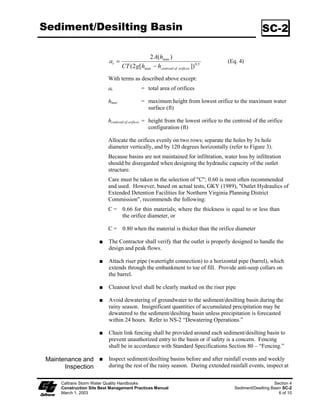

  • 251.
    Dewatering Operations NS-2 Schematic Designs: Cartridge Filter Caltrans Storm Water Quality Handbooks Section 7 Construction Site Best Management Practices Manual Dewatering Operations NS-2 March 1, 2003 12 of 12
  • 252.
    Paving and GrindingOperations NS-3 Standard Symbol BMP Objectives Soil Stabilization Sediment Control Tracking Control Wind Erosion Control Non-Storm Water Management Materials and Waste Management Definition and Procedures and practices for conducting paving, saw cutting, and grinding Purpose operations to minimize the transport of pollutants to the storm drain system or receiving water body. Appropriate These procedures are implemented where paving, surfacing, resurfacing, grinding Applications or sawcutting, may pollute storm water runoff or discharge to the storm drain system or watercourses. Limitations Finer solids are not effectively removed by filtration systems. Paving opportunities may be limited during wet weather. Standards and Substances used to coat asphalt transport trucks, asphalt trucks, and asphalt Specifications spreading equipment shall not contain soap and shall be non-foaming and non-toxic. Place plastic materials under asphaltic concrete (AC) paving equipment while not in use, to catch and/or contain drips and leaks. See also BMP WM-4, “Spill Prevention and Control.” When paving involves AC, the following steps shall be implemented to prevent the discharge of uncompacted or loose AC, tack coats, equipment cleaners, or other paving materials: ϑ Minimize sand and gravel from new asphalt from getting into storm drains, streets, and creeks by sweeping. ϑ Old or spilled asphalt must be recycled or disposed as approved by the Resident Engineer (RE). Caltrans Storm Water Quality Handbooks Section 7 Construction Site Best Management Practices Manual Paving and Grinding Operations NS-3 March 1, 2003 1 of 4
  • 253.
    Paving and GrindingOperations NS-3 ϑ AC grindings, pieces, or chunks used in embankments or shoulder backing must not be allowed to enter any storm drain or watercourses. Install silt fence until structure is stabilized or permanent controls are in place. ϑ Collect and remove all broken asphalt and recycle when practical; otherwise, dispose in accordance with Standard Specification 7-.3. ϑ Any AC chunks and pieces used in embankments must be placed above the water table and covered by at least 0.3 m ( ft) of material. ϑ During chip seal application and sweeping operations, petroleum or petroleum covered aggregate must not be allowed to enter any storm drain or water courses. Use silt fence until installation is complete. ϑ Use only non-toxic substances to coat asphalt transport trucks and asphalt spreading equipment. Drainage inlet structures and manholes shall be covered with filter fabric during application of seal coat, tack coat, slurry seal, and/or fog seal. Seal coat, tack coat, slurry seal, or fog seal shall not be applied if rainfall is predicted to occur during the application or curing period. Paving equipment parked onsite shall be parked over plastic to prevent soil contamination. Clean asphalt-coated equipment off-site whenever possible. When cleaning dry, hardened asphalt from equipment, manage hardened asphalt debris as described in BMP WM-5, “Solid Waste Management.” Any cleaning onsite shall follow BMP NS-8, “Vehicle and Equipment Cleaning.” Do not wash sweepings from exposed aggregate concrete into a storm drain system. Collect and return to aggregate base stockpile, or dispose of properly. Allow aggregate rinse to settle. Then, either allow rinse water to dry in a temporary pit as described in BMP WM-8, “Concrete Waste Management,” or dispose in accordance with Standard Specifications Section 7-.3. Do not allow saw-cut Portland Concrete Cement (PCC) slurry to enter storm drains or watercourses. Pavement Grinding or Removal Residue from PCC grinding operations shall be picked up by means of a vacuum attachment to the grinding machine, shall not be allowed to flow across the pavement, and shall not be left on the surface of the pavement. See also BMP WM-8, “Concrete Waste Management;” and BMP WM-0, “Liquid Waste Management,” and Standard Specifications Section 42-2 Caltrans Storm Water Quality Handbooks Section 7 Construction Site Best Management Practices Manual Paving and Grinding Operations NS-3 March 1, 2003 2 of 4
  • 254.
    Paving and GrindingOperations NS-3 “Grindings.” Collect pavement digout material by mechanical or manual methods. This material may be recycled if approved by the RE for use as shoulder backing or base material at locations approved by the RE. If digout material cannot be recycled, transport the material back to a maintenance facility or approved storage site. Digout activities shall not be conducted in the rain. When approved by the RE, stockpile material removed from roadways away from drain inlets, drainage ditches, and watercourses and stored consistent with BMP WM-3, “Stockpile Management.” Disposal or use of AC grindings shall be approved by the RE. See also BMP WM-8, “Concrete Waste Management.” Thermoplastic Striping All thermoplastic striper and pre-heater equipment shutoff valves shall be inspected to ensure that they are working properly to prevent leaking thermoplastic from entering drain inlets, the storm water drainage system, or watercourses. The pre-heater shall be filled carefully to prevent splashing or spilling of hot thermoplastic. Leave six inches of space at the top of the pre-heater container when filling thermoplastic to allow room for material to move when the vehicle is deadheaded. Contractor shall not pre-heat, transfer, or load thermoplastic near drain inlets or watercourses. Clean truck beds daily of loose debris and melted thermoplastic. When possible recycle thermoplastic material. Thermoplastic waste shall be disposed of in accordance with Standard Specification 7-.3. Raised/Recessed Pavement Marker Application and Removal Do not transfer or load bituminous material near drain inlets, the storm water drainage system or watercourses. Melting tanks shall be loaded with care and not filled to beyond six inches from the top to leave room for splashing when vehicle is deadheaded. When servicing or filling melting tanks, ensure all pressure is released before removing lids to avoid spills. On large scale projects, use mechanical or manual methods to collect excess Caltrans Storm Water Quality Handbooks Section 7 Construction Site Best Management Practices Manual Paving and Grinding Operations NS-3 March 1, 2003 3 of 4
  • 255.
    Paving and GrindingOperations NS-3 bituminous material from the roadway after removal of markers. Waste shall be disposed of in accordance with Standard Specification 7-.3. Maintenance and Inspect and maintain machinery regularly to minimize leaks and drips. Inspection Ensure that employees and subcontractors are implementing appropriate measures during paving operations. Caltrans Storm Water Quality Handbooks Section 7 Construction Site Best Management Practices Manual Paving and Grinding Operations NS-3 March 1, 2003 4 of 4
  • 256.
    Temporary Stream Crossing NS-4 Standard Symbol BMP Objectives Soil Stabilization Sediment Control Tracking Control Wind Erosion Control Non-Storm Water Management Materials and Waste Management Definition and A temporary stream crossing is a structure placed across a waterway that allows Purpose vehicles to cross the waterway during construction, minimizing, reducing, or managing erosion and downstream sedimentation caused by the vehicles. Appropriate Temporary stream crossings are installed at sites: Applications Where appropriate permits have been secured (60 Agreements, 404 Permits, and 40 Certification). Where construction equipment or vehicles need to frequently cross a waterway. When alternate access routes impose significant constraints. When crossing perennial streams or waterways causes significant erosion. Where construction activities will not last longer than one year. Limitations Will usually disturb the waterway during installation and removal. May require Regional Water Quality Control Board (RWQCB) 40 Certification, U.S. Army Corps of Engineers 404 permit and approval by California Department of Fish and Game. If numerical-based water quality standards are mentioned in any of these and other related permits, testing and sampling may be required. If monitoring related to these numerical-based water quality standards is not addressed in the contract documents, contact the Resident Engineer (RE). Installation may require dewatering or temporary diversion of the stream. See BMP NS-2, “Dewatering Operations” and NS-5, “Clear Water Diversion.” May become a constriction in the waterway, which can obstruct flood flow and cause flow backups or washouts. If improperly designed, flow backups can increase the pollutant load through washouts and scouring. Caltrans Storm Water Quality Handbooks Section 7 Construction Site Best Management Practices Manual Temporary Stream Crossing NS-4 March 1, 2003 1 of 8
  • 257.
    Temporary Stream Crossing NS-4 Use of natural or other gravel in the stream for construction of Cellular Confinement System (CCS) (refer to figure at the end of the section) ford crossing will be contingent upon approval by fisheries agencies. Ford crossings may degrade water quality due to contact with vehicles and equipment. CCS should not be used in excessively high or fast flows. Upon completion of construction activities, CCS blocks must be removed from stream. Standards and General Considerations Specifications Location of the temporary stream crossing shall address: Site selection where erosion potential is low. Areas where the side slopes from highway runoff will not spill into the side slopes of the crossing. The following types of temporary stream crossings shall be considered: Culverts - Used on perennial and intermittent streams. Fords - Appropriate during the dry season in arid areas. Used on dry washes and ephemeral streams, and low flow perennial streams. CCS, a type of ford crossing is also appropriate for use in streams. Bridges - Appropriate for streams with high flow velocities, steep gradients and/or where temporary restrictions in the channel are not allowed. Design and installation requires knowledge of stream flows and soil strength. Designs shall be prepared under direction of, and approved by, a registered civil and/or structural engineer. Both hydraulic and construction loading requirements shall be considered with the following: Comply with the requirements for culvert and bridge crossings, as contained in the Caltrans Highway Design Manual, particularly if the temporary stream crossing will remain through the rainy season. Provide stability in the crossing and adjacent areas to withstand the design flow. The design flow and safety factor shall be selected based on careful evaluation of the risks due to over topping, flow backups, or washout. Avoid oil or other potentially hazardous waste materials for surface treatment. Construction Considerations: Stabilize construction roadways, adjacent work area and stream bottom against erosion. Caltrans Storm Water Quality Handbooks Section 7 Construction Site Best Management Practices Manual Temporary Stream Crossing NS-4 March 1, 2003 2 of 8