INTRODUCTION
• C isa programming language developed at AT & T’s Bell Laboratories
of USA in 1972. It was designed and written by a man named Dennis
Ritchie. In the late seventies C began to replace the more familiar
languages of that time like PL/I, ALGOL, etc.
• ANSI C standard emerged in the early 1980s, this book was split into
two titles: The original was still called Programming in C, and the title
that covered ANSI C was called Programming in ANSI C. This was
done because it took several years for the compiler vendors to release
their ANSI C compilers and for them to become ubiquitous. It was
initially designed for programming UNIX operating system.
3.
Structure of CLanguage program
• Comment line
• Pre-processor directive
• Global variable declaration
• main function( )
{ Local variables;
Statements;
}
User defined function
{
}
4.
Comment line
• Itindicates the purpose of the program.
• It is represented as /*……………………………..*/ Comment line is
used for increasing the readability of the program.
• It is useful in explaining the program and generally used for
documentation. It is enclosed within the decimeters.
• Comment line can be single or multiple line but should not be nested.
It can be anywhere in the program except inside string constant &
character constant.
5.
Preprocessor Directive:
• #includetells the compiler to include information about the standard
input/output library.
• It is also used in symbolic constant such as #define PI 3.14(value).
The stdio.h (standard input output header file) contains definition
&declaration of system defined function such as printf( ), scanf( ),
pow( ) etc. Generally printf() function used to display and scanf()
function used to read value
• Global Declaration: This is the section where variable are declared
globally so that it can be access by all the functions used in the
program. And it is generally declared outside the function :
6.
main()
• It isthe user defined function and every function has one main() function from where
actually program is started and it is encloses within the pair of curly braces.
• The main( ) function can be anywhere in the program but in general practice it is placed
in the first position. Syntax :
main()
{ …….. …….. …….. }
The main( ) function return value when it declared by data type as
int main( )
{ return 0 }
7.
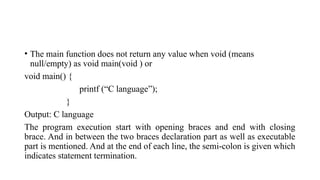
• The mainfunction does not return any value when void (means
null/empty) as void main(void ) or
void main() {
printf (“C language”);
}
Output: C language
The program execution start with opening braces and end with closing
brace. And in between the two braces declaration part as well as executable
part is mentioned. And at the end of each line, the semi-colon is given which
indicates statement termination.
8.
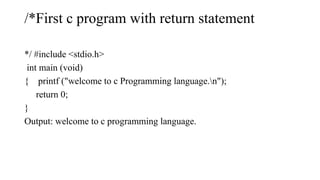
/*First c programwith return statement
*/ #include <stdio.h>
int main (void)
{ printf ("welcome to c Programming language.n");
return 0;
}
Output: welcome to c programming language.
9.
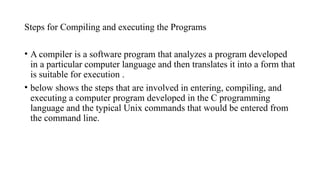
Steps for Compilingand executing the Programs
• A compiler is a software program that analyzes a program developed
in a particular computer language and then translates it into a form that
is suitable for execution .
• below shows the steps that are involved in entering, compiling, and
executing a computer program developed in the C programming
language and the typical Unix commands that would be entered from
the command line.
10.
• Step 1:The program that is to be compiled is first typed into a file on
the computer system. There are various conventions that are used for
naming files, typically be any name provided the last two characters
are “.c” or file with extension .c. So, the file name prog1.c might be a
valid filename for a C program. A text editor is usually used to enter
the C program into a file.
• For example, vi is a popular text editor used on Unix systems. The
program that is entered into the file is known as the source program
because it represents the original form of the program expressed in the
C language.
11.
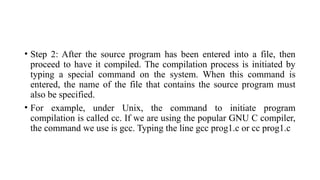
• Step 2:After the source program has been entered into a file, then
proceed to have it compiled. The compilation process is initiated by
typing a special command on the system. When this command is
entered, the name of the file that contains the source program must
also be specified.
• For example, under Unix, the command to initiate program
compilation is called cc. If we are using the popular GNU C compiler,
the command we use is gcc. Typing the line gcc prog1.c or cc prog1.c
12.
• In thefirst step of the compilation process, the compiler examines
each program statement contained in the source program and checks it
to ensure that it conforms to the syntax and semantics of the language.
If any mistakes are discovered by the compiler during this phase, they
are reported to the user and the compilation process ends right there.
The errors then have to be corrected in the source program (with the
use of an editor), and the compilation process must be restarted.
Typical errors reported during this phase of compilation might be due
to an expression that has unbalanced parentheses (syntactic error), or
due to the use of a variable that is not “defined” (semantic error).
13.
• Step 3:When all the syntactic and semantic errors have been removed
from the program, the compiler then proceeds to take each statement of
the program and translate it into a “lower” form that is equivalent to
assembly language program needed to perform the identical task.
• Step 4: After the program has been translated the next step in the
compilation process is to translate the assembly language statements
into actual machine instructions. The assembler takes each assembly
language statement and converts it into a binary format known as object
code, which is then written into another file on the system. This file has
the same name as the source file under Unix, with the last letter an “o”
(for object) instead of a “c”.
14.
• Step 5:After the program has been translated into object code, it is ready to be
linked. This process is once again performed automatically whenever the cc or gcc
command is issued under Unix. The purpose of the linking phase is to get the
program into a final form for execution on the computer. If the program uses other
programs that were previously processed by the compiler, then during this phase the
programs are linked together. Programs that are used from the system’s program
library are also searched and linked together with the object program during this
phase. The process of compiling and linking a program is often called building.
• The final linked file, which is in an executable object code format, is stored in
another file on the system, ready to be run or executed. Under Unix, this file is
called a.out by default. Under Windows, the executable file usually has the same
name as the source file, with the c extension replaced by an exe extension.
15.
• Step 6:To subsequently execute the program, the command a.out has
the effect of loading the program called a.out into the computer’s
memory and initiating its execution. When the program is executed,
each of the statements of the program is sequentially executed in turn.
If the program requests any data from the user, known as input, the
program temporarily suspends its execution so that the input can be
entered.
16.
• The programmight simply wait for an event, such as a mouse being
clicked, to occur. Results that are displayed by the program, known as
output, appear in a window, sometimes called the console.
• If the program does not produce the desired results, it is necessary to
go back and reanalyze the program’s logic. This is known as the
debugging phase, during which an attempt is made to remove all the
known problems or bugs from the program. To do this, it will
mostlikely be necessary to make changes to original source program.






![Basics of C Lecture 2[16097].pptx](https://cdn.slidesharecdn.com/ss_thumbnails/basicsofclecture216097-230510091738-88112a33-thumbnail.jpg?width=640&height=640&fit=bounds)


