BY,IN,ON+
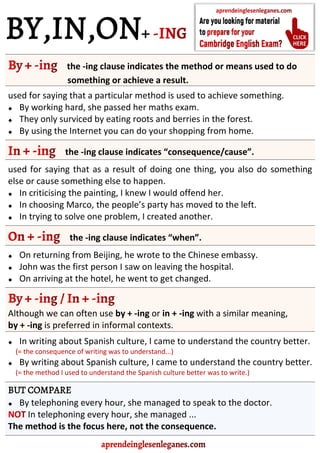
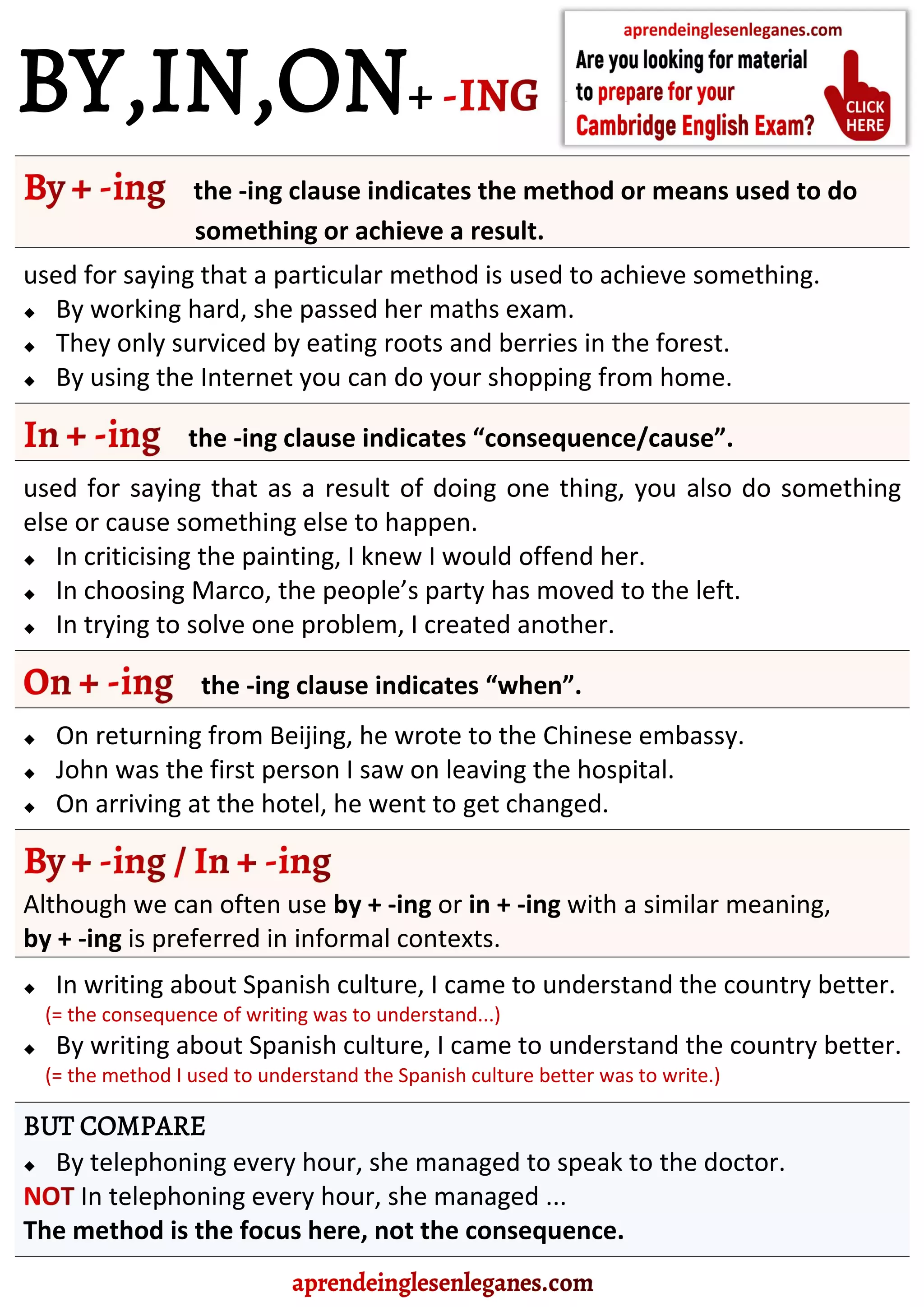
the -ing clause indicates the method or means used to do
something or achieve a result.
used for saying that a particular method is used to achieve something.
 By working hard, she passed her maths exam.
 They only surviced by eating roots and berries in the forest.
 By using the Internet you can do your shopping from home.
the -ing clause indicates “consequence/cause”.
used for saying that as a result of doing one thing, you also do something
else or cause something else to happen.
 In criticising the painting, I knew I would offend her.
 In choosing Marco, the people’s party has moved to the left.
 In trying to solve one problem, I created another.
the -ing clause indicates “when”.
 On returning from Beijing, he wrote to the Chinese embassy.
 John was the first person I saw on leaving the hospital.
 On arriving at the hotel, he went to get changed.
Although we can often use by + -ing or in + -ing with a similar meaning,
by + -ing is preferred in informal contexts.
 In writing about Spanish culture, I came to understand the country better.
(= the consequence of writing was to understand...)
 By writing about Spanish culture, I came to understand the country better.
(= the method I used to understand the Spanish culture better was to write.)
BUT COMPARE
 By telephoning every hour, she managed to speak to the doctor.
In telephoning every hour, she managed ...
The method is the focus here, not the consequence.

BY, IN, ON + ING.pdf

  • 1.
    BY,IN,ON+ the -ing clauseindicates the method or means used to do something or achieve a result. used for saying that a particular method is used to achieve something.  By working hard, she passed her maths exam.  They only surviced by eating roots and berries in the forest.  By using the Internet you can do your shopping from home. the -ing clause indicates “consequence/cause”. used for saying that as a result of doing one thing, you also do something else or cause something else to happen.  In criticising the painting, I knew I would offend her.  In choosing Marco, the people’s party has moved to the left.  In trying to solve one problem, I created another. the -ing clause indicates “when”.  On returning from Beijing, he wrote to the Chinese embassy.  John was the first person I saw on leaving the hospital.  On arriving at the hotel, he went to get changed. Although we can often use by + -ing or in + -ing with a similar meaning, by + -ing is preferred in informal contexts.  In writing about Spanish culture, I came to understand the country better. (= the consequence of writing was to understand...)  By writing about Spanish culture, I came to understand the country better. (= the method I used to understand the Spanish culture better was to write.) BUT COMPARE  By telephoning every hour, she managed to speak to the doctor. In telephoning every hour, she managed ... The method is the focus here, not the consequence.