Business Studies
An Integrated Approach
to Book-Keeping
Starting a Business
• Pick a business idea (idea generation)
• Brainstorm in groups of two/three
Our Business Ideas
Business Name
Business names should be:
• Short
• Easy to remember
• Relevant
• Free of copyright
How to choose a name:
• Brainstorm
• Internet
• Yellow Pages
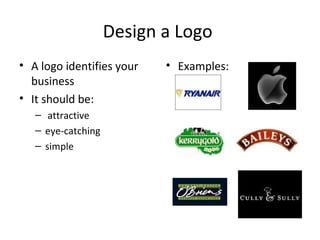
Design a Logo
• A logo identifies your
business
• It should be:
– attractive
– eye-catching
– simple
• Examples:
Research
• Why is research important?
• Where can you find information?
• List ways you can conduct research?
Finance
• What is capital?
• How can you raise capital?
– Savings
– Loans
– Grants
– Other ideas....
• List your local financial institutions and
agencies that provide grants to start-up
businesses
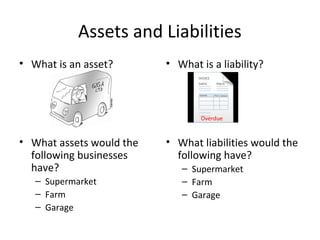
Assets and Liabilities
• What is an asset?
• What assets would the
following businesses
have?
– Supermarket
– Farm
– Garage
• What is a liability?
• What liabilities would the
following have?
– Supermarket
– Farm
– Garage
Overdue
Keeping Records
• Why do businesses keep records?
• What records should we keep?
– Records of daily transactions
– Final accounts for the end of year
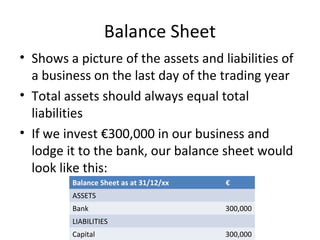
Balance Sheet
• Shows a picture of the assets and liabilities of
a business on the last day of the trading year
• Total assets should always equal total
liabilities
• If we invest €300,000 in our business and
lodge it to the bank, our balance sheet would
look like this:
Balance Sheet as at 31/12/xx €
ASSETS
Bank 300,000
LIABILITIES
Capital 300,000
Business Transactions
• All business transactions must be recorded
• List five transactions that your start-up
business may have, e.g. purchasing the
premises by cheque
Purchasing Stock
• We need goods to sell in the business
• Goods which we buy to sell are known as
“stock”
• Stock in our business will be an asset
• Stock is bought at cost price and sold at a
higher price
• What type of stock will your business need?
Business Documents
• It is important to shop around for the best value
for money when buying stock
• Stages involved:
– Send a letter of enquiry to several suppliers
– A quotation will be sent to you by each supplier
– Compare the quotations
– Send an order to the supplier who best suits your
needs
– Goods will be delivered and an invoice will be sent to
you
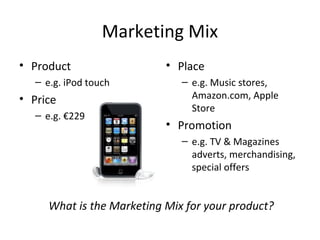
Marketing Mix
• Product
– e.g. iPod touch
• Price
– e.g. €229
• Place
– e.g. Music stores,
Amazon.com, Apple
Store
• Promotion
– e.g. TV & Magazines
adverts, merchandising,
special offers
What is the Marketing Mix for your product?
Methods of Promoting Your Product
• Personal Selling
– “one-to-one” communication with the customer
• Sales Promotion
– e.g. 2 for 1, 50% extra free, coupons
• Advertising
– e.g. TV, radio, internet, newspaper, magazine
• Public Relations
– e.g. Sponsorship
Selling Stock
• A combination of promotion methods can be
used to maximise sales
• What methods of promotion will your
business use?
• Design an advert that could be used either as
a brochure or inserted in print media
– A good advert should attract attention, achieve
interest, create desire and result in action
Profit
• Profit is the difference between the cost price
and the selling price of a product
• If the product is sold below cost price, the
business makes a loss
• Gross Profit/Gross Loss is calculated in the
Trading Account
• Net Profit/Net Loss is calculated in the Profit
and Loss Account
Finally...
• At the end of the year, a business will have to
present the following to its shareholders:
– Trading, Profit and Loss Account
– Balance Sheet
– Annual Report

Business studies booklet powerpoint

  • 1.
    Business Studies An IntegratedApproach to Book-Keeping
  • 2.
    Starting a Business •Pick a business idea (idea generation) • Brainstorm in groups of two/three
  • 3.
  • 4.
    Business Name Business namesshould be: • Short • Easy to remember • Relevant • Free of copyright How to choose a name: • Brainstorm • Internet • Yellow Pages
  • 5.
    Design a Logo •A logo identifies your business • It should be: – attractive – eye-catching – simple • Examples:
  • 6.
    Research • Why isresearch important? • Where can you find information? • List ways you can conduct research?
  • 7.
    Finance • What iscapital? • How can you raise capital? – Savings – Loans – Grants – Other ideas.... • List your local financial institutions and agencies that provide grants to start-up businesses
  • 8.
    Assets and Liabilities •What is an asset? • What assets would the following businesses have? – Supermarket – Farm – Garage • What is a liability? • What liabilities would the following have? – Supermarket – Farm – Garage Overdue
  • 9.
    Keeping Records • Whydo businesses keep records? • What records should we keep? – Records of daily transactions – Final accounts for the end of year
  • 10.
    Balance Sheet • Showsa picture of the assets and liabilities of a business on the last day of the trading year • Total assets should always equal total liabilities • If we invest €300,000 in our business and lodge it to the bank, our balance sheet would look like this: Balance Sheet as at 31/12/xx € ASSETS Bank 300,000 LIABILITIES Capital 300,000
  • 11.
    Business Transactions • Allbusiness transactions must be recorded • List five transactions that your start-up business may have, e.g. purchasing the premises by cheque
  • 12.
    Purchasing Stock • Weneed goods to sell in the business • Goods which we buy to sell are known as “stock” • Stock in our business will be an asset • Stock is bought at cost price and sold at a higher price • What type of stock will your business need?
  • 13.
    Business Documents • Itis important to shop around for the best value for money when buying stock • Stages involved: – Send a letter of enquiry to several suppliers – A quotation will be sent to you by each supplier – Compare the quotations – Send an order to the supplier who best suits your needs – Goods will be delivered and an invoice will be sent to you
  • 14.
    Marketing Mix • Product –e.g. iPod touch • Price – e.g. €229 • Place – e.g. Music stores, Amazon.com, Apple Store • Promotion – e.g. TV & Magazines adverts, merchandising, special offers What is the Marketing Mix for your product?
  • 15.
    Methods of PromotingYour Product • Personal Selling – “one-to-one” communication with the customer • Sales Promotion – e.g. 2 for 1, 50% extra free, coupons • Advertising – e.g. TV, radio, internet, newspaper, magazine • Public Relations – e.g. Sponsorship
  • 16.
    Selling Stock • Acombination of promotion methods can be used to maximise sales • What methods of promotion will your business use? • Design an advert that could be used either as a brochure or inserted in print media – A good advert should attract attention, achieve interest, create desire and result in action
  • 17.
    Profit • Profit isthe difference between the cost price and the selling price of a product • If the product is sold below cost price, the business makes a loss • Gross Profit/Gross Loss is calculated in the Trading Account • Net Profit/Net Loss is calculated in the Profit and Loss Account
  • 18.
    Finally... • At theend of the year, a business will have to present the following to its shareholders: – Trading, Profit and Loss Account – Balance Sheet – Annual Report