By Augustine Kadare
*2.6 million years ago
*Birth of subtractive manufacturing
*Charles Hull 1984
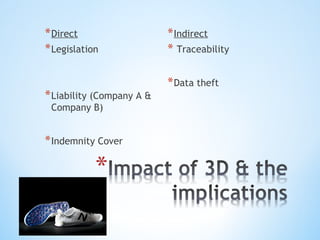
*Direct
*Legislation
*Liability (Company A &
Company B)
*Indemnity Cover
*Indirect
* Traceability
*Data theft
Is this the end of other technologies?
*Despite the media hype, 3D printers are still
only used by niche audiences including
-the automotive industry
-aerospace
-hobbyists
jewellery makers/toy designers
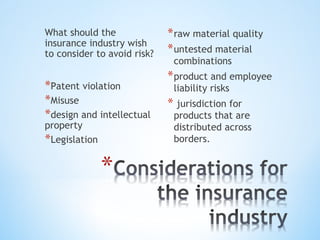
What should the
insurance industry wish
to consider to avoid risk?
*Patent violation
*Misuse
*design and intellectual
property
*Legislation
*raw material quality
*untested material
combinations
*product and employee
liability risks
* jurisdiction for
products that are
distributed across
borders.
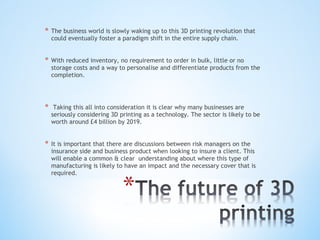
* The business world is slowly waking up to this 3D printing revolution that
could eventually foster a paradigm shift in the entire supply chain.
* With reduced inventory, no requirement to order in bulk, little or no
storage costs and a way to personalise and differentiate products from the
completion.
* Taking this all into consideration it is clear why many businesses are
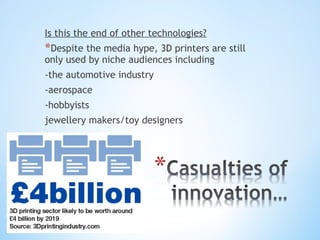
seriously considering 3D printing as a technology. The sector is likely to be
worth around £4 billion by 2019.
* It is important that there are discussions between risk managers on the
insurance side and business product when looking to insure a client. This
will enable a common & clear understanding about where this type of
manufacturing is likely to have an impact and the necessary cover that is
required.
Any Questions?

Business Presentation

  • 1.
  • 2.
    *2.6 million yearsago *Birth of subtractive manufacturing *Charles Hull 1984
  • 3.
    *Direct *Legislation *Liability (Company A& Company B) *Indemnity Cover *Indirect * Traceability *Data theft
  • 4.
    Is this theend of other technologies? *Despite the media hype, 3D printers are still only used by niche audiences including -the automotive industry -aerospace -hobbyists jewellery makers/toy designers
  • 5.
    What should the insuranceindustry wish to consider to avoid risk? *Patent violation *Misuse *design and intellectual property *Legislation *raw material quality *untested material combinations *product and employee liability risks * jurisdiction for products that are distributed across borders.
  • 6.
    * The businessworld is slowly waking up to this 3D printing revolution that could eventually foster a paradigm shift in the entire supply chain. * With reduced inventory, no requirement to order in bulk, little or no storage costs and a way to personalise and differentiate products from the completion. * Taking this all into consideration it is clear why many businesses are seriously considering 3D printing as a technology. The sector is likely to be worth around £4 billion by 2019. * It is important that there are discussions between risk managers on the insurance side and business product when looking to insure a client. This will enable a common & clear understanding about where this type of manufacturing is likely to have an impact and the necessary cover that is required.
  • 7.