Business-Level Strategy
Vikas Singh Sikarwar
MBA (Agribusiness)
20MBAAB030
Business-Level Strategy
2
 Overview:





Defining business-level strategy
Risks of business-level strategies
Differences in business-level strategies
5-Forces
Relationship between customers and strategy
Introduction
3
 Strategy: Increasingly important to a firm’s success and
concerned with making choices among two or more
alternatives.
 Choices dictated by


External environment (O and T)
Internal resources, capabilities and core competencies (S and W)
 Business level-strategy: Integrated and coordinated set of
commitments and actions the firm uses to gain a
competitive advantage by exploiting core competencies in
specific product markets/industry
 How we intend to compete in a specific industry
Business-Level Strategies
4
 Purpose: To create differences between position
of a firm and its competitors
 Firm must make a deliberate choice to
 Perform activities differently
 Perform different activities
 Impacts how value chain activities will be performed to
create unique value
 No strategy better than others
 Contingent on internal and external environment
4
Business-Level Strategies
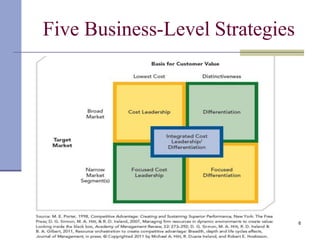
 Two types of competitive advantage firms must
choose between
 Cost (Are our costs LOWER than rivals costs?)
 Uniqueness (Are we DIFFERENT than rivals?)
 Two types of ‘competitive scope’ firms must
choose between
 Broad target
 Narrow target
 These combine to yield 5 different generic
business level strategies
 Can potentially be used by any organization competing
in any industry
Five Business-Level Strategies
6
Types of Business-Level Strategies
7
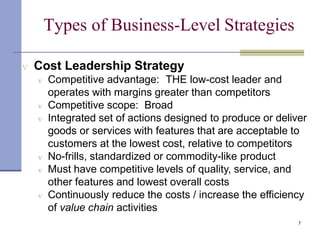
 Cost Leadership Strategy
 Competitive advantage: THE low-cost leader and
operates with margins greater than competitors
 Competitive scope: Broad
 Integrated set of actions designed to produce or deliver
goods or services with features that are acceptable to
customers at the lowest cost, relative to competitors
 No-frills, standardized or commodity-like product
 Must have competitive levels of quality, service, and
other features and lowest overall costs
 Continuously reduce the costs / increase the efficiency
of value chain activities
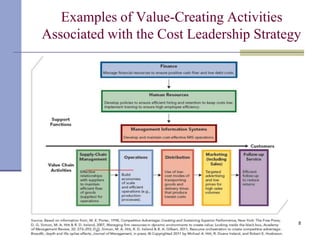
Examples of Value-Creating Activities
Associated with the Cost Leadership Strategy
8
8
Types of Business-Level Strategies
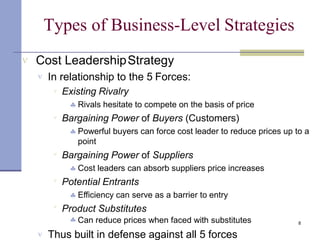
 Cost LeadershipStrategy
 In relationship to the 5 Forces:





Existing Rivalry
 Rivals hesitate to compete on the basis of price
Bargaining Power of Buyers (Customers)
 Powerful buyers can force cost leader to reduce prices up to a
point
Bargaining Power of Suppliers
 Cost leaders can absorb suppliers price increases
Potential Entrants
 Efficiency can serve as a barrier to entry
Product Substitutes
 Can reduce prices when faced with substitutes
 Thus built in defense against all 5 forces
Types of Business-Level Strategies
1
0
 Cost Leadership Strategy
 Competitive Risks
 Innovations by competitors can quickly eliminate cost
advantage
 Too much focus on cost reduction versus competitive
levels of differentiation
 Competitors may learn how to successfully imitate a
cost leader’s strategy
Types of Business-Level Strategies
11
 Differentiation
 Competitive advantage: Differentiation/uniqueness
 Competitive scope: Broad
 Integrated set of actions designed by a firm to produce
or deliver goods or services at an acceptable cost that
customers perceive as being different/unique in ways
that are important to them
 Targeted customers perceive product value
 Customized products – differentiating on as many
features as possible
 Can differentiate in many ways and in many value chain
areas
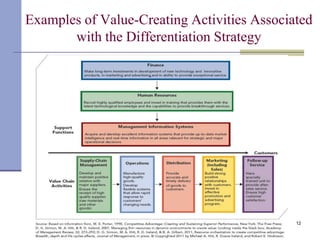
Examples of Value-Creating Activities Associated
with the Differentiation Strategy
12
Types of Business-Level Strategies
13
 Differentiation
 In relationship to the 5 Forces:





Existing Rivalry
 Customers are loyal purchasers of differentiated products
Bargaining Power of Buyers (Customers)
 Uniqueness and loyalty reduces customer’s sensitivity to price
increases
Bargaining Power of Suppliers
 Provide high quality components, driving up firm’s costs
 Cost may be passed on to customer
Potential Entrants
 Substantial barriers (see above) and would require significant resource
investment
Product Substitutes
 Customer loyalty effectively positions firm against product substitutes
Types of Business-Level Strategies
14
 Differentiation
 Risks
 Can charge too high of a price premium
 Differentiation theme no longer valuable to customers
 Over-differentiating
Customer experience shows differentiation not worth the
cost
 Counterfeiting
Types of Business-Level Strategies
Large firms may overlook small niches

 Focus strategies
 Competitive advantage: Cost Leadership or
Differentiation
 Competitive scope: Narrow
 An integrated set of actions taken to produce goods or
services that serve the needs of a particular competitive
segment
 Attractive when:



Firm lacks resources to compete in the broader market
Firm may be able to more effectively serve a narrow market
segment than larger industry-wide competitors
Niche is attractive
14
Types of Business-Level Strategies
16
 Focus strategyexamples
 Buyer groups
 Youths/senior citizens
 Product line segments
 Professional painter groups
 Geographic markets
 West vs. East coast
Types of Business-Level Strategies
17
 Focused Cost Leadership
 Competitive advantage: Low-cost
 Competitive scope: Narrow industry segment
 Motel 6, Kia
 Focused Differentiation
 Competitive advantage: Differentiation
 Competitive scope: Narrow industry segment
 Ritz-Carlton, Apple, Rolls Royce
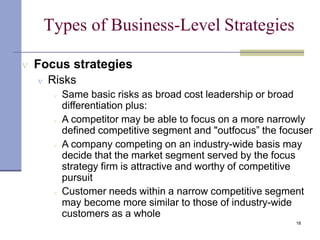
Types of Business-Level Strategies
18
 Focus strategies
 Risks
 Same basic risks as broad cost leadership or broad
differentiation plus:
 A competitor may be able to focus on a more narrowly
defined competitive segment and "outfocus” the focuser
 A company competing on an industry-wide basis may
decide that the market segment served by the focus
strategy firm is attractive and worthy of competitive
pursuit
 Customer needs within a narrow competitive segment
may become more similar to those of industry-wide
customers as a whole
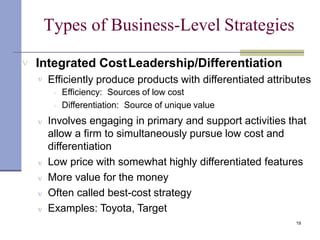
Types of Business-Level Strategies
19
 Integrated CostLeadership/Differentiation
 Efficiently produce products with differentiated attributes


Efficiency: Sources of low cost
Differentiation: Source of unique value
 Involves engaging in primary and support activities that
allow a firm to simultaneously pursue low cost and
differentiation
 Low price with somewhat highly differentiated features
 More value for the money
 Often called best-cost strategy
 Examples: Toyota, Target
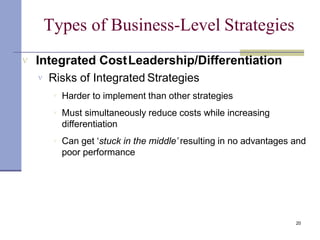
Types of Business-Level Strategies
20
 Integrated CostLeadership/Differentiation
 Risks of Integrated Strategies



Harder to implement than other strategies
Must simultaneously reduce costs while increasing
differentiation
Can get ‘stuck in the middle’ resulting in no advantages and
poor performance
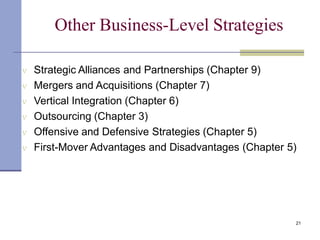
Other Business-Level Strategies
21
 Strategic Alliances and Partnerships (Chapter 9)
 Mergers and Acquisitions (Chapter 7)
 Vertical Integration (Chapter 6)
 Outsourcing (Chapter 3)
 Offensive and Defensive Strategies (Chapter 5)
 First-Mover Advantages and Disadvantages (Chapter 5)
21
Customers and their Relationship with
Business-Level Strategies
 Strategic competitiveness results when firm can
satisfy customers by using its competitive
advantages
 Five components in customer relationships
 Effectively managing relationships w/ customers
 Deliver superior value and build customer loyalty
 Reach, richness and affiliation
 Access and connection to customers, depth and detail of
information, and facilitating interactions with customers
 Who: Determining the customers to serve
 What: Determining which customer needs to satisfy
 How: Determining core competencies necessary to
satisfy customer needs

business level strategies.pptx

  • 1.
    Business-Level Strategy Vikas SinghSikarwar MBA (Agribusiness) 20MBAAB030
  • 2.
    Business-Level Strategy 2  Overview:      Definingbusiness-level strategy Risks of business-level strategies Differences in business-level strategies 5-Forces Relationship between customers and strategy
  • 3.
    Introduction 3  Strategy: Increasinglyimportant to a firm’s success and concerned with making choices among two or more alternatives.  Choices dictated by   External environment (O and T) Internal resources, capabilities and core competencies (S and W)  Business level-strategy: Integrated and coordinated set of commitments and actions the firm uses to gain a competitive advantage by exploiting core competencies in specific product markets/industry  How we intend to compete in a specific industry
  • 4.
    Business-Level Strategies 4  Purpose:To create differences between position of a firm and its competitors  Firm must make a deliberate choice to  Perform activities differently  Perform different activities  Impacts how value chain activities will be performed to create unique value  No strategy better than others  Contingent on internal and external environment
  • 5.
    4 Business-Level Strategies  Twotypes of competitive advantage firms must choose between  Cost (Are our costs LOWER than rivals costs?)  Uniqueness (Are we DIFFERENT than rivals?)  Two types of ‘competitive scope’ firms must choose between  Broad target  Narrow target  These combine to yield 5 different generic business level strategies  Can potentially be used by any organization competing in any industry
  • 6.
  • 7.
    Types of Business-LevelStrategies 7  Cost Leadership Strategy  Competitive advantage: THE low-cost leader and operates with margins greater than competitors  Competitive scope: Broad  Integrated set of actions designed to produce or deliver goods or services with features that are acceptable to customers at the lowest cost, relative to competitors  No-frills, standardized or commodity-like product  Must have competitive levels of quality, service, and other features and lowest overall costs  Continuously reduce the costs / increase the efficiency of value chain activities
  • 8.
    Examples of Value-CreatingActivities Associated with the Cost Leadership Strategy 8
  • 9.
    8 Types of Business-LevelStrategies  Cost LeadershipStrategy  In relationship to the 5 Forces:      Existing Rivalry  Rivals hesitate to compete on the basis of price Bargaining Power of Buyers (Customers)  Powerful buyers can force cost leader to reduce prices up to a point Bargaining Power of Suppliers  Cost leaders can absorb suppliers price increases Potential Entrants  Efficiency can serve as a barrier to entry Product Substitutes  Can reduce prices when faced with substitutes  Thus built in defense against all 5 forces
  • 10.
    Types of Business-LevelStrategies 1 0  Cost Leadership Strategy  Competitive Risks  Innovations by competitors can quickly eliminate cost advantage  Too much focus on cost reduction versus competitive levels of differentiation  Competitors may learn how to successfully imitate a cost leader’s strategy
  • 11.
    Types of Business-LevelStrategies 11  Differentiation  Competitive advantage: Differentiation/uniqueness  Competitive scope: Broad  Integrated set of actions designed by a firm to produce or deliver goods or services at an acceptable cost that customers perceive as being different/unique in ways that are important to them  Targeted customers perceive product value  Customized products – differentiating on as many features as possible  Can differentiate in many ways and in many value chain areas
  • 12.
    Examples of Value-CreatingActivities Associated with the Differentiation Strategy 12
  • 13.
    Types of Business-LevelStrategies 13  Differentiation  In relationship to the 5 Forces:      Existing Rivalry  Customers are loyal purchasers of differentiated products Bargaining Power of Buyers (Customers)  Uniqueness and loyalty reduces customer’s sensitivity to price increases Bargaining Power of Suppliers  Provide high quality components, driving up firm’s costs  Cost may be passed on to customer Potential Entrants  Substantial barriers (see above) and would require significant resource investment Product Substitutes  Customer loyalty effectively positions firm against product substitutes
  • 14.
    Types of Business-LevelStrategies 14  Differentiation  Risks  Can charge too high of a price premium  Differentiation theme no longer valuable to customers  Over-differentiating Customer experience shows differentiation not worth the cost  Counterfeiting
  • 15.
    Types of Business-LevelStrategies Large firms may overlook small niches   Focus strategies  Competitive advantage: Cost Leadership or Differentiation  Competitive scope: Narrow  An integrated set of actions taken to produce goods or services that serve the needs of a particular competitive segment  Attractive when:    Firm lacks resources to compete in the broader market Firm may be able to more effectively serve a narrow market segment than larger industry-wide competitors Niche is attractive 14
  • 16.
    Types of Business-LevelStrategies 16  Focus strategyexamples  Buyer groups  Youths/senior citizens  Product line segments  Professional painter groups  Geographic markets  West vs. East coast
  • 17.
    Types of Business-LevelStrategies 17  Focused Cost Leadership  Competitive advantage: Low-cost  Competitive scope: Narrow industry segment  Motel 6, Kia  Focused Differentiation  Competitive advantage: Differentiation  Competitive scope: Narrow industry segment  Ritz-Carlton, Apple, Rolls Royce
  • 18.
    Types of Business-LevelStrategies 18  Focus strategies  Risks  Same basic risks as broad cost leadership or broad differentiation plus:  A competitor may be able to focus on a more narrowly defined competitive segment and "outfocus” the focuser  A company competing on an industry-wide basis may decide that the market segment served by the focus strategy firm is attractive and worthy of competitive pursuit  Customer needs within a narrow competitive segment may become more similar to those of industry-wide customers as a whole
  • 19.
    Types of Business-LevelStrategies 19  Integrated CostLeadership/Differentiation  Efficiently produce products with differentiated attributes   Efficiency: Sources of low cost Differentiation: Source of unique value  Involves engaging in primary and support activities that allow a firm to simultaneously pursue low cost and differentiation  Low price with somewhat highly differentiated features  More value for the money  Often called best-cost strategy  Examples: Toyota, Target
  • 20.
    Types of Business-LevelStrategies 20  Integrated CostLeadership/Differentiation  Risks of Integrated Strategies    Harder to implement than other strategies Must simultaneously reduce costs while increasing differentiation Can get ‘stuck in the middle’ resulting in no advantages and poor performance
  • 21.
    Other Business-Level Strategies 21 Strategic Alliances and Partnerships (Chapter 9)  Mergers and Acquisitions (Chapter 7)  Vertical Integration (Chapter 6)  Outsourcing (Chapter 3)  Offensive and Defensive Strategies (Chapter 5)  First-Mover Advantages and Disadvantages (Chapter 5)
  • 22.
    21 Customers and theirRelationship with Business-Level Strategies  Strategic competitiveness results when firm can satisfy customers by using its competitive advantages  Five components in customer relationships  Effectively managing relationships w/ customers  Deliver superior value and build customer loyalty  Reach, richness and affiliation  Access and connection to customers, depth and detail of information, and facilitating interactions with customers  Who: Determining the customers to serve  What: Determining which customer needs to satisfy  How: Determining core competencies necessary to satisfy customer needs