How to use this business continuity plan template
This document has been designed to help small business owners create a simple business continuity plan to:
 identify risks to your business
 plan how to manage different risks and the resources you will need
 work out ways to keep operating even when you face disruption.
It is to be used in conjunction with A guide to using the business continuity plan template.
Steps
1. First, refer to the accompanying guide for instructions and examples on preparing your business continuity plan.
2. Use the business continuity checklist located at Appendix A to take stock of your business and its risks.
3. Then, complete each section in the template, consulting relevant team members to explore ideas.
4. Store your completed business continuity plan where it can be retrieved if your business location is unavailable (for
example, in the cloud, or at your home)
5. Review your plan regularly to ensure it remains up to date.
Once you have completed the plan template, delete this page and save the document for your records.
[Business name]
Business Continuity Plan
[Your business name]
[Main business address]
[Website]
[Email]
[Telephone]
[ABN/ACN]
Prepared by: [Your name], [date]
Version number Date reviewed Responsible person and position
Disclaimer
The Small Business Development Corporation (SBDC) does not provide legal advice. Formal legal advice should be sought when appropriate.
The information and advice provided is made available in good faith and is derived from sources believed to be reliable and accurate at the
time of release. However, the information is provided solely on the basis that readers will be responsible for making their own assessment of
the matters discussed and that they should verify all relevant representations, statements and information.
By accessing information or using this template, each user waives and releases the SBDC, the State of Western Australia, and their respective
officers, employees, and agents to the full extent permitted by law from any and all claims (including claims in negligence) relating to the usage
of the material made available by the SBDC, including in regards to any omission and/or errors. In no event shall the SBDC, the State of
Western Australia, or its respective officers, employees or agents be liable for any incident or consequential damages resulting from use of, or
reliance on this material.
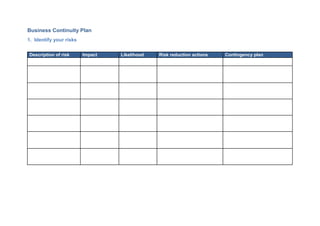
Business Continuity Plan
1. Identify your risks
Description of risk Impact Likelihood Risk reduction actions Contingency plan
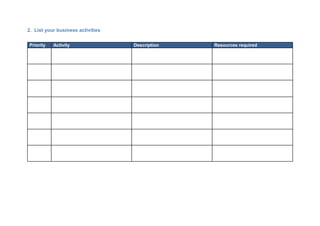
2. List your business activities
Priority Activity Description Resources required
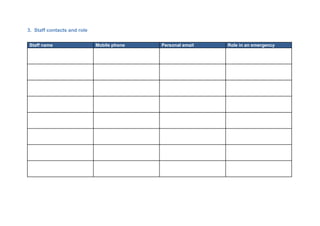
3. Staff contacts and role
Staff name Mobile phone Personal email Role in an emergency
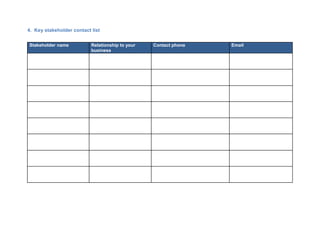
4. Key stakeholder contact list
Stakeholder name Relationship to your
business
Contact phone Email
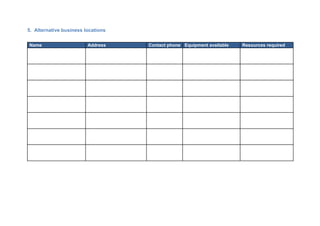
5. Alternative business locations
Name Address Contact phone Equipment available Resources required
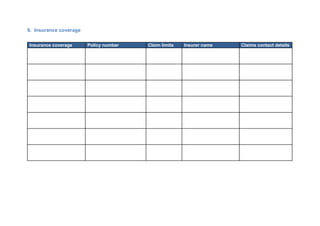
6. Insurance coverage
Insurance coverage Policy number Claim limits Insurer name Claims contact details
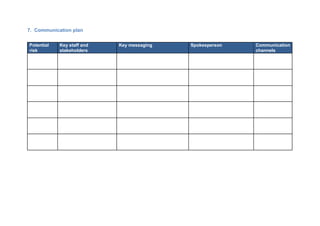
7. Communication plan
Potential
risk
Key staff and
stakeholders
Key messaging Spokesperson Communication
channels
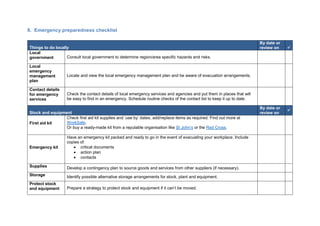
8. Emergency preparedness checklist
Things to do locally
By date or
review on 
Local
government Consult local government to determine region/area specific hazards and risks.
Local
emergency
management
plan
Locate and view the local emergency management plan and be aware of evacuation arrangements.
Contact details
for emergency
services
Check the contact details of local emergency services and agencies and put them in places that will
be easy to find in an emergency. Schedule routine checks of the contact list to keep it up to date.
Stock and equipment
By date or
review on

First aid kit
Check first aid kit supplies and ‘use by’ dates, add/replace items as required. Find out more at
WorkSafe.
Or buy a ready-made kit from a reputable organisation like St John’s or the Red Cross.
Emergency kit
Have an emergency kit packed and ready to go in the event of evacuating your workplace. Include
copies of:
 critical documents
 action plan
 contacts
Supplies Develop a contingency plan to source goods and services from other suppliers (if necessary).
Storage Identify possible alternative storage arrangements for stock, plant and equipment.
Protect stock
and equipment Prepare a strategy to protect stock and equipment if it can’t be moved.
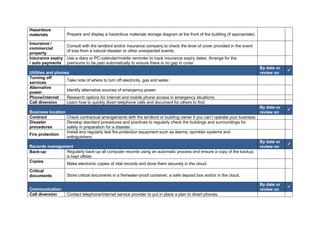
Hazardous
materials Prepare and display a hazardous materials storage diagram at the front of the building (if appropriate).
Insurance /
commercial
property
Consult with the landlord and/or insurance company to check the level of cover provided in the event
of loss from a natural disaster or other unexpected events.
Insurance expiry
/ auto payments
Use a diary or PC-calendar/mobile reminder to track insurance expiry dates. Arrange for the
premiums to be paid automatically to ensure there is no gap in cover.
Utilities and phones
By date or
review on

Turning off
services
Take note of where to turn off electricity, gas and water.
Alternative
power
Identify alternative sources of emergency power.
Phone/internet Research options for internet and mobile phone access in emergency situations.
Call diversion Learn how to quickly divert telephone calls and document for others to find.
Business location
By date or
review on

Contract Check contractual arrangements with the landlord or building owner if you can’t operate your business
Disaster
procedures
Develop standard procedures and practices to regularly check the buildings and surroundings for
safety in preparation for a disaster.
Fire protection
Install and regularly test fire protection equipment such as alarms, sprinkler systems and
extinguishers.
Records management
By date or
review on

Back-up Regularly back-up all computer records using an automatic process and ensure a copy of the backup
is kept offsite
Copies
Make electronic copies of vital records and store them securely in the cloud.
Critical
documents Store critical documents in a fire/water-proof container, a safe deposit box and/or in the cloud.
Communication
By date or
review on

Call diversion Contact telephone/internet service provider to put in place a plan to divert phones.
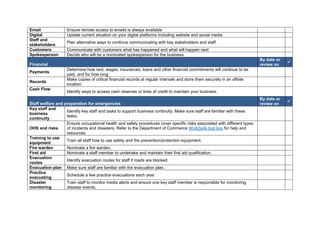
Email Ensure remote access to emails is always available
Digital Update current situation on your digital platforms including website and social media
Staff and
stakeholders
Plan alternative ways to continue communicating with key stakeholders and staff.
Customers Communicate with customers what has happened and what will happen next
Spokesperson Decide who will be a nominated spokesperson for the business.
Financial
By date or
review on

Payments
Determine how rent, wages, insurances, loans and other financial commitments will continue to be
paid, and for how long.
Records
Make copies of critical financial records at regular intervals and store them securely in an offsite
location.
Cash Flow
Identify ways to access cash reserves or lines of credit to maintain your business.
Staff welfare and preparation for emergencies
By date or
review on

Key staff and
business
continuity
Identify key staff and tasks to support business continuity. Make sure staff are familiar with these
tasks.
OHS and risks
Ensure occupational health and safety procedures cover specific risks associated with different types
of incidents and disasters. Refer to the Department of Commerce WorkSafe tool box for help and
resources.
Training to use
equipment
Train all staff how to use safety and fire prevention/protection equipment.
Fire warden Nominate a fire warden.
First aid Nominate a staff member to undertake and maintain their first aid qualification.
Evacuation
routes
Identify evacuation routes for staff if roads are blocked.
Evacuation plan Make sure staff are familiar with the evacuation plan.
Practice
evacuating
Schedule a few practice evacuations each year.
Disaster
monitoring
Train staff to monitor media alerts and ensure one key staff member is responsible for monitoring
disaster events.
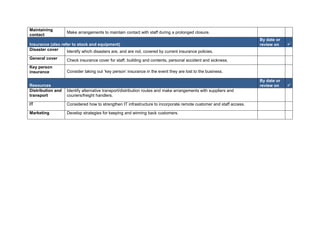
Maintaining
contact
Make arrangements to maintain contact with staff during a prolonged closure.
Insurance (also refer to stock and equipment)
By date or
review on 
Disaster cover Identify which disasters are, and are not, covered by current insurance policies.
General cover Check insurance cover for staff, building and contents, personal accident and sickness.
Key person
insurance Consider taking out ‘key person’ insurance in the event they are lost to the business.
Resources
By date or
review on 
Distribution and
transport
Identify alternative transport/distribution routes and make arrangements with suppliers and
couriers/freight handlers.
IT Considered how to strengthen IT infrastructure to incorporate remote customer and staff access.
Marketing Develop strategies for keeping and winning back customers.

business continuity plan template for all

  • 1.
    How to usethis business continuity plan template This document has been designed to help small business owners create a simple business continuity plan to:  identify risks to your business  plan how to manage different risks and the resources you will need  work out ways to keep operating even when you face disruption. It is to be used in conjunction with A guide to using the business continuity plan template. Steps 1. First, refer to the accompanying guide for instructions and examples on preparing your business continuity plan. 2. Use the business continuity checklist located at Appendix A to take stock of your business and its risks. 3. Then, complete each section in the template, consulting relevant team members to explore ideas. 4. Store your completed business continuity plan where it can be retrieved if your business location is unavailable (for example, in the cloud, or at your home) 5. Review your plan regularly to ensure it remains up to date. Once you have completed the plan template, delete this page and save the document for your records.
  • 2.
    [Business name] Business ContinuityPlan [Your business name] [Main business address] [Website] [Email] [Telephone] [ABN/ACN] Prepared by: [Your name], [date] Version number Date reviewed Responsible person and position
  • 3.
    Disclaimer The Small BusinessDevelopment Corporation (SBDC) does not provide legal advice. Formal legal advice should be sought when appropriate. The information and advice provided is made available in good faith and is derived from sources believed to be reliable and accurate at the time of release. However, the information is provided solely on the basis that readers will be responsible for making their own assessment of the matters discussed and that they should verify all relevant representations, statements and information. By accessing information or using this template, each user waives and releases the SBDC, the State of Western Australia, and their respective officers, employees, and agents to the full extent permitted by law from any and all claims (including claims in negligence) relating to the usage of the material made available by the SBDC, including in regards to any omission and/or errors. In no event shall the SBDC, the State of Western Australia, or its respective officers, employees or agents be liable for any incident or consequential damages resulting from use of, or reliance on this material.
  • 4.
    Business Continuity Plan 1.Identify your risks Description of risk Impact Likelihood Risk reduction actions Contingency plan
  • 5.
    2. List yourbusiness activities Priority Activity Description Resources required
  • 6.
    3. Staff contactsand role Staff name Mobile phone Personal email Role in an emergency
  • 7.
    4. Key stakeholdercontact list Stakeholder name Relationship to your business Contact phone Email
  • 8.
    5. Alternative businesslocations Name Address Contact phone Equipment available Resources required
  • 9.
    6. Insurance coverage Insurancecoverage Policy number Claim limits Insurer name Claims contact details
  • 10.
    7. Communication plan Potential risk Keystaff and stakeholders Key messaging Spokesperson Communication channels
  • 11.
    8. Emergency preparednesschecklist Things to do locally By date or review on  Local government Consult local government to determine region/area specific hazards and risks. Local emergency management plan Locate and view the local emergency management plan and be aware of evacuation arrangements. Contact details for emergency services Check the contact details of local emergency services and agencies and put them in places that will be easy to find in an emergency. Schedule routine checks of the contact list to keep it up to date. Stock and equipment By date or review on  First aid kit Check first aid kit supplies and ‘use by’ dates, add/replace items as required. Find out more at WorkSafe. Or buy a ready-made kit from a reputable organisation like St John’s or the Red Cross. Emergency kit Have an emergency kit packed and ready to go in the event of evacuating your workplace. Include copies of:  critical documents  action plan  contacts Supplies Develop a contingency plan to source goods and services from other suppliers (if necessary). Storage Identify possible alternative storage arrangements for stock, plant and equipment. Protect stock and equipment Prepare a strategy to protect stock and equipment if it can’t be moved.
  • 12.
    Hazardous materials Prepare anddisplay a hazardous materials storage diagram at the front of the building (if appropriate). Insurance / commercial property Consult with the landlord and/or insurance company to check the level of cover provided in the event of loss from a natural disaster or other unexpected events. Insurance expiry / auto payments Use a diary or PC-calendar/mobile reminder to track insurance expiry dates. Arrange for the premiums to be paid automatically to ensure there is no gap in cover. Utilities and phones By date or review on  Turning off services Take note of where to turn off electricity, gas and water. Alternative power Identify alternative sources of emergency power. Phone/internet Research options for internet and mobile phone access in emergency situations. Call diversion Learn how to quickly divert telephone calls and document for others to find. Business location By date or review on  Contract Check contractual arrangements with the landlord or building owner if you can’t operate your business Disaster procedures Develop standard procedures and practices to regularly check the buildings and surroundings for safety in preparation for a disaster. Fire protection Install and regularly test fire protection equipment such as alarms, sprinkler systems and extinguishers. Records management By date or review on  Back-up Regularly back-up all computer records using an automatic process and ensure a copy of the backup is kept offsite Copies Make electronic copies of vital records and store them securely in the cloud. Critical documents Store critical documents in a fire/water-proof container, a safe deposit box and/or in the cloud. Communication By date or review on  Call diversion Contact telephone/internet service provider to put in place a plan to divert phones.
  • 13.
    Email Ensure remoteaccess to emails is always available Digital Update current situation on your digital platforms including website and social media Staff and stakeholders Plan alternative ways to continue communicating with key stakeholders and staff. Customers Communicate with customers what has happened and what will happen next Spokesperson Decide who will be a nominated spokesperson for the business. Financial By date or review on  Payments Determine how rent, wages, insurances, loans and other financial commitments will continue to be paid, and for how long. Records Make copies of critical financial records at regular intervals and store them securely in an offsite location. Cash Flow Identify ways to access cash reserves or lines of credit to maintain your business. Staff welfare and preparation for emergencies By date or review on  Key staff and business continuity Identify key staff and tasks to support business continuity. Make sure staff are familiar with these tasks. OHS and risks Ensure occupational health and safety procedures cover specific risks associated with different types of incidents and disasters. Refer to the Department of Commerce WorkSafe tool box for help and resources. Training to use equipment Train all staff how to use safety and fire prevention/protection equipment. Fire warden Nominate a fire warden. First aid Nominate a staff member to undertake and maintain their first aid qualification. Evacuation routes Identify evacuation routes for staff if roads are blocked. Evacuation plan Make sure staff are familiar with the evacuation plan. Practice evacuating Schedule a few practice evacuations each year. Disaster monitoring Train staff to monitor media alerts and ensure one key staff member is responsible for monitoring disaster events.
  • 14.
    Maintaining contact Make arrangements tomaintain contact with staff during a prolonged closure. Insurance (also refer to stock and equipment) By date or review on  Disaster cover Identify which disasters are, and are not, covered by current insurance policies. General cover Check insurance cover for staff, building and contents, personal accident and sickness. Key person insurance Consider taking out ‘key person’ insurance in the event they are lost to the business. Resources By date or review on  Distribution and transport Identify alternative transport/distribution routes and make arrangements with suppliers and couriers/freight handlers. IT Considered how to strengthen IT infrastructure to incorporate remote customer and staff access. Marketing Develop strategies for keeping and winning back customers.