FINALPROJECT
FINALPROJECT
Business Analysis Final Paper
DeVry University
Thomas J Rones
FINAL PROJECT 2
FINAL PROJECT 2
Executive Summary ___________________________________________________________ 3
Business Problem Review_______________________________________________________ 3
Figure 1: U.S. Recoverable Oil vs Foreign __________________________________________________________ 4
Analytical Plan _______________________________________________________________ 4
Elicitation Techniques__________________________________________________________________ 5
Schedule of activities______________________________________________________________________________ 5
Figure 2: Inputs, Tasks, & Outputs ________________________________________________________________ 6
Survey Description and Question(s) ______________________________________________________ 6
Questions________________________________________________________________________________________ 6
Survey Conclusion ________________________________________________________________________________ 7
Requirements Communication __________________________________________________ 7
Internal Stakeholders:_____________________________________________________________________________ 8
External Stakeholders:_____________________________________________________________________________ 8
Enterprise Analysis____________________________________________________________ 8
Figure 3: Production Equation ___________________________________________________________________ 9
Figure 4: Exploration Equation__________________________________________________________________ 10
Figure 5: Techniques for Information Gathering___________________________________________________ 10
Requirements Analysis________________________________________________________ 11
Figure 6: To Drill or Not To Drill (Cap Rate is KPI) __________________________________________________ 12
Solution Assessment and Validation _____________________________________________ 13
Techniques__________________________________________________________________________ 13
Recommendations & Conclusion ________________________________________________ 13
FINAL PROJECT 3
FINAL PROJECT 3
Executive Summary
This project began with a focus on how oil refineries are adapting to the new business
environment brought on by the United States oil shale revolution, but shifted scope to exploration and
production of oil, due to the results found during elicitation. As a result, this paper is of use to vertically
integrated firms and firms considering integrating either up or downstream. Producers looking
downstream need to be aware of the complexities in the refining arena and patient so as not to invest in
the wrong technologies. Upstream integrators can use the information found here as a starting place for
deciding if exploration and production makes financial sense – i.e. before obtaining expertise brought
through acquisition or consultation.
Business Problem Review
In June 2008 all the major oil benchmarks hit highs between $145 & $147/barrel. We recently hit
a low of $27/barrel. Many analysts and amateurs have tried to predict the ebb and flow of the supply and
demand for oil --- making statements such as “Oil prices doubled last year,even if people did not see the
price of their petrol double. The reason for this is simple: global demand for oil, particularly from
developing countries like China and India, is rapidly catching up to global supply (Our World, n.d.)” If
only it were that simple --- we would all be trading futures. The reality is that there are a myriad of
variables affecting the price and supply of oil.
FINAL PROJECT 4
FINAL PROJECT 4
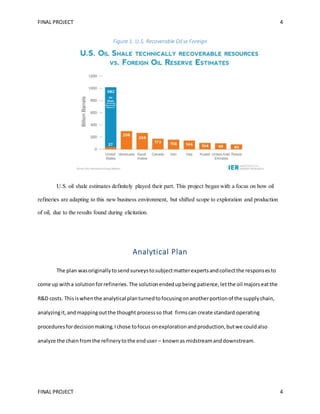
Figure 1: U.S. Recoverable Oil vs Foreign
U.S. oil shale estimates definitely played their part. This project began with a focus on how oil
refineries are adapting to this new business environment, but shifted scope to exploration and production
of oil, due to the results found during elicitation.
Analytical Plan
The plan wasoriginallytosendsurveystosubjectmatterexpertsandcollectthe responsesto
come up witha solutionforrefineries.The solutionendedupbeing patience,letthe oil majorseatthe
R&D costs. Thisiswhenthe analytical planturnedtofocusingonanotherportionof the supplychain,
analyzingit,andmappingoutthe thought processso that firmscan create standard operating
proceduresfordecisionmaking.Ichose tofocus onexplorationandproduction,butwe couldalso
analyze the chainfromthe refinerytothe enduser – knownas midstreamanddownstream.
FINAL PROJECT 5
FINAL PROJECT 5
Elicitation Techniques
Schedule of activities
A. Stakeholder Selection – Decision makers (C-suite) at US oil refineries. If possible,
attempt to obtain a relatively even number of respondents per region and based on
refinery size. At a minimum, notate refinery size, location, and respondent’s position
within company so that the results can be filtered for analysis with a more specific
focus.
B. Analysis Techniques - The respondents will be contacted by email and/or phone. A
survey will be administered.
C. Timeline
Jan 17th- Design Survey
Jan 17th- Send survey through email
Jan 18th - Jan 27th – Collect additional responses over phone
Jan 28th – Analyze responses
FINAL PROJECT 6
FINAL PROJECT 6
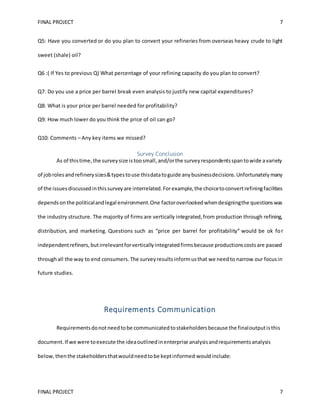
Figure 2: Inputs, Tasks, & Outputs
Survey Description and Question(s)
(For a full description of the rationale behind each question see week 3 Survey Monkey Essay.)
The goal behind the survey is twofold:
1. Use quantitative questions to gain insight into the change/risk management policies of domestic oil
refineries and..
2. Use qualitative questions to elicit information to guide the development of additional quantitative
questions for future surveys.
Questions
Q1: Isthe liftof the UnitedStatescrude exportbana positive,negative,orinconsequential development
for your business?
Q2: Why or Why Not?
Q3: Is US storage capacity an issue you consider? (1-10)
Q4: How large of a factor is the 2016 election in your risk management strategy? (1-10)
SurveyResults
Analysisof
SurveyResults
Recommendationsfor
future studies
Outputs
Conduct
Survey
Tasks
Document
Analysis
Survey
Timeline
Business
Need/Solution
Scope
Inputs
FINAL PROJECT 7
FINAL PROJECT 7
Q5: Have you converted or do you plan to convert your refineries from overseas heavy crude to light
sweet (shale) oil?
Q6 :( If Yes to previous Q) What percentage of your refining capacity do you plan to convert?
Q7: Do you use a price per barrel break even analysis to justify new capital expenditures?
Q8: What is your price per barrel needed for profitability?
Q9: How much lower do you think the price of oil can go?
Q10: Comments – Any key items we missed?
Survey Conclusion
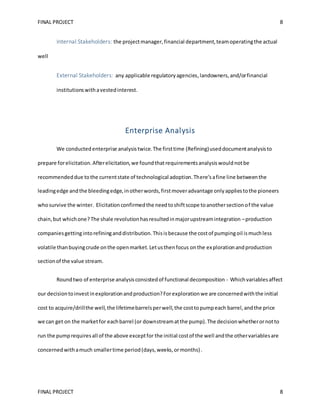
As of thistime,the surveysize istoosmall,and/orthe surveyrespondentsspantowide avariety
of jobrolesand refinerysizes&typestouse thisdatatoguide anybusinessdecisions.Unfortunatelymany
of the issuesdiscussedinthissurveyare interrelated.Forexample,the choicetoconvertrefiningfacilities
dependsonthe politicalandlegal environment.One factoroverlookedwhendesigningthe questionswas
the industry structure. The majority of firmsare vertically integrated,from production through refining,
distribution, and marketing. Questions such as “price per barrel for profitability” would be ok for
independentrefiners,butirrelevantforverticallyintegratedfirmsbecause productionscostsare passed
throughall the way to end consumers.The surveyresultsinformusthat we needto narrow our focusin
future studies.
Requirements Communication
Requirementsdonotneedtobe communicatedtostakeholdersbecause the finaloutputisthis
document.If we were toexecute the ideaoutlinedinenterprise analysisandrequirementsanalysis
below,thenthe stakeholdersthatwouldneedtobe keptinformed wouldinclude:
FINAL PROJECT 8
FINAL PROJECT 8
Internal Stakeholders: the projectmanager,financial department,teamoperatingthe actual
well
External Stakeholders: any applicable regulatoryagencies,landowners,and/orfinancial
institutionswithavestedinterest.
Enterprise Analysis
We conductedenterprise analysistwice.The firsttime (Refining)useddocumentanalysisto
prepare forelicitation.Afterelicitation,we foundthatrequirementsanalysiswouldnotbe
recommendeddue tothe currentstate of technological adoption.There’safine line betweenthe
leadingedge andthe bleedingedge,inotherwords,firstmoveradvantage onlyappliestothe pioneers
whosurvive the winter. Elicitationconfirmedthe needtoshiftscope toanothersectionof the value
chain,but whichone?The shale revolutionhasresultedinmajorupstreamintegration –production
companiesgettingintorefininganddistribution.Thisisbecause the costof pumpingoil ismuchless
volatile thanbuyingcrude onthe openmarket.Letusthenfocus onthe explorationandproduction
sectionof the value stream.
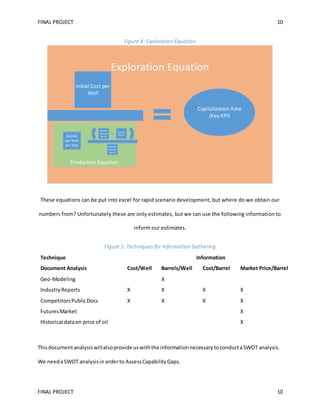
Roundtwo of enterprise analysisconsistedof functional decomposition - Whichvariablesaffect
our decisiontoinvestinexplorationandproduction?Forexplorationwe are concernedwiththe initial
cost to acquire/drillthe well,the lifetimebarrelsperwell,the costtopumpeach barrel,andthe price
we can get on the marketfor eachbarrel (or downstreamatthe pump).The decisionwhetherornotto
run the pumprequiresall of the above exceptfor the initial costof the well andthe othervariablesare
concernedwithamuch smallertime period(days,weeks,ormonths).
FINAL PROJECT 9
FINAL PROJECT 9
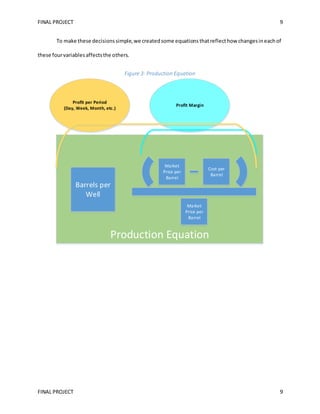
To make these decisionssimple,we createdsome equationsthatreflecthow changesineachof
these fourvariablesaffectsthe others.
Figure 3: Production Equation
Production Equation
Barrels per
Well
Cost per
Barrel
Market
Price per
Barrel
Market
Price per
Barrel
Profit Margin
Profit per Period
(Day, Week, Month, etc.)
FINAL PROJECT 10
FINAL PROJECT 10
Figure 4: Exploration Equation
Exploration Equation
Initial Cost per
Well
Production Equation
Barrels
per Well
per Year
Cost per
Barrel
Market
Price per
Barrel
Market
Price per
Barrel
Capitalization Rate
(Key KPI)
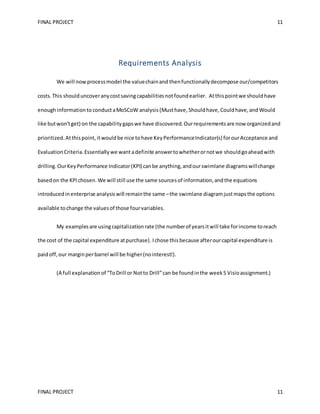
These equations can be put into excel for rapid scenario development, but where do we obtain our
numbers from? Unfortunately these are only estimates, but we can use the following information to
inform our estimates.
Figure 5: Techniques for Information Gathering
Technique Information
Document Analysis Cost/Well Barrels/Well Cost/Barrel Market Price/Barrel
Geo-Modeling X
IndustryReports X X X X
CompetitorsPublicDocs X X X X
FuturesMarket X
Historical dataon price of oil X
Thisdocumentanalysiswillalsoprovide uswiththe informationnecessarytoconductaSWOT analysis.
We needaSWOT analysisin orderto AssessCapabilityGaps.
FINAL PROJECT 11
FINAL PROJECT 11
Requirements Analysis
We will nowprocessmodel the valuechainand thenfunctionallydecompose our/competitors
costs. This shoulduncoveranycostsavingcapabilitiesnotfoundearlier. Atthispointwe shouldhave
enoughinformationto conductaMoSCoW analysis (Musthave, Shouldhave, Couldhave,and Would
like butwon'tget) on the capabilitygapswe have discovered. Ourrequirementsare now organizedand
prioritized.Atthispoint,itwouldbe nice tohave KeyPerformanceIndicator(s) forourAcceptance and
Evaluation Criteria.Essentiallywe want adefinite answertowhetherornotwe shouldgoaheadwith
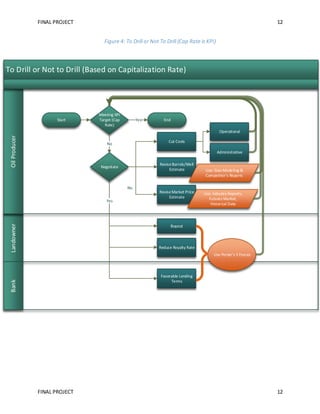
drilling. OurKeyPerformance Indicator(KPI) canbe anything,andourswimlane diagramswillchange
basedon the KPIchosen. We will still use the same sourcesof information,andthe equations
introducedinenterprise analysiswill remainthe same –the swimlane diagramjustmapsthe options
available tochange the valuesof those fourvariables.
My examplesare usingcapitalizationrate (the numberof yearsitwill take forincome toreach
the cost of the capital expenditure atpurchase).Ichose thisbecause afterourcapital expenditure is
paidoff,our marginperbarrel will be higher(nointerest!).
(A full explanationof “ToDrill or Notto Drill”can be foundinthe week5 Visioassignment.)
FINAL PROJECT 12
FINAL PROJECT 12
Figure 4: To Drill or Not To Drill (Cap Rate is KPI)
To Drill or Not to Drill (Based on Capitalization Rate)
LandownerOilProducerBank
Use Porter s 5 Forces
Start
Meeting KPI
Target (Cap
Rate)
EndYes
No
Negotiate
Cut Costs
ReviseBarrels/Well
Estimate
ReviseMarket Price
Estimate
No
Buyout
Reduce Royalty Rate
Favorable Lending
Terms
Yes
Operational
Administrative
Use: Geo-Modeling &
Competitor s Reports
Use: Industry Reports,
Futures Market,
Historical Data
FINAL PROJECT 13
FINAL PROJECT 13
Solution Assessment and Validation
The purpose of the KeyPerformance Indicatorissolutionvalidation. The Visiodiagramshown
above ismeantto be everexpanding, particularlyunder“CutCosts”.For example,operational couldbe
sub-dividedintocategories –alwaysrememberingthata pennysavedina repetitive processissaved
everytime the pumpruns.The solutionisthoroughinthatit remindsthe oil producerto considertheir
bargainingpower,throughfive forcesanalysis - thatpennysavedmightbe as a resultof beinga major
customerof the local electricutility. Tovalidate the solutionfurtherwe wouldhave toactuallygo
throughthe processof exploration andproduction.
Techniques
Techniqueshave beendetailedall throughoutthispaper.One keytechniqueisdocument
analysis.Afterelicitationyieldedsub-parresults,we useddocumentanalysistofindthatas of now it
wouldbe bettertorefocusour effortsonanothersectionof the value chain --- productioninsteadof
refining. Brainstormingandsurveyswere obviouslyused.
Recommendations & Conclusion
As recommendedinthe ExecutiveSummary,patience isavirtue forrefineries.Producersdonot
have such an easydecision.If the equationsindicate thatitwouldbe very profitabletoacquire landand
drill,thendoso.More work needsto be done to evaluate opportunitycosts.Inparticular,ahistoryof
drillinginnovationswithafocusonacquisition andoperatingcostwouldreassure producersthattheir
capital expendituresdonotbecome sunkcosts. It wouldalsobe prudenttogatherinformationabout
past dealsanddeal structure.Evenif itdoesnot make sense todrill inthe currenteconomic
FINAL PROJECT 14
FINAL PROJECT 14
environment,firmsshouldalwaysbe aware of the supply of anddemandforpropertysittingon shale
formations.
Oil majorsmay have more opportunityanalyzingandtransformingtheirdownstreamstrategy.
Minor issuessuchaspricingand gas stationaccessibilitycouldhave dramaticconsequences.Thismaybe
anecdotal,butI usuallyendupat the same gas stationsbecause theyare convenientlylocated. This
mightactuallybe a more interestingtopictoresearch, butunfortunatelywe have reachedthe end.
FINAL PROJECT 15
FINAL PROJECT 15
References
Eberhart, D. (2014, February 14). Light on the Top, Heavy on the Bottom: A Crude Oil Refinery
Primer - Canary, LLC. Retrieved January 16, 2016, from http://canaryusa.com/crude-oil-
refinery-primer/
Levine, S., Taylor, G., Arthur, D., & Tolleth, M. (2014). Understanding Crude Oil and Product
Markets. Retrieved January 15, 2016, from http://www.api.org/~/media/Files/Oil-and-
Natural-Gas/Crude-Oil-Product-Markets/Crude-Oil-Primer/Understanding-Crude-Oil-
and-Product-Markets-Primer-Low.pdf
Obama rejects Keystone XL pipeline - CNNPolitics.com. (n.d.). Retrieved January 16, 2016,
from http://www.cnn.com/2015/11/06/politics/keystone-xl-pipeline-decision-rejection-
kerry
Oil Price Rises as Airline Fails - Our World. (n.d.). Retrieved January 16, 2016, from
http://ourworld.unu.edu/en/oil-price-rises-as-airline-fails
Oil Shale - IER. (n.d.). Retrieved January 16, 2016, from
http://instituteforenergyresearch.org/topics/encyclopedia/oil-shale/
The Economics Of U.S Crude Oil Storage Capacity | Investopedia. (2015). Retrieved January 16,
2016, from http://www.investopedia.com/articles/investing/041015/economics-us-crude-
oil-storage-capacity.asp
U.S. Oil Shales: Breakeven Oil Price Is A Tricky Concept. (2015, May 10). Retrieved January
16, 2016, from http://seekingalpha.com/article/3166446-u-s-oil-shales-breakeven-oil-
price-is-a-tricky-concept

To Drill or Not To Drill?

  • 1.
    FINALPROJECT FINALPROJECT Business Analysis FinalPaper DeVry University Thomas J Rones
  • 2.
    FINAL PROJECT 2 FINALPROJECT 2 Executive Summary ___________________________________________________________ 3 Business Problem Review_______________________________________________________ 3 Figure 1: U.S. Recoverable Oil vs Foreign __________________________________________________________ 4 Analytical Plan _______________________________________________________________ 4 Elicitation Techniques__________________________________________________________________ 5 Schedule of activities______________________________________________________________________________ 5 Figure 2: Inputs, Tasks, & Outputs ________________________________________________________________ 6 Survey Description and Question(s) ______________________________________________________ 6 Questions________________________________________________________________________________________ 6 Survey Conclusion ________________________________________________________________________________ 7 Requirements Communication __________________________________________________ 7 Internal Stakeholders:_____________________________________________________________________________ 8 External Stakeholders:_____________________________________________________________________________ 8 Enterprise Analysis____________________________________________________________ 8 Figure 3: Production Equation ___________________________________________________________________ 9 Figure 4: Exploration Equation__________________________________________________________________ 10 Figure 5: Techniques for Information Gathering___________________________________________________ 10 Requirements Analysis________________________________________________________ 11 Figure 6: To Drill or Not To Drill (Cap Rate is KPI) __________________________________________________ 12 Solution Assessment and Validation _____________________________________________ 13 Techniques__________________________________________________________________________ 13 Recommendations & Conclusion ________________________________________________ 13
  • 3.
    FINAL PROJECT 3 FINALPROJECT 3 Executive Summary This project began with a focus on how oil refineries are adapting to the new business environment brought on by the United States oil shale revolution, but shifted scope to exploration and production of oil, due to the results found during elicitation. As a result, this paper is of use to vertically integrated firms and firms considering integrating either up or downstream. Producers looking downstream need to be aware of the complexities in the refining arena and patient so as not to invest in the wrong technologies. Upstream integrators can use the information found here as a starting place for deciding if exploration and production makes financial sense – i.e. before obtaining expertise brought through acquisition or consultation. Business Problem Review In June 2008 all the major oil benchmarks hit highs between $145 & $147/barrel. We recently hit a low of $27/barrel. Many analysts and amateurs have tried to predict the ebb and flow of the supply and demand for oil --- making statements such as “Oil prices doubled last year,even if people did not see the price of their petrol double. The reason for this is simple: global demand for oil, particularly from developing countries like China and India, is rapidly catching up to global supply (Our World, n.d.)” If only it were that simple --- we would all be trading futures. The reality is that there are a myriad of variables affecting the price and supply of oil.
  • 4.
    FINAL PROJECT 4 FINALPROJECT 4 Figure 1: U.S. Recoverable Oil vs Foreign U.S. oil shale estimates definitely played their part. This project began with a focus on how oil refineries are adapting to this new business environment, but shifted scope to exploration and production of oil, due to the results found during elicitation. Analytical Plan The plan wasoriginallytosendsurveystosubjectmatterexpertsandcollectthe responsesto come up witha solutionforrefineries.The solutionendedupbeing patience,letthe oil majorseatthe R&D costs. Thisiswhenthe analytical planturnedtofocusingonanotherportionof the supplychain, analyzingit,andmappingoutthe thought processso that firmscan create standard operating proceduresfordecisionmaking.Ichose tofocus onexplorationandproduction,butwe couldalso analyze the chainfromthe refinerytothe enduser – knownas midstreamanddownstream.
  • 5.
    FINAL PROJECT 5 FINALPROJECT 5 Elicitation Techniques Schedule of activities A. Stakeholder Selection – Decision makers (C-suite) at US oil refineries. If possible, attempt to obtain a relatively even number of respondents per region and based on refinery size. At a minimum, notate refinery size, location, and respondent’s position within company so that the results can be filtered for analysis with a more specific focus. B. Analysis Techniques - The respondents will be contacted by email and/or phone. A survey will be administered. C. Timeline Jan 17th- Design Survey Jan 17th- Send survey through email Jan 18th - Jan 27th – Collect additional responses over phone Jan 28th – Analyze responses
  • 6.
    FINAL PROJECT 6 FINALPROJECT 6 Figure 2: Inputs, Tasks, & Outputs Survey Description and Question(s) (For a full description of the rationale behind each question see week 3 Survey Monkey Essay.) The goal behind the survey is twofold: 1. Use quantitative questions to gain insight into the change/risk management policies of domestic oil refineries and.. 2. Use qualitative questions to elicit information to guide the development of additional quantitative questions for future surveys. Questions Q1: Isthe liftof the UnitedStatescrude exportbana positive,negative,orinconsequential development for your business? Q2: Why or Why Not? Q3: Is US storage capacity an issue you consider? (1-10) Q4: How large of a factor is the 2016 election in your risk management strategy? (1-10) SurveyResults Analysisof SurveyResults Recommendationsfor future studies Outputs Conduct Survey Tasks Document Analysis Survey Timeline Business Need/Solution Scope Inputs
  • 7.
    FINAL PROJECT 7 FINALPROJECT 7 Q5: Have you converted or do you plan to convert your refineries from overseas heavy crude to light sweet (shale) oil? Q6 :( If Yes to previous Q) What percentage of your refining capacity do you plan to convert? Q7: Do you use a price per barrel break even analysis to justify new capital expenditures? Q8: What is your price per barrel needed for profitability? Q9: How much lower do you think the price of oil can go? Q10: Comments – Any key items we missed? Survey Conclusion As of thistime,the surveysize istoosmall,and/orthe surveyrespondentsspantowide avariety of jobrolesand refinerysizes&typestouse thisdatatoguide anybusinessdecisions.Unfortunatelymany of the issuesdiscussedinthissurveyare interrelated.Forexample,the choicetoconvertrefiningfacilities dependsonthe politicalandlegal environment.One factoroverlookedwhendesigningthe questionswas the industry structure. The majority of firmsare vertically integrated,from production through refining, distribution, and marketing. Questions such as “price per barrel for profitability” would be ok for independentrefiners,butirrelevantforverticallyintegratedfirmsbecause productionscostsare passed throughall the way to end consumers.The surveyresultsinformusthat we needto narrow our focusin future studies. Requirements Communication Requirementsdonotneedtobe communicatedtostakeholdersbecause the finaloutputisthis document.If we were toexecute the ideaoutlinedinenterprise analysisandrequirementsanalysis below,thenthe stakeholdersthatwouldneedtobe keptinformed wouldinclude:
  • 8.
    FINAL PROJECT 8 FINALPROJECT 8 Internal Stakeholders: the projectmanager,financial department,teamoperatingthe actual well External Stakeholders: any applicable regulatoryagencies,landowners,and/orfinancial institutionswithavestedinterest. Enterprise Analysis We conductedenterprise analysistwice.The firsttime (Refining)useddocumentanalysisto prepare forelicitation.Afterelicitation,we foundthatrequirementsanalysiswouldnotbe recommendeddue tothe currentstate of technological adoption.There’safine line betweenthe leadingedge andthe bleedingedge,inotherwords,firstmoveradvantage onlyappliestothe pioneers whosurvive the winter. Elicitationconfirmedthe needtoshiftscope toanothersectionof the value chain,but whichone?The shale revolutionhasresultedinmajorupstreamintegration –production companiesgettingintorefininganddistribution.Thisisbecause the costof pumpingoil ismuchless volatile thanbuyingcrude onthe openmarket.Letusthenfocus onthe explorationandproduction sectionof the value stream. Roundtwo of enterprise analysisconsistedof functional decomposition - Whichvariablesaffect our decisiontoinvestinexplorationandproduction?Forexplorationwe are concernedwiththe initial cost to acquire/drillthe well,the lifetimebarrelsperwell,the costtopumpeach barrel,andthe price we can get on the marketfor eachbarrel (or downstreamatthe pump).The decisionwhetherornotto run the pumprequiresall of the above exceptfor the initial costof the well andthe othervariablesare concernedwithamuch smallertime period(days,weeks,ormonths).
  • 9.
    FINAL PROJECT 9 FINALPROJECT 9 To make these decisionssimple,we createdsome equationsthatreflecthow changesineachof these fourvariablesaffectsthe others. Figure 3: Production Equation Production Equation Barrels per Well Cost per Barrel Market Price per Barrel Market Price per Barrel Profit Margin Profit per Period (Day, Week, Month, etc.)
  • 10.
    FINAL PROJECT 10 FINALPROJECT 10 Figure 4: Exploration Equation Exploration Equation Initial Cost per Well Production Equation Barrels per Well per Year Cost per Barrel Market Price per Barrel Market Price per Barrel Capitalization Rate (Key KPI) These equations can be put into excel for rapid scenario development, but where do we obtain our numbers from? Unfortunately these are only estimates, but we can use the following information to inform our estimates. Figure 5: Techniques for Information Gathering Technique Information Document Analysis Cost/Well Barrels/Well Cost/Barrel Market Price/Barrel Geo-Modeling X IndustryReports X X X X CompetitorsPublicDocs X X X X FuturesMarket X Historical dataon price of oil X Thisdocumentanalysiswillalsoprovide uswiththe informationnecessarytoconductaSWOT analysis. We needaSWOT analysisin orderto AssessCapabilityGaps.
  • 11.
    FINAL PROJECT 11 FINALPROJECT 11 Requirements Analysis We will nowprocessmodel the valuechainand thenfunctionallydecompose our/competitors costs. This shoulduncoveranycostsavingcapabilitiesnotfoundearlier. Atthispointwe shouldhave enoughinformationto conductaMoSCoW analysis (Musthave, Shouldhave, Couldhave,and Would like butwon'tget) on the capabilitygapswe have discovered. Ourrequirementsare now organizedand prioritized.Atthispoint,itwouldbe nice tohave KeyPerformanceIndicator(s) forourAcceptance and Evaluation Criteria.Essentiallywe want adefinite answertowhetherornotwe shouldgoaheadwith drilling. OurKeyPerformance Indicator(KPI) canbe anything,andourswimlane diagramswillchange basedon the KPIchosen. We will still use the same sourcesof information,andthe equations introducedinenterprise analysiswill remainthe same –the swimlane diagramjustmapsthe options available tochange the valuesof those fourvariables. My examplesare usingcapitalizationrate (the numberof yearsitwill take forincome toreach the cost of the capital expenditure atpurchase).Ichose thisbecause afterourcapital expenditure is paidoff,our marginperbarrel will be higher(nointerest!). (A full explanationof “ToDrill or Notto Drill”can be foundinthe week5 Visioassignment.)
  • 12.
    FINAL PROJECT 12 FINALPROJECT 12 Figure 4: To Drill or Not To Drill (Cap Rate is KPI) To Drill or Not to Drill (Based on Capitalization Rate) LandownerOilProducerBank Use Porter s 5 Forces Start Meeting KPI Target (Cap Rate) EndYes No Negotiate Cut Costs ReviseBarrels/Well Estimate ReviseMarket Price Estimate No Buyout Reduce Royalty Rate Favorable Lending Terms Yes Operational Administrative Use: Geo-Modeling & Competitor s Reports Use: Industry Reports, Futures Market, Historical Data
  • 13.
    FINAL PROJECT 13 FINALPROJECT 13 Solution Assessment and Validation The purpose of the KeyPerformance Indicatorissolutionvalidation. The Visiodiagramshown above ismeantto be everexpanding, particularlyunder“CutCosts”.For example,operational couldbe sub-dividedintocategories –alwaysrememberingthata pennysavedina repetitive processissaved everytime the pumpruns.The solutionisthoroughinthatit remindsthe oil producerto considertheir bargainingpower,throughfive forcesanalysis - thatpennysavedmightbe as a resultof beinga major customerof the local electricutility. Tovalidate the solutionfurtherwe wouldhave toactuallygo throughthe processof exploration andproduction. Techniques Techniqueshave beendetailedall throughoutthispaper.One keytechniqueisdocument analysis.Afterelicitationyieldedsub-parresults,we useddocumentanalysistofindthatas of now it wouldbe bettertorefocusour effortsonanothersectionof the value chain --- productioninsteadof refining. Brainstormingandsurveyswere obviouslyused. Recommendations & Conclusion As recommendedinthe ExecutiveSummary,patience isavirtue forrefineries.Producersdonot have such an easydecision.If the equationsindicate thatitwouldbe very profitabletoacquire landand drill,thendoso.More work needsto be done to evaluate opportunitycosts.Inparticular,ahistoryof drillinginnovationswithafocusonacquisition andoperatingcostwouldreassure producersthattheir capital expendituresdonotbecome sunkcosts. It wouldalsobe prudenttogatherinformationabout past dealsanddeal structure.Evenif itdoesnot make sense todrill inthe currenteconomic
  • 14.
    FINAL PROJECT 14 FINALPROJECT 14 environment,firmsshouldalwaysbe aware of the supply of anddemandforpropertysittingon shale formations. Oil majorsmay have more opportunityanalyzingandtransformingtheirdownstreamstrategy. Minor issuessuchaspricingand gas stationaccessibilitycouldhave dramaticconsequences.Thismaybe anecdotal,butI usuallyendupat the same gas stationsbecause theyare convenientlylocated. This mightactuallybe a more interestingtopictoresearch, butunfortunatelywe have reachedthe end.
  • 15.
    FINAL PROJECT 15 FINALPROJECT 15 References Eberhart, D. (2014, February 14). Light on the Top, Heavy on the Bottom: A Crude Oil Refinery Primer - Canary, LLC. Retrieved January 16, 2016, from http://canaryusa.com/crude-oil- refinery-primer/ Levine, S., Taylor, G., Arthur, D., & Tolleth, M. (2014). Understanding Crude Oil and Product Markets. Retrieved January 15, 2016, from http://www.api.org/~/media/Files/Oil-and- Natural-Gas/Crude-Oil-Product-Markets/Crude-Oil-Primer/Understanding-Crude-Oil- and-Product-Markets-Primer-Low.pdf Obama rejects Keystone XL pipeline - CNNPolitics.com. (n.d.). Retrieved January 16, 2016, from http://www.cnn.com/2015/11/06/politics/keystone-xl-pipeline-decision-rejection- kerry Oil Price Rises as Airline Fails - Our World. (n.d.). Retrieved January 16, 2016, from http://ourworld.unu.edu/en/oil-price-rises-as-airline-fails Oil Shale - IER. (n.d.). Retrieved January 16, 2016, from http://instituteforenergyresearch.org/topics/encyclopedia/oil-shale/ The Economics Of U.S Crude Oil Storage Capacity | Investopedia. (2015). Retrieved January 16, 2016, from http://www.investopedia.com/articles/investing/041015/economics-us-crude- oil-storage-capacity.asp U.S. Oil Shales: Breakeven Oil Price Is A Tricky Concept. (2015, May 10). Retrieved January 16, 2016, from http://seekingalpha.com/article/3166446-u-s-oil-shales-breakeven-oil- price-is-a-tricky-concept