burrowing through Go!!
Language Basics
Vishal Ghadge
Sourav Ray
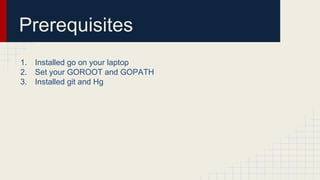
Prerequisites
1. Installed go on your laptop
2. Set your GOROOT and GOPATH
3. Installed git and Hg
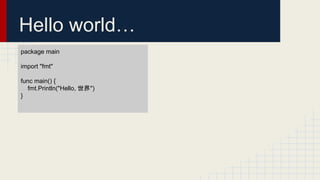
Hello world…
package main
import "fmt"
func main() {
fmt.Println("Hello, 世界")
}
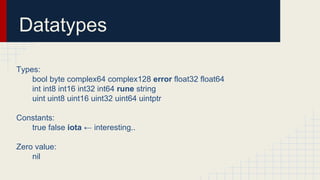
Datatypes
Types:
bool byte complex64 complex128 error float32 float64
int int8 int16 int32 int64 rune string
uint uint8 uint16 uint32 uint64 uintptr
Constants:
true false iota ← interesting..
Zero value:
nil
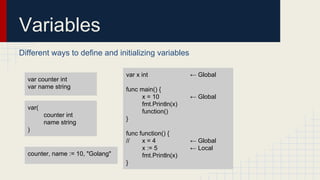
Variables
Different ways to define and initializing variables
var counter int
var name string
var(
counter int
name string
)
counter, name := 10, "Golang"
var x int ← Global
func main() {
x = 10 ← Global
fmt.Println(x)
function()
}
func function() {
// x = 4 ← Global
x := 5 ← Local
fmt.Println(x)
}
Datatypes
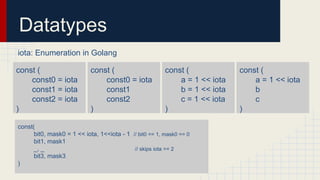
iota: Enumeration in Golang
const (
const0 = iota
const1 = iota
const2 = iota
)
const (
const0 = iota
const1
const2
)
const (
a = 1 << iota
b = 1 << iota
c = 1 << iota
)
const (
a = 1 << iota
b
c
)
const(
bit0, mask0 = 1 << iota, 1<<iota - 1 // bit0 == 1, mask0 == 0
bit1, mask1
_, _ // skips iota == 2
bit3, mask3
)
Control statement
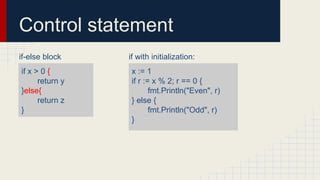
if-else block
if x > 0 {
return y
}else{
return z
}
if with initialization:
x := 1
if r := x % 2; r == 0 {
fmt.Println("Even", r)
} else {
fmt.Println("Odd", r)
}
Control statement
For Loop:
for init; condition; post { } ← c like for loop
for condition { } ← while loop
for { } ← Endless loop
J: for j := 0; j < 5; j++ {
for i := 0; i < 10; i++ {
if i > 5 {
break J
}
println(i)
}
}
list := []string{"a", "b", "c", "d", "e", "f"}
for k, v := range list {
fmt.Println(k, v)
}
Control statement
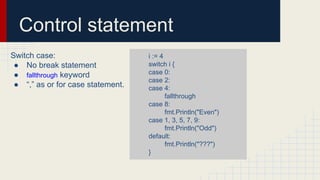
Switch case:
● No break statement
● fallthrough keyword
● “,” as or for case statement.
i := 4
switch i {
case 0:
case 2:
case 4:
fallthrough
case 8:
fmt.Println("Even")
case 1, 3, 5, 7, 9:
fmt.Println("Odd")
default:
fmt.Println("???")
}
Type declaration
Array type:
var arr[10]int
a:= [3]int{1,2,3}
weekEnd:=[2]string{“saturday”, “sunday”}
c:=[2][2]int{[2]int{1,2},[2]int{3,4}}
Type declaration
Slice
sl := make([]int, 10)
a:=[...]int{1,2,3,4,5} //array
s1:=a[m:n]
m ← starting index
n ← last index n-1
n-m ← length
//copy, append
s0 := []int{0, 1, 3, 4}
s1 := append(s0, 5) //returns new slice
n:=copy(s1,s[0,4]) //copy within limits
Type declaration
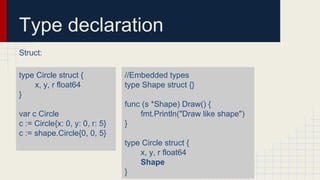
Struct:
type Circle struct {
x, y, r float64
}
var c Circle
c := Circle{x: 0, y: 0, r: 5}
c := shape.Circle{0, 0, 5}
//Embedded types
type Shape struct {}
func (s *Shape) Draw() {
fmt.Println("Draw like shape")
}
type Circle struct {
x, y, r float64
Shape
}
Type declaration
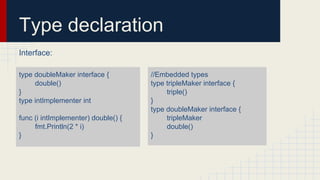
Interface:
type doubleMaker interface {
double()
}
type intImplementer int
func (i intImplementer) double() {
fmt.Println(2 * i)
}
//Embedded types
type tripleMaker interface {
triple()
}
type doubleMaker interface {
tripleMaker
double()
}
Type declaration
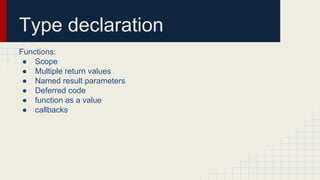
Functions:
● Scope
● Multiple return values
● Named result parameters
● Deferred code
● function as a value
● callbacks
Goroutines and channels
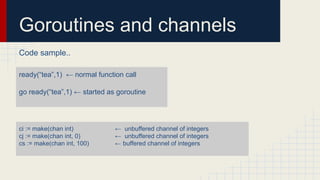
Code sample..
ready(“tea”,1) ← normal function call
go ready(“tea”,1) ← started as goroutine
ci := make(chan int) ← unbuffered channel of integers
cj := make(chan int, 0) ← unbuffered channel of integers
cs := make(chan int, 100) ← buffered channel of integers
Discussions...
Resources
Just search for golang...

Burrowing through go! the book

  • 1.
    burrowing through Go!! LanguageBasics Vishal Ghadge Sourav Ray
  • 2.
    Prerequisites 1. Installed goon your laptop 2. Set your GOROOT and GOPATH 3. Installed git and Hg
  • 3.
    Hello world… package main import"fmt" func main() { fmt.Println("Hello, 世界") }
  • 4.
    Datatypes Types: bool byte complex64complex128 error float32 float64 int int8 int16 int32 int64 rune string uint uint8 uint16 uint32 uint64 uintptr Constants: true false iota ← interesting.. Zero value: nil
  • 5.
    Variables Different ways todefine and initializing variables var counter int var name string var( counter int name string ) counter, name := 10, "Golang" var x int ← Global func main() { x = 10 ← Global fmt.Println(x) function() } func function() { // x = 4 ← Global x := 5 ← Local fmt.Println(x) }
  • 6.
    Datatypes iota: Enumeration inGolang const ( const0 = iota const1 = iota const2 = iota ) const ( const0 = iota const1 const2 ) const ( a = 1 << iota b = 1 << iota c = 1 << iota ) const ( a = 1 << iota b c ) const( bit0, mask0 = 1 << iota, 1<<iota - 1 // bit0 == 1, mask0 == 0 bit1, mask1 _, _ // skips iota == 2 bit3, mask3 )
  • 7.
    Control statement if-else block ifx > 0 { return y }else{ return z } if with initialization: x := 1 if r := x % 2; r == 0 { fmt.Println("Even", r) } else { fmt.Println("Odd", r) }
  • 8.
    Control statement For Loop: forinit; condition; post { } ← c like for loop for condition { } ← while loop for { } ← Endless loop J: for j := 0; j < 5; j++ { for i := 0; i < 10; i++ { if i > 5 { break J } println(i) } } list := []string{"a", "b", "c", "d", "e", "f"} for k, v := range list { fmt.Println(k, v) }
  • 9.
    Control statement Switch case: ●No break statement ● fallthrough keyword ● “,” as or for case statement. i := 4 switch i { case 0: case 2: case 4: fallthrough case 8: fmt.Println("Even") case 1, 3, 5, 7, 9: fmt.Println("Odd") default: fmt.Println("???") }
  • 10.
    Type declaration Array type: vararr[10]int a:= [3]int{1,2,3} weekEnd:=[2]string{“saturday”, “sunday”} c:=[2][2]int{[2]int{1,2},[2]int{3,4}}
  • 11.
    Type declaration Slice sl :=make([]int, 10) a:=[...]int{1,2,3,4,5} //array s1:=a[m:n] m ← starting index n ← last index n-1 n-m ← length //copy, append s0 := []int{0, 1, 3, 4} s1 := append(s0, 5) //returns new slice n:=copy(s1,s[0,4]) //copy within limits
  • 12.
    Type declaration Struct: type Circlestruct { x, y, r float64 } var c Circle c := Circle{x: 0, y: 0, r: 5} c := shape.Circle{0, 0, 5} //Embedded types type Shape struct {} func (s *Shape) Draw() { fmt.Println("Draw like shape") } type Circle struct { x, y, r float64 Shape }
  • 13.
    Type declaration Interface: type doubleMakerinterface { double() } type intImplementer int func (i intImplementer) double() { fmt.Println(2 * i) } //Embedded types type tripleMaker interface { triple() } type doubleMaker interface { tripleMaker double() }
  • 14.
    Type declaration Functions: ● Scope ●Multiple return values ● Named result parameters ● Deferred code ● function as a value ● callbacks
  • 15.
    Goroutines and channels Codesample.. ready(“tea”,1) ← normal function call go ready(“tea”,1) ← started as goroutine ci := make(chan int) ← unbuffered channel of integers cj := make(chan int, 0) ← unbuffered channel of integers cs := make(chan int, 100) ← buffered channel of integers
  • 16.
  • 17.