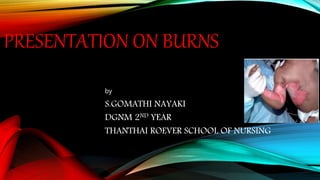
PRESENTATION ON BURNS
by
S.GOMATHI NAYAKI
DGNM 2ND YEAR
THANTHAI ROEVER SCHOOL OF NURSING
DEFINITION
• Burns are injuries caused by exposure of the body surface
to the temperature greater than 45*c .
• In children of the age between 6 month & 24 month ,
scalds are common with cooking liquids , while playing in the
kitchen or in the bath tub.
• In children of the ages 2 years to 6 years , common
causes are flame burns , while playing with matches , playing
near the fire or with the fire, crackers and by electric current.
CAUSES
• Wounds caused by exposure to :
• 1. Thermal
• 2.Chemical
• 3.Electrical
• 4.Radioactive
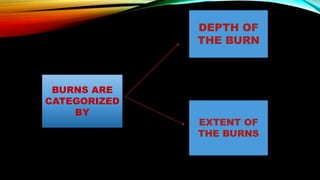
BURNS ARE
CATEGORIZED
BY
DEPTH OF
THE BURN
EXTENT OF
THE BURNS
DEPTH OF THE BURNS
• FIRST DEGREE : Epidermal tissues are burned .It leaves a dry
surface with erythema & is painful.
• SECOND DEGREE : partial thick skin is burned &it is very painful.
• DEEP DERMAL BURNS : the burns involve sebaceous gland , sweat
gland& hair follicles and leave a mottled , red or dull white skin.
• THIRD DEGREE : injury to the full thick skin . Nerve ending
may be destroyed.
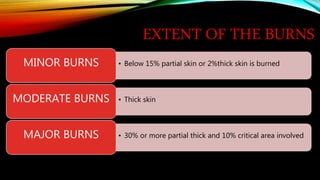
EXTENT OF THE BURNS
• Below 15% partial skin or 2%thick skin is burned
MINOR BURNS
• Thick skin
MODERATE BURNS
• 30% or more partial thick and 10% critical area involved
MAJOR BURNS
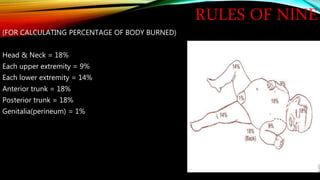
RULES OF NINE
(FOR CALCULATING PERCENTAGE OF BODY BURNED)
Head & Neck = 18%
Each upper extremity = 9%
Each lower extremity = 14%
Anterior trunk = 18%
Posterior trunk = 18%
Genitalia(perineum) = 1%
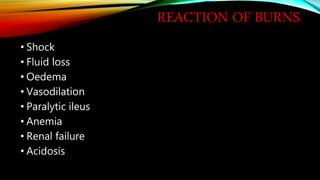
REACTION OF BURNS
• Shock
• Fluid loss
• Oedema
• Vasodilation
• Paralytic ileus
• Anemia
• Renal failure
• Acidosis
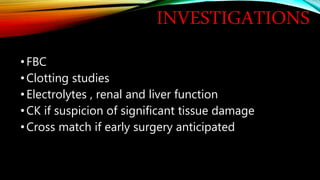
INVESTIGATIONS
•FBC
•Clotting studies
•Electrolytes , renal and liver function
•CK if suspicion of significant tissue damage
•Cross match if early surgery anticipated
COMPLICATION
• Shock
• Pulmonary complication such as pulmonary oedema ,
bacterial pneumonia and pulmonary embolism
• Wound sepsis may cause septic shock
• Encephalopathy
• Hypertension
• Contracture
EMERGENCY CARE
• The burning process should be stopped immediately.
• The burned area needs to be covered with sterile clean cloth and
the pt is required to be transferred to medical aid.
• A pt with burns should be placed horizontally
• Cooling of the burned part can be done by immersion of the part
in the cold water or in the non inflammable liquid for three
minutes .
• Cooling helps to relieve pain , decrease the oedema and slow the
process of heating.
CONTD…..
• In chemical burns , the part needs to be washed with the water or
neutralized.
• The wound needs to be covered with a clean or a sterile cloth to
prevent contamination and relieve pain by preventing contact
with the air.
TREATMENT
•Analgesics are required to relieve pain such as Morphine ,
Pethedine , Fortoin or Largactil.
•Antibiotics are prescribed to treat infection .
•Antitetanus serum is administered to prevent the
potential risk of tetanus.
•Mannitol may be prescribed in renal failure.
MANAGEMENT
 Bed sheet should be sterile.
 A bed cradle helps to prevent the weight of the linen.
 In severe cases , urine catheter is inserted to measure urine
output.
 The vital signs should be monitored to recognize the
symptoms of shock , to know the supportive measure to maintain
circulation.
CONTD…..
 The symptoms of shock such as tachycardia , hypothermia ,
pallor , prostration and shallow respirations should be observed
and notified.
 Maintenance of fluid and electrolyte balance is important.
 Intravenous crystalloids are administered on the first day as
prescribed.
 Isotonic solutions are necessary to expand the extracellular
volume.
CONTD….
 Fluid requirement of 24 hours is divided in two portions.
1.one half is administered during the first eight
hours and
2. Second half is administered in the next
sixteen hours.
•BROOK ARMY FORMULA :
1. 0.5% albumin : 0.5ml / kg / % of burns
2. 5% dextrose in Ringer’s lactate : 1.5ml / kg /% of burns
3. 5% dextrose in Ringer’s lactate : according to daily
requirement.
PARKLAND FORMULA :
5% dextrose in Ringer lactate : 4ml / kg / % of burns
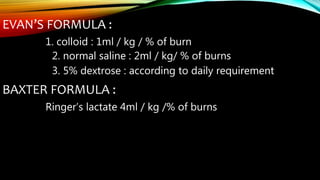
EVAN’S FORMULA :
1. colloid : 1ml / kg / % of burn
2. normal saline : 2ml / kg/ % of burns
3. 5% dextrose : according to daily requirement
BAXTER FORMULA :
Ringer’s lactate 4ml / kg /% of burns
CONTD….
 Maintenance of an adequate airway is essential.
 Burns around the face or injury from inhalation , flames, and
smoke or noxious gases require special attention to the
respiration.
 Endotracheal intubation or tracheostomy may be required.
 Maintenance of body temperature is required.
 Pain is relieved by administration of analgesics or narcotics as
prescribed.
CONTD…..
 Care of the wound is necessary to prevent infection
until epithelial regeneration restores the surface.
 Intact blisters can provide natural dressing.
 Initial cleaning of wound and removal of dead tissues
is done under sedation or anaesthesia.
CONTD…..
Following techniques are used for the care of the wound:
1.Topical antiseptic cream is applied in thick layer twice
a day.
2.Topical silver nitrate is applied to dressings and
dressings are changed twice a day .
3.Dressing with sterile boiled potato peel or other such
biological membranes are used for the dressing.
CONTD….
4.The skin around the wound should be kept clean to
prevent irritation by exudates.
5.Early escharectomy is done to prevent septicaemia.
 In severe burns, nasogastric intubation may be required to
remove the gastric secretion and decompress the stomach.
 In such cases , nothing should be given by mouth for 48
hours
CONTD….
 During the stage of burn , nitrogen and calories are lost,
therefore , proteins and calories should be supplied in the form
of milk , egg flip , banana flip , and butter milk.
 Additional vitamin C and iron are also necessary to treat
anaemia and to help in healing.
 General hygiene should be maintained to prevent infection.
 The care of the skin , eyes and mouth should provided.
 If genital area or buttocks are burned , care should be taken to
avoid contamination.
CONTD…
 Prevention of the contractures can be done by maintaining
good posture and by an appropriate physiotherapy.
 Splinting and traction may be used sometimes.
 Exercises should be encouraged to keep joints in function.
BURNS - PEDIATRICS

BURNS - PEDIATRICS

  • 1.
    PRESENTATION ON BURNS by S.GOMATHINAYAKI DGNM 2ND YEAR THANTHAI ROEVER SCHOOL OF NURSING
  • 2.
    DEFINITION • Burns areinjuries caused by exposure of the body surface to the temperature greater than 45*c . • In children of the age between 6 month & 24 month , scalds are common with cooking liquids , while playing in the kitchen or in the bath tub. • In children of the ages 2 years to 6 years , common causes are flame burns , while playing with matches , playing near the fire or with the fire, crackers and by electric current.
  • 3.
    CAUSES • Wounds causedby exposure to : • 1. Thermal • 2.Chemical • 3.Electrical • 4.Radioactive
  • 4.
    BURNS ARE CATEGORIZED BY DEPTH OF THEBURN EXTENT OF THE BURNS
  • 5.
    DEPTH OF THEBURNS • FIRST DEGREE : Epidermal tissues are burned .It leaves a dry surface with erythema & is painful. • SECOND DEGREE : partial thick skin is burned &it is very painful. • DEEP DERMAL BURNS : the burns involve sebaceous gland , sweat gland& hair follicles and leave a mottled , red or dull white skin. • THIRD DEGREE : injury to the full thick skin . Nerve ending may be destroyed.
  • 6.
    EXTENT OF THEBURNS • Below 15% partial skin or 2%thick skin is burned MINOR BURNS • Thick skin MODERATE BURNS • 30% or more partial thick and 10% critical area involved MAJOR BURNS
  • 7.
    RULES OF NINE (FORCALCULATING PERCENTAGE OF BODY BURNED) Head & Neck = 18% Each upper extremity = 9% Each lower extremity = 14% Anterior trunk = 18% Posterior trunk = 18% Genitalia(perineum) = 1%
  • 8.
    REACTION OF BURNS •Shock • Fluid loss • Oedema • Vasodilation • Paralytic ileus • Anemia • Renal failure • Acidosis
  • 9.
    INVESTIGATIONS •FBC •Clotting studies •Electrolytes ,renal and liver function •CK if suspicion of significant tissue damage •Cross match if early surgery anticipated
  • 10.
    COMPLICATION • Shock • Pulmonarycomplication such as pulmonary oedema , bacterial pneumonia and pulmonary embolism • Wound sepsis may cause septic shock • Encephalopathy • Hypertension • Contracture
  • 11.
    EMERGENCY CARE • Theburning process should be stopped immediately. • The burned area needs to be covered with sterile clean cloth and the pt is required to be transferred to medical aid. • A pt with burns should be placed horizontally • Cooling of the burned part can be done by immersion of the part in the cold water or in the non inflammable liquid for three minutes . • Cooling helps to relieve pain , decrease the oedema and slow the process of heating.
  • 12.
    CONTD….. • In chemicalburns , the part needs to be washed with the water or neutralized. • The wound needs to be covered with a clean or a sterile cloth to prevent contamination and relieve pain by preventing contact with the air.
  • 13.
    TREATMENT •Analgesics are requiredto relieve pain such as Morphine , Pethedine , Fortoin or Largactil. •Antibiotics are prescribed to treat infection . •Antitetanus serum is administered to prevent the potential risk of tetanus. •Mannitol may be prescribed in renal failure.
  • 14.
    MANAGEMENT  Bed sheetshould be sterile.  A bed cradle helps to prevent the weight of the linen.  In severe cases , urine catheter is inserted to measure urine output.  The vital signs should be monitored to recognize the symptoms of shock , to know the supportive measure to maintain circulation.
  • 15.
    CONTD…..  The symptomsof shock such as tachycardia , hypothermia , pallor , prostration and shallow respirations should be observed and notified.  Maintenance of fluid and electrolyte balance is important.  Intravenous crystalloids are administered on the first day as prescribed.  Isotonic solutions are necessary to expand the extracellular volume.
  • 16.
    CONTD….  Fluid requirementof 24 hours is divided in two portions. 1.one half is administered during the first eight hours and 2. Second half is administered in the next sixteen hours.
  • 17.
    •BROOK ARMY FORMULA: 1. 0.5% albumin : 0.5ml / kg / % of burns 2. 5% dextrose in Ringer’s lactate : 1.5ml / kg /% of burns 3. 5% dextrose in Ringer’s lactate : according to daily requirement. PARKLAND FORMULA : 5% dextrose in Ringer lactate : 4ml / kg / % of burns
  • 18.
    EVAN’S FORMULA : 1.colloid : 1ml / kg / % of burn 2. normal saline : 2ml / kg/ % of burns 3. 5% dextrose : according to daily requirement BAXTER FORMULA : Ringer’s lactate 4ml / kg /% of burns
  • 19.
    CONTD….  Maintenance ofan adequate airway is essential.  Burns around the face or injury from inhalation , flames, and smoke or noxious gases require special attention to the respiration.  Endotracheal intubation or tracheostomy may be required.  Maintenance of body temperature is required.  Pain is relieved by administration of analgesics or narcotics as prescribed.
  • 20.
    CONTD…..  Care ofthe wound is necessary to prevent infection until epithelial regeneration restores the surface.  Intact blisters can provide natural dressing.  Initial cleaning of wound and removal of dead tissues is done under sedation or anaesthesia.
  • 21.
    CONTD….. Following techniques areused for the care of the wound: 1.Topical antiseptic cream is applied in thick layer twice a day. 2.Topical silver nitrate is applied to dressings and dressings are changed twice a day . 3.Dressing with sterile boiled potato peel or other such biological membranes are used for the dressing.
  • 22.
    CONTD…. 4.The skin aroundthe wound should be kept clean to prevent irritation by exudates. 5.Early escharectomy is done to prevent septicaemia.  In severe burns, nasogastric intubation may be required to remove the gastric secretion and decompress the stomach.  In such cases , nothing should be given by mouth for 48 hours
  • 23.
    CONTD….  During thestage of burn , nitrogen and calories are lost, therefore , proteins and calories should be supplied in the form of milk , egg flip , banana flip , and butter milk.  Additional vitamin C and iron are also necessary to treat anaemia and to help in healing.  General hygiene should be maintained to prevent infection.  The care of the skin , eyes and mouth should provided.  If genital area or buttocks are burned , care should be taken to avoid contamination.
  • 24.
    CONTD…  Prevention ofthe contractures can be done by maintaining good posture and by an appropriate physiotherapy.  Splinting and traction may be used sometimes.  Exercises should be encouraged to keep joints in function.