Building Remote First
Engineering Teams
By: Matt Brunsdon
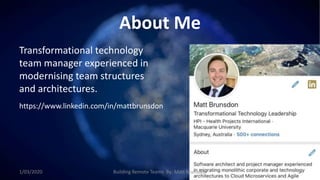
About Me
Transformational technology
team manager experienced in
modernising team structures
and architectures.
https://www.linkedin.com/in/mattbrunsdon
1/03/2020 Building Remote Teams By: Matt Brunsdon 2
Overview
This presentation discusses a stepwise approach
to building a remote team of software
engineers. It discusses some thoughts on how to
create the happiest & most the productive
remote team.
1/03/2020 Building Remote Teams By: Matt Brunsdon 3
Index
This presentation will
have the following
main sections:
1. The remote first working model
2. Working culture
3. Communication
4. Right tools
5. Regular Meetings
6. Setting etiquette
7. Keep up the work momentum
8. Team Structures
9. Embrace Continuous
Improvement
1/03/2020 Building Remote Teams By: Matt Brunsdon 4
1. Selecting the Remote
First Working Model
1/03/2020 Building Remote Teams By: Matt Brunsdon 5
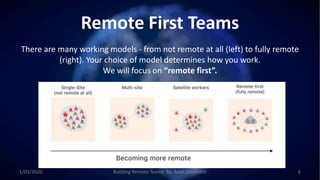
Remote First Teams
There are many working models - from not remote at all (left) to fully remote
(right). Your choice of model determines how you work.
We will focus on “remote first”.
1/03/2020 Building Remote Teams By: Matt Brunsdon 6
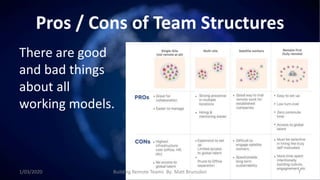
Pros / Cons of Team Structures
There are good
and bad things
about all
working models.
1/03/2020 Building Remote Teams By: Matt Brunsdon 7
Remote First or Single Site Only
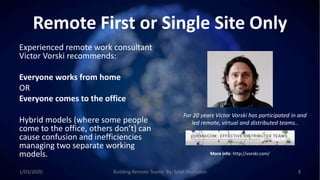
Experienced remote work consultant
Victor Vorski recommends:
Everyone works from home
OR
Everyone comes to the office
Hybrid models (where some people
come to the office, others don’t) can
cause confusion and inefficiencies
managing two separate working
models.
For 20 years Victor Vorski has participated in and
led remote, virtual and distributed teams..
More info: http://vorski.com/
1/03/2020 Building Remote Teams By: Matt Brunsdon 8
2. Working Culture in
Remote First Teams
1/03/2020 Building Remote Teams By: Matt Brunsdon 9
Remote workers are not second rate
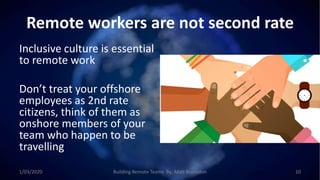
Inclusive culture is essential
to remote work
Don’t treat your offshore
employees as 2nd rate
citizens, think of them as
onshore members of your
team who happen to be
travelling
1/03/2020 Building Remote Teams By: Matt Brunsdon 10
Remote workers are not second rate
Points to focus on
when designing your
remote first teams:
 The same health care, sick days and holidays
 The same performance management and career
growth opportunities
 The same on boarding experience - e.g. 1 on 1
catch-ups, conduct a virtual office walkthrough,
spend the same times with remote employees
explaining processes and “how we work”
conventions, etc.
 The same company / team wide communications
 Ensuring OHS issues are addressed at the home, &
working environments are the same for all
 Observing local holidays, religious events, language
usages etc. in the same way for all.
1/03/2020 Building Remote Teams By: Matt Brunsdon 11
"Great Culture doesn’t happen by
itself, it's a accumulation of time,
effort and intentional planning."
1/03/2020 Building Remote Teams By: Matt Brunsdon 12
3. Communication
in Remote First Teams
1/03/2020 Building Remote Teams By: Matt Brunsdon 13
Setting Expectations
• Remote teams must communicate and check in
more regularly than when working in person
• Numerus non-verbal queues and cultural
etiquettes are not communicated when working
remotely
• Morale is influenced positively by regular contact
with co-workers
1/03/2020 Building Remote Teams By: Matt Brunsdon 14
Protocols and Norms
Some protocols and
norms that assist in
encouraging successful
remote teamwork:
 List technology tools you want
everyone to use
 List what an acceptable response
time is in group chat / email
 Meeting etiquettes
 Enforcing Daily team meetings
 Enforcing Daily check in check out
chats / meetings
 Availability protocol e.g.: “going to
lunch now” in chat
1/03/2020 Building Remote Teams By: Matt Brunsdon 15
Step 4. Right tool
for the job
1/03/2020 Building Remote Teams By: Matt Brunsdon 16
Tools for Remote First Teams
The right tool makes remote working a breeze,
this is what we’re using however there are a lot
of options out there…
1/03/2020 Building Remote Teams By: Matt Brunsdon 17
Real Time Chat
• Slack
– Exceptional chat tool for engineers to stay
connected and chat in a structured manner.
• Discord
– Constant connection to your team via audio, more
popular in the gaming world however quite useful
for ensuring responsiveness.
1/03/2020 Building Remote Teams By: Matt Brunsdon 18
Video Conference
• Zoom
– Excellent video conference system with support
for a large number of concurrent users
1/03/2020 Building Remote Teams By: Matt Brunsdon 19
Wiki / Team Collaboration
• Confluence
– Sophisticated wiki product integrated into the Jira
development management suite
1/03/2020 Building Remote Teams By: Matt Brunsdon 20
User Story / Task Management
• Jira
– Industry leader for engineering team user story
management, deep integration with a suite of
complimentary tools that facilitate CI/CD
practices.
1/03/2020 Building Remote Teams By: Matt Brunsdon 21
Meeting/Task Scheduling
• Inviited
– When working remotely you can often find team
members are spread across multiple time zones.
To effectively view and manage when there is
shared availability use Inviited. It’s a more
sophisticated method than the standard Outlook
or Email calendars.
1/03/2020 Building Remote Teams By: Matt Brunsdon 22
Step 5. Regular formal &
informal catch-ups
1/03/2020 Building Remote Teams By: Matt Brunsdon 23
Regular Contact = Happy Team
Work is never just work. It’s about social bonding
and building relationships with your peers.
Did you know that Jack on your team recently got
engaged, or Maxim is putting his dog through
Puppy School? These are the social nuances that
make working together meaningful.
1/03/2020 Building Remote Teams By: Matt Brunsdon 24
Formalize Regular Contact
Coming up with a formal set of regular touch
points for team contact, and enforcing these
will ensure more positive team contact and
structure.
Some examples of strategies are as follows:
1/03/2020 Building Remote Teams By: Matt Brunsdon 25
Check in / Check out
• Format: One-on-one phone call, video
conference, or instant chat
• Description: Start of day and end of day
informal catch-up with each team member,
sets a clear expectation that catch-up
conversations will happen 2 times a day.
1/03/2020 Building Remote Teams By: Matt Brunsdon 26
Daily Stand-up Meetings
• Format: Group chat or group video conference
• Description: Stand-ups build accountability
and trust, enforcing a regular team meeting
each day connects team members with each
other and uncovers any issues blocking
engineers.
1/03/2020 Building Remote Teams By: Matt Brunsdon 27
Responsiveness Expectations
• Format: Constantly running group audio feed through
discord, or teleconference, or group chat
• Description: Ensuring the team is always available to
chat by opening a constant audio connection is a good
way to simulate the environment of an office, it also
makes sure everyone is actually working and available.
Enforcing rules around time taken to respond during
the day is important.
1/03/2020 Building Remote Teams By: Matt Brunsdon 28
Weekly Showcase & Retro
• Format: Group video conference
• Description: A way for people to see what
everyone else on the team is working. 2~3
hours and all team members demo what they
have worked on from marketing, designers to
developers.
1/03/2020 Building Remote Teams By: Matt Brunsdon 29
Monthly Social Events
• Format: Group video conference, multiplayer video
games, sports tipping competitions, informal chat
groups, and group training / education sessions.
• Description: Friday knock off drinks are still possible via
Video Conference, scheduling some informal get
together time to have a laugh is a good idea. Also video
game tournaments, hackathons, training and education
groups, and sports tipping competitions help ensure a
healthy social atmosphere remotely.
1/03/2020 Building Remote Teams By: Matt Brunsdon 30
Yearly Retreats
• Format: In-person catch-up of all remote staff
• Description: Virtual is all well and nice, but where
possible a few days of R&R for the team all
together in a getaway location (think Thailand,
Bali, or Portugal) and hacking in the same room
goes a long way toward both productivity &
building great friendships amongst the team.
1/03/2020 Building Remote Teams By: Matt Brunsdon 31
Step 6. Setting etiquette rules
1/03/2020 Building Remote Teams By: Matt Brunsdon 32
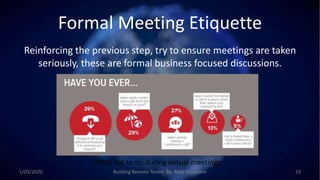
Formal Meeting Etiquette
Reinforcing the previous step, try to ensure meetings are taken
seriously, these are formal business focused discussions.
What not to do during virtual meetings…
1/03/2020 Building Remote Teams By: Matt Brunsdon 33
Step 7. Keep up work momentum
1/03/2020 Building Remote Teams By: Matt Brunsdon 34
Continuous Momentum
Momentum is important correct work momentum builds a
culture of fast work (great for any Agile team), makes everyone
feel productive, and empowered.
So it’s even more pivotal for distributed teams where a delay of a
few hours means a day or more of delayed output when
factoring for time zone.
1/03/2020 Building Remote Teams By: Matt Brunsdon 35
Achieving Continuous Momentum
To ensure continuous work momentum:
• Choose real time communication over email – Slack or Discord
• Prioritise offshore requests over local - to minimise delays
• Have regular check ins - ad hoc chat, and daily check ins
• Gauge team momentum in Weekly Showcase and Retros
Everyone can feel the team momentum. Done right, fluid team
momentum is the equivalent of Flow state, bringing with it the same
level of joy and propensity to be increasingly productive.
1/03/2020 Building Remote Teams By: Matt Brunsdon 36
Step 8. Structure your team to
encourage Autonomy, Mastery,
and Purpose
1/03/2020 Building Remote Teams By: Matt Brunsdon 37
Lead for engagement
One of the biggest pitfalls for remote team is dis-engagement.
Limited face to face communication, cultural differences, time
zone issues makes team bonding difficult.
The three top factors for motivation, and better performance
are Autonomy, Mastery, and Purpose…
Some ways to encourage these factors:
1/03/2020 Building Remote Teams By: Matt Brunsdon 38
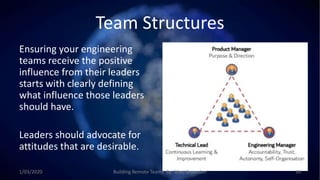
Team Structures
Ensuring your engineering
teams receive the positive
influence from their leaders
starts with clearly defining
what influence those leaders
should have.
Leaders should advocate for
attitudes that are desirable.
1/03/2020 Building Remote Teams By: Matt Brunsdon 39
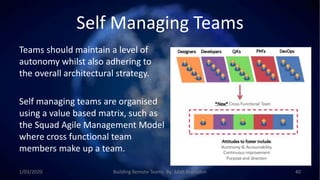
Self Managing Teams
Teams should maintain a level of
autonomy whilst also adhering to
the overall architectural strategy.
Self managing teams are organised
using a value based matrix, such as
the Squad Agile Management Model
where cross functional team
members make up a team.
1/03/2020 Building Remote Teams By: Matt Brunsdon 40
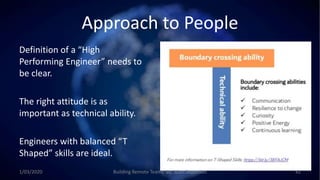
Approach to People
Definition of a “High
Performing Engineer” needs to
be clear.
The right attitude is as
important as technical ability.
Engineers with balanced “T
Shaped” skills are ideal.
1/03/2020 Building Remote Teams By: Matt Brunsdon 41
Finally. Embrace Continuous
Improvement
1/03/2020 Building Remote Teams By: Matt Brunsdon 42
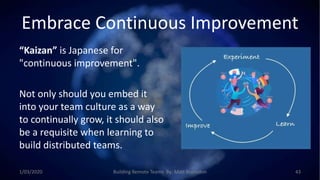
Embrace Continuous Improvement
“Kaizan” is Japanese for
"continuous improvement".
Not only should you embed it
into your team culture as a way
to continually grow, it should also
be a requisite when learning to
build distributed teams.
1/03/2020 Building Remote Teams By: Matt Brunsdon 43
Questions?
Please feel free to contact me
with questions and comments.
I am keen to hear how other
engineering teams are working
remotely.
https://www.linkedin.com/in/mattbrunsdon
1/03/2020 Building Remote Teams By: Matt Brunsdon 44
Building Remote First
Engineering Teams
By: Matt Brunsdon

Building Remote First Software Engineering Teams - By: Matt Brunsdon

  • 1.
    Building Remote First EngineeringTeams By: Matt Brunsdon
  • 2.
    About Me Transformational technology teammanager experienced in modernising team structures and architectures. https://www.linkedin.com/in/mattbrunsdon 1/03/2020 Building Remote Teams By: Matt Brunsdon 2
  • 3.
    Overview This presentation discussesa stepwise approach to building a remote team of software engineers. It discusses some thoughts on how to create the happiest & most the productive remote team. 1/03/2020 Building Remote Teams By: Matt Brunsdon 3
  • 4.
    Index This presentation will havethe following main sections: 1. The remote first working model 2. Working culture 3. Communication 4. Right tools 5. Regular Meetings 6. Setting etiquette 7. Keep up the work momentum 8. Team Structures 9. Embrace Continuous Improvement 1/03/2020 Building Remote Teams By: Matt Brunsdon 4
  • 5.
    1. Selecting theRemote First Working Model 1/03/2020 Building Remote Teams By: Matt Brunsdon 5
  • 6.
    Remote First Teams Thereare many working models - from not remote at all (left) to fully remote (right). Your choice of model determines how you work. We will focus on “remote first”. 1/03/2020 Building Remote Teams By: Matt Brunsdon 6
  • 7.
    Pros / Consof Team Structures There are good and bad things about all working models. 1/03/2020 Building Remote Teams By: Matt Brunsdon 7
  • 8.
    Remote First orSingle Site Only Experienced remote work consultant Victor Vorski recommends: Everyone works from home OR Everyone comes to the office Hybrid models (where some people come to the office, others don’t) can cause confusion and inefficiencies managing two separate working models. For 20 years Victor Vorski has participated in and led remote, virtual and distributed teams.. More info: http://vorski.com/ 1/03/2020 Building Remote Teams By: Matt Brunsdon 8
  • 9.
    2. Working Culturein Remote First Teams 1/03/2020 Building Remote Teams By: Matt Brunsdon 9
  • 10.
    Remote workers arenot second rate Inclusive culture is essential to remote work Don’t treat your offshore employees as 2nd rate citizens, think of them as onshore members of your team who happen to be travelling 1/03/2020 Building Remote Teams By: Matt Brunsdon 10
  • 11.
    Remote workers arenot second rate Points to focus on when designing your remote first teams:  The same health care, sick days and holidays  The same performance management and career growth opportunities  The same on boarding experience - e.g. 1 on 1 catch-ups, conduct a virtual office walkthrough, spend the same times with remote employees explaining processes and “how we work” conventions, etc.  The same company / team wide communications  Ensuring OHS issues are addressed at the home, & working environments are the same for all  Observing local holidays, religious events, language usages etc. in the same way for all. 1/03/2020 Building Remote Teams By: Matt Brunsdon 11
  • 12.
    "Great Culture doesn’thappen by itself, it's a accumulation of time, effort and intentional planning." 1/03/2020 Building Remote Teams By: Matt Brunsdon 12
  • 13.
    3. Communication in RemoteFirst Teams 1/03/2020 Building Remote Teams By: Matt Brunsdon 13
  • 14.
    Setting Expectations • Remoteteams must communicate and check in more regularly than when working in person • Numerus non-verbal queues and cultural etiquettes are not communicated when working remotely • Morale is influenced positively by regular contact with co-workers 1/03/2020 Building Remote Teams By: Matt Brunsdon 14
  • 15.
    Protocols and Norms Someprotocols and norms that assist in encouraging successful remote teamwork:  List technology tools you want everyone to use  List what an acceptable response time is in group chat / email  Meeting etiquettes  Enforcing Daily team meetings  Enforcing Daily check in check out chats / meetings  Availability protocol e.g.: “going to lunch now” in chat 1/03/2020 Building Remote Teams By: Matt Brunsdon 15
  • 16.
    Step 4. Righttool for the job 1/03/2020 Building Remote Teams By: Matt Brunsdon 16
  • 17.
    Tools for RemoteFirst Teams The right tool makes remote working a breeze, this is what we’re using however there are a lot of options out there… 1/03/2020 Building Remote Teams By: Matt Brunsdon 17
  • 18.
    Real Time Chat •Slack – Exceptional chat tool for engineers to stay connected and chat in a structured manner. • Discord – Constant connection to your team via audio, more popular in the gaming world however quite useful for ensuring responsiveness. 1/03/2020 Building Remote Teams By: Matt Brunsdon 18
  • 19.
    Video Conference • Zoom –Excellent video conference system with support for a large number of concurrent users 1/03/2020 Building Remote Teams By: Matt Brunsdon 19
  • 20.
    Wiki / TeamCollaboration • Confluence – Sophisticated wiki product integrated into the Jira development management suite 1/03/2020 Building Remote Teams By: Matt Brunsdon 20
  • 21.
    User Story /Task Management • Jira – Industry leader for engineering team user story management, deep integration with a suite of complimentary tools that facilitate CI/CD practices. 1/03/2020 Building Remote Teams By: Matt Brunsdon 21
  • 22.
    Meeting/Task Scheduling • Inviited –When working remotely you can often find team members are spread across multiple time zones. To effectively view and manage when there is shared availability use Inviited. It’s a more sophisticated method than the standard Outlook or Email calendars. 1/03/2020 Building Remote Teams By: Matt Brunsdon 22
  • 23.
    Step 5. Regularformal & informal catch-ups 1/03/2020 Building Remote Teams By: Matt Brunsdon 23
  • 24.
    Regular Contact =Happy Team Work is never just work. It’s about social bonding and building relationships with your peers. Did you know that Jack on your team recently got engaged, or Maxim is putting his dog through Puppy School? These are the social nuances that make working together meaningful. 1/03/2020 Building Remote Teams By: Matt Brunsdon 24
  • 25.
    Formalize Regular Contact Comingup with a formal set of regular touch points for team contact, and enforcing these will ensure more positive team contact and structure. Some examples of strategies are as follows: 1/03/2020 Building Remote Teams By: Matt Brunsdon 25
  • 26.
    Check in /Check out • Format: One-on-one phone call, video conference, or instant chat • Description: Start of day and end of day informal catch-up with each team member, sets a clear expectation that catch-up conversations will happen 2 times a day. 1/03/2020 Building Remote Teams By: Matt Brunsdon 26
  • 27.
    Daily Stand-up Meetings •Format: Group chat or group video conference • Description: Stand-ups build accountability and trust, enforcing a regular team meeting each day connects team members with each other and uncovers any issues blocking engineers. 1/03/2020 Building Remote Teams By: Matt Brunsdon 27
  • 28.
    Responsiveness Expectations • Format:Constantly running group audio feed through discord, or teleconference, or group chat • Description: Ensuring the team is always available to chat by opening a constant audio connection is a good way to simulate the environment of an office, it also makes sure everyone is actually working and available. Enforcing rules around time taken to respond during the day is important. 1/03/2020 Building Remote Teams By: Matt Brunsdon 28
  • 29.
    Weekly Showcase &Retro • Format: Group video conference • Description: A way for people to see what everyone else on the team is working. 2~3 hours and all team members demo what they have worked on from marketing, designers to developers. 1/03/2020 Building Remote Teams By: Matt Brunsdon 29
  • 30.
    Monthly Social Events •Format: Group video conference, multiplayer video games, sports tipping competitions, informal chat groups, and group training / education sessions. • Description: Friday knock off drinks are still possible via Video Conference, scheduling some informal get together time to have a laugh is a good idea. Also video game tournaments, hackathons, training and education groups, and sports tipping competitions help ensure a healthy social atmosphere remotely. 1/03/2020 Building Remote Teams By: Matt Brunsdon 30
  • 31.
    Yearly Retreats • Format:In-person catch-up of all remote staff • Description: Virtual is all well and nice, but where possible a few days of R&R for the team all together in a getaway location (think Thailand, Bali, or Portugal) and hacking in the same room goes a long way toward both productivity & building great friendships amongst the team. 1/03/2020 Building Remote Teams By: Matt Brunsdon 31
  • 32.
    Step 6. Settingetiquette rules 1/03/2020 Building Remote Teams By: Matt Brunsdon 32
  • 33.
    Formal Meeting Etiquette Reinforcingthe previous step, try to ensure meetings are taken seriously, these are formal business focused discussions. What not to do during virtual meetings… 1/03/2020 Building Remote Teams By: Matt Brunsdon 33
  • 34.
    Step 7. Keepup work momentum 1/03/2020 Building Remote Teams By: Matt Brunsdon 34
  • 35.
    Continuous Momentum Momentum isimportant correct work momentum builds a culture of fast work (great for any Agile team), makes everyone feel productive, and empowered. So it’s even more pivotal for distributed teams where a delay of a few hours means a day or more of delayed output when factoring for time zone. 1/03/2020 Building Remote Teams By: Matt Brunsdon 35
  • 36.
    Achieving Continuous Momentum Toensure continuous work momentum: • Choose real time communication over email – Slack or Discord • Prioritise offshore requests over local - to minimise delays • Have regular check ins - ad hoc chat, and daily check ins • Gauge team momentum in Weekly Showcase and Retros Everyone can feel the team momentum. Done right, fluid team momentum is the equivalent of Flow state, bringing with it the same level of joy and propensity to be increasingly productive. 1/03/2020 Building Remote Teams By: Matt Brunsdon 36
  • 37.
    Step 8. Structureyour team to encourage Autonomy, Mastery, and Purpose 1/03/2020 Building Remote Teams By: Matt Brunsdon 37
  • 38.
    Lead for engagement Oneof the biggest pitfalls for remote team is dis-engagement. Limited face to face communication, cultural differences, time zone issues makes team bonding difficult. The three top factors for motivation, and better performance are Autonomy, Mastery, and Purpose… Some ways to encourage these factors: 1/03/2020 Building Remote Teams By: Matt Brunsdon 38
  • 39.
    Team Structures Ensuring yourengineering teams receive the positive influence from their leaders starts with clearly defining what influence those leaders should have. Leaders should advocate for attitudes that are desirable. 1/03/2020 Building Remote Teams By: Matt Brunsdon 39
  • 40.
    Self Managing Teams Teamsshould maintain a level of autonomy whilst also adhering to the overall architectural strategy. Self managing teams are organised using a value based matrix, such as the Squad Agile Management Model where cross functional team members make up a team. 1/03/2020 Building Remote Teams By: Matt Brunsdon 40
  • 41.
    Approach to People Definitionof a “High Performing Engineer” needs to be clear. The right attitude is as important as technical ability. Engineers with balanced “T Shaped” skills are ideal. 1/03/2020 Building Remote Teams By: Matt Brunsdon 41
  • 42.
    Finally. Embrace Continuous Improvement 1/03/2020Building Remote Teams By: Matt Brunsdon 42
  • 43.
    Embrace Continuous Improvement “Kaizan”is Japanese for "continuous improvement". Not only should you embed it into your team culture as a way to continually grow, it should also be a requisite when learning to build distributed teams. 1/03/2020 Building Remote Teams By: Matt Brunsdon 43
  • 44.
    Questions? Please feel freeto contact me with questions and comments. I am keen to hear how other engineering teams are working remotely. https://www.linkedin.com/in/mattbrunsdon 1/03/2020 Building Remote Teams By: Matt Brunsdon 44
  • 45.
    Building Remote First EngineeringTeams By: Matt Brunsdon