8
8
BSED MATH
BSED MATH
LOGIC AND INCIDENCE
LOGIC AND INCIDENCE
GEOMETRY
GEOMETRY
NEGATION AND
NEGATION AND
QUANTIFIERS
QUANTIFIERS
LEARNING OBJECTIVES
LEARNING OBJECTIVES
At the end of the lesson , learners will be able to:
K- Define negation as a logical operation that reverses the
truth value of a statement.
S- Apply the rules og negation to manipulate and transform
mathematical statements and expressions
A- Appreciate the significance of negation and quantifiers
in formal mathematical reasoning and proof-writing.
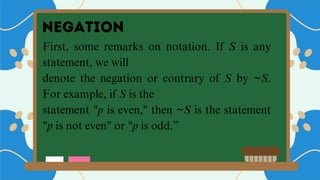
First, some remarks on notation. If S is any
statement, we will
denote the negation or contrary of S by ~S.
For example, if S is the
statement "p is even," then ~S is the statement
"p is not even" or "p is odd.”
NEGATION
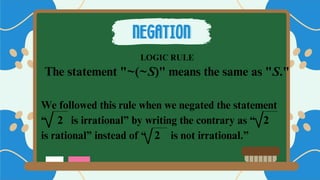
LOGIC RULE
The statement "~(~S)" means the same as "S."
We followed this rule when we negated the statement
“ 2 is irrational” by writing the contrary as “ 2
is rational” instead of “ 2 is not irrational.”
NEGATION
NEGATION
QUANTIFIERS
QUANTIFIERS
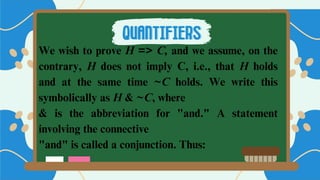
We wish to prove H => C, and we assume, on the
contrary, H does not imply C, i.e., that H holds
and at the same time ~C holds. We write this
symbolically as H & ~C, where
& is the abbreviation for "and." A statement
involving the connective
"and" is called a conjunction. Thus:
QUANTIFIERS
QUANTIFIERS
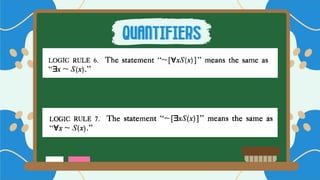
LOGIC RULE 4.
The statement "~[H => C] " means the same as "H &
~C.”
LOGIC RULE 5.
The statement "-[S1 & S2]" means the same as
“[~S1 or ~S2].”
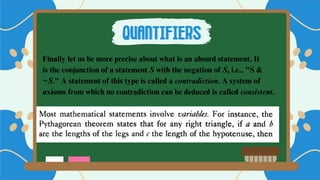
Finally let us be more precise about what is an absurd statement. It
is the conjunction of a statement S with the negation of S, i.e., "S &
~S." A statement of this type is called a contradiction. A system of
axioms from which no contradiction can be deduced is called consistent.
QUANTIFIERS
QUANTIFIERS
QUANTIFIERS
QUANTIFIERS
QUANTIFIERS
QUANTIFIERS
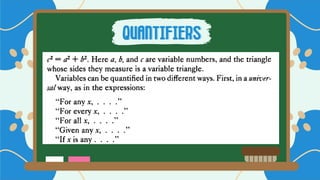
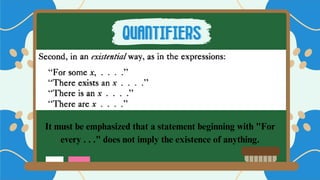
It must be emphasized that a statement beginning with "For
every . . ." does not imply the existence of anything.
QUANTIFIERS
QUANTIFIERS
QUANTIFIERS
QUANTIFIERS
QUANTIFIERS
QUANTIFIERS
THANK YOU!
THANK YOU!

BSED MATH 8 Jamon.pdf Quantifiers Negation

  • 1.
  • 2.
    LOGIC AND INCIDENCE LOGICAND INCIDENCE GEOMETRY GEOMETRY NEGATION AND NEGATION AND QUANTIFIERS QUANTIFIERS
  • 3.
    LEARNING OBJECTIVES LEARNING OBJECTIVES Atthe end of the lesson , learners will be able to: K- Define negation as a logical operation that reverses the truth value of a statement. S- Apply the rules og negation to manipulate and transform mathematical statements and expressions A- Appreciate the significance of negation and quantifiers in formal mathematical reasoning and proof-writing.
  • 4.
    First, some remarkson notation. If S is any statement, we will denote the negation or contrary of S by ~S. For example, if S is the statement "p is even," then ~S is the statement "p is not even" or "p is odd.” NEGATION
  • 5.
    LOGIC RULE The statement"~(~S)" means the same as "S." We followed this rule when we negated the statement “ 2 is irrational” by writing the contrary as “ 2 is rational” instead of “ 2 is not irrational.” NEGATION NEGATION
  • 6.
    QUANTIFIERS QUANTIFIERS We wish toprove H => C, and we assume, on the contrary, H does not imply C, i.e., that H holds and at the same time ~C holds. We write this symbolically as H & ~C, where & is the abbreviation for "and." A statement involving the connective "and" is called a conjunction. Thus:
  • 7.
    QUANTIFIERS QUANTIFIERS LOGIC RULE 4. Thestatement "~[H => C] " means the same as "H & ~C.” LOGIC RULE 5. The statement "-[S1 & S2]" means the same as “[~S1 or ~S2].”
  • 8.
    Finally let usbe more precise about what is an absurd statement. It is the conjunction of a statement S with the negation of S, i.e., "S & ~S." A statement of this type is called a contradiction. A system of axioms from which no contradiction can be deduced is called consistent. QUANTIFIERS QUANTIFIERS
  • 9.
  • 10.
    QUANTIFIERS QUANTIFIERS It must beemphasized that a statement beginning with "For every . . ." does not imply the existence of anything.
  • 11.
  • 12.
  • 13.
  • 15.