Digital Production, Design and Development - T Level
The Business Environment
Lesson Three
Each slide has detailed notes
Recap of the business environment
The business environment is rapidly changing
https://www.linkedin.com/pulse/why-businesses-need-adapt-change-rapidly-changing-colin-thompson/
Digital is transforming every business department
Production
Research and Development (often abbreviated to R&D)
Purchasing
Marketing and Sales
Human Resource Management
Accounting and Finance
Logistics and Supply Chain
Digital is transforming employees and customers
What do we mean by the business environment?
• Business Environment – Lesson One
• Key Organisational Areas – Lesson One
• Digital support in businesses – Lesson Two
• Project Feasibility – Lesson Two
• Characteristics of end users – Lesson Three
• Digital Value to a Business – Lesson Three
• Change Management – Lesson Four
• Risk – Lesson Four
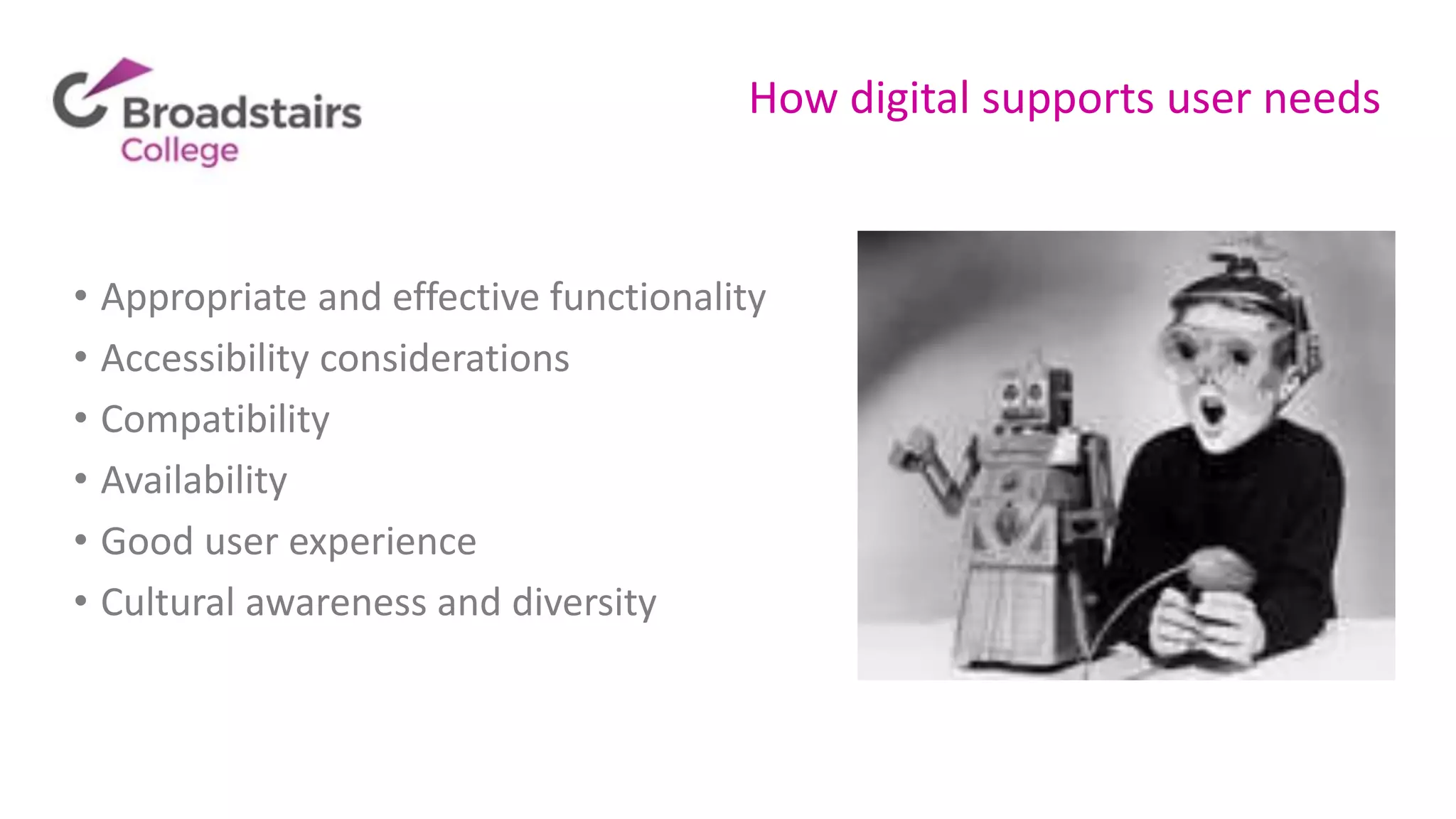
How digital supports user needs
• Appropriate and effective functionality
• Accessibility considerations
• Compatibility
• Availability
• Good user experience
• Cultural awareness and diversity
Watch this video and see how Uber uses
digital to support user needs
https://youtu.be/gvEU656kVCQ
Group discussion – Let’s score Uber out of 100
on each of these criteria
• Appropriate and effective functionality
• Accessibility considerations
• Compatibility
• Availability
• Good user experience
• Cultural awareness and diversity
Watch this video and see how Airbnb uses
digital to support user needs
https://youtu.be/WzGhFmiB9G0
Group discussion – Let’s score Airbnb out of 100
on each of these criteria
• Appropriate and effective functionality
• Accessibility considerations
• Compatibility
• Availability
• Good user experience
• Cultural awareness and diversity
How end users drive digital technologies
How end users drive digital technologies –
Focus groups and prototypes
• Consult end user needs
• Iterate, test and get feedback
• Build a prototype
• Iterate, test and get feedback
• Build a proof of concept
https://blog.hubspot.com/marketing/how-to-run-a-focus-group
How end users drive digital technologies –
Age and multi-generational end users
5 mins
•
https://www.ageing.ox.ac.uk/blog/use-of-technology-does-age-matter
• What are the factors that
influence the adoption
of technology by older
people?
How end users drive digital technologies –
Skills and education
• End users have different IT
skills/experience
• Online services and products
should be easy, intuitive and
straightforward to use
https://careerfoundry.com/en/blog/ux-design/what-is-user-experience-ux-design-
everything-you-need-to-know-to-get-started/
How end users drive digital technologies –
Differences between internal/external audiences
5 mins
https://www.bmc.com/blogs/internal-vs-external-customers/
• From an IT perspective, it’s often
helpful to separate the types of
customers you serve
• Understanding the needs of
customers can help clarify
workflows and decide whether a
company should distinguish
between internal and external
customers
How end users drive digital technologies –
Level of technical knowledge
• It is pointless to create digital
technology that is beyond the
technical skills of the end user.
• For example, when a bank such as
Lloyds is creating the interface for
its online banking app it needs to
consider the needs of users who
do not have a high level of
technical knowledge
Task – 15 minutes – Write down bullet point
notes to answer this question
And then we will discuss your findings
Digital Value to Business
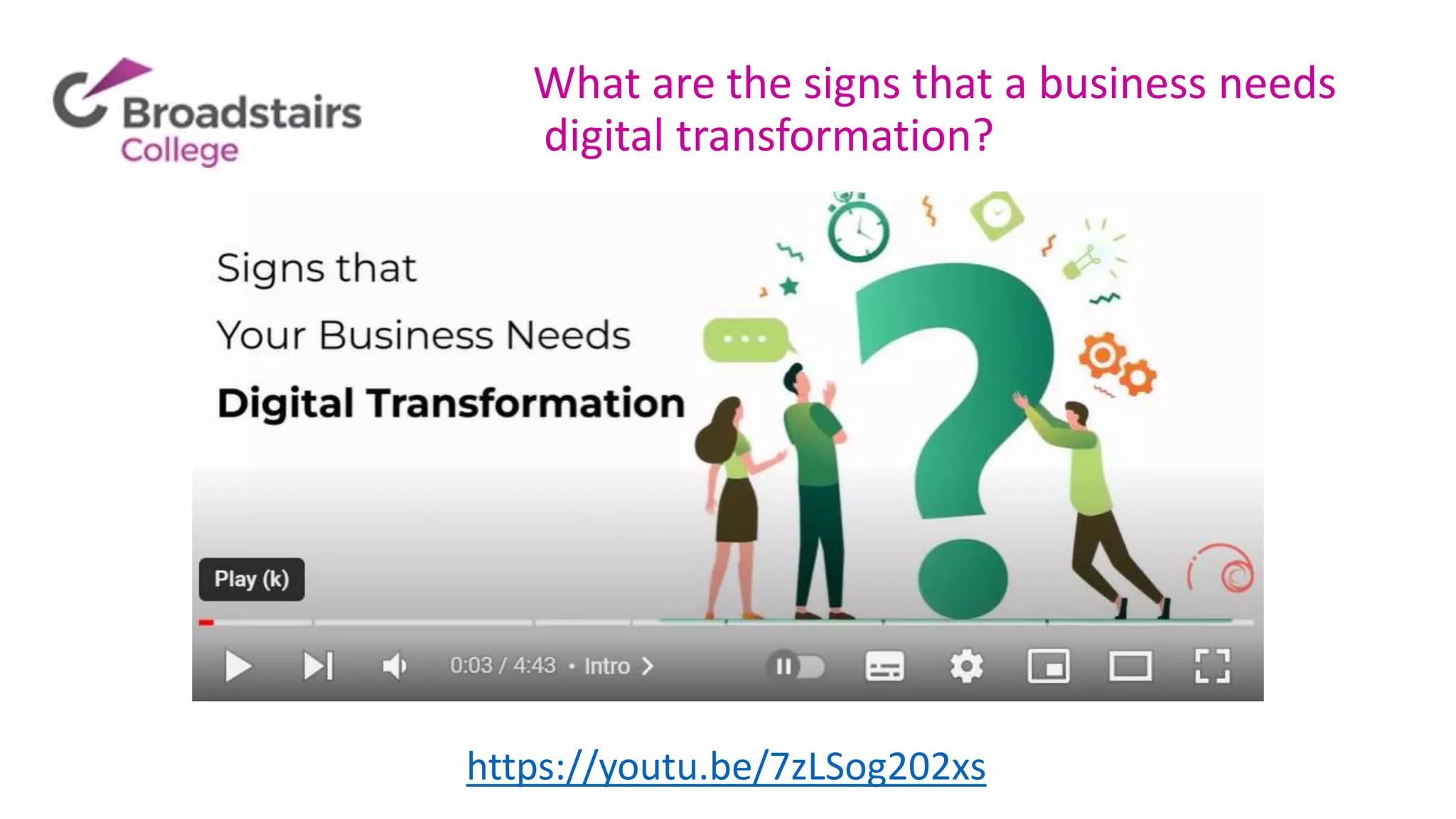
What are the signs that a business needs
digital transformation?
https://youtu.be/7zLSog202xs
The importance of digital within organisations
It is important to understand the importance of digital within organisations,
and ways in which digital is used to add value to a company:
• engagement of customers, users and other stakeholders
• provision of products and services to customers
• measurable value (reducing overheads, improving efficiency, facilitating
growth, recruiting talent)
• supporting processes and business models (product design, manufacturing
control, data modelling, local and remote working)
• context and market environment (stakeholders, user profiling,
personalised/appropriate content, data)
The importance of digital within organisations
engagement of customers, users and other stakeholders
Local council planning departments
now often share details of planning
applications via their websites so
interested parties can view the plans
https://stweonardsparishcouncil.gov.uk/planning-applications/
The importance of digital within organisations
Provision of products and services to customers
Numerous new products and
services have been developed as a
result of digital technologies which
can add value to the customer
relationship, e.g. online banking
enables customers to be able to
access banking services 24/7
https://www.statista.com/statistics/286273/int
ernet-banking-penetration-in-great-britain/
The importance of digital within organisations
Measurable value (reducing overheads, improving efficiency,
facilitating growth, recruiting talent)
https://youtu.be/zKMuMUQ4Yvg
The importance of digital within organisations
Supporting processes and business models (product design,
manufacturing control, data modelling, local and remote working)
Digital technologies enable
employees to do remote working
and access online portals and
carry out all the tasks that they
do in the office
The importance of digital within organisations
Context and market environment (stakeholders, user profiling,
personalised/appropriate content, data)
https://youtu.be/_zZ6dnW5Nic
How digital adds value to a company
What is a value chain?
Porter’s value chain: How to create value in your organisation
https://youtu.be/aeshYi6lj2Y
A value chain is the range of activities/functions that a
business organisation carries out to create a product or service
Discussion – How can digital technology influence all
the elements of Porter’s value chain?
Lesson recap
• How digital supports user needs
• How end users drive digital technologies
• How digital adds value to a company
• How digital technology influences all the
elements of Porter’s value chain
What have you learned?
Briefly describe ONE interesting
thing you’ve learned from this
lesson?

Broadstairs3

  • 1.
    Digital Production, Designand Development - T Level The Business Environment Lesson Three Each slide has detailed notes
  • 2.
    Recap of thebusiness environment
  • 3.
    The business environmentis rapidly changing https://www.linkedin.com/pulse/why-businesses-need-adapt-change-rapidly-changing-colin-thompson/
  • 4.
    Digital is transformingevery business department Production Research and Development (often abbreviated to R&D) Purchasing Marketing and Sales Human Resource Management Accounting and Finance Logistics and Supply Chain
  • 5.
    Digital is transformingemployees and customers
  • 6.
    What do wemean by the business environment? • Business Environment – Lesson One • Key Organisational Areas – Lesson One • Digital support in businesses – Lesson Two • Project Feasibility – Lesson Two • Characteristics of end users – Lesson Three • Digital Value to a Business – Lesson Three • Change Management – Lesson Four • Risk – Lesson Four
  • 7.
  • 8.
    How digital supportsuser needs • Appropriate and effective functionality • Accessibility considerations • Compatibility • Availability • Good user experience • Cultural awareness and diversity
  • 9.
    Watch this videoand see how Uber uses digital to support user needs https://youtu.be/gvEU656kVCQ
  • 10.
    Group discussion –Let’s score Uber out of 100 on each of these criteria • Appropriate and effective functionality • Accessibility considerations • Compatibility • Availability • Good user experience • Cultural awareness and diversity
  • 11.
    Watch this videoand see how Airbnb uses digital to support user needs https://youtu.be/WzGhFmiB9G0
  • 12.
    Group discussion –Let’s score Airbnb out of 100 on each of these criteria • Appropriate and effective functionality • Accessibility considerations • Compatibility • Availability • Good user experience • Cultural awareness and diversity
  • 13.
    How end usersdrive digital technologies
  • 14.
    How end usersdrive digital technologies – Focus groups and prototypes • Consult end user needs • Iterate, test and get feedback • Build a prototype • Iterate, test and get feedback • Build a proof of concept https://blog.hubspot.com/marketing/how-to-run-a-focus-group
  • 15.
    How end usersdrive digital technologies – Age and multi-generational end users 5 mins • https://www.ageing.ox.ac.uk/blog/use-of-technology-does-age-matter • What are the factors that influence the adoption of technology by older people?
  • 16.
    How end usersdrive digital technologies – Skills and education • End users have different IT skills/experience • Online services and products should be easy, intuitive and straightforward to use https://careerfoundry.com/en/blog/ux-design/what-is-user-experience-ux-design- everything-you-need-to-know-to-get-started/
  • 17.
    How end usersdrive digital technologies – Differences between internal/external audiences 5 mins https://www.bmc.com/blogs/internal-vs-external-customers/ • From an IT perspective, it’s often helpful to separate the types of customers you serve • Understanding the needs of customers can help clarify workflows and decide whether a company should distinguish between internal and external customers
  • 18.
    How end usersdrive digital technologies – Level of technical knowledge • It is pointless to create digital technology that is beyond the technical skills of the end user. • For example, when a bank such as Lloyds is creating the interface for its online banking app it needs to consider the needs of users who do not have a high level of technical knowledge
  • 19.
    Task – 15minutes – Write down bullet point notes to answer this question And then we will discuss your findings
  • 20.
  • 21.
    What are thesigns that a business needs digital transformation? https://youtu.be/7zLSog202xs
  • 22.
    The importance ofdigital within organisations It is important to understand the importance of digital within organisations, and ways in which digital is used to add value to a company: • engagement of customers, users and other stakeholders • provision of products and services to customers • measurable value (reducing overheads, improving efficiency, facilitating growth, recruiting talent) • supporting processes and business models (product design, manufacturing control, data modelling, local and remote working) • context and market environment (stakeholders, user profiling, personalised/appropriate content, data)
  • 23.
    The importance ofdigital within organisations engagement of customers, users and other stakeholders Local council planning departments now often share details of planning applications via their websites so interested parties can view the plans https://stweonardsparishcouncil.gov.uk/planning-applications/
  • 24.
    The importance ofdigital within organisations Provision of products and services to customers Numerous new products and services have been developed as a result of digital technologies which can add value to the customer relationship, e.g. online banking enables customers to be able to access banking services 24/7 https://www.statista.com/statistics/286273/int ernet-banking-penetration-in-great-britain/
  • 25.
    The importance ofdigital within organisations Measurable value (reducing overheads, improving efficiency, facilitating growth, recruiting talent) https://youtu.be/zKMuMUQ4Yvg
  • 26.
    The importance ofdigital within organisations Supporting processes and business models (product design, manufacturing control, data modelling, local and remote working) Digital technologies enable employees to do remote working and access online portals and carry out all the tasks that they do in the office
  • 27.
    The importance ofdigital within organisations Context and market environment (stakeholders, user profiling, personalised/appropriate content, data) https://youtu.be/_zZ6dnW5Nic
  • 29.
    How digital addsvalue to a company
  • 30.
    What is avalue chain?
  • 31.
    Porter’s value chain:How to create value in your organisation https://youtu.be/aeshYi6lj2Y
  • 32.
    A value chainis the range of activities/functions that a business organisation carries out to create a product or service
  • 33.
    Discussion – Howcan digital technology influence all the elements of Porter’s value chain?
  • 34.
    Lesson recap • Howdigital supports user needs • How end users drive digital technologies • How digital adds value to a company • How digital technology influences all the elements of Porter’s value chain
  • 36.
    What have youlearned? Briefly describe ONE interesting thing you’ve learned from this lesson?