Broadcast Media Law
Prof. Mark Grabowski
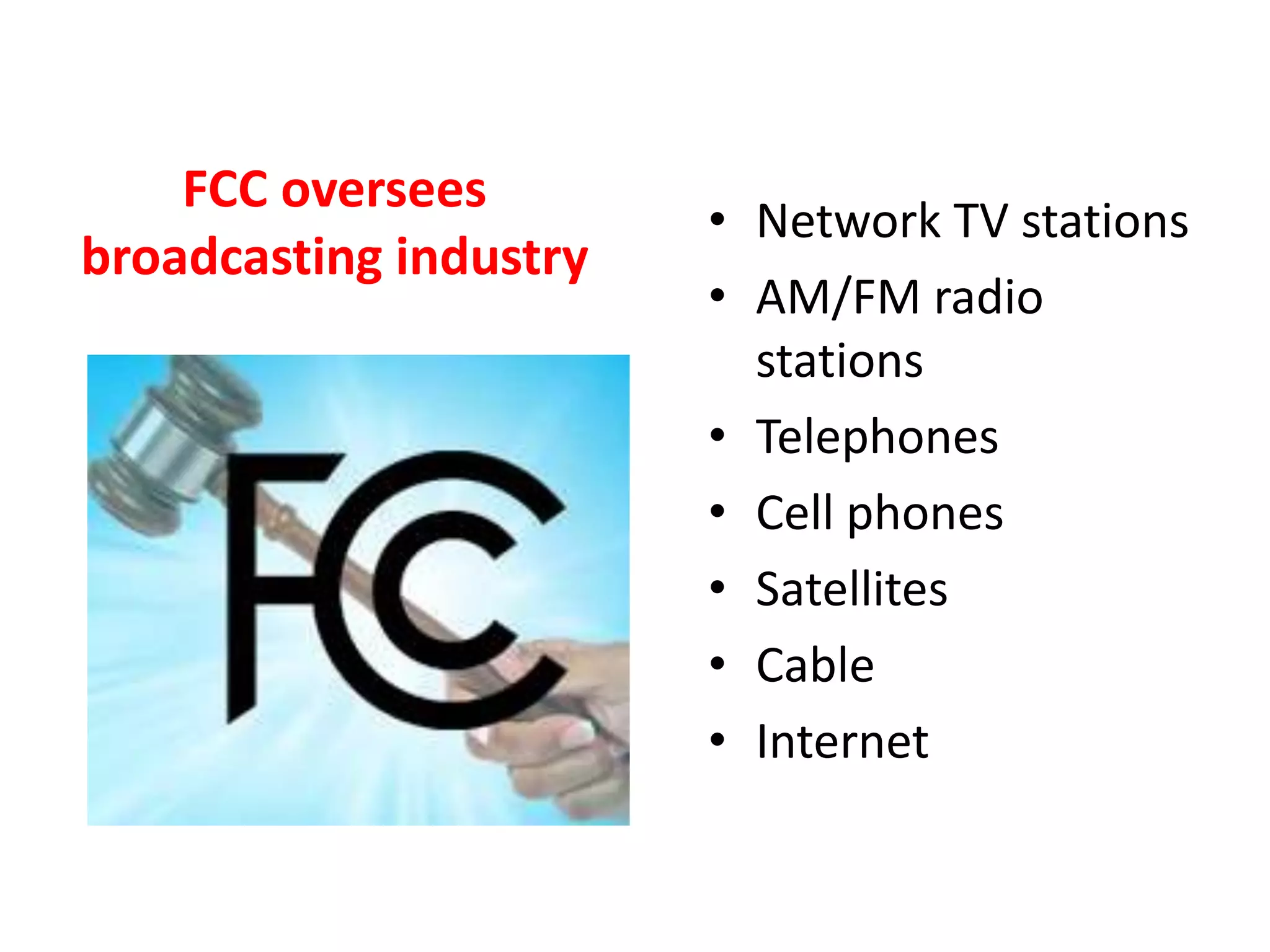
FCC oversees
broadcasting industry
• Network TV stations
• AM/FM radio
stations
• Telephones
• Cell phones
• Satellites
• Cable
• Internet
TV & radio much more regulated
The broadcast media are subject to far more
regulation than print media, because:
• The airwaves are said to be owned by the
public
• The scarcity of available frequencies on which
broadcasters can operate
• The potential for pervasiveness of broadcast
content
Military concerns along with the sinking of the
Titanic in 1912 led to radio regulations.
Fairness Doctrine
• FCC regulation enacted in 1949 required the
radio & TV stations to present controversial
issues of public importance and to do so in a
manner that was honest, equitable, and
balanced.
• Repealed in 1987, but recent push by
Congress to restore it.
• By contrast, the print media did not have such
a regulation.
Children’s TV shows
• The Children's Television Act of 1990 requires
that stations provide educational programs for
children and limit the number of commercials
to 10.5 minutes per hour for weekends and 12
minutes per hour for weekdays.
• The CTA also prohibits the advertising of a
product during a program based on that
product. E.g., Teenage Ninja Turtles can’t
advertise its action figures during its TV show.
Indecency
• FCC can regulate obscene, indecent, or
profane language and images on the radio and
television.
• They define what’s off limits (e.g. full nudity,
certain curse words)
• They set hours when indecency is not allowed
to be broadcast – “safe harbor”
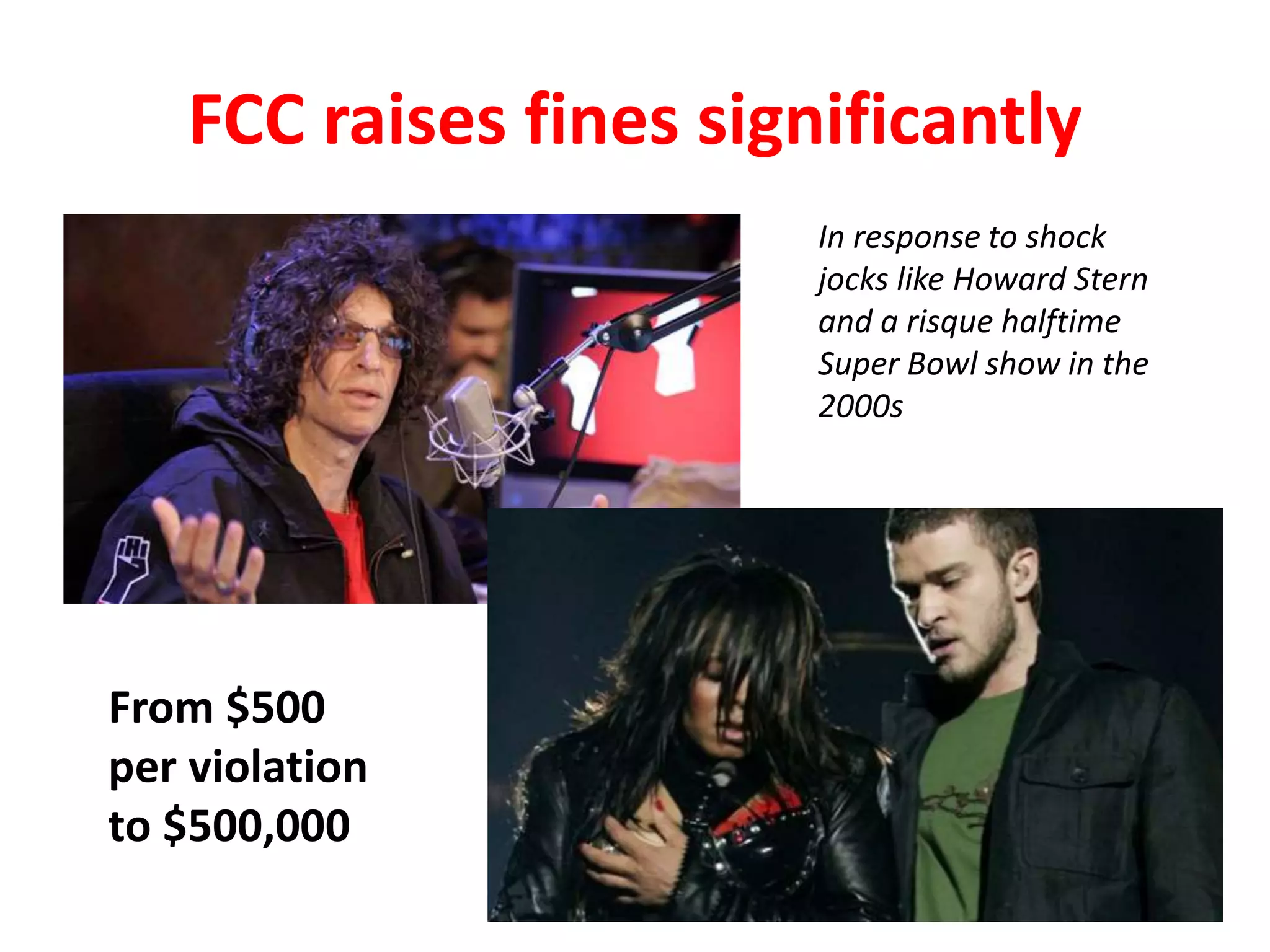
FCC raises fines significantly
In response to shock
jocks like Howard Stern
and a risque halftime
Super Bowl show in the
2000s
From $500
per violation
to $500,000
Fleeting expletives fined, too
• https://youtu.be/rWV4yBYt6b8
• https://youtu.be/k-BoeBedZ3k
Tape delays didn’t always prevent this stuff –
was it fair to hold stations responsible?
2012 Supreme Court ruling
• FOX challenges FCC’s fines and Supreme Court
rules FCC can’t fine TV networks for cursing &
nudity anymore.
• But the Court’s decision didn’t invalidate the
FCC’s ability to set indecency rules — just its
ability to enforce the rules through fines and
sanctions.
• Um, OK? So only ethics really prevents
indecency from being broadcast now.
Telecommunications Act of 1996
• Congress passed a sweeping package of new
laws that deregulated the telecomm industry,
including TV, radio, telephone and internet.
• First major law update since 1934.
• Relaxed ownership rules.
• Required V-chip for new TVs.
• Eliminated net neutrality for internet.
Meanwhile in
Norway…
https://youtu.be/kCZcEgd2G94
Are broadcast laws antiquated?
• Is it fair to hold AM/FM and network TV to
stricter standards in the Internet Age?
• Or, perhaps, instead of doing away with these
regulations we should apply them to other
media?
• With public trust in media rapidly declining,
should the Fairness Doctrine be re-
implemented and expanded to include other
media?

Broadcast law

  • 1.
  • 2.
    FCC oversees broadcasting industry •Network TV stations • AM/FM radio stations • Telephones • Cell phones • Satellites • Cable • Internet
  • 3.
    TV & radiomuch more regulated The broadcast media are subject to far more regulation than print media, because: • The airwaves are said to be owned by the public • The scarcity of available frequencies on which broadcasters can operate • The potential for pervasiveness of broadcast content
  • 4.
    Military concerns alongwith the sinking of the Titanic in 1912 led to radio regulations.
  • 5.
    Fairness Doctrine • FCCregulation enacted in 1949 required the radio & TV stations to present controversial issues of public importance and to do so in a manner that was honest, equitable, and balanced. • Repealed in 1987, but recent push by Congress to restore it. • By contrast, the print media did not have such a regulation.
  • 6.
    Children’s TV shows •The Children's Television Act of 1990 requires that stations provide educational programs for children and limit the number of commercials to 10.5 minutes per hour for weekends and 12 minutes per hour for weekdays. • The CTA also prohibits the advertising of a product during a program based on that product. E.g., Teenage Ninja Turtles can’t advertise its action figures during its TV show.
  • 7.
    Indecency • FCC canregulate obscene, indecent, or profane language and images on the radio and television. • They define what’s off limits (e.g. full nudity, certain curse words) • They set hours when indecency is not allowed to be broadcast – “safe harbor”
  • 8.
    FCC raises finessignificantly In response to shock jocks like Howard Stern and a risque halftime Super Bowl show in the 2000s From $500 per violation to $500,000
  • 9.
    Fleeting expletives fined,too • https://youtu.be/rWV4yBYt6b8 • https://youtu.be/k-BoeBedZ3k Tape delays didn’t always prevent this stuff – was it fair to hold stations responsible?
  • 10.
    2012 Supreme Courtruling • FOX challenges FCC’s fines and Supreme Court rules FCC can’t fine TV networks for cursing & nudity anymore. • But the Court’s decision didn’t invalidate the FCC’s ability to set indecency rules — just its ability to enforce the rules through fines and sanctions. • Um, OK? So only ethics really prevents indecency from being broadcast now.
  • 11.
    Telecommunications Act of1996 • Congress passed a sweeping package of new laws that deregulated the telecomm industry, including TV, radio, telephone and internet. • First major law update since 1934. • Relaxed ownership rules. • Required V-chip for new TVs. • Eliminated net neutrality for internet.
  • 12.
  • 13.
    Are broadcast lawsantiquated? • Is it fair to hold AM/FM and network TV to stricter standards in the Internet Age? • Or, perhaps, instead of doing away with these regulations we should apply them to other media? • With public trust in media rapidly declining, should the Fairness Doctrine be re- implemented and expanded to include other media?