10 :: Issue 6 ANA Magazine Spotlight www.ana.net
A
gencies need good briefs to produce
good work. But many agencies say
that they don’t receive the quality
briefs they need to allow them to maximize
advertising objectives. So how can you
develop a briefing program in order to help
your marketers write better briefs?
Agency Briefs — the Good,
the Bad, and the Ugly
In a 2013 survey conducted by Joanne
Davis Consulting, partnering with Scan
International, assignment briefing was
found to be a major pain point in the client/
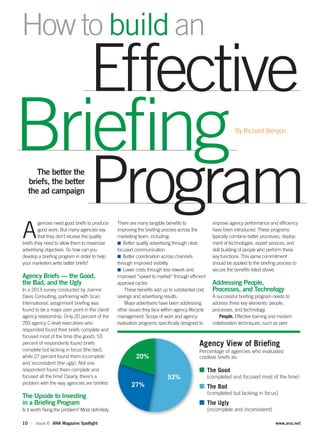
agency relationship. Only 20 percent of the
293 agency C-level executives who
responded found their briefs complete and
focused most of the time (the good), 53
percent of respondents found briefs
complete but lacking in focus (the bad),
while 27 percent found them incomplete
and inconsistent (the ugly). Not one
respondent found them complete and
focused all the time! Clearly, there’s a
problem with the way agencies are briefed.
The Upside to Investing
in a Briefing Program
Is it worth fixing the problem? Most definitely.
There are many tangible benefits to
improving the briefing process across the
marketing team, including:
■ Better quality advertising through clear,
focused communication
■ Better coordination across channels
through improved visibility
■ Lower costs through less rework and
improved “speed to market” through efficient
approval cycles
These benefits add up to substantial cost
savings and advertising results.
Major advertisers have been addressing
other issues they face within agency lifecycle
management. Scope of work and agency
evaluation programs specifically designed to
improve agency performance and efficiency
have been introduced. These programs
typically combine better processes, deploy-
ment of technologies, expert services, and
skill building of people who perform these
key functions. This same commitment
should be applied to the briefing process to
secure the benefits listed above.
Addressing People,
Processes, and Technology
A successful briefing program needs to
address three key elements: people,
processes, and technology.
People. Effective training and modern
collaboration techniques, such as peer
How to build an
By Richard Benyon
The better the
briefs, the better
the ad campaign
Effective
Program
Briefing
Agency View of Briefing
Percentage of agencies who evaluated
creative briefs as:
■ The Good
(completed and focused most of the time)
■ The Bad
(completed but lacking in focus)
■ The Ugly
(incomplete and inconsistent)
53%
20%
27%
www.ana.net ANA Magazine Spotlight Issue 6 :: 11
review, need to be put in place to assist
marketers in understanding how to write a
succinct and effective best-practice brief.
Processes. Well-defined and under-
standable processes need to be developed
and enforced at a corporate level. It is
important that these processes enhance
quality, communication, and velocity, not
detract from them.
Technology. Finally, appropriate technol-
ogy needs to be deployed to better manage
the interactions between the client and the
agency, and provide an analytical foundation
to assist with decision making. This technol-
ogy needs to cater to the highly complex
marketing environment, having the ability to
work across all agency disciplines, brands,
business units, regions, countries, etc.
Further, it has to be easy for the marketers
and agencies to use in order to gain
widespread adoption.
What Should Your Program Do?
› Enhance communication
Modern marketing departments are looking
for “agile” processes to increase collabora-
tion. A key tenet of this search is that people
and interactions are as important as
processes and tools. So the technology must
enhance communication, not try to replace
it. The Internet provides the ideal medium
for this collaboration. For stakeholders who
need to participate in the brief, it provides
access to a shared workspace, assisting
them to collaborate and contribute as they
build the brief together. View early, adjust
rapidly, and communicate often!
› Improve focus
Skilled training can assist marketers in writing
clear and concise briefs. Systems can also be
deployed to help structure and guide the
writing process. Creating a library of
templates appropriate for different types of
briefs and agency disciplines is highly
beneficial. Best-practice advice should be
directly embedded in the interface marketers
use to write the brief, guiding them to build
(to quote the language of the survey) both
“complete and focused” content. Peer review
is another technique that can be employed,
and again the systems utilized should
support the ability of marketers to easily
collaborate with their peers in reviewing briefs
during the authoring process.
› Speed up approvals
One of the most common gripes around
briefing is delays in approvals with
questions like Why has the campaign been
delayed?, Who has the latest version?,
What’s the next step?, and How long has it
been sitting with John? echoing through the
corridors. A shorter approval process, with
less-aggravating delays, can be put in place
using clearly defined approval workflows.
Often these use email-based messaging to
notify stakeholders of actions that they need
to take and status reports that give the
picture of exactly what is happening at all
stages of the workflow.
So how can you get started on building a
briefing program? Form a working group and
invite key stakeholders from marketing and
procurement/agency management, along
with representatives from your key agencies.
Build processes underpinned by appropriate
technology that address improving the quality
of brief content, speeding up workflow, and
enhancing communication. Consider
providing additional training and possibly
adopting techniques like peer review. The
benefits are immense. Better briefs will lead
to even better work! ■
Richard Benyon is the CEO
of Decideware, Inc.
“Well-defined and understandable processes need to be developed and enforced at a
corporate level. It is important that these processes enhance quality, communication,
and velocity, not detract from them.”

Effective Briefing Program

  • 1.
    10 :: Issue6 ANA Magazine Spotlight www.ana.net A gencies need good briefs to produce good work. But many agencies say that they don’t receive the quality briefs they need to allow them to maximize advertising objectives. So how can you develop a briefing program in order to help your marketers write better briefs? Agency Briefs — the Good, the Bad, and the Ugly In a 2013 survey conducted by Joanne Davis Consulting, partnering with Scan International, assignment briefing was found to be a major pain point in the client/ agency relationship. Only 20 percent of the 293 agency C-level executives who responded found their briefs complete and focused most of the time (the good), 53 percent of respondents found briefs complete but lacking in focus (the bad), while 27 percent found them incomplete and inconsistent (the ugly). Not one respondent found them complete and focused all the time! Clearly, there’s a problem with the way agencies are briefed. The Upside to Investing in a Briefing Program Is it worth fixing the problem? Most definitely. There are many tangible benefits to improving the briefing process across the marketing team, including: ■ Better quality advertising through clear, focused communication ■ Better coordination across channels through improved visibility ■ Lower costs through less rework and improved “speed to market” through efficient approval cycles These benefits add up to substantial cost savings and advertising results. Major advertisers have been addressing other issues they face within agency lifecycle management. Scope of work and agency evaluation programs specifically designed to improve agency performance and efficiency have been introduced. These programs typically combine better processes, deploy- ment of technologies, expert services, and skill building of people who perform these key functions. This same commitment should be applied to the briefing process to secure the benefits listed above. Addressing People, Processes, and Technology A successful briefing program needs to address three key elements: people, processes, and technology. People. Effective training and modern collaboration techniques, such as peer How to build an By Richard Benyon The better the briefs, the better the ad campaign Effective Program Briefing Agency View of Briefing Percentage of agencies who evaluated creative briefs as: ■ The Good (completed and focused most of the time) ■ The Bad (completed but lacking in focus) ■ The Ugly (incomplete and inconsistent) 53% 20% 27%
  • 2.
    www.ana.net ANA MagazineSpotlight Issue 6 :: 11 review, need to be put in place to assist marketers in understanding how to write a succinct and effective best-practice brief. Processes. Well-defined and under- standable processes need to be developed and enforced at a corporate level. It is important that these processes enhance quality, communication, and velocity, not detract from them. Technology. Finally, appropriate technol- ogy needs to be deployed to better manage the interactions between the client and the agency, and provide an analytical foundation to assist with decision making. This technol- ogy needs to cater to the highly complex marketing environment, having the ability to work across all agency disciplines, brands, business units, regions, countries, etc. Further, it has to be easy for the marketers and agencies to use in order to gain widespread adoption. What Should Your Program Do? › Enhance communication Modern marketing departments are looking for “agile” processes to increase collabora- tion. A key tenet of this search is that people and interactions are as important as processes and tools. So the technology must enhance communication, not try to replace it. The Internet provides the ideal medium for this collaboration. For stakeholders who need to participate in the brief, it provides access to a shared workspace, assisting them to collaborate and contribute as they build the brief together. View early, adjust rapidly, and communicate often! › Improve focus Skilled training can assist marketers in writing clear and concise briefs. Systems can also be deployed to help structure and guide the writing process. Creating a library of templates appropriate for different types of briefs and agency disciplines is highly beneficial. Best-practice advice should be directly embedded in the interface marketers use to write the brief, guiding them to build (to quote the language of the survey) both “complete and focused” content. Peer review is another technique that can be employed, and again the systems utilized should support the ability of marketers to easily collaborate with their peers in reviewing briefs during the authoring process. › Speed up approvals One of the most common gripes around briefing is delays in approvals with questions like Why has the campaign been delayed?, Who has the latest version?, What’s the next step?, and How long has it been sitting with John? echoing through the corridors. A shorter approval process, with less-aggravating delays, can be put in place using clearly defined approval workflows. Often these use email-based messaging to notify stakeholders of actions that they need to take and status reports that give the picture of exactly what is happening at all stages of the workflow. So how can you get started on building a briefing program? Form a working group and invite key stakeholders from marketing and procurement/agency management, along with representatives from your key agencies. Build processes underpinned by appropriate technology that address improving the quality of brief content, speeding up workflow, and enhancing communication. Consider providing additional training and possibly adopting techniques like peer review. The benefits are immense. Better briefs will lead to even better work! ■ Richard Benyon is the CEO of Decideware, Inc. “Well-defined and understandable processes need to be developed and enforced at a corporate level. It is important that these processes enhance quality, communication, and velocity, not detract from them.”