Brief Insight on
Antifungal Agents
BY :– HARSHIT SHRINGI
M-PHARM(PHARMACOLOGY)
Content :-
 Introduction about Anti –Fungal Agents.
 Classification Of Anti –Fungal Agents.
 Mechanism Of Action.
 Resistance Mechanism.
 Clinical Considerations .
 Side effects and Toxicity .
 Recent Advances .
 Case Study .
 References .
Introduction :-
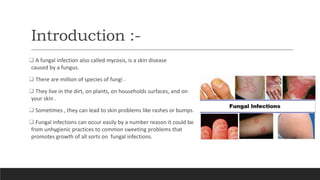
 A fungal infection also called mycosis, is a skin disease
caused by a fungus.
 There are million of species of fungi .
 They live in the dirt, on plants, on households surfaces, and on
your skin .
 Sometimes , they can lead to skin problems like rashes or bumps.
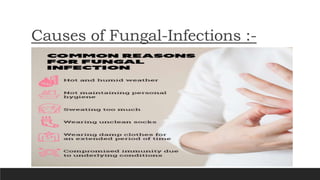
 Fungal infections can occur easily by a number reason it could be
from unhygienic practices to common sweeting problems that
promotes growth of all sorts on fungal infections.
Causes of Fungal-Infections :-
Symptoms :-
Fungal Infection Symptoms
A fungal skin infection might cause:
•Irritation
•Scaly skin
•Redness
•Itching
•Swelling
•Blisters
Anti-Fungal Agents :-
 The antifungals comprise a large and diverse group of drugs used to treat fungal
infections. These agents are usually classified as either systemic or topical, although
these divisions are somewhat arbitrary since many may be administered in either
way. The mechanisms of action of antifungals include inhibition of fungal
membrane and cell wall synthesis, alterations of fungal membranes, effects on
microtubules, and inhibition of nucleic acid synthesis.
 Many of the systemic antifungals are toxic to mammalian cells,
especially amphotericin B. Topical antifungals, in contrast, have little systemic toxicity
because of poor absorption through the skin. Included among the systemic
antifungals are the polyenes (amphotericin B), flucytosine, the imidazole's,
and triazoles (ketoconazole, fluconazole, itraconazole, and voriconazole),
and griseofulvin and ciclopirox. Terbinafine and caspofungin are two of the newer
systemic agents.
Classification Of Antifungal-Agents :-
 By Chemical Structure :
• Polyenes
• Azoles
• Echinocandins
• Allylamines
• Others ( e.g., Flucytosine )
 By Target Fungi :
• Systemic mycoses
• Superficial mycoses
Polyenes :-
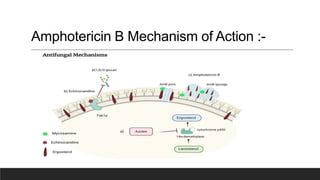
• Examples : Amphotericin B , Nystatin
• Mechanism of Action : Bind to ergosterol in Fungal cell membranes, creating pores and
causing cell death.
• Clinical Uses : Broad – spectrum antifungal , Severe systemic infections ( e.g. Cryptococcal
meningitis , candidiasis ).
• Side Effects : Nephrotoxicity, infusion-related reactions.
Amphotericin B Mechanism of Action :-
Azoles :-
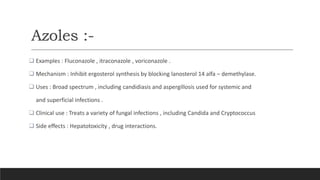
 Examples : Fluconazole , itraconazole , voriconazole .
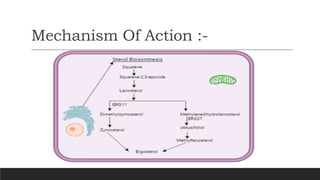
 Mechanism : Inhibit ergosterol synthesis by blocking lanosterol 14 alfa – demethylase.
 Uses : Broad spectrum , including candidiasis and aspergillosis used for systemic and
and superficial infections .
 Clinical use : Treats a variety of fungal infections , including Candida and Cryptococcus
 Side effects : Hepatotoxicity , drug interactions.
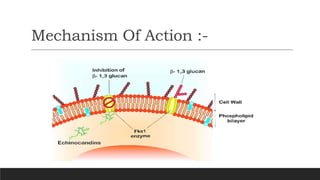
Mechanism Of Action :-
Echinocandins :-
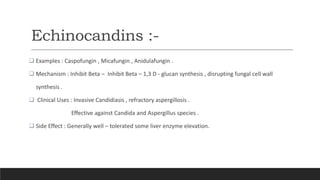
 Examples : Caspofungin , Micafungin , Anidulafungin .
 Mechanism : Inhibit Beta – Inhibit Beta – 1,3 D - glucan synthesis , disrupting fungal cell wall
synthesis .
 Clinical Uses : Invasive Candidiasis , refractory aspergillosis .
Effective against Candida and Aspergillus species .
 Side Effect : Generally well – tolerated some liver enzyme elevation.
Mechanism Of Action :-
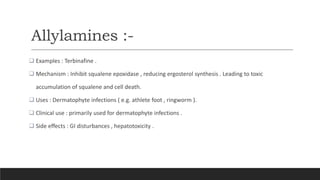
Allylamines :-
 Examples : Terbinafine .
 Mechanism : Inhibit squalene epoxidase , reducing ergosterol synthesis . Leading to toxic
accumulation of squalene and cell death.
 Uses : Dermatophyte infections ( e.g. athlete foot , ringworm ).
 Clinical use : primarily used for dermatophyte infections .
 Side effects : GI disturbances , hepatotoxicity .
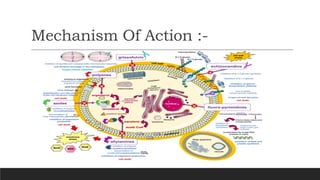
Mechanism Of Action :-
Other Anti-Fungal Agents:-
 Flucytosine :- Used in combination therapy for cryptococcal meningitis. Converted to
5 – fluorouracil inside the fungal cell , inhibiting DNA and RNA synthesis.
 Griseofulvin ;- Used for dermatophyte infections , especially tinea capitis .
Binds to microtubules , inhibiting mitosis.
 side Effects :- Vary by drug , including bone marrow suppression
( Flucytosine ) and CNS effects ( Griseofulvin ) .
Resistance Mechanism :-
 Efflux Pumps : Increase drug efflux ( example – azole resistance ).
 Target Alteration : Mutations in drug targets ( example – ergosterol synthesis enzymes ).
 Biofilm Formation :- Protects fungal cells from antifungal agents.
 Mechanism :-
• Reduced drug uptake
• Drug efflux pumps
• Mutation of drug targets
• Biofilm formation
• Impact : leads to treatment failure and requires alternative strategies.
Clinical Considerations :-
 Drug Interactions : important in azole therapy .
 Toxicity Monitoring : Regular monitoring for drugs like Amphotericin B and Flucytosine
 Patient Factors : Consideration of immune status and site of infection.
Clinical Uses
• Superficial Infections : Ringworm , athlete foot , oral thrush
• Systemic Infections : Candidemia , Cryptococcal meningitis , invasive aspergillosis.
Recent Advances :-
 New Agents : Isavuconazole , rezafungin .
 Research : Efforts in developing vaccines and novel therapeutic targets.
Isavuconzaole inhibits cytochrome P450-dependent lanosterol 14α-demethylase,
which is essential for the synthesis of ergosterol, a component of the fungal membrane.
This disruption leads to alterations in the structure and function of the fungal membrane
leading to cell death
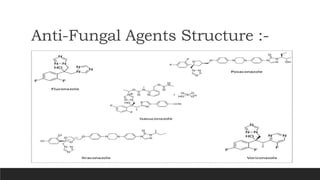
Anti-Fungal Agents Structure :-
Case-Study :-
Case Study: Treatment of Systemic Fungal Infection with
Fluconazole :-
Patient Background:
•Mr. Smith, a 58-year-old male, was admitted to the hospital with symptoms of fever,
cough, and shortness of breath.
•He has a medical history significant for diabetes mellitus and hypertension.
•Upon further evaluation, Mr. Smith was diagnosed with invasive pulmonary aspergillosis,
a serious fungal infection affecting the lungs.
Clinical Presentation:
•Mr. S.K Tripathi presented with worsening respiratory distress and hemoptysis.
•Imaging studies revealed multiple nodular infiltrates in both lungs consistent with
invasive fungal infection.
•Laboratory tests showed elevated inflammatory markers and positive fungal cultures
from respiratory samples.
Case-Study :-
Treatment Plan:
•Given the severity of Mr. Smith's condition and the diagnosis of invasive pulmonary
aspergillosis, antifungal therapy was initiated promptly.
•The Infectious Diseases team recommended treatment with fluconazole, an azole
antifungal agent known for its broad-spectrum activity against various fungal pathogens.
Treatment Course:
•Mr. Smith was started on intravenous fluconazole therapy at a dose of 800 mg on the
first day, followed by 400 mg once daily.
Case-Study :-
•Close monitoring of clinical symptoms, vital signs, and laboratory parameters was
conducted to assess treatment response and potential adverse effects.
•Over the course of several weeks, Mr. Smith's respiratory symptoms gradually improved,
with resolution of fever and cough.
•Follow-up imaging studies showed regression of pulmonary infiltrates, indicating a
positive response to antifungal therapy.
Throughout the treatment course, Mr. Smith's diabetes and hypertension were managed
concurrently to optimize his overall health status.
Case-Study :-
Outcome:
•After completing a four-week course of fluconazole therapy, Mr. Smith's symptoms
resolved, and he showed significant clinical improvement.
•Follow-up fungal cultures from respiratory samples were negative, confirming eradication
of the fungal infection.
•Mr. Smith was discharged from the hospital with a prescription for oral fluconazole to
complete a total of 12 weeks of antifungal therapy.
He was advised to follow up with his primary care physician and Infectious Diseases
specialist for ongoing monitoring and management.
Case-Study :-
Discussion:
•This case highlights the effective use of fluconazole, an azole antifungal agent, in the
treatment of invasive pulmonary aspergillosis.
•Fluconazole is a first-line therapy for certain fungal infections due to its favorable
efficacy, safety profile, and convenient dosing regimen.
•Close monitoring and multidisciplinary management are essential components of
successful antifungal therapy, especially in critically ill patients with comorbidities.
Case-Study :-
Conclusion:
•Antifungal agents play a crucial role in the management of systemic fungal infections,
particularly in immunocompromised patients.
•Individualized treatment plans, appropriate dosing, and vigilant monitoring are essential
for optimizing therapeutic outcomes and ensuring patient safety.
Case-Study :-
References :-
Science Direct References :
Debra J. Lugo, William J. Steinbach, in Principles and Practice of Pediatric Infectious Diseases (Sixth
Edition), 2023
William J. Steinbach, Christopher C. Dvorak, in Principles and Practice of Pediatric Infectious Disease (Third
Edition), 2008
Shmuel Shoham, ... Thomas J Walsh, in Infectious Diseases (Third Edition), 2010 .
Casadevall A, Scharff MD. Return to the past: The case for antibody-based therapies in infectious diseases. Clin Infect
Dis. 1995;21:150–61. [PMC free article] [PubMed]
Como JA, Dismukes WE. Oral azole drugs as systemic antifungal therapy. New Engl J Med. 1994;330:263–
272. [PubMed]
Brief insight on antifungal agents with case study.

Brief insight on antifungal agents with case study.

  • 1.
    Brief Insight on AntifungalAgents BY :– HARSHIT SHRINGI M-PHARM(PHARMACOLOGY)
  • 2.
    Content :-  Introductionabout Anti –Fungal Agents.  Classification Of Anti –Fungal Agents.  Mechanism Of Action.  Resistance Mechanism.  Clinical Considerations .  Side effects and Toxicity .  Recent Advances .  Case Study .  References .
  • 3.
    Introduction :-  Afungal infection also called mycosis, is a skin disease caused by a fungus.  There are million of species of fungi .  They live in the dirt, on plants, on households surfaces, and on your skin .  Sometimes , they can lead to skin problems like rashes or bumps.  Fungal infections can occur easily by a number reason it could be from unhygienic practices to common sweeting problems that promotes growth of all sorts on fungal infections.
  • 4.
  • 5.
    Symptoms :- Fungal InfectionSymptoms A fungal skin infection might cause: •Irritation •Scaly skin •Redness •Itching •Swelling •Blisters
  • 6.
    Anti-Fungal Agents :- The antifungals comprise a large and diverse group of drugs used to treat fungal infections. These agents are usually classified as either systemic or topical, although these divisions are somewhat arbitrary since many may be administered in either way. The mechanisms of action of antifungals include inhibition of fungal membrane and cell wall synthesis, alterations of fungal membranes, effects on microtubules, and inhibition of nucleic acid synthesis.  Many of the systemic antifungals are toxic to mammalian cells, especially amphotericin B. Topical antifungals, in contrast, have little systemic toxicity because of poor absorption through the skin. Included among the systemic antifungals are the polyenes (amphotericin B), flucytosine, the imidazole's, and triazoles (ketoconazole, fluconazole, itraconazole, and voriconazole), and griseofulvin and ciclopirox. Terbinafine and caspofungin are two of the newer systemic agents.
  • 7.
    Classification Of Antifungal-Agents:-  By Chemical Structure : • Polyenes • Azoles • Echinocandins • Allylamines • Others ( e.g., Flucytosine )  By Target Fungi : • Systemic mycoses • Superficial mycoses
  • 8.
    Polyenes :- • Examples: Amphotericin B , Nystatin • Mechanism of Action : Bind to ergosterol in Fungal cell membranes, creating pores and causing cell death. • Clinical Uses : Broad – spectrum antifungal , Severe systemic infections ( e.g. Cryptococcal meningitis , candidiasis ). • Side Effects : Nephrotoxicity, infusion-related reactions.
  • 9.
  • 10.
    Azoles :-  Examples: Fluconazole , itraconazole , voriconazole .  Mechanism : Inhibit ergosterol synthesis by blocking lanosterol 14 alfa – demethylase.  Uses : Broad spectrum , including candidiasis and aspergillosis used for systemic and and superficial infections .  Clinical use : Treats a variety of fungal infections , including Candida and Cryptococcus  Side effects : Hepatotoxicity , drug interactions.
  • 11.
  • 12.
    Echinocandins :-  Examples: Caspofungin , Micafungin , Anidulafungin .  Mechanism : Inhibit Beta – Inhibit Beta – 1,3 D - glucan synthesis , disrupting fungal cell wall synthesis .  Clinical Uses : Invasive Candidiasis , refractory aspergillosis . Effective against Candida and Aspergillus species .  Side Effect : Generally well – tolerated some liver enzyme elevation.
  • 13.
  • 14.
    Allylamines :-  Examples: Terbinafine .  Mechanism : Inhibit squalene epoxidase , reducing ergosterol synthesis . Leading to toxic accumulation of squalene and cell death.  Uses : Dermatophyte infections ( e.g. athlete foot , ringworm ).  Clinical use : primarily used for dermatophyte infections .  Side effects : GI disturbances , hepatotoxicity .
  • 15.
  • 16.
    Other Anti-Fungal Agents:- Flucytosine :- Used in combination therapy for cryptococcal meningitis. Converted to 5 – fluorouracil inside the fungal cell , inhibiting DNA and RNA synthesis.  Griseofulvin ;- Used for dermatophyte infections , especially tinea capitis . Binds to microtubules , inhibiting mitosis.  side Effects :- Vary by drug , including bone marrow suppression ( Flucytosine ) and CNS effects ( Griseofulvin ) .
  • 17.
    Resistance Mechanism :- Efflux Pumps : Increase drug efflux ( example – azole resistance ).  Target Alteration : Mutations in drug targets ( example – ergosterol synthesis enzymes ).  Biofilm Formation :- Protects fungal cells from antifungal agents.  Mechanism :- • Reduced drug uptake • Drug efflux pumps • Mutation of drug targets • Biofilm formation • Impact : leads to treatment failure and requires alternative strategies.
  • 18.
    Clinical Considerations :- Drug Interactions : important in azole therapy .  Toxicity Monitoring : Regular monitoring for drugs like Amphotericin B and Flucytosine  Patient Factors : Consideration of immune status and site of infection. Clinical Uses • Superficial Infections : Ringworm , athlete foot , oral thrush • Systemic Infections : Candidemia , Cryptococcal meningitis , invasive aspergillosis.
  • 19.
    Recent Advances :- New Agents : Isavuconazole , rezafungin .  Research : Efforts in developing vaccines and novel therapeutic targets. Isavuconzaole inhibits cytochrome P450-dependent lanosterol 14α-demethylase, which is essential for the synthesis of ergosterol, a component of the fungal membrane. This disruption leads to alterations in the structure and function of the fungal membrane leading to cell death
  • 20.
  • 21.
    Case-Study :- Case Study:Treatment of Systemic Fungal Infection with Fluconazole :- Patient Background: •Mr. Smith, a 58-year-old male, was admitted to the hospital with symptoms of fever, cough, and shortness of breath. •He has a medical history significant for diabetes mellitus and hypertension. •Upon further evaluation, Mr. Smith was diagnosed with invasive pulmonary aspergillosis, a serious fungal infection affecting the lungs.
  • 22.
    Clinical Presentation: •Mr. S.KTripathi presented with worsening respiratory distress and hemoptysis. •Imaging studies revealed multiple nodular infiltrates in both lungs consistent with invasive fungal infection. •Laboratory tests showed elevated inflammatory markers and positive fungal cultures from respiratory samples. Case-Study :-
  • 23.
    Treatment Plan: •Given theseverity of Mr. Smith's condition and the diagnosis of invasive pulmonary aspergillosis, antifungal therapy was initiated promptly. •The Infectious Diseases team recommended treatment with fluconazole, an azole antifungal agent known for its broad-spectrum activity against various fungal pathogens. Treatment Course: •Mr. Smith was started on intravenous fluconazole therapy at a dose of 800 mg on the first day, followed by 400 mg once daily. Case-Study :-
  • 24.
    •Close monitoring ofclinical symptoms, vital signs, and laboratory parameters was conducted to assess treatment response and potential adverse effects. •Over the course of several weeks, Mr. Smith's respiratory symptoms gradually improved, with resolution of fever and cough. •Follow-up imaging studies showed regression of pulmonary infiltrates, indicating a positive response to antifungal therapy. Throughout the treatment course, Mr. Smith's diabetes and hypertension were managed concurrently to optimize his overall health status. Case-Study :-
  • 25.
    Outcome: •After completing afour-week course of fluconazole therapy, Mr. Smith's symptoms resolved, and he showed significant clinical improvement. •Follow-up fungal cultures from respiratory samples were negative, confirming eradication of the fungal infection. •Mr. Smith was discharged from the hospital with a prescription for oral fluconazole to complete a total of 12 weeks of antifungal therapy. He was advised to follow up with his primary care physician and Infectious Diseases specialist for ongoing monitoring and management. Case-Study :-
  • 26.
    Discussion: •This case highlightsthe effective use of fluconazole, an azole antifungal agent, in the treatment of invasive pulmonary aspergillosis. •Fluconazole is a first-line therapy for certain fungal infections due to its favorable efficacy, safety profile, and convenient dosing regimen. •Close monitoring and multidisciplinary management are essential components of successful antifungal therapy, especially in critically ill patients with comorbidities. Case-Study :-
  • 27.
    Conclusion: •Antifungal agents playa crucial role in the management of systemic fungal infections, particularly in immunocompromised patients. •Individualized treatment plans, appropriate dosing, and vigilant monitoring are essential for optimizing therapeutic outcomes and ensuring patient safety. Case-Study :-
  • 28.
    References :- Science DirectReferences : Debra J. Lugo, William J. Steinbach, in Principles and Practice of Pediatric Infectious Diseases (Sixth Edition), 2023 William J. Steinbach, Christopher C. Dvorak, in Principles and Practice of Pediatric Infectious Disease (Third Edition), 2008 Shmuel Shoham, ... Thomas J Walsh, in Infectious Diseases (Third Edition), 2010 . Casadevall A, Scharff MD. Return to the past: The case for antibody-based therapies in infectious diseases. Clin Infect Dis. 1995;21:150–61. [PMC free article] [PubMed] Como JA, Dismukes WE. Oral azole drugs as systemic antifungal therapy. New Engl J Med. 1994;330:263– 272. [PubMed]