European Law Firm of the Year 2015
Hedge Fund Journal
Financial Times 2012-2014
Matheson is the only Irish law firm commended
by the Financial Times for innovation in
corporate law, finance law, dispute resolution
and corporate strategy.
Law Firm of the Year 2014
Irish Pensions Awards
Emerging Issues in Energy Litigation,
28 May 2015: ECHR & UK FIT Scheme
Michael O’Connor, Partner | Head of Projects, Energy
and Construction
2
Contents
The Cases …………..………………………………………………………………………….... Page 3
The UK FIT Scheme…………..…………………………………………………………………. Page 4
The Proposal…………….…………..……………………………………………………………. Page 7
Challenges to the Proposal…………..………………………………………………………….. Page 8
The Claimants ………………………..…………………………………………………………… Page 10
Grounds For Challenge: A1P1 ECHR…………..………….………………………………….. Page 11
“Possessions” Under A1P1 ECHR : High Court…………..…………………………………… Page 12
Interference: Court of Appeal…………..………………………………………………………… Page 17
Was the Interference Justified Court of Appeal……………………………………………….. Page 18
Legitimate Expectation & A1P1 ECHR………..……………………………………………….. Page 19
Loss of Profits……………………………………………………………………………………… Page 20
Closing Remarks……………………………………………………………………………………Page 21
3
The Cases
Four Judgements:
The Queen on the Application of Homesun Holdings Limited, Friends of the Earth Limited &
Solar Century Holdings v Secretary of State for Energy & Climate Change [2011] EWHC
3575 (High Court, Mr. Justice Mitting).
The Secretary of State for Energy & Climate Change v Friends of the Earth & Others [2012]
EWCA Civ 28 (Court of Appeal, Lloyd LJ., Moses LJ., & Richards LJ).
Breyer Group plc & Others v Department of Energy & Climate Change; Free Power
for Schools LP v. Department of Energy & Climate Change; Homesun Holdings
Limited & Another v Department of Energy & Climate Change; Touch Solar Limited v
Department of Energy & Climate Change [2014] EWHC 2257 (QB) (High Court, Mr.
Justice Coulson).
The Department of Energy & Climate Change v Breyer Group PLC & Others [2015]
EWCA Civ 408 (Court of Appeal, Lord Dyson, MR., Richards LJ., and Ryder LJ.).
4
The UK FIT Scheme
Department of Energy and Climate Change (“DECC”)
introduced a Feed-in-Tariffs (“FIT”) Scheme in 2010 to
encourage low carbon generation by specific technology
including solar photovoltaic (“Solar PV”).
The FIT Scheme introduced under the Feed-in-Tariffs
(specified Maximum Capacity and Functions) Order 2010
and the Energy Act 2008 (“Law”).
Two elements: Generation Tariff and Export Tariff.
Litigation principally concerned with the Generation Tariff.
5
The UK FIT Scheme
Solar PV got a higher tariff level because installation and
equipment costs were higher.
Once built and commissioned the Generation Tariff was fixed
for 25 years (subject to indexation).
The Generation Tariff was set out in Electricity Supply
Licences and could only be amended (1) following a process
of consultation and then a 40 day period of parliamentary
scrutiny of the proposed modification; and (ii) in relation to
new Solar PV installations commissioned after the date that
Parliament approved the modification.
6
The UK FIT Scheme
DECC’s original stated intention was that the FIT rates would
remain unchanged for new installations from the start of the
FIT Scheme in 2010 until April 2012.
DECC gave repeated assurances that any changes would
not be retrospective.
7
The Proposal
The Scheme was very successful:
Number of installations exceeded what was foreseen.
Costs of solar installations had fallen.
Rate of return for solar developers greatly exceeded what was anticipated.
Concern that solar would take a disproportionate amount of allocated
funding at the expense of other technology.
DECC announced a review in February 2011 and proposed (amongst
other things) to bring forward from 1 April 2012 to 12 December 2011
the date by which installations had to be commissioned / registered in
order to qualify for the original generous tariff rates for the life of the
installation (“Proposal”).
8
Challenges to the Proposal
The Proposal was challenged in judicial review proceedings.
The High Court (Judgment of Mitting J.) held that the
Proposal was ultra vires. This finding was upheld on appeal
but for different reasons.
DECC did not implement the Proposal and proceeded on a
different basis.
The Complainants alleged that by the time the Courts ruled
that the Proposal was unlawful many of the installations that
otherwise would have been completed by 1 April 2012 were
abandoned causing substantial losses.
9
Challenges to the Proposal
These Claimants then sought damages against DECC for
interference with their right to peaceful enjoyment of their
possessions under Article 1, Protocol 1, European
Convention on Human Rights (“A1P1 ECHR”).
10
The Claimants
Small scale Solar PV generators.
Nominated recipients under the FIT Scheme.
Others engaged in a variety of businesses connected in
some way with Solar PV Generation eg, equipment
suppliers.
11
Grounds For Challenge: A1P1 ECHR
Article 1. Protocol 1., ECHR states:
Every natural or legal person is entitled to the peaceful enjoyment of
his possessions.
No one shall be deprived of his possessions except in the public
interest and subject to the conditions provided for by law and by the
general principles of international law.
The preceding provisions shall not, however, in any way impair the
right of a State to enforce such laws as it deems necessary to
control the use of property in accordance with the general interest or
to secure the payment of taxes or other contributions or penalties.
12
“Possessions” Under A1P1 ECHR : High Court
The following principles can be extracted from the case law:
loss of future income is not a possession protected by A1P1;
loss of marketable goodwill may be a possession protected by A1P1;
a number of factors may point towards the loss being goodwill rather than the capacity to
earn future profits: these include marketability and whether the accounts and arrangements
of the claimant are organised in such a way as to allow for future cash flows to be
capitalised;
goodwill may be a possession if it has been built up in the past and has a present day
value (as distinct from something which is only referable to events which may or may not
happen in the future): and thus
if there is interference which causes a loss of marketable goodwill at the time of the
interference, and if that can be capitalised, then it is prima facie protected by A1P1.
13
“Possessions” Under A1P1 ECHR: High Court
Coulson J., held that:
the claimants had Al P1 possessions insofar as they had entered into contracts and/or they had
marketable goodwill constituted by or referable to those contracts;
the doctrine of legitimate expectation could not be invoked as a "trump card" if the claimants
could not establish that they had possessions on the basis of contracts and/or marketable
goodwill;
the Proposal interfered with the claimants' possessions and on the assumed facts this
interference caused the claimants to suffer loss;
the interference was not justified since it was unlawful and/or it was disproportionate; and
the claimants were entitled in principle to an award of damages assessed by reference to the
loss of profits caused by the interference with their possessions.
14
“Possessions” Under A1P1 ECHR: High Court
Applying that to one Claimant:
5,703 leases which had been requested and sent to customers following successful
surveys. It was claimed that, 3,415 would have led to installations by the cut-off date.
Speculative & Not Claimants Marketable Goodwill ≠ Possessions Under A1P1.
1,774 leases had been signed by customers but not by Claimants. It was claimed that
1,430 would have led to installations by the cut-off date. Proposed Contracts Not
Concluded & Not Legally Binding. More like loss of Future Profits than Claimant’s
Marketable Goodwill ≠ Possessions Under A1P1.
1,974 leases had been signed by customers and Claimant but systems had not yet been
installed and commissioned as defined in the law. It was claimed that 1,923 would have
led to installations by the cut-off date. Claimant’s Marketable Goodwill = Possessions
Under A1P1.
15
“Possessions” Under A1P1 ECHR: High Court
1,441 solar PV systems had been installed and commissioned as defined by the FIT
Scheme, following the associated leases having been signed by customers and the
Claimant. Applications were subsequently made for all of these solar systems entitling
claimants to the benefit of a FIT income stream at the original tariff. Claimants Marketable
Goodwill = Possessions Under A1P1.
2,539 solar PV systems had been installed and commissioned and an application had been
made as required by the FIT Scheme which entitled claimants to the benefit of a FIT
income stream at the original tariff. Claimants Marketable Goodwill = Possessions Under
A1P1.
16
“Possessions” Under A1P1 ECHR: Court of Appeal
Lord Dyson MR held:
The distinction between goodwill and loss of future income is not always easy to apply;
There is a clear line separating (1) possible future contracts; and (2) existing enforceable
contracts;
Contracts that are secured are part of the goodwill of a business because they are a
product of past work;
Contracts that a business hopes to secure in the future are no more than that; and
Classification of Coulsen J., upheld.
17
Interference: Court of Appeal
Lord Dyson MR held:
The Proposal interfered with the Claimants A1P1 rights;
The Proposal had “an immediate and serious adverse impact on the claimants’ so that it
was not economically viable for them to continue with their solar installation business;
It did not matter that the Proposal was a mere “proposal” and not a “final decision”;
A mere proposal can amount to an interference; and
Though the Proposal did not impact on the Claimants legally (it was not binding), it
impacted them practically.
18
Was the Interference Justified: Court of Appeal
Lawfulness:
Not contrary to the law to consult on a proposal which, if implemented, would be unlawful.
Courts are cautious of allowing JR of a Consultation Document – Prematurity.
Challenges to Consultation Documents could not be stopped if this was permitted.
Fair Balance:
High Ct. was correct to hold that the Proposal did not strike a fair balance between the
public interest and the interest of the investors in the scheme.
In reaching this conclusion the Court of Appeal took into consideration the following factors:
DECC statements that April 2012 was the cut-off date.
The statements that there would be no retrospective tariff changes.
The scale of investments made by the Claimants in reliance on these statements.
The fact that the losses caused by the interference with their possessions were dwarfed by the
savings achieved by DECC as a result of the interference.
19
Legitimate Expectation & A1P1 ECHR
Coulson LJ (High Court ) held:
A claim for legitimate expectation was not a “trump card” that enabled a claimant to
recover damages for interference with possessions even where the claim would
otherwise fail because it was for loss of future income rather than loss of goodwill.
In the alternative legitimate expectation had to be linked to a property right that was
already enjoyed.
There was legitimate expectation in respect of contracts which had been
signed/concluded before 31 October 2011 that payment would be made at the
maximum rate for installations completed by 1 April 2012.
Where the contracts were “matters of hope or aspiration” there was not a sufficient
property right to which the legitimate expectation could be attached.
Issue not addressed by Court of Appeal in any detail.
20
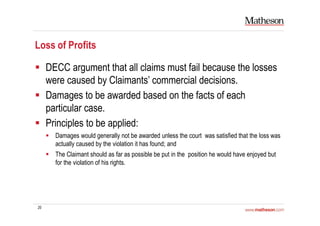
Loss of Profits
DECC argument that all claims must fail because the losses
were caused by Claimants’ commercial decisions.
Damages to be awarded based on the facts of each
particular case.
Principles to be applied:
Damages would generally not be awarded unless the court was satisfied that the loss was
actually caused by the violation it has found; and
The Claimant should as far as possible be put in the position he would have enjoyed but
for the violation of his rights.
21
Closing Remarks
Michael O'Connor
Partner | Head of Projects, Energy and Construction
Matheson
70 Sir John Rogerson's Quay
Dublin 2
T: +353 1 232 2283
F: +353 1 232 3333
E: michael.o'connor@matheson.com
W: www.matheson.com

Breyer Group PLC and Others 2015

  • 1.
    European Law Firmof the Year 2015 Hedge Fund Journal Financial Times 2012-2014 Matheson is the only Irish law firm commended by the Financial Times for innovation in corporate law, finance law, dispute resolution and corporate strategy. Law Firm of the Year 2014 Irish Pensions Awards Emerging Issues in Energy Litigation, 28 May 2015: ECHR & UK FIT Scheme Michael O’Connor, Partner | Head of Projects, Energy and Construction
  • 2.
    2 Contents The Cases …………..…………………………………………………………………………....Page 3 The UK FIT Scheme…………..…………………………………………………………………. Page 4 The Proposal…………….…………..……………………………………………………………. Page 7 Challenges to the Proposal…………..………………………………………………………….. Page 8 The Claimants ………………………..…………………………………………………………… Page 10 Grounds For Challenge: A1P1 ECHR…………..………….………………………………….. Page 11 “Possessions” Under A1P1 ECHR : High Court…………..…………………………………… Page 12 Interference: Court of Appeal…………..………………………………………………………… Page 17 Was the Interference Justified Court of Appeal……………………………………………….. Page 18 Legitimate Expectation & A1P1 ECHR………..……………………………………………….. Page 19 Loss of Profits……………………………………………………………………………………… Page 20 Closing Remarks……………………………………………………………………………………Page 21
  • 3.
    3 The Cases Four Judgements: TheQueen on the Application of Homesun Holdings Limited, Friends of the Earth Limited & Solar Century Holdings v Secretary of State for Energy & Climate Change [2011] EWHC 3575 (High Court, Mr. Justice Mitting). The Secretary of State for Energy & Climate Change v Friends of the Earth & Others [2012] EWCA Civ 28 (Court of Appeal, Lloyd LJ., Moses LJ., & Richards LJ). Breyer Group plc & Others v Department of Energy & Climate Change; Free Power for Schools LP v. Department of Energy & Climate Change; Homesun Holdings Limited & Another v Department of Energy & Climate Change; Touch Solar Limited v Department of Energy & Climate Change [2014] EWHC 2257 (QB) (High Court, Mr. Justice Coulson). The Department of Energy & Climate Change v Breyer Group PLC & Others [2015] EWCA Civ 408 (Court of Appeal, Lord Dyson, MR., Richards LJ., and Ryder LJ.).
  • 4.
    4 The UK FITScheme Department of Energy and Climate Change (“DECC”) introduced a Feed-in-Tariffs (“FIT”) Scheme in 2010 to encourage low carbon generation by specific technology including solar photovoltaic (“Solar PV”). The FIT Scheme introduced under the Feed-in-Tariffs (specified Maximum Capacity and Functions) Order 2010 and the Energy Act 2008 (“Law”). Two elements: Generation Tariff and Export Tariff. Litigation principally concerned with the Generation Tariff.
  • 5.
    5 The UK FITScheme Solar PV got a higher tariff level because installation and equipment costs were higher. Once built and commissioned the Generation Tariff was fixed for 25 years (subject to indexation). The Generation Tariff was set out in Electricity Supply Licences and could only be amended (1) following a process of consultation and then a 40 day period of parliamentary scrutiny of the proposed modification; and (ii) in relation to new Solar PV installations commissioned after the date that Parliament approved the modification.
  • 6.
    6 The UK FITScheme DECC’s original stated intention was that the FIT rates would remain unchanged for new installations from the start of the FIT Scheme in 2010 until April 2012. DECC gave repeated assurances that any changes would not be retrospective.
  • 7.
    7 The Proposal The Schemewas very successful: Number of installations exceeded what was foreseen. Costs of solar installations had fallen. Rate of return for solar developers greatly exceeded what was anticipated. Concern that solar would take a disproportionate amount of allocated funding at the expense of other technology. DECC announced a review in February 2011 and proposed (amongst other things) to bring forward from 1 April 2012 to 12 December 2011 the date by which installations had to be commissioned / registered in order to qualify for the original generous tariff rates for the life of the installation (“Proposal”).
  • 8.
    8 Challenges to theProposal The Proposal was challenged in judicial review proceedings. The High Court (Judgment of Mitting J.) held that the Proposal was ultra vires. This finding was upheld on appeal but for different reasons. DECC did not implement the Proposal and proceeded on a different basis. The Complainants alleged that by the time the Courts ruled that the Proposal was unlawful many of the installations that otherwise would have been completed by 1 April 2012 were abandoned causing substantial losses.
  • 9.
    9 Challenges to theProposal These Claimants then sought damages against DECC for interference with their right to peaceful enjoyment of their possessions under Article 1, Protocol 1, European Convention on Human Rights (“A1P1 ECHR”).
  • 10.
    10 The Claimants Small scaleSolar PV generators. Nominated recipients under the FIT Scheme. Others engaged in a variety of businesses connected in some way with Solar PV Generation eg, equipment suppliers.
  • 11.
    11 Grounds For Challenge:A1P1 ECHR Article 1. Protocol 1., ECHR states: Every natural or legal person is entitled to the peaceful enjoyment of his possessions. No one shall be deprived of his possessions except in the public interest and subject to the conditions provided for by law and by the general principles of international law. The preceding provisions shall not, however, in any way impair the right of a State to enforce such laws as it deems necessary to control the use of property in accordance with the general interest or to secure the payment of taxes or other contributions or penalties.
  • 12.
    12 “Possessions” Under A1P1ECHR : High Court The following principles can be extracted from the case law: loss of future income is not a possession protected by A1P1; loss of marketable goodwill may be a possession protected by A1P1; a number of factors may point towards the loss being goodwill rather than the capacity to earn future profits: these include marketability and whether the accounts and arrangements of the claimant are organised in such a way as to allow for future cash flows to be capitalised; goodwill may be a possession if it has been built up in the past and has a present day value (as distinct from something which is only referable to events which may or may not happen in the future): and thus if there is interference which causes a loss of marketable goodwill at the time of the interference, and if that can be capitalised, then it is prima facie protected by A1P1.
  • 13.
    13 “Possessions” Under A1P1ECHR: High Court Coulson J., held that: the claimants had Al P1 possessions insofar as they had entered into contracts and/or they had marketable goodwill constituted by or referable to those contracts; the doctrine of legitimate expectation could not be invoked as a "trump card" if the claimants could not establish that they had possessions on the basis of contracts and/or marketable goodwill; the Proposal interfered with the claimants' possessions and on the assumed facts this interference caused the claimants to suffer loss; the interference was not justified since it was unlawful and/or it was disproportionate; and the claimants were entitled in principle to an award of damages assessed by reference to the loss of profits caused by the interference with their possessions.
  • 14.
    14 “Possessions” Under A1P1ECHR: High Court Applying that to one Claimant: 5,703 leases which had been requested and sent to customers following successful surveys. It was claimed that, 3,415 would have led to installations by the cut-off date. Speculative & Not Claimants Marketable Goodwill ≠ Possessions Under A1P1. 1,774 leases had been signed by customers but not by Claimants. It was claimed that 1,430 would have led to installations by the cut-off date. Proposed Contracts Not Concluded & Not Legally Binding. More like loss of Future Profits than Claimant’s Marketable Goodwill ≠ Possessions Under A1P1. 1,974 leases had been signed by customers and Claimant but systems had not yet been installed and commissioned as defined in the law. It was claimed that 1,923 would have led to installations by the cut-off date. Claimant’s Marketable Goodwill = Possessions Under A1P1.
  • 15.
    15 “Possessions” Under A1P1ECHR: High Court 1,441 solar PV systems had been installed and commissioned as defined by the FIT Scheme, following the associated leases having been signed by customers and the Claimant. Applications were subsequently made for all of these solar systems entitling claimants to the benefit of a FIT income stream at the original tariff. Claimants Marketable Goodwill = Possessions Under A1P1. 2,539 solar PV systems had been installed and commissioned and an application had been made as required by the FIT Scheme which entitled claimants to the benefit of a FIT income stream at the original tariff. Claimants Marketable Goodwill = Possessions Under A1P1.
  • 16.
    16 “Possessions” Under A1P1ECHR: Court of Appeal Lord Dyson MR held: The distinction between goodwill and loss of future income is not always easy to apply; There is a clear line separating (1) possible future contracts; and (2) existing enforceable contracts; Contracts that are secured are part of the goodwill of a business because they are a product of past work; Contracts that a business hopes to secure in the future are no more than that; and Classification of Coulsen J., upheld.
  • 17.
    17 Interference: Court ofAppeal Lord Dyson MR held: The Proposal interfered with the Claimants A1P1 rights; The Proposal had “an immediate and serious adverse impact on the claimants’ so that it was not economically viable for them to continue with their solar installation business; It did not matter that the Proposal was a mere “proposal” and not a “final decision”; A mere proposal can amount to an interference; and Though the Proposal did not impact on the Claimants legally (it was not binding), it impacted them practically.
  • 18.
    18 Was the InterferenceJustified: Court of Appeal Lawfulness: Not contrary to the law to consult on a proposal which, if implemented, would be unlawful. Courts are cautious of allowing JR of a Consultation Document – Prematurity. Challenges to Consultation Documents could not be stopped if this was permitted. Fair Balance: High Ct. was correct to hold that the Proposal did not strike a fair balance between the public interest and the interest of the investors in the scheme. In reaching this conclusion the Court of Appeal took into consideration the following factors: DECC statements that April 2012 was the cut-off date. The statements that there would be no retrospective tariff changes. The scale of investments made by the Claimants in reliance on these statements. The fact that the losses caused by the interference with their possessions were dwarfed by the savings achieved by DECC as a result of the interference.
  • 19.
    19 Legitimate Expectation &A1P1 ECHR Coulson LJ (High Court ) held: A claim for legitimate expectation was not a “trump card” that enabled a claimant to recover damages for interference with possessions even where the claim would otherwise fail because it was for loss of future income rather than loss of goodwill. In the alternative legitimate expectation had to be linked to a property right that was already enjoyed. There was legitimate expectation in respect of contracts which had been signed/concluded before 31 October 2011 that payment would be made at the maximum rate for installations completed by 1 April 2012. Where the contracts were “matters of hope or aspiration” there was not a sufficient property right to which the legitimate expectation could be attached. Issue not addressed by Court of Appeal in any detail.
  • 20.
    20 Loss of Profits DECCargument that all claims must fail because the losses were caused by Claimants’ commercial decisions. Damages to be awarded based on the facts of each particular case. Principles to be applied: Damages would generally not be awarded unless the court was satisfied that the loss was actually caused by the violation it has found; and The Claimant should as far as possible be put in the position he would have enjoyed but for the violation of his rights.
  • 21.
  • 22.
    Michael O'Connor Partner |Head of Projects, Energy and Construction Matheson 70 Sir John Rogerson's Quay Dublin 2 T: +353 1 232 2283 F: +353 1 232 3333 E: michael.o'connor@matheson.com W: www.matheson.com