BROACHING
M Jahanzaib Naqvi
BS Mechanical Technology
UCET
University Of Sargodha
Structure of Presentation
Introduction
Broach
 Different Types of Broaches
Broaching Methods
Broaching Operation
Fixtures used in Broaching
Broaching Machines
Merits and Demerits of Broaching
Machines
Material of Broach
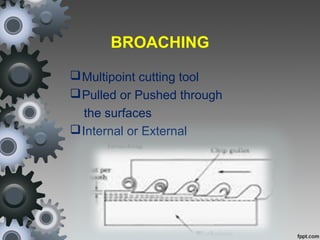
BROACHING
Multipoint cutting tool
Pulled or Pushed through
the surfaces
Internal or External
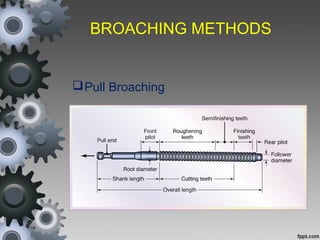
BROACHING METHODS
Pull Broaching
BROACHING METHODS
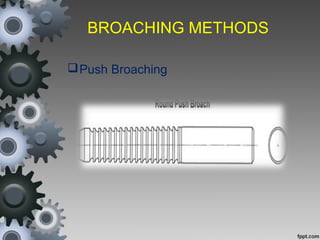
Push Broaching
BROACHING METHODS
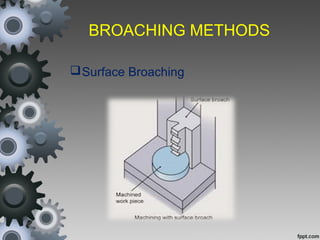
Surface Broaching
BROACHING METHODS
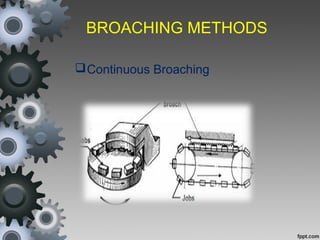
Continuous Broaching
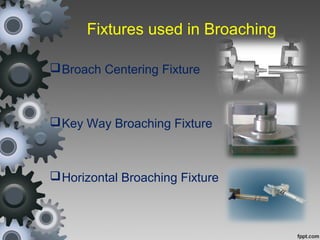
Fixtures used in Broaching
Broach Centering Fixture
Key Way Broaching Fixture
Horizontal Broaching Fixture
Broach
Broach is a broaching tool, it consists of
a series of distinct cutting edges called
cutting teeth along its length
Feed is accomplished by the increased
step between any two successive teeth
on the broach
 18-4-1 stainless steel
 Carbide
 Cemented Carbide
Material of Broach
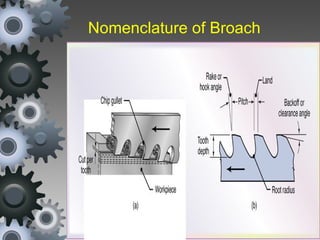
Nomenclature of Broach
Front Pilot
This centres the broach in the hole to
be finished just before start of
processing
Roughing Teeth
These are the cutting edges which
remove larger amount of stocks
during cutting. Larger amount
removal generates poor quality of
surface finish but makes the
operation faster
Nomenclature of Broach
Finishing Teeth
These are cutting edges removing
smaller stocks of material. These
are used for final finishing of the
surfaces and their accurate sizing.
Rear Pilot and Follower Rest
This is a supporting device to the
broach when it is likely to complete
its operation of broaching.
Nomenclature of Broach
Rear Pilot and Follower Rest
This is a supporting device to the
broach when it is likely to complete
its operation of broaching.
Land
It is the width of flank face of the
broach normally it is kept slightly
inclined to give relief angle to the
flank face of broach.
Nomenclature of Broach
Pitch
It is the distance between two
corresponding points on two
successive teeth of a broach.
Normally pitch of finishing teeth of a
broach is kept comparatively smaller
than the rough cutting teeth.
Nomenclature of Broach
Height of the Teeth
Height of the roughing and finishing
teeth gradually increases from the
shank to the finishing teeth. This
increment is called the cut per tooth,
it depends on the material being
machined. Normally the cut per
tooth is taken from 0.01 or 0.2 mm
for the finishing teeth and it may go
up 0.2 mm for the cutting teeth.
DIFFERENT TYPES OF
BROACHES
Progressive Cut Broaches
Broaches have cutting edges
Metal is removed in thick layers by
each tooth from only part of the
work surface
The last tooth of a progressive cut
broach remove a very thin layer
over the entire profile
DIFFERENT TYPES OF
BROACHES
Rotor Cut Broaching
Broaches are used for removing
large amount of material in holes
in forgings or castings
Recommended for making
square holes from a round cost
one
DIFFERENT TYPES OF
BROACHES
Burnishing Broaches
Broaches are used for making
glazed and finished surface on a
steel work piece
Used for finish the hole too
BROACHING MACHINES
According to Working principle
•(a) Hydraulic broaching machine
•(b) Mechanical broaching machine
•(c) Electro-mechanical broaching
machine
•(d) Computer controlled broaching
machine
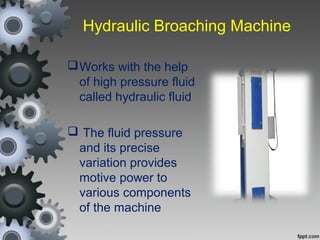
Hydraulic Broaching Machine
Works with the help
of high pressure fluid
called hydraulic fluid
 The fluid pressure
and its precise
variation provides
motive power to
various components
of the machine
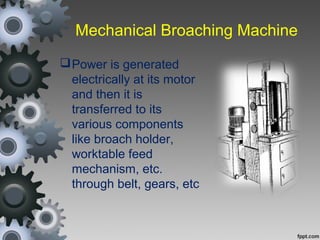
Mechanical Broaching Machine
Power is generated
electrically at its motor
and then it is
transferred to its
various components
like broach holder,
worktable feed
mechanism, etc.
through belt, gears, etc
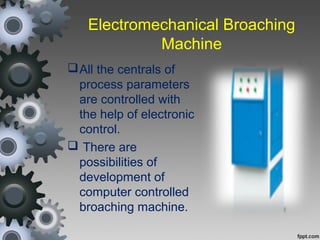
Electromechanical Broaching
Machine
All the centrals of
process parameters
are controlled with
the help of electronic
control.
 There are
possibilities of
development of
computer controlled
broaching machine.
BROACHING MACHINES
According to Construction
(a) Vertical broaching machine
(b) Horizontal broaching machine
(c) Rotary broaching machine
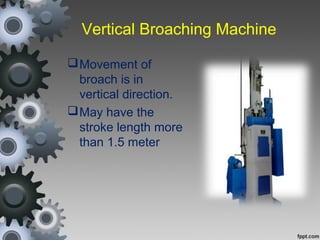
Vertical Broaching Machine
Movement of
broach is in
vertical direction.
May have the
stroke length more
than 1.5 meter
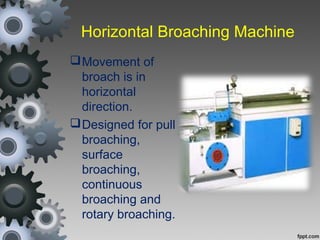
Horizontal Broaching Machine
Movement of
broach is in
horizontal
direction.
Designed for pull
broaching,
surface
broaching,
continuous
broaching and
rotary broaching.
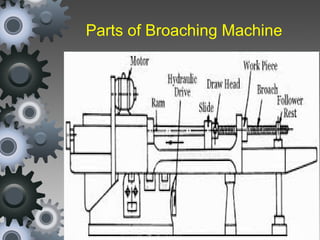
Parts of Broaching Machine
BROACHING MACHINES
According to Application
(a) internal broaching machine
(b) external broaching machine
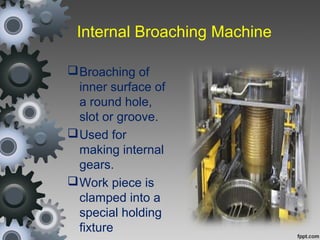
Internal Broaching Machine
Broaching of
inner surface of
a round hole,
slot or groove.
Used for
making internal
gears.
Work piece is
clamped into a
special holding
fixture
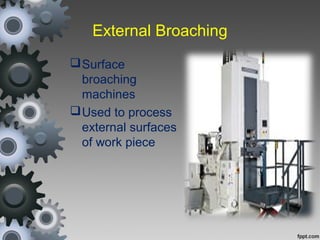
External Broaching
Surface
broaching
machines
Used to process
external surfaces
of work piece
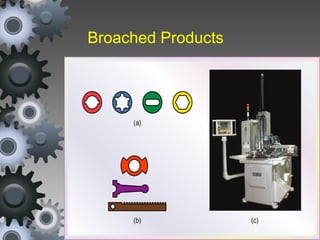
Broached Products
Major advantages
Of Broaching Machine
 Very high production rate (much higher
than milling, planing, boring etc.)
 High dimensional and form accuracy and
surface finish of the product
Roughing and finishing in single stroke of
the same cutter
Needs only one motion (cutting), so design,
construction, operation and control are
simpler
 Extremely suitable and economic for mass
production
Demerits of Broaching
Machines
Only through holes and surfaces can
be machined
 Usable only for light cuts, i.e. low chip
load and unhard materials
 Cutting speed cannot be high
 Defects or damages in the broach
(cutting edges) severely affect product
quality
Demerits of Broaching
Operation
Design, manufacture and restoration of
the broaches are difficult and
expensive
 Separate broach has to be procured
and used whenever size, shape and
geometry of the job changes
 Economic only when the production
volume is large

Braoching Operation

  • 2.
    BROACHING M Jahanzaib Naqvi BSMechanical Technology UCET University Of Sargodha
  • 3.
    Structure of Presentation Introduction Broach Different Types of Broaches Broaching Methods Broaching Operation Fixtures used in Broaching Broaching Machines Merits and Demerits of Broaching Machines Material of Broach
  • 4.
    BROACHING Multipoint cutting tool Pulledor Pushed through the surfaces Internal or External
  • 5.
  • 6.
  • 7.
  • 8.
  • 9.
    Fixtures used inBroaching Broach Centering Fixture Key Way Broaching Fixture Horizontal Broaching Fixture
  • 10.
    Broach Broach is abroaching tool, it consists of a series of distinct cutting edges called cutting teeth along its length Feed is accomplished by the increased step between any two successive teeth on the broach
  • 11.
     18-4-1 stainlesssteel  Carbide  Cemented Carbide Material of Broach
  • 12.
  • 13.
    Nomenclature of Broach FrontPilot This centres the broach in the hole to be finished just before start of processing Roughing Teeth These are the cutting edges which remove larger amount of stocks during cutting. Larger amount removal generates poor quality of surface finish but makes the operation faster
  • 14.
    Nomenclature of Broach FinishingTeeth These are cutting edges removing smaller stocks of material. These are used for final finishing of the surfaces and their accurate sizing. Rear Pilot and Follower Rest This is a supporting device to the broach when it is likely to complete its operation of broaching.
  • 15.
    Nomenclature of Broach RearPilot and Follower Rest This is a supporting device to the broach when it is likely to complete its operation of broaching. Land It is the width of flank face of the broach normally it is kept slightly inclined to give relief angle to the flank face of broach.
  • 16.
    Nomenclature of Broach Pitch Itis the distance between two corresponding points on two successive teeth of a broach. Normally pitch of finishing teeth of a broach is kept comparatively smaller than the rough cutting teeth.
  • 17.
    Nomenclature of Broach Heightof the Teeth Height of the roughing and finishing teeth gradually increases from the shank to the finishing teeth. This increment is called the cut per tooth, it depends on the material being machined. Normally the cut per tooth is taken from 0.01 or 0.2 mm for the finishing teeth and it may go up 0.2 mm for the cutting teeth.
  • 18.
    DIFFERENT TYPES OF BROACHES ProgressiveCut Broaches Broaches have cutting edges Metal is removed in thick layers by each tooth from only part of the work surface The last tooth of a progressive cut broach remove a very thin layer over the entire profile
  • 19.
    DIFFERENT TYPES OF BROACHES RotorCut Broaching Broaches are used for removing large amount of material in holes in forgings or castings Recommended for making square holes from a round cost one
  • 20.
    DIFFERENT TYPES OF BROACHES BurnishingBroaches Broaches are used for making glazed and finished surface on a steel work piece Used for finish the hole too
  • 21.
    BROACHING MACHINES According toWorking principle •(a) Hydraulic broaching machine •(b) Mechanical broaching machine •(c) Electro-mechanical broaching machine •(d) Computer controlled broaching machine
  • 22.
    Hydraulic Broaching Machine Workswith the help of high pressure fluid called hydraulic fluid  The fluid pressure and its precise variation provides motive power to various components of the machine
  • 23.
    Mechanical Broaching Machine Poweris generated electrically at its motor and then it is transferred to its various components like broach holder, worktable feed mechanism, etc. through belt, gears, etc
  • 24.
    Electromechanical Broaching Machine All thecentrals of process parameters are controlled with the help of electronic control.  There are possibilities of development of computer controlled broaching machine.
  • 25.
    BROACHING MACHINES According toConstruction (a) Vertical broaching machine (b) Horizontal broaching machine (c) Rotary broaching machine
  • 26.
    Vertical Broaching Machine Movementof broach is in vertical direction. May have the stroke length more than 1.5 meter
  • 27.
    Horizontal Broaching Machine Movementof broach is in horizontal direction. Designed for pull broaching, surface broaching, continuous broaching and rotary broaching.
  • 28.
  • 29.
    BROACHING MACHINES According toApplication (a) internal broaching machine (b) external broaching machine
  • 30.
    Internal Broaching Machine Broachingof inner surface of a round hole, slot or groove. Used for making internal gears. Work piece is clamped into a special holding fixture
  • 31.
    External Broaching Surface broaching machines Used toprocess external surfaces of work piece
  • 32.
  • 33.
    Major advantages Of BroachingMachine  Very high production rate (much higher than milling, planing, boring etc.)  High dimensional and form accuracy and surface finish of the product Roughing and finishing in single stroke of the same cutter Needs only one motion (cutting), so design, construction, operation and control are simpler  Extremely suitable and economic for mass production
  • 34.
    Demerits of Broaching Machines Onlythrough holes and surfaces can be machined  Usable only for light cuts, i.e. low chip load and unhard materials  Cutting speed cannot be high  Defects or damages in the broach (cutting edges) severely affect product quality
  • 35.
    Demerits of Broaching Operation Design,manufacture and restoration of the broaches are difficult and expensive  Separate broach has to be procured and used whenever size, shape and geometry of the job changes  Economic only when the production volume is large