MILLING CUTTER
DESCRIPTIONMilling cutters are cutting tools typically used in milling machines or machining centres (and occasionally in other machine tools). They remove material by their movement within the machine (e.g., a ball nose mill) or directly from the cutter's shape (e.g., a form tool such as a hobbing cutter).
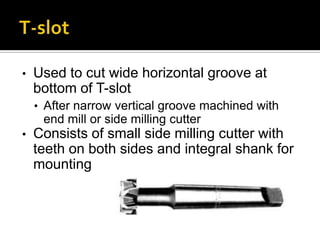
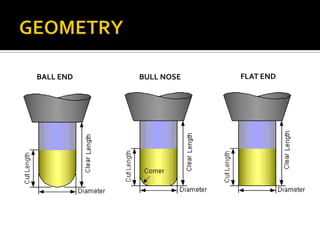
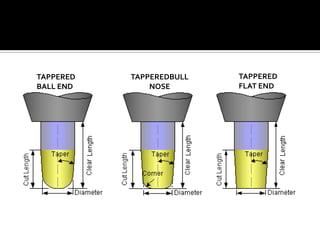
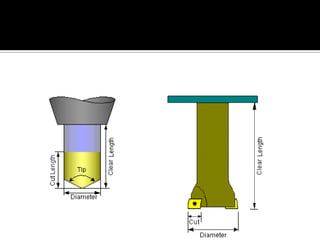
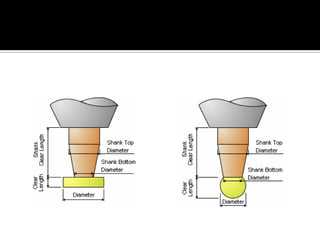
GEOMETRYA variety of grooves, slots, and pockets in the workpiece may be produced from a variety of tool bits. Common tool bit types are: square end cutters, ball end cutters, t-slot cutters, and shell mills. Square end cutters can mill square slots, pockets, and edges. Ball end cutters mill radiused slots or fillets. T-slot cutters mill exactly that: t-shaped slots. Shell end cutters are used for large flat surfaces and for angle cuts. There are variations of these tool types as well.There are four critical angles of each cutting tool: end cutting edge angle, axial relief angle, radial relief angle, and radial rake angle. See graph for common values.
GEOMETRYDepending on the material being milled, and what task should be performed, different tool types and geometry may be used. For instance, when milling a material like aluminium, it may be advantageous to use a tool with very deep, polished flutes and a very sharp cutting edge. When machining a tough material such as stainless steel, however, shallow flutes and a squared-off cutting edge will optimize material removal and tool life.
GEOMETRYA wide variety of materials are used to produce the cutting tools. Carbide inserts are the most common because they are good for high production milling. High speed steel is commonly used when a special tool shape is needed, not usually used for high production processes. Ceramics inserts are typically used in high speed machining with high production. Diamond inserts are typically used on products that require tight tolerances, typically consisting of high surface qualities (nonferrous or nonmetallic materials). In the early 1990s, use of coatings to reduce wear and friction (among other things) became more common. Most of these coatings are referred to by their chemical composition, such as:
GEOMETRYTiN (a basic yellowish coating that has fallen out of wide use)TiCN (a popular bluish-grey coating)TiAlN and AlTiN (an extremely popular dark purple coating)TiAlCrN, AlTiCrN and AlCrTiN (PVD coating).PCD veins. Though not a coating some endmills are manufactured with a 'vein' of polycrystaline diamond. The vein is formed in a high temperature-high pressure environment. The vein is formed in a blank and then the material is ground out along the vein to form the cutting edge. The tools can be very costly, however can last many times longer than other tooling.Advances in endmill coatings are being made, however, with coatings such as Amorphous Diamond and nanocomposite PVD coatings beginning to be seen at high-end shops (as of 2004).
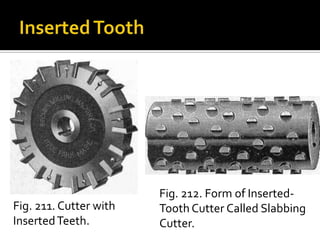
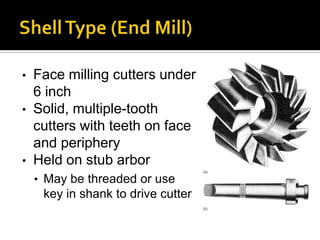
TYPES OF MILLING CUTTERArbor Type of Milling CutterPlain MillingSide MillingForm MillingFly CutterShank Type of Milling CutterEnd MillInserted ToothT-slotFly Cutter
Arbor Types of Milling CutterArbor milling is a cutting process which removes material via a multi-toothed cutter. An arbor mill is a type of milling machine Characterized by its ability to rapidly remove material from a variety of materials, this milling process is not only rapid but also versatile
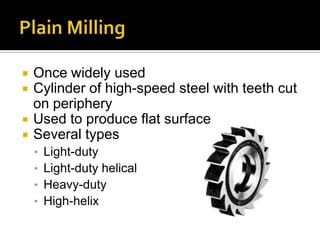
Plain MillingOnce widely used Cylinder of high-speed steel with teeth cut on peripheryUsed to produce flat surfaceSeveral typesLight-duty
Light-duty helical
Heavy-duty
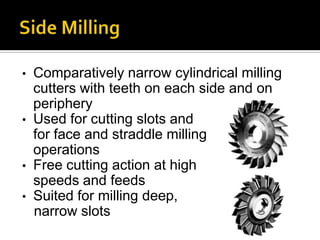
High-helixSide MillingComparatively narrow cylindrical milling cutters with teeth on each side and on periphery
Used for cutting slots andfor face and straddle millingoperations
Free cutting action at highspeeds and feeds
Suited for milling deep,    narrow slots
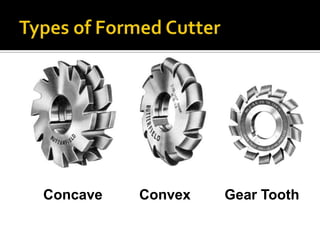
Form MillingIncorporate exact shape of part to be produced
Useful for production of small parts
Each tooth identical in shape
Sharpened by grinding tooth face (may have positive, zero or negative rake)
Important to maintain original rake
Difficult to sharpenTypes of Formed CutterConcaveConvexGear Tooth
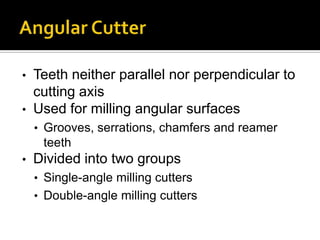
Angular CutterTeeth neither parallel nor perpendicular to cutting axis
Used for milling angular surfaces
Grooves, serrations, chamfers and reamer teeth
Divided into two groups
Single-angle milling cutters
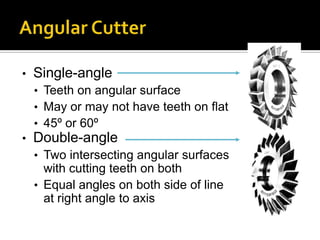
Double-angle milling cuttersAngular CutterSingle-angle
Teeth on angular surface
May or may not have teeth on flat
45º or 60º
Double-angle
Two intersecting angular surfaceswith cutting teeth on both
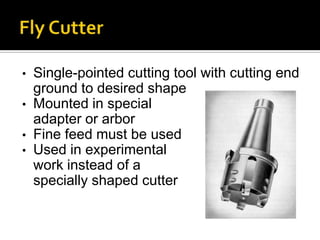
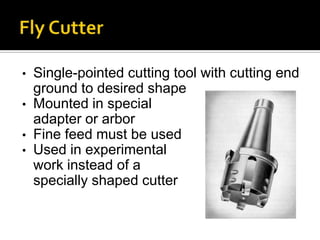
Equal angles on both side of line at right angle to axisFly CutterSingle-pointed cutting tool with cutting end ground to desired shape
Mounted in specialadapter or arbor
Fine feed must be used
Used in experimentalwork instead of a specially shaped cutterShank Type of Milling Cutter
End MillCutting teeth on end as well as periphery
Fitted to spindle by suitable adapter
Two types

Milling cutter

  • 1.
  • 2.
    DESCRIPTIONMilling cutters arecutting tools typically used in milling machines or machining centres (and occasionally in other machine tools). They remove material by their movement within the machine (e.g., a ball nose mill) or directly from the cutter's shape (e.g., a form tool such as a hobbing cutter).
  • 3.
    GEOMETRYA variety ofgrooves, slots, and pockets in the workpiece may be produced from a variety of tool bits. Common tool bit types are: square end cutters, ball end cutters, t-slot cutters, and shell mills. Square end cutters can mill square slots, pockets, and edges. Ball end cutters mill radiused slots or fillets. T-slot cutters mill exactly that: t-shaped slots. Shell end cutters are used for large flat surfaces and for angle cuts. There are variations of these tool types as well.There are four critical angles of each cutting tool: end cutting edge angle, axial relief angle, radial relief angle, and radial rake angle. See graph for common values.
  • 4.
    GEOMETRYDepending on thematerial being milled, and what task should be performed, different tool types and geometry may be used. For instance, when milling a material like aluminium, it may be advantageous to use a tool with very deep, polished flutes and a very sharp cutting edge. When machining a tough material such as stainless steel, however, shallow flutes and a squared-off cutting edge will optimize material removal and tool life.
  • 5.
    GEOMETRYA wide varietyof materials are used to produce the cutting tools. Carbide inserts are the most common because they are good for high production milling. High speed steel is commonly used when a special tool shape is needed, not usually used for high production processes. Ceramics inserts are typically used in high speed machining with high production. Diamond inserts are typically used on products that require tight tolerances, typically consisting of high surface qualities (nonferrous or nonmetallic materials). In the early 1990s, use of coatings to reduce wear and friction (among other things) became more common. Most of these coatings are referred to by their chemical composition, such as:
  • 6.
    GEOMETRYTiN (a basicyellowish coating that has fallen out of wide use)TiCN (a popular bluish-grey coating)TiAlN and AlTiN (an extremely popular dark purple coating)TiAlCrN, AlTiCrN and AlCrTiN (PVD coating).PCD veins. Though not a coating some endmills are manufactured with a 'vein' of polycrystaline diamond. The vein is formed in a high temperature-high pressure environment. The vein is formed in a blank and then the material is ground out along the vein to form the cutting edge. The tools can be very costly, however can last many times longer than other tooling.Advances in endmill coatings are being made, however, with coatings such as Amorphous Diamond and nanocomposite PVD coatings beginning to be seen at high-end shops (as of 2004).
  • 7.
    TYPES OF MILLINGCUTTERArbor Type of Milling CutterPlain MillingSide MillingForm MillingFly CutterShank Type of Milling CutterEnd MillInserted ToothT-slotFly Cutter
  • 8.
    Arbor Types ofMilling CutterArbor milling is a cutting process which removes material via a multi-toothed cutter. An arbor mill is a type of milling machine Characterized by its ability to rapidly remove material from a variety of materials, this milling process is not only rapid but also versatile
  • 9.
    Plain MillingOnce widelyused Cylinder of high-speed steel with teeth cut on peripheryUsed to produce flat surfaceSeveral typesLight-duty
  • 10.
  • 11.
  • 12.
    High-helixSide MillingComparatively narrowcylindrical milling cutters with teeth on each side and on periphery
  • 13.
    Used for cuttingslots andfor face and straddle millingoperations
  • 14.
    Free cutting actionat highspeeds and feeds
  • 15.
    Suited for millingdeep, narrow slots
  • 16.
    Form MillingIncorporate exactshape of part to be produced
  • 17.
    Useful for productionof small parts
  • 18.
  • 19.
    Sharpened by grindingtooth face (may have positive, zero or negative rake)
  • 20.
  • 21.
    Difficult to sharpenTypesof Formed CutterConcaveConvexGear Tooth
  • 22.
    Angular CutterTeeth neitherparallel nor perpendicular to cutting axis
  • 23.
    Used for millingangular surfaces
  • 24.
  • 25.
  • 26.
  • 27.
  • 28.
  • 29.
    May or maynot have teeth on flat
  • 30.
  • 31.
  • 32.
    Two intersecting angularsurfaceswith cutting teeth on both
  • 33.
    Equal angles onboth side of line at right angle to axisFly CutterSingle-pointed cutting tool with cutting end ground to desired shape
  • 34.
  • 35.
  • 36.
    Used in experimentalworkinstead of a specially shaped cutterShank Type of Milling Cutter
  • 37.
    End MillCutting teethon end as well as periphery
  • 38.
    Fitted to spindleby suitable adapter
  • 39.