MACHINING OPERATIONS AND
MACHINE TOOLS
•
•
•
•
•
•

Turning and Related Operations
Drilling and Related Operations
Milling
Machining Centers and Turning Centers
Other Machining Operations
High Speed Machining
ISE 316 - Manufacturing Processes
Engineering
Machining
A material removal process in which a sharp cutting
tool is used to mechanically cut away material so
that the desired part geometry remains
• Most common application: to shape metal parts
• Machining is the most versatile and accurate of
all manufacturing processes in its capability to
produce a diversity of part geometries and
geometric features
– Casting can also produce a variety of shapes, but it
lacks the precision and accuracy of machining
ISE 316 - Manufacturing Processes
Engineering
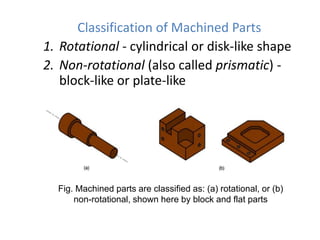
Classification of Machined Parts
1. Rotational - cylindrical or disk-like shape
2. Non-rotational (also called prismatic) block-like or plate-like

Fig. Machined parts are classified as: (a) rotational, or (b)
non-rotational, shown here by block and flat parts
Machining Operations and Part
Geometry
Each machining operation produces a
characteristic part geometry due to two
factors:
1. Relative motions between the tool and the
workpart
•

Generating – part geometry is determined by the
feed trajectory of the cutting tool

2. Shape of the cutting tool
•

Forming – part geometry is created by the shape of
the cutting tool
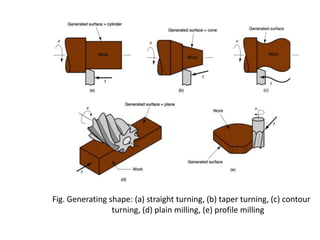
Fig. Generating shape: (a) straight turning, (b) taper turning, (c) contour
turning, (d) plain milling, (e) profile milling
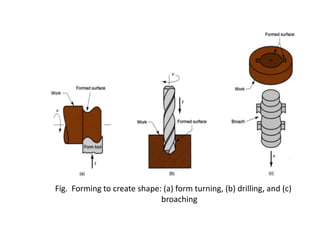
Fig. Forming to create shape: (a) form turning, (b) drilling, and (c)
broaching
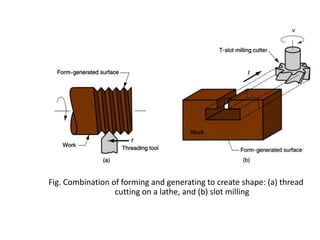
Fig. Combination of forming and generating to create shape: (a) thread
cutting on a lathe, and (b) slot milling
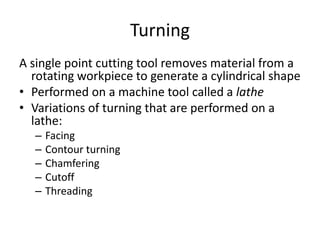
Turning
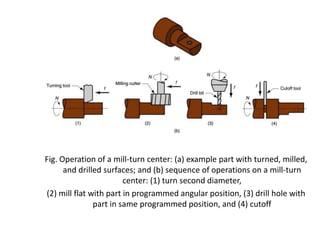
A single point cutting tool removes material from a
rotating workpiece to generate a cylindrical shape
• Performed on a machine tool called a lathe
• Variations of turning that are performed on a
lathe:
–
–
–
–
–

Facing
Contour turning
Chamfering
Cutoff
Threading
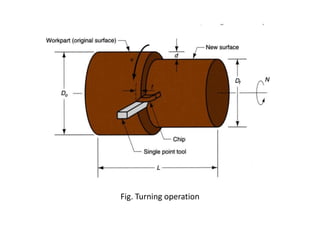
Fig. Turning operation
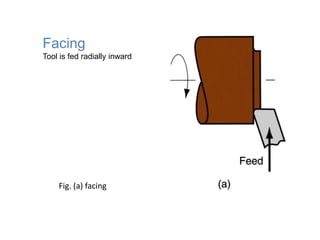
Facing
Tool is fed radially inward

Fig. (a) facing
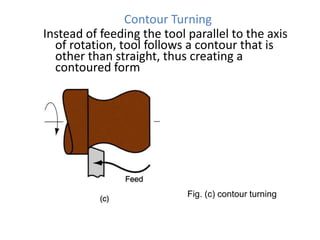
Contour Turning
Instead of feeding the tool parallel to the axis
of rotation, tool follows a contour that is
other than straight, thus creating a
contoured form

Fig. (c) contour turning
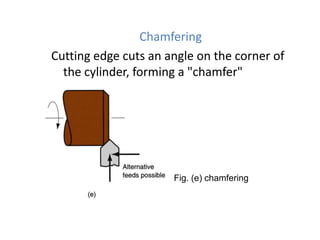
Chamfering
Cutting edge cuts an angle on the corner of
the cylinder, forming a "chamfer"

Fig. (e) chamfering
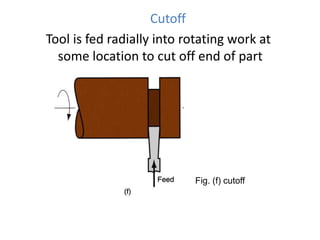
Cutoff
Tool is fed radially into rotating work at
some location to cut off end of part

Fig. (f) cutoff
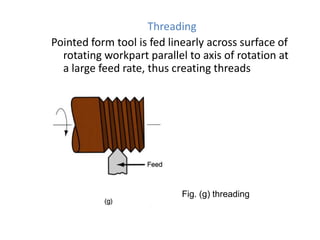
Threading
Pointed form tool is fed linearly across surface of
rotating workpart parallel to axis of rotation at
a large feed rate, thus creating threads

Fig. (g) threading
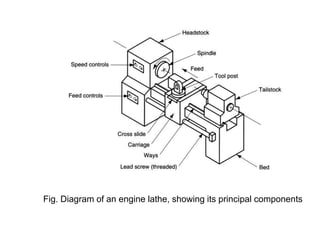
Fig. Diagram of an engine lathe, showing its principal components
Methods of Holding the Work in a
Lathe
•
•
•
•

Holding the work between centers
Chuck
Collet
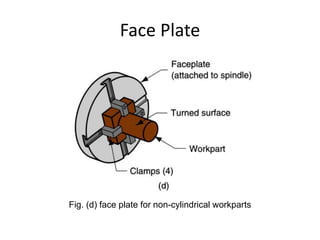
Face plate
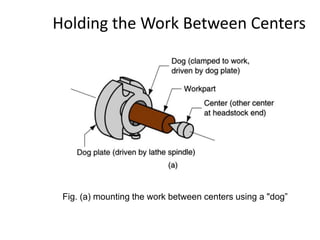
Holding the Work Between Centers

Fig. (a) mounting the work between centers using a "dog”
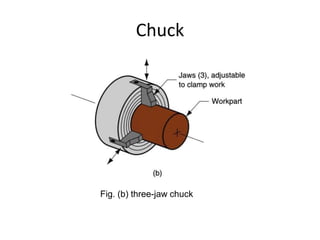
Chuck

Fig. (b) three-jaw chuck
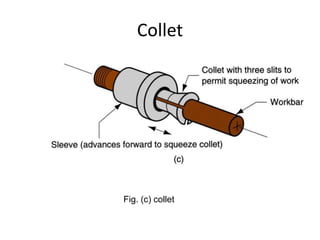
Collet

Fig. (c) collet
Face Plate

Fig. (d) face plate for non-cylindrical workparts
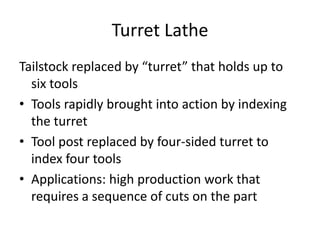
Turret Lathe
Tailstock replaced by “turret” that holds up to
six tools
• Tools rapidly brought into action by indexing
the turret
• Tool post replaced by four-sided turret to
index four tools
• Applications: high production work that
requires a sequence of cuts on the part
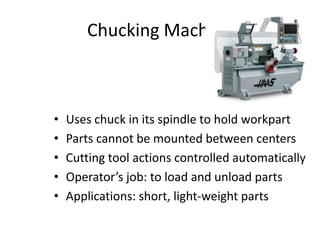
Chucking Machine

•
•
•
•
•

Uses chuck in its spindle to hold workpart
Parts cannot be mounted between centers
Cutting tool actions controlled automatically
Operator’s job: to load and unload parts
Applications: short, light-weight parts
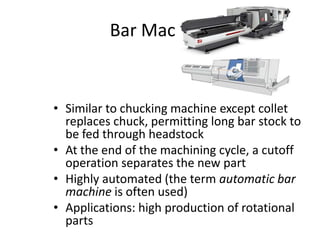
Bar Machine

• Similar to chucking machine except collet
replaces chuck, permitting long bar stock to
be fed through headstock
• At the end of the machining cycle, a cutoff
operation separates the new part
• Highly automated (the term automatic bar
machine is often used)
• Applications: high production of rotational
parts
Automatic Screw Machine
• Same as automatic bar machine but smaller
• Applications: high production of screws and
similar small hardware items; hence, its name
Multiple Spindle Bar Machines
• More than one spindle, so multiple parts
machined simultaneously by multiple tools
– Example: six spindle automatic bar machine works
on six parts at a time

• After each machining cycle, spindles (including
collets and workbars) are indexed (rotated) to
next position
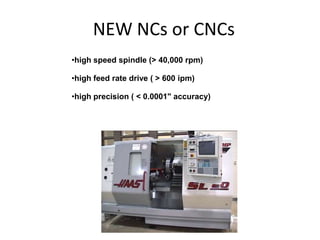
NEW NCs or CNCs
•high speed spindle (> 40,000 rpm)
•high feed rate drive ( > 600 ipm)
•high precision ( < 0.0001" accuracy)
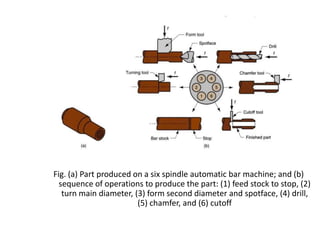
Fig. (a) Part produced on a six spindle automatic bar machine; and (b)
sequence of operations to produce the part: (1) feed stock to stop, (2)
turn main diameter, (3) form second diameter and spotface, (4) drill,
(5) chamfer, and (6) cutoff
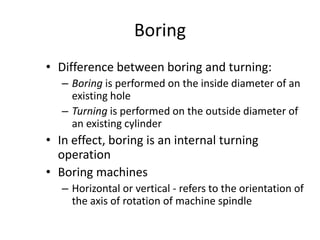
Boring
• Difference between boring and turning:
– Boring is performed on the inside diameter of an
existing hole
– Turning is performed on the outside diameter of
an existing cylinder

• In effect, boring is an internal turning
operation
• Boring machines
– Horizontal or vertical - refers to the orientation of
the axis of rotation of machine spindle
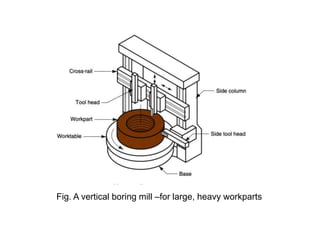
Fig. A vertical boring mill –for large, heavy workparts
•

•
•
•

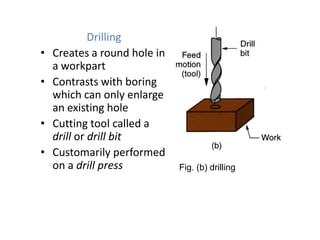
Drilling
Creates a round hole in
a workpart
Contrasts with boring
which can only enlarge
an existing hole
Cutting tool called a
drill or drill bit
Customarily performed
on a drill press

Fig. (b) drilling
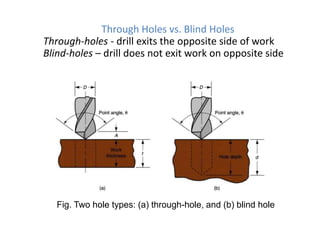
Through Holes vs. Blind Holes
Through-holes - drill exits the opposite side of work
Blind-holes – drill does not exit work on opposite side

Fig. Two hole types: (a) through-hole, and (b) blind hole
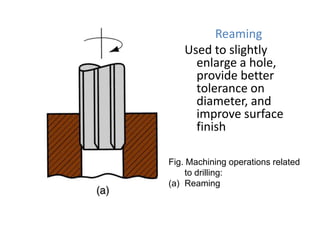
Reaming
Used to slightly
enlarge a hole,
provide better
tolerance on
diameter, and
improve surface
finish
Fig. Machining operations related
to drilling:
(a) Reaming
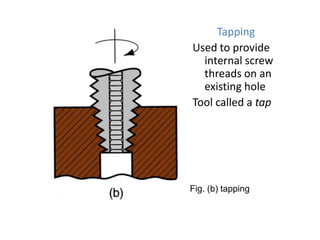
Tapping
Used to provide
internal screw
threads on an
existing hole
Tool called a tap

Fig. (b) tapping
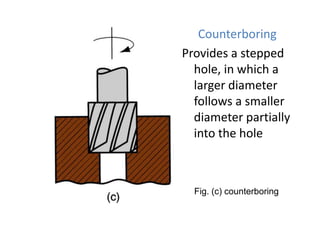
Counterboring
Provides a stepped
hole, in which a
larger diameter
follows a smaller
diameter partially
into the hole

Fig. (c) counterboring
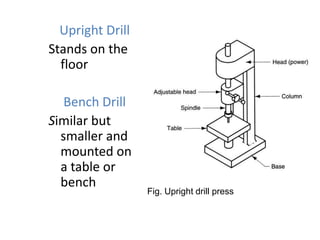
Upright Drill
Stands on the
floor
Bench Drill
Similar but
smaller and
mounted on
a table or
bench

Fig. Upright drill press
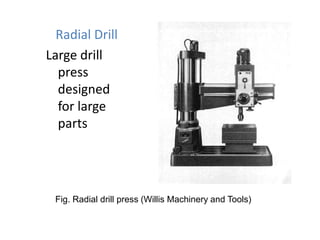
Radial Drill
Large drill
press
designed
for large
parts

Fig. Radial drill press (Willis Machinery and Tools)
Work Holding for Drill Presses
• Workpart can be clamped in a vise, fixture, or
jig
– Vise - general purpose workholder with two jaws
– Fixture - workholding device that is usually
custom-designed for the particular workpart
– Drill jig – similar to fixture but also provides a
means of guiding the tool during drilling
Milling
Machining operation in which work is fed past
a rotating tool with multiple cutting edges
• Axis of tool rotation is perpendicular to feed
direction
• Creates a planar surface; other geometries
possible either by cutter path or shape
• Other factors and terms:
– Milling is an interrupted cutting operation
– Cutting tool called a milling cutter, cutting edges
called "teeth"
– Machine tool called a milling machine
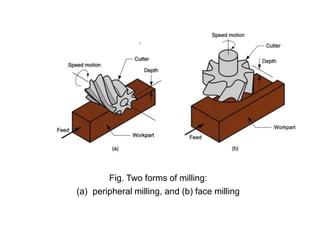
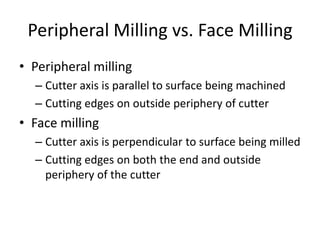
Fig. Two forms of milling:
(a) peripheral milling, and (b) face milling
Peripheral Milling vs. Face Milling
• Peripheral milling
– Cutter axis is parallel to surface being machined
– Cutting edges on outside periphery of cutter

• Face milling
– Cutter axis is perpendicular to surface being milled
– Cutting edges on both the end and outside
periphery of the cutter
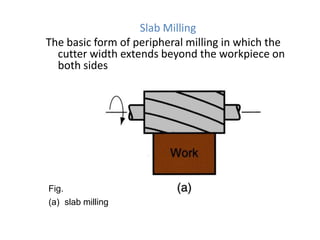
Slab Milling
The basic form of peripheral milling in which the
cutter width extends beyond the workpiece on
both sides

Fig.
(a) slab milling
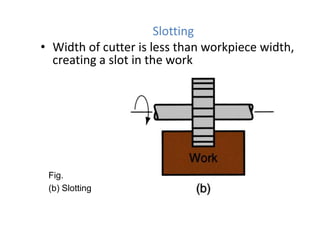
Slotting
• Width of cutter is less than workpiece width,
creating a slot in the work

Fig.
(b) Slotting
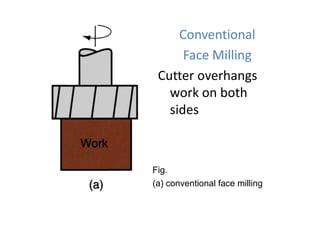
Conventional
Face Milling
Cutter overhangs
work on both
sides

Fig.
(a) conventional face milling
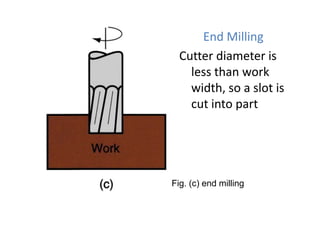
End Milling
Cutter diameter is
less than work
width, so a slot is
cut into part

Fig. (c) end milling
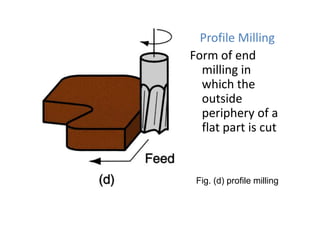
Profile Milling
Form of end
milling in
which the
outside
periphery of a
flat part is cut

Fig. (d) profile milling
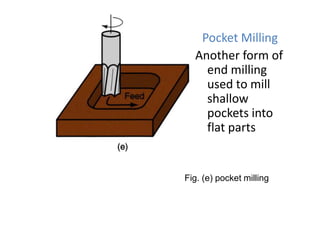
Pocket Milling
Another form of
end milling
used to mill
shallow
pockets into
flat parts

Fig. (e) pocket milling
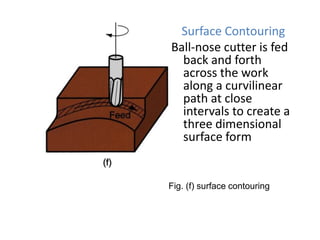
Surface Contouring
Ball-nose cutter is fed
back and forth
across the work
along a curvilinear
path at close
intervals to create a
three dimensional
surface form

Fig. (f) surface contouring
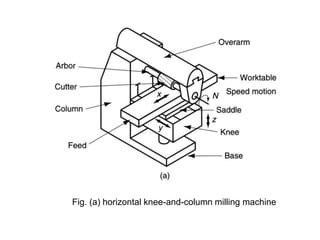
Fig. (a) horizontal knee-and-column milling machine
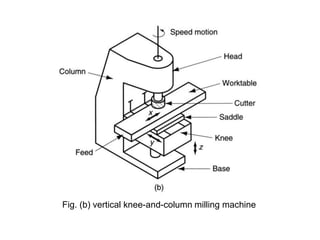
Fig. (b) vertical knee-and-column milling machine
Machining Centers
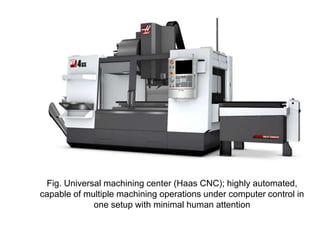
Highly automated machine tool capable of
performing multiple machining operations
under CNC control in one setup with
minimal human attention
– Typical operations are milling and drilling
– Three, four, or five axes

• Other features:
– Automatic tool-changing
– Pallet shuttles
– Automatic workpart positioning
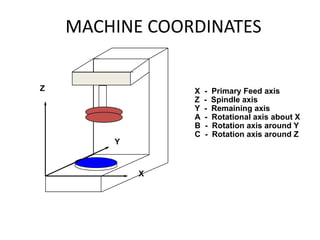
MACHINE COORDINATES
Z

X
Z
Y
A
B
C
Y

X

-

Primary Feed axis
Spindle axis
Remaining axis
Rotational axis about X
Rotation axis around Y
Rotation axis around Z
Fig. Universal machining center (Haas CNC); highly automated,
capable of multiple machining operations under computer control in
one setup with minimal human attention
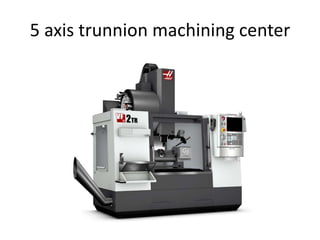
5 axis trunnion machining center
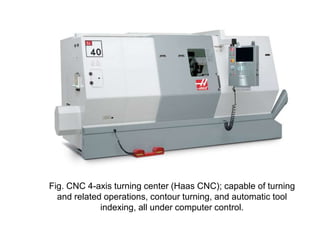
Fig. CNC 4-axis turning center (Haas CNC); capable of turning
and related operations, contour turning, and automatic tool
indexing, all under computer control.
Mill-Turn Centers
Highly automated machine tool that can perform
turning, milling, and drilling operations on a
workpart
• General configuration of a turning center
• Can position a cylindrical workpart at a specified
angle so a rotating cutting tool (e.g., milling
cutter) can machine features into outside surface
of part
– A conventional turning center cannot stop workpart at
a defined angular position and does not possess
rotating tool spindles
Fig. Operation of a mill-turn center: (a) example part with turned, milled,
and drilled surfaces; and (b) sequence of operations on a mill-turn
center: (1) turn second diameter,
(2) mill flat with part in programmed angular position, (3) drill hole with
part in same programmed position, and (4) cutoff
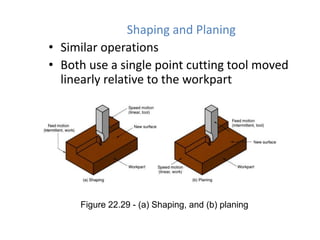
Shaping and Planing
• Similar operations
• Both use a single point cutting tool moved
linearly relative to the workpart

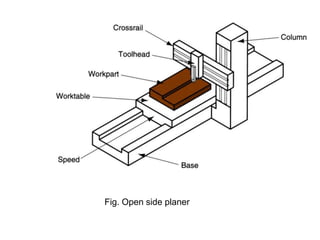
Figure 22.29 - (a) Shaping, and (b) planing
Shaping and Planing
• A straight, flat surface is created in both
operations
• Interrupted cutting
– Subjects tool to impact loading when entering
work

• Low cutting speeds due to start-and-stop
motion
• Usual tooling: single point high speed steel
tools
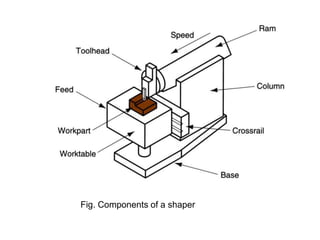
Fig. Components of a shaper
Fig. Open side planer
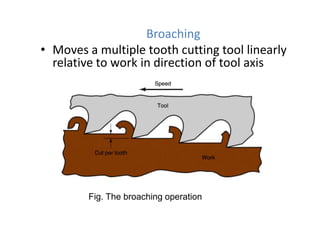
Broaching
• Moves a multiple tooth cutting tool linearly
relative to work in direction of tool axis

Fig. The broaching operation
Broaching
Advantages:
• Good surface finish
• Close tolerances
• Variety of work shapes possible
Cutting tool called a broach
• Owing to complicated and often
custom-shaped geometry, tooling is expensive
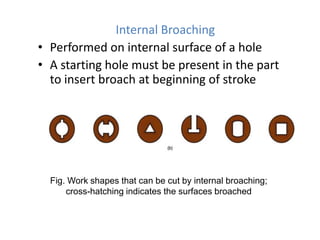
Internal Broaching
• Performed on internal surface of a hole
• A starting hole must be present in the part
to insert broach at beginning of stroke

Fig. Work shapes that can be cut by internal broaching;
cross-hatching indicates the surfaces broached
Sawing
• Cuts narrow slit in work by a tool consisting of
a series of narrowly spaced teeth
• Tool called a saw blade
• Typical functions:
– Separate a workpart into two pieces
– Cut off unwanted portions of part
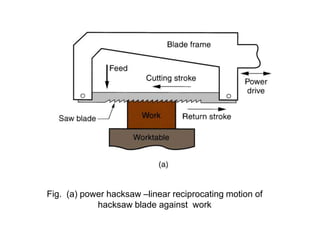
Fig. (a) power hacksaw –linear reciprocating motion of
hacksaw blade against work
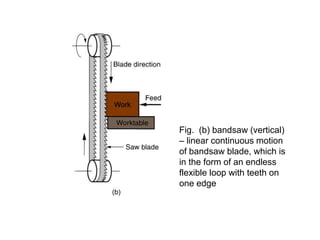
Fig. (b) bandsaw (vertical)
– linear continuous motion
of bandsaw blade, which is
in the form of an endless
flexible loop with teeth on
one edge
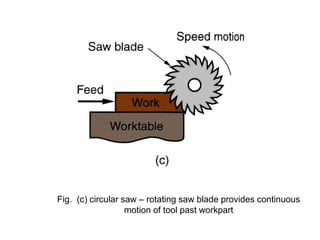
Fig. (c) circular saw – rotating saw blade provides continuous
motion of tool past workpart
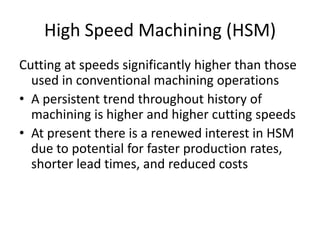
High Speed Machining (HSM)
Cutting at speeds significantly higher than those
used in conventional machining operations
• A persistent trend throughout history of
machining is higher and higher cutting speeds
• At present there is a renewed interest in HSM
due to potential for faster production rates,
shorter lead times, and reduced costs
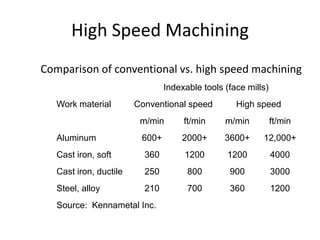
High Speed Machining
Comparison of conventional vs. high speed machining
Indexable tools (face mills)
Work material

Conventional speed

High speed

m/min

ft/min

m/min

ft/min

Aluminum

600+

2000+

3600+

12,000+

Cast iron, soft

360

1200

1200

4000

Cast iron, ductile

250

800

900

3000

Steel, alloy

210

700

360

1200

Source: Kennametal Inc.
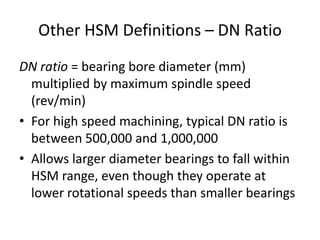
Other HSM Definitions – DN Ratio
DN ratio = bearing bore diameter (mm)
multiplied by maximum spindle speed
(rev/min)
• For high speed machining, typical DN ratio is
between 500,000 and 1,000,000
• Allows larger diameter bearings to fall within
HSM range, even though they operate at
lower rotational speeds than smaller bearings
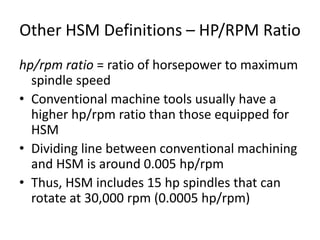
Other HSM Definitions – HP/RPM Ratio
hp/rpm ratio = ratio of horsepower to maximum
spindle speed
• Conventional machine tools usually have a
higher hp/rpm ratio than those equipped for
HSM
• Dividing line between conventional machining
and HSM is around 0.005 hp/rpm
• Thus, HSM includes 15 hp spindles that can
rotate at 30,000 rpm (0.0005 hp/rpm)
Other HSM Definitions
• Emphasize:
– Higher production rates
– Shorter lead times
– Rather than functions of spindle speed

• Important non-cutting factors:
– Rapid traverse speeds
– Automatic tool changes
Requirements for High Speed
Machining
• Special bearings designed for high rpm
• High feed rate capability (e.g., 50 m/min)
• CNC motion controls with “look-ahead” features
to avoid “undershooting” or “overshooting” tool
path
• Balanced cutting tools, toolholders, and spindles
to minimize vibration
• Coolant delivery systems that provide higher
pressures than conventional machining
• Chip control and removal systems to cope with
much larger metal removal rates
High Speed Machining
Applications

• Aircraft industry, machining of large airframe
components from large aluminum blocks
– Much metal removal, mostly by milling

• Multiple machining operations on aluminum to
produce automotive, computer, and medical
components
– Quick tool changes and tool path control
important

• Die and mold industry
– Fabricating complex geometries from hard
materials
Process equipment
• Multi-axis kinematic systems
– Prismatic – Cartesian based
• Milling
• Drilling
• Machining centers

– Turing centers – Polar based
• Lathes
• Turning centers

– Hybrids
• Mill turns

Machining Operations

  • 1.
    MACHINING OPERATIONS AND MACHINETOOLS • • • • • • Turning and Related Operations Drilling and Related Operations Milling Machining Centers and Turning Centers Other Machining Operations High Speed Machining ISE 316 - Manufacturing Processes Engineering
  • 2.
    Machining A material removalprocess in which a sharp cutting tool is used to mechanically cut away material so that the desired part geometry remains • Most common application: to shape metal parts • Machining is the most versatile and accurate of all manufacturing processes in its capability to produce a diversity of part geometries and geometric features – Casting can also produce a variety of shapes, but it lacks the precision and accuracy of machining ISE 316 - Manufacturing Processes Engineering
  • 3.
    Classification of MachinedParts 1. Rotational - cylindrical or disk-like shape 2. Non-rotational (also called prismatic) block-like or plate-like Fig. Machined parts are classified as: (a) rotational, or (b) non-rotational, shown here by block and flat parts
  • 4.
    Machining Operations andPart Geometry Each machining operation produces a characteristic part geometry due to two factors: 1. Relative motions between the tool and the workpart • Generating – part geometry is determined by the feed trajectory of the cutting tool 2. Shape of the cutting tool • Forming – part geometry is created by the shape of the cutting tool
  • 5.
    Fig. Generating shape:(a) straight turning, (b) taper turning, (c) contour turning, (d) plain milling, (e) profile milling
  • 6.
    Fig. Forming tocreate shape: (a) form turning, (b) drilling, and (c) broaching
  • 7.
    Fig. Combination offorming and generating to create shape: (a) thread cutting on a lathe, and (b) slot milling
  • 8.
    Turning A single pointcutting tool removes material from a rotating workpiece to generate a cylindrical shape • Performed on a machine tool called a lathe • Variations of turning that are performed on a lathe: – – – – – Facing Contour turning Chamfering Cutoff Threading
  • 9.
  • 10.
    Facing Tool is fedradially inward Fig. (a) facing
  • 11.
    Contour Turning Instead offeeding the tool parallel to the axis of rotation, tool follows a contour that is other than straight, thus creating a contoured form Fig. (c) contour turning
  • 12.
    Chamfering Cutting edge cutsan angle on the corner of the cylinder, forming a "chamfer" Fig. (e) chamfering
  • 13.
    Cutoff Tool is fedradially into rotating work at some location to cut off end of part Fig. (f) cutoff
  • 14.
    Threading Pointed form toolis fed linearly across surface of rotating workpart parallel to axis of rotation at a large feed rate, thus creating threads Fig. (g) threading
  • 15.
    Fig. Diagram ofan engine lathe, showing its principal components
  • 16.
    Methods of Holdingthe Work in a Lathe • • • • Holding the work between centers Chuck Collet Face plate
  • 17.
    Holding the WorkBetween Centers Fig. (a) mounting the work between centers using a "dog”
  • 18.
  • 19.
  • 20.
    Face Plate Fig. (d)face plate for non-cylindrical workparts
  • 21.
    Turret Lathe Tailstock replacedby “turret” that holds up to six tools • Tools rapidly brought into action by indexing the turret • Tool post replaced by four-sided turret to index four tools • Applications: high production work that requires a sequence of cuts on the part
  • 22.
    Chucking Machine • • • • • Uses chuckin its spindle to hold workpart Parts cannot be mounted between centers Cutting tool actions controlled automatically Operator’s job: to load and unload parts Applications: short, light-weight parts
  • 23.
    Bar Machine • Similarto chucking machine except collet replaces chuck, permitting long bar stock to be fed through headstock • At the end of the machining cycle, a cutoff operation separates the new part • Highly automated (the term automatic bar machine is often used) • Applications: high production of rotational parts
  • 24.
    Automatic Screw Machine •Same as automatic bar machine but smaller • Applications: high production of screws and similar small hardware items; hence, its name
  • 25.
    Multiple Spindle BarMachines • More than one spindle, so multiple parts machined simultaneously by multiple tools – Example: six spindle automatic bar machine works on six parts at a time • After each machining cycle, spindles (including collets and workbars) are indexed (rotated) to next position
  • 26.
    NEW NCs orCNCs •high speed spindle (> 40,000 rpm) •high feed rate drive ( > 600 ipm) •high precision ( < 0.0001" accuracy)
  • 27.
    Fig. (a) Partproduced on a six spindle automatic bar machine; and (b) sequence of operations to produce the part: (1) feed stock to stop, (2) turn main diameter, (3) form second diameter and spotface, (4) drill, (5) chamfer, and (6) cutoff
  • 28.
    Boring • Difference betweenboring and turning: – Boring is performed on the inside diameter of an existing hole – Turning is performed on the outside diameter of an existing cylinder • In effect, boring is an internal turning operation • Boring machines – Horizontal or vertical - refers to the orientation of the axis of rotation of machine spindle
  • 29.
    Fig. A verticalboring mill –for large, heavy workparts
  • 30.
    • • • • Drilling Creates a roundhole in a workpart Contrasts with boring which can only enlarge an existing hole Cutting tool called a drill or drill bit Customarily performed on a drill press Fig. (b) drilling
  • 31.
    Through Holes vs.Blind Holes Through-holes - drill exits the opposite side of work Blind-holes – drill does not exit work on opposite side Fig. Two hole types: (a) through-hole, and (b) blind hole
  • 32.
    Reaming Used to slightly enlargea hole, provide better tolerance on diameter, and improve surface finish Fig. Machining operations related to drilling: (a) Reaming
  • 33.
    Tapping Used to provide internalscrew threads on an existing hole Tool called a tap Fig. (b) tapping
  • 34.
    Counterboring Provides a stepped hole,in which a larger diameter follows a smaller diameter partially into the hole Fig. (c) counterboring
  • 35.
    Upright Drill Stands onthe floor Bench Drill Similar but smaller and mounted on a table or bench Fig. Upright drill press
  • 36.
    Radial Drill Large drill press designed forlarge parts Fig. Radial drill press (Willis Machinery and Tools)
  • 37.
    Work Holding forDrill Presses • Workpart can be clamped in a vise, fixture, or jig – Vise - general purpose workholder with two jaws – Fixture - workholding device that is usually custom-designed for the particular workpart – Drill jig – similar to fixture but also provides a means of guiding the tool during drilling
  • 38.
    Milling Machining operation inwhich work is fed past a rotating tool with multiple cutting edges • Axis of tool rotation is perpendicular to feed direction • Creates a planar surface; other geometries possible either by cutter path or shape • Other factors and terms: – Milling is an interrupted cutting operation – Cutting tool called a milling cutter, cutting edges called "teeth" – Machine tool called a milling machine
  • 39.
    Fig. Two formsof milling: (a) peripheral milling, and (b) face milling
  • 40.
    Peripheral Milling vs.Face Milling • Peripheral milling – Cutter axis is parallel to surface being machined – Cutting edges on outside periphery of cutter • Face milling – Cutter axis is perpendicular to surface being milled – Cutting edges on both the end and outside periphery of the cutter
  • 41.
    Slab Milling The basicform of peripheral milling in which the cutter width extends beyond the workpiece on both sides Fig. (a) slab milling
  • 42.
    Slotting • Width ofcutter is less than workpiece width, creating a slot in the work Fig. (b) Slotting
  • 43.
    Conventional Face Milling Cutter overhangs workon both sides Fig. (a) conventional face milling
  • 44.
    End Milling Cutter diameteris less than work width, so a slot is cut into part Fig. (c) end milling
  • 45.
    Profile Milling Form ofend milling in which the outside periphery of a flat part is cut Fig. (d) profile milling
  • 46.
    Pocket Milling Another formof end milling used to mill shallow pockets into flat parts Fig. (e) pocket milling
  • 47.
    Surface Contouring Ball-nose cutteris fed back and forth across the work along a curvilinear path at close intervals to create a three dimensional surface form Fig. (f) surface contouring
  • 48.
    Fig. (a) horizontalknee-and-column milling machine
  • 49.
    Fig. (b) verticalknee-and-column milling machine
  • 50.
    Machining Centers Highly automatedmachine tool capable of performing multiple machining operations under CNC control in one setup with minimal human attention – Typical operations are milling and drilling – Three, four, or five axes • Other features: – Automatic tool-changing – Pallet shuttles – Automatic workpart positioning
  • 51.
    MACHINE COORDINATES Z X Z Y A B C Y X - Primary Feedaxis Spindle axis Remaining axis Rotational axis about X Rotation axis around Y Rotation axis around Z
  • 52.
    Fig. Universal machiningcenter (Haas CNC); highly automated, capable of multiple machining operations under computer control in one setup with minimal human attention
  • 53.
    5 axis trunnionmachining center
  • 54.
    Fig. CNC 4-axisturning center (Haas CNC); capable of turning and related operations, contour turning, and automatic tool indexing, all under computer control.
  • 55.
    Mill-Turn Centers Highly automatedmachine tool that can perform turning, milling, and drilling operations on a workpart • General configuration of a turning center • Can position a cylindrical workpart at a specified angle so a rotating cutting tool (e.g., milling cutter) can machine features into outside surface of part – A conventional turning center cannot stop workpart at a defined angular position and does not possess rotating tool spindles
  • 56.
    Fig. Operation ofa mill-turn center: (a) example part with turned, milled, and drilled surfaces; and (b) sequence of operations on a mill-turn center: (1) turn second diameter, (2) mill flat with part in programmed angular position, (3) drill hole with part in same programmed position, and (4) cutoff
  • 57.
    Shaping and Planing •Similar operations • Both use a single point cutting tool moved linearly relative to the workpart Figure 22.29 - (a) Shaping, and (b) planing
  • 58.
    Shaping and Planing •A straight, flat surface is created in both operations • Interrupted cutting – Subjects tool to impact loading when entering work • Low cutting speeds due to start-and-stop motion • Usual tooling: single point high speed steel tools
  • 59.
  • 60.
  • 61.
    Broaching • Moves amultiple tooth cutting tool linearly relative to work in direction of tool axis Fig. The broaching operation
  • 62.
    Broaching Advantages: • Good surfacefinish • Close tolerances • Variety of work shapes possible Cutting tool called a broach • Owing to complicated and often custom-shaped geometry, tooling is expensive
  • 63.
    Internal Broaching • Performedon internal surface of a hole • A starting hole must be present in the part to insert broach at beginning of stroke Fig. Work shapes that can be cut by internal broaching; cross-hatching indicates the surfaces broached
  • 64.
    Sawing • Cuts narrowslit in work by a tool consisting of a series of narrowly spaced teeth • Tool called a saw blade • Typical functions: – Separate a workpart into two pieces – Cut off unwanted portions of part
  • 65.
    Fig. (a) powerhacksaw –linear reciprocating motion of hacksaw blade against work
  • 66.
    Fig. (b) bandsaw(vertical) – linear continuous motion of bandsaw blade, which is in the form of an endless flexible loop with teeth on one edge
  • 67.
    Fig. (c) circularsaw – rotating saw blade provides continuous motion of tool past workpart
  • 68.
    High Speed Machining(HSM) Cutting at speeds significantly higher than those used in conventional machining operations • A persistent trend throughout history of machining is higher and higher cutting speeds • At present there is a renewed interest in HSM due to potential for faster production rates, shorter lead times, and reduced costs
  • 69.
    High Speed Machining Comparisonof conventional vs. high speed machining Indexable tools (face mills) Work material Conventional speed High speed m/min ft/min m/min ft/min Aluminum 600+ 2000+ 3600+ 12,000+ Cast iron, soft 360 1200 1200 4000 Cast iron, ductile 250 800 900 3000 Steel, alloy 210 700 360 1200 Source: Kennametal Inc.
  • 70.
    Other HSM Definitions– DN Ratio DN ratio = bearing bore diameter (mm) multiplied by maximum spindle speed (rev/min) • For high speed machining, typical DN ratio is between 500,000 and 1,000,000 • Allows larger diameter bearings to fall within HSM range, even though they operate at lower rotational speeds than smaller bearings
  • 71.
    Other HSM Definitions– HP/RPM Ratio hp/rpm ratio = ratio of horsepower to maximum spindle speed • Conventional machine tools usually have a higher hp/rpm ratio than those equipped for HSM • Dividing line between conventional machining and HSM is around 0.005 hp/rpm • Thus, HSM includes 15 hp spindles that can rotate at 30,000 rpm (0.0005 hp/rpm)
  • 72.
    Other HSM Definitions •Emphasize: – Higher production rates – Shorter lead times – Rather than functions of spindle speed • Important non-cutting factors: – Rapid traverse speeds – Automatic tool changes
  • 73.
    Requirements for HighSpeed Machining • Special bearings designed for high rpm • High feed rate capability (e.g., 50 m/min) • CNC motion controls with “look-ahead” features to avoid “undershooting” or “overshooting” tool path • Balanced cutting tools, toolholders, and spindles to minimize vibration • Coolant delivery systems that provide higher pressures than conventional machining • Chip control and removal systems to cope with much larger metal removal rates
  • 74.
    High Speed Machining Applications •Aircraft industry, machining of large airframe components from large aluminum blocks – Much metal removal, mostly by milling • Multiple machining operations on aluminum to produce automotive, computer, and medical components – Quick tool changes and tool path control important • Die and mold industry – Fabricating complex geometries from hard materials
  • 75.
    Process equipment • Multi-axiskinematic systems – Prismatic – Cartesian based • Milling • Drilling • Machining centers – Turing centers – Polar based • Lathes • Turning centers – Hybrids • Mill turns