UNIT - IV
ABRASIVE PROCESS AND BROACHING
Abrasive processes: grinding wheel – specifications and selection,
types of grinding process– cylindrical grinding, surface grinding,
centreless grinding and internal grinding- Typical applications –
concepts of surface integrity, broaching machines: broach
construction – push, pull, surface and continuous broaching
machines
ABRASIVE PROCESS
Grinding is mainly used for the following purposes:
To remove small amount of metal from the work pieces
and finish them to close tolerances
To obtain a better surface finish
Sharpening of cutting tools
GRINDING WHEEL
Grinding wheels are made up of small abrasive particles
held together by bonding materials.
Grinding wheel abrasives
Natural abrasives
Artificial abrasives
Natural Abrasives
These are produced by uncontrolled forces of nature. These are
obtained from mines.
 Sandstone or solid quartz
 Emery (50 to 60% crystalline Al2o3 + iron oxide)
 Corundum (75 to 90% crystalline Al2o3 + Iron oxide)
 diamond
Artificial Abrasives
 These are manufactured under controlled conditions in
closed electric furnace in order to avoid the introduction of
impurities and to achieve the necessary temperature for the
chemical reaction to take place.
Aluminium oxide
Silicon carbide
Artificial diamond
Boron carbide
Cubic boron nitride
TYPES OF BOND
Bond is an adhesive substance which holds the abrasive
grains together to form the grinding wheel.
Bonds are classified into two types.
Organic
Non - organic
Organic
Resinoid bond
Rubber bond
Shellac bond
Oxy chloride bond
Non - organic
Vitrified bond
Silicate bonds
SPECIFICATION OF GRINDING
WHEEL
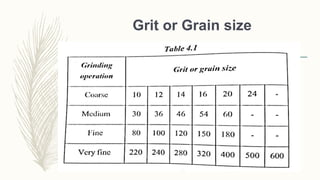
Grit or Grain size
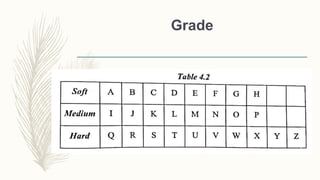
Grade
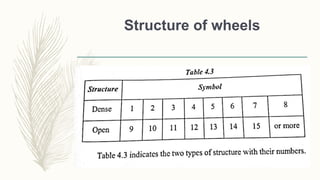
Structure of wheels
Grit or Grain size
Grade
Structure of wheels
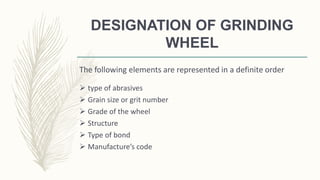
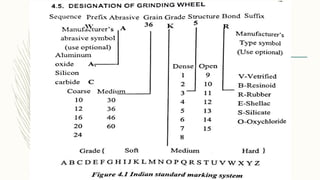
DESIGNATION OF GRINDING
WHEEL
The following elements are represented in a definite order
 type of abrasives
 Grain size or grit number
 Grade of the wheel
 Structure
 Type of bond
 Manufacture’s code
SELECTION OF GRINDING
WHEEL
The selection of a proper grinding wheel very important
for getting the best results in grinding work.
The grinding wheel selection will depend the following
factors
Constant factors
Variable factors
Constant factors
Physical properties of material to be ground
Amount and rate of stock to be removed
Areas of contact
Type of grinding machine
Variable factors
Work speed
Wheel speed
Condition of the grinding machine
Personal factors
RECONDITIONING OF
GRINDING WHEEL
Dressing
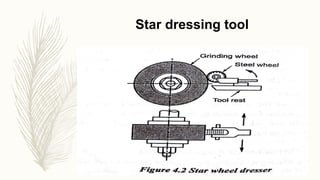
Star dressing tool
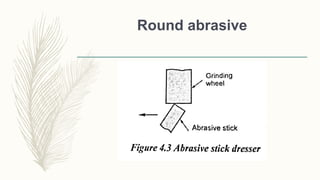
Round abrasive
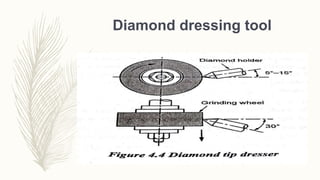
Diamond dressing tool
Truing
Star dressing tool
Round abrasive
Diamond dressing tool
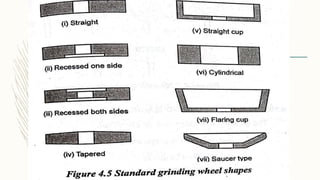
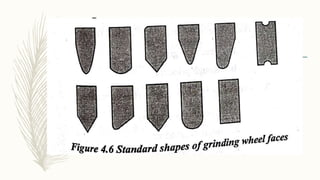
SHAPES OF GRINDING WHEEL
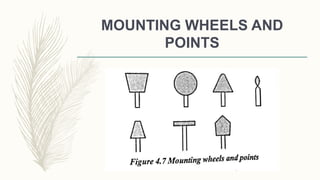
MOUNTING WHEELS AND
POINTS
TYPE OF GRINDING MACHINES
According to the type of operation
According to the quality of surface finish
According to the type of surface generated
Further classification
Rough grinders
 Floor stand grinders
 Bench grinders
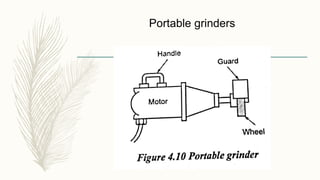
 Portable grinders
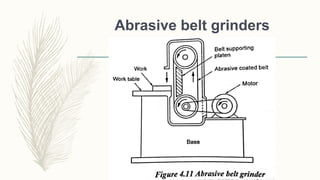
 Abrasive belt grinders
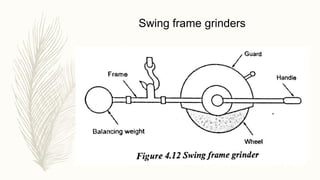
 Swing frame grinders
Precision grinders
 Cylindrical grinders
 Internal grinders
 Surface grinders
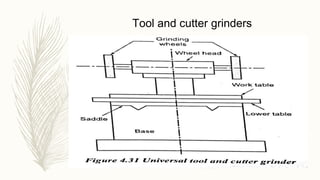
 Tool and cutter grinders
 Special grinders
Rough grinders
Rough grinders are mainly used for removing large
amount of metal from the work piece. Therefore the
surface finish and the accuracy in dimension are not
high.
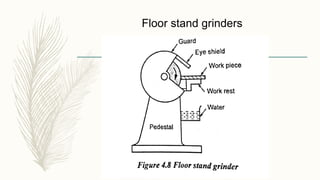
Floor stand grinders
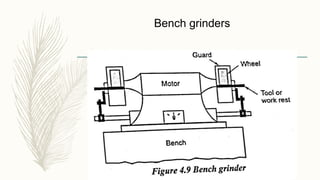
Bench grinders
Portable grinders
Abrasive belt grinders
Swing frame grinders
Precision grinders
Precision grinders are used to manufacture parts of
accurate dimensions and good surface finish. The work
piece and the grinding wheel are rigidly mounted but
they are adjustable according to the requirement of the
machining methods
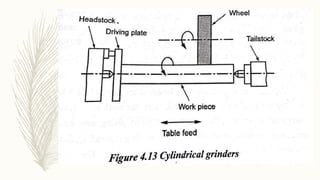
Cylindrical grinders
There are four movements in a cylindrical centre type
grinding.
Rotation of cylindrical work piece about its axis
Rotation of the grinding wheel about its axis
Longitudinal feed movement of the work past the wheel
face
Movement of the wheel into the work perpendicular to
the axis of the work piece to give depth of cut
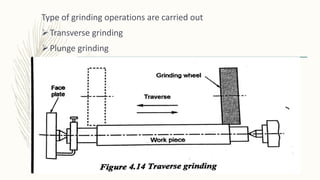
Type of grinding operations are carried out
Transverse grinding
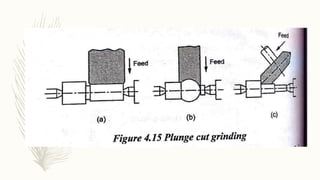
Plunge grinding
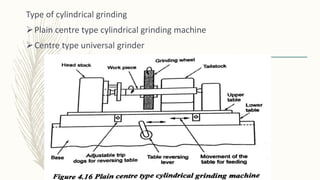
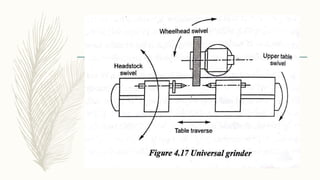
Type of cylindrical grinding
Plain centre type cylindrical grinding machine
Centre type universal grinder
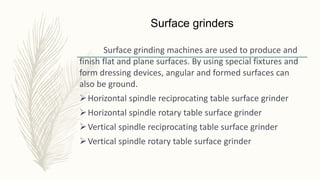
Surface grinders
Surface grinding machines are used to produce and
finish flat and plane surfaces. By using special fixtures and
form dressing devices, angular and formed surfaces can
also be ground.
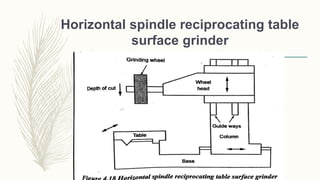
Horizontal spindle reciprocating table surface grinder
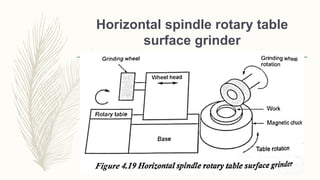
Horizontal spindle rotary table surface grinder
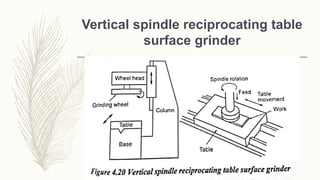
Vertical spindle reciprocating table surface grinder
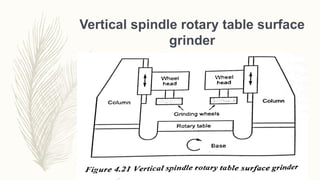
Vertical spindle rotary table surface grinder
Horizontal spindle reciprocating table
surface grinder
Horizontal spindle rotary table
surface grinder
Vertical spindle reciprocating table
surface grinder
Vertical spindle rotary table surface
grinder
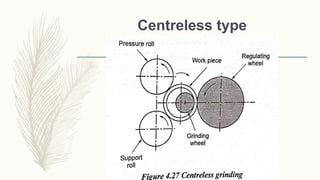
CENTRELESS GRINDERS
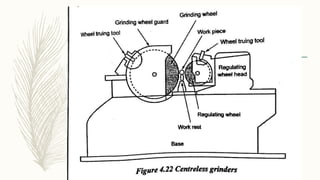
– Centreless grinding is performed on work pieces which
do not have centres, such as pistons, valves, rings, shafts
etc. centreless grinding can be done on both external
and internal cylindrical surfaces.
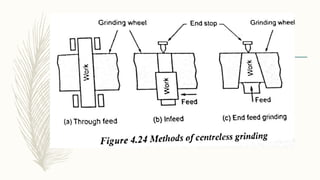
METHODS OF EXTERNAL
CENTRELESS GRINDING
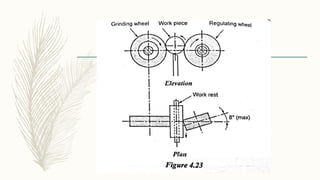
There are three different methods
Through feed
In feed
End feed
Internal grinders
There are three types of internal grinders
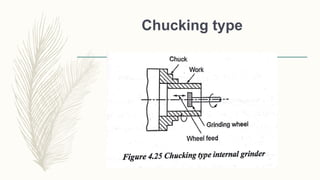
Chucking type
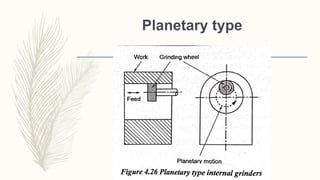
Planetary type
Centreless type
Chucking type
Planetary type
Centreless type
TYPICAL APPLICATIONS OF
GRINDING MACHINES
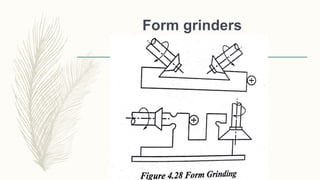
Form grinders
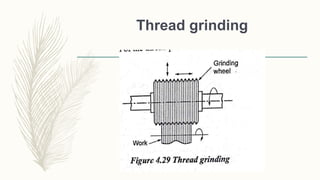
Thread grinding
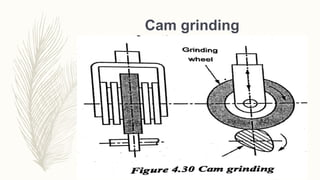
Cam grinding
Tool and cutter grinding
Form grinders
Thread grinding
Cam grinding
Tool and cutter grinders
CUTTING FLUIDS IN GRINDING
It cools the workpiece
It acts as a lubricant and reduces friction between chips,
workpiece and grinding wheel.
It removes chips from the contact area
CONCEPTS OF SURFACE
INTEGRITY
Surface integrity is the surface condition of a workpiece
after completing by a particular manufacturing process. In
grinding process, the surface integrity of ground specimen is
analysed.
Classification of surface integrity
Traditional process
Non traditional process
Finishing treatment
BROACHING
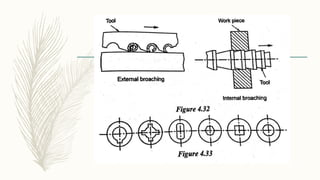
 Broaching is a process of machining a surface with a special
multipoint cutting tool called broach which has successively higher
cutting edges in a fixed path.
 It is a faster and cheaper method of machining but the depth of
removed material is limited to 6mm or less.
 Broaching the inside surface is called “internal or hole broaching”
and the outside surface is known as “surface broaching”.
SPECIFICATION OF A
BROACHING MACHINE
 Maximum length of stroke in mm.
 Maximum force developed by the slide in tonnes.
 Power rating of electric motor in H.P
 Speed and feed ranges
 Weight of the machine
 Floor space required
ADVANTAGES OF BROACHING
 Roughing , semi-finishing and finishing cuts are completed in one
pass of the broach.
 Broaching can be used for either external or internal surface
finishing processes.
 Semi skilled worker can perform a broaching operation
 Broaching is mostly adopted for mass production.
LIMITATIONS
 Initial cost of the broach tool is high when compared to other
tools
 Broaching is not suitable for the removal of large amount of stock.
 Almost all the work pieces will need the fixture for rigid support.
TYPES OF BROACHING
MACHINE
 Horizontal broaching machine
 Vertical broaching machine
 Continuous broaching machine
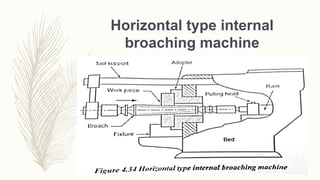
Horizontal broaching machine
 Horizontal type internal broaching machine
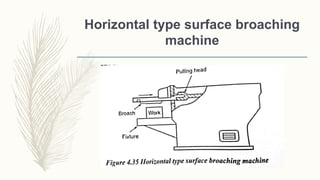
 Horizontal type surface broaching machine
Horizontal type internal
broaching machine
Horizontal type surface broaching
machine
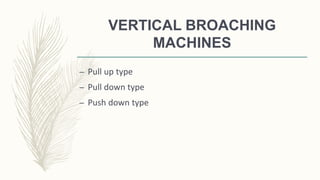
VERTICAL BROACHING
MACHINES
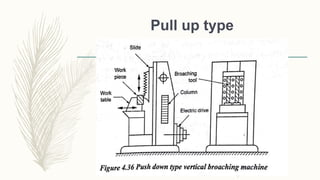
– Pull up type
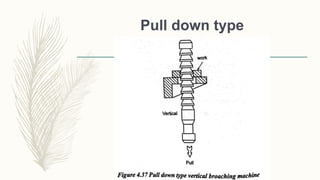
– Pull down type
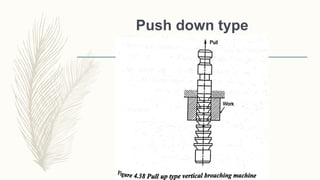
– Push down type
Pull up type
Pull down type
Push down type
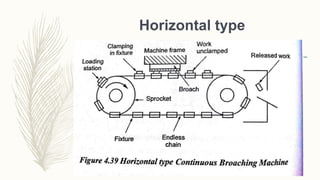
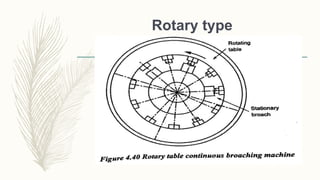
CONTINUOUS BROACHING
MACHINE
– Horizontal type
– Vertical type
– Rotary type
Horizontal type
Rotary type
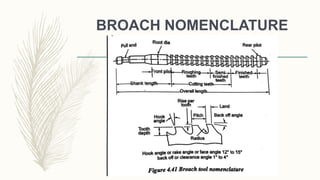
BROACH NOMENCLATURE
TYPE OF BROACHING TOOLS
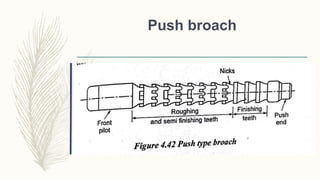
 Push broach
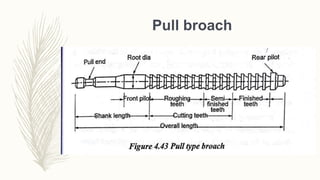
 Pull broach
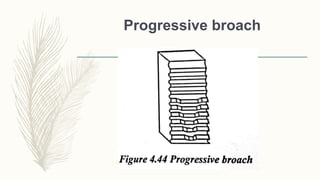
 Progressive broach
Push broach
Pull broach
Progressive broach
BROACHING OPERATIONS
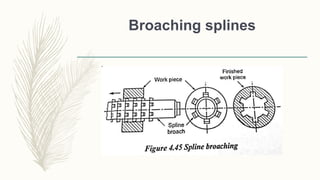
– Broaching splines
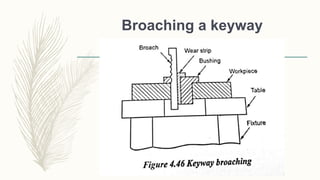
– Broaching a keyway
Broaching splines
Broaching a keyway
ABRASIVE AND BROACHING

ABRASIVE AND BROACHING