1
A certain device for analyzing
electromagnetic radiation is
based on the Bragg scattering
of the radiation from a crystal.
For radiation of wavelength
0.149 nm, the first-order Bragg
peak appears centered at an
angle of 15.15◦
. The aperture of
the analyzer passes radiation
in the angular range of 0.015◦
.
What is the corresponding
range of wavelengths passing
through the analyzer?
Helping Tools
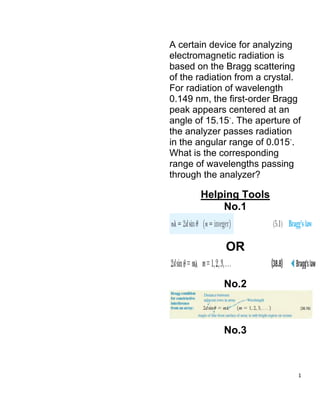
No.1
OR
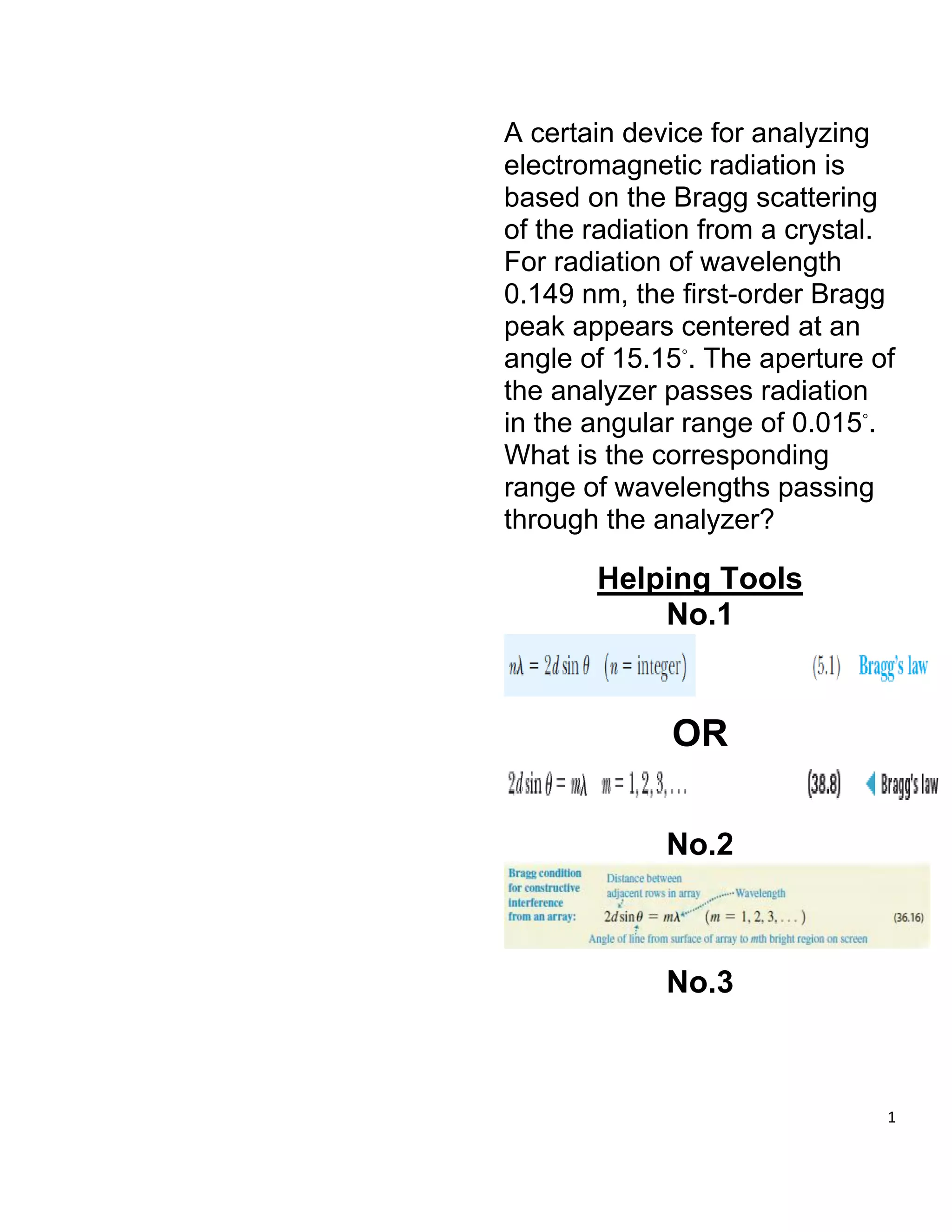
No.2
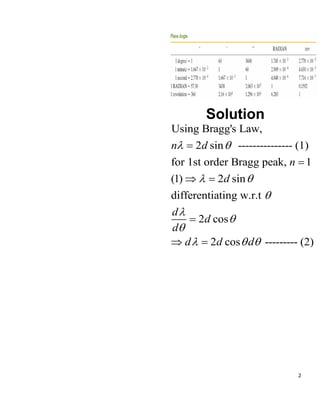
No.3
2
Solution
Using Bragg's Law,
2 sin --------------- (1)
for 1st order Bragg peak, 1
(1) 2 sin
differentiating w.r.t
2 cos
2 cos --------- (2)
n d
n
d
d
d
d
d d d
 
 




  
=
=
 =
=
 =
3
,
2 sin
2sin
(2) 2( )cos
2sin
cot -------- (3)
Now
d d
d d
d d

 


  

   
=  =
 =
 =
9
4
4
4
Using
0.149 0.149 10
cot15.15 3.69
0.015
0.015
57.30
2.6178 10
in eq.(3), we get
0.149 3.69 2.6178 10
0.0001439 1.439 10
nm X m
d rad
X rad
d nmX X X
nm X nm



−
−
−
−
= =
=
= =
=
=
= =

Bragg Scattering.pdf

  • 1.
    1 A certain devicefor analyzing electromagnetic radiation is based on the Bragg scattering of the radiation from a crystal. For radiation of wavelength 0.149 nm, the first-order Bragg peak appears centered at an angle of 15.15◦ . The aperture of the analyzer passes radiation in the angular range of 0.015◦ . What is the corresponding range of wavelengths passing through the analyzer? Helping Tools No.1 OR No.2 No.3
  • 2.
    2 Solution Using Bragg's Law, 2sin --------------- (1) for 1st order Bragg peak, 1 (1) 2 sin differentiating w.r.t 2 cos 2 cos --------- (2) n d n d d d d d d d            = =  = =  =
  • 3.
    3 , 2 sin 2sin (2) 2()cos 2sin cot -------- (3) Now d d d d d d              =  =  =  = 9 4 4 4 Using 0.149 0.149 10 cot15.15 3.69 0.015 0.015 57.30 2.6178 10 in eq.(3), we get 0.149 3.69 2.6178 10 0.0001439 1.439 10 nm X m d rad X rad d nmX X X nm X nm    − − − − = = = = = = = = =