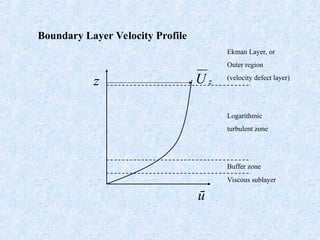
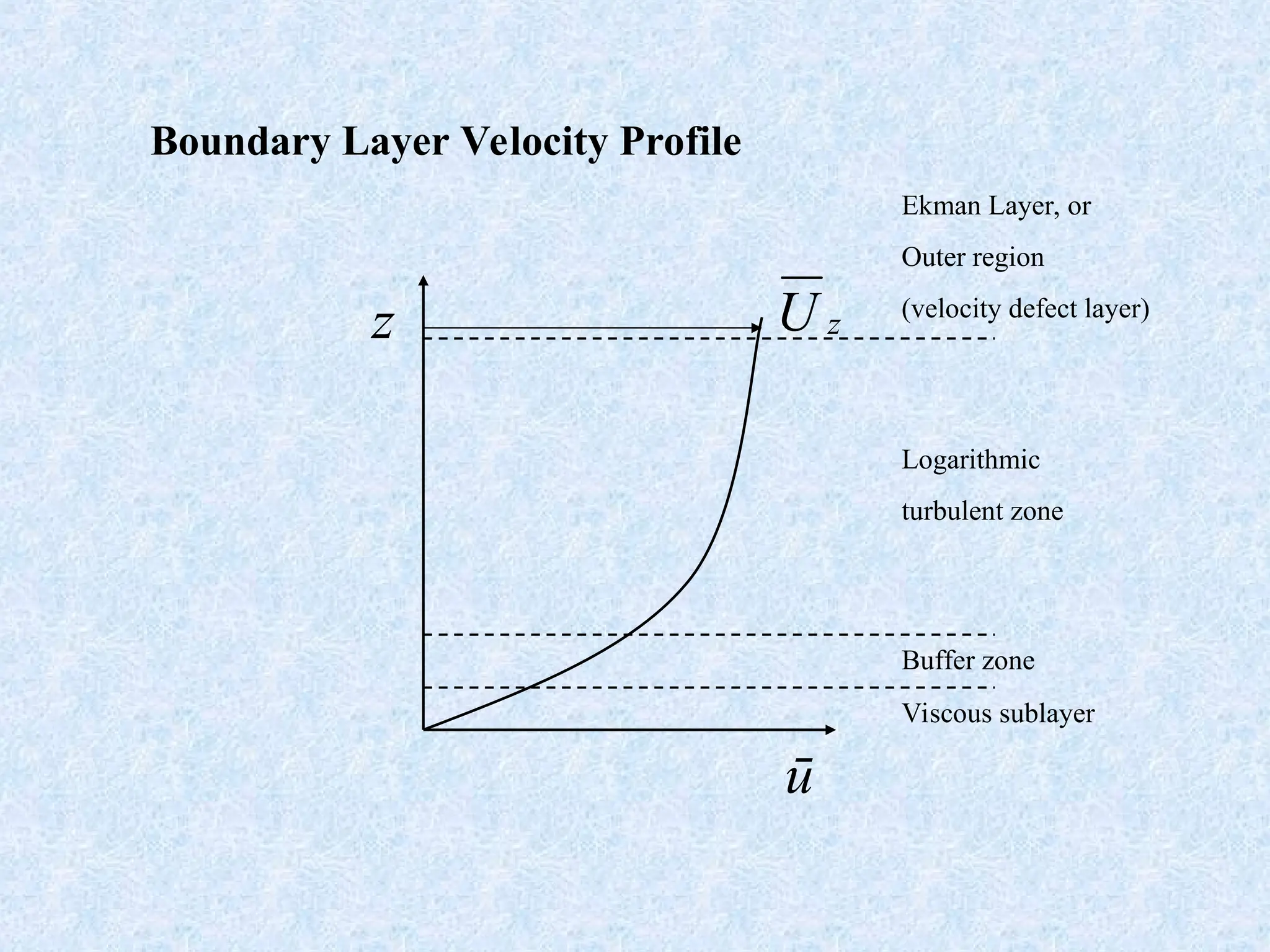
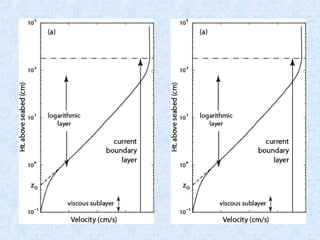
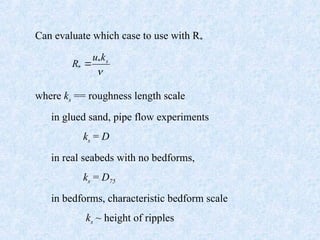
Boundary Layer Velocity Profile
z
ū
z
U
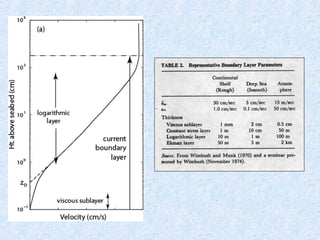
Viscous sublayer
Buffer zone
Logarithmic
turbulent zone
Ekman Layer, or
Outer region
(velocity defect layer)
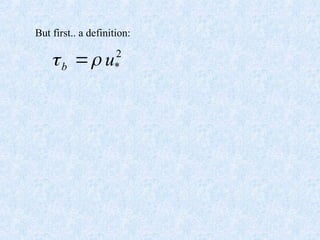
But first.. a definition:
2
*
u
b 
 
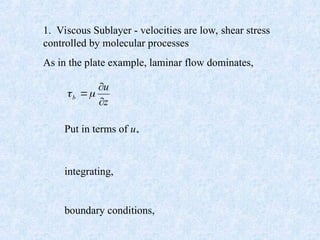
1. Viscous Sublayer - velocities are low, shear stress
controlled by molecular processes
As in the plate example, laminar flow dominates,
z
u
b




Put in terms of u*
integrating,
boundary conditions,
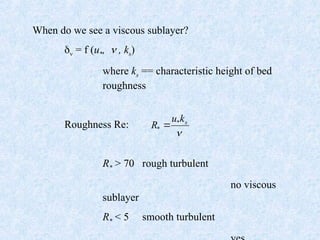
When do we see a viscous sublayer?
v = f (u*,  , ks)
where ks == characteristic height of bed
roughness
Roughness Re:
R* > 70 rough turbulent
no viscous
sublayer
R* < 5 smooth turbulent

s
k
u
R *
* 
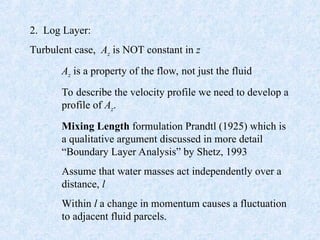
2. Log Layer:
Turbulent case, Az is NOT constant in z
Az is a property of the flow, not just the fluid
To describe the velocity profile we need to develop a
profile of Az.
Mixing Length formulation Prandtl (1925) which is
a qualitative argument discussed in more detail
“Boundary Layer Analysis” by Shetz, 1993
Assume that water masses act independently over a
distance, l
Within l a change in momentum causes a fluctuation
to adjacent fluid parcels.
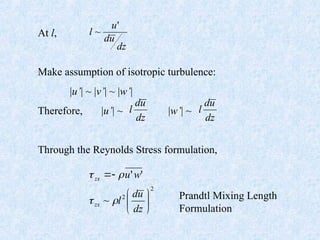
At l,
Make assumption of isotropic turbulence:
|u’| ~ |v’| ~ |w’|
Therefore, |u’| ~ |w’| ~
Through the Reynolds Stress formulation,
dz
u
d
u
l
'
~
dz
u
d
l
dz
u
d
l
2
2
~
'
'








dz
u
d
l
w
u
zx
zx




Prandtl Mixing Length
Formulation
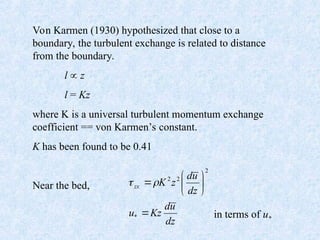
Von Karmen (1930) hypothesized that close to a
boundary, the turbulent exchange is related to distance
from the boundary.
l  z
l = Kz
where K is a universal turbulent momentum exchange
coefficient == von Karmen’s constant.
K has been found to be 0.41
Near the bed,
dz
u
d
Kz
u
dz
u
d
z
K
zx








*
2
2
2


in terms of u*
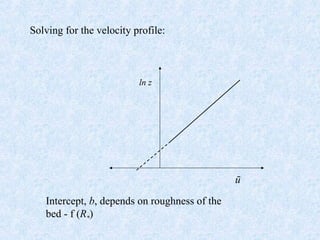
Solving for the velocity profile:
ln z
ū
Intercept, b, depends on roughness of the
bed - f (R*)
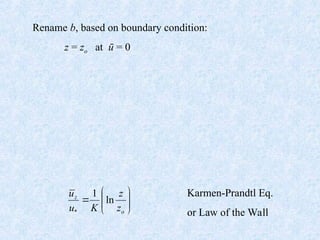
Rename b, based on boundary condition:
z = zo at ū = 0
Karmen-Prandtl Eq.
or Law of the Wall









o
z
z
z
K
u
u
ln
1
*
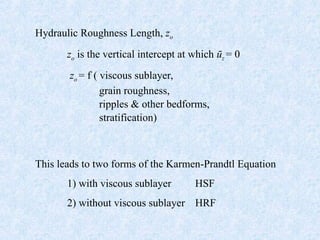
Hydraulic Roughness Length, zo
zo is the vertical intercept at which ūz = 0
zo = f ( viscous sublayer,
grain roughness,
ripples & other bedforms,
stratification)
This leads to two forms of the Karmen-Prandtl Equation
1) with viscous sublayer HSF
2) without viscous sublayer HRF
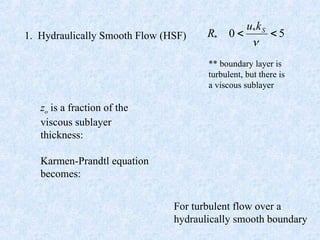
Can evaluate which case to use with R*
where ks == roughness length scale
in glued sand, pipe flow experiments
ks = D
in real seabeds with no bedforms,
ks = D75
in bedforms, characteristic bedform scale
ks ~ height of ripples

s
k
u
R *
* 
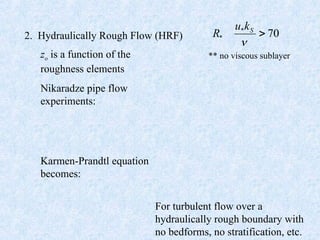
1. Hydraulically Smooth Flow (HSF) 5
0 *
* 


S
k
u
R
** boundary layer is
turbulent, but there is
a viscous sublayer
zo is a fraction of the
viscous sublayer
thickness:
Karmen-Prandtl equation
becomes:
For turbulent flow over a
hydraulically smooth boundary
2. Hydraulically Rough Flow (HRF) 70
*
* 

S
k
u
R
** no viscous sublayer
zo is a function of the
roughness elements
Nikaradze pipe flow
experiments:
Karmen-Prandtl equation
becomes:
For turbulent flow over a
hydraulically rough boundary with
no bedforms, no stratification, etc.
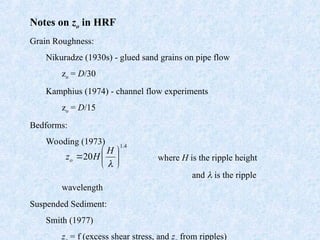
Notes on zo in HRF
Grain Roughness:
Nikuradze (1930s) - glued sand grains on pipe flow
zo = D/30
Kamphius (1974) - channel flow experiments
zo = D/15
Bedforms:
Wooding (1973)
where H is the ripple height
and  is the ripple
wavelength
Suspended Sediment:
Smith (1977)
z = f (excess shear stress, and z from ripples)
4
.
1
20 







H
H
zo
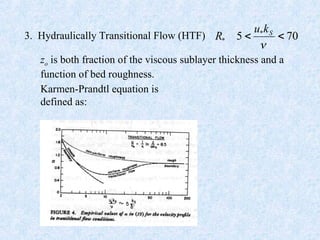
3. Hydraulically Transitional Flow (HTF) 70
5 *
* 


S
k
u
R
zo is both fraction of the viscous sublayer thickness and a
function of bed roughness.
Karmen-Prandtl equation is
defined as:
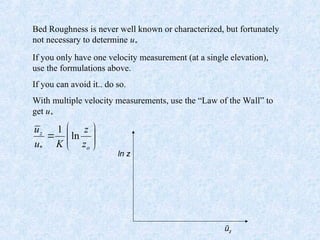
Bed Roughness is never well known or characterized, but fortunately
not necessary to determine u*
If you only have one velocity measurement (at a single elevation),
use the formulations above.
If you can avoid it.. do so.
With multiple velocity measurements, use the “Law of the Wall” to
get u*









o
z
z
z
K
u
u
ln
1
*
ln z
ūz
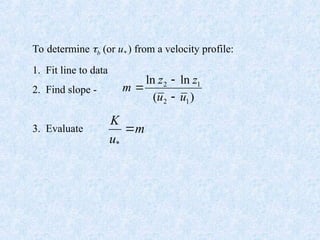
To determine b (or u* ) from a velocity profile:
1. Fit line to data
2. Find slope -
3. Evaluate
)
(
ln
ln
1
2
1
2
u
u
z
z
m



m
u
K

*

Boundary layer theory for the viscous laminar flow

  • 1.
    Boundary Layer VelocityProfile z ū z U Viscous sublayer Buffer zone Logarithmic turbulent zone Ekman Layer, or Outer region (velocity defect layer)
  • 2.
    But first.. adefinition: 2 * u b   
  • 3.
    1. Viscous Sublayer- velocities are low, shear stress controlled by molecular processes As in the plate example, laminar flow dominates, z u b     Put in terms of u* integrating, boundary conditions,
  • 4.
    When do wesee a viscous sublayer? v = f (u*,  , ks) where ks == characteristic height of bed roughness Roughness Re: R* > 70 rough turbulent no viscous sublayer R* < 5 smooth turbulent  s k u R * * 
  • 5.
    2. Log Layer: Turbulentcase, Az is NOT constant in z Az is a property of the flow, not just the fluid To describe the velocity profile we need to develop a profile of Az. Mixing Length formulation Prandtl (1925) which is a qualitative argument discussed in more detail “Boundary Layer Analysis” by Shetz, 1993 Assume that water masses act independently over a distance, l Within l a change in momentum causes a fluctuation to adjacent fluid parcels.
  • 6.
    At l, Make assumptionof isotropic turbulence: |u’| ~ |v’| ~ |w’| Therefore, |u’| ~ |w’| ~ Through the Reynolds Stress formulation, dz u d u l ' ~ dz u d l dz u d l 2 2 ~ ' '         dz u d l w u zx zx     Prandtl Mixing Length Formulation
  • 7.
    Von Karmen (1930)hypothesized that close to a boundary, the turbulent exchange is related to distance from the boundary. l  z l = Kz where K is a universal turbulent momentum exchange coefficient == von Karmen’s constant. K has been found to be 0.41 Near the bed, dz u d Kz u dz u d z K zx         * 2 2 2   in terms of u*
  • 8.
    Solving for thevelocity profile: ln z ū Intercept, b, depends on roughness of the bed - f (R*)
  • 9.
    Rename b, basedon boundary condition: z = zo at ū = 0 Karmen-Prandtl Eq. or Law of the Wall          o z z z K u u ln 1 *
  • 11.
    Hydraulic Roughness Length,zo zo is the vertical intercept at which ūz = 0 zo = f ( viscous sublayer, grain roughness, ripples & other bedforms, stratification) This leads to two forms of the Karmen-Prandtl Equation 1) with viscous sublayer HSF 2) without viscous sublayer HRF
  • 13.
    Can evaluate whichcase to use with R* where ks == roughness length scale in glued sand, pipe flow experiments ks = D in real seabeds with no bedforms, ks = D75 in bedforms, characteristic bedform scale ks ~ height of ripples  s k u R * * 
  • 14.
    1. Hydraulically SmoothFlow (HSF) 5 0 * *    S k u R ** boundary layer is turbulent, but there is a viscous sublayer zo is a fraction of the viscous sublayer thickness: Karmen-Prandtl equation becomes: For turbulent flow over a hydraulically smooth boundary
  • 15.
    2. Hydraulically RoughFlow (HRF) 70 * *   S k u R ** no viscous sublayer zo is a function of the roughness elements Nikaradze pipe flow experiments: Karmen-Prandtl equation becomes: For turbulent flow over a hydraulically rough boundary with no bedforms, no stratification, etc.
  • 16.
    Notes on zoin HRF Grain Roughness: Nikuradze (1930s) - glued sand grains on pipe flow zo = D/30 Kamphius (1974) - channel flow experiments zo = D/15 Bedforms: Wooding (1973) where H is the ripple height and  is the ripple wavelength Suspended Sediment: Smith (1977) z = f (excess shear stress, and z from ripples) 4 . 1 20         H H zo
  • 17.
    3. Hydraulically TransitionalFlow (HTF) 70 5 * *    S k u R zo is both fraction of the viscous sublayer thickness and a function of bed roughness. Karmen-Prandtl equation is defined as:
  • 18.
    Bed Roughness isnever well known or characterized, but fortunately not necessary to determine u* If you only have one velocity measurement (at a single elevation), use the formulations above. If you can avoid it.. do so. With multiple velocity measurements, use the “Law of the Wall” to get u*          o z z z K u u ln 1 * ln z ūz
  • 19.
    To determine b(or u* ) from a velocity profile: 1. Fit line to data 2. Find slope - 3. Evaluate ) ( ln ln 1 2 1 2 u u z z m    m u K  *