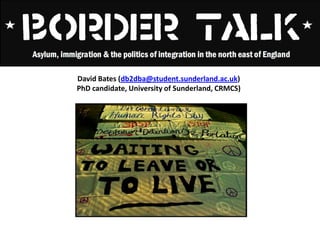
David Bates (db2dba@student.sunderland.ac.uk) PhD candidate, University of Sunderland, CRMCS)
OverviewAsylum and integration – a personal perspective3 stages of British ‘race relations’ ‘Race’ and racism in British historyConclusion: integration and the ‘Big Society’
Asylum and integration – a personal perspectiveresearchers should always “be aware of the ways in which their own biography is a fundamental part of the research process” (May 2001: 21)Independent Asylum Commission, 2008: “the treatment of asylum seekers falls seriously below the standards to be expected of a humane and civilised society”Poverty and destitution‘Culture of disbelief’Detention Forced removal/deportation
In spite of the hardships associated with the asylum process, asylum seekers often integrate very well into the communities to which they are dispersed“One senior political source yesterday told The Herald of growing suspicions that the Home Office wants to wind down the overall numbers of asylum seekers in Glasgow because of the public outcry when they are removed.  The source said: ‘Over the years we’ve had the Dungavel protests, the Ay family and the Glasgow Girls, Precious Mhango and the demonstrations about the dawn raids.  This doesn’t happen elsewhere in the UK and you’ve got to ask whether it is less hassle for UKBA to have Glasgow’s asylum seekers elsewhere.’ The Herald, 13th November 2010http://www.heraldscotland.com/news/politics/asylum-seeker-dispersal-is-set-to-start-in-days-1.1068015
INSTITUTIONAL ETHNOGRAPHY: “a means of describing how people’s lives are determined from beyond the scope of their everyday world” with a view to “challenging and transforming a ruling apparatus” (G.W. Smith, 1990: 646) Also requires an understanding of immigration, ‘race relations’ and asylum in their historical contextMigration: an ancient phenomena (see Bade 2003; Marfleet 2006)3 stages in British ‘race relations’ post-WWII  (Bourne 2007): 1. Assimilation
2. Multiculturalism
3. Community Cohesion1. Post-war migrants: hostility and self-helpThe first voluntary organisations for ‘BME’ communities (Black Minority Ethnic):Self-help and organisation – a willingness to do for ourselves what British society cannot or will not do for us.Mutuality – supporting those community members already here and providing for new arrivals.Political resistance – collective efforts to counter the experience of British racism and discrimination and to build up alternative community provision.Afridi and Warmington (2009: 14)
2.  Tolerance, diversity and multiculturalismLabour Home Secretary Roy Jenkins on multicultural integration, 1966: ‘equal opportunity accompanied by cultural diversity in an atmosphere or mutual tolerance’  (Rex 1995)Bourne (2007): grassroots multiculturalism versus ‘official’ multiculturalism used to address ‘cultural deficit’ of minoritiesState-sanctioned multiculturalism:  ‘a particularist, ethnocentric extension of British colonial policy ‘  (Melotti 1997)
3.  Community cohesion and the stateCantle Report (2001): institutionalised differences undermine ‘cohesion’, ‘common values’, ‘common aims and objectives’ and ‘common moral principles and codes of behaviour’ (Grillo 2007: 986)Commission on Integration and Cohesion: Our Shared Future (2007)Grillo (2007): does this mean cultural differences = unBritish?Pilkington (2008): relies on selective version of national narrative; overlooks political factors which undermine cohesion (war, housing policy, faith schools etc.)
‘Race’ and racism in British history‘Race’ has been understood in different ways throughout history: descent, typology, subspecies (Banton 1977) Miles (1993):  ‘race’ is ideologically constructed, meaning that there is no single ‘racism’ but many ‘racisms’Barker (1982), Gilroy (1987): contemporary racism draws on ideas of fixed cultural difference and national identity
Conclusion: Integration and the ‘Big Society’Conservative-Lib Dem Coalition government, May 2010Changing language of ‘community relations’Big Society >> greater involvement of ‘civil society’ in community relations >> charities and faith organisationsAsylum seekers and integration in the north eastIntegrated community workEducation Religious institutionsMedia
BibliographyAfridi, A. & Warmington, J. (2009) The Pied Piper: The BME third sector and UK race relations policy (London: Brap)

Border talk history paper

  • 1.
    David Bates (db2dba@student.sunderland.ac.uk)PhD candidate, University of Sunderland, CRMCS)
  • 2.
    OverviewAsylum and integration– a personal perspective3 stages of British ‘race relations’ ‘Race’ and racism in British historyConclusion: integration and the ‘Big Society’
  • 3.
    Asylum and integration– a personal perspectiveresearchers should always “be aware of the ways in which their own biography is a fundamental part of the research process” (May 2001: 21)Independent Asylum Commission, 2008: “the treatment of asylum seekers falls seriously below the standards to be expected of a humane and civilised society”Poverty and destitution‘Culture of disbelief’Detention Forced removal/deportation
  • 4.
    In spite ofthe hardships associated with the asylum process, asylum seekers often integrate very well into the communities to which they are dispersed“One senior political source yesterday told The Herald of growing suspicions that the Home Office wants to wind down the overall numbers of asylum seekers in Glasgow because of the public outcry when they are removed. The source said: ‘Over the years we’ve had the Dungavel protests, the Ay family and the Glasgow Girls, Precious Mhango and the demonstrations about the dawn raids. This doesn’t happen elsewhere in the UK and you’ve got to ask whether it is less hassle for UKBA to have Glasgow’s asylum seekers elsewhere.’ The Herald, 13th November 2010http://www.heraldscotland.com/news/politics/asylum-seeker-dispersal-is-set-to-start-in-days-1.1068015
  • 5.
    INSTITUTIONAL ETHNOGRAPHY: “ameans of describing how people’s lives are determined from beyond the scope of their everyday world” with a view to “challenging and transforming a ruling apparatus” (G.W. Smith, 1990: 646) Also requires an understanding of immigration, ‘race relations’ and asylum in their historical contextMigration: an ancient phenomena (see Bade 2003; Marfleet 2006)3 stages in British ‘race relations’ post-WWII (Bourne 2007): 1. Assimilation
  • 6.
  • 7.
    3. Community Cohesion1.Post-war migrants: hostility and self-helpThe first voluntary organisations for ‘BME’ communities (Black Minority Ethnic):Self-help and organisation – a willingness to do for ourselves what British society cannot or will not do for us.Mutuality – supporting those community members already here and providing for new arrivals.Political resistance – collective efforts to counter the experience of British racism and discrimination and to build up alternative community provision.Afridi and Warmington (2009: 14)
  • 8.
    2. Tolerance,diversity and multiculturalismLabour Home Secretary Roy Jenkins on multicultural integration, 1966: ‘equal opportunity accompanied by cultural diversity in an atmosphere or mutual tolerance’ (Rex 1995)Bourne (2007): grassroots multiculturalism versus ‘official’ multiculturalism used to address ‘cultural deficit’ of minoritiesState-sanctioned multiculturalism: ‘a particularist, ethnocentric extension of British colonial policy ‘ (Melotti 1997)
  • 9.
    3. Communitycohesion and the stateCantle Report (2001): institutionalised differences undermine ‘cohesion’, ‘common values’, ‘common aims and objectives’ and ‘common moral principles and codes of behaviour’ (Grillo 2007: 986)Commission on Integration and Cohesion: Our Shared Future (2007)Grillo (2007): does this mean cultural differences = unBritish?Pilkington (2008): relies on selective version of national narrative; overlooks political factors which undermine cohesion (war, housing policy, faith schools etc.)
  • 10.
    ‘Race’ and racismin British history‘Race’ has been understood in different ways throughout history: descent, typology, subspecies (Banton 1977) Miles (1993): ‘race’ is ideologically constructed, meaning that there is no single ‘racism’ but many ‘racisms’Barker (1982), Gilroy (1987): contemporary racism draws on ideas of fixed cultural difference and national identity
  • 11.
    Conclusion: Integration andthe ‘Big Society’Conservative-Lib Dem Coalition government, May 2010Changing language of ‘community relations’Big Society >> greater involvement of ‘civil society’ in community relations >> charities and faith organisationsAsylum seekers and integration in the north eastIntegrated community workEducation Religious institutionsMedia
  • 12.
    BibliographyAfridi, A. &Warmington, J. (2009) The Pied Piper: The BME third sector and UK race relations policy (London: Brap)