Shri Vaishnav Vidyapeeth Vishwavidyalaya, Indore
Shri Vaishnav Institute of information Technology
Department of Computer Science and Engineering
Year/ Semester – II/III
Subject Name - Computer Organization And Architecture
Subject Code - BTCSCS 202
Faculty Name – Mrs. Pallavi kala
Organization / Architecture ??
Organization – Physical Aspects of Computer
Architecture – Logical Aspects of Computer
Boolean Logic Basics
• Developed by English Mathematician George Boole in
between 1815 - 1864.
• Set of rules used to simplify given logic expression
without changing its functionality, it is used when
numbers of variable are less
• It is described as an algebra of logic or an algebra of
two values i.e True or False.
• The term logic means a statement having binary
decisions i.e True/Yes or False/No.
• Boolean Algebra = Boolean + Algebra
LOGIC
MATHAMATICS
It is a mathematical logic which is used to express a Boolean function by using some
well designed rules and laws
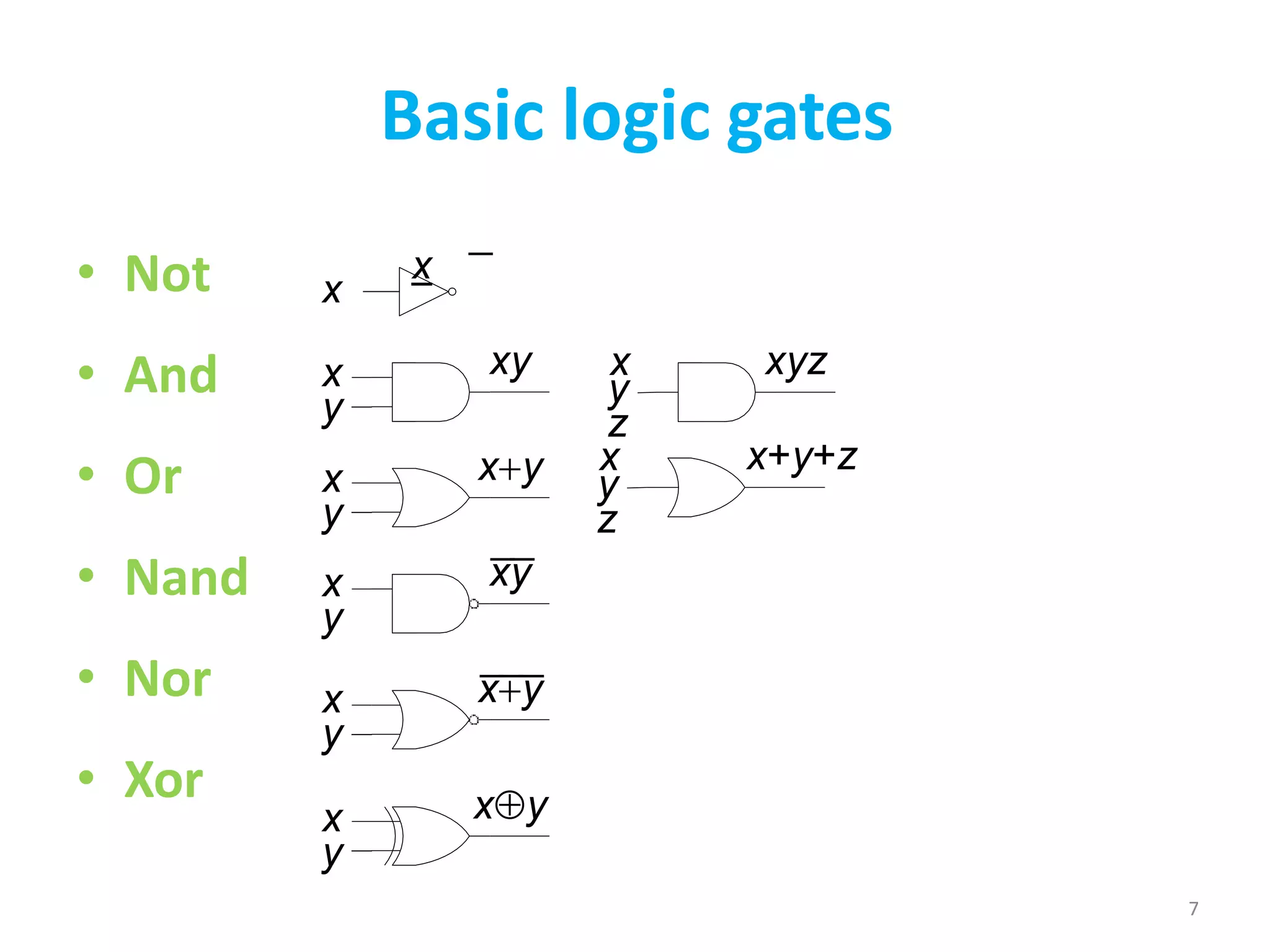
Basic logic gates
• Not
• And
• Or
• Nand
• Nor
• Xor
x
x
y
x
y
x
xy x
y
xyz
z
xy x x+y+z
y
z
x
y
xy
xyx
y
x
y
xy
7
The AND gate
Pavithran Puthiyapurayil , Maldives
National University
4/30/2018 8
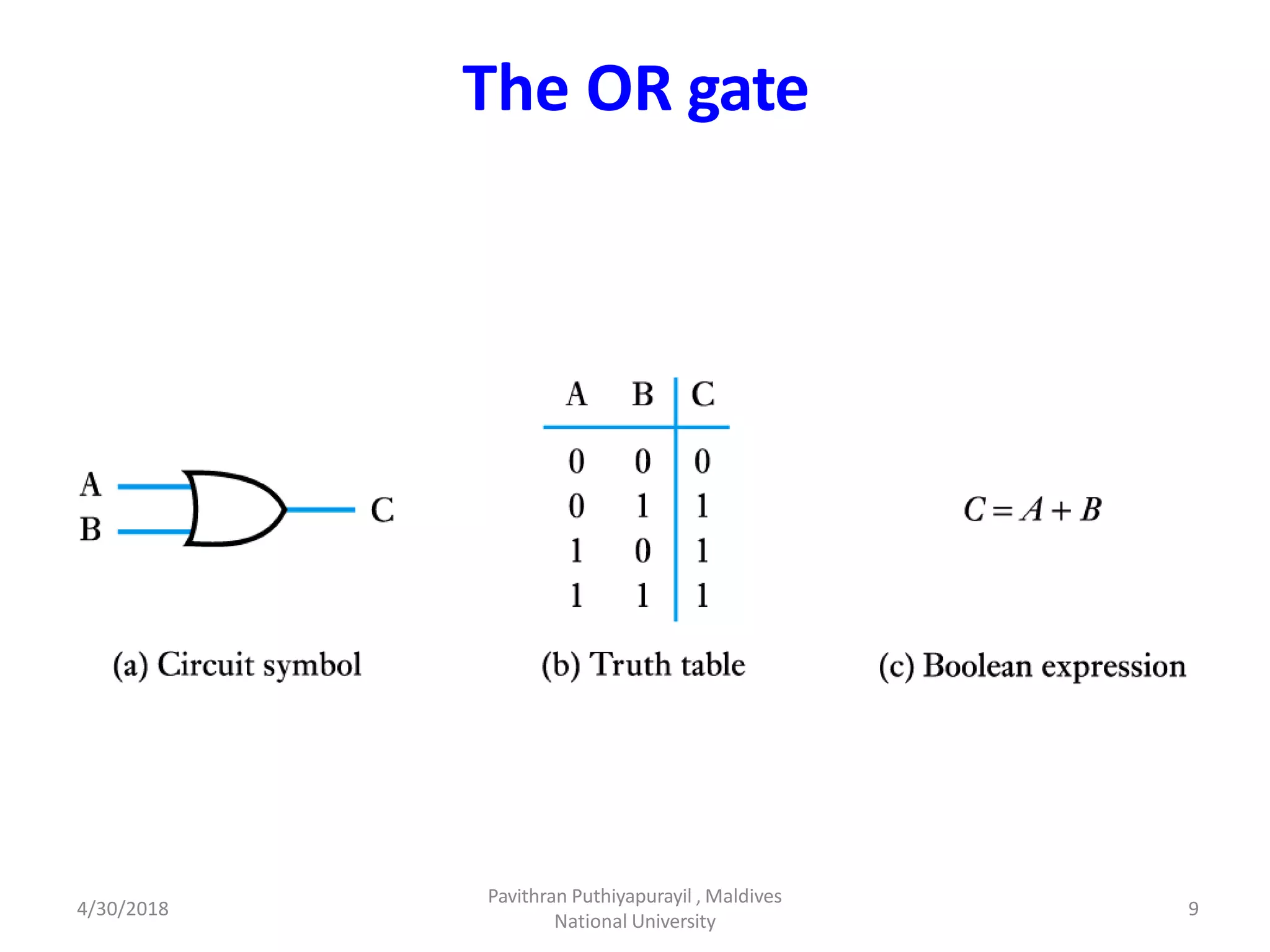
The OR gate
Pavithran Puthiyapurayil , Maldives
National University
4/30/2018 9
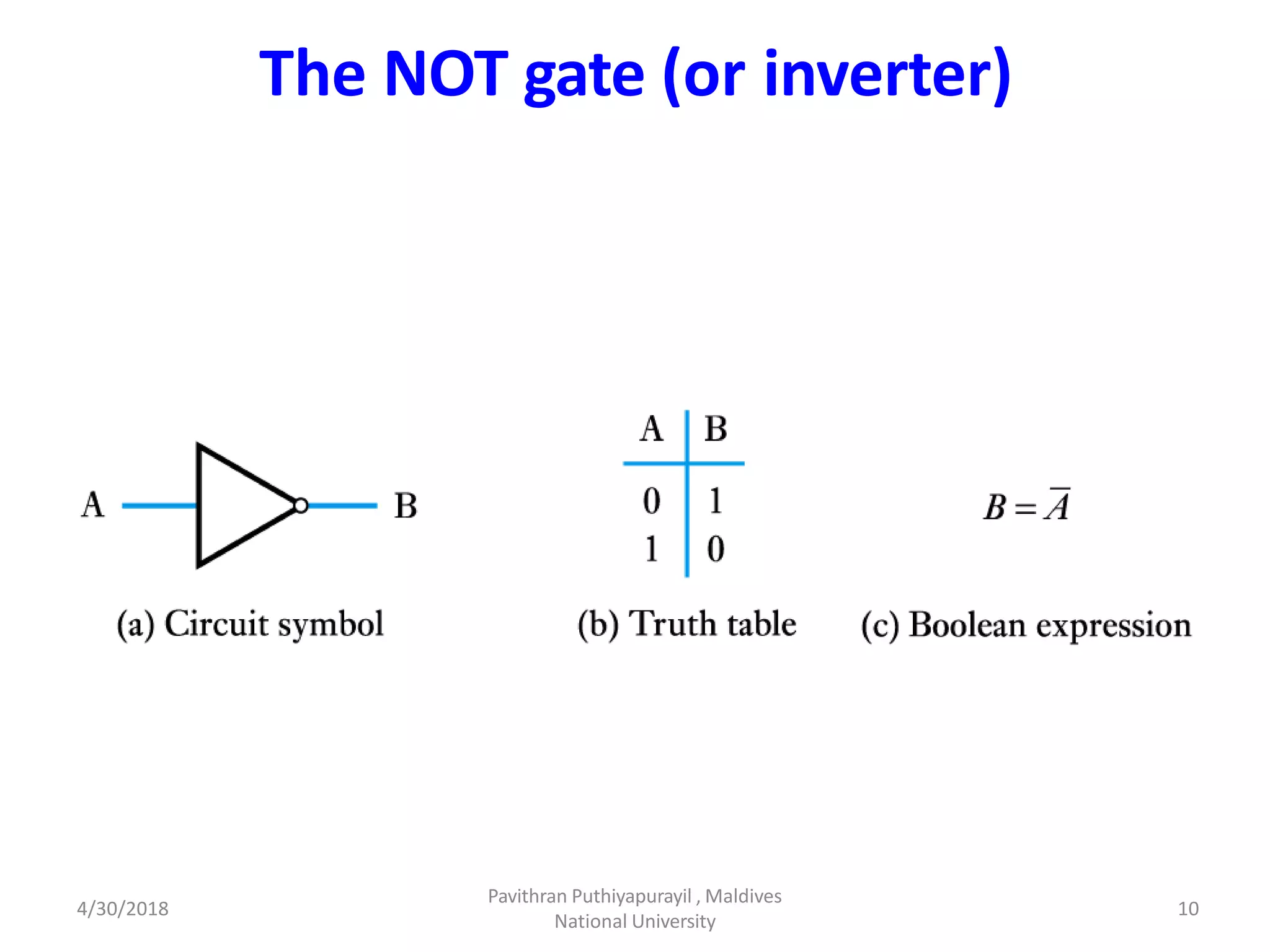
The NOT gate (or inverter)
Pavithran Puthiyapurayil , Maldives
National University
4/30/2018 10
The NAND gate
Pavithran Puthiyapurayil , Maldives
National University
4/30/2018 11
The NOR gate
Pavithran Puthiyapurayil , Maldives
National University
4/30/2018 12
The Exclusive OR gate
Pavithran Puthiyapurayil , Maldives
National University
4/30/2018 13
The Exclusive NOR gate
,
Laws of Boolean algebra
• Commutative Law states that the interchanging of the order of operands in
a Boolean equation does not change its result. For example:
OR operator → A + B = B + A
AND operator → A * B = B * A
• Associative Law of multiplication states that the AND operation are done
on two or more than two variables. For example:
A * (B * C) = (A * B) * C
• Distributive Law states that the multiplication of two variables and adding
the result with a variable will result in the same value as multiplication of
addition of the variable with individual variables. For example:
A + BC = (A + B) (A + C)
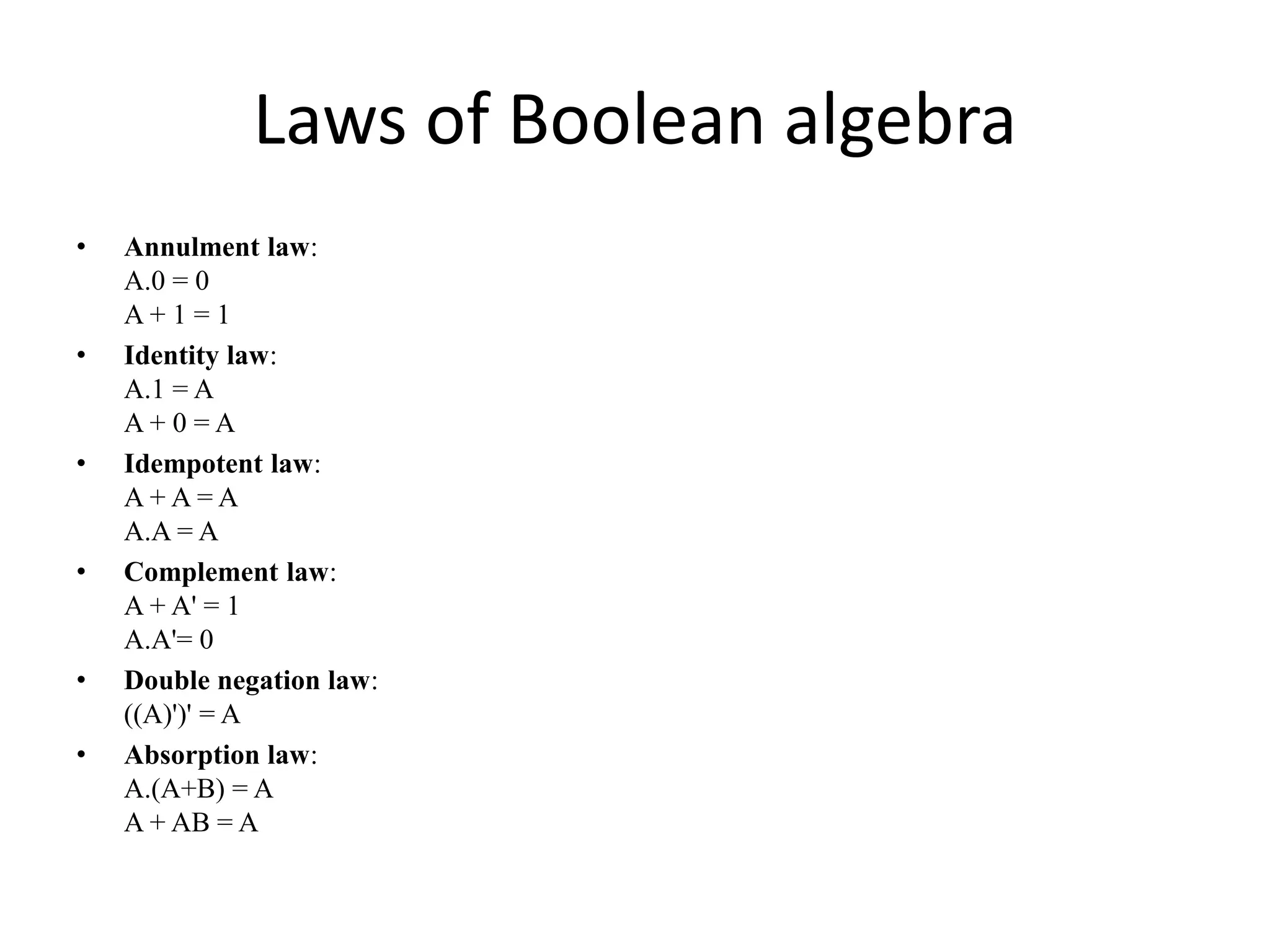
Laws of Boolean algebra
• Annulment law:
A.0 = 0
A + 1 = 1
• Identity law:
A.1 = A
A + 0 = A
• Idempotent law:
A + A = A
A.A = A
• Complement law:
A + A' = 1
A.A'= 0
• Double negation law:
((A)')' = A
• Absorption law:
A.(A+B) = A
A + AB = A

Boolean Algebra

  • 1.
    Shri Vaishnav VidyapeethVishwavidyalaya, Indore Shri Vaishnav Institute of information Technology Department of Computer Science and Engineering Year/ Semester – II/III Subject Name - Computer Organization And Architecture Subject Code - BTCSCS 202 Faculty Name – Mrs. Pallavi kala
  • 2.
  • 3.
    Organization – PhysicalAspects of Computer Architecture – Logical Aspects of Computer
  • 4.
  • 5.
    • Developed byEnglish Mathematician George Boole in between 1815 - 1864. • Set of rules used to simplify given logic expression without changing its functionality, it is used when numbers of variable are less • It is described as an algebra of logic or an algebra of two values i.e True or False. • The term logic means a statement having binary decisions i.e True/Yes or False/No.
  • 6.
    • Boolean Algebra= Boolean + Algebra LOGIC MATHAMATICS It is a mathematical logic which is used to express a Boolean function by using some well designed rules and laws
  • 7.
    Basic logic gates •Not • And • Or • Nand • Nor • Xor x x y x y x xy x y xyz z xy x x+y+z y z x y xy xyx y x y xy 7
  • 8.
    The AND gate PavithranPuthiyapurayil , Maldives National University 4/30/2018 8
  • 9.
    The OR gate PavithranPuthiyapurayil , Maldives National University 4/30/2018 9
  • 10.
    The NOT gate(or inverter) Pavithran Puthiyapurayil , Maldives National University 4/30/2018 10
  • 11.
    The NAND gate PavithranPuthiyapurayil , Maldives National University 4/30/2018 11
  • 12.
    The NOR gate PavithranPuthiyapurayil , Maldives National University 4/30/2018 12
  • 13.
    The Exclusive ORgate Pavithran Puthiyapurayil , Maldives National University 4/30/2018 13
  • 14.
  • 15.
    Laws of Booleanalgebra • Commutative Law states that the interchanging of the order of operands in a Boolean equation does not change its result. For example: OR operator → A + B = B + A AND operator → A * B = B * A • Associative Law of multiplication states that the AND operation are done on two or more than two variables. For example: A * (B * C) = (A * B) * C • Distributive Law states that the multiplication of two variables and adding the result with a variable will result in the same value as multiplication of addition of the variable with individual variables. For example: A + BC = (A + B) (A + C)
  • 16.
    Laws of Booleanalgebra • Annulment law: A.0 = 0 A + 1 = 1 • Identity law: A.1 = A A + 0 = A • Idempotent law: A + A = A A.A = A • Complement law: A + A' = 1 A.A'= 0 • Double negation law: ((A)')' = A • Absorption law: A.(A+B) = A A + AB = A