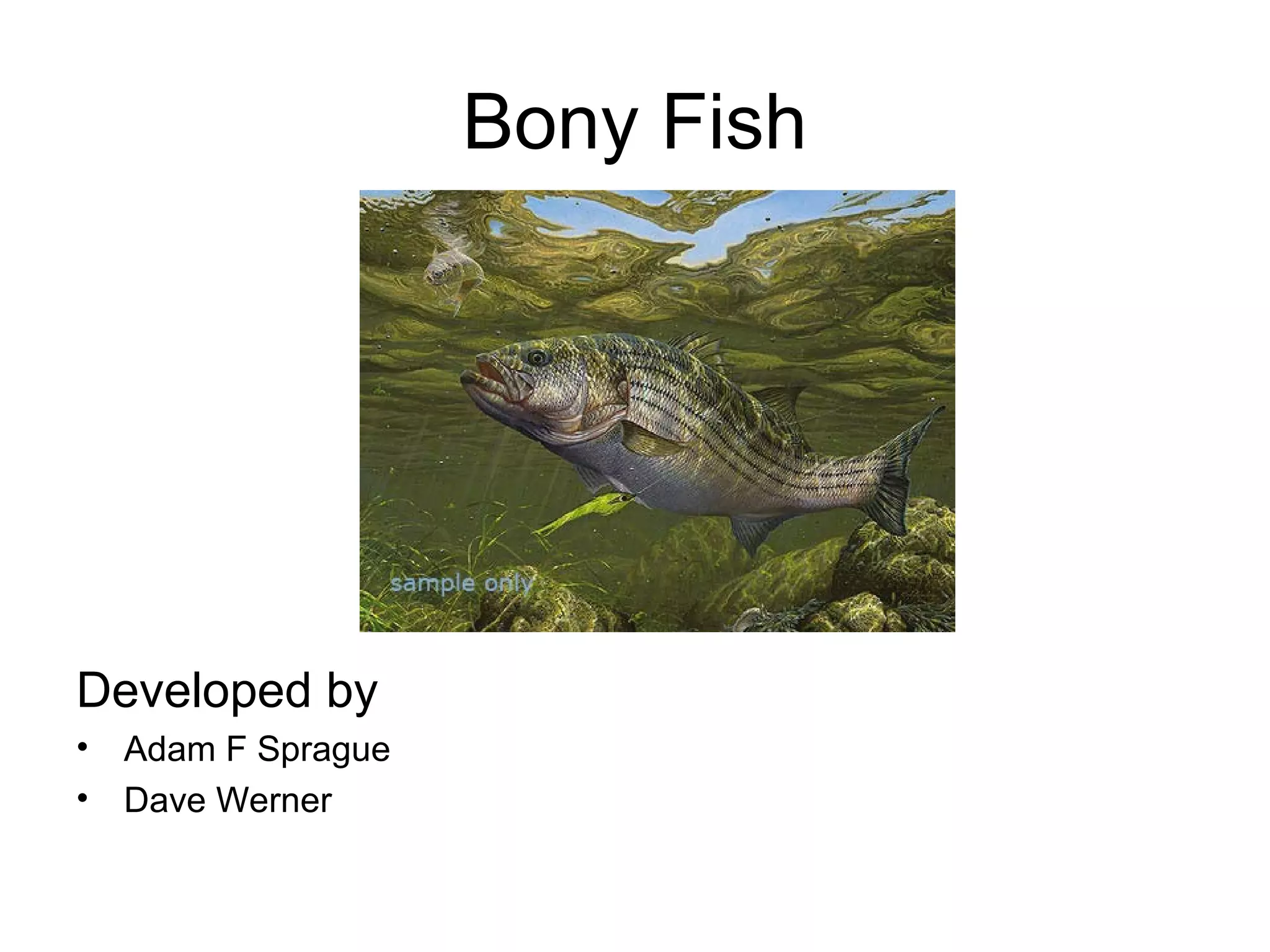
Bony Fish


Developed by
•   Adam F Sprague
•   Dave Werner
Intro to Chordates (fig. 7.51)
               Table 7.1
•   dorsal hollow nerve cord
•   notochord (dorsal, elastic supporting rod)
•   paired pharyngeal gill slits
•   post-anal tail
Chordates
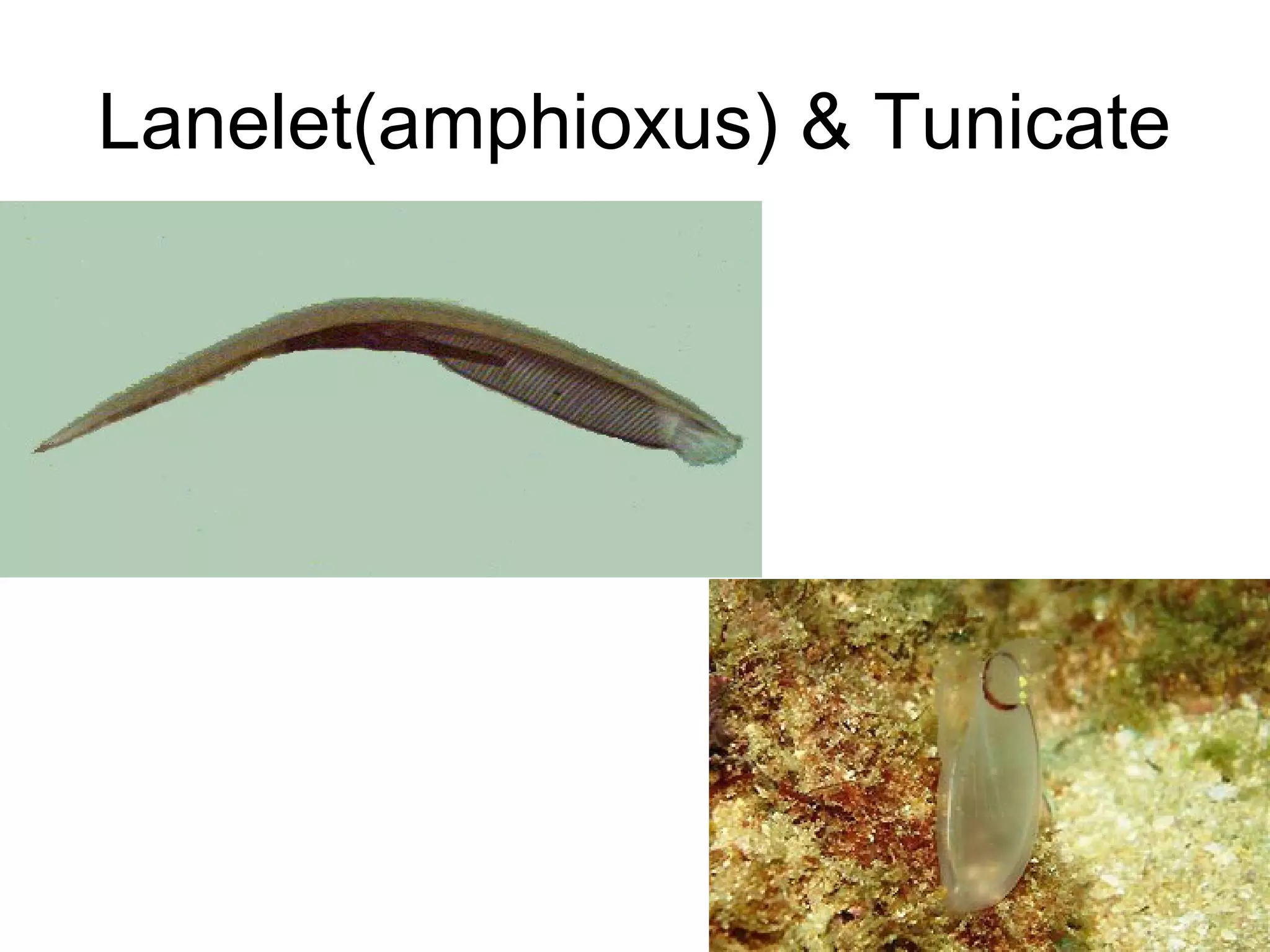
•   3 sub-phyla under group Acrania
    (Protochordata)
    1. Subphylum Urochordata (Tunicates, Sea
        Squirts)
    2. Subphylum Cephalochordata (Lancelets)
    3. Subphylum Vertebrata (Vertebrates) –
        cranium/brain
      •   Chordates w/ a backbone, skull, brain, and
          kidneys
Lanelet(amphioxus) & Tunicate
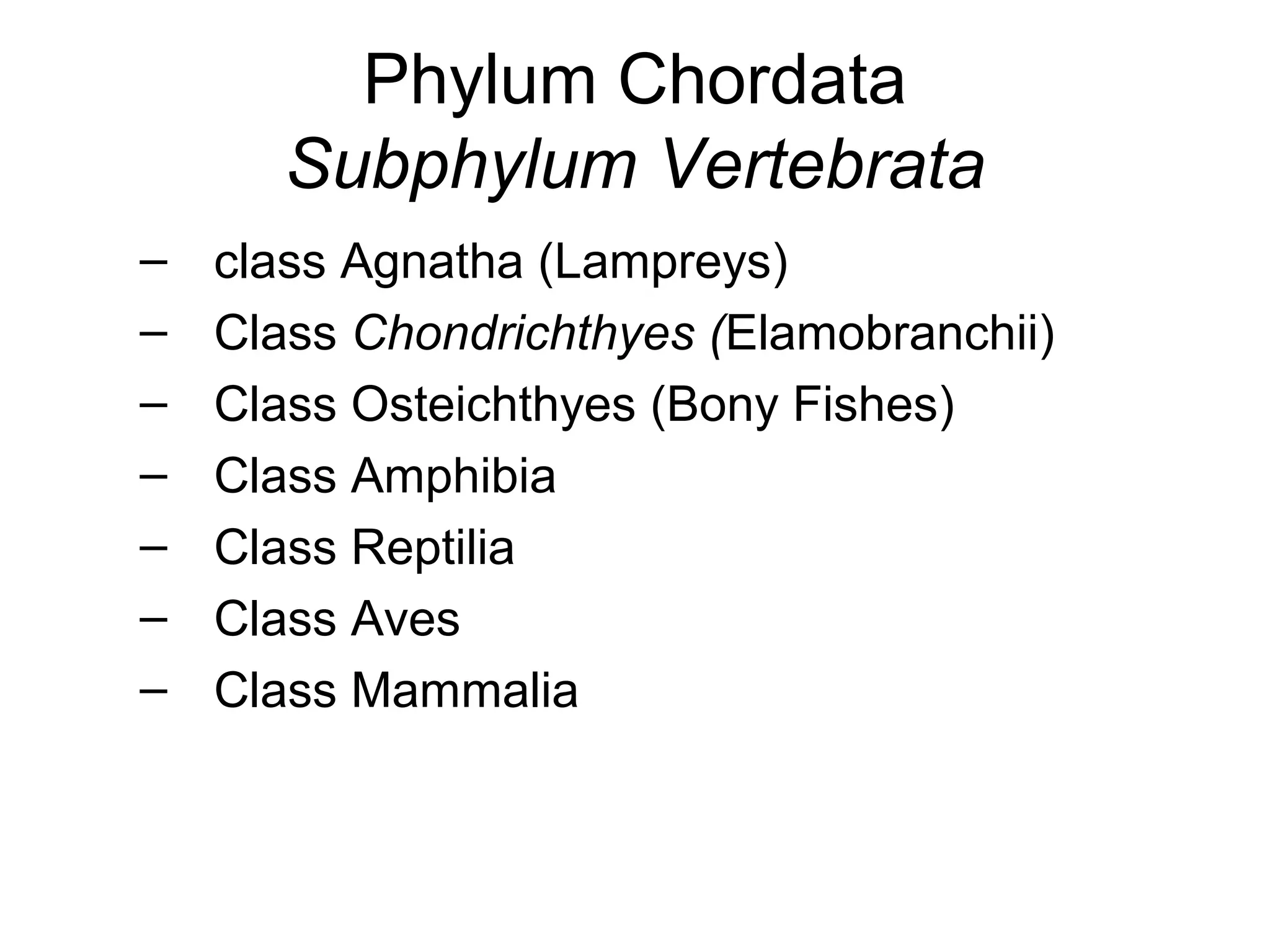
Phylum Chordata
       Subphylum Vertebrata
–   class Agnatha (Lampreys)
–   Class Chondrichthyes (Elamobranchii)
–   Class Osteichthyes (Bony Fishes)
–   Class Amphibia
–   Class Reptilia
–   Class Aves
–   Class Mammalia
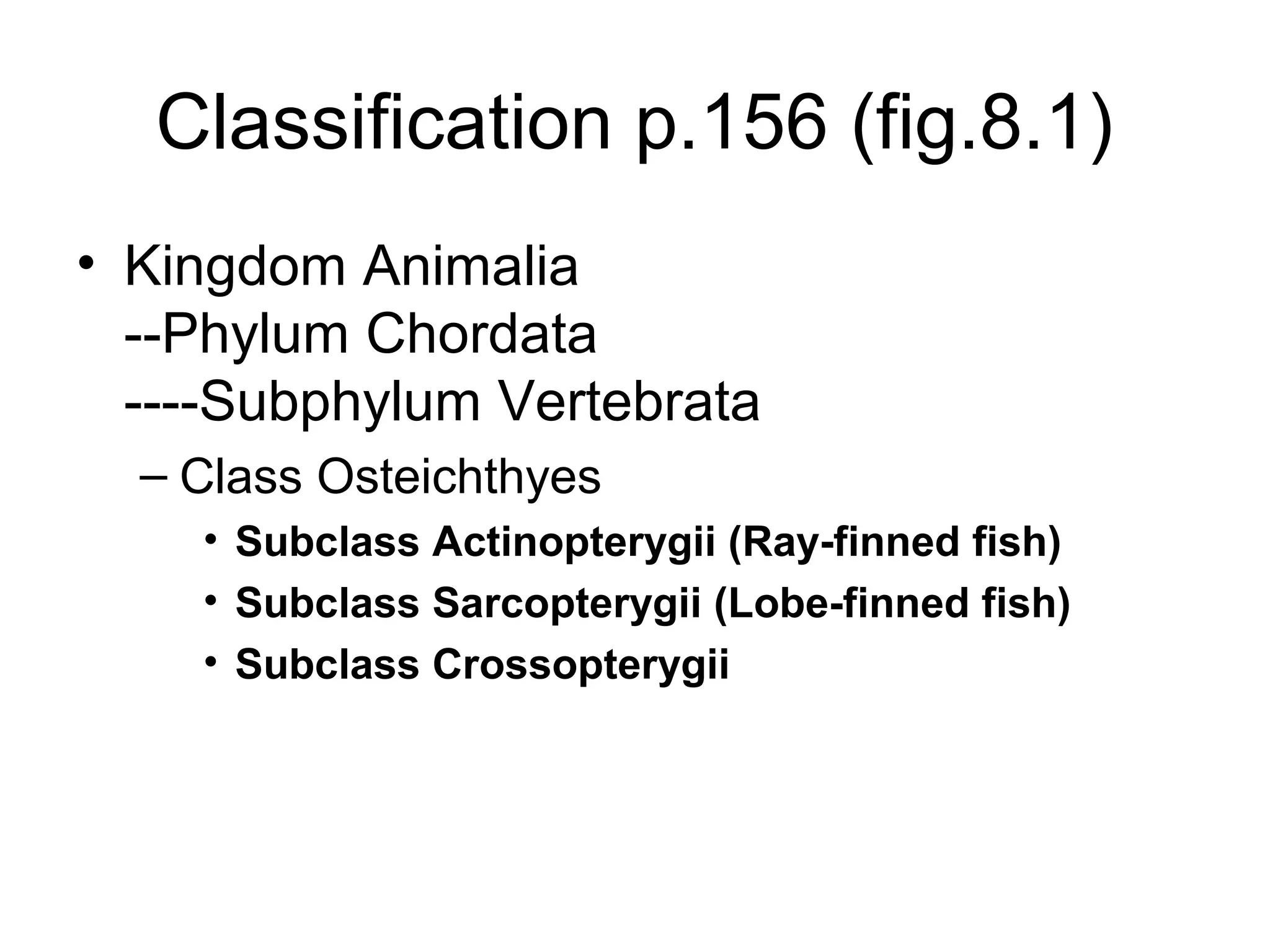
Classification p.156 (fig.8.1)
• Kingdom Animalia
  --Phylum Chordata
  ----Subphylum Vertebrata
  – Class Osteichthyes
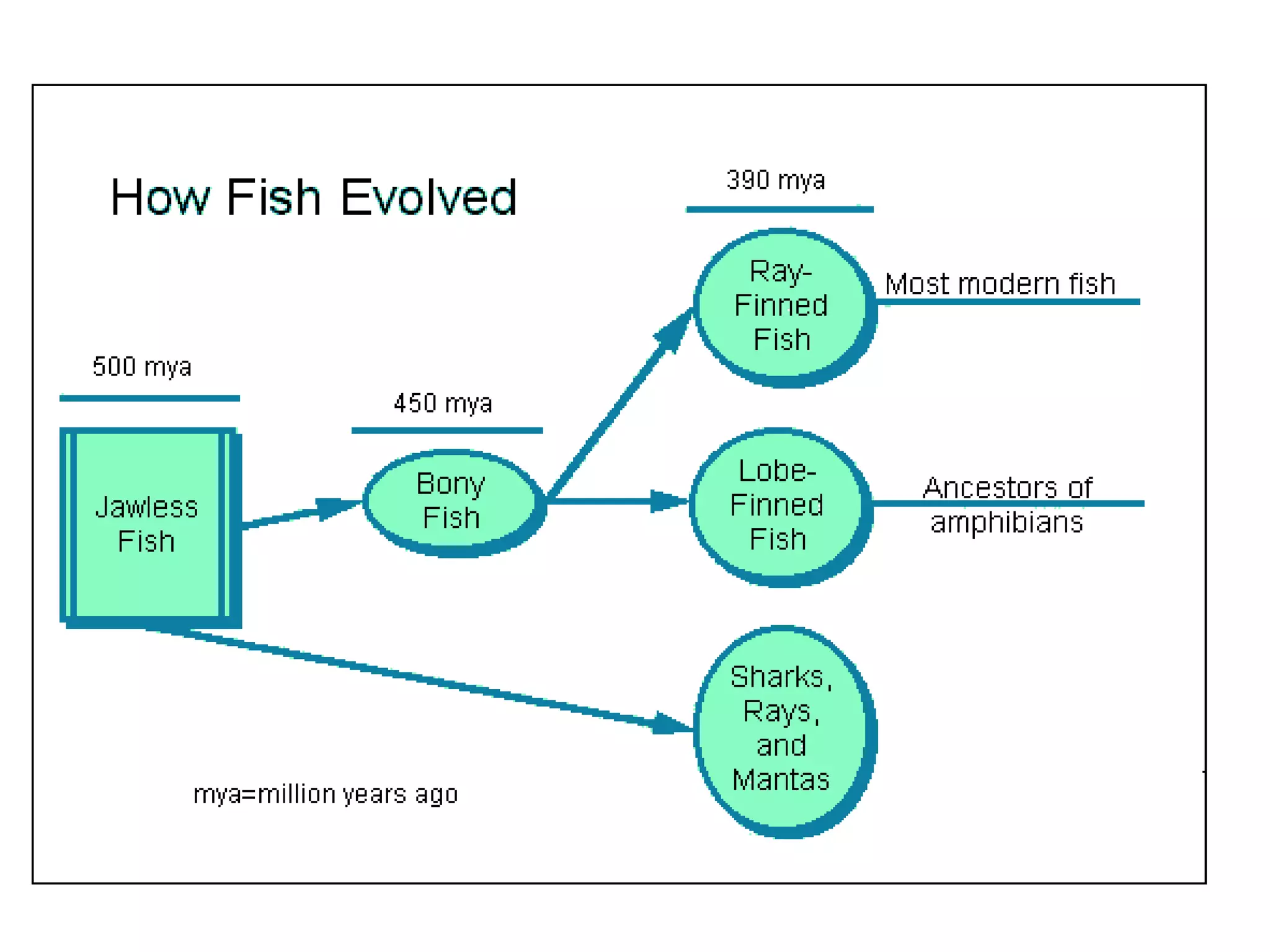
    • Subclass Actinopterygii (Ray-finned fish)
    • Subclass Sarcopterygii (Lobe-finned fish)
    • Subclass Crossopterygii
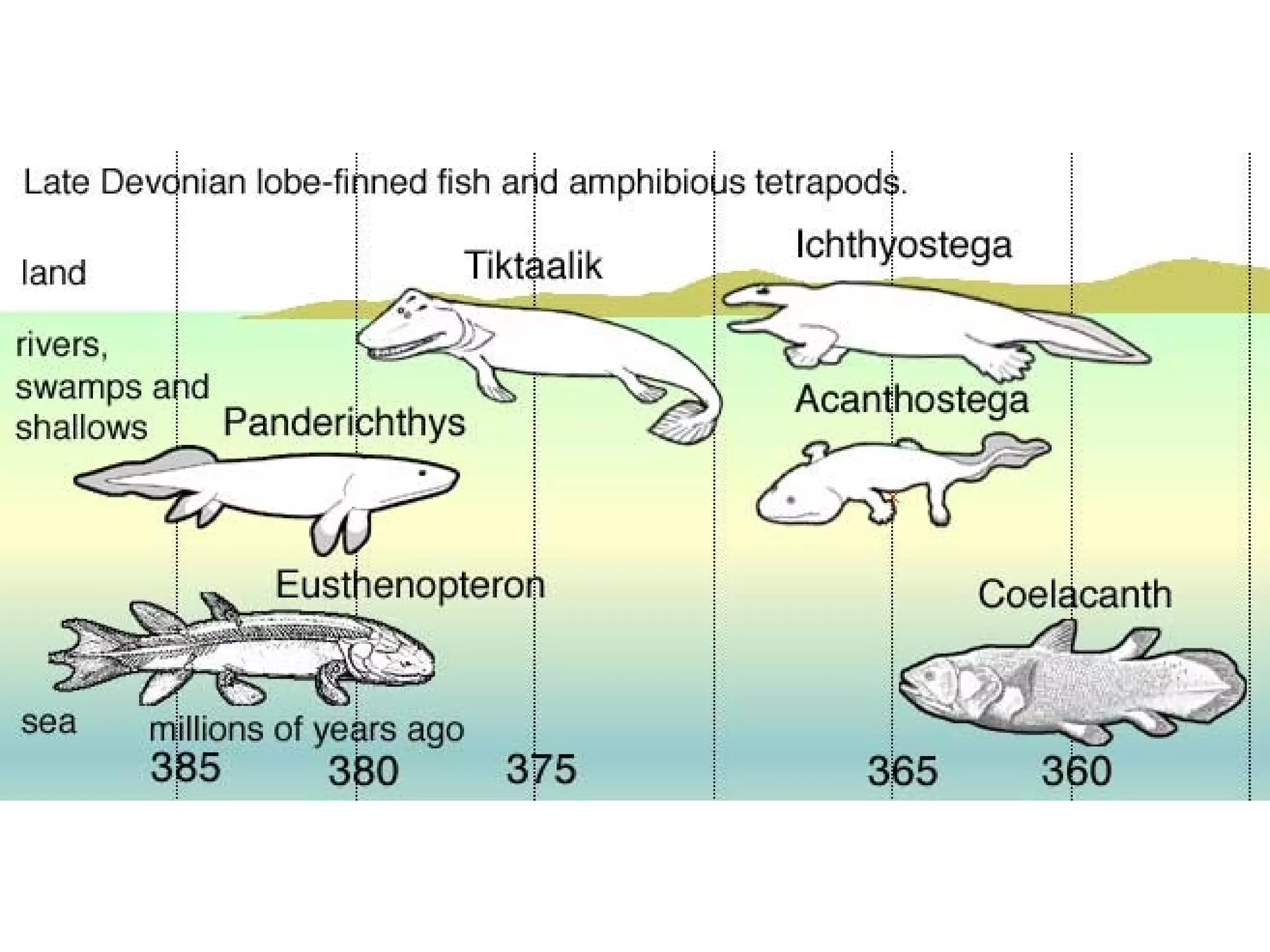
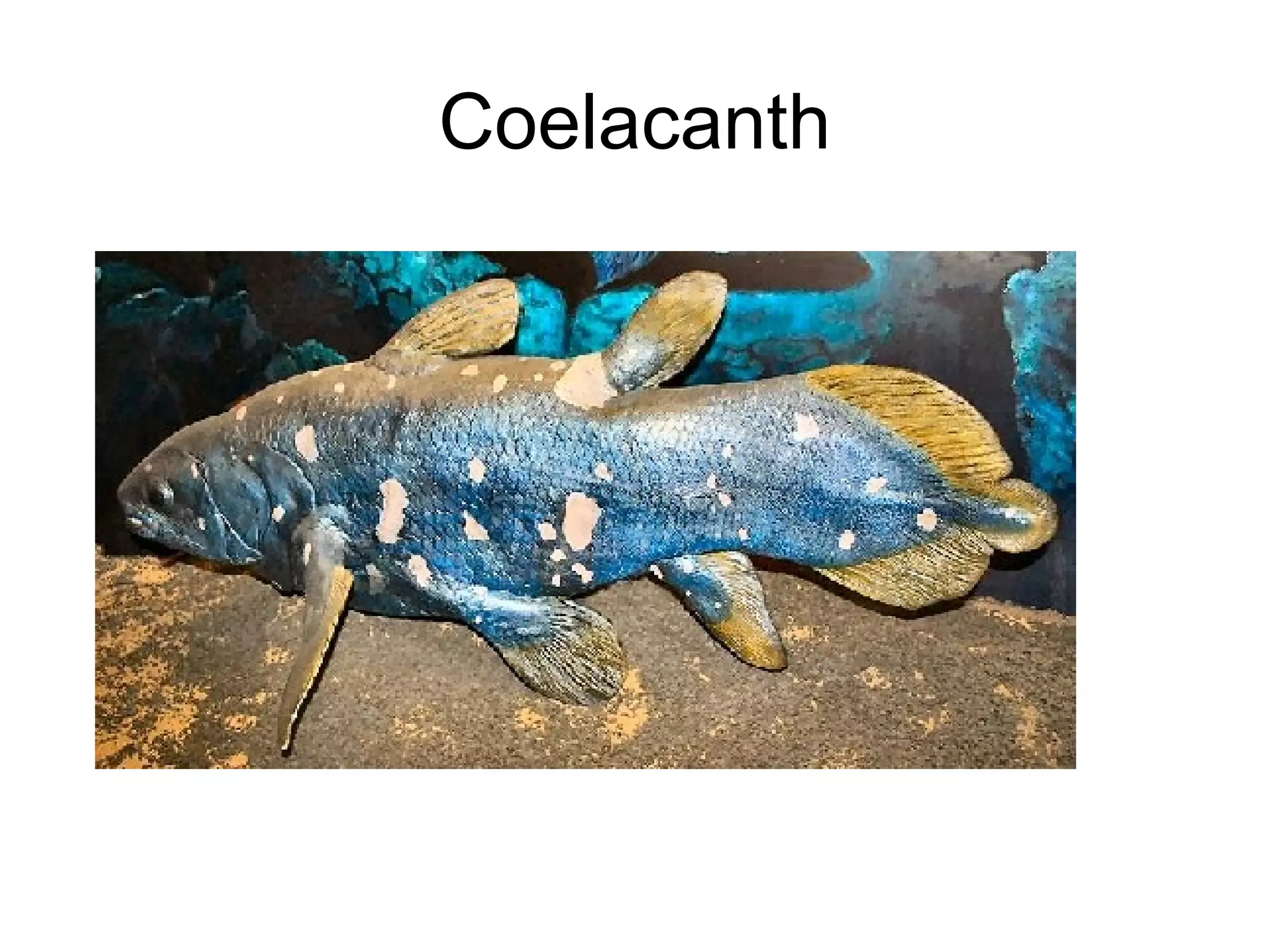
Coelacanth
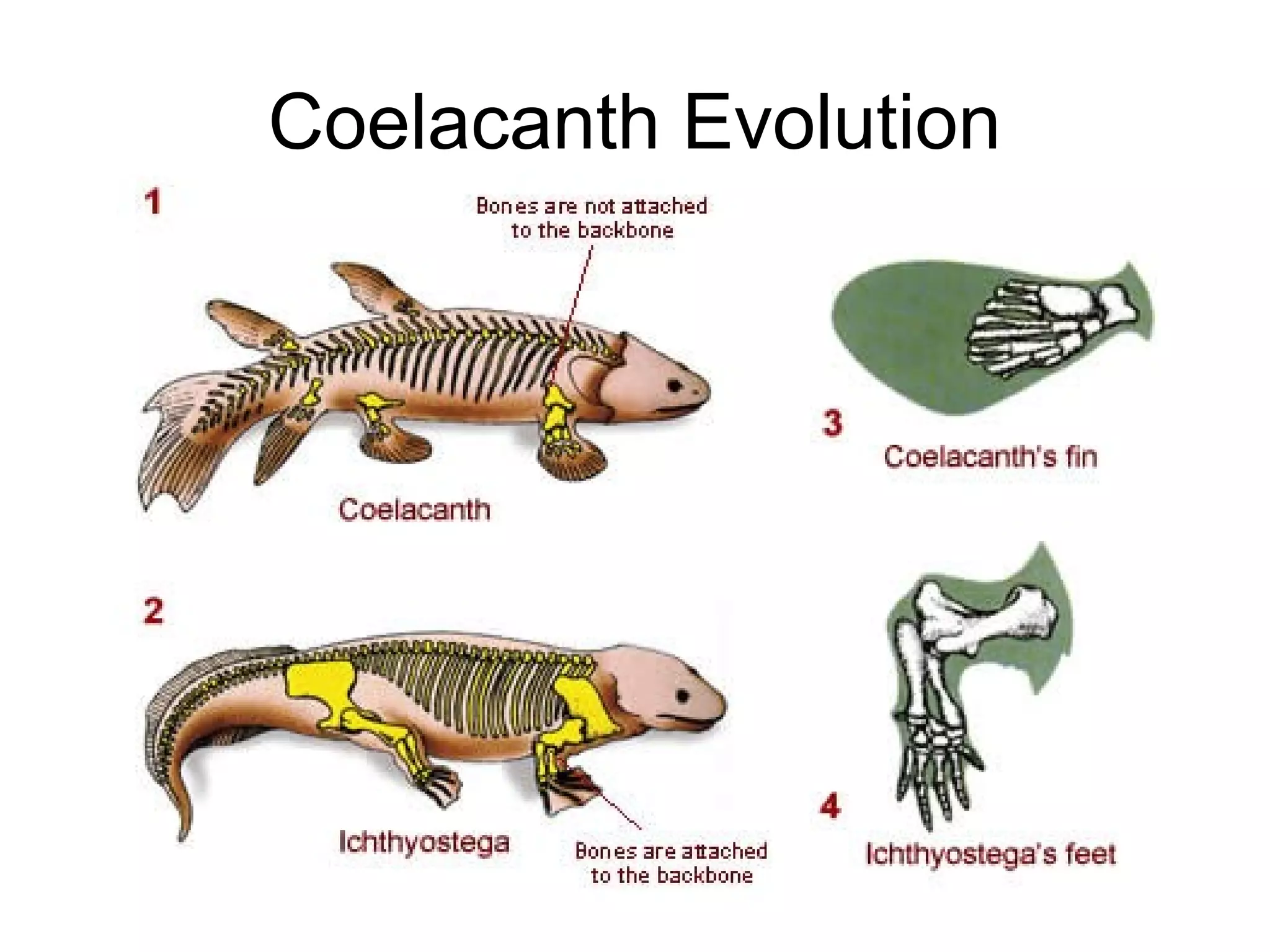
Coelacanth Evolution
Characteristics of Fish
•   Gills
•   Backbone (vertebrae)
•   Paired fins
•   Single loop circulation
Respiration
• How do fish breathe?
Fish Respiration (fig. 8.17)
• Water flows over gills as the fish swims - this
  water is flowing in the opposite of the flow of
  blood (countercurrent flow). Oxygen diffuses
  from the water and into the blood
• Gills are made of thousands of gill filaments
• When a fish opens its mouth, it "swallows"
  water, water passes over the gills and then out
  the gill slits, which are covered by the fish's
  operculum. You can see the operculum
  opening and closing.
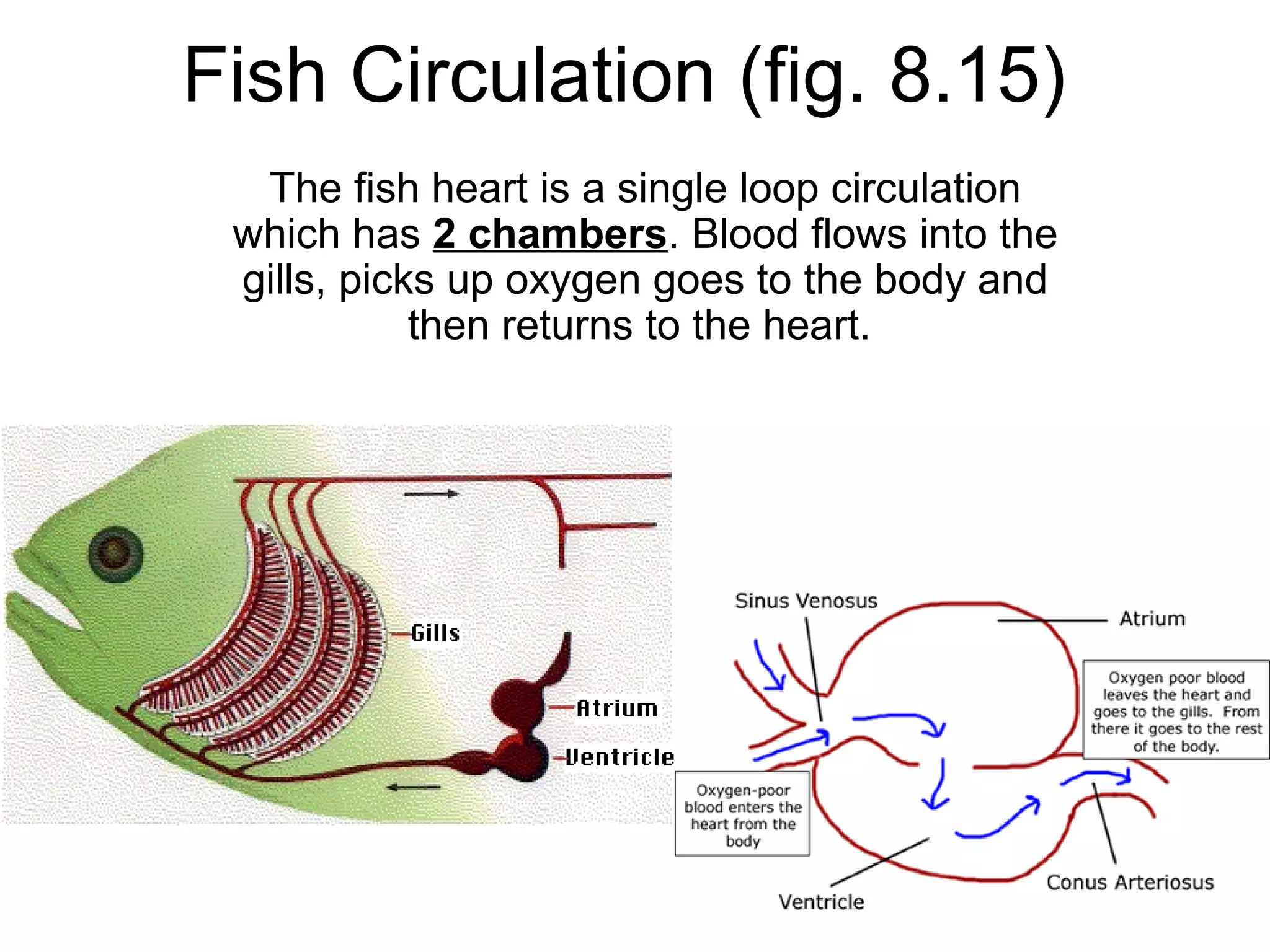
Fish Circulation (fig. 8.15)
  The fish heart is a single loop circulation
 which has 2 chambers. Blood flows into the
 gills, picks up oxygen goes to the body and
            then returns to the heart.
Maintaining Water Balance –
    HOMEOSTASIS (fig. 8.18)
• Remember that salt sucks?
• Salt water fish have a tendency to lose
  water
  Fresh water fish have a tendency to gain
  water (the fish is saltier on the inside)
• This is why you can't put a saltwater fish in
  fresh water - it is not adapted to it.
• Kidneys maintain homeostasis and
  water balance
Osmoregulation
• Freshwater take in water through body
  absorption and draw through mouth to
  breathe.
• Salt water fish take water through mouth
  salt leaves through gills and a small
  amount in urine as Urea.
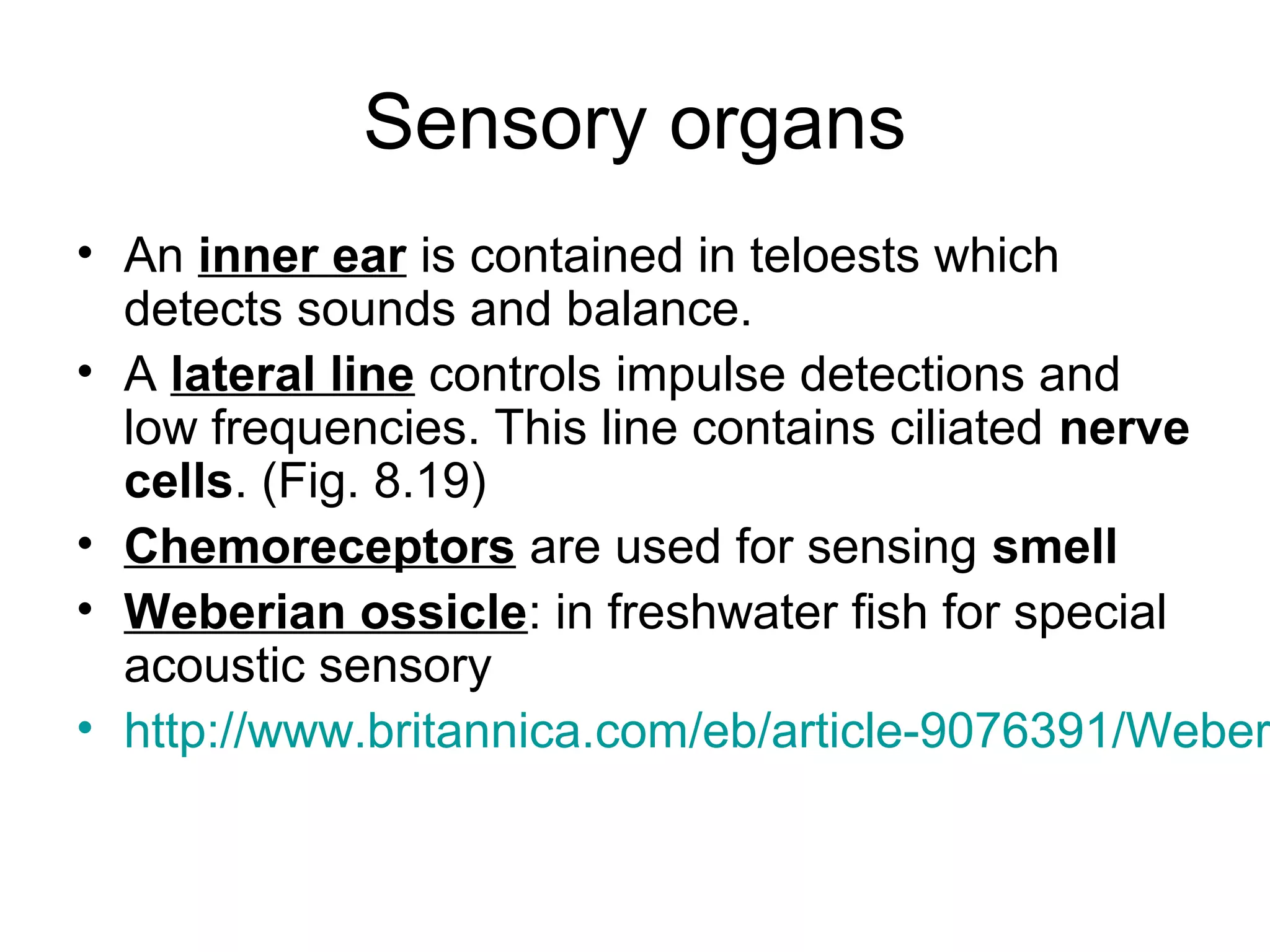
Sensory organs
• An inner ear is contained in teloests which
  detects sounds and balance.
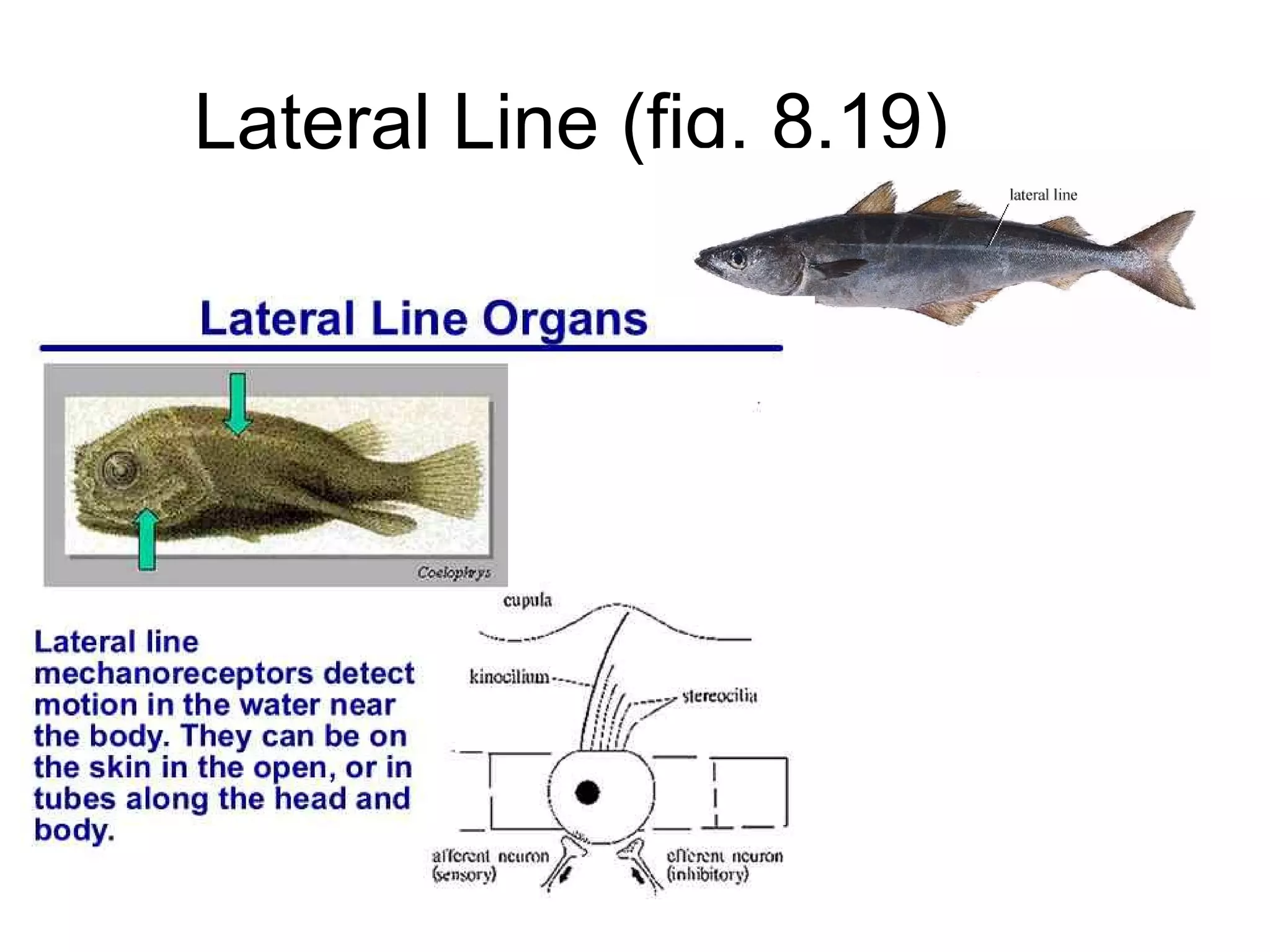
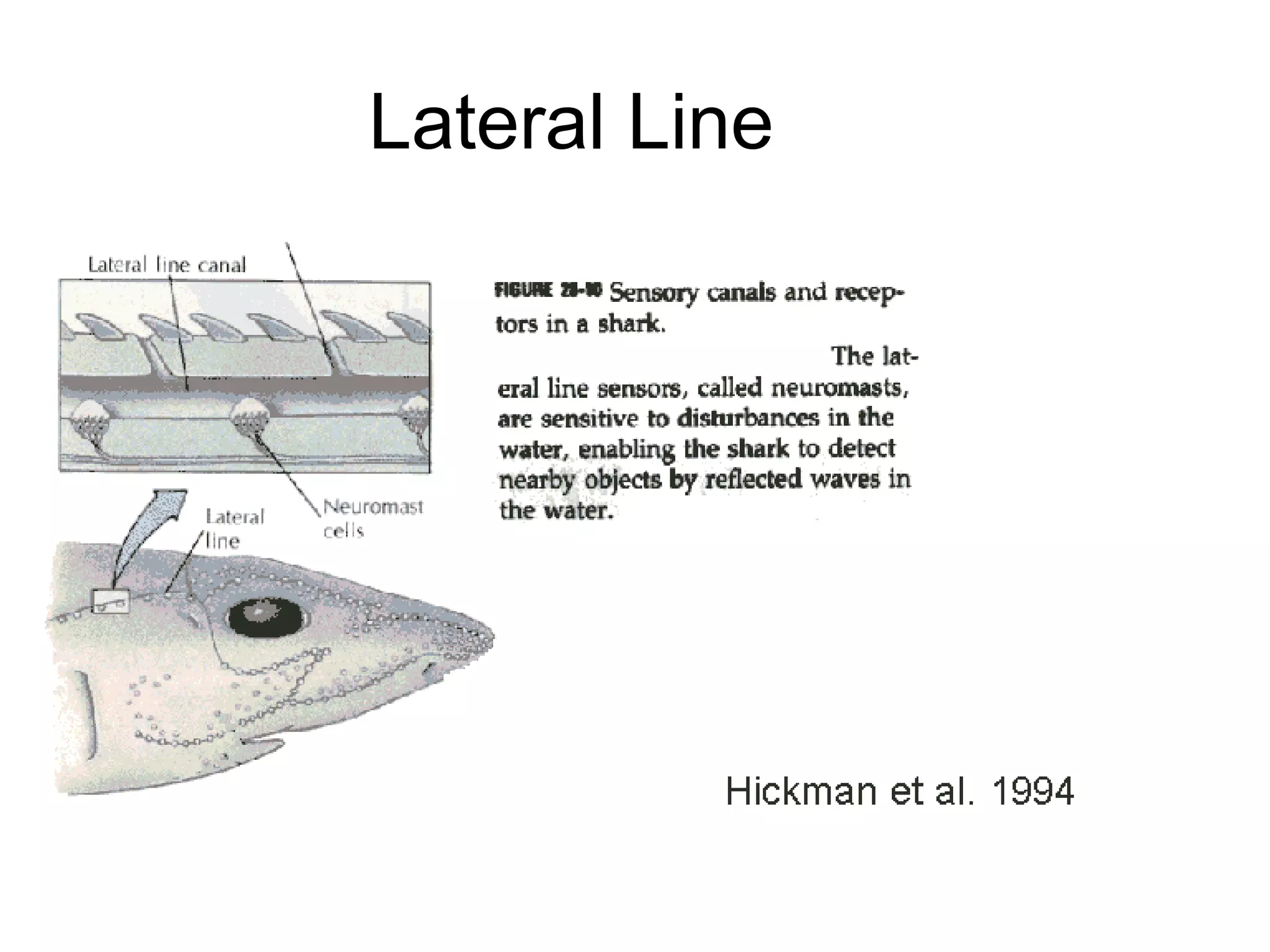
• A lateral line controls impulse detections and
  low frequencies. This line contains ciliated nerve
  cells. (Fig. 8.19)
• Chemoreceptors are used for sensing smell
• Weberian ossicle: in freshwater fish for special
  acoustic sensory
• http://www.britannica.com/eb/article-9076391/Weber
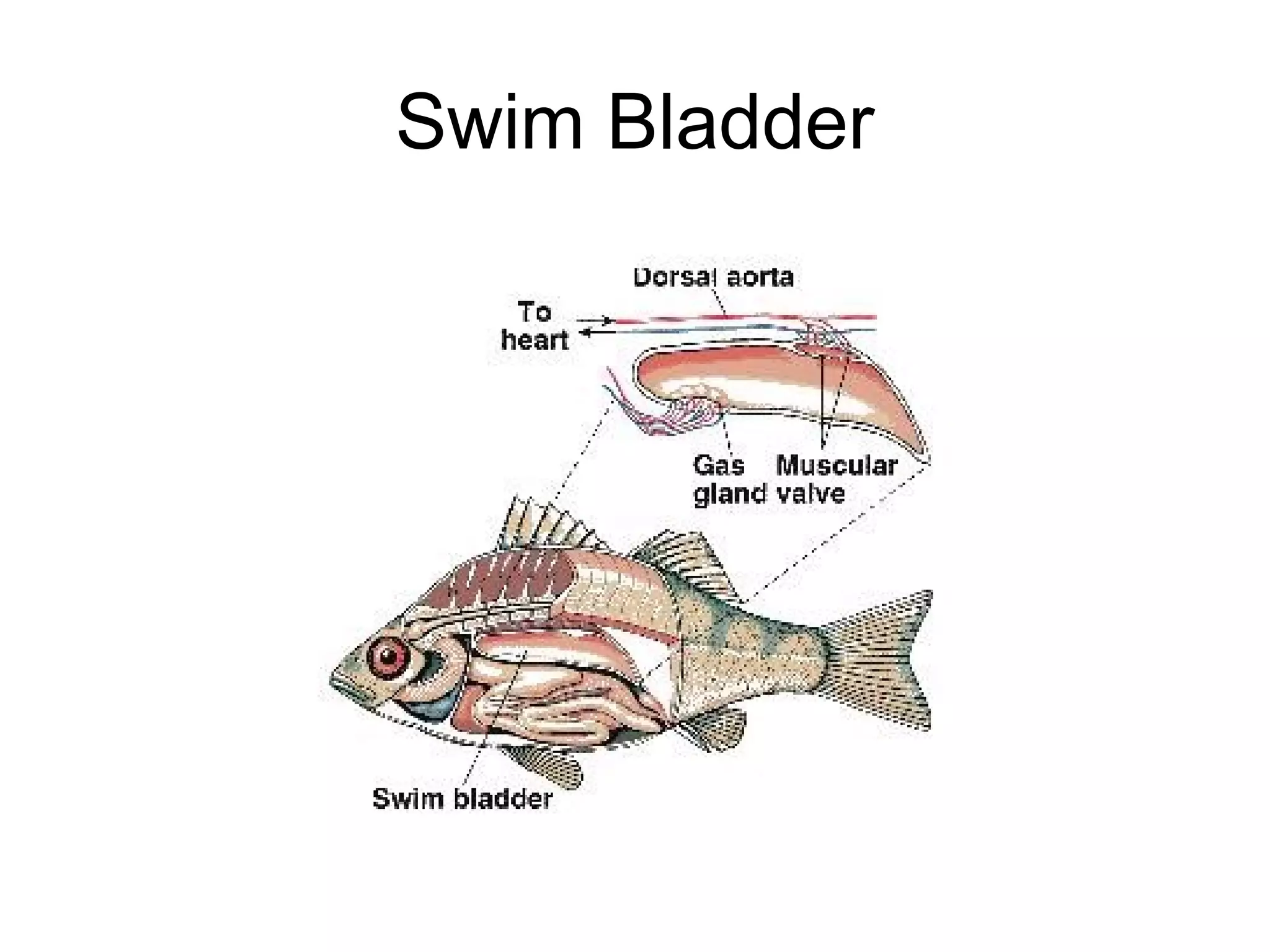
Swim Bladder
• Controls buoyancy in fish through oxygen filling the
  bladder or being released.
• Primitive fish have the bladder attached directly to the
  gills.
• Blood carries oxygen to and from the bladder.
• The deeper a fish goes the more pressure on the
  bladder.
• The air becomes more dense in the bladder.
• Gas is released through a gas duct.
• What about benthic or deep sea species???
• Flounder and other bottom/deep sea dwelling fishes
  have a reduced bladder.
Swim Bladder
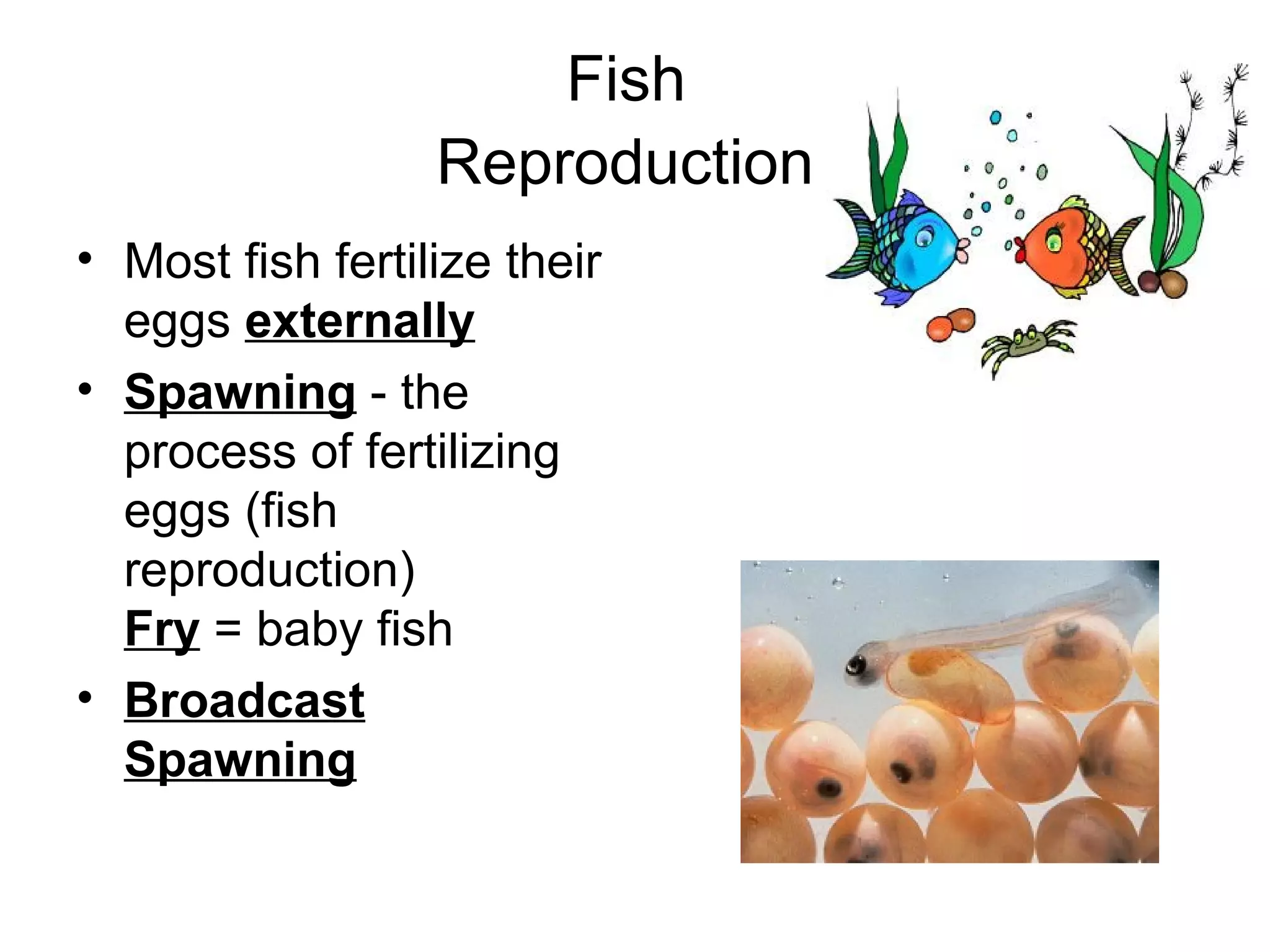
Fish
                  Reproduction
• Most fish fertilize their
  eggs externally
• Spawning - the
  process of fertilizing
  eggs (fish
  reproduction)
  Fry = baby fish
• Broadcast
  Spawning
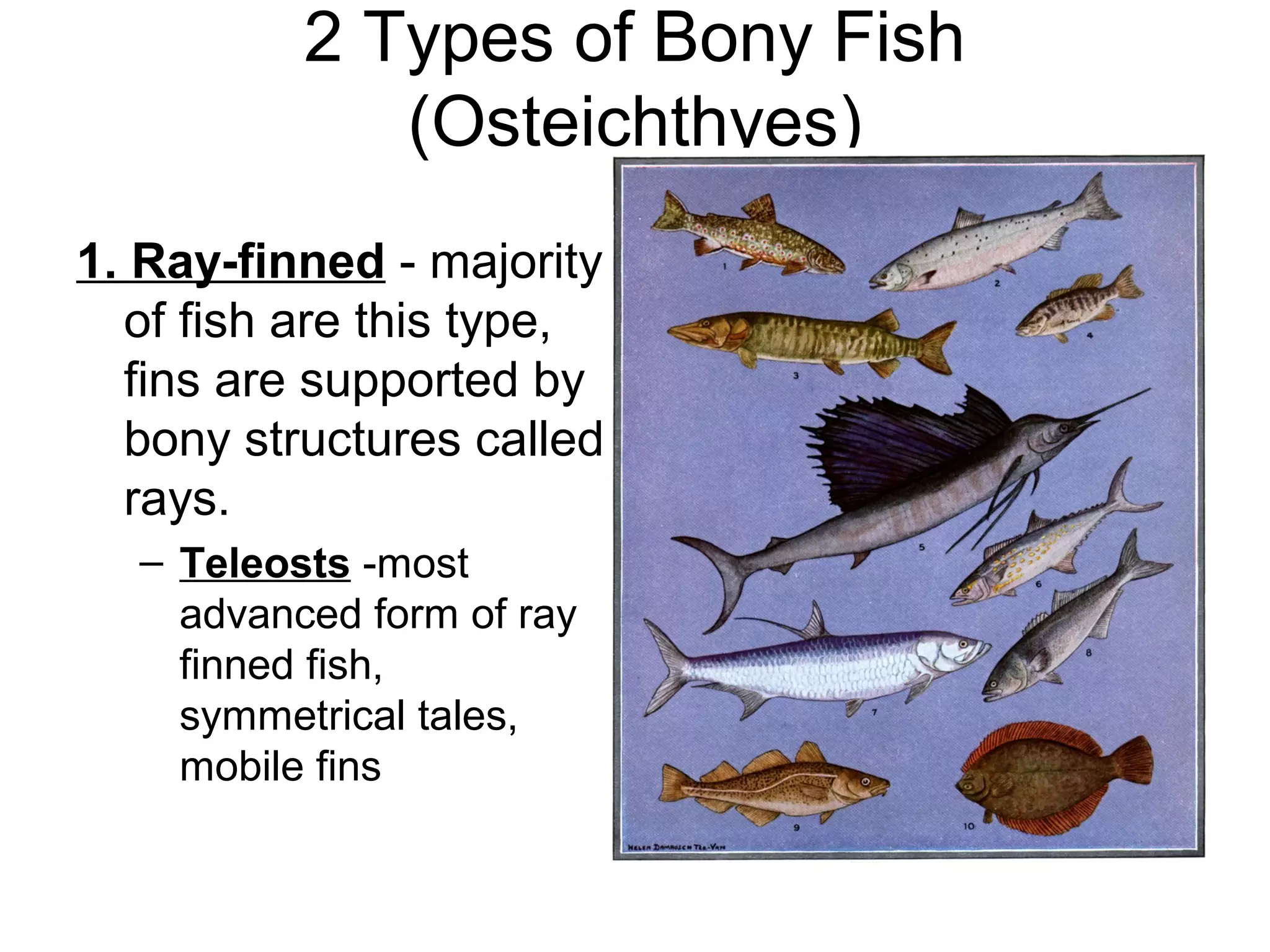
2 Types of Bony Fish
             (Osteichthyes)
1. Ray-finned - majority
  of fish are this type,
  fins are supported by
  bony structures called
  rays.
  – Teleosts -most
    advanced form of ray
    finned fish,
    symmetrical tales,
    mobile fins
Teleosts
• Advance dorsal fin is
  split into two regions;
  Anterior dorsal fin
  with spines,
  posterior dorsal
  with rays. Pelvic fin
  is ventrally located
  below pectoral.
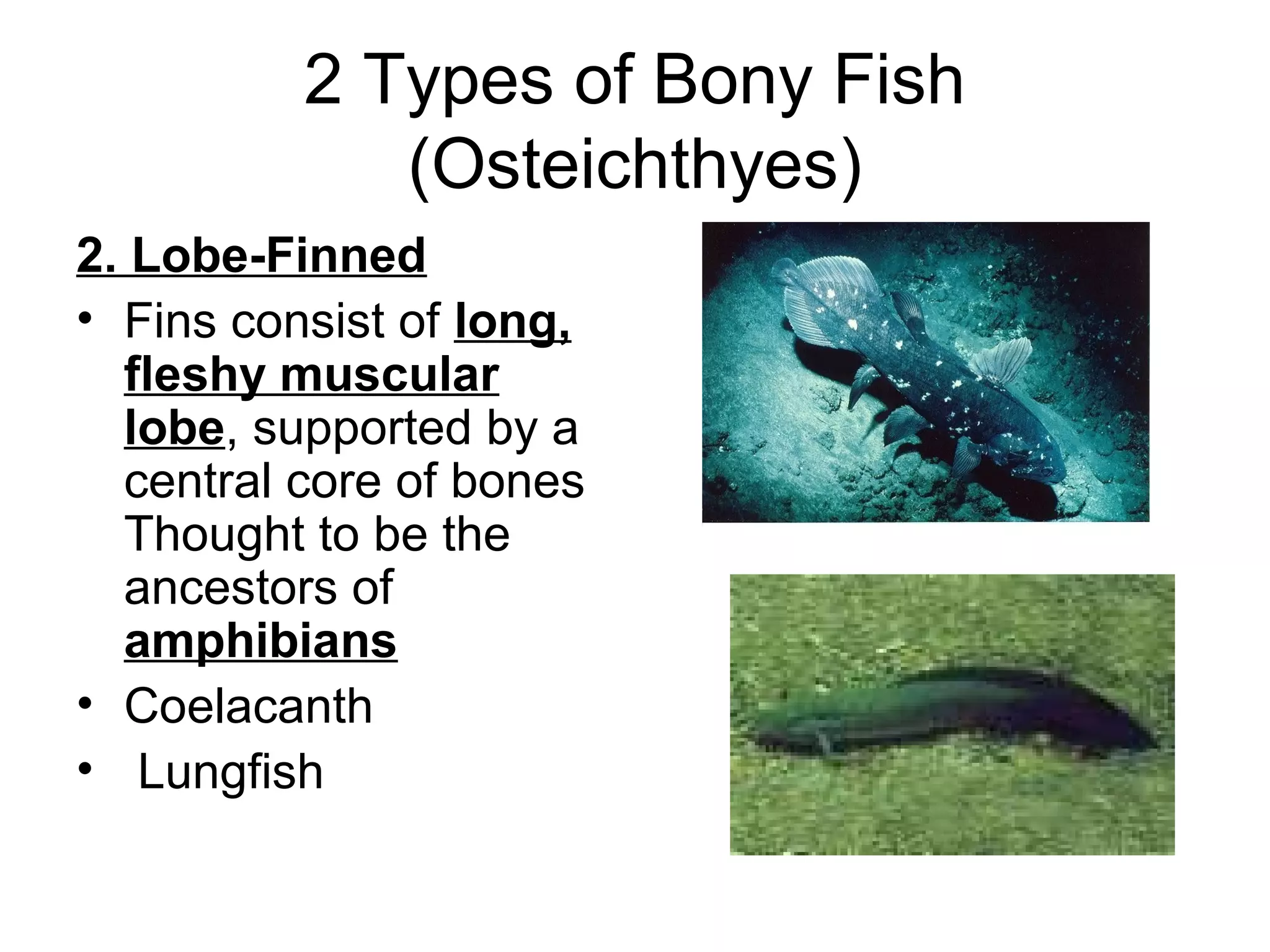
2 Types of Bony Fish
             (Osteichthyes)
2. Lobe-Finned
• Fins consist of long,
  fleshy muscular
  lobe, supported by a
  central core of bones
  Thought to be the
  ancestors of
  amphibians
• Coelacanth
• Lungfish
Fish Adaptations
• Lateral Line System - Used to detect vibrations,
  orientate fish in the water. A line of cells running
  down the side of the fish
• Gill Cover (Operculum) - covers gills,
  movement of operculum allows more water to be
  drawn in
• Swim Bladder - a gas filled sac that helps the
  fish maintain buoyancy (sharks do not have
  swim bladders, they sink when they stop
  swimming)
• How do sharks maintain buoyancy w/o a swim
  bladder???
Lateral Line (fig. 8.19)
Lateral Line
Fins
Fin Shape
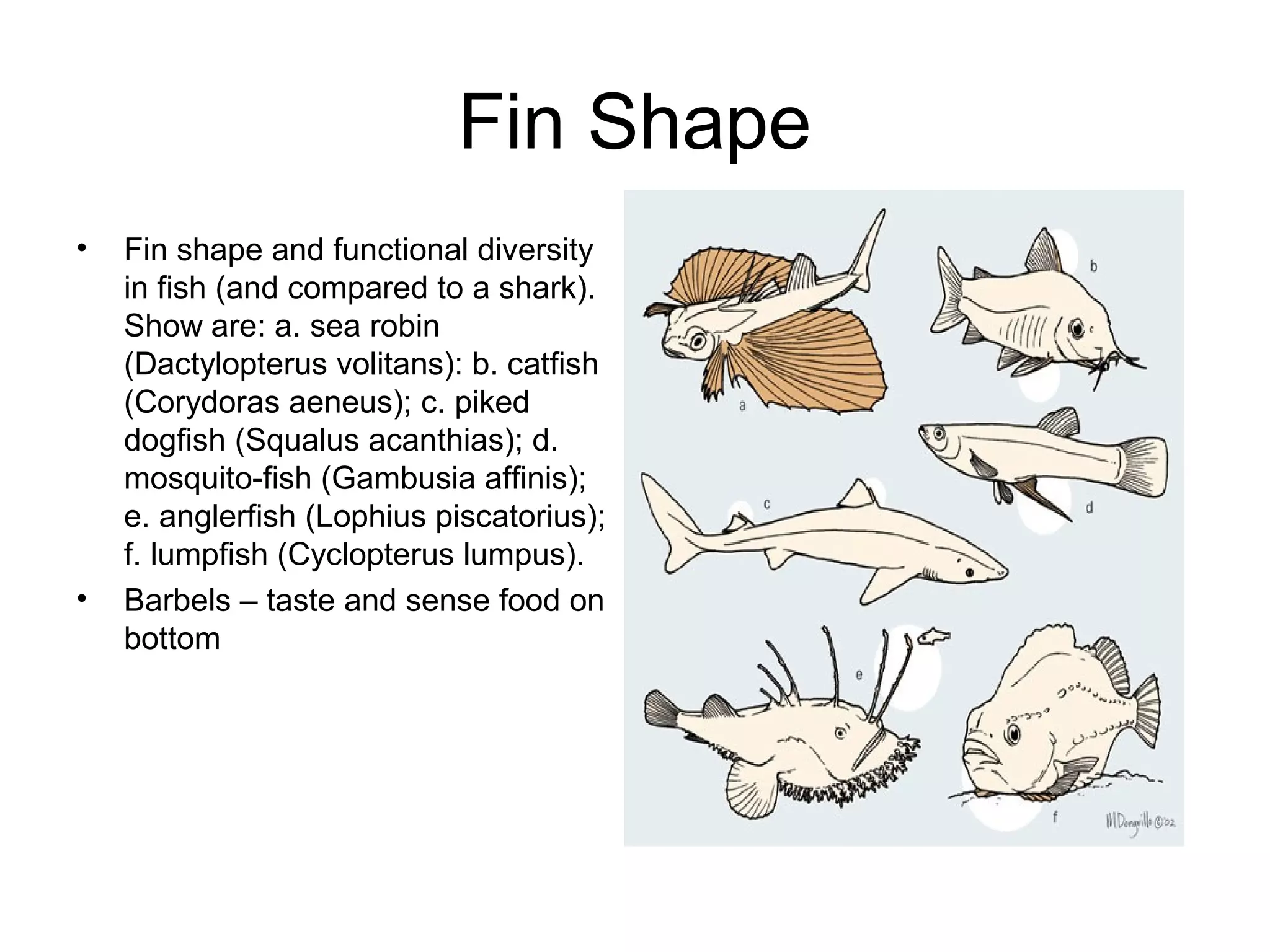
•   Fin shape and functional diversity
    in fish (and compared to a shark).
    Show are: a. sea robin
    (Dactylopterus volitans): b. catfish
    (Corydoras aeneus); c. piked
    dogfish (Squalus acanthias); d.
    mosquito-fish (Gambusia affinis);
    e. anglerfish (Lophius piscatorius);
    f. lumpfish (Cyclopterus lumpus).
•   Barbels – taste and sense food on
    bottom
Locomotion (fig 8.11)
•   Fish move through the water with movements of their tail, here
    different kinds of fish locomotion are illustrated: A. A crucian carp's
    fin action for stabilizing and maneuvering. a. Anguilliform locomotion
    (eel); b. Carangiform locomotion (tuna); c. Ostraciform locomotion
    (boxfish). The blue area on these fish shows the portion of the body
    used in locomotion.
Do all fishes have scales?
• No. Many species of
  fishes lack scales.
• All the clingfishes
  (family Gobiesocidae)
  for example, are
  scaleless. Their
  bodies are protected
  by a thick layer of
  mucous.
Mucous
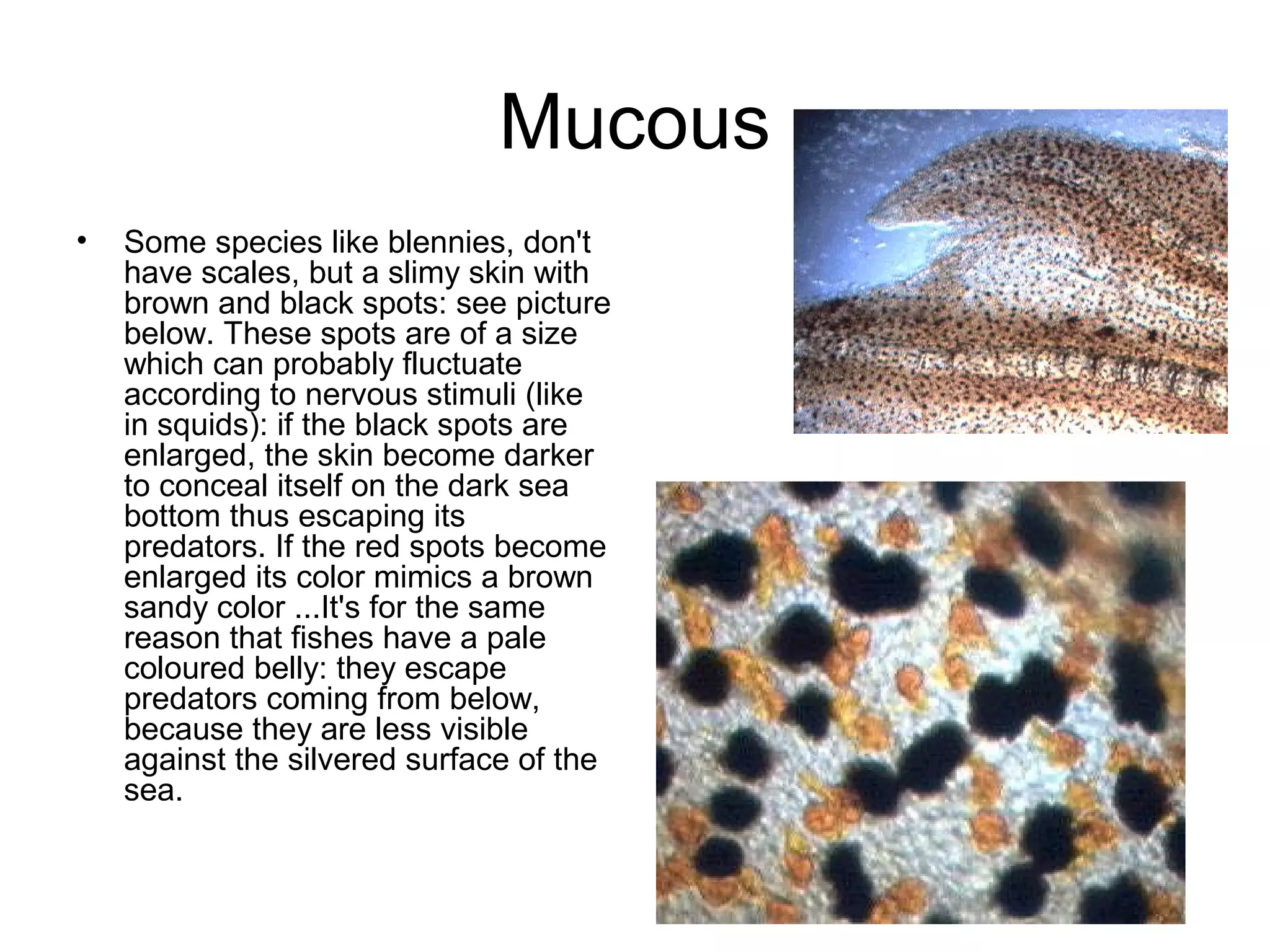
•   Some species like blennies, don't
    have scales, but a slimy skin with
    brown and black spots: see picture
    below. These spots are of a size
    which can probably fluctuate
    according to nervous stimuli (like
    in squids): if the black spots are
    enlarged, the skin become darker
    to conceal itself on the dark sea
    bottom thus escaping its
    predators. If the red spots become
    enlarged its color mimics a brown
    sandy color ...It's for the same
    reason that fishes have a pale
    coloured belly: they escape
    predators coming from below,
    because they are less visible
    against the silvered surface of the
    sea.
Scales: 4 types (fig. 8.8)
• 1. Ganoid: Bony scales found in oldest known
  species including sturgeon.
• 2. Cycloid: Simple thin disc lik escales with
  smooth surface which have circular rings to
  determine growth.
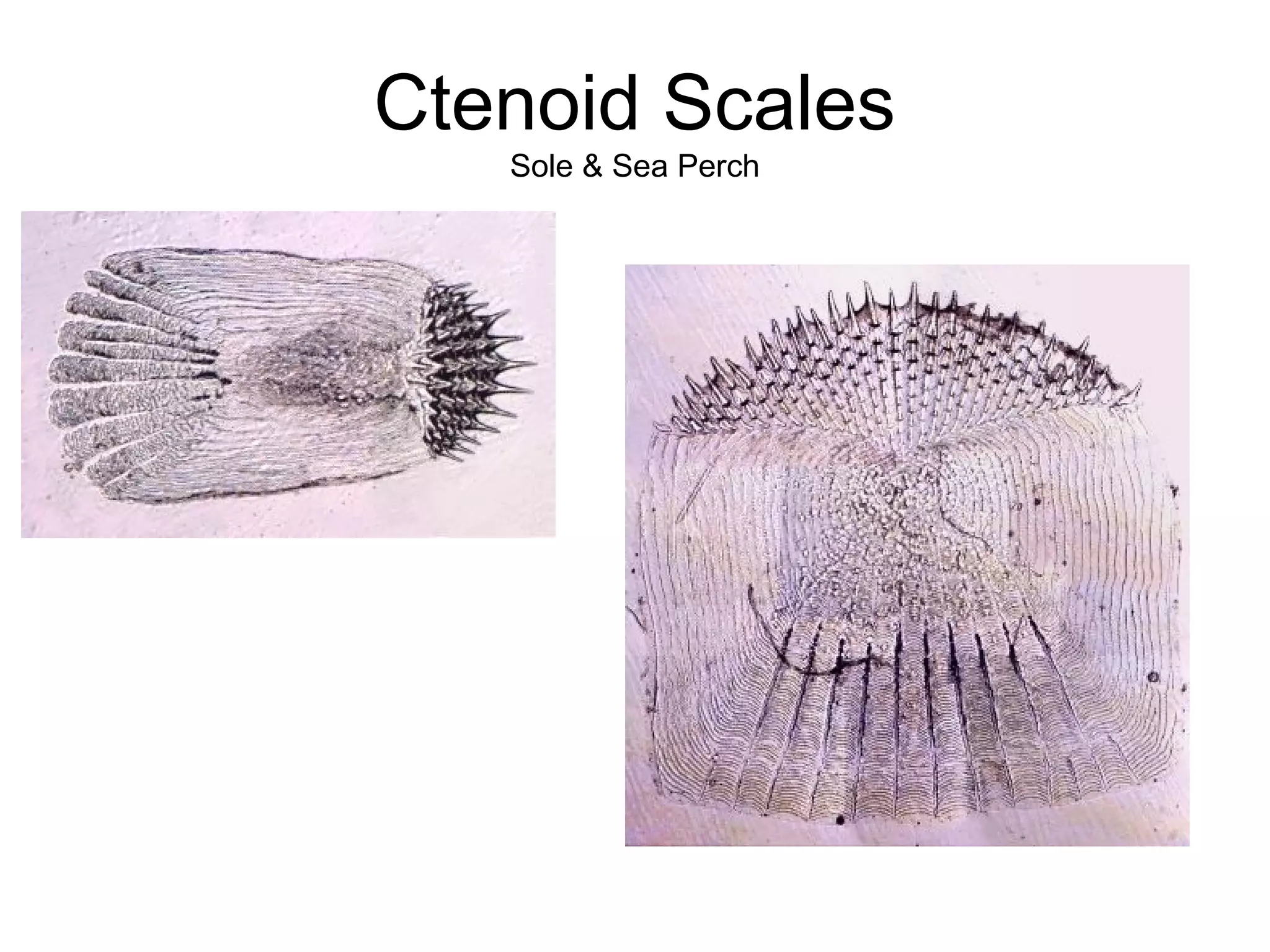
• 3. Ctenoid: same as cycloid, but have been
  found in most advanced teleosts which have
  posterior spikes from scales. Perch
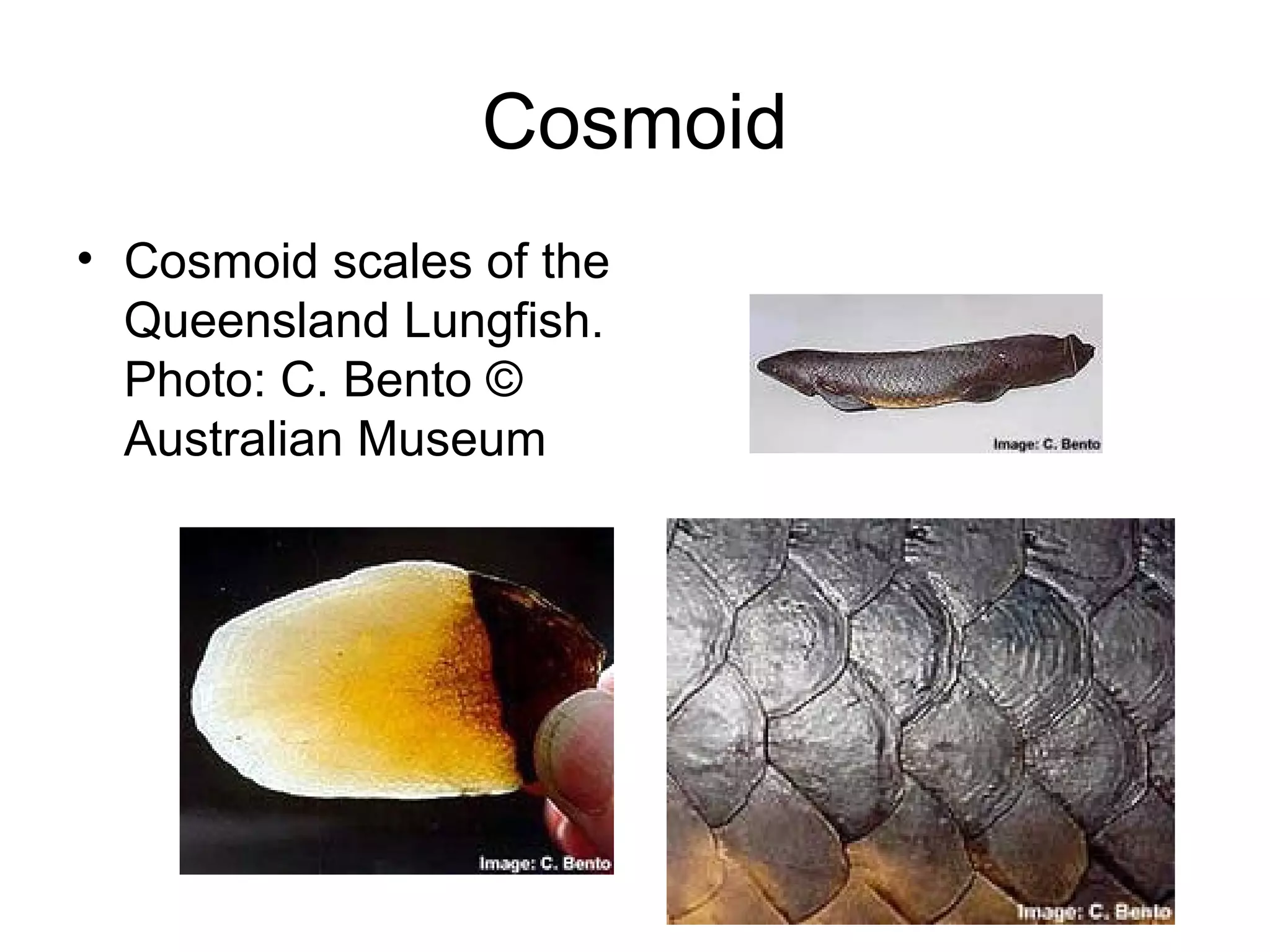
• 4. Cosmoid: Similar to placoid scales and
  probably evolved from the fusion of placoid
  scales.
Ganoid
•   Ganoid scales of the Florida
    Gar, Lepisosteus platyrhincus.
    Photo: C. Bento © Australian
    Museum
Ctenoid & Cycloid Scales
Sturgeon
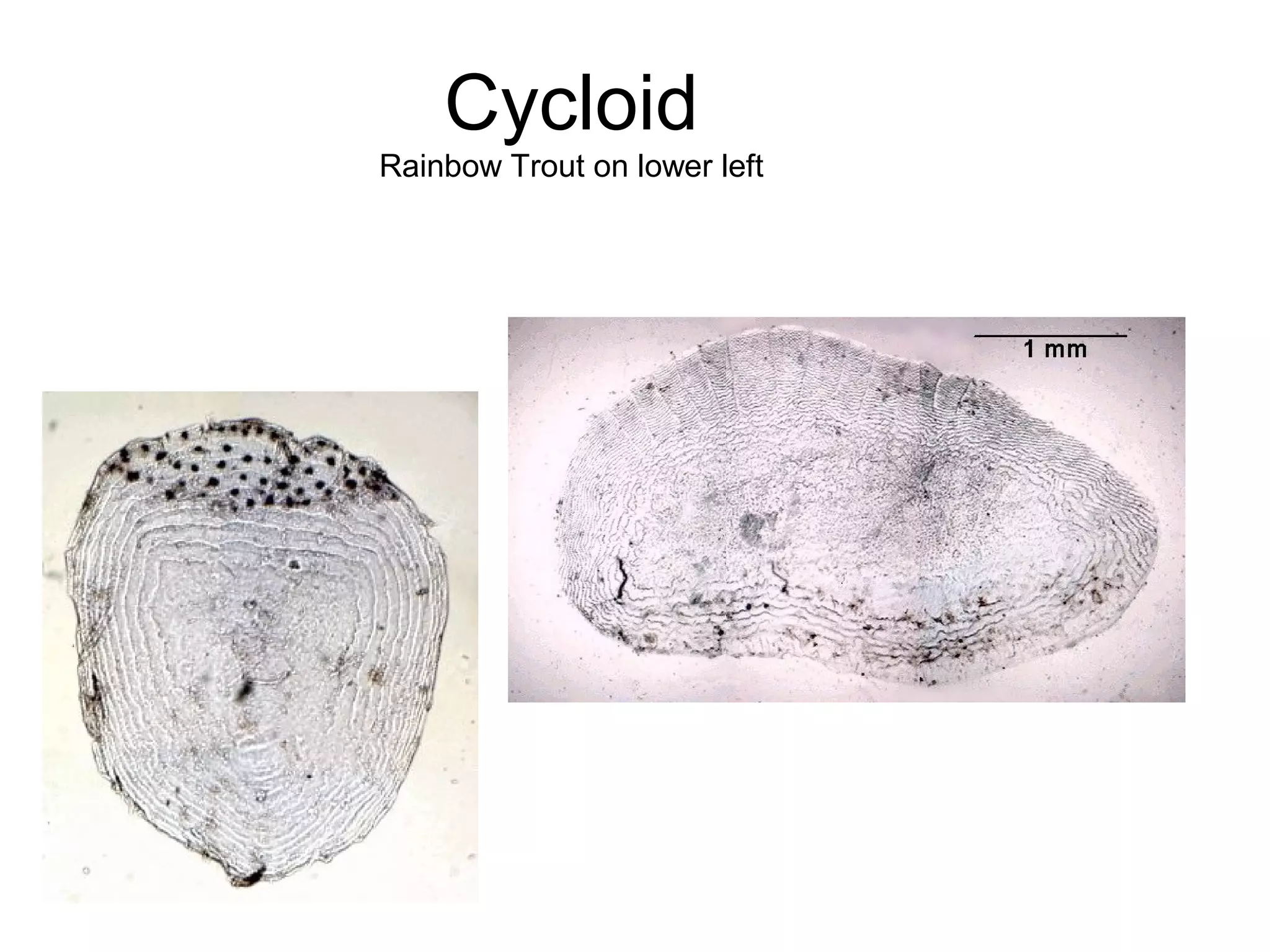
Cycloid
• Cycloid scales of Jungle Perch, Kuhlia
  rupestris. Photo: C. Bento © Australian
  Museum
Cycloid
Rainbow Trout on lower left
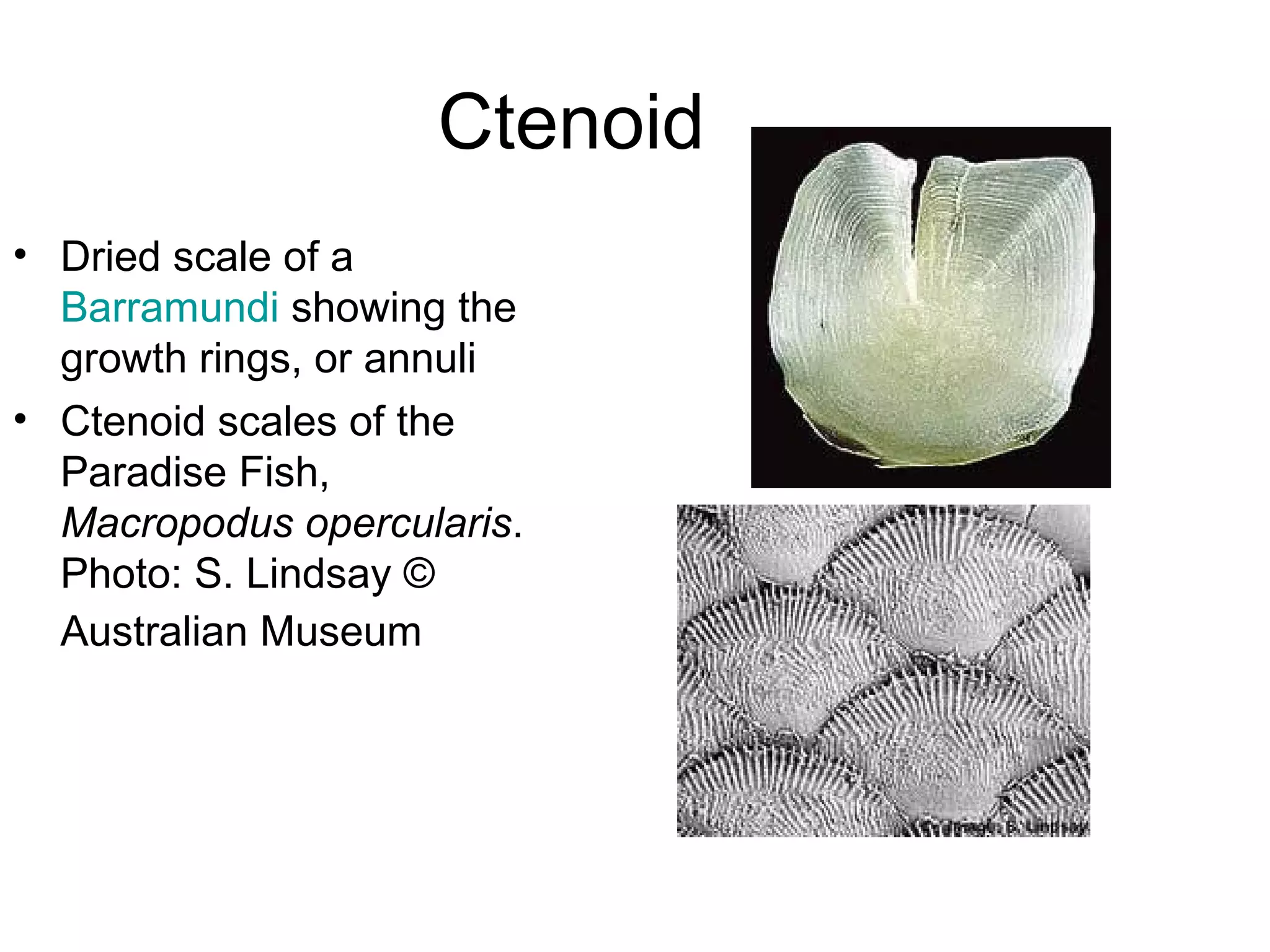
Ctenoid
• Dried scale of a
  Barramundi showing the
  growth rings, or annuli
• Ctenoid scales of the
  Paradise Fish,
  Macropodus opercularis.
  Photo: S. Lindsay ©
  Australian Museum
Ctenoid Scales
   Sole & Sea Perch
Cosmoid
• Cosmoid scales of the
  Queensland Lungfish.
  Photo: C. Bento ©
  Australian Museum
Red muscles
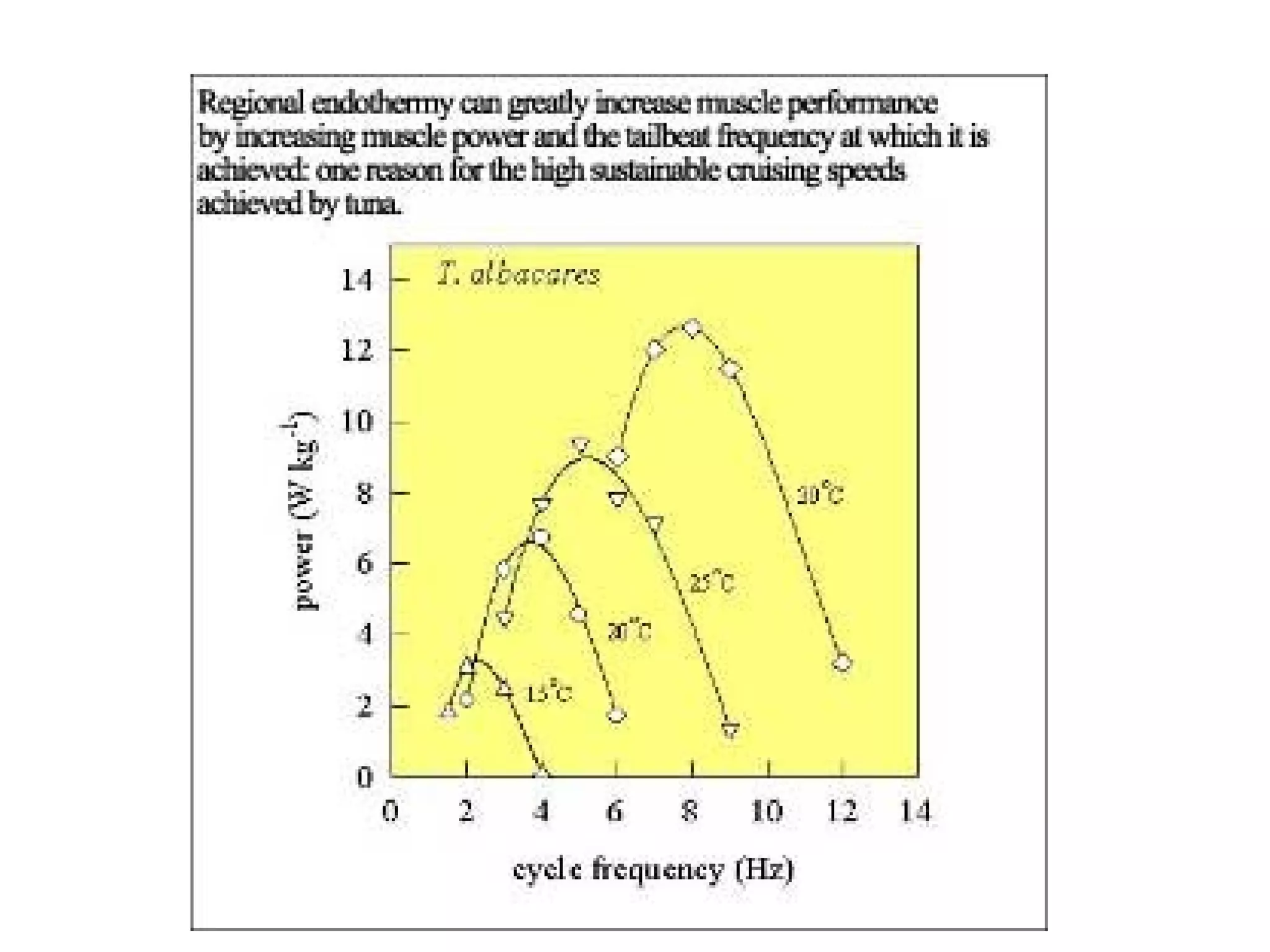
• Game fish have large amounts of red muscles
  which contain more blood vessels = more
  energy and O2.
• Red muscles produce greater heat energy b/c
  separate smaller blood vessels carry
  oxygenated blood to muscles and not dorsal
  aorta. The blood vessels are close to the veins
  which are 10 degrees warmer, thus heating the
  blood, producing more power.
Red Muscle - Myomeres
Body Design (fig. 8.9)
• Fish possess a dorsal, ventral, posterior,
  and anterior symmetry
• Fish are attenuated, compressed,
  depressed, or fusiform in shape
Attenuated
• Snake-like “THE
  FREAK SENIOR” and
  his lovely wife
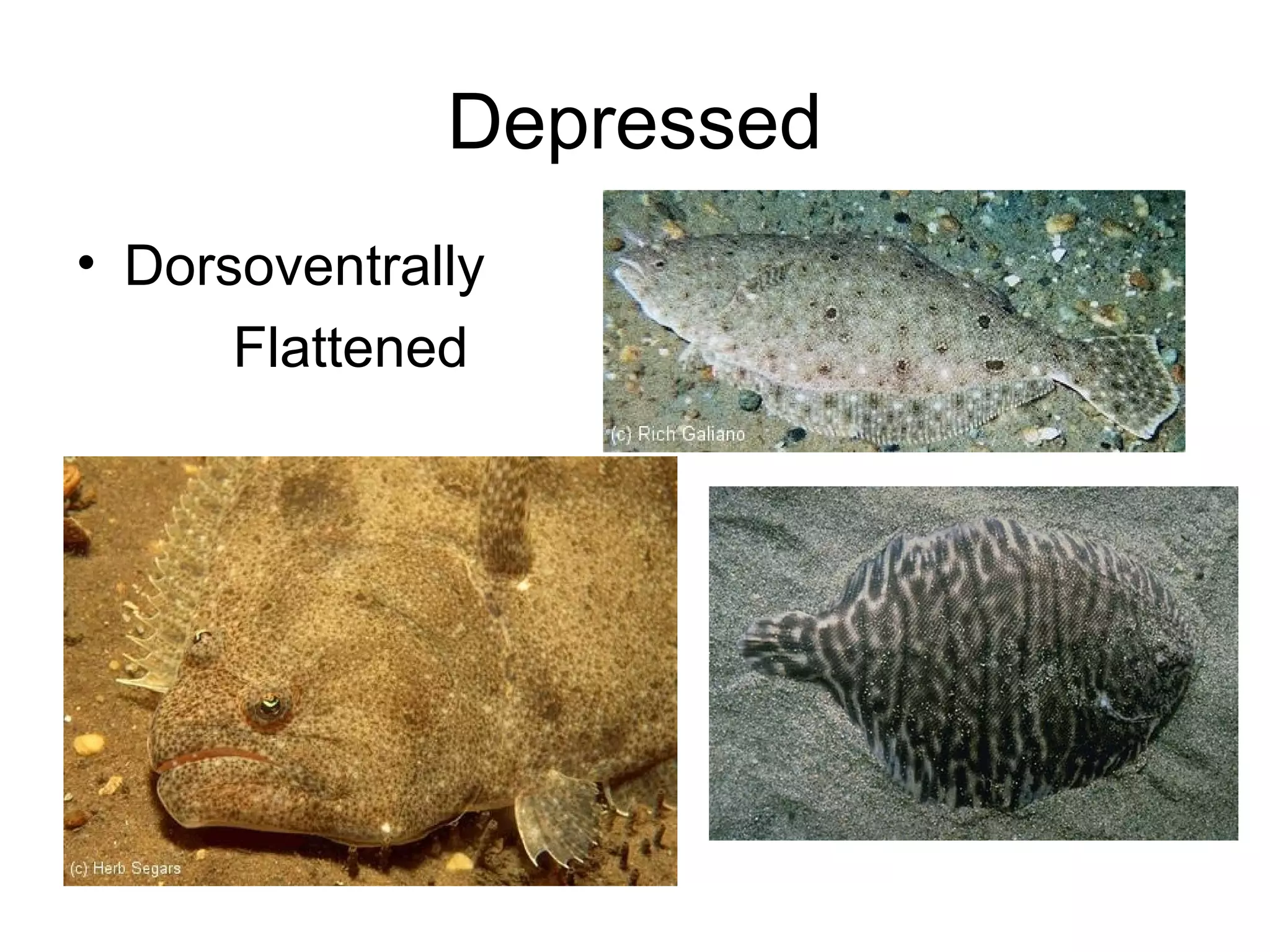
Depressed
• Dorsoventrally
      Flattened
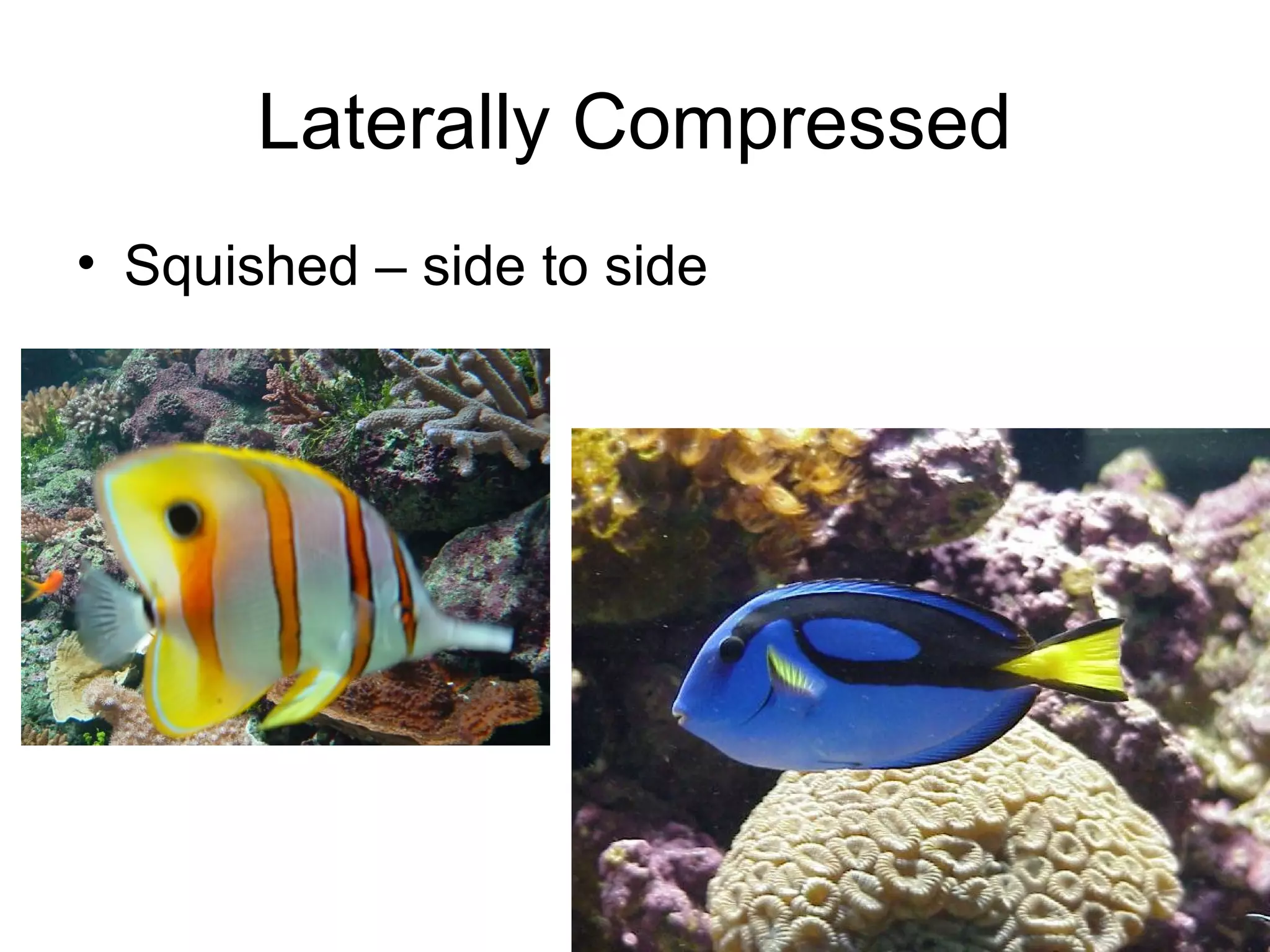
Laterally Compressed
• Squished – side to side
Fusiform


    • Torpedo Shaped = very
      fast
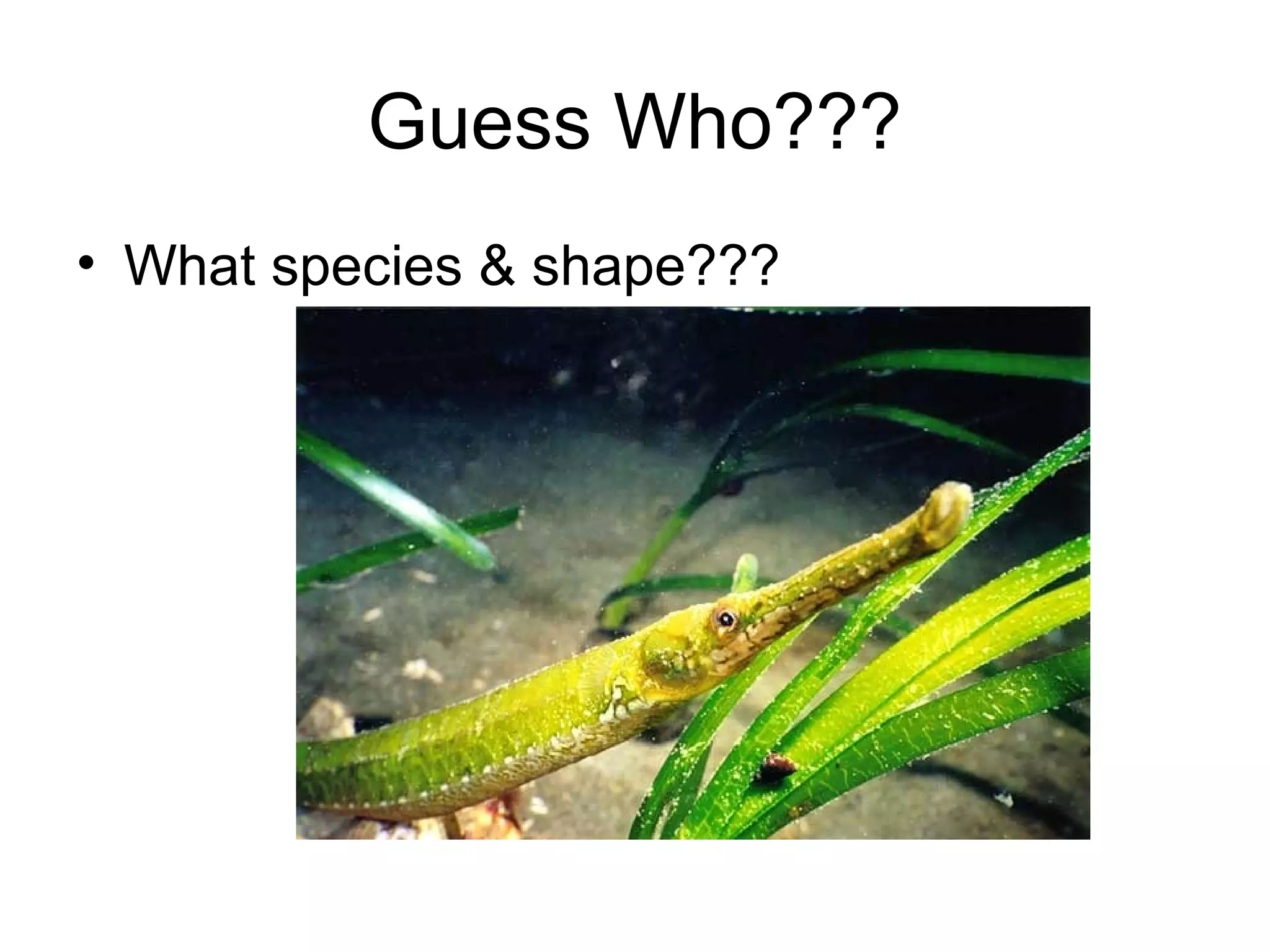
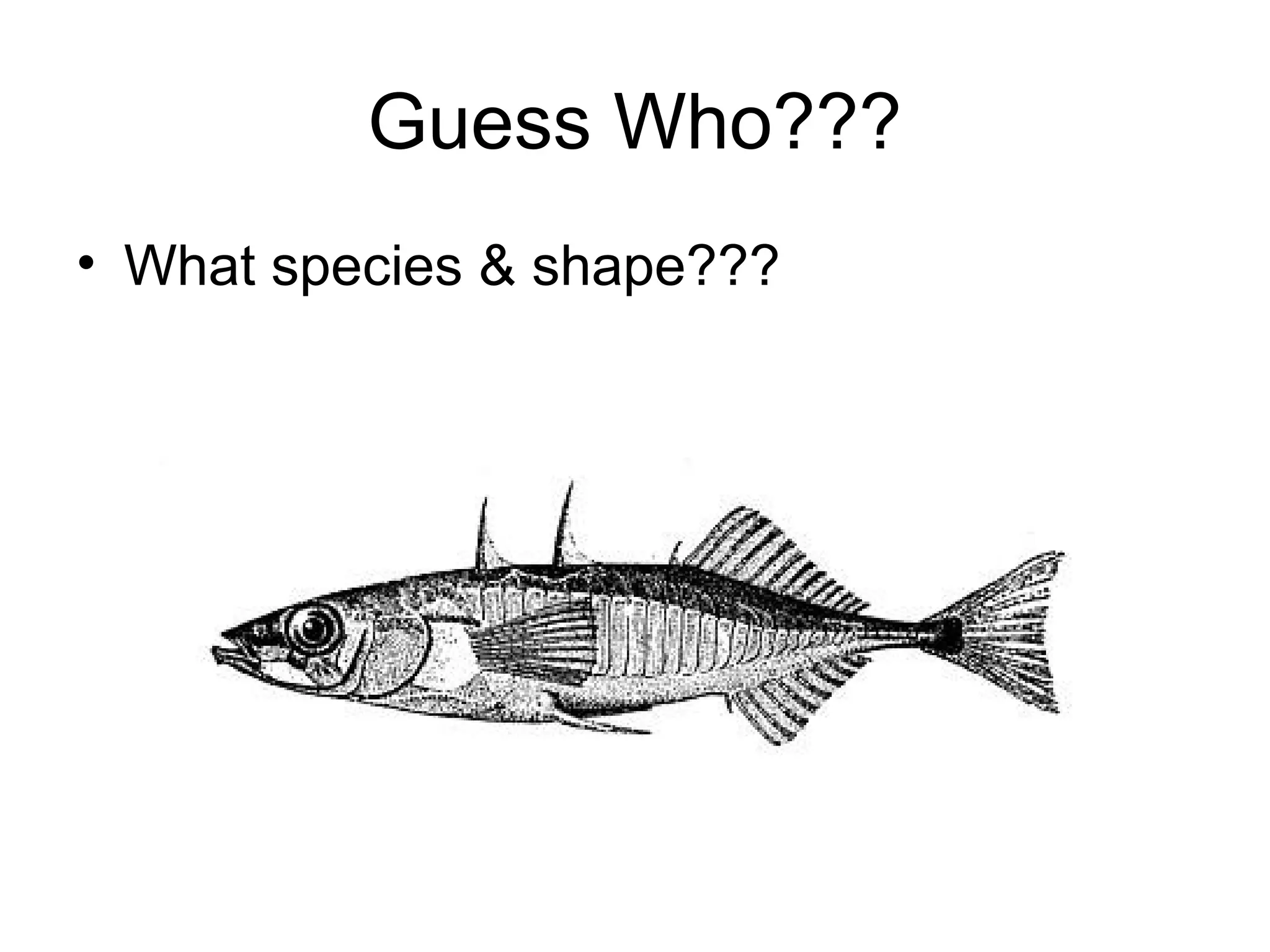
Guess Who???
• What species & shape???
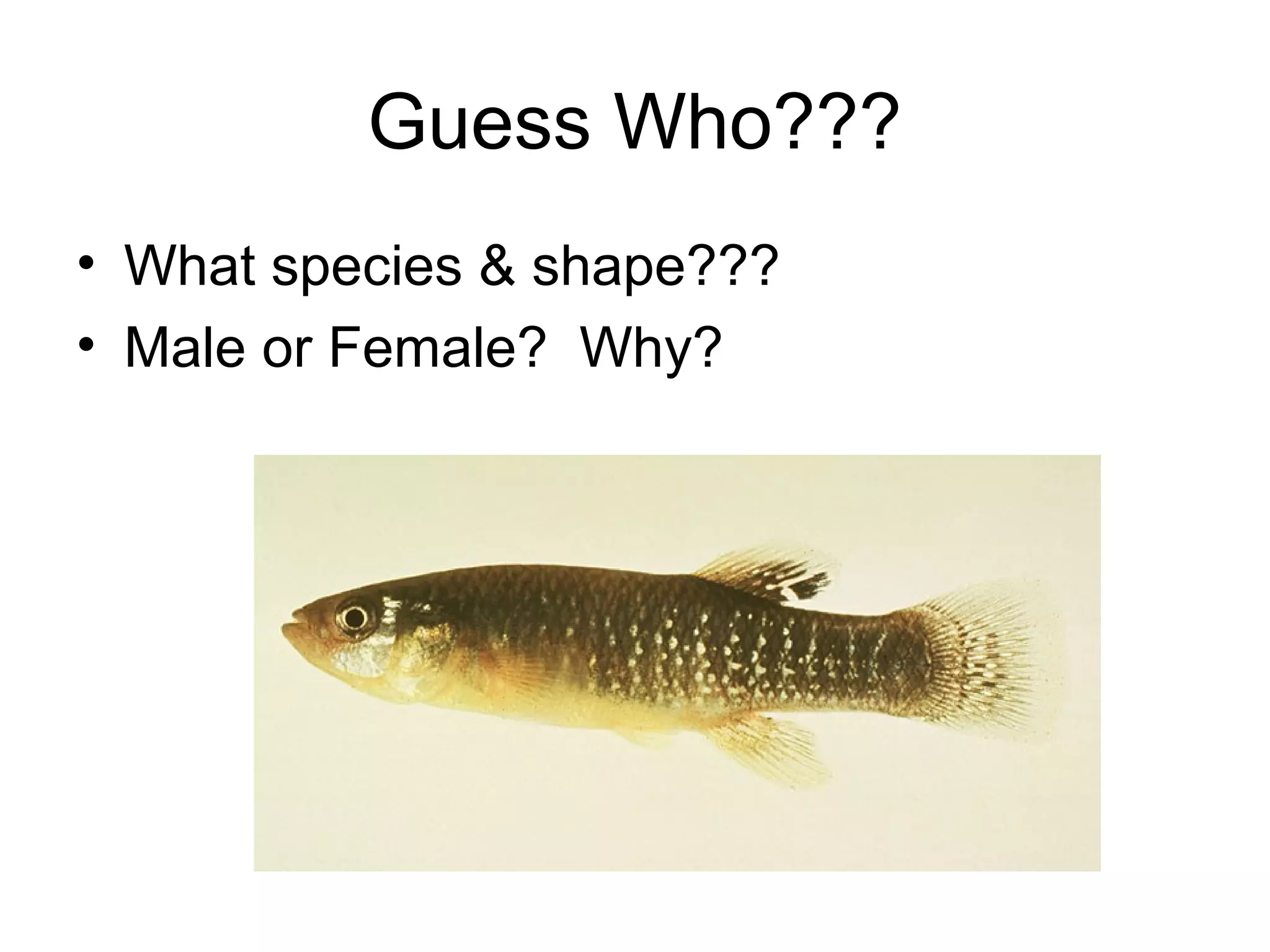
Guess Who???
• What species & shape???
• Male or Female? Why?
Guess Who???
• What species & shape???
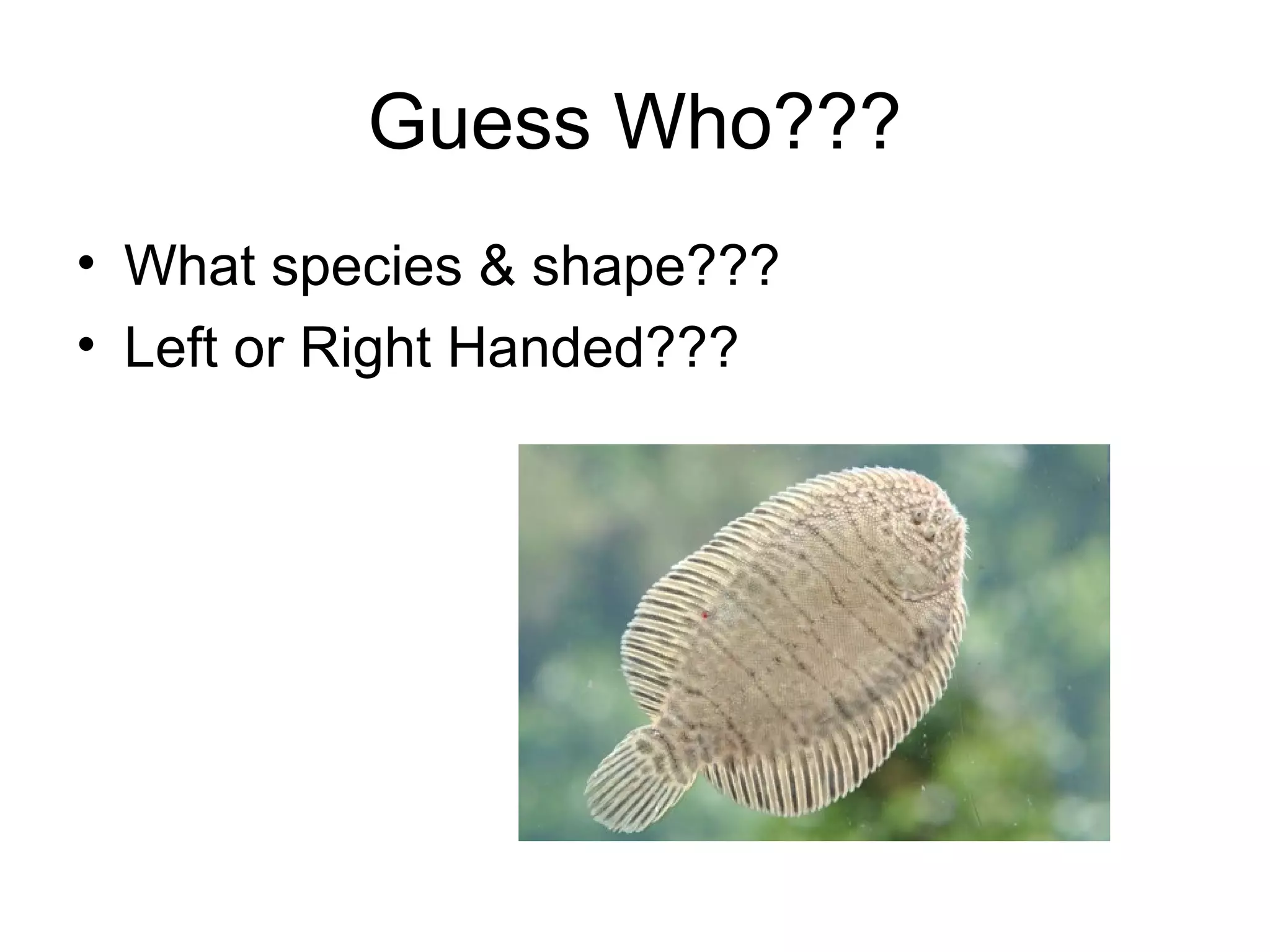
Guess Who???
• What species & shape???
• Left or Right Handed???
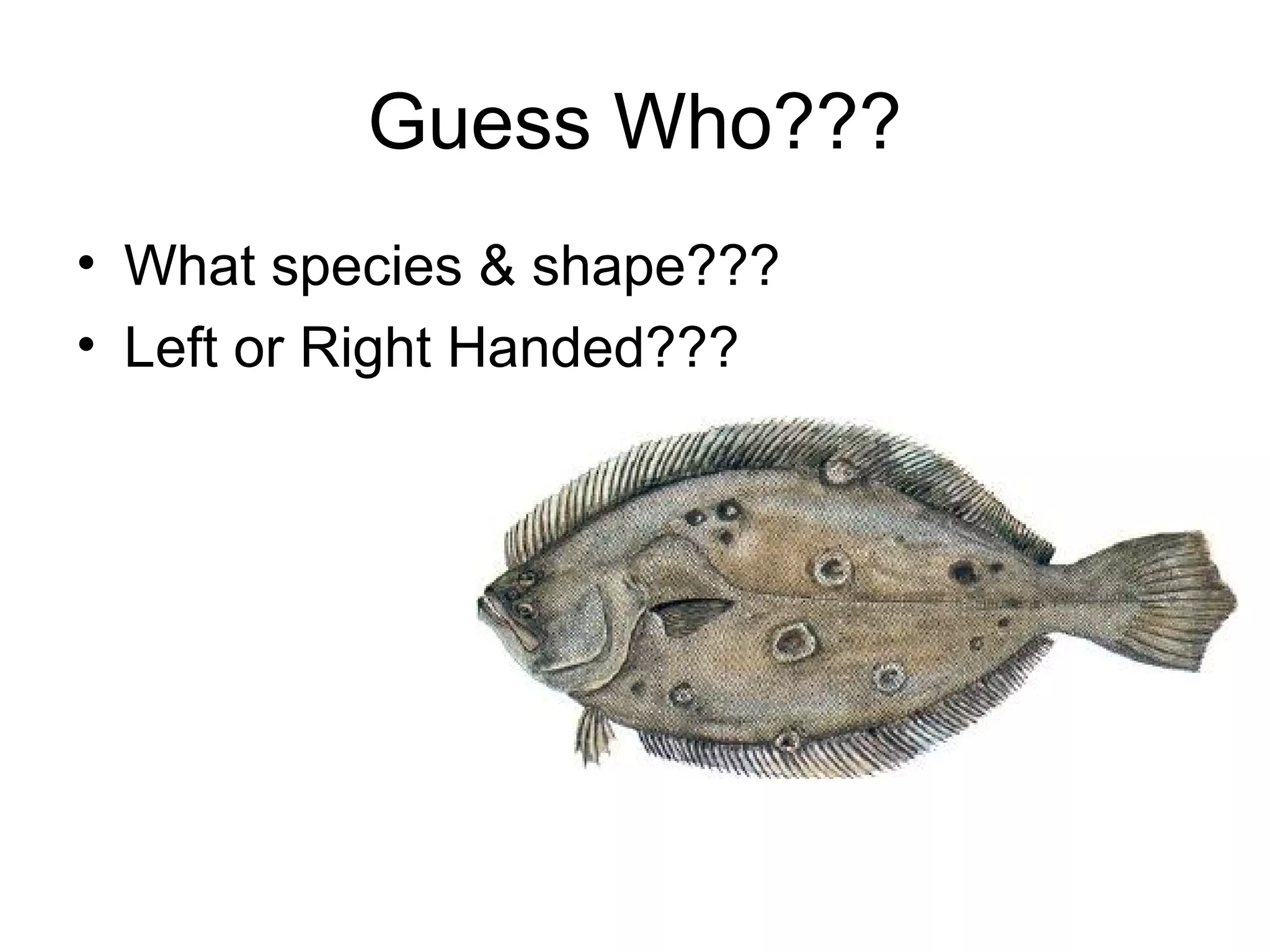
Guess Who???
• What species & shape???
• Left or Right Handed???
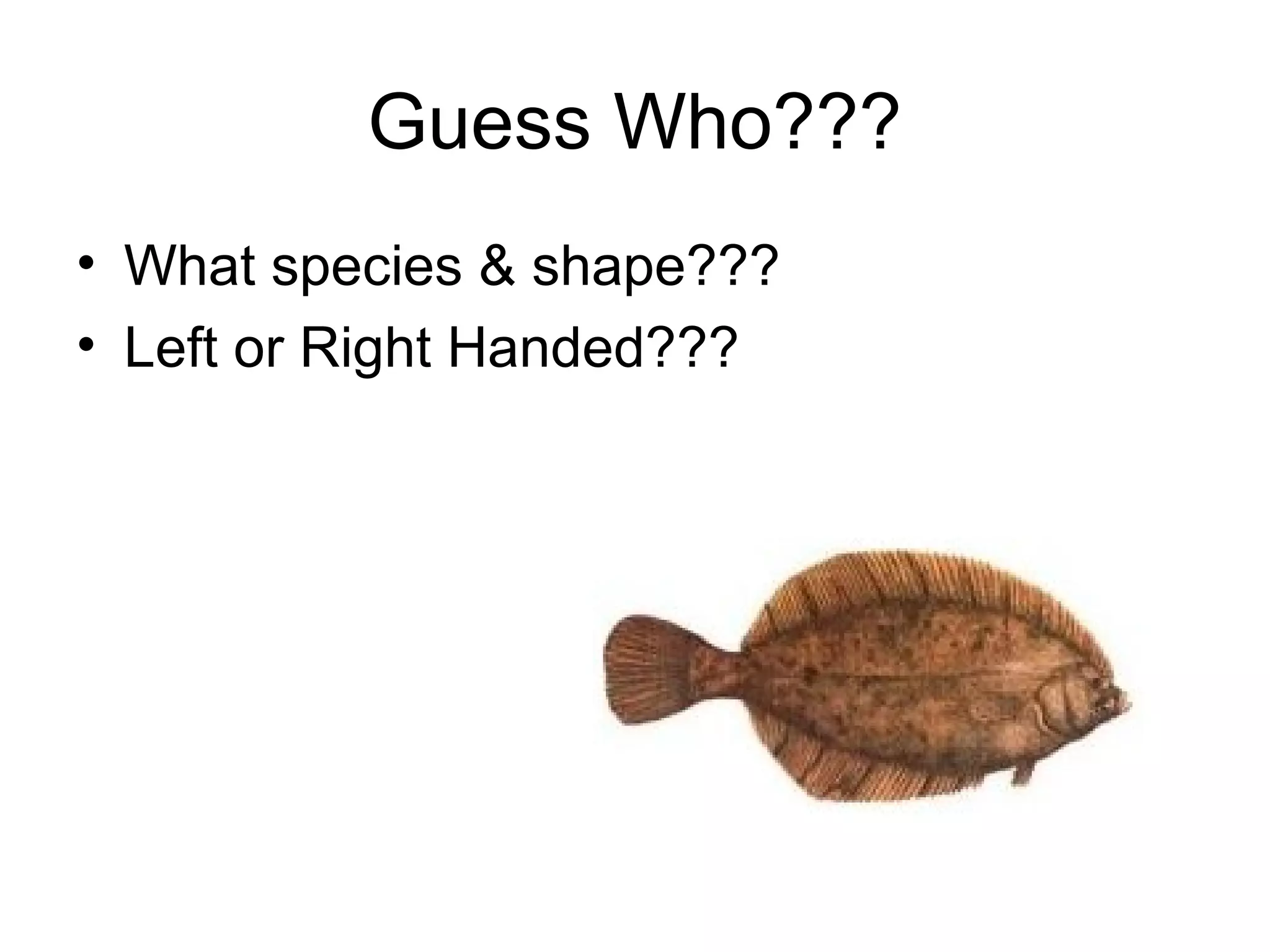
Guess Who???
• What species & shape???
• Left or Right Handed???
Guess Who???
• What species & shape???
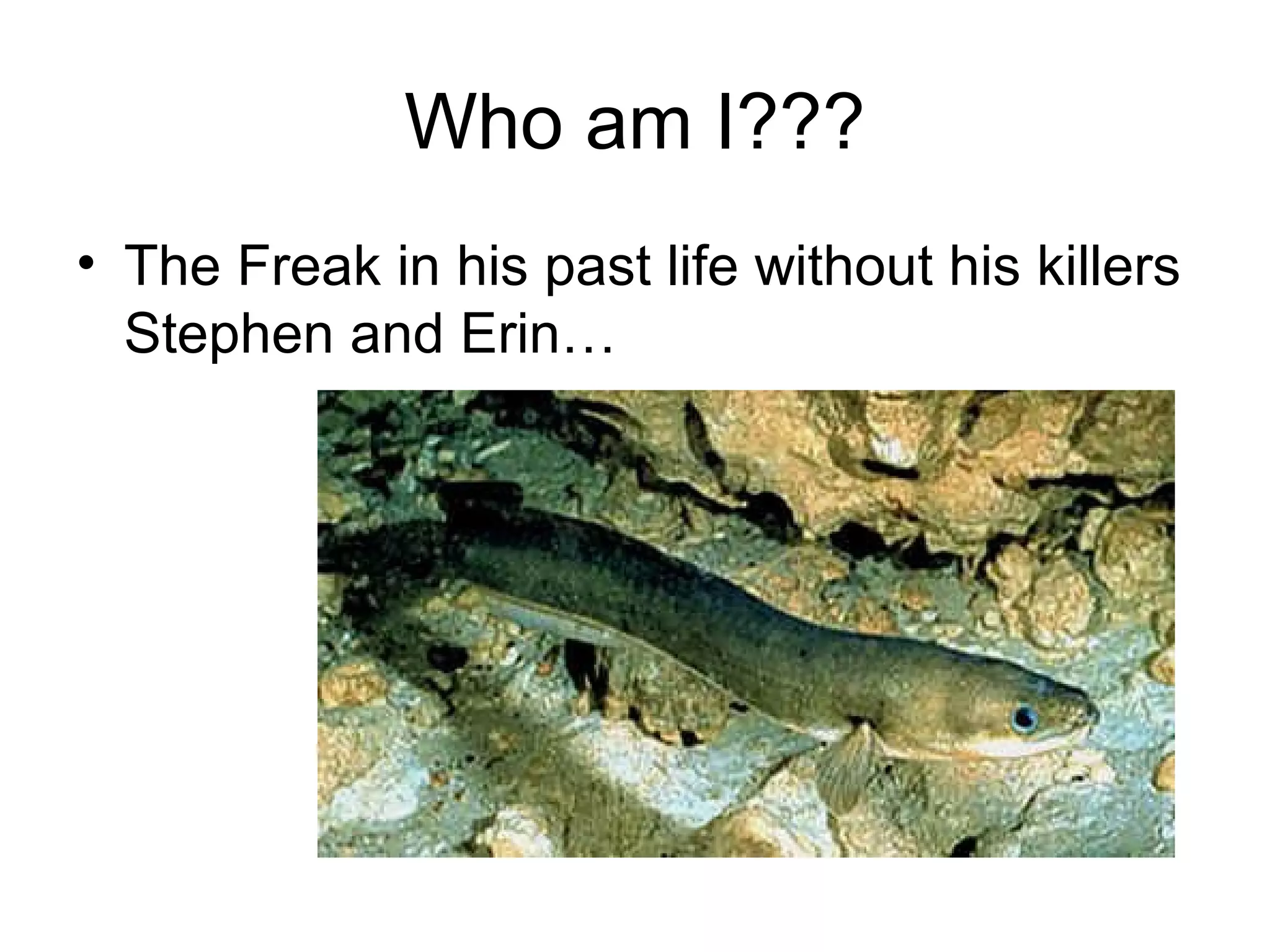
Who am I???
• The Freak in his past life without his killers
  Stephen and Erin…
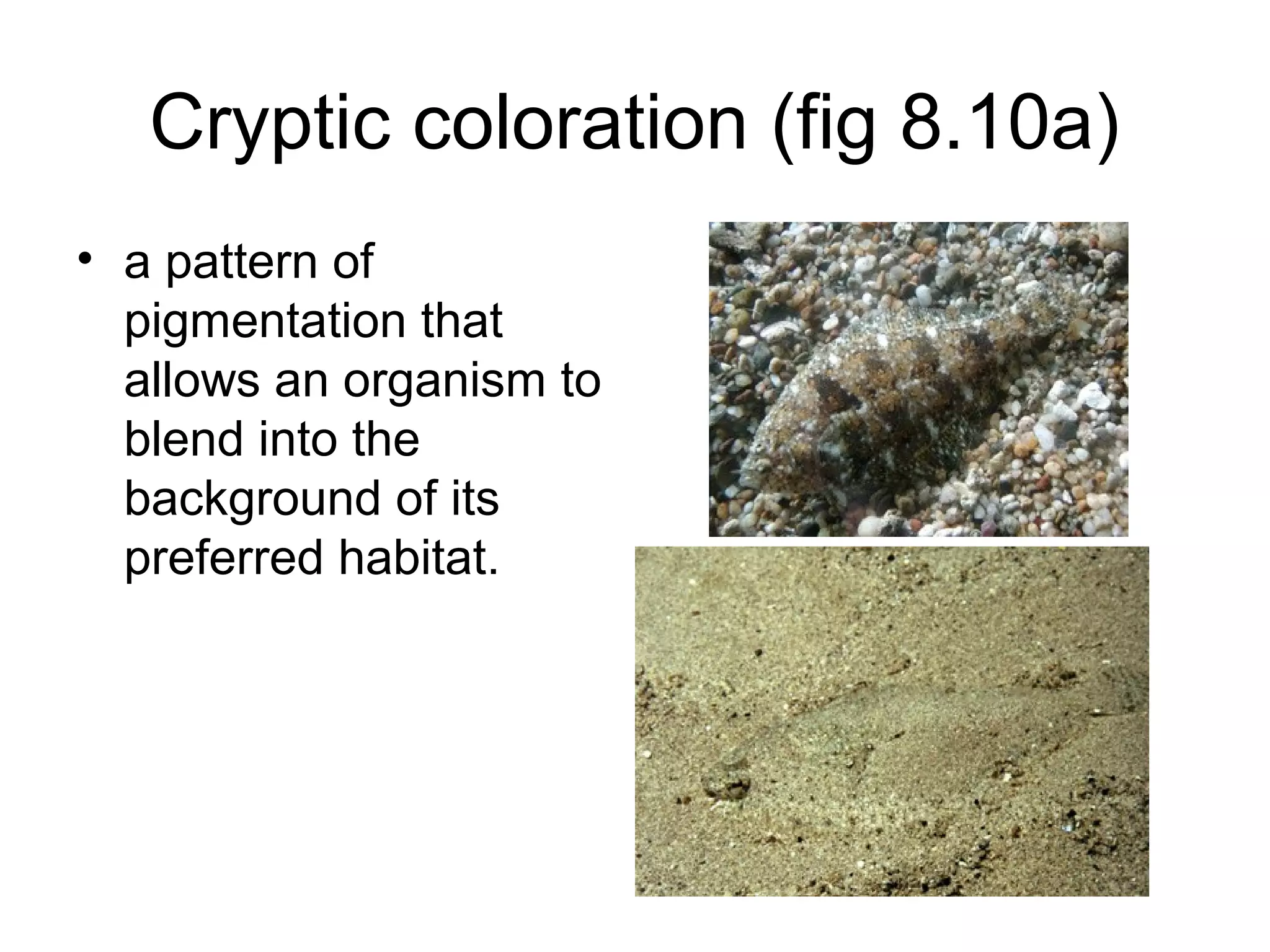
Cryptic coloration (fig 8.10a)
• a pattern of
  pigmentation that
  allows an organism to
  blend into the
  background of its
  preferred habitat.
Disruptive Coloration(fig.8.28,
                14.30)
• Color stripes, bars, or
  spots
Warning Coloration(fig.8.10c)
• Dangerous,
  poisonous, or taste
  bad
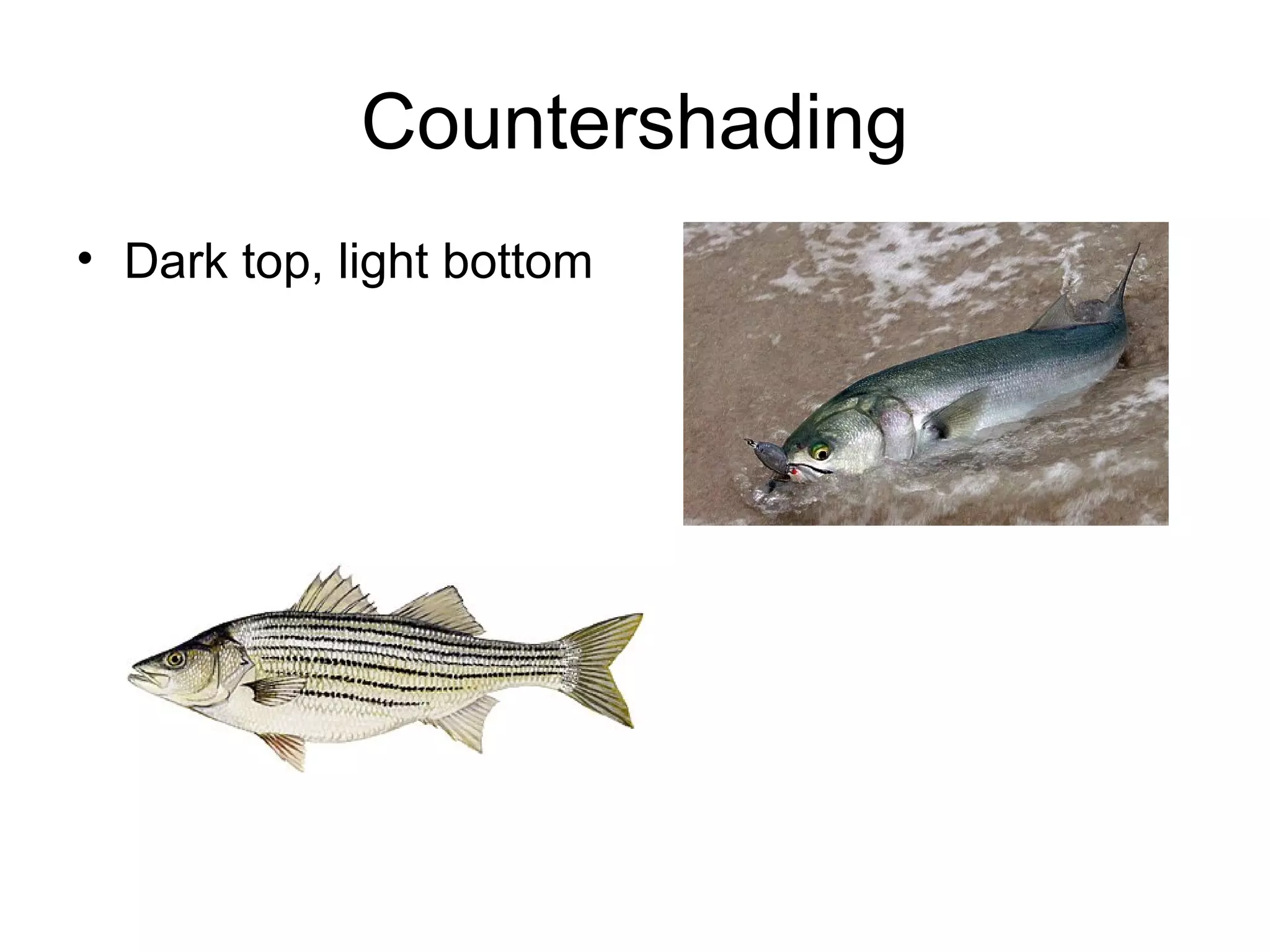
Countershading
• Dark top, light bottom
Symbiotic Relationships
1.Several species of
  small bony fishes,
  such as the cleaner
  wrasse (Labroides
  dimidiatus), are
  "cleaners" that eat
  debris and parasites
  from the skin and
  scales of larger
  fishes.
Symbiotic Relationships
2.Remoras (family
  Echeneidae) commonly
  attach themselves to
  sharks or other large
  fishes, whales, and sea
  turtles using a modified
  dorsal fin. They eat
  scraps left over from the
  meals of their hosts. They
  may eat parasites as well.
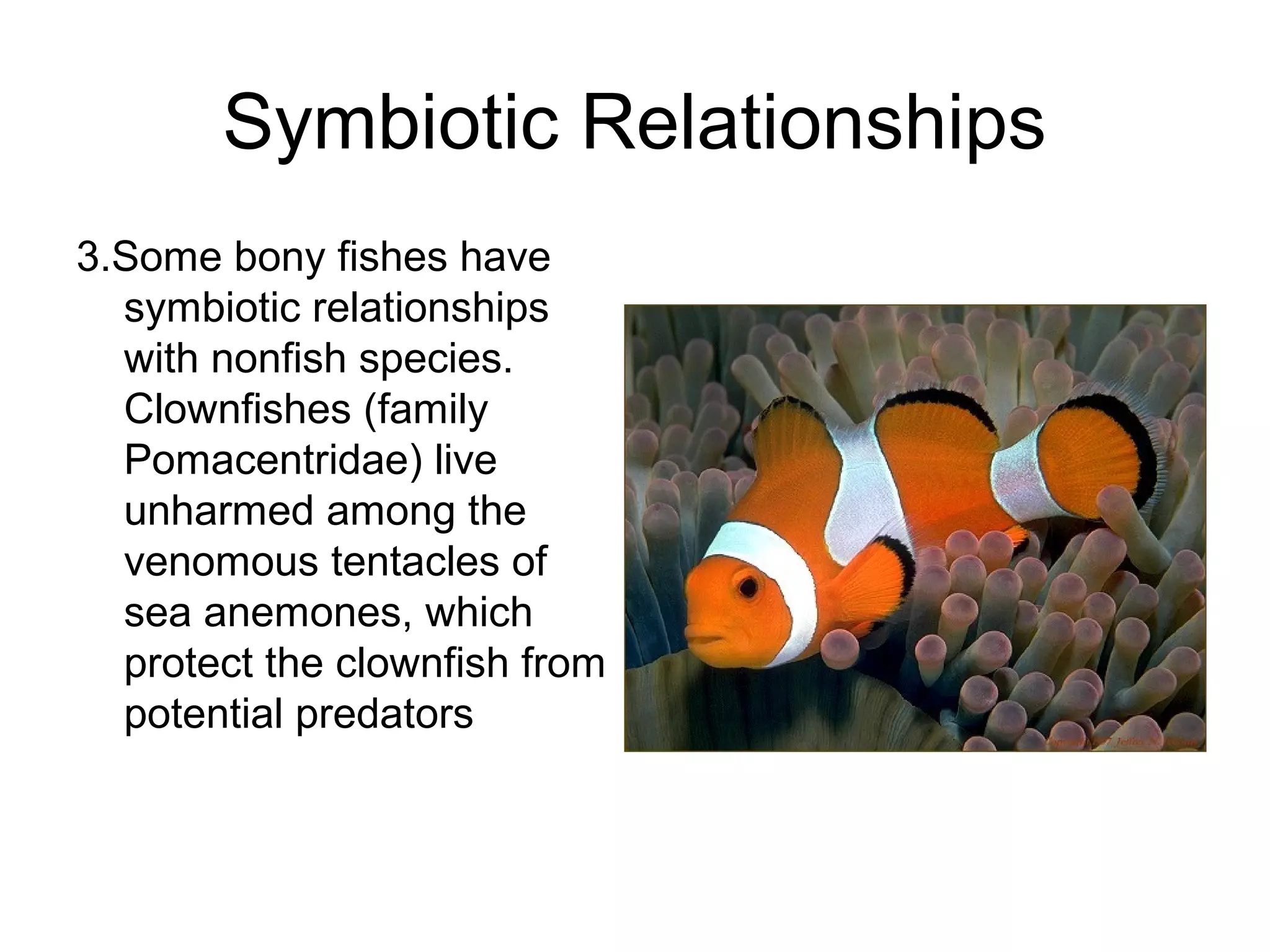
Symbiotic Relationships
3.Some bony fishes have
  symbiotic relationships
  with nonfish species.
  Clownfishes (family
  Pomacentridae) live
  unharmed among the
  venomous tentacles of
  sea anemones, which
  protect the clownfish from
  potential predators
Commensalism
• a situation in which two
  organisms are associated
  in a relationship in which
  one benefits from the
  relationship and the other
  is not affected much. The
  two animals are called
  commensals.
• The word derives from
  the Latin com mensa,
  meaning sharing a table.
• + and 0 =
  Commensalism.
Mutualism

• + and + = Mutualism. Both species
  benefit by the interaction between the
  two species.
• Examples???
• Cleaner Shrimp Video
Parasitism
• When one organism, usually physically
  smaller of the two (the parasite) benefits
  and the other (the host) is harmed.
• + and - = One species benefits from the
  interaction and the other is adversely
  affected. Examples are predation,
  parasitism, and disease.
• Examples???

Bony fish

  • 1.
    Bony Fish Developed by • Adam F Sprague • Dave Werner
  • 3.
    Intro to Chordates(fig. 7.51) Table 7.1 • dorsal hollow nerve cord • notochord (dorsal, elastic supporting rod) • paired pharyngeal gill slits • post-anal tail
  • 4.
    Chordates • 3 sub-phyla under group Acrania (Protochordata) 1. Subphylum Urochordata (Tunicates, Sea Squirts) 2. Subphylum Cephalochordata (Lancelets) 3. Subphylum Vertebrata (Vertebrates) – cranium/brain • Chordates w/ a backbone, skull, brain, and kidneys
  • 5.
  • 6.
    Phylum Chordata Subphylum Vertebrata – class Agnatha (Lampreys) – Class Chondrichthyes (Elamobranchii) – Class Osteichthyes (Bony Fishes) – Class Amphibia – Class Reptilia – Class Aves – Class Mammalia
  • 7.
    Classification p.156 (fig.8.1) •Kingdom Animalia --Phylum Chordata ----Subphylum Vertebrata – Class Osteichthyes • Subclass Actinopterygii (Ray-finned fish) • Subclass Sarcopterygii (Lobe-finned fish) • Subclass Crossopterygii
  • 10.
  • 11.
  • 12.
    Characteristics of Fish • Gills • Backbone (vertebrae) • Paired fins • Single loop circulation
  • 13.
  • 14.
    Fish Respiration (fig.8.17) • Water flows over gills as the fish swims - this water is flowing in the opposite of the flow of blood (countercurrent flow). Oxygen diffuses from the water and into the blood • Gills are made of thousands of gill filaments • When a fish opens its mouth, it "swallows" water, water passes over the gills and then out the gill slits, which are covered by the fish's operculum. You can see the operculum opening and closing.
  • 15.
    Fish Circulation (fig.8.15) The fish heart is a single loop circulation which has 2 chambers. Blood flows into the gills, picks up oxygen goes to the body and then returns to the heart.
  • 16.
    Maintaining Water Balance– HOMEOSTASIS (fig. 8.18) • Remember that salt sucks? • Salt water fish have a tendency to lose water Fresh water fish have a tendency to gain water (the fish is saltier on the inside) • This is why you can't put a saltwater fish in fresh water - it is not adapted to it. • Kidneys maintain homeostasis and water balance
  • 17.
    Osmoregulation • Freshwater takein water through body absorption and draw through mouth to breathe. • Salt water fish take water through mouth salt leaves through gills and a small amount in urine as Urea.
  • 18.
    Sensory organs • Aninner ear is contained in teloests which detects sounds and balance. • A lateral line controls impulse detections and low frequencies. This line contains ciliated nerve cells. (Fig. 8.19) • Chemoreceptors are used for sensing smell • Weberian ossicle: in freshwater fish for special acoustic sensory • http://www.britannica.com/eb/article-9076391/Weber
  • 19.
    Swim Bladder • Controlsbuoyancy in fish through oxygen filling the bladder or being released. • Primitive fish have the bladder attached directly to the gills. • Blood carries oxygen to and from the bladder. • The deeper a fish goes the more pressure on the bladder. • The air becomes more dense in the bladder. • Gas is released through a gas duct. • What about benthic or deep sea species??? • Flounder and other bottom/deep sea dwelling fishes have a reduced bladder.
  • 20.
  • 21.
    Fish Reproduction • Most fish fertilize their eggs externally • Spawning - the process of fertilizing eggs (fish reproduction) Fry = baby fish • Broadcast Spawning
  • 22.
    2 Types ofBony Fish (Osteichthyes) 1. Ray-finned - majority of fish are this type, fins are supported by bony structures called rays. – Teleosts -most advanced form of ray finned fish, symmetrical tales, mobile fins
  • 23.
    Teleosts • Advance dorsalfin is split into two regions; Anterior dorsal fin with spines, posterior dorsal with rays. Pelvic fin is ventrally located below pectoral.
  • 24.
    2 Types ofBony Fish (Osteichthyes) 2. Lobe-Finned • Fins consist of long, fleshy muscular lobe, supported by a central core of bones Thought to be the ancestors of amphibians • Coelacanth • Lungfish
  • 25.
    Fish Adaptations • LateralLine System - Used to detect vibrations, orientate fish in the water. A line of cells running down the side of the fish • Gill Cover (Operculum) - covers gills, movement of operculum allows more water to be drawn in • Swim Bladder - a gas filled sac that helps the fish maintain buoyancy (sharks do not have swim bladders, they sink when they stop swimming) • How do sharks maintain buoyancy w/o a swim bladder???
  • 26.
  • 27.
  • 28.
  • 29.
    Fin Shape • Fin shape and functional diversity in fish (and compared to a shark). Show are: a. sea robin (Dactylopterus volitans): b. catfish (Corydoras aeneus); c. piked dogfish (Squalus acanthias); d. mosquito-fish (Gambusia affinis); e. anglerfish (Lophius piscatorius); f. lumpfish (Cyclopterus lumpus). • Barbels – taste and sense food on bottom
  • 30.
    Locomotion (fig 8.11) • Fish move through the water with movements of their tail, here different kinds of fish locomotion are illustrated: A. A crucian carp's fin action for stabilizing and maneuvering. a. Anguilliform locomotion (eel); b. Carangiform locomotion (tuna); c. Ostraciform locomotion (boxfish). The blue area on these fish shows the portion of the body used in locomotion.
  • 31.
    Do all fisheshave scales? • No. Many species of fishes lack scales. • All the clingfishes (family Gobiesocidae) for example, are scaleless. Their bodies are protected by a thick layer of mucous.
  • 32.
    Mucous • Some species like blennies, don't have scales, but a slimy skin with brown and black spots: see picture below. These spots are of a size which can probably fluctuate according to nervous stimuli (like in squids): if the black spots are enlarged, the skin become darker to conceal itself on the dark sea bottom thus escaping its predators. If the red spots become enlarged its color mimics a brown sandy color ...It's for the same reason that fishes have a pale coloured belly: they escape predators coming from below, because they are less visible against the silvered surface of the sea.
  • 33.
    Scales: 4 types(fig. 8.8) • 1. Ganoid: Bony scales found in oldest known species including sturgeon. • 2. Cycloid: Simple thin disc lik escales with smooth surface which have circular rings to determine growth. • 3. Ctenoid: same as cycloid, but have been found in most advanced teleosts which have posterior spikes from scales. Perch • 4. Cosmoid: Similar to placoid scales and probably evolved from the fusion of placoid scales.
  • 34.
    Ganoid • Ganoid scales of the Florida Gar, Lepisosteus platyrhincus. Photo: C. Bento © Australian Museum
  • 35.
  • 36.
  • 37.
    Cycloid • Cycloid scalesof Jungle Perch, Kuhlia rupestris. Photo: C. Bento © Australian Museum
  • 38.
  • 39.
    Ctenoid • Dried scaleof a Barramundi showing the growth rings, or annuli • Ctenoid scales of the Paradise Fish, Macropodus opercularis. Photo: S. Lindsay © Australian Museum
  • 40.
    Ctenoid Scales Sole & Sea Perch
  • 41.
    Cosmoid • Cosmoid scalesof the Queensland Lungfish. Photo: C. Bento © Australian Museum
  • 42.
    Red muscles • Gamefish have large amounts of red muscles which contain more blood vessels = more energy and O2. • Red muscles produce greater heat energy b/c separate smaller blood vessels carry oxygenated blood to muscles and not dorsal aorta. The blood vessels are close to the veins which are 10 degrees warmer, thus heating the blood, producing more power.
  • 43.
    Red Muscle -Myomeres
  • 45.
    Body Design (fig.8.9) • Fish possess a dorsal, ventral, posterior, and anterior symmetry • Fish are attenuated, compressed, depressed, or fusiform in shape
  • 46.
    Attenuated • Snake-like “THE FREAK SENIOR” and his lovely wife
  • 47.
  • 48.
  • 49.
    Fusiform • Torpedo Shaped = very fast
  • 50.
    Guess Who??? • Whatspecies & shape???
  • 51.
    Guess Who??? • Whatspecies & shape??? • Male or Female? Why?
  • 52.
    Guess Who??? • Whatspecies & shape???
  • 53.
    Guess Who??? • Whatspecies & shape??? • Left or Right Handed???
  • 54.
    Guess Who??? • Whatspecies & shape??? • Left or Right Handed???
  • 55.
    Guess Who??? • Whatspecies & shape??? • Left or Right Handed???
  • 56.
    Guess Who??? • Whatspecies & shape???
  • 57.
    Who am I??? •The Freak in his past life without his killers Stephen and Erin…
  • 58.
    Cryptic coloration (fig8.10a) • a pattern of pigmentation that allows an organism to blend into the background of its preferred habitat.
  • 59.
    Disruptive Coloration(fig.8.28, 14.30) • Color stripes, bars, or spots
  • 60.
  • 61.
  • 62.
    Symbiotic Relationships 1.Several speciesof small bony fishes, such as the cleaner wrasse (Labroides dimidiatus), are "cleaners" that eat debris and parasites from the skin and scales of larger fishes.
  • 63.
    Symbiotic Relationships 2.Remoras (family Echeneidae) commonly attach themselves to sharks or other large fishes, whales, and sea turtles using a modified dorsal fin. They eat scraps left over from the meals of their hosts. They may eat parasites as well.
  • 64.
    Symbiotic Relationships 3.Some bonyfishes have symbiotic relationships with nonfish species. Clownfishes (family Pomacentridae) live unharmed among the venomous tentacles of sea anemones, which protect the clownfish from potential predators
  • 65.
    Commensalism • a situationin which two organisms are associated in a relationship in which one benefits from the relationship and the other is not affected much. The two animals are called commensals. • The word derives from the Latin com mensa, meaning sharing a table. • + and 0 = Commensalism.
  • 66.
    Mutualism • + and+ = Mutualism. Both species benefit by the interaction between the two species. • Examples??? • Cleaner Shrimp Video
  • 67.
    Parasitism • When oneorganism, usually physically smaller of the two (the parasite) benefits and the other (the host) is harmed. • + and - = One species benefits from the interaction and the other is adversely affected. Examples are predation, parasitism, and disease. • Examples???