Presented By
Kazi Faridul Hasan
Session : 2013-14
Deprtment of
Fisheries & Marine Science
E-mail: kazifaridul&gmail.com
Depertment of
Fisheries & Marine Science
Noakhali Science &
Technology University
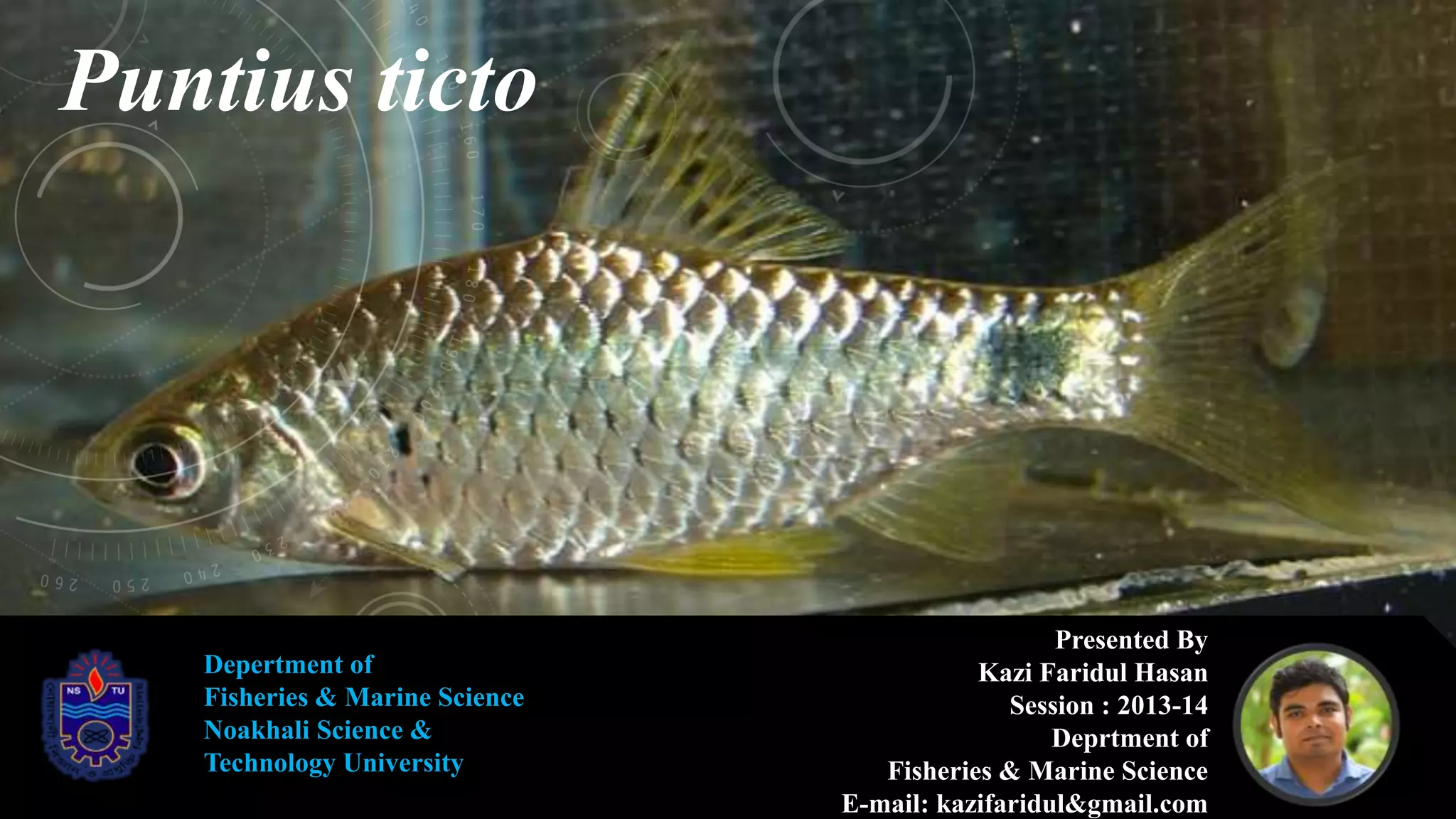
Puntius ticto
INTRODUCTION
The ticto barb or twospot barb (Puntus ticto) is a species of subtropical
freshwater fish belonging to the family Cyprinidae.
The ticto barb is silver and gold with two black spots; one just before the
pectoral fin and one near the back tail. It grows to a maximum length of 10 cm
(4 in).
It is natively found in still, shallow, marginal waters of lakes and rivers,
usually with muddy bottoms.
It browses close to the substrate in shallow water.
Their diet consists of small crustaceans, insects and plankton.
CLASSIFICATION
Kingdom: Animalia
Phylum: Chordata
Class: Actinopterygii
Order: Cypriniformes
Family: Cyprinidae
Subfamily: Barbinae
Genus: Puntius
Species: Puntius ticto
COMMON NAME
Ticto Barb
Two spot Barb
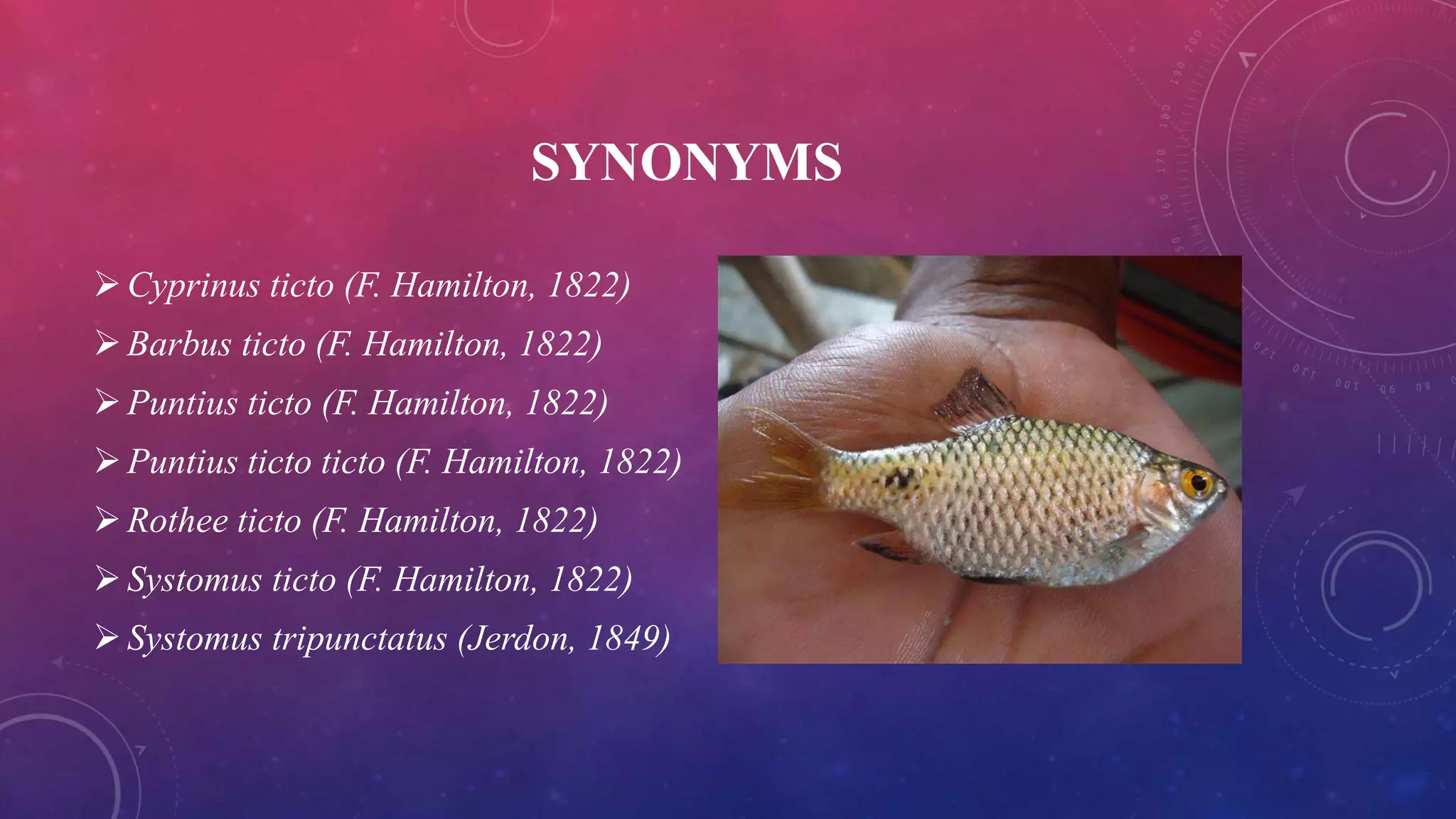
SYNONYMS
Cyprinus ticto (F. Hamilton, 1822)
Barbus ticto (F. Hamilton, 1822)
Puntius ticto (F. Hamilton, 1822)
Puntius ticto ticto (F. Hamilton, 1822)
Rothee ticto (F. Hamilton, 1822)
Systomus ticto (F. Hamilton, 1822)
Systomus tripunctatus (Jerdon, 1849)
DISTRIBUTION
Type locality is given as ‘southeast parts of Bengal’ by Hamilton, but P. ticto is
widely-distributed throughout most of the Indian subcontinent with records
from Pakistan, India, Nepal, Bhutan, Bangladesh, and Sri Lanka.
Occurrences in Myanmar and southern China may refer to other species but
this requires confirmation.
It is a native of the upper Mekong, Salwen, Irrawaddy, Meklong and upper
Charo Phraya basins in the countries of Nepal, India, Pakistan, Myanmar,
Bangladesh, Thailand, and Sri Lanka.
SUITABLE ENVIRONMENT
Ticto barbs natively live in a subtropical environment and prefer water with a
6.0—7.0 pH,
Water hardness of up to 10 dGH,
Temperature range of 14–22 °C (57–72 °F).
FIN FORMULA
D. 3/8; P1. 13-15; P2. 9; A. 3/5. (Islam M.A., 2007)
D.11 (3/8); P1. 13-15; P2. 9; A. 7-8 (2-3/8). (Rahman, 1989)
D ⅲ-ⅳ 8; A ⅱ-ⅲ 5; P ⅰ 12-14; V ⅰ 8 (Talwar and Jhingran 1991)
HABITAT
Apparently most abundant in shallow streams and minor tributaries,
sometimes at relatively high altitudes, and apparently shows a
preference for substrates of mud or silt.
Given the extent of its range it would seem sensible to assume that
it inhabits various habitat-types which also vary in water depth,
flow, and turbidity depending on the time of year.
MAXIMUM STANDARD LENGTH
55 – 65 mm.
FEEDING HABIT
Likely to be a foraging omnivore feeding on worms, insects and other small
invertebrates, as well as plant material and organic detritus.
In the aquarium it’s easily-fed but the best condition and colors offer regular
meals of small live and frozen foods such as bloodworm, Daphnia, and
Artemia, alongside good quality dried flakes and granules, at least some of
which should include additional plant or algal content.
IMPORTANCE
As a good food taste.
As a aquarium fish.
As a dry fish
IN THE AQUARIUM
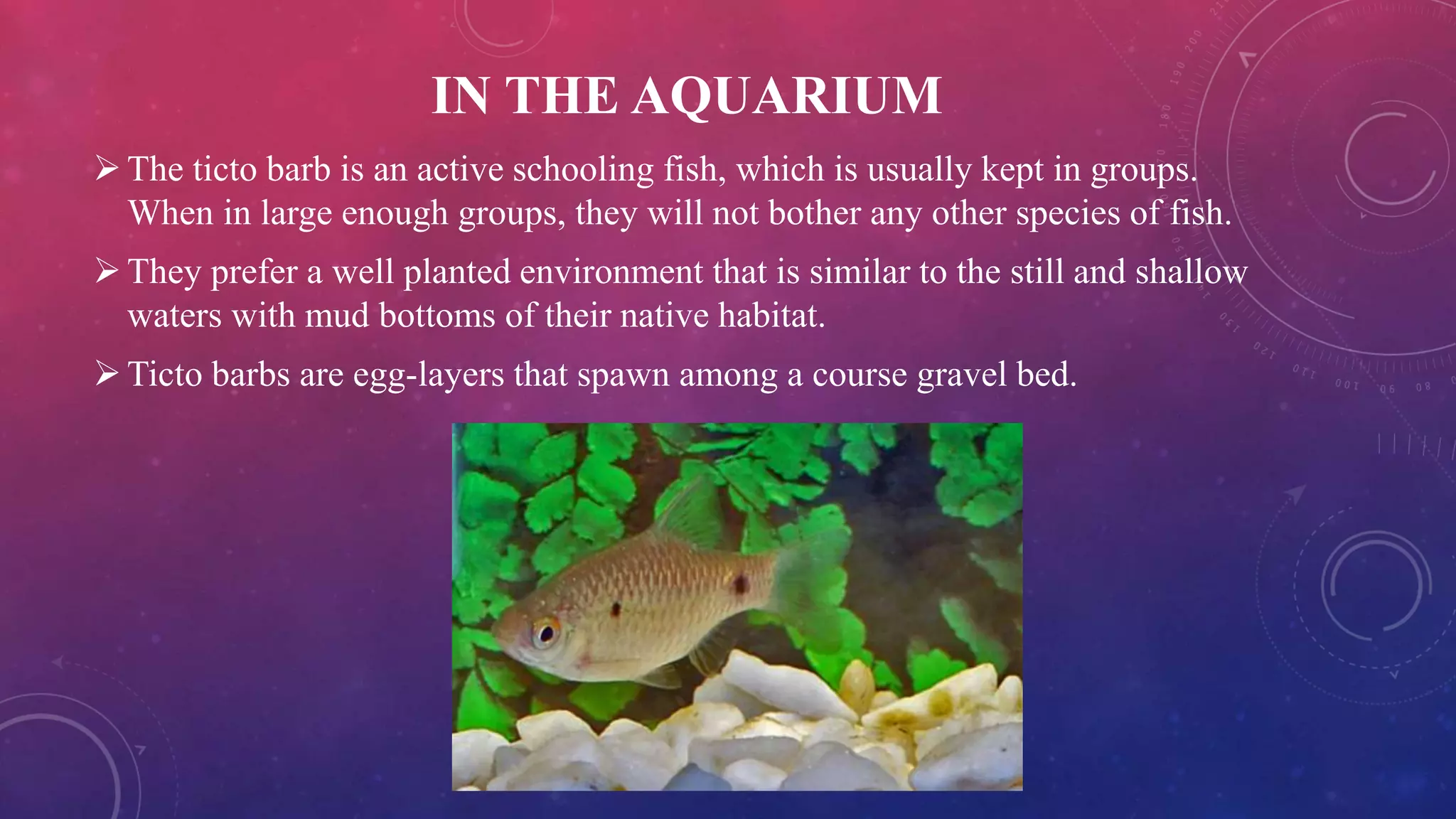
The ticto barb is an active schooling fish, which is usually kept in groups.
When in large enough groups, they will not bother any other species of fish.
They prefer a well planted environment that is similar to the still and shallow
waters with mud bottoms of their native habitat.
Ticto barbs are egg-layers that spawn among a course gravel bed.
CONTINUED….
During spawning, they will lay approximately 150 eggs, laying around 20 at a
time.
Once spawning is finished, they will usually eat any of the eggs that they find.
It is usually necessary to separate the fish from the eggs after spawning in
order to prevent the eggs from being eaten.
The eggs will hatch in approximately 1 day and will be free-swimming a day
later.
CONCLUSION
Puntius ticto is not as popular as food for its bitter taste.
It cultured as a aquarium fish.
Because of as a thretend species, it is necessary to culture this species as
commercially.

Puntius ticto

  • 1.
    Presented By Kazi FaridulHasan Session : 2013-14 Deprtment of Fisheries & Marine Science E-mail: kazifaridul&gmail.com Depertment of Fisheries & Marine Science Noakhali Science & Technology University Puntius ticto
  • 2.
    INTRODUCTION The ticto barbor twospot barb (Puntus ticto) is a species of subtropical freshwater fish belonging to the family Cyprinidae. The ticto barb is silver and gold with two black spots; one just before the pectoral fin and one near the back tail. It grows to a maximum length of 10 cm (4 in). It is natively found in still, shallow, marginal waters of lakes and rivers, usually with muddy bottoms. It browses close to the substrate in shallow water. Their diet consists of small crustaceans, insects and plankton.
  • 3.
    CLASSIFICATION Kingdom: Animalia Phylum: Chordata Class:Actinopterygii Order: Cypriniformes Family: Cyprinidae Subfamily: Barbinae Genus: Puntius Species: Puntius ticto
  • 4.
  • 5.
    SYNONYMS Cyprinus ticto (F.Hamilton, 1822) Barbus ticto (F. Hamilton, 1822) Puntius ticto (F. Hamilton, 1822) Puntius ticto ticto (F. Hamilton, 1822) Rothee ticto (F. Hamilton, 1822) Systomus ticto (F. Hamilton, 1822) Systomus tripunctatus (Jerdon, 1849)
  • 6.
    DISTRIBUTION Type locality isgiven as ‘southeast parts of Bengal’ by Hamilton, but P. ticto is widely-distributed throughout most of the Indian subcontinent with records from Pakistan, India, Nepal, Bhutan, Bangladesh, and Sri Lanka. Occurrences in Myanmar and southern China may refer to other species but this requires confirmation. It is a native of the upper Mekong, Salwen, Irrawaddy, Meklong and upper Charo Phraya basins in the countries of Nepal, India, Pakistan, Myanmar, Bangladesh, Thailand, and Sri Lanka.
  • 7.
    SUITABLE ENVIRONMENT Ticto barbsnatively live in a subtropical environment and prefer water with a 6.0—7.0 pH, Water hardness of up to 10 dGH, Temperature range of 14–22 °C (57–72 °F).
  • 8.
    FIN FORMULA D. 3/8;P1. 13-15; P2. 9; A. 3/5. (Islam M.A., 2007) D.11 (3/8); P1. 13-15; P2. 9; A. 7-8 (2-3/8). (Rahman, 1989) D ⅲ-ⅳ 8; A ⅱ-ⅲ 5; P ⅰ 12-14; V ⅰ 8 (Talwar and Jhingran 1991)
  • 9.
    HABITAT Apparently most abundantin shallow streams and minor tributaries, sometimes at relatively high altitudes, and apparently shows a preference for substrates of mud or silt. Given the extent of its range it would seem sensible to assume that it inhabits various habitat-types which also vary in water depth, flow, and turbidity depending on the time of year.
  • 10.
  • 11.
    FEEDING HABIT Likely tobe a foraging omnivore feeding on worms, insects and other small invertebrates, as well as plant material and organic detritus. In the aquarium it’s easily-fed but the best condition and colors offer regular meals of small live and frozen foods such as bloodworm, Daphnia, and Artemia, alongside good quality dried flakes and granules, at least some of which should include additional plant or algal content.
  • 12.
    IMPORTANCE As a goodfood taste. As a aquarium fish. As a dry fish
  • 13.
    IN THE AQUARIUM Theticto barb is an active schooling fish, which is usually kept in groups. When in large enough groups, they will not bother any other species of fish. They prefer a well planted environment that is similar to the still and shallow waters with mud bottoms of their native habitat. Ticto barbs are egg-layers that spawn among a course gravel bed.
  • 14.
    CONTINUED…. During spawning, theywill lay approximately 150 eggs, laying around 20 at a time. Once spawning is finished, they will usually eat any of the eggs that they find. It is usually necessary to separate the fish from the eggs after spawning in order to prevent the eggs from being eaten. The eggs will hatch in approximately 1 day and will be free-swimming a day later.
  • 15.
    CONCLUSION Puntius ticto isnot as popular as food for its bitter taste. It cultured as a aquarium fish. Because of as a thretend species, it is necessary to culture this species as commercially.