Mammals
• Blubber – thick layer of fat to keep them warm in the ocean
• Streamlined bodies – faster swimming
• Stores oxygen in muscles and blood - to stay under water for long periods
• More blood in proportion to their sizes
• Can slow their heartbeat – use less oxygen in a dive
“mammals adapted to aquatic life and rely on ocean to live”
Characteristics
MARINE
MARINE MAMMALS
- 20-30% are endangered/ threatened
- Spend longer time in water and breathe to the
surface
SEAL- cold environment, among the most
abundant
WHALES- migrate to warmer waters in the water
when food is harder to get in colder ecosystem
POLAR BEARS – feed on ice-associated seals,
spend most of their life on drift ice
ECOSYSTEM
AND THEIR
Class MAMMALIA
Order CETACEA
Whales, dolphins, and porpoises
• 86 species worldwide and are found in
coastal and estuarine waters
• Fusiform body shape with no external
ears
• Hind limbs are reduced and only vestiges
of them found inside the body
• Front limbs turned into flippers, and most
species possess a single dorsal fin
• Males slit are more widely separated,
while those of females are closer. Also,
females have two mammary slits
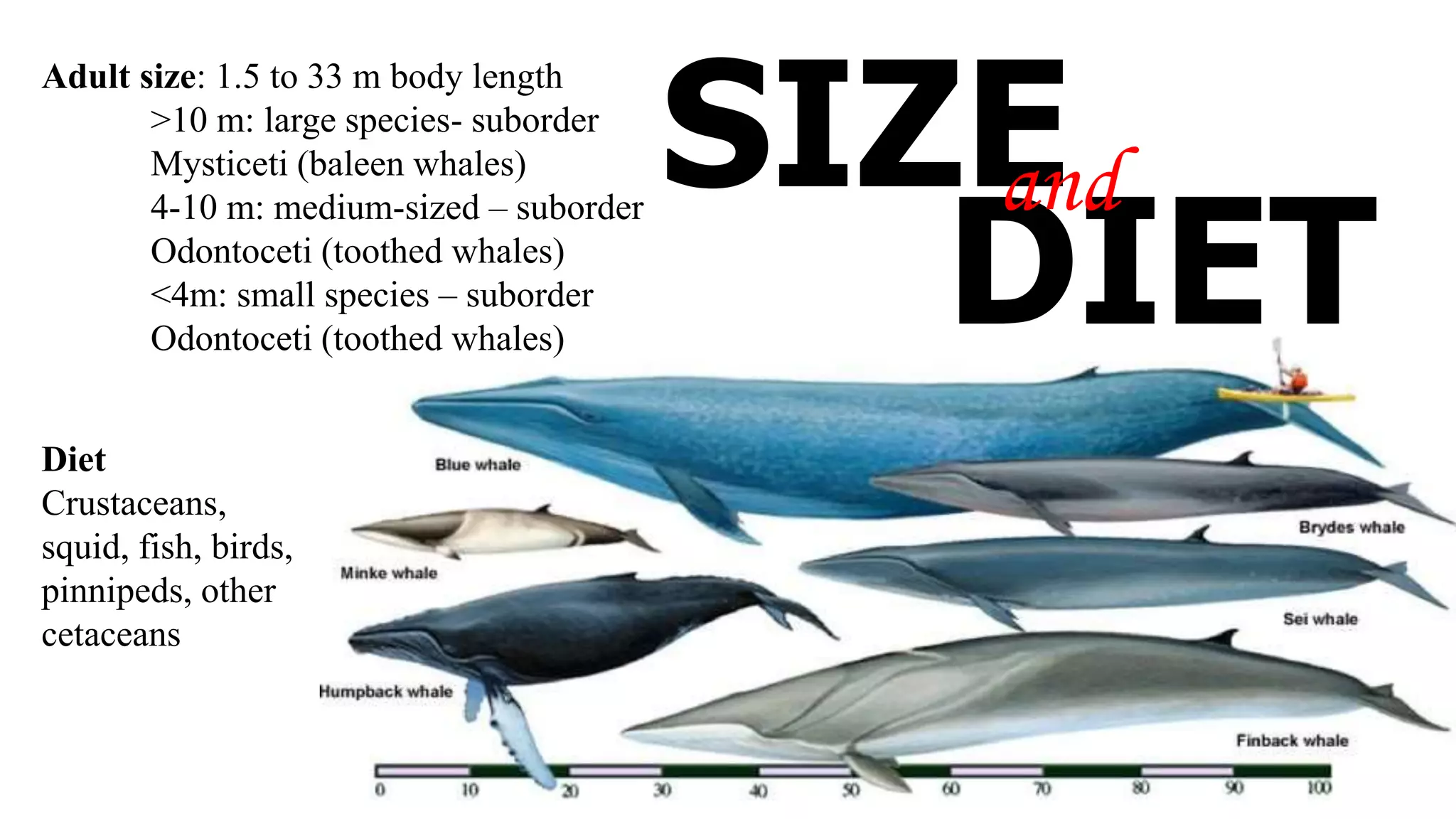
Adult size: 1.5 to 33 m body length
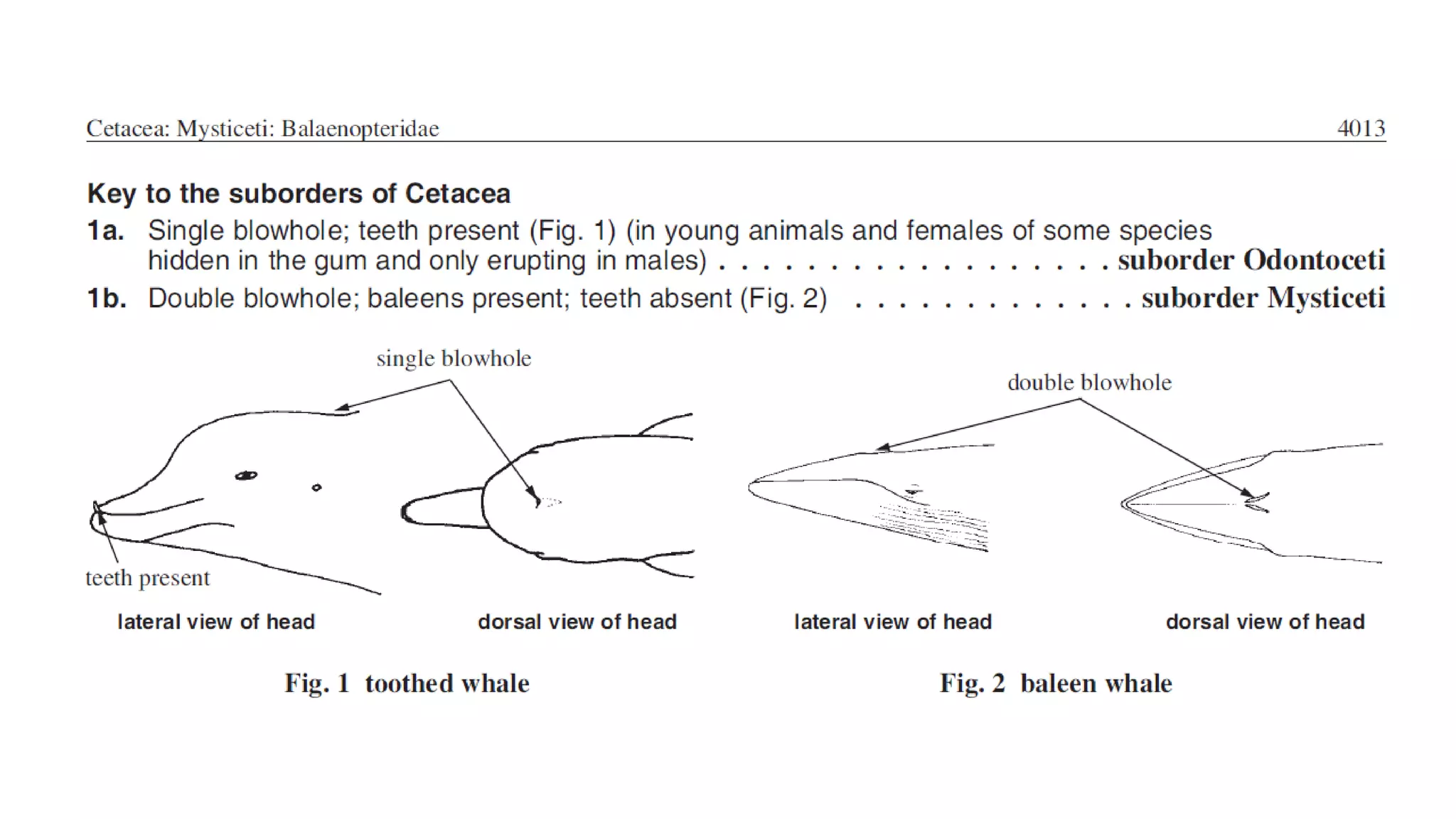
>10 m: large species- suborder
Mysticeti (baleen whales)
4-10 m: medium-sized – suborder
Odontoceti (toothed whales)
<4m: small species – suborder
Odontoceti (toothed whales)
Diet
Crustaceans,
squid, fish, birds,
pinnipeds, other
cetaceans
SIZE
DIET
and
• FLUKE – end of tail, for
propulsion
• BLOWHOLE – top of the head,
so that the rest of the body
remain submerged while
surfacing for air
• BLUBBER – thermal insulation
and gives them smooth,
streamlined body shape
• BALEEN/TEETH – for eating
• DORSAL FINS – keep them
upright and prevents roll
• PECTORAL FINS – to stop
turning, act as balancing planes
• ROSTRUM – beak-like
projection
STRUCTURE
BODY
Class MAMMALIA
Order FISSIPEDS
Sea Otters and Polar bears
Family URSIDAE: Bear family, Polar bears
Family MUSTELIDAE : Weasel family, Sea otters
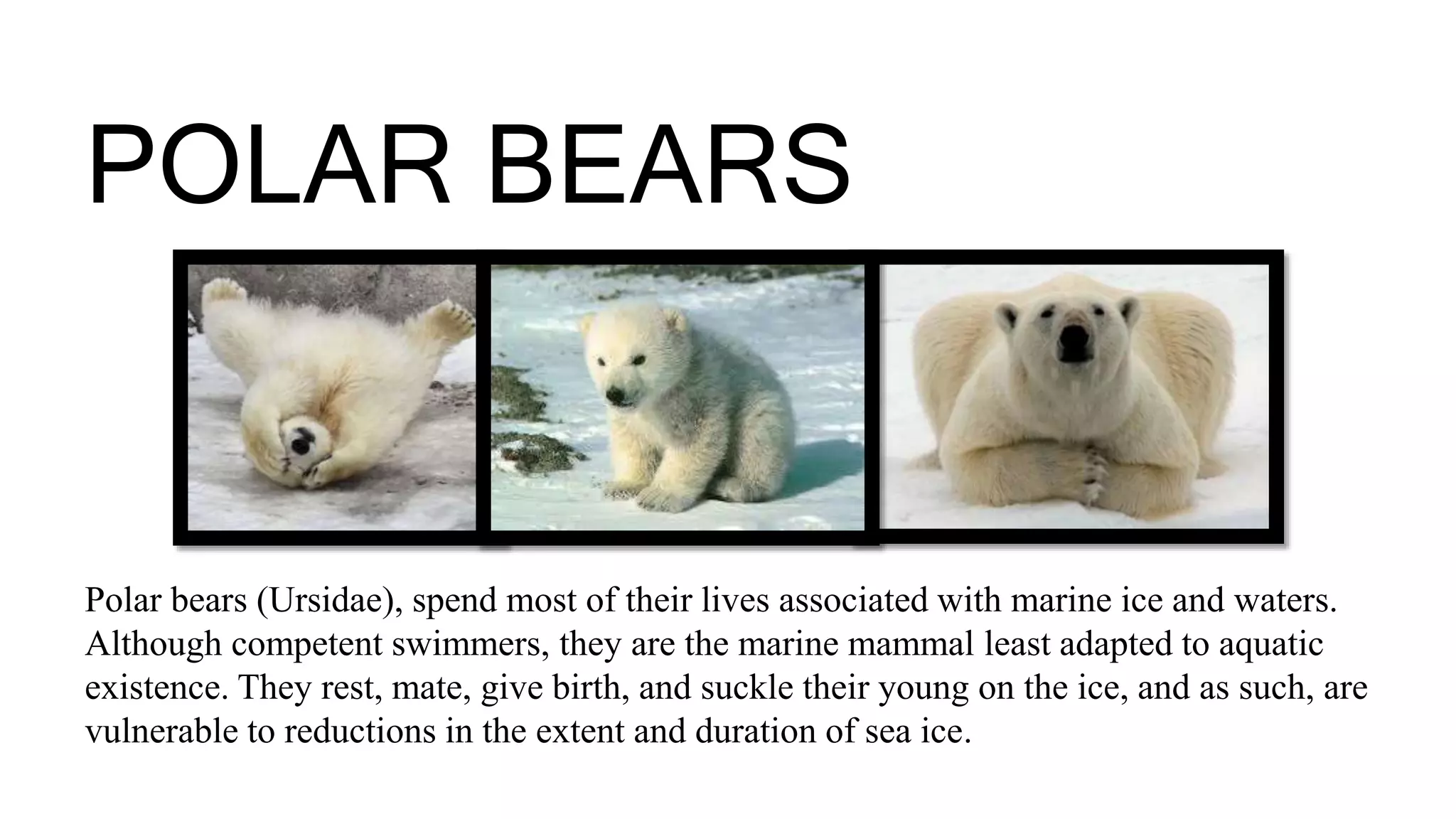
Polar bears (Ursidae), spend most of their lives associated with marine ice and waters.
Although competent swimmers, they are the marine mammal least adapted to aquatic
existence. They rest, mate, give birth, and suckle their young on the ice, and as such, are
vulnerable to reductions in the extent and duration of sea ice.
POLAR BEARS
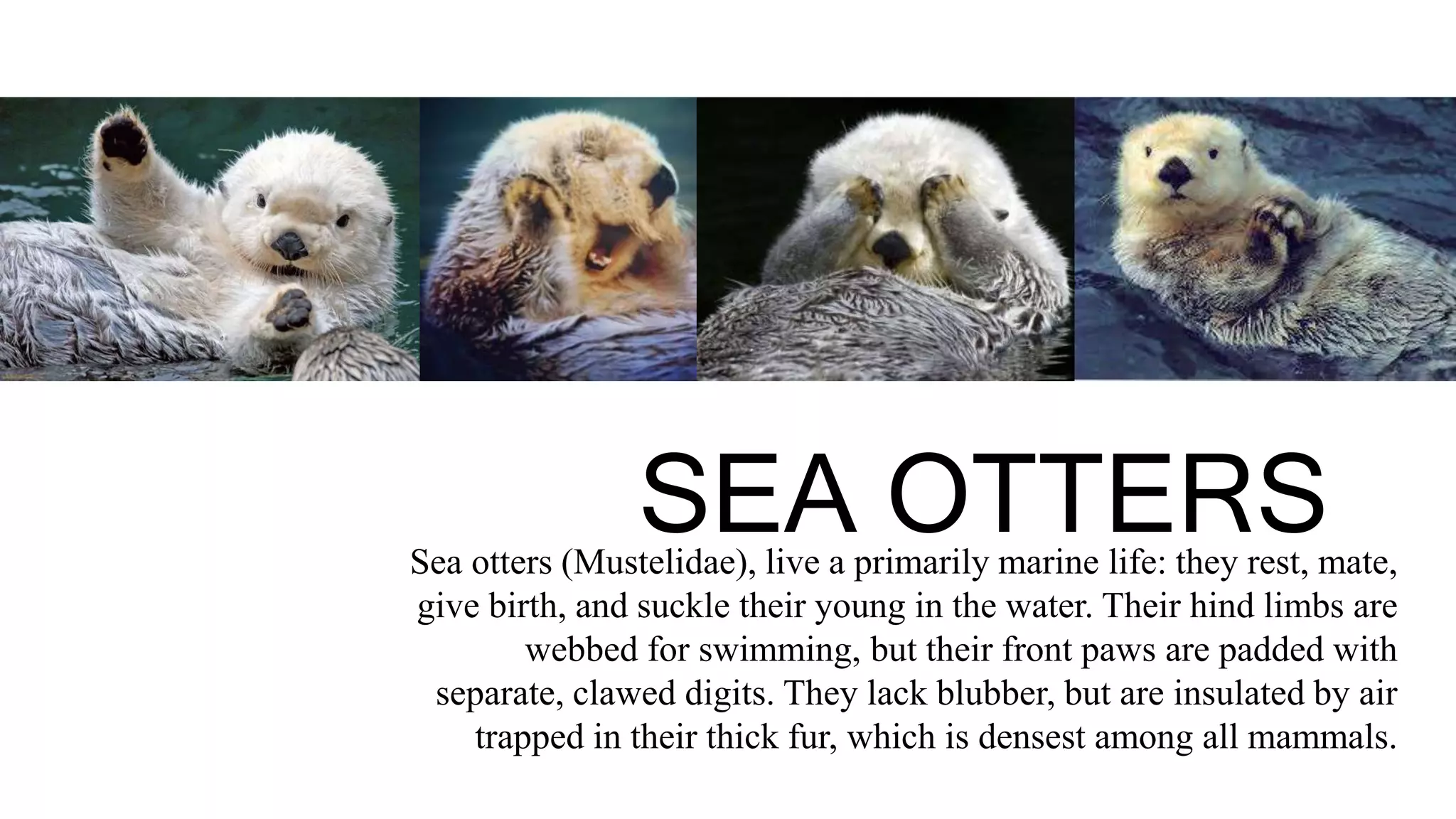
Sea otters (Mustelidae), live a primarily marine life: they rest, mate,
give birth, and suckle their young in the water. Their hind limbs are
webbed for swimming, but their front paws are padded with
separate, clawed digits. They lack blubber, but are insulated by air
trapped in their thick fur, which is densest among all mammals.
SEA OTTERS
• PAWS – distribute weight when
threading on thin ice
• Forepaws: large paddles
• Hind paws: rudders
• BLACK FOOTPADS - bottom of
each paw covered by small bumps
(papillae)
• PAPILLAE – grip the ice and keep
from slipping
• CLAWS – catch and hold prey and
also to provide traction on the ice
• EARS AND TAILS – eras are
small and round, tails are short and
compact. Conserve heat.
STRUCTURE
BODY
Class MAMMALIA
Order PINNIPEDS
Seals, Sea Lions & Walrus
• Large layers if blubber under the skin, also for
streamlining their shape
• 33 species with 3 families:
1. Phocidae (true seals) - visible ear flaps
2. Otariidae (eared seals) – do not have
visible ear flaps
3. Odobenidae (walrus) – combination of the two
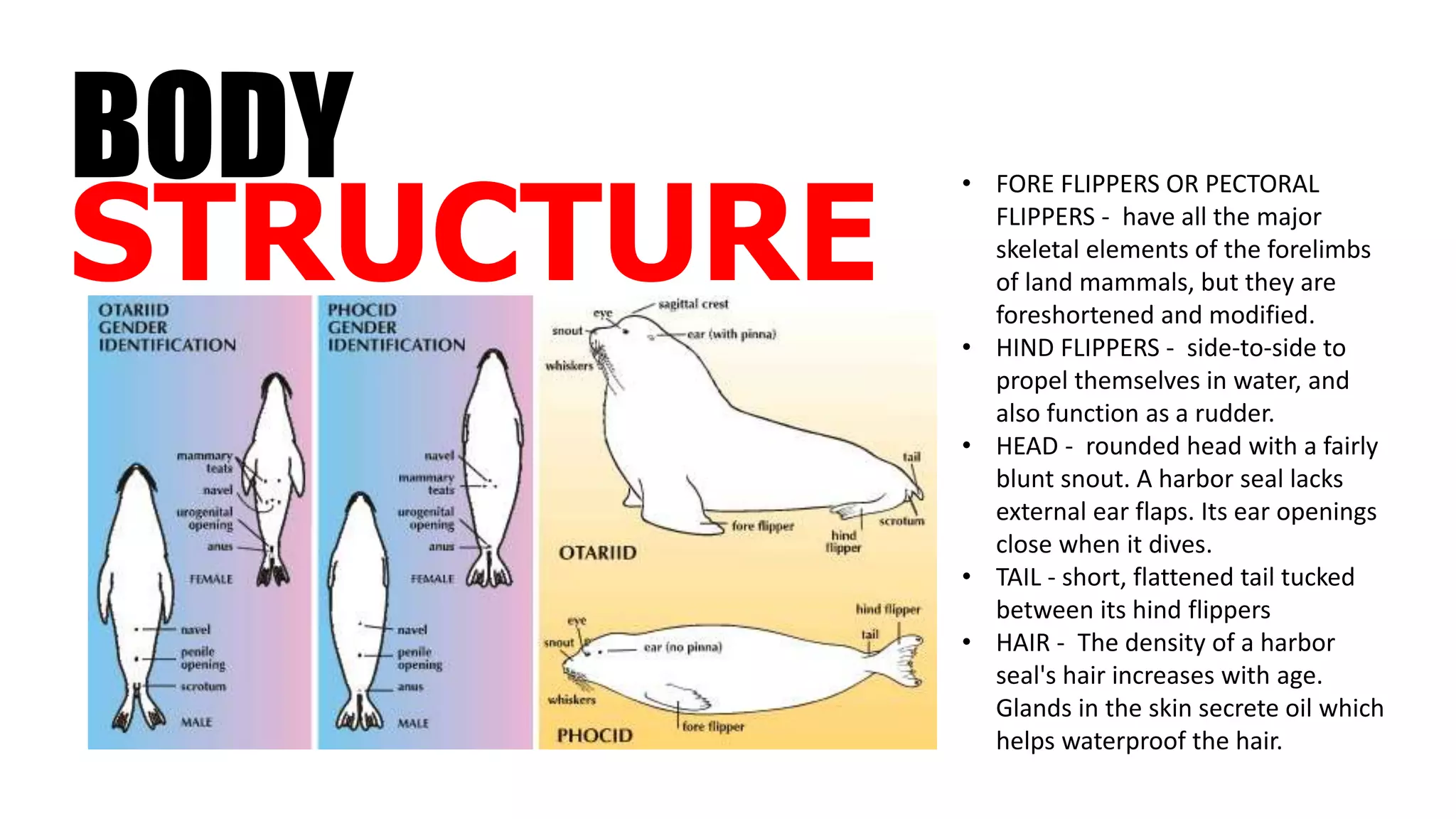
• FORE FLIPPERS OR PECTORAL
FLIPPERS - have all the major
skeletal elements of the forelimbs
of land mammals, but they are
foreshortened and modified.
• HIND FLIPPERS - side-to-side to
propel themselves in water, and
also function as a rudder.
• HEAD - rounded head with a fairly
blunt snout. A harbor seal lacks
external ear flaps. Its ear openings
close when it dives.
• TAIL - short, flattened tail tucked
between its hind flippers
• HAIR - The density of a harbor
seal's hair increases with age.
Glands in the skin secrete oil which
helps waterproof the hair.
STRUCTURE
BODY
Class MAMMALIA
Order SIRENIA
Dugongs and Manatees
• Slow and passive
• Limbs modified into arms for steering, tail
into paddle for propulsion
• Fat, but fusiform, hydrodynamic and highly
muscular
• Grow 2.5 – 4.0 m long
STRUCTURE
BODY
• TAIL – navigate in water
• Male’s genital area: below
belly button
• Female’s genital area:
above anus
• WHISKERS (manatees) – help
them with sensory due to
vibrations
• FLIPPERS – have jointed
bones that help them to
perform movements
• NOSTRILS – closes under the
water
WHAT IS A MARINE MAMMAL?. (n.d.). Retrieved (12 November 2016) from
http://www.whalefacts.org/what-is-a-marine-mammal/
MARINE MAMMALS. (n.d.). Retrieved (12 November 2016) from
http://www.fisheries.is/ecosystem/marine-life/marine-mammals/
SEA OTTERS AND POLAR BEARS: MARINE FISSIPEDS. (n.d.). Retrieved (12
November 2016) from https://seagrant.uaf.edu/marine-
ed/mm/fieldguide/fissipeds.html
SPECIES INFORMATION – THE PINNIPEDS. (n.d.). Retrieved (12 November
2016) from http://www.pinnipeds.org/seal-information/species-information-pages
REFERENCES

Aquatic mammals

  • 2.
    Mammals • Blubber –thick layer of fat to keep them warm in the ocean • Streamlined bodies – faster swimming • Stores oxygen in muscles and blood - to stay under water for long periods • More blood in proportion to their sizes • Can slow their heartbeat – use less oxygen in a dive “mammals adapted to aquatic life and rely on ocean to live” Characteristics MARINE
  • 3.
    MARINE MAMMALS - 20-30%are endangered/ threatened - Spend longer time in water and breathe to the surface SEAL- cold environment, among the most abundant WHALES- migrate to warmer waters in the water when food is harder to get in colder ecosystem POLAR BEARS – feed on ice-associated seals, spend most of their life on drift ice ECOSYSTEM AND THEIR
  • 4.
    Class MAMMALIA Order CETACEA Whales,dolphins, and porpoises • 86 species worldwide and are found in coastal and estuarine waters • Fusiform body shape with no external ears • Hind limbs are reduced and only vestiges of them found inside the body • Front limbs turned into flippers, and most species possess a single dorsal fin • Males slit are more widely separated, while those of females are closer. Also, females have two mammary slits
  • 5.
    Adult size: 1.5to 33 m body length >10 m: large species- suborder Mysticeti (baleen whales) 4-10 m: medium-sized – suborder Odontoceti (toothed whales) <4m: small species – suborder Odontoceti (toothed whales) Diet Crustaceans, squid, fish, birds, pinnipeds, other cetaceans SIZE DIET and
  • 7.
    • FLUKE –end of tail, for propulsion • BLOWHOLE – top of the head, so that the rest of the body remain submerged while surfacing for air • BLUBBER – thermal insulation and gives them smooth, streamlined body shape • BALEEN/TEETH – for eating • DORSAL FINS – keep them upright and prevents roll • PECTORAL FINS – to stop turning, act as balancing planes • ROSTRUM – beak-like projection STRUCTURE BODY
  • 8.
    Class MAMMALIA Order FISSIPEDS SeaOtters and Polar bears Family URSIDAE: Bear family, Polar bears Family MUSTELIDAE : Weasel family, Sea otters
  • 9.
    Polar bears (Ursidae),spend most of their lives associated with marine ice and waters. Although competent swimmers, they are the marine mammal least adapted to aquatic existence. They rest, mate, give birth, and suckle their young on the ice, and as such, are vulnerable to reductions in the extent and duration of sea ice. POLAR BEARS
  • 10.
    Sea otters (Mustelidae),live a primarily marine life: they rest, mate, give birth, and suckle their young in the water. Their hind limbs are webbed for swimming, but their front paws are padded with separate, clawed digits. They lack blubber, but are insulated by air trapped in their thick fur, which is densest among all mammals. SEA OTTERS
  • 11.
    • PAWS –distribute weight when threading on thin ice • Forepaws: large paddles • Hind paws: rudders • BLACK FOOTPADS - bottom of each paw covered by small bumps (papillae) • PAPILLAE – grip the ice and keep from slipping • CLAWS – catch and hold prey and also to provide traction on the ice • EARS AND TAILS – eras are small and round, tails are short and compact. Conserve heat. STRUCTURE BODY
  • 12.
    Class MAMMALIA Order PINNIPEDS Seals,Sea Lions & Walrus • Large layers if blubber under the skin, also for streamlining their shape • 33 species with 3 families: 1. Phocidae (true seals) - visible ear flaps 2. Otariidae (eared seals) – do not have visible ear flaps 3. Odobenidae (walrus) – combination of the two
  • 13.
    • FORE FLIPPERSOR PECTORAL FLIPPERS - have all the major skeletal elements of the forelimbs of land mammals, but they are foreshortened and modified. • HIND FLIPPERS - side-to-side to propel themselves in water, and also function as a rudder. • HEAD - rounded head with a fairly blunt snout. A harbor seal lacks external ear flaps. Its ear openings close when it dives. • TAIL - short, flattened tail tucked between its hind flippers • HAIR - The density of a harbor seal's hair increases with age. Glands in the skin secrete oil which helps waterproof the hair. STRUCTURE BODY
  • 14.
    Class MAMMALIA Order SIRENIA Dugongsand Manatees • Slow and passive • Limbs modified into arms for steering, tail into paddle for propulsion • Fat, but fusiform, hydrodynamic and highly muscular • Grow 2.5 – 4.0 m long
  • 15.
    STRUCTURE BODY • TAIL –navigate in water • Male’s genital area: below belly button • Female’s genital area: above anus • WHISKERS (manatees) – help them with sensory due to vibrations • FLIPPERS – have jointed bones that help them to perform movements • NOSTRILS – closes under the water
  • 16.
    WHAT IS AMARINE MAMMAL?. (n.d.). Retrieved (12 November 2016) from http://www.whalefacts.org/what-is-a-marine-mammal/ MARINE MAMMALS. (n.d.). Retrieved (12 November 2016) from http://www.fisheries.is/ecosystem/marine-life/marine-mammals/ SEA OTTERS AND POLAR BEARS: MARINE FISSIPEDS. (n.d.). Retrieved (12 November 2016) from https://seagrant.uaf.edu/marine- ed/mm/fieldguide/fissipeds.html SPECIES INFORMATION – THE PINNIPEDS. (n.d.). Retrieved (12 November 2016) from http://www.pinnipeds.org/seal-information/species-information-pages REFERENCES

Editor's Notes

  • #3 Highest group among the other phylum. Major characteristics are the mammary gland that provides milk to their offspring, and parental care.
  • #4 Plays also a role in maintaining a healthy marine ecosystem.
  • #5  Torpedo-shaped, Common body form of fast-swimming, open-water fishes
  • #7 Baleen – filter system inside the baleen whales
  • #8 surfacing characteristics of large whales with a dorsal fin occurring in the area note: except for the sperm whale (kogiidae), all species depicted are members of the Balaenopteridae lateral and dorsal views of heads of the balaenopterid species occurring in the area